
Part 1
The first thing Delaney Mercer noticed was that the man they intended to bury was still alive.
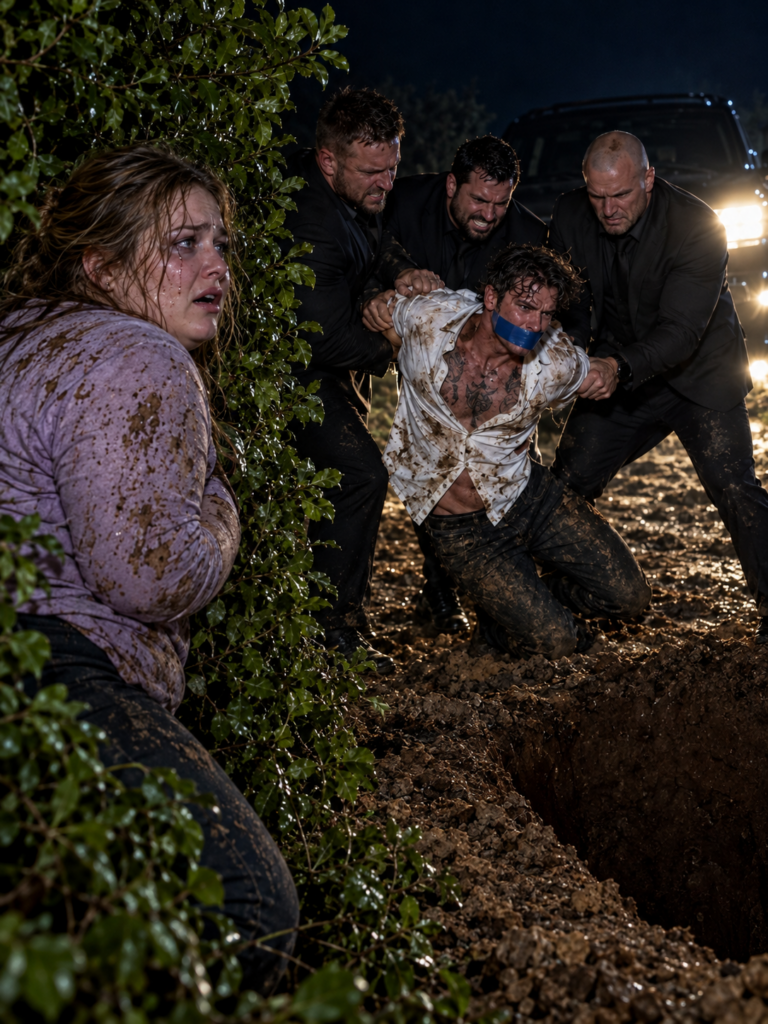
His shoes scraped desperately against the wet ground. His white shirt was soaked with mud, his hands tied behind his back, and a strip of silver tape sealed his mouth. Three men surrounded him in a clearing near the river, where an open grave waited beneath the headlights of a black car.
Delaney crouched behind a tangle of honeysuckle, trembling so badly that she had to press one hand against the earth to steady herself.
She had survived eight months without a home by following three simple rules: stay invisible, avoid trouble, and never interfere in another person’s business.
But nothing in those rules explained what to do when another human being was about to be buried alive.
One of the men ordered the others to finish digging before sunrise.
Then the prisoner turned his head.
Through the branches, his eyes found hers.
For one terrible second, Delaney was certain he would expose her. He could have shouted, moved toward her, or begged her to help.
Instead, he gave the smallest possible shake of his head.
He was warning her to stay hidden.
A man staring at his own grave had chosen to protect a stranger.
Delaney felt something change inside her.
Then the car’s headlights shifted, illuminating the lettering on its door.
RALDI.
Her stomach tightened.
She knew that name.
It had appeared on the development sign outside the apartments where her mother had died. It had appeared on the paperwork that ended their tenancy. And it had followed Delaney through every freezing night she had spent sleeping inside an abandoned boat.
The man facing death belonged to the very family whose company she blamed for destroying her life.
And in the next few minutes, she would have to decide whether that mattered more than his right to live.
Eight months earlier, Delaney had still believed she would become a nurse.
At twenty-seven, she possessed very little, but she guarded three objects as carefully as other people protected money.
The first was her expired student identification card from the nursing program at the community college in Ferndale.
The second was a spiral notebook filled with medical observations, dosage calculations, and handwritten reminders from classes she had loved.
The third was a small aluminum penlight, polished smooth where her fingers had held it during clinical training.
Every morning, she checked the pocket of her backpack to make certain all three remained there.
The rest of her possessions had disappeared one by one.
Her mother’s wedding ring had gone to a pawnshop on Delaware Street. Her winter coat had been sold, recovered, and finally lost again. Even her textbooks had gradually vanished, except for the knowledge she had managed to preserve in that battered notebook.
What she could not bring herself to surrender was the idea that the young woman pictured on her student card might still exist somewhere beneath the exhaustion.
Her mother, Nell Mercer, had believed in that young woman with an almost embarrassing certainty.
Nell had spent most of her adult life cleaning motel rooms near the interstate. She had worked through illness, aching joints, and years when money vanished faster than she could earn it.
When Delaney was accepted into nursing school, Nell had cried at their kitchen table.
Not because becoming a nurse would make her daughter wealthy.
Because she had finally seen proof that Delaney might escape the same narrow choices that had shaped her own life.
Then Nell’s kidneys began failing.
Dialysis became a three-day-a-week necessity. Medical appointments multiplied. There were mornings when Nell could barely rise from a chair, and afternoons when Delaney had to choose between attending a clinical rotation and helping her mother get home.
At first, she believed she could manage both.
Then she missed a rotation.
Then an entire semester.
Eventually, the college sent a letter informing her that she could no longer continue in the program.
Delaney kept the letter until the paper nearly dissolved from being folded and unfolded.
Her father offered no help.
Royce Mercer had abandoned them when Delaney was young. He had returned once, years afterward, to sign paperwork involving their home, then disappeared again.
Whenever Delaney questioned her mother about him, Nell refused to speak bitterly.
She only warned her daughter that some people consumed everything offered to them without ever becoming satisfied.
Delaney remembered those words when Nell died in the spring.
She remembered them again when the outstanding bills arrived.
And she remembered them most clearly when the redevelopment notices appeared along Larkin Row.
The apartments were old, inexpensive, and imperfect. But they housed people who had nowhere else to go: pensioners, working families, chronically ill tenants, and people who could not satisfy the financial requirements of newer buildings.
A representative of Raldi Development came to their apartment while Nell was still alive.
He offered a relocation payment in exchange for signing an agreement.
Nell was exhausted, frightened, and desperate for money.
Delaney had urged her not to sign.
But her mother had looked at the document and asked what choice they really had.
By autumn, chain-link fencing surrounded Larkin Row.
A rendering attached to the fence showed an elegant glass-fronted development replacing the little brick apartments.
Beneath the picture was the company’s name.
Raldi Development.
Delaney could no longer afford a room.
She eventually found the abandoned cabin cruiser at Cold Water Bend Docks. Its hull had been dragged onto a gravel bank years earlier, and weeds had grown around its supports.
Inside, she arranged her sleeping bag beneath a leaking window and learned where to place her belongings when rain entered through the roof.
Every night, she promised herself the arrangement was temporary.
Every morning, the river remained outside and the boat remained her home.
Until the night she heard the engine.
Hidden among the trees, Delaney watched the man with the telephone crouch beside the prisoner.
He was broad through the shoulders, middle-aged, and gray at the temples. His clothes looked expensive but practical, as though he had dressed to avoid drawing attention.
He removed the tape from the prisoner’s mouth.
“One last chance,” he said. “Tell me what I need to know.”
The man on the ground spat mud from his mouth before answering.
“You were clever enough to clear my appointments. You forgot about the audit.”
The older man’s expression changed.
“That report doesn’t exist.”
“It was completed eleven days ago.”
The prisoner spoke quietly, without the frantic pleading Delaney expected.
He explained that financial records detailing the theft had already been placed in escrow, with instructions to deliver them automatically to several recipients, including federal authorities.
If he failed to intervene before the deadline, the information would be released.
The older man accused him of bluffing.
“Then take the chance,” the prisoner answered. “But you have always preferred gambling with someone else’s money.”
Delaney could hardly believe what she was hearing.
This was not a random kidnapping.
These men knew one another. They were arguing about missing money, an audit, and crimes committed against families.
The older man took a telephone call.
He walked away from the grave, listening more than he spoke. Delaney noticed his bare ring finger, the pale band of skin where a wedding ring had usually rested, and a raised ridge from years of wearing it.
When he returned, he had made a decision.
“Don’t bury him deep,” he told the diggers. “I want him alive long enough to tell me where the evidence is.”
One man complained about having to dig him up again.
The older man ignored him.
He replaced the tape over the prisoner’s mouth and addressed him by name.
“Think carefully about that box, Cassian. I’ll be back when the sun comes up.”
Then he climbed into the black car and drove away.
Delaney remained motionless as the remaining two men forced Cassian into the grave.
She heard soil striking his body.
She heard the men discussing a football game as though they were finishing a routine assignment.
Then she heard something much worse.
Cassian was struggling to breathe beneath the earth.
She could have escaped.
Neither man knew she was there.
She might have slipped back to the boat, hidden beneath her sleeping bag, and spent the rest of her life pretending she had witnessed nothing.
But she remembered the brief warning Cassian had given her.
He had tried to save her when he could not save himself.
Delaney found a heavy stone beside her knee.
She threw it toward the riverside brush with every bit of strength she possessed.
It crashed through the branches some distance beyond the clearing.
Both diggers turned.
One insisted it was an animal.
The other went to investigate, taking his companion with him.
Delaney was already running.
She reached the grave and dropped to her knees.
The dirt was wet and heavy. It packed beneath her nails and filled her sleeves. She dragged it away in frantic handfuls, uncovering a shoulder, then the outline of Cassian’s chest.
By the time she exposed his face, he was motionless.
She tore away the tape.
Mud obstructed his mouth.
She cleared it as well as she could, struggled to drag him out of the shallow grave, and laid him on the firmer ground beside it.
He was not breathing.
She could detect no pulse.
For a moment, terror threatened to erase every lesson she had ever learned.
Then training took over.
Delaney opened his airway, positioned her hands on his chest, and began compressions.
She counted aloud.
Thirty.
Two rescue breaths.
Then another cycle.
Her arms burned.
Her knees sank into the mud.
She remembered the practice laboratory in Ferndale, the instructor correcting her posture, the repeated drills that had once seemed exhausting and unnecessary.
She had imagined performing CPR beneath fluorescent hospital lights with trained colleagues nearby.
Instead, she was alone in a muddy clearing, trying to restart the heart of a man whose company name she hated.
By the fourth cycle, her strength was fading.
“Come on,” she whispered. “You don’t get to die now.”
Suddenly, Cassian convulsed.
He turned his head and coughed violently, forcing mud and fluid from his mouth.
Delaney almost collapsed from relief.
Then someone shouted from the trees.
The diggers were returning.
She hooked her arms beneath Cassian’s shoulders and dragged him toward the narrow trail behind the clearing.
He was too heavy for her. Every movement hurt. But she knew the ground better than the men chasing them.
She knew where the ferns concealed a steep drop, where broken fence posts protruded from the earth, and where a hidden trail led toward the culvert beneath the state highway.
Gradually, Cassian recovered enough strength to stumble alongside her.
When he could finally speak, he rasped a warning.
“No police.”
“You’re barely standing,” she answered. “Save your energy.”
“You don’t understand what you’re getting into.”
“I understand exactly what happens if I leave you here.”
At the highway, an approaching tractor-trailer appeared around the bend.
Delaney stepped into the road and raised both arms.
The truck’s brakes screamed.
It stopped only a short distance from her.
The driver, Bud Kesler, climbed down already angry.
Then he saw Cassian’s bound wrists and Delaney’s mud-covered hands.
His anger vanished.
“Get inside,” he told them.
As Bud radioed for assistance, Delaney borrowed a pencil and wrote directions to the burial site on a napkin: the old road, the washed-out bend, and the two pine trees.
She pushed it into his hand.
By the time they reached Cold Water Regional Hospital, the sky was brightening.
Cassian disappeared into emergency care.
Delaney was placed in a consultation room with a paper cup of coffee that remained untouched.
Her hands were still dirty when Detective Owen Branigan arrived.
Branigan had spent twenty-six years investigating crimes in the county.
He listened to Delaney’s account without interrupting, but his expression revealed a familiar judgment.
He noticed her worn clothing.
He learned she had been homeless for eight months.
And when he mentioned the possibility of a reward, Delaney understood that he suspected she had invented or exaggerated the story for money.
She stared at the table.
Then she described the man who had directed the burial.
She explained the missing wedding ring, the pale mark on his finger, the telephone call, and the sudden order to leave Cassian in a shallow grave.
She repeated what she had heard about an audit and evidence hidden somewhere.
Branigan stopped turning his pen.
He asked her to repeat the description of the ring.
This time, he wrote down every detail.
When she finished, he apologized.
He admitted he had underestimated her, and his willingness to say it surprised her more than his earlier disbelief.
But when he suggested there would be compensation, Delaney refused.
She had not dragged a dying man through the woods to collect a reward.
She wanted to return to the docks, where no one expected anything from her.
Branigan caught her before she left the hospital grounds.
He carried a folder containing photographs and company records.
“If you recognize someone,” he said, “it could help more than you realize.”
Delaney took it reluctantly.
She walked to a diner on Delaware Street, ordered coffee, and began examining the photographs in a rear booth.
There were businessmen, construction employees, company representatives, and men photographed leaving offices.
Most faces meant nothing.
Then she reached the documents behind the photographs.
One page stopped her.
It was a relocation agreement from Larkin Row.
Her mother’s signature appeared near the bottom.
Nell Mercer.
Delaney remembered watching her sign it at their kitchen table, her fingers weak from illness.
The payment listed on the form had been painfully small.
But this time, Delaney examined the company representative’s signature.
S. Braco.
She returned to the photographs.
The man appeared near the bottom of the stack: broad shoulders, graying temples, and the same composed expression she had seen beside the grave.
Salvatore Braco.
Director of Community Relations.
The man who had ordered Cassian buried was the very man who had stood inside Delaney’s apartment and persuaded her dying mother to surrender her home.
She telephoned Branigan immediately.
He came to the diner and examined the agreement.
Then he explained what the documents suggested.
Raldi Development had provided the money required under its redevelopment arrangements to compensate displaced households.
But the payments recorded on individual agreements did not match the amounts that should have reached those families.
Braco had occupied the position between the company’s funds and its most vulnerable tenants.
He had identified households desperate for immediate cash and offered them only a fraction of their rightful compensation.
The remainder had disappeared into financial arrangements he controlled.
All while using the Raldi name to establish trust.
Delaney felt sick.
For a year, she had imagined a distant billionaire personally calculating how little her mother deserved.
Now she knew the man who had stolen from Nell had stood close enough to Delaney to hear her objections at the kitchen table.
And he had almost murdered his own employer to keep the theft hidden.
“Then Cassian didn’t know?” she asked.
“That’s what the audit appears to have uncovered,” Branigan replied.
Delaney looked at her mother’s signature.
“I hated the wrong man.”
Branigan considered her for a moment.
“Maybe you hated a name instead of the people hiding behind it.”
At the hospital, Cassian Raldi was recovering.
And he had already begun asking to meet the woman who saved him.
Cassian had made two important telephone calls from his hospital bed.
The first instructed his family’s longtime banking representative in St. Louis to freeze every account, holding, and financial arrangement connected to Salvatore Braco.
The second went to Lionel Hargrove, the attorney who had served the family for decades.
Cassian ordered a complete review of the redevelopment records.
Not merely the financial totals.
He wanted the names of the displaced tenants, the amounts they had actually received, and information about where they had gone.
Hargrove warned that tracing years of relocations could take months.
Cassian told him to begin anyway.
When Delaney entered his hospital room the following afternoon, she knew nothing about those calls.
She saw an expensive clean shirt, a freshly shaved face, and a man whose composure made his recent burial seem almost impossible.
He thanked her without sentimentality.
Then he offered her money.
Not a modest reward, but whatever amount she considered reasonable.
He spoke as though gratitude were an outstanding account that could be settled with the correct payment.
Delaney felt her patience vanish.
“My mother’s name was Nell Mercer,” she told him.
Cassian watched her carefully.
“She lived on Larkin Row. She was sick. Someone from your company came to our apartment and convinced her to sign away her home for almost nothing.”
He replied that he oversaw many businesses and could not personally inspect every transaction.
When she named Braco, his expression became colder.
“Then you know who’s responsible.”
“His name wasn’t the one on the fence,” Delaney answered. “Yours was.”
Cassian’s voice sharpened.
He would not accept personal blame for a document he had never seen, nor pretend he had personally visited her mother.
Delaney had not asked him to pretend.
She wanted him to understand that his name carried power into rooms he would never enter.
Braco had been welcomed into her mother’s apartment because he represented Cassian.
And Cassian’s wealth had allowed him the luxury of never knowing what happened afterward.
He finally told her he would not become the villain in her personal tragedy simply because that explanation was easier to live with.
Delaney stared at him.
Then she turned toward the door.
“You think I wanted to save someone I hated?” she asked. “You think that was easy?”
He said nothing.
“You’re right about one thing. It would have been much easier if I could still hate you.”
She left before he could answer.
For the first time in years, Cassian Raldi possessed more money and authority than he could reasonably use, yet neither could repair what he had just broken.
And for the first time, Delaney had encountered a powerful man who could not purchase his way out of the truth she had placed before him.
Neither understood yet how thoroughly that conversation would change their lives.
Part 2
Two days after Delaney rescued Cassian, the abandoned boat she called home burned.
By the time she learned what had happened, the cabin was destroyed, along with almost everything she had left there.
The fire marshal suspected it had been deliberately set, but nobody could explain why anyone would bother destroying an empty boat on a neglected stretch of riverbank.
Delaney found herself without even the inadequate shelter she had spent months learning to survive in.
That was how she eventually arrived at the Raldi estate outside St. Louis.
The family property stood beyond a low stone wall along a quiet county road. The main residence was large without being ostentatious, its size and age suggesting that several generations had lived there without ever worrying about rent.
A smaller guest house occupied a separate portion of the grounds.
It was there that Teresa Raldi met Delaney.
Cassian’s mother was sixty-six, slight, and reserved. She took the grocery bag containing Delaney’s remaining possessions, carried it inside, and placed it on the bed.
She offered neither pity nor unnecessary reassurance.
Instead, she put water on for tea.
For a woman accustomed to having every personal misfortune examined by strangers, that simple courtesy was almost unbearable.
Julia Raldi was less welcoming.
Cassian’s thirty-year-old sister had inherited her mother’s small build but none of her quiet reserve. She questioned Delaney about school, employment, and the months she had spent sleeping at the docks.
Her questions were polite.
Her suspicion was not.
Delaney answered every one without embellishment. She had studied nursing. She had left school when her mother became seriously ill. She had lived in an abandoned boat because she could not afford anything else.
She refused to make her poverty sound more respectable for Julia’s comfort.
Eventually, Julia ran out of questions.
It was Julia’s seven-year-old daughter who first treated Delaney as part of the household.
Nenah carried drawings everywhere, usually tucked inside an oversized folder.
One afternoon, she climbed onto the chair beside Delaney and spread a picture across the kitchen table.
It showed the house with several people standing in front of it.
Nenah identified each figure: Grandma, Mama, Uncle Cassian.
The last was a brown-haired woman with a green stethoscope.
“And that’s Aunt Dell,” she announced.
Julia quickly explained that Delaney was a guest who would only be staying for a while.
Nenah continued coloring.
She seemed entirely unconcerned by the distinction.
Delaney stared at the drawing longer than she intended.
For months, she had scarcely belonged anywhere.
A little girl who barely knew her had given her a place in a family picture.
Cassian’s recovery was slower than his patience could tolerate.
His lungs were still affected by what he had endured, and the physical therapist insisted on exercises he considered tedious.
Delaney had quietly resumed her studies at the community college, beginning with a single course. Someone connected to the Raldis had helped arrange the paperwork, though she had never met the person responsible.
She also became involved in Cassian’s daily walking exercises.
That arrangement produced arguments almost immediately.
One afternoon, she found him avoiding the stairs he had been instructed to practice.
“I did the other exercises,” he told her.
“Those aren’t a substitute.”
“I’m aware of what the therapist prescribed.”
“Then you know that sitting at your desk all afternoon isn’t going to help your lungs.”
He studied her with the chilly patience of a man accustomed to ending disagreements through silence.
Delaney did not move.
She had seen how easily he could intimidate other people.
But she had also seen him helpless beneath her hands, barely breathing, and fighting to return to consciousness.
His wealth and reputation could not erase that memory.
At last, he turned toward the staircase.
Delaney followed, keeping a careful distance in case he became unsteady.
Neither thanked the other.
Yet something had shifted.
Cassian was beginning to learn that Delaney’s refusal to flatter him was not disrespect.
And Delaney was discovering that beneath his controlled manner was a man more accustomed to responsibility than tenderness, and far less comfortable receiving help than giving orders.
Their conversations remained difficult.
But sometimes, in the long corridors or quiet kitchen, she caught him listening when she spoke about her classes.
He remembered the subjects she found challenging.
He noticed when an examination had gone well.
He never asked whether the money being spent on her education made her grateful.
That mattered more than either of them acknowledged.
One night, unable to sleep, Delaney walked past the main house and noticed a light beneath Cassian’s study door.
Inside, he was arranging dozens of photographs across a long table.
They were not pictures of business associates or criminals.
They showed ordinary people.
Elderly women. Middle-aged couples. Families outside modest homes. Faces that seemed vaguely familiar from the neighborhoods where Delaney had grown up.
Cassian stood over them, examining each one.
Delaney withdrew before he noticed her.
She did not ask what he was doing.
For once, she wanted to let someone choose when to explain himself.
The old Raldi organization had existed for generations.
It controlled legitimate businesses, property holdings, and commercial operations across the region. But parts of the family structure remained entangled with the illicit arrangements that had once made its name feared.
Cassian intended to end them.
He called a meeting at a warehouse on the North River frontage.
Six senior men arrived hours early. Together, they supervised much of what remained of the family’s old commercial network.
Delaney drove Cassian because his injuries still made longer trips difficult.
She remained near the warehouse entrance as he walked to a table and arranged six folders in front of the waiting men.
Hargrove stood beside him.
Cassian did not raise his voice.
He began identifying the concealed accounts, improper payments, hidden property interests, and financial arrangements each man had maintained.
No one had to open a folder.
Cassian already knew its contents.
He explained that the company’s restructuring was no longer negotiable. The audit would reach federal authorities, and everyone who continued participating in illegal business would face the consequences.
Those unwilling to accept the change could leave immediately with whatever legitimately belonged to them.
One senior associate, Puit, laughed bitterly.
He said Cassian’s father would have been disgusted by what had become of the family.
Then he put on his coat and walked out.
Cassian did not ask him to reconsider.
He instructed Hargrove to remove Puit from every account, deed, business arrangement, and payroll by the following morning.
Thirty years of association disappeared in a handful of instructions.
The other five men sat when Cassian told them to sit.
Delaney left the warehouse before the meeting ended.
On the drive home, Cassian noticed her silence.
“You didn’t like what you saw.”
She gripped the steering wheel.
“You cut that man out of your life as though he were an incorrect number on a spreadsheet.”
“He made his choice.”
“He worked with your family for thirty years.”
“If I’d treated his departure as something open to negotiation, the others would have challenged me. And that could have ended much worse.”
“That’s a practical explanation.”
“It’s the one I have.”
Delaney thought about the photographs on his study table.
“No,” she answered. “I think you have another one. I’ve seen what you’ve been doing at night.”
Cassian turned toward her.
She kept watching the road.
“I don’t know who those people are. But I don’t think the man looking at those faces is exactly the same man I watched in that warehouse.”
For a long time, Cassian said nothing.
When she finally glanced at him, he was staring toward the river.
She realized she had frightened herself not because he was cruel, but because he could become ruthless without appearing to feel the cost.
Whether he could change was still an open question.
Six weeks into Delaney’s stay, a stranger entered the guest house without waiting for permission.
He introduced himself as Aldo Raldi.
Cassian’s uncle was fifty-seven, impeccably dressed, and possessed the smooth confidence of someone who had spent decades borrowing authority from a powerful surname.
He studied the guest house before looking at Delaney.
Then he sat down and explained why he had come.
He believed she was exploiting Cassian’s sense of obligation.
Saving his nephew had been admirable, Aldo conceded. But remaining on the estate, accepting an education, and becoming close to the family were entirely different matters.
He offered money if she agreed to leave.
Delaney refused.
Aldo’s pleasant expression scarcely changed.
He warned that he could investigate her past and make her appear dishonest to the household.
She understood the threat.
Before she could answer, a voice came from the doorway.
“That’s enough, Uncle.”
Cassian stood there with his coat still on.
Aldo rose, smiling as if nothing unpleasant had occurred.
Cassian placed a folder on the table.
Then he told Aldo what he had heard on the night of the attempted murder.
Salvatore Braco had taken a telephone call near the grave.
He had believed Cassian could not hear the conversation.
But Cassian had recognized the voice coming through the phone.
It belonged to Aldo.
His uncle had wanted confirmation that the burial was complete.
After Cassian survived, Aldo had visited him in the hospital, prayed with Teresa, and advised him about the audit.
Cassian had followed none of his advice.
Instead, he had traced suspicious transfers through a paving contractor in Alton and a title office in Belleville.
The folder contained evidence of Aldo’s involvement.
A copy had already been delivered to the county prosecutor.
Aldo’s composure finally broke.
He reminded Cassian that they were family.
Cassian looked toward Delaney.
“When I was in that grave, one person came to make sure I stayed there. Another person, who owed me nothing, tore the dirt away with her bare hands.”
Aldo started to speak.
Cassian stopped him.
“Being related to me doesn’t excuse what you did. And it doesn’t make you more deserving of loyalty than she is.”
Aldo left.
Within a week, sheriff’s vehicles arrived at the estate, and his arraignment appeared in the newspaper.
Teresa remained in her room for two days.
When she finally emerged, she never again spoke about her brother-in-law.
That night, Delaney found Cassian in his study.
The photographs were still spread across the table.
This time, he told her what they represented.
Every picture belonged to someone displaced from Larkin Row.
Hargrove had been comparing relocation records against actual payments, while Cassian searched for the people who had vanished after the redevelopment.
Some were living with relatives.
Some had entered county care facilities.
Nine had died.
Cassian picked up a photograph of an elderly woman.
He reminded Delaney of their argument at the hospital.
“I told you I wasn’t responsible for what Braco did.”
She waited.
“I didn’t know the details. That’s true. But I gave him authority, and I never questioned what he was doing with it.”
Delaney looked at the photographs.
Cassian continued.
“Your mother opened her door because he worked for me. I can’t pretend my name had nothing to do with what happened afterward.”
It was not an apology designed to end the conversation.
It was the beginning of an obligation he could no longer deny.
For the first time, Delaney believed he understood the difference.
The next threat arrived through a television broadcast.
A local station interviewed Royce Mercer, who described himself as a father cruelly separated from his daughter by a powerful family.
He spoke emotionally about regret and claimed the Raldis had prevented him from seeing Delaney.
He said he wanted reconciliation.
Delaney watched the interview alone.
She knew he had never come to the estate and had made no sincere effort to contact her.
Yet the story spread quickly.
Some viewers praised Delaney for saving Cassian. Others accused her of abandoning her impoverished father after joining a wealthy household.
Then Royce began appearing near her.
His battered brown sedan waited outside the community college.
Days later, she saw it across from a grocery store.
Eventually, he parked near the estate entrance and remained there for hours.
Branigan investigated, but Royce had not yet approached her or entered private property.
The detective arranged additional patrols and warned Delaney to be careful.
But the constant watching exhausted her.
She began avoiding familiar routes.
Her sleep deteriorated.
Even the security of the guest house could not erase the feeling that someone was waiting just beyond the walls.
Teresa noticed her loss of appetite and quietly began serving her larger meals.
Cassian noticed how often she glanced toward the driveway.
Neither forced her to discuss what she was not ready to explain.
Then, on a Saturday morning, Royce entered through a service gate.
Delaney was studying in the garden when she heard his footsteps.
He stood several yards away, older and smaller than she remembered.
He claimed he wanted only a few minutes.
What he actually wanted was money.
He resented her education, her new surroundings, and the comfortable life he imagined she now possessed.
He told her to persuade the Raldis to write him a substantial check.
Delaney refused.
Then Royce mentioned her mother.
He said Nell had deliberately stopped attending dialysis.
Delaney already knew that her mother’s final months had involved difficult decisions and declining health.
But Royce twisted the information into something monstrous.
He claimed Nell had grown exhausted from supporting a daughter who needed too much, and that she had chosen death rather than continue caring for her.
Delaney tried to correct him.
Royce kept speaking.
He described her mother’s decision with a terrible counterfeit sympathy, suggesting he could reveal the story publicly unless she cooperated.
Something inside Delaney collapsed.
She dropped to her knees on the grass, struggling to breathe.
Royce was still talking when Cassian reached them.
Julia followed with her phone recording, while two security employees remained nearby.
Cassian established that Royce had entered through a private service gate without permission and had demanded money in front of witnesses.
Then he instructed Julia to contact the authorities.
He did not permit anyone to strike or threaten Royce.
Delaney barely heard the exchange.
She was staring at the grass, hearing her father’s words repeat inside her head.
When the sheriff arrived, Royce was taken away.
Teresa came outside with a blanket and sat beside Delaney on the ground.
She stayed there long after the vehicles had gone.
That evening, Delaney heard a different conversation through the study door.
One of Cassian’s former associates was offering to arrange trouble for Royce inside the holding facility.
A telephone call, he suggested, could make the man’s next several weeks extremely unpleasant.
Cassian listened.
Delaney entered before either man could continue.
“If you do that,” she told Cassian, “I won’t stay.”
He looked at her.
“After what he said to you?”
“This isn’t about what he deserves.”
Her voice shook.
“I’ve already lost enough people. I won’t build the rest of my life around loving a man who makes people disappear whenever they hurt him.”
The admission hung between them.
It was the first time she had spoken so openly about what Cassian had come to mean to her.
He looked at the telephone.
Then he moved it away.
He dismissed the other man and let the matter end there.
For Delaney, that choice mattered more than any promise of protection.
Cassian had listened to her when choosing otherwise would have been easier.
Months later, Branigan summoned Delaney to the county building.
One of the men who had helped bury Cassian had agreed to cooperate with investigators.
The young accomplice had already been facing serious conspiracy charges. As the case developed, he decided that telling the truth might offer him a better future than protecting Salvatore Braco.
Branigan played part of his recorded statement.
The witness described the trip to the docks, the digging, and the man they had buried.
Everything matched Delaney’s account.
Then he mentioned a fourth person.
Delaney frowned.
She remembered three attackers.
Braco and the two men with shovels.
But the witness described another man who had arrived separately, entered a vehicle farther up the road, and watched the operation without speaking.
He was there to confirm that Cassian had been killed.
Delaney had never seen him.
Then Branigan connected the testimony to the fire that destroyed her boat.
The fourth man had apparently known where she slept.
Investigators now suspected the fire had been an attempt to eliminate the witness who had unexpectedly saved Cassian.
Braco himself had already fled the region by the time the boat burned.
Someone else had remained behind to search for Delaney.
Branigan urged her to stay on protected property and avoid traveling alone.
He also revealed that Cassian’s financial actions had devastated Braco’s remaining resources.
Accounts had been frozen. Properties and vehicles had been seized or tied up in forfeiture proceedings. The fugitive who once enjoyed almost unlimited access to money could no longer use his former identity safely.
Branigan was concerned that desperation would eventually draw him back to familiar territory.
He was right.
By that period, Delaney had found a way to use the education she was rebuilding.
With a volunteer nurse practitioner, she had established a small mobile clinic operating two evenings a week behind an old feed store.
The clinic used a converted step van, basic medical supplies, and whatever time the volunteers could offer.
Most patients lacked reliable access to healthcare.
Some were unhoused.
Others had jobs but could not afford to miss work for appointments, or had prescriptions that had lapsed when their circumstances changed.
Delaney did not ask people to explain their poverty before receiving help.
She remembered too clearly what it felt like to be examined as a problem instead of treated as a person.
The patient line grew.
By autumn, dozens of people came on busy evenings.
One Tuesday, a quiet middle-aged man appeared wearing a baseball cap and a good canvas coat that seemed out of place.
He complained of headaches.
His blood pressure was elevated.
Delaney advised him to return for another check.
He came back the following week.
Then again.
On the third visit, rain hammered the roof of the van while she wrapped the pressure cuff around his arm.
As she adjusted the fabric, she noticed his hand.
A pale band crossed the base of his ring finger.
Beside it was a raised ridge of skin.
Delaney’s fingers continued working, but her mind returned instantly to the clearing near the river.
The headlights.
The telephone.
The man crouching beside an open grave without his wedding ring.
She kept her face neutral.
She made an ordinary comment about the weather and completed the examination.
Then she turned toward the back of the van, pretending to retrieve supplies.
Out of his sight, she sent a short message to Branigan.
When she looked back, the chair was empty.
The man was already leaving.
Delaney followed.
She would later question that decision many times.
But in the moment, all she could think about was the document her mother had signed and the months of homelessness that followed.
Salvatore Braco had stolen from people who could barely defend themselves.
He had nearly murdered Cassian.
And he had disappeared while others struggled with the damage he left behind.
She could not watch him escape again.
Braco hurried toward the old docks.
He did not know the area as well as Delaney did.
She recognized his mistake when he turned down an alley behind the ice house.
The passage appeared to connect to another street.
In reality, a high, slippery loading dock blocked the far end.
Delaney stopped at the entrance.
Braco reached the obstruction, realized he was trapped, and turned around.
He started toward her.
Then headlights flooded the alley.
County vehicles arrived from multiple directions.
Branigan emerged from the first car and ordered Braco to stop.
The fugitive surrendered without a struggle.
As deputies escorted him away, Braco paused beside Delaney.
He looked almost entertained.
“Ever wonder how I learned which boat you slept in?” he asked.
Delaney felt the rain running down her face.
He leaned slightly closer.
“Look closer to your own family.”
Then the deputy guided him into the vehicle.
Delaney stood motionless.
Before she could make sense of the warning, she heard footsteps behind her.
Cassian had arrived.
He walked toward her through the rain, his injured leg still affecting his stride.
He took her shoulders and searched her face.
Then he pulled her against him.
His hands were trembling.
She had seen this man command an entire warehouse without showing fear.
She had watched him confront his uncle with absolute control.
Yet now, with her safe in his arms, he could not stop shaking.
Delaney understood then how frightened he had been of losing her.
She lifted her face and kissed him.
There were no promises.
No declarations about fortunes or kingdoms.
Only two people standing in a rain-soaked alley, recognizing a feeling that had grown through arguments, loyalty, mistakes, and difficult choices.
For the first time, Cassian Raldi had nothing useful to command.
And for once, he did not try.
Part 3
For ten days after the night in the alley, Delaney kept the guest house door closed.
She attended her classes and continued working at the mobile clinic, but she avoided the main residence.
Cassian did not demand an explanation.
He understood that surviving one danger did not erase the others.
Delaney had endured homelessness, the death of her mother, her father’s cruelty, and the discovery that someone close to her had helped the men who tried to murder Cassian.
A kiss could not heal all of that.
On the third day, Cassian stopped visiting the path outside her door.
Instead, he went to see Branigan.
He wanted to know what happened to the possessions of tenants displaced from Larkin Row.
Branigan explained that belongings left behind during court-ordered clearances were sometimes inventoried and transferred to contracted storage facilities.
Cassian began searching.
His employees could have handled the work, but he drove to the storage facilities himself.
At the first location, he learned that the county contract had changed hands.
At the second, he waited while a manager searched through old records.
Eventually, they found an entry connected to Nell Mercer.
The outstanding storage charges had accumulated for almost a year.
Under ordinary policy, the belongings should already have been sold.
For reasons no one could explain, one cardboard box had survived.
Cassian paid the fees using his own name.
He carried the box to his car, placed it carefully on the back seat, and drove home.
He did not open it.
For years, his professional life had depended on examining private records, acquiring properties, and controlling assets.
But this box belonged to someone else.
Its contents were not his to inspect.
That evening, he carried it to the guest house.
He placed it outside Delaney’s door, knocked twice, and walked away.
He was nearly back to the main house when he heard the door open.
He did not turn around.
Delaney sat on the bedroom floor with the box between her knees.
When she opened it, she recognized the faint smell of her mother’s lavender soap.
Inside were old photographs, a church directory, and a hospital identification bracelet bearing Nell Mercer’s name.
At the bottom lay a sealed envelope.
The handwriting on the front was unmistakable.
It was addressed to Delaney, with instructions to read it when she felt strong enough.
Her fingers shook as she opened it.
Nell had written the letter before her death.
She explained that her doctor, Ancel, had told her dialysis might prolong her life by months, but it could not restore the strength she had lost.
She had made the decision to discontinue treatment herself.
It had not been a sudden act of despair.
It had been a painful medical choice made after understanding what the remaining treatment could offer.
And she had never told Delaney because she knew her daughter would blame herself.
Nell wrote about the pleasure of watching Delaney return from nursing school, hearing her talk about patients, and knowing she had helped her child move toward a better future.
Those were the moments she wanted to remember.
She had chosen to spend more of her remaining time awake and present with her daughter, even if that meant having less time overall.
Royce had told Delaney that her mother grew tired of carrying her.
The letter said the opposite.
Nell wanted her daughter to understand that caring for Delaney had given her life meaning, not taken it away.
Her final words offered one more piece of advice.
Delaney had spent too long protecting herself by refusing what others offered.
If she found people who loved her without demanding anything in return, Nell hoped she would allow herself to belong with them.
By the time Delaney finished reading, tears had blurred the page.
She cried for her mother, for the girl who had lost her education, and for the months spent believing she had somehow failed the person who loved her most.
When Cassian eventually approached the guest house, the door was open.
Delaney handed him the letter.
He read it quietly.
Then he sat beside her and helped return the photographs to their box.
There was nothing useful he could say that Nell had not already said better.
As he reached for another photograph, he stopped.
The picture showed a group of young hospital volunteers standing outside St. An’s.
Cassian recognized the building.
Delaney explained that she had worked there as a teenager because the volunteer program paid a small stipend. Her mother had needed medication they could not otherwise afford.
She had been assigned to a secure ward where a deputy guarded one of the patients.
Most volunteers avoided the room.
Delaney had spent two weeks reading the sports pages to an elderly man recovering from a stroke.
He had died shortly afterward.
Cassian looked at her.
“My father died on that ward.”
Delaney felt the meaning of his words before she could respond.
Cassian explained that he had been prohibited from visiting his father.
After the death, a nurse had telephoned the Raldi home with a final message.
His father had spoken about a young volunteer who treated him kindly despite knowing nothing about his identity or criminal history.
He wanted Cassian to become the kind of man who deserved that kindness.
Cassian had carried those words since he was twenty-three.
Now the girl from the story was sitting beside him.
She had once comforted his dying father.
Years later, she had pulled Cassian himself from a grave.
Neither had known the connection.
Delaney was still holding the photograph when her telephone rang.
It was Branigan.
His voice had changed.
He told her investigators had identified the fourth man present at the attempted murder.
For more than a year, the man had worked for Salvatore Braco, receiving cash payments for work kept off the books.
He had watched Delaney at the docks before the burial and identified the abandoned boat where she slept.
He had been present that night to witness Cassian’s death.
The fourth man was Royce Mercer.
Delaney closed her eyes.
Her father had helped the very people who destroyed the home where her mother spent her final days.
He had watched from the darkness while his own daughter unknowingly risked her life to save Cassian.
And the information he supplied had helped make her a target after the rescue.
The revelation also strengthened the investigation into the fire.
Delaney had once believed her father incapable of caring about her.
Now she faced something worse.
He had known exactly where she was all along.
Cassian reached for her hand.
This time, she let him hold it.
The federal proceedings against the Raldi organization’s former operators brought years of concealed wrongdoing into public view.
Salvatore Braco faced charges arising from the kidnapping and financial fraud.
Aldo Raldi faced conspiracy charges.
Investigators had financial records, cooperating witnesses, and evidence of improper transfers through businesses connected to the family’s old network.
But there was one question Cassian still had to answer.
How much responsibility belonged to the man who had created the system in which those crimes flourished?
His attorney, Lionel Hargrove, believed he could protect him.
The government did not need Cassian to establish the cases against Braco and Aldo.
If he cooperated, provided evidence, and avoided unnecessarily implicating himself, he could potentially preserve his remaining personal position.
Hargrove had served the family for twenty-two years.
He had watched Cassian’s father make decisions that ended in disaster.
He did not want history repeated.
Then Cassian raised the issue of a document kept in the family files.
Eleven years earlier, when he was only twenty-three and newly responsible for the company, he had authorized a redevelopment program.
It established a discretionary acquisition fund and delegated relocation negotiations to a single officer without meaningful oversight.
The arrangement had renewed automatically for years.
No one had properly reviewed it.
That authorization helped make Braco’s theft possible.
Hargrove argued that the government had not requested the document and that Cassian had no obligation to volunteer it.
Cassian disagreed.
He reminded his attorney of the warehouse meeting, when he had ordered everyone under him to abandon illegal business and accept responsibility.
He could not impose that standard on others while exempting himself.
He instructed Hargrove to produce the document.
At the federal courthouse, Delaney sat between Teresa and Julia.
She listened as the prosecutor introduced the newly disclosed authorization.
Its language was dry.
The consequences were not.
It placed responsibility for the oversight failure directly in Cassian’s hands.
When the prosecutor listed the affected developments, Delaney heard Larkin Row.
She looked toward Cassian.
He did not turn around.
She understood that he had voluntarily surrendered evidence that could cost him his liberty.
When the judge offered him an opportunity to speak, Cassian stood.
He acknowledged that Braco had personally deceived vulnerable tenants and stolen relocation payments.
But he had been able to do so because Cassian created a structure without sufficient supervision, then allowed it to continue unexamined for eleven years.
He accepted that responsibility without asking the court to overlook it.
The sentence was delivered on a Tuesday in February.
Federal imprisonment
18 months
Supervised release
5 years
Additional orders
Forfeiture of identified assets and restitution to the displaced households, based on a nine-page schedule Cassian had helped compile.
As officers prepared to escort him from the courtroom, Delaney stood.
Their eyes met.
She wanted to tell him that she would be there.
But she saw that he already knew.
During Cassian’s imprisonment, Delaney wrote to him every week.
Her letters were unusual.
She sent photocopied pages from her nursing textbooks, marked important passages in yellow, and added handwritten comments in the margins.
Sometimes she explained a complicated procedure.
Sometimes she told him about a patient who had reminded her why she wanted to become a nurse.
Occasionally, she wrote something personal between the notes.
Cassian answered on the lined paper available inside the facility.
He described ordinary days, books he was reading, and what it felt like to live without staff, wealth, or authority.
He never demanded additional visits.
He never asked her to surrender her education or responsibilities for him.
Their relationship grew through patience rather than possession.
Meanwhile, the restructured Raldi company began rebuilding Larkin Row.
The original proposal for an expensive glass-fronted development was abandoned.
In its place, the company constructed forty-one low-rise brick apartments.
Rents were fixed under a covenant, and former displaced households received a contractual right of first return.
Hargrove continued locating the remaining residents.
Delaney accompanied him on many visits.
They spoke with elderly former tenants, families scattered among relatives, and people who had believed they would never see their old neighborhood again.
Ultimately, twenty-nine of the original households returned.
For Delaney, that mattered more than the publicity surrounding Cassian’s conviction.
The company was finally doing something for the people whose lives its earlier decisions had damaged.
Not every loss could be repaired.
Her mother would never return to Larkin Row.
Neither would the other former tenants who had died.
But there would be homes again.
And people who had been pushed aside would have a place in them.
Cassian returned on a Thursday in August.
He carried a paper bag containing his belongings.
There was no entourage.
No limousine.
No financial empire waiting for him.
The forfeiture proceedings had stripped away the assets he once controlled, and his future remained subject to supervised release.
Teresa cried when she saw him.
Julia embraced him without tears.
Nenah, now several inches taller, immediately informed him exactly how much she had grown.
Cassian laughed.
It was an unfamiliar sound, unguarded and ordinary.
Two weeks later, he asked Delaney to drive with him to Larkin Row.
They walked through the middle building and climbed to the second floor.
He stopped outside apartment 4B.
Then he placed a key in her hand.
The apartment had been built on the footprint of her mother’s former home.
The windows occupied nearly the same positions.
The afternoon light fell across the empty front room in a way Delaney recognized.
For a moment, she could almost imagine Nell standing in the kitchen, asking whether she had eaten.
Cassian did not claim that the apartment could make up for the past.
He simply stood beside her.
Delaney turned the key in her fingers.
“What are you asking me, Cassian?”
He looked around the empty room.
Then back at her.
He explained that he was a man with a criminal record, a supervised release officer, and approximately nine hundred dollars in the bank.
He had no fortune to offer her.
Only himself, and a life they would have to build honestly.
Then he asked if she would marry him.
Delaney answered yes.
There was no elaborate proposal.
No ring hidden in expensive jewelry.
No audience waiting to applaud.
The man she had once pulled from the ground was standing in the home his company had once helped take away.
And for the first time, neither of them needed his power to decide what came next.
They married in October in the back garden of the Raldi estate.
About thirty people attended.
Teresa prepared food for three days and stubbornly refused every offer of assistance.
Julia stood beside Delaney during the ceremony.
It seemed natural by then. The suspicion that once separated them had gradually become the dependable affection of sisters.
Nenah scattered flower petals ahead of Delaney.
She ran out of petals before reaching the end of the aisle, turned around, and began scattering them again from the beginning.
Everyone laughed.
Branigan attended wearing a suit too warm for the weather.
Bud Kesler drove from Alton in the same old windbreaker he had worn the morning he stopped his truck on the highway.
Later, when the wedding meal was ending, Bud approached Delaney.
He placed something fragile in her palm.
It was a yellowed paper napkin, folded and worn thin.
On it, she recognized her own handwriting.
The directions to the burial site.
The old road.
The washed-out bend.
The two pine trees.
Bud told her he had kept it in the truck’s visor as a reminder that sometimes the most important thing a person could do was stop when someone needed help.
Delaney closed her fingers around the napkin.
She wore a simple wedding band that afternoon.
The only other piece of jewelry was not jewelry at all.
High on her forearm, beneath her sleeve, she wore Nell Mercer’s old hospital identification bracelet.
Her mother’s name was still visible on the faded band.
She did not explain it to anyone.
She did not need to.
As the afternoon light spread across the grass, the celebration became wonderfully ordinary.
Cassian stood beside a grill, attempting to cook while Julia criticized his technique.
Teresa carried another serving bowl outside.
Branigan sat on the steps with his jacket finally removed.
Bud laughed with the other guests.
Music drifted from the house.
Then Nenah raced across the garden carrying a ball.
“Aunt Dell! Come play!”
Delaney looked toward Cassian.
He smiled and nodded toward the child.
She set down her glass and ran across the lawn.
Once, she had slept inside an abandoned boat because the world seemed to have no place for her.
Once, Cassian had commanded businesses, properties, and powerful men while knowing almost nothing about the people whose lives depended on his decisions.
She had saved him from the grave.
But he had only truly changed when he accepted accountability, even after learning what it would cost.
Neither the rescue nor the money could have created their marriage on its own.
It had taken the difficult work of trust.
The willingness to confront cruelty without becoming cruel.
The courage to accept love without allowing it to become a debt.
And the understanding that family was not simply the name a person inherited, but the people who remained when everything else had disappeared.
Across the garden, Cassian watched his wife laugh as Nenah chased her toward the trees.
He no longer possessed the empire that had once made him feared.
Delaney no longer needed proof that she deserved a home.
They had something quieter and harder won.
A life neither could purchase.
A future neither had to face alone.
And when Nenah shouted for Cassian to join them, he set aside the useless barbecue tongs and walked across the grass toward his family.
The End.

