
Part 1
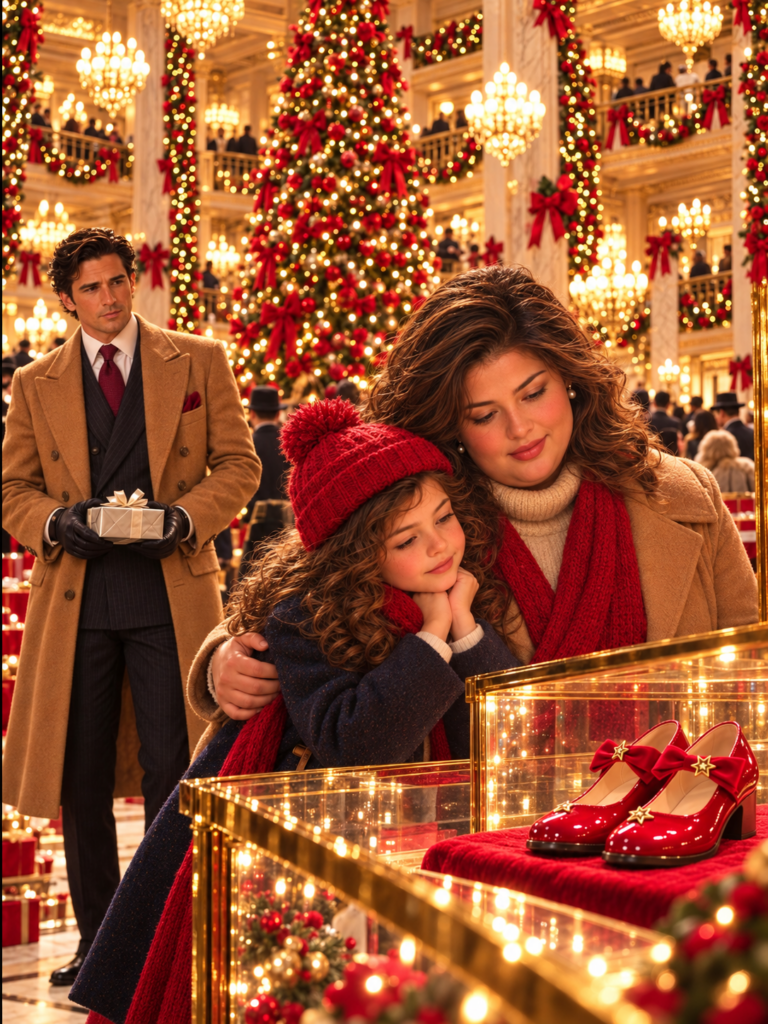
The little girl pressed her forehead against the glass as though getting closer might somehow make the red shoes belong to her.
Above the display, an enormous Christmas tree glittered beneath the soaring ceiling of Bergman’s department store on Fifth Avenue. Crystal chandeliers scattered light across the marble floor. Somewhere nearby, a piano played a familiar Christmas melody.
But six-year-old Rosie Kowalski noticed none of it.
Her entire world had narrowed to a pair of glossy red patent-leather shoes, each decorated with a satin bow and a tiny star-shaped buckle.
Her mother crouched beside her.
“Not today, sweetheart,” Anna Kowalski whispered.
Rosie studied the shoes for another moment.
Then she nodded.
“I know, Mama.”
She didn’t cry. She didn’t complain.
Instead, she reached into her coat pocket, found a pencil and an old bus ticket, and began carefully drawing the shoes on the back.
A tall man in an expensive camel-hair coat stood several feet behind them.
He had come to the store intending to spend hundreds of dollars on a gift.
Now he was watching a child draw something she couldn’t afford, and for the first time in years, Edward Hale found himself unable to walk away.
That afternoon would change three lives.
But the story had begun hours earlier, long before anyone entered the department store.
It was December 1984, and New York City was still dark when Anna Kowalski arrived at Novak’s Bakery on Ninth Avenue.
At five in the morning, the ovens were already roaring.
The air smelled of yeast, melted butter, rye flour, and fresh coffee. Warmth gathered against the windows while winter pressed its icy fingers against the other side.
Anna tied her apron around her waist, pushed up her sleeves, and began working.
At twenty-eight, she possessed the steady, practiced movements of someone who had learned that exhaustion was an inconvenience she couldn’t afford.
She shaped rye loaves, rolled poppy-seed pastries, arranged sweet buns on baking trays, and decorated cakes with the careful attention Mr. Novak expected from his employees.
She had worked there for six years.
By seven, the first customers were arriving.
Bus drivers stopped in before their routes. Nurses from the night shift bought coffee and rolls before going home. Elderly neighbors purchased a single pastry and lingered over newspapers at the counter.
Anna knew most of them by name.
She remembered who liked extra poppy seeds, who took coffee without sugar, and which elderly gentleman needed his change counted slowly because his hands shook.
The customers liked her.
Mr. Novak trusted her.
Neither fact changed her wages.
Forty-two dollars a week.
Every dollar had a destination before it ever reached her hands.
Rent for their tiny third-floor apartment on West Forty-Seventh Street. Milk. Winter clothing. Household necessities. The remaining installments on Rosie’s coat.
Mr. Novak sometimes allowed her to take leftover bread home without charging her.
Anna accepted because she worked for it.
She had never learned to be comfortable receiving something she couldn’t repay.
Four years earlier, her husband had announced that he was going to Chicago to look for work.
Rosie had been two.
He had kissed their daughter goodbye, picked up his suitcase, and disappeared.
No letters followed.
No money.
No explanation.
At first, Anna had watched the mail.
Then she had stopped watching.
One night, after putting Rosie to bed, she had sat at the kitchen table and made herself a promise.
If life was going to consist of herself and her daughter, she would make that life enough.
She had kept the promise every day since.
Rosie made it easier.
The little girl had dark curls, thoughtful brown eyes, and the serious expression of someone who believed every ordinary object deserved careful examination.
She carried a pencil everywhere.
If Anna left a grocery bag on the table, Rosie drew on its back. If an old newspaper appeared, Rosie filled the margins with sketches.
Once, to Anna’s considerable surprise, she had decorated the wallpaper beside her bed.
The drawings were almost always dresses.
Long dresses with floating skirts.
Short dresses with pearl-shaped buttons.
Dresses for princesses, dancers, and women Rosie saw passing on the sidewalk.
She even designed a gown for the elderly lady who lived downstairs.
“Why do you draw so many dresses?” Anna once asked.
Rosie considered the question.
“Because people look happier when they wear something beautiful.”
Anna had no money for art lessons.
She had no connections in the fashion industry.
But she saved every drawing she could.
On the second Saturday of December, after Anna finished her morning work, mother and daughter prepared for their favorite Christmas tradition.
It cost only two bus fares.
They rode to Fifth Avenue, admired the decorated shop windows, and visited Bergman’s to stand beneath its enormous Christmas tree.
They never bought anything.
That wasn’t the purpose.
For half an hour, Rosie could wander through a world of polished marble, glittering ornaments, and music that seemed to come from the ceiling.
And Anna could watch her daughter’s face light up.
Across Central Park that same morning, Edward Hale was fastening the buttons of his camel-hair coat inside his Park Avenue apartment.
He was thirty-eight years old.
A successful real estate developer, Edward had built residential properties throughout Manhattan. His company had become one of the city’s most respected, and his business decisions affected buildings, neighborhoods, and fortunes.
People listened when he entered a room.
Bankers returned his calls.
Architects sought his approval.
City officials made time for his meetings.
Yet his beautiful apartment remained painfully quiet.
Four years earlier, Edward’s wife, Helen, had died after an illness that hadn’t been recognized in time.
For months afterward, he had walked through their home as though she might still be waiting in another room.
Eventually, he learned not to look.
Instead, he worked.
Twelve hours a day, sometimes longer.
Work filled the spaces where grief had settled.
It also gave him a reason to avoid the silence.
His mother, Margaret Hale, was turning sixty-six the following day.
Margaret belonged to an old New York family and possessed the unshakable manners of a woman who had been taught that proper appearances mattered almost as much as proper conduct.
She wore pearls at breakfast.
Her table settings were immaculate.
And she had a talent for expressing disapproval without raising her voice.
Every year, Edward bought her an expensive birthday present.
A bracelet.
A silk scarf.
A crystal vase.
Every year, she thanked him graciously.
Then the gift disappeared into a cabinet.
Edward had no reason to believe this year would be different.
Still, he told his driver to take him to Bergman’s.
Shortly before noon, he arrived at the department store.
At almost the same moment, Anna and Rosie approached its revolving doors.
The three nearly collided.
“Oh! I’m sorry.” Anna stepped back immediately. “Please, go ahead.”
Edward looked at the young woman in the worn coat and red scarf.
Something about her smile stopped him.
It wasn’t particularly bold or flirtatious. She appeared slightly tired, and a loose curl had escaped from beneath her scarf.
But her expression held an uncomplicated warmth he hadn’t encountered in a long time.
He stepped aside and gestured toward the entrance.
“After you.”
Anna smiled again.
“Thank you.”
Rosie, standing beside her mother in a red knitted hat, caught the hem of her coat between two fingers.
Then she performed a remarkably formal curtsy.
Edward stared.
Rosie straightened, apparently satisfied with her manners.
And Edward laughed.
Not the restrained chuckle he used during business dinners.
He actually laughed.
The sound surprised him.
It had been years since laughter had escaped him so easily.
Anna laughed too, and for a brief moment the three of them stood smiling at one another beside the revolving doors.
Then Anna led Rosie inside.
Edward remained near the entrance an extra second.
He couldn’t have explained why he watched them disappear.
Upstairs, in the gift department, a saleswoman showed him several possibilities.
Leather gloves.
Decorative pins.
An enamel music box.
Edward examined everything politely.
Nothing seemed right.
Finally, he selected a delicate silver brooch shaped like a bird.
It was expensive, beautifully made, and entirely predictable.
He could already picture his mother thanking him before putting it away.
With the wrapped gift beneath his arm, he descended the broad marble staircase.
That was when he noticed the woman in the red scarf again.
She was kneeling beside the children’s shoe display.
Her little girl stood close to the glass, absorbed by something inside.
Edward slowed.
On a red velvet cushion beneath a miniature Christmas tree rested a pair of red patent-leather shoes.
Satin bows decorated their fronts.
Tiny star-shaped buckles caught the light.
Beside them stood a price card.
Thirty-eight dollars.
Edward could have paid that without thinking.
He didn’t know that Anna earned only forty-two dollars for an entire week’s labor.
But he saw the brief change in her expression when she noticed the price.
He understood enough.
Rosie reached for the pencil in her pocket.
She flattened an old bus ticket against the glass and began sketching.
Her hand moved carefully, capturing the curve of each shoe, the little buckle, and the way the satin bows gathered in the middle.
Anna placed an arm around her shoulders.
“Not today, sweetheart.”
“I know, Mama.”
Rosie kept drawing.
“I just want to remember what they look like.”
Edward stood motionless.
He had watched wealthy people complain over gifts costing more than most families earned in months.
He had seen extraordinary possessions purchased and forgotten almost immediately.
But here was a little girl trying to preserve the memory of something she knew she couldn’t have.
And she hadn’t asked for it.
He approached slowly.
“Excuse me.”
Anna turned.
Edward offered a small smile.
“I believe we met at the revolving doors.”
Recognition appeared in her eyes.
“Oh. Yes, we did.”
“Edward Hale.”
“Anna Kowalski. And this is my daughter, Rosie.”
Rosie immediately held up her bus ticket.
“Would you like to see my picture?”
Edward bent until he was at her eye level.
“I’d be honored.”
He studied the drawing with the same concentration he would have given an architect’s blueprints.
Rosie watched him anxiously.
Finally, he nodded.
“Miss Rosie, you have quite a remarkable hand.”
Her eyes brightened.
“Really?”
“Absolutely. In fact, I think you’ve made the bow even prettier than the real one.”
Rosie looked delighted.
Anna watched the exchange with cautious appreciation.
Most adults glanced at Rosie’s drawings and offered quick praise.
This stranger had actually examined one.
Edward straightened and turned toward Anna.
“Mrs. Kowalski, may I ask you something?”
She nodded.
“I came here today to buy my mother a birthday present,” he said. “Every year I bring her something expensive. Every year she thanks me, and every year she puts it away in a cabinet.”
Anna listened without interrupting.
Edward glanced toward Rosie.
“I’ve never seen anyone look at a pair of shoes the way your daughter looks at those.”
A faint flush appeared on Anna’s cheeks.
He continued carefully.
“I know we’ve only just met. And I don’t want to embarrass you.”
He paused.
“Would you allow me to buy them for her?”
Anna’s first instinct was immediate.
No.
She didn’t accept charity from strangers.
She wasn’t looking for someone to solve her problems.
And she was certainly not going to let a wealthy man mistake her circumstances for an invitation to purchase her gratitude.
But Edward didn’t reach for his wallet.
He didn’t call a saleswoman.
He waited.
As though Anna’s answer mattered more than his money.
Rosie stood very still beside her.
For several seconds, Anna looked between the man and her daughter.
“Why would you want to do that?” she asked quietly.
Edward considered his answer.
“Because I think she’d treasure them. And I’d like to give someone a gift that truly matters.”
Anna swallowed.
He wasn’t offering to take control of her life.
He was asking permission to make one small part of it beautiful.
At last, she nodded.
“Thank you.”
Edward smiled.
Before he could speak, Anna lifted her chin.
“But I have something I’d like to give you in return.”
He looked surprised.
“I work at Novak’s Bakery on Ninth Avenue,” she explained. “You said tomorrow is your mother’s birthday.”
“Yes.”
“I could bake her a cake. A Polish honey cake, from my grandmother’s recipe. Seven thin layers with honey and cream.”
Edward watched her.
“It isn’t something I could buy for you,” she added. “It’s something I’d make.”
His expression softened.
“Then I suspect it will be the first birthday present my mother doesn’t hide in her cabinet.”
The saleswoman brought the shoes in a white box lined with tissue paper.
Rosie sat on a velvet bench near the Christmas tree.
Edward removed his coat and knelt on the marble floor.
With deliberate care, he slipped off her worn brown shoes.
He helped her into the red ones, adjusted the straps, and fastened each little star buckle.
Rosie held perfectly still.
When he finished, Edward leaned back.
“There.”
She stood.
Took one step.
Then another.
The shoes gleamed beneath the chandeliers.
Rosie stared at her feet.
For several moments, she couldn’t speak.
Anna watched her daughter’s face and felt something tighten in her chest.
This wasn’t simply happiness.
It was wonder.
And she knew she would remember that expression for the rest of her life.
That night, Rosie refused to let the shoes out of her sight.
She placed them on the bedroom windowsill between a cactus and the windowpane, where the streetlamp outside caught their polished red surfaces.
She fell asleep looking at them.
Anna sat in the tiny kitchen with a cup of tea that had long since gone cold.
She kept remembering Edward Hale kneeling on the department store floor.
His expensive coat.
His patient hands fastening Rosie’s buckles.
Most of all, she remembered that he had asked instead of deciding.
By Christmas, she told herself, he would probably have forgotten their names.
But she rose before dawn the following morning anyway.
At four, while the city slept, she went down to Novak’s Bakery and began making the honey cake.
She rolled seven delicate layers.
Spread the honey-and-cream filling with meticulous care.
Decorated the top with walnuts.
She worked as though the cake carried more responsibility than a simple birthday gift.
Because it did.
At eleven, a black car stopped outside the bakery.
Mr. Novak looked through the window, then raised his eyebrows so high they nearly disappeared beneath his white cap.
Edward Hale stepped out wearing his camel-hair coat.
Inside, the usual Sunday crowd had gathered.
Nurses.
A policeman.
Bus drivers.
Elderly women buying bread.
Edward joined the end of the line.
He waited like everyone else.
When he finally reached the counter, Anna lifted the white cake box, tied with string.
“Your mother’s birthday present.”
Edward opened it.
For a moment, he simply stared.
“It’s almost too beautiful to cut.”
Anna smiled.
“People say that about cakes. Then they eat them in ten minutes.”
Edward laughed.
He closed the box carefully.
Then he turned toward Mr. Novak.
“May I buy a hot roll for everyone here? And coffee, if you have enough?”
The old women cheered.
The policeman shook his hand.
Mr. Novak grumbled something about needing more trays, though he was smiling.
Anna watched Edward interact with the customers.
He wasn’t trying to impress her.
He seemed genuinely pleased to offer a little warmth to people who had stepped inside from the cold.
When he was ready to leave, he hesitated beside the counter.
“Anna?”
“Yes?”
“Would I be terribly forward if I asked to see you again?”
She looked at him.
He added, “Not to thank you for the cake. Just because I’d like to.”
Anna rubbed her flour-covered hands against her apron.
For a moment, she thought of all the reasons this was impossible.
Then she thought of Rosie in her red shoes.
“I finish work at three on Wednesdays,” she said.
Edward waited.
“Rosie has never been ice-skating.”
A slow smile spread across his face.
“Then perhaps we should remedy that.”
That evening, twenty guests gathered in Margaret Hale’s Fifth Avenue dining room for her sixty-sixth birthday.
Silver candlesticks shone beneath the lights.
A string quartet performed in the corner.
Edward presented his mother with the silver bird brooch.
“How lovely, darling,” Margaret said.
He saw her glance toward the familiar cabinet.
Then dessert arrived.
The honey cake was placed at the center of the table.
Guests accustomed to expensive French pastries took their first bites.
Conversation stopped.
An elderly banker requested another slice.
A judge’s wife wanted to know who had made it.
Margaret, who rarely finished her birthday desserts, ate every crumb.
“Edward,” she asked, setting down her fork, “where did you buy this?”
“I didn’t.”
She looked up.
“A friend made it.”
Margaret studied her son.
For the first time in four years, he had spoken about someone with a warmth she hadn’t heard since Helen’s death.
She didn’t ask another question.
But she noticed.
Part 2
By Wednesday afternoon, the Christmas tree above Rockefeller Center’s skating rink stood against a clear winter sky.
Rosie Kowalski had never worn ice skates.
She discovered almost immediately that they were considerably less cooperative than her beautiful red shoes.
Both hands gripped the railing.
Her knees shook.
“I can’t do it,” she announced.
Anna stood nearby, holding a cup of hot chocolate.
“Of course you can, sweetheart. Just take your time.”
Rosie shook her head.
“No. These shoes are impossible.”
Edward approached slowly across the ice.
He looked incongruously elegant in his dark suit and long coat, moving with the easy balance of a man who had learned to skate years before.
“Miss Rosie,” he said solemnly, “may I offer some professional assistance?”
She regarded him suspiciously.
“Are you a professional skater?”
“No. But I’m an excellent catcher.”
Rosie considered that.
Then she reached for his hands.
Edward took both of them and began gliding backward, drawing her gently forward.
“Don’t stare at your skates,” he told her. “Look at me.”
“But what if I fall?”
“Then I’ll help you up.”
She tried.
One step.
Two.
On the third, her feet slid apart.
She landed on the ice.
For one terrible second, Anna expected tears.
Instead, Rosie burst into laughter.
Edward laughed with her.
He helped her up.
She fell again.
He helped her up again.
By the fifth attempt, Rosie managed several wobbly steps without falling.
“Mama!”
Her delighted scream carried across the rink.
“Mama, look! I’m skating!”
Anna waved from the railing.
Her hot chocolate had grown cold.
She hadn’t noticed.
Edward continued moving backward, holding Rosie’s hands while she skated toward him beneath the towering Christmas tree.
Anna watched them circle the rink.
She couldn’t remember the last time she’d smiled this much while watching a man.
When they finally left the ice, Rosie insisted on sitting beside Edward while she changed her skates.
Her red shoes rested safely in her lap.
She refused to put them on the bench.
“Someone might take them,” she explained.
Edward nodded gravely.
“A wise precaution.”
He helped loosen her skate laces.
Then he gestured toward the red shoes.
“What will you do with those when your feet grow too big?”
Rosie considered the question seriously.
“I’ll keep them forever.”
“Forever?”
“Yes.”
Then she added, “And when I’m grown up, I’m going to make shoes like these. And dresses to go with them.”
Edward looked at her.
“For whom?”
Rosie glanced toward Anna.
“For girls who have to look through windows.”
Edward didn’t answer immediately.
Instead, he reached into the pocket of his coat.
“I had a feeling you might need these.”
He produced a sturdy hardcover sketchbook and a box of forty-eight colored pencils.
Rosie stared.
“Forty-eight?”
“I counted.”
She opened the box.
The colors lay in perfect rows.
Her fingers hovered above them as though she was afraid touching them might break the spell.
Edward placed the sketchbook beside her.
“Every designer needs somewhere to keep her ideas.”
Rosie looked from the pencils to his face.
“Do you really think I could become a designer?”
“I think anyone who can draw a pair of shoes that carefully deserves the chance to find out.”
She threw her arms around the box, clutching it to her chest.
Anna looked away for a moment, struggling with the sudden pressure behind her eyes.
Edward wasn’t merely buying her daughter things.
He was taking her dreams seriously.
That frightened Anna more than she expected.
A person could become accustomed to living without luxuries.
It was much harder to imagine becoming accustomed to someone who made you feel seen.
There was no telephone in Anna’s apartment, so Edward began writing letters.
He left them at Novak’s Bakery in thick cream-colored envelopes.
Mr. Novak became an unlikely postmaster, delivering each letter with an expression of exaggerated irritation.
“Another one,” he would announce.
Anna would hide her smile and tuck the envelope into her apron.
The letters were brief.
Edward wrote about a building he’d visited, a street musician he’d heard, or a song playing on the radio that had reminded him of her.
Anna answered on pages torn from the small notebook she used for bakery orders.
Sometimes she described a ridiculous customer.
Sometimes she wrote about Rosie.
Occasionally, she admitted she had been thinking of him.
Those admissions cost her the most courage.
Edward kept every reply.
Meanwhile, Rosie’s imagination had found a new direction.
Directly below the Kowalskis lived Dolores Rivera, a seventy-year-old seamstress who had come to New York from Puerto Rico forty years earlier.
For three decades, Dolores had sewn wedding dresses in a Seventh Avenue workshop.
Age and arthritis had twisted her fingers.
She could no longer work as she once had.
But a black Singer sewing machine with gold lettering still stood in a corner of her living room.
Rosie had listened to its steady rhythm for as long as she could remember.
One afternoon, carrying her new sketchbook beneath one arm, she knocked on Dolores’s door.
She wore her red shoes.
Dolores opened the door and looked down.
“Rosie, niña. What brings you here?”
“I want to make a dress.”
Dolores raised an eyebrow.
“Do you?”
“A dress that matches my shoes. Can you teach me?”
The older woman glanced at the shoes, then at the sketchbook.
“Let me see what you’ve drawn.”
Rosie opened it.
Page after page revealed dresses with carefully drawn seams, bows, buttons, and full skirts.
Dolores stopped at one design.
It showed a dress with a wide skirt and a satin bow identical to those on Rosie’s shoes.
“Who taught you to draw like this?”
“Nobody.”
Rosie shrugged.
“I just look at things for a long time.”
Dolores studied her for another moment.
Then she pulled a small chair beside the Singer.
“First,” she announced, “you’ll learn to sew on a button.”
Rosie looked disappointed.
“A button?”
“Then you’ll learn to make a straight seam.”
“And then a dress?”
Dolores smiled.
“Then we’ll see.”
That evening, Anna found her daughter downstairs, seated beside the old seamstress.
Rosie’s tongue protruded slightly between her teeth.
She was painstakingly sewing a crooked button onto a scrap of red fabric.
She looked completely happy.
Anna stood in the doorway watching them.
For the first time in years, possibilities seemed to be opening around her daughter.
And Anna wasn’t sure whether to feel grateful or afraid of how quickly their small, carefully managed world was changing.
That same evening, another cream-colored envelope waited at the bakery.
Inside were three sentences.
There’s a concert at the Rainbow Room on Friday evening. From there, you can see almost the entire city.
More than anything, I’d like to dance with you.
Will you come?
Anna read the note three times.
Then she went home and opened her wardrobe.
Two old dresses hung inside.
Neither belonged in the Rainbow Room.
She touched the sleeve of one, then the other.
She knew Edward wouldn’t care.
But the people around him would.
She imagined walking into a room filled with wealthy women wearing gowns that cost more than she earned in a year.
She imagined their glances.
Their polite smiles.
Their conclusions.
She sat on the edge of her bed, still holding the letter.
Rosie found her there.
“What’s wrong, Mama?”
“Nothing, sweetheart.”
Rosie examined the two dresses.
Then the letter.
“Are you going dancing?”
Anna sighed.
“I’ve been invited.”
“By Edward?”
“Yes.”
Rosie’s expression brightened.
“Then you have to go.”
“It’s not quite that simple.”
“Why?”
Anna gestured toward the wardrobe.
“Because I have nothing suitable to wear.”
Rosie studied the dresses.
Then, without another word, she hurried downstairs.
Dolores was drinking coffee when Rosie appeared.
“My mama has to dance on Friday,” the little girl announced.
Dolores lowered her cup.
“Does she?”
“At the Rainbow Room. And she doesn’t have a dress.”
Dolores looked toward the ceiling, as though considering the problem.
Then she slowly rose and crossed to an old wardrobe.
From the back, she removed a garment bag that hadn’t been opened in decades.
Inside hung a gown of deep emerald silk.
Its fitted waist flowed into a skirt that moved like water.
Rosie’s mouth opened.
Dolores touched the fabric.
“I wore this to my wedding in 1952.”
Her voice changed slightly.
“My husband told me I looked like a queen.”
She smiled at the memory.
“It needs alterations. My hands aren’t strong enough to do everything anymore.”
She looked down at Rosie.
“But perhaps I have a pair of little hands to help me.”
For the next three evenings, the light in Dolores’s apartment burned until nearly midnight.
Anna stood on a chair while Dolores measured and pinned the gown.
Rosie threaded needles, organized pins, and learned how to press seams with the old heavy iron.
Dolores explained how silk behaved differently from cotton.
How a hem should fall.
Why a single crooked stitch could disturb the line of an entire garment.
Her arthritic hands sometimes failed her, but her eyes remained sharp.
And Rosie followed her instructions with fierce concentration.
By the third evening, the gown fit Anna perfectly.
Dolores stepped back.
“There,” she said. “Now you’re ready.”
Rosie frowned.
“Almost.”
She hurried upstairs.
When she returned, she held a small piece of red satin salvaged from the lining of an old coat.
She folded it, pinched it in the middle, and carefully formed a bow.
Then she asked Dolores to help attach it at the waist.
The red satin rested against the emerald silk like a little Christmas flame.
Rosie beamed.
“Now it matches my shoes.”
Anna laughed.
“Your shoes aren’t going to the Rainbow Room.”
“I know.”
Rosie touched the bow.
“But now it’s a family dress.”
On Friday evening, Edward’s black car pulled up outside the building on West Forty-Seventh Street.
Several neighbors appeared at their windows.
Edward stood beside the car wearing a black dinner suit.
He glanced toward the entrance as Anna descended the stairs.
Then he forgot what he had been about to say.
The emerald silk moved softly around her legs.
Her hair was arranged simply.
At her waist rested the small red bow.
She stopped on the final step.
“Is something wrong?”
Edward shook his head.
“No.”
He searched for words.
“Anna, you look extraordinary.”
Her cheeks warmed.
“Dolores made the dress. Rosie made the bow.”
Edward looked at the little piece of red satin.
“Then I owe both of them my thanks.”
He offered his arm.
Anna took it.
The Rainbow Room occupied the sixty-fifth floor of Rockefeller Center.
When the elevator doors opened, Manhattan stretched beneath them in a sea of winter lights.
The windows framed the city.
Crystal glittered on the tables.
An orchestra played beside the famous rotating dance floor.
Anna felt a dozen people turn to look as they entered.
But Edward remained beside her.
He didn’t hurry her.
He didn’t explain her to anyone.
And he didn’t behave as though she should be grateful simply to be there.
They ate a little.
They talked a great deal.
Eventually, their conversation moved beyond the safe subjects they’d discussed in letters.
Edward told her about Helen.
About the illness no one had diagnosed soon enough.
About helplessly watching someone he loved disappear despite possessing enough money to obtain almost anything.
“I thought if I kept working,” he admitted, “there would eventually be a day when the silence didn’t bother me.”
“Did it work?”
“No.”
He looked toward the windows.
“I just became very good at being busy.”
Anna told him about Rosie’s father.
About Chicago.
About the letters that never arrived.
About nights spent wondering whether she’d done something wrong.
Then she described the night she’d decided that she and Rosie would be enough for each other.
Edward listened.
When she finished, he said quietly, “You are enough, Anna.”
She looked down.
“That’s what scares me.”
“Why?”
“Because I’ve spent four years convincing myself I don’t need anyone else.”
Edward rested his hand near hers on the table.
“I don’t want to take anything away from the life you’ve built.”
She looked at him.
“I know.”
The orchestra began playing a slow melody.
Edward stood and extended his hand.
“May I have this dance?”
Anna hesitated.
“I haven’t danced in years.”
“Neither have I, properly.”
She placed her hand in his.
They stepped onto the rotating floor.
At first, Anna watched her feet.
Then Edward gently drew her closer.
“You’re doing fine.”
“I used to know how to dance.”
“You still do.”
Slowly, she relaxed.
She rested her head against his shoulder.
Around them, the illuminated city moved beyond the glass.
For a little while, the years of loneliness seemed very far away.
After that evening, a single white rose appeared outside Anna’s apartment every Saturday morning.
Never an extravagant bouquet.
Just one rose.
Rosie declared that it was so her mother would always remember the revolving doors where they had first met Edward.
Anna placed each flower in a glass on the windowsill beside the red shoes.
The sight became something she cherished.
A flower.
A pair of children’s shoes.
Two reminders that beauty didn’t always have to be expensive to matter.
On the final Thursday before Christmas, Rosie’s school held its holiday pageant.
Rosie had been assigned the role of a snowflake.
Dolores helped her make a costume from white tulle and silver thread.
Rosie insisted on placing every last sequin herself.
The auditorium filled with parents carrying coats, programs, and cameras.
In the front row, squeezed onto a tiny wooden chair designed for children, sat Edward Hale.
His expensive suit couldn’t disguise the ridiculous position of his knees.
He had canceled an important meeting with the city planning board to attend.
Anna, seated nearby, couldn’t stop smiling.
When Rosie appeared onstage, she immediately searched the audience for her mother.
Then she saw Edward.
Her whole face transformed.
She danced with such enthusiasm that the other snowflakes struggled to keep their formation.
At the end, she waved enthusiastically toward the front row.
Snowflakes, according to the teacher, were not supposed to wave.
Edward waved back anyway.
Later, in a taxi heading toward West Forty-Seventh Street, Rosie fell asleep against his shoulder.
Her white tulle costume spilled across the seat.
Her red shoes rested in her lap.
Anna watched the child sleeping beside him.
Edward gently adjusted his arm so she would be more comfortable.
The taxi turned through the snowy streets.
Then Rosie murmured something in her sleep.
“Papa.”
Anna heard it.
Edward heard it too.
Neither spoke.
Edward looked out the window for the rest of the journey.
That night, alone in his enormous apartment, he couldn’t sleep.
He had been called many things in his life.
Mr. Hale.
Sir.
Developer.
Businessman.
But one sleepy little word had reached somewhere inside him that money and success had never touched.
Across the city, Margaret Hale was also awake.
Her driver had told her everything he knew.
The bakery on Ninth Avenue.
The modest apartment on West Forty-Seventh Street.
The little girl.
The evening at the Rainbow Room.
And now the canceled meeting so her son could attend a school play.
Margaret understood what was happening.
Her son was falling in love.
And the woman he had chosen was not the woman Margaret had imagined for him.
On Saturday, she sent her car to Novak’s Bakery.
The chauffeur carried a formal card.
Mrs. Margaret Hale requests the pleasure of Mrs. Anna Kowalski’s company for tea.
Anna read the invitation.
She knew immediately that the meeting would not be about cake.
Part 3
Margaret Hale’s Fifth Avenue apartment seemed designed to remind visitors that the family had possessed money for generations.
Dark wood paneling lined the walls.
Silver gleamed from polished side tables.
Portraits of long-dead ancestors stared down from heavy frames.
Anna entered wearing her best modest dress.
Her hands were steady.
She had spent the morning telling herself that there was no reason to be afraid of another human being simply because that person owned more than she did.
Margaret received her in the drawing room.
She wore pearls, a precisely tailored outfit, and an expression of cool politeness.
“Mrs. Kowalski.”
“Mrs. Hale.”
“Please, sit.”
Margaret poured the tea herself.
For several minutes, they discussed harmless subjects.
The weather.
Christmas preparations.
The extraordinary cake Anna had baked.
“My guests are still talking about it,” Margaret said.
“I’m glad you enjoyed it.”
“I did. Very much.”
Margaret set down her cup.
Then her manner changed.
“Mrs. Kowalski, I’m going to speak plainly. At my age, I see very little benefit in pretending.”
Anna placed her cup carefully onto its saucer.
“Of course.”
“You appear to be a respectable young woman. You work hard. You’re clearly talented.”
“Thank you.”
“But my son is Edward Hale.”
Anna didn’t respond.
“He has responsibilities. A position in society. His wife will be expected to entertain senators, businessmen, and people whose decisions affect this city.”
Margaret gestured toward the room.
“She will receive them here.”
Anna felt her stomach tighten.
Margaret continued.
“You work in a bakery. You have a child whose father abandoned you. Whatever your personal qualities, people will talk.”
Anna looked at the older woman.
“People already talk, Mrs. Hale.”
“Yes. And they’ll talk about Edward.”
The words landed with more force than Anna wanted to admit.
Margaret reached for a small leather folder.
She opened it and removed a check.
It had already been signed.
She placed it beside Anna’s teacup.
“I believe this will allow you and your daughter to live comfortably for a very long time.”
Anna looked at the amount.
It was more money than she would earn at the bakery in ten years.
Enough to pay rent without counting every dollar.
Enough to replace the worn furniture.
Enough to buy Rosie proper art supplies, beautiful dresses, and perhaps one day the education Anna could scarcely imagine affording.
For a terrible moment, she understood how easily money could solve so many practical problems.
Then she understood exactly what Margaret was asking her to sell.
“You want me to stop seeing Edward.”
Margaret held her gaze.
“I believe it would be best for everyone.”
“Have you discussed that with your son?”
“This isn’t something he can see clearly at present.”
Anna looked down at the check.
She thought of Edward kneeling on the marble floor.
Of the letters he left at the bakery.
Of Rosie laughing as he helped her stand on the ice.
Of the way he had listened when Anna spoke about her past.
Margaret had offered enough money to change their lives.
But Edward had already changed them in a way money alone never could.
Anna picked up the check.
For an instant, Margaret’s expression relaxed.
Then Anna folded it.
And tore it in half.
She folded the pieces again.
Tore them once more.
Four pieces of expensive paper fell onto the table beside the silver teapot.
Margaret stared.
Anna spoke quietly.
“I didn’t enter your son’s life for money, Mrs. Hale.”
She stood.
“And I won’t leave it for money either.”
Margaret seemed unable to answer.
Anna straightened her coat.
“Thank you for the tea.”
She walked out with her head held high.
Only when she reached the snowy sidewalk did her composure begin to falter.
Margaret had insulted her.
But that wasn’t what hurt most.
What hurt was the possibility that part of the older woman’s warning might be true.
People would talk.
They would question her intentions.
They would speculate about Rosie.
And perhaps, eventually, Edward would grow tired of defending them.
Perhaps one day he would stand in a beautiful room surrounded by senators and society wives and wonder whether he’d made a mistake.
Anna could endure humiliation directed at herself.
She wasn’t sure she could bear watching Edward regret loving her.
Or watching Rosie discover that someone she’d begun calling Papa didn’t intend to stay.
By evening, Anna had made a decision.
When Edward arrived at the bakery carrying a white rose, she met him at the door.
He smiled when he saw her.
The smile faded when he noticed her expression.
“Anna? What’s happened?”
She kept one hand on the doorframe.
“I can’t do this.”
Edward stared.
“Can’t do what?”
“Us.”
He lowered the rose.
“Anna, talk to me.”
“Your mother invited me to tea.”
A shadow crossed his face.
“What did she say?”
“It doesn’t matter.”
“It matters to me.”
Anna looked at him.
“I’m not the woman your family expects you to marry.”
“That’s not their decision.”
“You say that now.”
“I’ll say it tomorrow. And next year.”
Her eyes filled.
“Please don’t make this harder.”
Edward took a breath.
“Are you telling me you don’t love me?”
Anna’s composure broke.
“No.”
The word came out almost as a whisper.
“I’m telling you I do.”
Edward didn’t move.
“I love you,” she repeated. “And that’s why I can’t let you stand between me and your mother. I won’t become something you regret.”
“Anna—”
“Please. Go home.”
She closed the door.
Through the bakery window, Edward could see her standing motionless.
Then she pressed both hands against her face.
He remained outside for a long time.
Snow collected on the shoulders of his camel-hair coat.
The white rose hung loosely between his fingers.
He wanted to knock.
To tell her she was wrong.
To promise that his feelings would never change.
But she had asked him to leave.
And the first thing that had made Anna trust him was that he respected her right to choose.
So he stepped away.
Behind the curtain separating the bakery’s front room from its workroom, Rosie sat on a sack of flour.
She had heard everything.
Her mother’s trembling voice.
Edward’s questions.
The silence after the door closed.
Rosie reached into her bag and pulled out her red shoes.
She held them tightly against her chest.
Then she began to cry as quietly as she could.
Edward climbed into his car.
“Where to, Mr. Hale?” the driver asked.
“My mother’s apartment.”
When he entered Margaret’s drawing room, snow still clung to his coat.
Margaret sat alone beside the silver tea service.
On the table lay four pieces of a torn check.
She hadn’t thrown them away.
Edward looked at them.
“She tore it up.”
It wasn’t a question.
Margaret followed his gaze.
“Yes,” she admitted. “Right in front of me.”
Edward removed his coat.
He didn’t shout.
He had never shouted at his mother, and he didn’t intend to begin.
Instead, he sat opposite her.
For a while, neither spoke.
Then Edward asked, “Mother, do you remember the silver bird brooch I gave you for your birthday?”
“Of course.”
“Where is it?”
Margaret’s eyes moved toward the tall cabinet in the corner.
Edward followed her glance.
“Beside last year’s bracelet?”
She said nothing.
“And the silk scarf? The crystal vase? The gloves?”
“Edward, I don’t see—”
“Every year I buy you something beautiful. Something expensive. And every year you put it in that cabinet.”
Margaret stiffened.
“Your gifts are always appreciated.”
“I know. But they’re things I purchase because it’s expected of me. You know it, and so do I.”
He leaned forward.
“Now tell me something. Where did you put Anna’s cake?”
Margaret glanced toward the empty dessert plates that hadn’t yet been cleared from the previous evening.
Edward continued.
“You couldn’t put it away. It was made to be shared. Someone got up at four in the morning and spent hours making something for you.”
Margaret lowered her eyes.
“Anna did that without knowing you,” he said. “She did it because I told her it was your birthday.”
He waited.
“Two weeks ago, I met a little girl who wanted a pair of red shoes more than I’ve wanted anything in years.”
Margaret listened.
“She couldn’t afford them. Her mother couldn’t afford them either. But instead of begging, the child drew them on a bus ticket so she wouldn’t forget.”
Edward’s voice softened.
“When I offered to buy them, Anna almost refused. And when she finally accepted, she insisted on giving something in return.”
He looked directly at his mother.
“That is the woman you offered money to.”
Margaret’s fingers tightened around her handkerchief.
“Edward, you must understand. I was thinking of your future.”
“So am I.”
He stood.
“I love Anna.”
Margaret looked up.
“And I love her daughter.”
The room seemed suddenly smaller.
Edward continued.
“Rosie called me Papa in her sleep the other night.”
Margaret’s expression changed.
Edward paused, remembering the taxi.
“I’ve spent four years believing there was nothing left for me outside my work. Now there’s a woman I want to come home to, and a little girl who trusts me enough to fall asleep on my shoulder.”
His mother looked toward the cabinet.
“I didn’t come here to ask your permission,” he said. “I came because you’re my mother, and I wanted you to know the truth.”
He moved toward the door.
“You can be part of our lives, or you can choose to remain outside them.”
Margaret stared at him.
“But understand what you’ll be giving up.”
He left.
For a long time, Margaret remained seated.
The apartment was silent.
Her eyes returned to the torn check.
Then to the tall cabinet.
She rose slowly and crossed the room.
For the first time in years, she opened its doors.
Inside were the beautiful presents Edward had given her.
Perfectly preserved.
Carefully arranged.
Almost untouched.
She lifted the silver bird brooch from its box.
She remembered thanking him.
She remembered how tired he had looked.
And, for the first time, she wondered whether he had been lonely in ways she had refused to see.
Downstairs from Anna’s apartment, the black Singer sewing machine was working late into the night.
Rosie had made a decision of her own.
She hadn’t told her mother.
Only Dolores knew.
“My mama is sad because of Edward’s mother,” Rosie explained.
Dolores examined the little girl’s solemn face.
“And what do you intend to do about that?”
“Make her something.”
Dolores looked surprised.
“Edward’s mother?”
Rosie nodded.
“A real present. Not something from a store.”
From her collection of treasured belongings, Rosie produced the white ribbon that had decorated the original Bergman’s shoe box.
She also brought a small scrap of red satin left over from the bow on Anna’s emerald dress.
Dolores arranged the materials on the table.
“What would you like to make?”
Rosie looked down at her shoes.
“A bow.”
For two evenings, they worked.
Dolores guided her hands as she measured and folded the satin.
Rosie cut the ribbon carefully.
Her stitches weren’t straight.
The fabric shifted.
The two loops of the bow emerged slightly uneven.
Several times, Rosie frowned and wanted to begin again.
Dolores shook her head.
“Keep going, niña.”
“But it’s crooked.”
“Then we’ll make it beautifully crooked.”
On the second evening, Dolores attached a small pin to the back.
The finished bow looked remarkably like those on Rosie’s red shoes.
One loop sat a little higher than the other.
Rosie held it against her dress.
“Do you think she’ll like it?”
Dolores looked at the child.
“I think she should.”
On Christmas Eve, Rosie put on her red shoes and her matching knitted hat.
She carried the little wrapped gift to the kitchen.
Anna was preparing their modest Christmas meal when her daughter appeared.
“Mama, I’m going to see Edward’s mother.”
Anna turned.
“You’re going where?”
“To Mrs. Hale’s house.”
“Rosie—”
“You can come with me. Or I can take the bus. I know the way.”
Anna stared at her.
“You cannot go across New York alone.”
“Then come with me.”
Anna looked at the small package.
“What’s that?”
“A present.”
“For Mrs. Hale?”
Rosie nodded.
“Because she needs one.”
Anna wanted to argue.
She wanted to explain that some problems were too complicated for a six-year-old child.
That adults could wound one another without meaning to.
That wealth and pride and family expectations didn’t disappear because someone brought a Christmas gift.
But Rosie stood in front of her with a determination Anna recognized all too well.
And something in her daughter’s expression made refusal impossible.
An hour later, they stood outside the Hale family’s Fifth Avenue apartment.
The butler who opened the door looked uncertain what to do with a young woman in an old coat and a child wearing bright red shoes.
Before he could explain their arrival, Margaret heard voices from the hallway.
She appeared herself.
Anna stiffened.
“Mrs. Hale, I’m sorry to come unannounced—”
But Rosie stepped forward.
“Mrs. Hale?”
Margaret looked down.
“Yes?”
Rosie held out the package.
“This is for you.”
Margaret blinked.
“For me?”
“I made it myself. Dolores helped with the hard parts.”
The older woman accepted the gift.
She removed the wrapping.
Inside, nestled on white tissue paper, lay a small red satin bow.
It was unmistakably handmade.
One loop tilted upward.
Several stitches were visible.
Margaret lifted it carefully.
Rosie pointed at her own shoes.
“See? It’s like the bows on these.”
Margaret glanced down.
Rosie continued.
“Edward gave me these when I thought there weren’t any miracles.”
Anna closed her eyes briefly.
But Rosie wasn’t finished.
“I thought you should have one too.”
Margaret looked at her.
“Why?”
Rosie hesitated.
“Because Mama says sometimes people get angry when they’re sad.”
A long silence followed.
The butler stood motionless.
Anna wanted to disappear.
Margaret looked at the bow.
Then she did something the household staff hadn’t seen her do in years.
She slowly removed her gloves.
With bare fingers, she fastened the little red bow onto her gray silk dress, directly above her heart.
It rested where her pearls usually drew attention.
Her chin trembled.
For several seconds, she couldn’t speak.
Then she looked down at Rosie.
“I’ve been given beautiful things for forty years,” Margaret said quietly.
She touched the crooked satin bow.
“But no one has made something for me with their own hands since my husband died.”
Her eyes filled.
Rosie watched her anxiously.
“Do you like it?”
Margaret lowered herself carefully until she could meet the child’s gaze.
“Oh, my dear.”
Her voice was scarcely more than a whisper.
“Yes. Very much.”
Then she stood and turned toward Anna.
The younger woman remained near the doorway.
Margaret’s expression no longer held the cold certainty it had worn during their meeting for tea.
“Mrs. Kowalski.”
Anna waited.
“I was wrong about you.”
The words came slowly.
“I was wrong about what makes someone worthy of belonging in this family.”
Anna felt her throat tighten.
Margaret looked once more at the little bow.
“My son tried to tell me that a gift could mean more than its price. I didn’t understand him.”
She reached out her hand.
“Would you and Rosie stay for Christmas Eve dinner?”
Anna looked at the offered hand.
There was no check this time.
No warning.
No calculation.
Only a woman asking another woman to stay.
Anna took her hand.
“I’d like that.”
From the entrance to the drawing room, Edward watched.
He had been standing there for nearly a minute.
He had seen his mother pin the crooked red bow to her dress.
He had heard her apology.
And now he watched her holding Anna’s hand while Rosie smiled beside them.
Edward turned his head toward the Christmas tree.
He needed a moment before anyone saw his face.
The next morning, Christmas Day, sunlight spread across Rockefeller Center.
Families crowded the skating rink.
Children fell, laughed, and struggled back onto their feet.
The great Christmas tree stood above them in all its glittering glory.
Rosie wore a new little red coat that Dolores had helped sew the night before.
She skated confidently across the ice.
No longer clutching the railing.
No longer afraid to fall.
Anna and Edward followed at a slower pace, holding hands.
For a while, they simply watched Rosie enjoying herself.
Then Edward stopped beneath the tree.
“Anna?”
She turned toward him.
His expression had become unusually serious.
“What is it?”
Edward reached into his coat pocket.
He didn’t kneel.
Kneeling on ice skates was not a sensible undertaking, even for a man who had built some of Manhattan’s finest properties.
Instead, he brought out a small box and offered it to her.
Anna stared.
Inside was a ring.
Tied to it with a thin white ribbon was a tiny red satin bow.
Slightly crooked.
Immediately familiar.
Anna looked at Edward.
“Rosie?”
He smiled.
“She made that one too.”
Anna began to laugh.
Then, without warning, tears came.
Edward reached for her free hand.
“I’ve spent years believing my life had already contained all the happiness it was going to hold.”
He glanced toward Rosie, skating in a small circle nearby.
“Then I met a little girl who wanted a pair of red shoes.”
Anna pressed her lips together.
“And her mother,” he continued, “who taught me more about love and dignity in a few weeks than I’d understood in years.”
He looked into her eyes.
“I don’t want to visit your life on Wednesday afternoons. I don’t want to send letters because I’m afraid I’ll lose the chance to hear your voice.”
He paused.
“I want to share the ordinary days with you. The early mornings. The difficult evenings. Everything.”
Anna was crying openly now.
Edward lifted the ring.
“Anna Kowalski, will you marry me?”
“Yes.”
Her answer came before he had finished smiling.
“Yes, Edward.”
He drew her into his arms.
Behind them, a small voice shouted.
“Mama!”
Rosie skated toward them with more enthusiasm than precision.
She stopped awkwardly, wobbling on her blades.
“What’s happening?”
Anna knelt slightly to show her the ring.
Rosie’s eyes widened.
Then she turned to Edward.
“Does that mean you’re going to stay with us?”
Edward looked at her.
“Yes.”
“For always?”
“For always.”
Rosie became very still.
Then she asked the question she had been carrying in her heart.
“Edward?”
“Yes, sweetheart?”
“Can I call you Papa now?”
Anna covered her mouth.
Rosie continued earnestly.
“For real? Not just when I’m asleep?”
Edward’s eyes filled.
He reached down and lifted Rosie into his arms, skates and all.
He held her tightly.
“Rosie,” he said, his voice unsteady, “I’ve been waiting for you to ask me that.”
She wrapped her small arms around his neck.
“Papa.”
This time, she was wide awake.
And he answered.
“I’m right here.”
Twenty-two years passed.
New York changed.
Buildings rose.
Fashions disappeared and returned.
Children grew up.
But in December 2006, something extraordinary appeared in the windows of Bergman’s department store on Fifth Avenue.
The main displays were filled with children’s dresses.
Full skirts.
Carefully fitted bodices.
Satin bows.
Tiny buttons shaped like stars.
The collection belonged to a young designer named Rose Hale.
Fashion writers called her one of the most exciting new talents in New York.
Her debut collection had attracted attention for its craftsmanship, tenderness, and understanding of how clothing could make children feel extraordinary.
But at the center of the most important window, there was no dress.
Beneath a glass dome, resting on a red velvet cushion, stood a pair of small, worn patent-leather shoes.
They had once been bright red.
Years had softened their shine.
Their tiny satin bows were faded.
Beside them lay another bow, handmade from red satin.
A little crooked.
Just as it had always been.
A small card beneath the display read:
Here is where the story began.
1984.
Outside, snow drifted gently onto Fifth Avenue.
An older couple stood together on the sidewalk.
The man was tall, his hair silver-gray, his camel-hair coat carefully buttoned against the cold.
Beside him stood a woman wearing a knitted red scarf.
They held hands.
For a long time, neither spoke.
They simply looked through the glass.
At the shoes.
At the bow.
At the quiet evidence of what a single afternoon had become.
Edward squeezed Anna’s hand.
She smiled, her eyes shining.
Then she leaned slightly toward the window, as though a little girl in a red knitted hat were still standing beside her.
Twenty-two years earlier, she’d looked into those same eyes and whispered the only answer she could afford.
Not today, sweetheart.
Now she gazed at the shoes her daughter had kept for a lifetime.
At the designs inspired by them.
At the dreams that had grown from one unexpected act of kindness.
And very softly, Anna whispered again.
“Today, sweetheart.”
She smiled through her tears.
“Today.”
Edward drew her closer.
Inside the store, beneath the Christmas lights, the little red shoes rested exactly where Rosie’s story had begun.
They were no longer the most beautiful shoes in the world.
They weren’t even new.
But they had become something far more valuable than anything Bergman’s could sell.
They were proof that a gift offered with respect could change a child’s future.
That a woman who possessed very little could still give something priceless.
That an old woman’s heart could be softened by a crooked ribbon stitched by small, determined hands.
And that a man who seemed to have everything could discover the one thing his fortune had never been able to purchase.
A family.
Sometimes a miracle doesn’t arrive with great announcements or impossible displays of wealth.
Sometimes it begins when someone opens a door.
When someone asks permission instead of making a decision for another person.
When a mother finds the courage to accept kindness without surrendering her dignity.
Or when a lonely little girl receives a pair of red shoes and begins to believe her dreams might belong in the world.
And sometimes that little girl remembers the kindness for the rest of her life.
Then grows up determined to create the same wonder for others.

