
Part 1
The first thing Clare Briggs ever said to me was, “Why are you touching my mother’s car?”
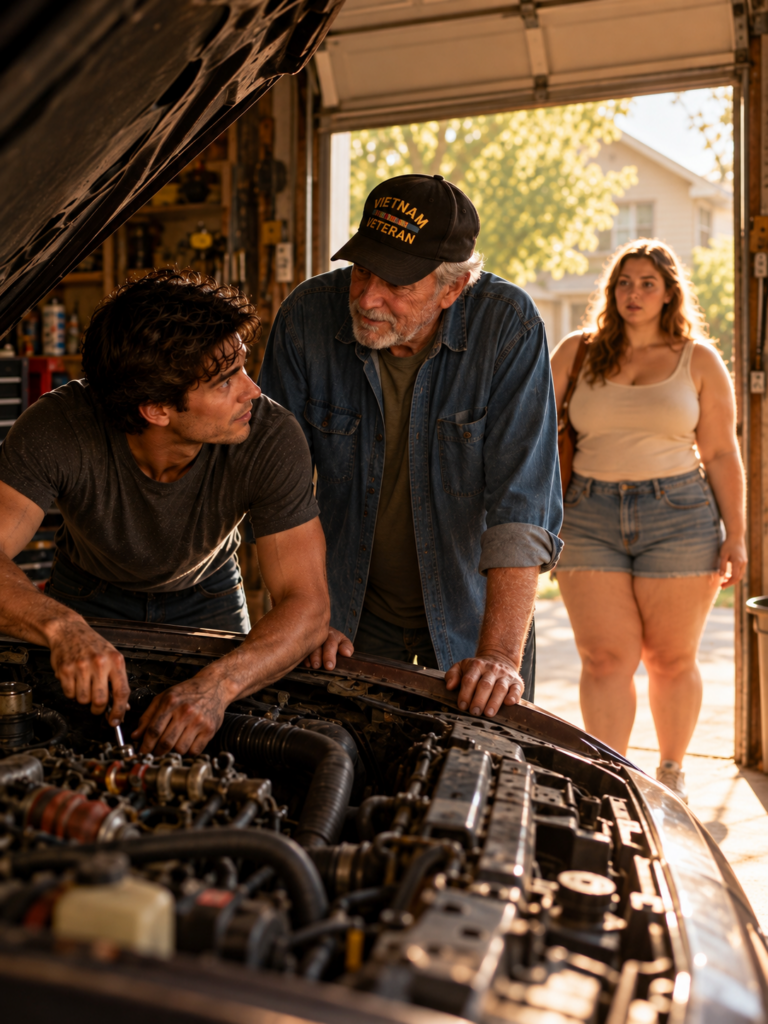
I was bent over the open hood of a faded blue 1967 Mustang with one hand resting on the air cleaner housing and a flashlight between my teeth.
Her father stood three feet away holding a box of old spark plugs.
Neither of us had heard the garage door open.
I removed the flashlight slowly.
The woman in the doorway looked to be in her late thirties. Dark brown hair was pulled back loosely from her face, and a canvas grocery bag hung from one hand. She wasn’t exactly angry.
Anger would have been simpler.
She looked like someone who had walked into a room and realized a decision had been made without her.
Three days earlier, I had barely known her father.
Walter Briggs lived four houses down from me in a quiet neighborhood outside Dayton, Ohio, where people waved from driveways and knew who owned which dog but generally avoided learning anything that might require a real conversation.
I knew Walter was a veteran because an American flag and a Desert Storm service emblem hung beside his front door. I knew he drank coffee on his porch before most of the neighborhood was awake. I knew his right knee bothered him, although he refused every offer to help carry his trash cans to the curb.
In four years, Walter and I had probably spoken twenty times.
Then one Tuesday evening, he appeared beside my driveway while I was replacing the brake pads on my pickup.
“You still work on old engines?” he asked.
I wiped my hands on a rag.
“Sometimes. Depends how old and how angry.”
Walter gave me the smallest smile I had ever seen.
“I’ve got one that’s both.”
He led me behind his house to a detached garage with a wooden door that groaned when he raised it.
Inside, dust floated through late-afternoon sunlight.
A gray cover hid most of the car beneath it.
Walter pulled the cover away.
The Mustang had been sitting a long time. Low tires. Dulled chrome. Dust across the windshield thick enough to write in.
But the body was straight. The interior looked complete. There was almost no visible rust around the wheel wells.
Walter ran his fingertips along the front fender.
“My wife bought it before we got married,” he said. “Worked two summers at a diner and saved every dollar she could.”
“How long has it been sitting?”
“Eleven years.”
I looked at him.
“Then we don’t turn the key.”
His eyes came to mine.
“We check the engine by hand first. Fuel system. Brake lines. Oil. Anything rubber that’s been sitting. Starting it is the last thing we do, not the first.”
“That’s why I asked you.”
I had restored two cars with my father when I was younger and still helped friends with repairs, but I wasn’t a professional mechanic. My real job was facility supervisor at a community college.
Most days involved boilers, work orders, bad fluorescent lighting, and explaining to people why unplugging equipment before repairing it was not merely a suggestion.
Machines made sense to me.
Broken ones especially.
They didn’t tell you nothing was wrong while leaking fluid across the floor.
I asked Walter what he expected from the Mustang.
“I’m not promising perfection.”
“I don’t need perfect.”
“What do you need?”
He looked through the open driver’s window.
“I want it to move under its own power one more time.”
Something in his voice stopped me from asking why.
We started Saturday.
Walter had kept the original service manual, several boxes of labeled parts, and a maintenance notebook filled with decades of careful handwriting.
The handwriting belonged to his wife, Margaret.
Oil changes. Tires. Filters. Repairs. Dates. Mileage.
Before we touched the ignition, we removed the spark plugs and tested whether the engine would rotate manually.
It did.
Slowly, but it moved.
The oil looked terrible. The gasoline smelled like varnish. Several hoses had hardened until bending them produced small cracks.
None of that surprised me.
Walter did.
He remembered bolt sizes without checking the manual. He remembered when the carburetor had been installed and who replaced the water pump six years afterward. His fingers shook slightly when he handled small tools, but whenever he talked about the Mustang, the tremor seemed less noticeable.
By Sunday afternoon we had drained the old fuel, changed the oil, removed the dead battery, and made a list of what we needed before attempting a start.
Walter carried two folding chairs into the driveway.
We sat.
He handed me a bottle of water.
“You have children?”
“No.”
“Married?”
“Not anymore.”
He nodded like that confirmed a theory.
Then he glanced at his house.
“My daughter thinks I should sell this place.”
“Do you want to?”
“No.”
“Then don’t.”
One corner of his mouth rose.
“You haven’t met her.”
Three days later, I did.
Walter straightened beside the Mustang.
“Clare. You’re early.”
Her gaze traveled over the open hood, the tools on the concrete, the parts arranged across the workbench.
“I can see that.”
Walter put down the spark plugs.
“This is Ethan Cole. He’s helping me get the Mustang running.”
Clare looked at her father first.
Then me.
“My father doesn’t ask people for help. So what exactly did he tell you?”
“That the car belonged to your mother. And that he wanted to hear it run again.”
“That’s all?”
“That’s all I asked,” Walter said.
Clare’s attention shifted back to him.
“You said one more time.”
Walter’s expression changed by less than an inch.
“I said I wanted it to move under its own power one more time.”
“That sounds different from wanting to restore it.”
“It means exactly what I said.”
I stepped away from the engine.
“For what it’s worth, we’re nowhere near driving it. We have brakes to inspect, hoses to replace, a fuel system to clean and an ignition system to test.”
Her eyes returned to me.
“How much is he paying you?”
“Clare,” Walter warned.
“It’s a fair question.”
I wiped my hands.
“He isn’t paying me. He’s buying the parts.”
“Why?”
“Because he asked.”
“That usually works?”
“Not often.”
The corner of her mouth moved.
Not a smile.
Almost.
Walter picked up her grocery bag.
“I’m putting these away while the two of you conduct your investigation.”
Clare watched him disappear into the house.
“He hates needing anything.”
“I noticed.”
“He also hates admitting when something is too much for him.”
“I noticed that too.”
That earned me a longer look.
Then she stepped toward the Mustang.
“What have you done?”
I showed her.
The old fuel. Fresh oil. Removed plugs. The hoses. The carburetor pieces waiting to be cleaned.
She leaned over the fender.
“That hose is routed wrong.”
“It isn’t connected yet.”
“No. I mean the route.”
She reached past me.
Her sleeve brushed my forearm.
Neither of us reacted.
She pointed to a small metal clip near the firewall.
“It goes behind this bracket. Not in front. If you put it there, it rubs against the linkage.”
I studied it.
She was right.
“You’ve worked on this car.”
“My mother did. I handed her tools and pretended I wasn’t listening when she explained things.”
“That’s a specific detail to remember while pretending not to listen.”
“She caught me more than once.”
This time she smiled.
Small, but unmistakable.
Something changed.
Not between us exactly.
In the garage.
The Mustang stopped being Walter’s old car and became Margaret’s car.
Clare opened the driver’s door.
Her fingers moved over the worn steering wheel. The cabin smelled of dust and old vinyl. A crack crossed the dashboard above the glove compartment. The passenger seat had been repaired near the bottom with a handstitched patch.
“My mother drove this everywhere,” Clare said. “Work. School. Grocery store.”
“She liked it.”
“She refused to call it a classic. Said that was what people called a car when they were afraid to use it.”
“She sounds practical.”
“She was.”
Clare sat behind the wheel.
Her hands settled low on it.
“When she got sick, Dad kept saying they’d take it out when she felt better.”
I didn’t ask what illness Margaret had suffered.
Clare had given me the amount she wanted me to know.
“After she died,” she continued, “he parked it here. Wouldn’t sell it. Wouldn’t look at it either.”
“Eleven years.”
Her head turned sharply.
“He told you?”
“The notebook did.”
Her eyes found Margaret’s handwriting on the workbench.
“My mother wrote in that thing like the car was another child.”
Walter returned carrying three glasses of iced tea.
“I heard that.”
“You were supposed to.”
He handed us drinks.
Clare stood.
“Dad, why now?”
Walter looked at the Mustang.
“Because waiting hasn’t improved it.”
“That isn’t an answer.”
“It’s the one I have today.”
The exchange told me their argument had started long before I arrived.
Walter pointed at the carburetor.
“Ethan thinks it can be rebuilt.”
“It can,” I said. “Accelerator pump is brittle. Float may need replacing. We’ll know after cleaning.”
Clare picked up the old gasket carefully.
“There should be another rebuild kit in the red cabinet.”
Walter frowned.
“There isn’t.”
“There was.”
She crossed the garage and opened the cabinet.
Behind several oil cans, she pulled out a dusty box.
Walter stared.
Clare handed it to me.
Inside was an unopened carburetor kit and a faded receipt almost fifteen years old.
I checked the part number.
“Correct kit.”
Walter shook his head.
“Your mother could hide things in plain sight.”
“She called it organizing.”
“She was wrong.”
Clare smiled fully then.
And, for reasons I wasn’t prepared to examine, I wanted to see it again.
We spent another hour rebuilding the carburetor.
Clare didn’t hover. She didn’t try to prove she knew more than she did.
She simply noticed things.
A missing washer.
A spring that had been installed backward sometime in the past.
One of Margaret’s handwritten notes tucked inside the manual.
Watching her work changed my first impression.
Suspicion hadn’t made her difficult.
It had made her careful.
There was a difference.
By evening, we had the carburetor rebuilt.
Then we found the leaking brake master cylinder.
Walter’s disappointment was immediate.
Clare’s reaction was harder to read.
Relief, maybe.
Not because she wanted the car broken.
Because every repair bought her more time to understand why her father had suddenly decided to wake it from eleven years of silence.
“I’ll order the cylinder,” Walter said.
“I’ll check the wheel cylinders Saturday,” I told him. “If one failed, the others may be close.”
Clare closed the manual.
“I’m coming Saturday.”
Walter lifted an eyebrow.
“You said you had plans.”
“I changed them.”
She looked at me when she said it.
Not with suspicion anymore.
More like a challenge.
At the back door she glanced over her shoulder.
“Eight o’clock.”
Walter said, “I told Ethan nine.”
“You say nine because you think normal people sleep late.”
“I’ll be here at eight,” I said.
Clare nodded.
After she went inside, Walter remained in the doorway.
“You don’t have to come early.”
“I know.”
His gaze went toward the Mustang.
Then back to me.
“She hasn’t sat in that car since the funeral.”
Before I could answer, he closed the door.
Part 2
Clare arrived Saturday at 7:52 carrying three coffees and a bakery bag.
Walter raised the garage door at exactly eight.
“You’re both early.”
“You raised me,” Clare said. “This is your fault.”
She handed me a coffee.
Black.
No sugar.
I stared at it.
“My father told me,” she said.
Walter lifted his own cup.
“I provide useful intelligence.”
Clare had traded her jeans and canvas jacket for worn work pants and a gray sweatshirt. Her hair was pulled back tighter than before.
She looked ready to work.
So we worked.
I raised the Mustang at the correct points, lowered it onto four jack stands, then pushed firmly against the body before removing the wheels.
Clare noticed.
“Dad usually puts a block of wood under something and calls it engineering.”
“It has worked so far,” Walter said.
“That is not a defense.”
The front brakes had been converted to discs years earlier. The rear still had drums.
A front hose showed enough cracking that I added both to the replacement list.
The left rear wheel cylinder was worse.
When I pulled the drum, dark brake fluid had soaked the lower shoes.
“Cylinder’s leaking,” Clare said.
“And those shoes are finished.”
Walter crouched carefully.
“Can they be cleaned?”
“I wouldn’t trust them. We replace both rear cylinders, both sets of shoes, hardware, then flush every line.”
Walter nodded.
No argument.
That was how I knew what the car meant to him.
Walter argued about everything else.
Clare held the light as I followed the steel brake lines. She listened to explanations without pretending to understand something she didn’t. When she had a question, she asked it.
When she remembered something, she said it.
It had been years since I’d noticed how much I liked being listened to.
My ex-wife used to tell me I could turn replacing a faucet washer into a technical seminar.
Eventually I had stopped explaining things at home.
Then, later, we had stopped explaining most other things too.
Around eleven Walter disappeared inside.
Ten minutes passed.
Clare looked toward the back door.
“He does that when his knee hurts.”
“He said he was getting rags.”
“There are forty rags in the cabinet.”
“Should we stop?”
“No. If we stop, he’ll come outside and pretend he feels fine.”
She sat on an overturned bucket.
“I keep asking him to see the orthopedic specialist again. He says the doctor already knows he has a knee.”
“That sounds like Walter.”
“He thinks being difficult is a personality.”
“Sometimes it is.”
She laughed.
It was the first time we had been alone.
Without Walter moving between us, I became aware of small things I hadn’t allowed myself to notice.
The streak of grease across her cheek.
The way she rolled one shoulder when it grew stiff.
The fact that she looked at me directly when I spoke.
Her gaze dropped to my left hand.
“You still wear your wedding ring?”
I looked down.
There was no ring.
Only a pale band around the finger.
“Took it off eight months ago.”
“How long were you married?”
“Twelve years.”
She waited.
No pity. No pushing.
Just room.
“We got very good at managing a house,” I said. “Bills. Groceries. Repairs. Scheduling. Somewhere along the way, that became the whole marriage.”
“Someone else?”
“No.”
“Sometimes that would almost be easier.”
“That’s what I thought.”
She picked at a loose thread on her sweatshirt.
“My parents were married forty-six years when Mom died. People kept telling me how lucky they were.”
“They probably meant well.”
“They weren’t wrong.” Clare looked toward the Mustang. “But sometimes people talk about a long marriage like it happened because neither person ever disappointed the other.”
I was still thinking about that when Walter returned with sandwiches.
His limp was worse.
Neither Clare nor I mentioned it.
Over lunch he told me Margaret had once changed the Mustang’s alternator in a grocery-store parking lot during a rainstorm while nine-year-old Clare held an umbrella.
“It was raining sideways,” Clare said.
“You complained the whole time.”
“I was nine.”
“You developed the skill early.”
The parts arrived that afternoon.
We replaced the rear wheel cylinders, shoes, springs, and hardware. Clare cleaned the backing plates and guarded the fresh linings from contamination like she had been doing brake jobs for years.
Late in the day, with the system assembled but not yet bled, she sat behind the wheel.
This time she rested one hand on the gear selector.
“Dad used to drive it,” she said. “But Mom was the one who understood it.”
“Maybe that’s why he asked me.”
“Maybe.”
Walter had gone inside to answer a call.
Clare looked through the windshield.
“There’s something he isn’t telling us.”
“What makes you think that?”
“He never cared if the car ran again. Not until now.”
She glanced at me.
“When my father suddenly decides something has to happen, there is usually a date attached to it.”
“You ask him?”
“He answered like a man under enemy interrogation.”
“That also sounds like Walter.”
She smiled.
I was standing just outside the driver’s door.
Close enough to see a fleck of blue paint near her eyebrow.
For a few seconds neither of us spoke.
There wasn’t anything dramatic in it.
Just a strange reluctance to move.
Then the Mustang’s horn blasted beneath her hand.
Clare jumped.
Her shoulder hit mine.
Walter appeared in the doorway.
“Good,” he said. “At least one thing still works.”
Clare covered her face.
I laughed.
A second later she did too.
Then Walter raised an envelope.
“Since you’re both here, I suppose I should tell you why I need the car ready by October.”
The laughter ended.
He removed a cream-colored letter.
“The Veterans Family Fund is holding its fall benefit October twelfth. Margaret volunteered with them for years. Helped spouses find transportation, child care, whatever they needed while someone was deployed.”
“I remember the fund,” Clare said.
“They’re doing a classic-car auction this year.”
Her expression changed.
“No.”
Walter stiffened.
“You haven’t heard the plan.”
“I don’t need to.”
I moved toward the workbench.
Walter held up the letter.
“I offered them the Mustang.”
Clare stared at him.
“You offered them Mom’s car.”
“It is not being used.”
“That doesn’t make it disposable.”
“I didn’t call it disposable.”
“You arranged to sell it without telling me.”
“The title is in my name.”
Clare flinched.
Walter hadn’t raised his voice.
He didn’t need to.
“Legally,” she said. “Yes.”
Then she looked around the garage.
At the brakes we had dismantled.
At the carburetor.
At the parts ordered and installed.
At me.
“You asked Ethan to spend weeks rebuilding it so you could drive it into an auction and hand over the keys.”
“I was going to drive it there with you.”
She gave a short laugh without humor.
“So that was the plan? Fix it. Surprise me with a memorial drive. Then make me stand there while a stranger buys it?”
“I thought when you saw what the money would do—”
“You thought I’d be less likely to say no in front of a room full of veterans.”
Walter said nothing.
The silence answered for him.
I understood why he had done it.
Margaret had cared about that fund. The money would help families who needed it.
I also understood Clare.
The Mustang might have been Walter’s property.
But it carried Margaret everywhere Clare looked.
Clare turned to me.
“How long have you known?”
“About thirty seconds.”
Her face softened.
Walter said, “I asked him to repair a car. I didn’t ask permission to donate it.”
“No,” Clare said. “You just made him part of the plan without telling him.”
She took her jacket.
Walter followed her toward the garage opening.
“Your mother believed in that fund.”
“My mother also believed families should talk before making decisions.”
“She is not here to talk about it.”
Clare stopped.
Walter’s face changed immediately, but the words couldn’t be taken back.
When she turned around, her eyes shone.
“That’s exactly the problem, Dad. She isn’t here. And every time I come back, something else that belonged to her is gone.”
“I haven’t thrown away her life.”
“You donated her clothes. You gave away her books. You took her photographs out of the bedroom.”
“I couldn’t wake up inside a memorial every morning.”
“And I wasn’t allowed to keep any of it because seeing it hurt you.”
Walter’s expression went still.
Not anger.
Recognition.
Clare looked at the Mustang.
“I thought at least this would still be here.”
Then she faced me.
“I’m sorry you got pulled into this.”
“You don’t owe me an apology.”
She left.
Walter stood beneath the open garage door until her car disappeared.
Then I began putting away my tools.
“What are you doing?” he asked.
“Stopping for today.”
“The brakes still need bleeding.”
“They can wait.”
“You agreed to help me get the car running.”
“I did.”
I placed the flare-nut wrench beside the brake-fluid container.
“I didn’t agree to help you use it to corner your daughter into accepting a decision.”
“I am not forcing her.”
“You planned to tell her after the car was ready.”
Walter started to answer.
Nothing came.
“You had good reasons,” I said. “That doesn’t mean you handled it well.”
His eyes followed the road where Clare had disappeared.
“She refuses to discuss anything connected to Margaret.”
“Maybe because you keep choosing the moment and the terms.”
Walter lowered himself into the folding chair.
For the first time, he looked old.
“I thought if she drove the car again, she’d remember more than the hospital.”
His hands rested between his knees.
“And if she still didn’t want to sell it…”
He stopped.
“What?”
“I didn’t let myself consider that.”
We sat in the garage.
My pickup ticked as its engine cooled outside.
After a while Walter spoke.
“Margaret used to tell me I could turn any good intention into an order.”
“She knew you well.”
No smile this time.
I closed my toolbox.
“I’ll come back when you and Clare decide what happens to the Mustang.”
“What if she decides it stays under that cover another eleven years?”
“Then that’s a family problem. Not a mechanical one.”
As I reached the driveway, he called my name.
Walter held Margaret’s maintenance notebook.
“Clare left this.”
“I’ll take it to her.”
He hesitated before surrendering it.
“Tell her I’m sorry.”
“No.”
His brow furrowed.
“You should tell her yourself.”
That evening, I drove fifteen minutes to Clare’s house.
Small brick place. Yellow porch light. Two empty flower pots beside the steps.
She looked surprised when she opened the door.
Then she saw the notebook.
“I forgot that.”
“I know.”
She reached for it.
For half a second I kept hold.
“Your father asked me to tell you he was sorry.”
Her face closed again.
“I told him he has to say it himself.”
Her eyes came to mine.
“Why did you come here, Ethan?”
I released the notebook.
“To return something that belongs to you.”
She held it against her chest.
“And the car?”
“It isn’t going anywhere until you decide together.”
“You may be waiting a long time.”
“That’s okay.”
I could have said something else.
I wanted to.
Standing beneath her porch light, without Walter or the Mustang between us, I was suddenly too aware that leaving felt different from any other goodbye we’d shared.
So I kept it simple.
“Good night, Clare.”
“Good night, Ethan.”
Four days passed before Walter called.
“I spoke to Clare.”
“I waited.”
“That’s all you’re going to say?”
“You called me.”
He exhaled.
“She came over last night. We talked nearly three hours.”
“How much of that was actual talking?”
“More than usual.”
Walter had apologized without defending himself.
That mattered.
Clare had admitted she had spent years avoiding difficult conversations with him, then resenting him for deciding things without her.
That mattered too.
They had compromised.
The Mustang would not be auctioned.
Walter would drive it to the October benefit, where it would be displayed in Margaret’s name.
Instead of selling the car, Clare would match visitors’ donations up to an amount she could afford.
“It may raise less,” Walter said.
“But you’ll still have your daughter afterward.”
“I had her before.”
“You know what I mean.”
He was quiet.
“She asked if you would finish the car.”
“What did you tell her?”
“That she should ask you herself.”
The silence on the other end became suspiciously satisfied.
The following evening, Clare appeared at my backyard gate while I was replacing a broken latch.
She held two takeout containers.
“I brought dinner.”
“That usually means someone wants something.”
“I learned from my father.”
We ate chicken sandwiches at the small patio table as daylight disappeared.
Clare told me more about her conversation with Walter.
“He said he wanted to sell the car because keeping it made him feel guilty. He thought Mom would hate seeing something useful sit under a cover.”
“What do you think?”
“She would have hated the dust.”
“That sounds consistent.”
Clare smiled.
“She also would’ve told both of us to stop treating grief like a contest.”
Her hands folded the sandwich wrapper into smaller and smaller squares.
“I owe you an apology.”
“You already gave me one.”
“That was for the argument. Not for assuming you had some reason to take advantage of him.”
“You didn’t know me.”
“I didn’t ask.”
I understood that better than she knew.
Suspicion sometimes felt safer than trust.
If you expected the worst, disappointment could pretend it had been prevented.
“What happens to the car after the benefit?” I asked.
“We keep it. But not under a cover.”
“Walter agreed?”
“He agreed to let me drive it once a month.”
“That is very specific.”
“He wanted every two weeks.”
“And you negotiated him down.”
“I have a job.”
Clare was a physical therapist at a rehabilitation clinic ten minutes from Walter’s house. She had lived nearby for seven years.
The distance between father and daughter had never been measured in miles.
She looked toward the repaired gate.
“Will you come back?”
“To finish the Mustang?”
“To finish the Mustang.”
She paused.
“And maybe not only for that.”
I looked at her.
Clare held my gaze.
She was nervous.
But she did not retreat behind a joke.
So I didn’t either.
“I’ll come back.”
Part 3
Saturday morning, Walter had the new master cylinder, front brake hoses, and fresh fluid arranged across the workbench.
“You two settle your diplomatic dispute?”
Clare handed him coffee.
“Careful. We can still donate your truck.”
We replaced the master cylinder after bench bleeding it, installed the new hoses, and flushed the system.
Clare sat behind the wheel.
“Slow pressure,” I called.
She pressed the pedal.
I opened each bleeder from the farthest wheel inward.
Walter watched fluid move through the clear hose.
At the last wheel he leaned closer.
“No bubbles.”
“No leaks either.”
We adjusted the rear brakes and checked every fitting again.
Then we returned to the engine.
Fresh gasoline.
Cleaned tank.
New hoses and filter.
Rebuilt carburetor.
New plugs.
Correct firing order.
Good battery connections.
I used a priming tool to circulate oil before the first attempt.
Walter stood beside the driver’s door.
Clare held a fire extinguisher.
She looked at it, then at me.
“That seems encouraging.”
“Precaution.”
“You moved it closer after I arrived.”
“Unrelated.”
Walter got behind the wheel.
I leaned over the engine bay.
“Key to run. Don’t crank yet.”
Warning lights illuminated.
No smoke.
No smell of leaking gasoline.
I nodded.
“Try it.”
The starter dragged the engine around.
Once.
Twice.
A cough.
Then nothing.
Walter looked at me.
“Wait.”
Second attempt.
The engine caught for less than a second and died.
Clare tightened both hands around the extinguisher.
Third attempt.
The Mustang came alive.
The engine stumbled, shook against its mounts, then settled into an uneven idle.
Dust drifted from beneath the car.
Walter didn’t cheer.
He placed both hands on the steering wheel.
Closed his eyes.
Clare lowered the extinguisher.
I adjusted the idle mixture while watching gauges and checking for leaks.
Oil pressure.
Good.
Temperature.
Stable.
Charging system.
Working.
After eleven years, Margaret’s Mustang was running.
Clare stepped beside me.
Her shoulder touched mine.
Neither of us moved away.
“I haven’t seen him look like that since before Mom died,” she said.
Walter opened his eyes.
Through the windshield, he looked at us.
Then smiled.
Not his usual half-smile.
A real one.
We let the engine reach operating temperature, shut it down, and inspected everything again.
The Mustang still wasn’t road-ready.
It needed tires, lights, steering and transmission checks, an alignment and cautious test drives.
But the hardest silence had already been broken.
Clare followed me outside.
“Are you free tomorrow evening?”
“I can be.”
“No tools. No brake fluid. No father supervising us from ten feet away.”
“What did you have in mind?”
“Dinner.”
I waited just long enough to make her uncertain.
Her eyes narrowed.
“Don’t make me regret asking.”
“I was deciding whether I should bring the fire extinguisher.”
She laughed and shoved my shoulder.
“Six-thirty.”
She turned toward the garage, then stopped.
“And Ethan?”
“Yeah?”
“This time I’m asking because I want to see you.”
She went inside before I could answer.
Our first date lasted nearly four hours.
Clare chose a small restaurant near the river where the tables stood too close together and the kitchen fell so far behind that our waiter apologized three times.
Neither of us cared.
Without the Mustang between us, conversation should have been more difficult.
It wasn’t.
Clare told me she became a physical therapist after watching Margaret struggle through months of treatment.
I told her I took the facilities job because I liked being useful without trying to sell anyone anything.
We talked about terrible first apartments.
Stubborn parents.
My marriage.
Her mother.
The strange kind of loneliness that came from living close to people you loved while making sure they never saw the parts of you that might need something.
When I walked her to her car, Clare faced me beneath a parking-lot light.
“I had a good time.”
“So did I.”
“You’re not going to make a joke?”
“I’m trying something new.”
“What?”
“Not hiding behind one.”
She stepped closer.
Then kissed me before I could decide whether I had said too much.
Nothing about it was dramatic.
No rain.
No music.
No perfect line afterward.
Only her hand resting lightly against my chest and the startling knowledge that I wanted another evening exactly like that one.
Over the next six weeks, the Mustang stopped being the only reason I went to Walter’s house.
Clare and I had dinner twice a week.
Sometimes Walter joined us.
Sometimes he mysteriously ate early and disappeared into the living room, where a baseball game would become loud enough to prove he was definitely not listening to us in the kitchen.
We finished the car gradually.
Exterior lights.
New tires to replace the cracked ones.
Steering inspection.
Transmission fluid.
Alignment at a shop with equipment suited to older cars.
On the first low-speed test, Walter drove.
I rode beside him.
Clare followed in her own car.
Walter kept both hands rigidly at ten and two.
“You can breathe,” I said.
“I am breathing.”
“Not convincingly.”
The Mustang pulled slightly.
The brakes stopped straight.
Temperature remained normal.
After another adjustment and several shorter runs, the car was ready.
October twelfth arrived.
Walter came outside wearing a navy blazer with his service pin on the lapel.
Clare pulled into the driveway wearing a dark green dress.
She stopped beside the Mustang.
We had cleaned and polished it, but we hadn’t tried to erase its history.
Small scratches remained in the blue paint.
The dashboard still carried its crack.
And Margaret’s handstitched patch remained on the passenger seat.
Walter held out the keys.
“You should drive.”
Clare shook her head.
“Mom wanted you to learn for forty-six years. You’re not escaping now.”
“I already know how to drive.”
“Then prove it.”
Walter took the keys.
Clare climbed into the passenger seat.
I followed in my pickup.
A small tool bag sat behind my seat despite Walter specifically ordering me not to bring one.
The Mustang arrived without trouble.
People gathered before Walter had shut off the engine.
Beside the car, he placed Margaret’s maintenance notebook on a display stand.
Next to it was a photograph of Margaret at twenty-two, leaning against the same blue fender.
The sign explained that the Mustang was not for sale.
Donations made in Margaret Briggs’s name would support transportation and child care for military families.
By the end of the benefit, the total exceeded what Walter had expected from the auction.
Clare matched donations up to the limit she had promised.
Walter read the final amount twice.
“Your mother would say we should’ve asked for more.”
Clare smiled.
“She would have asked everyone again on the way out.”
He looked at the Mustang.
“I almost gave away the last thing you wanted to keep.”
Clare touched his arm.
“You were trying to do something good.”
Walter looked at her.
“That doesn’t make every method good.”
I recognized the words.
I looked away before he noticed me smiling.
He noticed.
Later, while volunteers cleared tables, Clare and I went outside.
The Mustang sat beneath yellow parking-lot lights.
Reflections broke softly across its imperfect blue paint.
Clare slipped her hand into mine.
“You know what bothers me?”
“What?”
“My father likes you.”
“That sounds terrible.”
“He’s going to become unbearable.”
“He was difficult before I arrived.”
“That is true.”
She leaned against my shoulder.
For years I had thought relationships failed when people stopped loving each other.
Mine hadn’t been that simple.
Love could remain somewhere underneath everything else while two people became efficient at silence.
Clare had made me understand something I wished I had learned earlier.
Sometimes what destroyed closeness wasn’t the absence of feeling.
It was the decision to stop saying what mattered because silence seemed easier than risking an answer.
Walter had nearly lost the Mustang because he had turned grief into a plan instead of a conversation.
Clare had nearly lost part of her father because she had protected herself by staying away from conversations she was afraid to have.
I had spent the final years of my marriage solving every practical problem while avoiding the one problem no tool could fix.
I didn’t want easy silence with Clare.
“I’m falling in love with you,” I said.
She lifted her head.
I hadn’t planned it.
There was no speech waiting behind the sentence.
No expectation that she owed me the same words.
Clare studied my face for a moment.
Making sure.
Then she smiled.
“Good.”
I laughed softly.
“Good?”
“Because I’ve been trying not to say it for two weeks.”
“You could’ve saved us both some time.”
“I was waiting to see if you could fix something without being asked.”
I kissed her beside the car her mother had refused to call a classic.
Three months later, Walter handed Clare a second set of keys.
He never sold the Mustang.
He didn’t hide it beneath the gray cover again either.
Once a month, Clare drove it.
Sometimes Walter rode beside her.
Sometimes she picked me up, and I annoyed her by listening for unusual engine noises.
On a cold Sunday afternoon in January, the three of us stood in the garage discussing what the Mustang would need when spring arrived.
Walter eventually went inside to make coffee.
Clare sat on the edge of the workbench.
When I passed her, she caught the front of my jacket and pulled me between her knees.
“You realize he asked you to fix this car because he knew I’d eventually show up.”
“I thought he said he didn’t plan that.”
“He also claimed he knew nothing about the second carburetor kit.”
“That is compelling evidence.”
She looked around the garage.
Then at the Mustang.
“My mother used to say this car changed her life because it gave her independence.”
“I believe that.”
“And because it broke down outside a diner and my father stopped to help her.”
I laughed.
“So Walter copied his own love story.”
“Not exactly.”
Clare drew me closer.
“He fixed her car.”
“And I fixed his.”
She shook her head.
“No.”
Her voice softened.
“We fixed it together.”
Then she kissed me while the Mustang rested behind us.
Not restored into something flawless.
Not preserved like an exhibit.
The scratches remained.
The cracked dashboard remained.
Margaret’s handstitched patch remained.
But the engine ran.
The car went out into the world again.
It no longer sat beneath a gray cover carrying eleven years of things Walter and Clare had been unable to say.
It was simply a car again.
And the garage where I had expected to spend a few weekends helping a stubborn veteran had become the place where I found Clare.

