
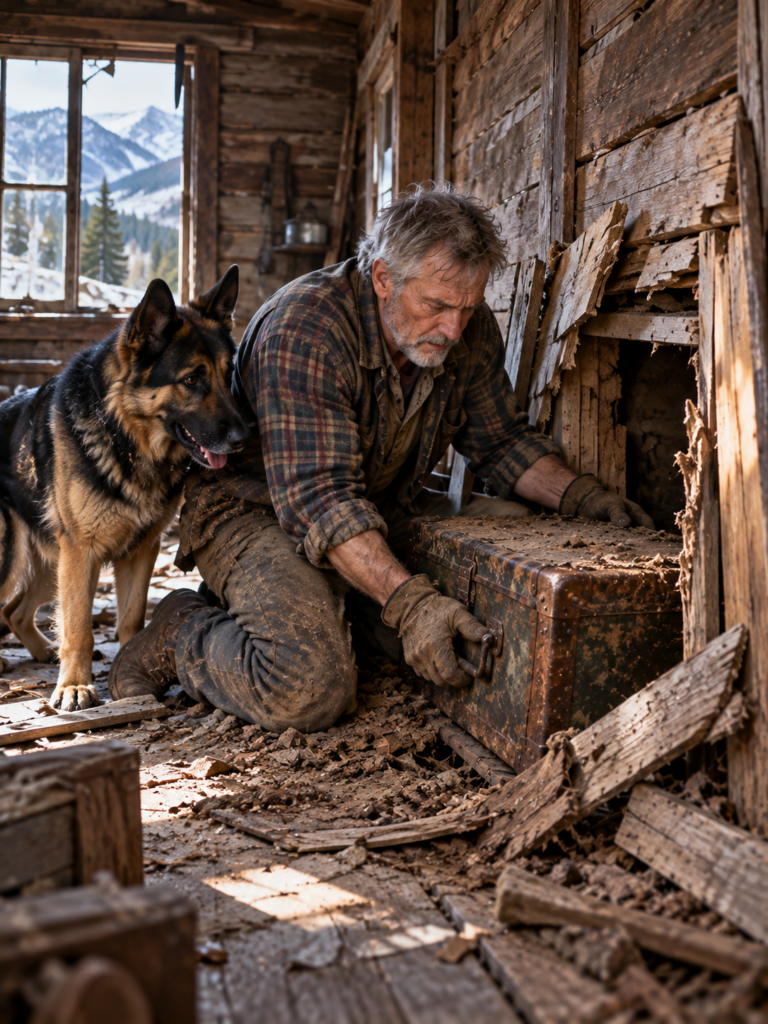
The latch resisted Marcus’s fingers, so he slipped the tip of his screwdriver beneath its edge and applied careful pressure.
The rusted fastening released with a sharp metallic snap.
Titan lifted his head.
Marcus opened the lid.
Inside were several bundles wrapped in stiff, aging cloth.
They had been protected from direct exposure, although dust had worked its way around the edges.
Marcus lifted the first bundle onto the floor.
The fabric unfolded around a stack of yellowed papers.
There were handwritten notes, measurements, and several maps.
He spread the largest map beside his knee.
Its ink had faded toward brown.
The lines marked ridges, streams, and a section of mountainous terrain.
He examined it without understanding the technical annotations.
Then he noticed the heading.
Silver Claim Survey.
Marcus read it twice.
“Silver?”
Titan sniffed the cloth wrapping.
Marcus looked toward the window.
The slope behind the cabin rose through dense pines toward exposed rock.
Could the map describe land somewhere nearby?
He turned to another document.
A signature appeared near the bottom.
Samuel R. Whitaker.
The records seemed to belong to an old prospecting venture.
Marcus searched through the bundles for a location that might establish whether the survey concerned his property.
A second sheet contained land measurements and geological observations.
The descriptions mentioned a creek, an eastern hillside, and a rocky outcrop.
Marcus thought of the stream he’d found that morning.
He returned to the map.
One creek bend looked familiar.
So did the ridge immediately east of the cabin.
He wasn’t certain.
A map more than a century old might not correspond to modern property boundaries, and he had no way to determine whether the underlying claim had survived.
Still, the resemblance was difficult to dismiss.
He opened another bundle.
Several small cloth bags lay inside.
He loosened one and tipped its contents into his palm.
Pieces of rock slid out.
Some contained a metallic sheen.
He held one beneath the flashlight.
A pale streak crossed its rough surface.
He knew enough not to identify a mineral by appearance alone.
But the rock had been deliberately preserved with the documents.
That made the old survey more than a random historical curiosity.
Marcus placed the sample beside the map.
The next pages contained correspondence between Whitaker and a man named Daniel Boone Carter.
The letters referred to early testing, a promising silver vein, and difficulties securing financing.
One letter linked the stalled development to the financial panic of 1884.
Marcus began to understand a possible history.
Someone had identified a promising mineral deposit.
They had recorded measurements, exchanged letters, and sought backing.
Then the project lost its financing.
The papers had been stored away.
But why inside this cabin wall?
He looked closely at the construction around the exposed cavity.
The old framing could have belonged to a structure used by people connected with the prospecting effort.
His father might later have purchased the property without realizing what remained there.
That would explain the chest’s presence.
But it didn’t establish who hid it or whether the ore deposit had ever been commercially valuable.
Marcus unfolded the survey again.
Near the center was a red circle.
Beside it, a notation identified a principal vein below a hillside.
He carried the map to the open doorway.
Titan followed.
The clearing stretched toward the trees.
Beyond it stood the rising eastern slope.
Marcus compared the old drawing with the land.
He could identify the stream’s general course.
The ridgeline looked similar.
And a rocky outcrop stood approximately where the red circle suggested.
He felt an unfamiliar excitement rise in his chest.
Then he stopped himself.
A century-old drawing was not a geological survey of the present.
A few metallic rock fragments did not prove a working mine.
And possession of a historic claim document did not automatically establish modern mineral rights.
He returned to the cabin.
“Easy, Marcus,” he said aloud.
Titan sat near the chest.
Marcus began sorting the documents into separate groups.
Maps.
Letters.
Survey notes.
Rock samples.
He placed the oldest papers carefully back on their cloth wrapping.
Then he studied one of Whitaker’s letters again.
The writer had believed the deposit could be substantial, but he had been unable to develop it.
That distinction mattered.
The buried chest contained evidence of an attempt to discover silver.
It did not yet prove the existence of an economically recoverable deposit.
Still, Marcus realized something that changed his understanding of the cabin.
His father had purchased twenty acres with an old, deteriorating structure and a history neither of them had investigated.
Now that forgotten history might be tied to the land itself.
He looked at the deed he’d brought from the divorce settlement.
The same parcel Rebecca had dismissed as nearly worthless.
If the map was accurate, a potentially valuable geological feature might lie beneath or near that property.
But the documents needed independent examination.
Marcus glanced at Titan.
The dog rested his muzzle on the floor beside the chest.
“You’ve given me quite a problem, old buddy.”
Marcus took a cloth folder from his duffel bag and began placing the survey papers inside.
He would drive to Hamilton and find someone qualified to examine the samples.
But first he needed to answer the simplest question.
Did the map actually match the mountain?
He opened it once more, set a finger on the marked creek bend, and began tracing the route toward the red circle.
Marcus’s finger followed the creek across the old map until it reached a sharp bend below the eastern hillside.
He stopped.
The bend resembled the place where he’d filled his canteen the previous morning.
But the old survey showed the stream from an unfamiliar angle. Several minor branches appeared on the drawing, and Marcus couldn’t be sure whether they still existed.
He carried the map outside.
Titan followed him down the porch steps.
The afternoon was cooling quickly. Wind moved through the pines, and shadows stretched across the clearing.
Marcus walked to the edge of the property where the forest began.
He could see the broad shape of the ridge from there.
The survey’s contours were imperfect, drawn before modern mapping equipment, but the hillside matched more closely than he expected.
Farther upslope, an outcrop interrupted the trees.
The red circle lay near a similar feature on Whitaker’s map.
Marcus looked toward it.
“That’s where he thought the silver was.”
Titan watched the hillside.
Marcus could have started digging immediately.
He had a shovel, a hammer, and enough stubbornness to exhaust himself before sundown.
But he’d spent too many years learning what happened when enthusiasm replaced preparation.
He turned back toward the cabin.
“Tomorrow, we’re finding someone who knows rocks.”
Inside, he spread the papers across the crooked table, holding the curling corners down with a wrench and his metal coffee cup.
He examined the documents until the fire burned low.
One letter particularly troubled him.
Whitaker had written confidently about a high-quality vein.
But the correspondence ended without establishing whether the prospectors had ever confirmed its full extent.
A claim abandoned because financing disappeared wasn’t the same as a claim abandoned because no valuable minerals existed.
Yet neither possibility could be ruled out.
Marcus wrote down the questions he wanted answered.
Were the rock samples actually silver-bearing ore?
Did the survey describe his property?
Was the deposit still there?
And, most importantly, did the old records establish any rights he could legally exercise?
He placed the documents carefully inside their cloth folder.
Titan slept beside the fireplace.
Marcus watched him for a moment.
Rebecca had laughed at the cabin.
The court had treated the property as a negligible asset.
And Marcus himself had accepted that judgment.
Now, for the first time, he wondered whether all of them had been mistaken.
The next morning, he secured the chest inside the cabin and carried the map, letters, and a small ore sample to his pickup.
Titan jumped into the passenger seat.
The engine required two attempts before it started.
They followed the dirt road down from the mountains, eventually reaching the paved route toward Hamilton.
Marcus hadn’t visited the town in years.
It seemed both familiar and strangely distant.
The streets were lined with small businesses, a diner, and modest offices serving the surrounding valley.
He stopped outside a geological services office.
Inside, shelves held rock specimens, survey equipment, and folders filled with technical documents.
A man in his forties looked up from a desk.
“Can I help you?”
“I hope so,” Marcus said. “I found some old survey papers.”
The man introduced himself as Ethan Brooks.
Marcus placed the folder on the desk.
Ethan opened it.
At first, his expression was professionally neutral.
Then he studied the large map.
He adjusted his glasses.
“Where did you get this?”
“Inside the wall of a cabin my father owned.”
Ethan looked at him.
“In the Bitterroots?”
“About ten miles west of town.”
The geologist spread the map flat.
He examined Whitaker’s measurements, the terrain markings, and the old correspondence.
Then he picked up the rock sample.
“Mind if I run a preliminary test?”
“That’s why I’m here.”
Ethan carried the sample into a small adjoining workroom.
Marcus waited.
Titan sat beside his chair, watching the door.
The minutes passed slowly.
Marcus looked around the office.
For years, the most important documents in his life had been deployment orders, medical reports, and finally divorce paperwork.
Now a set of century-old mining records lay before him.
And he had no idea whether they represented a forgotten fortune or an abandoned mistake.
Ethan returned after examining the sample.
His manner had changed.
“Mr. Hill, this sample contains high-grade silver ore.”
Marcus said nothing.
Ethan placed the specimen on the desk.
“That doesn’t establish the size of a deposit. We would need a proper geological survey, multiple representative samples, and a careful assessment of the property.”
Marcus nodded.
“But it is silver?”
“Yes.”
He looked down at the sample.
A small piece of stone.
Something he’d almost left inside a rusty box.
“What’s a deposit like that worth?”
“Potentially a great deal, if it extends the way these papers suggest. But we are nowhere near a defensible valuation.”
Ethan explained that individual high-grade samples could be misleading. A deposit needed sufficient size, continuity, accessibility, and economic viability.
Historical mining records could help identify promising ground, but a modern investigation would have to confirm the observations.
There was also the matter of ownership and mineral rights.
Marcus unfolded his deed.
Ethan reviewed the parcel description without claiming to settle the legal questions.
“You’ll need the title and mineral-rights position checked,” he said. “But first, you can compare the mapped outcrops with the terrain.”
Marcus looked toward the old survey.
“That’s what I intend to do.”
Ethan studied him.
“I’d suggest being careful about telling people what you’ve found until you know more.”
Marcus understood.
Rumors of silver could attract investors, companies, speculators, and unwanted attention.
He had barely enough money to repair his cabin.
He didn’t need people trying to buy a discovery he hadn’t even verified.
Ethan added that a full survey could establish whether the old prospect warranted further exploration.
Marcus thanked him and returned to the pickup.
Titan greeted him with a short wag of his tail.
“Well,” Marcus said, settling behind the wheel, “you found actual silver.”
The dog tilted his head.
“Not a fortune yet. But silver.”
On the way back, Marcus felt something he hadn’t experienced during the divorce.
Excitement without humiliation.
He wasn’t thinking about Rebecca.
He was thinking about the hillside.
When they reached the cabin, he gathered a flashlight, first-aid supplies, rope, the old map, and a small rock hammer.
He protected the survey inside a plastic sleeve.
Then he and Titan followed the route toward the eastern outcrop.
The trail climbed through thick trees.
Pine needles muffled their steps.
Marcus stopped frequently to compare the terrain against Whitaker’s notes.
The stream lay where the map suggested.
The ridge curved in the expected direction.
And when he reached the rocky hillside, the outcrop was unmistakable.
He studied exposed stone.
Several pieces showed faint metallic streaks.
He collected small samples from accessible rock rather than assuming that everything shiny was silver.
Titan moved a short distance upslope, nose close to the ground.
Marcus followed carefully.
Loose stones shifted beneath his boots.
The hillside steepened near an exposed section.
“Easy, boy.”
Titan stopped and looked back.
Marcus tested the ground before taking another step.
A stone slipped.
He caught himself against the outcrop, suddenly aware of the drop behind him.
The mountain was beautiful, but it was not forgiving.
He retreated to stable ground.
There would be no reckless excavation.
No rushing into unstable rock because he thought he might become wealthy.
He had survived too much to let impatience defeat him now.
Marcus sat on a broad stone and examined the map.
The red circle corresponded closely to the hillside where he’d collected the samples.
Whitaker’s survey was no longer merely a drawing hidden in a cabin wall.
At least part of it described the actual ground around him.
That answered one important question.
The documents were tied to this place.
The larger uncertainty remained.
How much silver lay beneath the mountain?
And who possessed the right to develop it?
Marcus rested the map against his knees.
His father had bought this property after the Vietnam War.
Had he known anything about the old mining effort?
Marcus tried to remember conversations from childhood.
His father had been a quiet man who preferred repairing engines to telling stories.
He’d spoken about building a hunting retreat, fishing in mountain streams, and escaping the noise of ordinary life.
Never about silver.
Never about historic mining claims.
Perhaps the chest had already been sealed when his father bought the land.
Perhaps he never removed the siding.
Marcus himself had almost missed it.
Without Titan scratching that precise section of wall, the chest might have remained there for another century.
He looked at the dog.
“You found what three generations of people overlooked.”
Titan moved closer and rested his head against Marcus’s arm.
For a moment, the discovery felt less like the beginning of a fortune and more like a message from an unexpectedly complicated past.
The old prospectors had believed in the ground beneath them.
His father had believed the land would someday give his family a place to retreat.
And Marcus, after losing nearly everything in his divorce, had come here expecting nothing.
Now he had a reason to stay.
Over the following weeks, Marcus worked with Ethan Brooks to examine the property more thoroughly.
The old survey helped guide their investigation.
Samples taken from the relevant exposures supported the presence of silver-bearing mineralization.
The work also made clear that Whitaker had not simply imagined his find.
His notes were grounded in the terrain, and several geological observations held up under modern examination.
But the historic correspondence clarified another part of the mystery.
The proposed mining venture had been interrupted by financial trouble following the panic of 1884.
The backers withdrew.
Development stalled.
Without sufficient capital, the project never matured into the operation Whitaker had envisioned.
Over time, the documents disappeared from view.
The chest was hidden inside the old structure and eventually forgotten.
Marcus looked again at the ruined cabin.
It had stood for more than a century as the last physical witness to an unfinished prospecting effort.
And the evidence of that effort had been concealed in a wall nobody thought worth repairing.
The discovery changed Marcus’s plans.
He had originally intended to make the building just safe enough to survive winter.
Now he began considering how to restore it properly.
Ethan advised him to proceed cautiously with further evaluation.
Marcus also understood that the property’s legal status needed to be clarified before any commercial development.
He began organizing the documents and reviewing the information connected to his deed.
There was no reason to contact Rebecca.
The twenty acres had been assigned to him during the divorce.
But Marcus knew that if the property became demonstrably valuable, she might reconsider the bargain she once ridiculed.
He wasn’t interested in revenge.
He wanted certainty.
And he wanted to know whether the land contained a resource substantial enough to support a future he had stopped expecting.
One afternoon, Ethan brought him the results of additional geological work.
The findings supported a potentially significant silver deposit.
Commercial development would still require planning, technical evaluation, and substantial expense.
But the prospect was real enough to justify continuing.
Marcus stood beside the table where the documents were spread.
For several seconds, he couldn’t speak.
Then he looked out toward the hillside.
A century earlier, Samuel R. Whitaker had believed that rock concealed something valuable.
Now modern examination was beginning to confirm that he had identified a genuine mineral occurrence.
Marcus turned toward Titan.
“Looks like the old fellow wasn’t wrong.”
Ethan smiled.
“Which old fellow?”
Marcus looked down at the dog.
“Take your pick.”
But that evening, as he returned the survey to its protective folder, Marcus understood that the discovery would bring more than financial opportunity.
It would bring decisions.
About the land.
About the past.
And about the people who might suddenly become interested in a cabin they had once called worthless.
He placed his father’s deed beside the old silver survey and began comparing what each document actually established.
The deed established Marcus Hill’s ownership of the twenty-acre property, while the old silver survey described a mineral prospect that had been investigated more than a century earlier.
They were different kinds of evidence.
Marcus laid them side by side, tracing the property description with one finger and Whitaker’s hand-drawn contours with the other.
The survey suggested where mineralization might lie.
The deed described the land he had received through his father and retained in the divorce settlement.
Neither document, by itself, answered every question about the mineral rights or the commercial value of what lay belowground.
That distinction became central to everything Marcus did next.
He had learned during military service that the most dangerous assumptions were often the ones people wanted to believe.
He wanted the silver to be valuable.
He wanted Rebecca to have been wrong.
He wanted the twenty acres to give him a new beginning.
But wanting something didn’t make it true.
So he continued working with Ethan Brooks.
They reviewed the history of the prospect.
They examined the old maps against the terrain.
They arranged further geological evaluation of the silver-bearing exposures.
And Marcus sought clarification of the ownership questions before proceeding with development.
The historical papers formed a coherent account.
Samuel R. Whitaker had identified promising silver-bearing ground in the Bitterroot Mountains.
He surveyed the terrain, collected samples, and corresponded with Daniel Boone Carter about financing a mining venture.
The early evidence encouraged them.
But the financial crisis in 1884 disrupted the plan.
The enterprise lost backing.
The proposed mine never became a functioning commercial operation.
As the prospecting venture faded, its documentation disappeared into the structure that later became Marcus’s cabin.
The chest remained hidden behind the boards.
Decades passed.
The hillside stayed largely undisturbed.
Marcus’s father eventually purchased the land, intending to use it as a hunting retreat.
There was no evidence that he understood the old prospect’s significance.
He died before fully developing the property.
Marcus inherited it but spent years overseas and then occupied with his marriage and family life.
The cabin deteriorated.
And the compartment remained sealed.
Until Titan found it.
Marcus returned frequently to the hidden space after removing the chest.
He studied the old framing and the way the boards had been fastened.
The compartment had clearly been intentional.
Yet the documents did not reveal exactly who had closed it or why the final custodian chose that location.
Perhaps someone intended to retrieve the records when financing returned.
Perhaps the chest was stored there for safekeeping during an uncertain period.
The complete reason remained unknowable.
Marcus didn’t need to invent an explanation.
The surviving evidence established what mattered.
A promising prospect had been documented.
The venture had failed to advance.
Its records had been preserved in the cabin.
And the ground could now be investigated again.
Over time, the modern geological work made the potential clearer.
Ethan confirmed that the silver-bearing zone was substantial enough to deserve commercial consideration.
The project would require careful engineering, financing, and safe operating plans.
Marcus had no wish to turn the property into a reckless excavation.
He had been wounded by enough things in life.
He would not create a new danger simply because there was money beneath the hillside.
He insisted that the work proceed methodically.
The mountain had waited more than a century.
It could wait for people to do the job correctly.
Gradually, the property began changing.
The cabin’s roof was repaired.
The damaged walls were reinforced.
The porch became stable enough for Marcus to sit outside without worrying about the boards beneath him.
He restored what he could of the old interior, preserving the stone fireplace and the character of the building.
The rusty chest remained part of the cabin’s history.
He cleaned it carefully without trying to make it look new.
The iron corners still bore the marks of age.
The latch still showed corrosion.
And the old papers were kept protected from further deterioration.
They were more than a discovery now.
They explained why the property possessed possibilities nobody had considered during the divorce.
Marcus found himself returning to the historical correspondence whenever the demands of planning became exhausting.
Whitaker had been confident in the mineral evidence but unable to find enough financial support.
Marcus understood something of that disappointment.
Different century.
Different circumstances.
But the same painful distance between what someone hoped to build and what life allowed him to keep.
The thought made him treat the old documents with increasing respect.
Meanwhile, the potential value of the silver began attracting attention.
People in the area heard that the neglected Hill property had become the subject of geological work.
There were inquiries.
Offers.
Questions about development.
Marcus received attention from people who had never shown interest in the cabin when it was falling apart.
He listened carefully.
He avoided making promises he didn’t understand.
And he continued working with specialists.
The property that had once seemed nearly worthless was becoming associated with a potentially lucrative mining opportunity.
That did not make Marcus automatically wealthy.
A mineral deposit still had to be developed.
Revenue still depended on actual production and costs.
But the discovery gave him something he’d almost forgotten how to feel.
A future he could plan.
For the first time since the divorce, he wasn’t organizing his life around loss.
He was making decisions about what came next.
And he was making them for himself.
Almost two years after the divorce, a black SUV entered the clearing.
Marcus heard it before he saw it.
The sound of tires on the gravel road reached him as he stood near the cabin, reviewing work underway on the hillside.
Titan lifted his head.
Marcus looked toward the arriving vehicle.
A woman stepped out.
Rebecca.
For a moment, he felt the old tightening in his chest.
He recognized her coat, her posture, and the expression she used when she believed a conversation ought to proceed on her terms.
She looked around the clearing.
The cabin had been repaired.
Equipment stood near the hillside.
The property was plainly no longer the abandoned, useless retreat she’d mocked in court.
A man emerged beside her.
He introduced himself as Daniel Pierce.
A representative accompanying Rebecca.
Marcus studied them both.
He had not invited either of them.
“Hello, Marcus,” Rebecca said.
He nodded.
“Rebecca.”
Her eyes moved toward the hillside.
“I’ve heard some interesting things about this place.”
Marcus didn’t answer.
She continued.
“Apparently, the land you received in our settlement has become quite valuable.”
Titan stood close beside him.
Marcus rested his hand lightly on the dog’s neck.
The animal settled.
Daniel Pierce cleared his throat.
“We’d like to discuss certain issues concerning the original property settlement.”
Marcus watched him.
“What issues?”
Pierce suggested that there might have been a misunderstanding about the property’s value and its place within the marital estate.
Rebecca spoke before he could continue.
“We were married for twenty-eight years, Marcus.”
“I remember.”
“You can’t seriously believe this has nothing to do with me.”
Marcus looked toward the repaired cabin.
He remembered the courthouse in Missoula.
The settlement.
The way Rebecca had accepted the valuable assets while dismissing the mountain property as practically useless.
He remembered her laughter beside Andrew Keller.
And the advice she’d shouted across the parking lot about not letting the shack collapse on him.
But none of those memories gave him reason to be careless now.
He asked Pierce what specific basis they were asserting.
The man referred to the need for further review of the settlement and the circumstances surrounding the land’s valuation.
Marcus listened.
He understood that a change in value did not, by itself, prove entitlement.
He also understood that legal questions required more than exchanging arguments beside a cabin.
“The property was assigned to me,” he replied. “If you believe there’s a legal issue, put it in writing.”
Rebecca crossed her arms.
“So that’s it? You’re not even willing to talk?”
“I’m talking now.”
She looked toward the hillside again.
“You had no idea what was here during the divorce.”
“Neither did you.”
“That’s not the point.”
Marcus shook his head.
“It’s an important part of the point.”
The cabin had been neglected.
Its potential was unknown.
Rebecca had considered it undesirable.
Marcus had accepted it.
Later, after he began repairing the building, Titan discovered the concealed chest.
Only then did the possibility of silver become apparent.
No one at the divorce proceedings had presented evidence establishing a valuable mine beneath the property.
Marcus had not concealed a known deposit from Rebecca.
He had discovered the historical records afterward.
Pierce continued discussing possible legal interpretations.
Marcus remained polite.
He did not attempt to resolve complicated property questions by arguing.
Instead, he made clear that the settlement documents and the relevant records could be reviewed through the appropriate channels.
Rebecca seemed dissatisfied.
She looked toward the repaired porch.
“You always were stubborn.”
Marcus allowed himself a small smile.
“Sometimes.”
For a moment, neither spoke.
He looked at the woman he’d shared almost three decades with.
He could remember good years.
Ordinary mornings.
Shared plans.
Long conversations before the marriage became a struggle neither of them knew how to repair.
Those memories were real.
So was the hurt that followed.
He had spent months thinking about what he might say if he ever faced her again.
He had imagined explaining how deeply her mockery wounded him.
He had imagined proving that he wasn’t a failure.
But standing there, with the mountain behind him and Titan beside him, he realized something had changed.
He no longer needed her to agree with his worth.
Rebecca’s gaze shifted toward the dog.
“Still have Titan, I see.”
Marcus rested his palm against the German Shepherd’s head.
“Of course.”
She looked at him for a moment.
Then her expression hardened.
“Do you think this is over?”
Marcus met her eyes.
“Our marriage ended when the settlement was finalized.”
The wind moved across the clearing.
He continued more quietly.
“If there’s a legitimate legal question, it can be handled properly. But I’m not going to relive our marriage because this property turned out differently than either of us expected.”
Rebecca looked away.
The conversation had reached its end.
She returned to the SUV.
Pierce followed after a brief hesitation.
Marcus watched the vehicle travel down the gravel road.
He felt no great victory.
No desire to laugh after her as she had laughed at him.
He was simply relieved to see the clearing become quiet again.
Titan pressed his nose against Marcus’s hand.
Marcus scratched behind his ears.
“Come on, partner.”
He looked toward the hillside.
Work was continuing.
The men there had practical concerns to manage.
Equipment.
Schedules.
Safety.
The prospect still required effort.
There was no point standing in the driveway replaying the past.
Marcus returned to the work at hand.
In the years that followed, the silver project developed into a modest, carefully managed mining operation.
It was not the vast industrial complex people might imagine from stories of sudden mineral wealth.
Marcus preferred a smaller operation with clear oversight and respect for the mountain.
The old geological records continued to guide the understanding of the deposit’s history, while modern surveys informed the actual mining decisions.
Ethan Brooks remained an important part of the work.
Marcus never pretended that a lifetime of military service made him a geologist.
He listened to those who understood the terrain and its risks.
He also remembered the circumstances that brought him there.
He knew what it felt like to be older, injured, and uncertain whether anyone still wanted his help.
As the operation became established, he began looking for ways to create opportunities for other veterans.
Not everyone returning from military service could simply resume the life they’d left.
Some carried physical injuries.
Some struggled with ordinary routines.
Others needed steady work and a place where their experiences would not be treated as weaknesses.
Marcus understood those difficulties.
He had lived with them for years.
So the property gradually became more than a mining site.
Cabins appeared among the trees.
Veterans were offered opportunities to work and regain stability.
The clearing that once held nothing but a collapsing building and an old truck began filling with purposeful activity.
The original cabin remained at the center.
Marcus refused to replace it with a grand house.
He repaired it.
Strengthened it.
Made it comfortable.
But he preserved its essential shape.
The stone fireplace still stood against the far wall.
The old table remained in use.
And the section of the rear wall where Titan discovered the chest was carefully restored.
Marcus knew exactly where the compartment had been.
Sometimes, when visitors asked about the property’s history, he showed them the old mining papers.
He explained the survey.
Samuel R. Whitaker’s work.
The correspondence with Daniel Boone Carter.
The financial troubles that interrupted the venture.
And the long period when the records lay forgotten.
He never claimed to know exactly who had hidden the chest.
That part of the history remained uncertain.
But he could explain what the evidence established.
A deposit had been identified.
The effort to develop it had failed.
The records survived.
And a century later, a German Shepherd’s curiosity brought them back into the light.
Three years after Marcus first arrived at the cabin, the clearing looked entirely different.
The mining operation was organized and productive.
The restored cabins glowed warmly after sunset.
Men who had once felt abandoned now had somewhere to work, rest, and rebuild their confidence.
Marcus walked among them without ceremony.
He helped when he could.
He listened when someone needed to talk.
And when difficult memories returned at night, he had people nearby who understood that recovery was rarely a straight line.
Titan remained his closest companion.
The dog was older now.
His movements were slower on cold mornings.
Sometimes he needed extra time climbing the porch steps.
Marcus never hurried him.
They had spent too many years looking after each other for that.
One autumn evening, Marcus sat outside the cabin with a blanket over his shoulders.
The mountains stood dark against a fading sky.
A few lights shone among the buildings farther down the clearing.
Laughter carried softly through the trees.
Titan lay beside his chair.
His muzzle rested against Marcus’s boot.
Marcus looked toward the hillside where the mining work had continued that afternoon.
He remembered standing on that same ground just after the divorce.
The broken windows.
The collapsing porch.
The cold air moving through gaps in the walls.
He’d been sixty-three, recently divorced, and uncertain how to survive the winter.
Rebecca had considered the cabin an insult.
At the time, Marcus had nearly agreed.
Now the property contained work, warmth, and people beginning new lives.
He looked down at Titan.
“Remember when we found that box?”
The dog’s tail moved once against the porch.
Marcus smiled.
“Neither one of us knew what we were getting into.”
Titan shifted closer.
Marcus placed a hand against the dog’s neck.
For a while, he watched the distant lights.
He understood something now that had escaped him during the early months.
The silver mattered.
Without it, many of the changes on the property would not have been possible.
But the money alone had never been enough to restore his life.
He had needed purpose.
Something to build.
Someone to care for.
A reason to get up in the morning that had nothing to do with proving Rebecca wrong.
Titan had given him that long before the hidden chest was discovered.
The dog had stayed with him through war memories, the collapse of his marriage, and those first freezing nights in the cabin.
Even before the silver was confirmed, Marcus had begun to feel better while repairing the old walls and walking the mountain trails.
The land had given him room to begin again.
The discovery had given him an opportunity to make that beginning larger.
He looked toward the repaired siding at the rear of the cabin.
He could still remember the sound of his hammer striking wood.
Solid.
Solid.
Then hollow.
Such a small difference.
A sound he might never have noticed if Titan had not insisted on scratching that particular board.
Marcus leaned back in his chair.
“Good find, old friend.”
Titan lifted his head.
His ears moved toward the cabin.
Then he settled again.
Marcus watched the last color leave the western sky.
He thought of his father buying this land after Vietnam.
A man with plans for a quiet hunting retreat.
He wondered what his father would think if he could see the property now.
The old cabin restored.
The mining work established.
Veterans living and working among the trees.
Marcus liked to believe his father would recognize the place despite all the changes.
Perhaps he’d even be pleased that the land had finally become something useful.
But Marcus didn’t need to imagine hidden instructions or secret messages from him.
His father’s gift had been the property itself.
The silver discovery belonged to a much older history.
And what Marcus built afterward belonged to the present.
The distinctions mattered.
They made the story more remarkable, not less.
His father had bought land for one purpose.
An earlier generation had investigated it for another.
And Marcus had nearly lost interest in it entirely.
Only a loyal dog had drawn his attention toward the missing evidence.
The wind cooled.
Marcus adjusted the blanket.
Titan rested his head against his knee.
Inside the cabin, a fire burned steadily.
The roof no longer leaked.
The windows were secure.
The walls no longer groaned under every gust of mountain wind.
It was a home.
Not because it was valuable.
Because Marcus had made it one.
As the years continued, the relationship between Marcus and the mountain settled into a familiar rhythm.
The mining operation provided income and employment.
The surrounding cabins gave veterans a stable place to begin new chapters.
The original house remained Marcus’s refuge.
He still experienced difficult nights.
A sudden sound could bring back an old memory.
Some mornings, his body ached more than he wanted to admit.
But he no longer measured his life against the marriage that had ended.
He measured it by the things he could still do.
A repaired fence.
A conversation with a veteran who had struggled to find work.
A safe day’s activity on the hillside.
A quiet evening beside Titan.
Then came the first snowfall of another winter.
Marcus woke before dawn.
The cabin felt unusually quiet.
The fire had burned down during the night, but enough warmth remained to keep the room comfortable.
He rose slowly and walked toward the window.
Snow had covered the clearing.
The mining equipment stood silent.
The pine branches carried thick white layers.
The hillside where Whitaker had once marked a silver vein had disappeared beneath the winter light.
Titan approached and stopped beside him.
Marcus opened the door.
Cold, clean air moved into the room.
They stepped onto the porch together.
The world was almost entirely white.
Marcus stood with his hands resting on the wooden railing.
He remembered the courthouse.
The deed Rebecca had dismissed.
His father’s unfinished hunting retreat.
The old metal chest.
Whitaker’s faded survey.
Ethan Brooks confirming the silver.
The years of work that followed.
And the men who now called this mountain property home.
Titan leaned gently against his leg.
Marcus looked down.
The dog had grown older beside him, but his eyes remained alert and familiar.
Marcus reached down and rubbed the thick fur behind his ears.
“You know something, buddy?”
Titan looked up.
Marcus glanced across the snow-covered clearing.
“I thought I was coming here because there was nowhere else left for me to go.”
He paused.
A thin ribbon of smoke rose from the chimney of one of the veterans’ cabins.
A light appeared in another window.
Soon the clearing would wake.
People would make coffee.
Someone would start clearing snow from the walkways.
The ordinary work of another day would begin.
Marcus smiled.
“Turns out we had somewhere we needed to be.”
Titan’s tail brushed against his leg.
They stood together as the sun rose over the Bitterroot Mountains.
The hidden silver had changed Marcus Hill’s circumstances.
But the more enduring discovery was that losing the life he’d known had not meant losing the possibility of another.
He had been left with a collapsing shack, twenty acres of forgotten land, and one faithful German Shepherd.
With time, work, and an extraordinary find concealed inside an old wall, he had built something he could never have imagined in the courthouse.
Not simply a mine.
Not simply wealth.
A home where his own recovery could continue, and where other people could begin theirs.
Marcus looked down at Titan one final time.
“Come on, soldier. Breakfast.”
The German Shepherd followed him back through the doorway.
And behind them, the mountain settled into the quiet winter morning, its century-old secret no longer hidden, and the life built from its discovery continuing in the clearing below.

