
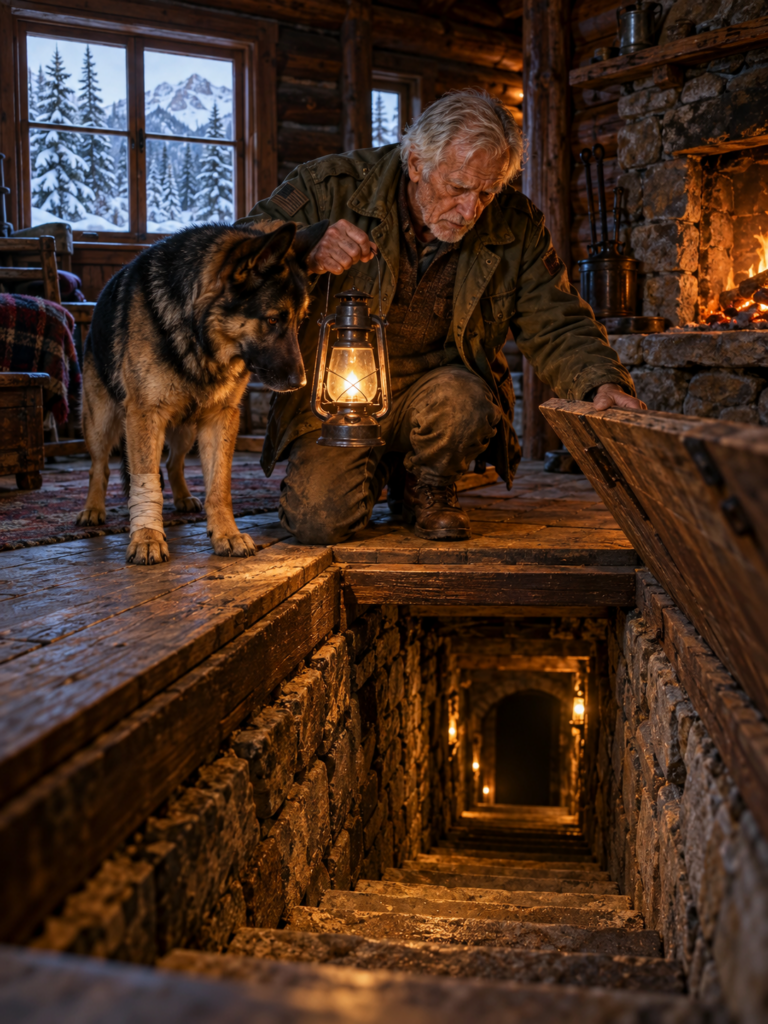
Franklin lowered his weight onto the first step.
The stone held.
He tested the second before shifting his balance.
Above him, Titan stood at the opening, watching closely.
“Stay where you are until I know what’s down here.”
Franklin moved another step.
The air grew cooler.
The walls narrowed just enough that his shoulders nearly brushed the stone.
He counted his movements carefully, keeping the lantern away from the wall.
Ten steps.
Fifteen.
Then the staircase curved.
Franklin could no longer see the cabin floor above.
He stopped.
For an instant, the enclosed passage awakened a memory from Iraq: a damaged building, darkness, and a voice calling for help somewhere he couldn’t reach.
His breathing quickened.
Then came the familiar sound of Titan’s paws on stone.
Franklin looked back.
The German Shepherd had followed him, placing his bandaged paw carefully on each step.
Franklin exhaled.
“Couldn’t leave me alone for five minutes, could you?”
Titan approached and pressed against his leg.
Franklin rested his free hand on the dog’s neck.
The memory loosened.
He was beneath a cabin.
Not in a war zone.
And he wasn’t alone.
They continued.
At the bottom, the narrow passage opened into a large underground chamber.
Franklin raised the lantern.
The light traveled over stone walls and wooden shelves.
The room was almost as broad as the cabin above.
Metal containers lined one side.
Sealed boxes occupied another.
But in the center stood three enormous wooden trunks reinforced with dark iron bands.
Franklin stopped.
There was no ordinary explanation for why Walter Briggs needed a concealed room of this size.
He approached the nearest trunk.
Its iron fittings were old.
Dust lay along the lid.
Nothing suggested anyone had opened it recently.
Franklin lowered the lantern and tested the lid.
It moved.
He lifted it carefully.
Rows of dull yellow metal caught the light.
For several seconds, Franklin simply stared.
Gold bars.
Each arranged with remarkable precision.
Several bore stamped markings.
He reached toward one, then stopped.
A metal bar that resembled gold wasn’t proof of its purity or ownership.
But the arrangement left little doubt that Walter had considered these objects valuable.
Franklin closed the trunk.
He crossed to the shelves.
Inside the first metal container he opened were envelopes of financial documents.
Investment records.
Stock certificates.
Papers concerning accounts and property holdings.
The figures appearing throughout them were astonishing.
Some showed amounts in the millions.
Others referred to transactions spread across many years.
Franklin sat on the edge of a nearby chair.
Walter hadn’t merely owned a peaceful mountain retreat.
He had apparently accumulated substantial wealth and stored evidence of it beneath the cabin.
Franklin looked toward the three trunks.
If the gold was genuine, it represented an extraordinary fortune by itself.
And the documents suggested it was only one portion of Walter’s holdings.
“What were you doing down here, Walter?”
Titan moved among the shelves, sniffing cautiously.
Franklin found velvet-lined cases containing antique watches, rare coins, and jewelry.
Another trunk held sealed bottles of old wine and whiskey.
Everything had been arranged with care.
The room looked less like a hurried hiding place than a collection accumulated and protected over decades.
Then Franklin noticed a small wooden desk against the far wall.
A leather-bound notebook rested on it.
Beside the notebook lay a sealed envelope.
Franklin approached.
The lantern revealed handwriting on the front.
His own name.
Franklin Hayes.
He froze.
Walter had expected him to discover this room.
Or at least had prepared for the possibility.
Franklin sat in the chair.
He lifted the envelope.
The paper felt dry and undisturbed.
He recognized nothing about the handwriting.
Walter had been little more than a name in an unexpected inheritance notice.
Why would a distant cousin leave him an underground fortune?
And why address a private letter to him inside a concealed chamber?
Franklin opened the envelope.
The first lines confirmed that Walter intended the letter for whoever discovered the vault—and specifically for Franklin.
The writer even anticipated Titan’s involvement.
Franklin looked at the dog.
“You’ve got yourself quite a reputation for somebody Walter barely knew.”
Titan sat beside the desk.
Franklin continued reading.
Walter wrote about people who pursued money aggressively and people who accepted responsibility without demanding rewards.
Then he described a family gathering twenty-five years earlier.
Franklin’s fingers tightened around the page.
According to Walter, he had watched Franklin repair a broken truck while other relatives argued about property.
Franklin stared at the words.
He couldn’t immediately remember the gathering.
But he remembered countless occasions when he’d fixed something while the rest of the family talked about what they wanted.
Walter had noticed.
And afterward, according to the letter, he had continued following news of Franklin’s life.
His military service.
His responsibilities.
His sacrifices.
The letter offered a startling partial answer.
Walter hadn’t selected Franklin randomly.
He had been paying attention for years.
But Franklin still didn’t understand why that quiet observation had led to a concealed fortune beneath a mountain cabin.
He held the paper closer to the lantern.
Then he turned it slightly and began reading the final lines.
The final lines told Franklin that Walter Briggs had admired the way he accepted responsibilities without expecting a reward.
And because of that, Walter had chosen him.
Franklin read the conclusion twice.
The man had entrusted the cabin and the wealth beneath it to a relative he believed would handle both with care.
There were no complicated instructions for spending the fortune.
No demand for a monument.
No request that Franklin punish relatives who had treated him badly.
Only an appeal to exercise good judgment.
Franklin lowered the letter.
For several seconds he listened to the faint hiss of the lantern.
Titan’s head rested against his knee.
Franklin stared across the chamber at the iron-bound trunks.
He had arrived in the mountains with a duffel bag, a pension, and a dog.
Now he was surrounded by assets whose value he couldn’t begin to determine without professional help.
But the most unsettling discovery was not the gold.
It was the knowledge that someone had noticed how he lived.
For twenty-five years, Walter Briggs had apparently watched from a distance.
Not every day.
Not every decision.
But enough to form an opinion about the man Franklin had become.
And the opinion was different from the one his children seemed to hold.
Greg saw an elderly father who couldn’t sleep without nightmares.
Amanda saw an inconvenience.
Melissa rarely called.
Walter had seen a person capable of responsibility.
Franklin folded the letter carefully.
“Wish we’d talked, Walter.”
He looked toward the notebook.
Its pages were filled with orderly entries documenting property purchases, investments, transactions, and accounts.
Some dated back more than thirty years.
Others were comparatively recent.
Franklin studied the handwriting.
The records suggested Walter had spent much of his adult life gathering and managing wealth without drawing attention to it.
One entry described the advantages of allowing wealth to remain quietly protected.
Franklin looked around.
Walter had taken that philosophy literally.
A cabin in the forest.
A hidden staircase.
A chamber beneath stone and timber.
But there was a distinction Franklin understood.
The notebook could describe what Walter believed he owned.
It could not, by itself, establish every current account balance, legal entitlement, or financial obligation.
The bars would need authentication.
The documents would need professional examination.
And the estate’s handling of the concealed assets would need careful review.
For the moment, Franklin could establish one essential fact.
Walter had knowingly left him far more than an old mountain cabin.
The letter explained why.
And the notebook showed that the concealed collection had been assembled deliberately over time.
Franklin extinguished the urge to keep opening boxes simply because he could.
He had seen enough for one day.
He gathered the letter and notebook, lifted the lantern, and turned toward the stairs.
“Let’s go upstairs, partner.”
Titan followed.
Franklin climbed slowly, pausing whenever his knees protested.
When they reached the living room, he replaced the floor panel and spread the rug over it.
The opening disappeared.
Nothing in the room suggested that a fortune lay beneath the fireplace.
Franklin sat in the wooden chair facing the hearth.
Titan settled beside him.
Outside, snow began falling.
The cabin looked exactly as it had when Arthur Lane handed him the keys.
But Franklin could no longer see it in quite the same way.
It wasn’t merely shelter.
It was Walter Briggs’s final expression of trust.
Over the next few days, Franklin examined the notebook gradually.
He studied its dates, compared entries, and tried to understand how Walter had acquired his holdings.
He did not immediately contact his children.
He wasn’t ready to explain the discovery before he understood it himself.
Instead, he repaired loose porch boards, organized the firewood, and continued learning the routines of mountain life.
One morning, he drove the old pickup Walter had left on the property into Clearwater, a small town in the valley.
Titan rode beside him.
Franklin bought groceries and tools, then stopped at a diner.
He had barely finished his coffee when a man approached outside.
The stranger introduced himself as Tom Larkin.
He asked whether Franklin was the person now living at the Briggs cabin.
Franklin confirmed it.
Tom said he remembered Walter as a quiet, unusual man.
The conversation was polite.
Still, Franklin noticed Tom watching the pickup when they parted.
Driving home, Franklin wondered whether news of Walter’s inheritance had begun circulating.
That would hardly be surprising.
Small towns often remembered people who kept to themselves.
And a new resident arriving at a property left vacant by death naturally attracted curiosity.
Franklin resisted giving that curiosity a sinister meaning.
Tom hadn’t threatened him.
He hadn’t mentioned the vault.
He might simply have wanted to welcome a newcomer.
But the meeting reminded Franklin that the cabin wasn’t as removed from the world as it sometimes felt.
Five days after discovering the chamber, he was repairing the porch railing when Titan stopped watching the forest and turned toward the road.
A truck was coming.
Franklin set down his hammer.
The vehicle rounded the last curve.
Greg’s truck.
Franklin felt his stomach tighten.
His son stepped out wearing a heavy coat.
Then the passenger door opened.
Melissa.
His daughter.
Franklin hadn’t seen her in almost a year.
Neither offered the kind of embrace he’d once expected from his children.
Greg looked at the cabin with open skepticism.
Melissa examined the aging logs and porch.
Franklin waited.
“What brings you both here?”
Greg rubbed his hands together.
“We’ve been talking to someone about the property.”
“What about it?”
“Dad, you’ve inherited forty acres in the mountains. That’s a lot for someone your age to handle.”
Franklin leaned against the porch railing.
“I’m handling it.”
Greg looked toward the roof.
“Until something goes wrong.”
Melissa stepped forward.
“We’re worried about you living here by yourself.”
Franklin glanced at Titan.
“I’m not exactly by myself.”
Greg dismissed the remark.
He explained that they had spoken with a lawyer about whether Franklin was capable of managing the property.
Franklin studied his son’s face.
“What are you actually asking me to do?”
Greg answered reluctantly.
Let them manage the land.
Sell it if necessary.
Use the proceeds to place Franklin somewhere supposedly safer.
“An assisted-living place?” Franklin asked.
Melissa said it might be worth considering.
Franklin remembered hearing Greg and Amanda discussing precisely that possibility while he slept in the garage.
He had never forgotten how little say he seemed to have in those conversations.
“I’m seventy-five,” he said quietly. “That doesn’t mean I’ve stopped being an adult.”
Greg’s jaw tightened.
“You have nightmares. You barely talk to anyone. You’re out here in the middle of nowhere.”
Franklin waited until his son finished.
“I know where I am. I know what I inherited. And I know what I want.”
Greg looked toward the cabin.
“You’ve got PTSD, Dad.”
“Yes.”
“That should tell you something.”
“It tells you I need to keep taking care of my health. It doesn’t tell you I can’t make decisions.”
Melissa looked away.
Greg eventually stated what Franklin had been expecting.
If Franklin refused to cooperate, they were prepared to seek a guardianship review through the court.
Franklin felt the familiar pressure of anger.
He had served his country.
Raised a family.
Worked for decades.
Managed his responsibilities even when sleep and memories made ordinary days difficult.
Now his own children were suggesting that a diagnosis and an isolated home justified removing his control over his life.
He looked at Greg.
“Is this about my safety or the land?”
Greg’s expression hardened.
“It’s about doing what’s best.”
“For whom?”
Neither child answered directly.
Franklin stood upright.
“I’ve heard what you have to say.”
Melissa tried again.
“Dad—”
“You should leave before the road freezes.”
Greg stared.
“You’re refusing?”
“Yes.”
His son shook his head.
“Then we’ll let the court decide.”
Titan moved closer to Franklin.
A low warning came from the dog’s chest.
Franklin rested one hand against his neck.
“Easy.”
Greg and Melissa returned to their truck.
Franklin watched them drive away.
He remained on the porch long after the sound of the engine disappeared.
Walter’s fortune had not been mentioned.
That worried him in a different way.
His children were already prepared to seek control of what they believed was a modest parcel of land.
What might happen if they learned what was beneath the fireplace?
Franklin went inside.
He looked at the rug covering the concealed panel.
Then he took Walter’s letter from the table and reread it.
The man who wrote it had believed Franklin would act responsibly.
Franklin now had to decide how to protect both the estate and his independence.
That evening, a storm moved into the mountains.
Snow swept between the cedars.
Wind pressed against the cabin walls.
Franklin sat near the fireplace with Titan resting beside him.
He tried to read but kept hearing Greg’s final words.
The court would decide.
Franklin had spent years being told what he should do.
Where he should live.
How much help he needed.
What was too difficult at his age.
He understood that concern could be genuine.
But concern became something else when it refused to listen to the person supposedly being helped.
Titan suddenly lifted his head.
Franklin looked toward him.
“What is it?”
The dog’s ears were pointed toward the back door.
At first, Franklin heard only wind.
Then came a heavy thump.
He sat upright.
A second noise followed.
Footsteps.
Someone was outside the cabin.
Franklin rose and took the flashlight from the table.
“Titan. Stay close.”
The German Shepherd moved toward the back door.
The handle rattled.
Franklin’s heart began to pound.
“Who’s there?”
No answer.
Then the door was forced open.
Cold air burst into the room.
A man wearing a dark jacket and a ski mask stepped across the threshold.
For one suspended second, the intruder stared at Franklin.
Then he noticed Titan.
“Back!”
The dog stood between them.
The man advanced.
Titan lunged.
The impact drove the intruder backward.
He struck the wall, struggling to free his sleeve from the dog’s grip.
Franklin shouted for him to leave.
Then the man pulled a metal pipe from his pocket.
He swung.
The blow struck Titan’s side.
The shepherd cried out.
Franklin felt something inside him go cold.
“Titan!”
The man swung again.
In the struggle, he stumbled into the kitchen table.
The pipe struck the floor.
He wrenched free and fled through the open doorway.
Franklin moved toward the entrance but stopped when he heard Titan whimper.
The dog had lowered himself near the fireplace.
Franklin immediately knelt beside him.
Blood darkened the fur near his ribs.
His hands shook as he examined the injury.
The visible cut was limited, but Franklin couldn’t know how much damage the impact had caused beneath the skin.
He cleaned and covered the wound as well as he could, knowing Titan needed proper veterinary attention.
The shepherd rested his head against Franklin’s knee.
Franklin swallowed hard.
“You already saved me once in a war. You shouldn’t have to keep doing it.”
Titan looked up at him.
Outside, snow covered the intruder’s tracks.
Franklin could not identify the man.
He had seen no face.
He had no proof of why the stranger entered.
But the break-in confirmed that living alone in the cabin carried risks he could no longer ignore.
Franklin looked toward the fireplace.
The hidden vault remained undisturbed.
Whoever had come inside hadn’t reached it.
He did not know whether the intruder had even been aware of its existence.
Yet the danger was real.
And now it had injured Titan.
The following day, Franklin drove into Clearwater with the dog resting carefully beside him.
He arranged attention for Titan’s injury and later stopped at the diner.
The waitress noticed his exhausted face.
She asked whether everything was all right.
Franklin gave a brief answer.
Then the door opened.
Greg entered.
A tall man in a gray suit followed him.
Franklin recognized his son’s expression immediately.
This was not a family visit.
Greg introduced the man as David Mercer, his attorney.
Mercer placed a folder on the counter.
He explained that a guardianship petition had been filed.
A hearing was scheduled in two weeks.
Franklin looked down at the papers.
Dates.
Procedures.
Claims regarding his living situation and his mental health.
Greg was asking a court to examine Franklin’s capacity to manage his affairs.
The implications were unmistakable.
If the petition succeeded, someone else could gain authority over decisions Franklin still believed he was fully capable of making.
He looked at his son.
“You actually filed it.”
Greg’s face tightened.
“We’ve been worried.”
Franklin glanced at Titan.
His companion had been injured protecting him from a stranger.
And now his own son stood across the diner counter asking the law to take control of his life.
Franklin slowly gathered the papers.
He would answer the petition.
Not with anger.
With evidence.
Walter had trusted him to make sound decisions.
Now Franklin needed to show that he still could.
He folded the documents and placed them beside Walter’s letter in his bag.
Then he looked directly at Greg.
“You’ll hear my answer in court.”
Greg held his father’s gaze across the diner counter.
For a moment, neither spoke.
David Mercer closed his briefcase.
Melissa wasn’t present, but her name and concerns appeared among the materials Franklin had just received.
The attorney reminded Franklin of the scheduled hearing.
Franklin nodded.
He had heard him.
Greg tried once more.
“Dad, we could settle this without making things difficult.”
Franklin looked at his son.
“What would settling it mean?”
Greg hesitated.
“You’d agree to let us help manage things.”
“And if I don’t?”
Greg didn’t answer.
Franklin placed a steady hand on Titan’s neck.
“Then I suppose we’ll see each other in court.”
He picked up his papers and left.
Outside, the winter air was sharp enough to sting his face.
Titan walked close beside him, moving carefully because of his injured side.
Franklin helped the dog into the pickup.
Then he sat behind the wheel without starting the engine.
He was frightened.
That was something he could admit to himself.
Not frightened of a courtroom in the same way he’d once feared combat.
Frightened of losing the right to decide how he lived.
A man could survive war and still be wounded by the people he loved.
Franklin had learned that slowly.
Through small humiliations.
A mattress on a garage floor.
Conversations held just loudly enough for him to overhear.
His son explaining that the house was crowded.
Amanda worrying about the children hearing his nightmares.
Melissa treating his decision to live in the mountains as evidence that something must be wrong with him.
And now a petition that threatened to turn those judgments into legal authority.
Franklin looked at the folder.
A hearing was not proof that his children were correct.
It was an opportunity for their claims to be tested.
He started the truck.
“Home, Titan.”
The dog settled against the passenger seat.
They drove toward the mountains.
Back at the cabin, Franklin placed the guardianship papers on the desk near the fireplace.
Walter’s notebook lay beside them.
It struck him that the two sets of documents represented entirely different opinions about the same man.
His family believed Franklin needed someone else to make decisions for him.
Walter Briggs had entrusted him with a complicated estate precisely because he believed Franklin possessed good judgment.
Neither opinion, by itself, could settle the question.
But Franklin knew what evidence he could provide.
He had managed his ordinary finances for years.
He understood the obligations attached to the inherited property.
He was capable of maintaining the cabin and arranging help when he needed it.
His nightmares sometimes disrupted his sleep.
They did not prevent him from understanding contracts, recognizing risks, or explaining his choices.
He was willing to seek assistance for difficult tasks.
He simply wanted that assistance to remain his decision.
Franklin spent the next several days preparing.
He reviewed the estate letter from Finch and Adler.
He organized his existing financial papers.
He read Walter’s documents carefully enough to understand what questions remained unresolved.
He knew the underground holdings required professional attention.
But acknowledging that need was a sign of sound judgment, not incapacity.
The cabin itself needed maintenance.
He continued caring for it.
He checked on Titan’s recovery.
He made sure the dog’s injury was healing.
And he thought carefully about what he wanted to say if anyone asked why he had moved to an isolated property at his age.
The answer was simple.
Because he wanted to.
Because the place belonged to him.
Because after three months of sleeping on concrete, a small house among the trees felt like a home.
Those reasons did not make him incapable.
They made him a man with preferences.
Two weeks after receiving the petition, Franklin stood outside the courthouse in Missoula.
Titan sat beside him wearing his service harness.
The shepherd’s injured side had largely healed, although Franklin still avoided putting pressure near the spot.
The courthouse steps were worn smooth from years of visitors.
Franklin looked up toward the entrance.
He had faced danger before.
But this was different.
The people seeking power over him shared his name.
He reached down and stroked Titan’s head.
“Well, partner. One more difficult day.”
Together, they climbed the steps.
Inside, Franklin found the assigned courtroom.
Greg was seated near the front with David Mercer.
For an instant, father and son looked at each other.
Greg’s expression was guarded.
Franklin took his seat.
A woman in a navy suit approached and introduced herself as Laura Bennett, counsel appointed to represent him.
She had reviewed the petition.
She explained that the central question was Franklin’s ability to make and manage decisions, not whether his family approved of his living arrangements.
Franklin listened carefully.
“What about my PTSD?”
Laura looked at him.
“A diagnosis matters to your care, but the question here is capacity. The evidence has to address that.”
Franklin nodded.
For weeks, he’d been afraid that the simple mention of his nightmares would be enough for people to dismiss everything else about him.
It helped to hear the issue stated clearly.
When the proceedings began, David Mercer described Franklin as an elderly veteran living in an isolated mountain cabin.
He referred to his PTSD.
His interrupted sleep.
His recent inheritance.
His family’s worries about his safety.
He also mentioned the violent break-in.
Franklin listened.
Parts of the account were true.
He was elderly.
He did live in an isolated cabin.
He had been diagnosed with PTSD.
A masked intruder had forced his way inside.
But the conclusions Greg wanted the court to draw were much broader than those facts established.
Laura Bennett responded.
She explained that Franklin had a history of independent living and handling his own affairs.
His medical history did not establish that he lacked decision-making capacity.
He understood the property he had inherited.
He recognized the need for assistance in evaluating complicated assets.
And he could explain the consequences of his choices.
The judge questioned Franklin directly.
He answered without rushing.
He described the cabin.
The inheritance.
His decision to leave Boise.
The reasons he preferred living in the mountains.
He did not pretend the property was risk-free.
Nor did he deny the nightmares.
When asked about the break-in, Franklin explained what had happened and how Titan had been injured.
He acknowledged that additional precautions were necessary.
Greg’s attorney pressed the question of the estate’s value.
Franklin understood the significance.
The assets beneath the cabin might be substantial.
Their exact value remained under review.
A large inheritance demanded responsible management.
But the fact that Franklin might need accountants or legal advisers did not mean he needed a guardian.
He had no intention of personally performing every professional task associated with the estate.
He intended to retain the authority to choose competent help.
The distinction mattered.
At one point, Franklin looked toward Greg.
His son stared down at the table.
Franklin wondered whether Greg genuinely believed he was helping.
Perhaps part of him did.
Perhaps the years of watching his father struggle had left him unable to see anything except vulnerability.
But concern could not justify every action.
Franklin had not asked Greg to make his choices.
He had asked to be treated as a person who still had a voice.
The hearing continued.
Then the judge reviewed the evidence.
Franklin sat quietly.
Titan remained settled near him.
The courtroom felt unusually still.
Finally, the judge explained that the concerns presented did not establish a sufficient basis for removing Franklin’s authority over his own affairs.
His age and medical history, without evidence of impaired capacity, were not enough.
The guardianship petition was denied.
Franklin closed his eyes briefly.
He hadn’t realized how tightly he had been holding his shoulders.
Beside him, Titan shifted.
Franklin rested his hand on the dog’s neck.
The case was over.
He remained responsible for his own decisions.
Laura gave him a quiet smile.
Franklin thanked her.
Across the courtroom, Greg looked stunned.
David Mercer began gathering his files.
Franklin stood.
He was ready to leave when Greg called after him.
“Dad.”
Franklin stopped.
His son approached a few steps.
“You’re making a mistake.”
Franklin studied him.
“What mistake?”
“Cutting yourself off from your family.”
The words hurt more than Franklin expected.
He looked at the man who had once been a little boy waiting by the front window for his father to come home.
He remembered teaching Greg how to use tools.
Helping him with schoolwork.
Working long hours to keep their household running.
He remembered the first time Greg had become a father himself.
The pride Franklin had felt.
Now they were standing in a courthouse because his son had tried to convince a judge he should no longer control his life.
Franklin spoke quietly.
“I didn’t want this fight.”
Greg said nothing.
“I wanted you to understand that being older doesn’t mean I stop being your father. And having nightmares doesn’t mean I stop being a person.”
Greg looked away.
Franklin continued.
“You can be concerned about me. You can disagree with me. But you don’t get to take over my life because you don’t like the way I’m living it.”
Greg’s expression tightened.
“I’m your son.”
“I know.”
Franklin swallowed.
“That is why this hurt so much.”
For a moment, neither moved.
Then Franklin turned toward the exit.
Titan followed.
Outside, winter sunlight illuminated the courthouse steps.
Franklin stopped near the top.
In the distance, mountains rose beneath a clear blue sky.
He felt no desire to celebrate.
Victory had brought relief.
But it hadn’t repaired the relationship with his children.
That damage would require something more difficult than a legal ruling.
Honesty.
Respect.
And a willingness to listen.
Franklin did not know whether Greg was ready for those things.
He could not make that choice for him.
Instead, he looked down at Titan.
“You stayed with me again.”
The dog’s tail moved once.
Franklin smiled.
“Let’s get back to our place.”
They returned to the truck.
The drive toward the mountains was quiet.
By the time Franklin reached the narrow gravel road, the sun had begun moving behind the western ridge.
Snow lay along the shoulders.
The stream near the cabin was partly frozen.
The cedar trees stood motionless around the clearing.
Franklin parked and stepped outside.
He breathed deeply.
The air was cold and clean.
Titan jumped down carefully and walked to the porch.
Franklin followed.
When he unlocked the cabin door, the familiar smell of cedar and old books greeted him.
The fireplace was cold.
He placed fresh wood in it and started a fire.
Then he sat in Walter’s old chair.
For several minutes, he simply watched the flames.
He had been thinking about the vault almost constantly since discovering it.
Now that the court case was over, a different question took its place.
What should he do with the fortune?
Walter’s letter had asked him to use it wisely.
Franklin had taken those words seriously.
He had never been a wealthy man.
For much of his life, money meant bills that needed paying, repairs that couldn’t wait, and decisions about what the household could afford.
He had worked for decades repairing engines and equipment.
He knew the satisfaction of fixing something that had stopped working.
Now he possessed the possibility of doing something much larger.
But he did not want to spend the rest of his life surrounded by gold bars and bank statements.
He wanted a life with purpose.
He looked at Titan.
The shepherd lay near the fireplace, his breathing slow and steady.
Franklin thought of the military veterans he’d known.
Men who had come home physically injured.
Others who carried wounds nobody could see.
Men who struggled to find work.
Men whose marriages had broken.
Men whose children didn’t understand why they sometimes went quiet during ordinary conversations.
He knew those struggles because parts of them belonged to him.
He also knew how much difference one steady relationship could make.
Titan had given him that.
The dog had been beside him on the garage floor.
On the bus.
Through the first peaceful night in the mountain cabin.
At the hidden staircase.
During the break-in.
And in the courthouse.
Franklin leaned forward.
He imagined another veteran arriving at the mountain property.
Not to search for treasure.
Not to hide from the world.
But to find somewhere quiet enough to begin rebuilding.
A cabin.
A warm room.
Someone willing to listen.
Professional support when it was needed.
A place where a man could admit he was struggling without being treated as useless.
Franklin looked toward the rug covering the hidden floor panel.
Walter had accumulated wealth for decades and protected it beneath stone.
Franklin wanted to put it to work above ground.
The decision settled inside him gradually.
Not as an impulse.
As a direction.
He would use a substantial portion of the inheritance to help veterans who needed a place to recover stability and independence.
He would build something lasting.
And he would make sure nobody who entered it had to sleep on a garage floor because his family considered him an inconvenience.
The following weeks brought practical work.
Franklin began arranging professional review of Walter’s holdings.
The gold needed assessment.
The investment records needed verification.
The estate’s financial obligations required careful attention.
Walter’s notebook was valuable as a guide to the collection, but it could not replace current accounting.
Franklin understood that.
He had spent his working life diagnosing problems before attempting repairs.
He approached the estate with the same patience.
Gradually, the scale of Walter’s wealth became clearer.
The gold, financial documents, property interests, and other valuable collections represented an enormous inheritance.
Far beyond what Franklin had imagined when he first received the letter.
He was not interested in announcing a spectacular number.
He was interested in understanding what resources were actually available and how to use them responsibly.
With that understanding came plans for the forty-acre property.
The original cabin would remain.
Franklin had no desire to demolish the place Walter had cared for over so many years.
Instead, the surrounding land would become a peaceful refuge for veterans.
A collection of small cabins.
Open paths through the trees.
A central building where residents could gather.
Practical support for men and women dealing with the difficult transition from military service into civilian life.
The work would require experienced people.
Franklin knew he couldn’t do everything himself.
He needed medical professionals, counselors, administrators, and staff who understood veterans’ needs.
He also wanted appropriately trained dogs to have a place in the program.
Not as a substitute for treatment.
But as companions who could help some people feel less alone while receiving support.
Titan had taught him the value of that kind of steady presence.
Franklin wanted others to experience it too.
Construction began as the seasons changed.
The quiet clearing gradually filled with the sounds of work.
Wood being cut.
Tools striking timber.
Vehicles bringing materials up the mountain road.
Franklin watched carefully.
He asked questions.
He checked plans.
He took walks through the developing property with Titan beside him.
Sometimes the noise startled him.
A sudden hammer strike could still pull his mind toward Iraq.
But the recovery was easier when he knew what was happening around him.
He would pause.
Feel Titan near his leg.
Remind himself that the noise belonged to construction.
Then continue.
It wasn’t a perfect transformation.
He still had difficult nights.
He still missed people and years he could never recover.
But his days were becoming fuller.
He was no longer sitting in a garage wondering whether there was any place left for him.
He was helping create a place for others.
As the new cabins were completed, Franklin walked through them.
He checked their sturdy doors and warm rooms.
He looked through windows toward the mountains.
He imagined veterans waking in those rooms with a chance to begin another day without feeling abandoned.
The sight mattered more to him than the value of Walter’s gold.
Then came the first arrivals.
A small group of veterans traveled to the mountain property.
Some arrived alone.
Others were accompanied by family.
They carried different histories.
Different expectations.
Some talked easily.
Others seemed uncertain what to say.
Franklin greeted them personally.
He did not make long speeches.
He introduced himself.
He explained the purpose of the place.
He told them they were welcome.
Titan walked beside him.
The shepherd quickly became familiar to the visitors.
His calm presence helped people feel comfortable.
Several veterans recognized the dog’s service harness and asked about his history.
Franklin told them that Titan had been a military working dog.
He described the loyalty that had carried them through difficult years.
He sometimes mentioned the hidden staircase beneath the original cabin.
But he was careful not to make the fortune the most important part of the story.
The meaningful thing was what followed the discovery.
A man who had nearly lost his sense of belonging had found a way to offer belonging to others.
Months became years.
The valley changed.
Cabin windows glowed at night.
Voices carried along the paths.
People gathered around fires.
There were difficult days, as Franklin had expected.
Some visitors needed more support than others.
Some struggled to trust the people around them.
Some were reluctant to talk about their experiences.
But the place remained open.
The staff continued their work.
And the quiet mountain property gradually became known as somewhere veterans could find stability, companionship, and help.
Franklin grew older.
His movements slowed.
He took more time climbing the porch steps.
He relied increasingly on others for the physical work.
But he continued to walk through the grounds and greet people.
Titan aged alongside him.
Gray appeared around the shepherd’s muzzle.
The dog no longer moved with the quick energy he’d displayed during his military years.
He rested more often.
But he still followed Franklin whenever his old companion stepped outside.
One evening, after the last visitors had returned to their cabins, Franklin stood on the porch of Walter’s original house.
The mountains were darkening beneath a clear sky.
Soft lights glowed in the valley below.
Titan sat beside him.
The shepherd’s tail tapped gently against the boards.
Franklin looked across the property.
Years earlier, he had arrived with almost nothing.
His son had expected the mountain cabin to be a burden.
His daughter had assumed he wouldn’t be able to manage it.
Nobody had imagined that Walter Briggs had hidden an extraordinary fortune beneath the fireplace.
Nobody except Walter had known what he intended to leave behind.
And Walter had chosen Franklin because of something the others seemed unable to recognize.
Character.
Patience.
Responsibility.
Franklin thought about the letter he’d found in the underground chamber.
It still meant more to him than the gold.
For years, he’d allowed his children’s disappointment to shape how he saw himself.
Walter’s words had not magically erased that pain.
But they had challenged the belief that he was no longer useful.
The cabin had given him room to make his own decisions.
The inheritance had given him resources.
And Titan had given him the courage to keep moving when he might otherwise have stopped.
Franklin rested a hand on the dog’s head.
“You remember that garage, old boy?”
Titan looked up.
Franklin smiled sadly.
“Cold floor. Thin mattress. Not much of a place for either of us.”
The dog leaned against his leg.
Franklin watched the cabin lights in the valley.
“Look at us now.”
A faint breeze moved through the pines.
Somewhere below, a group of veterans laughed together.
The sound drifted upward.
Franklin closed his eyes for a moment.
He remembered waking from nightmares in the garage, convinced he was back in Iraq.
He remembered hearing Greg and Amanda discuss where they might send him.
He remembered opening the inheritance letter and seeing his son’s disbelief.
Then the bus journey.
Arthur Lane.
The cedar cabin.
Titan scratching the floor beside the fireplace.
The hidden stone steps.
The iron-bound trunks.
Walter’s letter.
The masked intruder.
The courthouse.
Every part of it had brought him here.
Not to the life he would have chosen when he was younger.
But to a life he could still value.
Franklin opened his eyes.
He looked toward the original cabin behind him.
Inside, the rug still covered the concealed floor panel near the fireplace.
The underground chamber remained part of the property’s history.
Walter had built a place to protect the wealth he’d gathered.
Franklin had chosen to let that wealth protect people.
That was the difference.
The hidden room no longer represented secrecy for its own sake.
It represented the beginning of a responsibility Franklin had accepted.
He looked down at Titan again.
The German Shepherd’s muzzle was almost white now.
His ears still lifted whenever Franklin spoke.
Franklin bent carefully and stroked the familiar fur.
“You found the stairs,” he said.
Titan’s tail moved.
“But I think what you really helped me find was a reason to keep going.”
The dog pressed closer.
Franklin remained on the porch as stars began appearing over the mountains.
The valley below glowed warmly.
The cabin stood solid behind him.
For the first time in years, he wasn’t wondering where he belonged.
He knew.
And the fortune Walter Briggs had hidden beneath the cedar floor had become something its owner might never have imagined.
Not merely gold.
Not merely investments.
Not another prize for relatives to fight over.
A refuge.
A community.
A chance for people who had served their country to discover that their lives still held purpose.
Franklin looked at the lights one last time.
Then he turned toward the cabin door.
“Come on, partner. Time to head inside.”
Titan stood slowly and followed.
Together, the old veteran and his faithful German Shepherd entered the home they had found when everyone else believed they had nothing.
And behind them, the mountain valley remained alive with the quiet legacy of a man who had refused to measure his worth by what his family thought of him.

