
Part 1
He lowered the photograph slightly, and I noticed his hands were shaking.
Not badly. Just enough to make the glossy paper tremble between his fingers.
That frightened me more than the expensive black SUV parked behind him.
Men who arrived at a seventy-year-old widow’s home in tailored suits at seven in the morning usually knew exactly what they wanted. This one looked as though he wished he were somewhere else.
“My name is Simon Ashford,” he said. “I believe you knew my sister, Iris.”
I tightened my grip on the door.
Iris.
For three years, I had been trying to learn how to hear that name without feeling something break inside my chest.
She had been my daughter-in-law for almost a decade. More importantly, she had been the mother of the little girl sleeping upstairs.
“My daughter-in-law is dead,” I said.
“I know.”
“Then you should also know that showing up uninvited with photographs of her is a cruel way to introduce yourself.”
His eyes dropped.
“You’re right, Mrs. Bennett.”
I hadn’t told him my name.
That was when I considered closing the door.
But the photograph stopped me.
Iris stood beside an elegant woman wearing a pale blue dress. She looked about sixteen, with her dark hair falling over one shoulder and the shy, crooked smile I remembered so well.
The older woman had one hand resting on Iris’s shoulder.
On that hand was an enormous diamond ring.
I had seen it sparkle beneath the fluorescent lights of Miller’s Market the previous afternoon.
“Where did you get that picture?” I asked.
“It belonged to my mother.”
“And the ring?”
“My mother’s, too.”
I looked at him again.
Iris had told me almost nothing about her childhood. I knew she had grown up in a wealthy family outside Dayton. I knew her father had disapproved of her marriage to my son, Caleb.
And I knew that in nine years, not one of those relatives had visited our home.
“You’re telling me you’re Iris’s brother?”
“Yes.”
“She never said she had a brother.”
His face changed.
For an instant, I saw something painfully familiar in his expression.
The same look Iris sometimes wore when she thought no one was watching.
“She had good reasons not to talk about us,” he said.
Upstairs, a floorboard creaked.
I immediately glanced toward the staircase.
My granddaughter, June, sometimes woke early and came downstairs with her stuffed rabbit tucked beneath her arm.
I did not want her finding an unfamiliar man at our door.
“Whatever you have to say, say it quickly.”
Simon slipped the photograph into an envelope.
“There’s another person you met yesterday. My sister, Adrienne.”
The woman from the grocery store.
The one who had cried when June returned her diamond ring.
I felt my stomach tighten.
“That woman is related to Iris?”
“She’s her older sister.”
For a moment, all I heard was the ticking of the hallway clock.
Then I said the only thing that made sense.
“Why didn’t she tell us?”
Simon looked toward the SUV.
“Because our father has spent years making everyone in our family afraid of doing the right thing.”
The previous afternoon had begun with a problem so ordinary that I had almost forgotten it by bedtime.
A carton of milk, a package of chicken thighs, and a bank balance that would not stretch far enough to cover both.
I stood beside the refrigerated case at Miller’s Market, doing arithmetic in my head.
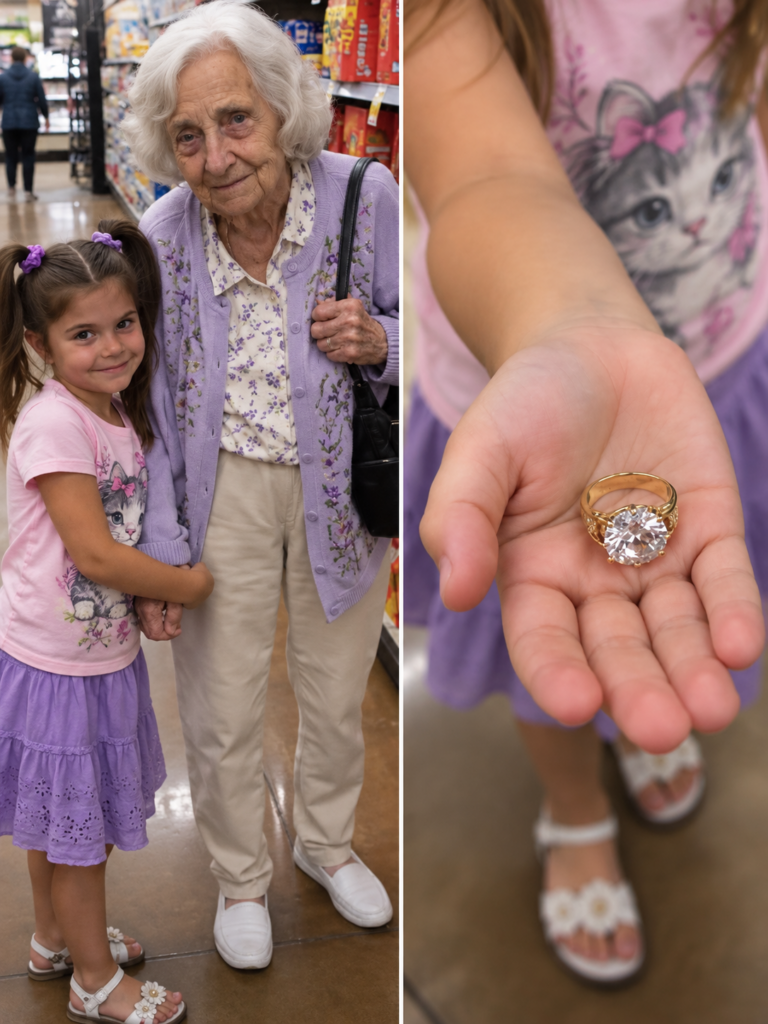
June was beside me, wearing a faded yellow jacket that had belonged to a neighbor’s granddaughter.
She was seven, small for her age, with the dark eyes she inherited from Iris and the same stubborn little chin my son had possessed since childhood.
“Grandma,” she said, “can we get the strawberry yogurt?”
I checked the price.
Then I checked my grocery list.
“Not this week, sweetheart.”
She studied my face.
“That’s okay. I like oatmeal.”
I pretended to examine the milk cartons so she wouldn’t see my expression.
Children should be able to ask for yogurt without wondering whether it will leave enough money for electricity.
But June had learned far too early that some things cost more than we could afford.
Three years earlier, I had buried my only son and his wife after a highway accident.
Caleb had worked at the county transportation depot, repairing school buses. Iris had been a medical assistant at a small family clinic.
They were hardworking, decent people.
Their savings had barely covered the funeral expenses.
I was sixty-six when June came to live with me permanently.
Now I was sixty-nine, raising a child on my Social Security and a small survivor benefit.
Our house was paid for, but it was aging faster than I could repair it.
The roof leaked above the back bedroom. The furnace groaned through every winter. My doctor wanted me to take medication that cost more than I liked to think about.
Still, we managed.
We always managed.
After I paid for our groceries, June asked whether we could walk down the seasonal aisle.
Halloween decorations had just appeared, and she loved the miniature skeletons and paper pumpkins.
“We’re only looking,” I told her.
“I know, Grandma.”
She took my hand.
Halfway down the aisle, she stopped so suddenly that I nearly stepped on her shoe.
“Something’s shining.”
She crouched beside a cardboard display of plastic pumpkins.
I assumed she had found a piece of discarded foil.
Instead, she reached beneath the lowest shelf and pulled out a gold ring.
It had a large diamond surrounded by smaller stones, arranged like tiny drops of water.
Even beneath those harsh store lights, it was breathtaking.
“Is it real?” June whispered.
“I think it might be.”
She turned it over carefully.
Inside the band was a small engraving.
The letters were worn, but I could make out a name.
Miriam.
I glanced down the aisle.
Nobody was nearby.
For one shameful moment, I imagined what a ring like that could pay for.
A new roof.
A reliable furnace.
Clothes that fit June without needing to be let down at the hems.
I imagined selling it quietly and never having to choose between groceries and prescriptions again.
Then June looked up.
“Somebody must be scared, Grandma.”
“Why do you think that?”
“Because if I lost something this pretty, I’d be looking everywhere.”
She held the ring out to me.
“We should help them.”
I looked at her small, trusting face.
There are times when a child reminds you of the person you have spent your whole life trying to be.
I took her hand.
“Yes, sweetheart. We should.”
We were heading toward the customer-service desk when a woman hurried through the entrance.
She wore a gray wool coat and carried a handbag that looked more expensive than my monthly grocery budget.
Her dark hair was coming loose from its clip.
“Please,” she said to the cashier. “I was here earlier. Has anyone turned in a ring?”
June looked at me.
I nodded.
She walked forward and held out her hand.
“Is this yours?”
The woman went completely still.
I watched the color leave her face.
Then she dropped to her knees.
“Oh, thank God.”
She looked closely at the engraving before taking the ring.
“It was my mother’s,” she whispered.
Her eyes filled with tears.
June smiled.
“I’m glad we found you.”
The woman stared at her.
Not at the ring anymore.
At June.
She examined her eyes, her hair, and the little dimple that appeared in her cheek whenever she smiled.
“What’s your name, honey?”
“June Bennett.”
The woman pressed a hand against her mouth.
“Bennett?”
“That’s our last name,” June explained.
I stepped closer.
“Are you all right?”
The woman seemed to pull herself together.
“Yes. I’m sorry. You just reminded me of someone.”
Her telephone began ringing.
She looked at the screen, and the change in her expression was immediate.
Fear.
She silenced the call.
Then she took a small folded note from her handbag.
For a second, she appeared ready to give it to me.
But the telephone started ringing again.
“I’m sorry,” she said. “I need to go.”
She thanked June repeatedly and hurried toward the parking lot.
Through the glass doors, I saw a black SUV waiting near the curb.
A man stood beside it.
The woman hesitated before approaching him.
Then they drove away.
I thought she had simply been overwhelmed by recovering something precious.
June was satisfied.
“Did you see how happy she was?”
“I did.”
“She must love her mommy a lot.”
That small sentence followed me all the way home.
Now, less than a day later, a stranger stood on my porch telling me that the crying woman from the grocery store was June’s aunt.
I looked at Simon through the narrow opening.
“What do you want?”
“I want you to hear what happened.”
“What happened to whom?”
“To Iris. To our family.”
I gave a bitter laugh.
“Your family had nine years to care about Iris while she was alive.”
He accepted the words without arguing.
Then he said something that made my anger turn to suspicion.
“We only learned about her death a few months ago.”
I stared at him.
“That’s impossible.”
“Our father told us she had moved away and didn’t want contact.”
“And you believed him?”
“For too long.”
I wanted to slam the door.
Instead, I asked, “How did you find June?”
Simon reached into his coat.
I immediately stepped back.
He stopped moving.
“Just papers,” he said.
He slowly removed a business card and a sealed envelope.
“Our attorney located the guardianship filing. I wanted to contact you directly, but Adrienne insisted she should come first. She thought you might trust another woman more easily.”
“She could have knocked.”
“She intended to.”
He glanced at the photograph.
“The ring complicated things.”
I looked at him.
“What about it?”
“Our mother left that ring to Iris. My father never gave it to her.”
I felt a sharp burst of anger.
“Why?”
“Because she married your son.”
For several seconds, neither of us spoke.
I thought about Caleb coming home from twelve-hour shifts with grease beneath his fingernails.
I thought about him carrying a sleeping June upstairs after working all day.
I thought about the way Iris used to stand in our kitchen, smiling whenever she heard his truck pull into the driveway.
“Your father didn’t know my son,” I said.
“No, ma’am.”
“He had no right to judge him.”
“I agree.”
“That doesn’t mean much now.”
Simon looked as if he wanted to argue, but he didn’t.
Then he handed me the envelope.
“Please read this before you decide whether to speak to us again.”
I took it.
Inside was a copy of a handwritten letter.
The paper was yellowed, and the handwriting was delicate.
My dearest Iris,
One day, when you have a daughter of your own, I want her to wear the ring my mother gave me. Not because diamonds matter, but because women in our family should always have something that belongs only to them.
Never let anyone persuade you that love must be earned by becoming someone else.
All my love, Mom.
The date was eight years before June was born.
My vision blurred.
Iris had spoken about her mother only a handful of times.
She had told me Miriam was kind but rarely challenged her husband.
She died before Iris and Caleb married.
I looked back at Simon.
“This was meant for Iris?”
“Yes.”
“And your father kept it?”
“He kept nearly everything connected to her.”
“Why come now?”
Simon hesitated.
“Our father is in the hospital. His heart is failing.”
I said nothing.
“He has spent years refusing to speak Iris’s name. But since learning about June, he has been… different.”
“Different how?”
“Angry. Frightened. He keeps asking questions about her and then insisting he doesn’t want the answers.”
I shook my head.
“He doesn’t get to walk into a little girl’s life because he’s suddenly frightened of dying.”
“I know.”
“And you don’t get to either.”
His eyes lowered.
“That’s fair.”
I was about to close the door when I heard June behind me.
“Grandma?”
She stood at the bottom of the staircase, barefoot and holding her stuffed rabbit.
Her hair was tangled from sleep.
“Who’s that man?”
Simon saw her.
His face changed so suddenly that I almost felt sorry for him.
He took one unsteady step backward.
“Good morning,” he said softly.
June peered around me.
“Do you know my grandma?”
“I knew your mommy.”
Her eyes widened.
“You knew Mommy?”
I felt my throat tighten.
Simon nodded.
“When she was younger.”
June smiled.
“Was she funny?”
He gave a shaky laugh.
“She used to hide my shoes whenever I annoyed her.”
June giggled.
“Grandma says Mommy liked jokes.”
“She did.”
I gently moved in front of June.
“That’s enough for today.”
Simon understood.
He looked at me.
“My number is on the card. I won’t come back unless you ask.”
Then he walked toward the SUV.
June watched him leave.
“Grandma, how did he know Mommy?”
I looked at the photograph still resting in my hand.
There was no simple answer that would satisfy her.
“He knew her a long time ago.”
“Can he tell me stories about her?”
I kissed the top of her head.
“Maybe someday.”
That morning, while June ate her oatmeal, I studied the envelope.
For the first time in years, I wondered how many parts of Iris’s life I had never known.
After breakfast, I opened the kitchen drawer where I kept old bills, insurance papers, and letters I had never found the strength to answer.
Near the bottom were two envelopes from an attorney’s office in Dayton.
Both were addressed to me.
Both had arrived three months earlier.
I had assumed they concerned some unpaid hospital expense.
I opened the first.
It requested a confidential meeting regarding the estate of Miriam Ashford.
The second mentioned June by name.
My heart began pounding.
At the bottom was a telephone number.
I was still staring at it when my phone rang.
“Mrs. Bennett?” a woman asked.
“Yes.”
“My name is Adrienne Ashford. We met yesterday at Miller’s Market.”
I sat down.
“I know who you are.”
A long silence followed.
Then she said, “I owe you an apology.”
“You owe my granddaughter more than that.”
“I know.”
I looked through the kitchen doorway at June, who was coloring a picture of a house with four windows.
“What do you want?”
“To tell you why my father is so afraid of meeting her.”
“Your brother said he’s dying.”
“He is.”
“Then I suggest he use whatever time he has left to make peace with himself.”
Adrienne drew a shaky breath.
“Mrs. Bennett, there’s something else.”
I closed my eyes.
“What?”
“It concerns the night Iris and Caleb died.”
I felt the blood drain from my face.
“What about that night?”
Adrienne’s voice dropped.
“My father has never told the truth about it.”
Part 2
I met Adrienne at a diner twenty minutes outside town.
Not because I trusted her.
Because I couldn’t bear the possibility that someone knew something about my son’s final hours and had kept it from me.
My neighbor, Mrs. Porter, agreed to watch June.
She was eighty-one, sharp as a tack, and had been leaving casseroles on my porch since the funeral.
Before I left, she caught my wrist.
“You don’t have to be polite to people who hurt your family, Nora.”
I squeezed her hand.
“I don’t plan to be.”
Adrienne was already sitting in a corner booth when I arrived.
Without the expensive coat and carefully arranged hair, she looked exhausted.
She stood as I approached.
“Thank you for coming.”
I sat opposite her.
“Start talking.”
She pushed a cup of coffee aside.
“Our father’s name is Franklin Ashford. He built a successful medical-supply company. In our house, everyone learned early that his opinion was the only one that mattered.”
I said nothing.
“He decided where Simon went to college, whom I dated, where we worked. Iris was the youngest, but she was the only one who ever challenged him.”
I pictured my daughter-in-law standing at our kitchen counter, rolling out cookie dough with June beside her.
She had always seemed gentle.
But there was a quiet strength beneath that gentleness.
“Tell me about Caleb,” I said.
Adrienne looked confused.
“What?”
“Tell me what your father said about my son.”
Her fingers tightened around her cup.
“He called Caleb an embarrassment.”
I felt my jaw clench.
“He said a mechanic was not an acceptable husband for his daughter.”
“Caleb repaired school buses.”
“I know.”
“He kept children safe. He worked in freezing garages while your father sat in a warm office.”
Adrienne lowered her head.
“He said Iris would destroy her future if she married him.”
“And what did Iris say?”
Adrienne’s expression softened.
“She said her future wasn’t something he owned.”
Despite everything, I almost smiled.
That sounded like Iris.
Adrienne continued.
“Dad offered her money. A house. A position in the company. He said he would give her everything if she ended the relationship.”
“And she refused.”
“Yes.”
“What did you do?”
The question made her look away.
“I said nothing.”
I waited.
“When Dad told her she wasn’t welcome anymore, I stayed at the table. I didn’t go after her.”
I could hear the faint clatter of dishes behind the counter.
Adrienne wiped at her eyes.
“I told myself I would contact her when things settled down.”
“Did you?”
“Not for years.”
“Why?”
“Because he threatened to cut me out of the business.”
I stared at her.
“My son and his wife were living in a rented duplex. They were saving for June’s birth. Iris worked until her feet were swollen every evening, and you’re telling me you wouldn’t call your own sister because you were worried about your job?”
Adrienne nodded.
“Yes.”
The simple admission made it difficult to find another insult.
She wasn’t defending herself.
She knew what she’d done.
“Iris wrote to me after June was born,” she continued. “She sent photographs. She said she missed us.”
“What happened to the letter?”
“I hid it.”
“Did you answer?”
“No.”
I looked toward the window.
Outside, a young mother was helping her son into a car seat.
The boy was laughing.
The mother kissed his forehead.
Such an ordinary moment.
Such an extraordinary thing, to be able to watch your child grow up.
“Then don’t tell me you loved Iris,” I said.
Adrienne flinched.
“I did love her.”
“Love that never shows up isn’t much use to anybody.”
She lowered her head.
“I know.”
For several minutes, we sat in silence.
Then I asked, “What happened the night they died?”
Adrienne opened her handbag and removed a folded sheet of paper.
It was a copy of a telephone record.
At 6:42 p.m. on the evening of the accident, Iris had called her father’s house.
The call lasted one minute and forty-seven seconds.
“She left a message,” Adrienne said. “She told him she and Caleb would be nearby that evening. She wanted to come by.”
My hands went cold.
I remembered that night.
Caleb had brought June to my house just after six.
He’d seemed nervous.
I had asked whether everything was all right.
“Just taking Iris out,” he said. “We’ve got something to sort out.”
I assumed they wanted an evening alone.
June was four then.
She had waved goodbye from my front window as their taillights disappeared down the road.
It was the last time she saw her parents alive.
“They were going to see Franklin?” I whispered.
Adrienne nodded.
“That’s what Simon discovered.”
“How?”
“Dad kept the answering machine recording. He had it transferred to his computer years ago.”
I pressed a hand against my chest.
“Did your father invite them?”
“No.”
“Did he tell them not to come?”
“He didn’t answer.”
I looked at the call record.
“Did they go anyway?”
Adrienne hesitated.
“Yes.”
My eyes filled.
“Did he see them?”
“I think so.”
“You think so?”
She looked miserable.
“He won’t discuss it. Every time Simon asks, Dad becomes furious.”
I pushed the paper back toward her.
“Then why are you telling me?”
“Because I think he’s been punishing himself for something, and he’s let everyone else suffer with him.”
I leaned forward.
“Your father knew my granddaughter was alive. He knew Iris had a child?”
“Yes.”
“Did he know about the accident?”
Adrienne swallowed.
“He knew before Simon and I did.”
I stared at her.
“How long before?”
“Three years.”
I couldn’t speak.
Adrienne began crying.
“He told us Iris had moved away. He said she had chosen never to contact us again.”
“And you believed him?”
“I wanted to.”
There it was.
A family that had spent years accepting whatever explanation was easiest.
Meanwhile, June had celebrated birthdays with an empty chair at the table.
She had made Mother’s Day cards that I placed in a box.
She had asked whether heaven had windows so her parents could see her riding her bicycle.
I stood.
Adrienne reached toward me.
“Mrs. Bennett—”
I stepped away.
“Don’t touch me.”
She withdrew her hand.
“Please. There’s something else you should know about the ring.”
I looked at her.
“What?”
“Our mother made arrangements for it before she died. Dad never completed the transfer.”
“Why did you have it yesterday?”
Adrienne stared at her hands.
“I took it from his study.”
I blinked.
“You stole it?”
“I suppose I did.”
“Then why were you at Miller’s Market?”
“Simon had found your address. I wanted to see June before I came to your house.”
She hesitated.
“I parked nearby and followed you into the store. I know that sounds terrible.”
“It is terrible.”
“I didn’t approach because I was afraid you’d refuse to speak to me.”
“And the ring?”
“My father realized it was missing. He sent his driver to bring me home.”
She wiped her cheeks.
“I was in the seasonal aisle when the driver called. I hurried out. I must have dropped it when I reached into my handbag.”
“So you weren’t searching for it by accident.”
“No. When I realized it was gone, I came back. I thought I’d lost the last thing Mother wanted Iris to have.”
I thought about June crouching beneath the pumpkin display.
About her concern for a stranger’s tears.
I had believed that returning the ring simply meant doing the right thing.
Now I realized she’d returned a family heirloom to an aunt who had been watching her from a distance.
It made me uneasy.
And angry.
“Stay away from June until I decide otherwise,” I said.
Adrienne nodded.
Then she spoke so quietly that I almost missed it.
“Iris used to say that our father could make a person feel lonely while standing in a room full of people.”
I stopped beside the booth.
“That sounds like something she would say.”
“She was right.”
For two nights, I barely slept.
I kept remembering little things.
Iris hesitating whenever someone mentioned Father’s Day.
Caleb changing the subject when I asked whether her family would visit for Christmas.
The way Iris had once stood in our kitchen holding a photograph of June and said, “I wish my mother could have met her.”
At the time, I thought she meant that she missed Miriam.
Now I wondered whether she had also been thinking about the rest of the family she had lost.
On Monday afternoon, I drove to the small storage unit where I kept Caleb and Iris’s belongings.
I hadn’t visited in almost a year.
Grief makes ordinary objects difficult.
A winter coat isn’t just a coat anymore.
A birthday card becomes proof that someone once existed.
I found three boxes labeled in Caleb’s handwriting.
KITCHEN.
BOOKS.
IRIS — KEEP.
That last one nearly undid me.
I sat on the concrete floor and opened it.
Inside were photographs, a knitted scarf, a pair of earrings, and a bundle of letters tied with ribbon.
Most were from friends.
One was addressed to Adrienne Ashford.
The envelope had never been mailed.
I unfolded the letter.
Dear Addie,
I know Dad is still angry, and I know you have your own reasons for staying away. But June started preschool this week. She has Caleb’s stubbornness and Mom’s eyes. Sometimes she does something funny and I reach for the phone before remembering I don’t know whether you’d answer.
I don’t need you to choose sides anymore. I only wish you’d remember that I’m still your sister.
If you ever want to meet her, I’ll open the door.
I read it twice.
Then a third time.
Iris had never mentioned writing that letter.
Perhaps she hadn’t wanted to burden Caleb.
Perhaps she was tired of being rejected.
Beneath it was a small notebook.
Most pages contained grocery lists, medical appointments, and June’s childhood milestones.
Near the back, one entry was dated the morning of the accident.
Caleb thinks we should try one more time. He says June deserves to know where I came from, even if Dad never changes.
I’m afraid he’s right.
I closed the notebook.
For three years, I had believed Caleb and Iris had been going out to dinner when they died.
They had been going to ask her father for something money couldn’t buy.
A place in their daughter’s life.
And somehow, that made their absence hurt all over again.
On Wednesday morning, Simon came to my house again.
This time, he called first.
I made him sit at the kitchen table.
June was at school.
He brought copies of his mother’s estate documents and a letter from an attorney named Patricia Lopez, who was independent of the Ashford family business.
“Our mother’s will specifically left the ring to Iris,” he explained. “Dad was the executor. The ring should have been transferred to her years ago.”
“Then why wasn’t it?”
“Because he refused to acknowledge her.”
“That can’t be legal.”
“Patricia agrees. She’s reviewing the estate records.”
I studied the documents.
They included a description of the ring, its estimated value at the time of Miriam’s death, and the terms of the bequest.
It was worth more than anything I owned.
But the figure beside it mattered less than the name written in black ink.
Iris Ashford Bennett.
She had never been erased from her mother’s will.
Only from her father’s household.
Simon watched me.
“We want to make that right.”
“Then make it right without asking June for anything in return.”
He nodded.
“That’s what Adrienne and I intend to do.”
I looked at him carefully.
“Your father has money and attorneys. If he decides he wants custody of June—”
“He won’t.”
“You don’t know what he’ll do.”
Simon’s expression grew serious.
“You have a guardianship order. June has lived with you since her parents died. You’re the only stable parent figure she remembers. Wealth doesn’t change that.”
“Rich people have ways of making poor people afraid.”
“I know.”
He looked ashamed.
“I’ve spent much of my life benefiting from that.”
For the first time, I felt something other than anger toward him.
Not forgiveness.
But perhaps the beginning of understanding.
Then Simon said, “Dad has asked to meet you.”
I leaned back.
“No.”
“He wants to explain.”
“He can write a letter.”
“I don’t think he’d be honest in one.”
“Then he can practice.”
Simon sighed.
“Mrs. Bennett, I don’t expect you to forgive him. But he has information about that night that no one else can give you.”
I looked toward the refrigerator.
June had taped a drawing to the door.
It showed me, her, and two figures floating above a blue house.
She had written MY FAMILY in careful purple letters.
A family missing half its people.
“Where is he?” I asked.
“St. Catherine’s Hospital.”
I stood.
“I’ll go alone.”
Franklin Ashford occupied a private hospital room overlooking a garden.
The hallway was quiet, the carpet thick, and a vase of fresh flowers stood outside his door.
It struck me that even illness looked different when a person had money.
I had spent nights in hospital waiting rooms drinking vending-machine coffee while Caleb lay dying.
Franklin had a room large enough to hold a sofa.
He was sitting upright when I entered.
His silver hair was neatly combed.
He looked frail, but his eyes were sharp.
“Nora Bennett,” he said.
I stopped.
“You know my name.”
“Of course.”
“Then you know why I’m here.”
His gaze moved toward the small velvet pouch in my hand.
“The ring.”
I placed it on the bedside table.
“Your daughter was entitled to this years ago.”
His jaw tightened.
“My wife had sentimental ideas about jewelry.”
“Your wife loved her daughter.”
He looked away.
“I’m not going to discuss Miriam with you.”
“Then we’ll discuss Iris.”
His expression hardened.
“Iris made her choices.”
“And you punished her for them.”
“She abandoned her family.”
“She married a man you didn’t approve of.”
He gave a thin, humorless smile.
“You wouldn’t understand the responsibilities of a family like ours.”
I felt heat rise into my face.
“I raised a son who worked six days a week, cared for his wife, and loved his child. Don’t lecture me about responsibility.”
Franklin looked toward the window.
“I didn’t ask you to come.”
“No. Your son did.”
“Simon has always been too sentimental.”
“And you have always been too proud.”
He turned sharply.
“You don’t know anything about me.”
“I know you let your daughter die believing you didn’t want her.”
For the first time, his expression cracked.
Only briefly.
Then he said, “You should go.”
I didn’t move.
“Did Iris and Caleb come to your house the night they died?”
He stared at me.
“Who told you that?”
“Answer the question.”
“That is none of your business.”
“My son never came home that night. It is absolutely my business.”
His hands tightened around the blanket.
“I’m tired.”
“Were they there?”
He pressed the button beside his bed.
A nurse appeared a moment later.
“Mr. Ashford?”
“I’d like my visitor to leave.”
The nurse looked between us.
I didn’t want to cause trouble for her.
So I picked up my purse.
But before leaving, I turned back.
“You can keep your money, Mr. Ashford. You can keep pretending my son wasn’t good enough for your daughter. But you will not use June to make yourself feel better about whatever happened that night.”
His face went pale.
I walked out before he could answer.
In the elevator, my hands began shaking.
Not from fear.
From the horrible suspicion that I had finally asked the right question.
The following evening, Adrienne came to my door.
She was carrying a tablet.
Her face was swollen from crying.
“Simon told me what happened at the hospital.”
“Then you know I don’t want another conversation with your father.”
“I know. But you need to see something.”
I hesitated.
She didn’t try to enter.
Instead, she turned the tablet toward me.
A security recording began playing.
The timestamp showed the night of the accident.
9:07 p.m.
A car pulled into the circular driveway of a large house.
I recognized Caleb’s old blue sedan immediately.
The driver’s door opened.
Caleb stepped out.
He walked around the car and opened the passenger door for Iris.
She emerged wearing the cream-colored cardigan I’d helped her buy the previous Christmas.
My knees weakened.
I hadn’t seen my son moving, breathing, alive, in three years.
He took Iris’s hand.
Together, they walked to the front door.
Iris rang the bell.
They waited.
She rang again.
Caleb looked down at her and said something the camera couldn’t capture.
Then he put an arm around her shoulders.
They stood there for nearly five minutes.
No one opened the door.
Finally, Iris lowered her head.
Caleb kissed her forehead.
They walked back to their car.
And drove away.
Adrienne stopped the recording.
My ears were ringing.
“Where did you get this?”
“Simon found it on Dad’s computer. He’d saved a copy.”
I stared at the blank screen.
“Was Franklin home?”
Adrienne’s mouth trembled.
“Yes.”
“How do you know?”
She looked down.
“Because Simon found another recording. From the camera inside the foyer.”
I felt my chest tighten.
“What did it show?”
Her eyes filled with tears.
“Our father standing behind the front door.”
She swallowed.
“He watched them the entire time.”
For a moment, I couldn’t speak.
I imagined Iris standing on that porch, hoping the man who raised her would finally welcome her home.
And Franklin Ashford standing a few feet away, choosing not to turn the lock.
Then Adrienne said the words that broke the last of my restraint.
“He knew they were there, Nora. He knew exactly why they’d come.”
Part 3
I returned to the hospital the following morning.
This time, I didn’t bring the ring.
I brought a copy of the recording and Iris’s notebook.
Franklin was awake when I entered.
His eyes moved toward the papers in my hand.
He seemed to understand immediately.
“Simon showed you.”
“Yes.”
He closed his eyes.
I pulled a chair beside the bed.
“I’m going to ask you one question, and this time you are going to answer me.”
He looked exhausted.
But I wasn’t there to comfort him.
“Why didn’t you open the door?”
For a long time, he said nothing.
The only sound was the soft rhythm of the monitor beside his bed.
Finally, he whispered, “I wanted to.”
I stared at him.
“What?”
“I heard her voice through the intercom.”
His eyes filled.
“She said, ‘Dad, it’s Iris. I just want to talk.’”
I pictured my daughter-in-law beneath that porch light.
Her hand in Caleb’s.
Trying one final time.
Franklin continued.
“I was standing in the foyer. I could see them on the screen.”
“And?”
“I thought if I opened the door, everything I’d said for years would mean nothing.”
I couldn’t believe what I was hearing.
“You thought admitting you were wrong would make you weak?”
He looked at me helplessly.
“I thought she should apologize first.”
“For marrying my son?”
He lowered his gaze.
“For refusing to listen to me.”
I let out a sound that was almost a laugh.
“Your daughter was standing outside your house, asking to see you, and you were waiting for her to surrender.”
His face crumpled.
“Yes.”
I looked away.
There were some kinds of cruelty that didn’t require shouting.
Sometimes they were quiet.
Sometimes they wore clean shirts and carried respectable names.
Sometimes they stood behind a locked door, listening to someone they loved beg for kindness.
“Caleb would have stayed,” I said.
Franklin looked up.
“If Iris had asked him to wait, he would have waited all night. That’s the kind of man he was.”
Franklin’s voice shook.
“I know.”
“No. You don’t.”
I opened Iris’s notebook.
“She was afraid to come to your house. She did it because she wanted June to have a bigger family.”
I placed the notebook on his blanket.
“That’s what she wrote the morning she died.”
His hands trembled.
He read the entry.
Then he covered his mouth.
For several minutes, he cried without making a sound.
I had expected to feel satisfied.
Instead, I felt terribly tired.
There was no victory in making an old man understand what he should have known while his daughter was alive.
“Did you know about the accident?” I asked.
He nodded.
“When?”
“The next morning.”
“How?”
“The police contacted me. They found a recent call to my number and wanted to reach her family.”
I closed my eyes.
“Did you come to the hospital?”
“No.”
“Did you call me?”
“No.”
“Did you attend their funeral?”
He shook his head.
I felt tears spill down my face.
“Eleven people came to that funeral, Franklin. Eleven. My son had spent years fixing the buses that carried this town’s children to school. Iris had held the hands of sick people who couldn’t afford private doctors.”
I leaned forward.
“They deserved more than eleven people.”
Franklin whispered, “Yes.”
“And you couldn’t even be one of them.”
His shoulders shook.
“I couldn’t face what I’d done.”
I looked at him.
“You didn’t cause the accident. The police report said another driver lost control on the wet road. But you chose to reject them. And afterward, you chose to hide.”
He nodded.
“I did.”
“What about June?”
At the sound of her name, his expression changed.
He looked almost frightened.
“Have you seen her?” I asked.
“From a distance.”
My chest tightened.
“What does that mean?”
“I drove past your street.”
“How many times?”
He hesitated.
“Three or four.”
I stared at him.
“You knew where she lived?”
“Yes.”
“Did you ever stop?”
“No.”
“Why?”
He began crying again.
“Because I didn’t know what to say.”
I stood.
“You could have said, ‘I’m sorry.’”
He lowered his head.
“You could have said, ‘I loved your mother.’”
His hands shook against the blanket.
“You could have knocked on my door and asked whether she needed anything.”
“I know.”
“No, Franklin. You knew she existed. That’s different.”
He looked up.
“I’ve been a coward.”
It was the first honest thing I had heard him say.
I sat down again.
For a long moment, neither of us spoke.
Then he reached toward the drawer beside his bed and removed a small envelope.
“I’ve kept something.”
He handed it to me.
Inside was a photograph of Iris holding newborn June.
I recognized it immediately.
I had taken it in the hospital the day June was born.
Iris was smiling, exhausted and radiant.
Caleb stood beside her, his hand resting gently on her shoulder.
On the back, in Iris’s handwriting, were the words:
For Dad. Your granddaughter, June. I hope someday you’ll meet her.
I looked at Franklin.
“How did you get this?”
“She mailed it after June was born.”
I felt sick.
“You received it?”
“Yes.”
“And you never answered?”
His eyes filled.
“No.”
I studied the photograph.
Iris had made so many attempts to bring her family back together.
A letter.
A photograph.
A telephone call.
A visit.
Each one had been met with silence.
“I don’t know how you live with yourself,” I whispered.
Franklin stared at the blanket.
“Neither do I.”
When I got home, June was sitting at the kitchen table doing homework.
She looked up.
“Grandma, Mrs. Porter says we’re making cookies on Saturday.”
“That sounds lovely.”
She studied my face.
“Are you sad?”
I hung my coat by the door.
“A little.”
“Because of Mommy and Daddy?”
I sat beside her.
“Yes, sweetheart.”
She pushed her workbook aside.
“I miss them too.”
I pulled her close.
She smelled of crayons and the lavender soap we used at bath time.
For a while, we sat without speaking.
Then she reached toward a drawing beside her schoolbooks.
Her teacher had asked the children to draw their families.
June’s picture showed me, her parents in the clouds, and a little dog she hoped to own someday.
But there was something new.
Two empty figures stood beside the house.
“Who are these?” I asked.
She looked embarrassed.
“I don’t know yet.”
I smiled faintly.
“What do you mean?”
“I was thinking about that man who knew Mommy. Maybe he could be in our family picture.”
My throat tightened.
“Why would you want that?”
“Because he knows stories about her.”
She paused.
“And maybe he misses her too.”
I looked at her.
At seven years old, she understood something that had taken the adults around her decades to learn.
Missing someone was a reason to reach toward people, not away from them.
But I still had to protect her.
“June, there are some people from Mommy’s family who would like to meet you.”
Her eyes widened.
“Really?”
“Yes.”
“Do I have cousins?”
“I think you might.”
“An aunt?”
“Yes.”
“An uncle?”
I nodded.
She gave a delighted little gasp.
Then her expression changed.
“Why didn’t they come before?”
There it was.
The question I had been dreading.
I thought carefully before answering.
“Sometimes adults make very wrong choices. And sometimes they’re ashamed of those choices.”
“Did they do something bad?”
“They hurt Mommy’s feelings.”
June became quiet.
“Did Mommy do something bad?”
I touched her cheek.
“No, sweetheart. Mommy loved someone, and some people were unfair to her because of it.”
She considered that.
“Daddy?”
“Yes.”
June frowned.
“But Daddy was nice.”
“He was.”
“Then they were wrong.”
I nodded.
“They were.”
She leaned against me.
After a moment, she whispered, “Can people stop being wrong?”
I held her a little tighter.
“They can learn to do better. But that doesn’t make the old hurt disappear.”
She thought about that for a long time.
Then she asked, “Could I meet them?”
I closed my eyes.
Everything inside me wanted to say no.
I wanted to keep the Ashford family far away from the little girl who had already lost too much.
I wanted to punish Franklin for the years he had wasted.
But June wasn’t asking for a diamond.
She wasn’t asking for an inheritance.
She was asking for people who remembered her mother.
People who could tell her whether Iris had been afraid of thunderstorms or liked chocolate cake.
People who might recognize her laugh.
I opened my eyes.
“We can meet them,” I said. “Slowly. And only if you feel comfortable.”
June smiled.
“Okay.”
Then she returned to her homework as though we had settled the most ordinary question in the world.
Before I allowed anyone near June, I met with Patricia Lopez.
She was a middle-aged attorney with practical shoes, reading glasses hanging from a chain, and an office that smelled faintly of old books.
I liked her immediately.
She reviewed my guardianship documents and assured me that June’s relationships with her mother’s relatives did not change my legal authority.
“Grandparents, aunts, and uncles can be involved in a child’s life,” she explained, “but involvement does not automatically create custody rights.”
I felt myself breathe a little easier.
“And the ring?”
Patricia tapped a document.
“Miriam Ashford’s will is clear. The ring belonged to Iris. It should have been transferred after Miriam’s death.”
“What happens now?”
“The estate will need to correct that failure. Since Iris has died, we’ll establish who inherits her interest under the applicable estate documents and law. I’m reviewing that with independent counsel for you and June.”
I nodded.
“I don’t want anything tied to visiting Franklin.”
“Neither do I. Any transfer should be completed without conditions.”
She leaned forward.
“Mrs. Bennett, may I ask something personal?”
“Yes.”
“Are you afraid they’ll use their money to take over June’s life?”
I stared at my hands.
“I’m afraid she’ll begin to love them and they’ll disappear.”
Patricia’s expression softened.
“That is a much harder problem than the paperwork.”
I gave a sad smile.
“Yes. It is.”
When I left her office, I called Simon.
“I have conditions,” I said.
“Of course.”
“No unexpected visits. No promises to June that anyone can’t keep. No discussion of money with her. No pressure to forgive anyone.”
“I agree.”
“And if she wants to leave, we leave.”
“Absolutely.”
I hesitated.
“Your father needs to understand that.”
Simon was quiet for a moment.
“He will.”
“He’d better.”
The first visit took place on a Sunday afternoon.
Not at the Ashford estate.
Not in an expensive restaurant.
At the small park near our house.
I wanted June somewhere familiar, with room to run if she felt overwhelmed.
Adrienne arrived carrying a modest bag of homemade cookies.
Simon brought a photograph album.
They looked more nervous than June.
Adrienne knelt in front of her.
“Hello, June. I’m your Aunt Adrienne.”
June studied her carefully.
“Are you the lady from the grocery store?”
Adrienne smiled through tears.
“Yes.”
“You found your ring.”
“You helped me find it.”
June nodded solemnly.
“Grandma says valuable things should go back to the person they belong to.”
Adrienne glanced at me.
“Your grandmother is right.”
Simon crouched beside them.
“And I’m your Uncle Simon.”
June’s eyes grew wide.
“You’re both Mommy’s brother and sister?”
“We are.”
She looked delighted.
“Did Mommy have the same bedroom as you?”
Simon laughed.
“No. She had her own room, but she was always sneaking into mine and borrowing things.”
“What kind of things?”
“My books. My sweaters. Once she borrowed my bicycle and rode it straight into a rosebush.”
June burst into laughter.
“Really?”
“Really. She told everyone the bicycle was defective.”
For the next hour, they told stories.
Not about money.
Not about the family business.
About Iris.
How she loved thunderstorms.
How she used to sing loudly and badly while doing chores.
How she once brought an injured bird into the house and refused to let anyone move it until it could fly.
June listened as though they were giving her treasures.
And perhaps they were.
When Adrienne showed her a photograph of Iris at twelve, June held it carefully.
“She looks like me.”
“She does,” Adrienne whispered.
June smiled.
“I like that.”
I turned away so she wouldn’t see me crying.
Two weeks passed before I agreed to take June to meet Franklin.
During that time, he sent no gifts.
No flowers.
No expensive toys.
At my request, he wrote a letter.
Not to June.
To me.
It was four pages long.
He admitted that he had treated Caleb cruelly because he believed money and status gave him the right to decide his daughter’s future.
He acknowledged that Iris had tried repeatedly to reconnect.
He admitted that he knew about her death and had failed to contact us.
Near the end, he wrote:
I cannot ask you to excuse my behavior. I can only promise that if June chooses to know me, I will never make her feel that she must earn my affection.
I read that sentence several times.
Then I called him.
“This doesn’t mean I forgive you.”
“I understand,” he said.
“And I won’t let you burden June with your guilt.”
“I won’t.”
“She isn’t responsible for making you feel better.”
His voice trembled.
“I know.”
I looked toward the living room, where June was arranging her dolls for a pretend tea party.
“You may meet her Sunday.”
Franklin began to cry.
June wore her favorite blue sweater to the hospital.
On the drive, she asked a dozen questions.
“Is he old?”
“Yes.”
“Older than you?”
“A little.”
“Does he have gray hair?”
“Yes.”
“Does he like cookies?”
“I don’t know.”
She thought about that.
“Maybe we should bring some.”
I smiled.
“Perhaps another time.”
At the hospital, Adrienne and Simon were waiting outside Franklin’s room.
June took my hand.
“Grandma?”
“Yes?”
“What if he doesn’t like me?”
I stopped walking.
I knelt in front of her.
“Listen carefully, sweetheart. You do not have to make anyone like you. If someone doesn’t treat you kindly, that’s their mistake. Not yours.”
She nodded.
“Okay.”
“And if you want to leave, you tell me.”
“I will.”
We entered the room.
Franklin was sitting upright, dressed in a clean white shirt instead of a hospital gown.
He looked thinner than before.
A small photograph stood on the bedside table.
Iris holding baby June.
Franklin stared when we entered.
For a moment, he looked completely unable to speak.
June stepped closer.
“Hello.”
He swallowed.
“Hello, June.”
She examined him.
“Are you my mommy’s daddy?”
“Yes.”
“Then you’re my grandpa?”
His eyes filled.
“If you’d like me to be.”
June considered this.
Then she nodded.
“Okay.”
A tear rolled down his cheek.
She looked puzzled.
“Why are you crying?”
Franklin drew a shaky breath.
“Because I’m very happy to meet you.”
June smiled.
“I’m happy to meet you too.”
She pulled a folded paper from her pocket.
“I made you something.”
She handed it to him.
It was a drawing of a house.
There was a green lawn, a yellow sun, and a red front door.
Four figures stood outside.
One was June.
One was me.
The third was Adrienne.
The fourth was Simon.
Inside a window, she had drawn a gray-haired man.
Franklin stared at it.
“That’s you,” June explained. “Because you’re in the hospital now.”
He touched the drawing gently.
“It’s beautiful.”
“And when you’re better, maybe you can come outside.”
Franklin pressed a hand to his mouth.
I saw him look at the red door.
I wondered whether he was remembering the one he had refused to open three years earlier.
His eyes moved toward me.
There was no need for words.
He understood.
June climbed into the chair beside his bed.
“Uncle Simon says Mommy rode her bicycle into a rosebush.”
Franklin gave a surprised laugh.
“She certainly did.”
“Did you see it?”
“I did.”
“Was she okay?”
“She was. The rosebush wasn’t.”
June giggled.
For the next forty minutes, they talked.
Franklin told her how Iris had learned to swim, how she loved animals, and how she always insisted on rescuing worms from the sidewalk after rain.
June told him about school.
About her best friend, Olivia.
About the stuffed rabbit she’d owned since she was a baby.
I stayed close.
But I didn’t interrupt.
Franklin didn’t ask June to love him.
He didn’t ask her to call him Grandpa again.
He simply listened.
And when she became tired, I stood.
“We should go.”
June looked disappointed.
“Can we come back?”
I looked at Franklin.
He was crying quietly.
“We’ll see,” I said.
June gave him a little wave.
“Bye, Grandpa.”
The word seemed to take what remained of his strength.
“Goodbye, sweetheart.”
Over the following month, I learned that trust was built through ordinary actions, not grand gestures.
Adrienne began calling every Wednesday evening.
Sometimes she spoke to June for ten minutes.
Sometimes for an hour.
Simon came to her school science fair and stood at the back of the classroom while June explained her model of the solar system.
Franklin sent handwritten notes.
Short ones.
He wrote about Iris’s childhood and answered June’s questions.
He never complained when we couldn’t visit.
He never asked for more than we were comfortable giving.
Patricia completed her review of Miriam’s estate, and the Ashford family began correcting the transfers that had been withheld.
The diamond ring was formally placed in safekeeping for June’s benefit.
Franklin also established an education trust for her through independent legal arrangements.
I insisted that Patricia review everything.
There would be no conditions requiring visits.
No expectations that June change her last name.
No strings attaching money to affection.
When the documents were signed, Franklin looked at me.
“I should have done this long ago.”
“Yes,” I said.
He lowered his eyes.
I didn’t soften the truth.
But I no longer needed to use it as a weapon.
A few weeks later, Adrienne came to my house carrying two grocery bags.
Inside were ingredients for June’s favorite dinner and a package of strawberry yogurt.
I stared at it.
Adrienne looked embarrassed.
“June mentioned she liked this kind.”
I smiled faintly.
“She does.”
Adrienne helped me cook while June did homework.
For the first time, I saw her in my kitchen not as a wealthy woman from another world, but as a sister who had missed years she could never reclaim.
While we washed dishes, she looked at the water stain on the ceiling.
“That roof needs work.”
“It does.”
“Would you let me help?”
I stiffened.
“Adrienne—”
“Not as charity,” she said quickly. “And not because I think you can’t manage.”
I set down a plate.
“Then why?”
Her eyes filled.
“Because Iris would want June warm and dry. And because I spent years refusing to show up for my sister. I don’t want to spend the rest of my life doing the same thing to her daughter.”
I looked at her for a long moment.
Then I nodded.
“We can talk about it.”
She smiled through her tears.
It wasn’t forgiveness.
Not yet.
But it was a beginning.
Winter arrived slowly that year.
By December, the roof had been repaired through a combination of my savings and help I had finally agreed to accept.
June had new boots.
The furnace worked properly.
But the greatest change was not inside the house.
It was at our kitchen table.
One Sunday afternoon, Simon arrived carrying a pie.
Adrienne brought a salad.
Franklin, now well enough to travel short distances with assistance, came wearing a heavy gray coat.
Mrs. Porter joined us too, because she had been part of June’s family long before the Ashfords appeared.
There were too many people for my little dining table.
We pulled in folding chairs from the garage.
Someone spilled gravy.
Simon burned the dinner rolls.
June laughed so hard that milk came out of her nose.
Franklin sat quietly at one end of the table, watching her.
At one point, he leaned toward me.
“Thank you for allowing me to come.”
I looked around the room.
For years, I’d imagined that having a bigger family meant having more people who could disappoint us.
I hadn’t been entirely wrong.
But I was learning that it could also mean having more people willing to help carry the ordinary burdens of life.
“You’re here because June wants you here,” I told him.
“I know.”
“And because you’ve been keeping your promises.”
He nodded.
“I intend to continue.”
I studied him.
I still remembered the footage of Iris standing outside his locked door.
That memory would never disappear.
Neither would the years of silence.
But Franklin wasn’t standing behind that door anymore.
He was sitting at my table, learning how to be part of a family without trying to control it.
That mattered.
Not enough to erase the past.
Enough to allow a different future.
After dinner, June brought out her school drawing.
She had made another family picture.
This one was crowded.
There were figures everywhere.
Me, June, Adrienne, Simon, Franklin, Mrs. Porter, and several cousins June had recently met.
Above them, she had drawn Caleb and Iris among the stars.
She held the picture up proudly.
“Look, Grandma. Everybody fits.”
I studied the paper.
She had squeezed the people close together, their arms stretching across the page.
Some faces were crooked.
One person had three fingers.
But everyone was smiling.
“Yes, sweetheart,” I said.
“Everybody fits.”
Later, after our visitors had gone, June helped me put away the dishes.
Then she opened the small drawer where I kept the velvet box containing Miriam’s ring.
She knew she was allowed to look, but not wear it yet.
She lifted the lid.
The diamond caught the soft light above the kitchen sink.
“Grandma?”
“Yes?”
“Was this Mommy’s?”
“It was meant for her.”
“And now it’s mine?”
“Yes. When you’re older, you can decide what to do with it.”
She studied the ring.
“It’s pretty.”
“It is.”
She closed the box.
Then she looked up at me.
“I’m glad we gave it back at the store.”
I smiled.
“Why?”
“Because if we hadn’t, I wouldn’t have met Aunt Adrienne and Uncle Simon.”
She thought for a moment.
“Or Grandpa.”
My throat tightened.
I knelt beside her.
“June, do you know why I’m proud of you?”
“Because I found a diamond?”
I shook my head.
“Because you found something valuable, and the first thing you thought about was whether somebody else was hurting.”
She smiled shyly.
“Mommy would have done that.”
I brushed a strand of hair from her forehead.
“Yes,” I whispered. “She would have.”
That night, after June went to bed, I stood at the kitchen window.
The house was quiet.
The roof no longer leaked.
The refrigerator hummed softly.
On the table lay June’s newest drawing, with all those uneven little figures holding hands.
I thought of Caleb.
Of Iris.
Of the ordinary life they had wanted for their daughter.
They would never get to see her grow up.
No amount of money could change that.
No apology could bring them back.
And I still didn’t know whether I would ever fully forgive Franklin Ashford.
But forgiveness wasn’t the only way forward.
Sometimes the most important thing was refusing to let one person’s cruelty become the rule by which everyone else had to live.
Franklin had kept his front door locked when his daughter came seeking love.
For years, that decision had cast a shadow over everyone she left behind.
I couldn’t open that door for Iris.
I couldn’t change the night she and Caleb died.
But when June asked whether she could know the family her mother had lost, I had a choice of my own.
I could let fear make the decision.
Or I could protect her while giving people the chance to do better.
I looked once more at the family drawing.
Then I turned off the kitchen light and walked upstairs.
At June’s bedroom door, I stopped.
She was sleeping beneath her quilt, one arm wrapped around her rabbit.
Beside her pillow lay the photograph Simon had given her of Iris as a teenager.
I stepped inside and tucked the blanket around her shoulders.
“Good night, sweetheart,” I whispered.
She stirred.
“Love you, Grandma.”
“I love you too.”
As I turned to leave, she murmured sleepily, “Don’t close the door all the way.”
I smiled and left it open a few inches.
A narrow strip of hallway light fell across her floor.
And standing there, watching that quiet light reach her bed, I understood something I wished Franklin had learned long before tragedy taught it to him.
A family isn’t made by money, names, or the things people inherit.
It’s made by the people who answer when someone needs them.
And sometimes, the greatest gift you can give a child is the simple certainty that when she reaches for love, someone will open the door.

