
Part 1
The photograph took three tries.
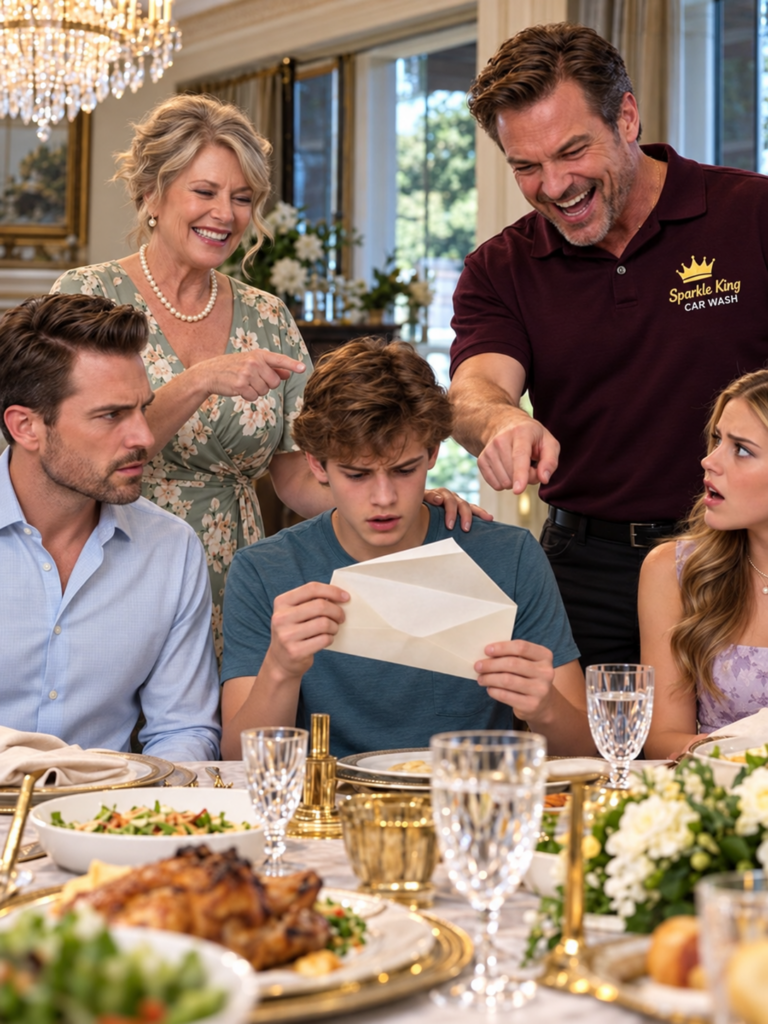
The first one came out blurry because my son’s hand was shaking. The second caught the glare from the dining room chandelier. On the third, Owen placed the cream-colored envelope flat against my mother’s blue tablecloth, adjusted his phone, and took a clear picture.
My brother watched with an amused expression.
“What are you doing, buddy? Making a scrapbook?”
Owen slipped his phone into his pocket.
“Something like that.”
My name is Claire Bennett. I was forty-four that summer, a widow raising one teenage boy in a small Ohio town called Cedar Hollow, where everybody knew everybody else’s business and family reputations lasted longer than marriages.
My older brother, Brent Whitaker, owned Bluebird Auto Wash, a successful business with two locations, seventeen employees, and a reputation for doing favors that somehow always left people owing him something.
That Sunday evening, we were gathered at our mother Lorraine’s house to celebrate the end of summer.
There was roast chicken on the table, sliced tomatoes from her garden, and a peach cobbler cooling beside the stove.
It should have been an ordinary family dinner.
Instead, my son was staring at an envelope that contained absolutely nothing.
I looked at Brent.
“Where is his paycheck?”
Brent leaned backward in his chair, smiling as though I’d missed the punch line of an obvious joke.
“Claire, come on. Don’t turn this into a whole thing.”
“I’m asking a simple question.”
“And I’m giving you a simple answer. The boy spent the summer learning how a real business operates. That kind of education costs money.”
Owen sat quietly beside me.
He was wearing a clean gray T-shirt, but the skin around his fingernails remained dark from weeks of scrubbing equipment. A small cut crossed his right thumb. There were rough patches along his wrists where protective gloves had rubbed against damp skin during long shifts.
I had watched those hands come home tired every evening.
Those hands were supposed to be earning money.
“Brent,” I said, struggling to keep my voice even, “you told us he’d be paid at the end of the summer.”
My brother lifted one shoulder.
“I said we’d settle up at the end of the summer.”
“What exactly did you think that meant?”
“It means we settled up.” He gestured toward Owen. “He got nine weeks of practical education.”
My mother set down her fork.
“Claire, your brother has been very generous.”
I turned toward her.
“Generous?”
“He took Owen into his business. He trained him. He trusted him around expensive machinery. That should count for something.”
“It does count for something,” I said. “It doesn’t replace wages.”
Mom sighed the way she always did when she thought I was being difficult.
“You’ve always been so concerned with keeping score.”
Brent chuckled.
There it was.
The old family accusation.
I had heard some version of it since childhood.
Whenever Brent borrowed my allowance and forgot to return it, I was keeping score. Whenever he took credit for a school project I’d helped him finish, I was keeping score. When Dad left him most of the equipment from our grandfather’s garage and gave me a box of old photographs, I was keeping score.
Brent could take.
I was supposed to understand.
Now that same rule was being applied to my child.
I pushed back my chair.
Before I could stand, Owen touched my wrist.
“Mom.”
His voice was soft.
I looked at him.
He shook his head once.
Not here.
Not like this.
Brent mistook Owen’s silence for agreement.
“See? Owen gets it. He’s more mature about this than you are.”
My son glanced at him.
“I understand exactly what you’re saying, Uncle Brent.”
“Good boy.”
Owen folded the empty envelope carefully along its original crease.
Then he picked up his backpack.
“Thanks for dinner, Grandma.”
Mom gave him a wounded look.
“Are you leaving already?”
“School starts soon. I’ve got some things to organize.”
She reached for his hand.
“Sweetheart, don’t be upset. Your uncle gave you something much more important than money.”
Owen looked at her for several seconds.
Then he said something that would stay with me long after the summer ended.
“Grandma, would you say that to someone else’s grandson?”
She blinked.
“What a strange question.”
“Would you?”
Brent laughed impatiently.
“Don’t start interrogating your grandmother.”
Owen stood.
“Good night.”
I followed him into the hallway.
Behind us, my mother muttered that teenagers had become terribly entitled.
Outside, the August air was heavy and still.
Owen walked toward our old Subaru without saying anything. He opened the passenger door, placed his backpack on the seat, and stood beside the car looking across the darkening lawn.
“Are you okay?” I asked.
“I’m angry.”
I wasn’t expecting him to admit it.
“Then you have every right to be.”
He looked at me.
“I need you to promise me something.”
“What?”
“Don’t call him tonight. Don’t call Grandma. Don’t post anything on Facebook.”
I frowned.
“Owen, I can’t just pretend this is acceptable.”
“I’m not asking you to pretend.”
“Then what are you asking?”
He glanced toward the house.
“Let me handle my part. You can handle yours.”
Something about the distinction caught me off guard.
He wasn’t asking permission to ignore what had happened.
He was asking me to trust that he understood it.
“All right,” I said reluctantly. “But if he threatens you or tries to intimidate you, you tell me immediately.”
“I will.”
He opened the car door.
“And Mom?”
“Yes?”
“Do you still have the messages where he promised I’d be paid?”
I felt my stomach tighten.
“Yes.”
“Don’t delete them.”
Nine weeks earlier, I would never have imagined needing those messages.
Owen had been looking for a summer job since April.
He wanted to buy a dependable used car before his senior year and save something toward the automotive technology program at a nearby community college.
He had inherited his father’s curiosity about machines.
My husband, Daniel, had been a maintenance technician at a paper mill. He could listen to a failing motor for thirty seconds and tell you which bearing needed replacing.
He died suddenly from a heart attack when Owen was eleven.
Five years later, my son still kept Daniel’s battered red toolbox under his bed.
Sometimes I found him on the garage floor with one of his father’s old repair manuals open beside him.
He wasn’t much of a talker, but he noticed things other people missed.
A loose hinge.
A leaking valve.
A change in someone’s tone.
I worked full-time as the records coordinator at our public library, which meant our household budget was steady but narrow. There was enough for bills and groceries, though not much left for extras.
When Owen announced that he wanted to earn his own car money, I encouraged him.
We applied to hardware stores, grocery chains, and a local repair shop.
Most places wanted someone who was seventeen or eighteen.
Then Brent called.
“I hear the kid needs summer work,” he said.
“He does.”
“Well, bring him over. I can use a reliable pair of hands.”
I hesitated.
My brother’s generosity came with a complicated history.
Still, he owned a legitimate business. Owen loved machinery. It seemed like a reasonable opportunity.
“What would you pay him?” I asked.
“Fourteen an hour to start. If he shows some initiative, we’ll talk about more.”
“And how many hours?”
“Twenty-five, maybe thirty a week, depending on how busy we get.”
That was more than Owen had hoped for.
I asked Brent to put the arrangement in writing.
He laughed.
“Claire, I’m his uncle, not some stranger off the street.”
“I understand that. I’d still like the details.”
A few minutes later, he sent a text.
Owen can start June 10. $14/hr. Mostly daytime shifts. I’ll settle everything at the end of the summer so he gets one nice big check. Family deal.
I remember showing Owen the message.
His face lit up.
“That’s almost three thousand dollars if I get enough shifts.”
“It might be,” I said. “But don’t spend money you haven’t earned yet.”
He grinned.
“Dad used to say that.”
“I know.”
I wish I could say I recognized the danger in Brent’s final two words.
Family deal.
At the time, I thought they meant he was doing us a favor.
By the end of August, I would understand that my brother and I had never agreed on what family meant.
Owen’s first day began at six-thirty in the morning.
Brent’s newer Bluebird location stood beside a highway exit near a truck stop and a row of fast-food restaurants. It had four vacuum islands, two wash tunnels, and a narrow office where the air conditioner always seemed to be struggling.
My son came home after his first shift with damp socks and a blister on his heel.
“How was it?”
“Loud.”
“Anything else?”
He thought about it.
“The conveyor makes a clicking sound every fifth rotation.”
I laughed.
“That sounds like something your dad would notice.”
“Yeah.”
He smiled briefly.
Then he disappeared upstairs and slept until dinner.
The first two weeks went reasonably well.
Owen cleaned vacuum canisters, stocked towels, helped customers at the payment terminal, emptied trash barrels, and guided vehicles toward the wash tunnel.
His supervisor was a woman named Mara Delgado, a practical, sharp-eyed manager in her fifties who had worked at Bluebird for nearly a decade.
She liked Owen immediately.
“He listens,” she told me when I stopped by one afternoon. “Half the new hires spend their first week looking at their phones. Your boy asks what needs doing.”
She also insisted that he wear eye protection around cleaning supplies and stay away from equipment he wasn’t trained or permitted to operate.
I appreciated that.
There was an employee time clock mounted beside the office door. Owen used it every morning and evening.
He also carried a small spiral notebook.
I had bought it for him when he was twelve, after he started helping me sort donated archives at the library.
On the first page, I had written something my father used to say.
If it’s important, write it down while you still remember.
Owen took that advice seriously.
At the end of every workday, he recorded his arrival time, departure time, assigned tasks, and any changes to his shift.
He photographed his timecard whenever the weekly records were posted.
When I asked why, he shrugged.
“Mara said the clock system sometimes loses punches when the internet goes down.”
That seemed sensible.
In the third week, a full-time employee quit without notice.
Owen began covering additional afternoon hours.
In July, an extended heat wave pushed temperatures above ninety degrees for several days.
He came home exhausted.
One evening, I found him at the kitchen sink washing his hands for the third time.
“What’s wrong?”
“The degreaser smell won’t come off.”
I handed him a fresh towel.
“Are they giving you proper gloves?”
“Yeah. They just get wet after a while.”
“Tell Mara.”
“I did. She ordered new ones.”
He sat down at the table.
I placed a plate of food in front of him.
“You know you don’t have to work every shift they ask you to take.”
He nodded.
“I know.”
“Then why are you pushing so hard?”
He hesitated.
“I’m close to having enough for a car if the hours keep up.”
I looked at him.
“And?”
He pulled at a loose thread on his sleeve.
“I don’t want you driving me everywhere next year.”
There are moments when raising a child becomes a strange mixture of pride and grief.
You want them to grow independent.
Then they start trying to carry burdens you never meant to place on them.
“Owen,” I said, “taking you places isn’t a burden.”
“I know.”
“Do you?”
He looked up.
“Mom, I just want to help myself a little.”
I reached across the table and squeezed his hand.
“All right.”
In retrospect, I should have insisted that Brent follow a normal payroll schedule.
I asked him about it more than once.
Each time, he brushed me off.
“End of summer, Claire. That’s our arrangement.”
When I questioned whether that was how his other employees were paid, he became irritated.
“Are you seriously accusing me of cheating my own nephew?”
I backed down.
That decision haunted me.
I had spent much of my adult life trying to avoid confrontations with my brother.
After Daniel died, Brent had helped pay for a furnace replacement when mine failed during a January cold snap. I’d repaid him in installments over the next eighteen months.
But he continued bringing up the favor at birthdays and holidays.
Remember when I saved you from freezing?
Sometimes he said it jokingly.
Sometimes he didn’t.
My mother considered that furnace the defining example of Brent’s kindness.
When Owen needed new glasses, she told me to ask Brent for help.
When my car needed tires, she suggested Brent.
When I explained that I preferred to manage my own expenses, she called me proud.
My brother had become the family member everyone admired for providing help.
I had become the woman who was expected to need it.
And somewhere along the way, Owen had become another person Brent believed should be grateful.
I didn’t understand how deeply until the final week of his summer job.
On Tuesday, Owen came home early.
He was carrying his notebook and an unopened bottle of water.
“Everything okay?” I asked.
“Yeah.”
He walked past me, then stopped.
“Uncle Brent told me something weird today.”
“What?”
“He said I should be prepared to learn the most important lesson of my life.”
I closed the dish cabinet.
“What did he mean?”
“He wouldn’t say.”
“Did you ask?”
“Twice.”
“What happened?”
“He laughed.”
I felt the first real chill of suspicion.
That evening, I texted my brother.
Just confirming Owen’s final payment will be ready Sunday, as promised.
His response arrived almost immediately.
Of course. Big family presentation planned.
I showed Owen.
He studied the words for a long moment.
“That’s not exactly an answer.”
“No,” I admitted. “It isn’t.”
He took a screenshot.
Then he asked me not to worry.
But I did.
And when Sunday finally arrived, everything I had feared turned out to be smaller than the insult Brent had actually planned.
The empty envelope wasn’t a misunderstanding.
It was a performance.
My brother had prepared it in advance.
He had brought it to my mother’s house knowing exactly how he intended to humiliate Owen.
He had waited until dessert so everyone could watch.
And my mother had laughed along.
After we returned home that night, Owen went straight to his bedroom.
I stood in the kitchen looking at Brent’s text messages.
The house was quiet.
Daniel’s photograph hung above the little desk where I paid bills.
In the picture, he was standing beside Owen, who was only four, helping him hold a plastic toy wrench.
I wondered what Daniel would have done.
He had never been a confrontational man.
But he hated people who used kindness as leverage.
Once, when a neighbor offered to repair our porch steps and later demanded twice the agreed price, Daniel had quietly paid him the original amount and never hired him again.
“He’s allowed to charge for work,” Daniel told me. “He’s not allowed to change the rules after it’s done.”
I sat at the kitchen table and cried.
Not because three thousand dollars would change our lives.
It wouldn’t.
I cried because my son had spent nine weeks believing his family valued his effort, only to learn that the people who were supposed to protect him considered his time disposable.
At ten-thirty, I knocked on his door.
“Come in.”
Owen was sitting at his desk with his laptop open.
His notebook lay beside the keyboard.
On the screen was a spreadsheet.
I recognized the format from the records I’d taught him to organize at the library.
“What are you doing?”
“Checking my hours.”
He turned the screen toward me.
Nine weeks.
Daily start times.
Daily end times.
Breaks deducted.
Weekly totals.
The final line read:
226 hours, 45 minutes.
At the agreed rate, the straight-time total came to $3,174.50, before any additional amounts that might apply.
I stared at the number.
“Owen…”
“I checked it twice.”
Then he opened a folder containing photographs of every available timecard.
Another folder held screenshots of scheduling messages.
Another contained Brent’s original promise.
And the final image was the empty envelope.
I pulled up a chair.
“Did you know he was going to do this?”
“No.”
“Then why did you keep all of it?”
He looked at me as though the answer should have been obvious.
“Because I worked those hours.”
For several seconds, neither of us spoke.
Then Owen opened his browser.
He navigated to the Google listing for Bluebird Auto Wash.
There were hundreds of reviews.
Most praised the quick service.
A few complained about waiting times or malfunctioning vacuums.
Owen clicked the option to write a review.
My pulse quickened.
“Are you sure you want to do this?”
He nodded.
“Have you thought about what people might say?”
“Yes.”
“Your uncle could get furious.”
“He’s already furious when anyone disagrees with him.”
I couldn’t argue with that.
“What are you planning to write?”
“The truth.”
I wanted to tell him to stop.
I wanted to protect him from whatever would follow.
But I also recognized the danger of teaching him that avoiding family conflict mattered more than being treated fairly.
“Show me what you’ve written,” I said.
He turned the screen.
The review began simply.
I worked at Bluebird Auto Wash for nine weeks this summer. I am sixteen years old. My recorded time was 226 hours and 45 minutes. My agreed hourly rate was $14. My actual payment was $0.
There was no insult.
No angry accusation.
No attempt to make his uncle look ridiculous.
Just facts.
He described his ordinary duties, the promised end-of-summer payment, and the empty envelope.
Then came the final paragraph.
I learned useful things here. I learned how to clean equipment, work with customers, and recognize when a machine needs attention. I also learned that working for family does not automatically mean family will treat your work as valuable. I have copies of my hours and the agreement. I hope the business changes how it handles this.
I read it twice.
“That’s it?” I asked.
“That’s it.”
“You’re not going to mention Grandma?”
“She doesn’t own the business.”
“What about what he said at dinner?”
“I included the family experience part.”
He scrolled down.
I saw the sentence.
When I asked about my paycheck, the owner said my compensation was a family experience.
Owen looked at me.
“Is any of it wrong?”
“No.”
“Then I think I should post it.”
I nodded.
He clicked.
For a moment, nothing happened.
Then the page refreshed.
His review appeared beneath the business name.
One star.
A simple photograph of the envelope.
A careful account of nine weeks.
Owen closed his laptop.
“Okay,” he said.
He sounded almost relieved.
I touched his shoulder.
“What now?”
He picked up his notebook.
“Now I find out who can help me get paid.”
That was the moment I realized the online review wasn’t his entire plan.
It was only the first thing he was willing to say out loud.
Part 2
By Monday afternoon, the review had received eleven helpful votes.
By Tuesday morning, it had forty-eight.
I tried not to check.
I failed.
Every time I opened my phone, I found another comment from someone who recognized Owen or had worked at Bluebird.
Most were sympathetic.
A few were skeptical.
One man wrote that teenagers needed to stop expecting rewards for every little chore.
Owen answered him once.
I agree that ordinary chores at home are not paid jobs. This was scheduled work at a commercial business for an agreed hourly wage.
He didn’t respond to anything else.
I was at the library on Tuesday afternoon when my brother called.
I let the phone ring four times before answering.
“Claire.”
“Brent.”
“Your son has made a serious mistake.”
I moved into the empty archives room.
“What mistake?”
“Don’t insult my intelligence.”
“I’m not trying to.”
“That review has been seen by half the town.”
“Then perhaps half the town knows what happened.”
He exhaled sharply.
“You think this is funny?”
“No.”
“Well, I don’t either. I’ve spent fifteen years building that business. Fifteen years. Do you understand how much work that takes?”
I thought about Owen coming home exhausted, his shirt damp and his knuckles sore.
“Yes,” I said. “I think I have some idea.”
“I’m losing bookings because of this.”
“Then call your accountant and calculate what you owe him.”
“Your kid wasn’t an ordinary employee.”
“He performed ordinary employee work.”
“He’s family!”
I closed my eyes.
It was remarkable how those two words kept appearing whenever my brother reached the end of an argument.
“He’s also sixteen,” I said. “And you promised him fourteen dollars an hour.”
“You know what? I’ve spoken to someone about this.”
“Who?”
“An attorney. He says that review is damaging my reputation.”
“Is anything in it untrue?”
A long silence followed.
Then Brent said, “You need to teach your son that actions have consequences.”
I looked through the glass wall at the children’s reading area.
A little girl was helping her grandfather choose books from a shelf.
I wondered when my brother had stopped understanding the difference between teaching a child and punishing one.
“I think he’s learning that very well,” I said.
Brent hung up.
Ten minutes later, Mom called.
I almost laughed.
They had been using the same sequence for years.
Brent became angry.
Mom became disappointed.
Then I was expected to apologize.
“Your brother is deeply hurt,” she began.
“Good afternoon to you too, Mom.”
“Claire, this isn’t a joke.”
“I know.”
“He has employees depending on him. Families. Mortgages. He’s afraid people will stop bringing their cars to his business.”
“Was he afraid of that when he decided not to pay Owen?”
She ignored the question.
“You should never have let that boy publish such a thing.”
“Owen wrote about his own experience.”
“He’s a child. You’re his mother. You’re supposed to guide him.”
“I did guide him.”
“Then you guided him badly.”
Her words hurt more than I wanted to admit.
My mother had loved Daniel. She had attended Owen’s school plays, sent birthday cards, and brought soup whenever we were sick.
She wasn’t incapable of kindness.
But when Brent was involved, her kindness developed conditions.
“Mom,” I said, “did you know Brent wasn’t planning to pay Owen?”
“What?”
“Before Sunday. Did you know?”
She hesitated.
“Your brother mentioned that he wanted to teach Owen about working for something bigger than himself.”
“That isn’t what I asked.”
“Claire, don’t cross-examine me.”
“Did you know?”
“I knew he intended to make a point.”
I gripped the phone.
“And you thought humiliating my son at dinner was acceptable?”
“He wasn’t humiliated until you made it uncomfortable.”
That sentence ended the conversation.
I told her I had to return to work.
Then I sat alone in the archives room for several minutes, staring at the wooden shelves.
I couldn’t decide which hurt more.
That my mother knew.
Or that she still believed I was the problem.
Wednesday changed everything.
A woman named Paige Mercer posted a screenshot of Owen’s review in a local Facebook group.
Paige had worked at Bluebird the previous summer.
Her accompanying message was short.
This sounds familiar. I worked closing shifts there, and we were regularly told to clock out before finishing cleanup. Has anyone else had this experience?
By lunchtime, the post had dozens of responses.
Several people remembered being asked to attend unpaid training sessions.
One former worker said she had been told that fifteen minutes of opening preparation didn’t count because the business wasn’t serving customers yet.
A former cashier described inconsistent time records.
Not every complaint was necessarily a legal violation.
Some were vague. Some involved disagreements over schedules rather than wages.
But several included dates, copies of messages, and specific descriptions of work performed after employees had clocked out.
For the first time, I began to wonder whether what happened to Owen was part of a larger problem.
Owen saw the discussion when he returned from a driver’s education class.
He sat beside me on the sofa and read the comments.
“That’s Paige,” he said.
“You know her?”
“Mara mentioned her. She used to work weekends.”
He scrolled farther.
Then he stopped.
“Mom, look.”
Someone had posted a photograph of a notice taped inside Bluebird’s employee breakroom.
It read:
All team members must arrive fifteen minutes before scheduled opening to ensure stations are operational. Timekeeping begins at official opening.
The notice was dated several months before Owen started working there.
I felt sick.
“Did you have to do that?”
“Sometimes.”
“Did you write down those extra minutes?”
“Yeah. In my notebook.”
He opened it.
Sure enough, there were entries marked opening preparation with the actual arrival time beside them.
We checked his spreadsheet.
He had included those minutes when they were time worked.
He hadn’t inflated his records.
He had simply written down when he started.
“Owen,” I said carefully, “I think we need some outside advice.”
He nodded.
“I already called.”
I stared at him.
“Called who?”
“The state’s wage-and-hour office.”
“When?”
“Monday.”
He looked almost embarrassed.
“I wasn’t sure how to explain it, so I wrote everything down before calling.”
Of course he had.
“They told me I could submit a complaint and supporting records. They also said they couldn’t decide anything until they reviewed the circumstances.”
“Did you file it?”
“Yesterday.”
I sat back.
For two days, I had been worrying about the review.
My son had been quietly pursuing the actual problem.
“Why didn’t you tell me?”
“I wanted to make sure I understood the process first.”
I looked at his face.
He was still sixteen.
He still left cereal bowls in his bedroom and forgot to put away clean laundry.
But somewhere during those nine weeks, he had developed a steadiness I didn’t quite know how to recognize.
“I’m proud of you,” I said.
He shrugged.
“I just want the money I earned.”
Then his expression changed.
“But there’s something else.”
“What?”
“People are being mean to Mara online. And the other workers.”
He showed me a comment accusing everyone at Bluebird of participating in the scheme.
Owen shook his head.
“That’s not fair. Mara helped me all summer. She doesn’t decide payroll.”
“What do you want to do?”
“I’m going to update my review.”
He added a paragraph asking people not to harass employees or make assumptions about workers who had no control over his compensation.
I watched him publish it.
That small act told me more about his character than anything Brent had claimed to teach him.
My son wanted accountability.
He didn’t want innocent people harmed.
The next afternoon, Mara called me.
Her voice was tired.
“Claire, do you have a few minutes?”
“Of course.”
“I want you to know I didn’t realize Owen wasn’t getting paid.”
I sat down at the kitchen table.
“You didn’t?”
“No. Brent told me he was handling the family arrangement directly.”
“Did that seem unusual?”
“Sure. But it’s his business. And Owen had a clock number and a schedule like everyone else.”
She paused.
“I should have asked more questions.”
“You were doing your job, Mara.”
“So was Owen.”
I heard her swallow.
“That boy worked hard. He wasn’t standing around getting an educational tour. He was doing shifts I would’ve had to assign someone else to cover.”
I closed my eyes.
“Thank you for saying that.”
“There’s another thing.”
Her tone changed.
“Brent has been telling people Owen wasn’t on the official schedule.”
I frowned.
“But he was.”
“Every week.”
“Do you have records?”
“The business does. I don’t want to get into trouble by taking personnel files home. But I can tell the investigator what I know, and I can explain how our scheduling system works.”
“That would mean a lot.”
“He’s a good kid, Claire.”
A brief silence followed.
Then Mara said, “I’ve spent nine years working for your brother. He’s not always a bad boss. When my husband had surgery, Brent gave me extra time off. He paid for repairs after my car broke down in his parking lot. I’ve seen him help people.”
“I know.”
“But sometimes he decides that because he’s helped someone, he gets to decide what they owe him afterward.”
I stared at the table.
Mara sighed.
“I think that’s what happened with Owen.”
I knew she was right.
I just didn’t know how far back the habit went.
On Friday morning, a letter arrived addressed to Owen.
The return address belonged to a law office in the neighboring county.
I called him downstairs.
He opened it himself.
The letter accused him of publishing damaging statements and demanded that he remove his review.
It warned that continued publication could result in further legal action.
Owen read it twice.
Then he handed it to me.
I felt heat rise in my face.
My brother had hired an attorney to threaten his sixteen-year-old nephew.
He still hadn’t offered him a paycheck.
I called a local legal aid office and explained what had happened. They couldn’t promise representation immediately, but a staff member gave us information about wage complaints and suggested that we have the letter reviewed before responding.
I also contacted an attorney who handled employment matters.
At our initial consultation, she looked through the review, the original text messages, Owen’s hours, and the lawyer’s demand letter.
Her name was Rebecca Shaw.
She had silver hair, narrow glasses, and the calm expression of a person who had seen families make terrible decisions over surprisingly modest sums.
“Don’t answer this letter yourself,” she advised. “And don’t expand the online accusations while the wage matter is being reviewed.”
Owen nodded.
“Can I leave the review up?”
“I’m not going to promise what the platform will do,” she said. “But as far as the statements themselves, your supporting records matter. We’ll respond through the proper channels.”
She studied Brent’s original text.
“Did you receive any payments at all?”
“No, ma’am.”
“Cash? Transfers? Gift cards?”
“No.”
“Did you sign an agreement saying you were volunteering?”
“No.”
“Was this a charitable organization?”
“No. It’s a regular car wash.”
Rebecca wrote something down.
“Then there are some serious questions your uncle needs to answer.”
She looked at me.
“And Claire, this isn’t a dispute about whether relatives should help each other. We’re dealing with a commercial workplace and work the business benefited from.”
Hearing an outsider say those words nearly brought me to tears.
For days, I had felt trapped between the obvious unfairness and my family’s insistence that I was overreacting.
Rebecca continued.
“The investigators will determine which laws apply, what hours are compensable, and what wages or other amounts are owed. Don’t assume the calculations are simple. Keep your original records.”
Owen leaned forward.
“What if Uncle Brent changes the records?”
“Then the originals you preserved may become especially important.”
He nodded.
I saw the tension leave his shoulders slightly.
For the first time since Sunday dinner, he looked like a boy who believed an adult outside our family was taking him seriously.
That weekend, Brent came to our house.
He arrived without calling.
I saw his truck pull into the driveway just after six.
Owen was upstairs.
I stepped onto the front porch before Brent could ring the bell.
“What do you want?”
My brother looked older than he had two weeks earlier.
There were dark circles beneath his eyes.
His Bluebird polo was wrinkled.
He glanced over my shoulder.
“Is Owen here?”
“Yes.”
“I want to talk to him.”
“About what?”
“Fixing this.”
“Are you here to pay him?”
Brent clenched his jaw.
“I’m here to have a reasonable conversation.”
“Then we can start with the money.”
He walked to the porch railing.
“Do you have any idea what this has cost me?”
I stayed near the door.
“Are we talking about money or pride?”
“Both.”
He looked toward the street.
“The city was considering us for a fleet-washing contract. They postponed the decision. Two customers canceled commercial accounts. I’ve got people leaving nasty messages on the business page.”
“Then why didn’t you settle Owen’s wages when you first learned about the review?”
“Because I won’t be bullied by a teenager.”
I stared at him.
“He’s asking for the pay you promised.”
Brent turned abruptly.
“Why is everything always about what you think you’re owed?”
The question was so familiar that I almost missed its significance.
“What does that mean?”
He shook his head.
“Nothing.”
“No. Tell me.”
He pointed toward our house.
“You’ve spent your entire adult life acting like this family has done nothing for you.”
My voice dropped.
“This is about the furnace, isn’t it?”
Brent looked away.
That was answer enough.
Seven years earlier, my heating system had failed during one of the coldest weeks of January.
Daniel was gone.
Owen was nine.
The repair estimate was more than I had in savings.
Brent offered to cover the replacement.
I accepted, deeply grateful.
Then I paid him back.
Every month, for eighteen months, I transferred money from my checking account until the balance was gone.
I remembered making the last payment.
I remembered how relieved I’d felt.
But Brent never stopped talking about the favor.
“Are you saying Owen shouldn’t be paid because you helped me seven years ago?”
Brent rubbed his forehead.
“I’m saying you might occasionally remember what your family has done for you.”
“I paid you back.”
He laughed bitterly.
“Financially, maybe.”
I felt the porch boards beneath my feet.
“What else was I supposed to repay?”
He didn’t answer.
Instead, he reached into his pocket and pulled out a folded check.
He held it toward me.
“Here’s six hundred dollars. Take it. Get the kid to remove that ridiculous review, and we’ll put this behind us.”
I didn’t touch it.
“Six hundred?”
“It’s a goodwill payment.”
“That’s not even close to what he earned.”
“It’s better than nothing.”
“Nothing is what you chose to give him.”
His face hardened.
“I’m trying to keep this family together.”
“No, Brent. You’re trying to make Owen’s silence cheap enough to purchase.”
He stared at me.
For a moment, I thought he might shout.
Instead, he folded the check and put it back into his pocket.
“You’ve always made everything harder than it needs to be, Claire.”
He walked down the steps.
I watched him climb into his truck.
As he drove away, I saw Owen standing in the hallway behind the screen door.
“How much did he offer?” my son asked.
“Six hundred dollars.”
Owen looked at the empty driveway.
“That’s not even three dollars an hour.”
“No.”
He sighed.
“I really hoped he’d just pay me.”
So had I.
On Monday, my mother invited me to lunch.
I almost declined.
Then she said she wanted to talk without Brent around.
We met at a diner outside town.
She had already ordered coffee when I arrived.
For a few minutes, we discussed ordinary things.
The weather.
Her garden.
Owen’s upcoming school year.
Then she placed her cup down.
“Claire, Brent is under tremendous pressure.”
I looked at her.
“Mom, please.”
“He has a business loan. He’s responsible for payroll. His insurance costs have gone up. You don’t understand how difficult that can be.”
“Then he should understand why wages matter.”
She pressed her lips together.
“I didn’t come here to argue.”
“What did you come here to do?”
“To ask you to think about the family.”
I felt something inside me finally grow still.
“I have been thinking about the family.”
“No, you’ve been thinking about Owen.”
I stared at her.
“He is my family.”
“Of course he is. But so is Brent.”
“Then why does protecting him require hurting my son?”
She looked out the window.
“You’re making this sound so ugly.”
“It is ugly.”
She lowered her voice.
“You know your brother helped you when you needed him.”
“I paid him back.”
“Money isn’t the only kind of obligation.”
The words landed with uncomfortable precision.
I remembered Brent’s expression on my porch.
I remembered his accusation that I’d repaid him only financially.
And suddenly, I understood that my mother wasn’t simply defending an unpaid summer job.
She believed I still owed my brother something.
Something without a number.
Something that apparently could be collected from my child.
“Mom,” I said carefully, “did Brent ever tell you he intended to count Owen’s summer work against what I supposedly owe him?”
Her hand froze around the coffee cup.
I watched her face.
She didn’t look confused.
She looked frightened.
“Who told you that?” she whispered.
My stomach turned cold.
“No one.”
She looked down.
“Then you shouldn’t make accusations.”
“What did you agree to?”
“Claire…”
“What did you agree to?”
She began folding her paper napkin into narrow strips.
“Brent thought it would be a good way for Owen to contribute to the family after everything we’ve done for you.”
I couldn’t speak.
She continued, still looking down.
“He said money comes and goes. That this would teach Owen loyalty.”
“And you agreed?”
“I didn’t think he’d handle the presentation so badly.”
That was the first time my mother admitted the empty envelope had been planned.
I felt the room grow strangely quiet around us.
“Mom, did you know he intended to keep every dollar?”
She said nothing.
I pushed my chair back.
“Did you?”
Finally, she whispered, “I thought you would understand.”
I stood.
For the first time in my life, I left my mother sitting alone at a restaurant table.
I didn’t apologize.
I didn’t return when she called my name.
I walked outside, sat in my car, and cried so hard I couldn’t start the engine.
Not because I was losing an argument.
Because I finally understood how long my family had been treating my independence as a debt.
That evening, an unexpected email arrived.
It was from Mara.
She had attached a photograph of a payroll adjustment sheet bearing Owen’s name and work hours.
The document had been reviewed with her during an internal records check after the wage complaint.
She explained that she’d provided the original through the appropriate investigative channel and wanted me to know what it showed.
I opened the image.
Across the top was Bluebird Auto Wash’s company information.
Below it appeared Owen’s employee identification number.
His total hours matched his notebook.
226.75 hours.
The hourly rate was correct.
$14.00.
The gross amount was correct.
$3,174.50.
For a second, relief washed through me.
Brent had recognized the wages.
The business had calculated them.
Then I saw the next line.
FAMILY ACCOUNT ADJUSTMENT — $3,174.50.
The net payment displayed beneath it was zero.
There was a handwritten note beside the adjustment.
Credit toward prior assistance to Claire B.
I stared at it until the words began to blur.
My brother hadn’t merely forgotten to pay Owen.
He had calculated the wages and deliberately directed the entire amount toward an imaginary obligation of mine.
And beneath the note was something worse.
Two initials indicated approval.
One set belonged to Brent.
The other belonged to our mother.
I enlarged the image.
L.W.
Lorraine Whitaker.
My mother had approved taking my son’s summer wages to settle a debt I had already paid.
I sat motionless in front of the screen.
Owen came into the room carrying a glass of water.
“Mom?”
I turned the laptop away.
Too late.
He had seen my face.
“What happened?”
I couldn’t find the words.
He set down the glass, pulled out the chair beside me, and looked at the document.
He read every line without speaking.
Then he leaned back.
For the first time since receiving the empty envelope, his composure broke.
His eyes filled with tears.
“He wasn’t teaching me anything,” he whispered.
I reached for his hand.
Owen looked at me.
“He was trying to make me pay for being your son.”
I wanted to tell him he was wrong.
But the document lay between us.
And I had no lie left that could make it less cruel.
Part 3
The next morning, I went to the library before opening time.
I had taken a personal day, but there was something I needed to retrieve from the storage cabinet beside my office.
Seven years earlier, when Brent helped me replace the furnace, I had created a file containing every document related to the loan.
The original invoice.
Our repayment agreement.
Bank statements.
Transfer confirmations.
And a printed copy of the final text message.
I had kept the documents partly because I worked in records management.
Mostly, though, I had kept them because some part of me had always known my brother might eventually rewrite the story.
I found the folder exactly where I remembered leaving it.
On the front, in my own handwriting, were two words.
PAID IN FULL.
I carried it to my desk.
The original furnace replacement had cost $2,800.
The repayment schedule showed eighteen installments.
Some were smaller than others because my income had fluctuated.
But the final bank statement confirmed that every dollar had been returned.
And there, clipped to the back page, was Brent’s message.
Got the last payment. We’re square. Thanks, Claire.
I read those words several times.
We’re square.
It was difficult to reconcile that sentence with the payroll sheet showing that my brother had taken more than three thousand dollars of my son’s earnings.
I placed both documents side by side.
Then I photographed them and sent copies to Rebecca.
She called within an hour.
“Claire, I want you to bring the original records to my office.”
“Does this prove what he did?”
“It supports your account of the old loan. And the payroll adjustment raises questions that go beyond whether he promised to pay Owen.”
“Can he legally apply my son’s wages to something he thinks I owe him?”
“Not simply because he says your family has an obligation. We’ll need the agency to review the records and determine exactly what happened.”
I looked at the handwritten adjustment.
“What should I do now?”
“Preserve everything. Don’t alter the records. Don’t post the payroll document online. And don’t confront employees about what they’ve told investigators.”
She paused.
“Have you told Owen that the old loan was fully repaid?”
“Yes.”
“Good. He needs to understand this wasn’t his debt. Even if you had still owed Brent money, that wouldn’t make Owen responsible for it.”
After we hung up, I sat alone at my desk.
For years, I had allowed Brent to tell the story of the furnace as though he’d rescued me from my own incompetence.
I had accepted his jokes.
I’d tolerated Mom’s reminders.
I’d listened politely whenever someone praised him for being so generous.
Never once had I stood up at a family gathering and said, “Yes, he helped me, and I repaid him.”
I thought staying quiet preserved peace.
Now I saw what that silence had cost.
It had taught my brother that he owned the story.
And eventually, he had begun acting as though he owned the people in it.
The wage investigation did not unfold dramatically.
There were no officers arriving with sirens.
Nobody marched Brent out of Bluebird in handcuffs.
Instead, there were letters, interviews, requests for payroll information, and long stretches when we heard nothing.
A wage investigator named Ms. Patel contacted Owen and arranged a meeting.
Rebecca attended with us.
Ms. Patel was direct and patient. She reviewed Owen’s notebook, timecards, schedules, original pay agreement, and the payroll adjustment.
She asked him to explain what he had done during his shifts.
Owen answered carefully.
He described cleaning the vacuum systems, helping customers, restocking supplies, and preparing the property before opening.
He explained which jobs Mara had assigned and which tasks Brent had personally requested.
Then Ms. Patel showed him a copy of the payroll sheet.
“Did you authorize this deduction?”
“No.”
“Did your mother?”
“No.”
“Were you ever told your wages would be used to repay a family debt?”
Owen swallowed.
“No. I didn’t even know he thought there was one.”
She made a note.
“Did you receive any other compensation for these hours?”
“No.”
“Thank you. That’s clear.”
He looked relieved.
Then she asked whether he had anything else to add.
Owen hesitated.
“Can I say something about Mara?”
“Of course.”
“She was a good supervisor. She made sure I took breaks, and she tried to keep us safe. I don’t want people thinking she was the one who decided not to pay me.”
Ms. Patel nodded.
“We’re examining records and decisions, Owen. Not assigning blame just because someone worked there.”
He relaxed.
As we left the building, he said, “That wasn’t as scary as I expected.”
“What did you expect?”
“I don’t know. Something like court.”
I smiled.
“Most important things happen in pretty ordinary rooms.”
He glanced back toward the office.
“That’s kind of disappointing.”
“It’s usually better than the alternative.”
For a moment, he looked like himself again.
Not the boy whose uncle had humiliated him.
Not the teenager whose review had become the subject of town gossip.
Just my son, surprised that grown-up problems often involved waiting rooms and paperwork.
I treasured that moment.
I waited another week before speaking to my mother.
She left several messages, but I couldn’t bring myself to return them.
Finally, she appeared at the library shortly before closing.
She stood beside the front desk holding her purse with both hands.
“Claire, please. Can we talk?”
I led her into a small meeting room.
She sat across from me.
For a moment, she seemed uncertain what to say.
Then she noticed the folder in my hands.
“What’s that?”
“The furnace records.”
Her eyes dropped.
I placed the original loan agreement on the table.
Then the repayment statements.
Then Brent’s message confirming that we were square.
She read everything.
Slowly.
Carefully.
When she finished, she looked up.
“I didn’t realize you had all of this.”
“Did you think I hadn’t paid him?”
She hesitated.
“Brent always said he’d carried you through a difficult time.”
“He lent me money, Mom. I repaid it.”
“I know that now.”
“You knew I’d been making payments.”
“Yes.”
“Then why did you approve taking Owen’s wages?”
Her hands tightened around the strap of her purse.
“I didn’t believe Brent would actually keep the whole amount.”
I stared at her.
“What did you believe?”
“That he’d make his point, then give Owen something. I thought perhaps he’d put the money aside and surprise him later.”
“You approved an adjustment that made his paycheck zero.”
“I know.”
“Did you even ask whether Owen agreed?”
She shook her head.
I felt a deep exhaustion settle over me.
“Mom, why?”
For several seconds, she said nothing.
Then she spoke so quietly I almost missed it.
“I was afraid of losing your brother.”
I frowned.
“What?”
“He’s been under pressure with the business for years. Every time someone criticizes him, he thinks they’re saying he’s a failure. When you question him, he takes it personally.”
“That doesn’t explain what you did.”
“I know.”
Her voice trembled.
“After your father died, Brent became the one I relied on for everything. Repairs, bills, appointments. I was grateful. Then I got used to siding with him because it seemed easier than having him angry with me.”
I leaned backward.
It was the first time my mother had admitted that her loyalty might have been driven by fear rather than fairness.
“He can be so difficult,” she whispered. “And you were always more forgiving.”
I looked at her.
“Mom, I wasn’t more forgiving. I was the one who learned to accept less.”
Tears appeared in her eyes.
She reached across the table.
I didn’t take her hand.
“Do you know what Owen said when he saw the payroll sheet?” I asked.
She shook her head.
“He said Brent was making him pay for being my son.”
My mother’s face crumpled.
“Oh, Claire.”
“He thinks his uncle punished him because of me.”
“I never wanted that.”
“But you helped make it happen.”
She lowered her head.
For the first time, she didn’t try to explain why Brent was right.
She didn’t mention his mortgage.
She didn’t tell me to remember the furnace.
She simply cried.
I sat quietly until she recovered enough to speak.
“Can Owen forgive me?” she asked.
“I don’t know.”
She looked frightened.
“Can you?”
I studied the woman who had raised me.
The woman who had also taught me, over and over, that keeping my brother comfortable was more important than expressing my own hurt.
“I can try,” I said. “But things won’t go back to how they were.”
She nodded slowly.
“I understand.”
“I don’t think you do yet.”
Her eyes filled again.
“Then tell me.”
I took a breath.
“No more asking Owen to apologize for telling the truth. No more using old favors as debts. And when Brent makes a decision that hurts someone, I need you to stop pretending the person who complains is the real problem.”
She wiped her cheeks.
“All right.”
“And Mom?”
“Yes?”
“I need you to tell Brent you were wrong.”
Her expression changed.
I could see the old reflex.
The fear of disagreement.
The desire to keep everyone happy.
Then she looked at the repayment records.
“I will,” she said.
I didn’t know whether she meant it.
But it was the first promise she’d made that didn’t require anything from me.
The investigation continued into autumn.
Owen started school.
He joined an after-school automotive technology program and spent Saturdays helping a neighbor restore an old pickup truck.
For a while, he avoided driving past Bluebird.
One afternoon, I asked whether he wanted to take a different route home.
He shook his head.
“No. It’s just a car wash.”
But I noticed him looking away as we passed the familiar blue sign.
That was how I knew the damage ran deeper than money.
Brent had been part of Owen’s life since birth.
He’d taught him how to cast a fishing line.
He’d attended his elementary school graduation.
He’d once driven three hours through snow to bring us a replacement tire after we were stranded on a highway.
Owen remembered those things.
That made the betrayal harder, not easier.
One evening, I found him sitting on the garage floor beside Daniel’s red toolbox.
He was cleaning a socket wrench with an old cloth.
“Can I sit?”
“Sure.”
I lowered myself onto the concrete beside him.
For a while, we listened to the crickets outside.
Then Owen spoke.
“Do you think Uncle Brent actually likes me?”
The question nearly broke my heart.
“Of course he does.”
“Then why would he do that?”
I considered giving him an easy answer.
Because he’s selfish.
Because he’s greedy.
Because he wanted to win.
There was truth in all of those possibilities.
But they weren’t complete.
“I think your uncle is very good at helping people when he gets to be in charge,” I said. “I don’t think he’s learned how to respect people when they disagree with him.”
Owen turned the wrench in his hands.
“He could’ve just said he couldn’t afford me.”
“Yes.”
“I would’ve understood. I could’ve found another job.”
“I know.”
“But he let me keep working.”
I nodded.
“And then he made me feel stupid for expecting what he promised.”
I reached for his shoulder.
“You weren’t stupid.”
He looked down.
“I felt stupid.”
That was the wound I couldn’t erase with evidence.
I could help him get his wages.
I could stand beside him while investigators reviewed the facts.
But I couldn’t undo the moment his uncle laughed at him over an empty envelope.
“I wish I’d stopped it sooner,” I said.
Owen shook his head.
“You asked him. A lot.”
“I should’ve insisted.”
“Maybe.”
He set the wrench down.
Then he looked at me.
“But you believed him because he was your brother.”
I nodded.
“Yeah.”
“I did too.”
We sat together in the quiet garage.
After a while, Owen picked up another tool.
“Mom?”
“Yes?”
“Can you hand me that ten-millimeter socket?”
I found it in Daniel’s old case.
He smiled faintly.
“Thanks.”
We stayed there until the porch light came on.
For the first time in weeks, neither of us talked about Bluebird again.
In November, the wage investigation reached a major turning point.
Records from Bluebird’s payroll system, scheduling software, and employee interviews had been compared.
The investigators identified unpaid work beyond Owen’s case, including required preparation and closing duties that hadn’t consistently been counted.
Several former employees were owed money.
The agency also reviewed the unusual adjustment made against Owen’s earnings.
According to Rebecca, Brent’s explanation had changed more than once.
First, he claimed Owen had been participating in an informal family training arrangement.
Then he argued that the work was voluntary.
When the time records and original wage agreement were presented, he acknowledged that the hours had been worked but insisted he’d intended to settle the matter privately.
The payroll entry did not help him.
Neither did the messages from employees describing mandatory tasks.
The agency required corrections, repayment of wages it determined were owed, and other compliance measures.
Brent faced penalties, additional administrative expenses, and the cost of professional assistance to restructure his payroll procedures.
He hired an outside payroll company.
Mara was given a more formal role in approving time records.
The business began requiring employees to record all compensable preparation and closing work.
I learned most of these details from Rebecca.
Brent didn’t call me.
For several weeks, neither did Mom.
Then, on a cold Thursday afternoon, a certified envelope arrived.
It was addressed to Owen.
He opened it at the kitchen table.
Inside was an official wage determination and a payment issued from Bluebird’s business account.
The amount covered the unpaid wages established through the investigation, along with additional amounts determined to be due.
Owen looked at the figures for a long time.
“Mom?”
“Yes?”
“It’s real.”
I sat beside him.
“Yes.”
He touched the check with one finger.
“It’s more than I expected.”
“Rebecca explained that the final calculation might be different from your first spreadsheet.”
He nodded.
Then he laughed.
Not loudly.
Not triumphantly.
Just a small, disbelieving laugh.
“After all that, it’s a piece of paper.”
I smiled.
“Sometimes a piece of paper is important.”
He looked at me.
“That’s what you always say.”
“I’ve been waiting sixteen years for you to admit I’m right.”
He laughed again.
Then his smile faded.
“Do you think Uncle Brent hates me now?”
I reached for his hand.
“I think your uncle is angry because he had to face something he didn’t want to admit.”
“That’s not exactly an answer.”
“No,” I said. “It isn’t.”
He nodded.
Then he folded the payment notice carefully and placed it beside his notebook.
He didn’t jump up.
He didn’t call anyone.
He simply sat quietly for a while.
I realized that justice sometimes arrives without celebration.
Sometimes it looks like a tired boy finally receiving money he should never have had to fight for.
Brent came to see us three weeks before Christmas.
He called first.
That alone was unusual.
I asked Owen whether he wanted to speak with him.
My son thought about it.
“Yeah,” he said. “I think I do.”
Brent arrived carrying a small cardboard box.
He looked worn down.
Not ruined.
Not broken.
Just different.
His business was still operating. The temporary loss of several accounts and the investigation expenses had hurt, but Bluebird hadn’t closed.
He had also lost something that seemed to matter to him more than revenue.
The comfortable belief that being successful made him right.
Owen met him at the front door.
“Hi, Uncle Brent.”
“Hey, kid.”
An awkward silence followed.
Brent glanced at me.
“Can we sit down?”
We moved into the living room.
Brent placed the box on the coffee table.
Inside was a set of automotive repair tools.
“I heard you’re taking those classes at the technical center,” he said.
Owen nodded.
“Yeah.”
“These are decent quality. Thought you might use them.”
“Thanks.”
Brent shifted in his chair.
Then he looked at Owen.
“I guess I owe you an apology.”
I said nothing.
Owen waited.
Brent rubbed his palms together.
“I handled the summer badly.”
Owen remained quiet.
“I should’ve paid you when I said I would.”
“Yes,” Owen replied.
Brent looked uncomfortable.
“I thought I was teaching you something about responsibility.”
My son glanced at the toolbox.
“Did you?”
Brent sighed.
“I thought family was supposed to help each other without always asking what they were getting back.”
Owen considered that.
Then he spoke.
“I did help you.”
Brent looked up.
“I covered shifts. I cleaned the machines. I worked weekends when you needed someone. I did everything you asked me to do.”
“I know.”
“I wasn’t asking for anything extra.”
The room fell silent.
“I was asking for what you promised,” Owen finished.
Brent lowered his eyes.
For a long moment, he didn’t speak.
Then he said, “You’re right.”
I wasn’t sure I’d heard him correctly.
Neither, apparently, was Owen.
“About what?” my son asked.
Brent gave a short, humorless laugh.
“About the promise. I made it. You did your part. I should’ve done mine.”
Owen nodded slowly.
“Thank you.”
Brent looked toward me.
“And the thing with the old furnace…”
I held his gaze.
“Don’t.”
He stopped.
I took a breath.
“I paid you back seven years ago. You acknowledged it. Whatever else you think I owe you, you don’t get to collect it from my son.”
He nodded.
“I know.”
“Do you?”
His expression tightened.
Then he looked at Owen.
“Yeah,” he said quietly. “I do.”
I wanted a bigger apology.
I wanted him to explain why he had allowed our mother to participate.
I wanted him to admit how much humiliation he’d caused.
But I had spent years wishing my brother would become a different person simply because I explained myself well enough.
That afternoon, I understood that one apology wouldn’t repair a lifetime of habits.
And it didn’t need to.
We could accept what was true without pretending everything was healed.
Brent stayed for another fifteen minutes.
He asked about Owen’s classes.
He told him Mara had mentioned his talent for spotting mechanical problems.
When he finally stood to leave, he hesitated beside the door.
“Owen?”
“Yeah?”
“That review. Are you going to take it down?”
My son looked at him.
“I’m going to update it.”
Brent’s shoulders lowered slightly.
“To say you were paid?”
“Yes.”
“And that we changed the payroll system?”
“Yes.”
He nodded.
“I’d appreciate that.”
Owen paused.
“But I’m leaving the original review there.”
Brent looked disappointed.
“Why?”
“Because it happened.”
My brother stared at him.
Then, surprisingly, he nodded.
“Fair enough.”
He left without arguing.
It was the first time I could remember him accepting an answer he didn’t like.
My mother’s apology came on Christmas Eve.
She visited with a tin of homemade cookies and a handwritten card for Owen.
He opened it while she sat beside him.
The card was longer than most of the notes she’d ever written.
She told him she was sorry for treating his work as less important because he was young.
She apologized for laughing when Brent gave him the empty envelope.
And she acknowledged that she had supported a decision she knew was unfair.
She didn’t blame me.
She didn’t excuse Brent.
She didn’t ask Owen to forget what had happened.
At the bottom, she had written:
You deserved to be proud of the work you did. Instead, we made you feel ashamed for expecting to be paid. I was wrong.
Owen read the message twice.
Then he looked at her.
“Thank you, Grandma.”
She began to cry.
“Can I hug you?”
He hesitated.
Then he nodded.
They embraced beside our little Christmas tree.
I watched from the kitchen.
I didn’t mistake the moment for a perfect resolution.
My mother still had years of habits to unlearn.
Brent still had trouble hearing criticism.
And Owen would probably never trust either of them in quite the same way again.
But something had changed.
For once, the adults weren’t asking the child to make everybody comfortable.
They were taking responsibility for what they’d done.
That mattered.
By spring, Bluebird was still in business.
The online controversy had faded from daily conversation.
Some customers had stopped going there.
Others returned after hearing that the wage issues had been addressed.
The postponed fleet contract eventually went to another company.
Brent wasn’t happy about it, but he survived.
Owen’s review remained visible for a while, with an update confirming the wage payment and the changes that had been made.
Eventually, newer customer reviews pushed it farther down the page.
It no longer dominated the business listing.
That was fine with Owen.
He had never wanted to become famous in Cedar Hollow.
He had wanted a summer job.
And a paycheck.
That April, we found a used Honda Civic advertised by a retired mechanic who lived twenty minutes outside town.
It was old enough to have faded paint and a driver’s seat with a small tear in the fabric.
But the engine ran smoothly.
The service records were complete.
And the asking price fit Owen’s budget.
We took it to an independent mechanic for an inspection before buying it.
Owen paid for the car with part of his recovered wages and the money he’d earned from occasional weekend jobs.
I helped cover the registration and insurance costs.
On the afternoon we brought it home, he parked in our driveway and sat behind the steering wheel for a long time.
I stood beside the open door.
“Well?”
He smiled.
“It makes a ticking sound when it’s cold.”
“Is that bad?”
“Probably not. I think it’s the heat shield.”
I laughed.
“Your father would’ve noticed that too.”
Owen looked down at the dashboard.
“Yeah.”
Then he opened the glove compartment.
Inside was a small envelope containing the purchase receipt, registration papers, and the mechanic’s inspection report.
He had organized everything in chronological order.
I shook my head.
“You really are my son.”
He grinned.
“I know.”
“Are you going to keep records of every repair?”
“Obviously.”
“And every oil change?”
“Mom.”
“And every time you buy windshield washer fluid?”
He rolled his eyes.
“Please stop.”
I laughed and stepped away as he climbed out of the car.
We walked into the garage together.
Daniel’s old red toolbox sat on the workbench.
Beside it was the newer set Brent had given Owen.
My son opened the new box, examined a ratchet, and placed it carefully beside one of his father’s old wrenches.
He stood there looking at both sets of tools.
“It’s weird,” he said.
“What is?”
“Uncle Brent taught me a lot about cars.”
“He did.”
“I actually liked working there. Before everything happened.”
I nodded.
“That makes sense.”
“Sometimes I feel bad for remembering the good parts.”
I leaned against the workbench.
“You’re allowed to remember them.”
He looked at me.
“Even after what he did?”
“Yes. Someone can teach you something useful and still treat you unfairly. You don’t have to erase one truth to recognize the other.”
Owen considered that.
Then he smiled.
“Sounds like something from one of your library books.”
“Probably a very good book.”
He laughed.
We spent the next hour checking the Civic’s fluid levels and replacing a worn windshield wiper.
When we finished, Owen washed his hands at the garage sink.
He dried them carefully.
The cracked skin from the previous summer had healed.
His old cuts were nearly invisible.
I remembered him sitting at my mother’s dinner table, holding an empty envelope while two adults insisted he should be grateful.
I remembered wanting to shout.
And I remembered the quiet request he’d made instead.
Please don’t speak for me.
At the time, I’d been frightened that allowing him to handle the situation would mean abandoning him.
Now I understood the difference between standing in front of someone and standing beside them.
He had never asked me to leave him alone.
He had asked me to trust his voice.
“Mom?”
I looked up.
Owen was holding a small folded piece of paper.
“What’s that?”
“The receipt for the car.”
“Shouldn’t it be in the glove compartment?”
“I made a copy.”
“Of course you did.”
He crossed the garage and placed it inside a folder labeled OWEN — VEHICLE RECORDS.
Then he opened another folder.
I recognized the empty cream-colored envelope immediately.
It had been preserved between two sheets of paper, along with the original wage agreement, time records, and proof of final payment.
“Why do you still have that?” I asked.
He looked down at it.
For a moment, I thought he might say he wanted to remember what Brent had done.
Or that he wanted evidence in case anyone tried to rewrite the story.
Both answers would have made sense.
Instead, he said, “Because I want to remember what happened when I finally stood up for myself.”
He closed the folder.
Then he turned off the workbench light.
Outside, his little silver Honda sat in the late-afternoon sunshine, its paint scratched and its tires dusty, waiting for him to drive it somewhere of his own choosing.
Owen picked up his keys.
“Want to go for a ride, Mom?”
I smiled.
“Where to?”
“Anywhere.”
He walked toward the driveway.
I followed.
And as I climbed into the passenger seat, I realized that my brother had been right about one thing.
My son really had learned an important lesson that summer.
Just not the one Brent intended to teach him.
He had learned that love doesn’t cancel a promise, gratitude doesn’t erase a debt, and being family doesn’t give anyone ownership of your labor or your dignity.
Most importantly, he’d learned that the truth doesn’t always need a raised voice.
Sometimes it only needs someone brave enough to write it down.
And keep the receipts.

