
Part 1
The first thing Clara Voss heard when the stagecoach stopped in Cutter’s Ford was a woman declaring that she would never trust her life to another woman with a medical bag.
The second was a child’s scream.
Clara had barely set one boot on the frozen boardwalk when the scream came from inside Getler’s Dry Goods. A sharp crash followed, then the unmistakable sound of something heavy striking the floor.
For an instant, everyone on the street stood still.
Clara did not.
She handed her traveling bag to the bewildered driver, gripped the worn leather satchel hanging from her shoulder, and went through the store door.
A boy of perhaps nine sat among broken glass beside an overturned display of lanterns. Blood ran down his wrist and dripped between the floorboards. Behind the counter, Mr. Getler was calling for clean cloth while a woman in a green bonnet told the boy not to move.
Clara knelt.
“What’s your name?”
“Thomas.”
“Thomas, I’m going to look at your hand. You can cry if you need to, but I want you to keep very still.”
His frightened eyes followed the metal instruments as she opened her satchel.
“Are you a doctor?”
“I’ve cared for a great many injured people. Right now, that’s what matters.”
She pressed clean linen against the wound, examined the boy’s fingers, and asked him to move each one.
A man appeared at the doorway, tall and broad through the shoulders, with snow dusting the brim of his black hat. He took in the broken lanterns, the blood, and the woman kneeling on the floor.
“Getler,” he said, “bring more light.”
The storekeeper obeyed.
Clara glanced up.
“Hold that lamp closer, please.”
The stranger took it without comment.
The cut was deep enough to require stitching, but the boy’s fingers moved properly. Clara cleaned the wound while his mother held his other hand. She spoke to him throughout, explaining what she was doing, giving him small things to concentrate on, never once promising that it would not hurt.
When she finished, the boy had stopped crying.
He regarded the neat white bandage with astonishment.
“Will I lose my hand?”
“Not if you follow my instructions and keep the wound clean. Your mother must watch for swelling, redness, or fever.”
Thomas nodded solemnly.
“Can I still throw snowballs?”
“Not until I say so.”
The boy sighed as though he had received a particularly severe sentence.
Someone laughed.
Clara rose, washed her hands in the basin Mr. Getler provided, and became aware of the silence surrounding her.
The woman in the green bonnet was staring.
“You must be the medical woman from Billings.”
“Clara Voss.”
“I’m Dora Phelps.”
The name meant nothing to Clara, but something in the woman’s tone suggested it was meant to.
Dora inspected the satchel.
“I understand you were trained by sisters somewhere out west.”
“At a hospital in Portland.”
“But you are not a proper physician.”
“No, Mrs. Phelps. I am not a physician.”
Dora’s eyebrows rose in satisfaction.
“Then I hope you won’t encourage people to imagine otherwise.”
Clara fastened the buckles on her satchel.
“I have never needed a title to stop a child from bleeding.”
Mr. Getler suddenly found something urgent to straighten behind his counter.
The tall stranger lowered the lamp.
Dora’s lips tightened.
Clara thanked the boy’s mother and walked outside before the conversation could become a public trial.
She had traveled nearly two hundred miles in search of a place where she could be useful.
Apparently, she had found one where usefulness would have to be proven daily.
The stranger followed her onto the boardwalk.
“Mrs. Voss?”
She turned.
He removed his hat.
“Eli Brand. I own a cattle ranch northeast of town.”
“I see.”
“I’ve been told you’re looking for employment.”
“I’d hoped to establish some kind of medical practice. Cutter’s Ford has no resident physician, according to the information I was given.”
“It doesn’t.”
“Then why does everyone seem surprised that someone came?”
Eli considered the question.
“People out here get used to doing without. After a while, they start distrusting anyone who says things could be different.”
It was the first sensible thing anyone had said to her since the stage arrived.
She waited.
“I have a boy,” he continued. “Four years old. His mother died three winters ago.”
Clara’s expression softened almost imperceptibly.
“I’m sorry.”
“I need someone to help care for him. There’s also work around the house. Cooking, stores, laundry. Regular wages, your own room.”
He paused.
“I can manage a household, Mrs. Voss. What I haven’t managed is making it feel like much of a home for my son.”
She studied him.
He was perhaps thirty-seven, with weather-darkened skin, gray eyes, and the careful bearing of a man who had learned to live with fatigue. His coat was good wool but repaired at one sleeve. His boots were worn honestly.
There was no polished charm about him.
After Harlan Fitch, that was a recommendation.
“Are you looking for a housekeeper or a wife, Mr. Brand?”
The question caught him off guard.
“A housekeeper.”
“Then we understand each other.”
He nodded.
“I also understand you have medical training. I wouldn’t ask you to put that aside.”
“Would I be allowed to see people who came to me for help?”
“I don’t see why not, provided Samuel is properly cared for.”
“And my wages?”
He named an amount that was fairer than she expected.
She gave him a moment to reconsider it.
He did not.
“May I ask why you approached me rather than someone from town?”
“Mrs. Aldridge has helped with Samuel since his mother died. She’s needed at her own place. The women here who might take the work all have families depending on them.”
“And you believe a stranger would be easier?”
“I believe you kept your head while a boy was bleeding. That’s worth something.”
Clara looked along the street.
She had thirty-four dollars remaining, a change of clothing, a medical satchel, and an address in Portland to which she had no intention of returning.
Eight days earlier, she had also possessed a promise of marriage.
Harlan Fitch had ended that with a letter.
He had written that their planned union no longer seemed advisable, that circumstances had altered his judgment, and that she might retain the travel money he had sent.
She had read the letter twice.
Then she had fed it to the stove in her rooming house and watched the corners turn black.
What wounded her was not merely that Harlan had withdrawn his offer. It was the cold discovery that, after months of courtship, he had considered her a convenience to be accepted or dismissed.
She was finished being someone’s convenience.
“I’ll take the position,” she told Eli.
He bent for her traveling bag.
“I can carry it,” she said.
“I know.”
He lifted it anyway, then waited to see whether she objected further.
For reasons she could not yet have explained, she did not.
The Brand Ranch lay seven miles beyond town, where the valley narrowed between timbered ridges and the wind traveled without interruption across the winter grass.
The main house was built of square-cut logs, with a newer kitchen extending from the eastern wall. Two barns stood beyond a fenced yard. Smoke climbed steadily from the chimney.
It was an orderly place.
Clara noticed that immediately.
Firewood stood beneath a proper shelter. Tools hung on hooks instead of lying in the snow. The yard gates closed squarely, and the horses in the corral were well fed.
She had expected the neglected kingdom of a helpless widower.
Instead, she found a man who had kept nearly everything functioning except the part of the household he could not repair with his own hands.
A weathered foreman met them beside the barn.
“Pete Garvey,” Eli said. “This is Mrs. Voss. She’ll be staying with us.”
Pete regarded the satchel on her shoulder.
“Hope you know something about cooking.”
“I know enough to recognize when someone else has done it badly.”
Pete’s mouth twitched.
“Then you’ll get along here.”
Inside, the house smelled of pine smoke, bread, and furniture polish.
A small boy sat at the kitchen table, guiding a wooden horse around an imaginary fence.
He looked up when they entered.
“Samuel,” Eli said, “this is Mrs. Voss.”
Samuel examined her face, the medical satchel, and the hem of her traveling dress.
“Is she staying?”
“For a while.”
“Like Mrs. Aldridge?”
“She’ll help look after you.”
Samuel lowered his gaze to the horse.
“Mrs. Aldridge says I should eat carrots.”
“Mrs. Aldridge is generally right,” Clara said.
“I don’t like carrots.”
“Then we have discovered our first disagreement.”
The boy looked up again, apparently surprised she had not argued.
Clara left him to his horse.
Her room was small, with a narrow bed, a washstand, and an eastern window. Someone had placed a fresh quilt over the mattress. There was a hook beside the door where she hung her satchel.
She put her traveling bag under the bed.
For a moment, she stood completely still.
At thirty-one, she had already buried a husband, left one city where she had hoped to build a permanent life, and been discarded by a man who had promised her another.
She had spent her childhood in an orphanage, where the Sisters of Providence had given her an education and, eventually, a profession.
Her first husband, Andrew Voss, had been a schoolteacher with gentle hands and a laugh that carried through walls.
Typhoid had taken him six years before.
She had fought for him with every skill she possessed.
It had not been enough.
Afterward, she had learned that there were two kinds of loneliness.
One came from having nobody beside you.
The other came from being surrounded by people who had no idea who you really were.
She had endured both.
Now she wanted work, an honest wage, and the ability to close a door without fearing that someone on the other side controlled her future.
It did not seem an unreasonable ambition.
During her first week, Clara discovered that Samuel disliked being hurried, Pete distrusted changes in routine, and Eli had an irritating habit of noticing things without mentioning them.
The boy ate slowly, dressed slowly, and required considerable patience before allowing his hair to be combed.
He was not disobedient.
He was cautious.
Clara recognized the difference.
Children who had lost someone important often treated affection like a valuable object that might be taken away.
She did not try to win him through embraces or endearments.
Instead, she let him sit beside her while she peeled potatoes.
When he asked why she carried so many instruments, she showed him a pair of bandage scissors and explained their purpose.
When he asked whether sick people always died, she set down her knife.
“No,” she answered. “Most get better. Some need a great deal of help.”
“Did my mama get help?”
Clara looked toward the doorway before answering.
“I’m sure people tried very hard to help her.”
Samuel stared at the potato in his small hand.
“Papa doesn’t like to talk about it.”
“Then perhaps he’ll tell you more when he’s ready.”
The boy considered this, then pushed another potato toward her.
That evening, Clara found a small wooden dog in the bottom of her traveling bag.
Andrew had carved it years earlier, during a rainy week when they had possessed very little money and a great deal of happiness.
She held it for a long time.
The next morning, she placed it beside Samuel’s wooden horse.
She said nothing.
By supper, the dog had become the horse’s traveling companion.
Three days later, Samuel informed her that both animals had crossed the mountains and fought off wolves.
“Did they survive?” she asked.
“Of course.”
“Good. I would hate to have lent you a poorly made dog.”
Samuel smiled.
It was the first unguarded smile she had seen from him.
Eli observed these developments with growing curiosity.
He had hired Clara because his son needed dependable care and because maintaining the house had become one responsibility too many.
He had not expected his mornings to begin with the sound of Samuel explaining imaginary expeditions to someone willing to listen.
He had not expected the kitchen to grow lively.
Nor had he expected Clara to understand his working habits almost before he spoke them.
She learned when the men came in hungry, which supplies were difficult to obtain, and how long a kettle needed to remain over the stove during bitter weather.
She also noticed that water collected beneath the south foundation when the snow briefly softened.
“You’ll have trouble there in spring,” she told him.
Eli inspected the ground.
“Probably.”
“You should turn the drainage toward the lower pasture.”
“I intend to.”
“When?”
He looked at her.
She looked back.
“Before spring,” he conceded.
It was not flirtation.
It was not even friendship, not yet.
But there was something quietly satisfying in speaking to a person who neither expected constant agreement nor mistook disagreement for disrespect.
One evening, Mrs. Aldridge arrived from the neighboring homestead with her youngest daughter, whose breathing had become labored after several days of illness.
Clara examined the girl near the stove.
The child was feverish, frightened, and exhausted. Clara listened carefully to her chest, checked for signs of worsening illness, and explained to the mother what she could do and what would require a physician.
She remained with them for hours, keeping the child upright and comfortable, offering small amounts of fluid, and watching her breathing.
By morning, the fever had eased and the girl could sleep.
Mrs. Aldridge embraced Clara at the doorway.
“There’s not a mother in this valley who won’t be glad you’re here.”
“That may be an optimistic judgment.”
Mrs. Aldridge hesitated.
“Mrs. Phelps has been talking.”
“About the child?”
“About you.”
Clara folded a clean cloth.
“I suspected as much.”
“She says you’re living in a widower’s house without any family connection. Says it’s improper.”
“Does she?”
“She also says you shouldn’t be treating sick people without a medical degree.”
Clara sighed.
“That part deserves an honest discussion. The rest deserves very little.”
Mrs. Aldridge studied her.
“You aren’t going to defend yourself?”
“Against what? A woman who has already decided what I am?”
Outside, Eli was helping Mrs. Aldridge’s husband hitch the wagon.
Clara watched through the window.
“I came here to be useful,” she said. “If people want my help, I’ll give it. If they don’t, I cannot force them.”
Mrs. Aldridge shook her head.
“You’re going to find this valley a difficult place.”
Clara smiled faintly.
“I’ve lived in difficult places before.”
The first serious snowstorm arrived early in December.
It covered the fence rails before dawn, swallowed the northern trail by afternoon, and turned the hills into indistinct gray shapes beneath a sky heavy with snow.
Pete Garvey rode out that morning to inspect the upper cattle shelter.
Eli had warned him about the weather.
Pete had replied that he had survived fifty winters without asking the clouds for permission to work.
By midafternoon, the wind had strengthened.
By four o’clock, the cattle were gathered near the barn, and the ranch hands had returned from the western pasture.
Pete had not.
Eli was fastening his coat when Clara came into the mudroom.
“He’s late.”
“Yes.”
“How far did he ride?”
“Three miles, perhaps four.”
“With this weather coming?”
“He knows the ground.”
Clara opened her satchel and checked its contents.
Eli watched her.
“What are you doing?”
“Preparing.”
“For what?”
She looked toward the yard.
A moment later, the horses began calling.
One of the hands shouted.
Eli threw open the door.
Out of the falling snow emerged a dark bay horse, reins dragging beneath its chest, saddle twisted badly to one side.
There was a pale streak of blood along its flank.
The animal stumbled into the yard and stopped, trembling.
No rider sat on its back.
Eli crossed the yard in three strides.
He caught the reins, checked the empty saddle, and looked toward the northern ridge.
Clara reached him.
“Is that Pete’s horse?”
Eli’s face had gone hard.
“Yes.”
“How long could he have been out there?”
“I don’t know.”
She tightened the strap of her satchel.
“Then we’d better find him.”
Eli looked down at her thin wool gloves and traveling boots.
“This isn’t an afternoon ride, Mrs. Voss. The storm is getting worse.”
“I can see that.”
“You could freeze.”
“So could Pete.”
He hesitated only once.
Then he turned toward the barn.
“Get the lantern.”
And together they went into the snow.
Part 2
The north pasture was almost invisible beneath the storm.
Snow blew across the open country in long, slanting sheets, erasing the wagon ruts and filling the shallow hollows between the ridges. The nearest fence appeared and disappeared as the wind changed direction.
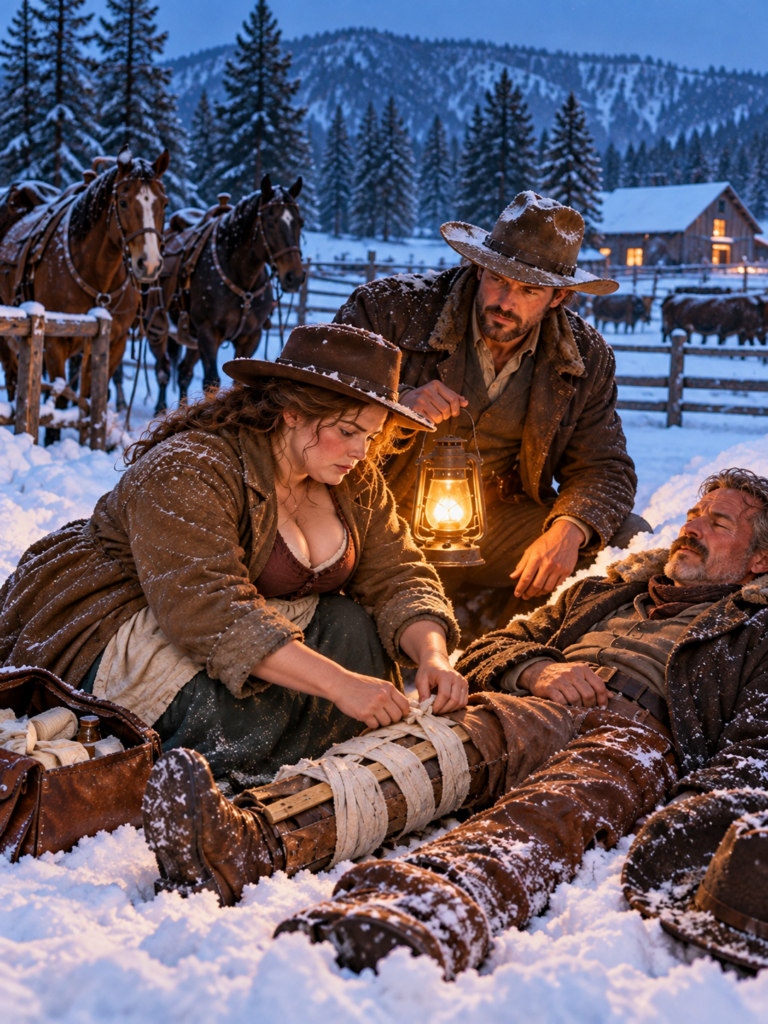
Eli rode ahead on a powerful gray gelding. Clara followed in the small work sleigh, holding a lantern beneath the shelter of her coat.
They had brought blankets, rope, wooden boards, and enough dry canvas to wrap an injured man.
Neither spoke much.
The wind stole most words before they could travel between them.
At the northern fence, Eli dismounted and examined the snow.
“The horse came through here.”
Clara held the lantern lower.
A section of wire had been pulled loose. Beyond it, something dark lay half-buried in the drift.
Eli moved toward it.
A hat.
Pete’s hat.
He picked it up, brushed off the snow, and looked toward the shallow ravine beyond the fence.
“Pete!”
No answer.
He called again.
The wind moaned through the pines.
Clara climbed down from the sleigh.
“Wait.”
Eli turned.
She pointed toward the hollow.
A faint sound reached them between gusts.
Not a shout.
A groan.
They found Pete Garvey at the bottom of a narrow wash, lying against a fallen branch with one arm curled around his chest.
His horse had apparently stepped through a crust of snow over hidden ice, stumbled, and thrown him down the slope.
His left leg lay beneath him at an unnatural angle.
Eli dropped to one knee.
“Pete!”
The foreman’s eyes opened.
“That you, boss?”
“Who else would be fool enough to come looking for you?”
Pete attempted a grin.
It collapsed into a grimace.
“Had a little trouble with the horse.”
“So I noticed.”
Clara set down the lantern and knelt beside him.
“Mr. Garvey, I’m going to examine you.”
Pete blinked at her.
“What are you doing out here?”
“At the moment, wishing you’d stayed home.”
“That makes two of us.”
She checked his breathing, his pulse, and the areas of his body he could move without pain.
He was cold, but alert.
There was blood on his trouser leg, though no bone protruded through the skin. When she exposed the injured area, she found a deep abrasion and a deformity below the knee.
His foot remained warm enough for her to feel some hope.
She examined its color, checked the pulse near his ankle, and asked him whether he could feel her fingers touching his toes.
He could.
“Your leg is badly broken,” she said.
Pete looked down.
“That explains a considerable amount.”
“We need to immobilize it before moving you.”
He stared at the boards Eli had carried down.
“You mean you’re going to tie me to a fence?”
“Only your leg.”
Pete gave a miserable laugh.
Clara looked at Eli.
“I need the canvas cut into strips. Those boards must be padded. And I need you to keep him steady.”
Eli immediately took out his knife.
Clara worked with a concentration that seemed almost unnatural in the bitter weather.
She checked for other injuries before carefully aligning and supporting the leg as much as safety allowed. She made no attempt to force the damaged bones into position. She placed padding along either side, secured the improvised splints above and below the injury, and checked Pete’s foot again.
Once, the foreman cried out.
Eli tightened his grip on the man’s shoulders.
“Easy, Pete.”
“Easy? I’d like to see you call it easy with your leg pointing the wrong direction.”
Clara leaned close.
“Look at me, Mr. Garvey.”
He obeyed.
“I know it hurts. You’re doing well. But we have to finish this properly.”
Her voice was calm.
Not detached.
Calm in the way a firmly held rope remains steady while everything around it pulls.
Pete swallowed and nodded.
At last she secured the final binding.
“All right. That’s as stable as we can make it here.”
Eli exhaled.
Only then did he notice her hands.
They were red and shaking slightly.
The gloves she had removed lay forgotten beside the lantern.
“Your fingers are freezing.”
“They still work.”
“They won’t much longer.”
“Then help me get him onto the sled.”
Together they eased Pete onto the canvas-covered frame and wrapped him in blankets.
By the time they began the journey home, the lantern flame had shrunk to a flickering blue-tipped glow.
Eli guided the team carefully, avoiding deep ruts and uneven ground.
Clara sat beside Pete, watching his face.
She kept him speaking whenever he seemed inclined to drift into dangerous silence.
She asked about the cattle, the ranch’s first winter, and how long he had worked for Eli’s father.
Pete answered between clenched teeth.
When he complained that the brand on the youngest bull was crooked, Clara knew he still possessed enough spirit to be troublesome.
She considered that encouraging.
At one point, Eli turned from the driver’s seat.
“How is he?”
Clara looked at Pete.
“Annoying.”
“Good,” Eli said. “That’s how he usually is.”
It was nearly midnight when they reached the ranch.
The hands came running with lamps.
Mrs. Aldridge, summoned earlier by one of the men, had stayed to watch Samuel.
Pete was carried into the spare room.
Clara directed the men with firm efficiency, insisting that they keep the injured leg supported while moving him. She examined the splint, dressed the abrasion, and checked again for signs that circulation had become compromised.
When everything possible had been done, she arranged for someone to remain near him.
A physician would have to be summoned when the roads allowed.
Until then, she would watch him closely.
Eli stood by the bed.
“Will he keep the leg?”
Clara looked at him.
“I believe so. But it’s a serious break, and I won’t promise what I cannot know.”
He nodded.
The honesty seemed to reassure him more than certainty would have.
In the kitchen, Samuel waited in his nightshirt, clutching his wooden horse.
His eyes widened when he saw the blood on Clara’s sleeve.
“Is Pete going to die?”
Clara knelt before him.
“He’s hurt, sweetheart. But he’s alive, and we’re going to care for him.”
“Did you find him?”
“Your father and I did.”
Samuel looked at Eli.
“Was it scary?”
Eli glanced at Clara.
“Yes.”
The boy considered this.
“Did you get scared?”
“Yes.”
“Then how did you do it?”
Eli crouched beside him.
“Because Pete needed us.”
Samuel thought for a moment.
Then he held out the wooden horse to Clara.
“He can borrow this.”
She accepted it carefully.
“I think he would like that very much.”
When Eli carried the boy back to bed, Clara placed the horse beside Pete’s pillow.
The foreman opened one eye.
“What’s that doing here?”
“Samuel thought you might need company.”
Pete grunted.
“Tell him I appreciate it.”
Then he closed his eyes.
The storm lasted another two days.
During that time, the house became a world unto itself.
Snow piled against the eastern wall. The men kept the barn paths cleared. Clara divided her hours between the kitchen, Samuel, and the spare room where Pete lay muttering complaints about everything from his leg to the quality of the weather.
She checked his circulation regularly, watched for fever or increasing swelling, and adjusted the padding whenever necessary.
Once the roads were passable, Eli sent for a physician from a distant settlement. The older doctor examined Pete, approved the immediate immobilization, and warned that the break would require many weeks of healing.
He also told Pete, with considerable emphasis, that trying to walk too soon could undo the good work already done.
Pete listened with an expression of profound disbelief.
Clara stood behind the physician, arms folded.
When the doctor departed, Pete looked at her.
“You two planned that speech.”
“I would have made it shorter.”
He regarded her suspiciously.
“You’re enjoying this.”
“Not nearly as much as I shall enjoy seeing you walk again.”
By the third evening, Eli noticed something remarkable.
His household was no longer divided into separate lives.
Samuel carried water to the spare room in a cup he insisted Pete use. The ranch hands entered quietly to visit their foreman. Mrs. Aldridge brought broth and gossip from the neighboring farms. Clara managed it all without allowing the house to become chaotic.
She had not made herself important by demanding attention.
She had made herself necessary through what she did.
And that realization unsettled Eli more than he wished to admit.
He had been married once.
He had loved his wife, Mary, with the quiet devotion of a man who expressed affection through work rather than poetry.
When she died giving birth to Samuel, something inside him had closed.
He had continued living because the boy needed him.
He had continued ranching because land did not stop demanding labor when a man was grieving.
But he had stopped expecting happiness.
Now he heard laughter from the kitchen and found himself standing still to listen.
That frightened him.
Not because the laughter was unwelcome.
Because he was beginning to want it to remain.
A week after the accident, Clara came downstairs late to find Eli at the kitchen table with two cups of coffee.
He pushed one toward her.
“You haven’t slept much.”
“Neither have you.”
“I have men who can manage the ranch.”
“And I have a foreman who believes instructions are personal insults.”
Eli smiled.
It changed his face.
Clara noticed, though she pretended otherwise.
For a while they listened to the wind moving across the roof.
Then Eli spoke.
“Why did you come to Montana?”
She looked at her coffee.
“The simple answer is that I needed employment.”
“What’s the other answer?”
She sat back.
“I was supposed to marry a man in Billings.”
Eli said nothing.
“His name is Harlan Fitch. He sells land and finds ways to make ordinary things sound more valuable than they are.”
“Sounds profitable.”
“It appears to be.”
“Why didn’t you marry him?”
“Because he decided I was unsuitable.”
Eli looked at her.
Clara continued before he could ask.
“He liked the idea of a respectable wife. A widow with no family to interfere, educated enough to be useful, and grateful enough not to make demands.”
Her fingers tightened around the cup.
“Then he discovered I intended to continue nursing.”
“What did he say?”
“That it wasn’t proper for his wife to enter strange men’s homes, or tend injuries, or spend nights beside sickbeds.”
Eli’s eyes darkened.
“And you told him no.”
“I told him I would not abandon my work.”
“Then?”
“He sent me a letter ending the engagement.”
For the first time, she allowed bitterness to enter her voice.
“He did not even have the courage to say it to my face.”
Eli regarded the fire.
“Foolish man.”
Clara almost laughed.
“You know nothing about him.”
“I know he threw away something worth keeping because he couldn’t control it.”
Silence settled between them.
Clara looked at Eli differently.
“You haven’t asked whether he might have been right.”
“Was he?”
“No.”
“Then why should I?”
She turned toward the window before he could see the sudden emotion in her face.
After a moment, she spoke.
“My husband died when I was twenty-four.”
Eli waited.
“Andrew was a teacher. Kind, patient, much too willing to lend money to people who wouldn’t repay it.”
A faint smile touched her mouth.
“He was a good man.”
“What happened?”
“Typhoid.”
The word remained in the warm kitchen like something cold brought in from outside.
“I knew what was happening to him. I understood the symptoms, the dangers, the terrible odds.”
Her voice thinned.
“And still I couldn’t save him.”
Eli studied his hands.
“Mary died bringing Samuel into the world.”
“I know.”
“I sent for the midwife. The snow was deep, and the creek crossing had iced over. By the time I brought her back…”
He stopped.
Clara knew better than to force the rest.
After a long silence, Eli said, “I spent years thinking that if I’d ridden faster, she’d still be here.”
Clara looked at him.
“And I spent years thinking that if I’d known one more thing, Andrew would have lived.”
Their eyes met.
Neither offered the other a comforting lie.
Some losses could not be repaired by trying harder.
That was a truth both had resisted.
At last Clara reached across the table and placed her hand over his.
“You did what you could,” she said.
Eli stared at their joined hands.
“So did you.”
Outside, the wind struck the shutters.
Inside, neither moved away.
By January, Pete was recovering slowly but steadily.
He remained in the spare room, where he entertained Samuel with stories that Clara strongly suspected had grown more impressive through repeated telling.
Each morning, she inspected his leg and reminded him not to bear weight until the physician allowed it.
Each morning, Pete assured her he understood.
And each afternoon, he attempted to invent a reason he should be permitted to stand.
The arrangement suited neither of them and amused everyone else.
Word of the rescue had also traveled through Cutter’s Ford.
At first, people repeated the story because it was dramatic.
Then they repeated it because Pete Garvey, who had never been accused of generosity toward strangers, began calling Clara the finest medical hand he had seen in twenty years.
“She worked in a blizzard,” he told one visiting rancher. “Couldn’t hardly see the end of her own nose, and she managed that leg better than half the men who’ve called themselves doctors around here.”
The rancher repeated the statement in town.
Soon, farmers began arriving with injured hands, lingering fevers, infected cuts, and ailments they had endured because a physician was too far away.
Clara helped where her training allowed and insisted on a doctor’s attention where it did not.
Eli cleared space in a warm outbuilding so patients would not have to crowd the kitchen.
He said nothing about the cost.
Clara noticed anyway.
One afternoon, she found him repairing the steps leading to the outbuilding.
“You needn’t do all this,” she said.
“Those steps were rotten.”
“They were perfectly serviceable yesterday.”
“Yesterday nobody was carrying a sick child across them.”
She watched him drive another nail.
“You’re a difficult man to thank.”
“Then don’t.”
But when she returned inside, she was smiling.
The growing stream of patients troubled Dora Phelps.
She had never entirely trusted Clara, and she believed a widowed man employing an unrelated woman beneath his roof invited scandal.
The fact that the woman was becoming indispensable only made the situation harder to criticize without appearing cruel.
Dora solved the problem by calling her objections concern.
She reminded people that Clara had no physician’s diploma.
She hinted that Eli was allowing his judgment to be influenced by a woman who had appeared in town without family, references, or a husband.
She suggested that respectability mattered as much as skill.
Some people agreed.
Others had children Clara had treated, or relatives whose suffering she had eased, and they were less inclined to listen.
Eli heard the rumors one morning at the feed store.
He returned to the ranch angrier than Clara had ever seen him.
“Mrs. Phelps has a great deal to say about things that don’t concern her.”
Clara continued sorting clean bandages.
“She has said most of them before.”
“Not about you and me.”
Her hands stopped.
He looked at her.
“Apparently a man can’t employ a woman without the entire valley deciding what it means.”
Clara resumed her work.
“People often prefer an interesting lie to a dull truth.”
“Doesn’t it bother you?”
“Of course it bothers me.”
She folded the last bandage carefully.
“I simply refuse to let it govern me.”
Eli stood by the stove.
“I could speak to her.”
“And then she’d say I asked you to defend me.”
“What would you have me do?”
Clara met his eyes.
“Treat me with the same respect tomorrow that you have shown me today.”
It was a small request.
Eli understood that it was also an enormous one.
The letter from Harlan Fitch arrived two days later.
It bore his elegant handwriting and carried the faint scent of the expensive stationery he favored.
Clara recognized it immediately.
She opened it after supper.
Harlan was in Cutter’s Ford on business. He had heard of her circumstances. Upon reflection, he felt their separation had been unfortunate.
He believed a meeting might allow them to reconsider their future.
The final paragraph suggested that he was prepared to overlook certain difficulties if she displayed a suitable willingness to compromise.
Clara read the letter once.
Then she folded it and placed it beneath a jar of buttons.
Eli, who was sharpening a pencil at the far end of the table, looked up.
“Bad news?”
“An old mistake trying to become a new one.”
He studied her face.
“Anything I can do?”
“No.”
He nodded and returned to his pencil.
The simple acceptance of her answer touched her more deeply than she expected.
Harlan appeared the following Friday.
Clara had accompanied Eli into town to purchase lamp oil, flour, and several medical supplies that Mr. Getler had managed to order for her.
The store was crowded with people preparing for the evening community supper.
Harlan waited near the entrance, wearing polished boots and a fine dark overcoat.
His smile appeared the instant he saw her.
“Clara.”
She stopped.
“Harlan.”
He glanced at Eli and then back at her.
“You look well.”
“I am well.”
“I hoped we might speak privately.”
“About what?”
He smiled as though she had made a charming mistake.
“Our future, of course.”
The people nearest the doorway grew quiet.
Clara could feel their attention gathering.
“We have no future together,” she said.
Harlan’s smile faltered.
“Surely there’s no need to be dramatic.”
“I’m not being dramatic. I’m answering your question.”
He lowered his voice, though not enough to prevent others from hearing.
“I know you’ve been through a difficult period. And I’ve learned you’re living at a ranch, employed in a household with a widower and his child.”
“That is correct.”
“I understand how circumstances can force a woman to accept an unfortunate position.”
Clara’s expression hardened.
“There’s nothing unfortunate about honest employment.”
“Clara, please. You were meant for better things than serving in a rancher’s kitchen.”
Eli shifted beside her.
Clara lifted one hand slightly.
He remained still.
Harlan continued.
“I’m prepared to resume our engagement. We can put this unpleasant episode behind us. Naturally, certain understandings would be necessary.”
“Such as?”
“You would cease this medical business. A wife of mine cannot be forever chasing sick strangers across the countryside.”
Clara looked at him for a long moment.
Around them, the store had become completely silent.
“You ended our engagement because I refused to give up my work.”
“I reconsidered.”
“No,” she said. “You reconsidered the inconvenience of being refused.”
His face flushed.
“You misunderstand my generosity.”
“I understood your letter perfectly.”
He glanced at the watching crowd.
“You’re making a spectacle of yourself.”
“Then stop asking me questions in public.”
A few people near the counter exchanged glances.
Harlan turned toward Eli.
“And you, sir? Are you content to keep a vulnerable woman in your home under such an arrangement?”
Eli’s reply was quiet.
“Mrs. Voss is employed on terms we both agreed to.”
“Surely you see how improper—”
“I see a woman capable of making her own decisions.”
Harlan stared at him.
Eli continued.
“She has already made this one.”
For several seconds, nobody moved.
Then Clara stepped around Harlan.
“Good afternoon.”
She entered the store.
Eli followed, carrying the shopping list.
Harlan remained on the boardwalk, suddenly aware that the audience he had expected to impress had witnessed something very different.
Later, while Eli loaded the wagon, Dora Phelps approached Clara.
For once, she had no companions.
“Mrs. Voss.”
Clara turned.
Dora’s expression was strained.
“I heard what happened.”
“Most of town did.”
“Mr. Fitch seemed to have a very high opinion of himself.”
“He does.”
Dora hesitated.
“My sister died some years ago. A traveling healer persuaded her to rely on his remedies when she needed proper care.”
Clara’s expression changed.
“I’m sorry.”
“Ever since, I’ve had little patience for people who claim they can cure what they don’t understand.”
“Neither have I.”
Dora looked at her.
“I suppose I should have asked more questions before speaking about you.”
“Yes, Mrs. Phelps. You should have.”
The older woman lowered her eyes.
She seemed almost ready to apologize.
Then pride intervened.
“Well. I only wish to see the town protected.”
“So do I.”
Dora nodded stiffly and walked away.
Clara watched her go without satisfaction.
She knew the difference between fear and cruelty.
She also knew that fear could become cruelty when people refused to question it.
On the drive home, Eli said very little.
The horses moved steadily through the snow, and the late sun cast long blue shadows over the valley.
At last he spoke.
“You handled Fitch well.”
Clara looked ahead.
“I’ve had months to decide what I’d say if I ever saw him again.”
“Didn’t seem to require much thought.”
“It didn’t.”
They traveled another half mile.
Then Eli asked, “Did you ever love him?”
Clara considered the question.
“I wanted to believe I could.”
“Why?”
“Because I was tired of being alone.”
The words surprised them both.
Eli kept his eyes on the road.
After a while, he said, “There’s a difference between wanting company and wanting a particular person.”
Clara turned toward him.
“Yes,” she said softly. “I’m beginning to understand that.”
Neither spoke again until the ranch came into view.
Samuel was waiting at the kitchen window.
When he saw the wagon, he waved both hands.
Clara waved back.
Something in her chest tightened with an emotion she was no longer certain she wished to resist.
Three mornings later, another letter arrived.
This one came from Portland.
The envelope carried the familiar handwriting of Sister Margaret, who had supervised Clara’s medical training and later encouraged her work among the sick.
Clara opened it beside the kitchen window.
The letter contained an offer.
The hospital was expanding its charitable nursing service. They needed an experienced woman to supervise younger trainees and assist with care for the city’s poorest families.
Clara’s name had been recommended.
The salary was generous.
The position was permanent.
And unlike her uncertain life in Montana, it would provide formal recognition of the work she had spent years learning to do.
Clara sat down.
For a long time, she did not move.
Everything she had once wanted was now being offered.
A secure future.
Respected employment.
A place where nobody would question why a woman devoted her life to caring for the sick.
There was only one difficulty.
The thought of leaving the Brand Ranch hurt far more than she had expected.
At the doorway, Samuel appeared.
“Mrs. Voss?”
She folded the letter.
“Yes, sweetheart?”
“Are you going away?”
Clara stared at him.
“Why do you ask?”
He pointed to the envelope.
“Mrs. Aldridge said people get letters when somebody wants them somewhere else.”
Clara looked toward the yard, where Eli and Pete’s temporary replacement were examining the harnesses.
Then she looked back at the boy.
For the first time since arriving in Montana, she had no ready answer.
And Samuel, who had already lost one mother, understood her silence in the worst possible way.
He turned and ran upstairs.
Part 3
Clara found Samuel in the barn.
He had climbed into an empty feed stall and curled himself against the wooden partition, with his knees drawn to his chest.
The little wooden dog lay beside him.
Outside, the winter wind pushed loose snow beneath the barn doors.
Clara stopped at the entrance to the stall.
“May I sit with you?”
Samuel shrugged without looking up.
She sat on an overturned bucket.
For several minutes, neither spoke.
Then he asked, “Did I do something wrong?”
Clara felt the question like a hand closing around her heart.
“No.”
“Then why are you leaving?”
“I haven’t decided to leave.”
“But somebody sent you a letter.”
“Yes.”
“And they want you to go away.”
“They’ve offered me work at a hospital.”
Samuel picked at a loose thread in his sleeve.
“Is it better work than being here?”
Clara considered how to explain an adult’s divided heart to a child.
“It’s work I know how to do. Work that matters to me.”
“Don’t we matter?”
She closed her eyes for an instant.
“Oh, Samuel.”
He looked at her then, and she saw the fear he had been carrying beneath all his careful manners.
He remembered almost nothing of his mother.
But he understood absence.
He understood the sound of a door closing and someone not returning.
He understood what happened when adults said things would be all right and afterward everything changed.
Clara moved from the bucket to the floor beside him.
“You matter very much.”
“Then stay.”
She wished the answer were that simple.
“Samuel, there are times when grown people have to make difficult decisions. But I want you to know something.”
He watched her.
“If I ever go anywhere, I’ll tell you properly. I won’t disappear without saying goodbye.”
“Promise?”
“I promise.”
He lowered his eyes.
Then, after a moment, he moved closer.
She did not reach for him.
She waited.
At last he leaned against her shoulder.
“Papa was sad when Mama died,” he whispered.
“I know.”
“He still gets sad.”
“Yes.”
“Would he get sad if you went away?”
Clara looked toward the barn doors.
Through the narrow opening she could see Eli crossing the yard, carrying an armful of firewood.
“I think he might.”
Samuel considered this.
Then he placed the little wooden dog in her lap.
“You can have him back if you need him.”
Clara stared at the small figure.
Andrew had carved it when their future seemed certain.
She had carried it across years of grief and hundreds of miles.
Now a lonely child was offering it to her because he believed she might need comfort more than he did.
She wrapped her fingers around the carving.
“Thank you.”
Samuel rested his head against her arm again.
For a long time, they remained together on the cold barn floor.
That evening, Clara took the letter to Eli.
He was in his office, studying accounts beneath the yellow light of an oil lamp.
She knocked on the open door.
“Do you have a moment?”
He set down his pencil.
“Of course.”
She handed him the letter.
He read it without speaking.
When he reached the end, his expression grew still.
“It’s a good offer.”
“Yes.”
“Better wages than I can pay.”
“Yes.”
“Proper employment at a hospital.”
“Yes.”
Eli placed the letter on the desk.
“Then you should consider it.”
Clara had expected many things.
She had not expected the disappointment that followed those words.
“Is that what you want?”
He looked at her.
“What I want shouldn’t decide your future.”
“But it might matter to me.”
He stood slowly.
For a moment, they faced one another across the desk.
“Clara,” he said, and it was the first time he had spoken her given name, “I’ve watched you work since the day you arrived. I’ve seen what you’re capable of. I’d be a selfish man if I asked you to give up something you spent years earning.”
She studied his face.
“Is that what you think I’d be doing by staying?”
“I don’t know.”
“Neither do I.”
He came around the desk.
“I know this valley needs you. I know Samuel needs you.”
He stopped.
“And I know I’ve begun depending on you in ways I never intended.”
Clara felt her pulse quicken.
“Eli—”
“But needing someone doesn’t give a man a right to keep her.”
The words settled between them.
She thought of Harlan Fitch and the careful arrangements he had proposed for their marriage.
A home in which her work would be tolerated only if it remained invisible.
A husband who wanted the appearance of a capable woman without accepting the choices that made her capable.
Eli was offering the opposite.
He was willing to lose her rather than make her smaller.
That realization unsettled her more deeply than any declaration of love could have.
“I don’t want to make this decision because I’m frightened of losing a home,” she said.
“Then don’t.”
“And I don’t want to leave because I’m frightened of finding one.”
Eli said nothing.
Clara looked down at the letter.
“I need to understand which life I’m choosing.”
“Take whatever time you need.”
She nodded.
As she reached the doorway, Eli spoke again.
“There’s something else.”
She turned.
“Whatever you decide, you’ve changed this house.”
His voice was steady, but his face betrayed him.
“Samuel laughs again. Pete has somebody to quarrel with besides me. And I’ve started looking forward to coming inside at night.”
Clara could not answer.
Eli gave a faint, almost embarrassed smile.
“I thought you ought to know.”
Over the following week, Clara tried to imagine herself back in Portland.
She remembered the hospital corridors, the orderly rows of beds, the Sisters moving quietly between patients, and the sense of purpose that came from work shared with others.
She remembered how proud she had felt the first time she was trusted to manage a ward.
That work had mattered.
It still did.
But when she imagined returning, she discovered that her thoughts traveled back to Montana.
To Samuel at the kitchen table, arguing that the wooden dog deserved more biscuits than the horse.
To Pete, whose complaints had become so predictable that she could often answer them before he finished speaking.
To Mrs. Aldridge arriving with fresh eggs because Clara had treated her daughter.
To Eli standing outside in the cold, repairing steps that he claimed had needed repairing long before she arrived.
And beyond the ranch, she thought of the families scattered across the valley.
Women who gave birth in isolated cabins.
Children who survived winter fevers without the help of a trained nurse.
Men who rode for hours with injuries that should have been treated immediately.
She had come because the district lacked medical care.
That need had not disappeared.
If anything, she understood it more clearly now.
The question was no longer whether Portland offered a respectable future.
It did.
The question was whether she could build something in Montana that was entirely her own.
The answer began arriving on a cold Tuesday afternoon.
A wagon came up the ranch road carrying Dora Phelps and two other women from town.
Eli met them beside the gate.
“Afternoon, ladies.”
Dora climbed down with unusual care.
“We’ve come to see Mrs. Voss.”
“She’s in the house.”
Clara opened the door as they approached.
Dora removed her gloves.
“May we speak?”
“Certainly.”
The women sat around the kitchen table while Clara poured tea.
For several moments, Dora examined her cup.
Then she drew a folded paper from her handbag.
“We’ve been talking with some of the families in town.”
Clara waited.
“Several would like to contribute toward regular nursing services here in the valley. Nothing grand, mind you. A modest fund for supplies, perhaps a visiting doctor’s expenses when needed, and assistance for families who cannot pay.”
She placed the paper on the table.
It carried nineteen signatures.
Clara recognized most of the names.
Mrs. Aldridge.
Mrs. Getler.
Two women whose children she had treated.
The wife of a ranch hand from the southern valley.
And at the top, written in careful, unmistakable letters, Dora Phelps.
Clara looked up.
“What brought this about?”
Dora cleared her throat.
“Mr. Garvey has been speaking rather loudly about his experiences.”
From the adjoining room came Pete’s voice.
“Wouldn’t have to speak so loudly if people listened the first time.”
One of the women laughed.
Dora looked briefly annoyed, but continued.
“And Mrs. Aldridge told us about her daughter. Others have their own stories.”
She paused.
“I also made inquiries about your training.”
Clara raised an eyebrow.
“Did you?”
“I did. The work you performed in Portland was respectable and demanding.”
“Yes.”
Dora drew herself up.
“I was wrong to suggest otherwise.”
The room became quiet.
Clara had expected defensiveness, perhaps another explanation wrapped in concern.
Instead, Dora met her eyes.
“I was also wrong to repeat things about your living arrangements. I know what unkind talk can do to a woman. I ought to have remembered that before contributing to it.”
For once, there was nothing halfhearted about the apology.
Clara rested her hands on the table.
“Thank you, Mrs. Phelps.”
Dora nodded.
“The valley still needs a physician. Nobody is pretending otherwise. But until one comes, and even after, we need someone with your knowledge.”
Clara looked again at the signatures.
For years, she had feared that every new home would require her to surrender some piece of herself.
Here, at last, people were asking her to become more fully the person she had trained to be.
“I would have to establish clear limits,” she said. “I cannot undertake work beyond my training, and some conditions will still require a doctor.”
“We understand.”
“And families must know when they need more experienced medical attention, even if reaching it is difficult.”
Dora nodded.
“What would you require?”
Clara considered the question.
“A clean room for patients. Proper storage for supplies. A reliable way to send messages during emergencies. Perhaps a weekly visit from a physician willing to travel from the next settlement.”
She looked toward the window.
“And I would like to teach a few women basic nursing skills. The next accident may happen too far from this ranch for anyone to come here first.”
Dora’s expression changed.
“That seems sensible.”
“It would take work.”
“We aren’t afraid of work, Mrs. Voss.”
From the other room, Pete called, “Long as none of you ask me to demonstrate walking.”
This time even Dora laughed.
That night, Clara wrote to Sister Margaret.
She thanked her for the offer, explained how much the confidence meant, and described the valley’s needs.
Then she wrote that she had decided to remain in Montana.
Not because she wished to abandon nursing.
Because she wished to practice it where it was desperately needed.
She asked whether the Sisters might recommend books, supplies, and physicians willing to advise her from a distance.
When she finished, she read the letter twice.
There was no panic in her heart.
No desperate feeling that she was closing the door on her only chance at happiness.
Instead, she felt the quiet certainty of a woman who had stopped allowing fear to make her decisions.
She sealed the envelope.
Then she went looking for Eli.
He was in the barn, repairing a harness by lantern light.
Clara stood in the doorway.
“I’m staying.”
Eli stopped working.
For a moment, he simply looked at her.
“Are you certain?”
“Yes.”
“The hospital—”
“I wrote to them this evening.”
He set the harness aside.
“Clara, I don’t want you to regret—”
“I won’t.”
She came farther into the barn.
“I’ve spent a great deal of my life running toward what I thought would make me safe. Marriage. Employment. A city where I knew the streets. A position where nobody could question my worth.”
Eli listened.
“But I don’t want safety bought at the price of belonging nowhere.”
He looked down.
“And you belong here?”
“I believe I could.”
Her voice softened.
“If I am wanted.”
Eli rose.
The lantern cast long shadows across the boards.
“You know you’re wanted.”
“As a housekeeper?”
He hesitated.
Then he shook his head.
“No.”
“As a nurse?”
“That too.”
Clara waited.
Eli took a slow breath.
“I’ve been trying to find a way to tell you something without making you feel obliged to answer.”
“Then tell me plainly.”
He smiled faintly.
“You always did prefer that.”
He stepped closer.
“I hired you because I needed help with Samuel and the house. That was the truth. I didn’t ask for a wife, and I had no intention of looking for one.”
Clara’s eyes shone.
“I remember.”
“Then I watched you become part of this place.”
He looked toward the barn doors.
“I watched my son trust you. I watched Pete survive because you knew what to do. I watched you stand before Fitch and refuse to apologize for being yourself.”
He turned back to her.
“And somewhere along the way, I found I couldn’t imagine the years ahead without you in them.”
Clara pressed her lips together.
Eli continued carefully.
“I loved Mary. I always will, in the way a man loves someone he has lost. But loving her memory doesn’t mean I have nothing left to give.”
A tear slipped down Clara’s cheek.
He took another step.
“I want to marry you, Clara. Not because Samuel needs a mother or because this house needs someone to manage it.”
His voice lowered.
“Because I love you. And because I want whatever life we can build together.”
She covered her mouth with one hand.
Eli waited.
Then he added, “Your work would remain yours. If you choose to say no, your position here remains exactly what we agreed. I won’t punish you for your answer.”
Clara gave a broken little laugh.
“You have made that rather difficult.”
He looked alarmed.
“Have I?”
“Yes.”
She reached for his hand.
“Because I love you too.”
For a moment, Eli seemed unable to understand the words.
Then his expression changed.
The careful restraint he had practiced for years gave way to something warmer and younger.
“Is that a yes?”
Clara stepped closer.
“Yes, Eli.”
He closed both hands around hers.
“You’re certain?”
“Quite.”
“Because I know a man who needs a little convincing sometimes.”
“Then perhaps I should say it again.”
She smiled through her tears.
“Yes.”
He bent his head and kissed her.
There was nothing hurried or possessive in it.
It was the gentle, astonished kiss of two people who had believed their best years were behind them and discovered they might have been wrong.
When they finally drew apart, Eli rested his forehead against hers.
“I never thought I’d have this again.”
“Neither did I.”
Beyond the barn, snow began falling softly.
But neither of them felt cold.
Telling Samuel proved more complicated.
Eli sat beside him the next morning while Clara remained near the stove.
“Mrs. Voss is going to stay with us,” he said.
Samuel’s eyes widened.
“Forever?”
“That’s what we’re hoping.”
The boy looked at Clara.
“Are you going to marry Papa?”
“Yes.”
Samuel considered the matter.
Then he frowned.
“Does that mean Mama isn’t my mama anymore?”
Clara immediately came to sit beside him.
“No, sweetheart. Your mother will always be your mother.”
“Even if you’re here?”
“Especially then.”
Eli put an arm around his son.
“Nothing changes how much your mama loved you.”
Samuel looked at the framed photograph of Mary on the mantel.
It had stood there since before Clara arrived.
“Will her picture stay?”
“Of course,” Clara said.
The boy studied her.
“And you won’t go away?”
“I intend to be here a very long time.”
He thought about that.
Then he climbed into her lap, an action he had never attempted before.
Clara wrapped her arms around him.
Samuel pressed his cheek against her shoulder.
“Good.”
It was all he said.
It was enough.
February gave way to March.
The deepest snow began to retreat from the southern slopes, leaving muddy paths and patches of flattened brown grass.
Pete Garvey’s recovery remained the subject of intense discussion.
By the time the physician approved gradually returning weight to his injured leg, Pete had become convinced that he was the most patient invalid in the history of Montana.
Nobody agreed.
His first walk across the kitchen required a cane, Clara’s supervision, and an audience of three ranch hands who tried unsuccessfully to disguise their amusement.
Pete reached the far wall and turned.
“There,” he announced triumphantly. “Good as new.”
Clara examined his face.
“You’ve walked twelve feet.”
“Thirteen.”
“Then perhaps tomorrow you’ll manage fourteen.”
Pete glared at her.
But his eyes were wet.
He knew how narrowly he had escaped a very different fate.
When she handed him his cane, he caught her wrist.
“Mrs. Voss.”
She looked at him.
“Yes?”
“That day in the snow.”
Her expression softened.
“I remember.”
Pete swallowed.
“I was certain I wasn’t coming home.”
Clara said nothing.
“Thought I’d lie there till the cold finished me.”
He looked toward the window.
“Then I heard you and the boss calling.”
His weathered face tightened.
“I don’t reckon I ever properly thanked you.”
“You’ve thanked me every morning by arguing with my instructions.”
Pete gave a rough laugh.
Then he grew serious.
“You gave me another chance, ma’am.”
Clara touched his shoulder.
“You did the difficult part. You survived.”
He shook his head.
“Couldn’t have done it alone.”
She thought of the lantern, Eli’s steady hands, the freezing ravine, and the long journey home.
“No,” she agreed. “None of us could.”
The wedding took place on a clear Wednesday afternoon in late March.
There was no grand celebration.
The minister came from Cutter’s Ford in a borrowed wagon. Mrs. Aldridge brought flowers gathered from a sheltered hillside where the first early blooms had appeared.
Pete stood beside Eli, leaning heavily on his cane and refusing to sit down.
Dora Phelps arrived carrying a carefully wrapped wedding cake.
Clara wore a simple cream-colored dress that Mrs. Aldridge had helped alter.
At her throat was a small silver brooch Andrew had given her years earlier.
She had considered leaving it in her room.
Then she realized there was no reason to pretend her earlier life had never existed.
It had brought her here.
Eli had placed Mary’s photograph on the mantel that morning and left it there.
Their marriage would not erase the people they had lost.
It would honor the fact that both had learned to love again.
Samuel sat on the front porch wearing his best shirt and holding the little wooden dog.
When the minister asked whether anyone knew of a reason the marriage should not proceed, Pete whispered loudly that Clara ought to consider whether Eli was worth the trouble.
The minister coughed.
Mrs. Aldridge elbowed Pete.
Eli smiled.
Clara laughed openly.
Then the vows were spoken.
When Eli slipped the ring onto her finger, his hand trembled slightly.
Clara looked up at him.
For years, she had believed strength meant never needing another person.
Now she understood it could also mean allowing someone to stand beside her without surrendering the right to stand on her own.
When the minister pronounced them husband and wife, Eli kissed her gently.
The room filled with applause.
And Samuel, unable to contain himself another moment, ran forward and wrapped his arms around both their legs.
“Now we’re a family,” he announced.
Eli lifted him.
“We were becoming one for quite a while, son.”
Samuel frowned.
“Then why did you take so long?”
Pete roared with laughter.
“Been asking that myself.”
Spring transformed the valley.
The snow withdrew from the creek banks. Water ran silver beneath the willow branches, and the first green shoots appeared along the southern fences.
With help from the townspeople, the outbuilding beside the ranch house became a modest nursing room.
Eli repaired the roof and widened the doorway.
Mrs. Aldridge provided shelves and clean linens.
Dora Phelps organized contributions for supplies, kept the accounts, and proved unexpectedly capable of persuading reluctant families to seek care before an illness became serious.
Clara established two regular days each week for patients.
On other days, she traveled when urgent need called her.
She arranged visits from a physician in a neighboring settlement and began teaching practical lessons in cleanliness, wound care, and recognizing dangerous symptoms.
She never pretended to possess knowledge she did not have.
People trusted her more because of it.
Pete became her loudest advocate.
He took considerable pleasure in showing visitors his healed leg and explaining that the woman they had once called a questionable medical practitioner had prevented him from freezing to death.
His account grew more dramatic each time.
Eventually, according to Pete, the snow had been six feet deep, the wind had uprooted trees, and Clara had performed the entire rescue while fighting off three wolves.
Samuel believed every word.
Clara did not bother correcting him unless someone seemed inclined to take the wolves seriously.
As for Harlan Fitch, he left Cutter’s Ford before the winter was over.
His business concluded, he departed with his polished boots, his expensive luggage, and the unshakable conviction that Clara had made a regrettable choice.
She heard of his departure from Mr. Getler.
She gave it no further thought.
A life once large enough to frighten her had become too small to occupy her mind.
One evening in late April, Clara sat on the front porch as the sunset turned the western mountains gold.
The air smelled of damp earth and new grass.
Pete stood in the yard teaching Samuel how to throw a rope.
The boy’s first attempt tangled around his own boots.
His second landed over Pete’s hat.
His third caught nothing at all.
Pete declared it a promising beginning.
Clara smiled.
Behind her, the house was warm and orderly.
Her medical satchel hung beside the back door, ready whenever someone needed her.
The nursing room stood across the yard with fresh curtains in its windows.
On the mantel inside were two photographs: Andrew, smiling in his dark schoolteacher’s coat, and Mary, seated beside the young Eli she had married.
They had become part of the family’s history rather than shadows over its future.
Eli came out carrying two cups of tea.
He gave one to Clara and sat beside her.
“Long day?”
“Not especially.”
“Mrs. Phelps says three more families have offered to contribute to the nursing fund.”
“She told me.”
“At this rate, she’ll have you running the whole valley.”
Clara smiled.
“She already thinks I do.”
Eli laughed.
For a while, they watched Samuel struggle with the rope.
Then Eli reached for her hand.
“Are you happy?”
Clara looked at him.
He asked the question without insecurity.
Without needing a particular answer.
Only because he wanted to know.
She turned toward the valley.
She thought of the stagecoach that had brought her to Cutter’s Ford with almost no money and fewer expectations.
She thought of the store where a child had bled and a stranger had held a lamp.
She remembered the blizzard, the wounded foreman, the lonely boy who had been afraid to trust another woman, and the man who had learned to open his heart without demanding possession of hers.
She remembered Harlan’s letter burning in the stove.
And the letter from Portland, which she had answered with a steady hand.
For so long, every important decision in her life had seemed to be made by death, disappointment, or someone else’s judgment.
Now she had chosen.
Not a refuge.
Not an escape.
A life.
“Yes,” she said. “I am.”
Eli lifted her hand and kissed it.
Samuel shouted from the yard.
“Mama! Look!”
Clara froze for the smallest fraction of a second.
The word had come naturally.
Without ceremony.
Without anyone asking him to say it.
She turned.
Samuel had finally managed to catch the fence post with his rope.
Pete stood beside him, looking almost as proud as the boy himself.
“Did you see?” Samuel shouted.
Clara set down her tea.
“I saw!”
“Was it good?”
“Very good.”
Samuel beamed.
Then he returned to his lesson, already determined to do better.
Eli watched Clara quietly.
He had seen the moment the word reached her.
He understood what it meant.
“You all right?” he asked softly.
She nodded.
A tear slipped down her cheek.
Eli put his arm around her shoulders.
She leaned against him.
The sun sank beyond the mountains, and a soft breeze moved through the grass.
At the edge of the porch, a single wooden board shone slightly newer than the others.
Eli had replaced it during the winter after Clara mentioned that it was loose.
Neither had spoken of it again.
It had simply become part of the house, solid beneath their feet.
Clara looked down at it and smiled.
Somewhere beyond the northern ridge lay the ravine where Pete’s horse had fallen, where the snow had nearly swallowed a man’s life, and where Eli had first watched her work by the unsteady light of a lantern.
He had gone into that storm believing he had hired a woman to help keep his household running.
He had come home having witnessed something he had not known how to name.
Not merely courage.
Not merely skill.
But the extraordinary strength of someone who had suffered deeply and had chosen, despite it, to remain gentle.
Clara had come to Cutter’s Ford with a single traveling bag and the determination never again to let another person decide her worth.
She had expected to find work.
Instead, she had found a place where her work was respected, where her presence mattered, and where love asked her to surrender nothing essential.
In the yard, Samuel laughed.
Pete called out another instruction.
Eli’s arm rested warmly around her.
And as evening settled over the Brand Ranch, Clara understood that home was not the place where someone finally agreed to keep you.
It was the place where you were free to stay.
And for the first time in many years, she had no desire to be anywhere else.

