
Part 1
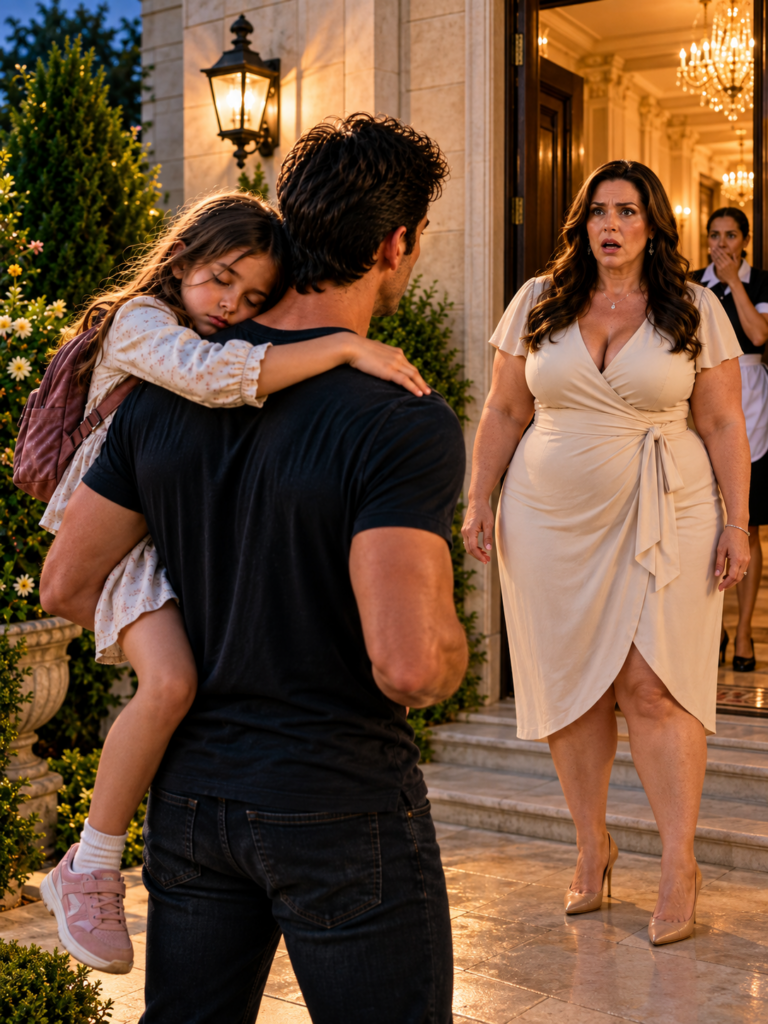
She was asleep on my shoulder by the time I reached the Ashworth gates.
Her backpack hung from one arm. Her cheek rested against the collar of my work shirt, leaving a damp little patch I pretended not to notice. Every few breaths, her fingers tightened against the back of my neck as if some part of her was still making sure I hadn’t disappeared.
I had known the kid less than an hour.
That should have been the strangest part of my evening.
It wasn’t.
The Ashworth house stood at the end of the drive exactly as I remembered it—white stone, tall windows, enough columns to make a courthouse jealous. Eight years hadn’t made it smaller. If anything, the place looked even more determined to remind a man like me that he was there by invitation only.
I parked in the circle drive and shut off the engine.
For a moment, I didn’t move.
The girl shifted against me through the open passenger door.
“All right,” I murmured, mostly to myself.
I carried her up the marble steps.
Before I could knock, the door opened.
Vivian Ashworth stood there.
Eight years disappeared so fast it made me dizzy.
She was older, obviously. So was I. But there were things time hadn’t touched: the slight crease between her eyebrows when she was frightened, the way one hand went still at her side while the other reached for something that wasn’t there.
Her eyes moved from my face to the child in my arms.
Her hand rose halfway to her mouth.
“Dalton.”
“Vivian.”
A woman in a black housekeeping uniform appeared behind her. She looked at the sleeping girl, then at me, and stopped dead.
Vivian swallowed.
“Where did you find her?”
“Frankfort Pike.”
Her face changed.
Not much. Vivian had been raised in a family where losing control in public counted somewhere between bad manners and moral failure.
But I knew her.
Or I had once.
And I saw fear.
“She was walking the shoulder,” I continued. “Alone.”
Vivian closed her eyes for half a second.
When she opened them again, there was something else there.
Decision.
“Come inside.”
I didn’t move.
“Vivian—”
“Please.” Her voice dropped. “Put her down somewhere comfortable. Then you and I need to talk.”
The little girl breathed against my neck.
I looked from her to Vivian.
Eight years earlier, Vivian had vanished from my life so completely that I’d eventually trained myself not to wonder why.
Now I was standing on her porch with a seven-year-old whose full name was Josie Ashworth Pruitt.
And I had already done the arithmetic.
My name is Dalton Pruitt.
I was thirty-four that Tuesday evening, and most days my life wasn’t complicated.
I built fences, graded land, repaired gates, cleared drainage lines, and did whatever else wealthy horse people around Midway and Lexington preferred to pay somebody like me to handle.
It was good work.
Physical work.
The kind where the problem in front of you usually had an answer.
A post leaned, you reset it.
A hinge broke, you replaced it.
A field held water, you found out why.
People were harder.
I’d learned that early enough.
I lived alone in a house with more bedrooms than I needed and a dog named Rusty who had never once asked me where a relationship was going. Most evenings I ate whatever could be cooked in one pan, let Rusty out, checked the weather, and went to bed early enough to do it all again.
I wasn’t unhappy.
That’s important.
People like to rewrite a man’s life backward once they know what happens next. They imagine he must have been secretly waiting for the missing piece.
I wasn’t.
I thought the shape of my life was the shape it was supposed to be.
Then I saw the girl on the road.
She was walking along the gravel shoulder of Frankfort Pike a little after six, backpack sliding off one side, marching with the determined posture of somebody who had made a plan and was too angry to reconsider it.
Cars passed her doing fifty.
I slowed my truck.
Rolled the window down.
“Hey.”
She stopped and looked at me.
“You lost?”
“No.”
That answer made me pull over.
I put the truck in park and leaned across the seat.
“You’re walking beside a highway.”
“I know.”
“You supposed to be?”
“No.”
At least she was honest.
I got out.
Up close, she looked seven, maybe. Brown hair coming loose from a ponytail. Dust on her shoes. A purple backpack covered in little silver stars.
She also looked tired.
Not kid-after-recess tired.
The other kind.
The kind that sat behind the eyes.
“You got somebody I can call?”
“No.”
“That’s not usually how phones work.”
“I mean you can’t call anybody.”
“Ah.”
She folded her arms.
I glanced at the traffic.
“Why don’t you get in the truck before we continue negotiating? You can sit right there. Door stays open if you want. But we’re not standing six feet from people who think the speed limit is a suggestion.”
She studied me.
“Are you weird?”
“Probably, but not in a dangerous way.”
That didn’t convince her.
I tried again.
“I mostly talk to fence posts and my dog.”
A tiny smile threatened her mouth.
“What’s your dog’s name?”
“Rusty.”
“That’s a boring dog name.”
“He didn’t complain.”
She climbed into the passenger seat.
I stayed outside until she was settled, then walked around and got behind the wheel.
“Name?”
“Josie.”
“I’m Dalton.”
Something flickered across her face.
I didn’t notice it then.
“So, Josie. Where are you going?”
“To find my dad.”
I looked at her.
She looked straight ahead.
“Your dad lives out here?”
“I don’t know where he lives.”
“Then how are you finding him?”
“I was going to keep looking.”
It was said with absolute seriousness.
I rested both hands on the steering wheel.
“Does your mother know you’re doing this?”
“No.”
“Does anybody?”
“No.”
“And you’re aware that’s a problem.”
She stared out the windshield.
I waited.
I’d learned a long time ago that people hated silence enough to fill it.
Apparently seven-year-olds did too.
“Today was Dad’s Day.”
“At school?”
She nodded.
“Everybody had somebody. Emma’s dad came. Trevor’s dad came. Layla’s dad drove all the way from Ohio, and her mom doesn’t even like him.”
“That’s dedication.”
“Trevor said maybe I don’t have one.”
The hurt in her voice didn’t sound like crying.
It sounded worse.
Flat.
Finished.
“So I decided I’d find him myself.”
I looked at that stubborn little profile.
“That’s a pretty big job.”
“Grown-ups keep saying they’ll explain things later.”
“Do they?”
“Yes.”
“And you’re tired of later.”
She finally looked at me.
“Yes.”
Something in my chest pulled tight.
I didn’t know why.
Not yet.
“Here’s what we’re going to do. I can take you to the sheriff’s office, or you tell me where you live and I’ll drive you home. Those are your choices.”
“You’ll tell my mom.”
“Absolutely.”
“Then they’re bad choices.”
“They’re the choices available.”
She made a sound that suggested my management style needed work.
Then she muttered, “Ashworth Lane.”
My hands went still.
“What?”
“Ashworth Lane. Big house. There’s a fountain near the front that doesn’t work right.”
Ashworth.
Eight years since I’d heard the name spoken in a way that mattered.
I put the truck back on the road.
“Your last name Ashworth?”
“Partly.”
“Partly?”
She dug through her backpack.
“Ashworth Pruitt.”
Everything inside me went quiet.
I kept driving.
“Pruitt?”
“Mom says I can pick which one I use when I’m older.”
The road blurred for one dangerous second before I blinked it clear.
“How old are you, Josie?”
“Seven and a half.”
Seven and a half.
Vivian had stopped answering my calls eight years ago.
I didn’t ask anything else.
At twenty-six, I’d thought loving Vivian Ashworth was complicated because her family had money and mine didn’t.
I had underestimated complicated.
I’d been hired to repair fencing and rebuild several gates on one of the Ashworth horse properties. Vivian started appearing at the barns in the afternoons.
At first, she asked practical questions.
Then questions that had nothing to do with fencing.
Then she started bringing coffee.
I knew who she was.
Everybody around Lexington knew the Ashworth name.
Old money. Horses. Land. Boards with family names engraved on brass plaques.
None of that mattered much while Vivian was sitting on an overturned bucket in the tack room laughing because I’d told her the expensive boots she wore had never seen mud.
“These boots have seen mud.”
“Walking from a car to a barn doesn’t count.”
“You are deeply judgmental for a man holding duct tape.”
“This is professional-grade repair tape.”
“It’s duct tape.”
Eight months.
That was how long we managed it.
The tack room.
A diner two towns over where nobody knew her.
Long drives without destinations.
A weekend in Nashville we’d planned and never took.
She was twenty-four. I was twenty-six.
I loved her with the confidence of a man who had not yet learned that loving someone and getting to keep them were separate things.
Then her father found out.
William Ashworth didn’t yell.
Men like him rarely needed to.
He found me beside a half-finished fence line and explained, in a calm voice, that my contracts could disappear.
That my name could become one respectable property owners stopped returning calls from.
That there were easier and harder ways for me to leave his daughter alone.
I told him Vivian could decide for herself.
The next day, her phone went straight to voicemail.
Two days later, the number had been disconnected.
A different crew finished my work.
Vivian never came to the diner.
Never came to my house.
Never sent a letter.
After a while, pride did what grief couldn’t.
It made me stop trying.
Now a seven-and-a-half-year-old girl with my last name had fallen asleep in my truck.
Vivian led me to the front sitting room.
I laid Josie on a long couch while the housekeeper—Carmen, Vivian called her—brought a blanket.
Josie barely stirred.
She looked smaller asleep.
That bothered me more than anything.
I followed Vivian into the hallway.
She folded her arms around herself.
“She ran away from school.”
“I gathered that.”
“There was an event.”
“She told me.”
Vivian looked toward the sitting-room door.
“I have spent years thinking I would know when the right time came.”
“For what?”
She met my eyes.
“To tell you.”
There it was.
Not the answer.
The thing before the answer.
My pulse slowed instead of speeding up.
“Tell me what?”
Her mouth trembled.
“Josie is your daughter.”
I’d known.
I had.
The math had been sitting beside me in the truck for the last twenty miles.
Still, hearing the words changed something.
I looked through the crack in the doorway.
A purple backpack.
Small shoes.
One hand curled beside her face.
Eight years.
“You’re sure?”
“Yes.”
“How long have you been sure?”
“Since before she was born.”
I turned back.
“Eight years, Vivian.”
“I know.”
“No. Don’t say you know like we’re discussing an overdue bill.”
She flinched.
I lowered my voice because there was a child sleeping ten feet away.
“Eight years.”
“I found out I was pregnant three weeks after my father forced you off the property.”
“You had my number.”
“I called.”
“My old number.”
“Yes.”
“Your father had my contractor line disconnected.”
“I didn’t know that.”
“My new number was on every truck I owned.”
Her eyes filled.
“You could have found me.”
“I know.”
“People find people, Vivian.”
“I know.”
“Stop saying that.”
She pressed her lips together.
For a moment we were twenty-six and twenty-four again, except neither of us had the protection of being young enough to believe we could fix everything later.
“My father told me if I contacted you again, he would ruin you.”
“So you let him.”
“I believed him.”
“Same result.”
“Yes.”
The fact that she didn’t defend herself took some of the force out of my anger and left the pain underneath it exposed.
She looked toward Josie.
“I was afraid.”
“You were always afraid of him.”
“Yes.”
“And I paid for it.”
Her eyes closed briefly.
“So did she.”
That stopped me.
Vivian opened them again.
“I told myself I was keeping you safe. Then I told myself too much time had passed. Then every year I waited became another reason the next year felt impossible.”
“That doesn’t make it better.”
“No.”
“She was walking down Frankfort Pike tonight.”
“I know.”
“Looking for somebody who would’ve been there if you’d given me the chance.”
“I know.”
Her voice broke.
This time I let her say it.
Behind us, the sitting-room door creaked.
“I can hear you.”
We turned.
Josie was sitting upright on the couch, hair crushed on one side, blanket in her lap.
She looked at Vivian.
Then me.
“Is that true?”
Nobody answered fast enough.
Josie’s eyes stayed on me.
“Are you my dad?”
I crouched in front of her.
My knees cracked.
Of all the things I might have imagined saying to a child if somebody had told me that morning I was a father, none of them were available.
So I told her the truth.
“Looks like I am.”
Her eyes grew shiny.
She didn’t cry.
“I went looking because I thought maybe if I found you myself, you’d want to come.”
My throat closed.
She went on.
“If Mom asked you, then maybe you’d only come because she made you. But if I found you, you’d get to decide.”
I sat down on the edge of the chair opposite her.
“Josie.”
She watched me carefully.
“I need you to understand something. If I’d known about you, I would have come.”
“To Dad’s Day?”
“Every Dad’s Day.”
“Even the boring school things?”
“Especially the boring school things.”
“What about assemblies?”
“I’d complain in the truck afterward, but I’d be there.”
Her mouth twitched.
“Field trips?”
“Depends. Are we talking zoo or educational corn maze?”
A small laugh escaped her.
Then she got serious again.
“You’re not going away?”
I couldn’t promise her what the courts would do.
I couldn’t promise how angry I was going to be tomorrow.
I couldn’t promise what Vivian and I would become.
But I could promise one thing.
“Not from you.”
She considered that.
Then nodded once.
“Okay.”
And because she was seven and had already lived too much day for one child, she lay down again.
Within minutes, she was asleep.
“I want a paternity test,” I told Vivian in the hallway.
“Of course.”
“And a lawyer.”
Her face went pale.
“I’m not trying to take her away from you.”
She exhaled.
“I want everything official. I want schedules. Information. School records. Medical records. I am finished learning about my own life by accident.”
“You should have all of it.”
“I mean that.”
“I know.”
I gave her a look.
“Sorry.”
For the first time that night, something almost human passed between us. Not warmth exactly.
Recognition.
The old kind.
Dangerous because it had once felt effortless.
“I don’t know what happens with us,” I said.
Vivian looked at me.
There were a hundred things in that look.
History.
Regret.
Something softer neither of us had earned the right to name.
“I’m not asking you to decide that.”
“Good.”
“But Dalton—”
“I mean it. Her first.”
“Yes.”
I looked at the child beyond the doorway.
“My daughter.”
Saying it hurt.
Saying it also felt strangely inevitable.
Vivian’s eyes filled again.
“Your daughter.”
I left close to midnight.
I drove home with the radio off.
Rusty met me at the door, tail knocking into the wall.
“Turns out,” I told him, “you aren’t my only dependent.”
He sneezed.
At two in the morning I sat at my kitchen table with a legal pad.
Seven and a half years.
Eight Christmases, depending how you counted.
Birthdays.
First steps.
First words.
First day of kindergarten.
First lost tooth.
Things I couldn’t even know to list.
I wrote until the page looked ridiculous.
Then I put the pen down.
Some problems couldn’t be fixed by calculating the missing pieces.
For the first time in years, I thought of Vivian without trying to shut the thought down.
Not the woman on the porch.
The girl in the tack room with expensive boots she claimed she’d gotten muddy.
I remembered how she’d laughed.
Then I remembered Josie saying, If I found you, you’d get to decide.
I looked at the clock.
Wednesday had already started.
And for the first time in eight years, I knew exactly where I needed to be.
Part 2
Pete Hollis listened without interrupting.
That was one reason I trusted him.
The other was that, several years earlier, he’d handled a property dispute for me without turning it into a six-month performance designed to increase his bill.
When I finished, he leaned back in his chair.
“You picked up your biological daughter by accident on Frankfort Pike.”
“Potential biological daughter.”
“You don’t actually believe there’s much potential involved.”
“No.”
“Good. Means we can skip pretending.”
He pulled out a yellow legal pad.
“First, paternity test. Proper lab. Chain of custody. Nothing anyone can challenge later.”
“Fine.”
“Second, you get your own representation if custody turns ugly.”
“You’re my representation.”
Pete sighed.
“Apparently.”
“Anything else?”
“Yes. The important part.”
I waited.
“Courts move slowly. Seven-year-olds don’t.”
That sentence stayed with me.
“Start showing up now,” he said. “Don’t make the kid wait for adults to finish paperwork before she finds out whether you meant what you said.”
So I called Vivian.
She answered on the second ring.
“Dalton?”
There was a carefulness in her voice I didn’t remember from when we were young.
“I want to see Josie Saturday.”
“Yes.”
“I don’t want to wait for test results.”
“Okay.”
“And I don’t want her thinking the test decides whether I’m coming back.”
“It doesn’t.”
“No. It doesn’t.”
Silence.
Then Vivian said, “She asked about you at breakfast.”
I gripped the phone harder.
“What did she ask?”
“If you liked pancakes.”
I almost laughed.
“That’s what she wanted to know?”
“She has priorities.”
“Tell her yes.”
“Plain?”
“Blueberry.”
A pause.
“You still like blueberry?”
The question landed too softly.
Eight years vanished again, but differently this time.
I could see a diner booth. Vivian stealing bacon off my plate. Me accusing her of ordering oatmeal for appearances.
“Yeah,” I said. “Still do.”
“Okay.”
Neither of us spoke for a moment.
Then I ended the call before memory became mistaken for forgiveness.
Saturday morning, Josie was sitting on the front steps before my truck had fully stopped.
She stood so quickly she nearly dropped whatever she was holding.
I put the truck in park.
She didn’t run to me.
Not yet.
She waited.
“You came.”
“Told you I would.”
“People say things.”
The words were matter-of-fact.
That made them worse.
I climbed out.
“I’m going to be irritating about meaning what I say.”
She squinted at me.
“How irritating?”
“You’ll probably get sick of me.”
“I might.”
“That’s the goal.”
That cautious half smile appeared.
Behind her, Vivian stood in the doorway.
She wore jeans and a dark sweater, no jewelry I could see except a small watch. For some reason, that surprised me. The Vivian I remembered had always looked slightly overdressed for wherever she was, as if her father’s expectations followed her around in visible form.
This Vivian looked tired.
Real.
She lifted one hand.
“Morning.”
“Morning.”
No apology.
No argument.
I appreciated that more than I wanted to.
Josie noticed the toolbox in my truck.
“What’s that?”
“Tools.”
“I know that.”
“Then why’d you ask?”
She rolled her eyes with the confidence of a child already becoming comfortable enough to be rude.
“What are they for?”
“I thought you might want to see what I do.”
Her expression brightened before she controlled it.
“Okay.”
We sat on the tailgate.
I showed her a spare fence bracket, a ratchet, a length of chain, and a come-along.
She found most of it unimpressive.
“This is what you do all day?”
“Among other things.”
“That looks boring.”
“Your respect means a lot.”
I let her work the ratchet.
The clicking caught her interest.
Five minutes later she refused to give it back.
While her hands were busy, she talked.
School.
A teacher named Mrs. Campbell.
A girl named Emma who cheated at four square.
Trevor.
That name made something shift in her.
“He’s the one who said you weren’t real.”
“He said maybe I didn’t have a dad.”
“Ah.”
“I told him everybody has one.”
“Technically correct.”
“But I didn’t know where mine was.”
I leaned beside her against the open tailgate.
“You know now.”
She stared at the ratchet.
“You’re really going to come to the next Dad’s Day?”
“If your school lets me through the door.”
“What if Mom says you can’t?”
Across the drive, I saw Vivian straighten.
She had been carrying two mugs toward us.
I kept my attention on Josie.
“Your mom and I are going to work out the grown-up parts.”
“That’s what grown-ups say when they’re not answering.”
I had to give her that.
“All right. Then the real answer is this: your mother would have to give me a very serious reason not to come.”
Josie glanced toward Vivian.
“Would you?”
Vivian handed me one of the mugs.
Coffee.
Black.
Exactly how I used to drink it.
She looked at her daughter.
“No.”
Josie nodded.
Satisfied.
I looked at the coffee.
Vivian noticed.
“I remembered.”
I took it.
“Thanks.”
Such a small thing.
It shouldn’t have mattered.
But standing there with Josie turning a ratchet between us and Vivian remembering how I took coffee after eight years of silence, I felt the first dangerous shift.
Anger was simple.
It asked nothing except that I keep feeding it.
Everything else was harder.
The paternity test took twelve days.
I opened the results at my kitchen table.
Rusty’s head rested on my boot.
Probability of paternity: greater than 99.99 percent.
Official words for something my body had somehow accepted before my brain.
I sat there a long time.
Then I called Vivian.
She answered immediately.
“I got it.”
“So did I.”
“It’s official.”
“Yes.”
I could hear Josie somewhere in the background.
“Can I tell her?”
“You’re asking me?”
“She’s your daughter too.”
Too.
Not my daughter.
Not the child.
Ours, without the word being spoken.
“Tell her.”
A minute later Vivian put me on speakerphone.
Josie’s voice came through.
“So you’re definitely my dad.”
“According to science.”
“I knew it.”
“You did?”
“You have the same weird quiet thing I do.”
I laughed.
“That’s apparently genetic.”
Vivian laughed too.
For one second, the three of us were caught in the same sound.
Then it ended, and I stood in my kitchen holding the phone after the call disconnected, aware of an ache I didn’t know what to do with.
Not for what we’d lost.
That ache I understood.
This was for something that might still exist.
That was more dangerous.
The legal part moved slowly.
Pete filed papers.
Vivian hired her own attorney.
We agreed on temporary visitation without turning it into war.
Saturdays first.
Then Wednesday evenings.
I expected resistance from Vivian.
Instead, she made room.
Not perfectly.
Not gracefully every time.
But deliberately.
She added my name to school pickup lists.
She sent me Josie’s pediatrician information.
She copied me on emails from teachers.
She gave me a folder containing seven years of school photographs.
That one I couldn’t open until I got home.
Kindergarten Josie with missing front teeth.
First grade Josie holding a paper sunflower.
A preschool picture where she wore a red bow and looked furious with the photographer.
I lined them across my kitchen table.
Rusty sniffed one.
“Don’t,” I told him.
Wednesday became mine.
I picked her up after school, took her home with me, fed her dinner, and brought her back before bedtime.
The first Wednesday, she explored every room.
“You have a lot of empty bedrooms.”
“I’ve noticed.”
“Why?”
“Bought more house than I needed.”
“That’s dumb.”
“Thank you.”
She met Rusty.
Within eleven minutes, I had been demoted to second favorite person in my own house.
By the third Wednesday, she kept a pair of sneakers beside my back door.
By the fifth, there was cereal in my pantry I would never have bought for myself.
These things happened quietly.
That was how attachment worked, I discovered.
Not always in declarations.
Sometimes it looked like a purple toothbrush appearing beside your sink.
Vivian and I learned each other again by necessity.
Not romantically.
Not at first.
Through logistics.
“She forgot her math folder.”
“I’ve got it.”
“She has a dentist appointment Thursday.”
“I’ll put it in my calendar.”
“She hates peas.”
“I know.”
“You know already?”
“She staged a labor strike over them.”
That made Vivian laugh.
The sound bothered me.
Not because I disliked it.
Because I remembered it too well.
Some Wednesdays, I stayed on the porch after dropping Josie off.
Five minutes.
Then ten.
Once, nearly half an hour.
We talked about practical things until practical things ran out.
One evening Vivian asked, “Do you still go to that diner?”
I leaned against the porch rail.
“Sometimes.”
“I haven’t been since.”
I looked at her.
“Why?”
She shrugged.
“It felt like ours.”
The answer sat between us.
The porch light caught loose strands of her hair.
Eight years earlier I would have reached out and tucked them back.
Now my hands stayed in my jacket pockets.
“That’s a long time to avoid decent pie.”
“I deserved bad pie.”
“Probably.”
Her eyes met mine.
Then, unexpectedly, she smiled.
It wasn’t flirtation.
It wasn’t forgiveness.
It was the first time I’d teased her without intending to hurt her.
We both knew it.
That made the moment more intimate than a touch would have been.
“Dalton,” she said after a while, “I’m sorry.”
“I know.”
“No. I mean—”
“I know what you mean.”
She looked down.
“I don’t expect you to forgive me because I’m behaving better now.”
“Good.”
“But I want you to know I’m trying.”
I watched her.
“You stood up to your father about the custody agreement.”
Her head came up.
“How did you know?”
“Pete heard from your lawyer.”
“He wanted me to fight you.”
“I’m shocked.”
“He said shared custody would destabilize Josie.”
“And what did you say?”
“That hiding her father for seven years had probably done enough stabilizing.”
I almost smiled.
“How’d he take it?”
“Badly.”
“Good.”
This time Vivian smiled too.
Then it faded.
“I should’ve done it eight years ago.”
“Yes.”
She accepted the answer.
That mattered.
She was no longer asking me to make her guilt easier.
And I was beginning, reluctantly, to respect the woman she’d become enough to stop punishing the woman she’d been every time we spoke.
William Ashworth came to my house on a cold afternoon.
He didn’t call first.
Naturally.
I found him beside my truck wearing a dark overcoat and an expression suggesting my driveway had failed inspection.
“You haven’t changed much,” he said.
“You’re trespassing.”
“I came to discuss Josie.”
“No. You came to discuss control.”
His mouth flattened.
Inside the house, I could hear Josie moving around. She was unpacking the overnight bag she’d recently started bringing for longer Saturday visits.
I kept my voice low.
William did the same.
That was the trouble with men like him. They could make threats sound civilized.
“I’m prepared to be generous.”
I stared at him.
“Generous.”
“If certain arrangements are maintained.”
“There’s that word.”
“What word?”
“Arrangements.”
His eyes hardened.
“Josie has had a stable upbringing.”
“She walked onto Frankfort Pike looking for a father nobody would tell her about.”
“A single unfortunate incident.”
“Seven missing years isn’t an incident.”
“I protected my daughter.”
“No.”
For the first time, something in me came loose.
Not loudly.
I didn’t need loud.
“You made a choice for your daughter. Then she made it for mine. And now you’re here trying to make it for me.”
His face went cold.
“I won’t let you disrupt—”
“You don’t get to let me do anything.”
The front door opened behind me.
I turned.
Josie stood there holding one of Rusty’s tennis balls.
“Everything okay?”
“Yep.”
She looked at William.
“Hi, Grandpa.”
William’s entire posture changed.
“Hello, Josephine.”
She hated being called Josephine.
I knew because she’d informed me six separate times.
I looked back at him.
“I’ll be inside.”
The words were quiet.
The warning wasn’t.
He left five minutes later.
That evening, after Josie had gone home, Vivian called.
“My father told me what happened.”
“His version or the real one?”
“His version first.”
“And?”
“I told him if he approached you about money again, he’d have to explain to me why he thought my daughter could be bought.”
I sat down at the kitchen table.
“You said that?”
“Yes.”
The old Vivian would have whispered it.
This one didn’t.
Something unfamiliar moved through me.
Pride.
Not ownership.
Not relief.
Respect.
“Good,” I said.
She was silent for a second.
Then, softly, “I should’ve been that person when I was twenty-four.”
“Maybe.”
“I wasn’t.”
“No.”
Another silence.
“But you are now.”
Vivian breathed in.
It was such a small sentence.
Yet afterward I sat alone at the table staring at the dark window, wondering why saying it had felt like opening a door.
Part 3
The hardest question Josie ever asked me came over macaroni and cheese.
There was no warning.
No dramatic lead-in.
She had spent ten minutes explaining why Emma and Trevor were no longer allowed to be partners on class projects.
Then she pushed a noodle around her plate.
“Are you going to disappear again?”
The fork stopped halfway to my mouth.
“What?”
“Like before.”
“I didn’t disappear before.”
She looked at me.
“Mom said you didn’t know about me.”
“I didn’t.”
“But you were still gone.”
The logic was perfectly unfair.
And perfectly reasonable for a child.
I put the fork down.
“Yeah.”
“How do I know you won’t be gone again?”
I wanted to answer immediately.
I wanted a sentence that fixed it.
There wasn’t one.
“I can tell you I won’t.”
“People say things.”
Her old line.
It hurt more now.
“I know.”
“So how do I know?”
I looked at her.
“You don’t.”
She frowned.
“That’s a bad answer.”
“It’s the true one.”
She waited.
“The only thing I can do is keep coming back until you don’t have to wonder so much.”
“What if I keep wondering?”
“Then I keep coming back.”
“For how long?”
“As long as it takes.”
She considered that.
Then she ate another bite.
“Okay.”
It wasn’t forgiveness.
It wasn’t security.
But I was learning that children, like adults, built trust from evidence.
Wednesday.
Saturday.
Wednesday.
Saturday.
Promises were cheap until they became a pattern.
That winter, Vivian and I settled into patterns too.
Some were easy.
Some weren’t.
We argued once about Josie staying overnight at my house.
Vivian worried it was too soon.
I heard I don’t trust you.
She heard you already stole enough from me.
We both got angry.
Then, for perhaps the first time in the history of our relationship, neither of us disappeared.
I called the next morning.
“I was defensive.”
She was quiet.
“So was I.”
“I thought you were trying to limit me.”
“I was scared.”
“Of me?”
“No.”
She took a breath.
“Of how quickly she’s attached to you.”
I didn’t answer.
“If something goes wrong,” Vivian continued, “she’ll be hurt.”
“You think I’m leaving.”
“No.”
“But some part of you does.”
“Some part of me believes people leave because I spent most of my life watching my father make sure they did.”
That was different.
Not an excuse.
A truth.
I sat on the edge of my bed while Rusty snored beside the door.
“I don’t know how to prove this faster.”
“You don’t need to.”
“Josie thinks I do.”
“Then we both keep showing her.”
We both.
There it was again.
Not romance.
Partnership.
Something we’d never truly had when we were young.
Back then, we’d stolen hours from other people’s expectations.
Now we were building something inside consequences.
It was slower.
Harder.
More honest.
And that honesty frightened me in ways falling in love at twenty-six never had.
The first overnight happened in February.
Josie arrived carrying enough luggage for an expedition.
Vivian stood beside my truck.
“Her allergy medicine is in the front pocket.”
“Got it.”
“She sometimes wakes up if there’s thunder.”
“No thunder forecast.”
“I know.”
“Vivian.”
She stopped.
“I’ve got her.”
“I know.”
For a second, neither of us moved.
The old version of us might have turned that silence into something reckless.
A touch.
A kiss.
A promise too big for the moment.
Instead, Vivian nodded.
“Call if you need anything.”
“I will.”
Josie leaned across the center console.
“Mom, we’re going to make pancakes tomorrow.”
“Blueberry?”
I glanced at Vivian.
She remembered.
“Blueberry,” Josie confirmed.
Vivian smiled.
“Have fun.”
We did.
Josie burned the first pancake because she insisted on flipping it herself.
Rusty ate half of it.
She claimed that proved it was edible.
That night, after she’d fallen asleep in the bedroom across from mine, I stood in the hallway staring at the thin strip of light beneath her door.
My house no longer felt too large.
That realization hit harder than the paternity papers had.
There were blocks on the coffee table.
A school sweater over a chair.
A glass beside the sink with a cartoon horse printed on it.
Signs of another life had invaded mine.
I didn’t want them gone.
The makeup Dad’s Day happened in spring.
Vivian called me as soon as the school announced it.
“They’re doing another one.”
“When?”
“April eighteenth.”
“I’m there.”
“I knew you would be.”
Something about the certainty in her voice stayed with me all week.
I arrived early.
Too early, according to the woman checking people in.
I didn’t care.
I’d ironed my own shirt.
Badly.
There was a stubborn crease near the pocket I couldn’t get out, and I finally decided parenthood probably didn’t have a dress code strict enough to reject me over it.
The gym was decorated with construction-paper ties and signs made by children who clearly had access to more glitter than judgment.
I stood in the doorway scanning the room.
Josie found me first.
She ran.
No hesitation.
No careful half smile.
Just seven-and-a-half-year-old momentum coming straight at me.
I barely had time to brace before she hit my chest.
My arms came around her automatically.
“You’re early,” she said into my shirt.
“I’ve got some catching up to do.”
She pulled back.
“How early?”
“Embarrassingly.”
“Good.”
I laughed.
Over her shoulder, Vivian stood near the wall.
Our eyes met.
She didn’t come over.
She didn’t interrupt.
She simply watched me with our daughter and smiled.
There was no possession in it.
No expectation.
Just happiness.
That did something to me.
Josie tugged my sleeve.
“Trevor is here.”
“The famous Trevor.”
“He might say something.”
“About me?”
She nodded solemnly.
I crouched slightly.
“If Trevor has concerns about my attendance record, tell him I’d be happy to discuss my entire professional history in fence construction with him.”
She stared.
“For how long?”
“Hours.”
Her eyes widened.
“That’s mean.”
“Effective, though.”
She burst out laughing.
Loud enough that a teacher looked over.
I would have endured every conversation with William Ashworth twice for that laugh.
Probably three times.
Afterward, we walked out together.
Josie ran ahead to show Carmen something she’d made.
That left Vivian and me beside my truck.
“You really did come early,” she said.
“I said I would.”
“I know.”
The words held more than the school event.
I looked at her.
Spring wind moved her hair across her cheek.
This time, after eight years and months of choosing caution, I almost lifted my hand.
Almost.
Then I stopped.
Vivian noticed.
Her eyes dropped briefly to my hand.
Neither of us pretended otherwise.
“We’re not there yet,” I said.
“No.”
I expected disappointment.
Instead, she gave a small nod.
“Thank you.”
“For what?”
“For not confusing wanting something with being ready for it.”
That sentence stayed with me.
At twenty-six, I would have kissed her.
At thirty-four, I understood why not kissing her meant more.
I leaned against the truck.
“Do you want it?”
Vivian’s eyes met mine.
For a long moment, all I heard was children yelling in the parking lot.
“Sometimes,” she said, “I think I’ve wanted you back since the day you left.”
“I didn’t leave.”
“I know.”
There was no defense in her voice.
“That’s part of the problem.”
I looked away.
She continued.
“And sometimes I think wanting you back is selfish. Because maybe what I want is the chance to undo something that can’t be undone.”
“Can’t undo eight years.”
“No.”
“Can’t pretend I’m not angry.”
“I know.”
“And I don’t know if what we were survived.”
“I know that too.”
I studied her.
“You’ve gotten better at that phrase.”
A surprised laugh escaped her.
Then her expression softened.
“What do you want?”
It would have been easier if she’d asked me months earlier.
Back then, anger had given me clean answers.
Now I had Wednesdays.
Blueberry pancakes.
Coffee handed across a tailgate.
Her standing up to her father.
Porch conversations that lasted longer each month.
Trust growing where certainty used to be.
“I want not to lie about it.”
“Meaning?”
“Meaning I still look for you when I pull into that driveway.”
Her breath caught.
I continued before I could lose the nerve.
“I notice when you don’t come outside. I notice when you’re tired. I know which days you’ve had a fight with your father before you tell me because you fold your arms exactly the same way you used to.”
Vivian didn’t speak.
“And some nights I stay on that porch longer than necessary because I don’t want to go home yet.”
Her eyes shone.
“But?”
“But Josie comes first.”
“Yes.”
“And I won’t build anything with you out of guilt.”
“I don’t want that.”
“Or nostalgia.”
“No.”
“Or because we made a kid eight years ago and now everybody thinks that’s supposed to make us a family.”
Vivian’s mouth trembled.
“What would you build it out of?”
I thought about the answer.
“The same thing I’m building with her.”
She waited.
“Showing up.”
Something changed in her face.
Not relief exactly.
Something steadier.
“Okay.”
“Okay?”
“One Wednesday at a time.”
I smiled despite myself.
“That’s my schedule with Josie.”
“I know.”
“You stealing my parenting system?”
“I’m an Ashworth. We have a long tradition of taking things that aren’t ours.”
I stared at her.
Then she winced.
“Too soon?”
I laughed.
Actually laughed.
And Vivian did too.
Josie came running back toward us.
“What happened?”
“Your mom made a joke.”
“Was it good?”
“No.”
Vivian looked offended.
“Your father has terrible taste.”
Josie stopped.
All three of us heard it.
Your father.
Not Dalton.
Not him.
Not a careful substitute.
My daughter looked from Vivian to me.
Then smiled.
“Yeah,” she said. “He does.”
There was no miraculous reconciliation after that.
No night when eight years disappeared because we finally talked honestly.
Some evenings I brought Josie home and stayed on the porch with Vivian until the bugs started gathering around the light.
Other evenings I barely made it past the driveway.
Sometimes anger returned unexpectedly.
A school photograph.
A story about Josie’s first word.
A scar on her knee from a fall when she was four.
Whole pieces of her life that Vivian remembered and I never would.
I had to learn that loving what I had now didn’t require pretending I wasn’t grieving what I’d missed.
Vivian had to learn that apologizing didn’t entitle her to forgiveness on a schedule.
And Josie had to learn that adults could fail each other without failing her forever.
We learned badly.
Then better.
Wednesday.
Saturday.
Wednesday.
Saturday.
By summer, she had her own room at my house.
She chose yellow curtains.
I thought they were too bright.
She informed me the room was not mine.
Fair enough.
Rusty started sleeping outside her door.
She learned to use a come-along properly and announced fence building was “kind of awesome for boring work.”
I took that as professional praise.
Vivian came once to pick her up while we were repairing a section of fence near the back pasture.
She stood watching us for a while.
Josie had work gloves on that were too large for her hands.
“Mom!” she called. “Dad says I’m better at this than he was at my age.”
“I said no such thing.”
“You implied it.”
“Absolutely did not.”
Vivian smiled.
The word still landed every time.
Dad.
Not like a miracle anymore.
Like a fact.
That was better.
One evening after Josie went inside to get something she’d forgotten, Vivian stayed beside my truck.
“You know,” she said, “she doesn’t ask me whether you’re going to disappear anymore.”
I looked toward the house.
“No?”
“No.”
“When did she stop?”
“I don’t know.”
That seemed right.
Trust rarely announced itself.
It arrived quietly after enough evidence.
Vivian studied me.
“I think you did it.”
“Did what?”
“Made her believe you.”
I shook my head.
“We did.”
Her expression changed at that.
I didn’t take it back.
Josie came charging through the door with her backpack.
“Found it!”
She ran down the steps.
I opened the passenger door.
“Seat belt.”
“I know.”
“Humor me.”
She climbed inside.
Vivian touched the edge of the open door.
“Wednesday?”
“Wednesday.”
Her eyes stayed on mine a moment longer than necessary.
No kiss.
No promise.
Not yet.
But no closed door either.
I drove home with Josie talking beside me about something Emma had said at school.
Halfway there, she asked, “Do you remember where you found me?”
“Pretty sure that’s not something I’m going to forget.”
“I found you.”
“You were walking down a highway.”
“Still counts.”
I glanced at her.
She was looking out the window, pleased with herself.
“I guess it does.”
“You would’ve driven past if you hadn’t seen me.”
That thought had occurred to me more times than I liked.
“But I did see you.”
“Because I found you.”
I smiled.
“Fine. You found me.”
She settled back into the seat.
Outside, the horse farms rolled past in the evening light. Fences I’d repaired. Gates I’d hung. Fields I’d driven by hundreds of times believing I knew what my life contained.
I had spent years building things designed to keep boundaries clear.
This property ended here.
That one began there.
Stay inside.
Stay outside.
Then a stubborn little girl walked along the wrong side of a county road and crossed every boundary I’d built around the life I’d lost.
I couldn’t recover her first seven years.
Vivian couldn’t undo the choice she’d made at twenty-four.
I couldn’t decide yet whether the woman waiting on that porch would someday become mine again, or whether loving her now would eventually mean accepting that we were meant to be something different from what we’d been.
For once, I didn’t need the answer immediately.
I knew what Wednesday looked like.
I knew Saturday.
I knew blueberry pancakes, an extra toothbrush, yellow curtains, a dog sleeping outside a little girl’s door.
I knew Vivian would be standing on the porch when I brought Josie back.
Some nights I’d stay.
Some nights I wouldn’t.
But I would return.
That was the promise underneath all the others.
Not forever spoken once.
Something harder.
Something proved.
Again.
And again.
And again.
One Wednesday at a time.

