
Part 1
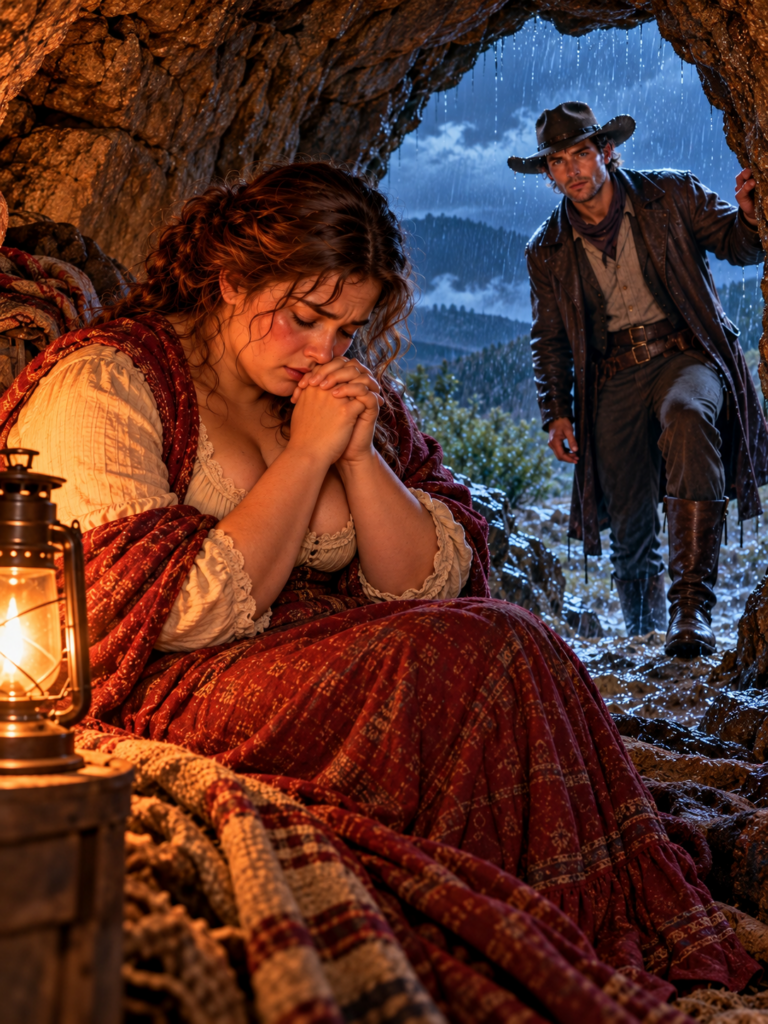
The first thing Caleb Hendricks heard inside the mountain cave was not the crying of a baby.
It was a woman’s voice speaking to God as though she had reached the end of a very long argument.
“Lord, I have carried her as far as I know how. If there is another road, You will have to show it to me.”
Caleb stopped beneath the rocky overhang, rain pouring from his hat and down the front of his coat.
Behind him, his gelding shuddered as thunder broke across the Bitterroot Mountains.
It was October of 1883, and the Montana Territory had turned vicious in the space of an afternoon.
Caleb had been riding south from Helena with a saddlebag full of receipts, a troublesome ache in his left knee, and the comforting expectation of reaching his ranch before another storm found him.
Then the clouds had swallowed the ridgeline.
The trail became a channel of brown water. Lightning split a dead pine less than a hundred yards from his horse, sending the animal stumbling sideways. Caleb had dismounted and led him toward the nearest shelter.
He had almost reached the cave before hearing the prayer.
Now he stood outside its entrance, knowing that a stranger who approached a frightened woman in such country could easily be mistaken for something worse than the weather.
“Ma’am?” he called.
The voice fell silent.
Caleb moved no closer.
“My name is Caleb Hendricks. I’ve a ranch south of the valley. The storm caught me on the trail, and I was hoping to borrow a little shelter.”
A small metallic click came from the darkness.
Caleb recognized it immediately.
Someone had drawn back the hammer of a revolver.
“Don’t come any farther.”
The woman sounded exhausted, but her voice was steady.
“I won’t.”
“Are you alone?”
“Unless my horse has been keeping company without telling me.”
No laughter answered.
Caleb glanced toward the black opening.
“I have a rifle in my scabbard and a pistol on my belt. If it makes you easier, I’ll leave both with the horse.”
A long silence followed.
Then the woman said, “Keep them. Just leave your hands where I can see them.”
Caleb obeyed.
He entered slowly, leading the gelding only as far as the dry shelf of rock near the entrance.
A lantern burned against the far wall.
Its flame illuminated a woman seated upon a folded canvas coat, her back against the stone. She wore a brown traveling dress darkened by mud and a gray shawl pulled close around her shoulders.
Her face was pale and narrow from fatigue. Damp strands of dark hair clung to her cheeks.
She appeared no older than twenty-eight.
The revolver in her hand trembled slightly.
Not from fear, Caleb thought.
From cold.
“I’m Abigail Sutton,” she said.
“Glad to make your acquaintance, Mrs. Sutton. Though I’d have preferred it under better circumstances.”
Her eyes traveled from his face to his weapons, then to the saddlebag he had placed on a rock.
“What have you got in there?”
“Coffee. Dried beef. A little bread that wasn’t particularly good even before the rain.”
She swallowed.
Caleb saw it.
“When did you eat last?”
“This morning.”
He waited.
She looked away.
“Yesterday morning,” she corrected.
He took out the bread, wrapped in waxed cloth, and set it upon a flat stone halfway between them.
“You’re welcome to it.”
“I have money.”
“Then you can buy me another loaf when we reach a bakery.”
“We?”
Caleb realized the presumption and shook his head.
“Figure of speech.”
He withdrew toward the entrance, where he could tend his horse without crowding her.
For several minutes, neither spoke.
Then came a sound from beneath the woman’s shawl.
A tiny, impatient cry.
Caleb turned.
Abigail immediately shifted, gathering a blanket against her chest.
The lantern light revealed a little face, flushed and round, with dark eyelashes and one fist pressed beside a small pink mouth.
Caleb stared.
“Well,” he said quietly. “There are two of you.”
“My daughter.”
“How old?”
“Nine months.”
The child opened her eyes.
For a moment she studied him with the grave suspicion of someone who had already endured far too much traveling.
Then she began to cry in earnest.
Abigail tried rocking her.
“It’s all right, sweetheart. Mama’s here.”
But the woman’s arms were shaking now, and the baby seemed to feel it.
Caleb looked at the bread.
“She can have some of that softened in water, if she needs it.”
Abigail hesitated.
Then she lowered the pistol.
“Her name is Hope.”
Caleb nodded.
“That’s a fine name.”
“Her father chose it.”
Something changed in Abigail’s face.
Caleb knew better than to press.
He built a modest fire near the mouth of the cave, where a crack in the stone allowed the smoke to escape. He heated water, made coffee, and cut the remaining bread into small pieces.
Only after Abigail had eaten did he ask whether the baby needed anything more.
“Dry cloth, perhaps?”
Abigail looked at the damp bundle beside her.
“I had dry things this morning.”
There was no complaint in the words.
That made them harder to hear.
Caleb reached into his saddlebag and brought out a clean flannel shirt.
“Never been worn. Bought it in Helena because Mrs. Pruitt keeps threatening to burn the old ones.”
“Who’s Mrs. Pruitt?”
“The woman who runs my household and half my life.”
He offered the shirt.
Abigail took it cautiously.
“Thank you.”
The rain worsened as evening settled over the mountain.
Lightning flickered across the cave opening. Water rushed over the rocks outside, and the forest beyond disappeared into a gray wall.
Caleb spread his bedroll near the entrance.
Abigail watched him.
“You aren’t going to ask why we’re here?”
“I expect there’s a reason.”
“There usually is.”
“Then you’re free to tell me when you want.”
She stared at him for a long time.
Caleb pretended not to notice.
He tended the fire, dried his gloves, and spoke occasionally to his horse, Buck, who seemed thoroughly disgusted with the accommodations.
By the time darkness filled the canyon, Hope had fallen asleep.
Abigail sat with the child against her chest, staring into the flames.
“My husband died last December.”
Caleb raised his eyes.
“I’m sorry.”
“His name was Edwin. He was thirty-two. He took sick just before Christmas and was dead four days later.”
She smoothed the baby’s blanket.
“Hope came in January. For a little while I believed that if I worked hard enough, I could keep everything standing.”
“The farm?”
She nodded.
“Forty acres outside Bozeman. Not much by some standards, but it belonged to us. Edwin built the kitchen addition himself. Every spring, the apple trees behind the house bloomed white.”
Her mouth tightened.
“Then a man came with mortgage papers.”
Caleb said nothing.
“Wesley Rourke. He told me Edwin had borrowed against the farm the summer before he died. I thought there must be some mistake.”
“Was there?”
“I never found one.”
She reached into a battered leather satchel and withdrew a folded document. The paper was creased and stained along its edges.
“A lawyer looked at it. Said the mortgage had been properly recorded. I sold the milk cows to pay his fee. Then I sold our wagon to cover the interest. I kept thinking I could save enough before they came for the rest.”
Caleb saw the official seal near the bottom.
A sheriff’s order.
“I was given two weeks to leave. Rourke wanted possession before winter.”
“When was that?”
“Seventeen days ago.”
Caleb looked at her thin hands.
Seventeen days.
A woman with an infant, crossing an unforgiving country, during the first hard storms of autumn.
“Where were you headed?”
“My sister Martha lived in Bozeman. I thought she would take us in until I found work.”
Abigail stopped.
The fire cracked softly.
“When I reached her house, someone else was living there.”
Caleb already knew.
He could hear it in her voice.
“She died in July,” Abigail whispered. “Fever.”
She looked toward the sleeping child.
“I stood in the cemetery with Hope and couldn’t think of a single person left in the territory who might open a door for us.”
The rain struck the rock outside with renewed force.
“I tried to find work. Nobody wanted a housekeeper with a baby. One family offered me a place in the laundry, but they said Hope would have to stay somewhere else while I worked.”
Her voice hardened.
“I wouldn’t do that.”
“Of course not.”
“Some people said I ought to be grateful for any offer.”
Caleb studied the fire.
“People have a great talent for being generous with what belongs to somebody else.”
For the first time, Abigail looked directly at him without suspicion.
“I walked west because a woman at the church told me there might be work near the mining camps. Then yesterday a freight wagon gave us a ride. The driver let us off before the mountain trail.”
She glanced toward the cave entrance.
“I thought I could reach a settlement before dark.”
Instead, the storm had found them.
Caleb understood now why the prayer had sounded so empty of expectation.
Abigail had not been asking for comfort.
She had been asking for the next possible hour.
He poured more coffee into her cup.
“My ranch is two days south if we travel carefully. There is a spare room, and Mrs. Pruitt could use someone to argue with besides me.”
Abigail went rigid.
“I won’t become anybody’s charity.”
“I didn’t say you would.”
“I know what happens when a woman has nowhere else to go. People decide what she ought to be grateful for. Then they decide what she owes.”
Caleb let the accusation rest between them.
He had heard enough of her story to know it was not truly aimed at him.
“You don’t owe me anything for tonight,” he said. “And you wouldn’t owe me anything for a room.”
“That’s easy to say.”
“Yes, ma’am. It is.”
His agreement appeared to surprise her.
“Words are cheap,” he continued. “You’d have to judge me by what I do.”
She studied him over the rim of the coffee cup.
“And if I don’t like what I see?”
“Then I’ll help you find a different road.”
Abigail looked away.
“Why would you do that?”
Caleb watched the flames.
He could have given her a dozen respectable answers.
A Christian duty.
Neighborly kindness.
The simple obligation of a decent man.
But what came to him instead was the memory of a winter thirty years earlier, when he had been a hungry nine-year-old boy outside a farmhouse kitchen.
He saw a woman placing a plate on the table without asking what his father had done with the grocery money.
“Someone once helped me,” he said. “When I had no right to expect it.”
Abigail waited for more.
He offered none.
Near midnight, the storm began to ease.
Hope woke once. Caleb turned his back while Abigail tended her, and afterward he fed the fire until both mother and child were asleep.
He remained awake longer than he intended.
Across the cave, the little girl slept beneath his clean flannel shirt.
Her mother held one arm protectively around her.
Caleb thought of his ranch, where the kitchen had been quiet every evening for almost fifteen years.
He thought of the spare bedroom whose windows Mrs. Pruitt opened each spring despite the absence of guests.
Then he reminded himself that two strangers in a cave were not his family.
Morning came bright and cold.
Water dripped from the pines. Mist filled the lower canyon, and the creek below the trail had swollen into a violent brown stream.
Caleb saddled Buck while Abigail wrapped Hope securely against her chest.
She looked down at the water.
“Is that the way we came?”
“It was.”
“Can we cross?”
“Not there.”
“Then we’re trapped.”
“No. Only delayed.”
He studied the hillside and pointed toward a line of trees above the creek.
“There’s an old pack trail farther up. It’ll add half a day.”
Abigail looked from the trail to the horse.
“How are we all going to ride?”
“We aren’t. You and Hope will.”
“And you?”
“I’ll walk.”
“Two days?”
“Maybe three now.”
Her expression sharpened.
“That horse could carry you.”
“He could.”
“Then why—”
“Mrs. Sutton, I’ve ridden him three hundred miles this month. You have a baby and haven’t had a proper meal in days.”
Abigail looked at the muddy trail.
“I don’t want to put you to trouble.”
Caleb adjusted the saddle strap.
“Trouble is a broken axle twenty miles from a blacksmith. This is walking.”
He lifted Hope’s bundled belongings behind the saddle.
Abigail placed her hand in his.
He helped her mount.
The first miles were slow.
The storm had torn branches from the firs and washed loose stones across the trail. Caleb walked ahead, testing uncertain ground while Buck followed with Abigail and Hope.
By afternoon, they reached a narrow crossing where the water rushed over a bed of polished rock.
Caleb studied it, then turned upstream.
Abigail looked toward the darkening sky.
“Can we afford another delay?”
“We can afford to be late. We can’t afford to be careless.”
They traveled farther and crossed where a fallen tree had narrowed the creek. Caleb led Buck through the current, water climbing past his knees.
Abigail clung to Hope and watched his boots slide over the stones.
For one terrifying moment, Buck stumbled.
Caleb caught the bridle close to the bit.
“Easy, boy.”
He steadied the horse with one hand against its shoulder.
The animal found its footing.
They reached the opposite bank.
Only then did Abigail realize she had been holding her breath.
Caleb glanced up.
“Everybody accounted for?”
Hope made a small, indignant noise.
He smiled.
“I’ll take that as a yes.”
They spent the night beneath a stand of spruce, sheltered by a canvas stretched between two trees.
Caleb gave Abigail the dry side.
She noticed.
She also noticed that he never called attention to what he gave up.
When he offered her the last of the coffee, he claimed he had already had enough.
When he handed her his bedroll, he announced that a rancher ought to be able to sleep on his own coat.
When she thanked him, he found something practical to do.
That evening, while Hope slept between them, Abigail asked, “Did you ever marry?”
Caleb shook his head.
“Never quite managed it.”
“Why?”
He took a moment before answering.
“My mother died when I was nine. My father took to drinking. By the time I was grown, the house had become a place I only wanted to escape.”
“And you did?”
“I bought land. Worked until I had enough to build a house. Then worked so much I scarcely lived in it.”
Abigail looked at him through the firelight.
“That sounds lonely.”
Caleb gave a small smile.
“Sometimes it is.”
The honesty surprised them both.
He did not explain further.
But later, when Abigail woke to find him putting another branch on the fire, she no longer reached immediately for the pistol beside her.
By the third evening, they emerged from the timber into a broad valley.
Golden grass rolled toward distant cottonwoods. Beyond a line of corrals stood a substantial two-story house with a broad porch and smoke rising from its chimney.
Several outbuildings clustered around it.
Cattle grazed beyond the fences.
Abigail stared.
“That’s your ranch?”
“What’s left of it after a difficult summer.”
She had imagined a cabin.
Perhaps two rooms and a muddy yard.
Not a place with wide windows and a roof that looked capable of keeping out every storm in Montana.
Her first instinct was to turn back.
She had learned how quickly comfortable houses could become places where poor women were expected to remember their station.
Before she could speak, the front door opened.
A broad-shouldered woman in a blue apron stepped onto the porch.
Her gray hair was twisted into a severe knot. She carried a wooden spoon like an instrument of authority.
“Caleb Hendricks!”
Caleb winced.
“Evening, Mrs. Pruitt.”
“You’re two days late. The south pasture fence is down, Mr. Talbot has been here twice, and somebody left wet saddle blankets in my pantry.”
“That last one sounds serious.”
“It is.”
Then she saw Abigail.
Her expression changed.
She came down the steps.
Caleb introduced them, explaining just enough to make their circumstances plain.
Mrs. Pruitt listened without interrupting.
When he finished, she looked at Abigail.
“Can I see the little one?”
Abigail hesitated.
Hope chose that moment to peer out from her blanket.
Mrs. Pruitt’s stern face softened.
“Well, aren’t you a sight.”
She held out her arms.
After a moment, Abigail allowed her to take the child.
Hope promptly seized the woman’s apron ribbon.
Mrs. Pruitt gave a delighted snort.
“She’s got a grip like a cattle buyer.”
Then she turned toward the house.
“There’s soup on the stove. Caleb, carry the bags. Mrs. Sutton, you come inside before you fall off that horse.”
Abigail dismounted slowly.
Her legs were stiff, her boots filthy, and her heart suddenly aching with a fear she could not explain.
Inside, the house smelled of baked bread and woodsmoke.
A lamp burned upon the kitchen table.
The floor was scrubbed clean.
A kettle sang quietly on the stove.
Abigail stood in the doorway, unable to move.
For the first time in weeks, she was looking at a room where people expected tomorrow to come.
Mrs. Pruitt noticed her hesitation.
“Something wrong, dear?”
Abigail shook her head.
“I don’t know how long we can stay.”
Caleb set her bag near the wall.
“As long as you need to decide what comes next.”
Abigail looked at him.
“I meant what I said. I won’t be kept.”
“I remember.”
Mrs. Pruitt glanced between them.
“Well, the Lord preserve me from two stubborn people discussing arrangements on an empty stomach.”
She seated Hope in a padded wooden chair and began filling bowls.
“Eat first. Argue afterward.”
That night, Abigail was shown a small bedroom near the kitchen.
A washstand stood beside the window. Clean sheets covered the bed. There was a plain wooden wardrobe, a chair, and a brass key resting upon the dresser.
Mrs. Pruitt pointed to it.
“That’s your key.”
Abigail stared.
“Mine?”
“Unless you’ve got another name I haven’t been told.”
Abigail picked it up.
The metal felt cool and substantial in her palm.
Mrs. Pruitt adjusted Hope’s blanket in the little cradle she had borrowed from a neighbor.
“No one will enter without knocking. Not me. Not Caleb. Nobody.”
After the older woman left, Abigail closed the door.
She turned the key.
Then she stood with her hand upon the lock, listening.
Nothing happened.
No footsteps approached.
No one demanded an explanation.
The baby slept.
Downstairs, dishes clinked and Mrs. Pruitt complained that Caleb had tracked mud through her kitchen.
Abigail sat slowly on the edge of the bed.
She had lost her husband, her farm, her sister, her savings, and the future she had imagined for her daughter.
Yet here, in a strange house belonging to a man she had met in a cave, she possessed something she had not known how desperately she needed.
A door she could close herself.
For the first time since the sheriff had driven his wagon into her yard, Abigail Sutton slept without her shoes on.
And downstairs, Caleb Hendricks made a decision that would quietly change all their lives.
He took a fresh page from his ranch account book, wrote Abigail’s name at the top, and entered the wages he intended to pay her for helping Mrs. Pruitt.
When the housekeeper saw it, she raised an eyebrow.
“She hasn’t agreed to work.”
“I know.”
“Then why write it?”
Caleb put down his pen.
“Because if she does, I want her to know exactly what she’s earned.”
Mrs. Pruitt watched him a moment longer.
“And if she decides to leave?”
Caleb looked toward the ceiling, where a child slept beneath his roof for the first time.
“Then she’ll take every dollar with her.”
Mrs. Pruitt said nothing.
But the look she gave him suggested she understood something Caleb had not yet dared to consider.
The hardest promise he had made to Abigail Sutton was not that he would give her shelter.
It was that he would never use the shelter to make her stay.
Part 2
Abigail woke the following morning to sunlight falling across a clean white quilt.
For several moments, she did not recognize the room.
Her body remembered sleeping on hard floors, in crowded wagons, beneath damp canvas, and against cold stone.
A bed without danger seemed almost impossible.
She sat up sharply.
“Hope?”
“Down here, dear,” called a voice through the door. “And she’s been having a splendid morning without you.”
Abigail hurried into her dress and opened the door.
In the kitchen, Mrs. Pruitt sat beside the stove with Hope on her lap. The baby had acquired a wooden spoon and was striking it triumphantly against a tin bowl.
“She’s been awake nearly two hours,” Mrs. Pruitt said.
“I’m terribly sorry.”
“For what?”
“I didn’t mean to sleep so long.”
“Young mothers who haven’t had a proper night’s rest in weeks ought to sleep when they get the chance.”
Abigail approached her daughter.
Hope greeted her with a delighted squeal.
Mrs. Pruitt handed her over.
“Caleb has gone out to the west pasture. He’ll be back for supper.”
Abigail glanced at the table.
A bowl of porridge waited beside a cup of warm milk.
She had not expected kindness to be so difficult to accept.
“Mrs. Pruitt, I need to speak with you about work.”
The housekeeper raised an eyebrow.
“Work?”
“I can cook, mend, clean, keep accounts, and manage household purchases. I don’t want to sit here eating food I’ve done nothing to earn.”
Mrs. Pruitt studied her.
“Do you know how to read a merchant’s account?”
“Yes.”
“Add columns?”
“Of course.”
“Tell when a man is lying about the price of flour?”
Abigail almost smiled.
“I believe I can.”
“Excellent. Caleb’s been paying for mistakes he could find himself if he ever sat still long enough to look.”
By noon, Abigail had examined three pages of household expenses, corrected an error in the general store’s invoice, and discovered that the ranch had paid twice for a shipment of harness leather.
Mrs. Pruitt watched her work with increasing satisfaction.
When Caleb came home that evening, Abigail was seated at the kitchen table with the books spread before her.
He stopped in the doorway.
“Am I in trouble?”
Mrs. Pruitt folded her arms.
“That depends. How many times would you like to pay for the same saddle straps?”
Caleb frowned.
“Once, preferably.”
“Then you’ve already paid once too many.”
Abigail showed him the receipts.
He leaned over the table, studying her neat figures.
“Well, I’ll be.”
“The second charge was entered two weeks after the first,” she explained. “If you send the original receipt to Mr. Bellamy at the store, he should credit your account.”
Caleb looked at the precise handwriting.
“Mrs. Sutton, would you consider keeping these books regularly?”
Abigail straightened.
“For wages?”
“Naturally.”
“How much?”
Mrs. Pruitt made a small approving sound.
Caleb considered.
“Fourteen dollars a month, with board and lodging. We can review it if the work grows.”
Abigail calculated silently.
It was more than she had expected.
Enough to begin saving.
Enough, eventually, to leave if she wished.
“I’d like that arrangement written down.”
Caleb’s expression did not change.
“Fair enough.”
He sat, pulled a fresh sheet of paper toward him, and wrote the terms.
Abigail read every word.
Then she signed.
Neither mentioned the fact that only a few weeks earlier, another document bearing her husband’s signature had taken away her home.
This time, she was entering an agreement she understood.
And this time, her signature meant she would be paid.
Life at the Hendricks ranch settled into a rhythm she had nearly forgotten existed.
Morning began with the smell of coffee and the sound of horses moving in the yard.
Mrs. Pruitt supervised the kitchen with an authority no ranch hand dared challenge.
Abigail recorded purchases, wrote orders, balanced wages, mended linens, and helped prepare winter stores.
Hope grew accustomed to sleeping in her borrowed cradle.
When Caleb came indoors, she greeted him with delighted cries and stretched both arms toward his belt, fascinated by the brass buckle.
He learned to remove the belt before lifting her.
Abigail watched these little exchanges more closely than she intended.
Caleb never picked up the child without first making certain she wanted him.
He never complained when Hope pulled at his beard.
And when she cried in the middle of the night, he did not ask whether Abigail knew how to manage her own baby.
Instead, the next morning, he sometimes left an extra log beside her bedroom stove.
Small things.
Almost nothing.
Yet Abigail had learned that a person’s character was often revealed most clearly in the moments when there was nobody to impress.
Not everything was easy.
The first time she went into town to settle the ranch’s account, she discovered how quickly strangers could turn kindness into gossip.
Mrs. Benton, the merchant’s wife, examined Abigail’s receipt.
“So you’re the young widow staying with Mr. Hendricks.”
Abigail kept her expression composed.
“I keep his household accounts.”
“And your little girl lives there too?”
“She does.”
Mrs. Benton lowered her voice.
“People naturally wonder about an arrangement like that.”
Abigail felt the old humiliation rise in her throat.
Once, she might have lowered her eyes and endured it.
But she thought of the written agreement in Caleb’s desk, of the work she had completed that morning, and of the money waiting in her own account book.
“Mrs. Benton,” she said, “if you have a question about the ranch’s purchases, I’d be pleased to answer it. If you’re asking about my daughter, I would expect you to speak more carefully.”
The older woman flushed.
“I meant no offense.”
“Then none need be taken.”
Abigail collected the corrected receipt and left.
Caleb was waiting beside the wagon.
He had heard enough through the open doorway to understand what had happened.
“Would you like me to speak to her?”
“No.”
He accepted the answer.
They climbed into the wagon and started home.
After several miles, Abigail spoke.
“I used to think being respectable meant that everyone would believe the best of you.”
Caleb guided the horses around a rut.
“And now?”
“I think it means knowing who you are, even when they don’t.”
He looked at her.
“Sounds like you’ve learned something worth keeping.”
She turned toward the hills so he would not see her smile.
As October gave way to November, the ranch prepared for winter.
Snow dusted the upper mountains. Ice appeared along the water troughs. Ranch hands stacked hay beneath the long shed while Caleb rode the fences, checking for broken posts and weak stretches of wire.
Abigail discovered that the household’s previous orders had been wasteful. She negotiated a better arrangement for flour deliveries and organized the accounts so that each expense could be traced without searching through piles of paper.
Caleb began asking her opinion about more than household matters.
One evening, he laid a stack of feed bills on the table.
“The south pasture won’t carry as many cattle through winter as I planned. If I sell the older steers now, I’ll lose money. If I keep them, I’ll need extra hay.”
Abigail examined the figures.
“How much would the hay cost?”
He told her.
She worked quietly.
Then she pointed to an earlier contract.
“You have two deliveries scheduled in December that could be moved forward. The freight cost is lower if the loads travel together.”
Caleb studied the numbers.
“That would save enough to cover half the hay.”
“And if you sell only the steers unlikely to winter well, you might not need the rest.”
He leaned back.
“Mrs. Sutton, I’ve owned this ranch fourteen years, and you’ve been here one month.”
“Does that trouble you?”
“Only when I think of what I’ve wasted in fourteen years.”
Mrs. Pruitt laughed from the stove.
Abigail laughed too.
The sound startled Caleb.
He had seen her smile before, usually at something Hope did.
But this was different.
She laughed without covering her mouth.
Without immediately looking ashamed of her happiness.
For a moment, he forgot the paperwork before him.
He wanted to hear that laughter every evening for the rest of his life.
The realization frightened him.
He lowered his eyes to the ledger.
Abigail noticed his sudden silence.
“Have I said something wrong?”
“No.”
“Then what is it?”
Caleb shook his head.
“Nothing worth troubling you over.”
But long after she had gone upstairs, he remained at the kitchen table, staring at accounts he could no longer concentrate upon.
He had spent years believing that a quiet house was evidence of a well-ordered life.
Now he found himself listening for the sound of footsteps overhead.
He listened for Hope’s sleepy cries.
He listened for Abigail’s voice asking Mrs. Pruitt whether more wood was needed.
And each sound filled an emptiness he had refused to name.
One cold afternoon, Abigail found him behind the barn, repairing a small wooden box.
He held a short knife in one hand and a smooth piece of pine in the other.
“What are you making?”
Caleb glanced up.
“Something for Hope.”
The object looked like a crude little wagon.
Four wooden wheels lay beside it.
Abigail crouched near the workbench.
“Does she need a wagon?”
“Probably not.”
“Then why are you making it?”
He shrugged.
“Thought she might enjoy one.”
Abigail touched the small carved wheel.
“Who taught you?”
“A neighbor woman named Dorothy Vance.”
He resumed carving.
“She lived near my father’s place. My mother died when I was a boy, and my father wasn’t much use afterward.”
Abigail waited.
“Dorothy had four children of her own and scarcely enough food for them. Still, whenever she saw me wandering near her fence around supper, she found a reason to call me inside.”
“Did your father know?”
“Likely.”
“Did he thank her?”
“Never.”
Caleb stopped carving.
“One winter, I asked why she kept feeding me when I wasn’t hers to feed.”
“What did she say?”
“That children shouldn’t have to earn their supper.”
Abigail looked down at the little wagon.
The words reached somewhere deep inside her.
“I wish Hope could have known her.”
Caleb smiled faintly.
“She’d have liked Hope.”
Then he looked at Abigail.
“She’d have liked you, too.”
For a moment, neither moved.
Snow drifted beyond the barn doors.
Abigail became suddenly aware of how close she was standing.
Caleb seemed to notice it as well.
He set down the knife.
“I’ll have this finished by Sunday.”
Abigail stepped back.
“She’ll treasure it.”
She walked toward the house with her heart beating much too quickly.
That night, she took Edwin’s wedding ring from the little wooden box in her drawer.
She had kept it wrapped in a square of linen since his burial.
Holding it brought back memories she had deliberately avoided.
Edwin laughing while the roof leaked over their first supper.
Edwin kneeling in the vegetable garden with dirt on his trousers.
Edwin promising that once the harvest was sold, they could afford a better cradle.
She remembered his tenderness.
She remembered his careless optimism.
And now she remembered the mortgage he had concealed from her.
For months, Abigail had struggled with the idea that loving him required defending every choice he had made.
But a husband could be loving and foolish.
A good memory could still contain anger.
She set the ring beside the foreclosure papers.
“I loved you,” she whispered into the empty room. “But you should have told me.”
Hope shifted in the cradle.
Abigail turned immediately to her daughter.
The child was sleeping peacefully.
She bent to kiss the small forehead.
Whatever Edwin had done, whatever grief remained, the future could not belong entirely to the dead.
The next morning, Abigail began a new page in her own account book.
At the top she wrote:
Money saved for Hope and me.
The amount was modest.
But she looked at it with pride.
It belonged to them.
Six weeks after their arrival, the letter came from Helena.
Mrs. Pruitt received it with the morning mail and read it standing beside the kitchen window.
Then she sat.
Then she read it again.
Caleb looked up from his breakfast.
“Bad news?”
“No.”
“You’re making a face that suggests otherwise.”
Mrs. Pruitt folded the letter carefully.
“My sister Ruth is looking for a household manager.”
Abigail continued feeding Hope her breakfast.
Mrs. Pruitt looked toward her.
“She lives in Helena. Her husband works with a freight company. They’ve two children in school, and their previous housekeeper moved east.”
Abigail’s hand paused.
“What sort of arrangement?”
“Room and board. Twenty dollars a month. A proper employment agreement. Ruth says a woman with a small child would be welcome, provided she can manage the work.”
Caleb stopped eating.
Mrs. Pruitt continued.
“I wrote her about you after you began keeping our accounts. I hope you don’t mind.”
Abigail stared at the letter.
“You wrote about me?”
“I thought you ought to have another possibility.”
Another possibility.
The words unsettled her.
She had spent so many months without any choices that an unexpected one felt almost like a threat.
“Twenty dollars?” she asked.
“Yes.”
“Every month?”
“Every month.”
It was considerably more than Caleb paid her.
The position included a room for Hope.
It would be respectable work in a growing territorial city, where shops, churches, and schools stood within walking distance.
A woman could make a life there.
Abigail could make a life there.
Mrs. Pruitt handed her the letter.
“Read it yourself.”
Abigail did.
Ruth McCall’s handwriting was neat and confident. The offer was plainly stated, with details about wages, lodging, duties, and the children.
There was no ambiguity.
No demand for gratitude.
No expectation of favors.
At the end, Ruth had written that she would gladly meet Abigail before making the arrangement permanent.
Abigail read the letter a second time.
Then she raised her eyes to Caleb.
“What do you think?”
He looked down at his coffee.
For several seconds, he said nothing.
Mrs. Pruitt watched him over the rim of her cup.
Finally, Caleb spoke.
“I think it’s a sound opportunity.”
Abigail felt as though something had been pulled sharply through her chest.
“You do?”
“Yes.”
“You think I ought to go?”
He met her eyes.
“I think you ought to see whether the position suits you.”
She folded the letter slowly.
“I see.”
Caleb recognized the hurt in her voice.
But he did not know how to tell her that the thought of losing her was unbearable without making that knowledge another burden she would have to carry.
After breakfast, Abigail excused herself.
She spent the morning working in the pantry, checking the winter stores twice and correcting figures that had not been wrong the first time.
Mrs. Pruitt found her there.
“You’re angry.”
“No.”
“You’re disappointed.”
Abigail set down her pencil.
“I thought Caleb wanted me here.”
Mrs. Pruitt folded her arms.
“He does.”
“Then why would he tell me to consider leaving?”
The older woman was silent for a moment.
“Because he remembers what you said when you arrived.”
Abigail looked away.
Mrs. Pruitt continued quietly.
“There’s a difference between a man offering you a home and a man making certain you have nowhere else to go. Caleb knows that difference.”
Abigail looked at the shelves.
“Perhaps I wanted him to ask me to stay.”
Mrs. Pruitt’s expression softened.
“Then perhaps you’ve both become afraid of the same thing.”
“What thing?”
“Wanting something you’re not sure you’ve any right to ask for.”
That evening, Abigail told Caleb she intended to visit Helena.
“I’d like to meet Mrs. McCall and try the work before deciding.”
Caleb nodded.
“That’s sensible.”
“She says I can stay four weeks.”
“Then four weeks it is.”
She waited for him to say more.
He didn’t.
“And if I accept the position?”
Caleb’s jaw tightened almost imperceptibly.
“Then I’ll make certain your wages here are settled, and I’ll drive you to the stage station.”
Abigail stood very still.
“You don’t mind?”
Caleb looked at her.
“I mind more than I ought.”
Her breath caught.
He continued before he could lose his nerve.
“This house has been different with you and Hope in it. Better than it’s been in years. And I don’t suppose it will feel the same after you’re gone.”
“Then ask me not to go.”
The words escaped before Abigail could stop them.
Caleb stepped toward her.
For one moment, she thought he would do exactly that.
Instead, he shook his head.
“No.”
She looked stricken.
“Why?”
“Because you came here with nothing but your daughter and the clothes on your back. Now you’ve got wages, a good offer, and a chance to decide what kind of life you want.”
His voice roughened.
“I can’t tell you what I feel and have you wonder whether saying no will cost you your home.”
Abigail stared at him.
“Do you think so little of me?”
“No.” He shook his head. “I think too much of you to put you in that position.”
The room became painfully quiet.
Abigail looked toward the stairs.
“I’ll leave Monday.”
Caleb nodded.
“I’ll have the wagon ready.”
She went upstairs before he could see her tears.
Over the next several days, the household moved through its ordinary routines, but the approaching separation seemed to inhabit every corner.
Mrs. Pruitt baked extra bread for the journey.
Abigail finished the accounts and prepared careful instructions for whoever would take them over.
Hope learned to pull herself upright against the kitchen chairs.
And Caleb completed the little wooden wagon.
He gave it to the child on Sunday morning.
Hope struck one wheel with her palm, watched it turn, and laughed.
Caleb lowered himself onto the floor.
“That’s the idea, little lady.”
Hope reached for him.
He opened his arms.
She took two uncertain steps before collapsing against his chest.
Caleb caught her.
Mrs. Pruitt clapped.
Abigail laughed with them.
Then, watching her daughter press her small hand against Caleb’s cheek, she felt a grief she had not expected.
Hope was learning to love him.
Not as a stranger who had found them in the rain.
Not as a wealthy man who permitted them to remain beneath his roof.
But as someone whose presence had become part of her little world.
Abigail wondered whether children knew the difference between a temporary kindness and a lasting one.
She feared they did not.
Later that afternoon, she found Caleb in the stable repairing the broken clasp on her traveling case.
She stood in the doorway.
“You don’t have to do that.”
He glanced up.
“The clasp wasn’t holding.”
“I could have managed.”
“I know.”
He tested the brass fastening.
It clicked firmly shut.
Abigail watched his hands.
“Caleb?”
He raised his eyes.
“Would you rather I stayed?”
He placed the case on the bench.
For a long moment, he seemed unable to answer.
Then he spoke with a quiet intensity she had never heard from him before.
“Every selfish part of me wishes you’d never heard of that job.”
Abigail’s eyes filled.
“But?”
“But I want you to take it if it’s the life you want.”
“And if it isn’t?”
Caleb swallowed.
“Then I hope you’ll know the road back.”
She looked at him a long time.
Then she picked up the case.
“Thank you for fixing it.”
Monday morning arrived beneath a cold, clear sky.
Caleb loaded Abigail’s belongings into the wagon.
Mrs. Pruitt wrapped a warm scarf around Abigail’s shoulders, complaining that Helena winters had never possessed a scrap of mercy.
Then she kissed Hope and pressed a small packet of biscuits into Abigail’s hand.
“Don’t let my sister work you to death,” she said. “And write if she tries.”
Abigail embraced her.
“I will.”
The drive to the stage station passed mostly in silence.
Caleb held the reins.
Abigail sat beside him with Hope tucked securely beneath her cloak.
At the station, he lifted down the luggage, checked the driver’s route, and paid for the additional space required for the child and her belongings.
Abigail offered him the money.
He accepted it without argument.
She knew why.
He was refusing even this small opportunity to make her feel indebted.
When the driver called for passengers, Abigail turned toward Caleb.
“I don’t know how to thank you.”
He shook his head.
“You’ve thanked me plenty.”
“Then I don’t know how to say goodbye.”
Caleb looked at Hope.
The child reached toward him, clutching her wooden wagon in one hand.
He took her carefully and held her for a few moments.
“Be good to your mama,” he murmured.
Hope tugged his beard.
Caleb smiled sadly.
“Yes, I know. You’ve heard that before.”
He kissed the top of her head and returned her to Abigail.
Then he stepped away.
Abigail climbed into the coach.
She settled Hope on her lap and looked through the window.
Caleb stood beside the horses, his hat in his hands.
He made no effort to stop her.
When the coach began to move, Abigail watched him grow smaller along the road.
She had come to the ranch as a woman with no choices.
Now she was leaving by her own decision, carrying wages she had earned and a letter promising honest employment.
It was everything she had prayed to have.
Yet when Caleb finally disappeared behind the bend, she pressed her face against Hope’s hair and wept.
Far behind the departing coach, Caleb remained at the station long after the dust had settled.
Then he mounted the wagon and turned toward home.
He had promised Abigail that she would be free to leave.
He had kept his word.
And by the time he reached the ranch, he understood that keeping it might cost him the only woman he had ever truly loved.
Part 3
Helena was nothing like the country Abigail had left behind.
The streets were crowded with freight wagons, merchants, miners, and travelers arriving from distant settlements. Tall brick buildings stood beside wooden storefronts. Church bells sounded above the noise of horses and iron-rimmed wheels.
For the first time in months, Abigail walked through a town without wondering where she would sleep that night.
Ruth McCall met her at the door of a comfortable house near the eastern edge of the city.
She was Mrs. Pruitt’s younger sister, though her appearance was quite different. Where Hester Pruitt possessed the commanding presence of a military officer, Ruth was slender, neatly dressed, and spoke with the brisk precision of a woman who kept appointments.
She welcomed Abigail and immediately made one thing clear.
“I don’t want you feeling beholden to me because my sister recommended you. This is employment, Mrs. Sutton. I expect good work, and you should expect proper treatment.”
Abigail liked her at once.
The household included Ruth’s husband, two school-aged children, and a young maid named Eliza who helped with the kitchen and laundry.
Abigail was given a pleasant upstairs bedroom with enough space for Hope’s cradle.
Her duties included household purchases, bookkeeping, supervising deliveries, planning meals with the cook, and making certain the children’s school supplies and clothing were maintained.
It was demanding work.
But Abigail discovered she was good at it.
Within a week, she had reorganized the pantry accounts and uncovered several unnecessary expenses.
Ruth reviewed the figures with satisfaction.
“My husband has been telling me for two years that this household costs too much to maintain.”
Abigail smiled.
“Perhaps he should have examined the invoices.”
Ruth laughed.
“That’s precisely what I told him.”
The position offered everything Abigail had needed so desperately after Edwin’s death.
Steady wages.
Respect.
A room for her child.
An employer who valued her work.
And no uncertainty about the nature of the arrangement.
At the end of her first week, Ruth paid her the agreed wages for the trial period.
Abigail took the money to the bank and deposited most of it in her own name.
She kept enough to buy Hope a new pair of winter shoes and herself a pair of sturdy gloves.
The purchases were small.
Yet walking back through the busy streets, carrying things she had paid for with money she had earned, Abigail felt a satisfaction that nearly brought her to tears.
She had survived.
Not merely been saved.
She had survived.
During the second week, however, she began noticing an unexpected emptiness in the evenings.
The McCall household was busy and cheerful. The children were polite. Ruth treated her fairly, and Eliza enjoyed playing with Hope when her duties permitted.
There was nothing wrong with the place.
That was what made the feeling so difficult to understand.
Sometimes, while organizing receipts after supper, Abigail would listen for the familiar scrape of boots on a kitchen floor.
She would expect a man’s voice asking Mrs. Pruitt whether the coffee had been left boiling again.
She would remember Caleb standing beside the stove, holding Hope awkwardly while the child tugged at his collar.
She missed the smell of hay on his coat.
She missed his habit of listening before answering.
She even missed the way he frowned at an account book as though the numbers had personally offended him.
At first, she told herself she was simply homesick for the ranch.
But one evening, while washing Hope’s little hands, she understood that it was not merely the place she missed.
It was the man who had made the place safe without ever demanding that she belong to him.
Hope seemed to remember him too.
She often played with the wooden wagon Caleb had carved.
She pushed it across the bedroom floor, following it on unsteady feet, and sometimes held it up toward the door as though expecting someone to admire it.
One night, Abigail knelt beside her.
“Do you remember Mr. Hendricks?”
Hope looked up.
“Ca.”
Abigail froze.
“What did you say?”
The baby laughed and pushed her wagon again.
“Ca.”
Abigail covered her mouth.
She had never taught Hope his name.
The child had heard it enough to try saying it herself.
That night, Abigail took out Edwin’s wedding ring.
She sat beside the window with it resting in her palm.
Outside, the lamps of Helena shone through a thin veil of falling snow.
“I don’t know what you’d think of this,” she whispered.
In her memory, Edwin remained young and laughing, forever standing beside the unfinished kitchen addition.
She had loved him deeply.
She had mourned him.
She had carried his child through hardship he could never have imagined.
Yet somewhere along the road, she had begun to believe that living meant betraying what had been lost.
Now, for the first time, she questioned that belief.
Perhaps loyalty to Edwin did not require a lifetime of loneliness.
Perhaps the love she had once known could remain true even if another love entered her life.
She placed the ring carefully back in its box.
Then she took out a blank sheet of paper.
She began a letter to Caleb.
Dear Mr. Hendricks,
She stopped.
The greeting looked absurdly formal.
She crossed it out.
Dear Caleb,
She wrote about Hope’s new shoes, the McCall children, and the work she was doing.
She told him how much she appreciated Ruth’s kindness.
She mentioned the snow.
Then she paused with the pen above the page.
What she wanted to write was that every evening she thought of him.
That she missed the ranch.
That she had begun to understand the difference between needing a place to stay and wanting to build a life with someone.
But the words frightened her.
Instead, she finished:
I hope the cattle are well, and that Mrs. Pruitt has finally persuaded you to wear a warmer coat.
Yours sincerely,
Abigail Sutton
She read the letter twice.
Then she added a final line.
Hope has begun trying to say your name.
She sealed it before she could change her mind.
Back at the Hendricks ranch, Caleb received the letter four days later.
He read it standing beside the kitchen window.
Then he read it again.
Mrs. Pruitt watched from the stove.
“Good news?”
“She and Hope are well.”
“Is she liking the position?”
“Seems to be.”
“Then why are you looking as though somebody has died?”
Caleb folded the letter.
“I suppose I’m learning what an empty house sounds like after it hasn’t been empty for a while.”
Mrs. Pruitt stirred the soup.
“That’s a poor excuse for standing about looking miserable. Go split some wood.”
He obeyed.
But he carried Abigail’s letter in his coat pocket for the rest of the day.
During the following weeks, Caleb learned that missing someone could change the shape of ordinary work.
He still rode the fences.
He still settled accounts and prepared the cattle for winter.
He still rose before dawn.
Yet every room reminded him of something.
The kitchen table was where Abigail had corrected his figures.
The spare bedroom was where Hope had slept.
The hallway was where he had once heard the child laughing with Mrs. Pruitt.
He did not write asking Abigail to return.
He told her about the ranch, the weather, the price of hay, and the wooden fence that had collapsed beneath the first heavy snow.
He asked after Hope.
He told Abigail that Mrs. Pruitt missed having someone sensible to talk to.
But he never mentioned how often he found himself looking toward the road.
He had offered her freedom.
He would not now use his loneliness to take it back.
As her fourth week in Helena drew to an end, Ruth invited Abigail into the sitting room.
“I’d like you to remain,” she said.
Abigail sat opposite her.
“You’re pleased with my work?”
“Very. I can offer you a permanent position at the same wages, with the possibility of an increase after six months.”
Abigail looked toward the window.
The day was bright and cold.
Beyond the rooftops, snow covered the distant mountains.
She had imagined this very moment during her long journey from Bozeman.
A respectable woman offering honest employment.
A future she could build through her own abilities.
It was everything she had wanted when she stood before Martha’s grave with Hope in her arms.
“May I have until tomorrow to answer?”
“Certainly.”
That night, Abigail opened her account book.
She counted her savings.
She calculated how much she could earn during the coming winter, how much she would need to travel, and what it might cost to rent a small room if she ever needed to live independently.
The figures were not large.
But they were real.
She had enough for choices.
Not every choice in the world.
Not an easy life.
But enough to refuse an arrangement that frightened her, enough to travel to another town, and enough to seek work without immediately risking starvation.
For months, Abigail had believed that independence required her to stop needing anyone.
Now she began to understand something different.
Independence meant having the freedom to decide whom she would trust.
It meant accepting kindness without surrendering judgment.
It meant loving someone without making love a debt.
She closed the account book.
The answer became clear.
The following morning, she returned to Ruth’s sitting room.
“Mrs. McCall, I owe you an honest answer.”
Ruth nodded.
“I should hope so.”
“The position is everything you promised. You’ve treated Hope and me with extraordinary kindness.”
“But?”
Abigail took a breath.
“But I believe my future lies somewhere else.”
Ruth studied her.
“Back at my sister’s ranch?”
“Yes.”
“Because of Mr. Hendricks?”
Abigail’s face warmed.
“Partly.”
Ruth smiled.
“Only partly?”
Abigail looked down at her hands.
“For a long time, I was afraid that if I stayed there, I’d only be staying because he rescued us. I needed to know I could make a living somewhere else.”
“And now you do.”
“Yes.”
Ruth leaned back.
“Then I suppose you’ve accomplished what you came here to do.”
Abigail’s eyes filled.
“I hope you aren’t disappointed.”
“I’ll be disappointed to lose a capable woman. But I won’t pretend that makes your decision wrong.”
She opened a drawer and removed a sheet of stationery.
“I’ll write you a reference before you leave. If you should ever need work again, you’re welcome to write to me. I can’t promise a vacancy, but I’ll help where I can.”
Abigail reached across the table and took her hand.
“Thank you.”
Ruth squeezed it.
“Go where you wish to make your life, Mrs. Sutton. That’s what having a choice is for.”
Three days later, Abigail and Hope boarded a southbound stage.
This time, Abigail bought the tickets herself.
She carried her savings, her account book, Edwin’s ring, Ruth McCall’s reference, and Hope’s little wooden wagon.
She also carried a letter she had received from Caleb that morning.
It contained an account of a stray calf rescued from a snowdrift, an apology for his dreadful handwriting, and a short message at the bottom.
The road home is passable. If you ever come this way again, there will be supper on the table.
He had not asked her to return.
He had simply left the possibility open.
Abigail folded the letter carefully and placed it beside her money.
For the first time in her life, she was traveling toward a man because she wanted to, not because she had nowhere else to go.
Snow lay along the fences when the stage reached the valley.
The sky was turning violet behind the mountains.
Caleb was in the stable when he heard wagon wheels approach the house.
He stepped outside, expecting a delivery.
Instead, he saw Abigail standing beside the yard gate with Hope in her arms.
For a moment, he did not move.
The world seemed to narrow around her.
She wore a dark winter coat and the sturdy gloves she had purchased in Helena.
Her cheeks were flushed from the cold.
Hope waved the wooden wagon at him.
Caleb slowly removed his hat.
“Abigail?”
She smiled uncertainly.
“Good evening.”
He walked toward them.
“I thought you were staying another week.”
“I finished my trial.”
“Was the work suitable?”
“Very.”
He stopped a few feet away.
“Did something happen?”
“No.”
His eyes searched her face.
“Then why—”
“Because I wanted to come back.”
Caleb went still.
Abigail shifted Hope against her shoulder.
“Mrs. McCall offered me permanent employment. Good wages. A pleasant room. A respectable position.”
“That’s wonderful.”
“It is.”
He looked confused.
Abigail took a breath.
“And I turned it down.”
“Abigail—”
“Not because I couldn’t manage it. Not because I was frightened. And not because I expected you to take care of me.”
She looked directly into his eyes.
“I turned it down because I knew I could stay there, and I still wanted to come here.”
Caleb’s face changed.
She continued before he could speak.
“I love the ranch. I love Mrs. Pruitt. I love the work. And Hope…”
The child stretched both arms toward Caleb.
He instinctively stepped forward.
Abigail smiled through sudden tears.
“Hope seems to have made her opinion plain.”
Caleb gently took the little girl.
Hope seized his collar and rested her cheek against his shoulder.
He closed his eyes.
For a moment, he looked like a man holding something impossibly precious.
Then Abigail spoke again.
“There’s one more thing.”
Caleb opened his eyes.
“I love you.”
The words settled into the cold evening air.
Caleb stared.
Abigail’s courage nearly deserted her, but she held her ground.
“I don’t know when it happened. Perhaps when you walked beside that horse for three days. Perhaps when you paid me for work I would gladly have done for nothing. Or perhaps it was all those ordinary evenings when you sat at the kitchen table and made this world seem less frightening.”
Her voice trembled.
“But I know it happened.”
Caleb moved toward her.
Then he stopped himself.
“Abigail, I have loved you for longer than I care to admit.”
She gave a shaky laugh.
“Then why didn’t you tell me?”
“Because I was afraid you’d think it was the price of staying.”
Tears slipped down her cheeks.
“And now?”
He looked toward the stage wagon disappearing down the road.
“Now I know you could have stayed in Helena.”
“I could have.”
“And you came back.”
“Yes.”
He reached for her free hand.
“Then I can finally tell you what I’ve been carrying around in my heart.”
Abigail smiled.
“I believe you already have.”
Caleb shook his head.
“Not nearly enough.”
He stepped closer.
“I love you, Abigail Sutton. I love your courage, your stubbornness, your clever mind, and the way you make room for everybody who comes near you. I love Hope as dearly as though she had been born under this roof.”
His voice broke.
“And if you’ll let me, I would like to spend the rest of my life making certain neither of you ever has to wonder whether you’re wanted.”
Abigail covered her mouth.
Caleb tightened his hold on her hand.
“Will you marry me?”
For several seconds, Abigail could not answer.
Then she laughed softly through her tears.
“I came all the way back from Helena hoping you might ask.”
Caleb smiled.
“Is that a yes?”
“Yes.”
Hope made a delighted noise between them.
Caleb looked at the child.
“Well, young lady, it seems we’re going to be a family.”
Abigail touched his cheek.
“We already are.”
From the porch, Mrs. Pruitt called, “If the three of you have finished declaring yourselves in the snow, there’s supper getting cold.”
Caleb laughed.
Abigail laughed with him.
And together, with Hope between them, they walked toward the lighted house.
They did not marry immediately.
Abigail wanted time.
Not because she doubted Caleb, but because she wanted to enter marriage on different terms from those upon which she had entered the cave.
She continued keeping the ranch accounts.
Caleb continued paying her wages.
Her savings remained separate, and he never asked how much she had accumulated.
Ruth McCall wrote occasionally from Helena. Abigail kept the letters and the reference Ruth had given her.
She also kept Edwin’s wedding ring.
When Caleb first saw it lying beside her account book, he asked nothing.
Abigail explained anyway.
“I don’t wear it now. But I don’t want Hope to think her father disappeared simply because our lives changed.”
Caleb looked at the little ring.
“Then keep it for her.”
Abigail searched his face.
“You truly don’t mind?”
“Edwin was her father. Nothing I do can change that.”
He paused.
“And I wouldn’t want to.”
Abigail took his hand.
It was another kind of kindness, perhaps the deepest she had yet known.
Caleb was not asking her to pretend she had never loved before.
He was making room for the whole truth of her life.
Through winter and into spring, the house changed around them.
Hope learned to walk confidently.
Her little wooden wagon rolled across the kitchen floor from morning until bedtime.
Mrs. Pruitt complained about the noise while carefully repairing one of the wheels when it loosened.
Caleb began finishing his outdoor work earlier whenever he could.
Sometimes Abigail found him sitting on the porch with Hope on his knee, pointing out birds in the cottonwoods.
Other evenings, she would discover him beside the cradle, singing in a low, uncertain voice.
He could not carry a tune.
Abigail loved listening to him anyway.
When summer arrived, she had saved enough money to feel secure in her decision.
She took out her account book one evening and examined the final column.
Then she closed it and went outside.
Caleb was repairing a gate near the barn.
“Caleb?”
He looked up.
“Something wrong?”
“Nothing at all.”
She walked toward him.
“I’ve been thinking about the wedding.”
He straightened immediately.
“Have you?”
“I believe I’d like an autumn ceremony.”
He smiled.
“Any particular reason?”
She looked toward the western mountains.
“Because I don’t want to remember that season only for the storm.”
Caleb’s expression softened.
“Then autumn it is.”
They married in October of 1884, almost one year after Caleb had heard a desperate prayer carried through a mountain cave.
The ceremony took place in the small church near the valley.
Mrs. Pruitt wore a new blue dress and cried so openly that nobody dared mention it.
Ruth McCall traveled from Helena with her husband and children.
Several ranch hands stood near the back of the church, looking uncomfortable in their best jackets.
Hope wore a little white dress with a pale ribbon at the waist.
She insisted upon walking beside Abigail rather than being carried.
Halfway down the aisle, she stopped to inspect a loose flower petal on the floor.
The guests laughed gently.
Caleb waited at the front, smiling.
Abigail watched her daughter wobble forward again.
Then Hope looked up at Caleb.
“Papa!”
The word rang clearly through the little church.
Caleb’s eyes filled at once.
He knelt and opened his arms.
Hope hurried toward him.
He caught her, lifted her, and held her close.
Abigail stopped walking.
For one moment, the memory of Edwin rose before her.
She thought of his excitement when he learned they would have a child.
She thought of the tiny cradle he had planned to build.
She thought of all the years he would never see.
The sorrow was real.
It always would be.
But standing before her was a man who had never tried to erase that sorrow.
He had simply loved the people who remained.
Caleb looked at Abigail over Hope’s shoulder.
His face held a question.
She answered with a smile.
Then she walked toward him.
When the minister asked whether she took Caleb Hendricks to be her husband, Abigail spoke clearly enough for everyone in the church to hear.
“I do.”
And when Caleb made the same promise, his voice was steady.
He had spent years building a ranch he believed would give him everything a man required.
Only now did he understand that walls, land, and cattle were not the same as a home.
A home was something people made together.
A place where no one had to earn affection by surrendering freedom.
A place where the past could be remembered without stealing the future.
After the wedding, life at the Hendricks ranch continued much as it had before, only louder.
There were arguments about purchases, shortages of flour, broken fences, and long weeks when the weather seemed determined to defeat every plan.
Caleb sometimes worked too much.
Abigail sometimes worried too fiercely.
Mrs. Pruitt still believed she was the only sensible person in the house.
And Hope continued leaving her wooden wagon in places where someone was certain to trip over it.
In time, two more children joined the family.
Hope grew older knowing that she had two fathers in her story.
Edwin Sutton, who had loved her before she was born.
And Caleb Hendricks, who had chosen to love her every day afterward.
On quiet evenings, Abigail told her children about the farm near Bozeman, the apple trees behind the kitchen, and the man who had once planted them.
Caleb listened.
Sometimes he added wood to the stove.
Sometimes he held the youngest child while Abigail spoke.
He never interrupted to make himself the center of the story.
Years later, during another autumn storm, Hope found a small brass key in her mother’s sewing box.
She was old enough by then to recognize it as a bedroom key, but not old enough to understand why Abigail had wrapped it so carefully in a square of faded flannel.
“What’s this for, Mama?”
Abigail looked up from her sewing.
For a moment, she saw the room as it had been on that first night.
The clean quilt.
The little cradle.
The lamp burning beside the window.
And the key that Mrs. Pruitt had placed upon the dresser.
“It belonged to the first room you and I had after we lost our farm.”
Hope turned it over.
“Was it a nice room?”
“The nicest I’d ever known.”
“Why?”
Abigail considered.
“Because nobody could send us away simply because we were frightened or poor.”
Hope frowned.
“But you didn’t stay in that room forever.”
“No.”
“Why not?”
Abigail smiled.
“Because being safe gave us the chance to choose where we wanted to belong.”
At that moment, the front door opened.
Caleb stepped inside, bringing with him the smell of rain and cold earth.
His coat was wet.
His hat dripped onto the floor.
Mrs. Pruitt, older now but no less commanding, immediately ordered him to remove his boots.
The children rushed toward him.
Caleb caught the youngest in his arms, laughed at something Hope said, and looked across the room at Abigail.
Their eyes met.
He smiled.
After all those years, that simple expression could still carry her back to a mountain cave, a frightened horse, and a voice asking permission to enter the darkness.
Abigail closed the sewing box.
She put the brass key away.
Then she rose and crossed the kitchen to welcome her husband home.
Outside, the storm moved across the valley.
Inside, the lamps burned steadily, supper waited on the stove, and the house rang with the noise of people who knew they belonged.
Abigail had once believed that the greatest gift anyone could offer her was a place to stay.
She had been mistaken.
The greatest gift Caleb Hendricks had given her was the freedom to leave.
And the greatest gift she had given him was coming home because she chose to.
For the rest of their lives, whenever autumn rain struck the windows of the Hendricks ranch, Abigail remembered the night she had prayed for one more mile of road.
She had not known where that road would lead.
She had only known that she could not carry her daughter much farther.
But now, listening to Caleb laugh with their children, she understood something that had taken her an entire year to learn.
Sometimes the answer to a desperate prayer is not a door that opens.
Sometimes it is the patient kindness of someone who gives you the key, steps aside, and trusts you to decide whether you want to stay.
And on that ranch beneath the Montana mountains, Abigail had made her decision.
Not once, out of fear.
Not once, out of gratitude.
But freely, joyfully, and every day that followed.

