
Part 1
The sound of breaking glass silenced the music before anyone saw what had happened.
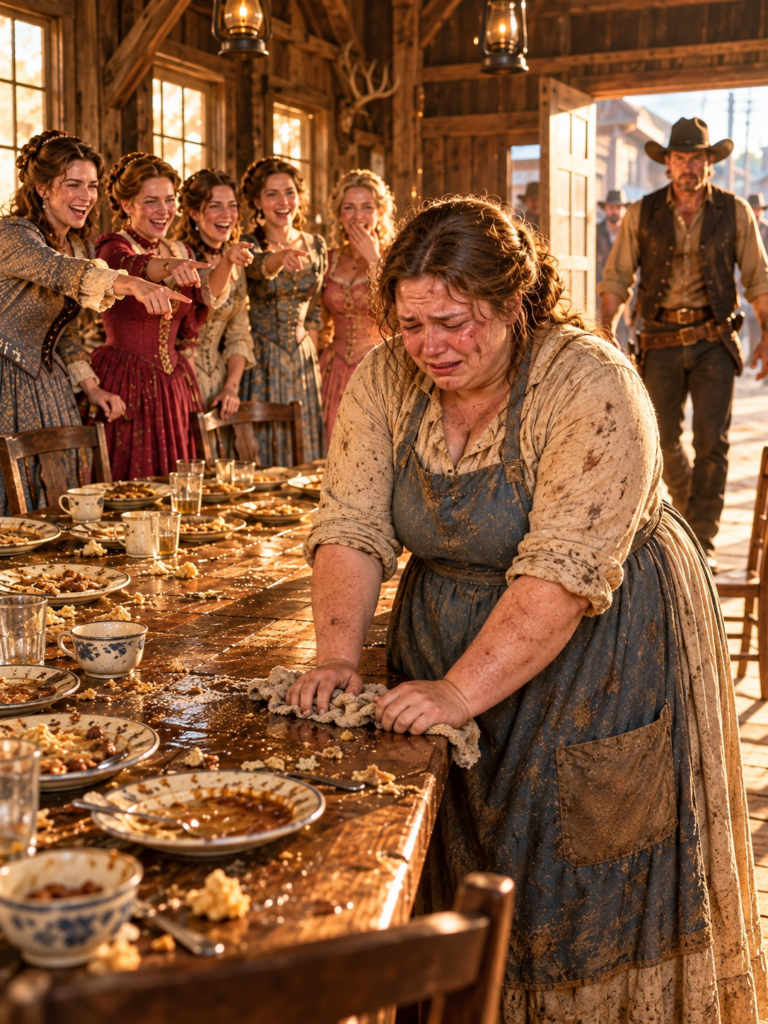
Amelia Whitaker stood beside the head table of the Harrington summer gathering, holding an empty serving tray against her waist. At her feet lay the broken pieces of a crystal goblet. A dark stain spread across the white tablecloth, dangerously close to the embroidered sleeve of Victoria Harrington’s evening gown.
For one suspended moment, nobody spoke.
Then Victoria rose.
“Do you have any idea what you’ve done?”
Her voice carried through the lantern-lit assembly hall. The musicians lowered their instruments. Conversations stopped. Nearly two hundred guests turned toward the young woman in the plain gray servant’s dress.
Amelia glanced at the overturned chair beside the table.
A gentleman had pushed it backward without looking, striking her tray. She had managed to keep the pitcher from falling, but the goblet had slipped from its edge.
“I apologize for the disturbance, Mrs. Harrington.”
Victoria looked at the broken glass, then at Amelia’s face.
“That goblet belonged to my mother’s wedding collection.”
“I understand, ma’am. I can have everything cleaned immediately.”
“Cleaned?”
Victoria repeated the word with a disbelieving little laugh.
“Do you imagine a bucket and a rag will repair something valuable?”
Someone at the adjoining table chuckled.
Amelia remained still.
She had spent six years working at Caldwell’s Boarding House in Red Willow Creek, Montana Territory. She knew when an apology was expected, when an explanation would be interpreted as insolence, and when silence offered the safest escape.
Tonight, she suspected, silence would not be enough.
Victoria reached for her wrist.
Her fingers closed around it with such force that Amelia nearly dropped the tray.
“Look at this girl,” Victoria announced. “She cannot even manage to carry a few glasses without making herself the center of attention.”
A few guests smiled.
“Perhaps she believes that if she stands near enough to respectable gentlemen, someone will mistake her for a lady.”
This time the laughter was louder.
Amelia felt heat rise beneath her collar.
She wanted to explain about the chair. She wanted to say that the goblet had fallen because someone else had moved carelessly.
But Victoria’s hand tightened, and Amelia understood that the truth of the accident was no longer the subject.
The subject was her place in the world.
And Victoria intended to remind her of it.
Across the room, Nathaniel Carter set down his untouched drink.
He had been seated between Clara Stanton, whose father owned the largest mercantile operation in three counties, and the unmarried daughter of a prosperous banker from Helena.
Both women had spent much of the evening attempting to attract his attention.
At thirty-five, Nathaniel was considered the most desirable unmarried rancher in the county. The Carter holdings stretched from the southern creeklands toward the foothills, carrying thousands of cattle and employing nearly forty men during the busiest months.
His father had built the property through stubbornness, sacrifice, and an almost unreasonable capacity for work.
Nathaniel had inherited the responsibility of making it larger.
He also carried an obligation, according to practically every prosperous family in Red Willow Creek, to marry a woman of suitable standing.
Victoria Harrington had devoted considerable attention to helping him fulfill it.
Now, watching her grip a servant’s wrist while the room laughed, Nathaniel rose from his chair.
He crossed the hall without hurrying.
“Mrs. Harrington.”
Victoria turned.
Her expression changed immediately.
“Nathaniel. I was just dealing with an unfortunate accident.”
“So I gathered.”
He looked at Amelia’s wrist.
“Would you release her?”
Victoria’s smile faltered.
“Surely you don’t imagine—”
“Please.”
Something in his voice ended the argument.
Victoria let go.
Amelia lowered her arm, careful not to rub the place where the woman’s fingers had pressed into her skin.
Nathaniel glanced toward the overturned chair.
“Mr. Bennett,” he said to the gentleman beside it, “wasn’t that your chair?”
The man cleared his throat.
“Well, I suppose it was.”
“And wasn’t it your chair that struck the tray?”
Bennett looked around the room, searching for support that did not arrive.
“I hadn’t realized she was behind me.”
“Then perhaps,” Nathaniel said, “the apology ought to come from you.”
The silence deepened.
Bennett adjusted his cuffs.
“My apologies, miss.”
Amelia nodded.
Nathaniel turned back toward Victoria.
“There seems little reason to hold a woman responsible for an accident she tried to prevent.”
Victoria’s cheeks colored.
“You’re making rather a great affair of something insignificant.”
“No,” Nathaniel replied. “I believe that happened before I stood up.”
The words were quiet.
Their effect was not.
Victoria stared at him, unable to find a response that would not make the situation worse.
Finally, she drew herself upright.
“The staff may clear the mess.”
Amelia crouched to collect the broken pieces.
Nathaniel bent beside her.
She looked up sharply.
“Please don’t, sir.”
He paused.
“Why not?”
“Because if the richest rancher in the county is seen gathering broken glass for a maid, they’ll be talking about it until Christmas.”
His mouth moved slightly.
“Are they likely to stop talking if I don’t?”
“No,” she admitted. “But they might find something else to discuss before midnight.”
He placed the largest shard on her tray.
“Then we’d best give them as little material as possible.”
For the first time that evening, Amelia nearly smiled.
She resisted.
Being rescued in public by Nathaniel Carter was dangerous enough.
Enjoying his company would be worse.
Outside the assembly hall, the Montana night smelled of dust, warm pine, and distant rain that had not yet arrived.
Amelia stood by the kitchen pump, holding a damp cloth against her wrist.
She had finished clearing the broken glass and escaped for a few minutes before the next serving round.
The bruises would appear by morning.
She was examining the red marks when a voice came from the darkness.
“Does it hurt?”
Nathaniel Carter stood several feet away, holding his hat.
Amelia pulled down her sleeve.
“Not considerably.”
“That wasn’t quite an answer.”
“It was the most useful answer I have.”
He accepted that without argument.
For a while he stood looking toward the low hills, where the moon had risen above a line of cottonwoods.
Amelia found his silence unusual.
Wealthy men generally expected their presence to produce conversation. They asked questions only when they wanted something confirmed.
Nathaniel appeared content to let her think.
Finally she said, “You shouldn’t have interfered.”
“Why?”
“Because Mrs. Harrington has a long memory.”
“So do I.”
“Her husband controls a great many things in this county.”
“Not all of them.”
Amelia turned toward him.
“That’s a comfortable distinction for a man who owns several thousand acres.”
He looked at her with fresh attention.
She immediately regretted the sharpness of her words.
“I meant no disrespect.”
“I know precisely what you meant.”
He leaned against the pump fence.
“And you’re right. There are consequences I can afford that you cannot.”
Amelia studied him.
She had expected a defense of his generosity, perhaps a reminder of his good intentions.
Instead, he had acknowledged the very thing that troubled her.
“My name is Amelia Whitaker,” she said.
“Nathaniel Carter.”
“I know.”
“I suspected you might.”
This time she did smile.
Only briefly.
But he noticed.
Three mornings later, Amelia was checking Caldwell’s kitchen accounts when Margaret Caldwell entered with an unexpected announcement.
“Mr. Carter is here.”
Amelia looked up from the ledger.
“Does he need a room?”
“No.”
“Breakfast?”
“He says he has business with you.”
Margaret’s expression suggested she considered the situation highly inconvenient.
Amelia put down her pencil.
Nathaniel waited in the front parlor, where the furniture was carefully polished and seldom used.
He stood when she entered.
“Miss Whitaker.”
“Mr. Carter.”
“I hope this isn’t an intrusion.”
“That depends on why you’re here.”
He looked toward the open account book beneath her arm.
“I’ve been told you’re good with figures.”
“Who told you that?”
“Mrs. Caldwell.”
Amelia glanced toward the doorway, where Margaret had suddenly become absorbed in examining a vase.
“I keep her household accounts,” Amelia said.
“And before that?”
“Hotel laundry records. Supply orders. Wages when the proprietor trusted me to calculate them.”
“Did you study bookkeeping?”
“No, sir.”
“Then how did you learn?”
She considered the question.
“By noticing that when people didn’t understand their own numbers, someone else usually paid the price.”
Nathaniel was quiet for a moment.
“My father and I have a problem at the ranch.”
“What sort?”
“Our accounts disagree.”
“Accounts often disagree. That’s why they’re kept.”
“These have been disagreeing for five years.”
Amelia raised an eyebrow.
“Then someone has been extraordinarily patient.”
“Neither of us has been patient,” he admitted. “We’ve simply been stubborn.”
He explained that Walter Carter had maintained the ranch records for nearly forty years. Nathaniel had introduced a newer system of categorizing purchases, wages, cattle sales, and grazing expenses.
Neither man had abandoned his preferred method.
Now the two sets of books had become almost impossible to reconcile.
“We’ve had two bookkeepers examine them,” Nathaniel said. “Neither finished.”
“Why?”
“My father dismissed the first. The second dismissed my father.”
Amelia looked down to hide her amusement.
“And you think I can succeed where they failed?”
“I think you might be willing to tell both of us when we’re wrong.”
“That sounds like a particularly unpleasant occupation.”
“I’ll pay you for it.”
That changed the conversation.
Amelia did not immediately accept.
She asked about the volume of records, the condition of the ledgers, the hours expected, and whether she would be permitted to examine original receipts.
Then she asked what he intended to pay.
Nathaniel named a figure.
She considered it.
“That will cover the preliminary examination. If the work proves more extensive, we’ll negotiate further.”
He blinked.
“Agreed.”
“And my employment with Mrs. Caldwell takes priority during my contracted hours.”
“Of course.”
“And I won’t be asked to disguise the work as a social visit.”
His expression grew serious.
“Miss Whitaker, I came because I need help with the ranch.”
“Good.”
She folded her hands.
“Then we understand each other.”
A moment passed.
Nathaniel put on his hat.
“There’s one other matter.”
Amelia felt an immediate tightening in her chest.
“Yes?”
“Would you object if I also came by occasionally when I didn’t need help with the ranch?”
The question was so plainly asked that it almost startled her.
She looked toward the window.
A wagon rolled past. Somewhere in the kitchen, Margaret closed a cupboard rather more loudly than necessary.
“That,” Amelia replied, “would require a different conversation.”
Nathaniel inclined his head.
“Then perhaps we’ll have it another day.”
And he left.
Amelia stood alone in the parlor, aware that the man had managed to unsettle her considerably more through courtesy than most men could have managed through persistence.
The Carter Ranch lay eighteen miles beyond Red Willow Creek, where the open grassland began to rise toward wooded ridges.
Amelia arrived the following Saturday in a supply wagon driven by a quiet ranch hand named Hector Ruiz.
The main house was substantial but unadorned, constructed of timber and pale stone, with a broad porch overlooking the cattle yards.
Nathaniel met her at the steps.
“My father is waiting in the study.”
“Does he know why I’m here?”
“Yes.”
“Does he approve?”
Nathaniel hesitated.
“No.”
“Then we’d better not waste his morning.”
Walter Carter was standing behind his desk when she entered.
He was a compact, weathered man in his sixties, with a face shaped by wind, labor, and the habit of finding fault before finding satisfaction.
He examined Amelia as though she were a horse being offered at an unreasonable price.
“You’re the woman from Caldwell’s.”
“Yes, sir.”
“The servant.”
“I work there, certainly.”
Walter looked toward his son.
“And this is your grand solution?”
Nathaniel’s jaw tightened.
Amelia spoke before he could.
“Mr. Carter, I haven’t examined your books yet. You needn’t decide whether I’m competent until you’ve seen my work.”
Walter returned his attention to her.
“And if I don’t like it?”
“Then you won’t pay for the next stage.”
He gave a short, humorless laugh.
“Fair enough.”
Four thick ledgers lay on the desk.
Amelia opened the oldest.
For the next three hours, she scarcely spoke.
She compared cattle purchases against transport charges, wages against seasonal labor reports, and household expenditures against the ranch’s general account.
Walter remained nearby, occasionally muttering something about unnecessary complexity.
Nathaniel brought her coffee.
She forgot to drink it.
By noon, she understood the problem.
Father and son had been recording the same transactions under different assumptions.
Walter treated certain advances as capital expenditures.
Nathaniel entered them as operating expenses.
Some payments were listed twice.
Others appeared only in memoranda.
Neither system was entirely wrong.
Together, they created a misleading picture.
Amelia turned toward Walter.
“You’ve been arguing with your son for years through your account books.”
Walter frowned.
“What does that mean?”
“It means neither of you has been willing to change your method, so you’ve each made a second version of the ranch’s finances. The difficulty isn’t poor arithmetic. It’s that you’re answering different questions with the same numbers.”
Nathaniel pulled up a chair.
“Can it be corrected?”
“Yes. But you’ll both have to stop defending the ledgers long enough to tell me what actually happened.”
Walter regarded her for a long moment.
Then he sat down.
“Ask.”
It was the first concession he had made all morning.
Amelia returned to the books.
She was halfway through the section covering the drought of 1870 when she found an entry that did not belong.
A payment of six hundred dollars had been charged to winter feed.
Beside it, in Walter’s cramped handwriting, were the words:
North range obligation. Marsh and Greeley acknowledged. Harrington to hold the balance.
Amelia checked Nathaniel’s newer ledger.
The payment appeared there under grazing access.
But the amount was different.
More troubling still, the grazing committee’s most recent statement showed the Carter Ranch owing the entire sum.
She took out the original receipts.
Two carried signatures.
The third bore no signature at all.
Instead, someone had written a date and a notation referring to a private understanding with Franklin Harrington.
“Mr. Carter?”
Both men looked up.
“Who administers the northern grazing agreement?”
Nathaniel answered.
“A committee of five landholders. Franklin Harrington is chairman.”
“And when does the agreement come up for renewal?”
“Next month.”
Amelia placed the three documents beside one another.
“According to your books, you paid for an obligation that the committee says remains unsettled.”
Walter grunted.
“I paid it.”
“Perhaps you did.”
“There’s no perhaps about it.”
“Then we need to know why the committee’s records disagree.”
Nathaniel leaned over the desk.
“Is it a mistake?”
Amelia studied the unsigned paper.
“It could be.”
She looked at the penciled notation again.
“But someone has kept this matter unresolved for four years, and Mr. Harrington appears to be the only person who can explain why.”
Outside, thunder rolled across the distant foothills.
For the first time since entering the study, Walter Carter looked uneasy.
“The north range is where we send the breeding herd after the summer pastures run thin,” he said.
Nathaniel nodded grimly.
“Without that agreement, we’d have to cut our numbers before winter.”
Amelia examined the papers once more.
Six hundred dollars.
Two signatures.
One missing acknowledgment.
And a committee chairman whose wife had recently humiliated her before the entire town.
She closed the ledger.
“I believe,” she said carefully, “we should begin by finding out what that payment was actually meant to settle.”
Neither man spoke.
Outside the study window, the first drops of rain struck the glass.
Amelia had come to the Carter Ranch expecting to straighten a set of books.
Instead, she had discovered that the future of the largest cattle operation in the valley might depend on a transaction neither father nor son fully understood.
And she had a growing suspicion that Franklin Harrington understood it very well.
Part 2
By the following Wednesday, Amelia knew more about the Carter Ranch finances than Nathaniel had learned in five years of managing them.
She also knew that Walter Carter disliked admitting uncertainty, that his son sometimes confused confidence with thoroughness, and that both men had inherited a remarkable talent for turning simple disagreements into matters of principle.
Yet neither was foolish.
That was what made the work satisfying.
Every question she asked led somewhere. Every corrected entry revealed another piece of the ranch’s history. When she identified a mistake, the men argued over its cause, but neither disputed her evidence.
And on the fourth afternoon, Walter surprised her.
“You’re wasting time on that page,” he said.
Amelia looked up.
“Am I?”
“The answer’s in the book underneath. I started keeping delivery quantities separate after the hard winter.”
She opened the other volume.
He was right.
“Thank you,” she said.
Walter appeared almost disappointed that she had accepted his correction so readily.
“You don’t mind being told you’re wrong?”
“Not when I am.”
He gave her a thoughtful look.
After that, he brought her the records she requested without being asked twice.
Nathaniel began accompanying Amelia home whenever the work kept her at the ranch until late afternoon.
At first they talked about expenses, cattle shipments, and the north range.
Then the conversations drifted.
He discovered she loved geography books because they showed places she had never expected to visit. She discovered he disliked formal gatherings because they reminded him of livestock auctions, except that nobody admitted what was being purchased.
Once, on a stretch of road overlooking the valley, he asked whether she had always intended to work in boarding houses.
“No.”
“What did you intend?”
Amelia watched the sun moving over the distant mountains.
“When I was younger, I thought I’d teach.”
“Why didn’t you?”
“Because people who have to eat cannot always afford to wait for the lives they imagined.”
He considered that.
“Would you still want to?”
“Perhaps. Though I’d rather keep accounts now.”
“Why?”
“Because an accurate account gives a person some control over what happens to them.”
She looked at him.
“My mother worked most of her life. She never knew exactly what she was owed because the people paying her were also the people keeping the records. I watched her accept less than she deserved more times than I can remember.”
“Is that why you learned?”
“Partly.”
“And the other part?”
Amelia smiled faintly.
“I like making sense of difficult things.”
Nathaniel returned her smile.
“I had noticed.”
A long silence followed.
Then he said, “There are several empty rooms above the west storehouse in town. I could arrange for you to use one as an office.”
Her smile vanished.
“Why would you do that?”
“Because you could take other clients.”
“At whose expense?”
“Mine, initially.”
She turned toward him.
“Mr. Carter, if you want to help me build a business, you may recommend my services. You may pay me fairly for work I perform. But you will not purchase the appearance of independence and expect me to call it mine.”
He stopped beside the wagon.
The words had struck more deeply than she intended.
“That wasn’t what I meant.”
“I believe you.”
“But it was what I offered.”
“Yes.”
He looked away toward the open range.
For several moments he seemed to be considering an answer.
Then he said, “I think I’m accustomed to solving problems with money.”
“It must be a pleasant habit.”
“It has its limitations.”
“Most habits do.”
He turned back.
“I owe you an apology.”
“No. You owe me nothing for making an offer I could refuse.”
His expression softened.
“Will you always make things this difficult?”
“Only when they deserve it.”
He laughed.
And Amelia, who had spent years measuring each word before she spoke, discovered that she could be completely herself in his company without constantly fearing the result.
That discovery frightened her far more than any of Victoria Harrington’s insults.
On Friday morning, Victoria arrived at Caldwell’s Boarding House in a black carriage.
Margaret received her in the parlor.
Amelia was sorting linen in the adjoining room when she heard her name.
Then she heard Victoria say, “You cannot seriously intend to encourage this.”
Amelia continued folding sheets.
Margaret’s voice remained controlled.
“Encourage what, precisely?”
“A servant making herself indispensable to a wealthy unmarried man.”
“Amelia has been hired to examine the Carter Ranch accounts.”
“How convenient.”
There was a pause.
Victoria continued, “You understand what people will think, Margaret. A respectable establishment cannot afford certain kinds of gossip.”
“My establishment,” Margaret replied, “has paid its bills for twenty-three years. I intend for it to continue doing so.”
“And your employee?”
“My employee has done nothing improper.”
Victoria’s tone hardened.
“I would hate for your boarding house to suffer because you refused to take a reasonable warning.”
Amelia set down the linen.
She entered the parlor before Margaret could reply.
“Mrs. Harrington.”
Victoria turned.
“I didn’t realize you were listening.”
“The walls are thin, ma’am.”
Margaret closed her eyes briefly.
Amelia stood with her hands folded.
“If your concern is my work for Mr. Carter, I have a written agreement. Mrs. Caldwell has seen it. I am paid for the hours I spend on the accounts.”
Victoria looked irritated rather than reassured.
“And you expect me to believe your interest is entirely professional?”
Amelia hesitated.
Here was a question she could not answer with convenient certainty.
“I expect you to believe that my employment is legitimate.”
“That isn’t what I asked.”
“No, ma’am.”
Victoria stepped closer.
“Do not mistake his attention for a promise. Men with Nathaniel’s responsibilities do not simply cast them aside because a young woman happens to interest them.”
Amelia looked steadily at her.
“Then his decisions should be discussed with him.”
Victoria’s expression became cold.
“You’re a very bold girl.”
“I’ve been called quieter things.”
Margaret made a small sound behind her.
Victoria drew on her gloves.
“You may discover that clever remarks do not keep a roof over your head.”
Amelia felt the warning settle heavily in her stomach.
She understood it.
She understood far more than Victoria imagined.
But she had spent too many years accepting humiliation as the ordinary price of employment.
“I know exactly what keeps a roof over my head, Mrs. Harrington. My work.”
Victoria left without another word.
After the carriage had gone, Margaret returned to the parlor.
“You took a risk.”
“I know.”
“She could make trouble for us.”
“I know that too.”
Margaret examined the younger woman’s face.
“Are you fond of him?”
Amelia looked down.
For a moment, the silence felt unbearable.
“Yes.”
The word was barely audible.
Margaret sighed.
“Does he know?”
“Not in so many words.”
“And are you certain he deserves it?”
Amelia considered all the mornings Nathaniel had traveled into town, all the discussions on dusty roads, all the occasions when he had listened instead of simply waiting for her to finish speaking.
“No,” she said. “I don’t think anyone can be certain of that at the beginning.”
Margaret nodded slowly.
“Then be certain of yourself.”
Amelia looked up.
Margaret’s expression was unusually gentle.
“You may be poor, child, but that doesn’t mean your heart is the least valuable thing you own.”
The answer to the northern grazing mystery emerged two days later.
It came not from a ledger, but from a visit to the Greeley homestead.
Ruth Greeley was a widow who maintained a small cattle holding on the edge of the northern range with the help of her grown nephew.
She received Amelia on a porch overlooking a narrow stream and a field of struggling late-season grass.
“I remember the payment,” Ruth said when Amelia explained her errand. “I remember every blessed dollar.”
“Then it reached you?”
“Some of it.”
Ruth disappeared inside and returned with a worn envelope.
Inside was a receipt dated October 1870.
The sum was considerably smaller than the amount Walter Carter had recorded.
Amelia examined it.
“And the remainder?”
“Was meant to pay for repairing the lower diversion ditch.”
“What happened to the ditch?”
“Carter cattle crossed it during the drought. The banks gave way after a storm. Lost me most of the water I needed for the second hay cutting.”
Amelia looked toward the stream.
“Walter Carter believed the damage was unavoidable?”
“He said the storm would have broken it regardless. Perhaps he was right.”
Ruth folded her arms.
“But I had to hire men to repair half the bank myself, and I couldn’t afford to finish the work.”
“Did he offer compensation?”
“He offered money through Harrington.”
“Why through him?”
“Franklin was helping settle disputes between the ranchers that year. He was supposed to hold the money until the repairs were completed and the new crossing agreed upon.”
“And were they?”
Ruth shook her head.
“Walter wouldn’t approve the location. Said it gave my cattle an advantage over his. Then we had an early freeze. After that, nobody wanted to discuss it.”
Amelia studied the receipts again.
The six hundred dollars had not vanished.
It had been distributed, withheld, and recorded differently by people who disagreed over what constituted settlement.
“Mrs. Greeley, would you support renewal of the grazing agreement if the ditch and crossing were properly repaired?”
Ruth considered the question.
“I might.”
“Even after all this time?”
“Miss Whitaker, I don’t particularly care who Nathaniel Carter takes to a dance. I care whether my hayfields have water.”
Amelia nodded.
That was the first entirely sensible statement she had heard about the matter in weeks.
She returned to the Carter Ranch that afternoon with a new set of questions.
Walter listened until she mentioned the ditch.
Then his expression changed.
“Greeley land again.”
“Yes.”
“That bank was already weak.”
“It may have been.”
“And I paid for what was fair.”
“You paid for what you believed was fair.”
He struck the desk with his palm.
“There’s a difference?”
Amelia kept her voice steady.
“There can be.”
Nathaniel looked from one to the other.
“Father, did you ever inspect the repairs?”
“No reason to. Harrington was supposed to handle them.”
“And did he?”
Walter said nothing.
Amelia laid Ruth’s receipt beside the older ledger.
“Mrs. Greeley received this amount. The committee held the rest. The crossing was never finished, and because it wasn’t finished, the settlement was never formally completed.”
Walter stared at the document.
“Franklin could have told me.”
“Perhaps he should have.”
“He certainly knew where I lived.”
“So did Mrs. Greeley.”
Walter looked sharply at Amelia.
She did not retreat.
“Mr. Carter, you built this ranch by understanding what every loss cost you. Surely you can understand that losing a season’s hay mattered just as much to a woman with twenty cattle as it would have mattered to you with two thousand.”
For a long time, he said nothing.
Then he took off his spectacles.
“She told you about her husband?”
“Only that he died in the winter before the drought.”
Walter looked toward the window.
“I knew him.”
His voice had changed.
“Thomas Greeley. Good hand with horses. Never could keep a fence straight.”
Nathaniel waited.
Walter rubbed his forehead.
“I should have gone to see her myself.”
Amelia nodded.
“Perhaps you still can.”
He looked at the ledger.
For once, he did not argue.
That evening, Nathaniel found Amelia outside the barn.
The ranch hands were driving the last cattle through the north gate, and the yard was full of dust and the low, restless sounds of animals returning from pasture.
“You were hard on him,” Nathaniel said.
“Was I wrong?”
“No.”
He leaned beside her against the fence.
“That’s the trouble.”
Amelia watched Hector close the gate.
“Your father is accustomed to being the man who decides what fairness means.”
“He’s accustomed to being the man everyone depends on.”
“Those aren’t always the same thing.”
Nathaniel was quiet.
Then he said, “When he first came west, he worked for other ranchers. Slept wherever someone would let him. Went hungry more often than he’ll admit.”
“I know.”
“He told you?”
“Not directly. The early books tell a good deal.”
Nathaniel smiled.
“Of course they do.”
He looked toward the house.
“I think he’s terrified of losing what he built. Everything he does comes back to that.”
Amelia studied the broad roofs, the cattle yards, the wagons, the men returning from work.
“Perhaps that’s why he finds it so difficult to remember what it felt like to have nothing.”
Nathaniel turned toward her.
For a moment, neither spoke.
Then he said, “I want you to know something.”
She waited.
“I’ve begun looking forward to your visits for reasons that have very little to do with the books.”
Amelia’s heart began to beat faster.
“I had suspected.”
“Does that trouble you?”
“Yes.”
He looked away.
She touched his sleeve.
“Not because I dislike it.”
He turned back.
“Then why?”
“Because you could lose very little by deciding this was a mistake. I could lose nearly everything.”
He did not answer immediately.
The sun had fallen behind the mountains, leaving the yard in a soft copper-colored light.
Finally he said, “I can’t promise that caring for me will cost you nothing.”
“No.”
“But I can promise not to make the decision for you.”
Amelia drew a slow breath.
It was not the reassurance she had expected.
It was better.
She looked at his hand resting on the fence.
Then, deliberately, she placed hers beside it.
Their fingers touched.
Neither moved away.
By September, the grazing dispute had become a public matter.
Franklin Harrington had announced that the committee would reconsider the Carter Ranch’s northern access at its next meeting.
He also began making visits to the smaller landholders, reminding them of debts, obligations, and the importance of maintaining good relationships within the county.
The timing was not accidental.
Nathaniel knew it.
Amelia knew it.
Walter Carter, who had never been particularly skilled at concealing anger, said so loudly enough for half the ranch to hear.
Then an invitation arrived for the Red Willow Creek Founders’ Celebration.
It was to be held at the same assembly hall where Victoria had humiliated Amelia.
Nathaniel visited Caldwell’s that afternoon.
He found Amelia in the kitchen, copying the last corrected entries into a new ledger.
“There’s a dance on Saturday.”
“So I’ve heard.”
“I’ve been invited.”
“I imagine you have.”
He put his hat on the table.
“I’d like you to come with me.”
Her pencil stopped.
Amelia looked at him.
“As what?”
“As my guest.”
“Mr. Carter—”
“Nathaniel.”
She set down the pencil.
“Do you understand what you’re asking?”
“Yes.”
“You’re asking me to enter Mrs. Harrington’s gathering on your arm, in front of the very people who’ve spent the summer accusing me of trying to rise above my station.”
“I understand.”
“And you know her husband is chairman of the committee deciding whether your ranch keeps its north grazing access.”
“Yes.”
She stood.
“Then perhaps you ought to consider whether provoking him is sensible.”
Nathaniel stepped closer.
“I’m not asking you to come in order to provoke Franklin Harrington.”
“Then why?”
“Because when I enter that room, I’d rather be accompanied by the woman whose company I actually enjoy than spend another evening pretending to be interested in women someone else has chosen for me.”
Amelia felt a warmth rise into her face.
“That is not a particularly cautious answer.”
“No.”
She looked down at her plain work dress.
“I haven’t anything suitable to wear.”
“I could—”
“Don’t offer to buy me a gown.”
He closed his mouth.
Then he smiled.
“I was going to say that I could ask Mrs. Caldwell whether she knows a good dressmaker.”
Amelia gave him a skeptical look.
“Of course you were.”
“Would you consider the invitation?”
She looked at him for a long time.
Then she thought about the assembly hall.
About Victoria’s fingers on her wrist.
About the laughter.
And about the strange, painful fact that she had permitted those people to determine where she could stand, how she could speak, and what she was allowed to hope for.
“Yes,” she said.
Nathaniel became very still.
“Yes?”
“I’ll come.”
His expression changed so completely that she could not help smiling.
“But I will wear a dress I pay for myself.”
“Naturally.”
“And I won’t have you treating me as an act of charity.”
“Never.”
“And if someone insults me, you needn’t fight the entire town.”
He considered that condition.
“I’ll do my best.”
Saturday arrived beneath a sky streaked with pink and gold.
Amelia stood before the narrow mirror in her room at Caldwell’s Boarding House.
Her dress was blue wool, modestly cut, with a white collar she had sewn by hand.
She had purchased the fabric using part of her wages from the Carter Ranch.
Margaret helped fasten the final button.
“You look very well.”
Amelia swallowed.
“I feel rather foolish.”
“Why?”
“Because I spent enough on this fabric to buy two weeks of groceries.”
Margaret adjusted the collar.
“Then see that you enjoy the evening.”
Amelia glanced toward her.
“Do you think I’m making a mistake?”
Margaret considered the question carefully.
“I think you might be making a choice.”
She placed both hands on Amelia’s shoulders.
“Those are not always mistakes, even when they’re frightening.”
When Nathaniel arrived, he stood at the foot of the stairs holding a small bunch of late-blooming wildflowers.
He looked up.
For several seconds he said nothing.
Amelia stopped halfway down.
“Is something wrong?”
“No.”
“Then why are you staring?”
“I’m trying to think of something worth saying.”
“And?”
He smiled.
“I haven’t managed it.”
She came down the final steps.
He offered the flowers.
“I picked them by the creek. I thought you’d prefer these to something expensive.”
She accepted them.
“You thought correctly.”
Margaret watched from the doorway as they left.
For the first time in many years, Amelia did not feel like someone departing for work.
She felt like a woman going somewhere because she wished to be there.
The assembly hall was crowded when they arrived.
Nathaniel helped Amelia down from the carriage.
Conversation near the entrance slowed.
Then stopped.
Clara Stanton stood beside her father, wearing a dress of pale silk. She looked from Nathaniel to Amelia and raised her eyebrows.
A banker whispered something to his wife.
Several older women exchanged glances.
Victoria Harrington stood near the musicians.
When she saw Amelia, her expression hardened.
“Nathaniel.”
He inclined his head.
“Victoria.”
Her eyes moved toward Amelia.
“I wasn’t aware Miss Whitaker had been invited.”
“She came with me.”
Victoria’s smile was thin.
“How unconventional.”
“Perhaps.”
He offered Amelia his arm.
“Shall we?”
Amelia took it.
They crossed the hall together.
For the first few minutes, she was certain every person in the building was watching.
Then the musicians began a waltz.
Nathaniel turned toward her.
“Would you dance with me?”
She looked at the floor.
“I haven’t danced in years.”
“Neither have I, if we’re speaking of doing it well.”
She laughed softly.
“You must be a dreadful partner.”
“Quite possibly.”
He held out his hand.
Amelia looked at it.
A familiar fear moved through her.
Not fear of him.
Fear of the life she had lived until now, and what might happen if she stopped obeying its rules.
Then she placed her hand in his.
They stepped onto the dance floor.
At first her movements were stiff.
Nathaniel guided her carefully, giving her time to find the rhythm.
“You’re looking at your feet,” he said.
“That’s because I intend to keep both of them.”
“Look at me instead.”
She did.
The room shifted around them.
The lanterns blurred.
The music grew easier.
And after a few moments, Amelia realized she was no longer counting the faces watching from the edges of the floor.
She was dancing.
Not because a rich man had chosen to be kind to her.
Because she had wanted to come.
Because she had accepted his invitation.
Because, for this one evening, she had stopped asking whether the world would permit her to be happy.
Franklin Harrington approached as the second dance ended.
He was a broad, carefully dressed man with silver beginning to appear at his temples. His expression was courteous in the manner of someone accustomed to making unpleasant remarks without raising his voice.
“Carter.”
“Franklin.”
Franklin glanced toward Amelia.
“Miss Whitaker.”
“Mr. Harrington.”
“I understand you’ve been helping with the ranch accounts.”
“Yes, sir.”
“A curious occupation for a boarding-house maid.”
“Not especially. Numbers behave much the same wherever they’re kept.”
Nathaniel lowered his head slightly.
Amelia suspected he was concealing a smile.
Franklin did not smile.
“Your father and I have been discussing the north grazing matter,” he told Nathaniel.
“So I understand.”
“Several committee members remain concerned.”
“About the outstanding settlement?”
“Among other things.”
Nathaniel’s expression sharpened.
“What other things?”
Franklin glanced around the room.
“This county depends on cooperation. Respect. An understanding that individual choices sometimes affect the larger community.”
Amelia felt Nathaniel’s hand grow still beneath hers.
“Are we discussing cattle,” he asked, “or my choice of company tonight?”
Franklin’s face remained composed.
“Sometimes the two cannot be entirely separated.”
The words landed heavily.
Nathaniel looked at him for several seconds.
Then he said, “If the committee has a legitimate objection to the grazing agreement, we’ll answer it. But I won’t negotiate my private life in exchange for pasture.”
Franklin’s expression cooled.
“Then you’re prepared to accept the consequences.”
“Of conducting my affairs honestly? Yes.”
“Very well.”
Franklin inclined his head and walked away.
Amelia watched him return to Victoria.
Neither husband nor wife looked pleased.
She turned toward Nathaniel.
“That may have cost you the agreement.”
“Perhaps.”
“Three thousand acres.”
“I know.”
“Winter feed for hundreds of cattle.”
“Yes.”
“And the wages of the men who depend on you.”
He looked at her.
That final argument had reached him.
She could see it.
“Amelia—”
“No. I need you to understand something.”
She lowered her voice.
“I won’t have people losing their livelihood so that you can prove you’re brave enough to court a servant.”
His expression changed.
The statement hurt him.
She knew it did.
But she could not withdraw it.
“I haven’t asked you to sacrifice the ranch for me,” she continued. “And I won’t allow either of us to turn needless loss into a noble gesture.”
Nathaniel looked toward the musicians.
Then he turned back to her.
“You’re right.”
The admission came with difficulty.
She appreciated it all the more.
“What do you suggest?”
Amelia took a breath.
“We stop treating this as Franklin Harrington’s argument and start treating it as a problem involving five landholders.”
“You have a plan?”
“Not yet.”
Her eyes moved toward Ruth Greeley, who stood near the refreshment table speaking to Henry Marsh, the local postmaster and another member of the grazing committee.
“But I believe I know where to begin.”
The next morning, Amelia received a folded note from Ruth Greeley.
It contained only a few lines.
Ruth had examined the old committee agreement.
Its renewal required the consent of every participating landholder.
She would not give hers.
Not while the diversion ditch remained unfinished.
Not while the unresolved settlement continued to hang over her property.
And not merely because Nathaniel Carter happened to be a decent man.
Amelia read the note twice.
Then she looked at the three original receipts spread across her desk.
The arithmetic had never been the real difficulty.
Walter had believed the payment settled his responsibility.
Franklin had used the unfinished settlement as leverage.
Ruth had lived with the damage.
And Nathaniel was about to lose access to valuable grazing land because none of the men had thought it necessary to begin by asking the person who had suffered the loss what would make matters right.
Amelia folded the note.
For months, people had argued about whether she was worthy of standing beside Nathaniel Carter.
Now she faced a much harder question.
Could she help him save his ranch without asking anyone else to surrender what was rightfully theirs?
Part 3
On Monday morning, Amelia entered the Carter Ranch study carrying three documents and a proposal.
Walter sat behind his desk.
Nathaniel stood near the window.
Neither man looked rested.
“I’ve spoken with Mrs. Greeley,” Amelia began. “And with Mr. Marsh. I believe the grazing agreement can still be renewed.”
Walter leaned forward.
“How?”
“First, the diversion ditch must be repaired.”
“We offered payment four years ago.”
“Payment that never completed the settlement.”
Walter’s jaw tightened.
Amelia continued before he could object.
“Second, the crossing must be rebuilt where all three properties can use it without damaging the adjoining fields.”
Nathaniel examined the sketch she placed before him.
It showed the ditch, the old cattle route, and a proposed crossing upstream.
“Who drew this?”
“Mrs. Greeley’s nephew measured the banks. Hector helped me calculate the distance.”
Walter studied the drawing.
“That’s a fair amount of work.”
“Yes.”
“And expense.”
“Less than losing the north range.”
Nathaniel looked at the figures.
“She’s right.”
Walter ignored him.
“What else?”
Amelia placed the third paper on the desk.
“A written arrangement for maintaining the shared waterworks. Every participating ranch contributes according to use. Every payment is recorded in a common account.”
Walter examined the document.
“Who keeps the records?”
“I suggest Mr. Marsh. He already keeps the post office accounts, and none of the ranchers employs him.”
Nathaniel nodded thoughtfully.
“That would give everyone confidence.”
Walter remained silent.
Amelia closed her folder.
“There is one final matter.”
“Go on.”
“You must speak to Mrs. Greeley yourself.”
Walter’s face hardened.
“I’ve said what I intend to say about that ditch.”
“You haven’t said it to her.”
“She’s had four years to come to me.”
Amelia met his eyes.
“Mr. Carter, you’ve spent forty years building a ranch that others respect. Would it truly diminish what you’ve built to admit that you might have overlooked another person’s loss?”
Walter looked away.
The room grew quiet.
At last, he stood.
“Have Hector bring the wagon around.”
Nathaniel blinked.
“Father?”
“I’m going to look at the damned ditch.”
The repair took nine days.
Walter traveled to the Greeley property and walked the damaged bank with Ruth and her nephew.
For the first hour, the discussion was unpleasant.
They disagreed over the cause of the original damage, the cost of labor, and the proper location of the crossing.
Then Ruth showed Walter the section of hayfield that had never recovered.
The old rancher stood looking at the thin, uneven grass.
“My cattle crossed here?” he asked.
“Yes.”
He examined the ground for a long time.
Finally, he said, “I should have come sooner.”
Ruth folded her arms.
“Yes, Mr. Carter. You should have.”
He nodded once.
It was neither forgiveness nor reconciliation.
But it was a beginning.
The next morning, Carter hands arrived with shovels, timber, and tools.
Nathaniel worked beside them.
Walter directed the rebuilding of the bank.
Ruth’s nephew supervised the drainage.
Amelia kept the expense records and made certain the work followed the agreement Ruth had approved.
By the ninth day, water was flowing through the repaired ditch.
Ruth watched it reach the lower field.
Then she turned toward Walter.
“That’ll do.”
Walter looked at the water.
“Should have been done years ago.”
“Yes.”
He accepted the answer.
Neither spoke of the old argument again.
The grazing committee met in the schoolhouse on the last Thursday of September.
All five landholders attended.
Franklin Harrington sat at the front table.
Walter and Nathaniel stood beside Amelia, who carried the corrected accounts, the old settlement papers, and signed acknowledgments for the completed work.
The meeting began badly.
Franklin questioned the proposed maintenance arrangement. Another landholder worried that the new rules would increase expenses. A third wanted assurance that the cattle crossing would not disrupt spring planting.
Amelia answered what she could.
Nathaniel answered for the ranch operations.
Walter explained the work already completed.
Finally, Ruth Greeley rose.
“I opposed this agreement because a problem on my land was left unfinished for four years.”
She looked toward Walter.
“That problem has now been put right.”
Franklin leaned forward.
“And you’re satisfied?”
“With the repair, yes. With the maintenance agreement, provided it’s kept.”
She turned toward Amelia.
“Miss Whitaker has written down exactly what everyone is responsible for. That’s more than we had before.”
Henry Marsh spoke next.
“I’ve examined the proposed accounts. They’re sound.”
Franklin tapped his pencil on the table.
“This is not merely a question of bookkeeping.”
“No,” Amelia said.
Every face turned toward her.
She stood.
“It’s a question of whether five people can keep an agreement despite disagreeing about other things.”
Franklin’s eyes narrowed.
“Are you suggesting the committee has acted improperly?”
“I’m suggesting the agreement should be decided by the land and the obligations attached to it.”
She placed the corrected records on the table.
“Four years ago, a payment was made. Part of it reached the people involved. Part remained unresolved because the agreed work was not completed. We now have receipts for the funds, records of the repairs, and a signed plan for future maintenance.”
She paused.
“Whether anyone approves of Mr. Carter’s personal decisions doesn’t alter those facts.”
A silence followed.
Then Henry Marsh cleared his throat.
“I move that we renew.”
Ruth seconded the motion.
Franklin looked around the table.
It was clear he had expected hesitation.
Instead, the others were studying the documents.
One by one, the members gave their votes.
Four supported renewal.
Franklin voted against it.
The agreement passed.
Nathaniel closed his eyes for a brief moment.
Walter sat completely still.
Then, to Amelia’s surprise, he reached across the table and shook her hand.
“Good work, Miss Whitaker.”
She returned his grip.
“Thank you, sir.”
He cleared his throat.
“You were right about the ditch.”
Amelia smiled.
“Mrs. Greeley was right about the ditch.”
Walter considered that.
“She was.”
And because he was Walter Carter, that was all he said.
Victoria Harrington visited Caldwell’s Boarding House a week later.
She arrived alone.
Amelia was at the front desk when the carriage stopped outside.
For a moment, both women looked at one another without speaking.
Then Victoria stepped forward.
“I understand the committee renewed the grazing agreement.”
“Yes, ma’am.”
“My husband is not particularly pleased.”
“I imagine not.”
Victoria studied her.
“You’ve become quite influential.”
Amelia shook her head.
“I kept records and helped settle a dispute.”
“Most people would call that influence.”
“Perhaps.”
Victoria removed her gloves.
There was an awkward silence.
Finally, she said, “I behaved badly toward you at the summer gathering.”
Amelia was still.
Victoria looked toward the window.
“I was accustomed to arranging things. Nathaniel’s marriage, the families he associated with, the position everyone occupied in this town. I mistook that habit for responsibility.”
She drew a careful breath.
“I had no right to put my hands on you.”
Amelia looked at her for a long moment.
“No, Mrs. Harrington. You didn’t.”
Victoria nodded.
“I won’t ask you to pretend it didn’t happen.”
“That would be difficult.”
For the first time, Victoria smiled faintly.
“I suppose it would.”
She placed a small envelope on the counter.
Inside was a letter recommending Amelia’s bookkeeping services to a mercantile firm in Helena.
“I heard you intended to take other clients,” Victoria said. “This may be useful.”
Amelia examined the letter.
“Thank you.”
Victoria turned toward the door.
“Miss Whitaker?”
“Yes?”
“I hope you’ll make good use of your abilities.”
Amelia held the envelope thoughtfully.
“I intend to.”
Autumn brought cold mornings to Red Willow Creek.
The repaired ditch carried water until the first hard frost.
The northern cattle remained on the range long enough for Nathaniel to bring the breeding herd home in good condition.
Walter resumed his arguments about supply prices, though now he occasionally asked Amelia to explain a disputed entry before announcing that someone had made a mistake.
And Amelia rented a small room above the mercantile store.
She bought a secondhand desk, two chairs, and a new account book.
On the frosted glass of the door, the local painter wrote:
AMELIA WHITAKER — ACCOUNTS AND CORRESPONDENCE
Nathaniel came to see the finished office one Saturday afternoon.
He stood in the doorway, looking at the sign.
“It suits you.”
Amelia arranged a stack of papers on the desk.
“I’ve three clients already.”
“Four, if you’ll continue handling our supply accounts.”
“I intend to charge you the same rate as everyone else.”
“I would expect nothing less.”
He came inside.
The room smelled of fresh paint, paper, and wood polish.
Through the window, they could see wagons passing along the main street.
Nathaniel took off his hat.
“Amelia, may I ask you something?”
She looked up.
“Of course.”
He stood beside her desk.
“When I first met you, I thought you were a woman who needed someone to stand up for her.”
Amelia raised an eyebrow.
“And now?”
“Now I think you would have found your own way to stand, whether I had crossed that room or not.”
She said nothing.
He continued.
“I would like to spend the rest of my life beside you. Not because I imagine I can make your life complete. And not because you owe me anything.”
His voice grew quieter.
“But because every day I’ve known you, you’ve made me want to be a better man.”
Amelia looked down at the unfinished entry beneath her hand.
She had imagined this moment.
Feared it.
Hoped for it.
And now that it had arrived, she found that the answer was simpler than she had expected.
“Nathaniel.”
He waited.
“I don’t intend to give up this office.”
“I know.”
“Or my clients.”
“I wouldn’t ask it.”
“And I will occasionally disagree with you.”
He smiled.
“Occasionally?”
She laughed.
Then she crossed the small room and took his hand.
“Yes,” she said. “I’ll marry you.”
For a moment, he seemed unable to speak.
Then he drew her gently into his arms.
Outside, the town continued about its business, unaware that anything extraordinary had happened.
Amelia preferred it that way.
Some of the most important decisions in a life, she was beginning to understand, needed no witnesses.
They were married on a cold January afternoon in the little church that served Red Willow Creek as both a place of worship and a schoolhouse.
Margaret Caldwell sat in the front pew.
Hector stood beside the other ranch hands, wearing a jacket that had clearly been pressed for the occasion.
Clara Stanton attended with her father and offered Amelia warm congratulations.
Walter Carter stood beside his son, looking stern until the minister pronounced them husband and wife.
Then he took out a handkerchief and pretended to have developed a sudden problem with his spectacles.
Victoria Harrington did not attend, but she sent a set of fine linen tablecloths and a brief, courteous note.
Amelia accepted the gift without forgetting the past or allowing it to govern the future.
After the wedding, Nathaniel brought his bride home to the ranch.
The winter sun was sinking behind the mountains when their carriage reached the broad porch.
Walter had ordered the study prepared for Amelia’s use whenever she wished to work there.
Nathaniel showed her the desk, cleared of the old piles of contradictory ledgers.
Beside it stood a new cabinet for her records.
She looked around the room.
“Your father arranged this?”
“He did.”
“And you didn’t suggest it?”
“Not a word.”
Amelia smiled.
Outside, cattle moved slowly toward the shelter of the lower barns. Smoke rose from the kitchen chimney. Far beyond the frozen creek, the mountains stood pale beneath the evening sky.
She went to the window.
Nathaniel came to stand beside her.
“Happy?” he asked.
Amelia considered the question.
She thought about the girl who had arrived in Montana with a battered traveling bag and very little money.
She thought about the woman who had spent six years carrying other people’s meals, cleaning their rooms, and being careful not to take up too much space.
She thought about Victoria Harrington’s hand closing around her wrist while the guests laughed.
Then she thought about the Carter ledgers, Ruth Greeley’s repaired ditch, her own small office, and the ordinary work that had allowed her to build a life no one could simply give her or take away.
“Yes,” she said.
Nathaniel took her hand.
She turned toward him.
“But I wasn’t unhappy because I was a maid.”
He listened.
“I was unhappy because I’d started believing that was all I was permitted to become.”
He touched his forehead to hers.
“And now?”
Amelia looked toward the desk waiting beneath the window.
“Now I intend to find out everything else I can be.”
Years afterward, people in Red Willow Creek would still tell the story of the wealthy rancher who walked across a crowded hall to defend a servant.
Some would remember the broken glass. Others would remember the dance. A few would speak of the grazing agreement and the quiet young woman who had helped save the Carter Ranch from a costly dispute.
But Amelia never thought of her life as something that began when a rich man chose her.
Nathaniel had offered her something precious: respect without condescension, affection without a bargain, and the freedom to choose him in return.
She had brought something equally precious into their marriage.
A mind that refused to surrender its judgment.
A heart that had survived humiliation without becoming cruel.
And the courage to believe that her own life deserved more than mere survival.
On winter evenings, the two of them sat together beside the fire while the wind moved through the cottonwoods outside.
Sometimes Nathaniel read.
Sometimes Amelia finished her accounts.
Sometimes they argued over small expenses until Walter shouted from the next room that they were both making the same mistakes he had made forty years earlier.
And sometimes, when the house was quiet, Amelia looked at the man beside her and remembered the first night he had stood up from his chair.
She was grateful he had done it.
But she was even more grateful for everything that followed.
Because the greatest change in her life had not been that Nathaniel Carter finally saw her worth.
It was that Amelia Whitaker had learned to see it herself.

