
Part 1
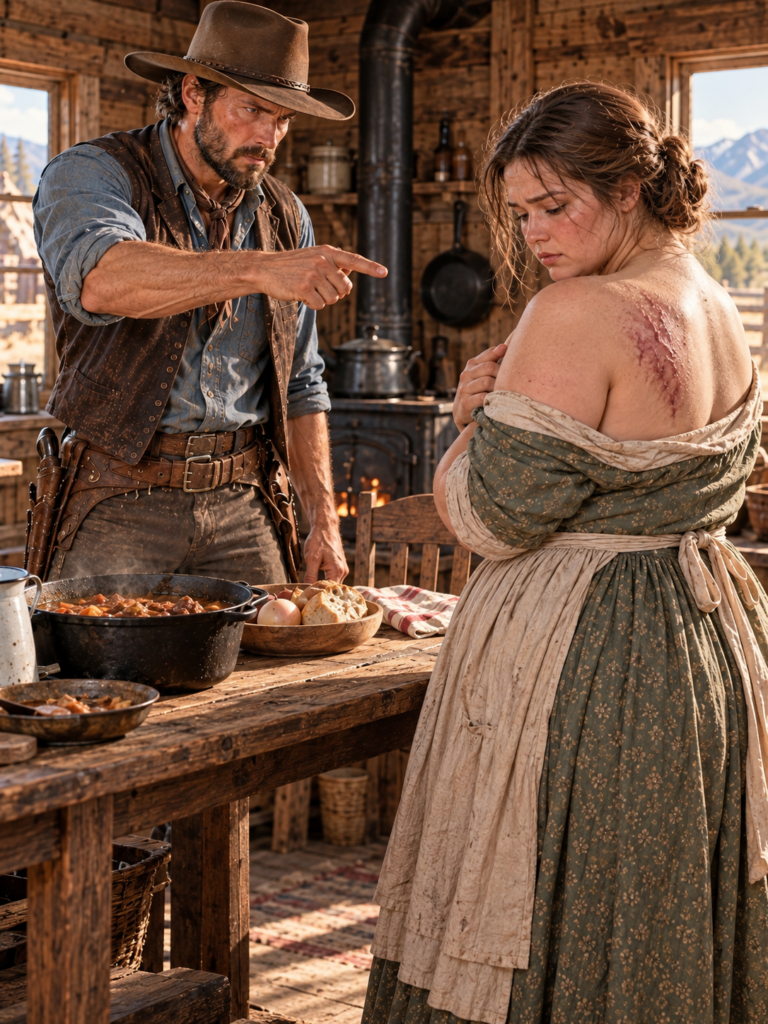
The first thing Maren Hale noticed about the Bell Iron Ranch was that somebody had nailed the kitchen window shut.
The second was that the boy standing beside the woodpile looked as though he expected her to disappear.
He was a narrow-shouldered child of about ten, with dusty brown hair and a pair of boots that had been repaired so many times the original leather was difficult to distinguish from the patches. He watched the freight wagon stop beside the house without stepping forward.
Maren climbed down, gathered her carpetbag, and reached for the small tin box beside her trunk.
The driver, a broad man called Fenwick, had carried her nearly forty miles from the railroad depot. He had spoken enough for three men during the journey, but now he fell silent.
There was a reason.
A tall rancher was crossing the yard toward them.
He wore a weather-stained hat and a dark vest with a loose thread at the shoulder. His face was handsome in the severe fashion of men who had forgotten the usefulness of smiling. The lines beside his eyes were deeper than they ought to have been, and his gaze rested on Maren with the measuring attention he might have given a horse he was considering buying.
“Mrs. Hale?”
“Miss Hale.”
His expression did not change.
“Silas Crane. This is my place.”
She waited.
“I wrote for a cook.”
“And I answered.”
“Can you manage bread for a dozen men?”
“Provided they don’t expect twelve different loaves.”
Fenwick made a small sound behind his hand.
Silas did not smile.
“You’ll have the kitchen and the little room beyond it. Three meals a day when the hands are here. Food stores are your responsibility. I don’t care to be bothered over household matters.”
Maren looked past him toward the house.
It had once been a respectable building. The porch posts were square and strong, the roof properly pitched against Wyoming snow. But the shutters hung unevenly, an overturned chair lay near the steps, and a strip of faded cloth had been nailed over a missing pane of glass.
“Anything else?” she asked.
Silas studied her for a moment.
“Keep to your work, Miss Hale. And stay out of my way.”
There was no cruelty in his voice.
That was what made the words unpleasant.
They were spoken with the indifference of a man describing the weather.
Maren lifted her tin box.
“Then we understand one another.”
She walked toward the house without asking him to carry anything.
Behind her, Silas remained in the yard, faintly irritated without knowing why.
He had hired a cook.
He had not expected someone who looked as though she had already survived far worse than him.
The Bell Iron occupied a wide stretch of southern Wyoming territory, where the wind crossed miles of open grass without encountering anything substantial enough to slow it.
In August of 1880, it was a prosperous ranch by the standards of the region.
There were cattle on the southern range, sound horses in the pasture, fresh fencing around the lower meadow, and a barn so carefully maintained that a man might have mistaken it for the pride of the property.
The house was another matter.
Maren discovered that on her first afternoon.
The kitchen stove had not been cleaned properly in weeks. There were mouse droppings beneath the flour bin, potatoes sprouting in a sack, and a pantry shelf that leaned dangerously toward the wall.
She opened the kitchen window.
Or tried to.
The lower sash did not move.
She examined the frame and found two long nails driven through it.
“Who did this?”
The boy stood in the doorway.
“My father.”
“Why?”
“He said the wind kept blowing it open.”
“Did he try repairing the latch?”
The boy shrugged.
Maren considered the nails.
Then she set down her bag, found a hammer, and pulled them out.
The window opened with a groan.
Fresh air entered the kitchen.
The boy stared as though he had witnessed a forbidden act.
“Father won’t like that.”
“Does your father particularly enjoy stale air?”
“No.”
“Then perhaps he’ll surprise us.”
For the first time, something nearly resembling amusement passed across the child’s face.
“What’s your name?” she asked.
“Wesley Crane.”
“I’m Maren.”
“I know.”
“Then we’ve made an efficient beginning.”
She returned to unpacking.
Wesley remained in the doorway.
After several minutes he asked, “Are you planning to leave?”
Maren turned.
“Not this afternoon.”
“I mean after you meet everybody.”
“Are they especially troublesome?”
“Sometimes.”
“Everybody is troublesome sometimes.”
He considered that.
“The other woman left because Father shouted at her.”
“Does he shout often?”
“Not much. He mostly doesn’t talk.”
Maren glanced toward the barn through the newly opened window.
“Well,” she said, “silence is something I know how to live with.”
Wesley nodded, but he did not look reassured.
She understood that, too.
Children who had been disappointed often enough learned not to trust promises, especially promises that had not actually been made.
By the following morning, the house smelled of coffee, bacon, and fresh bread.
Six ranch hands entered the kitchen before sunrise.
Two stopped on the threshold.
One removed his hat and looked around as though he’d mistaken the building.
The oldest among them, Ollie Dade, had a white mustache, a stiff left knee, and a remarkable ability to involve himself in matters that did not concern him.
He stared at the biscuits.
“Well, I’ll be.”
Maren placed a plate on the table.
“You may be whatever you please, Mr. Dade, provided you wash your hands before eating.”
The younger men laughed.
Ollie looked delighted.
By the third morning, eleven men were washing their hands without being reminded.
By the end of the week, the kitchen had become the busiest room on the property.
Maren imposed no grand changes.
She simply did things thoroughly.
She scrubbed the pantry shelves, mended the flour sacks, arranged the kettles according to their use, and placed a bucket of water beside each stove.
She also made one request that the men found peculiar.
Nobody was to enter the kitchen through the back door without announcing himself.
When Ollie asked why, she answered, “Because I would prefer not to have a man appear behind me while I’m carrying boiling water.”
That seemed reasonable enough.
Yet the men noticed other things.
Even during the hottest hours, Maren wore dresses with high collars and sleeves fastened close around her wrists.
She never pushed the cuffs back.
Once, while kneading dough, she let a trickle of sweat run down her temple rather than loosen her sleeves.
Another time, young Caleb Mercer came through the back door carrying a sack of flour.
He moved behind her without speaking.
Maren turned so quickly that the bread knife in her hand struck the table.
Caleb stopped.
“Sorry, ma’am.”
She stood perfectly still.
For one brief moment, all the color had left her face.
Then she laid down the knife.
“No harm done. Put the flour by the bin, please.”
Caleb did as he was told.
Later, he told Ollie that something was wrong with the new cook.
Ollie said that something was wrong with everybody, and the sensible thing was to leave people to their business.
But Silas had seen the incident from the yard.
He said nothing.
Silas Crane had been a widower for twenty-six months.
There were men who would have told him he ought to marry again.
There were women in Cheyenne who would have been quite willing to help.
He wanted none of them.
His wife, Elizabeth, had died in a barn fire on a bitter January night.
She had gone to attend a mare struggling with a difficult foaling. The men later believed a lantern had been knocked into the hay, though no living person could say exactly how it happened.
Silas had been away purchasing breeding stock.
By the time he returned, the barn was a blackened ruin.
Elizabeth was dead.
And Wesley, then eight years old, had stopped speaking.
The boy eventually recovered his voice.
Silas had never entirely recovered his own.
He rebuilt the barn larger and stronger than before. He inspected every lantern and stove on the property, established strict rules for handling flame, and dismissed any hand who disobeyed them.
He could not prevent winter storms or cattle sickness.
But fire, he believed, was something a careful man ought to control.
No open flame was permitted inside the barn.
No exceptions.
He also kept the sitting room dark.
Elizabeth had loved a particular brass lamp with a green glass shade. She used to place it beside her chair after supper and read while Wesley played on the rug.
After her death, Silas put the lamp in a cupboard.
There it remained.
When he thought of Elizabeth now, the memory that returned most readily was not her laughter.
It was the lantern.
And beneath his grief lay a terrible anger that he knew was unfair but could not seem to release.
Why had she taken it into the barn?
Why had she been so careless?
Why had she left him to bring up their son alone?
He hated himself for those questions.
He hated the silence in which they lived.
And because he did not know how to repair either thing, he worked.
He worked until there was no daylight left.
Then he worked some more.
Maren did not try to change him.
That was the first reason Silas gradually found himself less uncomfortable in her company.
She never offered condolences for a woman she had not known.
She did not ask why the front room remained closed.
She did not speak to him in the solicitous tones adopted by well-meaning neighbors who appeared to believe sorrow was a stubborn illness that could be cured by enough advice.
Instead, she noticed practical things.
The porch steps needed repairing.
The kitchen window needed a latch.
Wesley’s boots needed new soles.
She took care of what she could and asked permission for what she could not.
When Silas refused something, she generally accepted his decision.
Not always.
One evening, he returned from the north pasture to find the sitting-room curtains washed and the furniture uncovered.
Maren was standing on a stool, cleaning the mantelpiece.
“What are you doing?”
“Removing four years’ worth of dust.”
“That room isn’t used.”
“Then it has been collecting dust with remarkable determination.”
He looked toward the cupboard.
Its door stood open.
The brass lamp sat on the table.
He felt a tightening in his chest.
“Who told you to touch that?”
Maren followed his gaze.
“No one.”
“Put it back.”
She descended from the stool.
“Is it broken?”
“No.”
“Then perhaps Wesley might use it for his reading.”
“My son can read in the kitchen.”
“He can. But the kitchen gets noisy when the men come in.”
Silas’s voice hardened.
“I said put it back.”
Maren held his gaze.
Then she took the lamp and returned it to the cupboard.
She closed the door carefully.
“Very well.”
She did not apologize.
That bothered him more than an argument would have.
After supper, he found Wesley reading by the kitchen stove.
The boy was bent so close over his schoolbook that his nose nearly touched the page.
Silas stood behind him.
“Can’t you see properly?”
“Mostly.”
“Why don’t you light another candle?”
Wesley glanced at him.
“Because candles make you angry.”
The words were spoken without accusation.
That made them worse.
Silas turned away.
Later, when the kitchen was empty, he opened the cupboard.
He took out Elizabeth’s lamp.
He cleaned the chimney, trimmed the wick, and filled the reservoir.
Then he carried it into the sitting room.
He set it on the table and stood there for a long while before striking the match.
The flame caught.
Green light spread softly across the walls.
Silas sat down.
He had believed that seeing the room illuminated again would feel like losing Elizabeth a second time.
Instead, it made the empty chair beside the hearth easier to see.
He was still sitting there when Maren passed the doorway.
She paused.
Their eyes met.
Neither spoke.
But the next evening, Wesley did his reading in the sitting room.
And Silas did not send him away.
The first real disagreement between Silas and Maren concerned the barn.
A September storm had rolled in from the western hills, bringing a sharp wind and the smell of rain.
Wesley had spent the afternoon helping Ollie clean harnesses.
When supper was ready, he appeared with a splinter buried in his palm.
Maren drew it out with a needle while he made brave efforts not to wince.
“Where did you find this?”
“The west stall.”
“What’s wrong with the stall?”
“Nothing.”
“Wesley.”
He looked down.
“The back gate sticks. I climbed over it.”
Silas, entering the kitchen, heard the last words.
“You did what?”
Wesley stiffened.
“I was trying to get out.”
“Why?”
“The horse was pressing against the gate.”
Silas put down his gloves.
“You had no business climbing over anything. If a horse pins you against that gate, you could lose a leg.”
“I know.”
“Then use your head.”
The boy went red.
Maren finished tying a clean cloth around his palm.
“He’s used it well enough to tell us the gate needs repairing.”
Silas looked at her.
“This is between me and my son.”
“Then you should speak to him instead of frightening him.”
The kitchen became very quiet.
Wesley’s eyes widened.
Silas was not accustomed to being corrected in his own house.
Especially not in front of his child.
Maren straightened.
“I’ll see to supper.”
Silas remained where he stood.
For a moment it appeared he might say something unforgivable.
Then he turned toward Wesley.
“Show me the gate tomorrow.”
The boy nodded.
Silas left.
Maren let out a breath she had not meant to hold.
Wesley whispered, “He never listens when people tell him he’s wrong.”
“Perhaps he’s out of practice.”
The boy looked thoughtfully toward the door.
Then he asked, “Were you afraid of him?”
Maren considered the question.
“No.”
It was almost true.
She had not been afraid of Silas.
She had been afraid of what his anger might awaken in her.
The following week brought an unexpected visitor.
His name was Harlan Pike, a cattle buyer traveling east from Cheyenne. He was a heavyset man with rings on two fingers and a habit of inspecting every possession in a room as though calculating its value.
He came to discuss Silas’s fall shipment.
Maren served coffee in the sitting room.
Pike looked up when she entered.
His expression changed.
“Good Lord.”
Maren stopped beside the table.
“Sir?”
He leaned forward.
“What’s your name?”
“Miss Hale.”
Pike’s eyes narrowed.
“Maren Hale?”
Silas raised his head.
“Do you know my cook?”
Pike set down his cup.
“Know her? No. But I know that name.”
Maren could hear the blood beating in her ears.
“Mr. Pike,” she said quietly, “your coffee is getting cold.”
He continued looking at her.
“Cheyenne, wasn’t it?”
She did not answer.
“Something about a fire. A boardinghouse, I believe.”
The room seemed to contract around her.
Silas looked from Pike to Maren.
Pike rubbed his chin.
“Funny thing. They had a woman by that name mixed up in the business. I remember the newspaper—”
“Mr. Pike.”
Silas’s voice was soft.
The cattle buyer stopped.
“I believe Miss Hale came in to serve coffee. Not to have her history examined.”
Pike gave a small laugh.
“No offense intended.”
“Then none need be taken.”
But Maren had already seen the recognition settle into his eyes.
She knew that look.
She had seen it in boardinghouses, railway kitchens, laundries, and respectable homes where employers abruptly discovered they no longer required her services.
She set down the coffeepot without spilling a drop.
“Will there be anything else?”
Silas shook his head.
She left.
In the passage, she pressed one hand against the wall.
For three years, she had been moving from place to place.
She had changed nothing but the towns in which she was unwelcome.
She had hoped the Bell Iron might be far enough away.
Now she knew better.
That night, while Wesley slept and the ranch hands played cards in the bunkhouse, Maren drew her tin box from beneath the bed.
She sat with it on her lap for a long time.
At last, she opened the lid.
Inside lay three objects wrapped in cloth.
A child’s shoe, blackened along the sole.
A folded letter.
And a ruined brass padlock.
The padlock was heavier than it looked.
Its shackle had been torn apart by force, and fire had stained the metal almost black.
Maren held it against her palm.
She could still remember the heat.
The smoke.
The desperate sound of hands striking a locked door.
And the voices that had stopped calling before she could reach them.
She closed her eyes.
“I’m sorry,” she whispered.
She was still sitting there when someone knocked.
Not Silas.
A young stable hand stood outside with an envelope.
“Freight driver brought the mail, ma’am. This was for you.”
Maren took it.
The handwriting was familiar.
Alma Reese.
Cheyenne, Wyoming Territory.
She opened the letter with trembling fingers.
By the second paragraph, her face had gone white.
By the third, she had risen from the bed.
Alma had written that Mr. Vanning, the wealthy proprietor who had blamed Maren for the old boardinghouse fire, was preparing to open another establishment.
And there was something worse.
One of the women employed to prepare the new rooms had discovered iron bars fitted across an upstairs passage.
Vanning had reportedly told the women that once the place opened, he intended to lock the passage at night.
Maren looked at the brass padlock on her bed.
Three years had passed.
Two people had died.
And the man responsible had learned nothing.
She folded the letter.
For the first time since reaching the Bell Iron, she understood that simply finding another town would not be enough.
This time, she might have to go back.
Part 2
By morning, Maren had made a decision.
She would return to Cheyenne.
She had enough money saved to purchase a railway ticket, and Alma’s letter offered her a place to stay. She would speak to anyone willing to listen, and if necessary she would stand outside Vanning’s new establishment and warn every woman who approached its door.
She did not know whether anyone would believe her.
But she knew what silence had cost the last time.
She was packing her trunk when Silas appeared in the doorway.
“Going somewhere?”
Maren stopped folding a dress.
“Cheyenne.”
“When?”
“As soon as I can arrange transportation.”
He glanced at the trunk.
“Did Pike have something to do with this?”
“Not directly.”
“Then what happened?”
She hesitated.
Silas remained in the doorway, keeping a deliberate distance between them.
“I won’t pretend I haven’t heard the talk,” he said. “Pike mentioned a fire. He suggested you had something to do with it.”
Maren looked toward the window.
“People have suggested worse.”
“I would rather hear the account from you.”
“Would it change anything?”
“That depends on what you tell me.”
There it was.
The answer she had heard from employers in six different kitchens.
The promise of fairness that always came with a condition.
Maren returned to her packing.
“Perhaps it’s better I leave before either of us has reason for regret.”
Silas did not move.
“Miss Hale, I haven’t dismissed you.”
“No. But you haven’t believed me, either.”
He was silent.
She faced him.
“Do you know what a person becomes when she spends three years waiting for a stranger to recognize her name?”
Silas shook his head.
“Careful,” she said. “She becomes very careful. She notices who enters a room. She keeps her possessions close. She learns which questions are harmless and which mean it’s time to pack.”
Her hands moved to the buttons at her wrists.
“I wasn’t always like this.”
Slowly, she unfastened her left cuff.
Silas’s gaze dropped.
Maren pushed the sleeve above her elbow.
A broad scar crossed the inside of her forearm. Its edges were pale and uneven, the surface drawn tight in places where the flesh had healed badly.
Another mark circled her wrist.
Silas did not speak.
She unbuttoned the other sleeve.
The right arm was worse.
The scars rose nearly to her shoulder, disappearing beneath the fabric of her dress.
“These are why people remember me,” she said. “Not because of anything I said. Not because of anything I did wrong. Because a burned woman is something people remember.”
Silas took off his hat.
“What happened?”
Maren looked down at her arms.
And for the first time in three years, she told the whole story without being forced to defend herself before she had finished.
The Vanning House had stood on the eastern side of Cheyenne, a three-story boarding establishment that catered mainly to working women.
Laundry girls lived there.
Seamstresses rented rooms.
Waitresses, domestic servants, and shop assistants paid for beds by the week.
Henry Vanning, the proprietor, had made a comfortable business of collecting money from people with very little of it.
He spoke constantly of order.
He disliked visitors.
He disliked women returning after nine o’clock.
Most of all, he disliked anyone questioning his authority.
After several boarders began meeting friends in the evenings, he ordered the upstairs passage secured.
A heavy door stood at the head of the only interior staircase.
Vanning had a brass lock fitted to it.
The women objected.
He informed them they could find lodging elsewhere if they preferred.
Most could not afford to.
And so the door was locked each night.
Maren worked in the laundry behind the building.
On the night of the fire, she had been bringing in sheets from the yard when she smelled smoke.
She looked up and saw flames climbing the back of the house.
The stairwell was burning.
Someone had begun shouting from an upper window.
Maren ran toward the front entrance, but the staircase was already filled with smoke.
She could hear women upstairs.
Their voices came through the noise of the fire in broken, terrified cries.
She dragged a ladder from the yard.
It was too short to reach the upper windows.
So she climbed onto the porch roof and broke a pane of glass with a piece of timber.
The first room she entered was empty.
Beyond it lay a passage filled with smoke.
At the far end, four people were pounding against the locked stair door.
Two others had already fallen.
Maren tried to pull the door open.
It would not move.
She could see the brass padlock through the smoke.
Its shackle had been secured through a metal staple, and the women on the other side of the passage had no key.
Maren found an iron poker near a cold fireplace.
She wedged it beneath the lock.
The metal was already hot.
She wrapped her hands in a curtain and pulled.
Once.
Twice.
The wood around the staple began to split.
The curtain caught fire.
She tried again.
At last, the staple tore free.
The lock fell.
The stairwell below was burning too fiercely to use, but breaking the door gave the trapped women enough room to reach the window through which Maren had entered.
One by one, she helped them onto the porch roof.
A laundress.
A young seamstress.
A woman named Alma Reese.
And Alma’s fourteen-year-old daughter, Nell.
The first three found the ladder.
Nell could barely stand.
Maren carried her to the roof’s edge, where two men below managed to catch the girl.
Then Maren lost her footing.
Her right sleeve was already burning.
She struck the porch roof, slid across the shingles, and caught a projecting beam with her injured hands.
The men brought the ladder around again.
By the time they reached her, both arms were badly burned.
She survived.
Four others survived because she had gone into the building.
But two women did not.
One was called Lydia Price.
She was seventeen.
The other was Mrs. Bell, an older cook who had been saving money to return to her family in Missouri.
Maren knew both of them.
For months afterward, she dreamed of their voices.
“When the investigation began,” Maren continued, “Mr. Vanning said the upstairs door had never been locked.”
Silas stood beside the window.
“He told the newspaper I had entered the building with a candle and started the fire in the laundry. He said I’d been careless and tried to hide what I’d done.”
“Did anyone challenge him?”
“Alma did. Two of the other women did.”
“What happened?”
Maren gave a small, exhausted smile.
“Mr. Vanning owned the building. He had friends at the bank and among the merchants. The women who survived were servants and laundry girls.”
She looked at Silas.
“Who do you suppose they believed?”
He said nothing.
“Nobody proved I started the fire. The authorities never brought a charge. But the newspapers printed my name, and once people had read it, the truth hardly seemed to matter.”
She drew her sleeves down again.
“I was told to leave one position after another. Some employers dismissed me as soon as they recognized the scars. Others waited until the gossip reached them.”
“And you kept the lock?”
She turned sharply.
“How did you know about that?”
“You moved it into the bottom of your trunk yesterday. I heard the metal strike the boards.”
Maren hesitated.
Then she brought the tin box from beneath her bed and opened it.
She placed the ruined lock on the table.
Silas picked it up.
The brass was discolored.
The shackle was broken.
One side still carried a piece of the iron fitting torn from the door.
“This came from the upstairs passage?”
“Yes.”
“Has anyone else seen it?”
“Alma. And one of the men who helped us down from the roof.”
“Then why wasn’t it brought before the investigators?”
Maren’s jaw tightened.
“I tried. I was told that a burned lock found in the ruins proved nothing about whether a door had been secured before the fire.”
Silas turned it over.
“By itself, perhaps not.”
“No.”
“But with four people who saw it?”
“Three willing witnesses. One of the women went east and I haven’t found her.”
He set the lock down.
“What does Alma’s letter say?”
Maren handed it to him.
He read slowly.
When he finished, the room had grown very quiet.
Silas looked toward the yard.
Beyond the open window, Wesley was carrying water to a young horse.
“He’s doing it again,” Silas said.
“Yes.”
“After two people died.”
“Yes.”
Silas stared at the letter.
Then he asked, “What do you want to do?”
Maren had expected anger.
Suspicion.
Perhaps a demand that she explain why she had brought such a reputation into his house.
She had not expected a question about what she wanted.
“I want him stopped.”
Silas nodded.
“Then we’ll have to find a way.”
She stared at him.
“You believe me?”
“I do.”
“You haven’t spoken to the other witnesses.”
“I’ll speak to them because their testimony may help stop Vanning. Not because you need their permission to tell me what happened.”
Maren looked away.
Silas remained silent for a moment.
Then he said, “I owe you an apology.”
“For what?”
“For making you think you had to earn the right to stay here by explaining the worst night of your life.”
She pressed her lips together.
“Mr. Crane—”
“Silas.”
She looked up.
He set his hat on the bedpost.
“My wife died in a fire. Ever since, I’ve been angry at things I cannot change.”
His voice lowered.
“Sometimes I’ve even been angry with her.”
Maren listened.
Silas swallowed.
“I’ve told myself that if Elizabeth had been more careful, she would still be alive. But I wasn’t there. I don’t know what she faced. And I’ve been judging her for decisions she made while trying to save a living creature.”
He looked toward the scars concealed beneath Maren’s sleeves.
“I’ve no right to do the same to you.”
For a long moment, neither moved.
Then Maren closed the tin box.
“Alma thinks the newspaper editor may be persuaded to hear our evidence.”
“Then we’ll write him.”
“And the authorities?”
“We’ll write them too.”
“You make it sound easy.”
“It won’t be.”
Silas picked up his hat.
“But difficult things don’t become easier because everybody agrees to ignore them.”
The news spread through the ranch within two days.
Harlan Pike had repeated what he knew in town, and someone had supplied the rest from an old newspaper.
By Saturday, every hand at the Bell Iron had heard some version of the story.
Most of them believed Maren.
Some were uncertain.
Two said she ought to leave.
The loudest objection came from Caleb Mercer.
“She was accused of starting a fire,” he told the others. “And there’s a child in that house.”
Ollie Dade set down his coffee.
“She was accused. That isn’t the same as being guilty.”
“You weren’t in Cheyenne.”
“Neither were you.”
Caleb looked toward the house.
“All I’m saying is a man has to think about his own safety.”
Silas had entered the bunkhouse without anyone noticing.
“You’re correct about that,” he said.
The men turned.
Silas walked to the stove.
“I’ve spent two years telling everyone on this place how to prevent a fire. I intend to continue. But I won’t have a person driven off my property over a rumor.”
Caleb shifted uneasily.
“What if the story’s true?”
“Then we’d better know which story we’re talking about.”
Silas rested one hand on the mantel.
“The story Mr. Vanning told to protect himself? Or the story told by the people who survived because Miss Hale went into a burning house?”
Nobody answered.
Silas looked around the room.
“I won’t ask any man to think what I think. But while you draw your own conclusions, you’ll treat her with the courtesy you’ve shown since she arrived.”
He turned to leave.
Then he stopped.
“And Caleb?”
“Yes, sir?”
“If you’re concerned about fire, take the afternoon and clean the dry grass from the west side of the barn. That’s a danger we can actually do something about.”
Maren learned of the conversation from Ollie.
She was not entirely pleased.
“I don’t need someone fighting my battles for me,” she told Silas that evening.
Silas was repairing a leather strap at the kitchen table.
“Good. I’d make a poor fighter in most of yours.”
“You made my situation a matter of ranch discipline.”
“Some of my men were discussing whether you belonged under this roof. That already made it my concern.”
She folded a dishcloth.
“I’ve spent years trying to avoid becoming a source of trouble.”
“Has it helped?”
She stopped.
“No.”
“Then perhaps trouble isn’t always a sign you’ve done something wrong.”
Maren considered that.
Silas put aside his work.
“There’s something else.”
“What?”
“If you return to Cheyenne, I would like to come with you.”
She looked at him in surprise.
“Why?”
“Because two people may find it easier to carry a heavy box than one.”
Her eyes filled unexpectedly.
She turned toward the stove before he could see.
“I can carry my own box.”
“I know.”
The simplicity of his answer nearly undid her.
During the weeks that followed, Maren began noticing changes in the house.
Wesley laughed more often.
Not loudly, and never for long, but enough that Silas sometimes stopped in the doorway to listen.
The boy had become attached to a yellow mongrel that had wandered into the yard in late summer.
He named it Buttons.
Silas refused to allow the dog indoors.
Wesley built it a bed in the tack room.
Maren pretended not to know that scraps of bacon disappeared from the kitchen after supper.
One afternoon, Wesley found her hanging clothes.
“Miss Hale?”
“Yes?”
“Did the people in that fire get out?”
Maren’s hands stopped.
“Some of them.”
“All of them?”
“No.”
He was quiet.
Then he said, “My mother didn’t get out either.”
Maren turned.
Wesley looked toward the barn.
“Father says it was an accident.”
“I expect it was.”
“But accidents still happen because somebody does something.”
“Sometimes.”
He dug the toe of his boot into the dirt.
“I was sick that winter. Mother was worried about me. I heard her say she wanted to check the mare and come straight back.”
Maren waited.
“I asked her to bring me the little horse blanket when she came. She told me she would.”
His voice became faint.
“She never did.”
Maren put down the wet shirt.
“Wesley, did you make your mother go into the barn?”
“No.”
“Did you give her the lantern?”
“No.”
“Did you start the fire?”
He shook his head.
“Then what have you been blaming yourself for?”
He looked at her with the bewildered expression of a child who had carried a belief for so long that he no longer knew how to set it down.
“Wanting her to come back.”
Maren knelt beside him.
There were things she could not promise.
She could not say that nobody he loved would ever die.
She could not promise that the world was fair or that good intentions always saved people.
So she told him something true.
“Every child wants his mother to come home, Wesley. There’s no wrongdoing in that.”
His mouth trembled.
“Father doesn’t talk about her.”
“Perhaps it hurts him.”
“It hurts me too.”
Maren nodded.
“Then he ought to know.”
That evening, Wesley went into his father’s room and asked whether Elizabeth had been a good horsewoman.
Silas looked up from his accounts.
“The best I’ve known.”
“Better than Ollie?”
“Much better than Ollie.”
Wesley smiled.
Silas closed the ledger.
And for the first time in more than two years, he began telling his son a story about Elizabeth that did not end with the fire.
September deepened.
The grass dried beneath a succession of hot winds.
Water grew scarce in the upper draws.
Each morning, Silas studied the horizon before assigning the day’s work.
He had received a reply from the Cheyenne newspaper.
The editor was willing to examine signed statements, provided Maren and the witnesses could present their accounts openly.
Alma had written that two survivors were prepared to testify.
A carpenter who had once worked for Vanning might also be willing to speak.
There would be no guarantee of legal action.
But there was a chance of making the truth public.
Silas and Maren agreed to travel after the next cattle shipment.
It was the first time she had allowed herself to think of a future beyond merely keeping her employment.
One night, they sat on the porch after supper.
Wesley had gone to bed.
A mild wind moved across the yard.
Silas held a cup of coffee.
Maren sat a few feet away, mending one of Wesley’s shirts.
“Did you ever marry?” Silas asked.
She shook her head.
“I was engaged once.”
“What happened?”
“He heard about Cheyenne.”
Silas waited.
“He said a man had to consider the reputation of the woman he married.”
“Did he believe you started the fire?”
“He said he believed me. He simply couldn’t afford to have people wonder.”
Silas looked toward the darkness.
“Then he wasn’t worth much.”
Maren smiled faintly.
“He was worth enough to himself.”
Silas rested his elbows on his knees.
“I’ve done my share of hiding behind what other people might think.”
“You don’t seem particularly concerned with public opinion.”
“No. But I’ve been concerned with being seen as weak.”
He considered the coffee in his hand.
“I thought if I kept everything in order, Wesley would be safe. If I never let anyone see me grieve, he’d learn to be strong.”
“How has that gone?”
“Poorly.”
Maren’s smile deepened.
Silas looked at her.
For a moment, something unspoken passed between them.
He wanted to reach for her hand.
She knew it.
But he did not move.
She was grateful for his restraint.
Not because she would necessarily have refused him.
But because it meant the choice remained hers.
The fire began four days later.
It was shortly after three in the afternoon.
Maren was preparing supper when thunder rolled across the flats.
The sky held only scattered clouds.
No rain followed.
A rider came galloping from the eastern boundary.
“Lightning strike!”
Silas ran from the barn.
“Where?”
“Beyond Miller’s draw! Grass is burning!”
Silas looked toward the east.
A narrow column of smoke rose against the pale sky.
Then the wind shifted.
The smoke bent toward the ranch.
Silas’s expression changed.
He began issuing orders.
“Get the plow team into the north field. Ollie, take four men and cut the fire line below the draw. Caleb, turn the horses into the lower pasture. Keep every gate open.”
The men scattered.
Maren stepped onto the porch.
Silas caught sight of her.
“Fill everything that holds water. Bring wet blankets to the south fence.”
“Where’s Wesley?”
“He was with Ollie.”
“I haven’t seen him.”
Silas looked toward the barn.
“Wesley!”
No answer came.
He turned back to Maren.
“He’ll be with the men. Keep the house safe.”
Then he ran toward the stables.
Maren watched the smoke spread.
Within minutes, the eastern horizon had changed from gray to a broad, angry red.
The wind rose.
Ash began drifting across the yard.
Men shouted from the far pasture.
Maren carried buckets to the pump, soaked blankets, and dragged a water barrel beneath the porch.
She worked with the relentless concentration of someone who knew exactly how quickly a small fire could become impossible to control.
A horse screamed near the barn.
Then came a sound she would never forget.
Wesley calling for help.
She dropped the bucket.
The cry came from the tack room.
Maren ran toward the barn.
Smoke was pouring through the southern doors.
A pile of hay near the outer wall had caught fire.
The west gate, repaired only weeks earlier, stood open, and frightened horses were charging toward the pasture.
But the tack-room door was closed.
Maren shouted Wesley’s name.
His voice answered faintly.
“Miss Hale! Buttons won’t come out!”
A beam struck the ground inside.
Sparks scattered across the dirt.
Behind her, the grass fire roared toward the buildings.
Maren seized a wet horse blanket from a nearby trough.
She wrapped it around her shoulders.
She knew what was happening.
She knew what the next few minutes could cost.
For one terrible heartbeat, she was back in Cheyenne, staring at a door while people cried out behind it.
Then she heard Wesley cough.
And Maren Hale went inside.
Part 3
Smoke swallowed the doorway behind her.
Maren crouched, holding the wet blanket close around her head and shoulders.
The tack room lay along the southern side of the barn. In ordinary weather, it smelled of leather, saddle soap, dust, and horse sweat.
Now the air was thick with burning hay.
She could barely see the wall.
“Wesley!”
“Here!”
She followed his voice.
The boy was crouched beside a harness rack, clutching the yellow dog against his chest.
Buttons struggled weakly in his arms.
“Come to me,” Maren said.
Wesley tried to rise.
His knees buckled.
Maren reached him and pulled the blanket around both of them.
“Listen carefully. We’re going to move toward the door. Stay low and hold on to my dress.”
“I tried to get him out.”
“I know.”
“I couldn’t make him come.”
“We’ll talk about it outside.”
The boy began coughing again.
Maren lifted him beneath one arm.
The dog remained pressed against his chest.
She turned toward the main doorway.
A burning crossbeam fell across the passage.
The crash shook the floor.
Flames climbed the wall.
Maren stopped.
For one terrible moment, her mind became empty.
She could hear the Cheyenne boardinghouse again.
A woman crying.
Someone beating against a door.
The roar of fire filling the spaces where human voices had been.
Maren closed her eyes.
No.
Not again.
She forced herself to look around.
There had to be another way out.
A low window stood behind the harness shelves.
Its shutters were bolted from the inside.
Maren put Wesley down.
“Can you stand?”
He nodded.
She pulled the shelves away from the wall.
The wood caught against a floorboard.
She kicked it free.
Then she reached for the bolt.
It would not move.
Heat had warped the frame.
She pulled harder.
Pain shot through her scarred hand.
The old injuries had left some of her fingers stiff, but she had learned long ago to work around that weakness.
She took a small iron tool from the harness bench and struck the bolt.
Once.
Twice.
The metal gave.
The shutters flew outward.
Fresh air rushed into the room.
Outside, the ground fell sharply toward a drainage ditch.
There was no ladder.
No one waiting to catch them.
But the window was low enough.
Maren lifted Wesley onto the sill.
“Feet first. Then roll away from the wall.”
“What about you?”
“I’m coming.”
He hesitated.
“Wesley. Now.”
He dropped.
Maren heard him land in the dirt.
She bent to follow.
Then a burning board struck the back of her shoulder.
The blanket slipped.
Flame caught her sleeve.
She tore the cloth away, but not before the fire burned through the fabric.
For a moment, she was trapped between the window and the collapsing shelves.
She pushed with all her strength.
Wood cracked.
The shelves fell sideways.
And she climbed through the opening just as the tack-room ceiling began to give way.
She hit the ground hard.
The breath left her lungs.
Wesley crawled toward her.
“Miss Hale!”
Maren tried to answer.
Smoke filled her chest.
She managed to rise to one knee.
Then she heard a voice above the roar.
“Maren!”
Silas.
He was running toward them from the western side of the barn.
His face was streaked with soot.
He had been working with the plow team when Ollie told him Wesley was missing.
Now he saw his son in the drainage ditch.
He saw the yellow dog.
And he saw Maren kneeling in the dirt with her sleeves burned away and the old scars exposed from wrist to shoulder.
Silas reached them.
He caught Wesley and pulled him close.
“Are you hurt?”
The boy shook his head.
“She got us out.”
Silas looked at Maren.
Her face was pale.
Blood ran from a shallow cut near her temple.
She tried to stand, but her legs would not hold.
Silas moved toward her.
“May I?”
She looked at his outstretched hands.
For a moment, her expression was difficult to read.
Then she nodded.
He helped her to her feet.
She leaned against him.
Behind them, another section of the tack-room roof collapsed.
Silas drew them farther from the building.
“I thought I’d lost you,” he said.
He did not seem to realize he had said it aloud.
Maren looked at him.
“Not yet.”
The fire was not finished with the Bell Iron.
The southern wall of the barn had caught.
Sparks were carrying toward the house.
A fence line burned along the eastern pasture, and the wind drove smoke across the yard so thickly that the men could barely see one another.
But the plow team had cut a strip of bare earth along the north field.
Ollie and Caleb had turned the stock away from the flames.
There was still a chance to save the buildings.
Silas took Wesley to the pump.
“Stay here. Keep your head low.”
The boy nodded.
Silas turned toward Maren.
“You need to sit down.”
She looked at the barn.
“Where’s the water wagon?”
“By the north fence.”
“Bring it around the house. The sparks are crossing the yard.”
“I know.”
“Then stop arguing with me.”
He almost smiled.
Even then.
Even with the barn burning behind them.
He looked at Ollie.
“See that she doesn’t fall over.”
Maren caught his sleeve.
“Silas.”
He stopped.
She looked at the fire.
“Don’t go inside.”
Something shifted in his face.
He understood.
She was not ordering him to abandon the horses.
She was asking him not to make another grieving household.
“I won’t,” he promised.
Then he went back to the men.
For the next two hours, they fought fire with shovels, soaked sacks, barrels of water, and every desperate skill that men living on dry prairie had learned.
They lost most of the tack room.
Part of the southern barn wall collapsed.
A haystack burned down to black earth.
Forty yards of fence were destroyed.
But the main barn remained standing.
So did the house.
And when the wind finally weakened near midnight, every man, horse, and child on the Bell Iron Ranch was alive.
Maren sat beside the horse trough while Ollie examined the burns on her shoulder.
He had served as an army teamster years before and possessed enough practical knowledge to recognize when an injury required a doctor.
“Should have somebody from town look at this,” he muttered.
“Tomorrow,” Maren said.
“Tonight if I have my way.”
“You rarely do.”
Ollie gave her a wounded look.
Then he glanced at her arms.
The scars were completely visible.
In the light of the lantern beside the trough, he could see their full extent.
He looked away.
Maren noticed.
“You may look, Ollie. They won’t do you any harm.”
He swallowed.
“That’s not why I turned away.”
“Then why?”
The old man removed his hat.
“Because I’ve repeated things I had no business repeating.”
Maren did not answer.
He continued.
“That business in Cheyenne. I heard what Pike said, and I went and told the others. Didn’t consider how much of it I actually knew.”
He rubbed his forehead.
“I’ve been alive long enough to know better.”
Maren watched him.
“Yes,” she said gently. “You have.”
Ollie nodded.
“I owe you an apology.”
“Then you’ve given me one.”
“No, ma’am. Not properly.”
He rose.
Several of the hands were gathered near the pump, drinking water and tending minor burns.
Ollie raised his voice.
“Listen here.”
The men turned.
“I’ve spent the better part of a week talking about Miss Hale as though knowing somebody’s misfortune gave me the right to judge it.”
He looked at Maren.
“I was wrong.”
Nobody spoke.
Then Caleb Mercer stepped forward.
His hat was blackened with soot.
“I was wrong too,” he said.
Maren remembered him standing in the kitchen weeks earlier, insisting that a woman accused of starting a fire had no business living near a child.
Now he stood before her looking younger than his years.
“My sister was burned once,” he said quietly. “In a stove accident when she was little. I ought to have known better than to make those scars mean something they didn’t.”
Maren looked around the circle.
She had spent three years fearing what happened when people saw her arms.
Now they had seen them.
And the world had not ended.
Still, she did not thank the men for believing her.
Their apology mattered.
But she knew there was something dangerous in allowing other people’s forgiveness to become the measure of her innocence.
“I appreciate what you’ve said,” she told them. “But I was the same woman yesterday morning.”
Ollie nodded.
“Yes, ma’am.”
She pulled the blanket around her shoulders.
“And tomorrow I’d still like the kitchen pump repaired.”
A quiet laugh moved through the group.
It was the first easy sound any of them had made since the fire began.
Silas found her on the porch shortly before dawn.
Wesley was asleep in his room.
Buttons lay at the foot of the bed, having been granted an exception to the household rule without anyone formally announcing it.
The air smelled of smoke and wet earth.
Far beyond the pasture, the last line of fire had died against the bare ground cut by the plow.
Silas carried two cups of coffee.
He handed one to Maren and sat beside her.
Not too close.
The eastern sky was beginning to lighten.
For a while, they watched it in silence.
Then Silas said, “I was wrong about something.”
Maren looked at him.
“Only one thing?”
He gave a low laugh.
“One thing in particular.”
She waited.
“When I hired you, I told you to keep out of my way.”
“I remember.”
“I thought that was how a man kept his life orderly. Hire people to do their work. Don’t let them ask anything of you that isn’t written in the agreement.”
Maren held her cup between both hands.
Silas continued.
“I’ve spent two years protecting this place from anything that might remind me of Elizabeth. I thought if I kept enough of the world outside, nothing could hurt us again.”
He looked toward Wesley’s window.
“All I did was teach my boy to be lonely.”
Maren’s eyes softened.
“He loves you.”
“I know. But I haven’t always made it easy.”
“No.”
Silas turned toward her.
“And you walked into this house carrying a sorrow I knew nothing about. You fed my men. You gave Wesley somebody to talk to. You opened windows I’d nailed shut.”
He paused.
“You gave us a way to live here again.”
Maren stared into her coffee.
“I didn’t come to save anybody.”
“I know.”
“I came because I needed work. And because I thought nobody in Wyoming would know who I was.”
Silas nodded.
“That was reason enough.”
She looked at him.
“What happens when we go to Cheyenne?”
“We tell the truth.”
“And if it changes nothing?”
Silas thought carefully.
“Then you’ll still have a place here.”
She held his gaze.
“Even if the newspaper refuses to print it?”
“Yes.”
“Even if Mr. Vanning calls me a liar again?”
“Yes.”
“Even if everyone in town believes him?”
Silas leaned forward.
“Maren, I would have told you this before yesterday if I’d had the courage.”
He set down his cup.
“I don’t want you here because you saved Wesley. I was grateful for you before the fire. And I believed you before I saw what you were willing to risk.”
Her lips parted.
Silas’s voice grew quieter.
“I want you here because this house has begun to feel like a home when you’re in it.”
Maren looked away.
Tears filled her eyes.
For three years, she had carried the belief that any home she entered would eventually become a place from which she was driven.
Now a man who had every reason to fear fire was telling her she could stay despite everything connected to her past.
She began to cry.
Not violently.
Not with the desperate grief of the night in Cheyenne.
These were quieter tears.
The kind that come when a person has been bracing against a blow for so long that kindness feels almost unbearable.
Silas did not reach for her.
He sat beside her until she was ready to speak.
Then Maren placed her hand over his.
He turned his palm upward.
And held it.
They went to Cheyenne the following month.
The cattle shipment was complete.
Maren’s new burns had healed sufficiently for travel, though the doctor warned her to keep the injured shoulder protected.
Silas arranged for Ollie to oversee the ranch.
Wesley remained with him.
The boy watched from the porch as Maren prepared to leave.
“You’re coming back?”
She looked at him.
“Yes.”
“Even if things go badly?”
Maren crossed the yard and knelt in front of him.
“Even then.”
He studied her face.
Then he threw his arms around her neck.
She held him tightly.
“I’ll keep Buttons out of the kitchen,” he promised.
“That would be a first.”
“I’ll try.”
“That’s all I ask.”
Silas helped her into the wagon.
The road to Cheyenne stretched before them.
Maren carried the tin box on her lap.
But this time, she had allowed Silas to help lift it into the wagon.
The town had changed in three years.
New buildings stood along the main street.
Fresh signs hung above shops.
The railroad yards were noisier than Maren remembered.
Yet the smell of coal smoke and damp timber brought back memories with such force that she had to grip the edge of her seat.
Silas noticed.
“Would you like to stop?”
“No.”
“Are you certain?”
She looked at the streets ahead.
“I’ve spent three years avoiding this place. I don’t intend to turn around now.”
They went first to Alma Reese’s house.
Alma was a small, gray-haired woman with work-roughened hands and a manner that became fierce whenever she spoke of the fire.
She embraced Maren before a word had been exchanged.
“You came.”
“I said I would.”
Alma stepped back.
Her eyes filled with tears.
“Nell’s at the dressmaker’s. She’ll be home presently.”
Maren glanced around the modest room.
On the mantel stood a photograph of a young woman with dark hair and a serious expression.
Nell.
Older now.
Alive.
Maren looked at the picture for a long time.
Then she took off her gloves.
The meeting with the newspaper editor was held two days later.
The room was small and smelled of ink, paper, and tobacco.
A stove warmed the corner.
Two men sat behind a desk.
Alma was there.
So was Nell.
Another survivor, Margaret Sloane, had traveled from Laramie to testify.
A carpenter named Edwin Shaw had brought his old work ledger.
Henry Vanning arrived last.
He was a prosperous-looking man in a dark coat, with silver buttons and a polished walking stick.
He glanced at Maren.
Recognition passed across his face.
Then contempt.
“So,” he said, “the laundry girl has returned.”
Silas began to rise.
Maren touched his arm.
“Stay seated.”
She stood.
“My name is Maren Hale, Mr. Vanning.”
“I remember your name.”
“Then you’ll have no trouble remembering what we’re here to discuss.”
The editor, a thin man named Mr. Pritchard, asked everyone to sit.
He had promised no particular outcome.
He had only agreed to examine evidence that might justify correcting the earlier reporting.
Vanning appeared unconcerned.
He repeated his old account.
The upstairs passage had never been locked during the fire.
Maren had been seen carrying a candle.
He had no responsibility for what happened.
Then Edwin Shaw opened his ledger.
Three years earlier, Vanning had paid him to fit iron staples and locks to the upstairs passage door.
The date appeared in black ink.
So did Vanning’s signature acknowledging payment.
Vanning leaned forward.
“That proves nothing. Locks may be fitted without being used.”
“Certainly,” Mr. Pritchard said.
He turned to Alma.
“Mrs. Reese?”
Alma described the nights when the door was secured.
She described the arguments she had made to Vanning.
She described his refusal to remove the lock.
Margaret Sloane confirmed her account.
Then Nell stood.
She was seventeen now.
Her voice trembled, but she did not sit down.
“I was inside that passage,” she said. “I remember the door. I remember the lock. And I remember Miss Hale breaking it while her clothes were burning.”
Vanning shook his head.
“These women have had years to arrange their story.”
Maren opened the tin box.
She took out the brass padlock.
For a moment, she simply held it.
Then she placed it on the desk.
The sound was small.
A dull metallic weight against old wood.
Yet everyone in the room looked toward it.
“This was on the door,” Maren said.
Vanning’s expression tightened.
She turned the ruined metal so the broken staple was visible.
“You told the investigators the passage was never secured. You told the newspaper that I invented the lock.”
She looked directly at him.
“Here it is.”
Vanning’s face reddened.
He began speaking rapidly, insisting the evidence was incomplete, that the women were unreliable, that he had been subjected to an outrageous personal attack.
But this time he was interrupted.
Not by Maren.
By the carpenter.
“I fitted that lock,” Shaw said. “And I told you it was dangerous to fasten a stair passage where people slept.”
Vanning stopped.
Shaw’s voice remained steady.
“You told me it was your building, and you would do as you pleased.”
Silence filled the room.
Mr. Pritchard looked from the ledger to the lock.
Then he asked Vanning whether he had anything further to add.
For the first time, the proprietor had no useful answer.
The meeting did not produce an immediate arrest.
The law was more complicated than Maren had hoped, and too much time had passed for the evidence to resolve every question surrounding the fire.
But it produced something she had nearly stopped believing possible.
A public correction.
The Cheyenne newspaper printed a detailed account of the testimony.
It acknowledged that the original accusations against Maren had never been established and that multiple witnesses supported her account of rescuing people from behind a locked door.
The editor also agreed to print the names of the dead.
Lydia Price.
Mrs. Bell.
Maren insisted on that.
Their names belonged in the story as surely as her own.
The reports about Vanning’s new establishment were investigated. Workers confirmed that another upstairs passage had been fitted with locking hardware.
His business partners withdrew their support.
The building’s arrangements were changed.
And Vanning, who had spent years using his reputation to make other people seem unworthy of belief, discovered how quickly a reputation could be damaged when evidence finally emerged.
It was not perfect justice.
Maren understood that.
No newspaper could bring back the women who had died.
No public correction could return the three years she had spent moving from kitchen to kitchen.
But it could prevent the lie from remaining the only story people knew.
And it could make the truth harder to bury again.
On their last evening in Cheyenne, Maren visited the little cemetery where Lydia Price and Mrs. Bell were buried.
Silas accompanied her.
They carried flowers purchased from a shop near the station.
Maren knelt beside the first grave.
For a long while, she said nothing.
Then she placed the flowers against the stone.
“I used to think,” she said, “that if I’d found a better way, they would have lived.”
Silas stood nearby.
Maren touched the carved letters of Lydia’s name.
“I kept counting the minutes. Wondering whether I could have reached them sooner. Whether I should have broken another window.”
Her voice faltered.
Silas waited.
“People called me a hero after the hearing.”
She shook her head.
“I don’t know what to do with that word.”
“You don’t have to do anything with it.”
“I was too late for them.”
He knelt beside her.
“You went where other people could not.”
“That doesn’t change what happened.”
“No.”
Silas looked at the two graves.
“Some things don’t change. We carry them. But perhaps we don’t have to keep carrying the blame along with them.”
Maren closed her eyes.
She thought of the two women.
The laughter they had shared over laundry tubs.
The meals eaten together.
The plans that would never be completed.
Then she bowed her head.
“Goodbye, Lydia,” she whispered.
She moved to the next grave.
“Goodbye, Mrs. Bell.”
Silas waited until she rose.
When they returned to the wagon, he offered his hand.
This time, she took it without hesitation.
Winter came early to the Bell Iron.
Snow gathered along the fences.
The cattle moved down from the upper grazing land.
The barn smelled of clean straw and fresh timber where the burned wall had been rebuilt.
In the house, Wesley’s lessons filled the evenings.
Buttons slept by the kitchen stove.
Ollie came in more often than necessary, claiming the ranch coffee was considerably better than anything available in the bunkhouse.
Maren worked as she always had.
But there were differences.
She no longer kept the tin box beneath her bed.
It stood on a shelf in her room.
The brass lock rested inside beside the old letter and the child’s shoe.
She did not forget what those things meant.
She simply no longer needed to keep them hidden.
And when the stove became too hot, she rolled her sleeves above her elbows.
At first, the men noticed.
Then they stopped noticing.
The scars became part of Maren, no more remarkable in daily life than Ollie’s stiff knee or the old cut along Silas’s jaw.
One cold evening, Silas came into the kitchen while she was preparing bread.
Wesley was asleep.
The house was quiet.
Maren looked up from the dough.
“You’re late.”
“I was checking the horses.”
“Everything in order?”
“For once.”
She smiled.
Silas removed his hat.
“Could I ask you something?”
“That depends.”
“I’ve been thinking about the spring.”
“What about it?”
“About this house.”
She waited.
“About Wesley.”
Maren folded the dough over itself.
“And?”
Silas drew a small box from his pocket.
He placed it on the table.
Maren stared.
Inside was a plain gold ring.
Not extravagant.
Not the sort of jewel a prosperous man might buy to impress society.
It was simple and carefully made.
Silas looked at her.
“I loved Elizabeth,” he said.
“I know.”
“I still do, in a way.”
“I know that too.”
He swallowed.
“But loving someone who is gone shouldn’t mean refusing to love anyone who remains.”
Maren’s eyes filled.
Silas continued.
“I won’t ask you to forget Cheyenne. I won’t promise to keep you from every sorrow. I’ve learned how little a man can guarantee.”
He rested his hand beside the ring.
“But I can promise to listen when you speak. To stand beside you when things are difficult. And to build a life with you that neither of us has to survive alone.”
Maren looked toward the sitting room.
The brass lamp glowed beneath its green shade.
Beyond it stood Wesley’s little chair and a book left open upon the table.
The house was warm.
Not merely from the stove.
From the evidence of people living in it.
She turned back to Silas.
“Are you asking me to marry you?”
“I am.”
She smiled through her tears.
“Then you might have begun with that.”
Silas laughed.
It was a warm, surprised sound, and she realized she had never heard him laugh quite that way before.
“Would you?”
Maren looked down at the ring.
Then up at him.
“Yes.”
He closed his eyes for a moment.
When he opened them, she held out her hand.
He slipped the ring onto her finger.
It fit.
And when he kissed her, it was neither hurried nor demanding.
It was the kiss of two people who had learned that love was not a rescue from the past.
It was the courage to make a future.
They were married the following spring.
The ceremony took place in the house.
Ollie stood as witness.
Alma Reese and Nell traveled from Cheyenne.
The other ranch hands crowded onto the porch, wearing coats brushed clean for the occasion.
Wesley insisted on carrying the rings.
Buttons insisted on following him.
The dog nearly overturned the cake before Caleb caught it.
For the rest of his life, Ollie maintained that the rescue had been the most important service Caleb ever performed for the Bell Iron.
Maren wore a blue dress she had made herself.
Its sleeves ended at her elbows.
The scars were visible.
Nobody looked away.
When the minister pronounced them husband and wife, Silas took Maren’s hands in his.
His thumbs rested gently against the old marks.
There was no need to hide them.
And there was no need to explain them.
Years later, Wesley would remember many things about the woman who became his stepmother.
He remembered the smell of bread in the morning.
He remembered the way she could silence a roomful of ranch hands merely by raising an eyebrow.
He remembered that she made him finish his arithmetic even when he would rather have been riding.
And he remembered the night she entered a burning barn to bring him home.
But as he grew older, he understood that her courage had begun long before that night.
She had come to the Bell Iron with a single trunk and a tin box.
She had been accused, abandoned, and made unwelcome in place after place.
She had carried scars that other people mistook for proof of wrongdoing.
Yet she had continued to work, to care, to speak the truth, and finally to return to the town where that truth had first been buried.
Wesley would sometimes tell his children that his father had been a difficult man before Maren arrived.
Not an unkind man.
But one who had mistaken fear for strength and silence for peace.
It took time for Silas to change.
Longer than it took to repair a window or rebuild a barn.
But change he did.
He became more patient with his son.
He learned to speak of Elizabeth without bitterness.
And he discovered that allowing other people into his life did not dishonor the woman he had lost.
It honored the life that remained.
On warm evenings, when the work was finished, Silas and Maren often sat together on the porch.
Sometimes they talked.
Sometimes they watched the horses moving through the pasture.
Sometimes they simply listened to the wind.
One summer evening, long after their wedding, Maren came outside carrying two glasses of cold water.
She wore an old work dress with the sleeves rolled high.
Silas accepted his glass.
“Do you remember what you said to me when I first came here?” she asked.
He looked at her.
“I said a great many foolish things in those days.”
“One in particular.”
His mouth curved.
“I told you to stay out of my way.”
“You did.”
“I believe you ignored me.”
“Almost immediately.”
Silas laughed.
Maren sat beside him.
The sun was sinking beyond the Wyoming grasslands.
Light caught the windows of the house, the rails of the repaired corral, and the roof of the barn that had survived the fire.
Inside, Wesley was reading beneath the green-shaded lamp.
Buttons lay at his feet.
Maren rested her bare forearms on the porch railing.
She did not lower her sleeves when a rider passed on the road.
She did not turn away when Silas placed his hand over hers.
Once, those scars had been the reason strangers feared her.
Once, they had sent her traveling from town to town, carrying a small box of evidence and wondering whether any place would ever let her stay.
Now the scars remained.
But they no longer decided where she belonged.
And in all the years that followed, when people spoke of Maren Crane of the Bell Iron Ranch, they did not remember her simply as the woman who had survived two fires.
They remembered the woman who had refused to let either fire decide the rest of her life.
As the evening darkened, Silas rose to light the porch lamp.
Maren watched the flame catch.
Neither of them was afraid of its light.
And behind them, through the open doorway, the house shone warm against the wide Wyoming night.

