
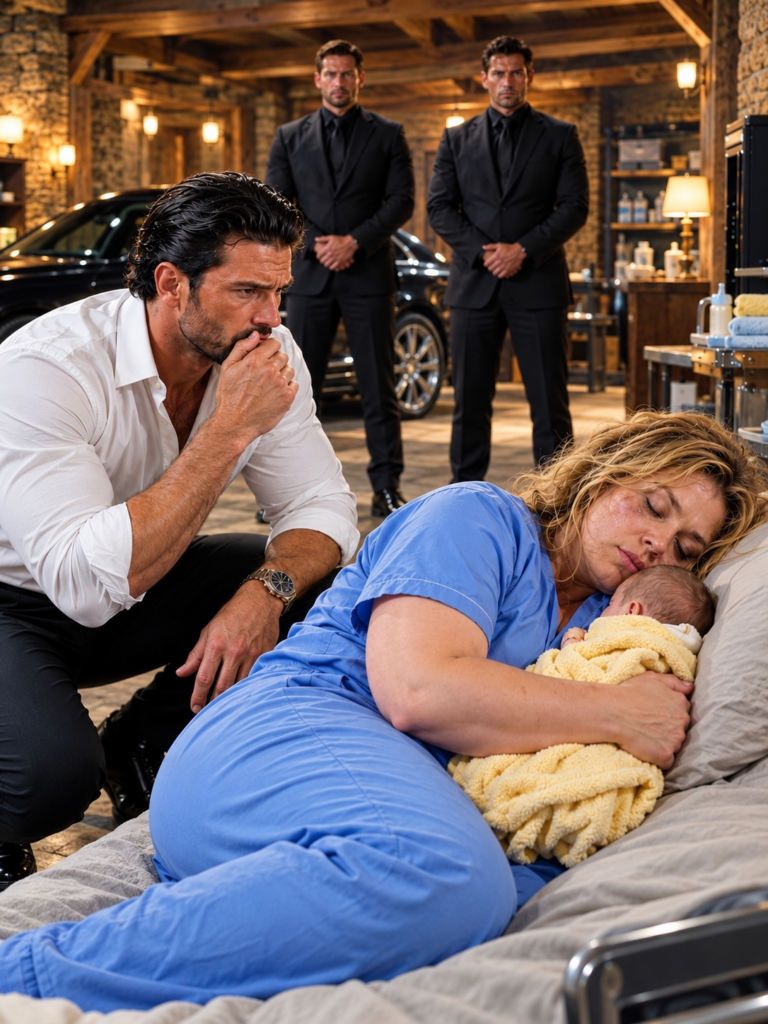
Part 1
The storage room smelled like wet concrete and lake water. Bernadette Sousa came awake all at once because she had trained herself to wake that way. Sixteen weeks of motel rooms and gas-station parking lots had burned the habit into her bones. One second she was under, the next her eyes were open and her arms were already locking tighter around the small warm weight pressed to her chest.
The baby made a soft, startled sound. She rocked without looking down. The motion was automatic now, the same one she used in the dark of every cheap room they had occupied since the night she walked out of Northwestern Memorial with nothing but a trauma blanket and a four-month-old infant who did not belong to her.
A man sat in the single wooden chair three feet from the cot. He did not move when she scrambled backward until the iron frame hit the wall. He kept his hands open on his knees, palms up, the way people did when they were trying not to spook a frightened animal. The single bulb overhead swung in a draft and threw his face into brief light, then shadow. She knew him. Everyone in Chicago who read a newspaper or watched the evening news knew Dominic Farrow. The photographs never captured the stillness. The photographs never showed the particular blankness behind the eyes when he decided a room had become his.
“Easy,” he said. His voice was low and even. “Don’t.”
Bernie pressed her back into the corner and kept rocking. The baby settled. Her heart slammed so hard she felt it in her wrists. She was forty-three years old, thick through the hips and thighs and chest, and she had spent her entire adult life learning how to make herself small in hospital corridors and parking structures at two in the morning. None of that helped here. The men who had taken her from the motel off I-90 had not been gentle. Her jaw throbbed. Dried blood crusted above one eyebrow. She still wore the same blue scrubs she had been wearing when they grabbed her. The fabric was stiff at the knees.
“You’re going to try to take him,” she said. Her voice shook. Her chin did not.
“I’m going to find out who you are first,” Dominic answered. “Bernadette.”
Something moved through her face before she could stop it. “Bernie,” she said, then hated herself for the correction. “Bernie.”
He repeated the name the way a man tested the weight of a key. “I know his name. I know the bracelet on his wrist. Marta bought six of those yellow blankets because she didn’t want to know the sex and she liked yellow. Tell me how you got him.”
The shaking got worse. For a moment she thought she would refuse. Then she closed her eyes, pressed her mouth to the baby’s forehead the way she always did when the fear rose too high, and opened them again.
“I was on shift,” she said. The words came out flat the way they did when she was giving report. “Sixteen weeks ago. Tuesday night. Maybe two-thirty. They brought a woman in through the ambulance bay. Multiple gunshot wounds, chest and abdomen. She was very badly hurt. There was a baby. He was wrapped in her jacket. Covered in blood, but none of it was his.”
She kept talking because the alternative was silence, and silence felt more dangerous. The ER had already been full. Two car accidents and a domestic. Her attending had told her to take the infant to the pediatric bay and run a full assessment. She had been cleaning blood out of the baby’s eyebrows when the man came through the curtain without knocking. Chicago PD badge. Weapon already drawn. He had not asked if the infant was stable. He had asked where the baby was, the way a person asked someone to take out the trash.
“Detective Pressler,” she said. “Scar through his left eyebrow. Wide face. He told me to hand the baby over for evidence processing.”
Dominic’s expression did not change, but something behind his eyes went colder. She felt it the way she felt a drop in temperature in a room.
“I don’t know how to explain what I knew,” Bernie continued. “I’ve been a fat woman my whole life. In hospitals, in staff rooms, in parking lots at two in the morning. I know which exits people don’t watch because they’re not watching me. I had a trauma blanket over my shoulders. I tucked the baby inside it against my chest and told Pressler I needed a consent form from the nurses’ station. I walked out through the supply corridor, out the linen exit, into the parking structure. I had my keys in my scrub pocket.”
She looked down at the baby, then back up. “I drove to a gas station on Kedzie and sat for four hours. Nobody came. So I went to my apartment, took the emergency cash and the backup ID, left my phone on the kitchen counter, and never went back.”
“Why?” Dominic asked. The word was quiet. “You don’t know me. You don’t know this family. You could have called a different precinct. You could have—”
“The woman,” Bernie said. Her voice changed. The clinical flatness cracked. “Marta. They rushed her to surgery about an hour after they brought her in. I was still in the pediatric bay when they wheeled her past. She was conscious. Maybe thirty seconds. She saw me. She saw what I was holding under the blanket. I don’t know how she knew. Maybe the yellow. Maybe instinct. She grabbed my wrist and she said, ‘Don’t let them take him. Don’t let the police take him.’ She said it twice. Then they took her through the surgery doors.”
Bernie stopped. She pressed her lips together hard enough that the cut on her jaw pulled.
“She didn’t survive the surgery,” Dominic said. The words were very quiet.
Bernie shook her head once. The bulb swung. The baby shifted and made a small dreaming sound against her chest. Dominic stood. He moved slowly, the way a man moved when he was trying not to startle something already cornered. He crouched in front of the cot so that his eyes were level with hers. He reached into his jacket and took out a small photograph. He held it out without touching her.
Christian and Marta, laughing at a lake house. Sun in their hair. Bernie looked at it for a long time. Her jaw worked. She did not cry, but the skin under her eyes tightened in a way that was worse.
“She was scared,” Bernie said finally. Her voice was barely sound. “When they wheeled her past me, she was scared. I think she knew she wasn’t going to make it out of surgery. And the only thing she could see was a stranger holding her baby. She had to say something. She had to try.”
Dominic took the photograph back. He put it away. “Bernie,” he said, “I need to ask you something and I need you to answer me honestly. Pressler—did he see your face clearly? Your hospital badge? Your name?”
The color left her face. “My badge. Full name. He knows who I am.”
“Yes,” Dominic said. “He’s been looking for you for sixteen weeks.”
She pulled the baby tighter. The baby did not make a sound. “Then why hasn’t anyone found me?”
“Because you are extremely good at being invisible,” Dominic said. “And because Pressler has been looking alone, without official channels. Which tells me he’s working for someone who cannot afford to have this search made official.” He paused. “He’s working for someone inside my family.”
Bernie stared at him. “Inside your own?”
“My uncle,” Dominic said. The word came out of him like something being cut free. “Sergio. He sits at my table every Sunday. He held Nico at the christening. He arranged the ambush on my brother and sister-in-law. He has been feeding Pressler intelligence about my search. The only reason you are still alive and still invisible is because Sergio did not know my people would find you tonight.”
The silence stretched. The bulb swung. Bernie looked at the man crouched in front of her and understood, with the cold clarity she had used in the ER when a patient’s numbers went bad, that the next few hours would decide whether she and the baby lived or died.
“Is this building safe?” she asked.
“For the next few hours,” Dominic said. “After that, I cannot guarantee it.”
“Then what are you going to do?”
Dominic stood. He straightened his jacket. He looked down at her—the heavy, battered woman on the cot, the nurse in dirty scrubs who had walked out of an emergency room with nothing but a trauma blanket and four hours of nerve and had kept his nephew alive for sixteen weeks on gas-station cash and sheer stubbornness.
“I’m going to move you both,” he said. “I have a residence in Lincoln Park. Private title. Not family connected. Roman is the only person alive who knows about it. You’ll have a real room. A real bed. Whatever the baby needs. And I am going to deal with Pressler and my uncle before morning.”
Bernie looked at him. The mistrust was still there, plain and unhidden. It was not a small thing he was asking. She had carried this child through sixteen weeks of ice and fear because a dying woman had grabbed her wrist in a hallway. Transferring that weight to a man she had every reason to fear felt like setting the baby down on the edge of a cliff.
“If you try to separate me from him,” she said carefully, “I will make it very difficult for you.”
“I won’t separate you from him,” Dominic said. “I promise you.”
He meant it. She could hear it in the way the words landed, the same way she could hear when a patient’s promise to follow discharge instructions was real and when it was performance. She shifted on the cot, gathering her weight beneath her. Her legs shook when she stood. Sixteen weeks of two-hour stretches of sleep had hollowed her out. Dominic put one hand beneath her elbow without thinking. She looked at the hand. She did not shake it off.
They rode to Lincoln Park in the back of an armored car. Bernie held the baby with the same locked-in ferocity she had used in the basement. Dominic sat on the opposite end of the seat and watched the city move past the tinted glass. She fell asleep somewhere on LaSalle, the heavy weight of her head tipping slowly to one side, her arm still bundled around Nico even unconscious. Dominic watched the rise and fall of her shoulders and thought about what it had cost her—money, terror, pure bodily endurance—to do what she had done. She had not done it for power or for payment. She had done it because a dying woman had grabbed her wrist and said, “Don’t let them take him,” and she had decided, in the space of a breath, that she could not let that be the last thing those hands ever did.
That kind of courage had no price he knew how to calculate. He had spent his adult life measuring everything in leverage and debts. This did not fit. He did not have a word for it that was not embarrassingly simple.
The Lincoln Park brownstone was four stories on a quiet side street. The top floor had been set up as a private apartment that did not appear in any family ledger. A doctor met them at the door—discreet, long-time connected in the deepest sense. He checked the baby quickly and efficiently. Nico was healthy, slightly underweight, within normal range, well cared for. Bernie received the information with a shudder that moved through her entire body from shoulders to ankles. She had not known. Not really. Not with certainty. She had been doing everything right and trusting that doing everything right would be enough, but she had not known.
“Thank you,” she said to the doctor, and her voice cracked open.
Dominic directed her to the bedroom. A large room. A proper bed. Thick curtains. He left a set of his own clothes on the chair—a soft shirt and sweatpants, the best approximation of comfort he could produce in under five minutes. She looked at them, then at him. Something complicated moved through her expression.
“You don’t have to,” she started.
“Get some rest, Bernie,” he said. “I’ll be outside that door. Not going anywhere.”
She looked at him a moment longer. The mistrust was thinner now, worn down by exhaustion and the simple fact of the warm room and the real bed and the fact that he had not yet done anything he had said he wouldn’t.
“Okay,” she said very quietly.
He left her to it. What happened on the other side of that night was not quiet. Dominic found Pressler at a bar in Bridgeport at midnight. The conversation was brief and happened in a back room and ended in a way that was permanent. He found Sergio at the family’s River North restaurant at four in the morning, eating alone because Sergio was the kind of man who ate alone at four in the morning in restaurants he controlled. That conversation also ended in a way that was permanent and took somewhat longer. The details of it were witnessed only by Roman and two men who had been loyal to Dominic’s father and who would remain loyal beyond the grave.
By sunrise the Farrow family had a new structure. Certain chairs at the Sunday table would remain empty going forward. Dominic called a meeting of the captains at seven and said what needed to be said in the flat, conclusive way that people in his position said such things. No one in that room asked a question they were not supposed to ask.
He got back to the Lincoln Park brownstone at eight-fifteen. He stood in the kitchen and drank a glass of water and realized that for the first time in sixteen weeks the particular coiled pressure behind his sternum had released. Not gone. It would never fully go. Christian and Marta were not coming back, and grief was not a problem you solved. It was a geography you learned to live inside. But the pressure of not knowing, of not being able to protect what his brother had left behind, had released.
He walked to the bedroom door and listened. Quiet breathing. Two sets of it. He sat down in the hallway with his back against the wall and his long legs stretched across the runner rug and his head tipped back against the plaster, and he stayed there. He wasn’t sleeping. He wasn’t quite awake. He was simply there outside the door because he had said he would be.
When Bernie emerged at ten, she was wearing his shirt and sweatpants. Her hair was down. Her face was clean. The bruising on her jaw had come up darker overnight. She pulled up short when she nearly stepped on him. She looked down at him on the floor for a long moment.
“You actually stayed,” she said.
“I said I would.”
She studied him with those dark, steady nurse’s eyes—the eyes that had looked at Pressler over a baby’s head and known in an instant what he really was. She had very good eyes.
“Is it done?” she asked. She did not specify what.
“Yes,” he said.
She nodded slowly. Nico was against her chest again, both hands on his back, the hold already second nature, already permanent in its way. “What happens to us now?” she asked.
Dominic stood. He unfolded his considerable height in front of her and looked at the big, tired, stubborn woman in his too-large clothes, holding his nephew with the same grip she had used in a basement twelve hours ago, asking the only practical question there was to ask. He did not have a prepared answer. He had not, in sixteen years of running this family, ever been in a situation for which he did not have a prepared answer. He found that he did not mind.
“Nico needs you,” he said. “That’s the beginning of it. What comes after that, we’ll figure out.”
Bernie looked at him a moment longer. Then she looked down at the baby. “He’s going to need a room,” she said. “A real one, not a floor. A proper crib. Blackout curtains. He startles at light changes. And a white noise machine. The ocean setting, not the rain.”
“I’ll have it arranged today,” Dominic said.
“And he’s due for his four-month checkup. He hasn’t had it. He needs a pediatrician.”
“Done.”
“And I want to know everything,” she said, looking back up at him. “About who did this and why. I’m not a person who functions well without information.”
“I know,” he said. He had understood that about her within about forty seconds of her waking up in that basement. She was that kind of person—the kind who processed fear by converting it immediately into the need to know. It was not a bad quality in a woman operating inside his world, temporary or otherwise.
“Okay,” she said. She shifted the baby slightly, redistributing his weight against her generous frame. “Then I’ll start with breakfast because I haven’t eaten since yesterday afternoon and I’m not pleasant when I’m hungry.”
“There’s a kitchen,” Dominic said. “It’s stocked.”
“I know how to cook,” she said, already moving toward it. “Real food. If you have eggs and something in a pan, sit down. You look like you haven’t slept either.”
He followed her into the kitchen and sat down at the island and watched her move through the unfamiliar space with the confident efficiency of a woman who had spent decades navigating crowded ER bays and small motel rooms and her own body in spaces not designed with her in mind. She cooked with Nico tucked in the crook of one arm and the other working the pan, and she talked quietly, matter-of-factly, about what the baby’s schedule had been, what formula ratio she had been using, what sounds meant what. She was transferring information, making sure he had it in case something happened to her. Even now, even in a kitchen with the sun coming in and the pressure released, her first instinct was to protect the continuity of care for the child she had adopted without ceremony or paperwork in a hospital hallway at two in the morning.
Dominic watched her and felt something settle in his chest that had nothing to do with his nephew—something quieter than that, something he recognized distantly as the beginning of a feeling he had not expected to have again. He did not say it. He was not a man who said such things prematurely, or really at all in full sentences. But he sat at the island in the warm kitchen while the woman who had saved his blood cooked eggs in a pan with a baby on her arm, and he did not look away.
Part 2
The brownstone became a geography of careful distances. Bernie took the larger bedroom because it had blackout curtains and because Dominic insisted, and she did not have the energy to argue about square footage. The crib arrived the same afternoon—solid wood, not the flimsy portable kind she had been using in motel rooms. Dominic had it placed against the wall opposite the window. A white noise machine sat on the dresser, set to the ocean. Bernie tested it twice before she was satisfied. Nico slept for four straight hours that first night. Bernie sat on the edge of the bed and watched the rise and fall of his chest until her own eyes burned, then she lay down on top of the covers still wearing Dominic’s shirt and slept for six.
Dominic slept in the room across the hall with the door open. He did not sleep much. He listened to the house. He listened to the baby’s occasional small sounds and to the particular quality of Bernie’s breathing when she finally went under. In the mornings he made coffee and left it on the counter before she came downstairs. She always drank it black. She always said thank you like the words cost her something.
On the third day she asked for a phone that could not be traced. Dominic gave her one. She used it to call a pediatrician Roman had already vetted. The appointment was set for the following Tuesday. Bernie wrote the time on a piece of paper and stuck it to the refrigerator with a magnet that had come with the house. She stood in front of the fridge for a long moment after she did it, looking at the ordinary domestic detail as if it belonged to someone else’s life.
“You’re thinking about running again,” Dominic said from the doorway.
Bernie did not turn around. “I’m thinking about what happens if someone finds this place.”
“They won’t.”
“You said that about the last place too, until your men did.”
“My men found you because I told them to look in places Pressler wouldn’t think to look,” Dominic said. “Sergio is gone. Pressler is gone. The men who took you from the motel answered to Roman, and Roman answers to me. No one else knows this address. No one else will.”
Bernie turned. She was wearing the same sweatpants and one of his shirts. The sleeves were rolled to her elbows. Her hair was tied back in a loose knot. The bruise on her jaw had started to yellow at the edges. “You keep saying that like it settles everything. It doesn’t. I still don’t know what this is. I still don’t know what you want from me.”
“I want Nico safe,” Dominic said. “I want you safe because he needs you. Everything else is secondary until those two things are true.”
“And after that?”
“After that we figure it out,” he said. “The same way I said before.”
She looked at him for a long moment. Then she nodded once, the way she nodded when she accepted a set of vital signs that were not ideal but were stable enough to work with, and she went back to the kitchen to make lunch.
The days settled into a pattern that was not quite domestic and not quite temporary. Bernie cooked. Dominic ate whatever she put in front of him and did not comment on the fact that she still cooked enough for four people even when it was only the two of them and the baby. She took Nico for walks in the small private courtyard behind the brownstone in the afternoons when the light was good. Dominic watched from the kitchen window. He did not join them. He did not want to crowd the space she was carefully carving out for herself inside a house that belonged to him.
On the fifth night the power flickered during a storm. Bernie was in the nursery with Nico when the lights went out. Dominic found her standing in the dark with the baby against her chest and one hand on the crib rail, breathing too carefully. He turned on the flashlight on his phone and set it on the dresser so the beam pointed at the ceiling. Soft light filled the room.
“The generator will kick in in about ninety seconds,” he said.
Bernie nodded. She did not move. Nico had not woken. Dominic stayed in the doorway until the generator hummed to life and the lights came back. Bernie exhaled. Her shoulders dropped a fraction of an inch.
“Thank you,” she said.
“For what?”
“For not making it a thing,” she said. “For not asking if I was scared.”
“You were scared,” Dominic said. “You don’t have to pretend you weren’t.”
She looked at him. The phone light caught the line of her jaw and the tired set of her mouth. “I spent sixteen weeks being scared every single night,” she said. “I got very good at not showing it. It’s harder when someone is watching.”
“I’m not watching you to catch you failing,” Dominic said. “I’m watching to make sure nothing gets close enough to hurt either of you.”
Bernie was quiet for a moment. Then she shifted Nico higher against her shoulder and said, “You can come in. If you want. He likes the sound of voices when he’s half-asleep.”
Dominic stepped into the room. He did not touch the baby. He stood near the crib and spoke in the same low voice he used when he was giving orders that were not meant to be overheard. He told Nico about the lake house where Christian and Marta had spent the previous summer. He told him about the way Marta used to sing off-key in the kitchen. He told him that his father had once tried to teach Dominic how to change a tire and had given up after twenty minutes because Dominic kept taking the lug nuts off in the wrong order on purpose just to watch Christian’s face. Bernie listened. She did not interrupt. When Nico’s breathing evened out again, Dominic stopped talking. He looked at Bernie across the crib.
“You can stay,” she said quietly. “If you want to sit. I’m not going to sleep yet anyway.”
He sat in the chair by the window. Bernie sat on the edge of the bed with Nico in her arms. They did not speak for a long time. The white noise machine filled the silence with the sound of waves. Outside, the storm moved east. Dominic watched the way Bernie’s thumb moved in small circles against the baby’s back and thought about the photograph he had shown her in the basement. He thought about Marta’s hands on Bernie’s wrist in a hospital hallway. He thought about the fact that this woman had kept his brother’s son alive for four months with nothing but stubbornness and a shoebox of cash, and that she was still here, still holding him, still looking at Dominic like she was deciding whether he was a man she could trust with the weight she had been carrying alone.
“I don’t know how to do this,” Bernie said eventually. Her voice was low. “Any of it. I know how to keep a baby alive in a motel room. I know how to disappear. I don’t know how to live in a house with a man who can make people disappear and expect me to just… stay.”
“You don’t have to decide tonight,” Dominic said. “You don’t have to decide tomorrow. You only have to decide that you’re not running tonight. That’s enough.”
Bernie looked down at Nico. Her mouth curved, small and tired. “He’s going to need a pediatrician who doesn’t ask too many questions about where he’s been,” she said. “And formula that doesn’t come from a gas station. And eventually he’s going to need to know who his parents were. I’m not going to lie to him about that.”
“You won’t have to,” Dominic said. “I’ll tell him. When he’s old enough. I’ll tell him about Christian and Marta. And I’ll tell him about the nurse who walked out of an emergency room with him under a trauma blanket because his mother asked her to.”
Bernie’s eyes lifted. Something moved through her face that was not quite trust and not quite fear. She nodded once. Dominic stayed in the chair until she fell asleep sitting up with Nico still in her arms. He stood carefully, took the baby from her without waking either of them, and settled Nico in the crib. Then he covered Bernie with the throw from the end of the bed and left the door open when he went back to his own room.
The first time someone from outside the house saw them together was at the pediatrician’s office. Roman drove. Dominic sat in the front passenger seat. Bernie sat in the back with Nico in a car seat that had arrived the day before. She had insisted on the car seat. Dominic had not argued. The pediatrician’s office was in a quiet building in Lincoln Park that Roman had already swept. The doctor was a woman in her fifties who did not ask unnecessary questions and who treated Bernie with the same professional respect she would have given any other guardian. Bernie answered every question about feeding and sleep and milestones with the calm precision of a nurse giving report. Dominic stood against the wall and watched. He watched the way Bernie’s hands moved when she undressed the baby for the exam. He watched the way she checked the doctor’s notes over her shoulder. He watched the way she thanked the nurse at the front desk like the woman had done her a personal favor by existing.
On the way out, a woman in the waiting room looked up from her phone and stared. She looked at Bernie. She looked at the baby. She looked at Dominic in his expensive jacket. Her mouth opened slightly. Bernie kept walking. Dominic put one hand lightly at the small of her back—not quite touching, just enough that the woman in the waiting room saw it—and guided her toward the door. Bernie did not shake the hand off. She did not look at him. She kept her eyes on the exit and her arms around the car seat.
In the car she was quiet for three blocks. Then she said, “She was staring.”
“People stare,” Dominic said. “It doesn’t mean anything.”
“It means she saw me,” Bernie said. “With you. With him. I’m not invisible anymore.”
Dominic turned in his seat so he could see her face. “Is that a problem?”
Bernie looked out the window. The bruise on her jaw was almost gone. “I don’t know yet,” she said. “I’ve spent most of my life being the person people don’t look at. It’s strange to be the person they do.”
“You don’t have to perform for them,” Dominic said. “You don’t have to be anything other than what you are. Nico needs you. I need you to be safe. Everything else is noise.”
Bernie was quiet again. Then she said, “You keep saying you need me to be safe. You haven’t said what you need from me after that.”
“I haven’t decided yet,” Dominic said. It was the most honest thing he had said to her since the basement. “When I do, I’ll tell you. Until then, you get to decide what you’re willing to give. Not the other way around.”
Bernie looked at him. Her eyes were steady. “Okay,” she said. “Then I’ll tell you what I’m willing to give right now. I’ll stay until Nico is old enough that he doesn’t need me to sleep in the same room. I’ll cook. I’ll take him to his appointments. I’ll tell you if I think something is wrong with him. I will not pretend this is a normal life. And I will not sleep with you just because you bought me a crib and a white noise machine.”
Dominic’s mouth curved, small and brief. “I didn’t ask you to.”
“Good,” Bernie said. “Because I’m not going to.”
They drove the rest of the way in silence. When they reached the brownstone, Bernie carried Nico inside and Dominic carried the diaper bag. Roman stayed with the car. In the kitchen Bernie set the baby in the bouncer Roman had also bought and started making lunch without being asked. Dominic sat at the island and watched her move. He watched the way she checked the baby every few minutes without breaking the rhythm of what she was doing. He watched the way she tasted the soup and added salt without measuring. He watched the way she set a bowl in front of him and then sat down across from him with her own bowl and ate like a woman who had spent sixteen weeks eating standing up in motel bathrooms.
“Thank you,” he said.
Bernie looked up. “For lunch?”
“For staying,” he said. “For not running. For telling me what you’re willing to give instead of making me guess.”
Bernie studied him for a moment. Then she nodded once and went back to her soup. Outside, the spring light moved across the courtyard. Inside, the white noise machine hummed from the nursery upstairs. Dominic ate his soup and did not look away from the woman across the island, and for the first time in months the coiled thing behind his sternum stayed quiet.
Part 3
The threat came on a Tuesday in early May. Bernie had taken Nico to the park two blocks from the brownstone the way she had started doing on clear afternoons. Dominic had gone with her because she had asked him to, not because he had insisted. They sat on a wide green bench under a tree. Nico slept in the stroller. Bernie had one hand on the stroller handle and the other resting on the bench between them. Dominic’s hand settled over hers without ceremony. She looked at it. She looked at him.
“You could just say it,” she said.
He looked at her sideways. The expression on his face was the flat, contained one she had learned to read over the past weeks. “I could,” he agreed.
“But you won’t.”
“I just put my hand on yours in a park,” he said. “In daylight. That is, for reference, not something I do.”
Bernie looked down at their hands—his scarred and deliberate, hers large and capable and unmanicured. She turned her hand over under his and held it back. They sat like that for twenty minutes while the spring light moved across the grass. Then Roman’s voice came through the earpiece Dominic still wore when he left the house.
“Boss. We have a problem.”
Dominic stood. Bernie stood with him. She did not let go of his hand until they reached the car. In the back seat she held Nico against her chest while Dominic listened to Roman’s report. A man who had worked for Sergio—low-level, not important enough to have been in the room when Sergio died—had been seen asking questions in Bridgeport about a nurse and a baby. He had a photograph. The photograph was grainy, taken from a distance outside the pediatrician’s office. It showed Bernie carrying the car seat and Dominic’s hand at her back.
“How many people have seen it?” Dominic asked.
“Three that we know of,” Roman said. “All of them answered to Sergio. Two of them are already in custody. The third one ran.”
“Find him,” Dominic said. “And find out who else has the photograph.”
Bernie was quiet until they reached the brownstone. Then she said, “I’m not running.”
Dominic looked at her. “I didn’t ask you to.”
“I know,” she said. “I’m telling you so you don’t have to wonder. I’m not taking him and disappearing again. I’m not leaving you to clean this up alone. If someone is looking for us, then we deal with it here.”
Dominic studied her face. The bruise was gone. The exhaustion was still there, but it had changed shape. She looked like a woman who had decided something. “All right,” he said. “Then we deal with it here.”
They found the third man two days later. He was staying in a motel off the Dan Ryan that rented rooms by the week. Roman’s people took him cleanly. Dominic did not go himself. He stayed at the brownstone with Bernie and Nico because she had asked him to. She sat at the kitchen island with the baby in her lap and listened while Dominic took the call from Roman. The man had been paid by someone outside the family—someone who had been feeding Sergio information for months and who had not stopped when Sergio died. The someone had a name. The name belonged to a captain in a rival crew out of Cicero who had been trying to move into Farrow territory for two years and who had seen the ambush on Christian as an opportunity.
“He’s not going to stop,” Bernie said when Dominic ended the call. “Even if you take this one. There will be another.”
“Yes,” Dominic said.
Bernie looked down at Nico. The baby was awake and watching her face with the serious concentration of a four-month-old who had learned that the world was mostly the shape of one particular woman. “Then we make it expensive for him to keep trying,” she said. “We make it so expensive that the next person who thinks about using a baby as leverage decides it’s not worth the cost.”
Dominic was quiet for a moment. Then he said, “How?”
“You already know how,” Bernie said. “You just don’t want to say it out loud because you think I’ll flinch. I won’t. You take the Cicero captain the same way you took Sergio. You make it public enough that the rest of his crew understands the message. And you make sure the message includes the fact that the nurse and the baby are under your protection and that anyone who comes near either of us will end the same way.”
Dominic looked at her. “You’re asking me to start a war.”
“I’m asking you to finish the one they already started,” Bernie said. “Christian and Marta are dead. Nico almost was. I spent sixteen weeks running because a man with a badge tried to take him. I’m done running. If you’re going to keep us here, then you keep us here all the way. Not halfway.”
Dominic stood. He walked around the island until he was standing in front of her. He did not touch her. He looked at the baby in her arms and then at her face. “If I do this,” he said, “there is no version of this where you go back to being invisible. People will know your name. They will know you are with me. They will know that Nico is mine to protect and that you are the reason he is still alive. Some of them will hate you for it. Some of them will try to use it against you. Are you ready for that?”
Bernie met his eyes. “I was ready the night I walked out of that hospital,” she said. “I just didn’t know it yet.”
Dominic nodded once. He reached out and rested his hand lightly on the back of Nico’s head. The baby turned toward the touch and made a small sound. Bernie watched Dominic’s face. She watched the way his mouth tightened and then relaxed. She watched the way he looked at the baby like he was looking at something he had already decided he would not lose again.
“All right,” he said. “Then we finish it.”
The Cicero captain was dead by the end of the week. The message was delivered in the way Dominic’s messages were always delivered—quietly, thoroughly, and in a manner that left no room for interpretation. Two of the captain’s lieutenants came to the River North restaurant on a Sunday morning and asked for a meeting. Dominic met them. He did not bring Bernie. He did not need to. By the time the meeting ended, the lieutenants understood that the nurse and the child were not leverage. They were family. Anyone who treated them as anything else would be treated accordingly.
Bernie heard about it from Roman the next morning while she was making breakfast. She listened. She nodded. She did not ask for details. When Dominic came downstairs she set a plate in front of him and said, “It’s done?”
“It’s done,” he said.
Bernie sat down across from him. Nico was in the bouncer at her feet, batting at a plastic ring. “Then I have a question,” she said.
Dominic waited.
“What happens now?” she asked. “Not with the family. With us. You said we would figure it out. I’m asking you to figure it out.”
Dominic was quiet for a long moment. He looked at the baby. He looked at the woman across the island who had cooked him breakfast every morning for six weeks and who had told him, in a park, that he could just say it. He looked at her hands—large, capable, unmanicured—and thought about the way those hands had locked around a baby in a basement and had not let go.
“I want you to stay,” he said. “Not because Nico needs you. Because I do. I want you in this house. I want you at the table on Sundays. I want you to plant whatever you want on the windowsill and fight with me about nap schedules and tell me when I’m being an ass. I want to put my hand on yours in parks and in kitchens and in rooms where no one else is watching. I want to know what it feels like to come home to you instead of to an empty floor. I’m not asking you to marry me today. I’m asking you to stay long enough to decide whether you want to. And I’m telling you that if you do, I will spend the rest of my life making sure no one ever makes you run again.”
Bernie looked at him. Her eyes were steady. She reached across the island and covered his hand with hers. “Okay,” she said. “Then I’ll stay. And we’ll figure out the rest.”
Outside, the spring light moved across the courtyard. Inside, the white noise machine hummed from the nursery. Nico made a small, contented sound in the bouncer. Dominic turned his hand over under Bernie’s and held it, and for the first time in a very long time the thing behind his sternum felt like something other than pressure. It felt like the beginning of a geography he was willing to learn how to live inside.

