
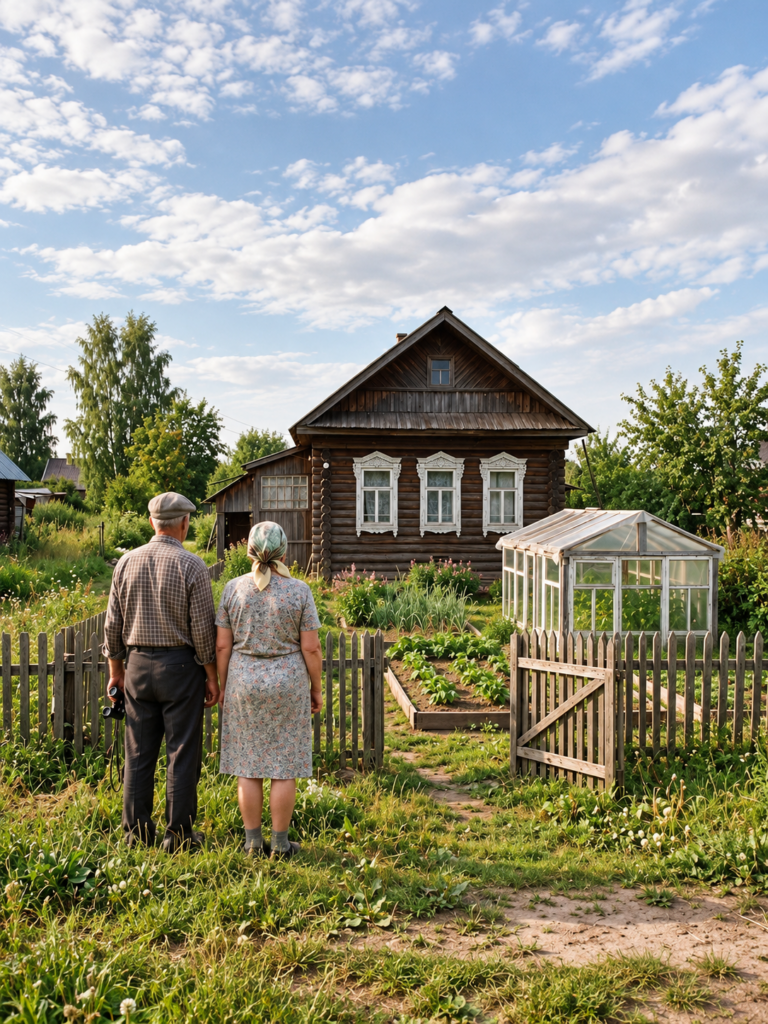
the old couple told their children they were going away for three weeks then hid next door and watched what each of them did when they thought the house was empty
Part 1
Tom and Mary Brennan sat at the kitchen table of the house they had built outside of Riverbend on a Sunday afternoon in June. Mary was peeling new potatoes into a bucket. The skins came off thin as paper. Tom sat across from her fixing the loose handle on the old sieve that had been rattling since spring. On the windowsill, bundles of mint and St. John’s wort dried, tied with twine, and the warm green smell filled the kitchen. The window was open to the yard. Outside on the porch stood their oldest daughter, Karen.
Karen had driven down from the city on Friday evening, the first time since Christmas. She brought a box of chocolates, a jar of instant coffee, and a tired face. She slept most of Saturday. On Sunday after lunch she stepped onto the porch with her phone and walked back and forth across the boards Tom had replaced ten years earlier. Mary did not listen at first. Karen always had someone on the line. Then Karen said, “Dave,” and Mary looked up.
She was talking to her brother. Her voice was even and businesslike, the voice she used at the office. “Dave, let’s be honest. They’re a burden. Not now, then in a year. Mom checks her blood pressure three times a day. Dad holds the rail on the stairs. Who’s going to drive out here? Me from the city? You? You’ve got the season. We need to sell the house while it still has value and get them a place in a decent care facility. There are nurses. There are doctors.”
Dave said something long. Karen was quiet, then said, “That’s what I think too. We’ll start preparing them in the fall.”
Mary watched her through the window. Karen stood sideways by the rail, and while she talked she ran her finger along a crack in the wood, slowly, from one end to the other, as if she were figuring what it would cost to fix before a sale. Mary had known that crack for twenty years. Tom kept meaning to repair it. Mary always said it held fine. Now their daughter’s finger moved along it and counted.
The potato stayed in Mary’s hand, half-peeled. Tom set the screwdriver down on the oilcloth, not dropping it, but placing it carefully beside the sieve. They did not look at each other. Both of them looked at the window: at their daughter’s back, at her light sweater, at her finger on the crack.
Burden. Mary knew the word. She had worked forty years in the county library. A burden was a weight you carried because you could not set it down. Karen finished the call, came inside, and looked into the kitchen. “Mom, is the kettle hot?” Mary said it was. Karen poured herself tea, took one of her own chocolates from the dish, and talked about the rush at work, the new boss, the heat in the city that was nothing like here. Then she went upstairs to pack. By evening a taxi took her to the station for the train. On the porch she kissed her mother on one cheek and her father on the other. “Take care of yourselves. Call if you need anything.” She left. She noticed nothing. Not the potato, not the screwdriver, not that her father had not made a single joke all evening.
They did not sleep that night. They lay in the dark and listened to the clock ticking on the wall, a mouse scratching in the shed, a barge far out on the river sounding its horn. Mary spoke first. “Did you hear?” Tom said, “I heard.” They said nothing more until morning.
In the morning Mary finished peeling the same potato, already dark, and boiled it because she could not throw food away. After breakfast Tom stood on a stool and took a leather case down from the top of the closet. Inside was a pair of heavy marine binoculars with worn grips. They had been given to him the day he left the river. For more than thirty years he had worked as a mechanic on towboats from the upper locks down to the Gulf. On his last day the captain had taken the binoculars from his own neck and put them on Tom’s. Since then they had stayed on the shelf and come down rarely: to watch elk across the river, the ice going out, the neighbor’s grandchildren when they drifted too far in a boat. Tom wiped the lenses with his sleeve and looked out the window at the fence, at Nina’s house beyond it, at the attic window under the roof.
“Mary,” he said, “let’s go away.”
She did not understand. “Go where? Why?”
“A sanatorium. No. Listen. We’ll tell them we’re going to a spa for three weeks. Down in Florida or wherever. Let them think we’re gone. We’ll stay right here.” He pointed the binoculars at Nina’s attic. “And we’ll watch what they do when they think we’re not home.”
Mary said he had lost his mind. It was not right. Children were children. Karen was only tired. People of seventy did not hide in attics. Tom listened and said nothing, turning the wheel on the binoculars. Then he said one thing. “And if she’s not only tired? You want to know. I can see you do.”
Mary wanted to. That was the worst of it. She wanted to know and she was afraid to know. In the evening they walked through the garden to the neighbor’s the way they had walked all their lives. There had been a small gate in the fence for forty years, on one hinge. Through it they had carried seedlings, salt, pie. Nina sat on the bench by her bathhouse picking the stems off currants. She had been a widow for six years. Her son lived far north and came once every two years. She listened without interrupting. Then she laughed, not meanly, the way people laugh when they want to cry.
“You two. Old spies.” She did not wait. “The room upstairs is empty. The window looks right onto your yard. Stay.”
The attic room at Nina’s was small. Under the slope of the roof, with an iron bed, a chest, and a rug. The round window, like a porthole, looked straight onto their yard, the porch with the cracked rail, the green trim, the shed, the greenhouse, the garden all the way to the barrel. Tom stood at the window and said, “Like from the bridge.” Mary understood he had already decided.
They wrote the children in the family chat. Mary typed carefully, fixing every word. Father had been given a voucher through the union. Three weeks at a spa. They left Monday. Everything was fine. Do not worry. At the end she added, “Who can water the garden? The tomatoes in the greenhouse and the cucumbers.”
The answers came by night. Karen wrote first. “Mom, what garden? I’m in the city. Rest. It’s good for you.” An hour later Dave. “Season. Mom, no time. Job after job. Let it dry. Plant new ones.” Julie did not answer. The message was read. Two checkmarks. No reply. Mary looked at those checkmarks a long time. “Even Julie,” she said. Tom said nothing.
On Monday morning a taxi from town pulled up to their gate. That was for the street. The neighbors needed to see them leave. Two suitcases, his hat, her coat, a bag of sandwiches for the road. Mary locked the door and hung the key on the nail under the porch where it always hung in case one of the children came. She turned and looked at the house. The driver said, “Ready, folks?” They went. The taxi took them to the station in town. They stood there half an hour among the pigeons and people with bags. Mary kept looking around as if someone might catch them. Then they took another taxi back and asked to be let out at the turn by the birch woods. They walked the rest of the way along the field road past other gardens, the wheeled suitcases sticking in the ruts. It was already evening. It smelled of cut grass and river water. They reached Nina’s back gate at dusk, and Nina was waiting with a flashlight.
The first night in the attic room Mary did not sleep at all. She lay and looked through the round window at their dark house. Not one light. The house stood like someone else’s, as if the owners had died. Tom slept beside her with his hand on the binocular case. Toward morning Mary got up, went to the window, and whispered to her house, “Hold on. Three weeks.”
Part 2
Living at Nina’s was simpler than they had thought and more shameful. Nina fed them like family: pancakes, soup, new potatoes with dill. Mary tried to give her an envelope with the pension. Nina pushed it back across the table with two fingers. “Put it away. I’ve been eating alone in this kitchen for six years. You’re a spa for me.” So Mary helped with the work. She weeded the beds on the side of Nina’s house that could not be seen from the road. She washed floors. She made jam from the currants. Tom had it harder. He did not know how to be idle, and there was nothing to do. He sat at the round window with the binoculars, on watch. They did not turn off their phones. That was the rule. If someone called, they answered. Only Julie called. Every evening around nine, sometimes later. Her voice was tired. A road hummed somewhere nearby. “Mom, how are you there? Did you get there all right? Are they feeding you?” Mary lied, and her ears burned with every word. About the mineral water that smelled like rotten eggs, about the treatments, about the park with the squirrels. She had been to a spa once, long ago, on a union voucher, and now she pulled everything she remembered from memory and was afraid her daughter would ask something she did not know. Julie did not ask. She said, “Rest,” and hung up.
The first evening, already in the dusk, Tom called her to the window. “Mary, look. Someone was in our garden.” A figure in a dark jacket with a hood walked from the barrel to the greenhouse with two buckets, bent, poured at the roots, walked back. It was already dark. The June night was short but thick, and even with the binoculars you could not see a face. Only the back, only the buckets, only that the person walked fast and knew where each bed was. After about forty minutes the figure went behind the house, and soon a car started on the road and drove away. “Dave,” Mary said, as if she had exhaled. So Dave had written that he had no time, and he had come himself. He was always like that, rough in words and different in deeds. She did not finish, but her face had softened. Tom said nothing. He had seen the back, and the back did not look like Dave’s. Dave was broad and heavy and walked with a roll. This person walked lightly. But in the dark anything could look like anything.
The figure came the second evening and the third. It watered. It tied something in the greenhouse. Once it sat a long time on the porch step, just sat, not moving. Mary stood at the window every evening and said, “There, Dave.” And in the daytime Nina, bringing them a plate of pies, looked out the window and said, “Mine should do that. Mine calls from up north once a month and that’s a favor. I’ve watered my own garden for forty years. You’ve got good children. They water.” And she set the plate down. Mary wanted to say yes, they were good, and somehow she did not say it.
On Saturday around noon a white car with city plates stopped at their gate. Karen got out in dark glasses, light pants, a bag over her shoulder. From the other side a young man got out, also in light pants, with a tablet under his arm and a tape measure on his belt. Karen took the key from the nail under the porch, the one her mother had left for the children, and opened the door. Tom raised the binoculars. Mary stood beside him but did not look. She just stood. The day was hot. Karen opened every window at once to air the house. Through the fence, through the beds, through the quiet of a summer noon the voices reached the attic as if the people were speaking in the next room.
“Art, look. This is the kitchen. Not much square footage, but if we knock out this wall it’ll be a living room. Everybody’s doing that now.” The young man tapped the wall with his knuckle and wrote something. “Is it load-bearing?” “Who knows. Dad built it himself. We’ll find out.”
Mary closed her eyes. Tom had built that wall the year Julie was born so the kitchen would have its own heat, separate from the rooms. He had hauled the timber himself. He had chinked it himself. Then they went through the rooms. Art took pictures. The shutter clicked on the tablet. Karen directed. “Don’t bother with the buffet. It’s Grandma’s. It eats the whole room. The rug too. But leave the stove. Buyers like a stove now. It’s our feature. Country style.”
Tom moved the binoculars to the kitchen window. Karen stood at the sill where the herbs dried. She picked up a bundle of mint, smelled it, made a face. “We’ll get rid of all this. It smells like old ladies.” And she swept the bundles into a store bag with one hand. All at once: mint, St. John’s wort, thyme, oregano. Mary had gathered them all through June at dawn, on the dew, on the old cutting beyond the village. “And the owners?” Art asked. It was very clear. He stood on the porch. “The owners are at a spa,” Karen said. “When they come back I’ll push them. Mom will cry and agree, and Dad doesn’t decide without her. The main thing for me is that you give me a price by fall and find buyers. A lot by the river with a view, people will snap it up. It’s a pretty place. Folks around here like it.”
Art said the place was pretty and it would be better with a power of attorney so they did not have to bother the old people more than necessary. “We’ll do a power of attorney,” Karen said. “I know how to talk to them.”
They stayed in the house about two hours. Then Karen carried the bag of herbs out to the porch and stuffed it into the trash bin by the gate. She locked the door, hung the key back on the nail, carefully, as one should, and got in the car. Art got in the other side, and the car drove away. Karen did not look in the greenhouse. She walked past the beds without looking, without even asking herself why everything in the garden was still green if the owners had been gone a week.
Tom lowered the binoculars. Mary sat on the edge of Nina’s bed and looked at her hands. “She knows how to talk to me,” she said quietly. “I’ll cry and agree.” Tom sat beside her and took her hand in his, big, with the black nails from old work. “You won’t cry.” And Mary suddenly understood that she would not. Not today.
In the evening the figure with the buckets came again. Mary went to the window as always and said, almost like a prayer, “At least Dave.” Tom did not answer. He looked through the binoculars, trying to make out hands, face, walk, and he could make out nothing. It was too dark, and the person did not turn on the light over the porch.
Dave came on Tuesday in the daytime. His work truck, the bed spattered with mortar, pulled right up to the shed on the garden road that ran along the back. Dave got out of the cab and another man, younger, in a builder’s jacket. Dave stood by the shed and touched the lock. The lock was a simple padlock, and the key hung in the same place as the house key, under the porch. Dave had known that since he was a boy. Tom watched the shed as if it were his own heart. It was his workshop. For thirty years on the river he had fixed other people’s motors, and when he came ashore he had partitioned half the shed and made himself a shop. A larch bench. Above the bench, each on its own nail, hung planes, still his father’s, with wooden bodies polished by palms to a shine, chisels in a leather roll, saws, the electric saw he had bought with two months of pension, a small lathe on which he turned handles for knives, legs for stools, and once a wooden doll for Julie. Dave opened the shed and began to carry things out quickly, in a businesslike way, the way you carry material off a job: the electric saw, the lathe, the two of them grunting, the planes in an armful together with the nails he pulled from the wall, the chisels, a box of wrenches. The helper asked something. Dave answered loudly over his shoulder. The wind was from the river, and the words reached the attic whole. “He doesn’t need them anymore. The old man won’t pick up a plane again, and my crew’s standing without tools. It’ll just go to waste. Load it.”
Mary gasped. Nina, who had just come up with tea, stopped in the doorway. Tom stood at the window, and the binoculars shook in his hands so he pressed his elbows to his sides to see. He saw Dave throw the leather roll of chisels into the bed, saw his grandfather’s plane land on its edge on top. Wrong, so the body could chip. He saw Dave wipe his hands on his pants, light a cigarette, get in the cab. Dave left the shed open. The door swung in the wind and banged the frame. The truck drove away on the garden road past the greenhouse, past the beds, past the barrel. Dave did not look back at the house once. Not at the windows, not at the porch, not at the garden that someone watered every evening. As if the house were not there at all.
Tom set the binoculars on the windowsill and sat on the chest. Nina set the tea on the floor because there was nowhere else to put it. The room was quiet except for the shed door out in the yard, banging and banging. Then Mary asked what they had both been thinking for half an hour. “Tom, then who is watering?”
In the evening they both stood at the window without agreeing. Nina came up too and stood behind them, holding the doorframe. The sun had gone behind the river. A blue shadow crawled across the garden. Then it was dark. Around ten-thirty a car rumbled, a door slammed, and the familiar figure in the jacket with the hood walked through the garden. First to the shed. It stood a long time by the open door. Then it closed the door and propped it with a stick. Then it went to the barrel and took the buckets. And then Mary’s phone rang in the pocket of her robe. She jumped so hard she almost dropped it. On the screen it said Julie. Mary pressed and put it to her ear. “Mom, hi. Are you asleep already? I’m driving home from work. Thought I’d call.” Tom, without lowering the binoculars, said with his lips only, “Mary.” And Mary looked where he was looking. The figure in the garden stood by the greenhouse with the buckets set on the ground and held a phone to its ear. The screen glowed a small blue spot against the cheek. “Mom, can you hear me? The connection’s bad there? In the mountains?” The figure took two steps toward the house, toward the porch, where a bulb hung on a cord over the door, and reached, and the bulb came on. The hood slid to the shoulders. Under the jacket were blue hospital pants, the ones they wear on the ward, light hair pulled into a ponytail, a thin tired face. It was Julie.
Mary talked to her daughter and watched her across the fence, across the garden, across forty yards of June dark. “I hear you, Julie. Everything all right? The food’s all right.” Julie stood under the bulb by the porch, by the same rail with the crack, and spoke into the phone. “That’s good. Rest. Don’t think about anything there, you hear? Nothing.” And Mary saw how her daughter, saying that, glanced at the open shed. “And how are you, daughter?” Mary asked. Julie was quiet. “It’s all right. The shift was hard. Okay, Mom, I’m driving. Talk to you later.” She hung up, put the phone in her jacket pocket, turned off the bulb, and went back to the greenhouse, to the buckets, into the dark. Mary stood with the phone at her ear even though it had been quiet for a long time. Then she slowly lowered her hand. Nina behind them crossed herself small and quick, the way old women do on a bus. Tom did not lower the binoculars. He watched his daughter carry the buckets from the barrel to the beds. Two at a time, leaning sideways under the weight. How she set them down. How she straightened her back, holding her hand to her lower back. Mary had held her lower back that way when she was young, when the two of them planted this garden the first time. “She said she was driving,” Mary said. “She’s standing in our yard and saying she’s driving.” “Why?” Tom did not answer at once. “So we wouldn’t ask who was watering. So you wouldn’t find out about the shed. Did you see how she looked at the shed? She saw it before we did. She’s protecting us from Dave.”
Mary stepped toward the door. Tom caught her by the sleeve of the robe, not hard, only to stop her. “Let me go. I’ll go to her. I’ll go now.” “Wait, Mary.” “Wait for what?” Tom was quiet, then said so low that Nina at the door did not hear, and Mary told her the words later herself. “We don’t know anything about her. All our lives we looked at Karen. Let me look at her. Just once, when she doesn’t know we’re looking.”
Mary sat on the chest. She wanted to argue. She wanted to say it was cruel, that her daughter was tired, that it was an hour and a half back, that she had a shift tomorrow. She said nothing, because Tom was right. And that was the most frightening thing. They truly knew nothing about their youngest. They knew where she worked. They knew she rented a one-room apartment on the edge of the city. They knew she was not married. And that was a sore place Mary asked about every time, and every time Julie said, “Mom, don’t start.” Nothing more.
That night Julie left around midnight. Her car was old, with a hoarse motor. You could hear it to the end of the street. Mary listened until the motor was gone.
Part 3
On Wednesday Julie apparently had a day off, because she came in the daytime around three. Tom saw her first and called Mary, and Mary called Nina. So the three of them stood at the round window now, like at a movie. Julie was in old jeans and her father’s checked shirt, which she must have found on the hook in the house. The shirt was big on her. She had rolled the sleeves to the elbows. In her hands was a bag from the hardware store. First she worked on the hose. Tom had been meaning to replace it for two years. It leaked in three places, and watering with it was misery. Half the water went into the path. Julie sat on an overturned bucket, laid the hose across her knees, and began wrapping the holes with blue tape. Carefully, in several layers, overlapping. Mary watched and recognized it. That was how Julie had bandaged her dolls when she was little and played hospital, and that was how she probably bandaged people now on the ward. Then she went into the greenhouse. The tomatoes had stretched in a week, and some vines had already fallen to the ground. Julie tied them with strips of cloth, and Mary, looking closely, gasped. It was an old sheet with small blue flowers that Mary kept in the closet for tying, torn into strips. No one had told her. Julie simply knew where it was because she had seen her mother do it. She had seen it as a child. She had seen it every summer. Mary had not noticed that her daughter was watching. While she worked Julie talked quietly, but in the silence of a summer day every word was clear. “Well, Mama’s, are you alive? Alive. Good for you. Another week and the owner will be back, and you’ll be standing here red.” She spoke to the tomatoes the way Mary had spoken to them all her life, with the same words. Nina behind them snorted and turned to the wall. Toward evening Julie went to the shed, stood by the door propped with a stick, opened it, and went in. She was gone a long time, and Tom moved the binoculars across the small window of the shed but could see nothing inside. Then she came out and sat on the threshold. She just sat, knees drawn up. On the wall behind her, Tom knew, there were only the holes from the nails where the planes had hung. Empty light rectangles on the dark boards where the tools had hung for thirty years and the wood had not faded. Julie took out her phone, dialed a number, put it on speaker, and set the phone beside her on the threshold. The rings went a long time. Then a man’s voice answered, loud, with the noise of a job behind it. “Yeah. Julie, what?” “Dave, did you take Dad’s tools?” A pause. “Yeah, I took them. So what? He doesn’t need them anymore. My crew’s standing without tools. They cleaned out the job. You know what an electric saw costs now?” “Bring them back.” “What bring them back? I said all of them. The lathe and the planes and the chisels.” Dave laughed. Short and mean. “Why are you sticking your nose in? You’re a nurse. What do you need a plane for? Or are you aiming at the house before Karen sells it? You’ve got no more share in it than I do.” Julie was quiet. Tom saw her face in the binoculars from the side, and the face was still. “I don’t need a share,” she said at last. “I need Dad to come back and see his plane on the nail.” “You left the door open, Dave. The wind beat it all night. Did you even look at the house when you left?” Dave was quiet, then said, “I don’t have time, Julie. That’s it. Later.” And he hung up. Julie sat a while longer. Then she stood, took a new padlock still in the package from the bag, hung it on the shed door, and snapped it shut. She put one key in her pocket and hung the second on the nail under the porch, next to the house key.
That night Tom did not go to bed for a long time. Mary heard him sitting at the window on the chest without turning on the light. Then he said into the dark, not to her, but somewhere aside. “I turned her a doll on that lathe. She was about six. She slept with that doll until school.” Mary said, “I remember. The wooden one with the braid.” “And for Karen I didn’t turn anything. For Karen we bought things in town at the store.” He was quiet, and Mary understood what he meant. On Karen they had spent money. On Julie they had spent time. And somehow all their lives they had counted money as dearer.
In the daytime, when there was nothing to do, they began to remember, without wanting to, as if someone had opened an old chest in them. They remembered how Karen had gone to the city for college and how they had sold the cow, Zorka, for it, and Mary had cried in the shed and then told everyone their daughter would study in the city. They remembered how after ninth grade Julie had said she wanted the nursing school in the next town, and Mary, she remembered this clearly, had said, “Well, at least someone will be near.” Not out of malice. She just said it. And Julie had nodded and gone to gather the papers herself, on the bus alone. They remembered the holidays, how for Tom’s anniversary Karen had sent a big bouquet from the city with a courier and a card, and Julie had come herself the day before and spent half the day cutting salads in the kitchen. And how at the table everyone asked Karen on the speaker, “How’s the city, how’s work, what promotion,” and Julie washed the dishes. How they had not gone to Julie’s graduation from the school because on the same day it was Karen’s birthday and Karen had invited them to the city, and that seemed more important. The city, a restaurant, the first time. And they had called Julie in the evening and congratulated her. Her voice on the phone had been normal, cheerful. Mary had thought then, “Good, she wasn’t hurt.” How they had been to Julie’s once, for the housewarming in her rented apartment. A small place on the fifth floor, no elevator, a view of the boiler-plant pipes. Julie had made borscht, bought a cake, and Mary, looking around the kitchen, had asked, “Julie, when are you going to find a normal job? With your brains. Your sister in the city’s doing so well.” Julie had answered, “Mom, I have a normal job. I pull people back from the other side.” And Mary had somehow laughed. It had seemed to her that her daughter was joking. Now, in Nina’s attic, Mary could not forgive herself that laugh. She sat at the window and watched Julie carry buckets in the dusk and thought how many times over the years her daughter had come like this, done something quietly, said nothing, and left. And no one had thanked her, because no one had noticed, the way no one had noticed who was watering the garden.
Nina listened to these talks but did not interrupt. Only once, when Mary said again, “We didn’t know, Nina, we didn’t know what she was like,” Nina set a bowl of cherries on the table and said, “You knew. You didn’t want to. Julie came to you every month when you were still young, and while she was here you cooed on the phone with Karen for an hour. Then she sat on my bench and said, ‘With them, Nina, I’m like a cupboard in the corner. And that’s fine.’” Mary went red to tears. Tom turned away. Nina looked at them and softened. “Eat the cherries. Nothing to do about it now. Now you watch.”
Tom was hard without work, and Nina saw it. On the fourth day she silently led him down to her little shed behind the bathhouse and opened a wooden box. In the box lay the tools of her late husband, Stepan. No one had touched them for six years. They were greased, wrapped in oily rags. “My garden gate is falling,” Nina said. “Stepan kept meaning to. You take a look.” Tom looked. He took Stepan’s plane in his hands, turned it, ran a finger along the blade. And all day on the side of Nina’s house that could not be seen from the road he fixed the gate. He took it off, took it apart, replaced the rotten post, planed, hung it on new hinges. His hands remembered everything. Someone else’s tool lay in his palm like his own. In the evening Nina opened and closed the gate five times, listening to how it moved. Soft, without a squeak. “There,” she said. “And yours says you won’t pick up a plane.” Tom said nothing, but that night he slept at once for the first time in a week.
On Friday Julie came with a bag and stayed the night. Mary saw the light come on in the window of her childhood room, the small one that looked onto the garden. The light burned a long time, almost until two. And in the morning on Saturday Julie opened every window in the house, carried the rugs out to the porch and beat them, washed the floors. Then she opened every door of Grandma’s buffet to air it and wiped every glass as if she were cleaning up after someone. Then she went to the trash bin by the gate. Mary did not understand at first why. Julie opened the bin, looked in, pulled out the store bag, that same one. She untied it, looked inside. She stood a long time, then carried the bag into the kitchen. And half an hour later Mary, looking through the binoculars Tom had finally given her, saw on the windowsill of her own kitchen the herbs: mint, St. John’s wort, thyme, oregano. Bundles tied again, no longer with twine but with some white tape, probably medical. Dried, a little crushed, but alive. Hanging in their place as they always had. Mary gave the binoculars back to Tom and went downstairs to Nina’s kitchen. There she sat on a stool and cried without a sound, the way old people cry who do not want to wake anyone. Nina poured her valerian, and then, thinking, some homemade wine. “Drink. It’s not mineral water, but it helps.”
That same day after lunch Karen called Julie. Julie sat on the porch step and ate bread with a cucumber, her lunch. The phone was on speaker again. Maybe she simply had the habit. Her hands were always busy. Maybe not. Tom thought about it later a long time. “Julie, where are you?” Karen asked. “At Mom and Dad’s.” “What are you doing there?” “Watering the garden.” Karen was quiet. “Listen, don’t touch much, all right? A man came, Art the realtor. He photographed everything as it is. The buffet, by the way, don’t bother. We’ll throw it out.” Julie set the bread on the step. “Karen, no Arts without Mom and Dad. This is their house. They’re alive.” “I know they’re alive. I’m thinking about them. Understand, Julie, you’re a nurse. You know better than I do. It’s only going to get worse for them. Blood pressure, heart, stairs. Who’s going to fuss with them? Are you going to drive here from the city every day? They’re a burden. Let’s be honest.” “For all of us, not for me,” Julie said. Her voice did not shake. “And let’s be honest, Karen. Old age comes for everybody. For you too. You’ll be a burden to somebody yourself.” Karen said, “You went too far.” She was quiet. “All right. They come back on Saturday. I’ll come. We’ll all talk. You come too, since you’re so right.” And she hung up. Julie sat on the step. The bread lay beside her. The cucumber had rolled into the grass. Then she raised her head and looked. It seemed to Tom she looked straight at him, straight into the round window under Nina’s roof. He jerked back from the window like a boy. When he raised the binoculars again Julie was already gathering the rugs from the porch.
There were other signs after that. Mary gathered them like beads on a string and sorted them every evening. How Julie, leaving, sometimes raised her hand, just raised it, did not wave, toward Nina’s house. How once, standing by the gate, she said loudly into the dark, for the whole street, “Good night, Nina.” Although Nina was nowhere to be seen. Nina was in the attic behind Tom. How Nina, coming back from the store, told them she had met Julie there, and Julie had asked her, looking very carefully, “Nina, aren’t you lonely by yourself? If you need anything, say so. I’ll always help.” And she had smiled. Nina told Mary that the smile had made her uneasy, like at the blackboard in school. “She knows,” Nina said. “Mark my words. She knows.” Tom shook his head. “How would she know? We’re like mice.” And Mary said nothing. Suddenly she wanted her daughter to know, so that all of it would end by itself, without her deciding.
On the nineteenth day, Thursday, Karen called Mary for the first time. “Mom, hi. How are you there? Did you rest? Did you get a tan?” The voice was bright, the voice Karen used when she needed something. “We rested,” Mary said. “You’re back on Saturday. I’ll meet you right at the house. I’ll come early. And, Mom, I’m bringing a good man, Art. About the house. Don’t be scared. Nothing terrible. Just some papers to sign. A power of attorney. So you don’t have to run around the offices at your age. I’ll do it all myself.” Mary listened and looked out the window at her house. “We’ll see,” she said. “Mom, what does we’ll see mean? It’s already arranged.” “We’ll see, Karen.”
An hour later Dave sent a short message. “Mom, welcome back in advance. I’ll stop by Saturday if I have time.” Nothing more. Not a word about the tools. And in the evening it rained. First fine, then hard, with wind, with thunder beyond the river. It poured so the garden disappeared in a gray curtain, and the barrel by the greenhouse overflowed and ran over the edge. Nine o’clock. Ten. Ten-thirty. Julie did not come and did not call. Mary stood at the window, holding the phone to her chest, and thought about the highway to the city, wet, dark, with trucks that raced through the puddles and threw waves over the little cars. Tom walked the attic from wall to wall, three steps one way, three back, ducking under the slope of the roof. “She won’t come, and she’s right,” he said. “Why water in the rain? The rain will water.” But he kept walking. Around midnight headlights flashed on the road, the hoarse motor, a door slammed. Julie came into the garden in a long raincoat with a hood. She did not take buckets. There was nothing to water. The rain had done it. She did not go to the greenhouse or the shed or the house. She walked the wet path straight to the fence, to the same gate on one hinge through which they had carried seedlings for forty years. She stopped at it, threw back the hood. The rain poured on her face, on her hair, and she stood and looked up, straight into the round window of Nina’s attic.
Part 4
She stood like that for two minutes, then pushed the gate, and the gate, creaking, hung on its one hinge. Julie walked through Nina’s garden to the porch and knocked. She did not ring. She knocked three times with her knuckles. Nina came down and opened. Tom and Mary stood at the top of the stairs and heard everything. “Good evening, Nina. Sorry it’s late.” “Hello, Julie. You’re soaked.” “Nina, Mom’s nightgown with the cornflowers has been hanging on your line for three weeks. Take it in or the rain will get it.” Nina said nothing. Julie was quiet. “Can I come up?” She climbed the narrow stairs slowly, holding the rail. Water dripped from the raincoat. At the top under the slope stood her father and mother. Mother in a robe, father in an undershirt and sweatpants with the binoculars on a strap around his neck. They stood like schoolchildren caught. Julie came up, stopped on the last step, looked at her mother, at her father, at the binoculars. “Hi, Dad. How’s the mineral water?” Tom opened his mouth and closed it. Mary stepped toward her daughter, and Julie took a step back down one step. Not sharply. She just did. “Wait, Mom. I’m wet, and I’ll say it first or I won’t say it.” She said she had known since the second day. That on the second evening when she came to water, the sun was setting, and something had flashed hard in Nina’s round window, like a little mirror. At first she thought Nina was watching television and it was reflecting. On the third evening it flashed again, and it was clear it was lenses, that the case was gone from the top of the closet at home, and she had gone up there for a basin and seen the empty place in the dust, that the woman at the store had said to her, laughing, “Nina’s buying kefir three bottles at a time now. Guests, or what?” And that one night when she sat on the porch, through Nina’s open window she had heard someone cough. “Dad, I’d know your cough out of a thousand. I’ve been in cardiology twelve years. Yours is a heart cough, at night. You cough lying down. Did you take your pills?” “I took them.” “No, you took them,” Tom said hoarsely. “Mary took them.” “Good,” Julie said, and suddenly she smiled just a little, with one corner of her mouth. “And Mom’s nightgown with the cornflowers. I gave it to her myself on the eighth of March. There’s only one like it in the whole county.” “Why didn’t you say anything?” Mary asked. Her voice broke. “Julie, why didn’t you come, why didn’t you knock, like now?” Julie did not answer for a long time. Water dripped from the raincoat onto Nina’s floorboards. “Because you hid,” she said at last. “Mom, at seventy you left your own house and went to the neighbor’s attic. That means it was very bad for you. I didn’t know why. I thought if they need to hide from us, then we did something to them. All of us, me too. I thought let them at least be all right at Nina’s if they’re not all right at home, and I’ll water so you’ll have somewhere to come back to when you decide. I waited for you to come out yourselves.” She looked at the binoculars on her father’s chest, and her face changed, not wet from the rain but wet for real. “You watched me through binoculars for three weeks, Dad. Every evening. I knew. I stood under the light on purpose so you could see.” She laughed short, and the laugh broke in the middle. “You never looked at me like that, as long as I can remember. You missed my graduation from the school. You were in the city at Karen’s in a restaurant. I called you from the graduation. I had a diploma with honors, a red one. You didn’t even ask what kind. You missed the first time I pulled a person back from the other side. I called you in the morning after the shift. I needed to tell someone, and you, Mom, said, ‘Julie, later. I’ve got Karen on the other line.’ You came to my housewarming once. And you asked when I was going to find a normal job.” Mary covered her face with her hands. Tom stood still. “And here three weeks,” Julie said. “Every evening. You watch me carry buckets. You know, at first it hurt, and then it was even good. At least like that. At least through binoculars.”
Then Tom did what Mary did not expect. He took the binoculars from his neck slowly, over his head, and set them on Nina’s chest the way one lays down a weapon. Then he went to his daughter, to the very stairs, and stood in front of her, big, stooped, in slippers wet from her raincoat. “Julie,” he said, “we didn’t hide from you. In June we sat in the kitchen and heard Karen tell Dave on the phone that we were a burden, that the house should be sold and us put in a facility. We wanted to know who was waiting for us. And we found out. Only we found out something we didn’t want. We found out that we never waited for you, and you waited for us the whole time.” Julie stood on the step and looked at her father. The word burden, it was clear, she heard differently now. Not the way she had heard it from Karen on the phone on the porch. Her face went white. “She said that to you?” “Not to us. In front of us. She didn’t know the window was open.” And then Mary finally stepped to her daughter. And this time Julie did not step back. Mary put her arms around her, wet in the raincoat, right on the stairs, and the raincoat soaked her robe through, and she did not notice. She spoke to her daughter into the wet shoulder, foolish old words, the ones she had said when Julie was little and fell off the bicycle. Julie stood with her arms down, then raised them and put them around her mother. Tom stood beside them and did not know where to put his big hands. And then Julie, without letting go of her mother, reached one hand and took him by the undershirt, by the edge, the way she had taken him when she was little and afraid of thunder. Nina downstairs put the kettle on. You could hear her clinking cups, scolding the cat, opening the cupboard. Then she called up through the whole house, “Tea’s getting cold! Spies!”
They drank tea at two in the morning in Nina’s kitchen, the four of them. Julie had taken off the raincoat and sat in her father’s checked shirt, which she had never put back on the hook. Nina brought out jam from the currants she had stemmed the first evening. Julie ran to the car and brought her blood-pressure cuff and, without asking, put it on her father’s arm. “Sit. Don’t talk.” Tom sat and did not talk. She watched the needle, moved her lips. “One-fifty over ninety. That’s from the binoculars, Dad. You can’t get worked up like that.” And for the first time all evening the four of them laughed at once. Then Mary asked what had been tormenting her. “Julie, and Dave? And the shed? Did you call him?” Julie nodded. “I called. He won’t bring them back. Mom, he says the crew’s standing.” “And Karen?” “Karen comes Saturday with Art and the papers. She told me to be there too.” Mary looked down into her cup, and Tom said, “Good. Let them all come. All three. We’ll come back from the spa.” He looked at his wife, at his daughter, at Nina. “Only we’ll come back honestly. Through Nina’s gate. In the daytime.”
On Saturday morning Nina took the nightgown with the cornflowers off the line, folded it in four, and put it in Mary’s hands. Evidence. Mary put the nightgown in the suitcase on top of everything else. Tom shaved at Nina’s over the sink a long time, carefully, put on a clean shirt, buttoned it to the throat the way he did for elections. He put the binoculars in the case and hung the case on his shoulder. Julie came at nine after a night shift, with dark circles under her eyes. She said nothing. She took one suitcase from her mother and the other from her father. Through Nina’s garden, through the gate on one hinge, the three of them walked. Nina walked with them as far as the fence. It was clear and quiet. After the night rain it smelled of wet earth and dill. Across the road on the bench by her house sat Aunt Val, the old woman who knew everything in the village. She saw Tom and Mary come out of Nina’s garden into their own with the suitcases and stood up. “Tom, Mary, weren’t you in Florida?” Tom raised a hand. “We were, Val. We’re back.” Aunt Val stayed standing.
The house met them with a smell. Dry herbs, washed floors, bread that Julie, it turned out, had brought from the city. On the kitchen windowsill hung the bundles of mint and St. John’s wort on white tape. Mary went to them, touched them with her fingers, then went out on the porch and touched the crack in the rail, also with a finger, from one end to the other. She was not counting. She was just touching, the way one touches a scar. Tom went to the shed. Julie silently gave him the key to her lock. He opened the door, went in, stood in front of the wall with the empty light rectangles and the holes from the pulled nails. The bench was in place, heavy, larch. Dave had not been able to carry it. Tom laid his palm on the bench, then came out, closed the shed, and said, “All right.”
Karen arrived around noon. The white car stopped at the gate, and behind it a gray one in which Art sat. Karen got out with a bouquet and a bag from a city bakery, saw her parents on the porch, and stopped. “Oh, you’re already— How did you get here? I wanted to meet you. I would have picked you up from the station.” “We weren’t far,” Mary said. Karen did not understand, laughed, hugged her mother, kissed her father, then saw Julie in the doorway. “Oh, you’re here too. Hi, the righteous one.” Art stayed by his car with a folder under his arm and nodded politely. Dave arrived half an hour later in the same truck. Only the bed was empty. He got out, said hello to everyone at once without looking at anyone, and said he was not staying long, he had a job. Tom said, “You’ll sit. The job will wait.” He said it so Dave did not argue anymore. They sat in the kitchen at the same table covered with the same oilcloth on which in June the screwdriver and the sieve had lain. Mary put the kettle on. Karen set her folder of papers on the table beside the dish. Dave sat closer to the door. Julie stood by the window, by the herbs, and did not sit. Tom sat at the head, took the case from his shoulder, took the binoculars out of it, and set them in the middle of the table between the dish and the folder.
“We didn’t go anywhere,” he said. Karen smiled, not understanding. “What do you mean, Dad?” “I mean it. Not to any spa. We lived three weeks at Nina’s. In that window.” He pointed out the window across the garden at the round window under Nina’s roof. Everyone looked. The window shone in the sun, and of course no one was in it anymore. “From there you can see our whole yard,” Tom said. “Like the palm of your hand.” It became very quiet. You could hear the kettle coming to a boil and a grasshopper chirping in the garden. Dave stared at the binoculars. Karen went pale, then red. “Dad, you’re joking? You spied on us? Is this some kind of test at your age?” “At our age,” Mary said from the stove, without turning, “at our age, Karen, you have to, when your own daughter says about you that you’re a burden.” Karen opened her mouth. Mary turned to her. She spoke calmly, evenly, without raising her voice. And Tom, looking at his wife, thought he had never seen her like this. “In June, on Sunday, you stood on the porch and talked to Dave. The window was open. You said, ‘Dave, let’s be honest, they’re a burden. The house needs to be sold while it still has value. They belong in a facility. We’ll start preparing them in the fall.’ You stood by the rail and ran your finger along the crack. I was peeling potatoes then. I didn’t finish them until morning.” Karen looked at her brother. Dave looked at the table. “You were eavesdropping?” she said, and she heard how it sounded, and she stopped. “The window was open,” Mary repeated. “And last Saturday you brought Art. You wanted to knock out Dad’s wall, Grandma’s buffet to the dump, my herbs you swept into a bag and into the bin by the gate. You said it smells like old ladies. You said Mom will cry and agree, and Dad doesn’t decide without her. You said, I know how to talk to them.” Mary was quiet. “You see, I’m not crying.” Karen sat very straight. Her fingers lay on the folder, and Tom saw they were shaking. “Mom, you don’t understand,” she began. “I’ve got a mortgage. I’m carrying it alone. Work until eleven at night. A new boss. They threaten to cut me every month. I lie awake at night and count. If Dad has a stroke, who pays for a nurse? Me. If Mom falls, who drives? Me. Four hours one way from the city. Dave will say season. Julie will say shifts. I didn’t say it out of spite. I said it the way I talk at work, like a task.” “Like a task?” Tom repeated. “So we’re a task for you, and the house is the solution.” “I didn’t mean it that way.” Karen stopped, looked at the crack outside the window on the rail, then at the herbs on the windowsill, at the white tape. “Who hung those?” “Julie,” Mary said. “She took them out of the bin, retied them, hung them back.” Karen looked at her sister. Julie stood by the window and said nothing. Then Tom turned to his son. “Dave.” Dave raised his head. He was big, broad, in a work jacket with cement dust in the folds, and he sat on the stool hunched the way he used to sit in eighth grade when they called him to the principal. “On Tuesday in the daytime you pulled the truck up to the shed, carried out the lathe, the saw, the planes, the chisels, the wrenches. You threw Grandpa’s plane into the bed on its edge. You told your helper, ‘The old man won’t pick up a plane again.’ You left the door open. The wind beat it all night. Julie propped it with a stick, and then she hung her own lock.” Dave swallowed. “You never looked back at the house once,” Tom said. “I watched. Not once.” Dave was quiet a long time, then said dully into the table. “On the job in town in May they cleaned out all my tools. All of them. At night from the trailer. The crew’s standing. The customer’s threatening a fine. To buy new ones I couldn’t pay it off in six months. I thought in your shed it was just hanging anyway. You worked yours out on the river. For you it’s already, well, hard. I thought you wouldn’t even notice, and later I’d bring it back somehow.” “And ask?” Tom said. Dave raised his eyes. “Ask, Dave. Call. Say, ‘Dad, I’ve got trouble, give me the saw.’ I would have given it. I would have put it in the bed myself. I would have given you the lathe too and shown you how. You didn’t ask. You took. That’s the difference.” Dave said nothing, then suddenly looked at Julie. “I left the door open,” he said. “That’s what you told me on the phone?” Julie nodded. “Then all the way back to town I thought about that door,” Dave said. “How it was banging.” And he lowered his head again. Karen suddenly turned sharply to her sister. “And you. So you’re the saint here. You knew where they were? You knew and said nothing. You all put on this play together? To make Dave and me look bad?” Julie did not have time to answer. Tom answered. “Julie knew we were at Nina’s. She guessed on the second day from the binoculars. She knew nothing else. Not about your call, not about the realtor. She found out about the shed herself before we did, and she didn’t say a word to us about her brother. Every evening she called her mother and lied that she was driving so her mother wouldn’t find out about the shed and get upset.” He was quiet. “She wasn’t testing us, Karen. She was waiting for us. She watered the garden so we’d have somewhere to come back to.” Karen was silent. She said nothing more. She sat looking at the folder, and her face was one Mary had not seen on her since she was a child, since the time she was little and broke the neighbor’s window with a ball and ran to hide in the shed. Mary took the kettle off the stove, set it on the stand, wiped her hands on her apron, then walked past the table, past her daughter, out onto the porch and down the path to the gate. Art stood by his gray car, smoking. When he saw her he threw the cigarette down and stepped on it. On the bench across the road sat Aunt Val. Now not alone, but with a neighbor. Nina stood at her own gate, the one Tom had hung for her, and pretended to look at her phlox. “Art,” Mary said. She said it loudly, clearly, for the whole street, the way she used to speak in the library when she announced to the children that it was time to return the books. “Thank you for coming. Sorry it was for nothing. The house is not for sale, and there will be no power of attorney. We’re alive. We sign what we need ourselves.” Art nodded. Young, polite, clearly embarrassed. “I understand. I’m sorry. They told me you agreed.” “We don’t agree,” Mary said. “Go with God. The road is long.” Art got in the car and drove away. Aunt Val on the bench said something to her neighbor under her breath, and both of them nodded. By evening the whole village knew.
When Mary came back, Karen was already standing in the entry. Her eyes were red. “Mom, all right, we won’t sell. I understand. But you know you’ll be alone here in the winter, with the stove, with this garden. Come to me in the city for the winter at least. Or I looked, there’s a good facility near town in the pine woods. They have everything. Doctors and meals.” “No,” Tom said. He stood in the kitchen doorway. “Thank you, daughter. No. We’re not a burden, Karen. For now we’re the owners. While we’re alive, we’re the owners here. And when it’s needed, we’ll say so ourselves. We’ll decide ourselves who to go to.” Karen left in an hour. She never opened her folder. Before she got in the car she stood a long time by the porch, by the rail, and Mary saw through the window that her daughter was touching the crack again, only now she was not running her finger along it but simply holding her palm on it. Then she came back into the house. Quickly, almost running, she hugged her mother in the entry and said into her neck, “Mom, forgive me.” Mary stroked her back. “I forgave you when I finished peeling that potato. In the morning. But I won’t believe you on your word yet. Karen, come when you want to. Not for the house. To us.” Karen said nothing, nodded, and left. The white car turned at the gate and drove away quietly, without gas, the way people drive away from a funeral. Dave left too. He said he had to get to the job. But in the evening around seven on the garden road behind the house his truck rumbled again. He pulled up to the shed, the same place he had pulled up on Tuesday, and stopped. In the bed, padded with old blankets, lay the lathe, the electric saw, the box of wrenches, the leather roll of chisels, and the planes. Every one. Dave unloaded in the light. It was not dark yet, and from the street you could see everything. Aunt Val had come to the fence already openly, with no pretense. Nina stood at her gate. A couple of neighbor boys had climbed the woodpile. Dave carried the tools back into the shed alone, without calling anyone. Although the lathe was heavy and the last time two of them had carried it, he set the lathe in its place, where the light mark of its feet still showed on the floor. Then he began hanging the planes on the wall. The nails he had pulled he had apparently lost. So he took new ones from his pocket and, holding each plane, drove a nail exactly into the old hole. Tom came out to the shed when Dave was hanging the last of his grandfather’s. Dave turned, held out the plane. “Dad, the body’s chipped on the edge. That’s me in the bed.” Tom took the plane, turned it, ran a finger over the chip. “We’ll glue it,” he said. “That’s no trouble. The trouble is you threw it. The body would have stayed whole.” He hung the plane on the nail himself. Then he took the electric saw from the bench, the one he had bought with two months of pension, and held it out to his son. “Here. Take it.” Dave did not understand. “Dad, what?” “Take it, I said. Your crew’s standing. Now I’m giving it to you myself. You see the difference?” Dave looked at the saw in his hands as if he were seeing it for the first time. “And let the planes hang,” Tom said. “If you want, come. You’ll plane here with me.” Dave stood with the saw, then said almost in a whisper, looking at the wall of planes, “Dad, I never asked you to teach me. All my life I meant to.” Tom answered, “So ask.” And he went into the house without looking back, because he did not want his son to see his face. Dave left after dark. Aunt Val at the fence watched the truck a long time, then said to Nina across the street, “There’s your spa.”
Part 5
A week later, on Thursday, Julie took a day off and drove her parents to town in her old car with the hoarse motor, along the highway by the river. She did not know where they were going. Tom only gave an address. It turned out to be a notary’s office on the first floor of an old brick building with a sign and a geranium on the windowsill. Julie stopped, looked at the sign, then at her father in the mirror. “Dad, what is this?” “Sit in the car,” Tom said. “We won’t be long.” They were there almost an hour. They came out with a clear folder. Mary sat in the back and held the folder on her knees with both hands. Julie started the motor and did not move. “Dad, Mom, what did you sign?” Tom did not answer at once. “A will. The house and the lot to you. The shed with the tools too. It’s all by law. The notary certified it. No one but the two of us can change it.” Julie turned off the motor. “Dad, don’t. I don’t need the house. I’m not after the house. I told you.” “That’s why it has to go to you,” Tom said. “You give it to the one who doesn’t want it. I learned that on the river. You don’t give the wheel to the one who’s grabbing for it.” Julie sat holding the wheel. “And Karen, and Dave? It won’t be fair. They’ll say I wormed my way in, that I watered for this.” Mary reached from the back seat and put her hand on her daughter’s shoulder. “There’s one more thing, Julie. We asked them to write a separate letter, not for the notary, for the three of you. That the doors of this house are open to all three while it stands, that each of you can come when you want and stay as long as you want. Only come, don’t take. And the planes to whoever learns. Dave, or a grandson if there is one.” Julie was quiet a long time, then said, “I’ll read that letter to Karen and Dave myself. Not you. Me.” “Why?” Tom asked. “Because you’ll say it to them like a judge again, and I’ll say it like a sister.” And she started the motor.
In the evening Tom called Karen and Dave himself, one after the other, briefly. He said they had been to the notary. He said they had decided. Dave was quiet and said, “Right, Dad,” and nothing more. Karen was quiet longer, then said very softly, “It’s fair, Dad.” And she hung up without saying goodbye, and Tom understood she was crying and did not want him to hear. On Saturday Julie came with the letter and read it on speaker. First to her brother, then to her sister. What she said to them after the letter, Tom and Mary did not know. She went with the phone into the garden by the greenhouse and talked there a long time, almost an hour, walking between the beds the way she had walked all those evenings with the buckets.
At the end of August, on one of the last warm mornings, Tom woke earlier than anyone. It was about five. Outside it was graying. He dressed quietly so as not to wake Mary. He took the case from the hook and went out on the porch. Dawn was rising from behind the river. The river lay below the bluff, all in mist, and the mist slid slowly off it like a sheet from a bed. A barge went along the channel far off, dark, with one light on the mast. Tom took out the binoculars and raised them to his eyes. He looked at the barge, at its wheelhouse, at the man who stood on the stern and smoked. He looked at the far bank, at the pines, at the meadow beyond the pines. Then he lowered the binoculars and looked across the fence at Nina’s house. The round window under Nina’s roof was dark. The gate between the gardens, the one that had hung on one hinge for forty years, now stood straight. Tom had fixed it last week with Stepan’s plane and new hinges that Dave had brought. Dave came on Sundays now. Not every one, but he came. He planed with his father in the shed, awkwardly, angry at himself. And Tom stood beside him and said, “Don’t push. It’ll go itself. You guide it, don’t push.” Tom no longer raised the binoculars at the neighbors. He held them in his hands, looked at the worn grips, at the strap, then went into the entry and hung them on a nail by the door next to the keys. Not on the top of the closet. On a nail, so they would be at hand if elk came across the river or the ice went out. But not for people. People he wanted to see close now.
The house was quiet. In the childhood room, the one that looked onto the garden, Julie was asleep. She had come the evening before after a night shift and fallen asleep without undressing, on top of the blanket in her father’s checked shirt, which she had never given back. Mary had covered her. On the floor by the bed stood her hospital slippers, and by the porch, by the bottom step, stood a new green watering can that Julie had bought in the city. She no longer carried the old buckets from the barrel. She said, “Mom, the can’s better. Right at the root.” Mary got up at six, went into the kitchen, put the kettle on, sat over the bucket to peel potatoes. There were no new potatoes left. These were the big August ones, and the skins came off in a thick ribbon. On the windowsill dried new herbs, August ones, that she had gathered on the cutting last week. They were tied with white tape, Julie’s. Mary tied with white now. She had put the ordinary twine away in the cupboard. The window to the yard was open. You could hear Tom on the porch working at the rail with the old crack. He had taken a plane from the shed, taken a chisel, stood, measured, and did nothing. Mary saw through the window how he ran his palm along the crack and said aloud to himself, “Let it be.” And he put the tools back. The phone rang when Mary was finishing the third potato. It lay on the oilcloth beside the bucket. On the screen it said Karen. Mary looked at the screen, then wiped her hands on her apron and picked up. “Yes, daughter.” “Mom.” Karen’s voice was quiet, without the brightness, without the business smoothness she always used on the phone, as if she had not slept either. “Mom, is it early? Did I wake you?” “No. I’m peeling potatoes.” Karen was quiet. “Mom, can I come on the weekend? Just like that. Nobody with me. No papers. I called Julie. She said, ‘Ask Mom yourself.’” Mary listened. Outside the window Tom stood by the rail. In the garden by the greenhouse stood the green watering can. Beyond the fence at Nina’s a door slammed, and Nina came out on the porch in her robe, saw Tom, and raised a hand. “Mom, are you there?” “I’m here,” Mary said. “Come, Karen. Of course come.” Karen exhaled into the phone. Long, the way you exhale when you have held your breath a long time. “Thank you, Mom. What should I bring?” Mary looked out the window at the garden, at the greenhouse, at the tomatoes hanging on the blue strips from the old sheet. Red, heavy, not picked yet. “Don’t bring anything,” she said. “Come and water the garden.” Karen laughed into the phone. She laughed and cried at once, the way people laugh when they want to cry. The way Nina had laughed in June when they came to her through the gate with this mad idea of theirs. “I’ll water, Mom,” Karen said. “I really don’t know how.” “Julie will show you,” Mary said. “She knows. She knew all summer.” She set the phone on the oilcloth beside the bucket and finished the potato. Then she took the next one. The kettle was coming to a boil. In the childhood room Julie turned and was quiet. On the porch Tom, after standing by the rail, sat on the step and watched the sun rise over the river. Without binoculars. Just so.

