
Part 1
The first week of October in western Kansas the wind had already turned cold enough to cut. Orin Drysbach stood at his gate with a certified letter in his pocket that gave him until the first of November, and the woman on the other side of the wire did not look up from the fence post. Her fingers rested on a rusted iron pin sunk into the dirt, tracing the stamped numbers the way a person reads braille.
“I can’t pay you what you’re worth,” he said. “I can barely pay myself.”
“I didn’t ask what I’m worth,” she said. “I asked for work.”
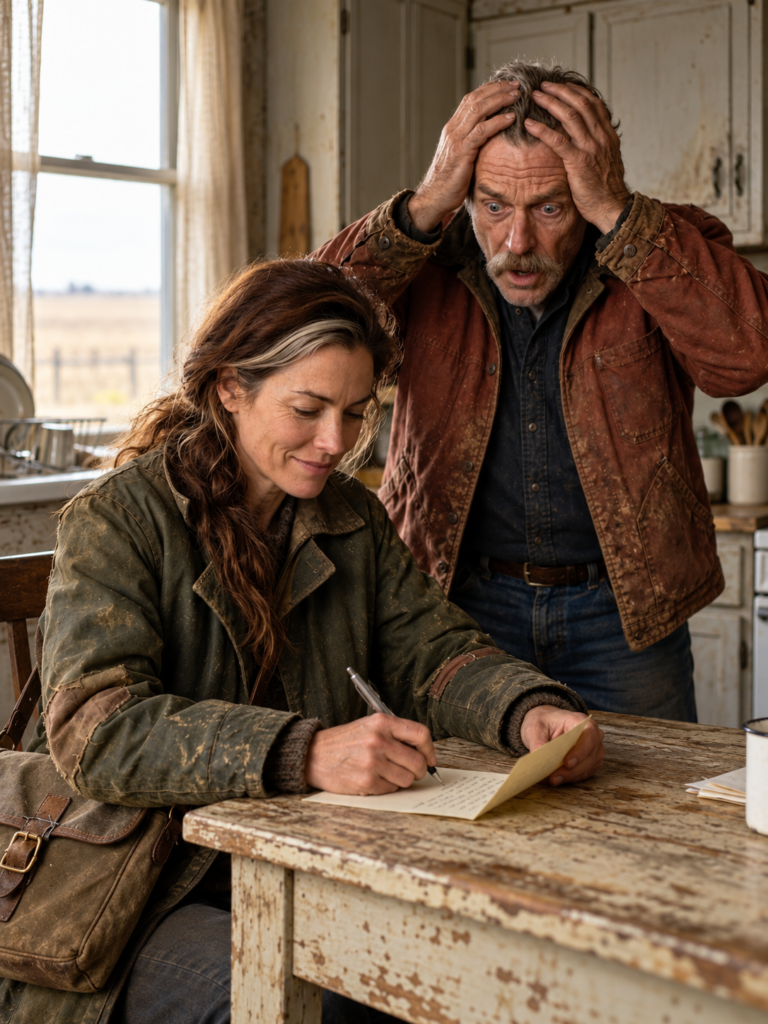
She wore a waxed cotton coat the color of old moss, patched at both elbows, and carried a canvas satchel with a brass clasp someone had mended with wire. A silver streak ran through her dark auburn hair as if one lock had been dipped in frost. She had walked four miles from the highway. She had not asked for money, a meal, or a ride.
Orin was fifty-seven, tall and stooped, with a gray handlebar mustache and a rust-red canvas jacket he had worn through three bad harvests. The farm was three hundred and twenty acres of winter wheat, a combine with a failing hydraulic pump, and a house that had been too quiet since his wife Ruth died six years ago. He could not afford a hired hand. He could not afford this.
“Where’d you sleep last night?”
“A culvert on County Road Nine.” She said it plainly, without asking for pity. “Mr. Drysbach, the pin by your gate. Do you know who surveyed it?”
He frowned. “It’s a fence pin.”
“No,” she said quietly. “It isn’t.”
He should have sent her on her way. But she did not lean on the gate, and she did not look past him toward the farmhouse where a stove might be burning. She stood like someone who had been turned away before and had decided not to take it personally.
“What’s your name?”
“Odessa.”
“Odessa what?”
“Just Odessa for now.”
He studied her. Then he did something that surprised them both. “Forty dollars a day, a cot in the old bunkhouse, and three meals. Wheat drilling starts Monday, and the east fence needs mending before then. If you steal from me, I’ll know by Tuesday.”
“If I steal from you,” she said, “you’ll know by lunch.”
It was almost a smile. She picked up her satchel and walked past him onto the property. At the gate post she stopped, touched the iron pin once more, and kept going.
That evening Orin watched her from the porch. She worked the east fence until dark, never asking for a break. Afterward she sat on the bunkhouse step with a pen and a stamped envelope, its corner worn soft from being carried, the address turned always inward. She wrote for a long time. Then she slipped the page into the satchel and did not mail it. Orin went to bed wondering what kind of person carries a stamped letter for months and never sends it.
In the morning he found out what kind of trouble he was in. The truck from the county courthouse had left a second certified letter. It was from a company called Altmiller Land and Grain. He read it standing at the mailbox with his coffee going cold. His farm had one way out. A mile-long gravel road, which everyone called Drysbach Lane, ran from his gate to the county road. His father had graded it. Orin had hauled every harvest down it for forty years. Ruth had planted lilacs along its last stretch, at the top of the hill where she was buried. Last spring Altmiller had bought the quarter section the lane crossed at a tax sale. A new survey, the letter said, proved the lane sat on Altmiller property. A title search found no recorded easement. On November first a locked gate would close the lane. At the bottom was an offer: three hundred and eighty thousand dollars for the farm in recognition of the challenges facing landlocked agricultural property. Landlocked land, everyone knew, sold for a third of its worth. The offer wasn’t generosity. It was arithmetic.
“I’ve used that lane fifty years,” he told the empty yard. “That makes it mine.”
“Does it?” Odessa had come up behind him with a roll of fence wire. She read the letter over his shoulder. “Using a road and owning the right to use it aren’t the same thing, Mr. Drysbach. Who did your father buy this farm from?”
“The Rennick outfit. Big ranch to the south. 1951.”
“Did he keep the paperwork?”
Orin shifted. Ruth had always handled the lawyers. After she died, reading paper had felt like grief. “There’s a tin box somewhere. I never opened it.”
Odessa nodded slowly, as though he had confirmed something she had already suspected.
Part 2
They spent the next three days drilling wheat, and Orin began to notice things that did not fit. When the tractor stalled in the north field she knelt, crumbled the soil in her fist, and told him the drill was set two inches too deep for the moisture. She was right. On the fourth morning she stopped at the east fence and walked it slowly, looking at the posts, not the wire.
“This fence is four feet inside the true line,” she said. “Whoever set it trusted a bad corner.”
“That fence has stood since my father’s time.”
“And that pin is a Rennick monument.” She pointed to the iron stake beside the gate. “See the stamp? RR 1951. Amos Rennick had his surveyor mark every corner that way. But the survey Altmiller sent you started from a different monument, the iron bar by the cattle guard at the section corner. I’d bet it’s off by sixty feet.”
Orin stared at her. “How in the world do you know that?”
“I spent a few years on a survey crew,” she said, “a long time ago.”
It was true, but it wasn’t all of the truth, and he knew it. He let it go because she handed him something else in the same breath. “Mr. Drysbach, is your property indexed at the courthouse by name or by legal description?”
“I don’t know. Why?”
“Because if a clerk once misspelled a name, a title search can miss a document that has been sitting there for seventy years.”
He looked at the stamped pin, then at the woman who had come to his gate with nothing. And for the first time he asked himself a different question. Who had actually been helped by this arrangement?
The next day Vance Altmiller drove up in a white pickup so clean it looked rented. He was forty-eight, calm, in a fleece vest with a company logo, and boots that had never met a feedlot. He did not raise his voice. He laid a tablet on the hood of his truck and showed Orin a map, a tax sale deed, and a title report.
“I’m not your enemy, Orin. I’m the only person offering you a way out. Take the money and retire.”
“My wife is buried at the top of that lane.”
“I’d preserve the cemetery in writing.”
It was a good answer. That was the dangerous part. Everything Altmiller said was reasonable, and everything he held was official.
“There’s no recorded easement,” he went on. “If you have one, show it to me.”
“I’m looking for it,” Orin said.
“Then look fast.”
Altmiller smiled at Odessa without recognition. “Ma’am, are you with the Drysbachs?”
“I work here.”
“Good for you.”
As he turned, his tablet swung toward her, and she saw the map on the screen. Dozens of parcels glowed green across the county. A thin red line ran straight through Orin’s farm to the county water district. The largest green block carried a label she read twice without moving. Rennick Ranch, receivership sale, DEC 14.
Altmiller didn’t want a farm. He wanted a corridor. Orin’s land was the missing piece of a water pipeline to the largest ranch in the county, and the lane was the leash that would bring Orin to heel.
After the white pickup disappeared, Odessa stood very still in the yard. “Odessa,” she said, then corrected herself. “Mr. Drysbach. I need you to take me to the courthouse.”
Part 3
The Mercer County Courthouse had a records room in the basement, and the records room belonged, in every way but title, to Ludie Gaskins. Ludie was eighty, retired for fifteen years, and still there three days a week, riding a mobility scooter between the shelves, with her glasses hanging from a beaded chain. She listened to Odessa’s request, gave her a long look through the thick lenses, and said, “Well, let’s find your deed.”
It took twenty minutes. The 1951 deed from Amos Rennick to Walter Drysbach was thin and brittle. On the second page one line read, “Subject to an easement for ingress and egress, as described in instrument recorded in book 14 of miscellaneous records.”
Ludie hauled book 14 onto the table. The index listed the instrument under the grantee name, D R E I S B O C K.
“There it is,” Ludie said. “Some clerk typed it wrong in 1951. Title searchers go by name, so a search for Drysbach would never find it.”
“So it doesn’t count?” Orin asked.
“I’m a clerk, not a judge. How a court treats an index mistake depends on your state and your facts. You’ll want a lawyer. What I can tell you is that the paper exists, and it’s been sitting here all along.”
She wheeled to a second shelf. “The lane runs across land Amos kept for himself. Who owns that now?” She pulled a plat book, then a computer printout from the Secretary of State. Odessa watched her read it.
“The strip is held by Rennick Land Company LLC,” Ludie said slowly. “Sole member of record.” She looked up over her glasses. “Odessa A. Rennick.”
Orin turned around.
“I worked beside your father at the county fair thirty years ago,” Ludie said to the woman in the moss-green coat. “You have his chin.”
Odessa let out a breath. “My name is Odessa Rennick. My father died three years ago. My uncle Gil sued the day after the funeral, claiming the land company had been transferred improperly. The court froze every account and appointed a receiver to sell the ranch to pay back taxes and legal fees.”
“The Rennick ranch,” Orin said. “That’s ten thousand acres.”
“Ten thousand forty. I own all of it on paper and I haven’t been able to spend a dollar of it, sell an acre of it, or borrow against it in three years.” She laughed short and bitter. “Land isn’t money, Mr. Drysbach. I paid lawyers until I had nothing left. Then I lost my apartment, then my car. I own ten thousand acres and couldn’t afford a motel room.”
“Why didn’t you say so the first day?”
“Because every time I told the truth it ended up in a courtroom.” Her voice cracked. “I stopped fighting. I came out here to see my grandfather’s house once, to say goodbye. Then I saw his pin on your gate and you didn’t ask me for anything first. You asked where I’d slept.”
Orin could think of nothing to say, so he said what he knew. “I don’t understand why you haven’t sent that letter.”
She stared at him. “How do you know about the letter?”
“I’m not blind.”
Odessa sat down on a chair beside book 14. “Because the day I send it I stop being a ghost,” she said. “I become the owner, and owners are responsible for everything.”
Orin made her coffee in Ruth’s kitchen that night and she wrote at Ruth’s table under the yellow light. This time she did not stop. A phone call would be a story, and stories were what Altmiller’s lawyers would pick apart. A sworn letter filed with the court and recorded with the county was a legal act that forced people to respond. It was addressed to Helen Aldis, the court-appointed receiver, with copies to the district court clerk and the register of deeds. It did three things. It formally claimed Odessa’s interest in the land company. It objected to the December fourteenth sale until Altmiller’s role was disclosed. And as owner of the land the lane crossed, it acknowledged the 1951 easement in writing and demanded that the receiver protect it.
Orin watched her sign it. “Your father,” he said carefully, “what did he tell you?”
“He said don’t let them sell it and don’t let them turn you into a fighter.” Her pen hovered. “I thought those two things couldn’t both be true.”
She signed. Ludie notarized it the next morning. By noon the letter was filed at the courthouse and mailed certified to the receiver.
Part 4
For two days nothing happened. On the third day Helen Aldis called Orin’s landline. Her voice was tired, careful, and absolutely clear. “Mr. Drysbach, I’ve placed a hold on any closure of Drysbach Lane. Until the court rules, Altmiller Land and Grain cannot lock that gate. The sale is also suspended while I verify Ms. Rennick’s claim.”
Orin leaned on the counter and let his shoulders drop for the first time in weeks. It did not last. Altmiller’s attorney filed a response within forty-eight hours. It called Odessa a transient with no verifiable documentation. It argued that an easement indexed under a misspelled name could not bind a buyer without notice. And it pointed to a clause in the original instrument: the easement lasted only so long as the land is farmed. “By all appearances,” the attorney wrote, “Mr. Drysbach is a failing operation.”
A hearing was set for October twenty-eighth, three days before the lane would otherwise be locked.
Then Altmiller came to the farm himself. He found Odessa alone by the bunkhouse. He didn’t threaten. He offered. “I’ll pay your back taxes and your legal fees. You’d walk away with a check. All you have to do is withdraw the objection and let the sale go through.”
It was the first real money anyone had put in front of her in three years, and she was sleeping on a cot in somebody else’s bunkhouse. She looked past him to the east fence she had mended with her own hands.
“No,” she said.
“May I ask why?”
“Because your pipeline needs a farm that doesn’t have a lane,” Odessa said, “and I know exactly who’s been working to make sure of that.”
For the first time Altmiller’s smile slipped.
That night Orin couldn’t sleep. At two in the morning he went to the tack room, pried up a loose board, and pulled out a rusted tin box he had not touched in six years. Inside were fifty years of Ruth’s handwriting, ledger after ledger, every harvest, every bushel, every truck that had rolled down Drysbach Lane. Beneath them, wrapped in a flour-sack cloth, lay the original instrument with Amos Rennick’s bold signature and a notary stamp. At the bottom, in pencil, in a hand Orin knew better than his own: “Walter says this paper is the most important thing we own. Keep it dry.”
Orin sat at the kitchen table until dawn. He was a man who had spent six years not reading paper, and he read every page.
On October twenty-eighth the Mercer County courtroom was nearly full. Helen Aldis presented the receiver’s findings. Ludie Gaskins testified about book 14. The Secretary of State’s record confirmed Odessa as sole member of the land company, and her father’s membership certificate, carried in the satchel’s lining for three years, matched it. Then Orin Drysbach took the stand. He was not a gifted speaker, but he laid Ruth’s ledgers on the rail, one volume at a time, and said, “She wrote down every harvest. My family has farmed that land continuously since 1951. The condition in that paper has never once been broken.”
Altmiller’s lawyer rose to cross-examine. He looked at the stack of ledgers, then at the instrument sealed in an evidence bag. Then he sat down.
The judge ruled from the bench that afternoon. The easement was valid and enforceable. The lane was part of the receivership property and could not be closed. Altmiller’s survey had placed the boundary fifty-eight feet from its true location, which also shrank his tax-sale parcel by eleven acres. The December fourteenth sale was vacated pending a plan to resolve the ranch’s debts.
Outside the courtroom Odessa stood at the top of the steps with her hands in her pockets. “We aren’t done,” she said. “The taxes are still owed. I still can’t spend a dollar.”
“Then we’re not done,” Orin said, “but we’re not losing the lane.”
Part 5
The ranch was saved in an unglamorous way. Over the winter Odessa and the receiver worked out a plan. She sold a conservation easement on six thousand acres to a regional land trust. The land could never be subdivided, but it could still be ranched and farmed, and the payment cleared the back taxes and legal fees. The receivership ended in March. She kept the land, the house, and for the first time in three years, the keys.
She also made Orin a proposal at Ruth’s kitchen table: a fair-market lease on twelve hundred acres of Rennick wheat ground, farmed on shares, not charity. A partnership. At the courthouse Odessa recorded a new instrument, a permanent easement for Drysbach Lane, correctly spelled and correctly indexed.
“Spell it right this time,” Ludie said, and stamped it herself.
Altmiller sold his parcel to the land trust at a loss. The pipeline was rerouted around the ranch at considerable cost.
On the first warm morning in April Orin walked the lane to the top of the hill. The lilacs were budding. He stood by Ruth’s grave for a while, then walked down to the gate where Odessa was waiting with a thermos of coffee. She had her hand on the old iron pin again, tracing the stamp, RR 1951.
“You still do that?” he said.
“Every gate.” She smiled. “My grandfather said you should always touch the corner before you enter a piece of land. It reminds you that someone drew a line and someone else was trusting it.”
A seventy-year-old pin, a misspelled name in a basement book, a tin box under a barn floor, a letter carried for months in a canvas satchel. None of it had been hidden. It had all been sitting in plain sight, waiting for someone to stop and read it.
Orin pushed open the gate and the two of them walked into the field. The wheat was up green and even. The east fence stood where she had set it true. Somewhere beyond the ridge the old Rennick house still waited, but the lane between them was open, and the wind that moved across the stubble no longer carried the sound of a gate that might close. They walked without speaking for a while, the way people walk when the work is not finished but the worst of it has been named and answered, and the ground under their boots is still theirs to cross.

