
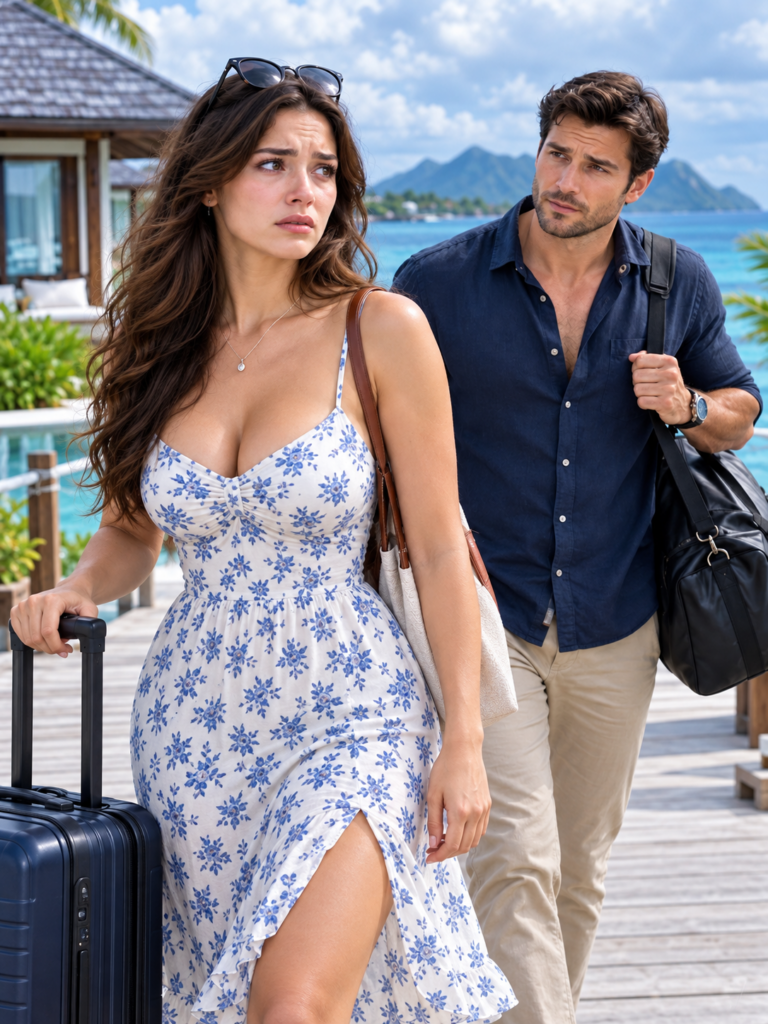
I was still taking the honeymoon after my fiancé left me—then my quiet single-dad neighbor saw my suitcase on the porch and said, “Don’t go alone. I’ll come with you…”
Part 1
The night before I was supposed to leave for my honeymoon, I sat on my front porch with a suitcase by the door, a glass of wine going warm beside me, and absolutely no husband to take with me.
Across the street, someone was dragging a trash can to the curb.
A dog barked two houses down.
Somewhere behind my neighbor’s fence, wind chimes tapped softly against one another.
Everything in the neighborhood sounded offensively normal.
Three weeks earlier, I had been arguing with a florist about whether ivory roses looked too yellow beside white hydrangeas.
Now I was calculating how many wedding deposits I had lost and wondering whether crying hard enough could actually make a person dehydrated.
My phone buzzed.
I looked down.
MOM.
I let it ring.
A second later, a text appeared.
Please reconsider. You don’t have to prove anything by going.
I stared at it until the screen went dark.
My mother meant well.
Everyone meant well.
My younger sister had offered to come sleep on my couch.
My best friend, Tessa, had offered to help me sell whatever parts of the trip were transferable.
My manager at the dental office had quietly reminded me that I could cancel my vacation request and come back to work if I needed somewhere to be.
Even Marcus’s mother had called me crying.
I hadn’t answered her either.
Because there were only so many times I could hear someone tell me they were sorry before the words began to feel like sandpaper.
I lifted my glass.
Empty.
Of course.
I laughed once.
It came out sounding terrible.
That was when the porch light next door came on.
I glanced toward the blue house on the other side of the fence.
Daniel Mercer stepped outside.
He was carrying a plastic grocery bag in one hand and wearing an old gray T-shirt and jeans.
I had lived beside Daniel for almost two years.
In all that time, I could probably count our real conversations on both hands.
We talked about trash pickup.
Snow shoveling.
A fallen tree branch.
The package delivery driver who kept confusing our house numbers.
He had once helped me jump-start my Honda before work.
I had once brought over a piece of mail that belonged to him.
That was basically the extent of our relationship.
But I knew things about him anyway.
Neighborhood things.
He had a seven-year-old daughter named Sophie.
He packed her lunch every morning.
He worked as an electrician for a commercial maintenance company downtown.
He left the house early, usually before seven, but somehow still managed to put Sophie’s hair into a ponytail most mornings.
He had a sister named Rachel who sometimes picked Sophie up after school.
And his wife had died.
Cancer.
Three years earlier.
I knew that part because people always knew those things.
Daniel crossed his yard.
For a second, I thought he was going to his car.
Then he walked toward my porch.
I quickly wiped my face with the back of my hand.
It did absolutely nothing.
He stopped at the bottom step.
His eyes moved from me to the suitcase beside the door.
Then to the wineglass.
Then back to me.
“You okay?”
I stared at him.
He gave the smallest wince.
“Bad question.”
“Very.”
“Sorry.”
“It’s fine.”
He hesitated.
Daniel had always struck me as someone who understood silence.
He didn’t rush to fill it.
That night, I appreciated that more than he could possibly have known.
Finally, he nodded toward the suitcase.
“You’re leaving tomorrow?”
I looked at it too.
“That was the plan.”
“For the trip?”
“The honeymoon.”
His jaw tightened.
Apparently he knew.
Everyone knew.
Marcus and I had been together for five years.
Our wedding invitations had gone to half the neighborhood because my mother believed excluding people was a form of social violence.
Three weeks before the ceremony, Marcus had come home after work, sat across from me at our kitchen table, and told me there was someone else.
No shouting.
No dramatic confession.
No plate smashed against the wall.
He simply folded his hands and said, “I don’t think I can do this anymore.”
I remembered staring at him and thinking he meant the argument we’d had the night before.
Then he said her name.
Vanessa.
Someone from his office.
Someone who, according to Marcus, “understood where he was in life.”
Apparently I had spent five years misunderstanding him.
I slid off my engagement ring.
Placed it between us.
He stared at it.
I waited for him to change his mind.
He didn’t.
He packed two bags and left before midnight.
The wedding disappeared in stages after that.
First the ceremony.
Then the caterer.
Then the band.
Then the photographer.
Then two hundred and twelve guests received the most humiliating group email I had ever sent.
But Santorini remained.
The villa had been prepaid.
Most of the reservations were non-refundable.
My plane ticket could be changed, but there was no refund.
Marcus’s ticket was useless because airline tickets weren’t transferable.
The money we had spent on it was simply gone.
Nearly four thousand dollars between airfare, hotel deposits, ferries, and activities.
Four thousand dollars was not money I could casually throw away.
Not after losing wedding deposits too.
Not on a dental receptionist’s salary.
So I had decided to go.
At least that was what I kept telling people.
The truth was more complicated.
I needed to prove that Marcus had not taken every future I’d imagined with him when he walked out the door.
Daniel leaned against the porch railing.
“Santorini, right?”
I looked up.
“How do you know that?”
He pointed vaguely toward my mailbox.
“You had a travel company envelope sticking out of it a few months ago. Big blue domes on the front.”
“That’s weirdly observant.”
“I fix electrical systems for a living. Noticing things is basically the job.”
Despite myself, I smiled.
It surprised me.
Daniel noticed too but didn’t comment.
“You going alone?”
“That’s generally what happens when the groom sleeps with someone from accounting.”
Daniel looked down.
“Marketing.”
“What?”
“I heard she was in marketing.”
I stared at him.
He immediately straightened.
“Rachel heard it from someone. I’m sorry. That was… incredibly inappropriate.”
For the first time in weeks, I laughed.
Actually laughed.
It hurt my ribs.
Daniel smiled cautiously.
“Glad my social incompetence helped.”
I wiped under my eyes.
“Vanessa is in brand strategy.”
“There you go. Rachel’s sources are unreliable.”
The laughter disappeared slowly.
Then the quiet returned.
Daniel looked toward his house.
Behind the front curtains, I could see the faint glow of the television.
“Sophie’s at my sister’s tonight,” he said.
I nodded.
He shoved his hands into his pockets.
“I remember the first trip Claire and I planned after Sophie was born.”
I knew immediately that Claire was his wife.
“We were going to Maine. Nothing fancy. Just a little rental near Bar Harbor.”
His voice had changed.
Softer now.
“She got sick before we could go. We kept rescheduling because we thought there’d be time later.”
He stared at the street.
“There wasn’t.”
I didn’t know what to say.
So I said nothing.
Daniel seemed grateful.
After a moment, he looked at me again.
“Don’t cancel because everyone thinks you’re supposed to stay home and be devastated.”
“I am devastated.”
“Then be devastated in Greece.”
I almost smiled again.
“That’s terrible advice.”
“Probably.”
I wrapped my arms around myself.
“The problem is I imagined every second of that trip with him.”
“I know.”
“No, you don’t.”
The words came sharper than I intended.
Daniel didn’t flinch.
I looked away.
“I’m sorry.”
“You don’t have to apologize.”
“I’m just…”
I swallowed.
“The villa has a terrace where we were supposed to have breakfast after the wedding. I booked a sunset cruise because Marcus hates boats but promised he’d do it for me. There’s a restaurant reservation for two on Tuesday.”
My voice began shaking.
“And I know how stupid those things sound compared to what you went through.”
“Don’t do that.”
I looked at him.
“Do what?”
“Measure your pain against mine.”
He said it gently.
“Someone doesn’t have to die for you to grieve the life you thought you had.”
That broke something in me.
I pressed the heel of my hand against my eyes.
“I hate him.”
Daniel waited.
“And I still miss him.”
“I know.”
“I hate that I miss him.”
“That part I know too.”
I looked at him again.
For the first time, I saw something behind the quiet neighbor I thought I knew.
Not sadness exactly.
A scar where sadness had lived so long that it had become part of his face.
He glanced at the suitcase.
“You shouldn’t have to go alone if you don’t want to.”
I sniffed.
“Unfortunately, the airline refuses to provide replacement husbands.”
His mouth twitched.
“I’ll go.”
I thought I had misheard him.
“What?”
“I’ll go with you.”
I actually stared.
Daniel seemed to realize how insane the sentence sounded only after saying it.
He rubbed the back of his neck.
“I have vacation time.”
“That’s not the issue.”
“Rachel can keep Sophie for a week.”
“Daniel.”
“I’ve got enough airline miles to cover most of a ticket.”
“Daniel.”
He stopped.
“We barely know each other.”
“I know.”
“You’re my neighbor.”
“I know that too.”
“You have a child.”
“She would not be coming.”
“Obviously.”
“Just clarifying.”
I stood.
The porch tilted slightly.
Too much wine.
Too little food.
Way too much emotional trauma.
“You cannot casually volunteer to join someone else’s honeymoon.”
“Canceled honeymoon.”
“That distinction does not improve this.”
“I didn’t say we had to pretend to be married.”
“Thank God.”
“Separate rooms.”
“The villa has two bedrooms.”
“Good.”
“You’ve really thought this through for the past thirty seconds, haven’t you?”
“Not particularly.”
I stared at him.
He smiled once, but there was nervousness underneath it.
Then he became serious.
“Look, Elena. I’m not trying to make this weird.”
“It’s already deeply weird.”
“Fair.”
He took a breath.
“I haven’t gone anywhere since Claire died.”
That stopped me.
“Not really. Work trips. Sophie’s soccer tournaments. Rachel’s place at Thanksgiving. That’s it.”
He looked toward the blue house.
“I keep telling Sophie we’ll travel someday. That I’ll take her to see places Claire talked about.”
“Then take Sophie.”
“I will.”
He paused.
“But maybe I need to remember how to leave first.”
The sentence hung between us.
Suddenly his offer didn’t feel like a rescue.
It felt like two people standing at the edge of different broken things.
I sat down again.
Daniel remained at the bottom of the steps.
“This is crazy,” I whispered.
“Absolutely.”
“My mother would lose her mind.”
“Mine would too, if she were still alive. That’s usually not a good enough reason to avoid something.”
“What if we hate each other?”
“We live next door. We can return to waving politely while taking out the trash.”
“What if it’s awkward?”
“It will definitely be awkward.”
“What if I spend the whole trip crying about Marcus?”
“I’ve survived a seven-year-old crying for forty-five minutes because I cut her grilled cheese diagonally instead of straight.”
I stared at him.
“That happened?”
“Last Tuesday.”
I laughed again.
And because heartbreak makes sane decisions feel strangely optional, I heard myself say:
“Okay.”
Daniel blinked.
“Okay?”
“You can come.”
His eyebrows lifted.
“Really?”
“Before I regain judgment.”
He smiled.
Not the polite smile from the driveway.
A real one.
It changed his whole face.
“I should probably go book a plane ticket.”
“You probably should.”
He turned.
“Daniel?”
He looked back.
“This isn’t a date.”
“I know.”
“It’s not a rebound.”
“Understood.”
“And if you murder me and throw me into the Aegean Sea, Rachel will know where you are.”
“That seems fair.”
He walked back across the lawn.
I watched him disappear into his house.
Then I looked at the suitcase by my door.
For the first time since Marcus left, tomorrow didn’t feel like something I had to survive.
It felt uncertain.
Which, strangely, was better.
Daniel knocked on my door at five forty the next morning.
He carried one duffel bag.
One backpack.
And two coffees.
I opened the door wearing sweatpants and panic.
“You’re early.”
“You said six.”
“It’s five forty.”
“I’m a dad.”
“That explains nothing.”
“It explains everything.”
He handed me coffee.
“I didn’t know your order, so I got plain latte.”
I took it.
“That is my order.”
He frowned.
“Seriously?”
“Yes.”
“Well, that’s unsettling.”
A horn sounded outside.
Rachel leaned over the steering wheel of a minivan.
Sophie was in the backseat waving violently.
Daniel looked embarrassed.
“She insisted on seeing us off.”
Sophie rolled down the window.
“DAD!”
“It’s five forty-five in the morning,” he called.
“I MADE RULES!”
Daniel closed his eyes.
“Oh no.”
She jumped out holding a folded sheet of notebook paper.
She had Daniel’s dark hair and Claire’s eyes—I knew that only from the framed photograph I’d once glimpsed through their front window.
Sophie ran up the driveway in pajama pants and sneakers.
She shoved the paper at her father.
“For Greece.”
Daniel unfolded it.
At the top, in purple marker, she had written:
DAD VACATION RULES.
-
BRING ME A BLUE ROCK.
DO NOT GET SUNBURN.
TAKE PICTURES.
HAVE FUN EVEN IF YOU FEEL BAD ABOUT HAVING FUN.
Daniel’s expression changed at number four.
Rachel stepped out of the minivan.
“That one was her idea.”
Sophie looked at me.
I suddenly felt as if I were being interviewed by a very small parole board.
“You’re Elena.”
“Yes.”
“You live next door.”
“Yes.”
“You were supposed to get married.”
Rachel inhaled sharply.
“Sophie.”
“What? Everybody knows.”
Daniel covered his face.
I bit back a laugh.
“Yes,” I said. “I was.”
Sophie studied me.
“Dad said you’re sad.”
Daniel looked ready to crawl underneath the car.
“I have been,” I said.
She nodded thoughtfully.
“Dad gets sad too.”
The driveway went quiet.
Then Sophie pointed at the paper.
“That’s why rule four is important.”
Daniel crouched and hugged her.
He held on longer than she expected.
Eventually Sophie patted his back.
“Dad. Breathing.”
He released her.
“Right.”
She turned to me.
“Make sure he has fun.”
I glanced at Daniel.
“I’ll do my best.”
“And blue rock.”
“Highest priority.”
That was how our canceled honeymoon began.
Not romantically.
Not beautifully.
But with terrible airport coffee, a child’s handwritten rules, and two people who had absolutely no idea what they were walking toward.
Part 2
The first problem happened before we even left the country.
My suitcase was nine pounds overweight.
Daniel watched the airline employee attach the orange HEAVY tag.
“You packed for seven days?”
“I packed for the honeymoon.”
“What’s the difference?”
I stared at him.
“There are outfits.”
“Apparently several dozen.”
“Don’t start.”
“I brought three shirts.”
“That explains why your bag looks like you’re fleeing a minor crime.”
The airline agent tried not to smile.
I paid the overweight fee while silently adding it to the growing list of financial consequences Marcus had left behind.
Wedding cancellation fees.
Half the final month’s rent on the apartment he had abandoned.
A hotel block deposit I hadn’t recovered yet.
Now this.
Daniel noticed my face as I put my credit card away.
“How bad?”
“Fine.”
“Elena.”
“One hundred dollars.”
He winced.
“Want to move some things into my bag?”
“No.”
“I have space.”
“No.”
“That sounded weirdly aggressive.”
“I am aggressively independent.”
“I’ve noticed.”
We made it through security and reached the gate with forty minutes to spare.
Daniel bought a muffin.
I checked my banking app.
Checking: $2,184.17.
Savings: $6,602.41.
Three months earlier, those numbers would have looked comfortable.
Now I saw dental bills, rent, cancellation penalties, and the balance on the credit card I had used for wedding deposits.
Daniel sat beside me.
“Stop looking at it.”
I locked my phone.
“At what?”
“Whatever number is making your forehead do that.”
“My forehead does nothing.”
“It’s doing a lot.”
“Do you always watch people this closely?”
“Occupational hazard.”
“You’re an electrician, not a detective.”
“I troubleshoot systems. Humans are just more poorly labeled.”
I looked at him.
“That may be the least romantic sentence anyone has ever said at an airport.”
He nearly choked on his muffin.
“We’re not being romantic.”
“Exactly.”
And yet when the boarding announcement came, I smiled.
The flight was almost eleven hours to Athens, plus a connection.
Somewhere over the Atlantic, the strange situation stopped being funny and became real.
Daniel was beside me.
Marcus wasn’t.
The realization hit without warning.
I had been watching a movie and suddenly couldn’t hear any of it.
Daniel noticed.
“You okay?”
I nodded automatically.
Then shook my head.
He waited.
“The last time I booked seats for this flight, his name was beside mine.”
Daniel looked at the seat-back screen.
“Do you want me to move?”
“What?”
“If having someone here makes it worse, I can see whether there’s another seat.”
That was the moment I began to understand him.
He wasn’t trying to insert himself into the empty space Marcus had left.
He was willing to leave the space empty.
I shook my head.
“No. Stay.”
So he stayed.
Hours later, while most of the cabin slept, we talked.
At first about easy things.
Work.
Neighbors.
Sophie.
Daniel told me he had learned to braid hair from online videos after Claire got sick.
His first attempt had apparently been so bad that Sophie had worn a winter hat to kindergarten in September.
I told him about my boss, Dr. Patterson, who refused to replace the twenty-year-old coffee machine in the staff room because “they don’t make appliances with integrity anymore.”
Daniel laughed.
Then the conversation changed.
“Marcus always wanted kids,” I said quietly.
Daniel looked toward me.
“So did I.”
“Did?”
I played with the edge of the airline blanket.
“I don’t know anymore.”
“Because of him?”
“Because I built everything around him.”
That was hard to admit.
“We started dating when I was twenty-four. I wanted to go back to school eventually. Maybe dental hygiene. Better pay. More responsibility.”
“What stopped you?”
“Nothing dramatic.”
That answer embarrassed me more than a dramatic one would have.
“Marcus got promoted. His schedule got harder. Then we were saving for a wedding. Then he wanted a bigger apartment.”
I shrugged.
“There was always a reason to wait.”
Daniel was quiet.
“Claire wanted to open a bakery.”
I turned toward him.
“She was good?”
“Terrifyingly good.”
He smiled at the memory.
“She made sourdough before everybody on the internet decided sourdough was a personality.”
I laughed softly.
“She kept saying she’d do it when Sophie started school.”
His smile faded.
“She never got the chance.”
For a while, neither of us spoke.
Then Daniel said, “Waiting makes sense until it doesn’t.”
I looked at him.
He wasn’t offering advice.
He was talking to himself too.
When we landed in Athens, we were exhausted enough to stop worrying about awkwardness.
We missed a shuttle.
Daniel lost his sunglasses.
I almost left my passport at a café table.
By the time we boarded the short flight to Santorini, we were operating like people who had known each other longer than twenty-four hours.
Then the island appeared beneath the plane.
Blue.
White.
Gold.
The Aegean stretched farther than I could comprehend.
I pressed my face closer to the window.
“Oh my God.”
Daniel leaned slightly to see.
For a few seconds, neither of us spoke.
Everything I had imagined was there.
And that hurt.
But something else was there too.
I had still come.
Our villa sat above the cliffs in Oia, reached by a narrow walkway and enough stairs to make me question every item in my suitcase.
An older woman named Marina met us at the entrance.
She had silver hair pinned loosely behind her head and the rapid, efficient energy of someone who had been managing tourists for decades.
“Mr. and Mrs. Bennett?”
My stomach dropped.
Daniel reacted immediately.
“Mercer.”
Marina looked at the reservation.
“Ah.”
I swallowed.
“The booking was originally under Elena Bennett and Marcus Hale.”
Daniel stepped slightly away from me—not dramatically, just enough to give me room.
Marina understood faster than most people back home had.
She crossed out Marcus’s name.
“No problem.”
That was it.
No pity.
No questions.
She handed me the key.
The villa was beautiful.
Painfully beautiful.
White walls.
Arched doorways.
Two bedrooms.
A terrace overlooking the caldera.
A little plunge pool reflecting the sky.
On the kitchen counter sat a chilled bottle of champagne beside a card.
WELCOME, NEWLYWEDS.
I froze.
Daniel saw it.
Without saying anything, he picked up the card, folded it once, and slipped it into a drawer.
Then he looked at the champagne.
“Still good champagne.”
I started laughing.
Not because it was funny.
Because otherwise I might have cried.
“Open it.”
“You sure?”
“Absolutely.”
He popped the cork.
It hit the ceiling.
Marina shouted something from outside.
Daniel called, “Sorry!”
I laughed harder.
That first night, we ate gyros from a paper bag on the terrace.
No formal dinner.
No honeymoon clothes.
No carefully planned romantic beginning.
Just two tired people watching the sun disappear into the sea.
After a while, I cried.
Quietly.
I hated that Daniel noticed.
But of course he did.
“I’m sorry.”
He frowned.
“For what?”
“This.”
“Crying?”
“Yes.”
“That seems allowed.”
“I feel ridiculous.”
Daniel stared toward the horizon.
“She would have loved this.”
I knew immediately who he meant.
Claire.
Instead of making me feel uncomfortable, the sentence gave me permission to say the thing I had been avoiding.
“Marcus would’ve complained about the stairs.”
Daniel looked at me.
“He hated walking.”
“Then Greece was an interesting honeymoon choice.”
“I was in charge.”
“Clearly.”
We sat with our ghosts between us.
Neither of us asked the other to pretend they weren’t there.
The next morning, I woke before Daniel.
For ten seconds, I forgot everything.
Then memory arrived.
The wedding.
Marcus.
Santorini.
Daniel.
I walked onto the terrace.
Daniel was already there.
He was on a video call with Sophie.
His voice was quiet.
“I know.”
Pause.
“No, I haven’t found a blue rock yet.”
Pause.
“I arrived twelve hours ago.”
Pause.
“No, that is not an excuse.”
I leaned against the doorway.
Daniel saw me.
“Sophie says I’m failing the assignment.”
“Tell her I’ll supervise.”
Sophie’s face appeared on the screen.
“Elena!”
“Good morning.”
“It’s nighttime here.”
“Then good night.”
“Did Dad have fun?”
I looked at him.
Daniel lifted an eyebrow.
“He shot a champagne cork into the ceiling.”
Sophie screamed with laughter.
“Dad!”
“It was an accident.”
“That means yes.”
After the call ended, Daniel stared at the dark phone screen for a second longer than necessary.
“You miss her.”
“Constantly.”
“You can go home early.”
“No.”
“Daniel.”
He looked at me.
“I miss Sophie when I’m at work too. Missing someone doesn’t mean you’re in the wrong place.”
That stayed with me.
We spent the day exploring.
We rented an ATV.
I insisted on driving first.
Daniel lasted exactly four minutes before asking to switch.
“You’re gripping the seat.”
“I value my life.”
“I’m going twenty miles an hour.”
“You took a turn like you were being pursued.”
“We were being pursued.”
“By what?”
“A bus.”
“The bus was behind us because roads work that way.”
I surrendered the handlebars.
Daniel drove.
On a steep curve outside Imerovigli, I grabbed his waist without thinking.
He stiffened.
So did I.
Neither of us said anything.
I kept my hands there.
We drove through villages washed white in the sun.
Stopped at a bakery where Daniel bought three pastries because he couldn’t choose.
Walked along a cliff path with the sea glowing below us.
For a few hours, I forgot to be abandoned.
That evening, guilt followed.
I stood in my bedroom looking at photographs on my phone.
Daniel laughing with pastry sugar on his shirt.
The ocean.
The blue domes.
A stray cat asleep on a wall.
I had enjoyed the day.
Actually enjoyed it.
And some broken part of me felt disloyal.
As if being happy proved I had never loved Marcus enough.
I almost texted him.
I opened our conversation.
The last message from him was still there.
I’m sorry for how everything happened. I hope someday you understand.
I typed:
I’m in Santorini.
Then deleted it.
Typed:
I hope she was worth it.
Deleted that too.
Finally, I locked the phone.
A knock came at my door.
“Elena?”
“Yeah?”
“I’m walking to get dinner. You want anything?”
I opened the door.
Daniel looked at my face.
He didn’t ask.
“Something with cheese,” I said.
“That covers approximately ninety percent of Greece.”
“Surprise me.”
He returned with food, and we ate in silence.
The next two days changed the rhythm between us.
Not dramatically.
That was what made it dangerous.
Daniel learned I hated olives but kept forgetting and ordering dishes containing them.
I learned he woke early even on vacation.
He learned I talked in my sleep when stressed.
I learned he checked his work email even though his supervisor had specifically told him not to.
He learned I had been quietly researching dental hygiene programs for over a year.
“You should apply,” he said.
We were sitting at a café in Fira.
I stirred iced coffee.
“It’s eighteen months.”
“So?”
“Tuition.”
“Loans exist.”
“Terrible sales pitch.”
“Scholarships exist.”
“My schedule.”
“Schedules change.”
I looked at him.
“You make everything sound easy.”
“No.”
Daniel leaned back.
“I just know ‘later’ is not a date.”
That annoyed me because it was true.
I changed the subject.
“What about you?”
“What about me?”
“You keep talking about things I should do. What are you not doing?”
He was quiet.
Too quiet.
I knew I had found something.
Finally he said, “My company offered me a supervisor position last year.”
“And?”
“I turned it down.”
“Why?”
“More hours.”
“More money?”
“About fifteen thousand more.”
I nearly dropped my spoon.
“Daniel.”
“Sophie was having trouble at school. Nightmares. Separation anxiety.”
“So you said no.”
“Yes.”
“Do you regret it?”
He looked toward the street.
“I regret that every decision feels like choosing between being a good father and being a person.”
The words hit harder than he intended.
He looked embarrassed after saying them.
I understood immediately.
Because I had spent years choosing between being a good partner and being myself.
“Maybe those aren’t supposed to be different people,” I said.
Daniel looked at me.
Something shifted.
Then my phone rang.
Marcus.
His name filled the screen.
Every part of my body went cold.
Daniel saw it.
“I can go.”
“No.”
He stood anyway.
“I’m going to pay.”
“You don’t have to.”
“I know.”
He walked inside.
I stared at the phone until the call ended.
Then it rang again.
I answered.
“What?”
“Elena?”
Marcus’s voice.
Familiar enough to hurt.
“I heard you went.”
I looked through the café window.
Daniel was at the counter talking to the cashier.
“How?”
“Tessa posted a picture.”
Of course she had.
“I’m in Greece.”
“With someone?”
The question made anger move through me.
“That stopped being your business three weeks ago.”
“Elena, I wasn’t—”
“You left me for someone else.”
“I know.”
“No. You say that like we misplaced luggage.”
People at the next table glanced over.
I lowered my voice.
“You humiliated me.”
“I’m sorry.”
“Then stop checking whether I’m still miserable enough for you.”
Silence.
Marcus breathed out.
“I just wanted to know you were okay.”
I watched Daniel through the glass.
He wasn’t looking at me.
Giving me privacy.
“I don’t know if I’m okay,” I said.
That was the truth.
“But I’m here.”
I ended the call.
My hands shook.
Daniel returned.
He set a bottle of water in front of me.
I looked at it.
“You bought me water?”
“You looked like you needed something to do with your hands.”
I almost cried.
Instead, I drank.
The pottery shop happened the next afternoon.
It was tiny.
Blue bowls lined the walls.
Ceramic bells hung near the door.
A young couple stood beside the register trying on handmade rings.
The woman laughed.
The man kissed her hand.
That was all.
Nothing cruel.
Nothing unusual.
But suddenly I was back in a jewelry store with Marcus.
He was sliding a ring onto my finger.
My mother was crying.
The salesperson was bringing champagne.
Marcus was saying, “That’s the one.”
My breathing changed.
I stepped backward.
My hip hit a display.
A bowl fell.
Daniel caught one.
Another shattered.
Everyone turned.
“I’m sorry.”
My face burned.
“I’m so sorry.”
The shop owner said something reassuring, but I couldn’t hear.
I put money on the counter and walked outside.
Then walked faster.
I didn’t stop until I reached a low wall overlooking the sea.
My hands were shaking so badly I couldn’t unlock my phone.
Daniel appeared a minute later.
He sat beside me.
No questions.
No touching.
Nothing.
Finally I said, “This is pathetic.”
“No.”
“I saw rings.”
“I know.”
“And completely lost it.”
“You broke a bowl.”
“Two.”
“I caught one.”
“Congratulations.”
He almost smiled.
Then he said, “You don’t have to be okay because the view is pretty.”
That sentence destroyed the last of my defenses.
I told him everything.
Not the polished version I had given friends.
The ugly version.
The months of Marcus coming home later.
The password he changed.
The dinners he canceled.
The way I sensed distance and responded by trying harder.
Cooking things he liked.
Planning date nights.
Making myself less demanding.
Less emotional.
Less complicated.
“I thought if I could become easier to love, he’d stay.”
Daniel looked furious.
Not at me.
At the idea.
“I stopped talking about school because he said we couldn’t afford it.”
My voice shook.
“I stopped asking him to come to my family dinners because he always seemed tired.”
I wiped my face.
“I kept shrinking my life until it fit around his.”
Daniel stared at the water.
“And he still left.”
“Yes.”
A long silence.
Then he said, “After Claire died, there were mornings I couldn’t get out of bed.”
I looked at him.
“Sophie was four.”
He rubbed his hands together.
“One week, her teacher called because I forgot her lunch three times.”
He laughed once, bitterly.
“I had food. I had money. I just couldn’t think.”
He swallowed.
“Rachel started showing up every morning because she didn’t trust me to function.”
“You were grieving.”
“I was drowning.”
His eyes were fixed ahead.
“And the worst part was everyone calling me strong.”
I understood.
“Because you didn’t feel strong.”
“I felt like a fraud.”
The wind moved through his hair.
“I thought being a good father meant Sophie could never see me fall apart. So I stopped talking about Claire. Packed away pictures. Stopped playing music Claire liked.”
He exhaled slowly.
“Then one day Sophie asked if Mommy had become a secret.”
My throat tightened.
“She said that?”
Daniel nodded.
“She thought I had stopped saying Claire’s name because we weren’t allowed to anymore.”
He looked down.
“That was when I realized protecting her from grief was teaching her to be ashamed of it.”
We sat beside each other.
Two strangers who weren’t strangers anymore.
“I’m scared,” I admitted.
“Of what?”
“That I’ll go home and become the person I was again.”
Daniel turned toward me.
“Then don’t.”
“That sounds very simple.”
“It isn’t.”
He held my gaze.
“But you’re allowed to change your mind about the life you want.”
Neither of us looked away.
For one dangerous second, I thought he might kiss me.
I wanted him to.
That frightened me so badly I stood.
“We should go.”
Daniel nodded.
“Yeah.”
We walked back separately.
The next day we barely touched.
Which meant I noticed every time we almost did.
Our hands brushing when he passed me sunscreen.
His palm near my back as we descended steep steps.
My knee against his beneath a restaurant table.
That night, we stayed out until most of Oia had gone quiet.
Strings of lights hung above narrow streets.
Music drifted faintly from somewhere uphill.
I had taken off my sandals and was carrying them because my feet hurt.
Daniel held my bag.
“You know,” I said, “this is technically theft.”
“What?”
“You have my purse.”
“You asked me to hold it.”
“There’s no documentation.”
“I’ll take my chances.”
We walked another block.
My hand brushed his.
Then again.
The third time, his fingers closed around mine.
We both stopped.
Daniel looked down at our hands.
Then at me.
“I can let go.”
I knew what he was really asking.
I tightened my fingers.
“Don’t.”
So he didn’t.
Part 3
On the sixth day, we hiked Nea Kameni.
The volcanic island looked almost unreal against the sea—dark rock, dry wind, a trail climbing toward the crater.
By then, Daniel and I had stopped pretending nothing was happening.
We hadn’t kissed.
Hadn’t discussed the future.
Hadn’t defined anything.
But we walked close.
Sat close.
Looked for each other whenever we entered a room.
That morning, Daniel received a video from Sophie.
She had lost a tooth.
In the video, she held it triumphantly toward the camera.
“THE TOOTH FAIRY BETTER KNOW RACHEL’S ADDRESS.”
Daniel laughed so loudly that a couple on the ferry turned toward us.
I watched his face.
And suddenly the reality of him hit me.
Daniel didn’t come alone.
Not emotionally.
Loving him—if that was where this was going—would mean Sophie.
Claire’s memory.
School mornings.
Soccer practices.
Nightmares.
A child who had already lost one mother.
It would mean consequences.
I became quiet.
Daniel noticed during the hike.
“You okay?”
“Fine.”
“You’re doing the forehead thing.”
“I hate that you know about the forehead thing.”
“Too late.”
We kept climbing.
At the top, the view opened around us.
The crater below.
Santorini across the water.
Boats cutting white lines through the blue.
And without warning, I started crying.
Again.
Daniel didn’t joke this time.
“What happened?”
I shook my head.
“I don’t know.”
He waited.
“I was supposed to stand here with Marcus.”
The words came out almost angrily.
“I know.”
“We were supposed to come back in ten years.”
My chest tightened.
“We talked about bringing our kids.”
Daniel looked toward me.
“I had names.”
I laughed through tears.
“How stupid is that?”
“Not stupid.”
“A house too.”
My voice cracked.
“Blue front door. Small yard. Marcus wanted a grill he would probably never clean.”
Daniel smiled faintly.
I kept going because stopping hurt more.
“I had Christmas mornings. Anniversaries. Arguments about schools. Retirement.”
I wiped my face.
“I had an entire imaginary life.”
Daniel stood beside me.
“And now it’s gone.”
The wind carried the words away.
He was silent for a long moment.
Then he said, “You’re allowed to want a different future now.”
I looked at him.
“One that has room for you exactly as you are.”
My breath caught.
Not because the words were romantic.
Because they weren’t.
He wasn’t asking me to choose him.
He was asking me to choose myself.
I laughed weakly.
“You practice these speeches?”
“No. Usually I communicate through circuit diagrams.”
I smiled.
Then I looked at him.
“What happens when we go home?”
His expression changed.
There it was.
The question we had both been avoiding.
“I don’t know.”
“That scares me.”
“Me too.”
“I don’t want this to be something we only did because we were in Greece.”
“Neither do I.”
“I don’t want you to wake up in two weeks and realize this was grief.”
Daniel looked away toward the water.
“That’s possible.”
The honesty hurt.
He continued.
“I’m scared Sophie will get attached.”
I nodded.
“She has already lost someone.”
“Yes.”
“I would never want—”
“I know.”
He rubbed his thumb over his palm.
“I’m also scared that I’m doing this because being with you feels like being alive again.”
I stared at him.
“And somehow that feels unfair to Claire.”
There it was.
His version of my guilt.
I stepped closer.
“Did you love her?”
“Yes.”
“Do you still?”
His eyes filled.
“Yes.”
“Then maybe loving her isn’t the problem.”
He looked at me.
“Maybe thinking you have to stop loving her before you can love anything else is.”
Neither of us spoke.
Then Daniel smiled.
A small, sad, grateful smile.
“That sounded suspiciously wise.”
“Don’t get used to it.”
We walked back down the volcano together.
That night, neither of us wanted dinner.
We sat on the villa terrace as the sky darkened.
Purple.
Then navy.
Then black scattered with stars.
The lights of boats moved across the water below.
Daniel had found Sophie’s blue stone that afternoon.
It sat between us on the table.
Smooth.
Deep blue-gray.
Ordinary enough that another person might have walked past it.
Important because someone had asked him to bring it home.
“I almost didn’t ask to come,” he said.
I turned toward him.
“What changed your mind?”
He smiled.
“Honestly?”
“Yes.”
“I heard you crying.”
I covered my face.
“Oh God.”
“Not that part.”
“You heard porch crying?”
“The neighborhood heard porch crying.”
“Daniel.”
“I’m kidding.”
I shoved his shoulder.
He laughed.
Then became serious.
“I looked out the window and saw the suitcase.”
He paused.
“And I remembered Claire.”
I waited.
“The last months she was sick, she used to make lists of things she wanted Sophie and me to do.”
“Like what?”
“Go to Yellowstone. Learn to ski. See the ocean on the West Coast.”
He rubbed his jaw.
“Date again.”
I looked at him.
“She put that on the list?”
“Underlined it.”
I smiled.
“That sounds like someone who knew you.”
“She also wrote, ‘Do not wear those terrible cargo shorts forever.’”
I laughed.
“She sounds incredible.”
“She was.”
No awkwardness.
No jealousy.
Just truth.
Daniel continued.
“I ignored most of the list.”
“Why?”
“Because doing those things felt like moving away from her.”
He looked at me.
“Then I saw you sitting there, about to cancel something you’d dreamed about because the person you planned it with was gone.”
The word gone meant different things for us.
But I understood.
“And I thought maybe we were making the same mistake.”
My throat tightened.
“Daniel.”
“I’m not saying this trip fixed anything.”
“It didn’t.”
“I still miss Claire.”
“I still hate Marcus.”
“Reasonable.”
“And sometimes miss him.”
“Also reasonable.”
I looked at the sea.
“But I don’t miss who I became with him.”
Daniel was quiet.
“That seems important.”
“It is.”
The silence afterward wasn’t uncomfortable.
Daniel reached across the table.
His fingertips touched mine.
“I’m scared,” I said.
“So am I.”
“I’m scared you’re going to kiss me.”
His eyebrows lifted.
“That is a very specific fear.”
“I’m serious.”
“So am I.”
I looked at him.
“I’m scared I’ll like it.”
Daniel exhaled.
“Elena.”
“I’m scared I’ll like it too much.”
He stood.
For one second, I thought he was leaving.
Instead he moved around the table and sat beside me.
Close.
Not touching.
“If you tell me no, nothing changes,” he said.
“I know.”
“We go home. We stay friends. I still fix your outlets when they break.”
“You’ve never fixed one of my outlets.”
“Then I’ll start.”
I laughed nervously.
His face was inches from mine.
“I don’t want to be the guy after Marcus.”
“You’re not.”
“I don’t want you to be proof that I survived Claire.”
“I’m not.”
“And I’m definitely not looking for someone to replace Sophie’s mother.”
“I would never try.”
“I know.”
We looked at each other.
No sunset.
No dramatic music.
No perfect timing.
Just two frightened adults sitting beneath a porch light on an island neither of us had expected to share.
I leaned forward first.
The kiss was gentle.
Almost careful.
Daniel’s hand touched the side of my face.
I felt his hesitation.
Then mine disappeared.
I kissed him again.
There were no fireworks.
No instant certainty.
Nothing about it erased the past.
That was what made it beautiful.
When we pulled apart, Daniel rested his forehead against mine.
“Well,” he whispered.
I smiled.
“Well.”
“Still scared?”
“Yes.”
“Good.”
I leaned back.
“Good?”
“If you weren’t scared, I’d be worried about your judgment.”
“My judgment allowed my neighbor to join my honeymoon.”
“Excellent point.”
We laughed.
The next morning, nothing magically became simple.
That mattered.
We talked.
For hours.
About boundaries.
About Sophie.
About Claire.
About Marcus.
About how quickly this had happened.
We agreed we would not call ourselves a couple yet.
We agreed not to hide what had happened.
We agreed Sophie would not be told anything beyond the truth that we had become better friends.
We agreed the trip was not a promise.
Then Daniel said, “Can we agree on one more thing?”
“What?”
“We don’t pretend it meant nothing.”
I looked at him.
“Deal.”
Our last day in Santorini was quieter.
We walked down toward Ammoudi Bay.
Ate lunch beside the water.
Bought Sophie a small bracelet.
Daniel rejected six blue stones before choosing another one because apparently the original needed “backup.”
I bought a postcard for myself.
Not Marcus.
Not my mother.
Not anyone.
On the back I wrote:
You came anyway.
I tucked it into my suitcase.
At the airport, we sat beside each other without holding hands.
Then Daniel reached over.
I looked at him.
He shrugged.
“Long flight.”
I laced my fingers through his.
“Terrible excuse.”
“Worked.”
On the flight home, I slept with my head on his shoulder.
When we landed, reality was waiting at baggage claim.
Bills.
Work.
Canceled wedding remnants.
Daniel’s job.
My apartment.
Our separate houses.
And Sophie.
She came running toward us before Daniel had fully cleared the sliding doors.
“DAD!”
He dropped his duffel.
She launched herself into him.
Daniel picked her up.
For a moment, his face buried in her hair.
Rachel stood several feet away smiling.
Then Sophie pulled back.
“Blue rock?”
Daniel looked offended.
“Hello to you too.”
“Blue rock?”
He reached into his backpack.
Sophie gasped when he handed it over.
She examined it like a jeweler inspecting a diamond.
Then she looked at me.
“Did he have fun?”
Daniel groaned.
“Sophie.”
I smiled.
“Yes.”
She narrowed her eyes.
“Pictures?”
“Hundreds.”
“Did he get sunburned?”
“Only once.”
“Hey.”
“Your nose was red.”
Sophie shook her head in disappointment.
“Rule two.”
Daniel looked at me.
“You’ve destroyed my credibility.”
Sophie tucked the stone into her pocket.
Then she studied me again.
There was something unsettlingly perceptive in her expression.
Finally she said, “Dad smiled more in the pictures.”
I glanced at Daniel.
He looked at Rachel.
Rachel suddenly found the ceiling fascinating.
Sophie continued.
“You can come for pancakes tomorrow.”
I blinked.
“Is that an invitation?”
“Yes.”
“Do I need to bring anything?”
“Chocolate chips.”
Daniel frowned.
“We have chocolate chips.”
“More.”
I crouched to her height.
“Deal.”
The next morning, I went next door with chocolate chips.
That became Sunday pancakes.
At first, nothing else changed.
Daniel still lived in the blue house.
I still lived next door.
He went to work.
I returned to the dental office.
For the first two weeks, we barely saw each other except across driveways.
The distance was deliberate.
We needed to know whether Santorini survived ordinary life.
Then my car wouldn’t start on a Wednesday morning.
I opened the hood and stared at it with the confidence of someone reading ancient Greek.
Daniel walked outside carrying his lunch.
“Problem?”
“No. I’m enjoying the engine.”
He set down his lunch.
Ten minutes later he diagnosed the battery.
Twenty minutes later he drove me to work.
That night he brought Sophie and jumper cables over.
Sophie held the flashlight.
Mostly into Daniel’s eyes.
“Other direction.”
“Sorry.”
“Other direction.”
“Sorry.”
I stood beside them and suddenly understood something.
I didn’t want a dramatic life.
I wanted this.
Small inconveniences.
Someone showing up.
A child complaining about homework at the kitchen table.
A man with grease on his hands asking whether I’d remembered to eat.
That frightened me more than the kiss in Santorini.
Because this could become real.
A month later, I applied to a dental hygiene program.
I didn’t tell Daniel until after submitting the application.
When I showed him the confirmation email, his entire face lit up.
“You did it.”
“I applied.”
“You did it.”
“I could get rejected.”
“You still did it.”
Two weeks after that, Daniel told me his company had reopened the supervisor position.
“You applying?”
He looked toward Sophie, who was drawing at his kitchen table.
“I’m thinking about it.”
Sophie looked up.
“About what?”
Daniel hesitated.
“A different job.”
“Does it pay more?”
He stared at her.
“Rachel talks too much.”
Sophie shrugged.
“Does it?”
“Yes.”
“Then get it.”
“It might mean I’m home later sometimes.”
She frowned.
“Every day?”
“No.”
“Will you still make pancakes?”
“Yes.”
“Then okay.”
Daniel looked at me.
I bit my lip to keep from laughing.
Children had a brutal talent for simplifying adult fear.
He applied.
He got the position.
It wasn’t perfect.
Some nights he came home late.
Sometimes Sophie hated that.
Sometimes I had evening classes after I was accepted into the dental hygiene program and couldn’t help.
Rachel stepped in.
We learned calendars.
Compromise.
Apologies.
Real life.
Marcus contacted me one more time.
Six months after Santorini.
He wanted coffee.
I almost said no.
Then I realized I wasn’t afraid of seeing him anymore.
We met at a café near my school.
He looked familiar.
And strangely distant.
Vanessa hadn’t worked out.
He didn’t say it like a confession, but I understood.
For a second, the old version of me wanted satisfaction.
I expected triumph.
Instead I felt tired.
“I’m sorry,” he said.
“I know.”
“I handled everything badly.”
“Yes.”
He looked down.
“Do you hate me?”
I thought about it.
“No.”
He seemed surprised.
Neither was I.
“I hated you for a while.”
“What changed?”
I looked through the café window.
Across the street, Daniel’s truck was parked.
He wasn’t waiting dramatically.
He had picked me up because my car was at the mechanic and was inside a hardware store buying something for Sophie’s school project.
“My life got bigger.”
Marcus followed my gaze.
He understood.
“I heard about him.”
“Neighborhood grapevine?”
He laughed awkwardly.
“Your sister.”
“Also unreliable.”
For the first time, we both smiled.
Then Marcus became serious.
“I hope you’re happy.”
I considered the word.
Happy made life sound finished.
It wasn’t.
“I’m becoming happy.”
That felt more accurate.
When I left, Daniel was loading wood into his truck.
He looked at me.
“You okay?”
I nodded.
“Yeah.”
“Want to talk?”
“Not really.”
“Good meeting?”
“Necessary meeting.”
He accepted that.
Then he handed me one end of a board.
“Hold this.”
“How romantic.”
“I contain multitudes.”
That night, while Sophie painted a school project across the kitchen table, Daniel asked if I wanted to officially call what we were doing dating.
I stared at him.
“We’ve been seeing each other for six months.”
“Yes.”
“You have a toothbrush at my house.”
“Practical.”
“I have a drawer here.”
“Storage efficiency.”
“Sophie told her teacher we’re ‘basically together.’”
From the table, Sophie called, “YOU ARE.”
Daniel lowered his voice.
“I’m trying to be respectful.”
I smiled.
“Yes.”
“Yes what?”
“Yes, you can call me your girlfriend.”
He smiled.
Sophie raised both hands.
“FINALLY.”
A year later, Daniel and I took Sophie to Maine.
Bar Harbor.
The trip he and Claire had planned years earlier.
I worried the entire time that I shouldn’t be there.
On the second night, Daniel took us to a rocky beach.
Sophie collected shells.
The wind was cold.
Daniel stood beside me.
“Claire wanted to bring her here.”
“I know.”
“I almost came alone with Sophie.”
I looked at him.
“You could have.”
“I know.”
He took my hand.
“But loving what was supposed to happen doesn’t mean I can’t love what happened instead.”
I cried.
Obviously.
By then Daniel had learned to carry tissues.
Two years after Santorini, I finished my dental hygiene program.
Sophie came to the ceremony wearing a dress she had chosen herself and carrying the blue stone from Greece in her backpack.
Daniel stood when my name was called.
He clapped louder than anyone.
That night, my mother hosted dinner.
Daniel fixed the loose outlet in her dining room because apparently he could not enter a building without identifying electrical defects.
Six months later, he proposed.
Not in Greece.
Not on a cliff.
Not in a restaurant.
On my porch.
The same porch where he had found me crying beside a suitcase.
I came home from work and found him sitting on the steps.
No decorations.
No photographer.
No hidden family.
Just Daniel.
“You okay?” I asked.
He laughed.
“That’s my line.”
Then he stood.
I saw the ring box.
My heart stopped.
“Elena.”
I covered my mouth.
“I had a speech.”
“Had?”
“It disappeared.”
I started crying.
“Obviously.”
He smiled.
Then his expression became serious.
“I can’t promise you a life that never falls apart.”
I lowered my hands.
“I know.”
“I can’t promise you we’ll never hurt each other or get scared or make mistakes.”
“I know.”
“But I can promise I won’t ask you to become smaller so I can feel bigger.”
Tears ran down my face.
“And I promise that if your life changes, I’ll keep learning who you become.”
He opened the box.
“Would you let me come too?”
I laughed through my tears.
It was the same sentence.
Different journey.
“Yes.”
Our wedding was small.
Forty-two people.
No hotel ballroom.
No elaborate flowers.
No seating-chart crisis.
We rented a house overlooking the Chesapeake Bay.
Rachel cried before the ceremony started.
My mother cried during everything.
Sophie stood beside me as my only bridesmaid.
She was ten by then.
Before we walked outside, she opened her hand.
The blue stone.
“You still have that?”
She looked offended.
“Of course.”
She placed it in my palm.
“For luck.”
I closed my fingers around it.
“Your dad kept his promise.”
“What promise?”
“To bring you a blue rock.”
Sophie shrugged.
“He usually keeps promises.”
There was no grander endorsement I could have received.
Daniel waited near the water.
When he saw me, he smiled the same way he had smiled the night I told him he could come to Greece.
Surprised.
Hopeful.
Almost disbelieving.
We married with the sound of waves behind us.
Claire’s photograph was not displayed like a memorial centerpiece.
But she was there in the ways that mattered.
In Sophie.
In Daniel’s history.
In the man grief had shaped him into.
Marcus was part of my history too.
Not because I still loved him.
Because losing the future I planned with him forced me to ask whether I had ever truly chosen that future for myself.
After the ceremony, Sophie ran barefoot across the grass.
My mother danced with Rachel.
Daniel found me standing alone near the railing.
“What are you doing?”
“Looking.”
“At what?”
“The view.”
He stood beside me.
I smiled.
“Still pretty.”
“Even without Marcus?”
I elbowed him.
“You waited three years to make that joke?”
“I have restraint.”
I leaned against him.
Across the water, sunlight flashed gold.
My life had not become perfect.
There were bills.
College loans.
Daniel sometimes worked too much.
I sometimes studied too much.
Sophie eventually became a teenager and developed opinions about everything from bedtime to the moral injustice of Wi-Fi restrictions.
We argued.
We apologized.
We learned.
The fence between our houses eventually came down.
Literally.
Daniel removed it when we decided to renovate his house and rent mine to help pay off my student loans.
He kept one small section.
When I asked why, he said, “Historical significance.”
We still travel.
Not constantly.
Life is expensive.
But every year we go somewhere we haven’t been.
Sometimes far.
Sometimes just a state away.
There is always a blue stone from each trip.
Sophie keeps them in a glass jar beside a photograph of Claire.
Three years after that canceled honeymoon, I found the postcard I had written to myself in Santorini.
You came anyway.
It was buried in the back of a drawer.
I carried it downstairs.
Daniel was making pancakes.
Sophie was complaining because he had bought the wrong chocolate chips.
“They are literally chocolate.”
“They are semisweet.”
“You asked for chocolate.”
“Nobody means semisweet when they say chocolate.”
Daniel saw me.
“Help.”
“I’m staying neutral.”
“Coward.”
I sat at the counter.
The postcard rested beneath my hand.
Daniel flipped a pancake.
“What’s that?”
“Something from Greece.”
He glanced at it.
“You kept it?”
“Yes.”
I turned it over.
The ink had faded slightly.
You came anyway.
For years I thought the most important choice I made was getting on that plane.
It wasn’t.
The important choice came earlier.
It happened when everything I had planned collapsed and I finally stopped asking how to recover the exact future I had lost.
Because sometimes you can’t.
Sometimes the wedding is canceled.
The money is gone.
The person leaves.
The diagnosis comes.
The dream changes.
The door closes.
And no amount of courage can put the old life back together exactly the way it was.
But there is another kind of courage.
The kind Daniel and I had both been afraid of.
The courage to want something new without pretending the old thing never mattered.
To laugh without betraying your grief.
To love without erasing the person you loved before.
To make plans after learning plans can fail.
To let your child see that adults can be frightened and still move forward.
To stop treating survival like the same thing as living.
Daniel slid a pancake onto my plate.
It was shaped vaguely like a heart.
I looked at it.
“Did you do that deliberately?”
“No.”
“Liar.”
“Electrical accident.”
“That doesn’t even make sense.”
Sophie leaned over.
“Can we go back to Greece someday?”
Daniel and I looked at each other.
“Maybe,” he said.
“I want to see where you found my rock.”
“I remember the exact beach.”
“You do?”
“Of course.”
She smiled.
Then Daniel looked at me.
The same quiet man who had once stood at the bottom of my porch steps with his hands in his pockets.
The same man who had heard me say I was going on my honeymoon without a groom and answered with four impossible words.
I’ll come with you.
I reached across the table and took his hand.
Maybe that was what love had become to me.
Not someone promising the road would never change.
Not someone swearing nothing painful would happen.
Not someone completing me.
Just someone willing to look at the unfamiliar road beside me and say:
I don’t know exactly where this goes.
But if you still want to go—
I’ll come too.

