
Part 1
The third week of November in 1889 the Beck ran brown past the dye house and the great weaving sheds of Hart’s Edge sat in a row beneath the low hills. Ruth Thorne stood in the cottage that had been her grandfather’s for forty years and watched two men from the mill office roll up the last of his life in a list.
“Loom one, broad loom, worn,” the younger clerk said, writing. “Warping frame one, shuttles six, cottage held on the mill’s lease.” He looked up at her without unkindness and without warmth. “Against these the arrears. Mr. Scarrow has the figures.”
Mr. Scarrow was the overseer of the Hart’s Edge sheds, a broad careful man with a soft voice and clean hands. He stood in the doorway with a leather book under his arm as though he had brought the weather with him.
“Your grandfather was a fine weaver, Miss Thorne,” he said. “No one will say otherwise. But a finest weaver can still fall behind. Rent, yarn advanced against work not finished, the doctor these last two winters. It comes to more than the loom will fetch.”
“He never fell behind,” Ruth said. “He kept every account in his head and half of them on the wall in chalk. I swept that chalk myself.”
“Chalk on a wall is not a ledger, Miss Thorne.” Scarrow’s voice stayed gentle. “The ledger is here. It is signed where he owed and it is not signed where he did not pay. I am sorry. The mill has been patient a long while.”
She was not, in the ordinary way, a woman easy to put down. Ruth had woven at the next loom to her grandfather since she was fourteen, after the fever took her mother and her father in one bad month. She could set a warp of eleven hundred ends without losing count. She could read a cloth with her fingertips in the dark and tell you where the weft ran thin. But she was young and orphaned and a woman, and in Hart’s Edge those three things together weighed less than one signature in a book she was not allowed to open.
“May I see the ledger?” she said.
“When the accounting is settled the executors will show you what is proper.” Scarrow smiled the smile of a man who has already won and can afford to be kind. “Take some keepsake if you wish. A cup, whatever the list does not name.”
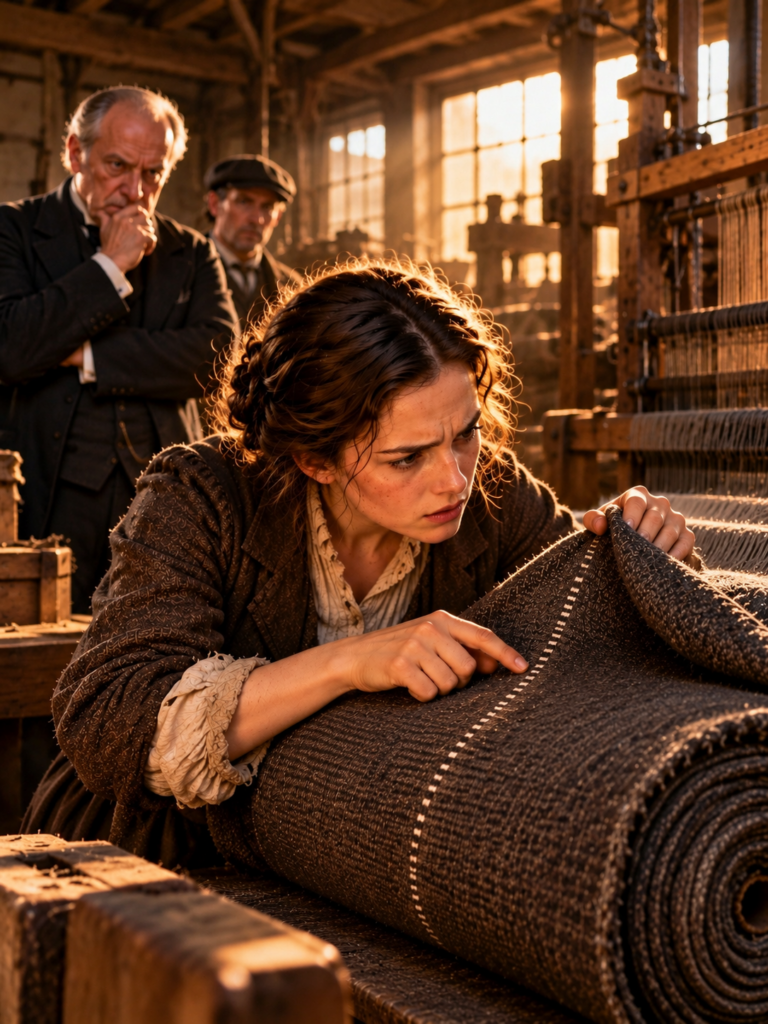
The list named the loom and the shuttles and the frame. It did not name the great roll of finished wool standing on end in the corner because the mill had refused it. Ruth crossed the room and put her arms around it. It was a broad cloth of deep gray, a fortnight’s work, the last full bolt her grandfather had ever taken off the loom, and the mill had turned it back with a fault marked against it, a repeating fault. One thread wrong at every set interval which spoiled it for the fine trade and dropped its price to nothing.
“This,” she said. “The bolt he was refused.”
Scarrow glanced at it and lost interest at once. “The spoiled cloth. Take it and welcome. It is charged as loss already. It will make you a coat that no lady will buy, but it will keep the rain off.”
He turned to go, then paused, and for just a moment something behind his careful eyes went still and watchful. “Your grandfather grew strange at the end, Miss Thorne. Old men do. Do not build your grief on a length of faulted cloth.”
Then he was gone and the clerks after him, and Ruth was alone in the empty cottage with a roll of gray wool taller than she was and nineteen shillings in the tin behind the clock.
She did not weep, though she had earned the right. She sat down on the cold hearthstone with the bolt laid across her knees and she did what her grandfather had taught her to do with any cloth that troubled her. She read it.
Her fingers found the selvage and ran along it and there was nothing wrong with the selvage. She turned the cloth to the gray window light and looked at the ground weave, and the ground weave was as fine as anything Elias Thorne had made in his prime, a twill so even you could have set a rule to it. This was not the cloth of a man grown strange. This was the cloth of a master at the very top of his craft.
And then she reached the fault.
It was a single warp end run wrong. Where the twill should have carried the thread over two and under two in its steady diagonal march, here one end broke the pattern and floated flat across four picks, a small bright bar against the grain, plain to a weaver’s eye and invisible to a gentleman’s.
She measured with the span of her hand from the start of the bolt. The first fault lay a little over a yard in. She went on. Her hands knew the rhythm of the twill and her mind kept the count and she found the second fault and she stopped.
The second fault was not the same as the first.
She had expected, anyone would have expected, that a mechanical trouble in the loom would print the same error at the same place in the pattern every time, like a nick in a wheel. That was what a fault was. But the first float floated over four picks and the second floated over two and they sat at different points across the width of the cloth. One near the left selvage, one nearer the middle. The intervals between them along the length were even, near enough a yard and a little, but the faults themselves were not identical. They differed.
Ruth sat very still on the cold stone. A loom does not choose to make a different mistake each time at an even spacing. A loom repeats itself exactly or not at all. A man though, a man weaving by hand, throwing his shuttle and lifting his heddles, a man could float a wrong end across as many picks as he pleased, wherever he pleased, and count his yards as he went and make each wrong end say something different from the last.
Her grandfather had not spoiled his last bolt. He had written on it.
She was awake all that night with a lamp and the bolt unrolled the length of the cottage floor, and by morning she had found eleven faults in thirty yards and she had them copied down on the back of the mill’s own inventory list because it was the only paper she had. Each fault she recorded three ways, the way he would have wanted. How many picks the wrong end floated over, how far in from the nearest selvage it lay, and how many inches of good cloth ran before it since the fault before. And a fourth thing she wrote against each because her eye caught it on the fifth fault and then she went back and checked them all. The direction the wrong end floated, the way its little bright bar leaned, whether the raised float climbed toward the right or toward the left as it crossed the picks. Long floats and short, some leaning right, some leaning left. She did not yet know the alphabet, but she could see there was one.
That was the state of things when Alice Dean knocked.
Alice was the widow who kept the little dame school by the chapel, a spare straight woman of perhaps forty with ink on her cuffs and no patience for Hart’s Edge opinion of anybody. She had taught Ruth her letters twenty years before and had never once in all that time spoken to her as though being poor were the same as being stupid.
“They have you turned out by Lady Day, I hear,” Alice said, stepping in and taking off her wet shawl. “And Scarrow smiling all over his face about it.” She stopped. She looked at the cloth spread the length of the floor and at the marks Ruth had made. “What is this, then?”
“My grandfather’s last bolt,” Ruth said. “The one they called spoiled. Alice, it isn’t spoiled. He put these faults in on purpose, every one different at even spaces. He was writing something into the cloth.”
Alice Dean did not laugh, which was one of the reasons Ruth loved her. She knelt down by the first fault and put her spectacles on and looked a long while. “Writing,” she said slowly, “in wool.”
“He couldn’t have written it on paper,” Ruth said. And as she said it she began to understand it. “Anything on paper the mill could take. They took his loom, his frame, his cottage, every scrap he ever signed. But a bolt of cloth marked as spoiled, they charged it as loss and threw it back at me. It was the one thing he could be sure they would let go out of the house.”
She set her palm flat on the gray wool. “He hid it where only a weaver would think to look. And he made it look like a fault so no one would think to look at all.”
“Then what does it say?”
“I don’t know yet.” Ruth sat back on her heels. “But I know how he counted. He never trusted a number he couldn’t check three ways. Look. Every fault has three measures. The number of picks the float runs over, the distance in from the nearest edge, the run of good cloth before it.” She frowned at her list. “Three measures. Like columns.”
Alice went very quiet. “Like a ledger,” she said.
The words sat in the cold room between them.
Part 2
Scarrow says my grandfather died owing the mill money he never paid,” Ruth said slowly. “And here is my grandfather writing three columns of numbers into a cloth and hiding them where the mill would never look.” She lifted her eyes. “What if this is his ledger, Alice? The true one. The one Scarrow’s book was made to contradict.”
They worked at it for four days, the schoolmistress and the weaver, at the long table in Alice’s cottage where the light was better and the fire could be kept in. And for three of those four days they were wrong, and Ruth had the honesty to know it.
Their first theory was that the numbers were money, that the float length was pounds and the distance from the edge was shillings or some such, and that each fault recorded a sum. But the sums came out wild and meaningless. Forty pounds here and a farthing there, and no order to them. Ruth threw down her pencil on the second night nearly in tears.
“It’s nothing. I’ve built a whole church on a crooked thread, and it’s nothing. He was just an old man whose hand slipped.”
“His hand did not slip eleven times at even spaces,” said Alice, who was the steadier of the two once she had committed herself. “We have the wrong key, that is all. A cipher is a lock. You do not throw away the box because the first key fails.” She tapped the list. “You said he counted the run of good cloth between the faults. Whatever else changes, the spaces between are near even. A yard and a bit each. If the spaces are even, the spaces are not carrying the message. The spaces are just turning the page. Each fault is one line. Set the spaces aside. Look only at the two measures that change. How many picks the float runs and the distance from the edge.”
Ruth stared at her. Then she took a fresh sheet and wrote the eleven faults out again with only two numbers each. The number of picks the wrong end floated over and the edge distance, and looked at them stripped bare, and the answer was not there either, but the shape of the answer was.
The float counts were all small numbers, one to seven. Never floating over more than seven picks in all eleven faults, but the edge distances ran up much higher. Nine, fifteen, twenty-two, thirty-one. Measured in the fine threads he could count across the warp.
“Seven,” Ruth said. “The float never runs over more than seven picks. Alice, there are only so many things you count to seven and stop. Days.” She looked up. “Days of the week.”
“Or,” said Alice softly, and reached for the old worn almanac she kept by the fire for the school, “the seven cottages on Weaver’s Row.”
The room seemed to tilt. Ruth knew Weaver’s Row as she knew her own name. Seven stone cottages in a terrace below the sheds where the hand weavers of Hart’s Edge had lived for a hundred years. Her grandfather in the fourth of them, and the tenancies of all seven held under the mill. He numbered the cottages one to seven from the top of the row.
“He numbered the cottages one to seven,” Ruth breathed. “His own was the fourth. The number of picks the float runs tells you which house, and the other number, the distance from the edge, is the sum owed,” Alice finished. “In shillings likely, counting each thread as a shilling. Ruth, this is not your grandfather’s debt at all. This is a debt he was keeping for the whole row.”
But that was their third theory, and it was also not quite right, and it was Ruth’s own skill that corrected it because Ruth knew the row and Alice only knew the almanac.
“No,” Ruth said, working it out even as the hope rose in her. “No, listen. If these were debts the tenants owed, why would my grandfather write them into a secret cloth and hide them from the mill? A debt the mill is owed, the mill wants written down. Scarrow would thank him for it. You don’t hide a thing the powerful man wants you to keep.” She pressed her knuckles to her mouth, thinking, thinking the way she thought at the loom when a shed would not clear. “He hid this because it was something Scarrow did not want kept. Not the debts owed to the mill. The debts my grandfather forgave.”
Alice set down her pen. “Explain that to me.”
“He was the eldest hand on the row, the head weaver.” Ruth’s voice came faster now. “The mill advanced yarn to each cottage against the cloth they’d bring back. Bad winters, a sick child, a run of thin work, a family falls behind on the yarn account, and the accounts on the row didn’t go straight to the office. They went through the head weaver first, through my grandfather. He tallied what each cottage owed, and he carried it up to Scarrow.” She stared at the eleven marks. “And these last two winters were cruel, Alice. The Emmett child at number one nearly died. Old Sarah Pike at number seven couldn’t work her loom for the rheumatism. My grandfather forgave those debts. I know he did. I saw him strike Sarah Pike’s arrears off the wall with the flat of his hand and tell her to say nothing. He forgave them out of the mill’s yarn on his own word as head weaver, the way the old head weavers always could.”
“Then where is the wrong?” said Alice. “If he forgave them, the families owe nothing, and there is nothing to hide.”
“Unless,” Ruth said slowly, and the cold came up through the floor into her, “unless the debts he forgave were charged again, quietly, by someone who kept the office book.”
For a long moment neither of them spoke. The fire ticked.
“Scarrow,” Alice said.
“My grandfather forgives Sarah Pike’s yarn, say two pounds on the row, in front of witnesses, and tells the mill it’s forgiven,” Ruth said. “But the office ledger is Scarrow’s to keep. He never strikes it off. He carries Sarah Pike’s two pounds forward as still owing, and the mill thinks it is still owed, and every quarter it draws interest, and Sarah Pike is too old and too frightened to argue with the office over a debt she thought was dead. Multiply that by the whole row. Every debt my grandfather forgave, Scarrow secretly recharged, and pocketed the difference between what the mill’s books showed owing and what he ever meant to collect.” She looked up, white. “And my grandfather found out. He confronted him, or he began to. That’s why the office ledger shows my grandfather himself in arrears. Scarrow rolled a false debt onto him too, to break his word if he ever spoke, to make him the man who couldn’t pay, so no one would believe the man who couldn’t pay when he said the overseer was a thief.”
“And your grandfather knew a plain accusation would never stand against Scarrow’s ledger,” Alice said very low. “One old weaver’s word against a signed book. So he wrote the true tally where the ledger could never reach it. In the one language he owned outright and Scarrow could not read.”
“In the cloth,” Ruth said. “He wrote it in the cloth and he marked the cloth spoiled so it would be handed out of the house to me. Because he trusted me to read it.” Her hands were shaking now, but not with fear. “He didn’t die owing them, Alice. He died with the proof in his hands and no way left to speak it but this.”
Part 3
They read the whole bolt through that night properly now with the key that fit. And here Ruth’s fourth measure, the one Alice had thought merely a curiosity, turned out to be the very hinge of the thing.
For as they read down the row, some of the sums ran higher than a cottage could plausibly owe in shillings alone. And Ruth remembered the way the floats leaned.
“He couldn’t count off both edges to mean two things,” she said. “For a fault has a distance from each. He needed one measure and one rule. So he gave himself the rule in the lean of the thread. Every fault she saw now was counted always from the nearest selvage. That was the fixed convention, no guessing. The shorter distance always the one that spoke. And which selvage was nearest, the float itself declared. Where the wrong end floated leaning toward the right, the count was shillings. Read in from the right edge. Where it floated leaning toward the left, the count was pounds. Read in from the left edge, each thread a pound. The lean of the thread was the denomination, plain in the wool. And the nearest edge was always the edge to count.”
It was clumsy and it was ingenious and it was entirely her grandfather. A man who never trusted one measure where three would do and who would not leave even the reading of an edge to chance.
Number one, the Emmett cottage, a left-leaning float two threads in for the pounds, a right-leaning one four in for the shillings, two pounds four, forgiven the winter the child was ill. Number three, eighteen shillings all told from the right. Number four, his own house, nothing owed at all, a single clean bar that leaned neither way to say this is the writer, and he owes you nothing, which was Elias Thorne’s whole quarrel set down in one wrong thread. Number seven, Sarah Pike, two pounds even, a left-leaning float two threads from the left edge and no shillings after.
On down the row, forgiven debts every one, and every one of them Ruth would learn within the week still standing open and drawing interest in the office ledger Scarrow kept locked in the counting house. The sum of it read off the gray wool was a little over eleven pounds of forgiven debt that the mill’s book still showed as owed, plus whatever Scarrow had drawn in interest across two years, plus the false arrears he had loaded onto Elias Thorne himself to seal his mouth.
It was not a fortune. It was better than a fortune. It was the truth, and it belonged to seven households, not to Ruth alone.
And that was where the choice came, sharp as a shuttle point.
Ruth understood it lying awake the next morning watching the light come gray across the ceiling. She could take this cloth and this reading and go quietly to Sarah Pike and the Emmetts and the rest and tell them privately, one by one, “Your debt was forgiven, do not pay it.” That was the safe path. That path troubled no powerful man. Scarrow would go on and find another old weaver’s word to break, and the next family that fell behind in a bad winter would be quietly bled for years and never know why. Ruth would keep her nineteen shillings and her secret and her skin.
Or she could take the cloth up the hill to the mill and lay a weaver’s word written in wool against an overseer’s word written in ink in front of the one man who could weigh them. And if she lost, if the master of Hart’s Edge Mill looked at eleven crooked threads and heard the old man grew strange at the end and believed a smooth clean-handed overseer over the turned-out orphan girl, she would lose everything. And Scarrow would know she had the cloth and the cloth would go into his fire and Elias Thorne would be twice dead.
She thought about it for one day. Then she thought about Sarah Pike, too proud to complain and too frightened to fight, paying interest into Scarrow’s pocket on a kindness she had wept over. And she stopped thinking and started work because Ruth Thorne, being a weaver, did not go up the hill to argue. She went up the hill to demonstrate.
She spent her last coin but two on a warp of plain undyed wool from the shop. And she borrowed the loan of a narrow loom from the Emmett house, for the Emmetts, when they heard only that Elias’s granddaughter needed a loom for a day and asked no questions, gave it gladly, which told Ruth something about how the row remembered her grandfather.
And on that borrowed loom, in two days and a night she wove a fresh strip of cloth, a short one, a handspan wide and a yard long, and into it she wove in her grandfather’s own hand-taught code a single line she chose herself, the float and the count for one cottage and one sum, the wrong end leaning plainly one way for the pounds and the other for the shillings, but she wove it plainly this time, larger than her grandfather ever had, so that the count of picks and the lean of each thread showed to an untaught eye.
And above it, on paper pinned to the strip, she wrote out in Alice Dean’s clean schoolroom letters exactly what the wrong thread said and how to read it. The number of picks the float ran for the cottage, the lean for the coin, the nearest edge always the one to count, so that any man who doubted could hold the wool in one hand and the key in the other and check it with his own eyes.
Then she sent word, through Alice, through the chapel, through the one clerk who had spoken to her without cruelty, that Miss Ruth Thorne wished to lay a matter of the accounts before Mr. Harmon, the master of the mill, and would bring proof he could hold in his hand, and that Mr. Scarrow ought to be present, for it concerned the ledger in his keeping.
That last was the risk, and she took it on purpose. She wanted Scarrow in the room. A guilty man watched who behaves as though he is watched.
Part 4
Nathaniel Harmon received her in the counting house on a gray Thursday, a dry old man of business who had inherited the mill and did not love it, and had certainly never in his life expected to spend a morning of it looking at a spoiled bolt of gray broadcloth unrolled across his own long table by a girl in a turned coat.
Scarrow stood at the end of the room with his leather book under his arm and his clean hands folded and a look on his broad face of patient sorrowful concern, the look of a good servant obliged to watch a grieving girl embarrass herself.
“Miss Thorne,” Harmon said, not unkindly, “I am told you dispute the accounts against your grandfather. I will hear you, but I will tell you plainly, the mill’s ledger is a solemn thing, and I do not overturn it on sentiment.”
“I am not asking you to overturn it on sentiment, sir,” Ruth said. Her voice shook and then steadied. “I am asking you to check it against another ledger, my grandfather’s, kept where Mr. Scarrow could not reach to alter it.”
She saw Scarrow’s folded hands tighten, one thumb over the other, and she knew she was right.
“And where is this ledger?” Harmon asked.
“Under your hand, sir.” She laid her palm on the gray cloth. “You have called this bolt spoiled. Mr. Scarrow charged it to the mill as a loss and gave it to me for a coat. It is not spoiled. Every fault in it was set there by my grandfather’s own hand at even spaces, and no two faults are alike because a fault is not what they are. They are writing. This is his account of every debt on Weaver’s Row that he forgave in the mill’s name these two winters past and that Mr. Scarrow’s ledger still shows as owing.”
For the first time Scarrow spoke, and his voice was gentle as ever and pitched for Harmon and not for her. “Sir, the poor girl is grieving. Her grandfather was a fine hand, but he had grown fanciful at the end, seeing enemies. A crooked thread in a spoiled cloth, I mean no unkindness, Miss Thorne, is a crooked thread. It is not a ledger. I have seen a hundred spoiled bolts. So has every man in this shed.”
“Then you will not mind checking one,” Ruth said, and turned to Harmon before Scarrow could answer. “Sir, I do not ask you to take my word. A weaver’s word is nothing here, I know that. It is why my grandfather could not simply come and tell you. That is the whole cruelty of it. So I have not brought you my word. I have brought you a lock and a key, and you may try them yourself.”
She unpinned the short strip she had woven and laid it beside Alice’s clean written key on the table under the master’s nose. “This I wove myself these two days in his code, so you may learn to read it in five minutes and not take five years. The number of picks the wrong thread floats over tells the cottage one to seven down the row. Which way the wrong thread leans tells the coin. Leaning to the right you count shillings in from the right edge. Leaning to the left you count pounds in from the left. Always the nearer edge. Read this line.”
Harmon despite himself bent to it. He was a man of business and a lock he was invited to pick is a hard thing for such a man to refuse. He held the strip to the light and counted the float with a blunt finger. One wrong end floating loose over seven picks together, and saw the little bright bar lean plainly toward the right, and read the key, and counted in from the right selvage, thread by thread, his lips moving.
“Cottage seven,” he said at last, slowly. “Leaning right, shillings. But it says here forty shillings. That is—” he paused, doing the sum, “two pounds.”
“Sarah Pike’s house,” Ruth said. “Two pounds of yarn debt she ran up the winter her hands failed her. My grandfather forgave it before three witnesses on the row. I was one, and struck it from his own tally, and told Mr. Scarrow it was forgiven as the head weaver had the right to do.” She turned at last full on the overseer. “Now, sir, open Mr. Scarrow’s ledger to Sarah Pike, cottage seven, and read me what it says she owes today.”
The room went still.
“That book is the mill’s private account,” Scarrow said, and for the first time the gentleness had a crack in it. “It is not to be poured over on the say-so of a—”
“Give me the book, Scarrow,” said Nathaniel Harmon.
It was very quietly said, and it stopped the overseer as though a hand had closed on his throat. Because Harmon had heard the crack too, and Harmon was a dry old man of business, but a man of business above all things hates to be robbed by his own servant, and the fear of that had just walked into the room.
Scarrow did not give up the book at once. He held it a breath too long, and in that breath every man in the room understood him, and after that there was no use in his holding it any longer. He set it on the table.
Harmon turned the leaves to the row accounts and found cottage seven, Sarah Pike, and ran his finger down. “Two pounds,” he read, “carried forward, and interest upon it four quarters.” He was quiet a moment, standing open.
“Now cottage one,” Ruth said. “The Emmett house. My grandfather’s cloth reads two pounds four, a left-leaning thread for the pounds, a right-leaning for the shillings. Forgiven the winter their child was ill. Read what the ledger shows.”
“Two pounds four,” Harmon read, “carried forward, interest four quarters.”
“Open. Cottage three, eighteen shillings.”
“Eighteen shillings,” said Harmon. “Open.”
He went down the row himself now, no longer needing to be told, matching the master’s ledger against the girl’s cloth, counting the picks of each wrong float for the cottage, and reading the lean of each wrong thread for the coin, and counting always from the nearer edge. And every debt Elias Thorne had woven as forgiven stood open and drawing interest pressed in Scarrow’s book, every one.
And at the fourth cottage, Elias Thorne’s own, where the wrong thread ran clean and leaned neither way and said nothing owed, Harmon found in his overseer’s ledger a fresh inked arrears of nine pounds against the name of Elias Thorne, entered in a hand not eighteen months old, against a man who by every other page had paid his rent forty years without a miss.
Part 5
Harmon looked at that entry a long time. “You entered this,” he said to Scarrow. It was not a question.
“He fell behind,” Scarrow said. “His hands had come unfolded. Old men fall behind.”
“He fell behind nine pounds in a single season after forty years clean, the same season his cloth says he found you out.” Harmon closed the ledger, and the sound of it was very final. “I am not a clever man, Scarrow, but I can read two books laid side by side. This girl has brought me one book that agrees with itself in three measures, and one that does not agree with the truth in any. You charged the row for kindnesses you knew were forgiven, and you charged a false debt to the one man who could name you to break his word before he spoke it. And when he died with the naming still in his mouth, you put his proof into his granddaughter’s arms and called it a coat because you were sure no one alive could read it.”
He turned to Ruth, and the dry old face had something in it now that Hart’s Edge had never once shown her. Not pity, and not kindness exactly, but the plain clean respect of one careful person for another.
“You read it, Miss Thorne.”
“My grandfather taught me, sir,” she said. “The world thought that was worth nothing. So did Mr. Scarrow. That was his whole mistake.”
They did not clap Scarrow in irons in the counting house, for that is not how such things went. But he was gone from Hart’s Edge within the month, and the mill did not give him a character, and the truth ran down Weaver’s Row faster than any thread ever ran through a shed.
The eleven forgiven debts were struck off in Harmon’s own hand before witnesses, the way Elias Thorne had struck them off on the wall. The interest Scarrow had drawn was made good to the households out of what could be recovered from him, and where it could not be recovered, Harmon made it good himself, because a man of business who has been shown a thief in his own house pays for the peace of not having been robbed unknowing. The nine-pound arrears against Elias Thorne was blotted out, and against his name in the clean new ledger Harmon wrote in a firm hand, “Paid in full, and something over.”
And Ruth Thorne kept her cottage. That was Harmon’s doing. And it was not charity, and Ruth would not have taken charity. He offered her the head weaver’s place on the row, the tally and the trust that had been her grandfather’s, “because,” he said dryly, “a village that will hand a woman its most careful accounts wrapped in a spoiled coat may as well let her keep them openly, and be glad she can read.”
Ruth took it. She set the broadloom going again in the fourth cottage before Christmas, and the sound of it down the row was, old Sarah Pike said, “Like a clock started again in a house where someone had died.”
She kept the last bolt whole. She would not cut a coat from it, though the winter was cold and she owned no other good wool, and Alice Dean scolded her for shivering over a principle. Ruth only smiled and said it was not a principle, it was her grandfather’s last letter, and you do not cut up a letter to keep warm.
In the end she gave it to the chapel on the one condition that it hang unfolded down the whole length of the schoolroom wall where Alice Dean taught the children of Weaver’s Row their letters, and Alice, who understood exactly what she had been handed, would take the sharpest of them up to it now and again and set a small finger against the first wrong thread and say, “Here is a man who was cheated and had no paper and no power and no voice the great would hear, and he wrote the truth so plainly and so patiently that it outlived him and undid the liar. Learn your counting and learn it true. You never know what you may one day need to say, nor how few will let you say it out loud.”
On the mantle of the fourth cottage, where her grandfather’s chalk had once tallied the row, Ruth kept two things and no more. A wooden shuttle worn smooth by his hand and now by hers, and pinned flat beside it the short hand-spun strip she had woven herself in two days and a night. The key that had opened the lock, with its one wrong thread floating over seven picks and leaning to the right and saying, “Cottage seven, two pounds forgiven.” So that she would never forget the morning she carried a spoiled cloth up a hill full of men who would not listen and made them read.

