
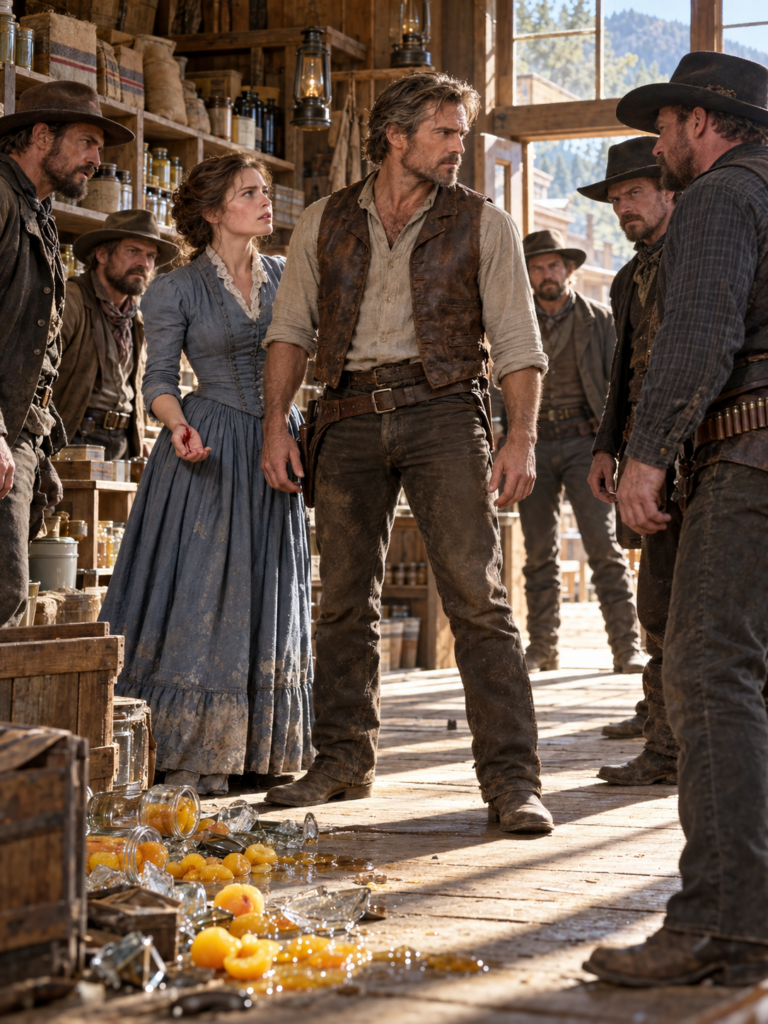
Roy Garrison bent over the appointment letter and laid one thick finger beside the first signature.
“That one,” he said.
Then he moved his finger to another name.
“And that one.”
Eleanor stared at the two marks.
“Both sit on the school board?”
“Both owe the mining company more than they’d care to admit.”
Roy withdrew his hand as though the paper had grown hot.
“Miss Whitaker, I shouldn’t be telling you this.”
“Then I appreciate that you are.”
She folded the letter slowly.
The board had written to Pennsylvania describing a flourishing settlement in need of an educated woman. The offer had seemed an answer to a year of grief and dwindling prospects.
Now she wondered whether she had been chosen for reasons that had nothing to do with teaching.
“Did Calvin appoint the previous teachers?”
“Had a hand in it.”
“And drove them away?”
Roy looked uncomfortable.
“There’s a difference between what a man suspects and what he can prove.”
Eleanor understood him.
In a town where one mining company employed half the men and influenced much of the trade, an accusation could cost a family its livelihood.
But understanding his caution did not make her willing to share it.
“Where’s the schoolhouse?”
“Two streets over, beyond the feed store.”
“Then that’s where I’m going.”
Roy glanced at her injured hand.
“You could take a day to settle yourself.”
“I’ve come eleven hundred miles. Another two streets won’t trouble me.”
She gathered her parcel, lifted her suitcase, and stepped back into the sunlight.
Outside, the heat seemed to press the buildings closer together.
She had imagined arriving in a place where children waited for books and neighbors welcomed a teacher.
Instead, her first afternoon had revealed a powerful man who resented educated strangers and a school board whose independence was doubtful.
Still, the school existed.
The children existed.
And neither belonged to Calvin Ror.
The schoolhouse stood beyond a dusty patch of ground, its front porch leaning slightly beneath a roof of weathered boards.
Eleanor opened the door.
Inside, twelve mismatched desks faced a worn blackboard. Two windows had cracked glazing. A badly fitted stovepipe slanted toward the ceiling, and one porch board shifted beneath her boot.
She walked the room once.
Then she set down her belongings.
From her satchel she took a notebook and pencil.
The first page filled quickly.
Windows. Stove. Desks. Books. Cleaning. Enrollment.
She paused, hearing her mother’s voice in memory.
When a problem looks too big, Eleanor, find the first piece you can put right.
Her throat tightened.
She opened the small tin box in her suitcase just far enough to touch the folded letters inside.
Then she shut it.
There would be time to grieve that evening.
For now, there was work.
She was testing a desk leg when boots sounded on the porch.
Eleanor straightened.
Nathan Cole stood in the doorway, hat in his hands, a canvas sack over one shoulder.
“I saw you come this way,” he said. “Thought these might be useful.”
He placed the sack on a desk.
Inside lay eight weathered schoolbooks.
Eleanor lifted one carefully.
“Where did you find them?”
“Supply shed on my ranch. Previous owner taught school. Left them behind.”
She opened another reader.
Its pages were yellowed but sound.
“These are valuable, Mr. Cole.”
“More use here than sitting in a shed.”
He glanced toward the stovepipe.
“That joint’s wrong. Smoke’ll come back into the room with the wind.”
“I’ve already listed it.”
His eyes moved toward her notebook.
“So you have.”
“And the windows. And the porch.”
Nathan’s mouth shifted almost imperceptibly.
“You’re thorough.”
“I intend to be.”
He studied the room.
“Can bring tools Thursday. Fix the pipe and glazing, if you’d like.”
Eleanor considered the offer.
She had heard enough about him to understand that accepting his assistance would become the subject of conversation.
But the repairs needed doing.
And a man’s reputation was not proof that every story about him was true.
“All right,” she said. “Provided we agree on something.”
He waited.
“This is my schoolroom. I decide what happens here.”
Nathan gave a single nod.
“Wouldn’t have it otherwise.”
She held his gaze.
“Then Thursday.”
“Thursday.”
He reached for his hat.
But before he could leave, Eleanor asked the question that had followed her from the trading post.
“Mr. Cole, why did the previous teacher leave your land so suddenly?”
Nathan’s hand stopped against the brim.
For the first time, she saw genuine hesitation cross his face.
“Calvin Ror had something to do with it.”
“How much?”
“Enough that the man didn’t come back for his books.”
A wagon rattled past outside.
Eleanor looked down at the readers, then back at Nathan.
She pulled a clean sheet from her notebook and began writing the first announcement for the school.
“What are you doing?” he asked.
“Preparing to open.”
“You heard what I said.”
“Every word.”
She carried the announcement to the front window and reached up to fasten it where passing families could see.
Nathan stepped forward to steady the loose window frame while she worked.
Then Eleanor pressed the paper firmly against the glass.
The paper stayed against the window while Nathan held the warped frame steady.
Eleanor smoothed its corners with her uninjured hand.
“School opens in September,” she said.
Nathan read the announcement.
“You’re certain?”
“About opening? Entirely.”
“About staying?”
She turned.
“Mr. Cole, if I began reconsidering every decision because someone disliked it, I’d never have reached Wyoming.”
For a moment, he looked almost amused.
Then he released the frame.
“Thursday,” he reminded her.
And this time, when he left, Eleanor found herself looking forward to his return.
By Thursday morning, she had unpacked the books, scrubbed the blackboard, and persuaded Roy Garrison to provide a proper broom.
Nathan arrived carrying tools and replacement pipe sections.
He worked without complaint while Eleanor sorted the first enrollment papers.
At noon she offered him some bread and cheese she had brought from the boarding house.
He accepted, sitting on the porch step rather than at her desk.
“Doesn’t seem you’ve spent much time in a classroom,” she observed.
“No, ma’am.”
“Yet you brought me readers and knew exactly what repairs were needed.”
“Didn’t need schooling to recognize a bad stovepipe.”
“True enough.”
She smiled.
“So what did you learn before coming to Silver Creek?”
He looked toward the mountains.
“Mostly how to work.”
She let the answer stand.
Some questions, Eleanor was learning, required patience.
Over the next several weeks, Nathan returned to replace window glazing, strengthen desks, and repair the broken porch step.
He never appeared without a reason.
But as summer slowly lost its fiercest heat, Eleanor began to suspect that he sometimes found reasons because he wanted to return.
She discovered he owned a modest ranch above the ridge, kept horses, and had spent several years living apart from most of the town.
She also learned that his quietness was not indifference.
He noticed when she struggled to lift a desk and offered assistance rather than taking it from her.
He remembered which window caught the afternoon glare.
And when her injured palm healed, he asked once whether it troubled her, accepted her answer, and never treated her as delicate.
One afternoon, as he worked on a desk leg, Eleanor finally raised the subject of Cheyenne.
“People tell me you hurt a man badly.”
Nathan’s tools grew still.
“I did.”
“They say you nearly killed him.”
“That’s true enough.”
She waited.
He looked at his hands.
“After the war, I was staying at a hotel in Cheyenne. Heard a woman crying behind the building. Her husband was hurting her.”
Eleanor listened without interrupting.
“I went out to stop him. Instead of stopping when he was down, I kept hitting him.”
Nathan’s voice roughened.
“His jaw was broken. He lost some hearing. I stayed until I knew he’d survive, then left.”
“What became of his wife?”
“She got away. Took the children to relatives in Denver.”
He swallowed.
“I was glad of that. Doesn’t excuse what I did after the danger had passed.”
“No,” Eleanor said quietly. “It doesn’t.”
He looked at her, surprised.
She continued.
“But neither does that night erase every decent thing you’ve done since.”
Nathan glanced toward the repaired windows.
“I came out here because I couldn’t trust my temper. Figured solitude might teach me to hold it.”
“Has it?”
“I’ve worked at it.”
Eleanor looked at the desk he had repaired so carefully.
“I believe that.”
He shook his head.
“You don’t know all there is to know.”
“Then I won’t pretend I do.”
Something eased in his face.
That was the afternoon he began speaking to her as Nathan rather than always hiding behind the formality of Mr. Cole.
And in the weeks that followed, their friendship deepened through a hundred ordinary exchanges.
She learned that he understood horses better than most people understood one another.
He learned that she had worked three years in her father’s accounting office before training as a teacher.
She could find an error in a column of figures almost at a glance.
He could identify a loose hinge by the sound it made when the wind struck.
Neither regarded the other’s knowledge as less important.
By September, eleven children were attending classes.
Eleanor’s first weeks as their teacher were full of ink stains, uneven reading, and the difficult business of giving children of different ages something useful to do in one room.
A small girl named Bess was frightened of horses.
Several other pupils were uncertain around them.
Eleanor asked Nathan whether he might teach the children how to approach an animal safely.
He hesitated.
“People will talk.”
“They already do.”
“Some won’t like their children learning from me.”
“Then they may come and watch.”
Nathan considered that.
“All right.”
He arrived Thursday with three horses: a calm gray mare, a younger bay, and a steady little pony.
Eleanor watched from the porch while Nathan taught the children to approach slowly, keep their movements quiet, and let a horse become accustomed to their presence.
Bess stood several feet away, twisting the edge of her apron.
Nathan crouched beside her.
“You don’t have to touch her.”
“Will she bite?”
“Not if we mind what she’s telling us.”
He showed Bess the mare’s ears and posture.
After several minutes, the girl extended a trembling hand.
The gray mare lowered her nose.
Warm breath brushed Bess’s fingers.
The little girl laughed.
Eleanor saw Nathan smile.
It was an expression so unguarded that she nearly forgot to breathe.
Several townspeople stopped to watch.
Among them stood Martha Hail, the doctor’s wife, who had become Eleanor’s closest friend.
“There’s going to be talk about this,” Martha murmured.
“About a man teaching children to approach horses?”
“About Nathan Cole being welcomed somewhere.”
Eleanor watched Bess stroke the mare again.
“Then perhaps it’s time people found something new to say.”
Calvin Ror responded within a day.
Three fathers sent letters withdrawing their children.
The wording was almost identical.
Eleanor read each carefully.
She recognized coordinated pressure when she saw it.
Instead of sending angry replies, she invited the fathers to meet with her.
She explained the lessons, answered questions, and made clear that their children were welcome regardless of their opinions about Nathan Cole.
Two boys returned within the week.
The third stayed away.
His father worked for the mining company.
Nathan came to the schoolhouse after hearing what had happened.
“I shouldn’t have brought the horses.”
“You brought knowledge the children needed.”
“Calvin’s using it against you.”
“He was already looking for an excuse.”
Nathan stood in the doorway, troubled.
“He’s done this before.”
“Then we must stop allowing him to succeed.”
Eleanor set down her pen.
“Tell me what you know.”
Nathan was silent for a long moment.
Then he explained that Calvin’s mining company had been pressuring ranching families over land boundaries and mineral rights.
Certain survey filings did not match the boundary markers Nathan remembered from the original property descriptions.
He had avoided town affairs for years.
But the pressure against the schoolchildren had changed his mind.
“I’ve spoken to Sheriff Reed,” he admitted.
Eleanor stared.
“When?”
“Earlier this week.”
“Does the sheriff believe you?”
“Believes enough to begin asking questions.”
“And the records?”
“That’s where we need help.”
Eleanor leaned forward.
“Before I became a teacher, I kept books in my father’s office.”
Nathan nodded.
“You told me.”
“I examined accounts, transfers, and entries that didn’t agree with earlier records.”
She reached for a clean sheet.
“If someone has altered a survey to claim land that belongs to another person, there should be differences we can trace.”
Nathan looked at her.
“You know how?”
“I know how to compare documents. We still need the originals.”
A few days later, an unsigned warning appeared beneath her schoolhouse door.
It informed her that Calvin controlled two school-board seats and had wanted a teacher who would cooperate with his company.
The second previous teacher had resisted him.
That was why he had left.
Eleanor took the letter to Martha.
Martha confirmed what she knew.
Calvin wanted children taught a version of local land history favorable to the mining company’s claims.
He had expected a newcomer dependent upon her appointment to accept his direction.
Eleanor read the warning again.
“He offered me the position because he thought I could be managed.”
Martha nodded grimly.
“Seems so.”
Eleanor folded the letter.
“Then he’s made a costly mistake.”
Martha had a contact at the county records office in Laramie, a woman named Clara Sims.
She wrote requesting assistance in locating the earlier survey.
Meanwhile, Eleanor prepared a comparison of the dates and descriptions already available.
Nathan supplied his knowledge of the physical boundaries.
He had walked the land before buying his ranch in 1877.
The original survey, he explained, used paired stone cairns to identify important corners.
The amended map appeared to shift one northwestern boundary by roughly six hundred feet.
That change mattered enormously.
It brought a valuable ore vein inside the mining company’s claimed holdings.
Under the older boundaries, the vein lay within land belonging to four ranching families.
Eleanor studied Nathan’s description.
“That’s why Calvin has been pressuring those ranchers.”
“Looks that way.”
“Then this isn’t simply about my school.”
“No.”
She held the pencil above the paper.
“It’s about everything those families own.”
Their work had barely begun when another warning came.
Someone cut the Vance family’s fence.
Two horses escaped.
One returned; the other was found injured miles away.
Eight-year-old Hector Vance arrived at school subdued and angry.
Eleanor learned that his father had resisted withdrawing him.
That afternoon she confronted Nathan on the schoolhouse porch.
“How far will Calvin go?”
Nathan looked toward the street.
“I can’t promise he won’t go further.”
“Then I need your knowledge, Nathan, not your reassurance.”
He turned back.
She explained what she wanted: his assistance tracing the original markers, and his testimony about the boundary descriptions.
She would continue preparing the documentary comparison.
Together they would give Sheriff Reed enough to send a serious report beyond Calvin’s local influence.
“I don’t want you putting yourself in danger,” Nathan said.
“I’ve already been placed in danger.”
He looked troubled.
She softened her voice.
“I’m asking you to help me make sound decisions. Not to make them for me.”
After a moment, he nodded.
“Fair enough.”
Then came the destruction of the schoolhouse.
On a Friday night, someone shattered windows, overturned desks, tore pages from six readers, and damaged the stovepipe Nathan had repaired.
Eleanor arrived Saturday morning to find the classroom in ruins.
For a moment, she could barely move.
The torn schoolbooks lay everywhere.
A child’s careful handwriting had been trampled into the dirt.
And the stovepipe, the first thing Nathan had repaired for her, hung crooked from its fittings.
She took out her notebook.
Her fingers trembled so badly that the first line was almost unreadable.
Nathan arrived shortly afterward.
He stepped inside and surveyed the damage.
His hands closed.
Eleanor recognized the old anger rising in him.
She crossed the room.
“Nathan.”
He looked at her.
“Help me repair it.”
For several seconds, he said nothing.
Then he opened his tool case.
They began.
Martha arrived with food and two neighbors.
Roy Garrison brought replacement glazing.
By afternoon, other townspeople had appeared, some carrying boards, others offering labor.
Not everyone came.
But enough did.
The schoolhouse that Calvin had tried to isolate became the busiest building in Silver Creek that Saturday.
That evening, Eleanor sat beside Nathan on the repaired porch.
“I think Calvin expected us to give up,” she said.
Nathan studied the street.
“He expected folks to be frightened.”
“Some still are.”
“Can’t blame them.”
“No. But now they know they’re not alone.”
Nathan looked at her.
“You’ve changed things here.”
“I haven’t done it by myself.”
They sat quietly as daylight faded.
After a time, Nathan spoke.
“There’s something I ought to tell you.”
Eleanor turned.
“When I came here, I thought keeping away from people was the best thing I could do for them.”
“And now?”
He looked at the schoolhouse.
“Now I’m beginning to wonder whether I was only doing it for myself.”
She reached over and rested her hand lightly beside his.
Neither moved away.
“There’s something I ought to tell you, too,” she whispered.
Nathan waited.
“When I left Pennsylvania, I thought I was coming west because I had nothing left to lose.”
She swallowed.
“But I find myself frightened of losing something again.”
His eyes moved toward hers.
For a moment, the space between them seemed impossibly small.
Then Eleanor withdrew her hand.
“Not yet,” she said softly.
Nathan understood.
“After we’ve finished this?”
“After.”
He accepted the answer.
And because he did, she trusted him more.
The following week, the boarding house caught fire.
Eleanor was at school when the bell rang.
She helped Martha and Mrs. Carver get the remaining residents safely away from the damaged building.
Her own room was destroyed.
The few dresses she had brought from Pennsylvania, her personal teaching materials, and the reader she had carried west were lost.
Fortunately, her mother’s letters were safe in their tin box, which she had already entrusted to Nathan.
Her working notes were with Martha.
But Nathan did not know she was safe.
When Eleanor heard he had been told about the fire, she borrowed Martha’s horse and rode toward his ranch.
She met him coming down the trail.
His face was pale with fury and fear.
“I’m unharmed,” she called.
He reined in so sharply that his horse tossed its head.
“Eleanor?”
“I was at the schoolhouse. Everyone got out.”
He stared at her.
Then he bowed his head for one long moment.
When he looked up, she saw what he had nearly done.
“Don’t go after Calvin,” she said.
Nathan’s jaw tightened.
“He’s destroying everything you’ve worked for.”
“Then help me preserve what’s left.”
He looked past her toward town.
“He’s trying to make me angry enough to act.”
“Yes.”
“And if I do, he’ll use it against us.”
“Yes.”
Nathan sat motionless.
Then, slowly, he turned his horse beside hers.
They rode back together.
Neither pretended the anger had vanished.
But he had chosen what to do with it.
And Eleanor understood that this choice mattered more than anything he had said about changing his life.
That night, in Martha’s kitchen, she laid out the copied boundary descriptions, correspondence, and notes.
“The children need their school,” she said.
“The ranchers need their property,” Martha answered.
“And Nathan needs to be heard for what he knows, not dismissed for what happened in Cheyenne.”
She took up her pen.
“We have to finish the evidence.”
Nathan stood across the table.
“I know where the original stone markers stand.”
Eleanor looked at him.
“Then we’ll go to them.”
He glanced at the papers.
“The trail isn’t easy.”
“I didn’t expect it to be.”
She held out a fresh sheet.
“Show me where we begin.”
Nathan took the pencil from Eleanor’s outstretched hand and marked the first boundary corner on her paper.
Then he drew the ridge, the old trail, and the line of stone cairns that had stood in the high country long before the mining company began working the disputed ore vein.
Eleanor watched closely.
“Those markers are still there?”
“Last time I rode that way.”
“Then they can be measured.”
“They can.”
“And the older survey can be compared with the amended one.”
Nathan looked at her.
“That’s what I’ve been trying to tell Reed.”
Eleanor smiled faintly.
“Then perhaps we ought to stop talking about it and start giving him the proof.”
Over the following weeks, their work became more demanding.
Clara Sims helped locate the earlier land records.
Martha carried correspondence between the town and trusted contacts.
Sheriff Thomas Reed gathered statements carefully, aware that accusations against a powerful mining concern required evidence stronger than rumor.
Eleanor organized the papers into a chronological record.
Original survey descriptions.
Amended filing dates.
Ranch ownership documents.
Measurements from the old markers.
Claims made by the mining company.
She compared each one, searching for points where descriptions contradicted measurements on the ground.
Nathan accompanied the boundary inspections.
He knew the ridges, trails, and cairns and could distinguish older markers from more recent work.
But he did not pretend to understand the accounting questions as well as Eleanor did.
She, in turn, accepted his judgment about dangerous paths, travel time, and the limits of what could be observed before dark.
Working together did not make either of them less independent.
It made their separate knowledge more useful.
The strongest evidence emerged from the northwest boundary.
The amended survey had shifted the line far enough to place the valuable ore deposit inside the company’s holding.
The original physical markers contradicted that alteration.
And the families whose land had been affected had long been subjected to threats, damaged fences, disrupted deliveries, and pressure to accept the company’s version of ownership.
One by one, the four ranching families provided statements.
Aldis Kerry, whose property lay near the contested line, examined the evidence with Eleanor.
“You mean to tell me the company’s been working ore that wasn’t theirs?”
“That’s what the measurements indicate,” she said. “The formal decision belongs to the authorities, but the difference between these surveys is too large to dismiss.”
Kerry stared at the records.
“My father knew those corners.”
“Then his knowledge matters. So does yours.”
He signed his statement.
For Eleanor, the signature was more satisfying than any argument she might have won against Calvin Ror.
It meant a man who had been made to doubt his own rights was beginning to reclaim them.
Yet the closer the investigation came to completion, the more dangerous the town became.
Calvin knew that Nathan had spoken to Reed.
He knew Eleanor was examining records.
And he knew the ranchers were beginning to stand together.
He also knew Nathan’s old history might be used against him.
A former cavalry acquaintance named Daniel Price arrived in Silver Creek.
Nathan recognized the name immediately.
Price had witnessed the violent confrontation in Cheyenne four years earlier.
He had not spoken in Nathan’s defense when the story spread.
Now Calvin hoped to use his testimony to discredit Nathan before the land investigation could proceed.
When Nathan told Eleanor, she found him standing outside Roy Garrison’s store.
His face was grim.
“Price was there that night,” he said.
“Then he knows what happened.”
“He knows enough to make things worse.”
“Has he told you why he’s here?”
“Calvin brought him.”
Eleanor considered this.
“Then perhaps we should hear what he has to say.”
Nathan shook his head.
“I won’t ask you to walk into a saloon over a matter like this.”
“You’re not asking.”
She looked toward the building.
“I’m choosing to find out whether the man intends to tell the truth.”
They found Daniel Price at a table.
He looked at Nathan with the discomfort of a man confronted by something he had spent years refusing to examine.
Eleanor introduced herself and asked him to describe the Cheyenne incident.
At first, Price avoided the question.
Then she asked whether Nathan had intervened because a woman was being assaulted.
“Yes,” Price admitted.
“Did Nathan begin the violence?”
“He went into the alley to stop it.”
“And afterward?”
Price shifted in his chair.
“He beat the husband badly. Worse than necessary.”
Nathan’s face remained still.
“That’s true,” he said.
Eleanor looked at Price.
“Did you tell anyone why Nathan intervened?”
Price stared at his drink.
“No.”
“Why not?”
A long silence followed.
“Was easier to say nothing. Cole left. Didn’t seem like anyone needed me.”
Nathan spoke at last.
“I needed you to tell the truth.”
Price looked up.
For the first time, he seemed to understand what those four years had cost.
“I should’ve spoken.”
“Yes,” Nathan said.
There was no easy forgiveness offered.
But there was an opportunity to do better.
Eleanor explained that Calvin intended to use Price’s account to destroy Nathan’s credibility in the mining investigation.
She made clear that the truth included both Nathan’s excessive violence and the reason he had entered that alley.
“Tell Sheriff Reed what you actually witnessed,” she said. “Not what Calvin wants people to believe.”
Price stared at her for several moments.
Then he nodded.
“I’ll speak to him.”
Outside, Nathan stood beside Eleanor in the afternoon light.
“You didn’t have to do that.”
She regarded him steadily.
“Neither did you, the day we met.”
“This isn’t the same.”
“No,” she agreed. “That day, you gave me room to stand. Today, I asked a witness to speak plainly.”
She glanced at him.
“And neither of us has to pretend that the other has never made a mistake.”
Nathan looked down the street.
“I nearly killed that man.”
“I know.”
“I’ve spent four years trying to live with it.”
“Then keep living differently.”
He turned toward her.
Eleanor continued.
“I won’t tell you that hurting someone so badly was right. I won’t pretend you should forget it, either. But you are responsible for the choices you make now, Nathan.”
He looked at her for a long time.
Then he nodded.
“I can do that.”
“I know.”
It was one of the few promises she made him without hesitation.
Meanwhile, the land investigation faced another obstacle.
A federal land agent named Harlon Morse appeared to be more concerned with protecting the mining company’s account than examining the conflicting surveys fairly.
The people working with Sheriff Reed began to fear that Calvin’s local influence extended beyond Silver Creek.
But the evidence no longer rested in one man’s hands.
Reed arranged for a supplementary report to go directly to the Federal Land Office in Washington.
Martha’s husband, Dr. Gerald Hail, contacted a trusted colleague in Cheyenne.
Clara Sims helped ensure that the earlier records could be examined.
Eleanor’s accounting analysis connected the altered boundary descriptions to the company’s claimed holdings.
And measurements from the physical markers supported the ranchers’ objections.
When another federal investigator, Catherine Aldred, became involved, the investigation could no longer be dismissed as the complaint of a disgruntled rancher.
The fraud had become a matter of documented public record.
Calvin’s final attempt to intimidate Nathan came on the mountain road near his ranch.
Eleanor learned that the confrontation was developing and rode up from town on Martha’s horse.
By the time she reached the clearing, Calvin was mounted with several men beside him.
Nathan stood near the ranch buildings.
There was no need for a gun to make the situation dangerous.
The men’s expressions were sufficient.
Calvin turned sharply when Eleanor rode into view.
“You’ve made enough trouble, schoolteacher.”
Eleanor brought the horse to a stop.
“Then you ought to be pleased that the matter is nearly finished.”
Nathan moved toward her.
“Eleanor, you shouldn’t have come alone.”
“I know the trail.”
She looked at Calvin.
“And I know why he’s here.”
Calvin’s expression darkened.
“This doesn’t concern you.”
“It concerns the school board you helped control. It concerns the four families whose property has been disputed. And it concerns the evidence you hoped no one would examine.”
He laughed without amusement.
“You think some papers make you powerful?”
“No.”
She sat straight in the saddle.
“I think they make the facts difficult to bury.”
Calvin’s companions exchanged glances.
Eleanor continued.
“Catherine Aldred is in Silver Creek. The Land Office has sent another investigator as well. Sheriff Reed has submitted further evidence. The original boundary measurements are documented, and the ranching families have arranged legal representation.”
For the first time, Calvin looked uncertain.
“You’re bluffing.”
“You’re welcome to ask Sheriff Reed.”
She took a breath.
“The original survey markers haven’t moved, Mr. Ror. Only the company’s description of where they stand.”
Calvin’s eyes shifted toward Nathan.
Nathan met the stare.
But he did not advance.
Eleanor understood what that restraint cost him.
Four years earlier, anger had nearly destroyed a man in Cheyenne.
Now he was standing before another man who had threatened people he cared about.
Yet Nathan made no attempt to settle the matter with his fists.
He allowed the evidence to speak.
Calvin looked from one to the other.
His authority had always depended on people believing there was no one willing to challenge him.
That belief had begun to crumble in a trading post.
It had weakened in a schoolyard.
It had broken when townspeople repaired a ruined classroom.
Now, with investigators examining the records and ranchers asserting their claims, intimidation was no longer enough.
Calvin pulled his reins.
“This isn’t finished.”
“The investigation isn’t,” Eleanor answered. “But frightening us won’t stop it.”
For several seconds, he said nothing.
Then he turned his horse toward the trail.
The men followed.
Eleanor watched until they disappeared below the pines.
Only then did she loosen her grip on the reins.
Nathan approached slowly.
“You rode all the way up here by yourself?”
“I did.”
“You could’ve been hurt.”
She looked down at him.
“So could you.”
He had no answer.
Eleanor managed a tired smile.
“Help me down?”
He reached for her.
She put her hands on his shoulders as he steadied her from the saddle.
When her boots touched the ground, his hands remained briefly at her waist.
He looked at her face.
“Eleanor.”
There was so much in the way he spoke her name that she felt her eyes sting.
For months they had avoided saying what had been growing between them.
There had always been another letter to send, another record to examine, another child to protect, another wrong to put right.
But the moment had arrived when the question could no longer be postponed.
“You remember what we said?” she asked.
Nathan nodded.
“After.”
She glanced down the trail where Calvin had vanished.
“I think we’re finally getting close.”
Nathan raised one hand, then stopped short of touching her cheek.
She leaned toward him.
His palm settled gently against her face.
“I have a house up here,” he said. “More space than one man needs.”
Eleanor smiled.
“That sounds suspiciously like a practical observation.”
“It is.”
“And?”
He drew a slow breath.
“And I want you in it.”
The words were simple.
That made them harder to misunderstand.
Eleanor looked toward the ranch buildings.
She knew how long Nathan had lived alone there.
She knew the peace he had tried to build, and the shame he had carried.
But she also knew that her future could not be decided merely by the comfort of being wanted.
“My school is in town,” she said.
“I know.”
“I won’t abandon it.”
“Wouldn’t ask you to.”
“And I won’t have my life arranged around your wishes without my own being heard.”
Nathan’s eyes stayed on hers.
“Then we’ll arrange it together.”
She watched him carefully.
“Do you mean that?”
“Every word.”
For the first time, Eleanor allowed herself to picture a future that held both the work she loved and the man standing before her.
Not a life in which one replaced the other.
A life they could build without diminishing either.
She touched his hand.
“Then when this is settled,” she whispered, “we’ll talk about that house.”
Nathan smiled.
This time, he did not hide it.
They returned to Silver Creek with the last of the major evidence already in official hands.
The investigation continued, but Calvin’s influence rapidly weakened as the altered surveys were scrutinized and the ranchers’ claims advanced.
The four families no longer had to face the mining company alone.
The community had witnesses, records, legal assistance, and officials willing to examine what had happened.
The school board could no longer treat Eleanor as a convenient stranger whose livelihood depended upon obedience.
And Sheriff Reed had grounds to pursue the wrongdoing through lawful channels rather than relying on a confrontation between armed men.
For Silver Creek, the change was neither instant nor effortless.
Some residents still depended on mining wages.
Others feared the consequences of speaking openly.
There were documents to review and disputed rights to settle.
But the families now had a meaningful chance to recover what the fraudulent survey had taken from them.
And the school remained open.
By October, the air turned sharp in the mornings.
The stove in Eleanor’s classroom drew properly.
The repaired windows kept out the worst of the wind.
Most of the damaged readers had been restored to usable condition, and the children continued their lessons.
Hector Vance’s family had endured the injury to their horse and the pressure against his schooling.
Hector himself had lost none of his determination to read.
One afternoon, Nathan arrived while Eleanor was finishing the day’s work.
He stood inside the doorway, holding his hat as he had on his first visit.
Eleanor looked up.
“You know, Mr. Cole, there was a time when you never entered this room without something broken to repair.”
He glanced at the stovepipe.
“Seems to be holding.”
“The windows, too.”
“Good.”
“And the desks.”
He looked at her.
“Anything else need fixing?”
Eleanor set down her pen.
“Perhaps something needs saying.”
Nathan’s expression grew serious.
He stepped inside.
For a moment, neither spoke.
Then he drew a slow breath.
“I’ve spent a good while thinking about what kind of life I can offer you.”
Eleanor waited.
“My ranch isn’t grand. There’s work enough to keep two people occupied, and the ride to town isn’t short.”
“I’ve seen it.”
“I know your school matters to you.”
“It does.”
“I won’t ask you to give it up.”
She felt her throat tighten.
Nathan continued.
“I can’t promise I’ll always say things properly. But I can promise I’ll listen when you tell me I’ve got something wrong.”
He looked at her with an openness she had not seen in the man who first stood in Garrison’s doorway.
“I love you, Eleanor. I’d be grateful if you’d consider making a life with me.”
She stood.
The classroom was quiet around them.
She thought of Pennsylvania and her mother’s grave.
Of the journey west and the terrible loneliness that had followed her across eleven hundred miles.
Of a trading post floor covered in broken glass.
And of a stranger who had opened a path to the door without demanding anything in return.
She thought of a schoolroom repaired by many hands.
Of children learning to read, ranchers standing together, and a man finding the courage to return to a community he had spent years avoiding.
“Nathan,” she said, “I didn’t come here looking for a husband.”
“I know.”
“I came to make a life of my own.”
“And you’ve done it.”
She smiled through sudden tears.
“I have.”
He waited.
“But somewhere along the way, I discovered that making a life of my own doesn’t mean I have to make it alone.”
Nathan took one step closer.
“Is that a yes?”
Eleanor laughed softly.
“That’s a yes to building something together. And if you’re asking whether I wish to marry you, that’s a yes as well.”
He released a breath.
She lifted a hand to his cheek.
“But I mean to keep teaching.”
“Wouldn’t have you do otherwise.”
“And we’ll decide together how to manage the school and ranch.”
“Agreed.”
She smiled.
“Then perhaps you’ve finally learned how to negotiate with a schoolteacher.”
Nathan laughed.
He bent and kissed her forehead.
Then, when she drew him closer, he kissed her.
There was nothing hurried about it.
They had waited through danger, work, uncertainty, and the slow learning of one another’s hearts.
There was no need to hurry now.
In December, Eleanor Whitaker and Nathan Cole were married in the little church at the east end of Silver Creek’s main street.
More townspeople attended than either expected.
Martha and Gerald Hail stood with them.
Roy Garrison closed his trading post for the afternoon.
Sheriff Reed came, along with ranching families whose determination had helped expose the disputed claims.
Hector Vance sat proudly in the front row, wearing a hat that was slightly too large for him.
When Eleanor walked toward Nathan, she saw that his hands were trembling.
She stopped beside him.
“You’re nervous.”
“A little.”
“Good.”
His brows lifted.
“Good?”
“It means you know how important this is.”
Nathan looked at her.
“I do.”
They spoke their vows plainly.
There were no extravagant promises about a life without hardship.
Both knew better.
There would be hard winters, tired evenings, difficult decisions, and days when the school or ranch demanded more than expected.
But there would also be shared work.
Honest disagreements.
The comfort of returning home to someone who listened.
And the freedom to remain themselves while choosing one another.
After the ceremony, they began shaping that future.
Nathan continued managing his mountain ranch.
Eleanor remained the teacher in Silver Creek.
They made practical arrangements around the journey between town and the ranch, the weather, and the needs of both livelihoods.
Nathan did not treat her teaching as something temporary.
She did not treat his years of careful labor as a life to be abandoned merely because they had married.
When ranch work demanded extra hands, they discussed what could be managed.
When the school needed repairs or supplies, Eleanor decided what was necessary, and Nathan offered his help without assuming authority over her work.
They learned when to rely on one another and when to allow the other room.
At the ranch, Eleanor brought her books and the tin box holding her mother’s letters.
She placed the box where it could remain safe and close at hand.
Nathan knew what those letters meant to her.
He never opened them.
When she wished to read them aloud, he listened.
When she needed to hold them privately, he left her in peace.
For Eleanor, that simple respect meant more than any grand declaration.
At the schoolhouse, Nathan remained a familiar visitor.
He sometimes helped with practical repairs and continued sharing his knowledge of horses.
The children no longer whispered anxiously when he approached.
Bess greeted his gray mare with confidence.
Hector asked endless questions.
And Nathan, who had once believed that staying apart from others was the only way to keep them safe, found himself answering with patient good humor.
The old story about Cheyenne did not disappear.
Nor should it have.
Nathan had hurt a man severely, and no amount of kindness afterward could undo that injury.
But the town gradually came to see a fuller truth.
He was a man who had committed a serious wrong while trying to stop another, had accepted responsibility, and had spent years learning to control the anger that frightened him.
He was also the man who had helped repair the schoolhouse, guided survey work, stood as a witness, and refused to let Calvin turn their conflict into another act of violence.
Eleanor never asked him to forget his past.
She asked him to continue making better choices.
And he did.
Years later, people in Silver Creek still talked about the summer the new teacher arrived.
Some told the story of five men retreating from Garrison’s trading post before a mountain rancher who scarcely raised his voice.
Others told the story of disputed survey lines, an investigation that exposed a mining company’s false claims, and four ranching families who found the means to defend their property.
Many remembered the schoolhouse windows.
They remembered the day it was damaged, and the following day when townspeople brought tools and supplies and worked until the children had a room fit for learning again.
The stories were all true.
But Eleanor had a favorite memory that few others mentioned.
It was the sight of Nathan kneeling on Garrison’s wooden floor, sweeping broken glass beside a woman he had never met.
There had been no promise of love in that moment.
No certainty of marriage.
Not even an understanding that they would see each other again.
He had simply helped because help was needed.
One autumn afternoon, long after their wedding, Eleanor passed the trading post with Nathan beside her.
Roy stood in the doorway.
“Afternoon, Mrs. Cole,” he called.
“Good afternoon, Roy.”
Nathan tipped his hat.
They continued down the boardwalk toward the school.
Eleanor slowed beside the window and looked inside.
The shelves had been repaired years before.
Glass jars of preserved peaches stood securely against the wall.
She smiled.
Nathan followed her gaze.
“Something amusing?”
“Do you remember the first day we met?”
“Reckon I do.”
“I was convinced I’d made a terrible mistake coming here.”
“You had a rough welcome.”
“I had broken jars, a bleeding hand, and five men determined to frighten me.”
Nathan glanced at her.
“You weren’t easily frightened.”
“I was terrified.”
He stopped.
“You never told me that.”
“I was trying very hard not to show it.”
Nathan considered her words.
Then he said, “You stood your ground.”
“I did.”
She took his hand.
“And you made sure I had somewhere to stand.”
He looked down at their joined hands.
For a moment, she saw the same thoughtful gray eyes that had watched her from the trading post doorway.
But the loneliness behind them was gone.
Not erased by love.
Changed by the choices they had made together.
“Wasn’t much,” Nathan said.
Eleanor shook her head.
“It was enough.”
They walked on toward the schoolhouse.
Inside, twelve desks waited beneath the windows Nathan had helped repair.
The stove stood ready for colder weather.
And on Eleanor’s desk lay a stack of readers, their worn covers bearing the marks of years of use.
Nathan opened the door for her.
She stepped inside, set down her books, and turned toward him.
“Well, Mr. Cole,” she said. “Are you staying to help?”
He removed his hat.
“If there’s work to be done.”
Eleanor smiled.
“There always is.”
He crossed the room and pulled out a chair beside her desk.
She sat, opened a reader, and showed him the lesson she was preparing.
Outside, the Wyoming mountains rose above Silver Creek, unchanged by the lives moving beneath them.
Inside, the room was warm.
And the woman who had once crossed eleven hundred miles believing she had nothing left to lose sat beside the man who had once believed solitude was all he deserved.
Neither had been saved by the other.
They had simply given one another something neither had possessed when they met.
A reason to trust.
A place to belong.
And the freedom to choose, every ordinary day, the life they had built together.

