
Part 1
Ellie Teague rode into Dry Creek with the wind already rising and the taste of dust in her mouth. She was eighteen, and for eleven days she had been riding with a grief that sat behind her ribs like a stone she could not set down. Her father, Tom, had died in a rented room above the feed store in Llanos, a hundred and forty miles north. He had been forty-four. The cough had taken him slowly, then all at once, and she had buried him with money from the sale of the wagon, his good boots, and the second rifle. What remained was the gray mare he had called June, a bedroll, a canteen, seventy-two cents in a tobacco tin, and the folded square of oilcloth he had pressed into her hand the night before he stopped speaking.
The oilcloth held a map of the valley around Dry Creek, drawn in the careful young hand she recognized from the years before the tremor started in his fingers. Three ridges. A dry creek. A well. And, almost against the margin of the paper, a small pencil cross with no name beside it. On the last night he had managed only a few words: “Ellie, if you ever got nowhere left to go, the ridge behind the third crate.” Then the cough had taken the rest.
Dry Creek was where he had grown up and left at nineteen, swearing he would let the desert swallow the place. She had nowhere else. The only aunt lived too far east on land that barely fed itself. So she came south on the mare that had been her mother’s before it was his, because something stubborn in her refused to walk out of that rented room on foot.
The town sat low under a sky the color of old tin. One long street of false-front stores bleached to the color of winter grass. A livery with its door hanging open on a single hinge. A cantina whose painted sign had faded to the brown of old blood. At the far end a church whose steeple leaned a little east, the way her father had always described it. She kept her chin level the way he had taught her. When you ride into a strange place, he said, keep your hands soft on the reins and do not be the first to look away.
She stopped at the livery. The man who came out was thin, graying in the beard, with eyes that took her in without hurry. Five cents for the stall and grain. Water free. She paid from the tin without letting him see how little was left. He led June into the shade and did not ask questions, though something small moved in his face when she said she had come from Llanos.
Inside the general store the air smelled of coffee and lamp oil. The woman behind the counter was broad through the shoulders, sleeves rolled, hands red at the knuckles. Ellie asked for a half-pound of cornmeal, a quarter of beans, and a candle. Thirteen cents. While the woman weighed and folded the paper cones, the door opened and three men came in laughing, loud with the heat. One of them, tall in a pale vest, said the name Teague the way a man says a name he has been waiting to use. “Girl rode in on a gray mare. Says she’s got the old man’s map.”
They laughed. One of them said Tom had left because he owed six months’ rent on south pasture to Harlan and could not pay. Another said the paper the Teagues held on the north ridge was not worth the ink. Harlan had bought every other claim for the price of a drink, calling it charity so no fool would die of thirst looking for silver that was never there. The only one he never got was the Teague title. Tom’s father would not sell. Tom would not sell either. Stubborn, they said. Stubborn and dead.
Ellie stood by a barrel of oats with the packages in her hands and did not move until the woman behind the counter said, sharp and dry, that there was a young lady present. The tall man turned, saw her, and settled into a smile that was worse than the laughter. She walked past him without speaking and stepped back into the hard yellow light.
Outside, an old woman sat on a bench in front of a small adobe house set a little back from the walk. She spoke without raising her voice. “Girl.” Ellie stopped. The woman’s eyes were the color of sky before snow. “You’re Tom’s.” She nodded. The old woman leaned forward, hands still in her lap. “What is kept in the dark is kept there for a reason. When the dark gives it back, it will charge the price to the one who carries it. Your father knew the price. He paid the smaller half. You will pay the larger.” She closed her eyes. “Keep the map dry.”
Ellie had not shown her the map. It lay flat under her coat against her ribs. She thanked the woman because she did not know what else to say, and walked on toward the livery with the words traveling in her pocket like a stone.
James Harlan met her there. He was sixty or a little more, square in the face, pale blue eyes, black hat clean and flat-brimmed. He had already heard she had come with the map. He offered two hundred dollars cash, a stage ticket east in the morning, and a letter to a friend who ran a decent boarding house in the next county. Two hundred dollars was a number her mind could not hold as real. She had fifty-nine cents left. He said the ridge was bad country. He had walked every foot of the claims he owned. No water. No silver. A winter wind that could kill a horse in a night. Her father had known that and kept the paper anyway because it was the last thing his own father left him. Harlan said he respected that. The offer stood until sunset tomorrow.
She told him her father had asked her three times to go to the ridge. She meant to go. He put his hat back on, nodded once, and rode out the way he had come. The men on the walk did not laugh again after he was gone.
In the livery the gray-bearded man watched her saddle June. He said nothing about the money. He handed her a coil of thin cotton rope without being asked. “You might need it up there.” The storm in the south had grown while she was in the street. A dark wall on the horizon, lightning along its lower edge. She told him she had to reach the ridge before it closed the way. He looked at the sky and shook his head the way a man shakes it at weather he already knows. “Then you better ride.”
She rode north out of Dry Creek with the wind at her back and the map pressed flat against her side. The town shrank behind her to a small stain of roofs. Ahead the ridge rose dark against the sky, and behind the ridge the storm climbed higher.
Part 2
The first hour the wind pushed them. June settled into the long, easy trot she had learned under Tom on a hundred roads like this one. Ellie stayed light in the saddle. The second hour the land began to lift. She slowed the mare to a walk and let her breathe. The grass thinned. Sage gave way to pale patches of caliche where the wind had scoured the thin soil down to rock. The light went the way light goes when a storm takes it from the side, pulled sideways out of the sky.
She kept her eyes on the ridge. Three crests, the map said. A dry creek. A pencil cross near the base of the northernmost, slightly east of center, where the rock came out and went back in. She rode east along the foot of the stone, watching. The wind turned and came down off the rock, cold and mineral. June’s ears stayed forward. Twice the mare stopped on her own and looked up at the ridge. Ellie let her look, then clicked once and they went on.
The dry creek opened where the map promised, a wide shallow mouth of pale gravel. She turned June into it. The walls rose on either side and cut the wind. In the sudden quiet she heard only the mare’s hooves on loose rock and the small creak of the saddle. A hundred yards in, the creek bent. On the inside of the bend, where the ridge pulled back from the old watercourse, there was a dark gap in the stone no wider than a door and no taller than a man, half-hidden behind a great slab that had fallen in some other season and now lay bleached in the gravel. From any other angle it would have been invisible.
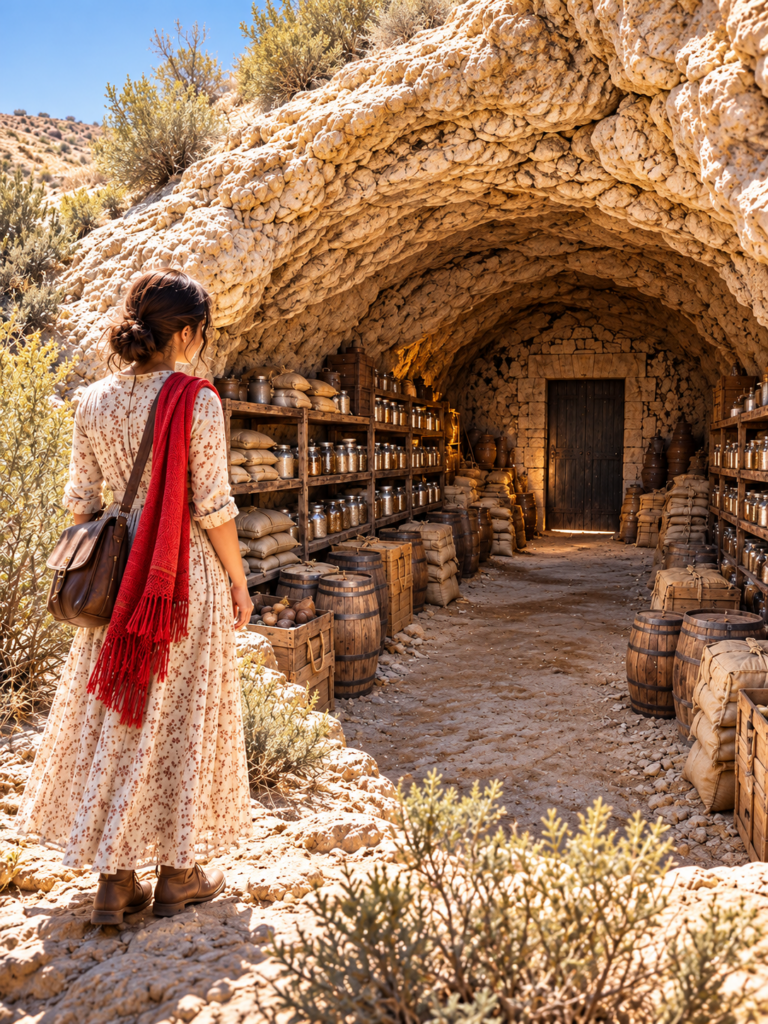
She dismounted and tied June loosely to the end of the slab. The gap was narrow. She lit the candle she had bought in the store and went in sideways. The air inside was ten degrees colder and dry as paper. The crack opened into a chamber larger than the whole general store. The candle showed the near wall and the sandy floor. Beyond that, shapes stacked in rows: long low forms covered in pale canvas, and square shapes that caught the light with the flat dull shine of painted tin. The rows went back into darkness past where the candle could reach.
She stood with the candle raised and felt the disappointment the town had carefully planted in her go still. The canvas, when she touched it, was stiff with years and dust. Under it she felt the hard edges of crates. She lifted one of the tins. It was heavy. On the lid, sealed in ink the color of weak coffee, was a date forty years old. She read it twice. Outside, far off through the stone, she heard the wind rise and pull at the mouth of the cave, then the first deep roll of thunder from the south. The dry wind of the storm had reached the ridge. The rain would follow in less than an hour.
She brought June inside. The mare did not like the gap, but she came. Ellie unsaddled her, tied her between two stone ledges with the rope from the livery, and gave her three slow handfuls of water from the canteen. Then she sat with her back against the saddle and ate four cold spoonfuls of the cornmeal left from yesterday while the wind outside became a steady howl and the first rain began to fall somewhere above the ridge. The tins with their dates stood in their rows. The canvas-covered crates waited behind them, patient as sleeping cattle. Whatever had been waiting in the dark had already waited forty years. It would wait one night more.
She slept in pieces. The storm passed over the ridge and settled against the rock. The thunder was long, rolling, breaking and starting again. Rain ran at the mouth of the gap. Once a stone the size of a fist came down the creek, struck the rocks, and passed the opening. June shifted her weight on the rope but did not pull. Ellie blew out the candle to save what was left and sat in the dark with the wool blanket over her knees. The chamber was not empty the way an empty room is empty. It had the held-breath quiet of a winter barn when the animals are asleep and the lantern is out. Someone had brought the tins and the crates and the canvas, arranged them in rows, left, and come back with more, across years she could not count on her fingers. The dark did not feel abandoned. It felt kept.
In the gray of morning she lit the candle again and walked the first row. Twelve crates. Twelve more behind them. The canvas was oil-treated, thicker than ordinary wagon cover, the kind a careful man uses when he means to come back. She counted thirty-one tins along the far wall. The dates climbed as she went: forty years, then two later, then four, then seven, then shorter gaps. The last tin was dated eleven years ago and sat a half-inch out of line, as if set down in a hurry. Eleven years ago her father had been thirty-three. That spring he had made a long trip north and come home thin and quiet, dust in the folds of his collar. He told her mother only that he had gone to see something old. Ellie had been seven. When she asked where, he said north. When she asked where north, he said a place he used to know. Her mother put a hand on his wrist and he closed his mouth.
Three of the crates in the first row had thinner dust, as if a sleeve or a hand had rested there in the dark. They were not grouped. They sat spaced along the row the way the dated tins were spaced across the years. She did not touch them. She walked the near wall with the candle low and found, twenty steps along, a single mark cut into the rock at shoulder height: a clean capital T, and beneath it a date. The year was the year her father left Dry Creek. He had been nineteen. The letter was small and sharp-edged. Nothing in the cave eroded. She stood a long time looking at it. Teague. Her grandfather’s name, her father’s, and now hers. Cut into the wall of a cave that had been filled for forty years with milled crates and dated tins.
She went back to the saddle and sat. Her legs trembled a little, not exactly from fear. Her father had not been given a map to this place. He had not stumbled on it. He had helped fill it, or he had known the man who did, and that man carried the same name. The crates were made to measure. The dates on the tins rose year by year like rings in a tree. Three of the crates had been touched more recently. The chamber went deeper into the rock than she had yet seen. Behind the third crate. She still did not know from which end to count. She only knew he had not sent her here out of desperation or a weak hope that a useless ridge would feed his daughter. He had sent her because something was here. He had known it was here his whole life and carried the knowledge until the breath was leaving him in that rented room.
Outside the rain thinned. The light at the entrance grew. She blew out the candle and stayed where she was, hands in her lap, and let the place take its true shape around her. What she did next would be the first thing in her life she could never undo. She wanted to come to it the way her father had taught her to approach a spooked horse: slowly, hands open, with no hurry at all.
Part 3
She began the way her father said any work should begin, with what was smallest and necessary. She shook out the blanket, folded it for a bed, and emptied the saddlebags onto it so nothing would be lost. Then she took the candle and the dry stick she had pulled from June’s hoof and walked the rows again. The crates were pine, milled and planed, corners dovetailed with small even teeth. Square-cut nails driven flush, four to a side. These had not been thrown together in a hurry. They had been built the way a man builds a thing he means to leave to his grandchildren.
On the sixth crate the dust was thinner in a soft oval. She lifted the edge of the canvas carefully. No new marks on the wood, no bright nail where one had been pulled. Only the canvas disturbed, and only enough that a careless eye would never notice. The ninth and the eleventh were the same. She stepped back and looked at the whole row in the thin light. Her mouth shaped the words her father had managed: behind the third crate. From which end. From which row. She was not going to guess. Guessing was how you lamed a horse on loose rock.
She walked the near wall again, candle low, reading the floor. The sand was fine and dry and had not been walked by anyone but her in a long time, yet it was not perfectly flat. Small rises sat against the bases of the older crates. The three she had marked had shorter rises in front of them. The sand there had been pressed. She knelt and traced one of the lowered lines and found, faint in the middle, a shape that might have been the heel of a boot. She covered it again and went to the tins. Thirty-one. The intervals told a life: someone coming when he could, leaving a tin, going back down to whatever the living required.
At the far end of the fifth row the last crate had been uncovered. The canvas lay folded beside it. On the lid, cut shallow, was another T and the same year, the year her father turned nineteen. The sand around it had been swept smooth with the edge of a hand in short arcs, the way a man sweeps ash while thinking of something else. The arcs were old. Dust had settled again, but thin enough that she could see the marks of four fingers. Not a large hand. Her father had never had large hands.
She went back to the first T on the wall and started from there, walking slowly toward the deeper dark, candle close to the rock. Forty steps in, where the wall began to curve, the candle caught a shadow that should not have been a shadow. A small arrow scratched into the stone, pointing deeper. She stopped. She did not need to know what it meant to understand that the chamber had been arranged so that one man could read it in the right order, and that she had been standing at the beginning of the sentence without knowing it was the beginning.
She counted her steps back, fixing the distances. Then she blew out the candle to save the tallow and sat with her knees up, arms crossed, looking toward the mouth of the cave where the light was thinning again. Her hands had already learned. Her head had not yet found the words. She let them settle the way a wild colt comes to a quiet hand on the near side of the fence, only because the hand stays still long enough.
When she lit the candle again she took only the stub and the dry stick. She walked to the shoulder-high T, counted the forty steps to the arrow, and followed the point straight into the length of the chamber. Behind the fifth row the air turned colder, as if that part of the stone remembered winter more steadily. A sixth row appeared, shorter than the others, only four crates. Behind the fourth the natural wall closed the gallery. On the lid of that fourth crate was another T, dated two years earlier than the first. She understood then. The marks had been set from the inside out. The mouth of the cave where she had slept was not the first word of the sentence. It was the last. The sentence was meant to be read from the dark toward the light.
The third crate, counting from the back, was the one beside the wall. Its canvas had been cut and folded inward so it could be pulled free quickly and quietly. She drew the rest of the cloth away. The wood was pale as the crumb of bread and smelled of the saddle oil her father had used on his reins. The smell went through her like an old bell. For a moment the cave was gone and she saw the rented room in Llanos, the bottle on the wicker chair, the thin hand reaching for her. She wiped her eyes with her sleeve and set both hands on the crate. It would not move at first. She put her shoulder to it and drove. Five inches. Ten. At last a foot. She stood catching her breath and lowered the candle.
Behind the third crate was a door. Three heavy black iron hinges, forged thick, screwed to a slab of oak reinforced with crossed straps. The door was set into the rock so precisely that if the crate had not been moved she would have taken it for another shadow. It was not tall. A man would have to stoop. Instead of a latch it had a single iron ring, hanging loose the way a tie-ring hangs in a corral no one uses. No padlock. The rows of crates had been the lock. The key had been the letter T and the arrow and the order in which they had to be read.
She sat on the sand in front of the door with her palms on her knees and waited for her breath to come back. She thought of the spring eleven years ago, her father coming home thin and dusty, her mother’s hand on his wrist. She thought of the third man in the store who had not laughed, who said Tom was stubborn and good. She thought of the old woman on the bench. She thought of James Harlan’s pale eyes and the two hundred dollars offered in daylight in front of witnesses. And she understood, slowly, while the candle burned, that Harlan had not wanted the paper. He had not bought every claim on the ridge out of charity or to save fools from dying of thirst. He had bought the whole ridge so that no one would ever climb it looking for this door. The only title he had never been able to get was the Teague title. And now the last Teague was sitting in front of it.
She took the ring with both hands, set her boots against the rock, and pulled. The hinges gave a long rusty cry. A breath of older, colder air came out and nearly killed the candle. She pulled again and the door opened. She stooped and went in with the candle ahead of her.
The second chamber was small, no larger than the store’s back room. On the left stood four wooden trunks with iron-bound corners. Stenciled letters on the wood, darkened by years: FEDERAL ARMY PAYROLL. She read it twice. Her knees went loose. She passed the candle over the other three. All four bore the same mark. All four had broken hasps, forced long ago with an iron bar. She lifted the lid of the first. Inside was only a folded canvas and the bare wood of the bottom. The second was empty. The third was empty. She closed the fourth without opening it all the way, lowering the lid the way one lowers the lid of a coffin.
On the right, against the wall, stood a rough pine table. On it sat a long tin box tied with string, a bundle wrapped in oilcloth tied the same way, and a thick ledger bound in brown canvas, spine cracked, edges darkened by the sweat of many fingers. She set the candle on the table and opened the tin box first. Inside were ten or eleven letters, folded small, worn from being opened and closed. The first was addressed to a lieutenant of a detachment whose name she did not know, dated forty-one years ago. The letters spoke of a job. An October forty-one years ago. An army wagon carrying the troop payroll, crossing the valley toward the post at Buenaventura. How many guards. What hour it would water the mules at the dry creek. Who would do what. Three men. One to hold the horses and pack mules, a boy of seventeen the letters never named. One with a rifle on the bank to cover the others. The third had planned it all: the place, the hour, the escape up the same dry creek Ellie had ridden the evening before, and where to hide what was taken until it was safe to spend. The man with the rifle was her grandfather. The letters named him Teague. At the foot of each letter, in the firm young hand of large round capitals, was the signature of the man who had planned it: James Harlan.
She set the letter with the others carefully. She felt the grief behind her eyes, tight, but she did not let it out. There was still work. She untied the oilcloth bundle. Inside were sheets written in the hand she knew better than her own, small and careful, slanting right. Her father’s testimony. He had written it on the trip eleven years ago. His own father, Ellie’s grandfather, had confessed everything on his deathbed. The job. The soldiers. The rifle. The money. The grandfather had never touched his share. He left it in the cave out of fear and shame and spent the rest of his life climbing the ridge to leave a tin the way a man leaves a candle in a church. Harlan, by contrast, had drawn his share out little by little across the years. Tom, at nineteen, after burying his father and learning the truth, could not live in the same town as that man, and so he left. There was a second small map on the back of one sheet showing the whole chamber, the rows, the arrow, the door. At the end Tom swore he had never taken a cent of the money. He had closed the door and put the crate back. He had not had the courage or the health or the time to carry the papers down to the town and do what needed doing. Below his signature he had left a blank line with no name, for whoever came after.
She wrapped the sheets again and tied them. Last she opened the ledger. Forty years of accounts, no year missing, all in the same round capitals. Every dollar of the job turned into cattle, land, loans, ground bought for nothing from desperate men. The south pastures. The north holdings. Every claim on the ridge bought for the price of a drink. All of it written with the patience of a man certain no one would ever read the pages. On the first leaf, in the margin, in a boy’s proud hand, one sentence: “The whole valley is a road.”
She closed the book and laid her open palm on the cover. The candle, burned to the end, guttered and went out. The dark was complete. In that dark she heard, clear as if he stood beside her, her father’s voice broken by the cough in the rented room: “Ellie, if you ever got nowhere left to go, the ridge behind the third crate.” It had not been a cave he left her. It had not been a ridge. It had been this door.
She struck a match with fingers that shook this time and lit the last stub. She sat on the floor with the ledger on her knees, the box of letters beside her, her father’s testimony in front of her, and felt the weight of all of it settle slowly and entire, the way a load settles when the packs are finally cinched and you understand how far you will have to carry them. She did not cry. She had already cried what she had to cry in that rented room the morning she found him cold. She did not mean to spend another tear in front of those empty trunks. What she felt was something else: a cold, quiet clarity, like the light of a lightning flash that shows the whole road for one instant. The girl who had ridden up to the ridge believing she inherited a worthless paper no longer existed. She would not ride down the same.
She wrapped the letters, the testimony, and the ledger in the oilcloth that had protected her father’s map. She tied them into one firm flat packet and put it under her coat, tight against her ribs the way she had carried the map for four days. She left the small chamber, closed the door, pushed the crate back into place inch by inch, covered it again with the canvas, and swept the sand with the edge of her hand to erase her tracks the way someone had done before her. She walked the path back toward the light, wiping her steps as she went.
June lifted her head when she came. Her father used to say a horse always knows the weight you carry even when you carry it inside, and never asks why, only gets ready to carry it with you. She put her hand on the mare’s gray forehead. “We’re going, girl.” June blew a warm breath across her wrist. Ellie saddled her, tightened the cinch in two pulls the way she had been taught, rolled the blanket behind the cantle, and hung the saddlebags. When she buttoned her coat the oilcloth packet pressed her ribs with every breath, reminding her what she carried and for whom. She blew out the candle, put the stub in the bag, and led June out through the gap with the same patience she had used the night before.
Outside the sky was washed a silver gray beginning to open into blue. The creek ran with two thin threads of muddy water the sun would soon dry. It smelled of wet sage and damp stone. She did not mount yet. She stood with her hand on the mare’s neck and listened. The creek was quiet. She looked south toward the flat and the wagon track that led to Dry Creek, then north toward the broken ridges where no one ever went, and made herself think calmly. Harlan had given her until sunset tomorrow, but Harlan was not a man who waited. He knew she had gone up. He knew the storm would have forced her to shelter somewhere on the ridge. Before noon he would send someone to look for her, and the men who came would not bring two hundred dollars. If they found her coming down the flat they would take the packet, and if she resisted the ridge had plenty of places a girl could fall where no one would ask questions. She could not ride into town. Not by day. Not alone.
She remembered the map. Farther north, along the ridge, her father had drawn a well. Where there is an old well there are usually old walls, a corral, a abandoned house, something to get behind. She could wait there until night and then find another way. She mounted, left the reins loose, and let June take the northward line along the base of the ridge.
Part 4
They had gone half a mile when she heard it. Not hooves. Not men’s voices. A thin, desperate crying that bounced between the rocks, the cry of a very small child, and above it a woman’s voice shouting the same thing over and over, hoarse from shouting. She checked the mare. June stopped with her ears pointed toward the sound. The crying came from below, from a wash where there was no road. Ellie guided the mare a few steps down the gravel slope until she could see the bottom.
A wagon sat tilted in the mud the storm had left. One rear wheel had broken. The iron tire was sprung and two spokes stuck out splintered. The canvas cover had fallen to one side. A mule still stood in the traces, legs sunk to the knees in the mud, head down, not moving. Beside the mule a woman in a soaked dark shawl pulled at the lead rope with one hand and held a screaming baby against her hip with the other arm. She was shouting at the mule, begging it, pleading with it to pull. The mule had decided not to move, and no mule in the world changes its mind because it is shouted at. On the edge of the wagon bed sat a boy of about ten. He held his left arm against his chest with his right. He was not crying, but his face was white and his lips were pressed tight. From above Ellie could see the elbow bent at an angle no healthy arm takes.
She looked south toward the flat. The wagon track to Dry Creek was empty. No dust. No riders. Not yet. They would come, maybe in an hour, maybe sooner. She thought of the packet tight against her ribs. She thought of the blank line her father had left at the end of his testimony. He had not written what she should do. He had left the space for her to decide. She turned June and went down.
The slope was slick. Halfway she dismounted and led the mare, mud to her ankles, until she reached the bottom. The woman turned at the sound of the hooves. Her face was pale, streaked with mud and tears, and in her eyes was the fear of someone who no longer knows whether what is coming is help or one more misfortune. “The wheel,” she said, voice nearly gone. She jerked her chin. “And the boy.”
“I see it,” Ellie said. She tied June to a rock and went to the wagon. The boy watched her come without speaking, the careful way of children raised on hard ground who learn early not to cry in front of strangers. She knelt beside him and looked at the arm without touching it. The elbow was swollen and bruised under the sleeve, but the skin was not broken and there was no blood. It was out of joint, not broken. When she was twelve her father had set an arriero’s shoulder behind the corral in Llanos and she had watched the whole thing. She remembered what he told her afterward while he wiped his hands: firm, then quick.
“What’s your name?” she asked the boy.
“Michael.”
“Michael. I’m Ellie. I’m going to help your mother, and then I’m going to help you. Can you stay very still a little longer?”
He nodded once. The woman had come up behind her, rocking the baby. “My husband died a month ago,” she said, as if she had to explain why she was alone in the middle of nowhere. “We were going south to his brother’s. The storm caught us on the road.”
“How long have you been stuck?”
“Since before the thunder stopped. It rained hard.”
Ellie looked at the broken wheel, the mule sunk in the mud, the sky opening, the southern flat still empty. “That wheel can’t be fixed here,” she said. “Farther up the ridge there’s an old well and some walls. We can get under cover there, but we have to go now. You take the baby. I’ll free the mule. The boy rides my mare.”
The woman looked at her a long moment. She looked at June, at Ellie’s muddy boots, at the ridge. She had every right to ask who this girl was who appeared alone on a horse in the middle of nowhere. She asked nothing. She nodded.
Ellie took her father’s knife and cut the traces. Two clean cuts. The mule, free of the wagon, shook itself, came out of the mud with an effort, and stood waiting for someone to tell it where to go. She lifted Michael carefully, without touching the bad arm, and set him in June’s saddle. She put his good hand on the horn. “Hold here. She’ll walk slow. Don’t let go.” June turned one ear toward the boy as if to watch him and did not move until Ellie took the rein.
They climbed the slope in a line: Ellie ahead with the mare, the boy in the saddle, the woman behind with the baby, the mule last, following without being led. No one looked back at the wagon. The mud sucked at their boots. No one spoke. Twice Ellie stopped to listen for hooves on the flat. She heard nothing. She prayed silently that Harlan had decided to wait, then told herself not to lie. Harlan was not a man who waited, and the men who worked for him were not either.
The well was where the map said. Around it stood the remains of an old house, adobe and stone walls, some waist-high, some nearly level with the ground. In one corner two posts still held a roof of poles and packed grass, large enough to give shade and break the wind. In the center the stone curb of the well, and down in the dark the shine of water. Ellie settled the woman and the baby under the roof on the dry ground. She lifted Michael down and sat him beside his mother on the blanket. She tied the mule where it could pull at some grass. Then she knelt in front of the boy.
“This is going to hurt,” she said. “A lot. But only for a little while. After that it will hurt less.” She turned to the mother. “Hold him tight across the chest and don’t let go.”
The woman put her arms around her son and whispered something in his ear, a very small prayer. Michael closed his eyes hard. Ellie took the elbow in one hand and the wrist in the other. She remembered: firm, then quick. She pulled. The boy let out a short cry that muffled against his mother’s shawl, and then the arm was straight. She felt the joint. It was in place. She pulled a thin board from the old roof and cut strips from the edge of her blanket. She splinted the arm turn after turn and made a sling so he could carry it from his neck.
“You were very brave, Michael,” she said. “You took it like a man.”
He opened his eyes and looked at her, and for the first time something like trust came into his face, the trust of a child who has just learned that someone hurt him only to heal him and kept her word. Ellie stood and walked to the south wall. From there she could see the whole flat, and she saw them. Two columns of dust on the wagon track, rising from Dry Creek. Two riders. They were not galloping. They came at a trot, unhurried, the way men ride when they know what they are looking for has nowhere to go.
She put her hands on the wall. The packet was against her ribs. Behind her a widow, a baby, and a boy with a splinted arm. Ahead the open flat. She thought of hiding. She thought of running north. But if she hid, those men would come up to the well looking for her and find the woman and the children as well. If she ran, the woman would be left alone with them. So she decided not to hide.
“Stay in here,” she told the woman. “Don’t make a sound. Hold your children behind that wall and don’t look out, no matter what.”
The woman looked at her with wide eyes, asked nothing, nodded, and took the children behind the wall. Ellie went to June and put her hand on the mare’s cheek. “You stay here, girl.” June blew a short breath. Ellie tied her well to one of the posts, loosened the cinch a notch, and went out through the gap in the wall. She walked down the slope on foot, heels digging into the loose gravel, until she reached the flat. Then she walked toward the riders down the middle of the track, in plain sight, the way her father had taught her to enter a corral with nervous horses: slowly, back straight, hands loose and empty, without looking behind her.
The riders grew larger. Soon she could tell them. The tall man in the pale vest, Roque, and beside him the red-faced man with the flat-brimmed hat. Both rode good chestnut horses, Harlan’s horses. Both were armed. They saw her alone, on foot, in the middle of the track, and checked to a walk. They stopped about twenty yards off, the way a man stops in front of a dog he is not sure will bite.
“Miss Teague,” Roque said.
“Mr. Roque.”
Roque looked past her toward the old walls on the slope where the mule’s ears showed like two posts. Then he looked at her, the mud on her skirt, the empty hands, no gun, no reins. “Came down to meet us,” he said, smiling. “How kind.”
“I came to your road.”
“Yes.” The smile widened as if she had said something foolish without knowing it. The red-faced man was not smiling. He had his hand on the rifle that lay across the saddle and he did not take it off. “Don James sent us to escort you back,” Roque said. “To his place.”
“I don’t have a place that way.”
“Then wherever. I know exactly where.” The smile thinned. He leaned forward in the saddle. “Girl,” he said, the soft voice a man uses on a horse before he puts the bit in. “Give me that paper and come along with us. Easy. Nobody’s going to call you a fool for changing your mind.”
Ellie did not put her hand to her coat. She did not step back. “I don’t have any paper,” she said.
“You have something, girl.”
“Yes, sir. I have something.”
“Then give it here and we’re done.”
“No.”
The red-faced man tightened his hand on the rifle. The leather creaked. Roque lifted one gloved finger to stop him without taking his eyes off her. The smile came back, but it was an ugly smile now. “Up there you’ve got a widow with two little ones,” he said. “I saw them from a ways off. Bad place for children. That ridge. Rattlers. Drop-offs. Cold at night. You come down with us the easy way and we’ll send a wagon for them. All peaceful. Nobody has to get mad.”
“You’re not going to send any wagon,” Ellie said. “You do what Don James tells you, and nothing else. And Don James doesn’t know what’s waiting for him. He has no idea.”
For the first time the smile left Roque’s face completely. He sat back in the saddle. The red-faced man glanced at him, uneasy. And in that silence, from below, from the flat, came a new sound. Hooves. Not two horses. Many. A steady gallop of well-shod horses that do not stop until they are told.
Roque heard it first. He spun his horse. The chestnut splashed a puddle and stopped. Up the wagon track came five riders, four men in dark clothes with rifles slung, and in front, on a bay horse, a man with a trimmed gray beard, black flat-brimmed hat, dark coat. On his chest, in the midday light, a five-pointed star shone. The star of the federal rural police.
Roque cursed under his breath. The red-faced man let go of the rifle as if the metal had burned his hand. The man with the star stopped his horse beside Ellie. He touched the brim of his hat and nodded to her. He did not look at Roque.
“Miss Teague,” he said. “Commander Mateo Barrera, Federal Rural Police, District. You didn’t write us. But eleven days ago a letter arrived at my office from Llanos. It was from Tom Teague. He said his daughter would be coming to Dry Creek very soon and asked us to be watching.”
Ellie put her hand to her chest without meaning to, to the hard packet under the coat. The commander noticed. “My father didn’t tell me about any letter,” she said.
“I know,” he said, voice softer. “Your father was careful. He wanted you to get there on your own feet and find it yourself first. We didn’t come to take it from you, miss. We came to make sure you got here alive to the end.”
He turned to Roque and looked at him the way a tired stableman looks at an animal he already knows too well. “Roque. You and your partner are going to ride down in front of us, slow, hands on the saddle, away from the guns. If either of you makes a move I don’t like, I’ll be sorry for the horses.”
Roque closed his mouth. He put both hands on the saddle horn. The red-faced man did the same. Two of the federals moved to their sides. The commander looked at Ellie again. “Up in those walls there’s a widow with two children.”
“Yes, commander. The boy’s arm was out. I set it and splinted it.”
“Then he will most likely keep the arm,” he said. “A wagon will leave the town for them inside an hour. Come down with us. Your mare is up there. Go get her. We’ll wait.”
Ellie climbed the slope again. Her legs were shaking now that they no longer had to hold. She told the woman the federals would send a wagon within the hour. The woman pressed her baby’s face into her dirty hair and, crying without sound, said over and over, “God pay you, my girl. God pay you.” Ellie untied June, tightened the cinch, and turned one last time. Michael, sitting beside his mother with his arm in the sling, raised his good hand to the brim of a hat he was not wearing, the way cowboys tip their hats. Ellie tipped an invisible brim back. Then she went down, mounted, and rode toward Dry Creek behind Roque and his partner, surrounded by the federals, with Commander Barrera at her side.
Part 5
They reached the town at midday. The sun fell straight down and the dusty street shone white. All of Dry Creek came out to watch them pass. The boy at the water trough stood up and this time did not run anywhere. The women stayed still in the doorways. The woman from the store stood on her threshold with her arms crossed. The gray-bearded liveryman came out of the stable and took off his hat. In front rode Roque and the red-faced man with their heads down. Behind them the federals. In the middle Ellie on her gray mare, skirt caked with mud, chin level. No one laughed. No one spoke. The men who had been in the cantina doorway went back inside without looking up.
When they passed the small adobe house Ellie saw the old woman on her bench. The old woman opened her pale eyes, watched her go by, and touched the small silver cross at her throat. Then she closed her eyes again, and Ellie understood that the woman had known from the beginning.
They stopped in front of the courthouse, a wooden building beside the church. The commander dismounted, tied his horse, and offered Ellie his hand to help her down. “Inside, miss,” he said. “You’ve carried that weight far enough.”
Inside it was cool and dim. Behind a desk sat a man with glasses and ink-stained fingers. At the name Teague he stood and brought her a chair. “Miss, I’m Inojosa, the judge here. I knew your father a little. I’m sorry.”
“Thank you, sir.” Ellie opened her coat, took out the oilcloth packet, and set it on the desk. Her hands did not shake. The judge looked at her, then at the commander. The commander nodded. Inojosa untied the string and laid each thing on the table: the ledger, the box of letters, Tom’s testimony. He opened the ledger first. He read the sentence in the margin under his breath. “The whole valley is a road.” He turned a page, then another. For three long minutes he said nothing. Only the rustle of paper. At the end he set both hands on the open pages and looked up at the commander. “It’s his hand,” he said. “He signs papers in this courthouse for thirty years. Every account in here is written in his own writing.”
The commander nodded slowly. He unfolded the first letter, then the second. After the third he set them on the table and looked at Ellie in silence. “Do you understand what is here, miss?”
“Yes, sir,” she said. “My grandfather helped rob the army payroll. James Harlan planned it all. My grandfather never touched his share. Harlan did.”
The judge let out a long breath. The commander did not take his eyes off her. “And the money?” he asked quietly.
“He turned it into something else,” Ellie said. “Cattle. Land. The south pasture. Every piece of ground in this valley. Every claim on the ridge except ours. It’s all in that book. He wrote it dollar by dollar.”
Inojosa slid the book to the commander. Barrera turned the pages one after another, then pushed his hat back. “Forty years,” he said. “Forty years written in his own hand and kept in a hole in the rock.”
“He kept them there because he believed no one would ever climb up to look,” Ellie said. “That’s why he bought the whole ridge.”
The commander looked at her then in a different way, not with pity, with respect, the way a man looks at someone who has carried more than she seemed able to carry. “Judge Inojosa,” he said, “send a boy to Harlan’s house. Tell him Commander Barrera asks him to come to the courthouse. If his obligations allow, come alone and unarmed. If he doesn’t come, we’ll go to him. But I think he will come.”
The judge stepped to the door and sent a boy. Then a heavy silence fell. Outside there were footsteps, murmurs, people gathering at the courthouse and going quiet the way people go quiet when they sense something is about to end. Ellie sat with her hands crossed on her skirt. She did not look at the letters or the book again. She had already read them. She looked out the window toward the south, toward the flat where the storm puddles shone in the sun and were drying little by little.
Harlan arrived alone, riding the chestnut with the white blaze. He wore the same long dark coat, the white shirt buttoned to the throat, the silver conchos on the saddle. He tied the reins himself, climbed the three wooden steps, and came in without knocking. He took off his hat. His eyes went from the commander to the desk to the open ledger. His face did not move a muscle.
“Commander,” he said. “Don James.” He looked at Ellie. She held his gaze the way she had held it the day before in the street and did not look away first. He said nothing. There was nothing left for him to say. He had already heard that Roque had come down escorted by the federals. He had understood everything before he arrived.
“May I sit?” he asked, voice low and tired, the voice of a man who has lost all his strength at once. The judge brought a bench. Harlan sat slowly and set his hat on his knee. He looked at the book. “That book is mine.”
“I know,” Ellie said. “I read all of it. You wrote down every dollar.”
Harlan looked at her a long time, then spoke without raising his voice. “Your father was a better man than I am, Miss Teague. Much better.”
“Yes, sir,” she said. “He was.”
Harlan nodded once, then looked at the commander and asked for nothing more. He did not excuse himself. He did not pray. Barrera stepped close and put a hand on his shoulder without roughness. “If it suits you, Don James, let’s go.”
Harlan stood, put on his hat, and settled the brim with the palm of his hand the way he would have done any morning for sixty years. He did not look at Ellie again. He walked out of the courthouse between two federals, down the steps, and across the dusty street. All of Dry Creek watched from doors and windows. No one said a word. The boy at the trough took off his hat. Ellie came out behind them and stood on the lower step in the sun. The woman from the store stood in her doorway. The liveryman still held his hat in his hand. The old woman on her bench had her eyes closed and her fingers on her cross. Ellie’s eyes filled to the brim like a full glass, but she did not let the tears fall. Not for that man. He was not worth the tears she had saved for her father.
Above Dry Creek the midday light fell clean, without shadows.
Autumn came early to the ridge that year, not with color but with a thinner wind at noon and golden afternoons that poured over the dry grass like honey in an old glass. Ellie stayed in Dry Creek. Judge Inojosa took her statement in the courthouse in front of witnesses. Copies were made of the letters, the testimony, and the ledger. The originals traveled east in a district wagon under federal escort. A party of army surveyors climbed the ridge with Commander Barrera, examined the cave, and sealed the oak door with iron. Ellie stood there beside June, hand on the mare’s neck. The widow and her children went south in a hired wagon as planned. Before they left, Michael, arm still splinted, came to Ellie and held out his good hand. She shook it firmly. “Thank you, miss,” the boy said. “Thank you very much.”
“Safe road,” she answered. The little girl peeked over her mother’s shoulder. The mother said nothing. Sometimes when the eyes have already said everything, words are extra.
The ridge was hers. The judge sealed the title in the name of Ellie Teague, the last of her family, and no one in the town laughed at it again. She did not sell a foot of it. She did not fence it. She left it as it had been for forty years: limestone, creosote, wind, and sun. And on the wall of the cave the small T her father had cut at shoulder height began to weather slowly, because air finally entered.
The district authorities gave her a reward taken from Harlan’s holdings. Ellie used only a small part, enough for a board house behind the store and a roofed stall for June. The rest she sent east to the army, for the families of the six soldiers who had died forty-one years earlier defending that payroll. She began to work in the store. The woman with the clean apron taught her to weigh flour, measure cloth, keep the account book. Ellie learned quickly, and when the men from the cantina came in she no longer had to lift her chin to meet their eyes. They were the ones who looked down.
The gray-bearded liveryman never again took her five-cent piece. “For Tom’s daughter, nothing,” he said, and there was no changing his mind. Two years later the old woman on the bench died in her sleep with the shawl over her shoulders and the silver cross on her chest. Ellie was one of the few who walked with her to the small cemetery under the steeple that still leaned a little east. She did not cry. Those tears she saved for the one who truly deserved them.
James Harlan was tried in the east in a long, slow process. His age saved him from the rope. The men he had sent to their deaths had been forty years in the ground, but he never returned to Dry Creek. His chestnut horse was sold at auction to a ranch farther south. His silver-concho saddle hung from a nail in an empty room where the leather dried and the spiders wove their webs over it. No one ever asked about it.
On the last afternoon of that first autumn Ellie took June out of town and rode slowly up the wagon track to the edge of the north ridge. She did not go to the creek or the cave or the sealed door. She stopped on a step of white limestone from which she could see the whole valley to the west. The sun was going down over the dry grass and the land took the color of honey and copper. Below, Dry Creek looked small and quiet and no longer laughed at anyone.
Ellie stayed a long time in silence with her hand on the warm neck of her mare. She thought of the rented room above the feed store. She thought of her father’s thin hand reaching for her in the dark and of the only thing he had been able to ask. “It was never for the silver, Papa,” she said quietly. “I came because you asked me to. And what you could not carry, I carried.”
June flicked an ear at a fly. The sun sank slowly from gold to purple. Ellie gathered the reins, turned, and rode down toward her house. This time there was no storm in the sky.

