
Part 1
The keys made a small cold sound as they left her belt one by one. Edith Fenner set down her cup of tea on the long table in the servants’ hall and unhooked them without hurry. The stillroom key, bright from the oil of her thumb. The linen press. The iron key of the china closet that no other hand in that house had ever turned. The new housekeeper stood across the table in stiff gray silk and held out her palm, and the kitchen maids watched with their spoons stopped halfway to their mouths. Not one of them spoke. When the belt was empty it felt so light that Edith’s hand went to it twice, as if she had left something behind.
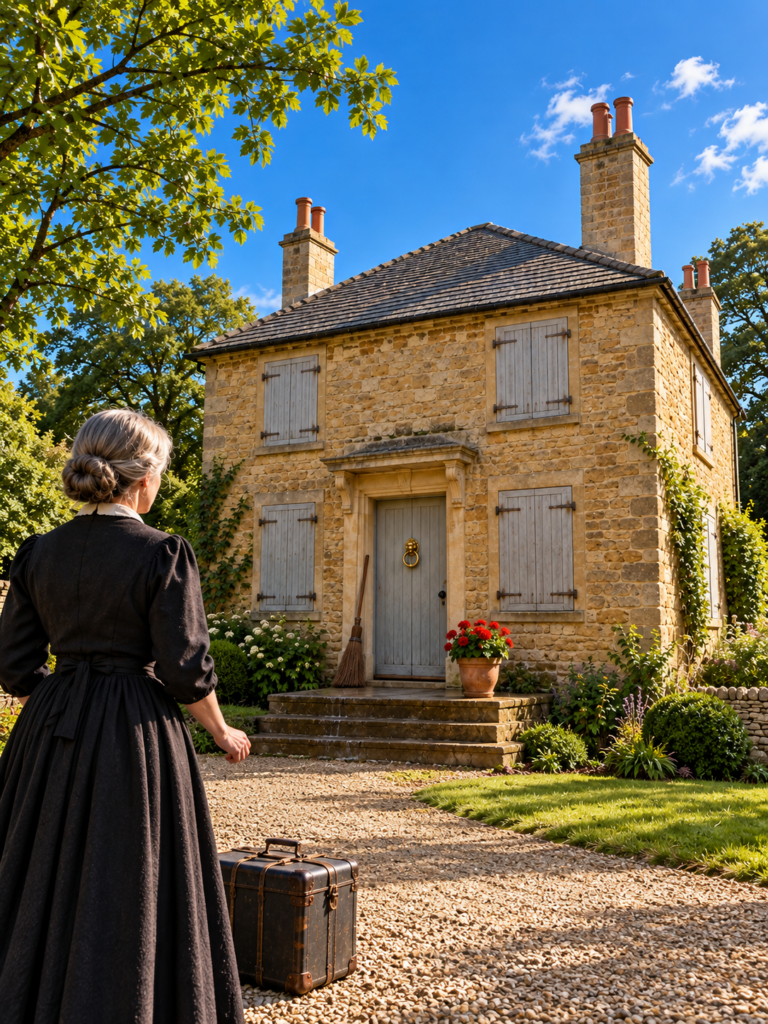
No one offered her the carrier’s cart. No one came to the door to see her go. She left at first light with her tin trunk roped onto a handcart borrowed from the potting shed, the wheel squeaking down a lane of wet hawthorn. The sun came up gold before she turned the last corner and saw it. Lark End stood in its own square of lawn, honey-colored stone under a clean blue sky. Every window closed behind pale wooden shutters. The paint on its door was gray and dry as bone. And the doorstep was wet.
Edith stopped the handcart on the gravel. The stone was dark with water from edge to edge, and a thin line of it still ran off the lower step into the grass. Somebody had swept it. Not yesterday. Minutes ago. The marks of the bristles were still on the stone, and a birch broom leaned against the doorframe, its twigs dripping. Above it the brass knocker shone as if a cloth had rubbed it that morning. Even the lawn around her feet was cut short. She looked back up the empty lane. She looked at the shut windows. There was no one.
Then she saw the pot of red geraniums on the top step, freshly watered, and the string that hung behind the pot from a nail in the stone. On the end of it was a key, and tied to the key was a brown luggage label. On the label, in a round and careful hand that Edith had read on menus and laundry lists and Christmas notes all her working life, were two words. Mrs. Fenner. Her dead mistress’s writing.
Edith stood in the sunshine with the label between her fingers and felt her throat close. She had never married. Every housekeeper in England was called Mrs. by courtesy, and only one person at the Court had ever written the title as though it were worth writing carefully. That person had been in the churchyard for nine days. The key turned in the lock without a sound. Somebody had oiled it. Edith braced herself for the smell of a shut house, mold behind the wainscot, the sour cold of rooms where no fire had burned in a generation. It did not come. The hall smelled of beeswax, faintly underneath of woodsmoke and lavender. The flagstones under her boots were dry.
She set down her bag and stood very still, the way she used to stand at the top of the back stairs at the Court, and listened to her house tell her what was wrong with it. Nothing was wrong with this one. She opened the shutters in the front parlor, and June light fell across a floor that had been polished until the boards shone like dark honey. She ran a finger along the chimneypiece and looked at it clean. In the grate a fire was laid ready, paper twisted underneath, dry kindling crossed over it, split logs on top, waiting only for a match. She went through the house room by room with her heart going faster than she liked. The dining room. The morning room. The kitchen with its range blacked and its copper pans hung bright. Upstairs every bed was made up under a white dust sheet. She pressed her palm to one mattress. Dry. Aired. It smelled of sun. In every room, in every grate, a fire was laid and not lit.
On the ground floor, off the passage behind the kitchen, there was one door she could not open. It was a plain oak door with a new brass lock, and the key on her string did not fit it. She put her palm flat on the wood and stood there. The door was cool, but the plaster wall beside it was warm under her hand, the way a loaf is warm an hour after the oven, as if a fire burned somewhere on the other side of it, in a house where no fire was lit. Edith took her hand away and looked at it.
That night she did not light a fire. It felt like a trespass to put a match to a grate someone else had laid. She ate her bread and cheese on the kitchen settle and opened her trunk on the floor. At the bottom, wrapped in a flannel shirt that had been his, lay her father’s bow drill. It was an ugly thing to anyone who did not know it. A shaft of pear wood no longer than her hand. A small iron flywheel near the foot. A diamond point in the tip. A bow of bent cane strung with cord, the cord dark and shiny where his fingers had held it. He had been a traveling china mender, calling at back doors for cracked teapots and broken platters. He had taught her to wash fine porcelain in water no warmer than her own wrist, to pack it in straw with paper between every piece, and to drill a cracked plate with that little singing bow so gently that the plate never knew.
She held the drill in her lap and listened. The house made none of the sounds a shut house makes. No drip. No rustle. No creak in the rafters. Only a deep dry quiet like a room someone has just stepped out of. She thought of the reading of the will. The Viscount had read it himself at the head of the servants’ table with his new wife beside him, because his mother had asked that her servants hear it. At the line about Lark End he had laughed. Shut since my grandmother died, he said. There is nothing left in it to keep. A few lines further he laughed again. To my housekeeper Edith Fenner, my French china, wherever it may be found. Sold long ago, he said, as the whole county knows, and he looked down the table at her, a woman of sixty-one in a black dress, and smiled. Edith had said nothing. At the far end of the table an old pensioner who came up to the Court for his quarter’s wage had said nothing either. He had only looked at her once and then down at his hands.
She lay awake on the maid’s bed under its dust sheet and listened. Nobody came in the night. And when she woke at first light and went down in her stockings and opened the front door, the step was wet again and swept, and the broom was gone.
Part 2
On the second evening she walked into the village for bread and came home through the long gold light with the loaf warm under her arm and a question pressing on her chest. Whoever was keeping that house did not want to be seen. But whoever it was had laid her fires, polished her knocker, and hung a key for her behind the geraniums with her title on it in a dead woman’s hand. It was not a stranger’s kindness. It was a plan. She meant to find out whose.
That night she did not go up to bed. She sat in the dark hall on a hard chair beside the door, a shawl around her shoulders, the way she used to sit up at the Court before a great dinner. She watched the fanlight turn from black to gray to the thin pearl color that comes just before sunrise. Then she heard it. A step on the gravel, slow and uneven. The clink of a pail being set down. The soft wet slosh of water thrown across stone. And then the broom. It was the most ordinary sound in the world. Swish and swish and swish.
She drew back the bolt and opened the door. An old man was bent over the step with a birch broom in both hands, his shirt sleeves rolled to the elbow, his white hair flattened with dew. He straightened slowly, as a man does when his back has been bent a long time, and looked up at her. It was the pensioner from the servants’ hall. Wilfred Barlow was eighty years old, once undergardener at Vessie Court, a quiet man with earth under his nails who used to leave sweet peas on the stillroom windowsill every summer without a word. She had not learned his Christian name before he was pensioned off to a cottage at the end of the lane. He held the broom against his chest like a man caught stealing it.
He had seen her on the lane that first morning, he said, and lost his nerve and gone behind the hedge. Edith did not know what to say. She found she was holding the doorframe.
“Who asked you to do this?” she said at last.
He looked at her as if the answer were obvious. “Her ladyship,” he said. “Every morning since she shut it, so it would be ready for Mrs. Fenner when they turned her out, as she said they would.”
The light was coming up now, gray and then gold, over the hawthorn along the wall. Edith saw it from a long way off. She made him tea in her own kitchen with water from her own pump, and he sat at the scrubbed table with his cap on his knee and told her a little at a time, as if each piece cost him something to set down. Lady Phoebe had come to his cottage one winter night twenty years before, alone, with her cloak over her head. Her husband’s affairs were very bad then, and there were men in the county who would have stripped the Court to its floorboards for what they were owed. She asked Wilfred to keep Lark End. Not to open it. Only to keep it. Fires in the kitchen range through every winter so the damp never reached the rear rooms. The floors waxed. The beds aired. The steps swept every morning so that anyone in the lane would take it for an old man’s habit. She paid him from her own purse a quiet wage on quarter days that never went through the estate books.
At first, Wilfred said, it was for what’s in the back room. She said so. These last years she said it was for you. Edith put her cup down very carefully because her hand was not steady.
“For me.”
“She knew her son,” Wilfred said simply. Her ladyship had known he would marry and that his wife would bring her own woman and that Edith would be turned out with a character and a trunk and nowhere to go that was hers. So she made somewhere.
He fumbled in his waistcoat pocket and brought out a key. It was small and brass and newer than any key in that house. It was tied with the same brown string as the one behind the geraniums, and it had its own luggage label, and on the label, in Lady Phoebe’s hand, it said, For Mrs. Fenner’s hand only. He had never used it. Not once. He lit the range on the other side of that wall to keep the room dry, but he was never to open the door. Only you, he said.
Edith took the key. It was warm from his pocket. She sat with it in her open palm, looking at the round careful letters, and felt the tears come at last, quietly, for the first time since the funeral. Not for the keys she had given up. For the woman who had known she would have to give them up. Wilfred looked out of the window while she wept and drank his tea and said nothing, which was the kindest thing anyone had done for her in a month.
She did not open the door that day. A housekeeper does not open a locked room until she knows what she will need inside it. She went into the kitchen and saw now how the range stood hard against that same wall, and how the heat of Wilfred’s winter fires soaked through the brick into the room she could not see. She filled the copper from the pump and set it on to warm. She scoured out an old wooden tub. She laid soft brushes and a roll of flannel on the kitchen table, the way her father once laid out his things before he ever looked at what was broken. And she lit the fire in the parlor grate, Wilfred’s fire, laid for her, and watched the kindling crackle, and the first thin smoke go up the chimney of a house that was hers.
Part 3
In the morning Wilfred came with his broom, and she was waiting on the step with a second cup of tea for him. Then she took the brass key from her apron pocket and walked down the passage to the back of the house. The lock was stiff, but it gave. The door swung inward on a breath of warm dry air that smelled of straw and old paper and something else, faint and clean, that she could not name at first. It was a long low room with one small window high up, its shutter closed. Edith opened the shutter, and the morning came in, and she stood on the threshold with her hand at her throat.
The room was full of tea chests. They stood in rows along the walls and down the middle, stacked two and three high, dozens of them, nailed shut, straw poking from the seams. The wall that backed onto the kitchen was warm from end to end, and the air was as dry as a linen press. Not one chest was stained. Twenty winters of damp had crept around this room and never once got in. Every chest had a luggage label nailed to its lid. Every label was written in the same round careful hand. Plates, soup. Turines. Sauce boats. Cups, pair and pair. Dessert, the flowered. Ice cups, 12. Handle with care. For Mrs. Fenner.
Edith walked slowly down the rows, touching the labels with her fingertips. At the end, set apart, was a smaller chest tied with tape, and pinned to the tape a folded letter. On the outside it said, Edith, read this first. She sat down on the chest beside it and unfolded the letter with fingers that would not work properly.
My dear Edith, if you are reading this, I am dead, and my son has done exactly what I told Wilfred he would do. When my husband’s creditors came, the one thing of mine they wanted was my mother’s French china. It came to me on my marriage, and it was mine alone. So I let the county believe I had sold it, and I had it carried here by night, and I paid Wilfred to keep the house, because a house kept for someone is a house that is waiting. There has only ever been one person I would trust to put her hands on it. You kept my house for forty years. Now let someone keep one for you. It is yours. All of it. And so is the house. Wash it gently. Your friend, Phoebe Vessie.
Edith read it twice. Then she held it against her chest in the warm dry room with the morning light on the straw and did not move for a long while. When she did move, it was to open the small chest. She lifted out a layer of straw and then a layer of soft tissue paper, and then she saw the rim of a plate. She knew by the weight of it in her two hands, which was less than it should have been, and by the warmth, which was more. Her father always said the French soft paste felt warm as skin and heavy as a feather. She had held one piece of it in her whole life, a broken saucer in his pack when she was a girl.
She lifted the plate into the light from the window. It was deep blue at the rim. A blue so rich and so clear it seemed to have light inside it, like a church window with the sun behind it. Inside the blue ran a border of gold, tooled so fine it looked like lace. And in the white center of the plate, painted as though somebody had just laid them there, lay a spray of flowers. A rose half open, pink at the heart and paler at the edge, and cornflowers, and a sprig of something small and white, with every petal lifted, every leaf veined. On the back, in blue, were two interlaced letters, the same mark she had seen on that broken saucer. Sèvres, the royal works outside Paris where the kings of France had their china made.
Edith sat with the plate in her lap and her hands round it and could not stop them trembling. There was no chip on it, no craze in the glaze, no rub on the gold, not a knife mark anywhere. It had never been set before a single guest. It had come out of the kiln and gone into paper and straw. And there it had stayed, across a revolution and a sea and two lifetimes, waiting. She laid it on the flannel on her knees and reached into the chest again.
The letter came from the agent in the second week. A stable lad of nineteen walked it over from the Court and would not come past the gate. It was short and very polite. His lordship, the agent wrote, wished to close the late Lady Vessie’s affairs. He would be obliged if Mrs. Fenner would confirm that she had found no French china at Lark End so that the matter might be put aside. Edith read it on the swept step in the sunshine. Then she sat at the little writing table in the parlor, dipped her pen, and wrote one line under the agent’s signature. I have found it. She blotted it, folded it, and handed it to the stable lad at the gate. She never heard another word from the Court all summer. She did not need to. She had work.
Every morning after the step was swept and the tea was drunk, Edith opened one chest, only one. She lifted each piece out of its straw as if it were asleep, washed it in the wooden tub in water no warmer than her wrist, dried it by hand, and held it to the window, reading the glaze as her father had taught her for the thin dark line that means a crack. Plates, every one painted with its own flowers. No two the same. Dessert plates crowded with roses and tulips and honeysuckle. Turines with domed lids. Little covered cups for custard and cream, each with a flower knob no bigger than her fingertip. Tall ice pails. By the end of July every surface in the kitchen and scullery was a meadow of painted flowers on deep blue and white. She counted as she went, because a housekeeper always counts. By summer’s end there were some two hundred pieces, and every one had come through straw and sea and dark without harm. All but three.
Part 4
Three dinner plates near the bottom of one chest each had a single crack running in from the rim. Fine as a hair. Nothing was missing. But a cracked plate is a plate waiting to break. She fetched the bow drill from her trunk. Wilfred sat at the far end of the kitchen table to watch. She laid the first plate face down on a folded cloth, marked a tiny dot of whiting on either side of the crack and another pair further along, set the diamond point on the first dot, pressed the top of the shaft into a wooden cap against her palm, and drew the bow.
The drill sang. It was a thin high patient sound, like a kettle just before it sings, and she had not heard it for more than thirty years. He had hummed along with it under his breath. Back and forth went the bow, and the diamond bit into the paste a hair at a time, never through. The sound filled the kitchen, and she felt her eyes sting and did not stop. When the holes were drilled she bent short lengths of brass wire into tiny staples, warmed the plate by the range so the metal would sit snug, pressed them home across the crack, and filled the holes with plaster and white of egg, smoothed with her thumb. When she turned the plate over, the painted rose on its face looked back at her. Whole. The crack was still there if you knew where to look. But it would never open now. It would hold for another hundred years.
Wilfred let out a long breath. “Your father did that,” he said. He remembered now. A traveling mender on the Court’s kitchen step long ago and an old punch bowl made whole.
“He did,” Edith said, “and I held the bow.”
She riveted the other two that week. Then she went back to her chests. The storm came late in August on a night so hot and still that the candles in the kitchen burned straight up without a flicker. It came from the west over the hills beyond the Severn. A low grumble like furniture moved in a far room. Then the wind came through the hawthorn all at once, and the first rain hit the kitchen window like thrown gravel. By midnight the thunder was right over the house. Edith was sitting up by the range with a lamp when she heard a new sound under the roar of the rain. A drip, then another, coming from the back of the house.
She took the lamp and ran. In the china room water was coming through the ceiling. A slate had slipped on the roof, and the rain was soaking through the old plaster in a dark spreading stain and dripping onto the chests below. Wilfred came in at the back door soon after, soaked through, with his coat over his head. He had seen her lamp from his cottage window. They did not waste words. Wilfred took one end of a chest and Edith the other, and they carried it down the passage to the kitchen and set it by the warm range, and went back for the next, through the thunder, while the lamp swung on its hook and threw their shadows up the walls.
They were halfway down the rows when someone knocked at the front door. Edith stood still with a chest in her arms. The knock came again, heavier. She set the chest down and took the lamp and went. On the step, streaming wet in the lightning, stood a stout man of fifty-five in a traveling coat and a hat that had given up entirely, and behind him in the lane a hired fly stood tilted on its axle with one wheel off in the ditch, and a driver bent over the broken wheel.
“Beg pardon, madam,” the stout man said. “Our wheel’s gone in your lane. We saw a light.”
Edith looked at him for a moment. Then she stood aside. “Come in,” she said. “You can help me carry.”
His name was Mr. Cyril Dunn. He had been at the porcelain works at Coalport on the river and was trying to reach Shrewsbury for the London train. He did not ask what they were carrying. He took the end of a chest from Wilfred’s shaking hands and carried it down the passage as though he had done nothing else all his life. The driver took the next. By the time the thunder moved off toward dawn, every chest was in the kitchen against the warm wall, and not one piece was harmed.
Edith put the kettle on. Mr. Dunn sat down heavily on the settle, wet and steaming by the range, and looked for the first time at the dresser across the kitchen, where the three riveted plates stood in the lamplight among a row of their sisters. He went very still. He crossed the kitchen and stood at the dresser without touching anything. Then he turned to Edith with the face of a curate when the bishop walks into the church.
“May I?” he said.
She nodded. He turned a plate over, looked at the mark, and set it down with both hands. Then his eyes went to the riveted one, at the tiny brass staples on its back, and at her.
“You did this,” he said.
“My father taught me,” Edith said.
Mr. Dunn sat back down on the settle, and for a while he did not say anything at all. He was a gentleman of the British Museum, it turned out, and had spent thirty years among its porcelain. He stayed until the wheel was mended the next afternoon, and asked her a great many questions gently, and read the letter, and walked through the empty china room with its warm wall. Before he left he asked whether she would allow the service to be seen. Not moved. Not sold. Seen once, in the house where it had been kept. He would come back from London to show it himself. He thought of the round careful hand on the labels. Wash it gently.
“Yes,” she said. “Here.”
Part 5
Word travels in a county. By the day Mr. Dunn came back in September the whole parish knew that the dower house at Lark End was to be opened. They came up the lane in the morning sunshine in gigs and on foot. The rector and his wife. Two squires and their ladies. The doctor. Old tenants from the Court farms who had known Lady Phoebe. They came over the step that Wilfred had swept at dawn into a house that smelled of beeswax and woodsmoke and stopped in the dining room doorway one by one and stared.
Edith had set the service out as she would have set out the best china for a great dinner, only not for eating. It stood the length of the dining table and filled the dresser to the cornice and covered the sideboard. Two hundred pieces of deep blue and white and gold and painted flowers, every one whole and shining in the sun. It was like walking into a garden. The Viscount came last. He came in his own carriage with his agent beside him. He had come, Edith understood when she saw his face, to see a fancy of his mother’s proved a fancy in front of the whole county. He stood in the dining room doorway in his gray frock coat and looked at the table, and the smile he had brought up the lane went out of his face like a lamp.
Mr. Dunn was standing at the head of the table. He did not look at the Viscount. He looked at Edith.
“Mrs. Fenner,” he said loudly enough for every person in that room to hear. “Do you have any idea what you have kept?”
Edith did not answer. She did not need to. Mr. Dunn turned to the room. “This is a service entire,” he said, “as it left the royal factory, and never once set before a guest. I have seen the great collections of London and Paris. There is nothing like it in England. There are kings who dine off less.”
The room fell silent. Into that silence the rector, who had been Lady Phoebe’s friend for thirty years and had witnessed her will, took a folded paper from his breast pocket and read it aloud slowly in front of everyone. To my housekeeper, Edith Fenner, my French china, wherever it may be found. He folded the paper again. Every head in that room turned toward the doorway. The Viscount stood there with his gloves in his hand. His eyes went over the rows of blue and gold, and then to the old woman in the plain black dress at the foot of the table, whom he had laughed at across his mother’s servants’ hall three months before. He opened his mouth, and nobody ever knew what he had meant to say because he closed it again without a sound. He said nothing. He turned and walked out through the hall and over the swept step and got into his carriage and was driven away down the lane before a single one of the other carriages had left. His agent had to run to catch it.
Then someone at the back began very quietly to clap, and the rector’s wife joined in, and then the whole dining room. Edith did not smile. She only put her hand flat on the edge of the table, as she used to rest it on the china closet door at the Court when a great dinner had gone off without a single chipped cup, and let the sound wash over her.
In the spring the service went to London in new chests that Edith packed herself, piece by piece, in straw and paper. It went on loan, not for sale, and under her name. Mr. Dunn saw to that. Edith stayed at Lark End with the shutters open and a fire lit in every grate she wanted lit. She kept back a dozen plates, the three riveted ones among them. And on Sundays she eats her dinner off one with a spray of pink roses under her knife. On the parlor chimneypiece, side by side, she keeps two things. Her father’s bow drill, with its cane bow and its cord dark from his fingers and from hers, and a brown luggage label on a piece of string with two words on it in a round careful hand. Mrs. Fenner.
Every morning at dawn she hears the broom on the step. Wilfred will not give it up. She has told him a dozen times that he is eighty years old and has earned his rest, and he only nods and comes anyway with his pail and his birch broom. And so every morning she has his tea poured and waiting on the step when he is done. Sometimes when the county ladies call and ask her about the day the Viscount walked out of her dining room, Edith only turns her cup in her hands.
“He turned me out of the house I had kept for forty years,” she says. “He never asked who was keeping mine.”
She was sixty-one when she walked down that lane with a borrowed handcart and a trunk into the rest of her life. It turned out to be a long one, and a good one, and it began on a wet step at dawn.

