
she bought an ox because she could not afford to fix her tractor then the auction sent a bull worth two hundred forty thousand dollars and she sent him home
Part 1
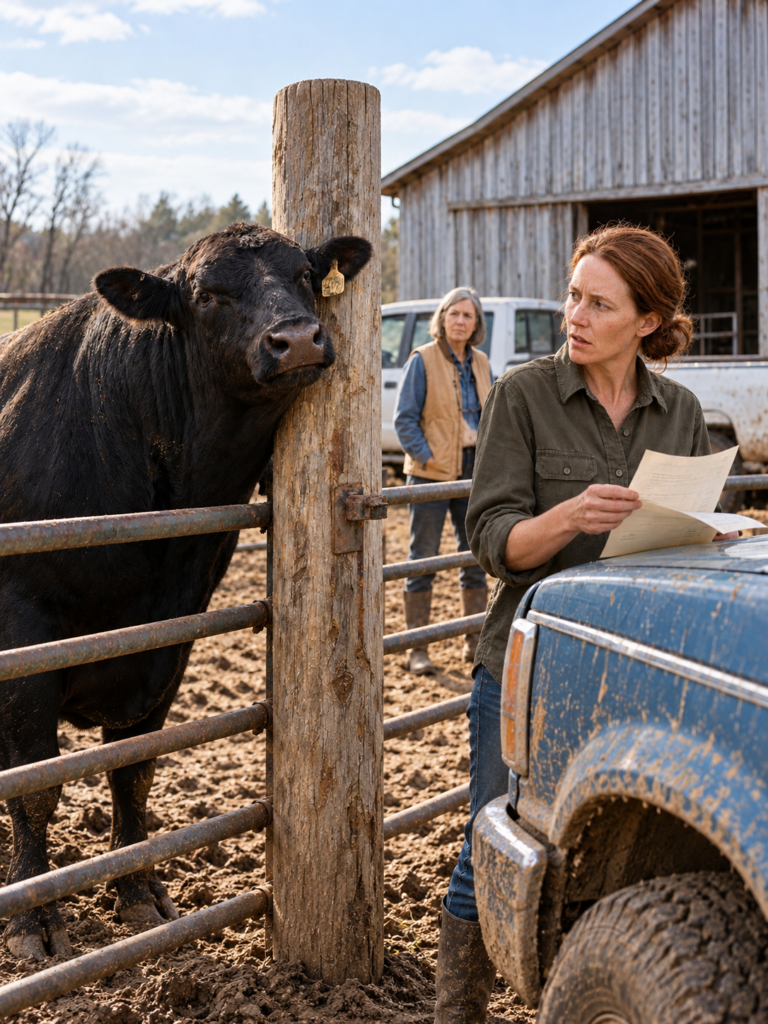
Emma stood at the end of the gravel lane with the delivery slip in one hand and the receipt in the other while the auction truck backed toward the old cattle barn. The driver had already called twice from the county road to confirm the turn. She waved him in, watched the trailer settle, and waited for the ramp. The animal that walked down was black, broad through the shoulders, with a yellow tag in his left ear. Water still beaded on his muzzle from the trough he had found on the way. He lifted his head, looked once at the barn, and stood still while the driver unclipped the lead.
The photograph on her phone showed a red ox with a white patch below one eye. The name on the receipt was Amos. The number on the yellow tag did not match either document. Emma kept the gate closed, stepped back, and called the auction office. The clerk said she had already checked the delivery records twice. While the clerk searched, Emma unfolded the papers the driver had left on the truck seat. A second document was tucked behind the delivery slip. It listed a breeder, a registration number, and a name someone had underlined by hand. She read that name into the phone. The clerk stopped typing.
“Leave him in the pen,” he said. “I need to get the manager.”
Emma photographed the tag, the delivery slip, her receipt, and the document beneath it. At thirty-eight she had spent enough years correcting other people’s paperwork to know that the first version of a mistake was usually the easiest one to understand. After the telephone calls began, people remembered what they thought should have happened. She wanted a record of what had. The manager called eleven minutes later. His name was Martin Bell. He asked if the animal was secure. Emma said the bull was in the old receiving pen, the water was full, and she had not gone in with him. Martin asked about the gates, the fencing, and whether she had other cattle. She had no other cattle. That answer seemed to let him breathe. They had contacted the breeder. She was coming with her stockman and a trailer. They needed to check his permanent identification before they moved him again.
“And my ox?” Emma said.
There was a pause. “We’ve located him.”
She looked past the barn toward the wood lot. Twenty-three marked logs lay where a winter windstorm had brought them down. A small sawmill had agreed to buy the usable sections if she could get them to the gravel lane. The first collection was scheduled for Thursday. The ox had cost eighteen hundred dollars. His name was Amos. He was nine years old, trained to work alone, and accustomed to the voice of a retired woodsman who had spent forty minutes showing Emma how he handled. She had not bought him because old ways were better than new ones. Her tractor needed a repair quoted at six thousand four hundred dollars. Amos came with the equipment she needed for the light work she had planned, and she knew how to use it. Her grandfather had worked cattle in those woods when she was a girl. More recently she had spent three Saturdays with Amos and his owner before placing her bid in the farm dispersal sale. She had asked about his feet, his habits, and the commands he knew. Now a breeding bull stood where Amos should have been, and Thursday was three days away.
At ten-thirty a white pickup stopped outside her gate. The woman who climbed out wore a faded canvas vest over a clean blue shirt. She had gray hair cut to her jaw and a pair of glasses hanging from a cord. She introduced herself as Ruth Mercer. Her stockman, Luis, walked directly to the outside of the pen and stayed there watching the bull without calling to him. Ruth studied the photographs on Emma’s phone. Then she looked at the animal.
“Well,” she said quietly. “There you are.”
“You know him?”
“I believe I do.”
Ruth asked permission before opening the folder on the hood of Emma’s truck. Inside were photographs, health records, and a copy of a proposed purchase agreement. The underlined name on Emma’s document was Mercer Fieldstone. Ruth tapped a photograph of a younger black bull standing beside a numbered board. He was supposed to be at their veterinarian’s receiving facility that morning. The auction’s transport crew had been handling several local deliveries after the sale. Emma looked again at the delivery slip.
“So they brought me somebody else’s animal.”
“Yes.”
“How much animal?”
Ruth hesitated, then turned the proposed agreement around. The figure was two hundred forty thousand dollars. Emma read the line beneath it before she said anything. The purchase was subject to confirmation of identity, satisfactory health documentation, and completion of the buyer’s review. That was not a completed sale. Ruth said no, but it was a real offer. Behind them the bull rubbed his neck against a post thick enough to support the corner of a house. Emma folded her receipt and put it in her pocket.
“I paid for Amos.”
“We’ll get you Amos,” Ruth said.
There was no sudden feeling of wealth. There was the uncomfortable awareness that the wrong animal had become her responsibility without becoming her property. She wanted him safely home. She wanted her ox. She wanted the morning back. Only the first two were possible.
The veterinarian arrived before noon. Martin followed in a separate truck. With the bull properly restrained in the handling equipment beside the receiving pen, they checked his identification against Ruth’s records. Emma stayed outside the working area. Luis read the tattoo aloud. The veterinarian checked it herself. It matched. Ruth’s shoulders lowered a fraction. Martin explained the delivery error with a route sheet held between both hands. Emma’s customer number was sixty-one. The transport booking for Ruth’s bull ended in sixteen. On the dispatch copy, two destination labels had been attached to the wrong entries. The animals had not looked alike. The destinations on the driver’s instructions had simply been wrong.
“Where’s Amos?” Emma asked.
“At the receiving facility. They’ve confirmed him with his owner.”
“Then bring him here after you’ve taken this one.”
Martin nodded. Emma noticed that he wrote the instruction down. By two o’clock the bull was loaded. Ruth remained beside Emma while Luis checked the trailer.
“You documented everything before you called us,” Ruth said, “before anybody corrected it. What kind of work do you do?”
“Accounts, mostly for a plumbing company, two days a week.”
“Mostly?”
“I used to handle inventory for an equipment distributor.”
Ruth looked toward the house. A porch step had been replaced with unfinished lumber. Beyond it stood a tractor with its hood raised. She asked whether Emma would be willing to help put together the transport incident file—photographs, times, copies. She would pay for the work. Emma considered the request and said to send what she had. Ruth handed her a business card. On the back she wrote her direct number. Amos arrived at four-seventeen. He was red with the white patch below his eye. Emma recognized the worn leather equipment before the driver brought it down from the truck. She checked the animal, the paperwork, and the equipment separately. Martin had refunded the delivery charge. He had also called the sawmill and offered to explain the delay. There wasn’t a delay yet, Emma said. After the truck left she stood outside the pen while Amos worked through a mouthful of hay. Her phone buzzed. Ruth had sent the first documents. There were nineteen attachments. Three had the same file name.
Part 2
Emma sat on the porch that evening with her laptop balanced on a board across two chairs. The kitchen table was covered with bills she did not want to rearrange. She made a timeline: booking confirmation, dispatch entry, loading record, arrival at her farm, first telephone call, veterinary identification check, departure. The work took two hours. She found a duplicate invoice, a missing departure time, and an attachment that referred to the wrong vehicle. None changed what had happened, but all would confuse someone reading the file six months later. She listed the gaps instead of filling them with guesses. At the bottom she wrote one sentence: animal identification confirmed by attending veterinarian before onward transport. She sent the file and closed the laptop. Across the yard Amos moved in the barn. The sound was familiar enough that she stayed outside another minute.
The farm had belonged to her father. Before him it had belonged to his parents. Thirty-one acres in western Virginia with an old cattle barn, a steep wood lot, and a house whose repairs had begun to depend on which room she could stop using. Emma had returned after a divorce with a pickup, some furniture, and enough savings to believe she had time. That had been nineteen months earlier. She still had time. She had less room for mistakes. The plumbing company paid regularly. The farm did not. A few hay sales, some firewood, and occasional bookkeeping jobs covered pieces of the year without covering the whole thing. She had made a list of what each part of the property could earn. The wood lot was first because the trees were already down.
On Wednesday she put Amos to work. She began with a short, manageable section on level ground, using the commands his former owner had taught her. She watched his response and stopped before either of them grew tired. By afternoon four logs lay beside the lane. On Thursday the sawmill truck collected nine. The buyer measured them, marked his sheet, and gave her a receipt. The payment would cover feed, groceries, and part of the electricity bill. It would not repair the tractor. Still, the logs were no longer lying in the woods.
Ruth called while Emma was coiling a chain. She had read the report. Nothing was wrong with it. That was why she was calling. She asked whether Emma could come to her farm the following afternoon. She had a larger problem and wanted Emma to look at it before deciding. Mercer Farm lay forty miles north, spread across a valley Emma had passed without ever turning into. She expected expensive gates and a long drive. The gate was ordinary galvanized steel. The drive needed grading. The money was evidently somewhere else. Ruth met her at a low office attached to the equipment shed. Inside, four cardboard boxes occupied the floor. Another sat on a chair.
“My husband kept the breeding records,” Ruth said. “I kept the accounts. He died last November.”
Emma set her bag down. “I’m sorry.”
Ruth nodded once. He had been good at it, but he knew where things were without having to label them for anybody else. She opened a box. There were herd books, printed laboratory results, sales sheets, and envelopes with dates written across the front. Some entries were also on a computer. Some were not. The buyer wanted a complete file on Fieldstone. They had the information. Finding all of it had become the job.
Emma looked through the first folder. There were records for his parents, his own performance, veterinary examinations, and offspring from earlier breeding work. The price began to make more sense. It was not payment for being large or black or descended from one famous animal. The buyer was evaluating him as a breeding investment with records behind the decision and conditions still attached. Emma stopped at a page containing columns of figures.
“I can organize this,” she said. “I can’t tell you whether these figures make him a good bull. I have people for that. And if something doesn’t match, I flag it. I don’t correct breeding information myself.”
“That’s exactly what I need.”
They agreed on an hourly rate and a limit for the first stage. Emma wrote the terms on one page. Ruth signed it before they opened the second box. For the next two weeks Emma spent mornings at her own farm and three afternoons a week at Ruth’s office. She did not start by entering everything into a new system. First she made an inventory of what existed. Each physical folder received a temporary reference. Each scan kept a link to its source. When two records disagreed, both remained visible. Ruth answered questions between farm jobs. Luis came in at the end of the day with mud on his boots and surprisingly precise memories. That calf had been moved after a storm. That cow had lost a tag. Those two animals had been photographed in the wrong order, which was why the numbers written on the backs mattered. Emma wrote down who had supplied each explanation.
On the ninth afternoon she found the problem that would hold up the sale. Two laboratory reports appeared to belong to Fieldstone. The registration number on one matched his certificate. On the other the farm identification belonged to a different bull. She laid them side by side.
“Ruth.”
Ruth read both sheets, then pulled a chair close to the desk. “Which one is right?”
“I don’t know yet. But one must be.”
“Possibly. We need the original submission records.”
They found the first submission sheet in a binder marked with the year. The second was missing. Ruth called the laboratory. Emma sent copies through the appropriate account with Ruth’s authorization. By evening they had established that a scanned report had been filed in the wrong animal’s folder. But the buyer’s adviser, now aware of the discrepancy and the recent delivery mistake, wanted fresh confirmation. Ruth stared at the message.
“They’re entitled to ask,” Emma said.
“I know.”
Outside the office window Luis drove past with an empty feed wagon. Ruth waited until the engine faded. “I thought we were almost finished.”
“We found it before the sale.”
Ruth rubbed the bridge of her nose. After a while she nodded. The veterinarian collected a fresh sample with the bull’s identification checked and recorded. Ruth submitted it through the breed association’s testing process. The answer would take weeks. There was nothing Emma could do to make the laboratory work faster.
At home the washing machine stopped draining. She emptied it by hand, ordered a part, and moved the damp clothes to a line behind the house. Then she opened her accounts. Her first payment from Ruth had arrived. For ten minutes she studied the tractor estimate. Then she paid the overdue property insurance installment instead. The tractor would wait.
Part 3
A neighbor named Daniel Price came over on Saturday to collect a borrowed jack. He found Emma cleaning Amos’s equipment.
“I heard they delivered you a four-million-dollar bull.”
“Two hundred forty thousand was the offer. And you sent him back.”
“He belonged to somebody.”
Daniel leaned the jack against his leg. “People are telling it like you won something.”
“She hired me to sort records.”
“That sounds more like you.”
He asked whether she wanted help moving the washing machine back into place. She did. They carried it through the narrow doorway without damaging the new hose. Before he left, Daniel looked at the raised hood of the tractor.
“Still waiting on that?”
“Yes.”
“Let me know when you’re ready. I can help haul it.”
There was no audience gathering to watch Emma succeed. Most people nearby had their own machinery apart and their own bills arranged in careful piles. The story about the expensive bull traveled farther than the truth about the paperwork. Emma had no time to follow it. While the laboratory worked she continued with the rest of Ruth’s records. A sale entry had been copied twice. A veterinary invoice had been attached to the wrong year. Several calves had complete records on paper and incomplete entries on the computer. Some afternoons produced only a short list of questions. On others three hours of searching ended with a single missing page found inside an unrelated folder. Ruth paid for those hours too.
One evening she brought two sandwiches into the office and placed one beside Emma’s keyboard. “My husband would hate these boxes,” she said.
Emma moved a folder away from the food. “He’d probably know what’s in them.”
“He would. That was part of the trouble. We could always ask him.”
For the first time Emma understood why the boxes had remained untouched. Every unanswered question had once been a conversation. She did not say that aloud. Instead she turned the screen so Ruth could see it. “I’ve made a page showing what we still need. There are eleven items.”
“How many did we start with?”
“Forty-three.”
Ruth looked at the list for a long time. Then she unwrapped her sandwich.
The fresh results arrived on a rainy Tuesday, almost four weeks after the sample had been submitted. Ruth called the veterinarian first and the buyer’s adviser second. Emma was at the plumbing company matching supplier statements when her phone lit up. Identity and parentage had been confirmed through the appropriate review. The new results were consistent with Fieldstone’s recorded pedigree. The misplaced report belonged in the other bull’s folder. Emma read the message twice. Then she answered that she would update the file that evening. Ruth called immediately.
“You could sound pleased.”
“I am pleased. You sound like you’re ordering printer paper.”
Emma smiled at the desk. “Printer paper usually arrives faster.”
The buyer still had questions. Confirmation did not turn the rest of the review into a formality. There were health documents to finish and terms to settle. Ruth’s veterinarian handled the medical work. The breeding advisers reviewed the performance information. Emma kept the document list current. When something was approved she recorded the date. When a question remained open she left it open. The final agreement was signed in June. Two hundred forty thousand dollars for the ownership interest and rights described in the contract. Ruth had her advisers check every provision before she signed. Emma received payment for sixty-eight hours of records work. The two figures belonged to different people and different kinds of work. She was satisfied with hers.
On the day Fieldstone left Mercer Farm, Ruth invited her over. Emma arrived in time to see Luis checking the identification against the transport documents. The driver checked it too. Nobody seemed embarrassed by how long they took. The bull walked into the trailer, paused, and settled his weight. For a moment Emma remembered him standing in her barn, drinking from the trough she had filled for Amos. Ruth closed the document folder.
“I owe you lunch,” she said.
“You paid my invoice.”
“I can still owe you lunch.”
They ate in the office with the window open. Three of the cardboard boxes were gone. The remaining two contained records awaiting routine filing, each folder marked so that someone besides Ruth could understand it. After lunch Ruth placed a fresh sheet of paper on the desk.
“I don’t want to do this again every time we sell an animal.”
“Then keep it current.”
“Will you?”
They discussed a monthly arrangement, a set number of hours, regular updates, extra work approved before Emma started it. Ruth remained responsible for the information. Emma would maintain the records and flag anything that needed expert review. The amount would not support a household by itself. Added to the plumbing work, it changed the shape of Emma’s month. She could plan with it.
Before leaving, Ruth asked another question. “What’s growing in the lower field at your place?”
“Mostly grass. Some weeds I haven’t caught up with.”
“Are you using it?”
“Not properly.”
“Would you consider boarding a small group of heifers next season? We’d need to look at fences, water, and whether the ground can carry them.”
Emma looked at the new agreement. “One job at a time.”
Ruth laughed. “All right. Think about it.”
Part 4
Emma did think about it. She also measured the field, checked the water supply, and asked for help assessing what it would need. The answer was more fencing than she had hoped and less immediate income than she had imagined. She told Ruth both things. They left the idea until the following spring. Through summer Emma worked the fallen timber with Amos in short sessions suited to the conditions. She left the difficult pieces for equipment better able to handle them. The sawmill took the usable wood. The rest became firewood where that made sense. She learned which jobs belonged to the ox and which did not. The tractor was still necessary.
In August she made the repair appointment. Daniel helped haul it to the workshop. When they returned with it two weeks later, Emma drove once around the yard before putting it under cover. Amos watched from the fence.
“You’re both staying,” she told him.
In September one of Ruth’s neighbors asked whether Emma could organize records ahead of a small cattle sale. Emma asked to see the files before quoting a price. There were fewer boxes. There were also handwritten notes on feed sacks. She accepted the job. A second inquiry came in October. She turned it down because she did not have the time. That refusal cost her an evening of doubt. Then the month ended with every promised job completed, and the doubt became easier to bear.
By winter the kitchen table was clear enough to eat at. Bills still arrived. The house still needed work. Emma bought a used filing cabinet instead of the porch window she wanted. She put the cabinet in the spare room and began working there. On the wall above it she pinned a photograph of each farm client’s identification system, with permission, so she could keep their methods straight. She did not display a photograph of Fieldstone. His folder was on the shelf. It belonged with the work.
The following March Ruth and Luis walked Emma’s lower field with her. They discussed repairs, access, and who would be responsible for what. Emma had a local adviser assess the pasture before they settled on a small group and a limited grazing period. The agreement included a plan for dry weather. Ruth would move the animals if conditions required it. Emma would not be expected to make grass appear because a calendar said summer had begun. They signed only after the costs were clear.
The heifers arrived in May. This time Emma stood beside the trailer with a printed list. Luis read each identification number. She checked it against the sheet. They counted the animals after unloading, then counted again from outside the fence. Ruth watched from the truck.
“Everything match?”
“Twelve delivered. Twelve listed.”
“Good.”
The boarding income was modest after expenses. It paid for work the field had needed anyway and gave that part of the farm a purpose. More useful than the first payment was the fact that Emma knew what the next one depended on. That summer was dry. By July grass growth slowed enough that they reduced the grazing period. Ruth collected the heifers early according to their agreement. Emma earned less than the best-case figure on her worksheet. She also avoided spending money she did not have trying to force the best case to happen. When Daniel asked whether the arrangement had worked, she said yes, even with them leaving. That was why it worked.
Late that autumn Ruth stopped by with a photograph. It showed Fieldstone at his new home, standing in a paddock beneath a pale sky. The buyer had sent an update. He had settled into their program. Ruth pointed out a detail in his stance that meant more to her than it did to Emma. Then she handed over the photograph.
“I thought you ought to have one.”
Emma looked at it. “He was only here a few hours.”
“A fairly busy few hours.”
Ruth followed her into the house. The porch step had been painted. The washing machine was running. Through the spare-room doorway Ruth could see the filing cabinet and a desk with two neat stacks of work.
“How many clients now?”
“Four, including the plumbing company. Enough for now.”
They drank coffee at the kitchen table. Ruth mentioned that someone had asked her whether Emma had been allowed to keep part of the bull.
“What did you tell them?”
“That you charge by the hour.”
Emma laughed. After Ruth left she put the photograph inside the completed incident file. Behind it went a copy of her eighteen-hundred-dollar receipt for Amos. She paused before closing the folder. On the first page was the arrival time she had written that morning when she still thought the biggest problem was getting the right animal before Thursday. She could see how easily the story might be told another way: a woman short of money, a mistaken delivery, a bull worth a fortune. But the money from that sale had gone to Ruth, whose years of breeding decisions and records had helped produce him. Emma’s money had come in smaller amounts, attached to hours worked and jobs completed—enough for the tractor, enough to stop moving one bill behind another, enough to remain.
Part 5
She closed the folder and went outside. The late light lay flat across the yard. Amos stood near the barn door, waiting for his evening feed. His red coat showed the same white patch below the eye that had been in the photograph she had studied before she bid. The leather equipment hung clean on the wall inside. Beyond him the lower field was empty for the season, the grass short and pale after the dry weeks, the new fence posts still bright where Daniel and a neighbor had helped set them. The repaired tractor sat under cover, ready for a job the following morning. Its hood was down. The work order from the shop was filed in the spare room with the other papers that now had places to go.
Emma filled the water trough first. A little spilled over the edge and darkened the same patch of ground where the black bull had stood the morning the wrong trailer arrived. The damp spot spread no farther than the size of a plate. She watched it soak in. Then she opened the gate and stepped inside with the feed bucket. Amos turned his head, took the grain without hurrying, and stood while she checked the place where the collar had rested. His feet looked sound. His manner was the same as it had been on the three Saturdays before the sale—steady, unhurried, willing to move when she asked and willing to stop when she said so.
She had kept the receipt for him in the folder with the incident file because the two papers belonged together. One recorded the animal she had paid for. The other recorded the animal that had arrived by mistake and left the same day. Between them sat the photographs she had taken before anyone else arrived, the timeline she had written on the porch, and the list of gaps she had refused to fill with guesses. None of those pages had changed the price of Fieldstone or the amount of the offer Ruth had eventually accepted. They had changed the shape of the months that followed. The tractor was fixed because the insurance and the feed and the electricity had been paid on time. The lower field had a purpose because the agreement had named what each person would do if the grass failed. The spare room held a filing cabinet instead of another unfinished repair because Emma had chosen the work that paid for the next month rather than the window she still wanted.
Ruth’s photograph of Fieldstone stayed inside the folder. Emma did not pin it to the wall. The bull had never been hers to display. His records had been Ruth’s to keep current, and Emma’s job had been to make those records clear enough that someone else could read them without having to ask the man who used to know where everything was. That work continued. Once a month she drove north, opened the remaining boxes if any new papers had arrived, updated the lists, and flagged what needed an expert. Ruth paid the agreed hours. When a question came from the buyer’s adviser or from the laboratory, Emma found the page and left the answer for the people who understood breeding. She did not invent explanations. She did not correct figures she did not own.
On the farm the work stayed small enough to finish. Some weeks the sawmill took another load of the storm-down timber. Some weeks she and Amos moved only the pieces that could be skidded on level ground without risking either of them. Daniel still came for the jack when he needed it and still offered to haul equipment when the tractor needed more than she could manage alone. The plumbing company still called twice a week. The other farm clients called when their sales approached or when a tag was lost or when a laboratory report arrived without a matching folder. Emma kept the photographs of their identification systems above the cabinet so she would not mix one farm’s numbers with another’s. She turned down the jobs that would have required her to leave her own work unfinished. The evenings of doubt after those refusals grew shorter. The months ended with the promised work completed and the bills arranged in a single stack rather than three.
The story that had traveled through the county in the first weeks after the delivery had not entirely stopped. People still mentioned the black bull sometimes when they saw Emma at the feed store or at the scale house. Most of them had already corrected the number. A few still said she had sent back something worth a fortune. Emma answered the same way she had answered Daniel: the animal belonged to somebody, and she had been hired to sort records. She did not add that the records had taken sixty-eight hours the first time and continued to take a set number of hours each month. She did not explain that the money from those hours had repaired the tractor and paid the insurance and left enough that she no longer moved one bill behind another. The explanation would have required more time than most people wanted to spend at the counter, and the work itself did not need an audience.
Late one afternoon in the following spring Emma walked the lower field with the printed agreement in her pocket. The new grass had come up evenly after the winter. Ruth had already called to confirm the limited grazing period and the plan for dry weather. Luis would bring the heifers on the same day the laboratory results for another animal were due. Emma would stand beside the trailer with a fresh list, check each identification number, and count twice. If the summer turned dry again, Ruth would move the animals early and Emma would not spend money she did not have trying to keep them longer. The field would still need the fence repairs they had already priced. The income would still be modest after those costs. That was the arrangement they had signed.
Amos stood at the barn door when she returned. She filled the trough, checked the collar, and closed the gate. The damp patch from the spilled water had dried. The ground where the black bull had stood looked no different from the rest of the yard. Inside the spare room the filing cabinet held the incident file with the photograph and the receipt side by side. On the first page of that file the arrival time she had written still sat above the photographs she had taken before the manager called. The rest of the pages showed what had followed: the inventory of boxes, the mismatched laboratory reports, the fresh sample, the signed agreement, the monthly updates, the boarding list, the tractor repair order. None of those pages told a story about a woman who had received a fortune by mistake. They told the ordinary sequence of work that had kept the farm running and the bills current and the ox in the barn where he belonged. Emma turned off the light, locked the door, and went outside to feed him. The evening was quiet. The logs that remained in the wood lot could wait until morning. The tractor was ready. Amos was ready. She had the list for the heifers in her pocket and the next month’s hours already marked on the calendar. That was enough.

