
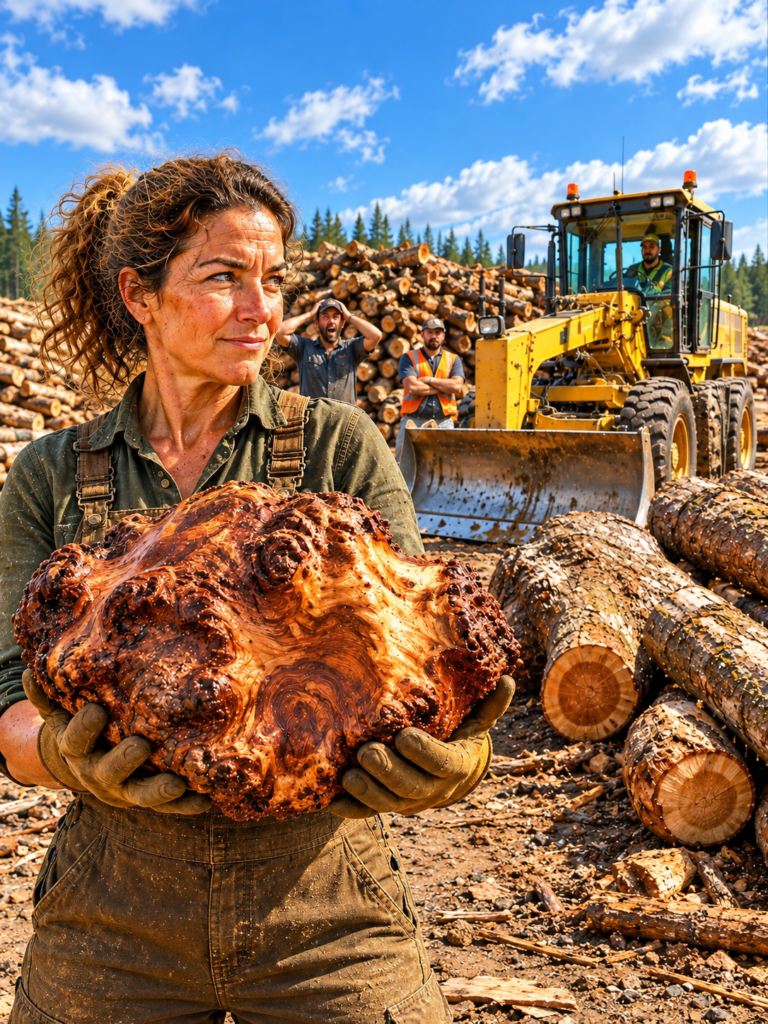
Part 1
On a Wednesday afternoon in October of 1991, Ruth Callaway backed a flatbed loaded with fourteen tons of hardwood into the scaling yard at Harden Mills in Osage County, Kansas, and waited forty minutes while a grader named Dale Prescott walked the load with a yellow crayon and marked every single log reject. The wind came off the river bottom and carried the smell of fresh-cut oak and diesel. Dale’s seed cap sat low on his brow. He did not look at her face while he worked. He looked at the ends of the logs and at the bark and at nothing else. When he finished he held the clipboard out without speaking.
Ruth did not argue with him. She looked at the clipboard, looked at the crayon marks on the logs, and said, “I’ll take them back.”
Dale Prescott blinked. He had expected her to negotiate. Every farmer who hauled timber to Harden Mills negotiated because the reject grade was an insult and everybody knew it. Forty-two dollars a ton for fourteen tons came to five hundred eighty-eight dollars. After the three hundred ten she had spent on fuel to haul the load from south of Lynden, she would clear two hundred seventy-eight for wood that had taken her three weekends to fell and buck. She did the math out loud, standing in the scaling yard with the engine ticking behind her. Dale watched her do it. When she finished she said the number once, flatly, the way you would read a temperature off a thermometer.
“Two hundred seventy-eight.”
Then she walked to the truck, lowered the tailgate, and started loading the logs back on by herself. The yard crew stood by the scale house and watched. Two of them leaned on a forklift. Nobody offered to help because nobody understood what she was doing. And when people do not understand what someone is doing, they tend to stay very still.
Ruth rolled each log up a pair of ramps she kept chained under the bed, using a can hook her father had bought in 1973. The handle was hickory and the hook was forged steel and the whole thing weighed eleven pounds. She worked it with one hand while she guided the log with the other. The logs were heavy and still green in places. Her shoulders burned. Sawdust stuck to the sweat on her forearms. It took her an hour and forty minutes to reload fourteen tons. When she was finished she chained the load, climbed into the cab, and pulled out of the yard without looking back. In the rearview mirror the yellow marks on the ends of the logs looked like flags.
It was 1978 and Ruth was eighteen years old. She lived on two hundred forty acres south of Lynden in Osage County and she worked beside her father Howard every day that she was not in school and most days that she was. Howard Callaway was fifty-two then and still the strongest man she had ever seen. Not the biggest. The strongest. There is a difference, and it has to do with how a person uses what they have. Howard used everything he had with a precision that made other farmers nervous. He could split a log with three strokes where most men took six. Not because he swung harder, but because he read the grain before he swung at all.
Howard never looked at a piece of wood and saw lumber. He looked at wood and saw what the tree had been doing while it grew. A twist in the grain meant the tree had fought prevailing wind. A tight curl near a branch union meant the cambium had folded over itself, trying to heal. A burl—that dense swirling mass of knotted figure that most sawyers cursed and most graders rejected—meant the tree had spent decades redirecting its own growth around a disruption it could not stop and could not escape. And the result was wood so dense and so complex that it could not be milled on a production line, could not be dried on a standard schedule, and could not be graded by a man with a yellow crayon who had been taught to look for straight grain and nothing else.
Howard’s one repeated line, the sentence Ruth heard more times than any other sentence in her life, was this: “The tree already did the hard part. You just have to read what it wrote.”
He kept a green ledger-style journal in his workshop, a notebook with entries on grain figure, species identification, and drawing notes that went back to 1964. The entries were written in pencil in a hand so small and so steady that Ruth needed reading glasses to make them out even when she was eighteen. Each entry described a specific piece of wood: species, diameter, where it grew, what the grain looked like when he split it open, how it behaved when it dried. Next to many entries he had drawn the grain pattern in cross-section. And next to some of those drawings he had written a single word: burl, or figure, or cathedral. These were not grading terms. These were the words Howard Callaway used for what he saw when he looked at wood the way other people looked at weather.
His workshop sat behind the barn, a concrete-floored room with a wood stove and a single window that faced east. The tools hung on pegboard in the order he had arranged them in 1967. In the center of the bench sat his Stanley number four hand plane. The wooden tote was worn smooth from decades of use. The blade was honed to a level of sharpness that Ruth tested once with a sheet of newspaper and watched the paper fall apart under its own weight. Howard used that plane the way a jeweler uses a loupe. It was not a production tool. It was a diagnostic instrument. He would take a rough slab of something the county would have chipped for mulch and run the plane across it once, twice, three times, and then hold the shaving up to the window light and read the grain in the curl of the shaving itself. From that single curl he could tell you whether the wood had figure worth saving or whether it was genuinely ordinary.
Howard died in March of 1987 during calving season of a heart attack that took him between the barn and the house. Ruth was twenty-seven years old. She found him in the mud with his boots still on and one hand curled around the handle of a bucket. She buried him on the east side of the property under a bur oak that he had once told her had the finest burl he had ever seen in a living tree. She went back to the workshop that same evening and sat at his bench and did not touch the hand plane and did not open the journal and did not cry because there was calving to finish and two hundred forty acres do not pause for grief.
She inherited the land, the cattle, the workshop, the journal, the hand plane, and a way of seeing that she had not yet tested on her own. For four years she ran cattle and sold what timber she could to Harden Mills and other yards in the region. The prices were never good and the work was never easy. She was alone on two hundred forty acres in a county where most operations her size had already sold or consolidated. But during those four years something else was happening that nobody in Osage County knew about.
In 1989, at a farm auction outside Burlington, Ruth bought a water-damaged copy of R. Bruce Hoadley’s Understanding Wood for seventy-five cents. The covers were warped and the first thirty pages were stained with what looked like coffee or maybe mineral oil, but the text was legible and the diagrams were intact. Ruth read it cover to cover three times in the first month she owned it. Hoadley wrote about wood the way Howard had talked about it, which is to say as a material with a logic that could be learned. The book confirmed things Ruth had suspected and taught her things she had not known and connected the two in ways that made her go back to Howard’s journal and read entries she had skimmed before with completely different eyes.
She started splitting sample logs in the barn, not for sale, not for firewood. She would haul home a reject log from a mill run, one that had been passed over for twist or knots or checking, and she would buck it into rounds and split the rounds open and look at the cross-section the way Howard had looked at shavings. She photographed the cross-sections with a disposable camera and taped the prints into a notebook beside her own drawings. She compared them to Howard’s journal entries on grain figure. She was teaching herself to read from the outside what a log was carrying on the inside. And she did this for two years before the Wednesday in October of 1991 when she loaded fourteen tons of mixed hardwood onto a flatbed and drove them to Harden Mills and watched Dale Prescott mark every single one reject.
Nobody in Osage County knew about the two years. Nobody knew about the photographs. Nobody knew about the notebook. What they knew was that Ruth Callaway ran cattle on her father’s land and sold timber when she could and kept to herself more than was usual. And when word got around that Dale Prescott had turned away her entire load and she had hauled it back home without a fight, the general opinion at Oster Feed and Supply was that she had made a mistake on the timber selection and was too proud to admit it.
Part 2
The night after the rejection Ruth sat in the workshop. The hand plane was on the bench where it had sat since 1987. The green journal was opened to a page she had read many times, a page on which Howard had written in that small steady pencil hand a note about burl in bur oak: Swirl goes all the way through, not just surface. Split it and you’ll see the grain is the record. Next to it the Hoadley book was opened to the chapter on figured wood. The pages were still warped from whatever had soaked them years before she bought them. There was no one to ask. That was the thing about having a dead mentor. The tools were there. The knowledge was there. The way of seeing was there. But the voice that would have said “You’re right. Go ahead,” or “Wait, think about this first,” was gone. And in its place was a silence that could mean anything you needed it to mean, which is the most dangerous kind of silence there is because it never tells you when you are wrong.
Ruth held the hand plane in both hands, turned it over, ran her thumb across the smooth tote where Howard’s palm had worn a shallow valley into the wood over twenty-three years of use, and set it back on the bench. She closed the journal. She closed the Hoadley book. She sat for a long time in the workshop with the wood stove cold and the single window black and the tools hanging in their exact places on the pegboard. And then she stood up and said to no one, “I’m going to split every one of them open.”
The next morning Ruth backed the flatbed up to the barn and began unloading fourteen tons of rejected hardwood by herself. The can hook, the ramps, the chain. Each log rolled off the bed and landed in the dirt with a sound like a door closing. She worked for two days. No one helped because no one had been asked. And in Osage County you did not show up to help with a project you did not understand because that was the same as saying you approved of it. And nobody approved of hauling home fourteen tons of wood that the best grader in the county had marked reject.
Burl is not a disease. It is not rot. It is not damage. It is a growth anomaly in which the tree’s cambium layer, the thin band of living tissue just beneath the bark where all new wood is made, begins dividing in a recursive nonlinear pattern instead of the orderly radial growth that produces straight grain. Nobody knows exactly why it happens. It may be triggered by a fungus, an injury, a genetic mutation, or some combination of all three, but the result is always the same: a dense swirling mass of interlocked grain that grows outward from the trunk like a fist made of wood. The cells are packed tighter than in straight-grain timber. The figure is three-dimensional, meaning it changes direction not just across the face of a board but through its depth. And when you cut it open and plane it smooth, light hits the grain at different angles and the surface appears to move, to ripple, to contain depth that is not physically there.
This is why burl is useless for framing. You cannot nail through it cleanly. You cannot predict how it will move when it dries. You cannot run it through a production mill because it will bind the blade and kick back. A grader at a scaling yard is trained to identify straight grain, consistent diameter, and minimal defect. And burl is the opposite of all three. So a grader marks it reject and moves on because his job is to sort lumber, not to look for miracles. But a furniture maker in Vermont or a bowl turner in Oregon or a luthier in Tennessee will pay between eight and fifty dollars per board foot for burl-figured bur oak, depending on the intensity of the figure and the size of the piece. And a single log that Dale Prescott marked with a yellow crayon and offered forty-two dollars a ton for might contain sixty or eighty or a hundred board feet of figured wood worth more than the entire load at reject grade.
Ruth knew this. She had known it for two years. The itemized cost of what she set up in that barn was small enough to fit on a single page of her notebook. The secondhand Husqvarna chainsaw mill she bought from a retired logger in Coffey County: one hundred forty dollars. A replacement chain: eighteen. Bar oil and fuel for the first month: twenty-two. A secondhand kiln drying fan and a thermometer from a school surplus sale in Emporia: thirty-five. Total initial outlay: two hundred fifteen dollars.
Ruth scribed a line down the first log with a chalk snap, set the chainsaw mill’s depth, and cut lengthwise. The saw screamed through the oak and the first slab fell open like a book, and inside, where Dale Prescott’s crayon had marked the bark, the grain swirled. Tight, dense, interlocked loops of bur oak burl, not surface deep, but running all the way through the cross-section exactly as Howard’s journal had said it would. Ruth set the slab on two sawhorses and ran her hand across the cut face and felt the grain change direction under her fingers four times in the span of six inches. She marked the slab with a grease pencil. Bur oak, heavy figure, October 1991.
The second log had burl. The third did not. The third was ordinary rejected oak, twisted and knotted, genuinely worthless, and Ruth set it aside for firewood without ceremony. The fourth had mild figure in walnut, interesting but not exceptional. The fifth was the same. The sixth carried dense burl in Osage orange, hedgewood so hard that the chainsaw mill bogged down twice cutting through it. She sharpened the chain in the barn and went back. Log seven she scribed the line, set the depth, and cut. The slab that fell open was the most intense burl figure she had found yet. Dense swirling grain in bur oak that looked like a topographic map of a landscape that did not exist. Contour lines of wood fiber curling into each other in three dimensions. And when she held the slab up to the light coming through the open barn door the figure seemed to move, to shift, to contain a depth that was impossible in a flat surface.
She stood there for a long time, covered in sawdust, holding eighty pounds of reject-grade bur oak up to the afternoon light. And she did not smile because this was not a surprise. This was a confirmation. She had known it was in there. She had known for two years. But knowing it was in there and getting it out in one piece were two very different things, and Ruth did not know that yet.
She carried the bur oak burl slab into the workshop and set it on the bench next to Howard’s hand plane. She opened the Hoadley book to chapter fourteen, the chapter on drying figured wood, and she read it again slowly, making notes in her notebook. The problem with burl, Hoadley explained, was that the grain was nonlinear. Straight-grain lumber shrinks predictably as it dries, mostly across the grain, very little along it, and a competent sawyer can account for that movement with proper stacking, air circulation, and time. Burl does not shrink predictably. The interlocked grain pulls in multiple directions at once. One side of a slab may lose moisture faster than the other because the grain density varies across the face. And when one side shrinks faster than the other the wood does what wood always does under unequal stress. It cracks.
Ruth followed the Hoadley book’s general schedule for hardwood. She sealed the end grain of each slab with paraffin wax melted in a coffee can on the wood stove and brushed on with a two-inch bristle brush. She stacked the slabs on stickers in the barn, quarter-inch strips of dry oak between each layer, spaced every twelve inches. She set up the fan. She hung the thermometer from a nail where she could read it from the door. She bought a pin-type moisture meter from a farm supply catalog for nineteen dollars and checked each slab every morning before dawn, pushing the pins into the end grain and writing the reading in her notebook: date, slab number, moisture content, ambient temperature, ambient humidity.
Three weeks passed. The cattle needed worming. A section of fence along the south pasture came down in a windstorm and she spent two days resetting posts. Hay season was approaching and she needed to arrange cutting. The work of two hundred forty acres does not stop because you have a project in the barn, and Ruth did not expect it to. She checked the slabs every morning. The moisture readings came down eight percent per week, then six, then four. As the slabs approached equilibrium the paraffin seals held. The sticker spacing looked right. The fan moved air evenly across the stack. It looked, by every measure she had, like it was working.
On the morning of the twenty-third day Ruth walked into the barn and heard it before she saw it: a sound like a knuckle cracking, sharp and final. She walked to the stack and found it. The finest slab, the bur oak from log seven, the one with the topographic figure, had cracked. A check ran from the sealed end grain to the center of the slab, then opened into a full split that followed the densest line of burl like a river finding a valley. The two halves had separated by a quarter inch. The wood on either side of the split was still beautiful, still figured, still dense with swirling grain, but the slab was ruined.
Ruth pulled it off the stack and carried it into the workshop and set it on the bench. She examined the split with a magnifying glass she kept in the drawer. The crack had followed the boundary between two different densities of burl figure, a line where tightly packed grain met slightly looser grain, and the tighter grain had dried faster and shrunk more and pulled away from the looser grain like two pieces of tape drying at different speeds. The drying had been too fast. Not by much, a few percentage points of moisture per week too fast. But in burl a few percentage points was the difference between a slab worth three hundred dollars and two pieces of firewood worth nothing.
She sat on the workshop floor with her back against the bench. The cracked slab was above her on the bench next to the hand plane and the green journal and the Hoadley book. The wood stove was cold. The single east-facing window showed a sky the color of galvanized steel. She could sell the cattle timber as firewood at twelve dollars a rick. She could clear the barn, put the chainsaw mill in the equipment shed, close the journal, shelve the Hoadley book, and go back to running two hundred forty acres the way everyone expected her to run them. The math was simple. Two hundred fifteen invested, zero returned. Twelve dollars a rick for firewood if she wanted to cut her losses. Quitting was right there. It was sitting on the bench next to the hand plane like a patient, reasonable guest who had been waiting for this exact moment to speak.
At Oster Feed and Supply that Thursday Marlene Oster rang up Ruth’s order of mineral blocks and said without looking up, “Heard you bought a chainsaw mill.”
Ruth said nothing. Marlene waited. Ruth signed the receipt and picked up the blocks and carried them to the truck. The town knew. The feed store knew. Marlene would tell the next three people who walked through the door, not out of malice, but because that is what a feed store counter is for in a county this size. And by Friday evening Dale Prescott would know too. And the grading crayon behind his ear would feel like a verdict all over again.
Ruth drove home. She parked by the barn. She walked past the stack of slabs, past the fan still running, past the thermometer still reading sixty-one degrees, and into the workshop. She picked up the two halves of the cracked bur oak slab and held them together, fitting the split back into alignment. And for a moment the figure was whole again, the topographic map complete, the grain swirling unbroken from edge to edge. Then she set the halves down on the bench side by side, the split between them like a road through a landscape. And she sat on the floor and looked at them and did not get up for a long time.
Part 3
Near midnight she got up, pulled Howard’s green journal toward her, and opened Hoadley’s book again. She did not look for another drying schedule. She had already followed one. Instead she compared the places where the two sources disagreed because disagreement between careful people usually meant they were solving different parts of the same problem.
Howard had written three pages about hedgewood he cut after an ice storm in 1978. Osage orange was dense, hard, and notorious for opening at the ends before the center had surrendered much moisture. He had tried ordinary sticker drying and lost five boards out of eight. On the next batch he buried the fresh-cut slabs in clean sawdust for two weeks, turning them every third day because loose sawdust slowed the exchange of moisture without sealing the wood completely. His final note was underlined once: Half speed at the beginning saves twice the time at the end.
Hoadley approached the same problem from another direction. His section on stress relief explained that the surface of a slab could become too dry while the core remained wet. The dry outer fibers contracted around a swollen center, setting up tension that might not release until days later. Wetting the surface during the early stage allowed those fibers to relax while the core continued losing moisture.
Ruth read Howard’s page, then Hoadley’s, then Howard’s again. The answer was in the space between them. She swept a clear patch of floor beside the barn wall and built a shallow box from old one-by-twelves. She filled it with dry oak sawdust collected beneath the chainsaw mill, laid a walnut burl slab inside, covered it with eight inches of sawdust, and wrote the date in her blue notebook. For fourteen days she uncovered and turned the slab every morning. The sawdust absorbed moisture nearest the surface, but because air could not move freely across the wood the loss remained slow. On the fifteenth day she removed the slab, wrapped it loosely in damp burlap, and set it on stickers without the fan. Every evening she weighed the burlap on a feed scale, added enough water to replace what had evaporated, and wrapped the slab again. A month later she removed the cloth and allowed open air around the walnut. Only after its moisture readings had nearly equalized across the face and center did she switch on the fan.
It was not a method from either book. It was what happened when she made the two books answer each other. Six weeks after she buried the slab Ruth carried it beneath the workshop lamp and examined both ends. There were no checks beneath the wax, no hairline separations across the face, and no hollow sound when she tapped the center with the handle of a screwdriver. The moisture meter gave readings within one percentage point at all six positions. She clamped the walnut to the bench and reached for Howard’s Stanley number four. The iron was still sharp. She set it for a shaving thin enough to curl against itself, leaned forward, and pushed. The plane crossed several changes of grain direction without tearing because the cut was shallow and the mouth was tight. One amber shaving slid from the throat. Beneath it the walnut figure caught the lamplight in overlapping whorls, dark at one angle and bronze at another. The slab had survived.
Ruth wrote three words beside its drying record: use this method.
Most people see a knotted log and they see a problem. Howard Callaway saw a diary. He saw every year of stress, wind, injury, and recovery recorded in the grain. And Ruth had read enough of those diaries by then to know which ones were worth opening. She spent the winter of 1991 into 1992 drying the remaining figure by the hybrid method. Sawdust first, damp burlap second, open air last. The barn smelled of wet oak, walnut tannin, and chainsaw oil. Every rack carried a paper tag and every tag matched a page in the blue notebook in her jacket pocket. She processed twenty-three slabs that winter. Nineteen survived intact. Two developed short end checks that could be trimmed away. One cupped beyond anything a furniture maker could flatten. And the split bur oak remained in the workshop as the cost of learning too quickly.
On each sound slab she planed a patch measuring three inches square. She photographed the exposed figure, then recorded the species, length, width, thickness, moisture content, drying time, and an intensity grade of her own making. One meant mild movement. Five meant figure so dense that no straight line of grain crossed the test patch. The first slab she priced was bur oak, fourteen inches wide, thirty-six inches long, and two and a quarter inches thick. The tree had grown on Callaway land so the raw log had cost her nothing. Fuel, chain wear, paraffin, sawdust handling, burlap, and fan electricity came to roughly eleven dollars and forty cents for that slab. Comparable bur oak burl at that intensity sold for three hundred ninety dollars. Ruth wrote eleven-forty on one line. Beneath it she wrote three hundred ninety. She underlined the difference, closed the notebook, and looked toward the rack.
She could find the figure. She could release it from the log, dry it without breaking it, grade it, and put a defensible price on it. None of that meant a furniture maker would drive down a gravel road four miles south of Lynden to buy wood from Ruth Callaway.
Before she could test that question Dale Prescott came to the barn. Marlene Oster had told a customer about the photographs Ruth brought into the feed store. That customer mentioned them to his brother at a church supper. The brother repeated it while buying hydraulic hose in Overbrook, where Dale’s wife happened to be waiting at the counter. By the following Saturday Dale drove onto Ruth’s property alone. He entered carrying his clipboard against his belly. The thick yellow grading crayon was behind his right ear and his faded green seed cap cast a line across his heavy brows.
Ruth stood near the drying rack in her olive canvas jacket, the loose strands at her temples dusted with walnut powder. Dale walked past the first slab, then the second. He touched the planed patch on the walnut and bent enough to watch the figure change in the light. At the bur oak he removed the crayon from behind his ear, rolled it between his fingers, and put it in his shirt pocket. The silence lasted about two seconds.
“I was wrong.”
The words cost him something. You could see it in the way he kept his eyes on the slab after speaking, but he said them cleanly without an excuse attached. Ruth nodded once. Dale examined the tags on the rack.
“You need me to flag the knotted hardwood before we chip it?”
“At reject price.”
“At reject price. I’ll need weight tickets.”
“You’ll get them.”
He did not apologize for calling it firewood. Ruth did not ask him to. On Monday morning he began placing selected rejects beside the west fence at Harden Mills, away from the chipper pile, and writing Callaway on the ends in yellow. Ruth had proved Dale wrong in the only language he trusted. But the rack in her barn still held nineteen slabs and not one buyer had seen them.
Part 4
In April of 1992 she loaded the first finished pieces into her pickup and drove south to a woodworking show in Wichita. She did not take the slabs to another lumberyard. Lumberyards had already decided what they were. She rented the cheapest booth in the building, a narrow space beside an emergency exit where the concrete floor sloped toward a drain, covered a folding table with brown paper, and leaned six slabs against it. The first two hours brought questions but no money. Men touched the planed patches, asked whether the slabs were kiln-dried, and moved on when Ruth explained the slow schedule. One called the bur oak too unpredictable. Another offered a hundred dollars for a walnut piece marked at three hundred twenty. Ruth declined and remained upright behind the table, her hands in her jacket pockets.
Shortly after noon Gene Hadley stopped at the booth. He was a Wichita furniture maker with a gray beard, a canvas measuring tape around his neck, and the habit of looking at wood from the edge before examining the face. He lifted a walnut burl slab, turned it over, sighted down its length, and held it toward the fluorescent lights.
“Where did you source this?”
“Rejected mill timber in Osage County.”
“You dry it?”
“Yes.”
“How long?”
“Six weeks under buffer. Four more equalizing.”
Gene checked the ends and pressed a thumbnail beside the moisture meter holes. He chose that slab, a second walnut, and one piece of bur oak. The three prices totaled nine hundred forty dollars. He paid without bargaining. Before leaving he handed Ruth a business card with sawdust ground into one corner.
“Call when you have more walnut like this.”
That first sale did more than repay the two hundred fifteen in equipment and the three hundred ten in hauling fuel. It answered the question the empty rack had been asking. Someone who understood figured wood had examined Ruth’s work closely and paid the stated price. But one buyer could still be an accident. Gene built a low cabinet with matched walnut burl doors and showed it to another furniture maker. That man called Ruth and bought two slabs. A bowl turner from El Dorado heard about the Osage orange and drove up on a Tuesday. Marlene Oster began keeping a ledger behind the feed counter, though Ruth had never asked her to. Every time someone mentioned buying Callaway wood Marlene wrote the name, species, and amount in pencil. Word traveled the way water travels on flat ground. It did not hurry, but it found every low place.
By the fall of 1992 Ruth had sold thirty-one slabs for eleven thousand six hundred dollars. She had bought no advertisement. Aside from the Wichita show she had not left Osage County. Buyers came to the barn, selected pieces from the rack, and carried them away wrapped in moving blankets. In 1993 she sold forty-seven slabs for eighteen thousand two hundred dollars. Dale set aside promising rejects at Harden Mills, but he did more than that. He began turning each log before marking it, looking for bark distortion, dormant buds, and rounded swellings he once treated as defects. He was still grading for the mill and many logs still went to the chipper, but the yellow marks now separated two kinds of reject.
In 1994 burl and figured wood brought Ruth more than forty-one thousand dollars. She built a dedicated drying shed behind the barn, twenty-four feet wide and forty-eight feet long, with adjustable vents along both walls and removable racks that allowed air to move without forcing it. The shed was paid for before the first post went into the ground. She also began buying reject-grade loads from two mills in neighboring counties. Depending on species and hauling distance she paid between fifty and sixty dollars a ton. The mills accepted those figures because chipped hardwood brought less after handling, blade wear, and transport. Ruth accepted them because one figured slab could repay the cost of several tons.
The economics deserve attention because the numbers explain why the operation could take blows that broke larger businesses. Ruth bought material the mills were already paying workers and machinery to dispose of. Her equipment was secondhand and paid off. Her labor belonged to her. The drying system used clean sawdust, burlap, moving air, and time instead of a commercial kiln with loan payments and heavy electrical demand. Her variable costs were chainsaw fuel, bar oil, replacement chains, wax, tags, and mileage. When sales slowed those costs slowed too. There was no financed building waiting for a monthly check and no payroll due on Friday.
You know what eighteen percent interest did to operations that borrowed to expand in the late seventies. It turned manageable notes into weights that good land could not carry. By the time the farm crisis reached the plains in the mid-eighties, leveraged operations were going under by the hundreds and the auctioneer’s truck became as familiar on county roads as the school bus. Ruth remembered those years. They were why every addition behind her barn was purchased with money already earned. When cattle prices dropped in 1996 three ranches in Osage County went to auction. Ruth’s cattle checks fell with everyone else’s and feed did not become cheaper simply because calves did. But the burl operation covered her property taxes, her feed bill, and her mortgage payment without touching cattle revenue. The thing held because debt could not call it due.
By 1998 Ruth was processing bur oak, walnut, hedge, maple, elm, and occasional honeylocust. She rejected more material than she accepted. Soft rot, insect galleries, hidden ringshake, and figure too shallow to survive milling all went to firewood. Finding value did not mean pretending every damaged log contained it. Her blue notebook had become seven notebooks arranged by year. Howard’s green journal remained at the beginning of the row. Marlene’s unofficial ledger at the feed store continued growing and Dale occasionally arrived with a mill ticket and a note identifying a log he thought Ruth should open first.
Up to this point Ruth had been choosing the wood, controlling the drying, and finding customers through private recommendation. That was about to flip because in 2002 a contributing editor named Paul Schreiber drove to Osage County while researching Midwestern sources for Fine Woodworking. Paul expected to spend an hour. He stayed two days. He photographed the drying shed, the tagged racks, the sawdust boxes, and Ruth planing a test patch with Howard’s Stanley number four. On the second afternoon she showed him a bur oak slab with tight eye figure crossing almost the entire face. He moved it beneath three different windows before asking whether he could photograph it alone.
The article appeared later that year. Paul called the bur oak the most dramatic piece of figured hardwood I have seen outside a museum collection. The week after publication Ruth received calls from Colorado, Minnesota, and Missouri. Buyers began driving directly to the yard with trailers and padded racks. Annual revenue passed one hundred twelve thousand dollars. But the increase created a question money did not answer. Ruth still inspected every log, kept every drying record, answered every call, and loaded every sale herself. The operation had become known beyond Kansas but it still depended on one woman opening the barn each morning. For nine more years that remained true.
Part 5
Up to this point Ruth had been in control of every piece of the operation. That was about to shift, not because something went wrong, but because someone showed up carrying a silver laptop with a cracked corner. It was 2011 and Ruth was fifty-one years old. Sun and wind had deepened the weathering across her cheeks but she still wore the faded olive canvas jacket over a cream thermal shirt and the blue notebook still rode in its left chest pocket. The covers had been replaced twice. The habit had not. The operation generated more than one hundred thirty thousand dollars that year. Ruth had processed over two thousand burl slabs without hiring an employee. She knew which mills cut too deep with their debarkers, which species tolerated winter harvesting, which buyers wanted wild figure, and which would pay more for quiet matched pairs. She was also tired in ways she did not mention. A log that had seemed merely heavy at thirty-one now required a longer pause before she set the can hook again. She stopped climbing the drying racks and used a rolling ladder. Orders sat unanswered for two or three days during calving because there was still only one Ruth Callaway and the cattle had never agreed to make room for figured wood. The unanswered question was no longer whether the work could support the farm. It was whether the work could exist apart from her.
Tom Engel arrived from Lawrence in May. He was Ruth’s sister’s son, twenty-two years old, slim, slightly slouched, with wavy light brown hair pushed to the right and a light sunburn across his nose. He wore a slate-blue work shirt with the sleeves rolled above freckled forearms, dark jeans, and dusty brown boots. In one hand he carried the damaged laptop. In the other he carried a notebook. Tom had completed a forestry degree and spent one summer inventorying urban trees after storm damage. He understood species identification, fungal staining, bark structure, and the difference between a growth defect and structural decay. More importantly he had spent enough holidays in Ruth’s barn to know that her grading system contained information buyers could not get from an ordinary lumber catalog.
He opened the laptop on the workbench and showed her a rough website. Each slab would have its own page. The page would include photographs from both faces and both ends, exact dimensions, moisture content, species, figure intensity, defects, weight, and drying history. Tom wanted to add Ruth’s grading scale but he wanted her to define it so a buyer in Oregon could interpret a slab almost as accurately as someone standing in the shed.
“The buyers could come to the wood before they drive here,” he said.
Ruth looked through twelve sample listings. Tom had photographed one walnut slab under harsh light and she pointed to the glare hiding the center figure. Another listing called bark inclusion rot when it was sound ingrown bark. She corrected both, then asked how payment would work, how shipping claims would be handled, and what happened if the screen made a mild figure look stronger than it was. Tom answered what he knew. Where he did not know he wrote the question down.
Ruth did not send him home to prepare a better proposal. She did not ask for a week. She did not make him sit beside an unanswered telephone while the idea cooled.
“Yes,” she said. One word, immediate and complete.
By July the laptop stayed in the workshop. Howard’s hand plane occupied the far end of the bench, its wooden tote darkened by decades of palms. Beside it lay the green journal with its swollen spine. Ruth’s current blue notebook with curled cardboard edges and Tom’s computer plugged into an extension cord running down from the wall. Three generations had recorded the same material differently. Howard used pencil and close observation. Ruth added measurements, photographs, and controlled tests. Tom built a searchable record that could cross state lines in seconds. None replaced what came before it.
Tom’s first grading draft used six categories. Ruth reduced it to four because the difference between his middle grades could not be repeated consistently. They measured figure coverage by quarters of the face, distinguished eye burl from wave and curl, and required every listing to show flaws under flat side light. Tom wanted polished photographs. Ruth wanted honest ones. He changed the camera setup. Their first online order came from a cabinet maker in Tulsa who bought two matched walnut slabs for one thousand one hundred eighty dollars. The second came from a bowl turner in Denver. The third was returned because the buyer mistook a bark pocket for a void. So Ruth and Tom added a close photograph with a ruler beside every inclusion. The failure cost them freight in both directions. It also fixed the catalog.
Within six months buyers were reserving slabs before the final open-air drying stage ended. Tom built a notice into each listing showing estimated completion dates, but Ruth refused deposits on unfinished wood. A slab could still move in its last weeks and she would not sell certainty she did not possess. Dale Prescott visited that autumn. He was seventy-three and retired from Harden Mills, heavier through the middle, with the same yellow crayon behind his ear though he had nothing left to grade. Tom showed him the website and opened a photograph of a bur oak slab sourced from the west fence pile at Harden. Dale studied the screen.
“Looks better here than it did in bark.”
“It always did,” Ruth said.
He gave a small nod. That was the entire conversation.
The site did not make Ruth’s work easier at first. It doubled the records, added shipping crates, and brought questions from buyers who wanted guarantees no piece of wood could give. But it also showed Tom where demand exceeded supply. Wide matched walnut sold quickly. Osage orange moved slowly until he placed the turning blanks in a separate category. Instrument makers wanted narrower stock with figure running consistently through the thickness while table builders needed slabs large enough that the grain movement could carry an entire surface.
Tom arrived with another proposal in 2012. He wanted to photograph selected logs before milling, map the likely figure from bark growth, and compare those predictions with the open slabs. Over time the records might improve Ruth’s ability to choose from a reject pile without making the first cut. She read two pages and said yes again. The prediction failed on nine of the first twenty logs. Bark distortion suggested burl where internal growth had straightened while two plain walnut logs contained deep crotch figure nobody anticipated. Tom wanted to discard the model. Ruth told him to add the failures. By the end of the second year the archive showed patterns neither had noticed alone. Dormant bud clusters mattered more than overall swelling in bur oak. Repeated low ridges around walnut trunks often indicated layered figure beneath the cambium. Hedge remained difficult because its deeply furrowed bark concealed too much. The online catalog did not replace Ruth’s judgment. It gave her judgment a longer memory.
One evening Tom asked what she would tell someone considering this kind of work. Ruth was sharpening the plane iron at the time, drawing the bevel over a fine stone with both hands. She wiped the steel, held it toward the window, and checked the edge.
“Nature already handled the difficult work,” she said. “You just have to read what it wrote.”
Those were Howard’s words, though not from any page in the green journal. Ruth had carried them through failed drying, nineteen surviving slabs, the Wichita booth, the cattle crash, the magazine article, and more than two thousand pieces of wood that reached workshops far beyond Kansas. Now Tom wrote them at the front of his notebook. By 2014 online sales accounted for more than half the operation’s orders. Tom handled the catalog and shipping calendar, but Ruth still selected the logs, approved every grade, and planed every test patch. The east window still faced the same direction. The tools still hung where Howard had hung them. And on the bench the Stanley number four waited for the next shaving that would tell her what the tree had already written.

