
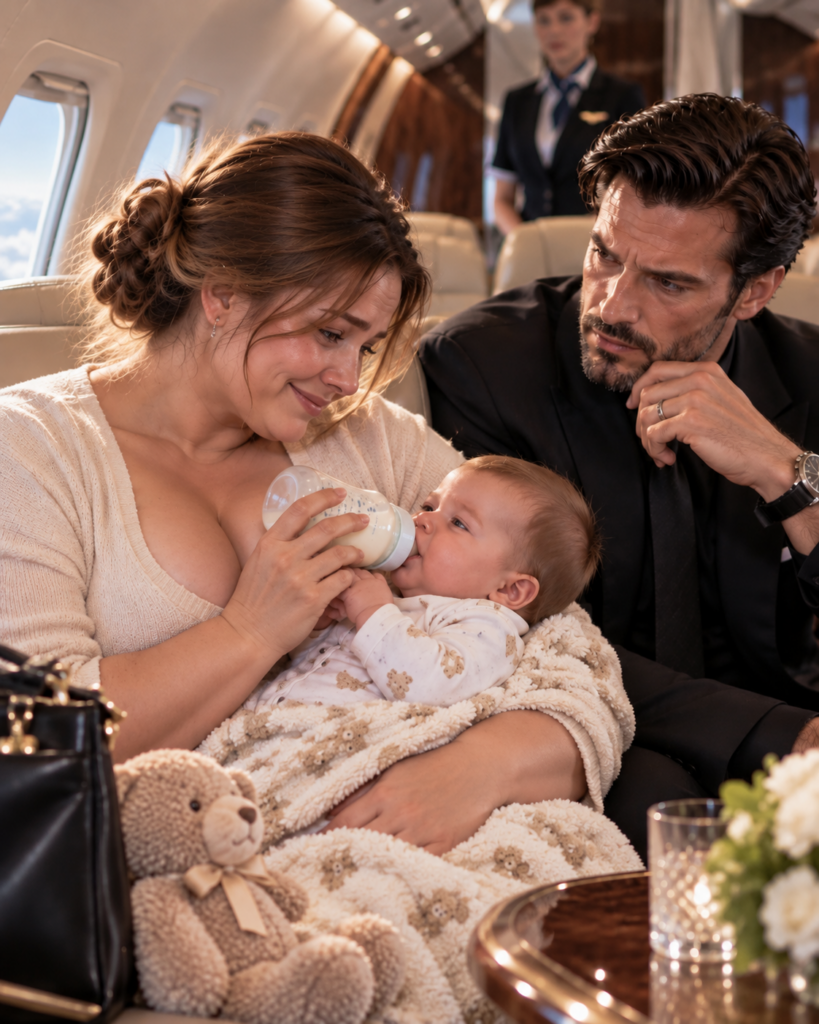
THE BABY WHO STOPPED CRYING FOR A STRANGER
The infant had screamed for forty-three minutes—until the grieving woman from economy touched her.
The dangerous man holding the child did not believe in miracles, accidents, or innocent strangers.
By the time the plane left the ground, he had already ordered someone to investigate her.

PART 1 — THE CHILD WHO CHOSE HER
The recycled cabin air tasted of metal and burnt coffee. Emma Carter pressed her forehead against the cold window of seat 23A and watched rain stripe the glass, turning the runway lights into trembling rivers of red and gold.
Around her, passengers shoved coats into overhead bins and complained about delays. Emma touched the yellowed hospital bracelet around her wrist, rubbing her thumb over the faded name printed in blue ink.
MIA CARTER.
Three years old in memory. Six hours old in life.
The first scream came from first class.
It was thin at first, almost lost beneath the closing luggage compartments. Then it sharpened into a full-bodied cry so desperate that Emma’s spine straightened before she could stop herself.
The woman beside her sighed. “Wonderful. A baby all the way to Chicago.”
Emma barely heard her.
Six rows ahead, a tall man in a charcoal suit held an infant as if someone had placed a live grenade in his arms. Two broad-shouldered men stood beside him, ignoring the flight attendant’s repeated request to sit down. One had a rigid jacket line that suggested a holstered weapon.
The crying worsened.
Emma knew that sound. It was not hunger. It was not stubbornness.
It was fear.
“Sir,” the flight attendant said, forcing a smile, “we need everyone seated.”
“I am trying.”
The man’s voice was low, controlled, and cold enough to quiet every adult nearby.
The child screamed harder.
An elderly passenger rose to offer help, but one of the guards blocked her. The captain appeared next, looking irritated until the man leaned close and whispered his name. Whatever he said drained the color from the captain’s face.
Emma should have stayed invisible.
Instead, she unfastened her belt.
Every step toward first class felt like trespassing into another world. The carpet grew thicker. The seats widened. The man’s black eyes found her immediately, and the guard nearest him slipped one hand inside his jacket.
“I might be able to help,” Emma said.
The man studied her wrinkled blouse, scuffed flats, and trembling hands. “Are you a nanny?”
“No.”
“A doctor?”
“No.”
“Then what are you?”
Her fingers closed around Mia’s bracelet.
“A mother.”
His gaze dropped to the bracelet, but the child’s cries broke whatever question had formed in his eyes.
Emma held out her arms. “Please.”
For one terrible second, she thought he would refuse. Then he transferred the baby to her.
Warmth. Weight. Damp curls.
Emma’s body remembered what grief had tried to erase. She settled the child against her chest, supported her head, and began to sway.
“There you are,” she whispered. “You don’t have to fight everyone. Just breathe.”
She hummed the unfinished lullaby she had once sung beside Mia’s hospital bassinet.
The infant’s screams fractured into hiccups. Her tiny fist caught Emma’s blouse. Thirty seconds later, she was silent.
The entire cabin seemed to exhale.
But the man did not look relieved. He looked alarmed.
“How did you do that?”
“She needed to feel a heartbeat.”
His eyes moved from his sleeping daughter to Emma’s face. “What is your name?”
“Emma Carter.”
He took her wrist—not painfully, but firmly—and examined the hospital bracelet.
“Who sent you, Miss Carter?”
“No one.”
“I don’t believe in coincidences.”
Before Emma could answer, he gestured toward an empty first-class seat.
“She stays here,” he told the flight attendant.
“My seat is in economy.”
“Not anymore.”
He reclaimed the baby, copying Emma’s hold with unnerving precision. The infant remained asleep against his chest.
As the aircraft began to taxi, one guard carried Emma’s battered suitcase forward. The other spoke urgently into a phone in Russian.
Emma lowered herself into the leather seat. “You still haven’t told me your name.”
The man fastened his belt without taking his eyes from her.
“Nikolai Volkov.”
The name passed through the nearby passengers like a silent electrical current. A businessman across the aisle abruptly looked away.
Nikolai leaned closer.
“You boarded this plane wearing the bracelet of a dead child. You approached a protected family without hesitation. And my daughter—who has rejected every nurse and specialist I hired—fell asleep in your arms.”
Outside, the engines roared.
“So before we land,” he continued, “you are going to tell me exactly who you are.”
Emma opened her mouth.
Nikolai’s guard bent beside him and whispered something in Russian. For the first time, fear cracked the surface of Nikolai’s face.
He turned toward Emma, one arm tightening around the baby.
“Change of plans,” he said. “Someone on this plane knows you.”
PART 2 — THE PRICE OF BEING SEEN
The aircraft climbed through a wall of storm clouds, rattling hard enough to make the glasses in first class chime against their trays. Emma gripped both armrests while lightning flashed beyond the oval windows, bleaching Nikolai’s face bone-white for an instant.
“Who knows me?” she asked.
Nikolai did not answer her. He held out one hand, and the guard placed a phone in it. A photograph filled the screen—a grainy airport image of Emma standing at the check-in counter.
A red circle had been drawn around her face.
Beneath it was a single line of text in Russian.
“What does that say?”
Nikolai looked at his guard. “Dmitri.”
The guard hesitated.
“Translate it.”
Dmitri’s pale eyes shifted toward Emma. “‘The woman has made contact.’”
The engines hummed beneath the sudden silence.
Emma stared at the picture. “I haven’t made contact with anyone. I bought my ticket yesterday. I didn’t even know you existed.”
“Convenient,” Nikolai said.
“True.”
“Those words rarely mean the same thing.”
The baby stirred at the edge in his voice. Nikolai immediately lowered it, pressing his broad palm against her back. That small adjustment unsettled Emma more than his suspicion. He could frighten a plane full of adults without raising his voice, yet one restless sigh from his daughter could rearrange his entire body.
“Search her bag,” he told Dmitri.
Emma stood so quickly that her belt snapped tight across her hips. “No.”
Several passengers looked over. Dmitri stopped beside her suitcase.
Nikolai’s gaze hardened. “Sit down.”
“You don’t get to invade my belongings because your daughter stopped crying.”
“You approached me.”
“To help a baby.”
“And within fifteen minutes, someone sent a message proving they were watching.”
“That makes me a target, not a spy.”
Something changed in his eyes. Not trust, but recognition.
Emma unfastened her belt and dragged the suitcase toward herself. “I’ll open it. You’ll keep your hands where I can see them.”
One corner of Dmitri’s mouth twitched.
Nikolai did not smile. “Do it.”
Emma laid the suitcase across the empty seat. Inside were two blouses, jeans, underwear, an old paperback, a toiletry bag, and a framed photograph wrapped in a gray sweater.
The glass had cracked through Mia’s face.
Emma froze.
She had wrapped it carefully that morning. She knew she had. Now the backing hung loose, and a thin black rectangle protruded from beneath the cardboard.
Dmitri reached for it.
Emma caught his wrist. “What is that?”
He removed a tracking device no larger than a stick of gum.
Every warm sensation left Emma’s body.
Nikolai took the device between two fingers. “This wasn’t placed by airport security.”
“I’ve never seen it.”
“Who packed your bag?”
“I did.”
“Who had access to it?”
“No one.”
Her answer came too fast.
Nikolai heard it. “You’re lying.”
Emma looked down at Mia’s fractured photograph.
“My former husband knew I was leaving.”
“What is his name?”
She closed the suitcase. “That has nothing to do with you.”
“A tracking device linked you to my daughter at thirty thousand feet. Everything has something to do with me now.”
The baby woke and made a small, uncertain sound. Nikolai shifted her too late. Her face crumpled.
Emma held out her arms.
He hesitated, suspicion and helplessness fighting across his features. Then he surrendered the child.
The baby settled against Emma’s heart.
“Her name?” Emma asked quietly.
“Natasha.”
“How old?”
“Five months.”
“Where is her mother?”
Nikolai looked toward the storm-dark window. “Dead.”
The word carried no invitation for sympathy.
Emma stroked Natasha’s velvet-soft hair. “Mia died three years ago.”
His gaze returned to the hospital bracelet.
“She was born with an infection. The doctors thought antibiotics would work.” Emma swallowed. “They were wrong.”
Nikolai’s jaw tightened. “And your husband?”
“He blamed me.”
“For the infection?”
“For everything. The labor. The bills. The funeral. The fact that I couldn’t become the woman I had been before.”
A flight attendant approached with water, sensed the atmosphere, and placed it down without speaking. The ice clicked faintly inside the glasses.
“His name,” Nikolai repeated.
“Luke Mercer.”
Dmitri was already typing.
Emma turned sharply. “What are you doing?”
“Finding out whether your ex-husband has enough imagination to plant a professional tracker,” Nikolai said.
“He was a Chicago police detective.”
Nikolai and Dmitri exchanged a glance.
“What?” Emma demanded.
Dmitri’s phone vibrated. He read the screen, then spoke to Nikolai in Russian.
Nikolai’s expression emptied.
“What did he find?”
“Luke Mercer resigned fourteen months ago while under investigation.”
Emma stared at him. “Investigation for what?”
“Selling protected information.”
“That’s impossible.”
“People often use that word when the truth is merely unpleasant.”
“He was cruel, not corrupt.”
“Cruelty and corruption share a hallway.”
The words struck harder because they sounded practiced.
Emma looked at Natasha’s sleeping face and remembered Luke standing in the funeral-home parking lot, rain shining on his uniform, telling her that if she had noticed the fever sooner, Mia might still be alive. She remembered apologizing.
For years, she had apologized.
“Why would Luke track me?” she whispered.
Nikolai closed his hand around the device. “That is the first intelligent question anyone has asked today.”
The plane landed in Chicago beneath a bruised evening sky. Rain hammered the runway, and black vehicles waited beyond the private exit despite Emma’s insistence that she would take a cab.
“You are not going home alone,” Nikolai said.
“I’m not going anywhere with you.”
“Someone tracked your bag.”
“Someone connected to you.”
“Possibly.”
“That distinction matters.”
“Not to a bullet.”
His calmness infuriated her. Emma stopped beneath the terminal awning, Natasha’s warmth still lingering like a phantom against her chest.
“You don’t own every decision because people fear your name.”
“No.” Nikolai handed Natasha to a waiting woman in a dark wool coat. “I own this decision because my daughter was placed within reach of an unknown operation, and you are the only lead I have.”
“Then call the police.”
A dark, humorless laugh left him. “Your former husband was the police.”
The rain blew sideways, peppering Emma’s face.
Dmitri emerged from the terminal carrying her suitcase. “Her apartment was entered this afternoon.”
Emma’s anger vanished. “What?”
“Building camera shows a man in a maintenance uniform. He left twelve minutes later.”
“My landlord?”
“Confirmed no repairs were scheduled.”
Emma reached for her phone, but Nikolai caught her hand.
“If Luke is involved, calling him tells him we found the tracker.”
“I have to know whether my home was damaged.”
“You need to stay alive long enough to care.”
The bluntness stopped her.
Behind him, Natasha began to cry inside the car. The woman holding her tried a bottle, then a pacifier. Neither worked.
Nikolai closed his eyes briefly, exhaustion cutting through his control.
Emma hated herself for noticing.
“I’ll come for one night,” she said. “Somewhere public. Somewhere I can leave.”
“You can leave whenever you choose.”
“Without being followed?”
“No.”
“That isn’t leaving.”
“That is surviving.”
The residence occupied the top three floors of a tower overlooking the lake. Steel, glass, pale stone—expensive surfaces arranged with military restraint. Security cameras watched the private elevator, and armed men stood behind doors that looked decorative until Emma noticed the reinforced hinges.
Yet the nursery was warm.
Moon-and-star wallpaper softened the walls. White curtains moved above a radiator. Hand-carved animals marched across shelves, and a mobile of silver birds turned slowly over Natasha’s crib.
Nothing matched except the love behind it.
The woman in the wool coat introduced herself as Elena, the household manager. “Mr. Volkov has hired seven nannies,” she said while laying out clean towels in the guest room. “The longest stayed eleven days.”
“Why did they leave?”
Elena glanced toward the hallway. “Some feared him. Some wanted access to him. Babies understand dishonesty sooner than adults.”
“And you?”
“I have known him since he was fifteen.”
“That doesn’t answer the question.”
“No,” Elena said. “It answers a more important one.”
At midnight, Emma could not sleep. The room smelled of linen and winter air, and lake wind moaned faintly against the windows.
She found Nikolai in the nursery.
He sat in the rocking chair with Natasha against his chest, his suit jacket discarded and his white shirtsleeves rolled to his elbows. In the low amber light, Emma saw the scars crossing his forearms—thin white lines, a round burn, and one deep ridge disappearing beneath his cuff.
Natasha was awake but quiet.
“You learned the hold,” Emma said from the doorway.
Nikolai looked up. “I pay attention.”
“You also interrogate strangers.”
“I pay attention aggressively.”
Despite herself, Emma almost smiled.
He noticed. Something in his expression softened, then closed again.
“Dmitri found Luke,” he said. “He has made four calls in the last week to a number connected with a man named Anton Saranov.”
“Who is that?”
“A broker. He sells routes, names, schedules—whatever can be converted into leverage.”
“Your enemy?”
“He has tried to become one.”
Emma stepped into the room. The rug was soft beneath her bare feet.
“Why would Luke sell him my flight?”
“Perhaps he knew I would be aboard.”
“How could he know that?”
Nikolai watched Natasha curl her fingers around his shirt. “My travel plans were compromised two weeks ago.”
“So I was used as camouflage?”
“Or bait.”
The word chilled the room.
Emma folded her arms across her sleep shirt. “Luke wouldn’t put me in danger.”
“Did he protect you when your daughter died?”
Her mouth went dry.
“That was different.”
“Was it?”
“Don’t use Mia to make your point.”
Nikolai rose carefully. Even barefoot, Emma had to tilt her head to meet his eyes.
“I am not using her,” he said. “I am asking why you still defend a man who taught you to blame yourself for losing her.”
The silence between them sharpened.
Natasha began to fuss, disturbed by the tension. Emma reached for her, but Nikolai did not immediately let go.
Their hands met beneath the baby’s back.
For one suspended second, all three of them were connected.
Then Nikolai released his daughter.
Emma sat in the rocking chair and hummed. Natasha’s eyelids lowered almost at once.
Nikolai stood beside the crib, watching them as if the sight caused him pain.
“Why does she respond to me?” Emma whispered.
“Her mother used to hum.”
“The same melody?”
“No. But you hold her the same way.”
Emma looked up.
“Who was she?”
“Irina Petrov. She was a pianist.” His voice became distant. “She made every room feel less brutal.”
“What happened?”
“Her car went through a bridge barrier.”
“I’m sorry.”
“It was not an accident.”
The mobile turned above them, scattering bird-shaped shadows across his face.
“Someone killed her?”
“Yes.”
“And you think Natasha was the target?”
“I know she was.”
Emma tightened her hold on the sleeping child.
Nikolai noticed. “Now you understand why I do not trust coincidences.”
“Do you know who ordered it?”
“I know who benefited.”
“That isn’t the same thing.”
“In my world, it often is.”
Emma looked at the man standing before her—the expensive shirt, the scarred arms, the grief he wore like armor. “What is your world?”
His eyes held hers.
“One you should leave before it closes around you.”
At breakfast, Dmitri placed a folder beside Nikolai’s coffee. Rain slid down the windows behind him, blurring the gray lake into the sky.
Emma fed Natasha a bottle while pretending not to listen.
“Mercer met Saranov twice,” Dmitri said. “Yesterday, he withdrew forty thousand dollars in cash.”
Emma nearly dropped the bottle.
“Luke never had forty thousand dollars.”
“He does now,” Nikolai said.
“There could be an explanation.”
Dmitri opened the folder. The top photograph showed Luke outside a restaurant, accepting an envelope from a man Emma did not recognize.
A second photograph showed Luke standing beside her suitcase in the airport parking garage.
That was enough.
Emma stared until his familiar face became a collection of shapes: sandy hair, square jaw, the mouth that had kissed her at twenty-four and told her she was worthless at twenty-nine.
“He put it there,” she said.
“Yes.”
“Why?”
Nikolai slid a printed message across the table.
DELIVERY CONFIRMED. WOMAN IN POSITION. CHILD WILL FORCE THE REST.
Emma’s stomach turned.
“What rest?”
“That,” Nikolai said, “we intend to discover.”
His phone rang.
The sound was ordinary. The way every armed man in the room went still was not.
Nikolai answered in Russian. He listened without interrupting, then rose so abruptly that his coffee spilled across the white tablecloth.
Dmitri was already moving.
“What happened?” Emma asked.
Nikolai looked toward Natasha.
“The man who killed Irina has entered Chicago.”
The apartment changed within minutes.
Steel shutters lowered over the lower windows. Security officers spoke into concealed microphones. Elena packed bottles, diapers, medicine, and clothing into black bags with terrifying efficiency.
Emma stood in the nursery holding Natasha. “Where are we going?”
“A safe house,” Nikolai said.
“We?”
“You and Natasha.”
“What about you?”
“I’m ending this.”
The absence of emotion in his voice frightened her more than rage.
“Ending it how?”
“You asked about my world. Do not ask questions if you cannot live with honest answers.”
“I can live with answers. I don’t know whether I can live with you deciding everything for me.”
His eyes flashed. “This is not a debate.”
“It is when you put me in a vehicle without telling me where I’m going.”
“A man who murdered my wife is less than five miles away.”
“And my ex-husband helped him reach us. I’m involved whether you approve or not.”
Nikolai closed the nursery door. The sudden privacy felt more dangerous than the armed activity outside.
“You want honesty?” he asked. “Here it is. Anton Saranov believes my daughter is the only thing I love. He arranged Irina’s death to prove he could reach my family. He failed to kill Natasha, so he waited until grief weakened my judgment.”
“Then why use me?”
“Because he knew Natasha had rejected every caretaker. He needed someone capable of getting close to her without alarming me.”
Emma’s skin prickled. “Luke told him about Mia.”
“Yes.”
The room tilted.
Luke had not merely sold her travel plans. He had sold her grief—had taken the most private, ruined part of her life and priced it for strangers.
Nikolai continued quietly. “Saranov selected you because he believed I would see a bereaved mother, not an operative.”
“But I wasn’t supposed to know.”
“No.”
“What was I supposed to do?”
“We found a second device sewn into your coat lining.”
Emma looked toward the chair where her inexpensive navy coat lay folded.
“What kind of device?”
“A short-range transmitter. Once you came within ten feet of Natasha, it activated.”
Her gaze flew to the baby.
Nikolai’s voice dropped. “It marked her location.”
Emma stopped breathing.
“If I had stayed in my seat—”
“They would have found another way.”
“But I walked directly to her.”
“You saved her from distress.”
“I led them to her.”
“No.” Nikolai stepped closer. “Luke did that. Saranov did that. Do not carry the guilt of men who weaponized your kindness.”
His words landed where years of counseling had failed to reach.
Emma’s chin trembled.
Nikolai raised his hand, then stopped before touching her face. The restraint surprised them both.
“I will get you out,” he said.
“And if I refuse?”
“Then I will ask, not command.”
The concession cost him. She saw it in his jaw.
“Ask me.”
“Take Natasha somewhere safe.” His eyes burned into hers. “Please.”
It was the first time she had heard him use the word.
Emma nodded. “Come back alive.”
Something raw passed over his face.
“I make no promise I cannot keep.”
“Then make one you can.”
Nikolai touched the edge of Mia’s bracelet. “I promise I will not surrender to grief before I have earned the chance to know what comes after it.”
Before Emma could answer, an explosion shook the building.
Glass burst somewhere below. The lights died, plunging the nursery into darkness.
Natasha screamed.
Nikolai dragged Emma behind the crib as gunfire snapped through the hall. Dmitri shouted in Russian. Smoke curled under the nursery door, sharp with burning plastic.
“Service exit,” Nikolai said, pulling a panel from the wall. “Go with Elena.”
Emma clutched Natasha. “You said the safe house was ready.”
“It was.”
The hidden passage beyond the panel glowed red beneath emergency lights. Elena appeared through the smoke, blood on one sleeve but no wound Emma could see.
“Now,” Nikolai ordered.
Emma stepped into the passage, then turned back.
He stood alone between them and the nursery door, a pistol in his hand.
“Nikolai.”
His eyes met hers.
For the first time, he looked neither powerful nor dangerous.
He looked like a father watching his family disappear.
“Go.”
The panel slid shut.
Elena hurried them down a narrow stairwell that smelled of dust and concrete. Natasha cried against Emma’s shoulder while alarms shrieked above them.
At the bottom waited an armored vehicle and three guards. Dmitri stumbled out of another doorway, one hand pressed to his bleeding side.
“Where is Nikolai?” Emma demanded.
“He follows.”
A bullet struck the concrete near her head.
The guards returned fire. Elena shoved Emma into the vehicle and climbed in after her. Dmitri slammed the door, and the driver accelerated before anyone had fastened a belt.
Buildings blurred past through smoked glass.
Emma held Natasha beneath her coat, shielding the child from the thunder of gunfire.
Dmitri spoke rapidly into his radio.
No one answered.
Minutes passed.
Then his earpiece crackled.
A man’s voice came through—not Nikolai’s.
“Miss Carter,” it said in English, smooth and amused. “Thank you for bringing me the child.”
Dmitri tore out the earpiece.
The driver turned his head.
Emma recognized him.
He was the maintenance man from her apartment building.
The car doors locked with a heavy metallic click.
PART 3 — WHAT GRIEF REFUSED TO BURY
For half a second, no one moved.
The driver’s eyes found Emma’s in the mirror. He was middle-aged, narrow-faced, with a healing cut beneath his left ear. At her apartment, the cap and coveralls had disguised him. Now he wore one of Nikolai’s security uniforms.
Dmitri reached for his gun.
The vehicle swerved.
He crashed against the door, his wounded side taking the impact. Elena threw herself over Natasha as Emma grabbed the nearest solid object—a steel flashlight clipped beside the seat.
The driver pressed a button on the console.
A glass partition began rising between the front and rear compartments.
Emma lunged before it sealed.
She jammed the flashlight into the gap. The motor whined. The driver cursed and struck backward blindly, catching her across the mouth.
Pain burst through her jaw.
Dmitri forced his injured body upright and shoved one hand through the opening. The driver accelerated, cutting between two buses while horns screamed around them.
“Take wheel,” Dmitri gasped.
Emma stared at him. “What?”
“Now!”
He hooked his arm around the driver’s throat.
The vehicle veered toward an intersection crowded with evening traffic. Emma climbed over the console, knees striking hard plastic, and seized the wheel with both hands.
The driver clawed at Dmitri’s injured side. Dmitri groaned but held on.
“Brake!” Elena shouted.
Emma found the pedal and stamped down.
The armored vehicle fishtailed across wet asphalt. Tires shrieked. A delivery truck missed them by inches, its horn roaring as they spun into a concrete divider.
Airbags exploded.
For several seconds, the world became powder, smoke, and high-pitched ringing.
Emma tasted blood.
Then Natasha cried.
The sound cut through everything.
Emma tore at the airbag, turned, and saw Elena upright with the baby protected beneath her body. Dmitri sagged against the partition, conscious but gray-faced.
The driver was not moving.
“Get out,” Dmitri said.
Emma tried the door. Locked.
Elena reached beneath the bench, found an emergency release, and pulled. Cold rain swept inside.
They stumbled onto the highway shoulder while cars crawled past the wreck. Emma took Natasha, wrapping her beneath the navy coat that had carried the transmitter.
She wanted to rip it off. Instead, she held it tighter around the child.
Dmitri leaned against the vehicle, blood soaking his shirt.
“We need an ambulance,” Emma said.
“No police.”
“You’ve been shot.”
“Police are compromised.”
“You’ll die.”
“Maybe.” He removed a second phone from inside his boot. “But not before I call boss.”
There was still no answer from Nikolai.
Elena took the phone. “Victor.”
“Who is Victor?”
“The one man Nikolai trusts outside the apartment.”
Dmitri gave a humorless laugh. “Trusted.”
Emma looked at him. “What does that mean?”
“The driver passed every security check. Someone with access changed roster.”
“Victor?”
“We do not know.”
Rainwater streamed down Dmitri’s face. His shoulders shook, though the night was not cold enough to explain it.
A black sedan approached.
Dmitri raised his weapon.
The car stopped twenty yards away. A broad man stepped out with both hands visible.
Elena exhaled. “Victor.”
He wore a dark overcoat with rain shining on its shoulders. His gaze moved across the wreck, Dmitri’s wound, and the infant hidden against Emma’s chest.
“Where is Mr. Volkov?”
Dmitri’s pistol remained raised. “You tell us.”
Victor’s expression did not change. “Building is secure. Attackers dead or gone. Mr. Volkov is missing.”
Emma’s legs weakened.
“Missing?”
“His blood was found in the west stairwell.”
Natasha whimpered beneath the coat.
Victor took a step closer.
Dmitri cocked his gun. “Stop.”
Elena’s face tightened. “Dmitri.”
“Someone changed driver assignment.”
Victor’s eyes moved to the man unconscious behind the wheel. “That was Pavel.”
“He posed as the maintenance worker at Emma’s building.”
A pause.
Small. Barely visible.
But Emma saw it.
Victor looked toward the wreck before Dmitri had told him which man was inside.
“You knew,” she said.
Victor’s attention settled on her.
“You knew who the driver was.”
Rain tapped against the highway barrier.
Then Victor smiled.
It was not cruel. Cruelty would have been easier. It was tired, almost regretful.
“Nikolai said you noticed things.”
Dmitri fired.
Victor moved at the same instant. His first shot struck Dmitri high in the shoulder, throwing him backward against the car. Elena screamed.
Emma ran.
She did not think about traffic, direction, or the pain in her jaw. She held Natasha against her chest and sprinted along the narrow shoulder while rain blinded her.
A car passed close enough to tear wind from her lungs.
“Emma!” Elena shouted behind her.
A hand caught the back of Emma’s coat.
She twisted, using Natasha’s weight to protect the baby, and drove her elbow backward. Victor grunted but did not release her.
“You cannot outrun this,” he said.
“Watch me.”
She kicked his knee. The joint buckled, and she tore free, leaving the navy coat in his grip.
The transmitter went with it.
Emma climbed over the highway barrier and half slid, half fell down the muddy embankment. Branches tore at her blouse. Natasha’s cries became thin with terror.
At the bottom, a chain-link fence separated them from a rail yard.
Emma found a gap where the metal had pulled free from a post and squeezed through, scraping skin from her shoulder. Freight cars stood in rows beneath orange industrial lights, their wet sides gleaming.
She crouched behind a rusted coupling.
“It’s okay,” she whispered, although nothing was okay. “I have you.”
Natasha’s small body trembled.
Emma began to hum.
Her voice shook on the first notes. She tasted blood, rain, and salt.
The baby quieted enough to breathe.
Footsteps crunched on gravel.
Emma pressed herself against the freight car.
Victor’s voice drifted through the darkness. “You cannot protect her by hiding.”
She closed her eyes.
“You know what men like Nikolai bring into a child’s life,” he continued. “Blood. Fear. Rooms without windows.”
Emma moved silently along the train.
“Irina knew,” Victor called. “That was why she tried to leave.”
Emma stopped.
“She wasn’t attacked by Saranov,” he said. “She was running from Nikolai.”
A freight engine groaned in the distance.
Emma’s mind raced. Nikolai had said Irina’s death was not an accident. He had never said Saranov ordered it. He had said only that he knew who benefited.
“What did you do to her?” Emma called.
Victor’s footsteps stopped.
“Nothing.”
“That isn’t an answer.”
“It is the truth. Irina discovered what Nikolai was becoming. She took Natasha and drove toward the border. Nikolai’s men pursued her. Her car struck the barrier.”
“You were one of those men.”
Silence.
Emma understood.
“You chased her.”
“I followed orders.”
The phrase carried the odor of every cowardly thing ever done.
“You killed Natasha’s mother.”
“The crash was an accident.”
“So was Mia’s fever,” Emma said, her voice breaking. “Accidents don’t erase the people who failed them.”
Victor appeared between two freight cars, pistol lowered but ready. “Give me the child.”
“Why?”
“Saranov will trade Nikolai for her.”
“You have Nikolai?”
“Yes.”
“Is he alive?”
“For now.”
Emma looked past him, searching shadows and angles. No other footsteps. No second voice. He had come alone because he believed a frightened woman carrying a baby required no help.
Luke had believed that too.
Men kept mistaking grief for weakness.
“What happens after the trade?” she asked.
“Nikolai dies. Saranov takes control. Natasha is sent somewhere safe.”
“You expect me to believe the man who ordered an attack on a nursery cares about her safety?”
“Saranov did not order that attack. I did.”
The confession entered the cold air without weight.
Victor’s face looked carved from stone. “Nikolai would never step away willingly. He had to believe his world had become impossible.”
“You murdered his guards.”
“They chose him.”
“You shot Dmitri.”
“He chose him too.”
“And Elena?”
“She should have stayed in the house.”
Emma shifted Natasha higher. “You keep calling murder a choice other people made.”
His mouth tightened.
“Where is Luke?” she asked.
“Waiting at the exchange.”
“Did he know I could die?”
Victor’s silence was sufficient.
A train horn wailed beyond the yard.
Emma glanced toward the tracks. Red lights flashed at a crossing. The freight car beside her jerked once as the locomotive engaged.
Victor took another step.
“Give her to me.”
Emma backed toward the narrow platform between two cars.
“You said Irina tried to take Natasha somewhere safe.”
“She did.”
“Then help me finish what she started.”
“I am.”
“No. You’re handing her to another violent man and calling it rescue.”
Anger finally cracked his composure. “Nikolai corrupts everything he touches.”
“Then why did you stay?”
Victor’s gun wavered.
“You could have left. You could have warned Irina. You could have testified. Instead, you served him for years, waited until you could profit, and rewrote cowardice as justice.”
The freight cars began to roll.
Emma stepped onto the metal ladder.
Victor lunged.
She climbed with one arm while holding Natasha with the other. Her wet shoe slipped from the bottom rung, and pain shot through her shoulder.
Victor caught her ankle.
Emma kicked at his face. He pulled harder, dragging her down.
Natasha screamed.
A gunshot split the rain.
Victor’s grip disappeared.
He fell onto the gravel with surprise still visible in his eyes.
Behind him, Elena stood with Dmitri’s pistol braced in both hands. Blood streaked one side of her face.
“I stayed in the house long enough,” she said.
The train gathered speed.
Emma jumped down before it could carry her away. Elena reached for Natasha, checking the baby’s hands, face, and breathing.
“Dmitri?”
“Alive. Ambulance is coming. We must move before Victor’s people arrive.”
Emma looked at Victor’s still body. “He said Nikolai is being held for an exchange.”
Elena’s face went pale. “Where?”
“He didn’t say.”
“Then we have nothing.”
“We have Luke.”
Emma wiped rain from her mouth and tasted blood again.
“He will call me.”
Luke called eleven minutes later.
Emma, Elena, and Natasha waited inside an abandoned rail office while distant sirens converged on the highway. The room smelled of damp wood and machine oil. A single fluorescent tube flickered above a desk covered in yellowed freight schedules.
Luke’s name illuminated Emma’s screen.
Her thumb hovered over it.
Elena touched her arm. “He must believe you are alone.”
Emma answered.
“Where are you?” Luke demanded.
No greeting. No concern.
The last fragile illusion inside her died without drama.
“I don’t know,” she whispered. “There was a crash. Men were shooting.”
“Is the baby with you?”
Emma looked at Natasha.
Not Are you hurt?
Not Are you safe?
The baby.
“Yes.”
Luke breathed out. “Good. Listen carefully. I can help you, but you have to do exactly what I say.”
The old authority in his voice reached across three years. Emma felt herself shrinking into the kitchen of their apartment, apologizing while he stood over a shattered plate and explained that she had made him angry.
She looked down at Mia’s bracelet.
Not this time.
“Did you put the tracker in my suitcase?”
A pause.
“What tracker?”
“Don’t.”
“Emma, you’re confused.”
“You sold me.”
“I protected you.”
She almost laughed.
“By placing me beside a marked child?”
“I didn’t know they’d attack the building.”
“But you knew something would happen.”
“I knew Volkov would take an interest in you. That was the point. Once you were inside his residence, the device would map his security.”
“What did they pay you?”
“This isn’t about money.”
“How much?”
Silence stretched.
“Forty thousand,” he admitted. “But that was a deposit. After tonight, we can disappear. Start somewhere new.”
We.
The word was obscene.
“You told them about Mia.”
His breath changed.
“You told strangers how she died. You told them I still wore her bracelet. You told them I would respond to a crying baby.”
“I told them you were predictable.”
Emma closed her eyes.
A line of fluorescent light trembled across her lids.
“Where are you?” she asked.
Luke softened, mistaking surrender for need. “That’s my girl.”
She nearly dropped the phone.
“I’m at the old Calumet ferry terminal. Bring the baby to the southern loading dock. Come alone.”
“And Nikolai?”
“He’s alive. If you do this right, maybe he stays that way.”
Emma looked at Elena, who was writing the location on the desk in black marker.
“Why should I trust you?”
“Because I loved you.”
“No,” Emma said. “You loved the version of me that apologized.”
She ended the call.
Elena stared at her. “He will know.”
“He already knows I’m not coming willingly.”
“What do you plan?”
Emma looked at Natasha’s damp curls, at the child’s enormous dark eyes.
“We make him believe I have no other choice.”
Within twenty minutes, Dmitri’s remaining loyal officers arrived. One was a woman named Anya with close-cropped hair and a scar across her chin. She spread a terminal map across the freight-office desk.
“The building sits beside the river,” Anya said. “Three entrances. Broken cameras. Saranov chose it because police response is slow.”
“Can you reach Nikolai without trading Natasha?” Emma asked.
“If we know where he is inside.”
“Luke will take me to him.”
Elena shook her head. “Absolutely not.”
“He expects me. If I don’t go, they move or kill Nikolai.”
“If you go, they take both of you.”
Emma unfastened Mia’s hospital bracelet.
The skin beneath it was pale, untouched by the sun. For three years, she had believed removing it meant abandoning her daughter. Now she understood that memory was not housed in plastic.
She laid the bracelet on the map.
“Put a tracker inside the clasp.”
Anya studied her. “If they search you—”
“They’ll find what they expect to find: a grieving woman wearing her dead baby’s bracelet.”
Elena’s eyes filled, but her voice remained stern. “Natasha does not enter that terminal.”
“No.”
Emma looked toward a row of metal storage cabinets.
“We make them think she does.”
The southern loading dock leaned over black river water. Rain had weakened to mist, but wind swept beneath Emma’s coat and chilled the sweat at the base of her neck.
She carried a bundled infant carrier against her chest.
Inside it were blankets, a portable speaker, and one of Natasha’s pink hats. Anya had placed a warm saline bag beneath the blanket to give the bundle weight.
A recording of Natasha’s soft fussing played at irregular intervals.
Luke stepped from behind a rusted column.
He wore the leather jacket Emma had bought him on their fifth anniversary. Seeing it felt worse than seeing the gun in his hand.
His hair was thinner. His face had grown heavier. Yet he still tilted his head with the same practiced concern that had once convinced her every wound was her own fault.
“You look awful,” he said.
Emma stopped six feet away. “So do you.”
His mouth tightened. “Give me the carrier.”
“Let me see Nikolai.”
“This isn’t a negotiation.”
“Then you should have chosen someone who still obeyed you.”
Luke moved closer. His gaze dropped to the bracelet, checking that grief remained where he had left it.
“You always make simple things difficult,” he said.
“No. I used to make cruel things easy.”
The wind rattled a loose sheet of metal overhead.
Luke reached for the carrier. Emma stepped back.
“Where is he?”
A voice answered from the darkness.
“Here.”
Anton Saranov emerged with two armed men.
He was smaller than Emma expected, immaculate in a black raincoat, silver hair combed neatly away from a refined face. Violence did not radiate from him the way it did from Nikolai. It sat invisibly beneath his politeness.
“Miss Carter,” he said. “You created a remarkable amount of disorder.”
“You chose me.”
“I chose a vulnerability. You happened to wear it openly.”
His eyes moved to the carrier.
“Bring her.”
“Show me Nikolai first.”
Saranov smiled. “Your affection developed quickly.”
“I need to know you kept your promise.”
“You have learned something from Volkov.”
“No. I learned from Luke what promises are worth.”
Luke’s face flushed.
Saranov gestured toward the terminal.
The interior was cavernous and nearly dark. Water dripped through holes in the roof, striking metal with hollow, irregular notes. An old ferry waited beyond the loading bay, its white paint peeling in long strips.
Nikolai sat tied to a chair beneath a hanging work lamp.
Blood darkened one side of his shirt. His face was bruised, and one eye had swollen nearly shut. But when he saw Emma, his entire body came alive with fury.
“No.”
His voice scraped across the room.
“Emma, leave.”
Luke shut the door behind her.
Nikolai’s gaze dropped to the carrier. Horror hollowed his face.
“What did you do?”
“I brought her,” Emma said.
“No.” He pulled against the restraints until the chair legs screeched. “You give them nothing.”
Saranov walked around him. “Touching. He would rather die than watch his child become an asset.”
“She is not an asset,” Emma said.
“In our world, everything loved becomes leverage.”
“That’s because men like you have no imagination.”
One guard searched Emma, finding no weapon. His fingers touched Mia’s bracelet but dismissed it.
Anya now knew their exact location.
Emma needed time.
She walked toward Nikolai.
Saranov blocked her path. “The child first.”
“I want to know why.”
He raised one eyebrow. “Why what?”
“Why kill Irina? Why pursue a baby for five months? Why involve me when you already had Victor inside Nikolai’s organization?”
Nikolai stopped struggling.
Saranov glanced toward Luke. “Curiosity is an expensive habit.”
“So is pride. Yours appears to have cost several men their lives tonight.”
The faint smile vanished.
Good, Emma thought.
Angry men explained themselves.
“Irina found records,” Saranov said. “Accounts proving that Nikolai’s father and I built our business together. When the old man died, Nikolai inherited everything and decided honor permitted him to keep my share.”
Nikolai laughed through split lips. “You trafficked girls through our shipping routes.”
“I diversified.”
“I shut you out.”
“You stole from me.”
“I stopped you.”
Saranov’s eyes chilled. “Irina copied the account ledgers. She intended to give them to federal investigators.”
Emma looked at Nikolai. “Did you know?”
“Not until after she died.”
“Victor chased her on your orders.”
“I told him to bring her home.”
“And he ran her off a bridge.”
Pain cut across his face. “Yes.”
The single word held no excuse.
Emma appreciated him for that—and hated the truth anyway.
“You let me believe Saranov ordered her death.”
“I believed he had corrupted Victor. I was right.”
“But you hid your part.”
“I was ashamed.”
Saranov sighed. “Confession is tedious. Give me the child.”
Emma held the carrier tighter. “What happens to Natasha?”
“She will be raised outside this life.”
“By whom?”
“People I select.”
“So she becomes insurance against Nikolai’s remaining allies.”
“She becomes useful.”
Nikolai surged against the ropes. “I will tear out your throat.”
Saranov pressed a pistol against Nikolai’s wounded side.
Emma’s pulse thundered.
“Stop,” she said.
Everyone looked at her.
She lowered her eyes as if defeated. “Take her.”
Luke stepped forward.
Emma loosened the blanket and held out the carrier.
Nikolai made a sound she would remember for the rest of her life—not a shout, but the broken gasp of a father watching history repeat itself.
Luke seized the carrier.
The recorded baby fussed.
He looked down, triumphant and almost tender. Then he pulled back the blanket.
The speaker stared up at him.
Emma dropped to the floor.
The terminal windows shattered.
Anya’s team fired through three entry points at once. Saranov’s guard spun toward the doors, and Nikolai drove both feet into the man’s knees. Bone struck concrete.
Luke grabbed Emma by the hair.
She twisted and drove her palm beneath his chin. His teeth snapped together. He swung the carrier into her shoulder, knocking her sideways.
Gunfire strobed across the darkness.
Saranov dragged Nikolai’s chair backward, using him as a shield while pressing the pistol beneath his jaw.
“Stop shooting!” Emma screamed.
Anya’s team held fire.
Luke caught Emma around the throat. “You stupid—”
She slammed her heel onto his instep.
His grip loosened. Emma tore free, but he struck her across the face with the back of his hand.
She fell beside the carrier.
The portable speaker continued playing Natasha’s cries.
The sound transformed Luke.
He kicked the speaker until it broke, each impact wild and personal.
“Couldn’t save that one either,” he spat.
The room disappeared.
Emma saw a hospital bed beneath fluorescent light. Mia’s still face. Luke beside the window, rigid with rage because grief had given him no one to arrest.
He had said those words before.
You couldn’t save her.
For three years, Emma had carried them in her body.
Now she looked at the man who had planted them there.
“She was six hours old,” Emma said.
Luke raised his gun. “What?”
“She fought harder in six hours than you have in your entire life.”
His face twisted.
“And I did save someone tonight.”
Emma pulled the steel flashlight from beneath the fake blankets and swung it into his wrist.
The gun discharged into the ceiling.
She struck him again.
He collapsed with a scream, clutching his broken hand. Anya’s officers rushed in and pinned him to the floor.
Across the terminal, Saranov dragged Nikolai toward the open ferry ramp.
A boat engine coughed to life outside.
Emma ran after them.
“Stay back!” Saranov shouted.
Wind tore through the doorway, carrying river spray and diesel fumes. Nikolai’s chair struck the edge of the ramp.
Saranov’s gun remained pressed beneath his jaw.
“You cannot win,” Nikolai said.
“You’re tied to a chair.”
“And you still need him to stop me,” Nikolai replied, looking past Saranov.
Saranov turned.
Victor stood in the doorway.
Blood soaked his coat where Elena had shot him, but he remained upright, one hand braced against the frame and a pistol trembling in the other.
“You,” Saranov said.
Victor’s gaze settled on Nikolai.
For fifteen years, he had guarded that man. He had eaten at his table, stood beside his wife’s grave, and watched Natasha sleep beneath the protection he later dismantled.
“You left me,” Saranov said.
Victor’s voice was faint. “You left everyone.”
He fired.
The bullet struck Saranov’s shoulder.
Nikolai threw his weight sideways. The chair crashed onto the ramp while Saranov stumbled toward the river.
Emma reached Nikolai first.
She pulled at the rope around his wrists, but the knots were wet and tight.
“Knife,” he gasped. “My boot.”
She found the blade strapped beneath his trouser cuff.
Behind them, Saranov recovered his weapon.
Victor fired again.
His gun clicked empty.
Saranov shot him once in the chest.
Victor remained standing for a stunned moment. Then he sank beside the door, leaving a dark streak against the metal.
Emma cut through the first rope.
Saranov aimed at her.
Nikolai shoved the chair into her knees, knocking her flat as the gun fired. The bullet tore through the backrest where her chest had been.
She sliced the final knot.
Nikolai surged upward.
He struck Saranov with both hands, driving him against the rail. The pistol skidded across the wet ramp and vanished into the river.
They fought without elegance.
Two wounded men crashed against steel, slipping in rain and blood. Saranov clawed at Nikolai’s injured side. Nikolai slammed his forearm across Saranov’s throat.
The railing groaned.
Emma rose. “Nikolai!”
Saranov’s hand found the knife she had dropped.
He drove it forward.
Nikolai caught his wrist inches from his stomach.
Both men trembled with the effort.
Emma grabbed the broken length of rope from the chair, looped it around Saranov’s knife arm, and pulled with everything left in her body.
His balance shifted.
Nikolai twisted.
The knife fell.
Saranov struck the damaged railing. Metal snapped, and his body tipped over the edge.
Nikolai seized his wrist.
For one impossible second, Saranov hung above the black river, held by the man he had tried to destroy.
“Help me,” he gasped.
Nikolai looked down at him.
Emma saw the choice gather in his face.
Revenge would be easy. Gravity would do the work. No witness could claim murder with certainty.
“Nikolai,” she said.
He looked at her.
She did not tell him what to do.
That mattered.
With a roar of pain, Nikolai hauled Saranov high enough for Anya’s officers to seize him. They dragged him onto the ramp and locked steel cuffs around his wrists.
Saranov stared up, disbelieving.
“You should have let me fall.”
Nikolai pressed one hand against his bleeding side. “Death would end your fear.”
He crouched beside him.
“I want you awake when every account, every name, and every girl you sold becomes evidence.”
Saranov’s face changed.
Nikolai had found the punishment he truly feared.
Behind them, Victor coughed.
Elena entered the terminal carrying a medical bag. She took one look at Nikolai, then went to Victor instead.
Nikolai did not stop her.
Victor lay against the wall, his breathing wet and shallow. Elena pressed gauze to his chest, though everyone could see it would not be enough.
His gaze wandered until it found Nikolai.
“Irina,” he whispered.
Nikolai knelt.
“Did she suffer?”
Victor’s eyes closed.
The silence stretched until Emma thought he would die without answering.
“She called your name,” he said. “Not because she wanted you. Because she wanted you to know Natasha was in the back seat.”
Nikolai bowed his head.
Victor’s mouth trembled. “I pulled the baby out.”
The revelation moved through them like cold wind.
“You saved Natasha,” Emma said.
“I killed her mother.”
Both truths existed together. Neither erased the other.
“Why betray him?” Elena asked, tears moving silently down her face.
Victor looked toward Nikolai. “Because forgiveness never came.”
“You never asked,” Nikolai said.
Victor released a broken breath that might have been laughter. “Would you have given it?”
Nikolai looked at the dying man who had betrayed him, protected him, ruined him, and saved his daughter.
“No,” he said. “But I might have understood.”
Victor’s face slackened.
His last breath passed without ceremony.
For a long moment, the terminal held only rain, the river, and the approaching sirens.
Then Emma heard a baby crying through Anya’s radio.
Real this time.
Natasha.
Her knees nearly gave way.
Anya steadied her. “She is safe with Dmitri. He refused transport until he saw her secured.”
Emma laughed and sobbed at once.
Nikolai tried to stand, but his wound buckled him.
She caught him beneath the arm.
“You came back,” he said.
“So did you.”
“I told you to leave.”
“I’m not very obedient.”
“I noticed.”
His weight sagged against her, warm and frighteningly heavy.
“Stay awake,” she ordered.
“Is that a request?”
“No.”
A faint smile touched his bruised mouth.
“Good.”
Nikolai spent nine days in the hospital.
He underwent two operations, accepted armed federal protection with visible disgust, and gave investigators the records Irina had died trying to expose. In exchange for consideration—not immunity—he agreed to dismantle the illegal parts of his organization and testify against the officials Saranov had purchased.
The arrangement did not make him innocent.
Emma respected it because it did not pretend to.
Luke accepted a plea agreement after learning that Saranov intended to testify against everyone. He admitted planting both devices, selling Emma’s travel information, and helping Victor alter the security roster.
At sentencing, Emma sat three rows behind him.
Luke turned once, searching for the woman who used to apologize.
He did not find her.
When invited to speak, Emma stood with Mia’s bracelet in her hand.
“You told me grief made me useless,” she said. “Then you sold that grief because you knew it would move me toward a crying child. You were right about one thing: I was predictable. I heard someone in pain, and I went to help.”
Luke stared at the table.
“That is not my weakness. It never was.”
The judge sentenced him to eleven years.
Emma felt no triumph when the guards led him away. Triumph would have meant he still occupied too much space inside her.
She felt a door close.
That was better.
Winter settled over Chicago in blue shadows and silver mornings. Nikolai’s apartment changed slowly after the attack.
Some guards disappeared. Others surrendered their weapons as part of the federal agreement. The private elevator still required biometric access, but the nursery door remained open.
Nikolai began physical therapy.
He hated it.
Emma stood across from him in the rehabilitation room while he gripped the parallel bars. Sweat darkened the collar of his gray T-shirt. His injured side trembled with each step.
“You are enjoying this,” he said.
“A little.”
“You have a cruel streak.”
“I learned from an expert.”
He took another step, face tightening.
Natasha sat in a stroller nearby, chewing a cloth giraffe. When Nikolai reached the end of the bars, she squealed and struck both palms against her tray.
He looked at her, and the exhaustion left his face.
“Again,” he told the therapist.
Later, Emma found him alone beside the nursery window. Snow drifted across the city, softening the rooftops and lakefront roads.
He held an envelope.
“What is that?” she asked.
“Your final payment.”
Emma did not take it.
“Our contract ended when someone fired into the nursery.”
“It ended before that.”
“When?”
“The plane.”
She waited.
He set the envelope on the dresser. “I used power to keep you near me. I told myself it was protection, but fear was part of it. I feared you would leave if given a clean choice.”
“You weren’t entirely wrong.”
Pain flickered through his expression.
Emma walked to the crib and adjusted Natasha’s blanket. “You frightened me. You ordered people around. You treated questions like disobedience.”
“All true.”
“You also listened when I told you to ask.”
“Once.”
“It was a memorable occasion.”
He almost smiled.
Emma turned toward him. “I won’t be owned, Nikolai.”
“I know.”
“I won’t be hidden away because you’re afraid.”
“I know.”
“And I will not raise Natasha inside a beautiful prison.”
At his daughter’s name, his eyes sharpened. “What do you want?”
“A house with doors we can open. A life where security exists but does not become the point of living. The legal businesses stay. Everything else ends—not on paper, not temporarily. Completely.”
“You ask me to abandon the world that kept me alive.”
“No. I’m asking whether survival is the only thing you want to teach your daughter.”
The radiator clicked behind them.
Nikolai looked at Natasha. Her fingers had closed around one wooden bar of the crib, and her lips moved in a dreaming smile.
“What if I don’t know how to become another man?” he asked.
Emma’s anger softened, but she did not move closer.
“Then become one decision at a time.”
His eyes returned to hers. “And if I do?”
“Then we see what remains when fear is no longer making our choices.”
He absorbed that in silence.
“What about us?”
“There is no us until I can leave freely.”
Nikolai reached into his pocket and placed a small black access card beside the envelope.
“What is that?”
“Elevator access. Garage access. Every door.”
Emma picked it up.
“No guard will stop you,” he said. “No one will follow unless you request protection. You may take the payment, take a car, and go anywhere.”
“And Natasha?”
His throat moved.
“You may say goodbye.”
The words cost him more than blood had.
Emma packed that afternoon.
She folded her clearance-rack blouse, her jeans, and the sweater that had once protected Mia’s photograph. Elena watched from the doorway without interfering.
“Will you come back?” she finally asked.
“I don’t know.”
“That is honest.”
Emma carried the suitcase into the nursery. Nikolai stood beside the window with Natasha in his arms.
He did not ask her to stay.
That was how she knew something had truly changed.
Emma kissed Natasha’s forehead. The baby smelled of soap and warm milk. Her tiny hand caught Emma’s hair, refusing to release it.
“Sweet girl,” Emma whispered. “You taught everyone how loudly love can cry.”
Nikolai gently freed Emma’s hair from Natasha’s fingers.
Their hands touched.
“I am sorry,” he said.
“For what?”
“For every moment I made safety feel like a cage.”
Emma nodded. “I’m sorry you learned to confuse the two.”
She picked up her suitcase.
At the elevator, she looked back once.
Nikolai stood in the open nursery doorway, holding his daughter correctly—head supported, body close, one hand moving in slow circles across her back.
He had remembered everything.
Emma left.
She rented a small apartment near the lake with windows that faced east. She returned to nursing, first part-time, then full-time in a pediatric recovery unit.
On her first day, a six-month-old boy woke from surgery screaming. His exhausted father tried everything and failed.
“May I?” Emma asked.
The father handed her the child.
She held him against her heartbeat and hummed.
The grief remained. It always would. But it no longer opened beneath her like a grave. It moved beside her, carrying Mia’s name without swallowing Emma’s.
Three months passed.
Nikolai did not come to her apartment.
He did not send guards.
He wrote letters.
Not messages demanding answers. Not gifts designed to create obligation. Letters in his own severe handwriting, describing Natasha’s first tooth, Dmitri’s recovery, and the slow dismantling of businesses his father had built.
One letter contained a photograph of Nikolai at a government office, signing the sale of a shipping company linked to Saranov.
Another held a picture of Natasha asleep beneath the silver-bird mobile.
On the back, Nikolai had written:
She still turns toward the door when someone hums.
Emma placed the photograph beside Mia’s.
In early spring, a knock came at her door.
She looked through the peephole.
Nikolai stood alone.
No guards. No tailored suit. He wore dark jeans, a navy coat, and an expression less certain than any she had seen on him.
Emma opened the door.
“You found the building,” she said.
“You gave Elena the address for Christmas cards.”
“And she gave it to you?”
“No. She told me that if I wanted to see you, I should ask.”
Emma waited.
“May I come in?”
She stepped aside.
He entered slowly, noticing the inexpensive furniture, the bowl of lemons on the counter, the nursing textbooks stacked beside the couch. His gaze stopped on the two photographs.
Mia.
Natasha.
He did not touch either frame.
“How is she?” Emma asked.
“Angry.”
“At whom?”
“Everyone. She has learned to stand.”
Emma smiled before she could stop herself.
Nikolai watched the smile as if sunrise had entered the room.
“What do you want?” she asked.
“To tell you that the last illegal account closed yesterday. The men who wished to stay moved into legitimate security work. The others were paid and released.”
“And your cooperation agreement?”
“Five years of monitoring. Travel restrictions. More interviews than any human should endure.”
“That sounds almost fair.”
“It is irritatingly fair.”
Emma poured coffee. He accepted the chipped blue mug without comment.
“What else?” she asked.
He looked down at the steam.
“I bought a house.”
Her shoulders stiffened.
“It is not for you,” he added quickly. “That came out wrong.”
“It did.”
“It has a yard. Ordinary locks. Neighbors close enough to complain. Elena says the kitchen is too small, which may be the first normal problem I have ever had.”
Emma leaned against the counter.
“Why are you telling me?”
“Because I would like you to see it.”
“Nikolai—”
“Not move into it. Not promise anything.” He set down the mug. “See it.”
She studied him.
“And if I say no?”
“I go home.”
“Without ordering someone to investigate my judgment?”
“With significant private disagreement.”
A laugh escaped her.
His face softened.
“Where is Natasha now?” she asked.
“Elena has her in the car.”
Emma crossed to the window.
Below, at the curb, Elena stood beside a stroller beneath the tender green branches of a city tree. She looked up, saw Emma, and deliberately turned away to inspect the traffic.
Emma closed her eyes.
“Bring her up.”
Nikolai did not move. “Are you sure?”
“No.”
For once, uncertainty did not feel like danger.
It felt like freedom.
Natasha entered the apartment wearing a yellow coat and one tiny white shoe. The other had apparently been lost in battle.
For a moment, she only stared at Emma.
Then her face transformed.
She reached out with both arms.
Emma took her.
The child fit differently now—longer, heavier, alive with movement. She patted Emma’s cheeks, grabbed her nose, and laughed with such delighted certainty that Emma’s vision blurred.
Nikolai stood by the door.
He did not intrude.
Emma looked over Natasha’s head. “Come here.”
He approached cautiously.
They sat on the rug. Natasha moved between them, using Emma’s knee and Nikolai’s shoulder to pull herself upright.
“One step,” Nikolai said. “She has managed one alone.”
Natasha released him.
Her knees wobbled.
Emma held her breath.
The baby took one unsteady step toward her, then another. She collapsed into Emma’s lap, astonished by her own courage.
Emma laughed through tears.
Nikolai covered his eyes with one hand.
When he lowered it, his face was unguarded.
“I missed you,” he said.
Emma touched Natasha’s curls. “I missed both of you.”
“Is that enough?”
“No.”
He nodded.
“But it’s real.”
His breath caught.
They visited the house that weekend.
It stood on a quiet street north of the city, red brick softened by ivy, with a maple tree in the front yard and a kitchen Elena was correct to dislike. No gate blocked the driveway. No armed men waited in the foyer.
Nikolai had placed the silver-bird mobile above Natasha’s new crib.
Emma noticed three locks on the back door.
“Ordinary?” she asked.
“I am improving gradually.”
She walked through the rooms. Sunlight lay across bare wooden floors. Somewhere nearby, a lawn mower started, and a dog barked behind a fence.
At the end of the hallway was an empty room.
“What is this one?” Emma asked.
Nikolai stood several feet behind her. “Whatever you choose.”
“Dangerous answer.”
“I have survived worse.”
On the windowsill sat a small wooden box.
Emma opened it.
Inside lay no diamond and no contract.
Only a new silver clasp designed to protect a fragile plastic bracelet.
Nikolai’s voice was quiet. “Elena said the old clasp was breaking.”
Emma lifted Mia’s bracelet from the box.
“You kept it?”
“You left it on the terminal map. Anya gave it to me.”
Nikolai approached but did not touch her.
“I used to think remembering the dead meant obeying the guilt they left behind,” he said. “But guilt does not come from them. It comes from us.”
Emma ran her thumb across Mia’s name.
“I thought removing it meant I was no longer her mother.”
“You will always be her mother.”
Tears slipped down Emma’s face.
Nikolai waited.
“Help me put it on,” she said.
His hands were careful as he fastened the new clasp around her wrist. The bracelet no longer felt like a chain.
It felt like a name she could carry forward.
One year after the flight, they returned to the airport.
Not for a dramatic departure. Not to flee an enemy.
They were taking Natasha to see the ocean.
The terminal smelled of coffee, luggage wheels, and rain carried in on hundreds of coats. Emma wore Mia’s bracelet beside a simple gold band Nikolai had given her only after asking three separate times whether she was certain.
Natasha toddled between them, one hand in Emma’s and one in Nikolai’s.
At the gate, a baby began crying.
Nikolai looked toward the sound.
Emma raised an eyebrow. “Thinking of interrogating the mother?”
“I was going to offer assistance.”
“You?”
“I have experience now.”
Natasha demanded to be picked up. Nikolai lifted her, settling her against his heartbeat with effortless confidence.
She rested her head on his shoulder.
Emma touched the pale scar near his collar.
He turned to her. “Regrets?”
“Several.”
His expression faltered.
Emma smiled. “None about staying.”
The boarding announcement sounded.
They walked down the jet bridge together—not healed in the way stories often promised, because some wounds did not vanish. They became part of the body. They warned of weather. They ached when touched carelessly.
But wounds could close.
Men could choose differently.
Women could stop apologizing.
And love, Emma had learned, was not proven by how tightly someone held you.
It was proven by the moment they opened their hand—and trusted you to remain.
Inside the aircraft, Natasha began to fuss.
Nikolai looked at Emma.
“I have her,” he said.
He hummed the old unfinished lullaby.
The same melody Emma had once sung beside Mia’s hospital bed. The same melody that had crossed a crowded plane and awakened a frightened father. His notes were imperfect, his voice rough, but Natasha quieted against him.
Emma sat beside them and watched clouds gather beyond the window.
Three years earlier, she had believed motherhood had ended when Mia stopped breathing. A year earlier, she had boarded a plane certain that she was invisible.
Now Natasha reached across Nikolai’s chest and wrapped her fingers around Emma’s bracelet.
Mia’s name caught the light.
For one shimmering second, Emma could see every road that had led them here: a hospital room, a funeral, a broken marriage, a tracker hidden behind a photograph, a dark terminal beside the river, a man choosing justice when revenge would have been easier.
The truth had not rescued them gently.
It had cut through every lie they used to survive.
Yet what remained was strong enough to live inside.
Nikolai covered Emma’s hand with his.
Natasha slept between them as the plane rose into morning, carrying one daughter in their arms and another forever with them.
And this time, no one was running.

