
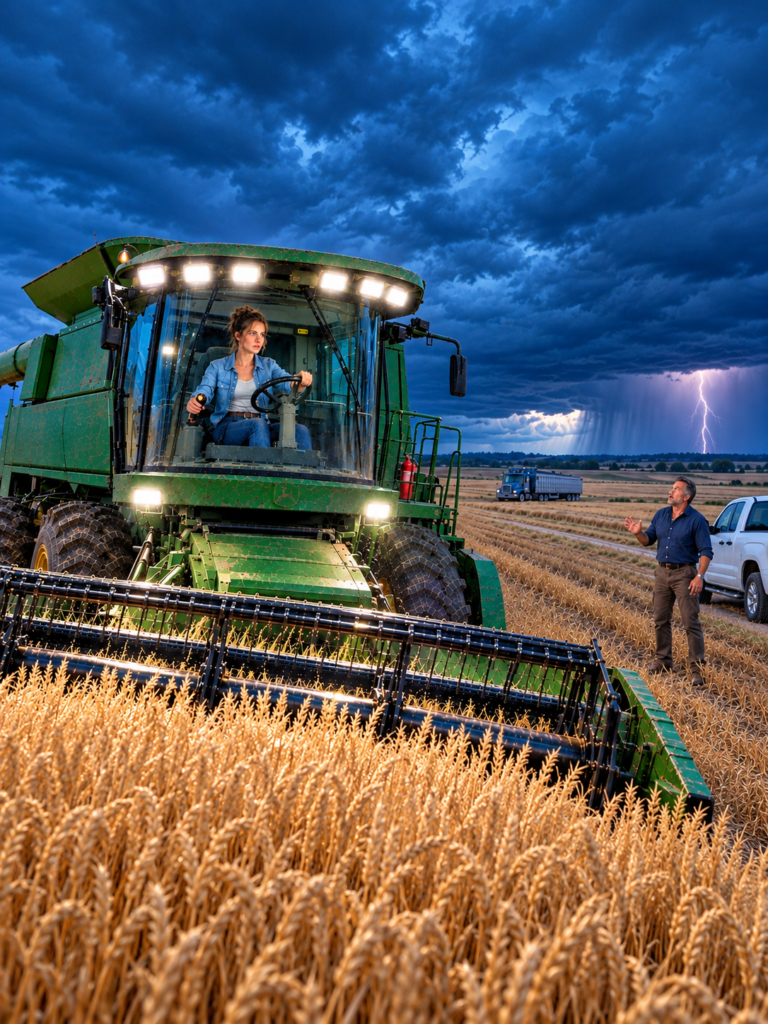
Part 1
The Bennett farm sat eleven miles southeast of Hayes on a stretch of Ellis County Road that turned to packed clay after the first half mile. One hundred eighty acres of winter wheat ran from the tree line in the north down to the dry creek bed that marked the southern edge. In a good year the field looked like something off a calendar. This was not a good year for anything except the crop itself, which had come in better than Laurel Bennett had any right to expect. She was thirty-five and had been running the place alone for three years, since the morning she found her father sitting in the kitchen chair with his coffee untouched and his hands folded in his lap. She had understood before she even said his name that he was gone.
After the funeral and the paperwork and the first winter alone, she made a list of what she had and what she owed. The list of what she owed was longer. Forty-six thousand to the bank, accumulated across two drought years and one equipment repair that cost twice what the shop had quoted. The list of what she had was shorter, but not nothing: the land, the house, the outbuildings, and one John Deere 9660 STS combine her father had bought used in 2006 and maintained with the particular devotion of a man who could not afford to replace it.
The machine was old. Anyone standing next to it could see that the green paint had faded and chipped until the body looked closer to gray-green in flat light. The cab had a crack across the lower corner of the right window, sealed with weather stripping. The header had been rebuilt once, the feeder house repaired twice, but the engine block and the rotor were sound. Her father had told her that every time he stepped down after a run, the same way some people tell you a used car has a good frame. He believed it. More importantly, he had documented it.
The maintenance log sat in the tool compartment on the left side of the cab. It was a standard spiral notebook, the kind sold at any hardware store, but what was inside was not standard. Her father had kept records going back to the machine’s first season under his ownership—every oil change, every belt replacement, every bearing that showed early wear, every adjustment made to the rotor speed or concave clearance to match the crop condition of a particular field on a particular day. He had taped photocopied pages from the service manual to the inside covers. He had written notes in the margins of those pages in handwriting so small that Laurel sometimes needed reading glasses to follow it. She was not a trained mechanic, but she had grown up handing him tools, listening to him explain what he was doing and why, and learning to hear the difference between the sounds a machine made when it was working and the sounds it made when it was about to stop.
The sound it made on the morning of the test run was wrong. She had taken the combine out to the near field to run through a short pass before committing to the main harvest block. Somewhere around the four-hundred-foot mark, a vibration started in the threshing system. Not a rattle, not a bang, something more like an uneven pulse, the kind of feedback that meant a rotating component was no longer running true. She shut the header down immediately, brought the machine to a stop, and stepped down to the ground. What she found after an hour of checking confirmed what the sound had suggested. The bearing on one of the threshing drum assemblies had degraded significantly. The belt on the adjacent drive was showing wear on the inner edge, which meant the load had been running slightly off center long enough to score the contact surface.
The parts were not in her shop inventory. The bearing was a specific size and rating that the local co-op did not stock. She called ahead and drove to the Grant Voss dealership in Hayes. Voss Farm and Equipment occupied a corner lot on the north side of town with a row of new machines lined up along the highway frontage and a service department that ran three bays and a full parts counter. Grant Voss had built it into the largest agricultural dealership in a forty-mile radius over twenty years of giving priority to operations that could buy in volume and pay without negotiating. He knew every large-acre farmer in Ellis County by first name. He knew the smaller operators by their equipment, and his opinion of their equipment told you most of what you needed to know about his opinion of them.
He was standing at the parts counter talking to two other customers when Laurel came in. She set her phone on the counter with the photographs—the bearing, the belt surface, the drive assembly with the access panel removed—and explained what she had found and what she needed. Grant glanced at the photos. He picked up the phone, held it for a moment, and set it back down. Then he turned slightly toward the two men he had been talking to and said it loud enough for them to hear, the kind of remark a man makes when he is performing confidence rather than expressing it.
“That thing’s only worth scrap metal.”
The other men laughed. One of them shook his head slowly, the way people do when they want to seem like they are reluctantly agreeing with something they find obvious. Grant turned back to Laurel. He pulled a service estimate form from under the counter and quoted her a figure north of eighteen thousand dollars for what he called a full drivetrain evaluation and component overhaul. When she asked for a breakdown of specific parts and labor, he explained that his technicians would need to do a complete inspection before itemizing anything. The wait time for that inspection was three to five business days. He then offered her his harvest crew service with a deposit required before scheduling. When she told him she did not have the deposit, he leaned against the counter and made the offer she had not asked for. He would buy her standing crop outright, not at market, at sixty percent of estimated value after his projected harvest costs were deducted. He said it the way someone describes a favor they are doing reluctantly, as though the inconvenience of the offer was on his side.
Laurel folded the estimate and the buyout offer into her jacket pocket. She asked him to write down the bearing specification he would use for the drivetrain evaluation. He said that would be on the work order after inspection. She picked up her phone. She told him she would be in touch and she walked out. Grant said something to the two men as the door closed behind her. She did not hear it. She did not need to.
Part 2
She sat in her truck in the dealership parking lot and called three harvest contractors she had numbers for. The first had no availability before the storm window. The second was already committed through the end of the week. The third was Marcus Hail, who ran a two-machine operation out of a shop east of Victoria. He listened to what she had, asked about access to the fields, and said he might be able to work something out if she could wait until the following morning to confirm. She said she could wait. She drove home and started pulling the access panels on the combine herself.
By nine that evening she had identified the full scope of what needed to be done. The bearing was the immediate problem, but the uneven wear on the belt meant the support bracket for the drive pulley had developed a slight lateral shift over time, loading one side of the bearing cage more than the other. Replacing the bearing without correcting the bracket alignment would get her through a few hours before the same failure repeated. She needed the bearing, a replacement belt, and she needed someone to assess whether the bracket surface itself had worn enough to require machining. Beyond her cash reserve she still had a small amount sitting in her farm operating account, money she had kept separate and untouched specifically for the kind of emergency that could not be solved with what was already on hand. She had hoped not to touch it this season. That hope was gone now.
She opened the maintenance log to the section her father had labeled threshing system and found what she was looking for on the third page: a note from seven years earlier, handwritten beside a photocopied diagram describing a similar vibration event and the cause he had traced it to. At the bottom of that page, in slightly different ink, as though written on a different day, he had added: Nolan machine work before you replace the bearing. Don’t skip this step. She looked up the number for Nolan Price’s shop and left a message.
Then Marcus Hail called back. His voice was different from the afternoon call—tighter, the pacing slightly off, the way a person sounds when they are reading from a script someone else handed them. He said he had received information that her equipment was in an unsafe operational state and that bringing his machines onto her property under those conditions created liability he was not in a position to accept. He was sorry. He hoped she found a solution. She thanked him and ended the call.
She sat at the kitchen table for a moment with the phone face down on the wood. She did not need him to tell her where the information had come from. She had walked out of that dealership three hours ago, and Grant Voss had spent at least part of those three hours making sure the remaining options closed behind her. That was when the decision stopped being a question. She drove to the parts supplier in Hayes the following morning with twenty-four hundred dollars in cash—her reserve, the money she had set aside for situations with no good options—and bought the bearing, two belts, and the hardware she needed for the bracket work.
On the way back through town she stopped at Nolan Price’s shop. He was a sixty-two-year-old retired precision machinist who now ran a one-man operation out of a converted equipment shed, taking jobs that required tight tolerances and someone with the patience to do them right the first time. He had done work for her father going back fifteen years. His number was in the maintenance log under the heading People who know what they’re doing. She showed him the bracket and described what she had found. He said he would need to measure it properly, but that if the wear was what it sounded like, he could resurface it to spec on his lathe. He could not come to her farm—his back was not up to fieldwork anymore—but if she brought the component to him, he could turn it around in a few hours.
She drove back to the dealership one more time, not inside, just to the parking lot. She had one more thing to say to Grant Voss, and she wanted to say it where there were witnesses. He was walking out to the equipment lot when she pulled in. She got out of the truck and said it plainly without raising her voice. She had watched her father understand that machine through twenty seasons, and what Grant had seen in those photographs was a paint job, not an engine. The machine was not what he thought it was. Grant smiled at her the way people smile when they have already decided the outcome of a conversation.
“Then I guess your dad better help you get it running before the rain hits,” he said.
She looked at him for a moment. Then she got back in her truck. Her phone showed a text from Tessa Rowan, the neighbor whose water system she had repaired the previous winter during three days of frozen pipes when no one else was willing to make the drive. The message was four words: I’m here if needed. Laurel put the truck in gear and drove back toward the farm. The storm was forty-six hours out. The combine was still sitting in the north field with the access panels removed. She had a bearing, two belts, a bracket that needed machining, and a maintenance log that had already told her more than she had expected. She had a great deal of work to do.
Part 3
Nolan Price had the bracket resurfaced by seven the next morning. He handed it back to Laurel across his workbench without ceremony, wiped his hands on a shop rag, and told her the wear had been moderate enough to cause the problem she described, not enough to require a full replacement. The resurfaced bore was back to factory tolerance. She paid him from the cash envelope and drove back to the farm with the component wrapped in a clean cloth on the passenger seat.
The work of reassembly took longer than she wanted and less time than she had feared. She reinstalled the bracket with new hardware, seated the bearing properly, replaced both belts with the correct tension, and checked the alignment of the drive pulley against the reference marks her father had scribed into the frame years ago—small lines in the painted steel that she had never paid attention to until she found them mentioned in the log. She checked the rotor, the cleaning shoe, the feeder house. She went through the pre-harvest checklist in the back of the manual her father had taped inside the front cover. By midafternoon she turned the key. The engine caught on the first crank. She let it run at low idle for ten minutes, watching the gauges, listening. The vibration that had stopped her two days ago was gone. The threshing system ran smooth and even. She pushed the throttle up to operating speed and held it there, still clean.
She drove the machine to the near field and ran a two-hundred-foot pass. The concave clearance was set too wide. The grain loss out the back was higher than acceptable. She could see it in the chaff trail behind the machine. She stopped, stepped down, and adjusted the concave. Made another pass. Better but not right. She adjusted the fan speed and the upper sieve. Another pass. She stood at the rear of the machine and checked the material coming off the return elevator. This time what she saw was close to what she wanted. She made one more adjustment to the rotor speed and ran a longer pass. The loss dropped to a level she could accept.
She had already called Tessa Rowan before she got back behind the wheel. By the time she brought the machine around to start the first real harvest run on the main field, Tessa’s grain truck was coming up the access road, a faded blue Ford that had probably hauled wheat every season for thirty years. Tessa was a practical woman who did not waste words on situations that were already in motion. She pulled alongside the combine, asked Laurel where she wanted the first load delivered, confirmed the turnaround route, and rolled the window back up.
They fell into a rhythm. Laurel worked the outside passes first, establishing the headland turns, then moved into the interior of the field in long parallel strips. The 9660 was not fast, not by the standards of newer machines, but it ran without interruption, and that was what the next two days required. She watched the yield monitor, adjusted her travel speed to match the crop density, and kept the header close to the ground without picking up soil. Every time the grain tank reached capacity she held position while Tessa pulled alongside for the transfer. Then Tessa drove south to the co-op elevator and came back empty and they started again. By the time the sun touched the tree line to the west she had covered thirty-one acres and the machine had not missed a beat.
The dealership truck came up the access road just before dark. Laurel saw the headlights from the cab and knew the vehicle before it stopped. She had seen the white truck with the Voss Farm and Equipment decal on the door enough times in the past week to recognize its profile. Grant stepped out and stood at the edge of the harvested ground, looking at the stubble rows and then at the combine moving in the middle distance. He waited until she brought the machine around to the headland and stopped for the tank transfer. She stepped down and walked toward him. She did not hurry. He told her his offer still stood, but only through tonight. Once the storm track was confirmed in the morning, the logistics changed and the number would change with them. He said it like he was doing her a service, extending a deadline she should have met days ago.
She told him she was in the middle of a harvest run. He looked past her at the machine, then at the field, and said the thing she suspected he had driven out here specifically to say—that at her current pace she would not reach the halfway mark by morning. He phrased it as an observation. He had probably calculated it. She said she would take that into account. He drove away. She got back in the cab.
That evening, while Tessa made the last elevator run of the day, Laurel pulled up the group text from the local farming network on her phone. Grant’s post was already there, a photograph taken from the road, her combine visible in the background, the header raised between passes. The caption suggested that anyone considering older equipment for a season under weather pressure should contact his service department. He had tagged three other operators who were known to run older machines. The post had fourteen responses, most of them from people who did business with Grant regularly. She put the phone face down on the console and kept working until the dew point made it inadvisable to continue.
Part 4
That night she slept for four hours in the farmhouse and was back in the field before first light. She did not learn about the phone call Grant had made to the regional grain hauler she used as backup transportation until the following afternoon, when she called to confirm availability and the dispatcher told her they would try to help but could not make any promises on timing. The phrasing was careful in a way that phrasing usually is not when someone simply has a full schedule. She noted it and adapted.
The second full day of harvest brought three problems that cost her time she did not have. The first was the crop itself. The northeast quarter of the field had a higher stand density than she had estimated from the road. The stems were longer and the moisture content was slightly elevated in that area from a low spot that drained poorly. She had to reduce travel speed by nearly twenty percent to keep the grain loss within acceptable range. What she had planned as a three-hour block took just under four. The second problem was Tessa’s truck. Just after noon Tessa called on the radio to say the right rear brake was locking intermittently. Not dangerous yet, but not something to ignore on loaded runs down a county road. She pulled off at the farm to check it. The line had a soft spot that needed a clamp before it could be trusted. Laurel came off the field for forty minutes to help locate the right fitting in the shop and get the line stabilized. It was not a permanent fix, but it was enough to finish the day safely. The third problem was money. The independent hauler she had called as backup confirmed in the early afternoon that he could help, but he needed payment in cash at each load, not at week’s end. She agreed. She drove to the bank between runs, withdrew what remained in her operating account, and handed it over load by load through the afternoon. By four o’clock, between the cash reserve already spent and what she had just pulled from the account, there was very little left anywhere, and she did not let herself think about that for long.
At the end of the second day she had harvested one hundred forty-two of the one hundred eighty acres. Thirty-eight remained. The updated forecast showed the storm system moving faster than the previous model had indicated. The leading-edge winds above forty miles per hour with gusts to sixty and the possibility of hail in the heaviest cells was now projected to arrive within eleven hours rather than the original fourteen. The core of the system would cross the area sometime before dawn. She sat in the cab with the engine idling and worked through the math. Thirty-eight acres at her current efficiency rate, accounting for the slower patches she had already cleared, with the remaining ground likely to be more straightforward, was achievable in five to six hours under normal conditions. The combine was not running under normal conditions. It was running under conditions that had already included a major repair, two full days of operation, and the accumulated heat and vibration load that long harvest runs put on a machine that was not young. She had been checking the temperature gauges every thirty minutes. She had been listening for anything that changed. Nothing had changed. But that was not the same as nothing being wrong.
At approximately the thirty-fourth hour of total operation she was running the western headland of the last large block when the coolant temperature gauge climbed out of the normal band. She did not ignore it. She did not give it another pass to see what happened. She shut the harvesting system down, brought the machine to the edge of the field, and stopped. The inspection took her twelve minutes. She found it on the lower left side of the engine compartment: a length of reinforced coolant hose that had developed a longitudinal crack along the outer wall. The coolant loss was slow but steady, a thin trail running down the side of the block and dripping off the frame. The hose was not going to hold through another hour of operation. If she ran the engine hard with that crack opening under pressure and heat, she would be looking at an overheated engine, block damage that went far beyond this season into the question of whether the machine would ever run again.
She stepped away from the machine and stood in the dark field. Thirty-eight acres. The storm was somewhere between ten and twelve hours out. The combine was sitting still in Ellis County, Kansas, coolant dripping onto dry ground. She opened the maintenance log. She turned to the section her father had labeled engine and cooling and found his notes on the system, the diagram, the specifications, the service intervals. Near the bottom of the third page, in the slightly smaller handwriting he used when adding something as an afterthought, she found: coolant hose lower left—check fitment with Nolan before ordering. He had a length of compatible material in stock last time. And below that, in darker ink written on what must have been a different day: Never confuse stubbornness with knowing when a machine is safe to run.
She sat with that for a moment. Then she called Nolan Price. He answered on the fourth ring. She described what she had—the crack location, the hose diameter, the routing, the operating temperature and pressure range the hose needed to handle. He was quiet for a moment. Then he said he had a length of high-temperature reinforced hose in the shop from a job he had done the previous spring. He thought the spec would match. He could not guarantee it until he was standing in front of the engine with a tape measure, but it was worth checking before she called the parts store in Hayes and waited on a delivery that might not arrive before morning. He said he would drive out.
Laurel closed the maintenance log and put it back in the tool compartment. She called Tessa, who had pulled off to wait at the co-op after the last transfer. She told her to stay there for now, that there was a mechanical issue, that she would call back within two hours with an update. Either way, Tessa said she understood and that she was not going anywhere. The field was quiet. Thirty-eight acres of uncut wheat stood in the dark to the north, the heads heavy and dry, exactly what they were supposed to be. The first distant flicker of lightning was visible on the western horizon, still far off, still just weather rather than danger, but moving in the direction of the farm at whatever speed the system had decided on. Laurel went to the toolbox mounted on the frame and started laying out what she would need when Nolan arrived.
Part 5
Nolan Price arrived forty minutes later in a pickup that was older than the combine and ran better than it had any right to. He did not say much when he got out. He took his flashlight and his tape measure and went straight to the engine compartment. Laurel held the light while he measured the hose diameter, the length of the run, and the clearance around the routing bracket. He went back to his truck, unrolled a length of high-temperature reinforced hose from a cardboard tube, and compared it against what he had measured. He checked the wall thickness and the temperature rating printed on the outer sleeve. He said it would work.
They did not rush the repair. The engine had been sitting for over an hour and the block temperature had come down, but Nolan insisted on checking it with his hand before he opened the system. When he was satisfied he drained what coolant remained in the overflow reservoir into a clean bucket, removed the cracked section of hose, and cut the replacement to length with a utility knife. He seated both ends with the correct clamps, torqued them to spec with a screwdriver from Laurel’s toolbox, and refilled the system with the coolant she had in a jug in the back of her truck. She carried it the same way her father always had, because he had told her once that the only thing worse than running out of coolant was running out of coolant when the parts store was forty minutes away. When the system was closed and full they ran the engine at idle for fifteen minutes and watched the temperature gauge come up to operating range. It held steady. Nolan put his hand near the hose ends and felt for moisture. Nothing. He told her she could run it. He told her to check the gauge every fifteen minutes and pull over immediately if it climbed past the upper mark. He said he would stay at the edge of the field until she was done.
It was approaching the forty-third hour since the storm warning had first gone out. Laurel called Tessa. She said three words: We’re still going. She heard the truck engine start on the other end of the call before Tessa even answered back. She settled into the seat, pushed the throttle up, and drove back to the wheat.
The last thirty-eight acres ran south to north along the western edge of the property, a long rectangle that ended at the fence line where the Bennett ground met the road. It was the most straightforward section of the field—flat, even stand density, good drainage. Under normal conditions, in a machine with no history behind it, a competent operator could clear that ground in four and a half hours. These were not normal conditions, and the machine had a great deal of history behind it. Laurel set her travel speed conservatively for the first two passes, watching the yield monitor and listening to the threshing system for anything that was not right. Everything was right. The rotor turned even and steady. The cleaning shoe handled the material without surging. The temperature gauge sat in the middle of its range and did not move. She increased her speed by half a mile per hour.
Tessa arrived with the grain truck and positioned herself at the south end of the field for the first tank transfer. They did not talk over the radio unless there was something to say. Transfer. Drive south. Empty. Drive back. The rhythm they had built over the past two days came back without discussion. The lightning to the west was closer now. Not the distant flicker from earlier. These were full strikes visible as distinct lines dropping from the cloud base to the ground. The storm was moving. The question was not whether it was coming, but whether she would be finished before it arrived.
She worked the passes from east to west, shortening each strip as she moved toward the road fence. The headland turns took time she did not want to spend. She tightened her turn radius as much as she safely could and came back on each new strip without letting the machine fully settle before opening the header again. At the ninety-minute mark she checked the temperature gauge. Still steady. She kept going.
She did not see the vehicles arrive at the field edge. Tessa told her about them later. Two pickups first, then a third, all parked along the road fence with their headlights off. The people inside had gotten out and were standing at the fence line watching the combine move through the dark. One of them had a spotlight aimed at the cut rows, not at the machine, just lighting the stubble so they could see how much remained. Word moved the way word moved in small agricultural communities, which was faster than most people outside of them would expect. Someone at the co-op elevator had mentioned that Laurel Bennett was still running. Someone else had done the math and decided it was worth driving out to see. They were not there to help. There was nothing left for them to do. They were there because certain things needed to be witnessed.
Grant Voss arrived sometime around the forty-sixth hour. He drove past the group at the road fence and pulled into the access road. Tessa was at the field end waiting for the next transfer and blocked his way in without intending to. He stopped and got out. He stood at the front of his truck with his arms at his sides and looked at what was in front of him. The combine was working the third-to-last strip. The cut was clean and the rows were straight and the grain tank was three-quarters full. On the western horizon the storm wall was visible as a dark mass that had blotted out the lower stars on that side of the sky. The air had the specific weight it gets in the hour before a major weather system arrives—heavy and still and charged with something that is not quite electricity yet, but is getting there. Grant had driven out expecting to find a machine parked in a dark field and a woman waiting for someone to come and salvage what was left of her season. He did not say anything. He stood at the front of his truck and watched.
Laurel finished the last strip at the forty-seventh hour. She brought the combine down the length of the field one final time with the header cutting the last standing wheat in the northwest corner of the property. When the header ran clear of standing crop and there was nothing left to cut, she raised it and brought the machine to a stop at the field boundary. She did not get out immediately. She sat in the cab and listened to the engine idle. The temperature gauge was exactly where it had been for the past five hours. The threshing system wound down from operating speed to low idle without a sound she did not recognize. Outside the windshield the field was stubble from the tree line to the road fence, every acre of it. She killed the header drive, throttled down, and stepped out of the cab.
Tessa pulled alongside for the final tank transfer. The auger ran until the tank was empty, then swung back and locked. Tessa drove south toward the elevator. By the time she reached the county road the first gusts hit from the west. Not the full storm, just the advanced air pushing out ahead of the system, the kind of wind that bends the roadside grass flat and tells you it is time to be indoors. Nolan Price walked across the stubble from where he had parked at the field edge. He looked at the combine, then at the field, then at Laurel. He nodded once. She nodded back. He walked to his truck and drove home. The people along the road fence had seen enough. They got in their vehicles and left one by one, driving into the dark in different directions. Grant Voss drove out the access road without stopping.
The rain started before Laurel had the combine into the equipment shed. Not hard yet, just the first drops, large and spaced, hitting the metal roof of the cab with the irregular rhythm of the very beginning of something. She pulled the machine inside, shut the engine down, and closed the large door. She sat on an overturned feed bucket inside the shed with the door rolled shut and the rain beginning to work on the roof overhead. She had the grain receipts from the co-op in the inside pocket of her jacket. She took them out and laid them on the concrete floor and looked at what they added up to. The repair costs had been real. The independent hauler had taken most of her operating reserve. The bank payment coming at the end of the month was fixed and it was not small. What the harvest had brought in was not a windfall. There was no version of this story where one good crop erased three years of accumulated pressure. But the number on those receipts was her number, arrived at on her terms, in her time, with her machine. She had not signed Grant Voss’s buyout. She had not handed him sixty cents on the dollar and walked away with just enough to owe the bank for another season. She had the full value of what she had grown, less what it had cost her to bring it in. And she would decide what came next. That was not nothing. That was in fact the whole point.
One week after the storm Laurel drove into Hayes for maintenance supplies. Grant was at the parts counter when she came in. He recognized her immediately. She took a ticket and waited her turn. While she was waiting, a farmer she recognized from a neighboring operation looked over at her and then at Grant and asked, in the direct way of people who have spent their lives dealing with weather and equipment and not much time for indirection, whether that was the combine Grant had said was only worth scrap. Grant did not answer right away. The farmer said he had heard the machine finished one hundred eighty acres before the storm came through. He said he had heard Grant’s service crew had not cleared all the fields on their schedule before the weather hit. There were three other people at the counter. No one said anything. Grant acknowledged that he had underestimated the condition of the equipment. He said it in the careful way people say things when they are trying to close a subject. He followed it by turning to Laurel and telling her that whenever she was ready to talk about moving into a newer machine, he could put together a trade package that would make the transition straightforward.
Laurel looked at him. She said that when a newer machine would genuinely do better work on her farm than the one she had, she would be interested in that conversation. She said that day had not arrived and that when it did she would make that determination herself. She collected her parts, paid at the register, and drove back to the farm.
In the weeks that followed, three operators with older combines called her to ask how she organized her pre-harvest inspection process. Not because they had heard something dramatic—most people in that county were not interested in drama—but because they had heard she had worked through a major mechanical problem under time pressure and come out the other side with the crop in the bin. That was the kind of information people in Ellis County found useful. She talked to each of them the same way her father had talked about machines: specifically, without exaggeration, focused on what was documented and what was observable. Nolan joined for two of the conversations where the questions required more precision than she had. It was not a business. It was just knowledge moving between people who needed it, which was how most useful things moved in places like Hayes, Kansas.
The following spring, on the first morning she took the combine out to check it before the season, Laurel stood beside the machine for a moment before getting in. The paint was the same. The crack in the lower window, sealed with the same weather stripping, was the same. The tool compartment on the left side held the maintenance log, worn at the spine now from three more years of use, its pages thick with additions in two different handwritings. She opened the log to the last page her father had written on. Below his final entry, in her own handwriting, she had added a single line the morning after the harvest: 180 acres, one old machine, a crew that showed up, and a harvest we earned. She closed the log, put it back in the compartment, and settled into the seat. The engine started on the first try. She drove out toward the field.

