
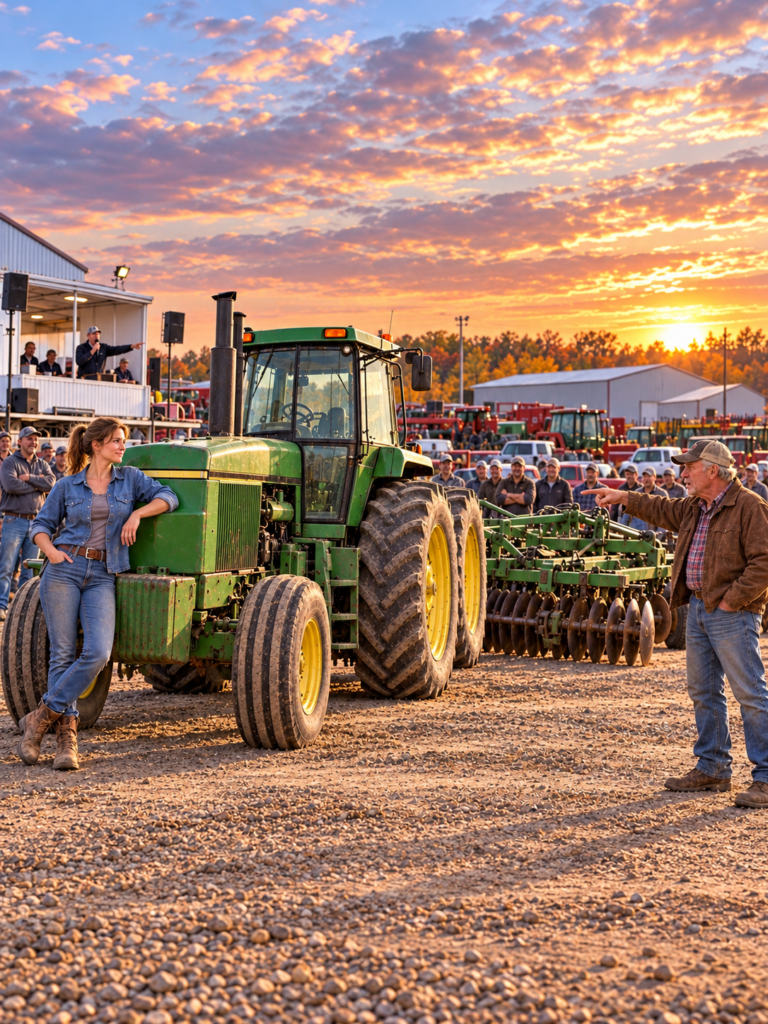
the young woman in the grease stained jacket told the auction crowd she would finish eighty acres of stubble before the rain and keep the heavy disc harrow if that whistling john deere could pull it
Part 1
The auction yard smelled of diesel and dry dust. Combines sat in uneven rows, their headers raised like the arms of men who had already done their work for the year. Wagons and balers lined the fence. Farmers stood in small groups on the gravel, talking low about prices and weather, their boots scuffing the same ground they had walked every fall since they were old enough to hold a paddle. Rachel Baird stayed near the edge of the crowd. She was twenty-five. Her brown hair was tied under a faded farm cap, and grease had already marked the cuffs of her jacket from the morning she had spent checking a pump at home. She had come for one machine.
The John Deere 4650 sat with its faded green hood warm under the afternoon sun. Frank Nistrom owned it. He also owned the eighty acres of soybean stubble that stretched behind the machine sheds. A hard rain was forecast within three days, and he wanted that ground disced before the clay turned to mud he could not work. He was selling equipment as he stepped back from the full load of the farm. When the auctioneer called the number, Frank stepped forward and spoke loud enough for the men nearest the block to hear.
“You’re bidding on that 4650, sweetheart,” he said. “You got a reason I shouldn’t?”
Rachel looked at the tractor, not at him. “That turbo’s cooked. Hear it scream under load.”
A few men laughed. She had heard the sound herself when the auction crew started the engine and put a light load on it. She had also walked around the machine while the others watched the hood. She had seen the narrow track of clean metal near the intake connection where dust had been blown away in a straight line. The whistle had only appeared when the engine worked hard. That mattered more than the laughter.
“I heard it,” she said. “I also saw the intake. Eighty acres out back. Rain comes in three days. And you haven’t disced them.”
Frank folded his arms. For a moment the yard went quiet enough that the auctioneer on his flatbed lowered the microphone. “Finish eighty acres. Keep the harrow if you can.”
Someone near the front asked if he had just put the disc on the sale. Another voice told the auctioneer to pull it. Rachel kept her eyes on Frank. “Pull the harrow from the sale,” she said. “And put our agreement in writing. I buy the deer, I do the field. If I finish before the rain, the harrow is mine.”
Frank looked toward the auctioneer. The auctioneer said both of them would need to sign and that the harrow would not leave the property until the work was done. Rachel nodded. Frank gave a short laugh, but he agreed. The bidding began. A dealer opened, hoping to buy the tractor for parts. A farmer raised him once, then stopped when someone mentioned the turbo. Rachel waited until the next call, then lifted her hand. Frank shook his head and said it was an expensive way to learn a lesson. She did not look at him. She was watching the strip of clean metal again.
The hammer struck the wooden rail. Sold. Rachel felt the weight of the purchase settle in her stomach. The receipt represented nearly everything she had saved for a replacement tractor. If her judgment was wrong, she would own a tired machine and an empty place where her savings used to be. Frank held out the paperwork. Three days, he said. She took the pen. Then we better get it home before dark.
By the time she signed, the bidding had moved on to a red combine. She barely heard its engine. The clerk gave her a copy of the agreement. Frank had signed it too. Eighty acres of soybean stubble, finished before the rain. In return the heavy disc harrow would belong to her. Fuel, repairs, and the risk of failure were hers.
Outside, the John Deere waited. She climbed into the cab. The seat was split along one seam, and dust lay thick around the gauges. She turned the key. The diesel caught promptly and settled into a steady rumble. No sharp whistle. No uneven knocking. She eased it into gear and pulled away as the crowd returned to its business. The eleven miles home gave her time to listen. On the gravel road the tractor rolled without protest. The steering felt sound. The temperature held. But she knew an empty tractor on a road was not the same machine as one pulling a heavy disc through stubborn ground. She had learned that difference in her father’s repair shed, where she had spent childhood afternoons sorting bolts and later worked beside him on pumps, injectors, and worn farm engines. He had never let her buy a part simply because somebody named it as the problem. Find out what failed first, he used to say. Then spend your money.
Her own shop was smaller now. An old machine shed with a concrete floor and one good workbench. She parked the deer inside just as the light turned gold across the doorway. For a while she stood with the engine off, listening to the metal tick as it cooled. Through the open door she could see the darkening western sky. The forecast promised rain in three days. Forecasts did not make promises they had to keep.
Part 2
Rachel raised the side panel and swept her flashlight across the intake plumbing. There it was again—the narrow track where dust had vanished beside a dark stain. She touched the joint, then examined the neighboring housing. A failed turbo was possible. So was a leak that only opened when pressure rose. The difference could cost her thousands. She laid her pressure testing equipment on the bench and pulled the shop door nearly shut against the evening wind. She had bought the tractor on a suspicion. Before morning she needed something better than that.
She switched on the lights above her workbench. Light fell across the deer’s hood as daylight slipped through the windows. She rolled her pressure tester closer and laid a clean rag beneath the intake housing. She remembered the auction. The sharp whistle had begun when the disc dug in. Then came black smoke and falling engine speed. If the turbo had stopped moving air altogether, she would have expected different signs. But guessing was what had frightened everyone away from the bidding.
With the engine cool and shut down, she checked the intake hoses for splits and loose clamps. She fitted her test adapter to the pressurized air passage. Then she fed in a little regulated shop air, watching the gauge instead of rushing the pressure higher. The needle rose, hesitated, and slowly fell. She closed the valve. Somewhere between the compressor outlet and the engine, air was escaping. That did not prove the turbo was healthy, but it meant the whistle might have come from something far less costly.
She applied soapy water around the joints and added pressure again. Nothing appeared at the first hose. Nothing at the next clamp. Then a small ring of bubbles formed along the edge of the aftercooler housing. The bubbles grew, broke, and formed again. “There you are,” she whispered. She wiped away the grime and found a flattened seal beneath the joint. Years of heat and vibration had hardened it. Under light load it could almost hold. Under heavy load the gap opened and let compressed air escape before the engine could use it.
She sketched the joint in her notebook, then loosened the fasteners evenly. She cleaned the mating surfaces without scratching them and checked for damage that a fresh seal could not cure. The metal looked sound. In her parts cabinet she found a replacement sealing ring that matched the old one. Outside, a truck passed on the county road. She hardly noticed. She fitted the new seal, brought the joint together carefully, and tightened everything in stages. The pressure held on the next test. The soap stayed still around the repaired seam. For the first time since the auction, Rachel let herself smile.
She checked her watch. Midnight was approaching, and the harrow was still waiting at Frank’s farm. But a quiet engine in a shop could not finish eighty acres. Only a tractor pulling hard through real dirt could tell her whether she had fixed enough. She slept for three hours on the old couch in her office. Before sunrise she was back beside the John Deere, checking the oil, coolant, and the clamps she had touched during the night. The repaired joint was dry. She had no reason to celebrate yet.
The sky was pale when she reached Frank’s farm. His pickup stood outside the machine shed, and the disc harrow waited exactly where the auction crew had left it. Frank came out carrying a thermos. “Thought you might have changed your mind,” he said.
“Not after spending half the night on it.”
Frank watched while she backed the tractor to the hitch. He helped guide the drawbar pin into place, then stepped away as she checked the hydraulic hoses and raised the disc clear of the gravel. Neither spoke about the auction crowd. At the field entrance she eased the harrow into the soybean stubble. Its steel blades cut through dry stalks, leaving dark lines across the tan ground. The diesel settled into a steady working note. She watched the temperature gauge and felt the pull through the seat. A hundred yards passed. Then another. The engine held its speed. The high whistle was gone. Rachel finally let out the breath she had been holding.
Then the field dipped toward a strip of heavier clay. The harrow pulled deeper. The engine worked harder, and a thin, sharp sound rose beneath the hood. Not as loud as at the auction, but unmistakable. She lifted the disc immediately. The whistle faded as the load came off. A brief puff of black smoke drifted behind her. She brought the tractor to the headland and shut it down.
Frank had been watching from his pickup. He walked over slowly. “Still think it wasn’t the turbo.”
“I fixed one leak,” she said. “That doesn’t mean there was only one.”
She hated how calm her voice sounded compared with the disappointment in her chest. The first repair had been real. The tractor had pulled better. Yet she could not risk running eighty acres with air escaping every time the soil turned heavy.
Part 3
Back at her shop, Rachel connected the pressure tester again. At the setting she had used the night before, the needle stood firm. She raised the test pressure cautiously, staying within the safe limit for the system. This time a faint hiss came from behind the adjoining adapter. She held the light closer. A second seam was beginning to sweat tiny bubbles. Outside the open shop door the morning was already slipping away.
She leaned closer to the adapter, keeping the flashlight steady while the last bubbles slid down the metal. The first repair had held. This was a different leak, hidden behind a narrow flange where the housing met the intake passage. She released the air pressure and took the tester off. The shop smelled of warm oil and damp gravel. Outside, the sun had climbed above the windbreak, and every minute of daylight belonged to the eighty acres she had promised to finish.
One lower bolt resisted for an hour. Then she loosened the adapter and eased it away. The sealing ring beneath it was hard and flattened on one side. A polished track on the metal showed where pressurized air had been slipping past. She set the ring beside the one she had replaced during the night. The two failures had been sitting inches apart. She pictured the auction crowd hearing the whistle and naming the turbo. They had heard a real problem. So had Frank. But a sound could tell a farmer where to look without telling him what to buy.
She inspected the mating face with a straight edge. No crack. No deep scoring. She removed the inlet hose and checked the turbo wheel for damage and excessive shaft movement. Nothing obvious suggested that the charger itself had failed. In her parts drawers she found a sealing ring of the correct size and material. She checked it twice before fitting it. Then she cleaned the flange, replaced the ring, and tightened the fasteners evenly. On the first pressure test the gauge held. She waited, then brought the pressure up in careful stages. She brushed soapy water along both repaired joints. Not a bubble appeared.
By late afternoon she finally sat down. Her coffee had gone cold hours ago. She drank it anyway, staring at the tractor through the open shop door. Frank answered his telephone on the fourth ring. “Are you coming back to the field?” he asked.
“Not today. I found another leak and fixed it. I’ll pull that disc at first light, then we’ll know.”
There was a silence. Then Frank said, “Weatherman’s still calling for rain.”
“I know.”
She hung up and looked at the notebook beside her tools. Not one acre finished. Two mornings left before the rain if the forecast held. She closed the hood and started the engine. It settled into its familiar rumble. She listened without smiling. The next time she heard that engine working hard, there would be no shop walls around it and no room left for guessing.
At first light she drove the John Deere through a thin mist that hung over the gravel road. The engine sounded just as it had the night before, steady and ordinary. She refused to take that as proof of anything. Frank was waiting beside the disc harrow, his pickup parked near the field gate. He watched her back up to the drawbar without offering an opinion. Together they secured the hitch and checked the hydraulic lines. Then she walked the length of the disc, looking for loose blades and dry bearings. She greased two fittings before climbing into the cab.
Frank rested a hand on the fender. “If it starts screaming again, don’t tear up my field trying to prove a point.”
“I won’t,” she said. “And if it pulls clean, I won’t waste the morning talking about it.”
He stepped back and she rolled toward the first unworked strip of soybean stubble. The harrow settled into the earth with a low metallic shutter. Brown soil folded around the blades. She eased the throttle forward and felt the weight come onto the engine. The exhaust darkened briefly, then cleared. The tractor kept pulling. She watched the tachometer while the first fence post slipped past her window. The needle stayed steady. At the heavier patch where yesterday’s whistle had returned, she held her speed and listened. The diesel grew deeper under load, but there was no thin scream from beneath the hood. She reached the headland, raised the disc, and turned carefully. On the second pass she let the blades work at their proper depth. Instead of giving the machine an easy test, the deer answered with the same even pull.
Across the field, Frank had gotten out of his pickup. He stood with both hands on his hips, following the green tractor as it moved through the stubble. She could not see his expression from the cab, and she did not need to. By mid-morning several long strips lay dark and evenly worked behind her. She stopped on firm ground, climbed down, and checked the repaired connections for any trace of oil or escaping air. Both joints were dry. The temperature was normal. She wrote the first completed acreage in her notebook and looked toward the far end of the field. Eighty acres still seemed enormous. The tractor had finally answered one question. Now the weather would ask another.
Part 4
By noon the first broad section of Frank’s field had changed color. Pale soybean stalks lay beneath long bands of freshly turned earth, and the John Deere was still pulling with the same steady voice it had found that morning. Rachel kept her speed modest. The heavy disc wanted to bite deeper whenever the ground turned damp and dark, but she knew better than to force it. She raised the blades slightly in those places, then lowered them again where the soil opened easily. Every turn at the headland cost time. Every careless turn could cost far more.
At the field edge she shut the engine down long enough to eat a sandwich from the cab and check the machine. The repaired joints were clean. The coolant level was sound. She greased the disc bearings, brushed packed stalks from a scraper, and climbed back into the seat before her coffee had cooled. The afternoon passed in measured rows. Dust worked its way through the window seal. Her shoulders ached from watching the implement and the strip of soil ahead. More than once she caught herself staring at the far fence instead of the ground beneath the blades. She made herself focus on the next pass, not the last one.
Near sunset Frank’s pickup appeared on the headland. She finished her row before stopping. He walked toward the cab, studying the dark field behind her. “Still screaming?” he asked.
“Only thing screaming now is the clock.”
Frank looked toward the west. A broad bank of clouds sat low beyond the grain bins. “You’ve made a dent,” he admitted.
She unfolded the field map on her knee. She had marked each completed section with a pencil line, allowing for the narrow corners she still had to work. “Forty-four acres,” she said. “Thirty-six left.”
For the first time Frank did not question the tractor. He glanced at her tired face instead. “You planning to run after dark?”
“Not with that disc. I’ll be back at first light.”
He nodded once and went to his truck. She eased the harrow onto firm ground, locked the equipment safely, and let the engine idle briefly before shutting it down. When the diesel fell silent, the evening seemed suddenly enormous. She could hear wind moving through the standing weeds along the fence. She had won back the tractor’s strength. She had earned more than half the field. But beyond the darkening horizon the rain was moving closer, and no amount of skill could repair the sky.
She reached Frank’s field before sunrise the next morning. The John Deere stood where she had left it, a dark shape against the pale soybean stubble. She ran a flashlight along the hydraulic hoses, checked the disc bearings, and felt the repaired intake joints with her fingertips. Everything was dry. Everything was tight. Beyond the eastern fence a narrow strip of pink light appeared under a ceiling of gray clouds. The wind was coming from the south now, carrying the damp smell that sometimes arrived hours before a Minnesota rain. She had thirty-six acres left. She knew the number as clearly as she knew the sound of the engine.
The deer started with its familiar deep rumble. She waited for the gauges to settle, then rolled into the unfinished section. The disc sank into the soil and the tractor took the load without hesitation. For the first hour the work went cleanly. Each pass ran alongside yesterday’s dark strips. Each turn brought her a little closer to the far fence. She kept the same careful pace, though the sky gave her every reason to hurry. Near the low end of the field the ground grew heavier. Moisture held beneath the stalks, and the blades began lifting thick slabs of earth. She eased the disc shallower rather than demand more from the engine. The deer kept pulling steady and strong, but the slower ground cost her precious minutes.
Frank arrived just before noon. He parked by the gate and waited until she stopped to clear stalks caught near a scraper. “Radio says rain by supper,” he called.
“Then I’ve got an afternoon,” she answered.
He looked at the freshly worked ground. “You might have more tractor than I gave you credit for.”
She glanced at the faded green hood. “Let’s see what it does with the rest.”
She drank water, checked the wheel hubs for unusual heat, and took out the field map. Twenty-one acres completed since dawn. Fifteen remained—close enough to picture the finish, but too much to gamble on a worn machine or a bad turn. Without the harrow she would still own the deer, but not the implement she needed back home. When she climbed back into the cab, the wind rocked the dry weeds against the fence. Far off, a low roll of thunder crossed the prairie. She lowered the disc and watched the blades bite. The tractor had earned her trust. The sky had not.
Part 5
The thunder faded, but she could still feel it through the seat of the John Deere. Fifteen acres remained, spread across the uneven west end of Frank’s field. She had covered nearly everything in sight. Yet the unfinished ground seemed to grow larger each time she looked at the map. A gust struck the cab as she entered the next pass. Dry soybean leaves chased one another across the glass. The engine kept its deep even note, and the disc rolled steadily through the stubble. She watched the blackening sky, then made herself look back at the soil. A hurried turn could leave an untouched wedge that Frank would notice, and she had promised to finish the whole field.
At the low corner the disc began pushing a ridge of wet stalks. She noticed the drag before the engine speed changed. She raised the harrow, drove onto firm ground, and shut the tractor down. With the equipment safely lowered and motionless, she used a long hook to clear the packed residue. Mud clung to her boots. When she finally climbed back inside, her watch showed that she had lost almost twenty minutes.
Frank’s pickup rolled up beside the headland. He opened his window. “There’s a shortcut across the middle,” he called. “You could finish the big section first and leave the corners.”
“And leave the corners?” she asked.
Frank glanced toward the weeds along the fence. “They’re a nuisance.”
“They’re part of your eighty acres.”
He studied her for a moment, then gave a small nod. “Fair enough.”
She went back to work. The deer climbed the gentle rise without smoking or losing speed. Each clean pass reminded her how different it had sounded at the auction when that shrill whistle had turned grown farmers away from the bidding. She had no time now to enjoy being right. Late afternoon light thinned beneath the clouds. She crossed another section from the map, then another. Only the final narrow piece remained, tucked against the western fence where the field tapered toward a drainage ditch.
Frank stood at the gate, cap pulled low against the wind. She could see him counting the remaining passes as carefully as she was. A curtain of rain appeared beyond the far tree line, turning the distant road a dull gray. She looked toward the ditch, lowered the disc to its working depth, and eased forward. The storm was coming across the neighboring fields, and she still had ground to cover.
The first drops had not reached the field, but she could see the rain advancing beyond the cottonwoods. The unfinished strip ran along the drainage ditch, too narrow for a full turn and too uneven to rush. She kept the John Deere in a low, steady gear and watched the disc through the rear window. At the end of the row she raised the blades before the ditch, eased around on firm ground, and lined up for another pass. The engine answered each pull with the same deep note. No whistle. No cloud of black smoke. Only the sound of steel cutting the last standing stubble. Loose stalks tapped the disc frame, and the tires pressed dark tracks into the headland.
Frank had moved his pickup closer to the gate. He stood outside it now, one hand holding his cap against the wind. At the auction he had laughed when she examined a dusty connection beneath the hood. Now he followed the harrow with his eyes, measuring what remained. A gust rattled the cab door. She glanced at the dark horizon, then at a thin triangle of untouched ground beside the fence. Cutting across it would have been quicker, but the disc might leave a ridge that counted as unfinished work. She backed carefully into position and made one short, clean pass. The final piece lay straight ahead. Her hands ached from the steering wheel. She could feel every hour of lost sleep in her shoulders. For an instant she thought of the money she had spent and the little shop waiting at home. If the rain caught her now, she would still own the tractor. The harrow would stay with Frank.
She lowered the blades for the last time. The deer leaned into the load and moved forward without hesitation. Brown earth rolled over in a continuous ribbon behind her. Fence posts passed the window one after another. At the far end she raised the harrow, brought the tractor to the headland, and looked back. There were no untouched strips left inside the marked eighty acres. She shut off the engine. In the sudden quiet she heard the first drops ticking against the cab roof.
Frank walked toward her through the wind. His boots stopped beside the front tire. He looked over the field, then up at the young woman behind the glass. She opened the cab door. “All eighty,” she said.
Frank took off his cap. For a long moment he had no answer. Rain tapped against the cab roof as she climbed down from the John Deere. Her boots settled into the worked soil, and she stood beside him without speaking. Across the field eighty acres lay dark and evenly disced from the gravel lane to the fence above the drainage ditch. He walked a few steps into the field. He bent, lifted a handful of soil, and let it crumble through his fingers. The last pass was as clean as the first. There were no untouched corners for him to point out and no excuse left to make. The first drops darkened his sleeves, but he took his time looking over the rows.
“You really did it,” he said.
She rubbed the ache from her right hand. “We agreed on eighty acres.”
“I know what we agreed on.”
He turned toward the disc harrow behind the tractor. Three days earlier he had stood before a crowd and offered it to a young woman he was certain would never finish the job. He had expected the deer to fail before she crossed the first field. Instead it had worked through two long days without that terrible whistle. Now the machine sat cooling in the rain, its engine silent, the harrow coated with honest Minnesota dirt.
Frank held out his hand. “You earned it, Rachel.”
She shook it. His grip was firm, and for the first time there was no trace of mockery in his face. “Looks like that’s yours,” he added, nodding toward the disc.
She glanced at the implement. The bearings were warm from work. The blades carried fresh earth, and the frame had held together across every acre. She had pictured bringing a harrow home for years. She had never imagined earning one under a sky like this. “Let’s get the paperwork finished,” she said.
Frank nodded. They moved the equipment onto firm ground before the rain grew heavier, then drove to the farm office. Inside, beneath a dusty calendar, he found the auction agreement they had signed. He wrote a bill of sale for the harrow, marked the price as the completed fieldwork, and signed his name. She read it carefully before adding hers. He slid the paper across the desk. “I thought I was making a safe bet. You gave me a chance to work for something I needed.”
He looked out at the green tractor beside the shed. The rain was washing the dust from its hood. “Tell me one thing,” he said. “How much did that new turbo cost you?”
She folded the bill of sale and looked back at him. Through the rain-streaked office window the John Deere stood beside the shed, the disc harrow still attached, both machines dark beneath the storm. “Same turbo,” she said.
Frank looked up. “You didn’t replace it.”
“Never touched it except to check it. Two seals were leaking around the intake and aftercooler connections. When the engine worked hard, the air escaped before it could reach the cylinders. That’s why you heard the whistle and saw black smoke.”
Frank studied the notebook she opened on the desk. She showed him the two joints she had drawn beside the pressure readings. Her pencil marks were smudged with grease. “I owned that tractor twelve years,” he said quietly.
“And you knew what it did,” she answered. “I needed to know why.”
Rain rattled against the windows. Frank glanced toward the eighty acres she had finished just ahead of the storm. Then he looked at the bill of sale in her hand. “So what did the repairs cost?”
“Two seals and a few hours in the shop. The second one took longer to find.”
Frank let out a slow breath. “I told half the county that turbo was shot. And I told you that you couldn’t finish.”
“You weren’t wrong about the trouble,” she said. “Just what caused it.”
He held out his hand again. “I owe you an apology.”
She shook it. The man who had called her sweetheart at the auction now stood looking at her like a fellow farmer. Neither needed a crowd to witness the change. When the rain eased, Frank helped her park the deer and harrow safely under cover. She would bring them home once the roads were fit to travel. For now the field was finished. The agreement was honored, and the old tractor had found another season of work. She stood for a moment in the doorway of the shed and listened to the rain on the metal roof. Her father had been gone four years. He would have understood the sound of an engine that finally pulled the way it was meant to. He would have understood the value of a tool earned by finishing the ground before the weather closed the door. She closed the shop door behind her and walked out into the wet yard, the bill of sale folded in her jacket pocket, the weight of the day settled but not heavy. The field was done. The harrow was hers. And the men who had laughed at the auction would hear about both before the week was out.

