
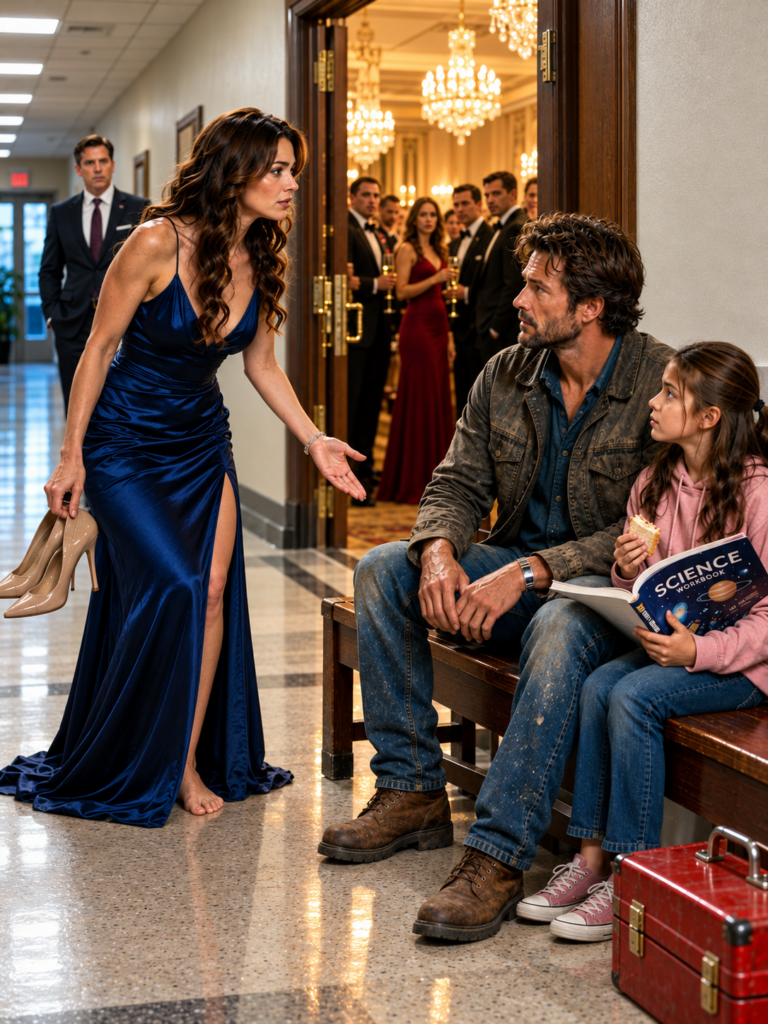
“Do not let her sit there.”
Everett Sloan’s voice cut across the hospital corridor so sharply that even the laughter drifting from the ballroom seemed to hesitate.
Marin Caldwell stopped beside an old wooden bench. One hand still wrapped around the silver bracelet at her wrist, the other holding the heels she had slipped off 3 minutes earlier.
Behind her, beyond the double doors, 200 guests were drinking champagne beneath crystal chandeliers and applauding a $25 million donation made in her name.
In front of her sat a man in a faded work jacket, sharing a peanut butter sandwich with a little girl who had a science workbook open across her knees.
He looked up at Everett, then at Marin. Calm eyes. Grease beneath one thumbnail. No recognition, no sudden smile, no attempt to stand.
“Why?” he asked.
Everett stepped closer, lowering his voice as if wealth itself required protection.
“Because you do not know who she is.”
The man glanced at Marin again, then moved his red metal toolbox 6 inches to the side.
“Then I guess she can tell me.”
Marin stared at him.
Men twice his size had changed posture when she entered rooms. Executives rehearsed sentences before speaking to her. Reporters shouted her name from sidewalks. Investors watched her face before deciding whether to laugh.
But this stranger had simply made room.
She looked at the empty space beside him.
“Can I sit with you?”
The little girl scooted closer to her father before he could answer.
“Sure,” she said, “but Dad only has one sandwich left.”
For the first time that evening, Marin laughed without checking who was watching.
She sat.
The bench creaked beneath them. Fluorescent lights buzzed overhead, warmer and duller than the gold light pouring beneath the ballroom doors.
The air smelled faintly of coffee, floor wax, and the cinnamon pretzels sold in the lobby downstairs.
Somewhere far away, silverware struck china, and another wave of applause rose for people Marin had spent years learning how to impress.
Here, nobody seemed impressed at all.
“Tessa,” the man said gently. “Manners?”
“I have manners.”
The girl held up half the sandwich.
“I was going to share.”
Marin smiled.
“That may be the nicest offer I have gotten tonight.”
The man studied her face for half a second. Not suspiciously, not admiringly, just carefully.
“Long night?”
“Long decade.”
Tessa frowned.
“That sounds worse.”
“It is.”
The man handed Marin an unopened bottle of water from beside his boot.
“Here.”
She took it automatically.
“Thank you.”
“You look like you need it.”
Everett remained standing several feet away, visibly uncomfortable with the entire scene.
“Miss Caldwell, the board is waiting. The photographers are ready for the donor presentation.”
The man’s eyes shifted once toward Everett. Then back to Marin.
Nothing changed.
That surprised her more than it should have.
“You really do not know who I am?” she asked.
Tessa looked at her father.
“Dad barely knows celebrities unless they play for Detroit.”
“That is not true.”
“You thought Taylor Swift was an actress.”
“She probably has acted.”
Marin covered another laugh with the water bottle.
Everett did not laugh.
“Marin,” he said, dropping the formal title now. “We need to go.”
She ignored him.
“I am Marin Caldwell.”
The man nodded.
“Hollis Mercer.”
No pause, no widened eyes. No recognition in his voice.
She waited for the second reaction that always came when the name registered.
Caldwell Health Ventures, Caldwell Biomedical, the interviews, the magazine covers, the estimate of her fortune repeated online as if it were part of her anatomy.
Nothing.
“And this is Tessa,” Hollis added. “My daughter.”
“Ten and a half,” Tessa said. “The half matters, apparently.”
Marin looked back toward the ballroom doors.
“I just gave that hospital wing $25 million.”
Hollis glanced toward the ceiling where one fluorescent fixture flickered irregularly.
“That much?”
“Yes.”
“Then somebody should probably fix that light.”
Tessa groaned.
Marin stared at him, then laughed so suddenly she had to look down.
Hollis did not seem proud of the joke. He simply opened the second half of his sandwich and handed it to his daughter.
Marin realized something strange.
For 10 full minutes, nobody on that bench had asked her for anything.
No investment, no introduction, no donation, no photograph.
It felt almost unnatural.
“What do you do here?” she asked.
Hollis nodded toward the toolbox.
“Maintenance electrician. Mostly things nobody notices until they stop working.”
“That sounds important.”
“Most useful things are.”
Everett checked his watch.
“We are already late.”
Marin started to rise.
Then Hollis reached toward the floor and picked up the water bottle cap she had dropped.
That was when she saw it.
A faded woven band around his wrist, almost hidden beneath his sleeve.
Gray thread, frayed edges.
Two small letters stitched in dark blue.
H M.
Marin stopped breathing for one beat.
Eight years collapsed into a single second.
A rented apartment in Chicago, an empty refrigerator, medication she could not afford, a company 3 weeks from closing, and a white envelope that had arrived without a return address.
Inside had been $286 and five handwritten words she had never forgotten.
Keep standing. Someone still believes.
The note had been signed with only two letters.
HM.
Her fingers tightened around the bottle.
Hollis noticed.
“You okay?”
Marin forced air back into her lungs.
“Yes.”
But her eyes remained on the bracelet.
H M.
Hollis Mercer.
She had spent 8 years looking for those initials.
Eight years.
And now a maintenance worker she had never met was sitting beside her daughter, offering water as if nothing in the world had changed.
Everett opened the ballroom door. Golden lights spilled across the dull tile.
“Miss Caldwell.”
Marin stood slowly.
Hollis returned the bottle cap to her palm.
Their fingers barely touched.
His expression remained steady.
Either he truly had no idea who she was, or he was better at hiding the truth than anyone she had ever met.
Before she walked away, Marin looked back once.
Hollis was already helping Tessa with a math problem, his head bent toward the page.
The billionaire he had just met apparently forgotten.
But Marin could not forget him.
Not anymore.
By the time Marin returned to the ballroom, the applause sounded different, too polished, too rehearsed.
She stood beneath the chandeliers while donors shook her hand. Board members praised the new hospital wing, and cameras flashed against walls draped in gold and navy.
Yet her thoughts stayed in the service corridor with a faded gray bracelet and two stitched letters.
HM.
“Marin.”
Everett leaned toward her.
“You missed the question.”
She blinked.
A reporter was waiting.
“Sorry. Long night.”
She gave the practiced answer, smiled for the photograph, and endured another 20 minutes before slipping away again.
The corridor was quieter now.
Hollis was no longer on the bench. The sandwich wrappers were gone. Tessa’s workbook was gone.
For reasons Marin did not want to examine, disappointment settled in her chest.
Then she heard the metallic click of a ladder locking into place around the corner.
Hollis stood beneath the flickering fluorescent fixture, sleeves rolled above his wrists, replacing the ballast while Tessa sat cross-legged near his toolbox reading a paperback.
Marin stopped several feet away.
“You actually fixed it.”
Hollis glanced down.
“It was buzzing.”
“I thought you were joking.”
“Electricity usually is not.”
Tessa looked over her book.
“He makes jokes. He just does not know when.”
Marin smiled, but her eyes returned to Hollis’s wrist.
The bracelet was partly hidden now.
She needed to know whether coincidence was playing with her.
“You really had never heard my name before tonight?”
Hollis climbed down carefully and folded the ladder.
“I have heard the name Caldwell.”
“That is not what I asked.”
He met her eyes. Quiet, steady.
“You asked if I knew who you were, and I know now.”
It was an answer without being one.
Marin had spent years negotiating with people who hid intentions behind polished language.
Hollis did not sound polished.
Somehow that made him harder to read.
“Caldwell Health Ventures,” she said. “We operate in 17 states.”
“That sounds like a lot of meetings.”
“It is a multi-billion-dollar company.”
“That sounds like more meetings.”
Tessa covered a grin with her book.
Marin laughed despite herself.
“Most people react differently.”
Hollis placed a screwdriver into his toolbox.
“To what?”
“The money.”
“It is not mine.”
Three words.
Nothing clever. Nothing flattering.
Yet they landed harder than the speeches she had heard all evening.
Marin reached into the small clutch she had carried from the gala and pulled out a cream business card embossed with her name.
“Take this.”
Hollis looked at it but did not reach for it.
“Why?”
“Because you helped me tonight.”
“I gave you water and a place to sit. That was not mine to sell.”
Marin held the card between them.
“Maybe I want to return the favor.”
Hollis closed his toolbox with a soft metal click.
“I did not do anything that needs returning.”
Something inside her went still.
She had heard that idea before. Not those exact words, but close enough to bring back a cramped apartment 8 years earlier.
Rain streaking the windows. Unpaid medical bills spread across a folding table.
One of the anonymous notes had said, “Kindness is not a debt. Pass it forward when you can.”
Marin slowly lowered the card.
“Do you always refuse opportunities?”
Hollis shrugged into his work jacket.
“Depends whether it is an opportunity or an obligation wearing a nicer coat.”
“You think my card is an obligation?”
“I think you look like somebody who has spent all night having people want something from her.”
He nodded toward the card.
“Seems unfair to make you wonder what I want, too.”
For a moment, Marin had no answer.
Everett had spent years telling her that everyone wanted something.
Investors wanted access. Foundations wanted her name. Politicians wanted photographs. Even old friends sometimes arrived with business plans folded behind smiles.
Hollis Mercer wanted nothing.
That should have made him easy to dismiss.
Instead, it made him impossible to ignore.
Tessa stood and slipped her book into her backpack.
“Dad. Grandma said we are late.”
Hollis checked the time.
“She is right.”
He lifted the toolbox.
Marin stepped aside, then noticed the bracelet again as his sleeve pulled back.
“Hollis.”
He turned.
“What does HM stand for?”
His gaze dropped briefly to his wrist.
“My name.”
“Just your name?”
A pause passed between them, small enough that anyone else might have missed it.
“What else would it be?” he asked.
Then Tessa tugged his sleeve, and they walked toward the employee elevators.
Marin remained beneath the newly repaired light, listening to their footsteps fade.
In her hand, the business card Hollis had refused felt strangely heavy.
Years ago, an anonymous stranger had taught her that kindness was not a debt.
Tonight, another stranger had said almost the same thing.
And for the first time in 8 years, Marin wondered if the person she had searched for across bank records, clinic files, and dead ends had not disappeared at all.
Maybe he had simply learned how to stand close enough to be seen without ever asking to be recognized.
That night, long after the gala had ended and the city outside her penthouse had gone quiet beneath a cold Michigan rain, Marin Caldwell opened the safe she had not touched in almost 2 years.
The steel door released with a soft click.
Inside were legal papers, old photographs, a watch that had belonged to her father, and one narrow cedar box wrapped with a faded blue ribbon.
Marin carried it to the kitchen table and sat beneath a single pendant light.
For several seconds, she only stared at it.
Then she lifted the lid.
Three handwritten notes rested on top. Beneath them were seven deposit receipts, each one from a different month during the worst year of her life.
$286, $419, $173.
Never enough to make someone rich.
Always enough to keep something from collapsing.
Rent, medication, groceries, a utility bill, one more payroll check for the two employees who had stayed when everyone else had walked away.
Marin touched the first note with her thumb.
The paper had softened at the folds.
Keep standing. Someone still believes.
Signed, only HM.
She had once believed HM had to be wealthy.
Who else could give money to a stranger without asking for anything back?
But 8 years of searching had taught her something strange.
The payments had never looked like wealth.
They looked like sacrifice, uneven amounts, odd dates, sometimes three months between them.
Once only $68, as if whoever sent them had opened a wallet, counted what could be spared, and sent it anyway.
Marin picked up the second note.
Kindness is not a debt. Pass it forward when you can.
Hollis Mercer’s voice returned to her with uncomfortable clarity.
I did not do anything that needs returning.
She closed her eyes.
“Coincidence,” she whispered.
The words sounded weak in the empty room.
At 7 the next morning, her assistant Karen Voss found Marin already in the office wearing yesterday’s determination with today’s coffee.
“I want the old search reopened.”
Karen stopped at the doorway.
“The HM file?”
“Everything.”
“Marin, we exhausted it years ago, then exhausted it again.”
Karen studied her.
“What changed?”
Marin slid a photograph across the desk.
It was a quick image she had taken of the gala hallway before leaving. Hollis was barely visible in the background beside the ladder.
“Hollis Mercer, maintenance electrician at Saint Anne Medical Center.”
Karen looked from the photograph to Marin.
“You think he is the donor?”
“I think I want to know why his initials have been following me since I was 28.”
By noon, questions were moving quietly through hospital administration, employment history, previous addresses, volunteer records.
Nothing illegal, nothing invasive, just enough to establish whether Hollis had ever crossed Marin’s life before.
And by 1:15, Hollis knew.
He was changing a damaged outlet in an outpatient waiting room when his supervisor approached carrying a clipboard.
“You got friends upstairs now?”
Hollis kept tightening the faceplate.
“No.”
“Someone from Caldwell’s office called human resources asking how long you have worked here.”
The screwdriver stopped only for a second.
“What did you tell them?”
“That is human resources’ problem.”
Hollis finished the screw, stood, and gathered his tools.
At 3:30, he submitted a request to swap his Friday shift.
Then Saturday, then the following Tuesday.
That evening, Tessa sat at their kitchen table eating macaroni and cheese while Hollis studied the revised schedule on his phone.
She watched him for almost a minute.
“Are you avoiding Marin?”
Hollis set the phone down.
“No.”
“You changed three shifts.”
“Scheduling issue.”
“You never have scheduling issues.”
“I do now.”
Tessa narrowed her eyes with the merciless logic of a 10-year-old.
“That is a yes.”
Hollis almost smiled, but the expression did not stay.
Rain tapped against the windows of their small brick rental on the west side of Grand Rapids.
The refrigerator hummed.
A school magnet held Tessa’s spelling test beside an old photograph of Elise smiling in the summer sun.
Hollis looked at it longer than he meant to.
“Sometimes,” he said quietly, “people go looking for answers because they think the answer will make things simpler.”
Tessa took another bite.
“Does it?”
“Usually not.”
“Is Marin looking for an answer?”
Hollis did not respond.
Later, after Tessa was asleep, he went into the garage and switched on the bare bulb above his workbench.
The room smelled of motor oil, cedar dust, and winter coats drying near the side door.
He moved a socket set, lifted an old metal cash box from the bottom shelf, and unlocked it with a key from his ring.
Inside were tax receipts, Elise’s hospital bracelet, several photographs, and a stack of folded papers bound with a rubber band.
Hollis removed one, a photocopy, 8 years old.
At the top was the letterhead of a small Chicago patient assistance clinic.
Below it was the name of a young woman requesting emergency help while undergoing treatment and trying to keep a failing medical technology startup alive.
Marin Caldwell.
Hollis sat down slowly.
He had never spoken to her then, never heard her voice, never imagined she would become one of the most powerful women in American healthcare.
Back then, she had simply been a stranger who sounded dangerously close to giving up.
He turned the page over.
In his own handwriting, faded but unmistakable, were four words he had written before mailing the first envelope.
Help her keep standing.
Hollis closed his eyes.
Across town, Marin was searching for HM again.
And for the first time in 8 years, the man she had been trying to find was searching for a way not to be found.
Marin did not call Hollis the next morning.
She wanted to.
Instead, she stared at his name on the unfinished search report until the letters began to feel like an accusation.
If Hollis Mercer was HM, she needed proof.
If he was not, she refused to turn a decent man into another mystery she could purchase an answer to.
So she did something that surprised Karen even more than reopening the investigation.
She stopped it.
“No more calls to human resources,” Marin said. “No background digging, nothing.”
Karen studied her across the office.
“You were certain yesterday.”
“Yesterday I was looking for someone from 8 years ago.”
Marin closed the folder.
“Today I am trying not to ruin someone standing in front of me.”
Three days passed.
Hollis worked different shifts.
Marin attended meetings in Chicago, signed contracts, answered questions about numbers with nine zeros, and still found herself remembering the way he had refused her business card.
Then Tessa solved the problem neither adult was willing to admit existed.
On Saturday morning, Marin received a message from an unfamiliar number.
This is Tessa Mercer. We are selling cupcakes for the school science club. Dad says I am not supposed to text strangers, but technically you gave him your card, so this seems legally complicated.
Marin laughed so loudly her driver glanced at her in the mirror.
Forty minutes later, a black sedan stopped two blocks from Roosevelt Elementary.
Marin got out wearing jeans, a cream sweater, and carrying a cardboard box that leaned dangerously to one side.
Tessa spotted her first.
“You came.”
Hollis turned from the folding table, surprise crossing his face before he could hide it.
“She invited you?”
“Apparently, there was a legal argument.”
Tessa pointed at Marin’s box.
“What is that?”
“Cupcakes.”
“You made them?”
“Technically.”
Tessa opened the lid.
Half the frosting had migrated sideways.
“Are they edible?”
Marin considered this.
“Legally, probably.”
Hollis laughed, not the polite breath of amusement she had heard in the hospital corridor.
A real laugh, warm and unguarded.
Marin felt something shift.
For the next 2 hours, nobody called her Miss Caldwell.
Parents bought cupcakes. Children spilled lemonade.
Hollis fixed the loose wheel on a boy’s bicycle with a wrench from his truck.
Marin helped Tessa explain a solar system model to a first grader who insisted Saturn was shaped like a donut.
It was ordinary, almost painfully ordinary.
And Marin realized how badly she had missed ordinary.
Later, when rain began tapping against the school windows, Hollis offered her a ride because her driver had left to pick up another executive.
His old Ford Ranger smelled faintly of coffee, sawdust, and the peppermint gum Tessa kept in the glove compartment.
“You know,” Marin said as Hollis drove through wet streets, “most people would be embarrassed to give a billionaire a ride in this.”
Hollis glanced at the cracked dashboard.
“Truck runs.”
“That is your defense?”
“It is transportation, not a campaign speech.”
Tessa laughed from the back seat.
That evening, Marin stayed for dinner.
Nothing elaborate.
Tomato soup, grilled cheese.
Tessa’s science projects spread across the kitchen table.
Marin held cardboard planets while Hollis repaired a broken model stand with wood glue.
No one asked her about quarterly growth.
No one mentioned stock prices.
When Tessa accidentally glued Jupiter to her sleeve, Marin laughed until her eyes watered.
Much later, after Tessa went upstairs, Marin sat on the living room sofa listening to rain whisper against the windows.
She had intended to leave 10 minutes earlier.
Instead, exhaustion finally won.
When she opened her eyes again, a blanket covered her legs.
The house was quiet.
Hollis stood in the kitchen rinsing coffee mugs.
Marin sat up, embarrassed.
“How long was I asleep?”
“20 minutes.”
“Why did you not wake me?”
“You looked like you needed 20 minutes.”
She smiled, then noticed the photograph on the bookshelf beside her.
Hollis stood beside a blonde woman with kind eyes.
Both of them younger, both smiling beneath a blue awning.
“Elise,” Marin assumed.
Behind them was a brick building with a small white sign.
St. Agnes Community Clinic.
Marin’s smile faded.
She knew that logo.
She had seen it on every receipt inside the cedar box.
St. Agnes had processed the anonymous assistance payments that kept her medication filled when she was 28.
Her pulse slowed.
“Hollis.”
He turned.
Marin lifted the photograph carefully.
“Was this taken at St. Agnes?”
For the first time since she had met him, Hollis did not answer immediately.
The refrigerator hummed between them.
Rain touched the glass.
Then his eyes moved from the photograph to hers, and the quiet in the little house suddenly carried the weight of eight missing years.
Hollis looked at the photograph in Marin’s hand, then at the rain tracing thin silver lines down the living room window.
“Yes,” he said. “Elise and I spent a lot of time at St. Agnes.”
Marin’s fingers tightened around the frame.
“Did you work there?”
“For a while. Nights, maintenance, electrical, whatever they needed.”
The answer was simple, almost ordinary, but nothing inside Marin felt ordinary anymore.
She set the photograph carefully back on the shelf.
“Did you know me?”
Hollis went still.
The refrigerator hummed behind him.
Somewhere upstairs, a floorboard creaked as Tessa shifted in her sleep.
“No,” he said.
Marin searched his face.
“You are sure?”
“We had never met.”
That was true.
It was also not the whole truth.
Hollis had never heard Marin laugh before the gala.
He had never watched her struggle with crooked cupcakes or seen her asleep beneath a blanket in his living room.
But 8 years earlier, he had known her name.
He had read words she wrote when pride had finally lost its argument with desperation.
He had known she was sick, frightened, nearly broke, and trying to keep two employees paid while her company slipped toward failure.
He had known enough to help.
Marin did not know any of that.
Not yet.
“All right,” she said quietly.
Hollis nodded, but the relief he expected never came.
Instead, something heavier settled beneath his ribs.
Marin picked up her coat.
At the door, she turned back.
“Thank you for dinner.”
“It was grilled cheese.”
“You say that like grilled cheese cannot matter.”
Hollis almost smiled.
“Good night, Marin.”
“Good night, Hollis.”
She walked through the rain toward the sedan waiting at the curb, carrying one answer and twice as many questions.
By Monday morning, Everett Sloan had noticed.
He noticed Marin cancelling breakfast with investors because Tessa had sent her a photograph of a collapsing science model.
He noticed the hospital search file on Karen’s desk.
Most of all, he noticed the name Hollis Mercer appearing where Everett believed it did not belong.
“Who is he?” Everett asked.
Karen did not look up.
“A maintenance electrician.”
“That is what he does. I asked who he is.”
“Ask Marin.”
Everett did something else.
He called a private investigator his family had used for corporate vetting.
“Nothing illegal,” Everett said. “Employment, public records, financial connections. I want to know whether Mercer had any contact with Marin before that gala.”
Two days later, a thin folder landed on Everett’s desk.
Hollis Mercer had no hidden company, no expensive property, no mysterious inheritance.
His public record looked painfully ordinary.
Years of steady employment, an old mortgage, a used Ford Ranger registered in his name, no business holdings, no expensive property, no lawsuits, and nothing that suggested hidden wealth or a calculated connection to Marin.
Everett almost closed the file.
Then he saw St. Agnes.
Archived donor acknowledgements and old charitable records showed Hollis Mercer making small contributions to the clinic over several years.
Some were listed under patient assistance.
Others were recorded simply as anonymous support.
The dates reached back to the exact period when Marin had been treated there.
Everett sat straighter.
“Well,” he murmured to himself.
The pattern did not look generous.
It looked calculated.
He ordered older records cross-checked.
One archived donation entry was dated less than a week before Marin received the first anonymous payment documented in her old HM file.
Another appeared the following month.
Hollis Mercer had known of St. Agnes.
He had moved money through St. Agnes.
And now, years later, he had somehow ended up sitting alone with Marin Caldwell outside her own gala.
Everett did not believe in coincidence.
By Friday afternoon, Marin was standing beside the windows of her Grand Rapids office when Everett entered without knocking.
“You need to see this.”
“If this is about the acquisition, send it to legal.”
“It is about Hollis.”
She turned immediately.
Everett noticed that too.
He placed a photocopy on her desk.
“You asked who your anonymous donor was for 8 years.”
Marin looked down.
Bank routing information.
St. Agnes Community Clinic.
A donor name partially released through an archived charitable record.
Hollis Mercer.
Her pulse seemed to disappear.
Everett laid down a second page.
“That payment was made within days of the first money you received.”
Marin did not touch it.
“Where did you get this?”
“Does that matter?”
“Yes.”
“He knew the clinic. He knew your case could be there. He had financial connections to the same assistance program. Then he meets you by accident at a hospital gala.”
Everett’s voice softened.
“Marin, what if he knew exactly who you were?”
She remembered the bench, the water bottle.
Hollis refusing her card, his eyes when she asked about St. Agnes.
Did you know me?
No.
The word returned differently now.
“He said we had never met.”
Everett watched her carefully.
“That is not the same as saying he did not know who you were.”
Marin looked at Hollis’s name printed beside a date she had memorized 8 years earlier.
For the first time, the mystery no longer felt like hope.
It felt like a door Hollis had been holding closed while she stood on the other side.
The rain had stopped by the time Marin left her office, but the streets still reflected the city lights like broken glass.
She drove herself to Hollis’s house.
No driver, no assistant, no warning, just the folder Everett had placed on her desk and eight years of questions pressing against her ribs.
When Hollis opened the door, he knew immediately.
Not because of the folder.
Because Marin was not angry in the way powerful people usually were.
She looked hurt.
“Tessa is at my mother’s,” he said quietly.
“Good.”
Marin stepped inside.
The little house smelled faintly of coffee and cedar.
The same science project still sat on the kitchen table, one crooked planet leaning toward another.
Nothing had changed, and somehow that made everything worse.
Marin placed the folder on the table.
“Were you HM?”
Hollis looked at the papers, then back at her.
He did not ask where she got them.
“Marin.”
“Were you?”
A long silence.
The refrigerator hummed.
A car passed outside on the wet street.
Hollis lowered his eyes once.
“Yes.”
The word was barely louder than breath, but it seemed to move the whole room.
Marin stared at him.
Eight years of dead ends.
Eight years of imagining an old doctor, a retired businessman, a wealthy widow, anyone except the quiet man standing three feet away in a work shirt with a burn mark near one cuff.
“You sent the money?”
“Yes.”
“The notes?”
“Yes.”
“The first payment was $286.”
Hollis nodded.
“I remember.”
That hurt more than if he had forgotten.
Marin took one step back.
“Did you know who I was at the gala?”
Hollis’s face changed.
Not much, just enough.
“Yes.”
Her eyes closed for half a second.
“So you lied to me.”
“I said we had never met.”
“Do not do that.”
Her voice sharpened for the first time.
“Do not hide behind wording now.”
Hollis absorbed it without defending himself.
“You are right.”
“You let me sit there and tell you pieces of my life like you were hearing them for the first time.”
“I was hearing them from you for the first time.”
“You knew my name.”
“Yes.”
“You knew what happened to me.”
“Some of it.”
“You knew I spent years looking for you.”
Hollis looked at her.
“I hoped you would stop.”
Marin actually laughed, but there was no warmth in it.
“You hoped I would stop?”
“Yes.”
“Why?”
He took a breath.
“Because the point was never for you to find me.”
“You do not get to decide what the point was for me.”
That landed.
Hollis said nothing.
Marin opened the folder and pulled out a copy of the first transfer.
“Do you know where I was when this came through?”
“No.”
“Sitting on the floor of my apartment because the power company had given me 48 hours. I had $71 in checking. My medication refill was due. Payroll was Friday. I was deciding which promise to break.”
Hollis’s jaw tightened.
“Marin.”
“Then this showed up.”
She tapped the page.
“$286. Not enough to fix my life. Just enough to get me through the week.”
Her eyes filled, but her voice stayed steady.
“Then another. Then another. You kept appearing every time I was almost done.”
Hollis looked toward the old photograph of Elise on the shelf.
“Someone once did that for us.”
Marin followed his gaze.
He continued.
“When Elise was sick, we were drowning in bills. One morning, a balance disappeared from her clinic account. We never found out who paid it. I tried.”
“So you chose me?”
“St. Agnes had a list of people who needed help. Your letter was in it.”
“Why mine?”
Hollis answered without drama.
“You sounded tired.”
Marin blinked.
“That is it?”
“You sounded like somebody who had been strong for too long.”
Silence settled again.
Softer now, but heavier.
Marin looked down at the copies in her hands.
“And after I became successful, you did not need me anymore. That is why you stopped.”
“That is why I moved to the next person.”
She looked up sharply.
“The next person?”
Hollis seemed to realize he had said more than he intended.
“Marin.”
“How many?”
“It does not matter.”
“It matters to me.”
“That is exactly why I did not tell you.”
She stared at him.
Hollis stepped closer, but not close enough to touch her.
“A gift stops being a gift the moment you use it to buy gratitude.”
“I never said you were buying anything.”
“No, but if I had told you at the gala, every conversation after that would have been different.”
Marin’s anger faltered.
“You do not know that.”
“Neither do you.”
She looked at him for a long time.
“I liked you before I knew.”
Hollis’s face softened.
“I know.”
“That makes this worse.”
He nodded once.
No argument, no excuse, just acceptance.
Marin gathered the papers with trembling hands.
At the door, Hollis finally said, “I am sorry.”
She stopped but did not turn.
“For helping me?”
“For thinking silence could protect both of us.”
Marin stood there another second, then opened the door.
“You taught me kindness was not a debt, Hollis.”
Her voice was quiet now.
“But truth should not feel like one either.”
Then she walked out into the wet night.
Hollis did not follow.
He stood alone in the doorway until her taillights disappeared, understanding too late that quiet dignity and quiet fear could sometimes wear the same face.
Marin did not sleep that night.
She sat in the dark of her apartment with Hollis’s words moving through her mind.
Not because she doubted that he had helped her, but because she finally understood how much of himself he had hidden inside the silence.
By morning, Everett was already waiting outside her office.
“You spoke to him?” he asked.
Marin set her purse down.
“Yes.”
“And he was HM?”
Everett exhaled as if a theory had become a victory.
“Then we need to contain this before anyone else finds out.”
Marin looked at him.
“Contain what?”
“A maintenance worker with a financial history tied to your medical records who later ended up sitting beside you at a public event. You know how that looks.”
“I know what happened.”
“The public will not.”
Everett placed a folder on her desk.
Inside was a draft statement, polished and sterile.
It described Hollis as an individual who had developed an inappropriate personal connection to Marin’s private history.
Marin’s eyes hardened.
“You wrote this already.”
“I prepared for the obvious.”
“Delete it.”
Everett did not move.
“Marin, this is not about feelings. This is about exposure.”
She closed the folder.
“Then expose nothing.”
But Everett had spent too many years believing control was the same thing as protection.
Two days later, Hollis received a call from Caldwell Health Ventures asking him to attend a confidential meeting downtown.
He almost refused.
Then the caller mentioned legal review.
Hollis arranged for Tessa to stay with his mother and arrived after his shift, still wearing work boots and a clean blue shirt with a faint crease where his tool belt usually rested.
The conference room was all glass, steel, and silence.
Everett sat at one end of the table beside two attorneys.
A white envelope rested in front of an empty chair.
“Sit down, Mr. Mercer.”
Hollis remained standing for a moment, then pulled out the chair.
Everett slid the envelope toward him.
“We are prepared to resolve this privately.”
Hollis looked at it.
“Resolve what?”
“Your involvement with Miss Caldwell.”
“I am not involved with her company.”
“Do not be difficult.”
Everett folded his hands.
“You had access to information connected to her before she became wealthy. You sent money through the same clinic. Years later, you reappear. That creates questions.”
Hollis’s expression did not change.
“For you.”
Everett pushed the envelope closer.
“There is a confidentiality agreement inside. Sign it. Accept the payment and step away from her life.”
Hollis did not open it.
“How much?”
Everett relaxed slightly, mistaking the question for interest.
“Enough.”
“That is not a number.”
“It can be.”
Hollis looked at him.
“Why?”
Everett frowned.
“Why what?”
“Why do you need me to have a price?”
The attorneys glanced at each other.
Everett’s jaw tightened.
“Everyone has one.”
Hollis pushed the envelope back across the table.
“Then you have spent too long around people who do.”
The room went still.
Everett leaned forward.
“Do not pretend this is noble. You have a daughter. School costs money. College costs money. A better neighborhood costs money. This could change her life.”
Something in Hollis’s face became quieter.
Not angrier.
Simply firmer.
“Leave my daughter out of your assumptions.”
“I am offering you security.”
“No, you are offering me permission to disappear.”
Hollis stood.
“Those are not the same thing.”
Everett’s voice sharpened.
“If this reaches the press, they will not care about your intentions.”
“Then tell them the truth.”
“The truth is messy.”
Hollis reached for the door.
“Only when somebody needs it to be.”
He opened it and stopped.
Marin was standing in the hallway.
She had heard enough.
Everett rose.
“Marin, this is not what it looks like.”
She looked past him to the unsigned agreement, then to the untouched envelope.
“It looks like you tried to buy a man who never asked me for a dollar.”
Everett started to speak.
Marin lifted one hand.
“No.”
One word.
Quiet. Final.
Hollis met her eyes, but there was no triumph in his face.
That mattered more than she expected.
He had not refused because he believed she would see it.
He had believed she never would.
He had been willing to leave with nothing except his name intact.
Marin stepped into the room and picked up the envelope.
“How much?”
Everett said nothing.
She opened it.
Her expression changed.
“You thought this would make him go away?”
Everett answered carefully.
“I thought it would protect you.”
Marin placed the check back on the table.
“From the man who helped me when nobody knew my name?”
Silence.
“Or from the fact that he cannot be controlled by the things you understand?”
Everett’s face went pale.
Hollis looked toward Marin.
“You do not have to defend me.”
She turned to him.
“I know.”
That was the difference.
She was not defending a donor anymore.
She was defending the truth.
Hollis nodded once and left.
Marin watched the elevator doors close behind him, then looked back at Everett.
For the first time, she understood something that money had spent years making difficult to see.
Hollis had never been dangerous because he wanted something from her.
To men like Everett, he was dangerous because he did not.
Marin did not go home after Hollis left the building.
She returned to her office, closed the door, and placed Everett’s signed check beside the old HM file.
For nearly an hour, she said nothing.
Then she called Karen.
“I need every charitable transfer connected to St. Agnes that can legally be reviewed, not just mine.”
Karen hesitated.
“How far back?”
“10 years.”
By the next afternoon, the first records arrived.
Marin expected to find a handful of payments.
Instead, she found a pattern.
$40 toward pediatric medication assistance.
$112 to a veteran support fund.
$75 toward emergency housing assistance.
$200 toward winter utility relief.
Different names, different years, the same donor initials.
HM.
Marin leaned closer to the screen.
“How many?”
Karen asked quietly.
“I do not know yet.”
The answer grew over the next 2 hours.
Eleven people, then 17, then 23.
Hollis had not saved Marin and disappeared.
He had simply moved to the next person.
And the next, and the next.
None of the amounts were impressive by the standards of Marin’s world.
That was what made them devastating.
These were not gifts from abundance.
They were pieces of ordinary paychecks, overtime hours, grocery money, something postponed so someone else could breathe.
Then Karen found the record that stopped Marin cold.
Six years earlier, during the same month Tessa underwent surgery, a retired St. Agnes coordinator had written a note beside one of Hollis’s donations.
She had urged him to keep the $40 for his own family.
Hollis had paused, then told her to send it anyway.
The amount was small.
The timing was not.
Marin stared at the number.
$40.
Everett would have called it meaningless.
Marin knew better.
Eight years earlier, $68 had once meant groceries to her.
$286 had meant another week of medication.
Small money only looked small from far away.
“There is more,” Karen said.
She opened an archived note from St. Agnes.
It had been written by a retired clinic coordinator after Hollis tried to repay assistance that someone had once given Elise.
The coordinator had told him the original donor wished to remain anonymous.
Hollis had asked one question.
“Who needs it next?”
Marin covered her mouth.
Suddenly, the story she had carried for 8 years changed shape.
She had believed she was the beginning.
She had not even been the second chapter.
Hollis had been helped when Elise was sick.
Unable to repay the stranger, he had passed the kindness forward.
Marin had received it.
Then he passed it again.
That evening, Marin requested an emergency meeting with the Caldwell Health Ventures board.
Everett arrived last and sat without looking at her.
On the table before each member was a single-page summary.
No private medical details, no dramatic photographs, just dates, amounts, and the words anonymous assistance.
Marin stood at the head of the room.
“For 8 years, I told people an anonymous donor saved my life.”
No one moved.
“I was wrong.”
Everett looked up.
Marin placed the first receipt on the screen behind her.
$286.
“This came when I could not afford medication and payroll in the same week.”
The next appeared.
$173.
Then $68.
“I thought these payments were about me.”
She changed the slide.
Dozens of small transfers filled the screen.
“They were not.”
Silence deepened.
“The man who helped me never stopped helping people. He never became wealthy. He never built a foundation. He never put his name on a wall. He just kept giving what he could.”
Everett shifted in his chair.
Marin displayed the $40 transfer from the month of Tessa’s surgery.
“This is the one I want you to remember.”
A board member frowned.
“$40?”
Marin looked at him.
“Exactly.”
She let the number sit there.
“He sent that during the same month his own daughter was undergoing surgery.”
No one spoke.
Marin turned toward Everett.
“You offered him money because you believed everyone has a price.”
Everett’s face tightened.
“Marin.”
“He already showed us his.”
She pointed toward the $40.
“His price was what he was willing to give up so someone else could make it through one more day.”
The room became utterly still.
Marin looked around the table, her voice softer now.
“I spent 8 years trying to find the man who saved my life.”
She paused.
“I was wrong about that, too.”
The board waited.
“He was not saving my life.”
Another pause.
“He was living his.”
Everett lowered his eyes.
Marin picked up the check he had prepared for Hollis and tore it once down the middle.
Then again.
She placed the pieces on the table.
“No more buying gratitude. No more charity designed for photographs. We are rebuilding the patient assistance program around anonymous microgrants. No donor names. No publicity requirement. No one owes us a story.”
One board member asked, “What do we call it?”
Marin looked at the screen filled with ordinary amounts that had quietly carried extraordinary weight.
“Nothing with his name.”
And somewhere across Grand Rapids, Hollis was helping Tessa glue Saturn back onto her science project, unaware that a room full of powerful people had finally fallen silent for the one thing he had never asked them to notice.
Three months later, there was no plaque with Hollis Mercer’s name on it.
No photograph in the hospital lobby, no press release calling him a hero.
That was exactly how he wanted it.
Caldwell Health Ventures had quietly rebuilt its patient assistance program around anonymous microgrants, and Marin had kept every promise she made in the boardroom.
No recipients were required to tell their stories.
No donor names appeared on walls.
No cameras arrived when a heating bill was paid, when a prescription was covered, or when a mother found enough money in her account to make it through another week.
The first time Karen showed Marin the new monthly report, there were no photographs at all, only numbers.
47 families helped.
19 medical bills reduced.
11 utility shutoffs prevented.
Marin stared at the page for a long moment, then smiled.
“Good,” she said.
She had spent most of her adult life believing impact had to be measured by scale.
Hollis had taught her to notice distance instead.
Sometimes the distance between despair and tomorrow was only $40.
She did not try to buy Hollis a house.
She did not offer him a position at her company.
She did not create a trust fund for Tessa behind his back.
She had finally understood that respect was not giving someone everything you could afford.
Sometimes it was believing them when they told you what they did not want.
Hollis remained at Saint Anne Medical Center, repairing wiring, replacing worn outlets, and walking past rooms where families received help without ever knowing that part of the program had grown from choices he made years earlier.
Everett Sloan resigned from his strategy role before the end of the quarter.
Marin accepted the resignation without humiliation, without a public battle, and without giving him the ending he expected.
Some lessons did not need an audience.
Hollis and Marin spoke only twice during those three months.
Both conversations were brief.
Both were kind.
Neither tried to force forgiveness before it was ready.
Then on a cold Thursday afternoon, Hollis finished a maintenance call near the west wing and found Tessa waiting outside the elevators with her backpack and a folded science fair certificate.
“Second place,” she announced.
Hollis looked impressed.
“What happened to first?”
“Volcano kid. Hard to beat lava.”
“It was baking soda.”
“Still dramatic.”
They walked toward the service corridor together.
The old wooden bench was still there beneath the fluorescent light Hollis had repaired the night of the gala.
Someone had placed two paper coffee cups on it.
Beside them sat Marin.
No tailored suit, no board members, no security detail hovering nearby.
Jeans, a dark green coat, and the expression of someone who had rehearsed nothing.
Tessa smiled immediately.
“Marin.”
Hollis stopped.
Marin stood, then seemed to reconsider and sat again.
“Hi, Tessa.”
“Did you come for my science fair?”
“I heard about the tragedy with Volcano Kid.”
Tessa looked at Hollis.
“I like her.”
“I noticed.”
Tessa took her certificate and headed toward the vending machines with suspiciously convenient timing.
Hollis watched her go.
“She planned that.”
“She texted me at lunch.”
“Of course she did.”
Marin looked at the empty space beside her.
For a second, neither of them spoke.
The hospital breathed around them.
Elevator bells, rubber soles against tile, a coffee cart rattling somewhere downstairs.
Ordinary sounds, the kind Hollis trusted.
Marin rested her hands around one cup.
“Can I sit with you?”
Hollis looked at the bench, then at her.
“You are already sitting.”
“That is not really what I am asking.”
He understood.
Marin did not look away.
“I was angry because you kept something from me.”
Hollis nodded.
“You had a right to be.”
“And you were afraid that if you told me, everything between us would become about what you did 8 years ago.”
Another nod.
“You had a right to be afraid, too.”
Hollis sat at the opposite end of the bench.
Not close, not far.
“I should have trusted you with the truth.”
“I should have trusted the man in front of me before letting someone else tell me who he was.”
Silence settled between them, but it no longer felt like punishment.
Marin slid one coffee toward him.
“No check inside.”
Hollis lifted it.
“That is progress.”
She smiled.
“I have been practicing.”
Tessa returned carrying pretzels and dropped into the space between them.
“So, are we done being weird now?”
Hollis nearly choked on his coffee.
Marin laughed.
“I think we are improving.”
“Good. Because I have a regional science fair in 6 weeks, and Dad cannot make cupcakes.”
Hollis frowned.
“Neither can Marin.”
“Exactly. You need each other.”
Marin looked across Tessa at him.
Hollis shook his head, but the smile arrived anyway.
Nothing miraculous happened in that corridor.
No orchestra rose.
No billionaire gave away her fortune.
No struggling fathers suddenly became rich.
Marin still had board meetings the next morning.
Hollis still had a leaking junction box waiting on the fourth floor.
Tessa still wanted first place.
But a woman who once believed every relationship carried a price had learned how to sit beside someone without trying to purchase her place there.
And a man who had spent years believing goodness required invisibility had learned that being seen did not always turn grace into debt.
Sometimes it simply gave another person the chance to choose you back.
As they stood to leave, Marin reached for Hollis’s empty coffee cup.
He handed it to her.
Tessa walked ahead talking about Saturn, baking soda, and why volcano projects should probably be banned.
Hollis and Marin followed side by side.
At the elevator, their hands brushed.
This time neither pulled away.
The doors opened.
Tessa stepped inside and held them with one hand.
“Are you two coming?”
Hollis looked at Marin.
Marin looked at him.
“Yeah,” he said softly. “We are.”
And the doors closed on three people standing together with no one owing anyone anything.

