
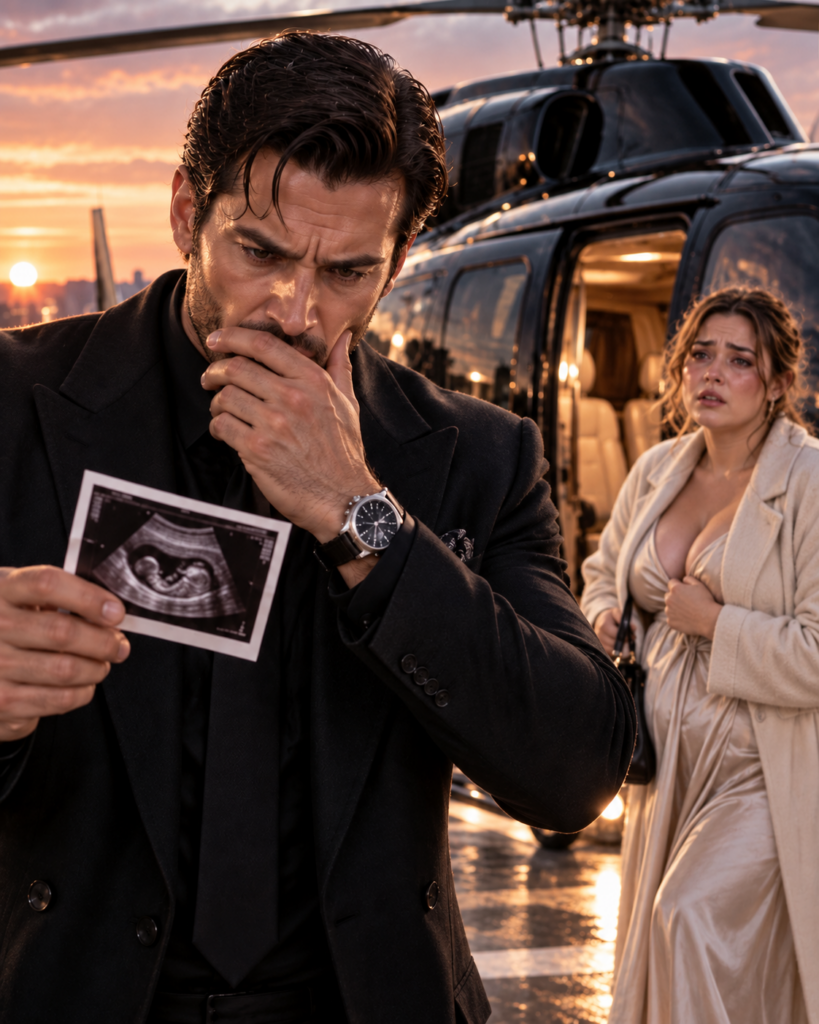
The stranger replied with four words: Is the baby mine?
Minutes later, he sent me my home address, my office floor, and the exact time I bought coffee every morning.
Before midnight, two men were outside my apartment—and the father of my child was no longer the man I feared most.

PART 1 — THE MESSAGE THAT FOUND THE WRONG MAN
The clinic’s fluorescent lights buzzed above me, washing the examination room in a cold blue-white that made everything look unreal. I stared at the grainy image in my hand—a pale curve, a small dark space, a life no larger than a bean.
“You’re about eight weeks along, Ms. Reynolds,” the technician said. “Everything looks normal.”
Normal.
Three weeks earlier, Mark had vanished from my apartment without his coat, his charger, or an explanation. His last message still sat on my phone.
Can’t wait to see you tonight. Miss you.
He never came.
Outside, late-September rain silvered the Manhattan sidewalks. I tucked the ultrasound inside my coat and rode the subway home to Queens, surrounded by wet umbrellas, perfume, and the metallic shriek of wheels against rails.
My apartment felt smaller than usual. The refrigerator clicked in the kitchenette. Water tapped against the fire escape. On the counter sat Mark’s favorite coffee mug, still carrying a faint brown stain along the rim.
I needed to tell someone before fear swallowed me.
My best friend Jenna was traveling through Europe, but she checked her messages whenever hotel Wi-Fi cooperated. I photographed the ultrasound and typed through trembling fingers.
I’m pregnant, Jen. Mark is gone. I don’t know what to do.
I pressed send, showered, and returned wrapped in a thin towel when my phone chimed.
The reply was not from Jenna.
Is it mine?
Heat rushed into my face. I had sent the ultrasound to an unfamiliar New York number.
I’m sorry. Wrong person. Please ignore it.
The answer appeared immediately.
Who is this?
I tightened the towel around myself.
Someone who made a mistake. Good night.
The typing symbol appeared, vanished, then returned.
You texted Mark Tanner’s old number.
My wet fingers nearly dropped the phone.
How do you know Mark?
This time the answer took longer.
We had business together. He owes me.
A cold pressure formed behind my ribs.
What kind of business?
The kind people do not walk away from.
I sat on the floor. Mark had called himself an investment consultant, yet his watches, weekend trips, and cash-heavy habits had never matched the salary he claimed.
I don’t know where he is. He disappeared three weeks ago.
But you’re carrying his child.
Before I could block the number, another message arrived.
You live at 1843 Astoria Boulevard, apartment 4B. You work at Harland & Wilson on Fifty-Second Street. Every morning at 7:15, you buy a large vanilla latte. You have checked your bank balance eleven times this week.
My skin went numb.
The final message appeared.
I know everything about you, Eliza Reynolds. Now I know about the baby too.
I reached for the kitchen knife and dialed emergency services, but a violent pounding shook my door before the call connected.
“Ms. Reynolds,” a man said from the hallway. “Mr. Castellano would like to speak with you.”
“I called the police.”
“No, you didn’t.”
The handle moved.
“You can come as a protected guest,” the man continued, almost gently, “or we can enter and treat you as a security problem.”
My hand settled over my still-flat stomach.
“I need to get dressed.”
“You have three minutes.”
When I opened the door, two broad-shouldered men in dark suits waited beneath the flickering hallway light.
They escorted me upstairs instead of down.
Rain blew across the roof. A black helicopter stood where no helicopter should have been, its blades gathering speed above my apartment building.
As one man opened the door, my phone vibrated again.
Mark stole two million dollars and a drive containing names that could ruin powerful people.
A second message followed.
If he hid them with you, everyone hunting him will come for your child next.
Then the helicopter lifted me into the storm.
PART 2 — THE HOUSE WHERE EVERY DOOR LOCKED QUIETLY
The blades cut through the night with a pulse I felt in my teeth.
I sat between the two men who had taken me from my apartment, strapped into a leather seat and sealed beneath noise-canceling headphones. Manhattan fell away beneath us until the streets became glowing threads and the buildings resembled pieces on an illuminated circuit board.
My reflection hovered in the window: damp hair, gray sweater, white knuckles.
One of the men tapped my shoulder and pointed north.
An estate emerged above the Hudson River. Warm lights traced a stone mansion surrounded by dark woods, terraced gardens, and a security wall nearly invisible from the air. A helipad glowed beside the cliff.
It was not a home designed to welcome visitors.
It was a fortress built by someone who expected enemies.
The helicopter descended. Cold air rushed through the cabin when the door opened, carrying the smell of pine and river water.
“Stay close,” the taller guard said.
His name, I would later learn, was Giovanni. At that moment he was simply one more stranger who knew where I lived.
A stone path led to an enormous oak door. It opened before we reached it.
A silver-haired woman in a black dress waited inside. Her face was narrow, composed, and unreadable.
“Ms. Reynolds,” she said. “I’m Teresa. Follow me.”
“Where are they taking my phone?”
“To be checked.”
“No.”
I turned toward Giovanni, but he had already placed it inside a signal-blocking pouch.
“I need it.”
“You’ll receive it back,” Teresa said.
“That’s what kidnappers say when they want their victims calm.”
Her gaze sharpened slightly. “I understand why you would call this a kidnapping.”
“What do you call armed men at my door?”
“An emergency handled badly.”
“Badly for whom?”
Something almost approving entered her expression.
“For you,” she said. “Which is why you should say exactly that to Mr. Castellano.”
She led me through marble hallways softened by antique rugs. Paintings hung beneath discreet cameras. The air smelled of beeswax, old books, and expensive flowers that had no business blooming in autumn.
I was shown into a study overlooking the river.
Floor-to-ceiling shelves surrounded a black walnut desk. A fire burned beneath a carved mantel, but the room held little warmth. On the desk rested a slim file bearing my full name.
I remained standing.
The door opened behind me.
Vito Castellano entered without hurry.
He was taller than I expected, perhaps forty, with dark hair touched by silver at the temples and a charcoal suit fitted precisely to his broad frame. His face was not conventionally gentle, but neither did it carry the theatrical cruelty I had imagined.
His stillness was worse.
Men who shouted wanted to frighten people. Vito behaved like fear had already completed the work for him.
“Ms. Reynolds.”
“Mr. Castellano.”
His eyes moved briefly toward my stomach before returning to my face.
“Please sit.”
“I’d rather stand.”
“As you wish.”
He crossed to a sideboard and poured a drink. When he reached for a second glass, I shook my head.
“I don’t drink.”
His gaze lowered again.
“Of course. The baby.”
“Mark’s baby.”
The name hardened something in him.
“Where is he?” I asked.
“I hoped you might tell me.”
“I haven’t heard from him in three weeks.”
“You sent messages.”
“They weren’t answered.”
“Because the number no longer belongs to him.”
“It belongs to you?”
“To a secure line he used for business.”
“The kind no one walks away from?”
Vito lifted his glass, acknowledging the phrase.
“What did Mark do?”
He approached the desk and opened the file. Inside were photographs of Mark entering office buildings, meeting men beside parked cars, and carrying a silver case through a private terminal.
“He managed financial structures for companies under my control,” Vito said. “Three weeks ago, he disappeared with two million dollars and a storage drive.”
“What’s on it?”
“Account records, corporate ownership information, and the identities of people whose exposure would create considerable danger.”
“Danger for them or you?”
“Both.”
I folded my arms. “And you think he gave it to me?”
“I think Mark Tanner trusted no one. But he often hid valuable things inside ordinary lives.”
My stomach tightened.
“You watched me.”
“Yes.”
“For how long?”
“Since Mark disappeared.”
“You tracked my coffee.”
“I needed to know whether he contacted you.”
“You read my bank activity.”
“Financial movement reveals intention.”
“You entered my life before I knew your name.”
His face remained controlled. “That is true.”
“And tonight you sent men to my apartment.”
“After you revealed the pregnancy to a number monitored by my security team.”
“You could have called.”
“I did.”
“You threatened me by text.”
“I gave you information.”
“You sent my address.”
“To prove you were already exposed.”
The calm precision of his answers made anger rise through my fear.
“You could justify a fire by explaining how carefully you struck the match.”
His eyes held mine.
“Yes,” he said. “I could.”
The admission startled me.
Vito set down his glass. “You are not here to be harmed. You are here because Mark’s theft has attracted people less concerned with whether you survive.”
“Who?”
“A Russian organization that had been trying to purchase information from him. They know he had a relationship with you.”
“How?”
“They watched him before he disappeared. Two of their people were outside your office yesterday.”
I thought of the dark car I had noticed on Fifty-Second Street. I had assumed it belonged to a client.
“Why didn’t you warn me?”
“I increased surveillance.”
“That isn’t an answer.”
“No. It was a decision.”
“Made for me.”
“Yes.”
The word sat heavily between us.
I glanced at the door. “Am I free to leave?”
Vito’s pause answered before he did.
“Not tonight.”
“Then stop calling me a guest.”
His jaw shifted.
“You are safer here.”
“I didn’t ask you to decide that.”
“If I had waited for permission, you might already be in someone else’s custody.”
“And now I’m in yours.”
The fire settled with a soft crack.
Vito walked around the desk and picked up a small plastic evidence bag. Inside was a brass key.
“This was found inside Mark’s locker at Grand Central.”
I recognized it immediately.
“He had one like that on his key ring.”
“We found one. The duplicate may still be in your apartment.”
“I don’t remember seeing it.”
“What did he leave behind?”
“Some clothes. Books. A gym bag. Nothing worth two million dollars.”
“Did he give you jewelry?”
“A necklace on my birthday.”
“What kind?”
“A small gold pendant.”
“Where is it?”
“In my apartment.”
Vito looked toward Giovanni, who stood beyond the half-open door.
“Retrieve it.”
“No.” I stepped between them. “Nobody enters my home.”
“They already have.”
My mouth went dry.
“Who?”
“The Russians searched it while you were at the clinic.”
The room seemed to tilt.
“That’s impossible.”
Vito turned his laptop toward me.
Security footage showed two men entering my building through the service door. One carried a locksmith’s case. Another camera captured them leaving my apartment twenty-two minutes later.
The timestamp was that afternoon.
“They found nothing,” Vito said. “If they had, they would not still be watching you.”
My legs weakened, and I finally sat.
The life I had believed was messy but ordinary—my rent, my job, my missing boyfriend—had been surrounded by strangers making calculations about me.
Vito placed a bottle of water on the table.
I ignored it.
“What happens if I don’t help you?”
“You remain under protection until the immediate threat is resolved.”
“That sounds indefinite.”
“It may be.”
“What happens if I do help?”
“We find Mark, recover the drive, and remove your name from the conflict.”
“Remove how?”
His face gave nothing away.
“Legally where possible.”
“And where it isn’t?”
“Carefully.”
A chill moved through me.
“I want a lawyer.”
“You work at a law firm.”
“As an administrative assistant. That doesn’t make me a lawyer.”
“You may call anyone you trust in the morning.”
“Why not now?”
“Because outgoing communications could reveal this location.”
I stood again.
“You know what frightened people do when they want control? They make every restriction sound temporary and necessary.”
Vito looked at me for a long moment.
“Teresa will show you to a room.”
“I’m not finished.”
“Neither am I. But you’re exhausted, frightened, and pregnant. A useful conversation requires more than endurance.”
“I can decide when I’m done.”
For the first time, irritation entered his eyes.
Then, with visible effort, he inclined his head.
“Continue.”
“Did you hurt Mark?”
“No.”
“Did you make him steal for you?”
“No.”
“Was he afraid of you?”
“Yes.”
“Should I be?”
Vito did not answer immediately.
“You should be cautious with every man involved in this situation,” he said at last. “Including me.”
It was the most honest thing he had said.
My room overlooked the river.
It contained cream-colored curtains, a four-poster bed, a sitting area, and a bathroom larger than my apartment’s kitchen. Fresh clothes hung in the closet, all approximately my size.
I stood before them in silence.
Teresa placed a tray of soup and bread on the table.
“You prepared this before I arrived.”
“We knew Mr. Castellano might bring you here.”
“He planned to take me.”
“He planned for the possibility.”
“That distinction only matters to him.”
Teresa removed the lid from the soup. Steam carried the scent of rosemary and chicken through the room.
“You need to eat.”
“I need my phone.”
She placed it on the table.
Relief came too quickly.
When I reached for it, she added, “External calls are temporarily restricted.”
I laughed without humor. “Of course they are.”
“You may message your employer and your friend. Security will review the messages before they are sent.”
“That is not communication. It’s a hostage note with good grammar.”
Teresa’s expression softened by one degree. “I have worked here twenty-two years. Mr. Castellano can be severe, but he does not harm women or children.”
“He had me removed from my home.”
“To prevent others from doing the same.”
“Why are you defending him?”
“I am explaining him. Defense is something he must earn.”
She turned toward the door.
“Teresa.”
She paused.
“What happened to people who betrayed him?”
Her hand rested on the brass knob.
“They stopped being trusted.”
“That isn’t what I asked.”
“No,” she said quietly. “It is the only answer I will give.”
After she left, I searched the room.
No visible cameras. The bathroom mirror passed the fingertip test Arthur—no, not Arthur; that belonged to another life—someone online had once recommended. The lamps contained ordinary wires. The windows opened three inches before a security catch stopped them.
On the nightstand sat a landline.
I lifted the receiver.
A man answered immediately. “Security.”
“I need to call my friend Jenna.”
“Provide the number.”
“I can dial it myself.”
“All external calls must be routed.”
I hung up.
The soup cooled untouched.
At midnight, nausea sent me to the bathroom. I knelt on the marble floor, trembling while my body rejected the little I had eaten that day.
A knock sounded.
“I’m fine,” I called.
The door opened anyway.
Vito stood in the bedroom, no jacket, his sleeves rolled back. He did not enter the bathroom.
“Teresa said you hadn’t eaten.”
“Teresa reports everything?”
“She reports medical concerns.”
“I’m pregnant, not ill.”
“You are pale.”
“I was taken from my apartment in a helicopter.”
His mouth tightened.
“I can have a physician come.”
“No.”
“A woman.”
“No.”
“Someone you choose.”
“I choose to be left alone.”
He remained in the doorway.
“Mark knew about the Russians,” he said.
I gripped the sink. “Why are you telling me this now?”
“Because the threat existed before his theft. He began moving money six months ago.”
Six months—the same month he started leaving clothes at my apartment.
“He moved in with me because he wanted a hiding place.”
“Possibly.”
“Don’t soften it.”
“He used your address to create financial accounts and register a storage unit.”
My reflection in the mirror looked hollow.
“Did he love me at all?”
Vito’s expression changed in a way I could not name.
“That question should be answered by someone who deserves to speak about love.”
“And you don’t?”
“No.”
The answer quieted me.
He placed a paper bag on the dresser.
“Crackers, ginger tea, and electrolyte packets. The doctor recommended them.”
“You called one after I said no?”
“I described the symptoms without giving your identity.”
“That is still ignoring me.”
“Yes.”
“You do that easily.”
“I have survived by acting before agreement was available.”
“Maybe survival isn’t the same as living correctly.”
He looked at me with an intensity that made the room feel smaller.
“No,” he said. “It isn’t.”
Then he left.
Morning arrived in pale strips across the Hudson.
I found ginger tea outside my door and no guard visible in the corridor. When I walked toward the staircase, however, Giovanni emerged from an alcove.
“Good morning.”
“Am I allowed downstairs?”
“Yes.”
“Outside?”
“Not beyond the terrace.”
“So the invisible leash reaches the garden.”
His face remained professional. “I was instructed not to lie to you.”
“How generous.”
In the dining room, Vito sat at a long table reading documents. Only one place had been set across from him, though the room could have seated twenty.
I picked up the coffee pot.
“Decaffeinated,” he said.
“Do you monitor caffeine too?”
“I asked the doctor.”
“The one I didn’t authorize.”
His eyes lowered briefly.
“Yes.”
I poured half a cup out of spite, then discovered I could not tolerate the smell. I pushed it away.
Vito slid a file toward me.
“Read first. Defend later.”
“What am I defending?”
“Mark.”
“I’m not defending him.”
“You still believe his disappearance may have had a noble reason.”
I opened the file.
Bank records showed transfers beginning ten months earlier. Mark had moved small amounts through shell companies, increasing them slowly to avoid detection.
Photographs showed him meeting a hard-faced man outside a Brooklyn nightclub.
A final image captured Mark entering my building with a black duffel bag on a night he had told me he was traveling to Boston.
“That was February,” I whispered.
“Yes.”
“He brought me flowers that night.”
“People often perform tenderness most convincingly when covering a betrayal.”
I looked at Vito. “Experience?”
“More than I wanted.”
“What happened?”
“This conversation is not about me.”
“Every conversation in this house is about you. Your money, your enemies, your rules.”
He leaned back. “What would you like to know?”
“Are you a criminal?”
“Yes.”
The bluntness unsettled me.
“What kind?”
“My family once controlled businesses through intimidation, bribery, and violence. I inherited those structures.”
“Inherited is a passive word.”
“I maintained them.”
“Past tense?”
“Not entirely.”
“Have you killed anyone?”
The silence answered.
I closed the file.
“You expect me to help you.”
“I expect you to protect yourself.”
“By choosing the less immediate threat?”
“If that is how you see me.”
“How should I see you?”
“As a man with resources, information, and an interest in keeping you alive.”
“Interest because of the drive.”
“At first.”
The final two words hung between us.
I looked away first.
Vito pushed another document forward. It was a copy of a storage-unit contract bearing my forged signature.
Mark had listed me as co-owner.
Inside the unit, investigators had found empty cases designed to hold cash and electronics.
“He used my name.”
“Yes.”
“If the police find this, they’ll think I helped.”
“Which is why I have already preserved evidence proving the signature was forged.”
“Why?”
“Because innocence should be documented before powerful people decide it is inconvenient.”
The sentence sounded personal.
“What do you want me to remember?” he asked.
“About Mark?”
“Yes.”
I pressed my hands around a glass of water.
“He hated ordinary routines. He changed restaurants, gyms, even dry cleaners. He said predictability made people lazy.”
“Yet he came to your apartment regularly.”
“He said it made him feel normal.”
“Where did he spend time alone?”
“The bathroom.”
Vito lifted one eyebrow.
“He took long showers. Sometimes an hour.”
“Any repairs recently?”
“He replaced the medicine cabinet because the old one was loose.”
Vito looked toward Giovanni.
“Send a team.”
I stood. “I’m going with them.”
“No.”
“I know the apartment.”
“It may be watched.”
“It is my home.”
Vito’s jaw tightened.
“Your men already searched it, didn’t they?”
“Only visually.”
“Then they missed whatever Mark hid. I might recognize what changed.”
“It is too dangerous.”
“You mistook my fear for permission.”
He became still.
“If you expect my cooperation,” I continued, “I go.”
“No helicopter.”
“Agreed.”
“I choose the security.”
“I expected that.”
“And you stay beside me.”
I almost refused simply because he had said it as an order. Then I considered the Russians outside my office and Mark’s forged signature.
“Fine.”
Vito nodded, but relief flickered in his eyes before he concealed it.
We returned to Queens in an armored SUV with Giovanni driving.
Rain-dark buildings slid past the windows. The city looked exactly as it had the day before, which felt offensive. A woman walked a terrier beneath a yellow umbrella. Delivery workers unloaded produce. Two children argued over a backpack.
My life had become unrecognizable while everyone else waited for traffic lights.
My building superintendent stared when Vito entered in his charcoal coat, followed by two security men. He opened his mouth, decided against speaking, and retreated into his office.
The apartment door showed no damage.
Inside, drawers had been emptied and replaced too neatly. My books sat in the wrong order. A framed photograph of Jenna and me had been turned facedown.
I crossed to the kitchenette.
Mark’s coffee mug remained beside the sink.
For reasons I could not explain, that was what broke me.
I picked it up and threw it against the wall.
Ceramic shattered across the floor.
Vito dismissed the guards with one glance. He stayed near the door while I pressed both hands over my face.
“I keep thinking there must have been a version of him that was real,” I said.
“There may have been.”
“That’s worse.”
“Yes.”
He did not touch me.
I was grateful.
After a minute, I stepped over the broken pieces and entered the bathroom. The new medicine cabinet looked ordinary: mirrored door, white metal frame, three shelves.
I removed the toiletries.
One screw differed from the others.
“Mark hated using mismatched hardware,” I said.
Vito crouched beside me. “Move back.”
He removed the screw, then the cabinet. Behind it was a narrow cavity containing a waterproof pouch.
Inside lay a gold pendant, a second brass key, and a folded note.
My hands trembled as I opened it.
Eliza—if I don’t return, do not trust anyone who knows about the drive. Not the police. Not Castellano. The pendant contains what they want. Keep it on you and disappear. I did this for us.
Vito held out his hand. “The pendant.”
“No.”
“Eliza.”
“He said it contains the drive.”
“Yes.”
“And warned me not to trust you.”
“Because he knew I would find him.”
“He also said he did this for us.”
Vito’s face hardened. “Mark created evidence implicating you in theft. That is not protection.”
“Maybe he intended to come back.”
“Maybe he intended to use your pregnancy as a sentimental defense when he needed you.”
The cruelty of the possibility made me recoil.
Vito noticed and lowered his voice.
“The pendant is dangerous. Let me examine it.”
“Here.”
“My equipment is at the estate.”
“Then bring it here.”
“The apartment is compromised.”
“Everything becomes compromised when you want me behind your walls.”
He looked at the note in my hand.
“What would make you agree?”
“A choice.”
“You have one.”
“No. I have options you approve.”
His eyes darkened, but he listened.
“I’ll return to your house for forty-eight hours,” I said. “You examine the pendant while I watch. I get unrestricted access to my phone. I contact Jenna and a lawyer. No message screening.”
“Calls can be traced.”
“Then provide a secure line, but no listening.”
“That creates risk.”
“For you?”
“For everyone in the house.”
“Then decide whether my cooperation is worth it.”
Vito glanced toward the bathroom door. Giovanni waited outside, pretending not to hear.
“Agreed,” Vito said.
“Put it in writing.”
A faint, unexpected smile touched his mouth.
“You work for lawyers.”
“I learn by osmosis.”
“I’ll have Teresa prepare the agreement.”
“I’ll prepare it.”
The smile disappeared, replaced by something close to respect.
“As you wish.”
The pendant contained a micro-storage drive.
It held partial account records, encrypted contacts, and a schedule of payments connecting Mark to the Orlov organization. The files were valuable, but incomplete.
The missing data was protected behind a biometric lock linked to Mark.
“He divided the information,” Vito explained. “The pendant proves he negotiated with them. Another device holds the records he took from me.”
We sat in his study while rain pressed against the windows. The gold pendant lay beneath a glass lens, looking too delicate to carry so much danger.
“Can this clear my name?” I asked.
“It proves Mark forged your signature before the theft.”
“Then send it to law enforcement.”
“Not yet.”
I looked at him sharply.
“If these names are released before I identify the compromised officials, Mark will be warned,” he said.
“You told me he already knows you’re hunting him.”
“He does not know which evidence I have.”
“Still protecting your organization.”
“Protecting the legitimate companies and employees who would be destroyed if the records were released without context.”
“That is the same argument powerful men always use.”
“Yes.” Vito met my gaze. “Sometimes they use it because it is true.”
I hated that I could not dismiss him.
That afternoon, I called Jenna through a secured connection.
She answered from a hotel room in Paris, furious and frightened.
“You’re where?”
“With someone who knew Mark.”
“That is not a location, Eliza.”
“I can’t give you the address.”
“Are you being held?”
I looked through the study window. Vito stood on the terrace, deliberately far enough away not to hear.
“I was. Now I’m negotiating.”
“That is not reassuring.”
“I know.”
“Call the FBI.”
“I’m speaking with an attorney first.”
“Whose attorney?”
“Mine.”
Vito had allowed me to choose a former federal prosecutor from my firm’s referral list. The lawyer advised me to preserve every message, sign nothing regarding Mark’s property, and insist on independent medical care.
She also confirmed something I had not wanted to hear.
If the Russians believed I possessed stolen information, returning to my apartment would be reckless.
After the call, I found Vito in the greenhouse.
Warm damp air fogged the glass. Citrus trees grew in large clay pots, their leaves glossy beneath hanging lights. He stood among them with his jacket removed, trimming a dead branch from a lemon tree.
The domestic image disturbed me more than his weapons or guards.
“Who maintains this place?” I asked.
“I do.”
“You?”
“My mother planted the first trees.”
I looked around. “She lived here?”
“Until she died.”
“Was she part of your world?”
“She spent her life trying to keep it from entering the house.”
“Did she succeed?”
“No.”
He clipped another branch.
“What happened?”
“My father’s enemies placed a device beneath her car. I was sixteen.”
The greenhouse became too quiet.
“I’m sorry.”
“So am I.”
“That’s why you built all this security.”
“It is one reason.”
“And why you think protection excuses control.”
His hand stilled.
“Yes.”
The honest answer took the sharpness from my accusation without making it untrue.
“You can’t keep every person you care about behind walls,” I said.
“No.”
“But you keep trying.”
He set down the shears. “You believe I care about you.”
“I believe you’ve become invested.”
“Those are not the same.”
“No.”
He came closer, stopping with a lemon tree between us. The leaves released a clean, bitter scent where he had cut them.
“At first, you were connected to Mark and the drive,” he said. “Then I learned about the child.”
“Mark’s child.”
“Yes.”
“Why does that matter to you?”
His expression was difficult to read. “Children do not choose the danger adults create.”
“That still doesn’t explain why you look at me as if my leaving would be a personal insult.”
A pulse moved beside his jaw.
“Because I am accustomed to being obeyed.”
“There. An honest answer.”
“Not the complete one.”
Before I could ask, Giovanni entered.
“Sir, we have movement at Ms. Reynolds’s office.”
He handed Vito a tablet.
Security footage showed a man entering Harland & Wilson using a forged maintenance badge. He opened my desk, searched the drawers, and placed something beneath the keyboard.
“What is that?” I asked.
“A listening device,” Giovanni said. “Or a tracker.”
Vito’s face became cold. “Remove it without alerting him. Follow, do not engage.”
Giovanni left.
I wrapped my arms around myself.
“The Russians?” I asked.
“Likely.”
“Or Mark.”
Vito looked at the tablet. “Possibly both.”
My phone chimed.
A new message had arrived from a blocked account.
I’m alive. I’m sorry. Don’t trust Castellano. Meet me alone if you want the truth. —Mark
Beneath it was a photograph taken outside my office ten minutes earlier.
Mark stood across the street.
Alive.
Watching.
He contacted me again that evening.
Tomorrow. Three o’clock. Marlow Café on West Twenty-Third. Come alone. We can still save our family.
I read the final word three times.
Family.
A week earlier, it would have broken me open. Now it felt like a key being tested in a lock.
Vito stood across the study.
“You want to go,” he said.
“I need to hear him.”
“You need information, not closure.”
“I need both.”
“Closure is often bait with a compassionate name.”
“That doesn’t make you wrong, but it doesn’t make the decision yours.”
He crossed to the window.
“If Mark is working with Orlov, the meeting is a transfer attempt.”
“Then we use it.”
His head turned.
“You put a listening device on me,” I said. “Your people watch from outside. I meet him.”
“No.”
“You need him.”
“I can take him before he enters.”
“And he never tells us where the missing drive is.”
“He may not tell us anyway.”
“Then why have you spent three weeks looking?”
Vito’s silence was answer enough.
I approached the desk.
“You said you wanted my cooperation. This is what it looks like.”
“It looks like placing a pregnant woman across from a desperate thief.”
“I will be surrounded by your security.”
“That did not protect my mother.”
The words came out harder than he intended.
I looked at him carefully. “I am not your mother.”
“No.”
“You cannot repair that night by controlling this one.”
His shoulders lowered by a fraction.
“What are your conditions?” he asked.
“A public café. Daylight. I choose the table. Giovanni’s team outside. No one approaches unless I use a code word or Mark tries to move me.”
“And a microphone.”
“Yes.”
“A tracker.”
“Yes.”
“Body armor.”
“I’ll look ridiculous.”
“It can be concealed beneath your coat.”
“I’m not wearing tactical equipment to drink tea.”
His mouth nearly smiled. “The coat, then.”
“What code word?”
“Honeymoon.”
I stared at him.
“Why that?”
“Mark once searched resorts in countries without extradition agreements. He labeled the file ‘Honeymoon.’”
The ugliness of the joke settled between us.
“Fine.”
Vito opened a drawer and removed a velvet box.
Inside lay a diamond pendant.
“The microphone is behind the center stone.”
I lifted it. “Subtle.”
“He has seen you wear inexpensive jewelry. Something new may make him ask who gave it to you.”
“And jealousy will loosen his mouth.”
“Possibly.”
“You understand manipulation very well.”
“Yes.”
“Another honest answer.”
He came around the desk.
“May I?”
I turned my back.
His fingers brushed my neck as he fastened the chain. The touch was brief, careful, and far more unsettling than if he had been bold.
The pendant rested beneath my collarbone.
“Beautiful,” he murmured.
“The microphone?”
His eyes met mine in the dark window.
“Both.”
I stepped away.
“Do not confuse fear with intimacy.”
“I won’t.”
But the air in the room had already changed.
Marlow Café smelled of cinnamon, roasted coffee, and wet wool.
I sat beside the front window wearing the hidden microphone and a cream-colored coat Vito’s staff had bought because mine was still in evidence. Outside, pedestrians moved beneath umbrellas. A black SUV waited half a block away.
Vito was inside another building across the street, listening.
Three o’clock passed.
At three fifteen, I began to wonder whether Mark had noticed the security.
At three twenty-five, he entered through the side door.
He had lost weight. His designer suit was gone, replaced by jeans, a dark cap, and a worn leather jacket. Stubble shadowed his face. He scanned the room twice before sitting opposite me.
“Eliza.”
For one unbearable second, familiarity struck before judgment could defend me.
The tilt of his mouth. The small scar above his eyebrow. The way he reached for my hands as if returning from an ordinary business trip.
I pulled mine away.
His face tightened.
“I’ve been worried sick.”
“Have you?”
“I saw Orlov’s people outside your building.”
“You also left me there.”
“I had no choice.”
“You always had choices. You simply made them alone.”
He looked down at my coat, then at the pendant.
“Where did you get that?”
“A friend.”
“What friend?”
“The kind who answers messages.”
Jealousy flashed exactly as Vito predicted.
“Castellano has you.”
“I’m sitting here.”
“You know what I mean. He took you.”
“He did.”
“And you trust him?”
“No.”
Relief softened Mark’s face.
“But I trust you less,” I added.
He glanced toward the window. “Did he tell you I stole from him?”
“He showed me records.”
“Records he controls.”
“He showed me your forged signature on a storage unit registered in my name.”
Mark’s expression changed.
“You found that?”
“Yes.”
“It was temporary.”
“Fraud often is.”
“I needed a clean name.”
“You used mine.”
“I was protecting the money for us.”
“There was no ‘us’ in those documents.”
His hands closed around the edge of the table.
“I planned to come back.”
“When?”
“When it was safe.”
“You left me pregnant and alone.”
His eyes dropped toward my stomach.
“You’re certain?”
“Eight weeks.”
“And it’s mine?”
Pain sliced through me even though the question had come from the stranger first.
“Yes, Mark. It is yours.”
He rubbed both hands over his face.
“I didn’t know.”
“You made sure I couldn’t tell you.”
“I had to destroy my phone.”
“You could have found another.”
“They monitored everything.”
“Yet you found a way to photograph me outside my office.”
He looked away.
I understood then that Mark had not disappeared because communication was impossible. Silence had simply served him.
“What did you take?” I asked.
“Enough to get free.”
“Two million dollars and a drive.”
“Castellano has ten times that buried in offshore accounts.”
“So stealing becomes moral if the victim is richer?”
“He is not a victim. He is a murderer.”
“Are the records real?”
Mark leaned forward. “They contain his entire financial structure, officials he pays, businesses he uses, every hidden account. Orlov will release enough to destroy him.”
“You gave it to the Russians?”
“Not all of it.”
“So Vito is right.”
“Don’t call him Vito.”
The sharpness surprised me.
“What should I call the man keeping me alive?”
“He’s using you to reach me.”
“And what are you doing?”
“I’m trying to save you.”
“You forged my name.”
“To protect the assets.”
“You put stolen property behind my bathroom wall.”
“In case something happened to me.”
“You made me the first person everyone would search.”
“That wasn’t supposed to happen.”
His answers arrived too quickly, each one polished by repetition.
I thought of the man who had brought soup when I worked late. The man who had slept with one hand on my waist. Perhaps those moments had been real to him. Perhaps real tenderness and unforgivable selfishness could inhabit the same body.
That possibility hurt most.
“What do you want now?” I asked.
“To leave.”
“With me?”
“With you and our child.”
“Where?”
“There’s a boat waiting. We can reach international water before midnight.”
“Who arranged it?”
“Friends.”
“What kind of friends?”
His eyes shifted toward the window.
“People who can protect us from Castellano.”
“Orlov?”
He did not answer.
My pulse accelerated.
“The Russians who searched my apartment?”
“They were looking for the pendant.”
“The pendant you hid.”
“I didn’t know they would move that quickly.”
I touched the diamond at my throat. Vito was hearing every word.
“What happens when Orlov has the drive?”
“They give us new identities.”
“And the money?”
“We keep half.”
“How generous.”
“Eliza, listen to me. I did this for our future. Two million gives us a life without debt, without bosses, without worrying about rent.”
“You could have asked what future I wanted.”
“You would have been afraid.”
“I am afraid.”
“I can fix that.”
“No. You created it.”
Mark reached across the table and took my hand.
His skin was cold.
“I know I made mistakes,” he whispered. “But you loved me.”
“I loved the man you presented.”
“He was real.”
“Then why isn’t he the one sitting here?”
His eyes filled—not enough to prove innocence, but enough to show loss.
“We can argue later. Right now, we need to move.”
“I haven’t agreed.”
“We don’t have time.”
“There it is.”
“What?”
“The part where your emergency becomes my obligation.”
He released my hand and looked around the café.
“Castellano’s people are here, aren’t they?”
I said nothing.
His face hardened.
“You’re wearing a wire.”
I touched the pendant.
Mark rose.
“Come with me.”
“No.”
“Sit down,” I said.
“Eliza, now.”
Customers glanced toward us.
He forced a smile and placed one hand at my back, pretending affection while pushing me toward the restrooms.
I could say the code word.
Vito’s people would enter.
But I still did not know where the missing drive was or whether Mark’s claim about the boat was true.
I allowed him to guide me through the kitchen.
Stainless steel counters flashed beneath fluorescent light. Cooks protested as Mark pulled me between them. The rear door burst open, releasing cold rain into the corridor.
A gray sedan waited in the alley.
Its driver lowered the window.
A scar cut across his jaw. His eyes moved from me to my stomach with calculating interest.
“This her?” he asked in a Russian accent.
Mark nodded. “Yes. Open the door.”
I stopped.
“Who is he?”
“A friend.”
“He doesn’t look friendly.”
“We need to go.”
The driver unlocked the rear door.
Mark tightened his grip on my arm.
The truth assembled itself from small, ugly pieces.
“You’re not running from the Russians,” I said. “You’re working with them.”
His silence confirmed it.
“You promised them the drive.”
“It was the only way to stay alive.”
“And me?”
“Eliza—”
“What did you promise them about me?”
“Nothing.”
The driver said something impatiently in Russian.
Mark looked toward him, then back at me.
“The baby gives them confidence that I’ll cooperate.”
The alley seemed to narrow.
“You offered your child as collateral.”
“No one will hurt you.”
“That is what every coward says after giving dangerous men permission to own someone else.”
His fingers dug into my arm.
“Get in the car.”
“No.”
“Do not make this difficult.”
I looked at the pendant.
“Honeymoon.”
Mark’s face changed.
“What did you say?”
“Honeymoon.”
The sedan doors locked.
Black SUVs entered both ends of the alley, blocking every exit. Men in protective gear moved into position, but no one fired.
The Russian driver reached inside his coat.
Giovanni’s voice boomed from behind a vehicle. “Hands where we can see them.”
Mark pulled me against him.
A gun pressed into my side.
The world became painfully clear: rain striking metal, steam drifting from the kitchen vent, my own breathing too fast and shallow.
“Stay back!” Mark shouted. “I’ll hurt her.”
Vito stepped into the alley.
He wore no protective vest and carried no visible weapon. Rain darkened the shoulders of his coat. His gaze fixed on Mark’s hand.
“Let her go.”
“I want a clear road to the harbor.”
“No.”
“I have the drive.”
“You have part of it.”
“I’ll destroy the rest.”
“Then you lose your value to Orlov and to me.”
Mark pushed the gun harder against my ribs.
“You think I won’t do it?”
“No,” Vito said. “I think you have spent a year placing your survival above hers. You will not surrender your last shield until you see another.”
“Get me a car.”
“You already have one.”
Vito nodded toward the sedan.
The Russian driver opened his door and raised his hands. Giovanni’s team had surrounded him from the blind side.
Mark’s breath struck my ear in ragged bursts.
“Eliza,” Vito said, his voice low. “Remember what Giovanni taught you.”
During the previous morning’s security preparation, Giovanni had shown me how to break a wrist grip and move off the line of an attack. I had rolled my eyes, embarrassed by the padded practice room.
Now my body remembered before my fear could object.
I dropped my weight and drove my elbow backward.
Mark gasped.
His grip loosened.
I turned away from the weapon and fell toward the wall as Vito’s team rushed forward. Giovanni trapped Mark’s arm, removed the gun, and forced him onto the wet pavement.
No shot was fired.
No heroic blur erased what had happened.
There was only Mark on his knees, rain running down his face, and me pressed against brick with both arms protecting my stomach.
“Eliza,” Mark pleaded. “Don’t let him take me. Think about our baby.”
The fury that rose inside me was cold.
“You lost the right to use that word when you offered us as insurance.”
Vito stopped several feet away.
“Are you hurt?”
“My arm.”
A bruise was already forming where Mark had gripped me.
Vito’s eyes moved to it, and something dangerous entered his face.
“No,” I said sharply.
He looked at me.
“Whatever you are thinking—no. He goes to the police.”
Mark laughed bitterly from the pavement. “You think Castellano calls the police?”
“He will this time.”
Vito remained silent.
I stepped closer to him.
“If you want me to believe you are different from the danger you describe, prove it where it costs you.”
Rain collected along his eyelashes.
Mark had stolen information that could expose Vito’s organization. Turning him over meant official investigations, questions, and scrutiny Vito would normally avoid.
It also meant surrendering the private justice his world expected him to deliver.
Finally, Vito looked toward Giovanni.
“Call the federal task force. Tell them we recovered Mark Tanner during an attempted abduction. Preserve every recording.”
Giovanni hesitated for less than a second.
“Yes, sir.”
Mark stared at Vito in disbelief.
“You can’t do that.”
Vito’s expression went still.
“She asked for justice,” he said. “You should be grateful she did not ask for vengeance.”
The federal agents arrived twenty minutes later.
Mark attempted to bargain before they finished reading his rights. He offered names, account codes, and the location of the missing drive in exchange for protection.
It was hidden inside a waterproof case beneath the engine compartment of the boat waiting at the private dock.
Orlov’s men were arrested there.
The records implicated Mark in theft, conspiracy, fraud, and the attempted abduction. They also exposed illegal financial operations connected to Vito’s companies.
Vito handed over the pendant voluntarily.
He did not hand over everything.
I knew that because I had learned the shape of his silences.
But he surrendered enough to trigger investigations and dissolve several dangerous partnerships. The decision cost him contracts, political protection, and men who had been loyal only while his power appeared absolute.
We rode back north in a quiet SUV.
I sat beside the window with a medical ice pack against my arm. Vito occupied the other side of the seat, close enough to help if I asked and far enough not to presume.
“What happens to Mark?” I asked.
“He will likely cooperate. The sentence will depend on how useful he is.”
“That sounds unfair.”
“Justice often negotiates with guilty people to reach guiltier ones.”
“And Orlov?”
“The authorities have enough for arrests.”
“Only because you gave them evidence.”
“Yes.”
“Why?”
“You told me to prove the difference.”
“And that was enough?”
“No.”
I waited.
Vito looked through the rain-streaked window.
“My mother used to say a man’s principles are not visible until they prevent him from doing what he wants.”
“What did you want?”
“To handle Mark privately.”
The honesty chilled me.
“And now?”
“Now he is beyond my reach.”
“Does that bother you?”
“Yes.”
“Do you regret it?”
His gaze returned to mine.
“No.”
The car entered the estate gates.
Home, I almost thought.
The word frightened me more than the guards.
A doctor examined me that evening.
The baby was safe.
The heartbeat came through the monitor in fast, steady pulses, filling the quiet medical room with proof that something innocent had survived every choice made around it.
Vito stood outside until I invited him in.
He remained near the door.
“That’s the heartbeat,” the doctor said.
His face changed.
It was not joy exactly. It was wonder restrained by the knowledge that he had no claim to the moment.
I appreciated that restraint.
Afterward, Teresa brought soup to my room. This time I ate.
At midnight, I found Vito in the library.
He had removed his tie and opened his collar. Papers covered the desk: legal notices, frozen-account summaries, resignations, and government requests.
“You’re losing things,” I said.
“Yes.”
“Because of me?”
“Because of decisions I made long before meeting you.”
“Mark’s drive only exposed them.”
“Yes.”
I entered the room. “Will you be charged?”
“Possibly.”
The answer stopped me.
“What happens then?”
“I respond through counsel, surrender records where required, and accept whatever cannot be defended.”
“You could run.”
“I could.”
“Will you?”
“No.”
“Why not?”
He looked at the fire.
“Because I watched you face the father of your child when running would have been easier. It would be embarrassing to prove less courageous.”
“That almost sounded like a joke.”
“I’m told I am improving.”
I sat opposite him.
“What happens to me now?”
“The immediate threat has diminished. You may return to your apartment when security clears it.”
“And the people who still want the information?”
“I can provide protection.”
“How long?”
“As long as necessary.”
“Without conditions?”
“Yes.”
“No requirement that I live here?”
“No.”
“No surveillance without permission?”
“No.”
“No decisions made for me because you believe fear justifies them?”
His pause was small.
“I will try.”
“That isn’t a promise.”
“It is more honest than one I may fail to keep.”
I looked toward the dark windows.
“My apartment doesn’t feel like mine anymore.”
“I can arrange another.”
“That is exactly the problem.”
He went silent.
“I don’t want you to solve my life,” I said. “I want enough space to decide what it becomes.”
“What do you need?”
“A lawyer who doesn’t work for you.”
“You already have one.”
“A temporary apartment in my name, paid from my salary and whatever victim assistance I qualify for.”
“I can arrange the security without owning the property.”
“That’s acceptable.”
“Anything else?”
“My phone unmonitored.”
“That is unwise.”
“Vito.”
His mouth tightened. “Agreed.”
“And I continue working if my firm keeps me.”
“It will.”
“You spoke to them?”
“I had Teresa inform them you were involved in a protected federal matter.”
“So you spoke for me again.”
“Yes.”
He rubbed a hand over his face, tiredness revealing the man beneath the discipline.
“I see the pattern.”
“Good.”
“I can correct it.”
“Good.”
The fire clicked softly.
“Why do you keep helping me?” I asked.
His answer came without performance.
“At first, because you were useful. Then because you were endangered by a man who worked for me. After that…”
He stopped.
“After that?”
“I began waiting for the sound of your footsteps in rooms that had been silent for years.”
My breath caught.
“That is not a reason to own me.”
“No.”
“It is not a reason to become the father of my child.”
“No.”
“It is not a promise that your world is safe.”
“No.”
I looked at him. “Then what is it?”
“A truth. Nothing more.”
For the first time, he offered intimacy without using it as leverage.
I could accept a truth without surrendering to it.
PART 3 — THE LIFE I CHOSE AFTER THE LIES
I moved out of Vito’s estate six days later.
The apartment my lawyer found stood in a guarded building near Riverside Park. It was smaller than Vito’s guest suite and larger than my old place, with pale wooden floors, reliable locks, and morning light across the kitchen.
The lease carried only my name.
Vito paid for exterior security through a separate legal agreement that gave him no access to my home, phone, or finances. My attorney reviewed every paragraph.
When Giovanni delivered the keys, he placed them in my palm without entering.
“Mr. Castellano instructed us to respect the threshold.”
“Did he use those words?”
“Several times.”
I almost smiled.
My employer placed me on paid leave during the investigation. Jenna returned from Europe and spent the first night on my couch, furious enough for both of us.
“You were kidnapped by a criminal after accidentally sending him an ultrasound,” she said, staring into her tea. “Then your boyfriend tried to hand you to another criminal group.”
“When you summarize it like that, it sounds stressful.”
“It sounds like a streaming series no sane producer would believe.”
I laughed.
The sound surprised me.
Jenna reached across the table and covered my hand.
“Are you in love with Castellano?”
“No.”
“That answer came quickly.”
“Because love is not what I need.”
“What do you need?”
I looked around the apartment: unopened boxes, security alarms, a folder of legal documents, and the ultrasound attached to the refrigerator with a plain blue magnet.
“Time without anyone deciding what my fear means.”
Jenna nodded. “That sounds expensive in New York.”
“It is.”
“Good thing you work for lawyers.”
Mark accepted a plea agreement.
His testimony led to charges against several Orlov associates and three financial intermediaries who had helped move the stolen money. He faced years in federal prison.
He asked to speak with me before sentencing.
I refused twice.
The third request came through my attorney and concerned parental rights.
Mark intended to sign them away in exchange for my promise not to make a victim statement opposing his plea agreement.
The proposal made me nauseated.
He was bargaining with fatherhood the same way he had bargained with money, information, and my safety.
I agreed to one recorded meeting at the federal courthouse.
The conference room smelled of institutional carpet and stale coffee. Mark entered wearing a plain detention uniform. Without expensive clothing and practiced confidence, he appeared smaller.
He sat across from me.
“You look well,” he said.
“I’m not here for compliments.”
His mouth tightened.
“I heard the baby is healthy.”
“You are not entitled to medical information.”
“I’m still the father.”
“Biologically.”
Pain flashed across his face, but I no longer rushed to soothe it.
“I made terrible decisions,” he said.
“You made a sequence of deliberate choices.”
“I was afraid.”
“So was I. Fear did not make me sell my child.”
“I never meant for Orlov to hurt you.”
“You made my safety dependent on your usefulness to them.”
“I thought I could control it.”
“That is what Vito thought when he took me from my apartment.”
Mark’s eyes narrowed at the name.
“So you’re with him.”
“I’m here to discuss parental rights.”
“He manipulated you.”
“Yes.”
The answer surprised him.
“He watched me, confined me, and made decisions without consent,” I continued. “The difference is that when I set boundaries, he began respecting them. You asked me to trust you while building your escape on my body.”
“He’s dangerous.”
“So are you.”
“He kills people.”
“And you delivered the mother of your child to men who treated us as collateral. Do not use another man’s sins to make yours look smaller.”
Mark looked down at his cuffed hands.
“I did love you,” he said.
I believed him.
That was the tragedy.
“I think you loved how I made your lie feel like a life.”
His eyes filled.
“Can I ever meet the baby?”
“That depends on the court, your conduct, professional recommendations, and what protects the child. Not on what relieves your guilt.”
“You sound like a lawyer.”
“I’ve spent enough time cleaning up after men who thought rules belonged to other people.”
He laughed once, bitterly.
“What does Castellano want in return for protecting you?”
“Nothing.”
“No man like him does anything for nothing.”
“Perhaps he is learning that care ceases to be care when it arrives with an invoice.”
Mark studied me.
“You really believe he can change.”
“I believe behavior is evidence. I’m watching the evidence.”
“And me?”
“Your evidence is here.”
I placed the parental-rights proposal on the table.
“Withdraw this. If you want any possibility of knowing your child one day, stop treating parenthood as a bargaining chip.”
His face crumpled.
I stood.
“Eliza.”
I looked back.
“I’m sorry.”
The words were real.
They were also insufficient.
“I hope you become someone who understands why sorry cannot be the end of the sentence.”
Then I left.
Vito’s legal consequences arrived slowly.
His companies entered federal monitoring. He surrendered ownership in two shipping firms and closed businesses that could not survive lawful accounting. Several longtime associates abandoned him.
Others threatened him.
For the first time, the danger surrounding him did not automatically become mine. He informed my security team of credible risks but did not order me back to the estate.
He called once a week.
If I did not answer, he left no second message.
That restraint mattered more than flowers would have.
In December, he invited me to dinner at Il Fiore, a legitimate restaurant he owned in Manhattan. Public place. My choice of time. Jenna knew where I would be.
He arrived before me.
No bodyguards sat inside, though I recognized Giovanni across the street.
Vito stood when I approached. His dark suit remained immaculate, but exhaustion marked his face.
“You came.”
“You invited.”
“That has not always produced the desired result.”
“Growth.”
A quiet smile touched his mouth.
Dinner moved slowly. We spoke about ordinary things at first: my job, Teresa’s lemon trees, Jenna’s campaign to make me buy furniture that had never belonged to strangers.
When dessert arrived, Vito placed an envelope beside my plate.
I did not touch it.
“What is that?”
“The complete file your attorney requested.”
“Which file?”
“Every surveillance record collected on you. Dates, personnel, photographs, messages, access logs.”
I opened the envelope.
A notarized statement confirmed that all original copies had been transferred to my lawyer. Vito retained only materials required by law, sealed under third-party control.
“You destroyed your access?”
“Yes.”
“Why?”
“Because you asked for privacy.”
“I asked months ago.”
“Yes.”
“What took so long?”
“Lawyers, investigations, and my difficulty surrendering information.”
The honesty kept the gesture from becoming grand.
“Thank you.”
“You should not have needed to.”
“No.”
He looked toward the window, where snow had begun drifting between the buildings.
“I used to believe knowing everything about someone made them safer,” he said.
“It makes the watcher feel safer.”
“Yes.”
“Those are different things.”
“I understand that now.”
The waiter cleared our plates.
Vito did not reach for my hand.
“I have another question,” he said.
“You usually do.”
“May I attend one medical appointment?”
My first instinct was refusal.
He saw it.
“Not as the father,” he added. “Not as a claim. I would like to know the child is well. If the answer is no, I will not ask again.”
“Why does it matter so much?”
His gaze rested on the untouched candle between us.
“Because on the night you arrived, the baby was an unexpected complication. Then I heard the heartbeat and understood there was an innocent life inside the conflict my world helped create.”
“Mark created this.”
“Mark worked for me. The people hunting you came through my network.”
“That does not make you responsible for every choice he made.”
“No. But responsibility does not need to be complete to be real.”
I considered him.
“One appointment,” I said. “You sit where I tell you. You ask no questions unless invited.”
“Agreed.”
“And no gifts.”
His expression suggested I had guessed correctly.
“What did you buy?”
“Nothing.”
“Vito.”
“A crib.”
I stared at him.
“It remains boxed.”
“Return it.”
“Yes.”
“And the car seat?”
He glanced toward the window.
“Return that too.”
“Yes.”
Despite myself, I laughed.
His smile appeared slowly, almost uncertainly, as if pleasure had become something he no longer expected to receive.
The anatomy scan took place in January.
Snow pressed against the clinic windows. The examination room was dim except for the monitor’s blue glow.
Vito sat in the chair I indicated, hands clasped, shoulders too broad for the small space. He looked more nervous than he had in the alley.
The technician moved the instrument across my stomach.
“There’s the spine,” she said. “Heart looks strong. Measurements are right on schedule.”
The baby shifted on-screen.
Vito leaned forward.
“Would you like to know the sex?” the technician asked.
I looked toward him.
He immediately said, “Her decision.”
I nodded. “Tell us.”
“A girl.”
A daughter.
The word opened a room inside me.
The technician printed several images. I gave one to Vito after we left.
He held it by the edges as if it were irreplaceable.
“She has your stubbornness,” he said.
“She weighs less than a pound.”
“I can tell.”
“Your experience with prenatal personality assessment is impressive.”
“I read books.”
“How many?”
He hesitated.
“Twelve.”
I stopped walking.
“Twelve?”
“Teresa selected them.”
“Of course she did.”
He tucked the image into the inner pocket of his coat.
“Thank you,” he said.
“For inviting you?”
“For allowing me to be present without deciding what presence means.”
That distinction mattered.
I touched his hand.
Only briefly.
He did not close his fingers around mine.
In March, someone attacked one of Vito’s warehouses after the federal monitoring agreement became public.
The facility was empty, but the message was clear. Former partners believed his cooperation had weakened him.
Giovanni doubled security around my building without entering it. Vito called and told me exactly what happened.
He did not order me away.
“What do you recommend?” I asked.
“That you relocate temporarily.”
“To the estate?”
“It is the most secure option, but not the only one. Your attorney identified a protected residence in Connecticut.”
“Which do you prefer?”
“The estate.”
“Why?”
“Because I trust my people.”
“That isn’t the whole answer.”
“No.”
I waited.
“Because I would sleep better knowing you were near.”
The admission was simple, not strategic.
“I’ll come for one week,” I said. “Separate rooms. My security agreement remains in force.”
“Yes.”
“No changes to the gates without notifying me.”
“Yes.”
“And I keep my own car.”
“Yes.”
“You sound disappointed.”
“I am practicing obedience.”
“You are practicing consent.”
“That too.”
The estate felt different when I returned.
Perhaps the house had changed. Perhaps I had.
The door to my room remained open. My phone worked everywhere. No guard followed me through the halls.
Vito gave me a key card that opened the main gates from either direction.
“This works to leave?” I asked.
“Yes.”
“At any hour?”
“Yes.”
“Even if you think it is dangerous?”
“I may argue.”
“But the gate opens.”
“The gate opens.”
The small card weighed almost nothing.
Yet it changed the entire house.
A shelter and a prison could contain the same walls. Sometimes the difference was one working key.
The warehouse attack led investigators to a former Castellano associate named Carlo Bianchi. He had also maintained contact with Orlov’s remaining people.
Carlo knew about me.
More troubling, he knew the baby was a girl.
That information had been shared only with Jenna, my lawyer, Teresa, Giovanni, and Vito.
Someone near us had spoken.
Suspicion entered the estate like smoke.
Security staff were questioned. Phones were audited with consent. Teresa’s household records revealed nothing.
Giovanni volunteered his devices.
Vito refused to treat loyalty as innocence.
“Everyone is checked,” he said.
“Including you?” I asked.
“Yes.”
“By whom?”
“Your lawyer’s investigator.”
The answer surprised me.
Three days later, the leak was found.
It had not come from the house.
The clinic technician had mentioned my appointment to her cousin, who worked for a private security contractor. The information passed through three people before reaching Carlo.
An ordinary indiscretion had become danger.
The technician was dismissed. Her cousin was questioned. Carlo was arrested while attempting to purchase sealed medical records.
The incident left me shaken.
That night, I stood in the greenhouse while freezing rain clicked against the roof. The lemon trees released their faint, clean fragrance beneath the warm lamps.
Vito found me there.
“I’m sorry,” he said.
“You didn’t cause this.”
“My name made the information valuable.”
“Mark’s name did too.”
“I can move you somewhere no one knows.”
“No.”
“Eliza—”
“No more disappearing.”
He stopped.
“My daughter will not grow up believing safety means erasing herself. We use laws, records, boundaries, and security. We do not teach her to live like prey.”
Fear moved across his face.
“What if that is not enough?”
“Then we adjust. Together. We don’t surrender our entire life to what might happen.”
He looked at the trees his mother had planted.
“She believed something similar.”
“And you lost her.”
“Yes.”
“That loss taught you to control everything.”
“Yes.”
“But control didn’t bring her back.”
“No.”
“Then don’t make her death the architect of my daughter’s life.”
He closed his eyes.
When he opened them, the battle inside him had not vanished, but he had chosen a side.
“All right.”
I stepped closer.
“You don’t have to stop being afraid.”
“What do I do with it?”
“Tell me the truth. Then let me choose.”
His hand rose toward my face and stopped before touching.
“May I?”
“Yes.”
His palm rested against my cheek.
The tenderness in the gesture did not erase who he had been. It did not promise he would never fail. It simply honored the question that came before it.
I kissed him.
Not because he rescued me.
Not because I needed his house.
Because, in that moment, he had allowed fear to remain fear instead of turning it into authority.
When we separated, he pressed his forehead lightly against mine.
“This changes nothing you did not choose to change,” he said.
“Good answer.”
“I have been reading.”
“Twelve books?”
“Thirteen.”
My daughter arrived during a thunderstorm in May.
Labor began in my apartment, not the estate. Jenna timed contractions while dropping ice cubes across the kitchen floor. Giovanni drove us to the hospital after I rejected the helicopter with language that made even him smile.
Vito met us at the entrance.
He did not enter the delivery room until I asked for him.
Hours narrowed into pain, voices, cold cloths, and the antiseptic brightness of the hospital. Jenna stood on my left. Vito stood on my right, allowing me to crush his hand without complaint.
When panic climbed into my throat, he did not tell me to calm down.
He said, “I’m here. You decide what you need.”
At 3:42 in the morning, my daughter announced herself with an outraged cry.
The nurse placed her against my chest.
She was warm, furious, and perfect, with dark hair damp against her small head. Her fingers opened and closed against my skin.
Vito turned away.
His shoulders shook once.
“Are you crying?” Jenna asked him.
“No.”
“You absolutely are.”
He wiped his face and looked at the baby.
“What is her name?” the nurse asked.
I had chosen it weeks earlier but told no one.
“Hope,” I said. “Hope Eliana Reynolds.”
Not Tanner.
Not Castellano.
Mine.
Vito looked at me.
“That’s beautiful.”
I watched for disappointment at the surname.
None appeared.
“Would you like to hold her?” I asked.
He approached slowly.
The nurse placed Hope in his arms. For a man accustomed to controlling rooms, he looked terrified by six pounds of sleeping life.
“Support her head,” I said.
“I am.”
“Not like she’s an unexploded device.”
“She feels more consequential.”
Hope opened her eyes.
Vito stared down at her.
“I am not your father,” he whispered. “I will never lie to you about that. But if your mother allows it, I will spend my life becoming someone safe enough to stand beside you.”
Tears blurred my vision.
Promises were easy.
This one understood it had to be earned.
Mark received a twelve-year sentence.
He wrote to Hope once, addressing the letter to me. He did not ask for forgiveness. He admitted that he had confused providing money with building a family and fear with justification.
I placed the unopened original in a legal archive and kept a copy for Hope to read when she was old enough to choose.
Vito’s investigations ended with fines, forfeitures, and a suspended sentence conditioned on continued cooperation. He lost control of several companies and converted the remaining legitimate businesses into independently audited operations.
Some newspapers called it reform.
Others called it survival.
Vito called it overdue.
I returned to work part-time, then trained as a paralegal. My experience with evidence, coercion, and financial records gave me an interest in cases involving domestic control and economic abuse.
I kept my apartment.
Hope spent time at the estate, where Teresa spoiled her and Giovanni installed more childproof locks than any house required. But the gate card remained on my key ring.
It always opened both ways.
A year after Hope’s birth, Vito asked me to walk with him through the greenhouse.
The lemon trees were flowering. White petals rested against the dark soil, and evening sunlight turned the glass roof gold.
He carried no ring.
I noticed.
“I want to ask you something,” he said.
“That sentence has improved since the night you sent armed men.”
“I considered beginning with an apology.”
“You’ve made it repeatedly.”
“And I will continue when needed.”
He took a breath.
“I do not want you to move here because danger exists. I do not want you to marry me because I protected you. I do not want Hope to call me anything she does not choose.”
“Then what do you want?”
“A life with you in which every door opens from both sides.”
My throat tightened.
“That sounds suspiciously like a proposal.”
“It is an invitation to discuss the possibility of a proposal.”
“Very cautious.”
“I have legal counsel.”
“So do I.”
He smiled.
I looked around the greenhouse—the place where his fear had first become understandable but not excusable. He had changed through hundreds of unremarkable choices: asking before entering, explaining rather than ordering, accepting no without punishment, and allowing my independence to inconvenience him.
That was what made the change believable.
Not the helicopter.
Not the mansion.
Not the protection.
The unlocked doors.
“I’m not giving up my apartment yet,” I said.
“I know.”
“Hope keeps my surname.”
“I know.”
“We sign a prenuptial agreement that protects my finances, my home, and my right to leave.”
“I already asked your attorney to draft one.”
I raised an eyebrow.
“With instructions that she represents only you.”
“That was almost presumptuous.”
“Almost?”
“Very.”
He waited.
“Yes,” I said. “We can discuss the possibility.”
Relief softened his entire face.
He did not reach for me until I reached first.
On the second anniversary of the wrong-number message, rain returned to New York.
Hope slept upstairs at the estate, one fist closed around the corner of her blanket. Jenna and Teresa argued cheerfully in the kitchen over whether birthday cake counted as breakfast.
I stood in Vito’s study with my old phone in my hand.
The original exchange remained archived.
Is it mine?
Who is this?
You texted Mark’s old number.
Beneath those messages lay fear, coercion, betrayal, and the beginning of choices none of us had understood.
Vito entered carrying two cups of tea.
He placed mine beside the window.
“Why are you reading that?”
“Remembering.”
“Do you wish you had sent the ultrasound to Jenna?”
I looked toward the hallway, where Hope’s laughter suddenly rose as she awakened and discovered both Jenna and Teresa waiting for her.
“Yes,” I said.
The answer surprised him.
“I wish I had learned about Mark without being taken from my apartment. I wish you had called instead of sending men. I wish none of it had happened the way it did.”
He lowered his eyes.
“But wishing for a gentler road doesn’t mean I reject where I chose to go after it.”
He looked at me again.
“That is more mercy than I deserve.”
“It isn’t mercy. It’s accuracy.”
Hope came running into the study in yellow pajamas, her curls wild from sleep. She lifted both arms toward Vito.
“Up.”
He glanced at me out of habit.
I nodded.
He picked her up, and she immediately seized his tie.
“Mine,” she announced.
Vito looked at the tiny hand gripping silk that once represented power, control, and a world he had believed he could manage through fear.
“No,” he told her gently. “But you may borrow it.”
She laughed and buried her face against his shoulder.
On the desk, beside my cooling tea, lay the old ultrasound image. Its corners had softened with time. The tiny shape that had once frightened me now raced through hallways, scattered toys across marble floors, and called for people by the names she chose.
I picked up my keys.
The estate key hung beside the key to my apartment.
Neither canceled the other.
Outside, rain silvered the river, and every locked gate opened when I pressed the card.
Can love ever become safe after it begins with control, or must trust always depend on the freedom to walk away?

