
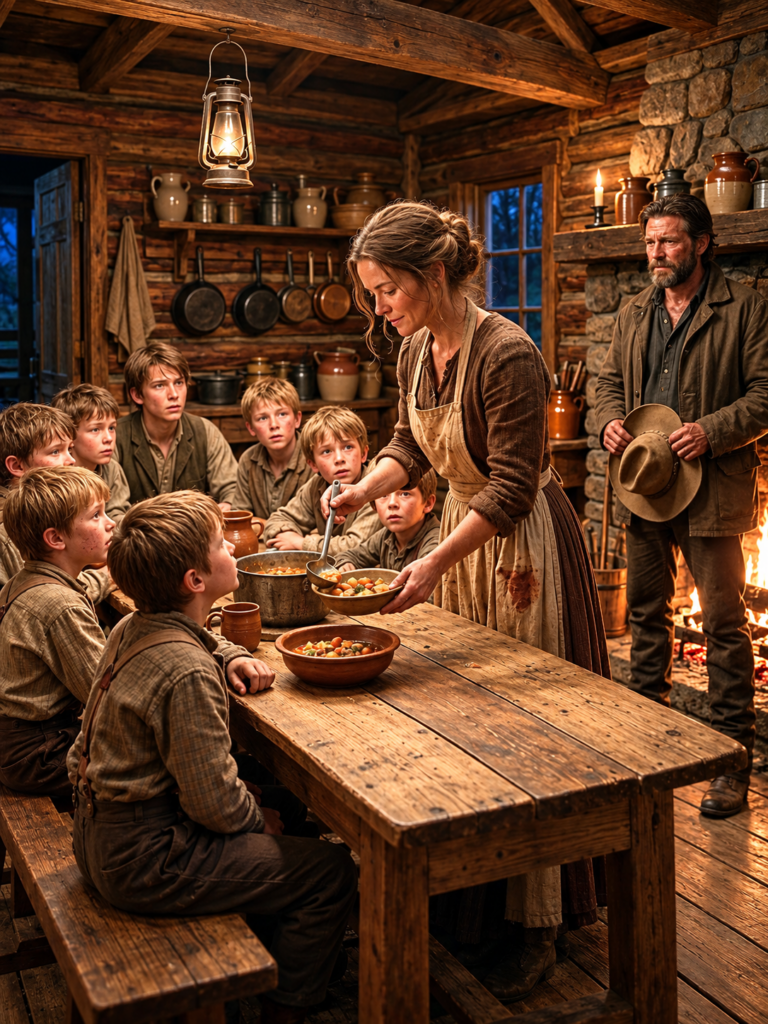
Rosalie Vain’s voice cut through the crowded general store like a blade, loud enough to turn heads, sharp enough to draw blood.
“Oh, I heard Gideon Mercer finally sent away for one.”
She smiled at the women gathered around the dry goods counter, her tone sweet as spoiled honey.
“A mail-order bride. Can you imagine? The man couldn’t find a single woman in three counties willing to take on seven wild boys and a half-dead ranch, so he ordered himself one like a new plow.”
She laughed.
“I wonder if she’ll last a week. Two?”
Nobody corrected her. Nobody told her to stop.
And that was the moment Evelyn Hart, standing just outside the open door with her single travel bag and dust still on her boots, understood exactly what kind of life she had just stepped into.
Evelyn Hart was 31 years old, which in 1884 Wyoming meant she had already outlived most people’s idea of what a woman’s life was supposed to look like.
She had never been pretty in the way that made men stumble. She was plain in the way that made people underestimate her, which she had long since decided was more useful.
She had gray-green eyes that saw more than she usually let on, hands that were already calloused from years of domestic work, and a posture that strangers often described as stubborn, though she thought of it as simply upright.
She had answered Gideon Mercer’s advertisement in the Wyoming Territorial Gazette because she had no better options, and she was honest enough with herself to admit it.
The advertisement had been blunt, which she respected.
Widower, 42, seven sons, working cattle ranch outside Kerry Springs, seeking capable woman, good health, willing to work, correspondence welcomed.
No poetry, no promises.
She had written back in the same tone. They had exchanged four letters over six weeks. None of the letters had contained anything resembling warmth. She had found that reassuring.
The stagecoach dropped her in Kerry Springs on a Tuesday morning in late September, and the first thing she did was pick up her bag before the driver could pretend to help and then demand something for the effort.
The second thing she did was ask directions to the Mercer ranch from the man sweeping the post office steps, who gave her a look she was already beginning to recognize. The look people gave a woman traveling alone with one bag and no escort.
The wagon Gideon had arranged was waiting at the edge of town. The driver was a boy of about 14 with hay in his hair and absolutely no interest in conversation, which suited Evelyn fine.
She sat with her bag on her lap and watched the town fall away behind her and the open land open up ahead, and she told herself the same thing she had told herself on the three-day train ride and the long stagecoach haul before it.
This is a job. You are going to do the job. You are not going to expect anything else.
She had expected the ranch to be modest.
She had not expected it to look quite so tired.
The house was large enough, two stories, a wide porch that wrapped around the front and one side, a barn visible beyond the main structure, fenced pasture rolling out in three directions.
But everything about it had the particular exhaustion of a place where nobody had stopped to care for it in a long time.
The porch railing on the left side was missing two boards. The front steps sagged slightly to the right. The window boxes were empty and cracking. The paint on the shutters had given up entirely on the south-facing side.
She noticed all of it in the time it took the wagon to roll to a stop.
There were boys on the porch.
She had known there would be seven of them, ranging in age from six to 19.
What she had not fully prepared herself for was the particular quality of silence that seven boys could produce when they had all decided collectively to make a judgment.
They stood or sat in a row and watched her climb down from the wagon without helping.
And the silence was the kind that had an opinion inside it.
The tallest one stepped forward when she reached the bottom of the porch steps.
He was broad-shouldered and dark-haired, with a jaw that had recently finished deciding it was done with boyhood.
He looked at her the way a man twice his age might look at a horse he suspected was lame.
“Wyatt Mercer,” he said.
He didn’t offer his hand.
“Evelyn Hart.”
She didn’t wait for the hand.
“Pa’s in the south pasture. He’ll be back before supper.”
“All right.”
He looked at her bag, then back at her face.
“You know there were two before you.”
She met his eyes.
“I heard they didn’t stay. I noticed you mentioned that rather than say your name or a welcome.”
Something shifted in his expression, not softening exactly, more like recalibration.
He hadn’t expected pushback delivered that flatly.
“I’m just telling you how it is.”
“I understand that,” she said. “Now tell me where the kitchen is.”
The kitchen was worse than she had imagined, which was saying something because she had prepared herself for bad.
The smell hit her first: old grease, something sour she didn’t want to investigate immediately, and underneath it all the particular odor of a space that had been cleaned only when absolutely necessary, and not recently.
The cast-iron stove was filmed with grease and ash. The table had the remains of what appeared to be at least three meals still present on its surface.
The floor hadn’t been swept in days.
She set her bag down just inside the doorway and stood there for a moment, not in dismay, but in assessment, the way a doctor might look at a wound before deciding where to begin.
A small voice said, “It’s bad, huh?”
She turned.
The youngest boy was standing behind her.
He was six years old and had his brothers’ dark hair, but none of their guardedness.
He was simply standing there with a candid expression, holding a biscuit that appeared to be several days old.
“What’s your name?” she asked.
“Eli.”
“Eli.”
She crouched down to his level.
“How long has it been like this?”
He thought about it seriously, the way small children do when they want to give you a correct answer.
“Since Mama died. But it got worse when Mrs. Callaway left.”
“Who was Mrs. Callaway?”
“The second one.”
She absorbed that.
“When did she leave?”
“Before the first frost last year.”
So the kitchen had been running without any real management for nearly a year.
She stood back up and looked at the stove, the table, the shelves, the single small window that faced north and let in almost no light.
“All right,” she said, mostly to herself.
“Are you going to leave, too?” Eli asked.
She looked down at him.
He was holding his stale biscuit with both hands, and his face was carefully neutral in the way that children get when they’ve learned that hoping for things is dangerous.
“Not today,” she said, which was the most honest thing she could offer.
She found Gideon Mercer at the edge of the south pasture fence just as the light was beginning to go amber.
He was repairing a section of wire with his back to her, and he didn’t hear her coming until she was ten feet away, which told her either that he was very concentrated or very tired.
He turned and looked at her.
He was taller than she’d expected.
The photograph he’d sent had been a small and unhelpful thing taken at some distance.
In person, he was lean and weathered in the way that outdoor work created, not broken down, but worn to the essentials.
There were lines around his eyes that had nothing to do with squinting at the sun.
His hands, she noticed automatically, were the hands of a man who had not stopped working since before he could remember.
He looked at her with an expression she couldn’t immediately read, which she respected.
“Miss Hart,” he said.
“Mr. Mercer.”
There was a pause.
Neither of them was comfortable with pleasantries, which meant neither of them wasted time on them.
“I would have come to the house,” he said.
“I wanted to see the property, and it needs work.”
He didn’t look offended.
“Yes.”
“Kitchen needs to be stripped and started over. Pantry is nearly empty. The garden is finished for the season, but it wasn’t tended this summer, so next spring we’ll be planting from scratch.”
She had walked the perimeter before coming to find him.
“The root cellar has potatoes and some dried beans and two jars of preserves that I think are still good. There’s a ham hock that might be salvageable. I can make supper from what’s there.”
He was looking at her with that same unreadable expression.
“All right.”
“I have some questions about the arrangement.”
“Go ahead.”
“Your eldest made clear this morning that I’m the third woman you’ve brought to this house. I’d like to know what happened with the first two from you, not from the boys.”
His jaw tightened slightly.
Not in anger, she thought, but in the way of a man who isn’t used to being asked direct questions.
He looked out at the pasture for a moment, then back at her.
“The first one came in April. She lasted 11 days. She said the boys were unmanageable and the house was too isolated.”
A pause.
“She wasn’t wrong on either count.”
He said it without apology.
“The second one, Clara Callaway, stayed five months. She was a decent woman. She left because Wyatt made it clear enough that she wasn’t welcome. And I didn’t step in the way I should have.”
He said that last part evenly, but something in his eyes shifted when he said it, something that looked like a man who had looked at his own failures and hadn’t looked away.
“I appreciated the honesty in your advertisement,” she said. “I don’t have the patience for the other kind.”
“Neither do I.”
She looked at him directly.
“I came here because I needed a situation and you offered one. I don’t expect warmth, and I’m not going to pretend I feel things I don’t. But I’ll work, and I’ll work honestly, and I’d like to know I’m working towards something more than just outlasting the previous two.”
He was quiet for a moment.
Then he said, “What do you want, Miss Hart?”
It was a plain question.
She answered it plainly.
“A roof that’s mine, work that’s real. To be left alone to do it.”
He nodded.
“That’s reasonable.”
“Then we understand each other.”
They walked back to the house in the beginning of the evening dark, not speaking.
And Evelyn thought that this was at least a starting point.
Not a good one, but an honest one.
Supper that first night was not remarkable.
It was not supposed to be.
She found an old ham hock in the root cellar, exactly where she’d thought it might be, shriveled and dense, but not gone.
She boiled it down with dried beans and a handful of salt and the better of two tired onions she found in a crate by the back door.
It was plain food.
It was the kind of food that didn’t ask anything of anyone.
The boys came to the table in a rough sort of order that suggested they had done this before, once, when someone had made them.
They ranged from Eli at six to Wyatt at 19, with five boys stacked in between: Thomas, who was 16 and said nothing; the twins Aaron and James, 14, who talked to each other in low voices throughout the meal; Samuel, 11, who watched Evelyn with open curiosity; and Noah, nine, who had apparently decided to conduct an experiment in ignoring her completely.
Gideon sat at the head of the table.
He did not say grace. None of the boys seemed to expect it.
Evelyn served the food herself, starting from the youngest, and sat at the far end of the table.
Wyatt looked at his bowl.
He picked up his spoon and then set it back down.
He looked at Evelyn.
“Mrs. Callaway made a proper stew.”
“Mrs. Callaway had five months to locate proper stores,” Evelyn said. “I have been here six hours. This is what six hours looks like.”
Thomas, the silent one, made a sound that might have been almost a laugh and covered it with a cough.
Wyatt didn’t say anything else.
He picked up his spoon and ate.
Not enthusiastically, not gratefully, but he ate.
Eli, beside Evelyn, said quietly, “I like it.”
She didn’t make a fuss of it.
“Good,” she said.
And that was that.
She did not sleep well her first night, but she hadn’t expected to.
The room Gideon had set aside for her was small and clean enough.
She could tell someone had made an effort in the last few days, probably recently, which meant he had cared at least that much.
There was a narrow bed and a dresser with a cracked mirror and a hook on the back of the door, and the window looked out over the dark shape of the barn.
She lay in the unfamiliar dark and listened to the sounds of an unfamiliar house and made herself take stock of what was real.
She had $41 saved from her years of domestic work, which was not nothing.
She had skills, real ones, not the decorative kind. She could cook and preserve and manage a household budget against impossible odds, which was more than most people gave credit for.
She could read and keep accounts, and she was not afraid of physical work.
What she did not have was a family, a home, a single person in the world who would notice if she failed here.
That thought was not new.
She let it sit there in the dark for a moment, turned it over, and then set it aside.
Self-pity was a luxury she had learned she couldn’t afford.
She would deal with the kitchen tomorrow.
She would start with what was there and work outward.
She fell asleep before she finished planning.
The next morning she was in the kitchen before anyone else was awake.
She had found an apron in the bottom of a trunk in the pantry, someone else’s, worn thin at the ties, but still serviceable.
She put it on and built the fire in the stove from scratch, which took longer than it should have because someone had let ash accumulate until it was blocking the draft.
She cleared it, got the fire drawing right, and then stood in the middle of the kitchen and made herself look at everything slowly.
The shelves needed scrubbing before anything went back on them.
The floor needed sweeping and then washing.
The stove needed to be degreased before she could trust what she cooked on it.
The table needed more than wiping. Needed sanding probably, but that could wait.
She started with the shelves.
She was halfway through the second shelf when she heard boots on the stairs.
Then a pause in the doorway.
She didn’t turn around.
“There’s coffee on the stove. Cups are on the right side of the shelf I already cleaned.”
A silence, then the sound of a cup being taken down.
She kept working.
It was Thomas, the silent 16-year-old, who had come down first.
She’d noticed at supper that he watched everything but committed to nothing, the way of a boy who had decided the safest posture was observation.
He poured his coffee and stood near the stove and drank it, and she scrubbed the shelf, and neither of them felt the need to make it into anything more than what it was.
The second one down was Samuel, the 11-year-old, who came in, looked at her, looked at the state of the kitchen, and said, “What are you doing?”
“Cleaning.”
“Why?”
“Because it needs it.”
He considered this.
“Can I help?”
She looked at him.
He had an open face, the kind that hadn’t learned yet to hide what it was thinking.
She had a feeling Samuel was going to be the easy one.
“Sweep,” she said. “The broom is behind the door.”
He found it and swept badly, at first pushing the dirt around more than gathering it, but she didn’t correct him immediately.
She let him figure out his own technique for a few minutes before saying from her position at the shelf, “You’re moving it, not picking it up. Short strokes.”
He tried it like that.
Better.
Swept better after that.
It wasn’t a transformation, but it was something.
By the time the rest of the boys came down and Gideon came in from morning chores, Evelyn had cleaned three shelves, swept the floor, and had something that was almost a proper breakfast.
Fried potatoes from the root cellar, what was left of the salt pork, and coffee strong enough to count as a statement.
Wyatt came into the kitchen, looked at the state of the shelves, looked at Samuel, still hovering near Evelyn with a proprietary air that suggested he felt responsible for the progress, and his expression did something complicated.
He sat down at the table and said nothing.
After breakfast, which was eaten in the same rough silence as the night before, Gideon said, “What do you need from town?”
“A list,” she said, and handed him the piece of paper she’d already written while the potatoes were frying.
Flour, lard, salt, yeast, dried fruit if available, sugar if affordable, a new scrub brush because the current one was past use, and two yards of muslin if it wasn’t too much.
He looked at the list.
“The muslin?”
“For preserving. Possibly curtains, if there’s enough.”
He folded the paper and put it in his shirt pocket.
He looked at her for a moment, in that same way, considering, not quite readable.
Then he went to get his coat.
Wyatt watched the exchange from the table and said nothing, but he was watching.
The flour arrived back from town that afternoon along with most of the rest of the list.
Gideon had added a small bag of oats she hadn’t asked for, which she noted without comment.
She spent the rest of the afternoon baking.
The oven ran hot, which she discovered when the first test biscuits came out darker on the bottom than the top, so she adjusted: lower rack, shorter time, rotate halfway through.
By the third batch, she had it figured out.
The smell of fresh bread moved through the house in a way that Evelyn noticed but didn’t comment on.
She watched from the corner of her eye how the boys drifted toward the kitchen in ones and twos, not dramatically, not suddenly, but the way animals moved toward water.
Eli appeared first and stood in the doorway with his hands in his pockets, pretending he was there for another reason.
Aaron and James, the twins, came in together and then immediately pretended they hadn’t come in on purpose.
Even Thomas drifted in at some point and leaned against the wall near the stove.
She cut the bread when it came out and gave each of them a piece without ceremony.
No performance, no warm speech, just bread.
Noah, the nine-year-old who had committed to ignoring her, took his piece without meeting her eyes and walked away chewing.
She counted that as progress.
Wyatt did not come into the kitchen, but she saw when she passed the window that he had stopped his work at the fence post he’d been setting and was standing still for a moment, face turned toward the house.
She went back to the stove.
It was not warmth she felt.
It wasn’t happiness.
It was something quieter and less comfortable, the particular feeling of a person who decides to build something and has just laid the first stone in the wall and is already looking at how much further there is to go.
But the stone was there, and that was enough to work with.
The bread was gone by morning.
Not just the loaves she’d set out at supper. The extra she’d wrapped in cloth and left on the shelf above the stove was gone, too.
And when she came down at first light, she found only crumbs on the cloth and the faint smell of yeast still hanging in the kitchen air.
She stood there a moment looking at the empty shelf.
She was not sentimental about it.
Food was meant to be eaten, but she noted it the way she noted everything, quietly, without making a fuss, filing it away in the part of her mind that kept track of what was actually happening beneath the surface of things.
She rebuilt the fire, set the coffee on, and started on oatmeal because oats were what she had enough of.
She’d need to stretch the flour across the week until she had a better sense of what the household consumed, and that required paying attention to patterns she hadn’t had time to observe yet.
Samuel came down first again.
She was beginning to think he was a natural early riser, or possibly that he was positioning himself strategically. Arriving before his brothers meant he got to be her temporary ally without any of them seeing it.
Children were more political than most adults wanted to admit.
“Bread’s gone,” he announced from the doorway.
“I noticed.”
“Wyatt probably ate it. He gets up in the middle of the night sometimes.”
He said this as though it were information she’d asked for.
“Hmm,” she said, which was neither confirmation nor rejection.
“Are you making more today?”
“Oatmeal today, bread tomorrow.”
He made a face, not an offensive one, just honest.
And she handed him the spoon and pointed at the pot.
“Don’t let it catch on the bottom.”
He took the spoon with the automatic compliance of a child who had been waiting for someone to give him a direction.
That was the thing she was beginning to understand about this family.
They didn’t need to be broken or managed.
They needed to be directed.
Somewhere in the year since Gideon’s wife had died, the household had simply lost its organizing principle.
And everything had drifted: the chores, the meals, the boys’ behavior, the state of the kitchen, the whole rhythm of the day.
It wasn’t destruction.
It was entropy.
And entropy, in Evelyn’s experience, responded well to consistency.
She just had to be consistent long enough for them to believe she’d stay.
That was the harder part.
By the end of the first week, she had established a morning routine that the boys had not agreed to but had begun to follow anyway, the way people fall into the gravity of a schedule when someone holds it firmly enough.
Breakfast at 6:30, which meant the fire was built and the coffee was on by six.
The three oldest, Wyatt, Thomas, and the twins, were out with Gideon before breakfast, which meant she kept plates warm on the back of the stove.
The younger three ate at the table, and she used that time to run through what needed doing in the day and to assign Samuel, who had appointed himself her unofficial assistant, whatever tasks she needed done inside the house.
The kitchen was cleaner.
Not clean, that would take more time, but cleaner.
The shelves were organized. The stove drew properly now.
She’d found a crack in the flue pipe that had been letting heat escape sideways and stuffed it with clay she’d mixed from the dirt at the garden edge.
It wasn’t a permanent fix, but it was functional, and functional was what she was working toward.
The pantry was her next project.
She spent a morning pulling everything out of it, and there was more there than she’d initially found, which was both encouraging and instructive.
Someone at some point had put up preserves with some skill.
There were eight jars of what turned out to be pickled green beans, still sealed and good.
There were three jars of apple butter, so old the labels had mostly faded, but when she opened one, it smelled right.
There was a sack of cornmeal she hadn’t seen behind a broken crate, and a small tin of molasses, and a paper bag of dried apples that were mostly fine once she picked through them.
She laid it all out on the kitchen table and inventoried it by hand, writing it in a small notebook she’d brought in her bag.
Gideon came in from the barn at midmorning, stopped in the kitchen doorway, and looked at the table.
“What’s all this?”
“Taking stock. You had more than you knew.”
She looked up from the notebook.
“The preserves on the left shelf are still good. The cornmeal was behind a broken crate. I don’t know how long it’s been there, but it passed the smell test. The dried apples are serviceable.”
He came around the table and looked at the jars.
“My wife put those up,” he said.
He said it plainly, but something in his voice had weight to it.
“Apple butter.”
“I know.”
She hadn’t known, but she understood immediately.
“I’ll use them carefully.”
He didn’t say anything else.
He picked up one of the jars and turned it in his hands for a moment, then set it back down and walked out.
She watched him go and then looked back at her notebook and did not make anything of it.
She had a sense, still uncertain, still forming, of what the real shape of this family’s grief was.
But she was not here to fix grief.
She was here to fix the pantry.
She put everything back in order and went on with her morning.
The town of Kerry Springs was small enough that news traveled in one direction, outward from the general store and the post office, and specifically from anyone who had seen or spoken to anyone connected to anything worth discussing.
Evelyn learned this on her first trip into town eight days after her arrival, when she went to collect a bolt of thread she’d asked Gideon to order for her.
She went alone.
Gideon had offered to send one of the boys, but she wanted to see the town herself.
Assess it the way she’d assessed the kitchen, from the inside, slowly, without someone else’s lens.
Kerry Springs had two streets that crossed, and a third that ran parallel to the main one before dead-ending at the livery.
It had a general store, a post office, a small hotel that also served as a saloon after dark, a barbershop, a land office, and a dressmaker’s shop that doubled as a millinery.
There was a church on the far end of the main street that she noted and did not particularly assign meaning to.
The woman at the general store, a Mrs. Pickham, in her 50s, efficient and curious in equal measure, took one look at Evelyn and said, “You must be the new Mercer woman.”
“Evelyn Hart,” she said.
Mrs. Pickham got her thread from the back with the speed of someone who had already been planning for this interaction.
“How are you finding it up there?”
“Fine,” Evelyn said.
“Those boys giving you trouble?”
“No more than expected.”
Mrs. Pickham set the thread on the counter and her hands on top of each other and looked at Evelyn with the frank appraisal of a woman who had seen a great many things come through her store and formed opinions on most of them.
“Clara Callaway was a good woman,” she said. “She just wasn’t the right kind of tough for that situation. Gideon’s a decent man. Rough, but decent.”
She paused.
“He had a hard two years.”
“I know.”
Mrs. Pickham seemed to reach some internal conclusion.
She wrapped the thread in paper without being asked, which Evelyn appreciated.
“You need anything else, you let me know. I can hold things for pickup if the trip’s inconvenient.”
“Thank you.”
She paid and turned to go.
And that was when she heard the voice from the other side of the store.
Not loud, not quite, but pitched in that particular way that meant it was intended to carry.
“A mail-order bride. Can you imagine having to resort to that?”
She didn’t turn around.
She knew without looking who was speaking.
She’d seen the woman when she came in, standing at the fabric counter with two others, young, well-dressed, the kind of beautiful that had been told about itself too many times.
“I heard she came all the way from Ohio. No family, no connections.”
A pause that had performance in it.
“I suppose when you have nothing to offer and nowhere else to go, you take what you can get.”
Evelyn walked to the door, opened it, and left.
She stood on the boardwalk outside for a moment in the late morning air.
Her face was neutral.
Her jaw was tight, but she made herself relax it.
She had heard things like that before.
She would hear things like that again.
The question was never whether people would say them.
The question was what you did afterward, whether you let the words root inside you or whether you composted them into something useful.
She walked back to the wagon she’d borrowed, loaded the thread, and drove home.
She did not mention the exchange to Gideon.
She did not mention it to any of the boys.
She went back to the kitchen and spent the rest of the afternoon reorganizing the dry goods storage according to a system she’d worked out in her head on the drive home.
It was more efficient than what had been there before.
She did not need anyone to notice.
It was Samuel who told her about Rosalie Vain, which she suspected was not accidental.
He brought it up the following afternoon while she was showing him how to properly scrub a cast-iron pan the right way, which meant hot water and a rag and no soap, and then oil while it was still warm.
He had a natural instinct for information delivery, this boy.
He led with the unimportant thing first, and then circled to the thing he actually meant to say.
“She’s Mr. Vain’s daughter,” he said, scrubbing with more enthusiasm than technique. “He owns the lumber mill and the grain storage. Most of the folks in town owe him something one way or another.”
“That’s useful to know,” Evelyn said. “You’re scrubbing too hard. Let the heat do the work.”
He softened his strokes.
“She wanted to marry Pa.”
That she hadn’t known.
She kept her voice even.
“When?”
“After Mama died. About six months after. Rosalie Vain came to call twice. Pa wasn’t—he wasn’t in a good place then.”
Samuel frowned at the pan.
“He didn’t ask her to come. Her pa brought her. I think they thought—”
He stopped.
“Thought what?”
“That Pa might need help with the ranch. He’d be grateful enough for help that he’d accept whatever came with it.”
She handed the pan to him, and he oiled it and set it back on the low heat of the stove.
“He didn’t. He was polite about it, but Wyatt said it was real clear he wasn’t interested.”
Evelyn absorbed this.
It reframed the woman at the general store in a new way.
Not just casual cruelty, but something with a wound underneath.
It didn’t make the cruelty acceptable, but it made it legible.
“Why are you telling me this?” she asked Samuel.
He shrugged with the elaborate casualness of an 11-year-old who had planned this conversation.
“I just thought you should know.”
“Hmm.”
She turned back to the stove.
“Thank you.”
He looked pleased with himself in a way he was trying to suppress.
She let him have it.
Wyatt was the problem she hadn’t solved yet, and she knew it.
He wasn’t hostile in any way she could directly address.
He didn’t refuse her instructions or speak rudely to her face or make scenes at the table.
He was, in fact, more controlled than boys twice his age, which was its own kind of problem.
He complied with everything in a way that communicated clearly and without words that he was choosing to comply and could choose to stop at any time.
He watched her.
She watched him.
They had been in a kind of cold negotiation since the morning she’d arrived, and neither of them had moved significantly toward the other.
She understood in an abstract way why he was doing it.
He was 19 years old, and he had been the man of this house in every practical sense for over a year.
He had held the family together when Gideon had been too deep in grief to function, had managed his younger brothers when nobody else was doing it, kept the ranch running at a bare subsistence level through a year that would have beaten most grown men.
He had earned his position the hardest way a person earns anything.
And then she had arrived and disrupted the order, and his father had not consulted him.
That, she thought, was probably the real issue.
Not that she was here, but that nobody had asked.
She chose her moment carefully.
It came on a Wednesday afternoon when the other boys were occupied and Wyatt was alone in the barn repairing a saddle with the focused, slightly angry stitching of a man working through something in his head.
She brought him coffee without asking if he wanted any.
She set it on the workbench beside him and didn’t say anything.
And she sat on a hay bale across from him and looked at the horse in the nearest stall, which looked back at her with the calm indifference of an animal that has no stake in human drama.
Wyatt didn’t look up from the saddle.
He stitched three more passes before he said, “I don’t need the coffee.”
“I know.”
Another four stitches.
“What do you want?”
“Nothing specific.”
“Then why are you here?”
She considered the direct route, rejected it, chose the honest one instead.
“Because you’re the one I haven’t talked to yet. Not really.”
He looked up then.
His expression was the complicated, guarded kind that people wear when they’re prepared to be mocked and have decided to meet it standing.
“What’s there to talk about?”
“You ran this house for a year,” she said. “Not nothing.”
He was quiet.
“I’m not here to tell you that you did it wrong,” she continued. “You kept seven people alive and a ranch going on almost nothing. That’s a real thing. I’m not going to pretend I walked in and found a disaster. I found a family that’s survived a disaster.”
He looked back down at the saddle.
His jaw was tight.
“It wasn’t—there were things I couldn’t—the younger ones. I couldn’t do everything.”
“No,” she said. “You couldn’t. You’re 19, not 40. One person cannot do everything.”
A long silence.
“I’m not trying to replace anything,” she said. “I’m not your mother. I don’t have any interest in pretending to be. I’m a woman who needed a situation, and your father offered one, and I’m trying to do the job I agreed to do.”
She paused.
“But the job goes better with you working alongside me than against me. Think you know that.”
He picked up the coffee finally.
He drank some.
He set it back down and looked at the horse in the stall, and for a moment he looked exactly his age, 19, and exhausted and carrying something heavier than he should have been handed.
“You’re not what I expected,” he said at last.
“What did you expect?”
“Someone softer. Someone who’d try to make us like her.”
“That’s not something you can make people do.”
He almost smiled.
It was a small thing, barely visible there for a second, and then gone.
“No.”
She stood up from the hay bale.
“I’m making fried salt pork and beans tonight. It’ll be ready at six.”
She walked out of the barn and did not look back to see his expression.
But that evening, Wyatt came to the table before she called supper, and he helped his youngest brother climb onto his chair without being asked, and he ate without his jaw doing that tight, skeptical thing it usually did.
It was not reconciliation.
It was not even close to that, but it was a first step in the right direction.
And Evelyn was in the business of first steps.
The garden was a problem she couldn’t solve immediately, and that gnawed at her.
The season was too far gone for planting.
It was October now, the mornings sharp with frost, the ground beginning to harden at the edges.
Whatever the garden might have been in summer was gone.
What remained was a tangle of dead plants and weeds, and the ghost of a structure, raised beds that had once been deliberate, paths between them that had once been clear.
She went out to look at it on a Sunday afternoon, when the boys were occupied elsewhere and Gideon was doing accounts in the house.
She walked the perimeter of it slowly, the way she’d done with the kitchen and the pantry, taking stock.
It had been a real kitchen garden once.
She could tell from the infrastructure, the depth of the beds, the placement to catch the southern sun, the remnants of a cold frame on the east end that, if repaired, could extend the season by several weeks.
Someone had built this with knowledge, not just hope.
Someone who had gardened seriously for years.
Gideon’s wife.
She thought about the apple butter in the pantry.
She thought about the way Gideon had picked up the jar and held it.
She crouched down and pushed aside some dead growth near one of the bed edges.
And underneath, where the frost hadn’t gotten yet, she found what she’d hoped might be there.
A few small, stunted carrots that had been left in the ground and missed at harvest.
She pulled one, brushed the dirt off it, bit off the tip.
Bitter, but real.
She left the carrots where they were.
She had an idea about them.
Behind her, she heard footsteps.
Light, quick, the particular rhythm of Eli.
“What are you doing?” he asked, which was his standard greeting.
“Looking at the garden.”
He came and stood beside her and looked at it too with the focused attention he gave to most things.
“Mama grew tomatoes here,” he said. “Big ones, red ones. She used to slice them with salt for supper.”
“That’s a good memory to have.”
“Beans. She grew beans and I helped with them.”
He paused.
“I was little.”
“You’re still little.”
He considered this philosophically.
“Wyatt said the garden’s too far gone to bother with.”
“Next spring it won’t be.”
He looked at her.
“You’re planning next spring?”
It was a child’s question asked with a child’s directness, and it landed squarely in the part of her that was always keeping track, always keeping track of whether she believed her own words.
She was planning next spring.
That was what the question was really asking, whether she meant to stay.
“Yes,” she said. “I’m planning next spring.”
He seemed satisfied with this.
He crouched down beside her and started pulling dead plant stalks out of the nearest bed with the energy of a child who has found a task and is fully committed to it for approximately the next four minutes.
She let him pull.
She started thinking about what she’d need to do to prepare the beds over winter so they’d be ready when the ground softened.
Two and a half weeks in, something shifted in the household.
And it shifted in the way things usually did, not dramatically, not all at once, but in an accumulation of small moments that you only recognized as a pattern when you looked back at them.
Thomas started talking.
Not to her at first.
He started talking more to his brothers at the table, which she took as an indirect sign.
If the table felt safe enough for conversation, it was because something about the table had changed.
He had a dry observational humor that surprised her.
He said one morning, watching Aaron attempt to pour coffee and miss the cup by a significant margin, “He’s been doing that for two years. We just stopped warning people.”
Aaron looked wounded.
James, his twin, laughed.
Even Wyatt across the table made a sound.
It was not a significant event, but it was the first time she’d seen all of them make any sounds in the same direction at once, and she filed it.
Noah, the nine-year-old who had sustained his program of pointed indifference to her with remarkable discipline, broke his streak on a Thursday evening when he came into the kitchen while she was making apple butter from the dried apples and asked without preamble what she was doing.
“Making apple butter.”
“Out of the dried ones?”
“Yes.”
He watched for a minute from the doorway, his arms crossed in the stance of a child who is not committed to entry.
“Taste right?”
“It’ll taste different from fresh. Still good.”
He stood there another moment.
Then he uncrossed his arms and came in and stood at the edge of the table, watching her work through the process, the softening of the dried fruit in water, the mashing, the spicing.
She handed him a spoon with a small amount on it when the sugar went in.
He tasted it.
He made a face, then reconsidered the face.
“Different,” he said.
“Told you.”
“But it’s okay.”
“Glad you think so.”
He stood there until the apple butter was in the jars, and then he left without saying anything else.
But the following morning he came down to the kitchen at a normal hour without any visible evidence of his previous campaign.
She counted that as a negotiated peace.
The hardest moment came, as hard moments often do, in the middle of something ordinary.
She was mending a shirt, Eli’s, which had split at the shoulder seam again in the way that children’s clothes split when children use them the way children use them, when Gideon came into the kitchen at an unusual hour.
It was midafternoon, and he was normally outside at this time.
He poured himself coffee and stood at the window, which was not his normal behavior either.
She kept mending.
She waited.
“I got a letter,” he said finally.
“Good news or bad?”
A pause.
“Unclear.”
He turned from the window.
“From the bank in Cheyenne. There’s a payment coming due on the ranch from a loan I took out after Margaret died.”
He stopped.
He was not a man who exposed difficulty easily, and she could see the effort of the current exposure.
“I didn’t—I let some things slide when I was—last year was a bad year.”
“How much?”
He told her.
The number was significant, not catastrophic if the cattle sale in spring went well, but significant enough that it required actual management.
“When’s it due?”
“March.”
She set the mending down and thought.
“How many head are you selling this spring?”
He told her that, too.
She did the arithmetic in her head.
Rough, but directional.
“If we cut household spending by about a third between now and then, and the cattle price holds where it was last year, you make it,” she said. “If you can get any extra work out of the ranch between now and spring…”
She trailed off.
“What else can this land carry?”
He blinked.
“What?”
“Chickens? I haven’t seen any. Eggs would cut your food cost significantly.”
He stared at her for a moment.
Then he said slowly, “Margaret had chickens. After she died, they got—the coyotes got into the coop one night, and that was—I didn’t rebuild it.”
“I can look at the coop.”
She picked up the mending again.
“What I’m saying is it’s manageable, but it requires managing.”
He was quiet for a long moment.
Then he said, “Why are you doing this?”
“Which part?”
“Any of it. All of it. You came here for—”
He stopped.
“You came here with a contract, a roof, an arrangement. You didn’t come here to fix my accounts.”
She looked at him directly.
“I came here because I needed a situation. The situation I found is this ranch, these boys, and this debt. If I’m going to be here, I’d rather it stay standing.”
He looked at her the way he sometimes looked at her when she said something that he was deciding what to do with.
It was a look that had something behind it that she hadn’t fully identified yet, not just assessment, not just calculation.
Something that made her uncomfortable in a way she set firmly to one side.
“The coop’s behind the barn,” he said. “North side. It’s in bad shape.”
“Most things out here are,” she said. “That doesn’t mean they can’t be fixed.”
He set down his coffee cup and went back outside.
She finished the mending and started on supper and did not spend time thinking about the look on his face.
She had enough to think about already.
The week before the harvest gathering, Evelyn made a decision she didn’t announce.
She had flour, and she had the last of the dried apples from her reorganized stores, and she had found a recipe in her own memory.
Her aunt’s apple pie, which her aunt had made every October with a confidence that had seemed to Evelyn as a child like a kind of power.
She hadn’t made it since her aunt died seven years back, not because she couldn’t, but because there had never been anyone to make it for.
She made it on a Saturday afternoon, when the kitchen was briefly empty.
The pie crust was the honest kind, not delicate, but solid, with enough fat to hold its own in a working oven.
The filling she spiced from memory: cinnamon, a small amount of the remaining molasses for depth, a pinch of salt.
She did not have fresh apples, which was a problem she solved by reconstituting the dried ones slowly in a small amount of water and cider vinegar until they softened back towards something real.
The pie was not going to be beautiful.
The crust cracked slightly in one corner during baking.
The filling was darker than it should have been because the dried apples caramelized differently than fresh.
But when she pulled it out of the oven and let it cool on the window ledge, the smell was right.
Exactly right.
The kind of smell that pulled at something old and specific in whoever caught it.
The first person who caught it was Gideon coming in to wash before supper.
He stopped in the doorway and stood there for a moment without saying anything, and something went across his face that she looked away from deliberately because it was private.
She heard him exhale slowly.
“That’s Margaret’s recipe,” he said.
“I wouldn’t know,” she said carefully. “It’s my aunt’s.”
Another pause.
“Where’d your aunt learn it?”
“Ohio farm country. Same as a thousand other women.”
She kept her back to him.
She heard him move to the sink, pour water, wash his hands.
When she turned around, he was already heading back out, and his face was the face he usually showed the world, closed, settled, giving nothing away.
That was fine.
She wasn’t looking to pry anything out of him.
The pie was for the harvest gathering.
She had already decided that.
The gathering was in four days at the community hall in Kerry Springs, and Gideon had mentioned it with the flat tone of a man who was going because he always went and not for any other reason.
She’d said she’d bring food, and he hadn’t argued.
She wrapped the pie in cloth and set it on the highest shelf.
Eli found it within 20 minutes.
She heard the stool scraping and came into the kitchen to find him balanced on it, reaching.
“That’s not for now,” she said.
He looked at her over his shoulder, hands still extended toward the pie.
“When’s it for?”
“The harvest gathering.”
He got down from the stool with the expression of a child managing significant disappointment with dignity.
“Four days?”
“Yes.”
“What if it goes bad?”
“It won’t.”
He looked at her, then back at the pie, then at her again.
“Can I smell it?”
She almost laughed, which surprised her.
She didn’t quite.
“You already did,” she said. “That’s what brought you in here.”
He conceded this point by sitting down at the table and accepting the small square of cornbread she cut him instead, and eating it without further negotiation.
She went back to the stove.
Four days to the gathering.
She had bread to bake, preserves to jar, and the particular problem of Rosalie Vain to consider.
Because Samuel’s information, combined with what she’d heard in the general store, told her that the gathering was not going to be a neutral event.
She had spent her life being underestimated.
She had learned that the best response to being underestimated was not to argue with the estimation, but to simply do the work and let the work speak in a volume that arguments couldn’t reach.
Pie was part of that.
The bread was part of that.
Preserves were part of that.
She was not building a defense.
She was building a record.
And on the day of the gathering, that record was going to speak for itself, whether Rosalie Vain liked it or not.
The morning of the harvest gathering, Evelyn was up before the dark had fully lifted.
She had slept badly, not from nerves, she told herself, but from the particular restlessness of a mind that wouldn’t stop running through lists.
The bread she’d baked the day before was wrapped in cloth on the kitchen shelf.
The two jars of preserves she’d selected, the pickled green beans and the better of the two apple butters, were in the wooden crate she’d found in the barn.
The pie was wrapped separately, nestled in a nest of clean cloth so the crust wouldn’t crack further on the wagon ride.
She built the fire, put the coffee on, and stood at the kitchen window in the gray predawn and looked at nothing in particular.
She was not afraid of Rosalie Vain.
That was true in the way that most honest statements are not complete but accurate enough to work with.
What she felt was something more like the focused attention of a person walking into a room where she knows the furniture has been rearranged in the dark.
Don’t stop walking.
You just pay attention to where you put your feet.
Gideon came down earlier than usual.
He stopped in the kitchen doorway, looked at her, looked at the packed crate, and said nothing about any of it.
He poured his coffee and drank it, standing at the counter, and when he put the cup down, he said, “We’ll leave at eight. It’s an hour’s drive.”
“I’ll be ready.”
He started to leave, then stopped.
“You don’t have to come if you don’t want to.”
She turned from the window.
“I know.”
“Rosalie Vain will be there.”
He said it plainly, not as a warning exactly, more like a man clearing his throat before a difficult sentence to make sure the words came out right.
“Her father’s on the harvest committee. The Vains always have a table.”
“Samuel told me about the Vains.”
Something moved across his face.
A flicker of something she couldn’t quite name.
“Did he?”
“He thought I should know.”
Gideon was quiet for a moment.
“She’s not—Rosalie isn’t a bad person,” he said with the slightly pained tone of someone who doesn’t fully believe their own charitable assessment but is committed to making it. “She’s just—her father’s raised her to think the world owes her attention.”
“That’s a generous interpretation.”
“It’s the one I’ve got.”
He went back upstairs.
She turned back to the window and thought about what he’d just done, offered her an out and then offered her context, in that order.
Neither one was an accident.
Gideon Mercer, she was learning, communicated through the things he said sequentially rather than the things he said directly.
She finished her coffee and went to wake the boys.
The community hall in Kerry Springs was a large barn-like structure on the eastern edge of town that had been built for exactly this kind of occasion.
Wide plank floors, long trestle tables along three walls, cleared space in the center for whatever activities the day required.
By the time the Mercer wagon rolled in at nine, the lot outside was already filling with wagons and horses, and the sound coming from inside had the particular quality of a crowd that had been building energy since early morning.
Evelyn climbed down from the wagon seat before anyone could offer help and went around to the back to get her crate.
Eli appeared immediately at her elbow with the proprietary helpfulness that had become his standard operating mode.
“I can carry the pie,” he said.
“You can carry the beans,” she said, and handed him the jar, which was heavier than it looked.
He staggered slightly and adjusted his grip and followed her toward the hall with the focused dignity of a child carrying something important.
The other boys piled out of the wagon with varying degrees of enthusiasm.
Samuel was genuinely interested. He’d mentioned twice the previous evening that there would be apple cider at the gathering.
Thomas was neutral in the way he was neutral about most things.
The twins were already scanning the crowd for boys their age.
Noah stayed close to Wyatt without making it obvious he was doing so.
Wyatt walked with his hands in his pockets and his hat pushed back slightly and the general air of a young man attending an obligation.
Gideon walked beside Evelyn without quite walking beside her.
There was a distance of about two feet between them, not deliberate, or not entirely, but present.
She noted it and filed it with the other things she was noting.
Inside the hall, the smell hit her first: cider and sawdust and food from a dozen different kitchens, and the particular warm smell of too many people in an enclosed space.
Tables were set up along the walls, and women were arranging their contributions with the focused competitiveness that polite people pretend doesn’t exist at events like this.
There were pies and bread and preserved goods and casseroles in Dutch ovens, and the arrangement of things on each table had clearly been given more thought than most of the women present would have admitted to.
Evelyn found an open section of table near the middle of the left wall and set down her crate.
She was unpacking the bread when she felt it.
The shift in the room’s ambient noise that happens when someone notable enters and people adjust their conversations to accommodate the new presence.
She didn’t turn around.
She kept unpacking, but she heard the voice.
“Look at that. The Mercer table.”
Rosalie Vain’s voice was exactly as Evelyn remembered it from the general store, projected with the practiced confidence of a woman who had never had to wonder whether she was worth listening to.
“I didn’t realize we were expecting so many contributions this year.”
Polite laughter from somewhere to Evelyn’s right.
She placed the bread on the table, unwrapped the cloth, and moved to the preserves.
“Is that the apple butter?”
A new voice.
One of the women from Rosalie’s circle, curious rather than cruel.
“It smells wonderful.”
“It’s reconstituted,” Evelyn said without turning around. “Dried apples. We didn’t have fresh this season.”
She heard the small pause that followed, the kind of pause that means something has surprised someone.
Then Rosalie’s voice again.
Closer now.
“How practical.”
Evelyn finally turned around.
Rosalie Vain in person was more than just pretty.
She had the kind of look that people in small towns sometimes produced, where generations of relative prosperity and a certain gene for good bones had combined into something that the town had built a story around.
She was 23 or 24, Evelyn guessed.
She wore a dress that had been made for this occasion, not ostentatiously expensive, but carefully chosen to suggest effortlessness.
Her hair was dark and arranged with precision.
Her eyes were sharp and pale and currently performing the social maneuver of appearing friendly whilst assessing.
“You must be Miss Hart,” she said with a smile that was perfectly calibrated to the situation.
“Mrs. Mercer,” Evelyn said, because that was the correct form of address, whatever the marriage had been in feeling, and she had decided on the drive over that she would use it.
Something shifted in Rosalie’s expression, barely visible, but real.
The use of the married name had landed somewhere.
“Of course,” she said. “Forgive me.”
She tilted her head slightly.
“We were all so surprised when Gideon—well. Particular arrangement, isn’t it? We all wish you well. Naturally.”
“Naturally,” Evelyn said.
“It takes a certain kind of woman,” Rosalie continued, looking at the table, “to come into a situation like that. No family connections? No—”
She gestured vaguely.
“It’s very brave, or perhaps just very practical.”
The smile stayed in place.
“I suppose when your options are limited, practicality becomes a virtue.”
The women around her made small sounds of demurral that meant the opposite of demurral.
Evelyn looked at Rosalie Vain for a moment with the expression she had perfected over 31 years of being underestimated: calm, attentive, and entirely unintimidated.
“The pie needs to breathe before serving,” she said. “Excuse me.”
She turned back to the table and unwrapped the pie, and Rosalie Vain, without anything to push against, moved on.
The gathering ran through the morning and into the afternoon, and it had the texture of all such events, part genuine celebration, part community business, part social performance.
There was a brief ceremony involving the harvest committee and a reading of tallies that everyone listened to with the particular politeness of people who have already heard the numbers through the town’s informal information network.
Then the food was served and the real business of the day began.
Evelyn stayed at her table.
She was not performing modesty or strategic retreat.
She genuinely had work to do, slicing the bread evenly, making sure the preserves were properly labeled so people understood what they were taking, keeping the pie intact until the right moment.
She had a role and she was playing it.
And the playing of it did not require her to circulate and make herself agreeable to people who had already formed opinions about her.
The first person to stop at her table who was not from her household was a woman named Agnes Booth, mid-50s, a farmer’s wife from the northern edge of the county, with hands that told the same story as Evelyn’s own hands.
She looked at the bread with an experienced eye, cut herself a slice without waiting to be invited, and chewed it slowly.
“Good crumb,” she said. “What’s your flour?”
“Mill-ground from Kerry Springs. Mixed with a little cornmeal. I ran low.”
Agnes nodded.
“Cornmeal helps in a dry autumn. Keeps the moisture longer.”
She looked at the apple butter.
“Can I try that, please?”
She tried it.
She was quiet for a moment.
“Different from fresh.”
“Yes.”
“Better in some ways,” Agnes said almost to herself. “Deeper.”
She looked at Evelyn with the frank assessment of a woman who was interested only in reality.
“You’ve been managing the Mercer kitchen how long now?”
“Three weeks.”
Agnes raised her eyebrows, not in surprise at the quality of the food, Evelyn thought, but at the timeline.
She seemed to be doing her own arithmetic.
“You’ve got your work cut out for you,” she said, which was the most honest and therefore the most useful thing anyone at the gathering had yet said to her.
“I know,” said Evelyn.
Agnes cut herself another piece of bread and moved on.
Others came, not in a flood but steadily, the way people drift toward things that smell right.
A couple from the eastern edge of town who didn’t seem to know the social architecture of the Vain situation and simply wanted to eat.
Two of the harvest committee men came for the pie and stayed to ask about the apple butter.
A woman about Evelyn’s age named Clara Whitfield, who had moved to the county two years ago and had the particular solidarity that comes from being an outsider in a place where everyone else has 20 years of shared history.
“I heard about you before I saw you,” Clara said.
She was small and frank and had a baby on her hip who was conducting an independent investigation of Evelyn’s sleeve.
“People talk.”
“I’ve noticed.”
“Don’t let it bother you.”
“It doesn’t,” Evelyn said, which was mostly true.
Clara looked at her with the directness of a woman who has decided life is too short for social softening.
“Rosalie Vain has been the only woman in this county under 35 with any social standing for a while. She’s not used to company at that level.”
“I’m not—”
“She doesn’t know that.”
Clara detached her baby from Evelyn’s sleeve with the practiced move of a woman who has done this a thousand times.
“It’s its own kind of problem.”
The pie went out at noon when the room was at its fullest.
Evelyn had been watching the rhythm of the gathering, the way the energy crested and ebbed, and she had timed it not manipulatively, just practically.
People were ready for something sweet at noon, and the hall was loud and warm and full.
And when she sliced the pie, the smell expanded outward in the way that smells do in enclosed, warm spaces.
Samuel appeared at her elbow immediately.
“Is that—”
“Yes,” she said. “You can have the second piece. After everyone’s been offered first.”
He stationed himself at the table with the patience of a child who has negotiated a deal and intends to hold both parties to it.
The pie moved faster than she’d expected.
People stopped and took slices, and the expressions on their faces were the honest kind that food produces when it’s the right thing at the right moment.
Agnes Booth came back for a second look.
The harvest committee men sent a third man she hadn’t met.
Even Wyatt, who had spent the morning on the other side of the hall, talking to boys his own age with his back mostly to his family’s table, came over and stood at the edge of her space and took a slice without ceremony and ate it standing up.
And he said in a voice low enough that it was clearly not meant to carry, “It’s good.”
She didn’t make a thing of it.
“There’s enough for a second piece if you want.”
He took the second piece.
He went back to his conversation.
She stored that away next to the moment in the barn and the morning he’d come to breakfast early, and she thought, Things shift slowly and unevenly and without announcement, but they shift.
She was cutting the last of the pie when Rosalie Vain returned.
She had three women with her this time, which was not accidental.
An audience was a structural choice, not a coincidence.
She came to the table with the ease of a woman who owns every room she enters.
And she looked at the nearly empty pie dish and at the depleted bread and at the near-empty jar of apple butter, and something moved behind her eyes.
That wasn’t quite what Evelyn expected.
It wasn’t anger.
It was something older and more complicated than anger.
But she covered it quickly, and what replaced it was the smile.
“It seems your baking was well received,” she said. “The women here are always so generous. They’ll eat anything if it comes with a hard-luck story.”
The table went very still.
The women around Rosalie made small sounds of discomfort.
“I don’t know that I have a hard-luck story,” Evelyn said. “I came to Wyoming and I started working. That’s not particularly dramatic.”
“But it is, isn’t it?”
Rosalie’s voice was warm with fake sympathy.
“Come all this way with nothing for a man you’d never met and seven boys who didn’t want you there.”
She paused.
“It’s very brave or very desperate. Sometimes I confuse the two.”
“Rosalie.”
One of the women beside her said it quietly.
A warning.
Rosalie didn’t hear it or chose not to.
She was looking at Evelyn’s table, at the bread, at the empty preserve jars, at the cracked crust of the pie sitting in its cloth.
“I’m sure a woman who grew up with real advantages, a proper family, a proper education, a proper name, might have found a different path.”
She smiled.
“But this is a perfectly respectable way to find a situation, I suppose. For a woman whose skills begin and end in the kitchen.”
The room nearby had gone quiet.
Not the whole hall. It was too large and too loud for that.
But the ten or twelve people within hearing distance had become very still in the way that people do when something real is happening that they aren’t sure how to respond to.
Evelyn looked at Rosalie Vain.
She looked at her the way she looked at a stove that was running too hot.
The calm assessment of a person who has dealt with this kind of thing before and is not surprised by it.
“You have a beautiful dress,” Evelyn said.
Rosalie blinked.
She hadn’t expected that.
“The fabric is good quality,” Evelyn continued.
She was not being cruel.
She was being precise.
“The cut is very fine. You’ve clearly had excellent makers available to you.”
She let that sit for exactly one beat.
“Some women express their intelligence through what they wear. It’s a legitimate form of skill.”
The pause that followed was the particular kind of pause that comes when a room isn’t sure whether what it heard was a compliment or something else.
Rosalie’s expression did something complicated.
Her jaw didn’t tighten. She was too controlled for that.
But something behind her eyes sharpened into something real for the first time.
“And some women,” she said quietly, “think a good pie is enough to make a family.”
“No,” Evelyn said. “A pie is just a pie.”
She began wrapping the remaining cloth around the empty dish.
“But knowing how to make one from nothing, when the pantry is nearly empty and seven people need feeding, and it’s October and the garden’s dead, that’s not nothing.”
She lifted the crate from the table.
She looked at Rosalie directly.
“I didn’t come here to compete with you,” she said. “I came here to bring food to a community gathering and go home to my family.”
She picked up the crate.
“I hope you enjoy the rest of the afternoon.”
She turned and walked away from the table, and the ten or twelve people in the vicinity of that exchange watched her go, and not one of them moved to fill the silence she left behind.
She found Eli near the cider barrel, as predicted.
He had apple cider on his chin and the blissful expression of a child who has reached his primary objective.
“Ready to go home?” he asked, which suggested he was ready to go home.
“Not yet,” she said. “Go find your brothers.”
She set the crate down near the door and turned to survey the room.
And that was when she saw it.
Gideon across the hall in conversation with a man she didn’t recognize.
He was listening with the focused posture he had when something required his full attention.
The other man was talking with his hands, which was usually a sign of either enthusiasm or anxiety.
And from across the room, she couldn’t tell which.
Wyatt was beside his father.
He had moved without Evelyn noticing, which told her he’d seen the same thing she was seeing.
She started across the room.
She was halfway there when Rosalie Vain stepped into her path.
Not aggressively.
There was no physical obstruction, just a positioning that made it clear the encounter was intended.
She had left her companions at the other table, and she was alone now, and without the audience, her face was different.
The performance had come down several degrees.
“Miss Hart.”
She used the wrong form of address again deliberately.
“A word.”
“All right,” Evelyn said.
“What you said before—”
Rosalie stopped.
She was choosing her words with a precision that Evelyn suspected didn’t come naturally to her.
“I want you to understand that this county, this community, has a certain way of doing things. A certain order.”
She paused.
“Gideon Mercer is—he’s well regarded here. He’s always been well regarded.”
“I know that.”
“What I’m saying is—”
She stopped again, and for just a moment beneath the calibrated surface, Evelyn saw the thing she’d caught a glimpse of at the table.
Not malice.
Something more like pain and embarrassment and the particular anger of a person who has been embarrassed and isn’t sure what to do with it.
“What I’m saying is that appearances matter in a place like this.”
“I agree,” Evelyn said.
Rosalie looked at her.
She seemed to be waiting for something more, a flinch, a concession, some indication that the morning’s campaign had left a mark.
“Appearances matter,” Evelyn said again. “Which is why I came today and brought food and did the work in front of people.”
She met Rosalie’s eyes.
“I know what I am. I’m a woman who came here with one bag and no family and took a difficult situation because it was what was available. I know that’s not the story this county would have written for Gideon.”
She looked at the other woman steadily.
“But it’s what happened, and I intend to make it work.”
Rosalie’s jaw was tight.
Whatever she had expected from this conversation, it wasn’t this, not the flat, unapologetic delivery of fact.
“You’re very confident for someone who’s been here three weeks,” she said.
“I’m not confident,” Evelyn said. “I’m just honest about what I’ve got.”
She picked up her crate.
“Excuse me. I need to find my husband.”
She moved past Rosalie Vain and across the hall to where Gideon stood.
The man Gideon was talking to was named Harland Press, and he was not good news.
She read that in the way Wyatt’s shoulders were set before she heard a word of what was being said.
Wyatt had a particular posture for situations he was trying to manage while simultaneously communicating to his father that he was alarmed, square and controlled, but with a tension in the line of his back that she recognized from the barn, from the dinner table, from every moment in the past three weeks when something had gone wrong and he’d absorbed it silently.
She came up beside Gideon.
He glanced at her, then back at Harland Press.
Press was about 50, with the soft, settled look of a man who had made his money doing something that didn’t require physical work and knew it.
He had small eyes that moved quickly, and a quality she could tell from the way he adjusted his position when she arrived, of a man who categorized people by usefulness.
“This is my wife,” Gideon said. “Evelyn, this is Harland Press. He runs the cattle brokerage out of Cheyenne.”
“Mrs. Mercer,” Press said with a nod that was polite and dismissive in equal measure. “I was just telling your husband about next spring’s market.”
“Is it good news?” she asked.
A pause.
The kind that means no.
“The market’s soft,” Press said. “There’s been an overstock situation in the eastern markets. We’re looking at prices about 15% below last year.”
She did the arithmetic without showing that she was doing it.
Fifteen percent below last year’s price changed the March calculation in a significant way.
Not insurmountably, but significantly.
“How certain is that estimate?” she asked.
Press looked at her with the mild surprise of a man unused to being questioned by women at community gatherings.
“Market projections aren’t certain, Mrs. Mercer. But our brokers are—”
“I understand they’re projections,” she said. “I’m asking about the range. Is 15% the midpoint or the floor?”
Another pause.
Wyatt made no sound, but she felt his attention shift.
“Midpoint,” Press said with a slight recalibration of his tone. “Could be better. Could reach 20.”
Twenty percent below last year changed things more seriously.
She looked at Gideon, and he looked at her, and the look communicated more in two seconds than they had managed in most conversations.
She understood that he’d been calculating the same numbers she was, and that his face was neutral not because he wasn’t alarmed, but because he’d decided this was not the place to show it.
“Thank you for telling us,” she said to Press. “We’ll need to review our spring plans.”
Press nodded, made a few more remarks that amounted to sympathy dressed up as information, and moved on.
In the silence that followed, Wyatt said quietly, “How bad?”
Gideon didn’t answer immediately.
He was looking at the middle distance with the expression she’d seen at the fence post, the expression of a man looking at a problem he hasn’t finished forming a response to.
“We’ll talk tonight,” Evelyn said, because this was not the conversation to have in a public hall. “There are options. We need to know the real number first.”
Both of them looked at her.
Wyatt with his guarded, considering look, Gideon with something more complicated.
“Tonight,” Gideon said.
He nodded.
They were loading the wagon in the late afternoon when it happened.
The hall had mostly cleared, and the remaining people were gathered in small clusters in the yard, the way events wind down slowly, in stages with several false endings.
The boys were at the wagon in various states of readiness.
Eli had fallen asleep against the wheel and been propped there by Thomas, who was leaning against the wagon side with his arms folded, apparently guarding him.
Rosalie Vain was still there.
She might have let the afternoon end without another movement, except that one of the women with her said something, and Rosalie laughed, and the laugh had a direction to it.
It was aimed at the wagon, at Evelyn, who was wrapping the empty crate, the whole tableau of seven boys and a tired wagon and a woman in a plain dress packing up the remnants of her contribution to the harvest gathering.
“Quite the family operation,” Rosalie said.
Not quite to the group around her, not quite to the open air.
“A mail-order wife running a bread stall at the harvest gathering.”
She smiled at the woman beside her.
“It’s very industrious.”
The laughter that followed was small, private, the kind that comes from people who follow someone else’s lead before they’ve decided how they feel.
The boys heard it.
She knew they’d heard it because the quality of stillness around the wagon changed, the particular stillness that settles over a group of people who have received an insult in public and are waiting to see what the adult is going to do about it.
Evelyn finished wrapping the crate.
She lifted it into the wagon bed, turned around, and then something happened that she hadn’t planned, hadn’t anticipated, hadn’t included in any version of this afternoon’s calculation.
Gideon spoke.
He had been standing at the wagon head, checking the harness, and she had thought he hadn’t heard.
He was 15 feet away, and the sound of the yard covered a great deal.
But he had heard.
He turned from the harness, and he looked at Rosalie Vain with an expression that was not angry exactly, but had the quality of a man who has reached the end of a patience that had been quietly running for some time.
“Rosalie,” he said.
She turned.
She hadn’t expected to be addressed.
The smile stayed on her face from momentum.
“Evelyn didn’t come to this county to run a bread stall.”
His voice was level and clear, not loud, but with the carrying quality of a man who spent his days outdoors and knew how to make words travel.
“She came because I asked her to. Because this family needed someone, and I wasn’t—I wasn’t in any condition to manage it alone.”
He paused.
A pause with weight.
“She came into a house that was falling apart, and she put it back together in three weeks. She fed my boys. She fixed the stove. She found a way to bring food to this gathering from a pantry that had almost nothing in it.”
Rosalie’s smile had gone still.
“I’m not interested in what you think of the arrangement,” Gideon continued. “I haven’t been for a while. But I won’t stand here while you make her the punchline of your afternoon.”
He turned back to the harness.
“We’re heading home now.”
The yard was quiet.
Not completely.
There were still sounds from the far end, conversations continuing, horses shifting.
But in the immediate vicinity of the Mercer wagon, a circle of silence had fallen that was different from ordinary quiet.
Rosalie Vain stood in it.
Whatever she had expected from the afternoon, and Evelyn suspected she had expected a great many things, she had not expected this.

