
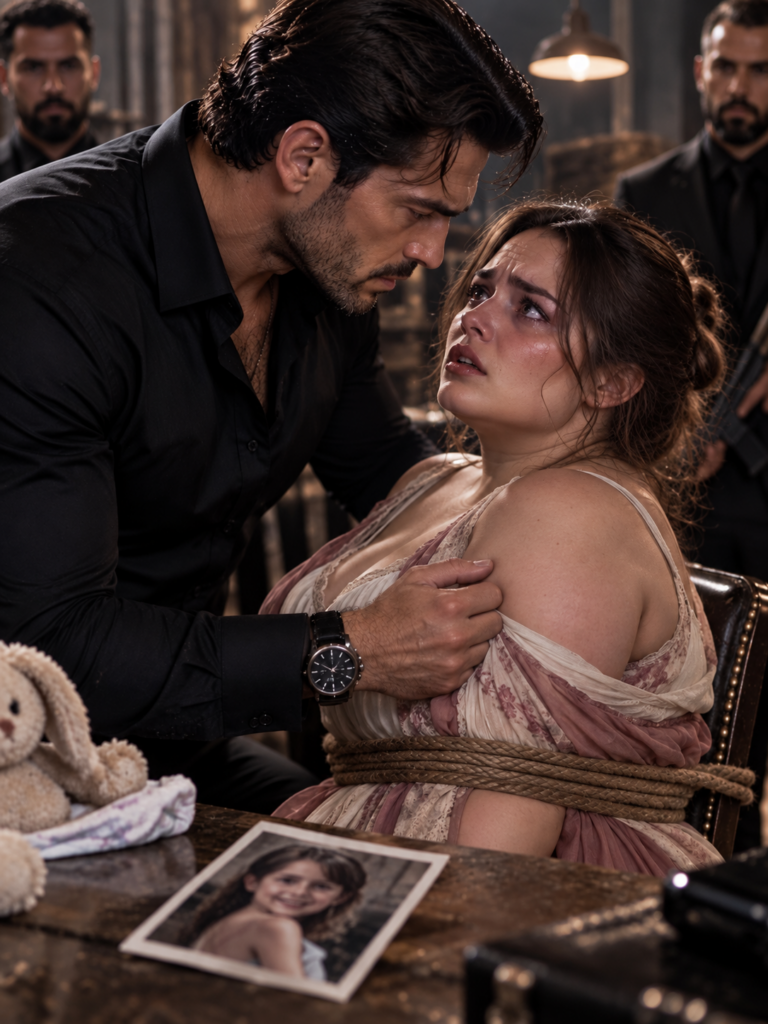
Elias Moretti forced his son’s nanny into a windowless room because she had seen something she was never meant to see.
Three days later, one tear in her faded dress revealed a scar from a massacre his family had erased twenty years earlier.
And when Elias recognized the wound, the most feared man in Europe whispered, “You were supposed to be dead.”

PART 1 — THE NANNY BEHIND THE FORBIDDEN WALL
The day Seraphina Hayes disappeared began with a child’s laughter.
Rain silvered the windows of the Moretti estate outside Monaco, softening the Mediterranean into a gray sheet beyond the cliffs. Inside, four-year-old Leo raced through marble corridors while Seraphina counted with her eyes covered.
“Ten, nine, eight…”
Her voice carried through rooms furnished for display rather than comfort. She wore a faded denim dress, flat shoes, and neat braids pinned away from her face. Nothing about her looked dangerous.
She was paid to be useful and invisible.
“Three, two, one. Ready or not.”
A giggle drifted from the basement.
Seraphina followed it down a narrow staircase past the wine cellar. The air smelled of damp stone, cork, and old paper. Leo’s favorite hiding place was a forgotten storage room crowded with leather trunks.
When she opened the door, he was not behind the trunks.
He stood beside a hanging tapestry with one finger pressed against a hidden metal panel. A red light flashed beneath his palm.
“Look,” Leo whispered. “It woke up.”
Seraphina’s stomach tightened.
She had spent three years watching wealthy households conceal danger beneath beautiful surfaces. That blinking light was not part of the heating system.
“Good hiding, sweetheart. Now we need to go.”
She lifted him just as heavy footsteps sounded above them.
A man appeared at the top of the stairs.
Elias Moretti wore a black suit cut so precisely it made him seem carved rather than dressed. His dark hair was combed back from a severe face, and his gray eyes carried the cold patience of someone accustomed to receiving answers before asking questions.
Seraphina knew who he was.
Everyone near Monaco did.
He controlled shipping companies, hotels, ports, and businesses that never placed his name on their paperwork. Leo’s father employed him as a security consultant, although the armed men who lowered their eyes when Elias passed suggested a different profession.
“What were you doing?” he asked.
“Playing hide-and-seek.”
His gaze moved to the blinking panel.
“That sensor protects records worth millions.”
“Leo touched it by accident.”
Elias descended one step at a time. “Children have accidents. Adults create explanations.”
Leo wrapped his arms around Seraphina’s neck.
“She didn’t do it,” he said. “I found the sleepy light.”
Elias did not soften.
“Stefan.”
A broad, kind-faced guard appeared behind him.
“Take the boy upstairs.”
Leo began crying when Stefan reached for him. “No. Seraphina comes too.”
“I’ll see you soon,” she promised.
Elias waited until the child was gone.
Then he looked at her as though the word soon belonged to him.
Two guards took Seraphina through an underground corridor and placed a black cloth over her eyes. When it came off, she was seated in a windowless room containing a steel table, two chairs, and one bare light.
Elias sat across from her with a file.
“Seraphina Hayes. Born in Kingston. Your visa expired eleven months ago. Your mother requires heart medication, and your younger sister attends nursing school.”
Her hands locked together beneath the table.
“I didn’t see any records.”
“Who sent you?”
“No one.”
“You expect me to believe you discovered the only unmarked security panel in that house by chance?”
“Leo discovered it.”
Elias leaned closer. “You are disposable. If you vanish tonight, only three people will ask questions, and none of them can afford answers.”
Fear traveled through her body, but she refused to lower her eyes.
“The panel looked like the sensor beneath the Persian rug in the south parlor,” she said. “That one triggered false alarms whenever the older maid pushed her cart over it.”
The room changed.
Elias stopped breathing.
The south-parlor sensor was not household security. It monitored secret meetings, and only three members of his inner circle knew it existed.
Seraphina had mentioned it as though it were nothing.
Elias slowly closed her file.
“You noticed a device hidden under a rug?”
“I notice anything that could hurt the child.”
A knock came at the door. Stefan entered, his face pale.
He handed Elias a tablet showing the estate’s exterior cameras.
A black sedan had stopped beyond the western gate. Three men were photographing the house—and one of them held a recent picture of Seraphina.
Elias looked from the screen to the frightened nanny.
She was either the finest infiltrator ever placed inside his world—
—or someone else had been waiting for the exact moment he discovered her.
“Lock down the estate,” he ordered.
The lights went out before Stefan reached the door.
In the darkness, a man’s voice came through the ventilation system.
“Give us the woman, Elias, and your son lives.”
PART 2 — THE SCAR THAT REMEMBERED THE FIRE
The Woman Everyone Wanted
Emergency lights came on in a dim red wash.
Seraphina’s chair scraped as she stood. Elias moved faster, catching her wrist before she could reach the door.
“Let go.”
“If those men know your name, leaving this room will kill you.”
“You threatened to make me disappear five minutes ago.”
“And someone just threatened my son.”
“That does not make you my protector.”
“No.” His grip loosened without releasing her. “It makes our enemies temporarily the same.”
A gunshot sounded somewhere above them.
Seraphina flinched. Elias did not. His head tilted as he counted the echo.
“Western corridor,” he said.
Stefan pressed a hand to his earpiece. “The gate cameras are dead. Victor is moving Leo to the interior safe room.”
“Tell him no exterior elevators.”
Stefan relayed the order.
Elias pulled Seraphina toward the back wall and pressed a hidden switch. A narrow steel panel opened, exposing a passage lit by strips of white light.
She resisted.
“Where are you taking me?”
“Somewhere the men outside cannot hear us.”
“You mean another prison.”
“You can call it anything you like if you remain alive.”
A second shot cracked above them.
This one was closer.
Seraphina entered the passage.
The protected room at the far end contained security screens, locked cabinets, and a communications console. Leo appeared on one monitor, crying in Stefan’s arms as guards carried him through a corridor.
“Seraphina!” His small voice came through the speaker.
She moved toward the screen.
Elias watched her face.
No trained operative would have displayed that kind of unguarded panic over a child unrelated to the mission. Her hands pressed against the console, and every line of her body leaned toward Leo as if she could reach him through glass.
“I’m here, sweetheart,” she said when Elias activated the microphone. “You stay with Mr. Stefan and listen to him.”
“Are you coming?”
Her gaze shifted toward Elias.
“Yes,” she said. “I’m coming.”
Elias ended the transmission.
“You should not promise what you cannot control.”
“He is four.”
“He needs truth.”
“He needs to know one adult in that house will come back for him.”
The rebuke landed with unsettling accuracy.
Elias turned toward the exterior feeds. One intruder had reached the north wall before guards intercepted him. The other two retreated into the trees.
They had not expected to enter.
They had wanted Elias frightened enough to move Seraphina.
“It was a test,” he said.
“For what?”
“To confirm you were here.”
“Who were they?”
Elias enlarged the image of the sedan. Its license plate belonged to a rental company in Marseille, but the man in the passenger seat wore a silver pin shaped like a wolf’s head.
Elias knew the symbol.
Silas Kresnik.
Kresnik controlled a violent network running from the Balkans through Western Europe. Twenty years earlier, he had been a minor associate in Elias’s father’s organization. Now he possessed enough money and influence to challenge everything Elias had inherited.
But Kresnik had never shown interest in nannies.
Not until Seraphina touched the hidden sensor.
“I don’t know yet,” Elias said.
She gave him a hard look. “You know enough to be afraid.”
He turned away.
After two hours, the attackers disappeared. The estate remained sealed, and Leo was moved to another property under Stefan’s protection.
Seraphina was not released.
Elias returned her to the windowless room.
“You said our enemies were the same.”
“Temporarily.”
“You confirmed I’m not working for them.”
“I confirmed you care about the boy.”
“That should be enough.”
“It proves one truth. It does not eliminate the others.”
She stood in the doorway with the guards behind her. “How many truths do you need before you stop treating a person like an object?”
“As many as survival requires.”
“That sounds like something a frightened man tells himself.”
His eyes narrowed.
Seraphina went inside.
The door locked behind her.
For two days, the room remained her entire world.
Stefan brought three meals and a fresh blanket. He apologized without saying the word, setting down each tray gently and lingering near the door.
On the second evening, Seraphina stopped him.
“How is Leo?”
“Safe.”
“Did he ask for me?”
Stefan’s eyes softened. “Every hour.”
Her throat tightened.
“Can I speak to him?”
“I’m not authorized.”
“Who authorizes kindness in this place?”
The guard looked toward the camera in the ceiling.
“Not the people who should.”
Seraphina sat again.
Stefan placed an orange beside her tray. It was the first fresh thing she had seen since entering the room.
“My daughter liked those,” he said.
“Liked?”
“She died a long time ago.”
“I’m sorry.”
“So am I.”
He closed the door.
Elias watched the conversation from the security room.
Victor Hale stood behind him, broad-shouldered and silver-haired, with the rigid posture of a man who considered mercy an operational defect.
“She has seen too much,” Victor said.
“She saw a blinking light.”
“She recognized the south-parlor sensor.”
“She notices details.”
“She is connected to Kresnik.”
“Perhaps without knowing it.”
Victor’s expression cooled. “Ignorance does not make her safe.”
“No.”
“Then remove the risk.”
Elias looked at the monitor.
Seraphina was peeling the orange slowly, placing each strip of skin in a neat spiral. She ate only half and wrapped the rest in a napkin, probably saving it out of habit.
She lived as though every small comfort might be needed later.
“Continue the investigation,” Elias said.
Victor studied him. “You are hesitating.”
“I am verifying.”
“Your father called hesitation fear.”
“My father is dead.”
“His enemies are not.”
Victor left.
Elias remained before the monitor.
Seraphina fell asleep in the chair with the blanket across her shoulders. As her head tilted, the back of her dress shifted.
A pale line showed above the fabric.
Elias leaned toward the screen.
The mark began near her left shoulder blade in a star-shaped cluster, then traveled downward in a narrow, uneven curve.
His pulse changed.
For one second, he smelled burning oil.
A child screamed inside his memory.
Then the image vanished.
Elias turned away from the screen so violently that his chair struck the wall.
It meant nothing.
The world contained millions of scars.
But that night, he did not sleep.
The Dress That Tore
On the third afternoon, Stefan brought lunch.
Seraphina stood to help him balance the tray. The back of her worn dress caught on a sharp edge beneath the steel table.
The fabric tore from her shoulder toward her waist.
She gasped and seized the loose cloth.
Stefan dropped the tray.
A metal cup rolled across the floor, spilling water.
The scar was fully visible.
It began in a pale burst near her shoulder blade and curved downward like lightning frozen beneath the skin. Smaller marks surrounded it—faint, precise, almost geometric.
Stefan stared.
All color left his face.
“You,” he whispered.
Seraphina backed against the wall. “What?”
His eyes filled with recognition. “The body remembers.”
“What are you talking about?”
Before he could answer, the door opened.
Elias entered.
He saw the torn dress, Stefan’s expression, and the scar.
His entire body went still.
The room disappeared around him.
He was ten years old again, crouching behind oil drums outside a factory in Milan. Fire turned the windows orange. His father dragged him by the arm while steel screamed inside the building.
A little girl stood near the central pillar.
A rod struck the thick industrial window beside her. Glass exploded in a white star. One long fragment cut across her back as the floor shifted beneath her.
Elias remembered her falling.
He remembered his father saying, “Do not look.”
He had looked.
Now the same wound marked the woman before him.
“Turn around,” he said.
Seraphina clutched the dress against her chest. “No.”
“Let me see the scar.”
“You have imprisoned me, investigated my family, and threatened my life. You do not get to inspect my body.”
His voice broke. “Please.”
The word astonished everyone.
Elias Moretti did not ask.
Seraphina turned slowly, keeping the torn fabric pressed over herself. The emergency light caught every uneven line of the wound.
Elias moved closer but did not touch her.
“How did you get it?”
“I fell against a broken gate when I was six.”
“Where?”
“Kingston.”
“Who told you?”
“My mother.”
“Do you remember it?”
She opened her mouth, then stopped.
The story had always belonged to Aisha. Seraphina remembered antiseptic, fever, and her mother crying while changing the bandages.
She did not remember the gate.
“I remember pieces.”
“What pieces?”
“Cold metal. A loud sound. Someone carrying me.”
Elias stepped backward.
Stefan crossed himself.
Seraphina looked between them. “Why are you both looking at me like that?”
Elias gripped the chair until the wood creaked.
“That is not a gate injury.”
“You cannot know that.”
“I watched it happen.”
Her face changed.
“No.”
“It happened in Milan.”
“I have never been to Milan.”
“You were a child.”
“I grew up in Jamaica.”
“Someone took you there afterward.”
She shook her head. “Stop.”
“The mark at the top came from industrial glass. The curved line came from debris dragging across your back when the floor collapsed.”
“Stop.”
“I saw the window break.”
“Stop!”
Her voice struck the walls.
Elias fell silent.
Seraphina’s breathing became shallow. She pressed herself against the concrete as though the room were shifting beneath her.
“You are lying because you want me frightened.”
“I have done many things to frighten people. This is not one of them.”
He turned to Stefan.
“You recognized it.”
Stefan’s gaze dropped.
Elias moved toward him. “How?”
“I was part of the cleanup team.”
Seraphina stared.
Stefan’s shoulders sagged. “Not the first team. The second. We were ordered to remove anything that connected the factory to your father.”
“Did you find the girl?”
“No.”
“Then why did you recognize her wound?”
“Because we found the glass pattern in the blood near the pillar. Your father kept photographs.”
Elias’s voice hardened. “Who removed her?”
“I never knew.”
“You whispered that the body remembers.”
Stefan closed his eyes.
“I had seen the old photograph in your father’s private archive. The scar matches the projected wound in the medical reconstruction.”
Seraphina touched the mark on her back.
Her fingers felt numb.
Elias called Victor and demanded every surviving record from the Milan factory collapse. Within hours, laptops covered the steel table.
The official file listed three missing people: factory foreman Marco Rossi, a maintenance worker, and Marco’s six-year-old daughter, Elena.
A childhood photograph accompanied the report.
The girl had dark braids, mahogany skin, and large hazel eyes.
Seraphina stared at the image.
The child wore the same silver bracelet Aisha kept in a locked box at home.
“Elena Rossi,” she whispered.
The name carried no memory, yet her body reacted. Her hands became cold. A pressure gathered behind her eyes.
Victor opened adoption records from Jamaica.
Aisha Hayes had registered a daughter named Seraphina less than five months after the Milan disaster. The paperwork was legal, but a Swiss shell company had paid Aisha a large sum days before the registration.
“She was paid to take me,” Seraphina said.
“No,” Elias replied. “She was paid to protect you.”
“You do not know that.”
“She raised you for twenty years when she could have abandoned you after the money was gone.”
Seraphina looked at the mother’s name on the screen.
Aisha had worked two jobs. She had sat beside Seraphina through fevers, saved coins for schoolbooks, and gone hungry while claiming she had eaten at work.
Whatever the payment meant, that life had not been false.
But the story of the gate was.
“Who sent the money?” she asked.
Victor traced the shell company through dormant accounts.
The original manager was dead. One recent inquiry, however, had accessed the same records six months earlier.
It came from Kresnik’s network.
Elias paced the room.
“Kresnik discovered the missing child survived.”
“Why would he care?” Seraphina asked.
“Because your father opposed my father’s control of the docks. The collapse was covered as an accident. You are living proof that witnesses were erased.”
“Proof against your family.”
“Against me now.”
Her eyes sharpened. “So that is why you care whether I live.”
The accusation struck cleanly.
Elias stopped.
“I care because Kresnik will use you and dispose of you.”
“That is what you planned to do.”
“Yes.”
His honesty silenced her.
“I was wrong,” he continued. “That does not make me good. It makes the next decision mine.”
Victor shut the laptop.
“The decision is obvious. Move her. New documents, remote property, no contact.”
Seraphina turned toward him. “You mean erase me again.”
“Keep you alive.”
“By replacing one invented identity with another?”
Victor’s mouth tightened. “You are not qualified to understand the threat.”
“I understand men deciding my life belongs to whoever has the most weapons.”
Elias looked at her.
She stood barefoot in a borrowed shirt Stefan had brought, her torn dress folded on the chair. She possessed no money, legal status, or allies powerful enough to enter the room.
Yet Victor looked threatened by her.
That revealed more than any file.
“I want to speak to Aisha,” Seraphina said.
Elias nodded.
Victor objected. “The call can be traced.”
“Route it securely.”
“You are indulging her.”
“I am correcting information.”
Victor stared at him for several seconds before arranging the connection.
Aisha answered from Kingston shortly before dawn.
Her face appeared on the screen, older and thinner than Seraphina remembered from their last call. A fan turned above her. Rain drummed against a zinc roof.
“Mama.”
Aisha leaned close. “Seraphina? Where are you? I have called for three days.”
“Who is Elena Rossi?”
The fan continued turning.
Aisha’s expression emptied.
Seraphina did not need another answer.
“You told me the scar came from a gate.”
“My baby—”
“Was I born in Jamaica?”
Aisha began to cry.
Elias turned away from the screen, granting them the privacy of his back if nothing else.
Aisha described a man arriving at her clinic twenty years earlier with an injured child. He called himself Dmitri Stavros. He carried papers, money, and a warning that powerful men would kill the girl if they found her.
Aisha had been a nurse.
She treated the wound for six weeks.
Then she kept the child.
“At first, I told myself I was only hiding you,” she said. “But you began calling me Mama.”
“Why didn’t you tell me when I grew up?”
“Because the man returned twice. He said the Moretti family still watched old records.”
Seraphina looked at Elias’s back.
“Did he tell you who caused the explosion?”
“He said one family started the fire and another turned it into a trap.”
“Kresnik,” Elias said quietly.
Aisha heard him.
Her face tightened with terror. “Is that Elias Moretti?”
Seraphina looked at him. “Yes.”
“Get away from him.”
“I cannot.”
Aisha covered her mouth.
“Mama, where is Stavros?”
“I do not know. He left an address to use only if you remembered the factory.”
“What address?”
Before Aisha answered, the screen went black.
Victor looked at the console. “The connection was intercepted.”
A new image appeared.
Silas Kresnik sat in a dark room, silver wolf pin gleaming on his lapel. He was older than Elias, with a narrow face and patient smile.
“A touching reunion,” he said.
Seraphina’s blood chilled.
Kresnik lifted a photograph of Aisha leaving her clinic that morning.
“Bring Elena Rossi to Geneva,” he continued, “or her mother learns what happens to people who adopt ghosts.”
The Command She Was Never Meant to Hear
Elias destroyed the screen with one blow.
Glass cracked beneath his fist.
Victor remained composed. “Emotional reactions waste time.”
Elias turned on him. “Secure Aisha.”
“Kresnik has teams across the Caribbean. We cannot reach her first.”
“Try.”
Victor left to issue orders.
Seraphina stood beside the broken console.
“This happened because of me.”
“No.”
“He found her because I asked for the call.”
“He found her six months ago. Today gave him leverage, not information.”
“That is supposed to comfort me?”
“No. It is supposed to keep you from carrying his decision.”
Elias called another team.
His language became efficient and cold. Flights, armored vehicles, extraction routes, false documents. Seraphina listened as he arranged human beings across maps like pieces.
Then he contacted Victor privately near the door.
“Find Stavros before Kresnik does.”
“We have a possible location outside Geneva,” Victor replied through the phone.
“Bring him in.”
“If he resists?”
Elias looked toward Seraphina.
She appeared occupied with the damaged screen.
“Do not let him speak to anyone else,” Elias said.
The old meaning of those words was clear.
Silence the witness.
Seraphina heard every syllable.
When Elias ended the call, she faced him.
“You ordered Stavros killed.”
“He is dangerous.”
“He saved me.”
“He also knows enough to sell you.”
“You told me you were correcting your mistake.”
“I am keeping you alive.”
“You are repeating it.”
His expression hardened. “This is not a moral argument.”
“It is the only moral argument. Your father erased witnesses to protect his empire. Now you are doing the same.”
“Kresnik will use Stavros to reach you.”
“Then protect him.”
“Protection fails.”
“So does murder. It simply fails after destroying someone else.”
He moved closer. “You have lived outside this world.”
“Because someone risked his life to put me there.”
“You do not know his motives.”
“No. I know yours.”
That stopped him.
“You are not protecting me,” she said. “You are protecting the version of yourself that still controls the ending.”
Outside, thunder rolled across the coast.
Elias looked at the torn dress folded on the chair. A strip of denim hung loose from the shoulder—the ordinary garment of a woman he had called disposable.
His father had taught him that sentiment created vulnerability.
Victor believed the same.
Kresnik relied upon it.
Every powerful man around Seraphina had defined survival as the right to choose who disappeared.
Elias raised the phone again.
“Victor. Change of order.”
Silence answered.
“Stavros comes back alive.”
Victor’s voice cooled. “That is unwise.”
“It is final.”
“You are risking the organization for a nanny.”
“I am preventing another witness from being erased.”
“You sound weak.”
Elias ended the call.
Seraphina studied him. “Will he obey?”
“He has never refused me.”
“That was not my question.”
Before Elias could answer, a muffled shot came from the corridor.
Stefan shouted.
The door lock flashed red.
Elias drew his weapon.
Victor’s voice sounded beyond the steel.
“Open the door, Elias. Give me the girl, and I will preserve what remains of your authority.”
Elias pushed Seraphina toward the concealed passage.
“Go.”
“What about Leo?”
“Stefan moved him before the lockdown.”
“How do you know?”
“I ordered it when Kresnik appeared.”
“You did one thing correctly. Do not become proud.”
Despite the danger, a breath of laughter escaped him.
Then the outer door exploded inward.
Victor entered with two armed guards.
Stefan lay wounded in the corridor behind them.
Victor looked past Elias toward Seraphina.
“The Milan witness dies tonight. Kresnik receives a body, the organization survives, and Leo keeps his father.”
Elias raised his weapon. “You were my father’s man before you were mine.”
“I served the structure.”
“You served fear.”
“I served continuity.”
Seraphina backed into the passage.
Victor aimed.
Elias stepped between them.
Gunfire filled the room.
Seraphina crawled into darkness as bullets struck steel behind her. One body fell. Then another.
A final shot echoed.
Silence followed.
“Elias?” she called.
No answer.
Every instinct ordered her to keep moving.
Instead, she turned back.
Elias sat against the wall with blood spreading across his shoulder. Victor had disappeared, leaving both guards behind.
“You came back,” Elias said through clenched teeth.
“I make my own bad decisions.”
She tore a strip from the denim dress and bound his wound.
He watched her hands work.
“The woman I called disposable is saving my life.”
“Do not make this sentimental. Stand up.”
He obeyed.
The passage was narrow, wet, and black beyond the emergency lamps. Seraphina supported him through turns he could barely navigate.
For the first time, the man who controlled ports and governments had to follow her directions.
“Left,” she said.
“There is an exit to the right.”
“I hear footsteps on the right.”
He listened.
She was correct.
They took the left passage.
After twenty minutes, Elias’s weight grew heavier against her. Sweat chilled his face, and the clean scent of his cologne had given way to blood and damp concrete.
“You should leave me,” he said.
“You would.”
“I would slow you down.”
“You left one injured girl behind. I will not become you to escape you.”
The words hurt him more than the wound.
At dawn, they emerged through a drainage hatch in wooded hills above Monaco.
A low-level driver loyal to Stefan took them to an abandoned farmhouse across the French border. Its kitchen smelled of dust, lavender, and old ash.
Seraphina cleaned Elias’s wound beside a cracked window.
The bullet had passed through muscle. He would survive.
When she finished, he looked at the strip of denim around his shoulder.
“You kept the dress.”
“It was the only thing in that room that belonged to me.”
“I will replace it.”
“That would miss the point.”
He lowered his eyes.
Seraphina washed her hands. Pink water circled the basin.
“What happens now?”
“Victor will offer Kresnik the organization in exchange for support. They will go after Stavros.”
“And Aisha?”
“I sent Stefan’s daughter’s old contact in Kingston to move her.”
“You said Stefan’s daughter died.”
“She did. The contact belonged to her former police unit.”
“Will it work?”
“I do not know.”
His admission frightened her more than false certainty would have.
Elias removed a sealed phone from his pocket. One message waited from an unidentified number.
A Geneva address.
Beneath it appeared a sentence:
THE MAN WHO SAVED ELENA WILL TESTIFY AT NOON—IF SHE ARRIVES ALIVE.
Seraphina read it twice.
“Stavros sent this?”
“Or Kresnik.”
“Either way, we go.”
Elias stared at her. “Geneva is a trap.”
“So was your estate.”
“This trap is designed for you.”
“My entire life was designed by someone else. I am finished waiting inside it.”
He saw no fearlessness in her.
She was afraid. Her hands trembled, and exhaustion darkened the skin beneath her eyes. Courage was not the absence of those things. It was her refusal to let them choose for her.
“We go to Geneva,” he said.
A second message arrived.
This one contained live security footage from Leo’s safe house.
Victor stood beside the sleeping child.
He looked directly into the camera and raised one finger to his lips.
PART 3 — THE MAN WHO KNELT BEFORE THE TRUTH
The Price of His Son
Elias watched the footage without blinking.
Leo slept beneath a blue blanket, one hand curled beside his cheek. Victor stood near the bed wearing the same blood-marked shirt from the firefight.
The image froze.
A message followed.
STAVROS FOR THE BOY. ELENA FOR THE EMPIRE. GENEVA. NOON.
Seraphina gripped the phone.
“He has Leo.”
“Yes.”
“How?”
“Victor knew every safe property.”
“You trusted him.”
“I trusted his loyalty to power. I assumed I would always possess it.”
The admission carried no self-pity.
Elias called Stefan.
The guard answered weakly from a hospital outside Monaco. Victor had arrived minutes after Leo and removed him under Elias’s authorization code.
“He knew everything,” Stefan said. “Routes, passwords, fallback identities.”
“Rest,” Elias told him.
“Bring the boy home.”
The line ended.
Seraphina stood near the farmhouse window, watching rain bead along the cracked glass.
“Kresnik wants you to choose,” she said. “Stavros or Leo.”
“He expects me to sacrifice the witness.”
“Will you?”
Elias did not answer immediately.
That pause told her the choice was real.
“Leo is four,” he said. “He has no part in any of this.”
“Neither did I.”
Pain crossed his face.
Seraphina continued more gently. “That is why we cannot repeat it. If you trade Stavros, Leo grows up protected by the same lie that created you.”
“He grows up.”
“And when Victor becomes inconvenient? When Kresnik decides your son is a cleaner heir?”
Elias looked away.
“He will never be safe while they own the truth,” she said.
“What do you suggest?”
“We give them what they fear.”
“Which is?”
“Not me. Not Stavros. Public evidence.”
Elias understood.
Kresnik and Victor could control a secret witness. They could not control records released simultaneously to journalists, prosecutors, financial authorities, and rival organizations.
“You want to expose Milan.”
“I want to expose everything built after it.”
“That includes my present operations.”
“Yes.”
“It will end my organization.”
“Yes.”
“Hundreds of people depend on those businesses.”
“Then separate the legal workers before the records go public. Protect their wages. Not your ownership.”
He studied her.
Three days earlier, she had been a frightened nanny in a denim dress. Now she was dismantling an empire with the same clarity she used to protect a child from a hidden sensor.
“You have thought about this.”
“I have spent my life budgeting medicine, groceries, rent, and school fees. Power likes to pretend practical thinking belongs only to wealthy men.”
Elias opened his laptop.
For four hours, they worked.
He created protected payroll trusts for legitimate employees and transferred control to independent administrators. He collected evidence of bribery, smuggling, extortion, and shell companies.
Seraphina organized the files chronologically.
“Do not bury the Milan evidence beneath financial records,” she said.
“The financial records prove motive.”
“The photographs prove cost.”
He looked at the scanned image of the factory.
Near the pillar lay a child’s broken bracelet.
Seraphina recognized it.
Her mother kept the matching silver charm in Jamaica.
Her breath stopped.
Elias saw her face and closed the file.
“No.”
She reopened it.
“You do not decide what I can bear.”
“I was trying to—”
“I know. Stop.”
She enlarged the photograph.
A small figure lay partly covered by debris. The scar was not visible, but one shoe remained on the floor several feet away.
Seraphina remembered waking beneath a blanket while a man carried her through rain. She remembered his beard scratching her cheek.
Dmitri Stavros.
The memory vanished before she could hold it.
At eleven, they drove toward Geneva in a farm truck borrowed from the property. Elias wore plain clothes and kept his injured arm beneath a dark coat.
Seraphina had replaced the torn dress with black pants and a gray sweater.
The strip of denim remained around Elias’s shoulder beneath the bandage.
They reached an abandoned lakeside hotel outside Geneva twelve minutes before noon.
Winter wind moved across Lake Geneva, flattening the water into hammered metal. The hotel’s windows were boarded, but fresh tire marks cut through the gravel.
Elias stopped the truck beneath bare trees.
“If they take me, release the files.”
“If they take me?”
“I release them.”
“If they threaten Leo?”
His jaw tightened. “We release them.”
She heard what the answer cost him.
Inside, the lobby smelled of mildew and rotting carpet. A chandelier hung crooked above a marble floor clouded with dust.
Dmitri Stavros sat in a chair at the center of the room.
He was in his seventies, thin and stooped, with both hands bound. A white beard covered much of his face.
Seraphina knew him.
Not from photographs.
From the half-memory of rain.
“You carried me,” she whispered.
Stavros raised his head.
“Elena.”
The name in his voice felt different from the name in the files. It held grief, recognition, and relief.
Victor stepped from behind a column with Leo.
The boy’s wrists were not tied, but Victor’s hand rested on his shoulder.
“Seraphina!” Leo cried.
She moved instinctively.
Elias blocked her path.
Silas Kresnik emerged near the staircase. He wore a dark wool suit and the silver wolf at his lapel.
“This is almost beautiful,” Kresnik said. “The dead child, the guilty heir, and the old traitor.”
Seraphina’s eyes remained on Leo. “Let him go.”
“When Elias gives me Stavros and access to the Milan archive.”
“You already know what happened.”
“I know stories. Courts prefer documents.”
Victor looked at Elias. “You brought the woman. Good. There may still be something left to preserve.”
“You shot your own men,” Elias said.
“They hesitated.”
“You wounded Stefan.”
“He chose sentiment.”
Victor’s fingers tightened on Leo’s shoulder.
The child whimpered.
Elias’s face became still.
Seraphina had seen that stillness before. It was the mask he wore while deciding who could be removed.
She touched his uninjured hand.
He looked at her.
“Do not become him to save Leo,” she whispered.
Kresnik smiled. “She understands you.”
Elias stepped forward. “Release the boy. You get the archive.”
“First, Stavros tells us who authorized Elena’s extraction.”
Stavros laughed weakly. “Still confused after twenty years, Silas?”
Kresnik’s smile disappeared.
“You rigged the factory,” Elias said.
“I strengthened an opportunity your father created.”
“You expected both families to die inside.”
“I expected your father to enter without dragging his child to a criminal raid.”
Elias’s gaze sharpened. “You knew I was there.”
“Of course.”
The truth struck him.
Kresnik had not merely sabotaged the factory. He had known ten-year-old Elias would be present and accepted his death as part of the plan.
“You were the third party,” Seraphina said. “But not the one who saved me.”
“No.” Stavros lifted his bound hands. “I did that.”
“Why?”
“Your father, Marco, helped my wife escape Kresnik’s trafficking route. I owed him a life.”
Seraphina’s eyes filled.
“Was my father alive?”
“For three days after the collapse.”
She stepped closer.
Victor warned her back.
Stavros continued. “Marco knew he would not survive. He gave me the bracelet and made me promise to take you somewhere the families could not reach.”
“He knew Aisha?”
“No. I found her at a clinic in Kingston. She treated you without asking whether the money was legal. When you woke and reached for her, I understood she could give you what none of us could.”
“A childhood.”
“Yes.”
“Why did you pay her?”
“To relocate, create records, and protect your sister.”
Seraphina frowned. “My sister?”
The room became silent.
Aisha’s daughter in nursing school.
Nadia.
“She is not Aisha’s biological child,” Stavros said. “She is yours.”
The words did not make sense.
“My daughter?”
“Your younger sister,” he corrected gently. “Marco’s infant daughter. She had been staying with neighbors during the factory shift. I moved both of you. Aisha raised you as sisters because two unrelated adoptions would have drawn attention.”
Seraphina pressed one hand to her mouth.
Nadia—the girl whose tuition she paid, whose birthday cakes she ordered from Europe, whose first steps Aisha had described in stories—was Elena Rossi’s sister as well as Seraphina Hayes’s.
Her family had not been invented.
It had been preserved.
Kresnik lost patience. “Enough.”
He nodded to Victor.
Victor moved Leo toward the staircase.
Elias stepped into the center of the lobby.
“I will give you the archive.”
Seraphina looked at him.
He removed a small drive from his coat and held it up.
Victor stopped.
“All internal accounts,” Elias said. “Every port, every official, every protected company.”
Kresnik’s eyes gleamed.
“And Milan?”
“The original photographs, payments, and witness list.”
“Bring it.”
Elias approached.
Seraphina watched his left hand.
Three fingers opened once.
A signal.
She did not know the plan, but she understood its purpose: keep their attention on him.
Elias placed the drive on a marble table halfway between them.
“Leo walks to Seraphina.”
“After verification,” Kresnik said.
“You verify it while he walks.”
Victor objected. “The child remains leverage.”
Kresnik’s tone hardened. “I decide.”
The fracture appeared.
Victor had expected partnership. Kresnik saw him as an employee.
Elias noticed too.
“Kresnik will kill you when this ends,” he told Victor.
“Be quiet.”
“You know the archives. You know his role in Milan. You are the final loose end.”
Victor’s face tightened.
Kresnik reached for the drive.
Elias pressed a button on his watch.
Every phone in the room vibrated.
Kresnik checked his screen.
A news alert appeared:
INTERNATIONAL DATA RELEASE LINKS MORETTI AND KRESNIK NETWORKS TO MILAN FACTORY DISASTER.
Victor stared at his phone.
Financial authorities had received the account ledgers. Journalists had the photographs. Prosecutors had Elias’s recorded confession.
The drive on the table was empty.
Kresnik’s calm vanished. “What have you done?”
“Removed your leverage.”
“You destroyed yourself.”
“Yes.”
The answer unsettled everyone.
Kresnik reached inside his coat.
Victor pulled Leo backward.
Stavros kicked the leg of his chair into Victor’s knee. Victor stumbled, loosening his grip.
Leo ran.
Seraphina crossed the floor and caught him.
A gunshot cracked.
Elias struck Kresnik’s arm, sending the weapon across the marble. Victor drew his own gun, but police lights flooded the boarded windows before he could aim.
Stefan entered through the side door with Swiss tactical officers.
His arm was in a sling.
“Put it down, Victor.”
Victor looked from Kresnik to Elias.
The empire he had betrayed everyone to preserve no longer existed.
He lowered the weapon.
Leo buried his face against Seraphina’s neck.
“I knew you’d come,” he sobbed.
She held him tightly.
“I promised.”
Across the lobby, Elias stood with his hands raised as officers surrounded him.
His eyes found his son.
Relief moved across his face before the handcuffs closed.
The Name She Chose
The arrests spread across Europe.
Kresnik faced charges for trafficking, conspiracy, attempted murder, corruption, and the Milan sabotage. Victor was charged with kidnapping, assault, conspiracy, and obstruction.
Dmitri Stavros entered protective custody and testified publicly.
Aisha and Nadia were moved from Jamaica before Kresnik’s remaining men could reach them. When Seraphina finally met them at a secure hospital in France, Aisha did not ask for forgiveness.
She simply opened her arms.
Seraphina stood several feet away.
Nadia waited beside their mother, crying.
“You should have told me,” Seraphina said.
“Yes,” Aisha replied.
“You let me believe every memory belonged to Jamaica.”
“I was afraid that if you remembered Milan, they would find you.”
“They found me anyway.”
“I know.”
Seraphina looked at the woman who had lied about her name and told the truth through every meal, school uniform, fever, and sacrifice.
“Did you love me before I called you Mama?”
Aisha’s face crumpled.
“The moment Stavros put you in my arms.”
Seraphina crossed the room.
Their embrace did not erase the lie. It held the love and damage together because both were true.
Nadia joined them.
“My tuition money,” Nadia whispered against Seraphina’s shoulder. “You were paying for your own sister.”
“You still owe me.”
Nadia laughed through tears. “I’ll become a nurse and repay you in terrible medical advice.”
For the first time since the basement, Seraphina laughed freely.
She kept both names.
Legally, she remained Seraphina Hayes. In her testimony, she acknowledged that she had been born Elena Rossi.
Neither identity replaced the other.
Seraphina was the woman Aisha raised.
Elena was the child who survived.
Elias pleaded guilty to organized financial crimes, obstruction, and offenses committed under his authority. Prosecutors recognized that he had been a child during Milan, but adulthood had offered him countless opportunities to expose the truth.
He had chosen power until Seraphina forced him to choose otherwise.
The judge sentenced him to fourteen years.
Before sentencing, he turned toward the gallery.
Seraphina sat with Leo, Aisha, Nadia, and Stefan.
“I spent my life believing guilt was something powerful men could manage privately,” Elias told the court. “But private guilt does nothing for public harm. I did not create the first crime, yet I protected the world it created.”
He looked at Seraphina.
“She did not save me. She gave me a choice, and I finally stopped asking other people to pay for it.”
He faced the judge again.
“I accept the sentence.”
Leo lived with his father’s sister in France, close to Seraphina. She remained part of his life, but no longer as an invisible employee.
She returned to school and studied child psychology, focusing on young survivors of displacement and organized violence. Nadia completed nursing school and moved to France two years later.
Aisha divided her time between Kingston and Marseille.
Stavros died peacefully four years after the trial.
At his memorial, Seraphina placed the small silver bracelet from the factory beside his photograph. He had carried a child from a burning building and spent twenty years believing anonymity was the price of her survival.
She wanted his name remembered.
Elias served nine years before receiving conditional release for extraordinary cooperation and sustained rehabilitation work.
He left prison on a clear autumn morning.
No car waited for him.
Seraphina stood across the road with Leo, now thirteen and nearly as tall as she was.
Elias stopped outside the gate.
Age had placed silver at his temples. Prison had removed the tailored perfection from him, leaving a lean man in an ordinary dark coat.
Leo looked at Seraphina.
“Can I go?”
“That is your choice.”
The boy crossed the road.
Elias did not open his arms until Leo did.
They held each other for a long time.
Seraphina watched Elias’s hand press against the back of his son’s coat. His face remained hidden, but his shoulders shook.
When they separated, Leo wiped his eyes with the heel of his hand.
“You look terrible.”
“I have been told.”
“Do you still give orders?”
“Only when the laundry room schedule permits it.”
Leo smiled.
Then Elias looked at Seraphina.
She stayed on her side of the road.
“You came,” he said.
“For Leo.”
“I know.”
He crossed halfway and stopped, leaving distance between them.
“Stefan said you finished your degree.”
“Yes.”
“And your mother?”
“Complains about French winters while refusing to return permanently to Jamaica.”
“Nadia?”
“Runs an emergency ward and terrifies surgeons.”
A faint smile touched his mouth.
“I am glad.”
Silence settled beneath the rustling plane trees.
“What happens now?” he asked.
“You find work.”
“I have an offer from a nonprofit that tracks shell companies connected to trafficking.”
“That sounds appropriate.”
“They know my history.”
“They should.”
His gaze dropped to the road.
“I wrote you many letters.”
“I received them.”
“You never answered.”
“You did not ask a question that required one.”
He accepted that.
Seraphina studied him. The cold authority was gone, but she knew better than to mistake suffering for transformation. Time would prove what prison could not.
“Leo wants you in his life,” she said. “That does not mean you control it.”
“I understand.”
“He decides how often he sees you.”
“Yes.”
“If you manipulate him with guilt, I will notice.”
“I believe that.”
“If you threaten anyone—”
“I won’t.”
“You interrupted.”
He lowered his eyes. “Sorry.”
Leo laughed from behind them.
“Still terrifying,” he told his father.
“She always was,” Elias said.
“No. You were simply accustomed to people pretending not to be.”
That evening, the three of them ate at a small café near the river.
There were no guards, private rooms, or hidden sensors. Rain began after sunset, tapping softly against the windows.
Leo talked about school, football, and a girl whose messages he insisted were not romantic.
Elias listened.
He did not correct every exaggeration. He did not ask questions like an investigator. When the boy spilled water, Elias reached for a napkin instead of raising his voice.
Seraphina noticed.
Of course she did.
After dinner, Leo went to buy pastries from the counter.
Elias looked at the scar visible above the collar of Seraphina’s dress.
“I used to think that mark was evidence against me.”
“It was.”
“Yes.” He folded his hands on the table. “But it was never yours to carry for that purpose.”
“What do you think it is now?”
“A part of your body. Nothing more unless you decide otherwise.”
She considered the answer.
“You finally learned not to turn me into a symbol.”
“I am trying.”
“Trying is not the same as succeeding.”
“No.”
“You still want forgiveness.”
“Yes.”
“I may never give it.”
“I know.”
Outside, headlights moved across the wet street. The café smelled of coffee, butter, and orange peel.
Elias reached into his coat and placed a small object on the table.
It was the metal staff badge Seraphina had worn at the Moretti estate.
Her photograph showed a younger woman in a plain uniform. Beneath it, someone had printed:
SERAPHINA HAYES — NANNY
“I found it among the evidence returned after the case closed,” he said.
She picked it up.
For years, powerful people had decided which of her names was useful. Elena Rossi had been a witness. Seraphina Hayes had been camouflage. The nanny had been disposable until her scar became valuable.
She removed the plastic card from its holder.
Then she broke it in half.
Elias did not flinch.
“What should I call you?” he asked.
“Seraphina.”
“Not Elena?”
“Elena is part of my history. Seraphina is the woman who survived it.”
He nodded.
Leo returned with three pastries balanced in both hands.
“One for each of us.”
He placed a pastry before his father, then another before Seraphina. Powdered sugar dusted the table like pale snow.
Elias reached for his wallet.
Leo stopped him. “I paid.”
“With whose money?”
“My own.”
Elias looked prepared to object.
Seraphina raised one eyebrow.
He closed his mouth.
“Thank you,” he said.
Leo sat down, visibly pleased.
In that small act, Seraphina saw the future clearly—not clean, effortless, or free from consequence, but open to choices that had once been impossible.
Elias would never recover his empire.
He would live with public disgrace, restrictions, and the knowledge of every person harmed beneath his command. Seraphina would carry a scar, missing memories, and love for a mother whose protection had included a devastating lie.
No one walked away untouched.
That was what made the ending honest.
When they left the café, rain had stopped.
Leo walked ahead, jumping over reflections in the pavement. Elias paused beneath the awning while Seraphina fastened her coat.
“May I see you again?” he asked.
“For Leo?”
“For him whenever he asks.” Elias swallowed. “For myself, if you choose.”
She looked at the man who had once locked her in a room and called her disposable. He no longer stood like someone who owned the answer.
“One coffee,” she said. “Next month.”
Relief crossed his face.
“That is all.”
“I understand.”
“You pay for your own.”
“I can manage that.”
“And if you investigate me—”
“I will not.”
She stepped into the cool night.
Elias walked several feet behind her, keeping the distance she had not asked him to close.
At the corner, Leo turned and called their names.
Not Elena.
Not the nanny.
Not the boss.
“Seraphina! Dad! Hurry up!”
They followed him toward the river.
Under the streetlamp, Seraphina’s shadow stretched ahead of her, whole and unbroken. She touched the place beneath her coat where the scar crossed her back, then let her hand fall.
Behind them, a black sedan pulled away from the curb.
Elias saw it first.
The rear window lowered just enough to reveal Victor’s silver signet ring resting against the glass—the same ring that had been sealed in police evidence after his reported death during a prison transfer.
Then the car vanished into traffic.
Seraphina turned toward Elias.
His old instincts returned for one dangerous second.
“Who was that?” she asked.
Elias stared after the disappearing taillights.
“The last lie my empire buried,” he said.
And somewhere beyond the rain-dark river, a dead man was waiting for them to believe the story was over.

