
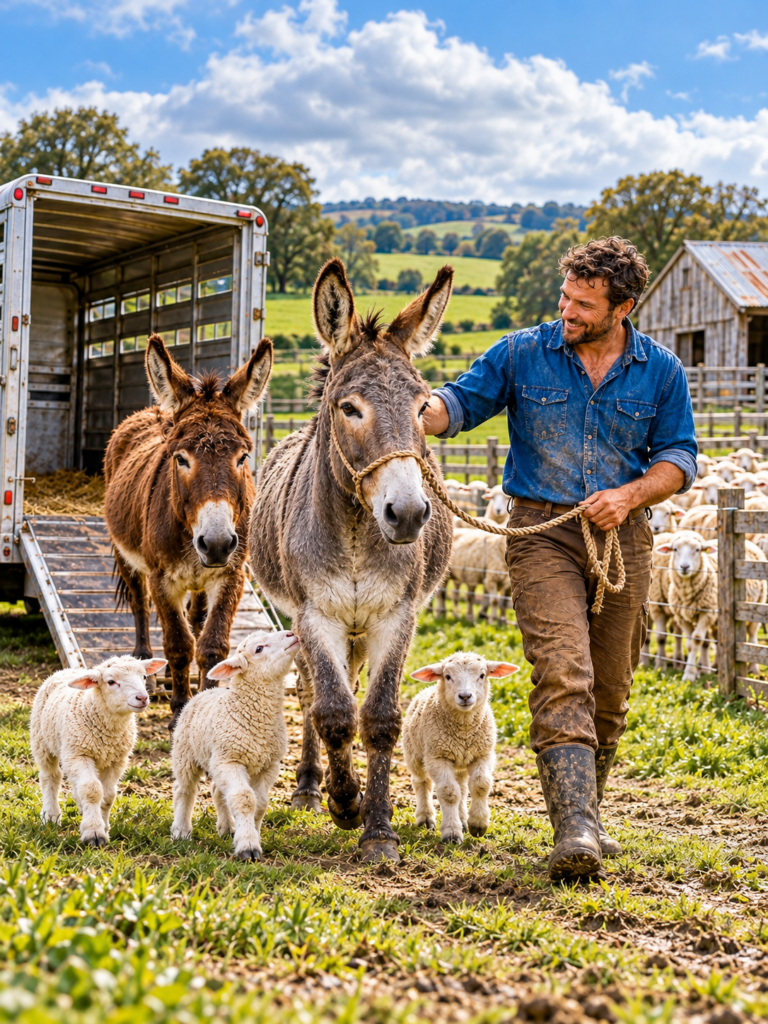
Part 1
By the last Tuesday in September, Nico Etcheverry had lost twenty-three lambs to coyotes, and the number had begun to follow him everywhere.
It followed him into the kitchen each morning, where the bank statements lay beneath a chipped coffee mug. It followed him through the barn while he measured feed and checked water. It followed him into the fields, where every empty place among the sheep represented money he would never collect.
At thirty-six, Nico had inherited more than a ranch from his grandfather. He had inherited a reputation, a mortgage, and the expectation that an Etcheverry man ought to know how to keep his sheep alive.
That morning, he did not reach the creek pasture until after nine.
The sun had cleared the eastern ridge, laying a pale gold across the dry grass. The air smelled of sagebrush and cold water. Somewhere farther down the creek, a magpie called from the willows.
Nico walked slowly, carrying his grandfather’s old sheep hook.
Most sheepmen in that part of Wyoming had been working for hours by then. They rode out before sunrise, checked their fences in the half-light, and knew where their flocks were long before breakfast.
Nico had stopped doing that years ago.
He never explained why.
Near the mouth of the draw below the reservoir, he spotted something white caught among the sagebrush.
He approached carefully.
Wool.
A little farther away lay a yellow ear tag, half-buried in the dirt.
Nico bent down, rubbed the dust off with his thumb, and read the number.
418.
He recognized it immediately.
The lamb had been a twin wether from one of his strongest ewes. Healthy, broad across the back, nearly ready for market. In three weeks, it should have been loaded onto a truck with the rest of the fall lambs.
Instead, there was an ear tag and a patch of bloody ground.
Nico crouched beside the creek.
In the mud were several sets of paw prints. One belonged to a large coyote with a distinctive split in the pad of its left front foot.
The same animal had been coming down from the ridge all summer.
Nico could have recognized that damaged print in a hundred tracks. He had followed it through dust, mud, and dried creek beds, always arriving after another lamb was gone.
He slipped the ear tag into his shirt pocket.
Lamb prices were running close to three hundred dollars a head. Twenty-three missing animals represented more than six thousand dollars in lost revenue, most of what he had intended to put toward the fall payment on his operating note.
The bank would not care how the animals had died.
It would care about the numbers.
He straightened with the help of his sheep hook, an old ash pole fitted with a curved iron end. Decades of use had polished the wood where his grandfather’s hand had gripped it.
Fermin Etcheverry had carried that hook across these pastures long before Nico was born.
He had arrived from the Basque Country in 1958 with a three-year contract to herd sheep in the Bighorn Mountains. For seasons at a time, he lived in a canvas sheep wagon, accompanied by two dogs and fifteen hundred ewes.
He saved nearly every dollar he earned.
By 1971, he had saved enough to purchase the ranch.
When Nico was eleven, his father died in a highway accident during a ground blizzard. After that, Fermin became the person who taught him nearly everything that mattered.
How to recognize a sick ewe before she stopped eating.
How to judge a storm from the direction of the wind.
How to mend a fence properly instead of making it look repaired.
And how to understand the difference between protecting something and simply destroying whatever threatened it.
Fermin had never believed in putting out poison for coyotes.
He used to tell Nico that a sheep deserved somebody willing to stand between her and whatever came out of the darkness.
For Fermin, that had meant countless nights sitting beneath the open sky with a rifle across his knees.
Nico still owned the rifle.
He simply couldn’t do what his grandfather had done.
A vehicle approached along the county road.
Nico looked up.
A silver Dodge pickup rolled to a stop beside the fence. A large spotlight was mounted above its cab, and dust drifted around the rear tires.
Wade Kessler lowered his window.
Wade ran twenty-five hundred ewes on the adjoining ranch to the south. He was a broad-shouldered, weathered man who had known Fermin for more than forty years.
Their families had a history that stretched beyond property lines.
When Wade’s father died during spring lambing, Fermin had helped deliver Wade’s lambs rather than leave the young man to handle the season alone.
Wade remembered that debt.
Unfortunately, he also remembered it whenever he wanted to tell Nico how the Etcheverry ranch should be managed.
“Another one?” Wade asked, looking toward the draw.
Nico nodded.
“How many now?”
“Twenty-three.”
Wade rested his forearm on the window.
For several seconds, he said nothing.
“Your grandfather would’ve been sick over that.”
“I know.”
“I don’t believe he lost that many in all the years I knew him.”
Nico turned the yellow tag over inside his pocket.
Wade studied him.
“Let my trapper come across the property line,” he said. “He’s putting cyanide devices up on my ridge. We could extend the line onto your place. Wouldn’t cost you anything.”
“No.”
“You’ve got to do something.”
“I am.”
“What?”
Nico did not answer.
Wade leaned farther out the window.
“Then stay down there at night. Your granddad used to sit along that creek with his thirty-thirty. I could see his lantern from my kitchen.”
Nico looked past the truck toward the road.
Wade followed his gaze, then sighed.
“You don’t come to the Thursday suppers anymore. You hardly show your face in town. People are starting to wonder what you’re doing out here.”
“I’m taking care of my sheep.”
“Doesn’t look much like it.”
The words landed harder than Wade probably intended.
For a moment, Nico could hear Fermin’s voice correcting him during a childhood chore, stern but patient. His grandfather had always expected better work, but he had never mistaken silence for laziness.
Wade shifted in his seat.
“Listen, I’m not trying to make life harder for you. Your grandfather helped me when I needed it. I haven’t forgotten.”
He glanced toward the creek bottom.
“My offer still stands. Nine hundred an acre for that lower ground. If the bank gets difficult, at least you’d have a way out.”
“The creek pasture isn’t for sale.”
“The bank might see things differently come spring.”
“It’s my land.”
Wade’s expression tightened.
“Then you need to figure out how to keep it.”
He rolled up the window and drove away.
Nico remained beside the fence until the dust settled.
He knew Wade considered himself practical. Maybe even helpful.
But the thought of selling the creek pasture made Nico feel as if he were being asked to sell the last living piece of his grandfather.
He turned back toward the sheep.
Twenty-three lambs gone.
And somewhere beyond the draw, the coyote with the damaged foot was still hunting.
That Saturday, Nico hauled eleven cull ewes to the livestock auction in Buffalo.
It was the kind of sale barn where men recognized one another’s trucks before seeing their faces. Coffee came in paper cups, old grievances surfaced between bids, and everybody knew which rancher was having a good year.
Nico sold his ewes and counted the proceeds.
He should have gone straight home.
The barn lay twenty-six miles from his ranch, with eleven miles of gravel road near the end. The sun would be low by the time he reached the final stretch.
Instead, he wandered toward the holding pens behind the auction ring.
At the far end stood the animals destined for slaughter buyers.
A few thin horses shifted their weight against the rails.
In the back corner stood two female donkeys.
One was brown and relatively young, with strong legs and alert eyes. The other was gray, older, and so worn-looking that her almost-white muzzle made her seem ancient.
What caught Nico’s attention was the way they stood together.
The older donkey kept her nose pressed against the brown one’s side.
When the brown donkey moved, the gray one moved with her.
When the younger animal stopped, the older one stopped too.
Nico rested his hands on the fence.
During the previous winter, he had read an agricultural extension bulletin about using donkeys to guard sheep.
Donkeys often reacted aggressively to canine predators. A suitable jenny, properly introduced to a flock, might help discourage coyotes without traps or poison.
Nico had spent months thinking about that possibility.
He had not seriously considered buying one until now.
A small card fastened to the pen gate indicated that the animals were being sold together.
Two jennies.
One lot.
He watched the brown donkey lower her head toward a patch of hay. The older one followed the movement, staying close enough that their necks touched.
Nico knew almost nothing about their history.
But he knew what would likely happen if the kill buyer took them.
And he knew what another dozen lost lambs would do to his finances.
The auctioneer was already working through the last groups of animals.
Nico checked the light through the barn windows.
Then he stayed.
By the time the two donkeys entered the ring, evening had turned the glass orange.
The kill buyer opened at two hundred sixty dollars.
Nico raised his hand.
“Two eighty.”
Several heads turned.
The buyer looked across the ring, amused, and offered three hundred.
Nico felt the envelope inside his shirt pocket.
He had exactly three hundred ten dollars.
He had been keeping it for an appointment with his eye doctor in November.
The doctor was in Billings, and the money had taken months to put aside.
Nico raised his hand again.
“Three ten.”
The kill buyer shrugged.
“Old gray one’s hardly worth the fuel to haul her,” he muttered.
He lowered his hand.
The auctioneer’s gavel fell.
“Sold. Three hundred ten dollars to the sheepman.”
Laughter rippled across the seats.
Someone called that Nico had bought the ugliest sheep in Wyoming.
More laughter followed.
Up in the top row, Wade Kessler laughed louder than anybody.
Nico kept his eyes on the ring.
He paid the clerk, collected the paperwork, and led the two animals toward his trailer.
The brown donkey resisted briefly, then stepped onto the ramp. The gray one followed so closely that her nose kept brushing the other’s hip.
By the time Nico secured the trailer, the sun had disappeared behind the mountains.
He stood beside the pickup, staring toward the western ridge.
Then he got in.
For the first few miles, the paved road was manageable.
By the time he reached the gravel, the world had begun to dissolve.
Fence posts lost their sharp edges.
The shoulders of the road blurred into darkness.
His headlights illuminated a narrow, milky passage through which he could barely distinguish the ground.
He slowed.
Twenty miles an hour.
Fifteen.
Ten.
Then he pulled onto the shoulder and switched off the engine.
He held the steering wheel with both hands.
Nico Etcheverry was losing his sight.
The problem had begun in his twenties, when night driving became increasingly difficult. At first, he had blamed fatigue or poor headlights.
Then the darkness had started arriving earlier for him than for everyone else.
The spring he turned thirty, a specialist in Billings diagnosed retinitis pigmentosa.
It was a progressive retinal disease.
His peripheral vision was narrowing, and the doctor warned him that the deterioration would continue.
By the time he reached his fifties, he might have very little useful sight remaining.
At night, he was already nearly blind.
Nobody in the county knew.
Nobody except Fermin, who had driven him to the specialist and carried the secret to his grave four winters earlier.
The clinic had given Nico a white cane.
It was still sealed in its plastic wrapping behind the pickup seat.
He preferred the old sheep hook.
People recognized it as something a rancher carried.
Nobody asked questions.
In the trailer, a donkey shifted its hooves.
Nico closed his eyes.
It hardly changed what he could see.
He thought about the appointment in November, the empty envelope, and the two unwanted animals standing behind him.
Then he settled into the seat to endure the cold.
Sunrise was eleven hours away.
The morning came slowly.
At twenty minutes before seven, a dull strip of pink spread along the ridge.
The fence posts emerged first.
Then the gravel shoulder.
Then the road itself.
Nico climbed out of the truck, stiff from spending the night in the driver’s seat.
Both donkeys stood close to the trailer slats.
The brown one looked directly at him.
The gray one held her head slightly crooked, her pale face turned past his shoulder. Her ears moved toward the sound of his boots.
“Morning, girls,” he said.
The gray donkey’s ears twitched again.
He reached the ranch after driving the remaining nine miles at a cautious pace.
At the corral, he lowered the trailer ramp.
The brown jenny stepped down first.
Her red nylon halter had faded almost pink. Riveted to one side was a worn leather tag with a name burned into it.
Tess.
Nico rubbed the lettering with his thumb.
Someone had once taken enough care to give her a name and mark her halter.
Whatever had happened afterward had landed her in a slaughter pen.
The gray donkey followed, staying close enough to bump Tess’s hip.
She wore no halter.
No tag.
No sign that anybody had bothered to name her.
Nico looked at her weathered face.
“Can’t have you going around without a name.”
He thought of Fermin’s wife, the grandmother who had once ruled their kitchen with a wooden spoon and an expression that could silence three men.
They had called her Amona.
It was the Basque word for grandmother.
Nico smiled faintly.
“Amona it is.”
The old donkey turned an ear toward him.
He opened the gate to the small trap pasture beside the corral, where the ewes came down for water.
The agricultural bulletin had recommended introducing guard donkeys gradually, keeping them separated from the sheep by a fence for roughly two weeks.
Nico followed the instructions.
Tess immediately began exploring.
She walked the fence line, sniffed the wooden posts, investigated the water trough, and brayed at the curious ewes on the other side.
Amona followed every movement.
Where Tess walked, Amona walked.
When Tess stopped, Amona stopped.
At first, Nico assumed the older donkey was simply timid and had grown dependent on her companion.
But one morning he approached Amona quietly from her left side.
She startled so violently that her hind legs nearly folded beneath her.
“Easy, old girl.”
He spoke softly, reaching for her neck.
She calmed as soon as she heard him.
Nico watched her for a while, then dismissed the incident.
Tess was clearly the leader.
Amona would follow her anywhere.
And if Tess could drive coyotes away from the creek pasture, Nico would consider the money well spent.
Every evening, he finished his work before sunset.
He locked the gates, checked the fences, and stood beside the trap pasture as the light slipped from the hills.
Sometimes he talked to the donkeys.
He told them about the coyotes, the bank, and the animal with the torn pad on its foot.
Tess usually wandered off.
Amona remained beside the fence with her ears turned toward his voice.
It was a peculiar comfort to have something listen without expecting an explanation.
On the ninth day, Wade Kessler drove into the yard.
He stayed behind the wheel.
“My trapper starts along our property line Monday,” he announced. “Cyanide devices every quarter mile on my side. Keep your dogs away.”
“I don’t have dogs.”
Wade looked toward the pasture.
“Then keep those donkeys out of trouble.”
Tess was drinking from the water tank.
Amona approached from behind her.
The younger donkey shifted away.
Amona continued forward and struck the steel tank with her shoulder.
The hollow clang echoed through the yard.
She backed up, shook her head, and walked into it again.
Wade stared.
Then he began laughing.
He laughed so hard he had to wipe his eyes.
“Good Lord, Nico. That old donkey can’t see a thing.”
“She’s old,” Nico replied.
“My mother’s old. She can still find a water tank.”
Wade shook his head, still grinning.
“Three hundred ten dollars.”
He put the truck in gear.
“Never thought I’d see the day an Etcheverry paid that kind of money for a blind donkey.”
The Dodge rolled away.
Nico remained standing beside the gate.
He knew Wade had been talking about Amona.
He knew the remark had nothing to do with him.
Yet the word blind seemed to hang in the cold October air long after the pickup disappeared.
He looked across the pasture.
Amona had found Tess again.
Her nose was resting against the brown donkey’s flank.
Nico gripped the familiar wooden handle of his grandfather’s hook.
For the first time, he wondered whether the oldest, weakest-looking animal in his pasture was hiding something as carefully as he was.
Part 2
On October fifteenth, Nico opened the gate between the trap pasture and the creek pasture.
The morning was cold enough that frost still clung to the shaded grass. Beyond the gate, the ewes were scattered along the creek, grazing among the sagebrush and willows.
Tess stepped through without hesitation.
She raised her head, surveyed the unfamiliar ground, and trotted downhill toward the flock.
Amona remained at the opening.
Her ears moved forward and backward.
She lifted one hoof, set it down, and stretched her nose into the empty space where Tess had been.
Nico watched from beside the gate.
“Go on,” he encouraged.
Amona did not move.
From farther down the hill came a loud bray.
Tess.
The gray donkey reacted immediately.
She passed through the gate, broke into an awkward trot, and hurried after the sound until she reached her companion.
Only then did she settle.
Nico leaned against the post.
He had expected the animals to adjust slowly. The bulletin had warned that introducing livestock guardians could take patience.
Still, something about Amona’s behavior bothered him.
She wasn’t watching Tess leave.
She seemed to be waiting for a sound that told her where to go.
He pushed the thought aside.
The pasture was open.
The donkeys were among the sheep.
For the first time in months, he had something resembling a plan.
That night, the braying began shortly after dark.
Nico lay in bed with his window cracked open, listening.
The sound traveled up from the creek bottom, rough and startling in the still air.
Twice he got out of bed and went onto the porch.
He swept a flashlight toward the pasture.
The beam created a small white circle on the frosty ground.
Beyond it, the darkness remained complete.
He imagined his grandfather sitting beneath the willows, rifle balanced across his knees, lantern burning beside a dented coffee pot.
Fermin would have gone down to investigate.
Nico stood with the useless flashlight until the braying stopped, then returned to bed.
The following morning, he searched the creek crossing.
In the soft mud near the bend were familiar tracks.
The coyote with the split foot had come down the draw.
This time, however, the tracks stopped well short of the place where Tess and Amona had been standing.
Then they turned around.
Nico crouched and studied them for several minutes.
The animal had approached.
It had encountered the donkeys.
And it had retreated.
He felt something close to hope.
It was the first encouraging sign he had found since early summer.
For five more nights, the donkeys remained in the pasture.
Every morning, Nico counted his sheep.
On the sixth morning, he walked the length of the creek and climbed toward the upper end of the field, where most of the flock had bedded overnight.
There, nearly a mile from the bend, he found another yellow ear tag.
The ground around it was disturbed.
He recognized the tracks immediately.
The split front pad.
Another lamb gone.
Twenty-four.
He stood holding the tag until the cold worked through his gloves.
When he returned downstream, Tess and Amona were waiting near the same bend where he had seen them all week.
They had not followed the flock.
Not once.
The two donkeys had been protecting one another instead of the sheep.
Nico stared at them.
Tess lifted her head.
Amona stood with her muzzle pressed against Tess’s shoulder.
He thought about the water tank.
About the way the older donkey startled when he approached silently.
About how she refused to pass through the gate until Tess called.
He went back to the house and telephoned Glenda Voss.
The call went to voicemail.
“Glenda, it’s Nico. I’ve got an older jenny here. Something isn’t right with her. She’s walking into things.”
He hesitated.
“Could you come have a look?”
Glenda arrived at four that afternoon.
At sixty-six, she had been the county’s large-animal veterinarian longer than Nico had been alive. She was short and solidly built, with closely cropped gray hair and a canvas work coat worn thin at both elbows.
She stepped out of her truck carrying her veterinary case.
“Which one?” she asked.
“The gray one.”
“The pair from the kill pen?”
Nico nodded.
Glenda gave him a look.
“Wade’s been telling that story all over the county.”
Nico opened the barn.
They brought both donkeys into the central alley because Amona became distressed whenever Tess was taken away from her.
Glenda examined the older animal carefully.
She checked her legs and mouth, felt along her neck, and spoke in a low, steady voice while she worked.
Amona seemed comfortable with the veterinarian’s hands as long as she could hear her.
Finally, Glenda took a penlight from her pocket.
She directed it into one eye, then the other.
“Hmm.”
Nico stepped closer.
Glenda moved her hand quickly toward Amona’s face, stopping just short of touching her.
The donkey did not blink.
She tried again.
Still no reaction.
Then Glenda clapped once beside the animal’s head.
Both ears sprang upright.
“There it is,” Glenda murmured.
She motioned Nico forward.
“Take a look at the center of her eyes.”
He leaned close enough to see the cloudy film behind the dark surface.
The right eye looked worse than the left.
“Cataracts,” Glenda said. “Both eyes. Pretty advanced.”
Nico glanced at Amona.
“How much can she see?”
“Maybe a little light and shadow in bright sun. Not enough to find her way around properly.”
He considered that.
“But she finds the water. She follows Tess. She knows where the gate is.”
“She knows where Tess is,” Glenda corrected. “That’s how she finds everything else.”
Amona reached forward and touched the brown donkey’s neck.
Glenda stroked her mane.
“She’s been blind a long time, Nico.”
He let out a strange, short laugh.
Glenda looked at him.
“What’s funny?”
“Wade told me she was blind as a fence post. I told him she was just getting old.”
Glenda shrugged.
“Even Wade manages to be right occasionally.”
She continued examining the donkey.
“Someone knew about this before the auction. That’s probably why she ended up in that pen.”
Nico stared at the old animal.
Three hundred ten dollars.
The November appointment.
The twenty-fourth lamb.
He had spent money he couldn’t afford on a donkey who couldn’t see the sheep she was supposed to protect.
“What am I supposed to do with her?” he asked.
Glenda stopped beside Tess.
“That’s your decision. The buyers will be back at the auction Saturday.”
She glanced from one animal to the other.
“But I doubt the brown one would do much good without her. They’re more attached than most pairs I’ve seen.”
She explained that two donkeys did not necessarily make an effective guarding arrangement. Instead of bonding with the sheep, they could become preoccupied with one another.
Nico knew that was exactly what had happened.
Then Glenda mentioned something else.
She had seen blind horses learn to follow a companion wearing a bell.
A cowbell or sleigh bell could give an animal a reliable sound to follow, allowing it to move with greater confidence.
“You might try that,” she said.
Nico looked at Tess.
“A bell?”
“Something she can hear moving. Once she learns what it means, she won’t need to keep her nose against Tess every second.”
The idea seemed almost embarrassingly simple.
Outside, the daylight was fading.
Shadows filled both ends of the barn alley.
Glenda took the penlight from her pocket again and offered it to Nico from his left side.
“Hold this for me.”
He did not move.
“Nico.”
He turned toward her voice.
Only then did he notice the light.
He took it.
Glenda said nothing, but he could feel her attention settle on him.
Later, as he walked her to the truck, he failed to notice the veterinary case she had placed beside the door.
His boot struck it.
He stumbled.
Glenda caught his arm before he fell.
For a moment, neither moved.
Then she asked quietly, “How long have you had retinitis pigmentosa?”
Nico froze.
The yard seemed to grow silent around him.
“I don’t know what you mean.”
Glenda kept her hand on his arm.
“My brother had RP. He concealed it for years.”
She looked toward the road.
“When he was forty-four, he drove a grain truck into an irrigation ditch at dusk. That’s how everybody finally found out.”
Nico withdrew his arm.
“You’re mistaken.”
Glenda watched him.
Then she nodded once.
“All right.”
She picked up her case and opened the truck door.
Before climbing in, she looked back.
“Keeping something like that hidden takes an awful lot out of a person.”
She drove away.
Nico remained in the yard as the last color disappeared from the mountains.
When he finally turned toward the house, he found the porch railing with his hand.
He knew what Glenda meant.
He had spent six years measuring his movements, inventing excuses, and arranging his life around the hours when he could still see.
He had stopped attending Thursday suppers because the gatherings often ended after dark.
He avoided visiting neighbors in the evenings.
He planned every trip around sunset.
He had even ended his engagement to a schoolteacher in town after receiving his diagnosis.
She had asked him why.
He had offered no explanation that made sense.
Eventually, she married someone else.
As far as Nico knew, she still believed he had simply stopped loving her.
He had never told her the truth.
Standing in the dark beside his empty pickup, he realized how much of his life had been sacrificed to keep one secret.
The following Thursday, Nico drove to town at noon.
He needed fence staples, and before heading home he stopped at the café across from the auction barn.
Wade Kessler was sitting at the round table near the window with three other ranchers.
Nico recognized their voices before he reached the counter.
He took a stool and waited for coffee.
“Three hundred ten dollars,” Wade was saying. “For a blind donkey that’s supposed to guard sheep.”
Someone chuckled.
“What does Nico say about it?”
“Not much. Nico never says much. His grandfather always did the talking.”
Another man asked how a blind donkey was supposed to know when coyotes were coming.
“Maybe she’ll hear them,” Wade answered.
The table erupted.
Then Wade added something about the blind leading the blind.
The men laughed even harder.
Nico kept his eyes on the glass pie display.
He could see the pale crusts lined up beneath the counter.
He could hear the coffee machine steaming.
He could feel every word from the table behind him.
The waitress set a cup of coffee in front of him.
“Here you go.”
Nico placed a five-dollar bill beneath the saucer.
Then he stood and walked out without taking a sip.
He drove home in silence.
In the yard, he backed his stock trailer against the pasture gate.
He filled a bucket with grain and shook it.
Tess approached first.
Amona followed at her side.
Both donkeys walked up the trailer ramp after the sound of the grain.
Nico closed the door behind them.
Saturday was two days away.
He could haul them back to the auction.
The kill buyer would take them.
The jokes would end.
He climbed into the pickup and sat behind the steering wheel.
He did not turn the key.
The cab was warm from the afternoon sun, and the empty envelope that had once held his medical money lay in the glove compartment.
He thought about Fermin.
The old man had faced winters, storms, predators, and years of uncertain prices without surrendering an animal simply because it became inconvenient.
But Fermin had been able to see.
He had been able to sit beside the creek after sundown and know what was moving beyond the fence.
Nico stared at the dashboard.
“You could see what was coming, Granddad,” he murmured.
His voice grew rough.
“You could always see.”
He struck the steering wheel with his palm.
Once.
Hard enough to sting.
Then he sat staring ahead, furious with himself for speaking to a man who had been buried for four winters.
Finally, he climbed out and walked to the back of the trailer.
Amona stood near the slats.
When he approached, her ears turned toward the sound of his footsteps.
She brought her muzzle forward until it touched his coat.
Nico rested one hand on her face.
She was old.
She could not see.
She depended on another animal to guide her through a pasture.
And the whole county had decided that made her worthless.
He rubbed the soft hair between her ears.
“If I send you back because you’re blind,” he said quietly, “I suppose I ought to climb in there beside you.”
Amona breathed against his sleeve.
Nico unlatched the trailer.
He opened the door.
Tess stepped down and went straight toward the water.
Amona remained beside him a moment longer, her nose touching his coat.
Then she turned toward the sound of Tess’s hooves.
Nico watched her walk away.
The decision was made.
He would not sell them.
What he needed now was a way to make the two donkeys useful without separating them.
And somewhere in the workshop, he remembered, his grandfather had left something that might help.
Five old brass bells hung on a nail above Fermin’s workbench.
They were attached to a weathered leather strap, their surfaces darkened by years of handling and dust.
The largest was about the size of a coffee cup.
Fermin had brought them from the Basque Country in his suitcase.
Nico hadn’t touched them since his grandfather died.
He lifted the strap.
The bells rang together, filling the workshop with a bright, familiar sound.
For an instant, he was nine years old again.
He remembered a morning in the mountains when fog had swallowed the sheep wagon and erased the hills.
He had stood beside Fermin, frightened because he could not see the flock thirty feet away.
His grandfather had closed his eyes.
Then he had listened.
After a moment, he pointed into the fog, telling Nico where the sheep were grazing.
Nico had asked how he knew.
Fermin had told him to close his eyes too.
At first, Nico heard only wind.
Then came the bells.
One faint and distant.
Another nearer the creek.
A third moving slowly toward the hillside.
Every sound marked a place in the white emptiness.
When the fog was too thick to see through, Fermin explained, a shepherd had to learn to listen.
Nico stood in the workshop holding the bells.
All these years, he had remembered his grandfather’s lantern, rifle, and steady eyes.
He had almost forgotten the bells.
He selected the largest one and carried it to the pasture.
Tess allowed him to fasten it to her faded red halter.
When she shook her head, the bell rang sharply.
Amona raised her muzzle.
Her ears tilted forward.
Tess started walking.
The bell sounded again.
Amona followed.
But this time, something was different.
She was not pressing her nose against Tess.
There was a little open space between them.
Then more.
Nico watched as the older jenny moved across the corral, following the bell without touching her companion.
He opened the gate.
Tess descended toward the creek.
The bell rang with each step.
Amona followed the sound.
Nico remained at the fence long after they disappeared among the sheep.
For the first time, he wondered whether he had misunderstood what the old donkey needed.
Perhaps she was not incapable of guarding anything.
Perhaps she had simply never been given a way to move confidently through the world she could no longer see.
That night, shortly before midnight, the bell woke him.
It was ringing much faster than usual.
Then came Amona’s bray.
Not the casual, rough call he had heard during the previous weeks.
This was loud, insistent, almost frantic.
Nico threw off his blankets.
Outside, he could hear sheep running across the frozen ground.
He went onto the porch with his flashlight.
The beam reached only a small patch of grass.
Somewhere near the draw, a coyote gave a sharp yip.
Tess brayed.
A heavy impact sounded in the darkness.
Then the bell stopped.
Nico stood motionless, listening.
Nothing.
He remained on the porch for hours, afraid that the silence meant the coyotes had reached the flock.
He could not go down to investigate.
Not yet.
When morning finally revealed the creek bottom, he hurried through the pasture carrying his hook.
He counted the ewes.
Then he counted the lambs.
Every animal was there.
Near the mouth of the draw, the frost had been torn apart by a violent struggle.
Large hoofprints marked the ground.
Among them were the tracks of the familiar coyote with the damaged front pad.
Those tracks led away toward the ridge in long, uneven strides.
On the lower strand of the fence hung a tuft of gray coyote hair.
Amona stood between the draw and the flock.
There was a scrape across her shoulder, and dried blood had darkened the pale hair beneath it.
Tess remained at her side.
The bell hung motionless from her red halter.
Nico understood then.
The two donkeys had challenged the coyote and driven it away.
Afterward, they had remained together near the draw, facing the direction from which it had come.
He approached Amona.
She turned toward his voice.
“Well, would you look at that,” he whispered.
He examined the scrape.
It was shallow, painful-looking but not serious.
Amona allowed him to touch the wound.
Then she pushed her warm muzzle into the opening of his collar.
Nico laughed softly.
For once, he did not care whether somebody might be watching.
The lamb trucks arrived the following Monday.
Nico shipped twenty-four fewer animals than he should have.
The payment covered his fall bank installment, purchased hay and propane for the winter, and left very little afterward.
But the bank payment was made.
The ranch was still his.
And the coyotes had not taken another lamb since the night the bell began to ring.
As autumn became winter, the flock’s behavior changed.
By Thanksgiving, the sheep were following the sound of Tess’s bell.
By Christmas, the ewes gathered around both donkeys at night.
Amona often stood in the middle of them, half asleep, her ears moving whenever something stirred beyond the pasture.
Twice during January, Nico discovered fresh tracks from the split-footed coyote coming down through the snow.
Both times, the tracks stopped before reaching the flock.
Both times, they turned back toward the ridge.
Nico began learning from the animals he had rescued.
During quiet afternoons, he walked the fence between the yard and the creek with his eyes closed.
His gloved hand rested against the upper wire.
He counted the posts.
There were two hundred twelve between the gate and the crossing.
He learned the low murmur of water running beneath creek ice.
He learned to recognize an older ewe by her persistent cough.
And he learned the different rhythms of Tess’s bell.
When she grazed, it sounded softly and irregularly.
When she walked, it settled into a steady pattern.
When the bell stopped, he knew she had stopped.
He practiced until the sounds formed a map in his mind.
In mid-January, Glenda came to float Amona’s teeth.
She pulled into the yard just as Nico returned from the creek, one hand against the fence and his eyes closed.
He opened them near the gate.
Glenda was standing beside her truck.
She had clearly been watching him.
But she said nothing about it.
After finishing with the donkey’s teeth, she leaned against the corral fence and studied the ewes clustered around Tess and Amona.
“Wade’s trapper has killed nine coyotes on that ridge since Christmas,” she said.
Nico looked across the snow-covered pasture.
“Good for Wade.”
Glenda made a doubtful sound.
She believed removing established coyotes could sometimes make livestock predation worse by leaving territory open to inexperienced animals looking for food.
“That pair with the damaged foot seems to have learned your sheep aren’t worth the trouble,” she told him. “I’d rather have that than a whole ridge full of hungry newcomers.”
Amona moved among the ewes, her ears swiveling toward each sound.
Glenda watched her.
“Best guard donkey I’ve ever seen,” she said. “And she can’t see her own feet.”
Nico smiled.
“She knows where they are.”
Glenda glanced at him.
For once, he met her eyes without looking away.
“You planning to tell anybody?” she asked.
Nico knew she was no longer talking about the donkey.
“Not this winter.”
She nodded.
“All right.”
In February, a ground blizzard swept down from the mountains.
For two days, blowing snow erased the fences and hills so completely that even people with perfect vision could barely see their boots.
Nico went looking for his flock.
He followed the sound of the bell toward the creek, where the sheep had gathered beneath the protection of the willow-covered bank.
Every ewe was there.
He found them without needing to see across the pasture.
The storm passed.
The winter slowly loosened its grip.
And for the first time since his diagnosis, Nico began to consider that losing his sight might not mean losing everything else.
Then, in March, the bank called.
The young loan officer wanted to discuss renewal of the ranch’s operating note.
He needed Nico’s lambing numbers before May.
He also mentioned that Wade Kessler had visited the bank and expressed interest in purchasing the creek ground if Nico needed to restructure his finances.
Nico stood beside the kitchen telephone, staring toward the pasture.
“I’m not selling,” he said.
The loan officer hesitated.
Then he remarked that a pair of donkeys did not amount to much of a predator-control plan.
Nico looked through the window.
Tess was crossing the lower pasture.
The bell swung from her halter.
Amona followed a few paces behind.
“You’ll have the numbers in May,” Nico replied.
He ended the call.
A week later, Wade was waiting beside the mailbox when Nico drove down the ranch road.
“Heard the bank called,” Wade said.
“Heard you went to see them.”
Wade did not deny it.
“Somebody has to make sure your grandfather’s ranch is looked after.”
Nico held his gaze.
“It’s my ranch, Wade.”
“Then start acting like it.”
Wade drove away.
Nico remained beside the mailbox, his hands tightening around the steering wheel.
He knew what the spring would decide.
If another lambing season ended in heavy losses, the bank might refuse to renew his loan.
Wade would be waiting.
And the creek pasture Fermin had worked so hard to buy could pass into somebody else’s hands.
For the first time in months, Nico did not respond by thinking about what his grandfather would have done.
He looked down toward the flock and listened to the distant bell.
He had already made his own choice.
Now he needed it to hold.
Part 3
The first lambs arrived on April fifteenth.
Spring had begun to work its way into the Wyoming hills, although the nights remained bitterly cold. Snow still lingered in shaded gullies, and the creek ran high with meltwater beneath its fragile edges of ice.
Nico brought the ewes into the creek pasture for lambing, just as Fermin had always done.
From the first usable light until sundown, he moved through the flock, checking newborns and watching for ewes in trouble.
After dark, he lay in bed with the window open.
He listened.
The bell had become as familiar to him as the ticking kitchen clock.
Sometimes it moved slowly along the creek.
Sometimes it stopped for hours.
Occasionally, Amona’s rough bray broke the silence.
Nico no longer assumed that every sound meant disaster.
He had learned to distinguish the ordinary movements of the flock from the sharp, restless noises that suggested danger.
The ewes had learned something too.
When a newborn lamb struggled to stand, Amona sometimes remained nearby, her gray head lowered and her ears constantly turning.
Other ewes had begun choosing places to lamb close to the donkeys.
Nico watched those small changes with growing confidence.
Every morning, he counted the lambs.
Every morning, the number was right.
By April twenty-third, two hundred six lambs had been born.
Not one had been lost.
It was the best beginning to lambing season Nico had experienced in years.
But the coyotes were still on the ridge.
Their pups were in the dens now, and hungry adults were ranging farther for food.
Glenda had warned him that the danger could increase.
Some nights, rifle shots echoed from Wade’s property to the south.
Two shots.
Three.
One evening, Nico counted seven.
He wondered how many coyotes Wade was finding, and how many lambs had already been lost on the neighboring ranch.
Then he returned his attention to his own flock.
He could not protect Wade’s sheep.
He could only protect the animals entrusted to him.
And each night, somewhere near the creek, the brass bell continued ringing.
The night of April twenty-third was moonless.
Long after midnight, the ranch lay beneath a darkness so complete that the barn and fences seemed to have disappeared.
A little after two o’clock, Nico awoke to a sound that made him sit upright.
Amona was braying.
Loudly.
Repeatedly.
Beneath her cries, Tess’s bell clanged in a wild, uneven rhythm.
Then came the unmistakable sound of a ewe calling in distress.
Nico threw back the covers.
He pulled on his boots and coat, grabbed the sheep hook, and took the large flashlight from the kitchen drawer.
Outside, the cold struck his face.
He switched on the flashlight.
It illuminated a patch of frozen grass immediately ahead of him.
Beyond that small circle, he saw almost nothing.
He could hear the bell near the creek.
Amona brayed again.
This time there was an urgency in her voice that left no room for hesitation.
Nico found the yard gate with the iron end of his hook.
Then he located the fence.
He placed his gloved hand on the top wire and began walking.
Ten posts.
Twenty.
Thirty.
The flashlight beam bounced against his boots.
He stopped trying to direct it toward the pasture. The narrow beam could not tell him what was happening beyond the fence.
At sixty posts, a barb caught his sleeve.
He pulled free, tearing the fabric.
Ninety.
One hundred.
The ewe’s cries grew louder.
The bell continued ringing.
Farther ahead, a coyote gave a sharp yip.
Another answered.
Nico felt his stomach tighten.
There were at least two.
He kept moving.
One hundred fifty.
One hundred eighty.
Then two hundred.
At the two hundred twelfth post, the fence turned toward the creek crossing.
He knew the place.
He had crossed there hundreds of times in daylight and practiced the route throughout the winter.
He reached out with the hook, found the edge of the bank, and stepped down.
His boot struck ice.
His foot slid out from under him.
He fell hard onto one knee in the shallow water.
The flashlight flew from his hand.
He heard it strike the creek, followed by a splash.
The beam vanished.
For a moment, he remained where he had fallen.
Cold water seeped through his jeans.
Pain spread upward from his knee.
Around him, the darkness was complete.
Then the bell sounded again from the far side.
Nico reached for the last fence post and hauled himself upright.
His hook scraped against frozen stones.
He could hear the creek running beneath the remaining ice.
He found the opposite bank with his hand and began climbing.
The slope was steep, slick with frost, and difficult to negotiate without sight.
He climbed on his knees, dragging the hook beside him.
At the top, he stopped to listen.
To his left, the bell was moving.
Straight ahead, the ewe continued calling.
Beneath her voice came another sound.
A thin, wet bleat.
A newborn lamb.
Nico stood still, trying to separate the noises.
Then he started toward the ewe.
He held the sheep hook ahead of him like a walking staff.
Its iron end struck sagebrush.
He moved around it.
A moment later, the hook found the edge of a badger hole. He adjusted his steps and continued.
He stumbled again and struck the frozen ground hard enough to knock the breath from his chest.
For several seconds, he lay there gasping.
He could hear the lamb.
Its cries were weakening.
Nico pushed himself upright.
He followed the ewe’s voice until his outstretched hand brushed against wool.
The ewe stamped and snorted.
“Easy, girl. I’m here.”
He ran his hand down her side.
At her feet were two lambs, still wet from birth.
One was standing on trembling legs.
The other lay on the cold grass.
Nico felt blood beneath his fingers.
The second lamb was injured.
He was trying to determine how badly when a low growl sounded from his right.
Close.
Much too close.
Nico went still.
Somewhere beyond the newborns, an animal moved through the grass.
He heard its paws scrape the frozen ground.
Another coyote circled farther away.
Nico stepped across the lambs, planting himself between them and the sound.
His grandfather’s hook was in his hands.
He could not see where the coyotes were.
He could not aim a rifle even if he had brought one.
But he knew precisely where the lambs lay.
And he knew what stood between them and the draw.
He raised his voice.
It was not an ordinary shout.
It was the high, carrying call Fermin had once used to turn a scattered flock across a mountain valley.
Nico had not made that sound since childhood.
Now it came tearing out of his throat.
He called again.
The sound rolled across the creek bottom.
For a heartbeat, the coyotes hesitated.
Then Amona answered.
Her bray came from downstream.
Almost immediately, Nico heard hooves pounding over frozen ground.
The old donkey was running toward him.
Toward his voice.
Tess’s bell rang behind her.
Something brushed against the backs of Nico’s legs.
He swung the hook into the darkness.
The iron end struck nothing.
The coyote moved again.
Nico could hear it circling toward the lambs.
Then Amona reached them.
She passed him so closely that her shoulder knocked him sideways.
Her hooves struck the ground.
She turned sharply toward the movement and kicked with both hind legs.
A coyote yelped.
On the other side of the newborns, Tess gave a furious bray.
Her bell clanged as she lunged after the second animal.
Then Nico heard running feet moving away.
Two sets.
Both heading up the draw.
One coyote continued yelping as it fled.
The sounds grew faint.
Then disappeared into the ridge.
The bell slowed.
Finally, it stopped.
Nico remained beside the lambs, breathing hard.
Somewhere nearby, Tess stood blowing air through her nostrils.
Amona approached him.
Her muzzle pressed against his chest.
He placed one trembling hand against her neck.
The donkey was trembling too.
For a long moment, they stood together in the darkness.
Nico could feel her breathing.
He could hear the wounded lamb moving weakly beneath its mother.
And he understood that the old jenny had found him in the dark the same way he had found the flock.
She had listened.
A white light swept across the creek bottom.
Nico turned his head.
The beam moved along the ridge, briefly catching two pairs of eyes retreating into the darkness.
Then it swung back.
The light settled on Nico.
An engine growled near the pasture gate.
Wade Kessler’s silver Dodge came down the slope and stopped.
Wade climbed out carrying a rifle and his handheld spotlight.
“Nico?”
“Over here.”
Wade approached.
His light traveled over the ewe, the newborn lambs, the two donkeys, and Nico’s soaked jeans.
“What happened to your flashlight?”
“Lost it in the creek.”
Wade stared at him.
“You came down here without a light?”
“I had one when I started.”
“Then how in the world did you get across the pasture?”
Nico looked toward Wade’s voice.
“The light wouldn’t have helped much anyway.”
Wade raised the spotlight toward his face.
Nico squinted.
His eyes did not quite settle where Wade expected.
Wade went quiet.
“What do you mean by that?”
Nico could have invented another excuse.
He had become good at them.
For six years, he had practiced explaining why he would not drive after sunset, why he avoided evening gatherings, and why his grandfather’s sheep hook never seemed to leave his hand.
He could have told Wade that the battery had been weak.
That he knew the pasture well enough.
That the darkness had simply been unusually heavy.
Instead, he tightened his grip on the worn wooden shaft.
“I can’t see at night, Wade.”
Wade lowered the light slightly.
“What?”
“I haven’t been able to for years.”
He swallowed.
“And my daylight vision’s going too. Slowly.”
The creek murmured behind them.
Wade stared.
“Fermin knew?”
“He took me to the specialist.”
Wade looked toward the old gray donkey.
Amona stood above the twins, her ears moving.
The spotlight caught the cloudy surfaces of her eyes.
“And her?” Wade asked.
Nico rested his hand against Amona’s neck.
“She’s blind too.”
Wade made a quiet sound, almost a laugh, but without amusement.
“I said she was blind as a fence post.”
“You did.”
“I said some other things too.”
“I heard them.”
Wade looked down.
For once, he seemed unable to find the next thing to say.
The spotlight illuminated the frozen grass between their boots.
At last, Wade turned toward the ridge.
“My trapper has forty cyanide devices out along my side,” he said. “I’ve lost thirty-one lambs since the fifteenth.”
Nico said nothing.
Wade looked back at him.
“How many have you lost?”
“None.”
The single word seemed to settle over both men.
Wade looked toward Tess and Amona again.
Then toward the ewe and her twins.
He lowered the rifle.
“We’d better get these little ones inside.”
Together, they lifted the ewe and her newborns into the back of the Dodge.
They drove them to the shed, where the ewe immediately began licking her lambs beneath a heat lamp.
The injured lamb was alive.
Its twin was alive.
Their mother was safe.
Wade watched until the family settled.
Then he turned to Nico.
“Get in the truck.”
Nico climbed into the passenger seat.
They drove the creek bottom with Wade’s spotlight sweeping across the pasture until the eastern sky began to pale.
Nico rode with his window down.
For a long time, neither spoke.
Then Wade broke the silence.
“The Thursday suppers.”
Nico nodded.
“Yes.”
“And why you never go out to the sheep before nine.”
“Yes.”
Wade glanced toward the hook lying between Nico’s boots.
“And that thing.”
Nico followed his gaze.
“Six winters I’ve watched you carry it,” Wade said. “I thought you were trying to be your grandfather.”
Nico looked at the familiar polished wood.
“I was.”
He ran his thumb along the handle.
“But I also needed something to help me find the ground.”
Wade returned his attention to the road.
They drove farther along the creek.
Finally, Wade spoke again.
“I went to the bank because I figured if this ranch slipped away from you, somebody ought to get it who’d take care of it the way Fermin did.”
Nico turned toward him.
“I am taking care of it the way he did.”
Wade did not argue.
The truck moved slowly through the pasture.
After a while, he asked, “How do you know where those animals are?”
Nico listened.
Far beyond the engine, the familiar bell rang near the willows.
“That,” he said.
Wade lowered his window.
For several seconds, both men listened.
At sunrise, they counted the flock together.
Wade walked one side of the creek.
Nico took the other.
They called numbers back and forth across the water.
Every ewe was accounted for.
Every lamb was alive.
Inside the shed, Nico fastened yellow ear tags onto the newborn twins.
207.
208.
Both lambs protested loudly.
Their mother watched every movement.
When Nico finished, he stepped outside into the cold morning air.
Wade had brought a thermos from the truck.
He poured coffee into two cups, and they stood beside the tailgate as sunlight crept across the western ridge.
The mountains slowly regained their color.
The creek pasture stretched before them, pale with frost.
Wade held his cup in both hands.
“Your grandfather used to say a sheep needed somebody willing to stand between her and the dark.”
Nico nodded.
“I remember.”
Wade looked toward the donkeys.
“I always figured he meant a fellow sitting out there with a rifle.”
Nico watched the bell move among the ewes.
Then he answered quietly.
“He never said you had to see the dark.”
Wade turned his coffee cup in his hands.
The sunlight reached the lower pasture.
For a while, they stood without speaking.
Then Wade cleared his throat.
“I’m going to call that young fellow at the bank this morning.”
Nico glanced at him.
“I told him some things this winter,” Wade continued. “Things I ought to take back.”
Nico gave a small nod.
He did not ask for an apology.
Wade had already said more than Nico had expected.
The older rancher finished his coffee.
Then he looked out toward the two donkeys.
“Where does a fellow find a pair of those?”
Nico almost smiled.
“Saturday auction.”
“The same place you got yours?”
“The kill pen.”
Wade considered that.
“Think they’d have another pair?”
“Maybe.”
Nico rested one hand against the tailgate.
“I’ll ride along if you drive.”
Wade looked at him.
Then he nodded.
“I’ll drive.”
He walked toward the pickup, but stopped before opening the door.
The old gray jenny stood among the ewes, her pale muzzle lifted toward the morning air.
“What’s her name again?”
“Amona.”
Wade repeated it softly.
“What’s it mean?”
“Grandmother.”
Wade looked at her for another moment.
Then he climbed into the Dodge and drove out through the ranch gate.
Nico watched until the truck disappeared.
The ranch was quiet again.
Nico walked toward his own pickup.
Behind the seat lay the white cane the clinic had given him six years earlier.
It was still wrapped in its original plastic.
He reached for it.
For years, he had been unable to bring himself to open the package.
The cane represented something he feared other people would see in him.
Weakness.
Dependence.
A man no longer fit to manage the land his grandfather had spent a lifetime building.
But that morning, Nico thought about Amona.
He remembered watching her stumble into the water tank when she could not find Tess.
He remembered the first time the brass bell had given her enough confidence to walk without keeping her nose against another animal.
And he remembered the sound of her hooves coming through the darkness when he called.
She had not regained her sight.
She had simply learned how to live without depending on it.
Nico tore away the plastic.
He carried the white cane into the house and placed it beside the porch door, where he would find it the next time he went to town.
He did not throw away Fermin’s old sheep hook.
He took it with him when he returned to the pasture fence.
The sun had climbed above the ridge.
In the morning light, he could still make out the nearer stretches of the creek bottom, the pale shapes of the ewes, and the brown and gray figures moving among them.
He leaned against the fence and listened.
The bell rang somewhere near the willows.
Then it moved toward the open pasture.
The sheep followed.
Amona moved with them, attentive to every sound.
Nico closed his eyes.
He thought about Fermin standing beside him in the mountain fog when he was nine years old, teaching him to recognize the position of sheep he could not see.
For most of his adult life, Nico had believed that blindness meant the end of the man he had been raised to become.
He had confused his grandfather’s strength with his grandfather’s eyesight.
But Fermin had left him more than a ranch, an old hook, and five brass bells.
He had taught him to pay attention.
To stay when something needed protecting.
To find another way when the familiar one was no longer possible.
The creek carried a steady murmur beneath the morning breeze.
An old ewe coughed somewhere down the fence.
And beyond her, the bell sounded again, slow and easy.
Nico could tell where Tess was walking.
He knew Amona would be close behind.
He knew the flock was safe.
He stood with his eyes closed, listening to the life moving through his grandfather’s pasture.
For the first time in six years, he was no longer trying to hide from the darkness.
He had learned how to find his way through it.

