
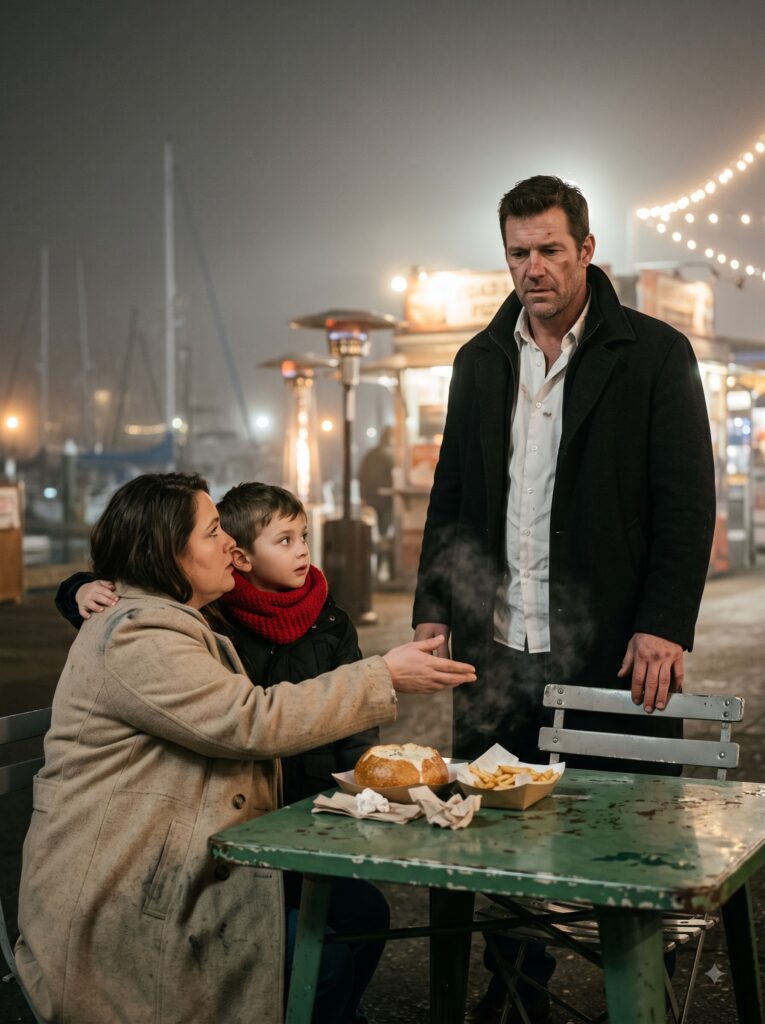
Beatrice’s arms closed around Leo just as Antonio drove the green metal table into the first attacker’s path.
The metal legs struck the man’s knees.
He stumbled, his weapon jerking downward.
Antonio pulled his pistol.
Two muffled shots cracked beneath the noise of the holiday crowd.
The first attacker fell.
The second tried to raise his gun, but Antonio fired again before the man could aim.
Behind the overturned table, Beatrice dropped to her knees, shielding Leo with her body.
“Eyes closed, baby,” she whispered. “Hold Mommy’s coat.”
A third man charged Antonio.
They slammed against the waterfront railing.
Antonio’s pistol skidded across the pavement.
For one terrible second, Beatrice watched the larger man force him backward.
Beyond the railing waited black water.
Antonio twisted, struck his attacker, and sent him crashing onto the concrete.
The struggle ended.
But the screaming was only beginning.
Someone shouted for the police.
A woman grabbed her children and ran.
Antonio retrieved his weapon and turned toward Beatrice.
He expected her to flee from him.
Instead, she was already standing with Leo against her chest.
Her face was bloodless.
Her eyes were clear.
“We need to get him away from here,” she said.
Antonio approached.
“Are either of you hurt?”
“No. But he’s frightened, and I don’t know if those men brought anyone else.”
Antonio looked toward the crowd.
She was right.
He couldn’t see another attacker.
That didn’t mean there wasn’t one.
“Come with me.”
“Where?”
“Somewhere secure.”
Beatrice’s expression hardened.
“Tell me who those men were.”
“Not here.”
“Then tell me why they looked at my son.”
Antonio stopped.
That question landed harder than the attack.
“They came for me,” he answered. “And you were sitting with me.”
Beatrice stared at him.
“You knew them.”
“Yes.”
Before she could respond, sirens rose beyond the waterfront buildings.
Antonio took off his overcoat and offered it to her.
“Leo’s shaking.”
She accepted the coat for her son, then caught Antonio’s sleeve.
“Don’t mistake me walking with you for permission to make decisions about my child.”
He held her gaze.
“I won’t.”
They hurried down a side street.
Antonio called his security chief, directing him to meet them on Bay Street and send help to secure the area.
When the black SUV arrived, Beatrice stopped beside its open door.
Two armed security men stood nearby.
She looked at the vehicle, then at Antonio.
“Tell them to put those weapons away from my son’s sight.”
Antonio gave the instruction immediately.
Only then did she climb inside.
Leo curled against her.
Antonio settled opposite them.
For several minutes, nobody spoke.
The city lights passed across the windows.
Beatrice stroked Leo’s hair until his trembling eased.
Then she asked the question Antonio had been dreading.
“Who are you?”
“Antonio Bellini.”
Her forehead tightened.
She recognized the name.
Even people who never entered San Francisco’s criminal world had heard stories about the Bellini family.
“The Bellini crime syndicate?”
He nodded.
“And those men?”
“Damian Caro’s people. Caro leads a rival organization. We had a confrontation earlier today. Tonight he decided it wasn’t finished.”
Beatrice looked at the blood drying across Antonio’s knuckles.
Then at Leo, nearly asleep against her shoulder.
“You brought a war to our dinner table.”
Antonio didn’t defend himself.
“Yes.”
She swallowed.
“I invited you because you looked hungry.”
“I know.”
“I wasn’t asking for trouble.”
“I know that too.”
His answer sounded almost broken.
Beatrice reached into her canvas bag and removed a small packet of wet wipes.
Antonio watched as she extended one toward him.
“Your hand.”
He looked at her.
“Beatrice—”
“It’s bleeding onto the seat.”
He took the wipe.
But his bruised fingers trembled when he tried to clean the cuts.
After a moment, she reached out and gently steadied his wrist.
Antonio went utterly still.
No one had touched him with such ordinary kindness in years.
“You’re not frightened of me?” he asked.
Beatrice continued cleaning the blood.
“I’m frightened of what happened. I’m frightened of those men finding Leo again.”
Her voice softened.
“And I’m frightened of not making rent next week. That’s been true since before I met you.”
Antonio stared at her.
“You shouldn’t have to live like that.”
“Neither should my son.”
She released his hand.
“But don’t confuse that with me needing someone to take over my life.”
Antonio nodded slowly.
Outside, the SUV turned toward the glass towers overlooking the bay.
“Where are we going?” she asked.
“My penthouse. It’s secure.”
“And afterward?”
“I’ll make sure you can leave safely.”
Beatrice looked through the window.
Then she said something that unsettled him more than any threat Caro had made.
“Antonio, if I’m taking my son into your home, I need to know whether I’m accepting your protection or becoming another person your enemies can use against you.”
He had no easy answer.
And for the first time that night, Antonio Bellini understood that winning the coming confrontation would not be enough.
He would have to prove she could trust him without surrendering her freedom.
As the SUV descended into the private garage beneath Bellini Tower, Beatrice tightened her hold on Leo.
Then she reached for the door handle and waited for Antonio to answer.
Antonio watched Beatrice’s hand resting on the SUV door handle.
The garage lights reflected against the dark windows.
Outside, his security team had already taken positions near the elevator.
He could have told her everything was under control.
He could have promised that nobody would ever touch her son.
Those were the words powerful men used when they wanted obedience.
But Beatrice had asked for something more difficult.
An honest answer.
“Both things are possible,” Antonio admitted. “My enemies may see you as leverage because you were with me tonight. I’m offering protection because that danger exists. But you don’t belong to me, Beatrice. You can tell me no.”
She searched his face.
“And if I do?”
“Then I’ll arrange another safe place and transportation. You decide.”
“And Leo?”
“He stays with you. Every decision about him is yours.”
The tension around her mouth eased slightly.
“Good.”
She opened the door.
“Because I may be poor, Antonio Bellini, but I’m not helpless.”
He stepped out beside her.
“I noticed.”
The private elevator was quiet.
Leo had finally fallen asleep, his head resting beneath Beatrice’s chin.
Antonio stood across from them, hands folded in front of him.
He had negotiated with men who controlled entire criminal crews.
He had faced betrayal inside his own organization.
He had survived threats meant to destroy everything his father left behind.
But he had never felt so unsure of himself as he did standing in an elevator with a tired woman and her sleeping child.
When the doors opened, Beatrice found herself facing an enormous living room.
Floor-to-ceiling windows overlooked San Francisco Bay.
Dark furniture sat in precise arrangements.
The marble floors reflected the city lights.
Everything was expensive.
Everything was immaculate.
Nothing looked lived in.
Leo stirred.
“Mommy?”
“I’m here, sweetheart.”
“Are we home?”
Beatrice kissed his forehead.
“Not yet. We’re staying somewhere safe tonight.”
Antonio felt those words settle heavily in his chest.
Not yet.
He had never considered that a place could contain everything a person needed and still fail to feel like home.
“There are bedrooms down the hall,” he said.
Beatrice looked at him.
“Separate rooms?”
“Yes.”
“And you won’t lock us inside?”
“No.”
She nodded.
“Then show me where he can sleep.”
Antonio led them to the largest bedroom.
A wide bed stood beneath tall windows. Heavy curtains blocked the city lights when Beatrice pulled them closed.
She laid Leo on the mattress, removed his shoes, and carefully unwound the red scarf from his neck.
For a moment, she simply watched him breathe.
Antonio remained in the doorway.
He noticed the way her shoulders dropped now that her son was asleep.
She had been holding herself together for hours.
Only now could she afford to be tired.
“There’s a bathroom through that door,” he said quietly. “Anything you need, tell me.”
Beatrice looked at the clean white towels, the deep bathtub, the expensive fixtures.
Then she turned.
“Do you have something for him to eat in the morning?”
Antonio blinked.
“I can have a chef prepare whatever he wants.”
“He likes scrambled eggs. No pepper.”
Antonio almost smiled.
“I’ll remember.”
“And please don’t overwhelm him with strangers. He’s had enough excitement.”
“Understood.”
She studied him for another second.
“You take instructions surprisingly well for someone with your reputation.”
“Only when they’re reasonable.”
“Then you’ll be learning a lot tonight.”
For the second time that evening, Antonio laughed.
It was a small sound.
But it made Beatrice smile.
And that frightened him more than he wanted to admit.
Because he liked her smile.
He liked that she challenged him without performing courage for an audience.
He liked that she cared more about breakfast for her son than the price of his home.
And he knew that liking her could make her position more dangerous.
When they returned to the living room, his head of security was waiting near the elevator.
“Boss. We have an update.”
Antonio’s expression sharpened.
“Speak.”
The man glanced at Beatrice.
Antonio noticed.
“You can say it in front of her.”
“Caro’s men have left the warehouse area. But Caro himself is still at the Obsidian. He hasn’t moved.”
“Has he heard about the waterfront?”
“Almost certainly.”
Antonio looked toward the city.
Damian Caro had tried to humiliate him publicly.
Then he had sent armed men after him through a crowded tourist district.
It was no longer a question of wounded pride.
Caro had shown that he was willing to put civilians in danger to challenge Bellini authority.
And if Antonio let that tactic succeed, more people would be caught between them.
“We need to finish this,” he said.
Beatrice stepped forward.
“What does that mean?”
Antonio turned.
“It means I have to deal with Caro.”
“With more guns?”
He hesitated.
She noticed.
“You just brought me and my son here because armed men almost killed us. Don’t expect me to applaud when you walk back into the same thing.”
“This conflict existed before tonight.”
“And it will continue after tonight if everyone keeps solving problems the same way.”
His security chief lowered his eyes.
Nobody spoke to Antonio Bellini like that.
Especially not in his own home.
But Antonio didn’t interrupt.
Beatrice continued.
“I understand that people are threatening you. I understand you can’t pretend those men aren’t dangerous.”
She glanced toward the bedroom.
“But my son is sleeping down that hallway. I need to know that whatever you do next won’t make him another target.”
Antonio drew a slow breath.
“I can’t promise Caro will stop because I ask politely.”
“I’m not asking for a polite conversation. I’m asking you to remember there are people outside your war.”
That struck him.
Hard.
Because only hours earlier, he had walked away from the Obsidian to protect the innocent staff inside.
And then, without intending to, he had brought danger straight to a woman who had offered him dinner.
“You’re right,” he said.
His security chief looked up in surprise.
Beatrice was equally startled.
Antonio turned toward the windows.
“Have the restaurant staff cleared through the service exit before we arrive,” he told his security chief. “I want no civilians in that building.”
“Yes, boss.”
“And tell our men nobody fires unless there’s an immediate threat.”
The security chief nodded.
Antonio looked back at Beatrice.
“I’m going because Caro needs to understand that using crowded streets and families as leverage won’t work.”
She folded her arms.
“And what happens if he doesn’t understand?”
Antonio didn’t answer immediately.
“Then I’ll have to live with the consequences of stopping him.”
Beatrice studied his face.
For the first time, she saw something beneath the composure.
Not only anger.
Grief.
A man exhausted by the world he had inherited.
A man who knew violence too well to mistake it for glory.
“Why did you walk away from the restaurant earlier?” she asked.
Antonio looked surprised.
“How did you know about that?”
“You told me Caro took it. But you were alone when I found you. That means you chose to leave.”
Antonio stared at her.
Then his expression changed.
“The manager said Caro would hurt the staff if I entered.”
“And you believed him?”
“He was terrified.”
“So you left.”
“Yes.”
Beatrice stepped closer.
“Then you do know how to walk away from a fight when other people might pay the price.”
Antonio watched her quietly.
“Sometimes walking away only delays it.”
“Sometimes delaying it keeps somebody alive.”
Neither spoke for several seconds.
Then Antonio nodded.
“You’ve made your point.”
“Good.”
She glanced at his injured hand.
“Now sit down before you bleed on anything else.”
Antonio gave her an incredulous look.
“Beatrice—”
“Sit.”
His security chief quickly turned away, concealing a smile.
Antonio Bellini, who commanded some of the most dangerous men in San Francisco, sat down on his own sofa because a woman in a faded coat told him to.
Beatrice fetched the first-aid supplies his security chief provided.
She cleaned the remaining cuts on Antonio’s knuckles.
Up close, she noticed a small scar near his thumb.
An older injury.
One of many, she suspected.
“Does it ever stop?” she asked.
“What?”
“The fighting.”
Antonio watched her fingers moving carefully over his skin.
“No.”
She paused.
“That’s a terrible answer.”
“It’s the honest one.”
Beatrice set down the bandage.
“You’re very good at surviving, Antonio. But I don’t think you’re very good at living.”
The room grew quiet.
He looked at her.
No one had ever said it so plainly.
And no one had ever made him believe it might be true.
“My father built the organization,” he said after a moment. “When he died, everything became my responsibility. The businesses. The men. The people depending on us. The enemies waiting for weakness.”
“And what about you?”
Antonio frowned.
“What about me?”
“Who looks after you?”
He almost answered with the names of his security team.
Then stopped.
Beatrice understood his silence.
She placed the last bandage across his knuckles.
“There,” she said softly. “At least one thing is taken care of.”
Antonio looked at his hand.
A simple white bandage.
He had paid doctors to repair worse injuries.
Yet this felt different.
Because she had not treated him like a boss.
Or a weapon.
Or a bank account.
She had treated him like a person.
“Beatrice.”
She lifted her eyes.
“You and Leo can stay here tonight. Tomorrow, we’ll discuss arrangements that make you comfortable. Your employment, your apartment, whatever security you need.”
Her expression tightened.
“My apartment?”
“You said you’re facing eviction.”
“I did.”
“I can help.”
“I know you can.”
“Then let me.”
She sat back.
“Helping isn’t the same as buying your way into someone’s life.”
“I didn’t say it was.”
“No. But men with money sometimes forget the difference.”
Antonio accepted that without argument.
“Tell me what help would mean to you.”
Beatrice looked down at her worn hands.
For a long moment, she didn’t answer.
Then she said, “A stable home. Work that lets me see my son while he’s awake. Enough money to stop counting every spoonful of food.”
Her voice caught slightly.
“Not a new life somebody can take away the moment I disappoint him.”
Antonio felt something twist painfully inside his chest.
“I wouldn’t do that.”
“You don’t know me well enough to promise.”
He considered her words.
Then nodded.
“Fair.”
She looked up, surprised.
“I want to believe you,” she admitted.
“Then don’t believe me yet.”
Antonio rose.
“Watch what I do.”
His security chief appeared again at the doorway.
“Boss. The staff are leaving the Obsidian now. Caro’s men have noticed.”
Antonio’s face hardened.
“Is Caro moving?”
“No. He’s waiting.”
“Then so am I done waiting.”
Beatrice stood.
“Antonio.”
He turned.
She approached until she stood directly in front of him.
He could smell the faint scent of soap and cold sea air in her hair.
“I’m not going to tell you I understand your world,” she said.
“And I’m not going to pretend I know what you should do about every person threatening you.”
Her eyes held his.
“But don’t come back here expecting me to celebrate another man’s death.”
Antonio swallowed.
“I won’t.”
“Come back because you chose to survive.”
For one suspended second, neither moved.
Antonio raised his hand.
He stopped before touching her cheek.
Beatrice saw the question in his eyes.
After a moment, she stepped closer.
His fingertips brushed her face.
It was the gentlest touch she had received in a long time.
“Come back in one piece,” she whispered.
“Leo and I still owe you a proper New Year’s dinner.”
Antonio smiled faintly.
“You already fed me.”
“One French fry doesn’t count.”
“It did tonight.”
She looked away before he could see the sudden moisture in her eyes.
Antonio lowered his hand.
Then he turned and left.
The elevator doors closed between them.
Beatrice stood alone in the enormous room, listening to the silence.
She did not know whether she would see him again.
And what unsettled her most was how badly she wanted to.
Downstairs, Antonio joined his security team.
Several SUVs waited in the garage.
His security chief handed him an update.
“Caro still has armed men inside. But the restaurant staff are out.”
Antonio studied the information.
Good.
At least the people who had served dinner there would not have to stand between rival organizations.
He entered the lead vehicle.
As the convoy moved through the fog, Antonio remembered Beatrice’s words.
Come back because you chose to survive.
He had never been afraid of dying.
That was the problem.
A man who had nothing to live for could mistake recklessness for courage.
Tonight, for the first time in years, he wanted tomorrow.
At the Obsidian, Caro was still celebrating.
He had taken the restaurant.
He had publicly humiliated Antonio Bellini.
And he believed his scouts had completed the job.
Then the call he was waiting for never came.
Instead, one of his men rushed through the dining room.
“Boss. Bellini’s outside.”
Caro stood.
“What?”
Before anyone could answer, the glass entrance shattered.
Antonio Bellini walked through the broken doorway with his security men behind him.
The remaining Caro men reached toward their weapons.
“Don’t,” Antonio said.
His voice was calm.
That made it worse.
Caro stared at him.
“You should be dead.”
Antonio stepped forward.
“And you should have left the families on the waterfront alone.”
Caro’s expression changed.
He realized his men had failed.
Antonio continued.
“You wanted my attention. You have it.”
The dining room fell silent.
Broken glass glittered across the floor.
Caro’s fingers moved toward the pistol at his waist.
Antonio watched him.
“Don’t make another mistake, Damian.”
But Caro was already drawing.
And Antonio raised his weapon.
The gunshot shattered the silence.
Damian Caro stumbled backward against the white linen table.
His champagne glass toppled and broke.
For one suspended second, the entire dining room seemed frozen.
Then Caro collapsed.
Antonio kept his weapon trained in his direction until his security chief confirmed there was no further threat.
Across the room, Caro’s remaining men stood motionless.
They had watched their leader provoke the confrontation.
They had watched him reach for his gun.
And now they understood the price of a conflict that had escalated beyond business into a reckless public attack.
Antonio looked at them.
“It’s finished.”
Nobody answered.
“You leave this building without touching another employee, customer, or civilian. You don’t come near my people again.”
One of the men slowly raised his hands.
The others followed.
Antonio’s security chief moved forward to direct them out.
But Antonio did not smile.
There was no triumph in his expression.
No satisfaction.
Another man was dead.
Another violent night would leave consequences that could not simply be erased.
Caro’s death ended the immediate confrontation, but Antonio knew that a dead rival did not magically erase every alliance, resentment, or obligation left behind.
There would be questions.
Retaliation to guard against.
People who had depended on Caro and would now have to choose a different future.
Antonio had spent his adult life understanding such consequences.
He simply had never cared so much about living through them.
“Boss?” his security chief said.
Antonio lowered his weapon.
“Make sure the staff get home safely. Our people will deal with the damage and cooperate with the necessary inquiries.”
He looked around the ruined restaurant.
Earlier that evening, he had wanted nothing more than to sit at his favorite table.
Now he could have any table in the room.
And he wanted none of them.
“Let’s go.”
***
At Bellini Tower, Beatrice had spent the past hour trying to convince herself she wasn’t waiting.
She had checked on Leo three times.
Found a glass of water.
Folded his coat over a chair.
Straightened his little red scarf.
Then she had wandered toward the massive windows overlooking the city.
From this height, San Francisco looked almost peaceful.
Lights shimmered along the waterfront.
Boats moved slowly across the bay.
Distant celebrations echoed through the streets.
It was difficult to believe that somewhere beneath those lights, people were fighting and dying over territory.
Beatrice pressed her palm against the cold glass.
Her own life had been difficult enough without organized crime entering it.
She worked two minimum-wage jobs.
She rented an apartment she could barely afford.
Some mornings, she woke before sunrise to begin a shift and returned home after Leo had fallen asleep.
She had learned to calculate grocery prices in her head.
To repair clothes instead of replacing them.
To make one meal stretch into two.
She had become very good at surviving.
But the last few hours had shown her something frightening.
Survival could become a life so narrow that there was no room left for hope.
She thought of Antonio.
The wounded man at the waterfront.
The dangerous stranger who had accepted a cold French fry as though it were a gift.
The mafia boss who had listened when she challenged him.
And the man who had gone back into danger because his enemy would not leave him alone.
Beatrice closed her eyes.
“Please come back,” she whispered.
Then she frowned at herself.
She had known him for only a few hours.
A few terrible, extraordinary hours.
How could a stranger already matter?
Perhaps because she understood loneliness better than she wanted to admit.
Leo was the center of her world.
But being loved by a child was not the same as having another adult beside you.
Someone who noticed when you were tired.
Someone who asked what you wanted rather than what you could endure.
She had forgotten how much she missed that.
The private elevator chimed.
Beatrice turned.
Antonio stepped into the living room.
His black coat hung open.
His face was pale with exhaustion.
There was a fresh tear in the cuff of his shirt.
But he was standing.
Alive.
For a moment, she couldn’t speak.
Then she crossed the room.
“Antonio.”
He stopped.
“Beatrice.”
She looked him over.
“Are you hurt?”
“Nothing new.”
“That isn’t an answer.”
He gave a tired smile.
“I’m all right.”
She stared at him.
Then, unable to stop herself, she threw her arms around him.
Antonio froze.
His hands remained at his sides for a fraction of a second.
Then he carefully wrapped his arms around her.
Not tightly enough to trap her.
Just enough to hold her.
Beatrice rested her cheek against his chest.
His heartbeat was strong and steady.
And for the first time since the shooting at the pier, she felt her own breathing slow.
“You came back,” she whispered.
“I told you I would.”
She pulled away slightly.
“Is it over?”
Antonio looked at her.
“Caro is dead.”
Her expression changed.
She had expected the answer.
Still, hearing it hurt.
“Did you kill him?”
“Yes.”
Antonio did not soften the truth.
“He reached for his weapon when we confronted him. I fired.”
Beatrice lowered her eyes.
For several seconds, neither spoke.
Then she asked, “Did you have another choice?”
“I went there knowing he might force one.”
“That isn’t what I asked.”
Antonio was silent.
He thought of the ruined restaurant.
The men standing with their hands raised.
The life that had ended on the floor.
“I don’t know whether another path would have worked,” he admitted. “I know I chose to confront him tonight. I have to own that.”
Beatrice nodded slowly.
“Then don’t tell me this makes everything safe forever.”
“I won’t.”
“And don’t pretend what happened tonight is something you did for me.”
Antonio looked at her sharply.
She continued.
“Caro was your enemy before I met you. He threatened you before Leo and I ever sat at that table.”
“Yes.”
“I don’t want you making me the reason for every dangerous decision you take.”
Antonio felt the weight of her words.
Earlier, he had imagined he could solve everything by destroying the man who threatened them.
But Beatrice refused to become an excuse.
Or a prize.
Or a debt.
She was asking him to see her as a person whose life existed beyond his own.
“You’re right,” he said quietly.
She looked at him.
“I don’t know how to live in your world, Antonio.”
“I’m not asking you to.”
“Good. Because I won’t raise my son inside a war.”
Antonio stepped back, giving her room.
“Then we need to talk about what happens next.”
Beatrice almost laughed.
“It’s nearly midnight.”
“Yes.”
“And my son is asleep in a bed bigger than our apartment’s living room.”
Antonio’s mouth curved.
“I noticed he took the middle.”
“He always does.”
The ordinary exchange eased something between them.
For a moment, there were no rival organizations.
No broken glass.
No weapons.
Only two tired adults standing in a quiet room, trying to understand what this strange evening had done to their lives.
Antonio removed his coat.
“I’ll be back in a moment.”
“Where are you going?”
“To wash up.”
Beatrice glanced at his hands.
“Good idea.”
He smiled.
Then disappeared down the hallway.
When he returned, his face was clean, his coat gone, and his sleeves rolled to the elbows.
Beatrice was standing near the windows.
Outside, the first bursts of fireworks were beginning to illuminate the fog.
“Still awake?” he asked.
“Apparently.”
He approached but stopped a respectful distance away.
“May I stand with you?”
She gave him a small smile.
“It’s your window.”
“That wasn’t what I asked.”
Something warm moved through her chest.
“Then yes.”
Antonio stood beside her.
For a while, they watched the city in silence.
Then he spoke.
“Earlier, when you asked who looks after me…”
Beatrice turned.
“I’ve been thinking about it.”
“And?”
“I realized I didn’t have an answer.”
Her expression softened.
“That’s a lonely way to live.”
“It was the only way I knew.”
He glanced at her.
“Then you invited me to sit down.”
Beatrice smiled faintly.
“You looked hungry.”
“I was.”
“For food?”
Antonio considered the question.
“For something I didn’t know how to ask for.”
The air between them changed.
Beatrice could hear the distant countdown beginning somewhere along the waterfront.
She looked at him carefully.
“I need you to understand something.”
“Tell me.”
“I don’t want to be rescued into a life where I owe someone everything.”
“You don’t owe me anything.”
“Not even for tonight?”
“Especially not for tonight.”
She studied his face.
“I want my own home. I want to work. I want Leo to grow up knowing his mother can stand on her own.”
Antonio nodded.
“I can help you find work that pays fairly. Or help you keep the work you choose. But the decision will be yours.”
“And the apartment?”
“We can arrange somewhere secure while the threat is assessed. You decide whether to accept it. If you prefer your own place, we’ll discuss ways to make that safe.”
Beatrice sighed.
“You make it sound simple.”
“It won’t be.”
At least he was honest.
“I don’t know whether I can trust you,” she admitted.
“I understand.”
“But I think I’d like to find out.”
Antonio turned fully toward her.
For the first time all evening, uncertainty showed openly on his face.
“You would?”
She smiled.
“You’re not the only person who had a lonely New Year’s Eve planned.”
Antonio’s expression softened.
“Beatrice…”
“Don’t ruin it with a speech.”
He laughed quietly.
She stepped closer.
“I’m serious. No promises about forever. No deciding what my life should look like. No pretending a few hours mean we know everything about each other.”
“All right.”
“And if I tell you no, you listen.”
“Every time.”
She watched him for a long moment.
Then reached for his hand.
His bandaged knuckles rested gently against her fingers.
“Then maybe we could start with dinner.”
Antonio looked at her.
“Dinner?”
“A real one. With actual chairs that don’t threaten to collapse.”
His smile widened.
“Would tomorrow work?”
“Tomorrow I have Leo.”
“Bring him.”
“Antonio, you can’t just order a fancy restaurant to—”
“I wasn’t going to.”
She raised an eyebrow.
“Really?”
“I thought we could eat somewhere he likes.”
Beatrice considered him.
“He likes grilled cheese.”
Antonio nodded solemnly.
“Then grilled cheese it is.”
She burst into laughter.
It was a full, delighted laugh.
Antonio stared at her as though he had never heard anything so beautiful.
Outside, the countdown reached its final seconds.
Ten.
Nine.
Eight.
Antonio gently brushed a loose strand of hair away from Beatrice’s cheek.
“May I kiss you?” he asked.
Her laughter faded.
She looked into his eyes.
The dangerous man from the waterfront stood before her.
But he wasn’t commanding.
He wasn’t claiming.
He was asking.
And the difference mattered.
“Yes,” she whispered.
At midnight, fireworks exploded over San Francisco Bay.
Antonio bent toward her.
Their lips met.
The kiss was gentle at first.
Almost cautious.
Then Beatrice rested her hand against his chest, and Antonio pulled her closer only when she moved willingly into his arms.
For a brief, astonishing moment, the violence of the evening seemed very far away.
When they separated, Antonio rested his forehead lightly against hers.
“Happy New Year, Beatrice.”
She smiled.
“Happy New Year, Antonio.”
From the hallway came a small, sleepy voice.
“Mommy?”
They turned.
Leo stood at the bedroom doorway, his red scarf wrapped loosely around his shoulders.
His hair stuck up in every direction.
“Did I miss the fireworks?”
Beatrice immediately stepped away.
“Oh, sweetheart.”
Leo hurried toward her.
She knelt and gathered him into her arms.
“Only the beginning.”
Antonio crouched beside them.
“Want to see?”
Leo looked suspiciously at the tall man.
“From here?”
“Best view in the building.”
“Even better than outside?”
“Much warmer.”
Leo considered the offer.
Then nodded.
Antonio moved aside to give them the clearest place at the window.
Beatrice lifted her son.
Leo pressed his little hands against the glass.
Gold and red lights burst above the distant water.
“Wow,” he whispered.
Antonio stood beside them.
And watched.
Not the fireworks.
Not the city.
The woman who had fed him when she had almost nothing.
The child who had welcomed him to a battered table.
The two people who had reminded him that life could contain something other than power and duty.
He didn’t mistake the moment for a promise of instant happiness.
He knew tomorrow would bring difficult questions.
But for once, he wanted to answer them.
***
The following morning, Beatrice woke to the smell of breakfast.
For several confused seconds, she didn’t recognize the room.
Then she heard Leo laughing.
She hurried into the hallway.
In the kitchen, Antonio stood beside a plate of scrambled eggs.
Leo sat on a high stool, wearing his red scarf.
“You remembered!” the boy announced.
Antonio glanced up.
“Remembered what?”
“No pepper!”
Beatrice stopped in the doorway.
Antonio looked almost embarrassed.
“He gave me very specific instructions.”
Leo nodded seriously.
“And he made toast.”
“Did he?”
“It’s a little burned.”
Antonio sighed.
Beatrice laughed.
The sight was absurd.
A mafia boss who had survived a violent New Year’s Eve confrontation now stood in a spotless kitchen being judged by a five-year-old over toast.
Antonio looked at her.
“Good morning.”
“Good morning.”
He pulled out a chair.
“Coffee?”
She hesitated.
Then smiled.
“Yes, please.”
He poured it himself.
No servants appeared.
No grand declarations followed.
They ate breakfast together.
And when Leo became occupied with his eggs, Antonio quietly told Beatrice he had arranged for his security chief to review the danger around her apartment before she made any decisions about returning.
He had not canceled her lease.
He had not contacted her employers.
He had not moved her possessions.
He had waited.
Beatrice recognized the significance.
“You really meant what you said.”
Antonio met her eyes.
“Yes.”
She looked down at her coffee.
“Then I want to make a plan.”
They did.
Not a fairy-tale plan.
A practical one.
Beatrice would keep control of her finances and employment. Antonio would help her evaluate safer housing options without putting property or obligations in her name without her agreement.
She wanted better work.
He offered to introduce her to the manager of one of the family’s legitimate hospitality businesses, where positions were available.
She insisted on applying like everyone else.
Antonio agreed.
She also insisted that any help he offered for Leo’s safety had to be explained to her first.
Again, he agreed.
The weeks that followed were not effortless.
The aftermath of Caro’s death required Antonio’s attention, and the organizations involved had not forgotten their grievances overnight.
He had to make hard decisions about security, leadership, and the future of the businesses under his influence.
There were evenings when he couldn’t visit.
Times when Beatrice questioned whether the dangers surrounding him were something she could ever accept.
And moments when Antonio instinctively tried to solve problems before asking what she wanted.
Each time, she challenged him.
Sometimes they argued.
Sometimes they needed space.
But Antonio kept learning the most difficult lesson of his life.
Love did not mean making every decision for someone.
It meant making room for someone else’s decisions, even when uncertainty frightened him.
Beatrice, meanwhile, began rebuilding the life she had wanted long before meeting him.
She interviewed for a better-paying position in hospitality.
She earned it through her own experience, reliability, and ability to handle demanding customers.
She moved into a modest, secure apartment she chose herself.
Leo settled into a steadier routine.
For the first time in years, Beatrice could buy groceries without adding every price twice.
But the achievement she treasured most wasn’t financial.
It was coming home in time to hear Leo tell her about his day.
Antonio visited when invited.
Sometimes he brought dinner.
Sometimes he helped Leo with a puzzle.
Sometimes he sat quietly at Beatrice’s small kitchen table after a long day and let her tell him about hers.
He was still Antonio Bellini.
Still powerful.
Still dangerous.
Still responsible for a complicated world Beatrice refused to romanticize.
But the man who once believed solitude was the cost of leadership had begun to understand that companionship was not weakness.
And the woman who once believed accepting help meant losing independence had discovered that genuine support could make her choices larger rather than smaller.
Their relationship grew slowly.
Through difficult conversations.
Ordinary evenings.
Disagreements that didn’t become threats.
Promises tested by actual behavior.
And the steady realization that they wanted to choose each other again the following day.
***
One year later, on New Year’s Eve, the fog returned to Fisherman’s Wharf.
The seafood stand was still there.
So were the three battered green tables.
The same cold wind blew off the bay.
And at the third table sat Beatrice Sacco, bundled in a new winter coat, with Leo beside her in his familiar red scarf.
He was eating French fries with great concentration.
“Mommy,” he said, “do you remember when we met Antonio?”
Beatrice smiled.
“I do.”
“He looked really sad.”
“Yes, sweetheart. He did.”
“Was it because nobody gave him fries?”
She laughed.
“Maybe a little.”
A deep voice spoke behind them.
“I can confirm the fries helped.”
Leo turned.
“ANTONIO!”
Antonio Bellini approached the table carrying three steaming bowls of clam chowder.
His expression softened as Leo waved him toward the empty chair.
“Sit here!”
Antonio obeyed.
Beatrice watched him settle into the same uncomfortable green chair where their lives had first crossed.
“You know,” she said, “for a man who can afford any restaurant in San Francisco, you keep choosing this one.”
Antonio looked at her.
“Best table in the city.”
“It’s wobbly.”
“I’ve noticed.”
“The fries are usually cold.”
“They were memorable.”
“And the service?”
Antonio reached across the table.
Beatrice took his hand.
“The service,” he said softly, “changed my life.”
She smiled.
This time, there was no fear behind it.
No desperate need to pretend everything was fine.
She had work she was proud of.
A home she controlled.
A son who was thriving.
And a man beside her who had learned that choosing someone meant respecting the life they had already built.
Leo pushed the fries between them.
“Everybody gets some.”
Antonio took one.
Beatrice took another.
And when the midnight fireworks began to brighten the sky, Antonio looked across the little green table at the woman who had once offered him a chair without knowing his name.
He no longer thought of her as someone he had rescued.
Because on the night they met, she had given him something his power could never command.
A place to belong.
Not as a feared boss.
Not as a ruler of territory.
Not as a man everyone obeyed.
Simply as Antonio.
And this time, when Beatrice reached across the table, he did not hesitate to take her hand.
The city was still complicated.
Their future was not guaranteed to be easy.
But they were no longer strangers, and neither had surrendered the right to choose.
Leo laughed as a burst of gold lit the bay.
Beatrice leaned against Antonio’s shoulder.
And the man who once couldn’t find a table on New Year’s Eve finally understood that the best seat in the world was the one someone freely saved for him.

