
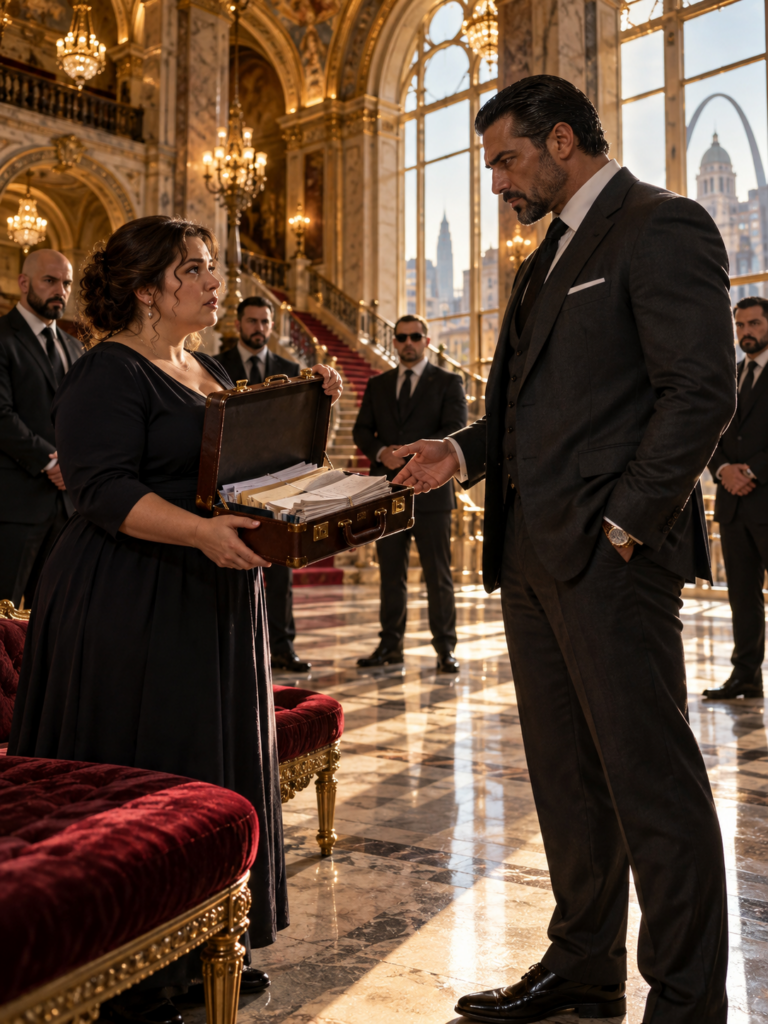
His fingers closed around the paper, but Teresa kept her hand on the opposite edge.
“You’re negotiating with me?” Alessio asked.
“I’m deciding whether your proposal is better than the danger I’m already in.”
One of the guards gave a startled laugh.
Alessio turned his head.
The laughter stopped.
“Leave us within sight,” he told his men. “But give us some distance.”
They moved toward the grand staircase.
Teresa watched until they were beyond ordinary speaking range.
Then she released the page.
“First, I don’t accept responsibility for Curado’s theft.”
“Agreed.”
“Second, I keep control of my personal finances.”
“At present, you have none.”
The words landed harder than he intended.
She looked away.
That morning, she’d checked her bank account six times, unable to believe the same number kept appearing.
Zero.
Not enough for rent.
Not enough for groceries.
Not enough to leave St. Louis.
Curado had even taken the savings she’d accumulated before meeting him.
“I know what I have,” she said.
Alessio’s expression changed.
“That wasn’t meant as an insult.”
“Then don’t use my situation as leverage.”
He watched her for a moment.
“Continue.”
“I need access to the financial information required for the investigation. And my work must count for something beyond paying a debt I never owed.”
“Compensation.”
“Yes.”
“How much?”
“We can negotiate that after I know the work involved.”
Another pause.
“You really are an accountant.”
“That seems to surprise everyone.”
He looked at the financial statements scattered across the table.
“Show me something I can verify.”
Teresa pulled one page free.
“Your restaurant business reported certain supplier expenses twice during the same accounting period. The amounts were routed differently, but the original transaction dates match.”
Alessio read the figures.
“You’re accusing my people of stealing?”
“I’m identifying a discrepancy. Someone needs to establish why it exists.”
He studied the page a second time.
Then he took out his phone.
“Bring me the restaurant accounts,” he told the person who answered. “And don’t change anything before I see them.”
He ended the call.
Teresa felt a flicker of relief.
He was listening.
Then he asked, “Why didn’t you take these records to the police?”
Her throat tightened.
“Because my signature is all over them. Curado made sure of that.”
“And you’re worried they would arrest you.”
“I’m worried no one will believe I didn’t know.”
“Did you?”
She met his eyes.
“I knew he worked with dangerous people. I didn’t know he was stealing from them. If I had, I wouldn’t be standing here.”
Alessio searched her expression.
“You’re either very convincing or very brave.”
“I’m frightened out of my mind.”
“Then why haven’t you run?”
“Because he would still have my name on those papers.”
The answer seemed to settle something in him.
He pulled out the chair opposite the velvet bench.
“Sit.”
Teresa remained standing.
Alessio exhaled slowly.
“Please sit, Teresa.”
That single word changed the moment.
She sat.
He took the opposite chair, placing the table between them.
“My marriage proposal wasn’t made for entertainment,” he said. “Inside my family, a marriage would make your protection an unmistakable obligation.”
“But it wouldn’t make me your property.”
“No.”
“And it wouldn’t give you the right to make every decision for me.”
His jaw tightened.
“I’m accustomed to making decisions that keep people alive.”
“Then you can learn to explain them.”
Something in his gaze shifted.
Not tenderness.
Not yet.
Recognition.
He was beginning to understand why Curado had concealed the extent of her intelligence.
“I can have a written agreement prepared,” Alessio said.
Teresa blinked.
“You said your world didn’t work that way.”
“My world has lawyers, Miss Fina. Despite what you may have heard.”
It was the first time she smiled.
A small smile, gone almost immediately.
“Then there’s one more condition.”
“I’m beginning to regret asking.”
“If we marry, our personal relationship remains separate from the business arrangement.”
He regarded her carefully.
“Meaning?”
“Meaning a wedding ring doesn’t give you permission to touch me, sleep beside me, or demand affection.”
The silence grew heavy.
Then Alessio nodded.
“Understood.”
Teresa had expected an argument.
His simple acceptance unsettled her more.
He looked down at the documents again.
“But there’s something you should know before you sign.”
“What?”
“Vogel didn’t merely leave your name on those papers.”
Teresa’s pulse accelerated.
Alessio turned one document toward her.
Beside her forged signature was a notation she had never seen before.
“The accounts were structured to make you look like the person controlling the transfers.”
She leaned forward.
“That’s impossible.”
“Can you prove it?”
She stared at the page.
Then she recognized the date.
Her stomach dropped.
“Yes,” she whispered. “But I’ll need access to the original records.”
Alessio held out his phone.
“Then tell my accountant exactly what you need.”
Teresa reached for it, knowing that the moment she made the call, she would be stepping further into the world she’d come here to escape.
Teresa took Alessio’s phone and gave his accountant a precise list of records.
She asked for the original transaction entries, the supporting documents, and the dates the records had first been entered into the system.
The accountant hesitated.
“Mr. Caruso, who exactly is requesting these?”
Alessio held out his hand.
Teresa thought he intended to take the phone away.
Instead, he switched it to speaker.
“Her name is Teresa Fina,” he said. “And you’ll answer her questions.”
“Yes, sir.”
“Don’t alter anything.”
The call ended.
Teresa placed the phone on the table.
“That was surprisingly reasonable.”
“Don’t sound so disappointed.”
“I’m adjusting my expectations.”
Alessio almost smiled.
Within two hours, she had confirmed the first piece of Curado’s deception.
Several transactions bearing her name had been recorded on days when she had no access to his workplace or accounts. The electronic documents had been created through business systems she had never been permitted to use.
Her signatures were forged.
But the most damaging part wasn’t the forgery itself.
It was the deliberate way Curado had arranged the evidence.
He had created the appearance that she was directing the transfers while he merely carried out routine instructions.
“He didn’t expect anyone to investigate beyond the paperwork,” Teresa said.
They were still at the opera house, now working at a table near the windows.
Alessio examined the dates.
“He expected me to blame you.”
“Yes.”
“Why?”
“Because it’s easier to punish someone who can’t defend herself than to find the person who actually took the money.”
The words hung between them.
Alessio looked at her.
“You believe that’s what I would have done.”
“Your men came to my apartment to collect a debt.”
His silence answered enough.
Teresa closed the file.
“I’ll recover your money. But I’m not going to pretend I came here because I admired your reputation.”
“Fair.”
“And I’m not going to marry you because I’m grateful you decided not to hurt me.”
“Then why consider it?”
She glanced toward the entrance.
“Because I need protection from Curado. And because you need something I can provide.”
For the first time that morning, Alessio looked almost relieved by her honesty.
“Then we’ll start with the agreement.”
***
Forty-eight hours later, Teresa stood in a judge’s private study wearing a simple navy wrap dress.
The marriage was legal.
The arrangement was practical.
And the ring Alessio slipped onto her finger felt heavier than anything she’d ever worn.
Two members of his organization witnessed the ceremony.
There were no flowers, no music, and no declarations of love.
Only signatures, formal words, and a man whose attention never seemed to leave her face.
Afterward, Alessio offered his arm.
Teresa glanced at it.
“Are we supposed to pretend we’re in love?”
“No.”
“Good.”
“But we should probably appear comfortable standing next to each other.”
She considered that.
Then she took his arm.
“That sounds manageable.”
His estate stood beyond the crowded neighborhoods of St. Louis, overlooking a private lake.
Security monitored the entrances.
The house was quiet, expansive, and unmistakably built for a man who trusted very few people.
Teresa’s belongings arrived in two suitcases.
Everything she owned fit inside them.
A housekeeper showed her a spacious bedroom with windows overlooking the water.
“This is yours, Mrs. Caruso.”
Teresa looked around.
“Where does Alessio sleep?”
The woman hesitated.
Before she could answer, Alessio appeared in the doorway.
“That’s something we should discuss.”
Teresa folded her arms.
“Yes. We should.”
He looked toward the housekeeper.
“Thank you.”
Once they were alone, he gestured around the room.
“This was my bedroom.”
“Was?”
“I’ve arranged another room for myself.”
She stared at him.
“You gave me your room?”
“It’s the most comfortable suite.”
“You could have put me in a guest room.”
“I could have.”
Teresa examined his expression.
“Why didn’t you?”
“Because I want you to be comfortable here.”
She didn’t know what to say.
Curado had spent years making her feel that her body occupied too much space.
He had criticized the way she dressed, complained about sharing a bed, and embarrassed her whenever she ordered dessert in public.
Now she stood in the private bedroom of a feared criminal leader, and he was offering to leave it.
“You don’t have to flatter me,” she said quietly.
Alessio frowned.
“What?”
“I know I’m not the kind of woman men like you usually marry.”
“Men like me?”
“Powerful men. Men who could choose anyone.”
He studied her.
“Teresa, I offered you a marriage because you were the first person in months to bring me a solution instead of an excuse.”
“That’s not what I meant.”
“I know.”
His voice softened.
“Your appearance isn’t something you need to apologize for.”
She looked down at her hands.
“Curado made it feel that way.”
“Curado seems to have made a career out of being wrong about you.”
Unexpectedly, she laughed.
Alessio stepped toward the door.
“Get some rest. We’ll start work tomorrow.”
“Alessio?”
He turned.
“Thank you for asking about the room.”
He inclined his head.
“Good night, Teresa.”
For a long moment after he’d left, she remained standing beside the bed.
Then she closed the door.
For the first time in years, she slept without anyone criticizing how much space she took up.
***
The following weeks transformed the estate.
Teresa converted a portion of Alessio’s study into a financial workspace.
She organized the records by account, business, and transaction date, separating reliable documents from entries that could have been manipulated.
Alessio gave her access to the information necessary to trace the missing funds.
She quickly discovered that the theft wasn’t simply a single disappearance.
Curado had concealed it inside legitimate business activity and complicated transfers that made the missing money difficult to follow.
He had also left weaknesses in the organization’s accounting controls.
When Teresa explained them, Alessio listened.
Not always patiently.
But he listened.
Late one evening, he found her at the desk surrounded by papers and brought her dinner.
“You skipped lunch,” he said.
“I’m close to finding something.”
“The numbers won’t disappear if you eat.”
“You don’t know that.”
“I do know you’re exhausted.”
She looked up.
“Are you always this demanding?”
“When I’m worried, apparently.”
That admission surprised them both.
Alessio placed the plate beside her and stepped back.
Teresa took a bite.
“You’re getting better at asking.”
“I’m making an effort.”
“Keep practicing.”
He sat in the chair opposite her.
And for the first time, their conversation drifted beyond ledgers and stolen money.
She told him about the accounting career she’d wanted before Curado gradually convinced her to abandon it.
He spoke about inheriting responsibilities inside his family that had left little room for trusting strangers.
Neither offered every detail.
But something changed.
He began asking what she thought before giving instructions.
She began believing that her opinions mattered.
***
The first serious test arrived during a meeting with his senior men.
Teresa stood beside the dining-room table presenting the financial evidence.
She wore a crimson dress she’d chosen for herself, one that made her feel confident instead of concealed.
Most of the men listened carefully.
Sylvio, an older capo, did not.
“So now we’re taking financial orders from Vogel’s leftover girlfriend?” he asked.
Teresa stopped speaking.
The room went silent.
Sylvio leaned back.
“She looks more suited to shopping than handling our accounts.”
Alessio stood.
The scrape of his chair drew everyone’s attention.
“Sylvio.”
The older man looked toward him.
“Boss, I meant—”
“You were asked to examine the figures.”
Alessio’s voice was dangerously quiet.
“Instead, you’ve insulted the person doing the work you failed to do.”
Sylvio’s face reddened.
Teresa placed her folder down.
“Actually, I’d like to answer him.”
Alessio turned toward her.
She met his eyes.
“Please.”
He stepped aside.
Teresa walked to Sylvio’s end of the table.
“Three weeks ago, you approved expense summaries that included duplicated supplier charges.”
Sylvio frowned.
“I approve hundreds of documents.”
“I know. That’s why I prepared a list.”
She placed a page in front of him.
“Those duplicates helped Curado conceal missing money. Your department was responsible for identifying them.”
His face drained.
Teresa continued.
“My appearance has absolutely nothing to do with those numbers. Your approval signature does.”
Nobody spoke.
She returned to the head of the table.
“So if we’re finished discussing my body, I’d like to explain how we’re going to keep this from happening again.”
Alessio looked around the room.
“You heard her.”
Sylvio remained silent.
Teresa continued her presentation.
Only later, when the room emptied, did Alessio approach her.
“I should have stopped him sooner.”
“You did stop him.”
“After he insulted you.”
She gathered her papers.
“I appreciate you backing me up. But I don’t need you to frighten people into pretending they respect me.”
“What do you need?”
“For them to understand why I’m right.”
Alessio considered that.
Then nodded.
“Fair enough.”
She looked at him with a faint smile.
“You’re learning.”
“Apparently marriage has become an education.”
***
By the end of the first month, the missing money had a destination.
Teresa found the pattern Curado had tried to hide.
The transfers ultimately connected to accounts outside the United States.
More importantly, an old phone she’d kept after their breakup contained an authentication method connected to his financial arrangements.
Curado had once treated that phone as useless.
He’d forgotten Teresa rarely threw anything away.
She sat at her desk one evening reviewing the account details when the remaining evidence finally aligned.
“Alessio.”
He looked up from the chair across from her.
“What’s wrong?”
“I found it.”
He moved beside the desk.
She pointed toward the screen.
“The money.”
“All of it?”
“Three million dollars.”
He went still.
“Where?”
“In the accounts Curado used after the original transfers.”
“Can we recover it?”
“Possibly. I can establish the route, and the access information on this phone may allow the financial institutions involved to act.”
Alessio stared at the figures.
For weeks, he’d watched accountants argue over partial records.
Teresa had reconstructed the trail.
“You’re extraordinary,” he said quietly.
She glanced up.
There was no mockery in his expression.
No calculation.
Only respect.
“Don’t celebrate yet,” she said.
“Why not?”
“Because Curado will realize someone found the money.”
Alessio looked at the old phone.
“And he’ll know it’s you.”
“Yes.”
A troubling silence followed.
Then Teresa opened another document.
“Which means we need to be ready for what he does next.”
Alessio moved closer.
“I can increase security.”
“Good. But I won’t stop working.”
“I wasn’t going to ask you to.”
She looked at him.
“Really?”
He smiled slightly.
“I’m learning.”
***
Three days after the recovered funds were secured, Teresa visited a Caruso-owned restaurant in the Hill neighborhood.
She wanted to review the original financial books in person.
Rocco, Alessio’s security chief, accompanied her with several guards.
The morning was bright.
Inside the restaurant, employees prepared for lunch while fresh bread cooled behind the counter.
Teresa finished examining the records and began placing her laptop in its case.
Then the front windows exploded.
Gunfire ripped through the dining room.
Glass scattered across the tables.
Rocco shouted for everyone to get down.
Teresa dropped beside the booth as security moved between her and the front entrance.
Her heartbeat thundered.
Someone screamed from the kitchen.
“Back exit!” Rocco shouted.
Teresa followed him through the overturned chairs.
They reached the kitchen just as a man forced open the alley door.
A shotgun appeared in his hands.
Rocco was turned toward the dining room.
Teresa saw the weapon before he did.
Her hand closed around a heavy cast-iron skillet on the preparation counter.
She threw it.
The skillet struck the attacker in the chest, throwing his aim upward.
A blast tore into the ceiling.
Rocco turned and fired.
The attacker fell.
“Move!” Rocco shouted.
Teresa ran toward the open alley door as he reached for her arm.
Rocco caught Teresa’s arm and guided her into the alley.
An SUV waited beside the restaurant’s rear entrance.
The driver opened the back door.
Teresa climbed inside, clutching her leather briefcase against her chest.
Only when the vehicle pulled away did her hands begin to shake.
Her palms were scraped.
Glass dust covered her coat.
And the sound of the gunfire kept repeating in her head.
Rocco glanced back from the front seat.
“Mrs. Caruso?”
“I’m all right.”
“You just saved my life.”
“I threw a frying pan.”
“You threw it at a man holding a shotgun.”
Teresa looked down at her trembling fingers.
“I was scared.”
“So was I.”
That answer helped more than any reassurance could have.
They drove toward the estate.
As the city disappeared behind them, Teresa stared out the window.
Curado had tried to make her helpless again.
This time, he’d failed.
But people had been injured.
A restaurant had been destroyed.
And the danger had followed her into a place where strangers were simply trying to work.
When the vehicle passed through the estate gates, Alessio was already outside.
He reached the SUV before it stopped completely.
Rocco opened the door.
Alessio looked at Teresa, his expression changing as he noticed her dusty clothes and scraped hand.
“Are you hurt?”
“Just a scratch.”
“Teresa.”
“I’m telling you the truth.”
He took a breath.
“May I?”
She understood.
He wanted to hold her.
She nodded.
His arms closed around her, firm but careful.
For several seconds, neither spoke.
Then she felt him tremble.
The realization startled her.
Alessio Caruso, the man who seemed impossible to frighten, was holding her as though he’d spent the past hour imagining her death.
“I’m here,” she whispered.
He stepped back enough to look at her.
“I know.”
Rocco approached.
“She saved me in the kitchen. The attacker had me turned the wrong way. Mrs. Caruso threw a skillet and knocked his shot off target.”
Alessio’s eyes returned to hers.
“You did that?”
“Apparently my years of cooking weren’t completely wasted.”
He released a short, disbelieving breath.
Then his face hardened.
“Vogel.”
Teresa nodded.
“That’s what I think.”
Rocco explained that the attackers appeared to be hired men, not members of an established rival family.
The surviving assailants had been identified, and information gathered after the attack soon pointed toward Curado.
Alessio ordered additional protection at his businesses.
Then he turned to Teresa.
“You won’t be going out again until this is settled.”
Her expression changed.
“Alessio.”
“It’s too dangerous.”
“I know it’s dangerous. I was there.”
“Then you understand.”
“I understand that you were frightened. But you don’t get to decide I’m locked inside this house.”
His jaw tightened.
“Someone tried to kill you.”
“And someone tried to kill everyone else in that restaurant. We need to handle the threat, not pretend I’m safe merely because you hide me away.”
He looked toward Rocco.
“Give us a minute.”
Once they were alone, Alessio spoke more quietly.
“I thought I’d lost you.”
Teresa’s anger softened, though it did not disappear.
“You didn’t.”
“I couldn’t bear the thought.”
She stepped closer.
“Then help me stay alive without taking my life away from me.”
Alessio shut his eyes briefly.
When he opened them, the command had gone out of his expression.
“Tell me what you want.”
“I want to finish this.”
***
By midnight, Curado’s location had been established.
He was hiding in an abandoned meatpacking plant near the Mississippi River.
His money was gone.
His attempt to escape overseas had failed.
He had little protection left.
Alessio intended to confront him.
Teresa intended to go with him.
“No,” Alessio said immediately.
They stood in his study, the same room where she’d spent weeks rebuilding the stolen financial history.
“You saw what happened today.”
“Yes.”
“And you still want to walk into the place where Vogel is hiding?”
“I want to face the man who did this.”
“I can handle him.”
“That’s precisely what I’m afraid of.”
Alessio stared at her.
“What does that mean?”
“It means I don’t want my future decided by two men who think they know what’s best for me.”
The words struck harder than she intended.
Alessio looked away.
She waited.
Finally, he said, “I want him held responsible.”
“So do I.”
“He’s dangerous.”
“I know. I lived with him.”
He looked back at her.
The fear in his eyes was suddenly plain.
“You don’t have to prove anything.”
“I’m not trying to prove I’m brave.”
“Then why go?”
Teresa considered her answer.
“Because for three years, I let that man define who I was. He called me stupid. He called me unattractive. He made me believe I couldn’t survive without him.”
Her voice tightened.
“Then he stole my money, forged my signature, and left me to die for his crimes.”
Alessio said nothing.
“I need to look him in the face and tell him he was wrong.”
He moved closer.
“If we go, we follow a security plan. No unnecessary risks.”
“Agreed.”
“And when I tell you there’s immediate danger—”
“I’ll listen. But I expect you to listen to me, too.”
He nodded.
“All right.”
She reached for his hand.
“Thank you.”
Alessio brought her fingers to his lips.
“Come back safely with me.”
“I intend to.”
***
The meatpacking plant stood beside the dark river, its broken windows reflecting the distant lights of St. Louis.
A cold wind moved across the abandoned yard.
Teresa stepped out of the SUV wearing a long black coat over a protective vest.
Alessio stood beside her.
Rocco and the security team moved ahead.
Teresa didn’t pretend she wasn’t afraid.
She watched the doors, listened to the quiet, and remained close to the agreed route.
The building smelled of rust and damp concrete.
Once the team had checked the entrance and upper floor, Rocco returned.
“We found him.”
“Alive?” Alessio asked.
“Yes.”
They crossed the main processing floor.
Metal stairs led to a second-floor office.
Curado emerged between two of Alessio’s men, frightened and disheveled, with his hands secured behind him.
When he saw Alessio, he began speaking immediately.
“Please. I can explain. I can get more money.”
Alessio didn’t answer.
He stepped aside.
Teresa moved into view.
Curado stopped speaking.
His face changed.
“Teresa?”
“Hello, Curado.”
He stared.
“You’re alive.”
“Disappointed?”
“No. Of course not. I thought—”
“You thought Alessio would punish me for what you did.”
Curado swallowed.
“That’s not what happened.”
“I’ve seen the documents.”
His eyes darted toward Alessio.
“She doesn’t understand the business.”
Teresa almost laughed.
Even now.
Even after everything, Curado was trying to convince another man that she was incapable of understanding what she’d discovered.
“I understand enough,” she said, “to find the three million dollars you stole.”
His face went pale.
“And enough to identify the false documents you created using my name.”
“Teresa, sweetheart—”
“Don’t call me that.”
He flinched.
She continued.
“I know which accounts you used. I know when the transfers happened. And I know you deliberately made it appear that I authorized them.”
“You’re confused.”
“No.”
Her voice was steady.
“For once, I’m not confused about anything.”
Curado looked toward Alessio.
“She’s always been emotional. You can’t trust what she says.”
Alessio’s expression went cold.
“I’ve reviewed the financial evidence myself.”
Curado opened his mouth.
Alessio raised his hand.
“And I’ve spent weeks watching her do the work you tried to conceal.”
Curado fell silent.
Teresa stepped closer, stopping several feet away.
“Why did you do it?”
He stared at the floor.
“Because I needed the money.”
“You already had a job.”
“It wasn’t enough.”
“So you stole from a criminal organization and left me to take the blame?”
“You were supposed to keep your mouth shut.”
There it was.
The truth she’d suspected from the moment she saw the forged signatures.
Curado hadn’t simply been careless.
He had calculated that she would be too frightened, too isolated, and too uncertain of herself to challenge the story he’d created.
“You knew they’d come after me,” she said.
He wouldn’t meet her eyes.
“Curado.”
He looked up.
“You knew.”
His silence confirmed it.
Teresa felt something inside her settle.
For weeks, she’d imagined that confronting him would make her cry.
She’d imagined shouting.
She’d imagined asking how a man who claimed to love her could do something so cruel.
But looking at him now, she realized she no longer needed him to explain himself.
His actions had already provided the answer.
He had used her because he’d believed he could.
Alessio stepped forward.
“This ends tonight.”
Curado dropped to his knees.
“Please. I can still be useful.”
Teresa looked at Alessio.
She knew his reputation.
She also knew what could happen to Curado if she simply walked away.
“Before you decide what happens,” she said, “I want to say something.”
Alessio stopped.
The other men waited.
Curado looked up hopefully.
Teresa faced him.
“You spent years teaching me to be ashamed of myself. You convinced me that being loved meant being grateful for whatever little kindness you offered.”
Her voice remained quiet.
“I believed you for far too long.”
He began shaking his head.
“Teresa—”
“But you were wrong.”
She glanced toward Alessio, then back at Curado.
“I’m not valuable because another man wants me. I’m valuable because I was always worth more than the way you treated me.”
Curado stared.
“You can’t do this to me.”
“I didn’t do this to you.”
She stepped back.
“You did it yourself.”
Then she turned toward Alessio.
“I want the evidence preserved. Every forged document. Every record proving what he stole and what he did to me.”
Alessio studied her.
“And Vogel?”
“He doesn’t get another opportunity to use me as his shield.”
For a moment, the old severity returned to Alessio’s expression.
He looked at Curado, who was still pleading.
Then he turned back to her.
“I’ll make sure the evidence isn’t destroyed.”
Teresa held his gaze.
“And you won’t ask me to witness whatever happens next.”
“No.”
“And you won’t tell me later that anything done in my name was some grand romantic favor.”
His expression changed.
“No, Teresa.”
She nodded.
“Then I’m ready to leave.”
Alessio instructed Rocco to take responsibility for Curado and preserve the records connected to the theft.
The confrontation was finished.
Curado remained in custody of Alessio’s men, facing consequences Teresa had no desire to watch.
She walked toward the exit.
Behind her, Curado called her name.
She didn’t turn around.
***
Outside, the Mississippi River moved slowly beneath the darkness.
The night air was cold against Teresa’s face.
Alessio opened the SUV door for her.
She stopped before climbing inside.
“Alessio?”
He turned.
“Yes?”
“Did you mean what you said earlier?”
“About what?”
“That you thought you’d lost me.”
His face softened.
“Every word.”
Teresa watched him carefully.
“At the opera house, you offered to marry me because I could recover your money.”
“Yes.”
“And because being your wife would make it easier for you to protect me.”
“Yes.”
“Was that all?”
He took a long breath.
“At first, I saw a brilliant woman who’d been treated terribly and who could solve a problem no one else had solved.”
“That sounds very romantic.”
He smiled faintly.
“I wasn’t finished.”
She waited.
“Then I watched you work. I watched you challenge men who’d spent their lives expecting obedience. I watched you refuse to let fear decide who you were.”
His voice lowered.
“I fell in love with you somewhere between those arguments and the nights we spent in my study.”
Teresa looked down.
For so long, she’d wanted someone to say those words.
But love had once come with conditions.
Lose weight.
Speak less.
Don’t embarrass me.
Be grateful.
She lifted her eyes.
“And if I didn’t want to stay married?”
Alessio didn’t answer immediately.
She felt her heart begin to sink.
Then he spoke.
“I would be devastated.”
Teresa’s breath caught.
“But I’d respect your decision,” he continued.
She searched his expression.
“You’d let me leave?”
“You’re my wife, Teresa. Not my prisoner.”
A tear slipped down her cheek.
Alessio reached toward her, then stopped.
She closed the distance herself.
His arms settled around her.
“I’m not leaving tonight,” she whispered.
He exhaled against her hair.
“That’s enough for tonight.”
She drew back.
“But we still have things to work out.”
“I’m sure you’ve made a list.”
“A fairly long one.”
He laughed softly.
And under the cold St. Louis sky, Teresa kissed the man she’d once married only because she was desperate to survive.
This time, she kissed him because she wanted to.
***
The weeks that followed were quieter, though never entirely peaceful.
The financial records Teresa assembled helped disentangle her name from Curado’s fraudulent transactions.
The recovered funds and supporting documentation were secured for the Caruso businesses.
Curado’s freedom to manipulate her was over.
Alessio’s organization continued operating in a dangerous world, and neither pretended his position made their future uncomplicated.
But the relationship inside the estate changed.
Teresa wasn’t simply the woman he’d married to recover stolen money.
She became a trusted financial adviser with defined responsibilities, access to the information necessary for her work, and the right to challenge decisions she believed were wrong.
She also began rebuilding an independent professional future.
Alessio supported that decision without asking to control it.
One afternoon, she stood in the estate’s study reviewing a proposal for improved accounting procedures across the family’s legitimate businesses.
Sylvio sat at the table with several other senior men.
Teresa finished explaining the changes.
“Questions?”
Sylvio cleared his throat.
“I have one.”
She raised an eyebrow.
“Go ahead.”
He pointed toward a figure on the page.
“Why is this amount different from the previous report?”
Teresa examined the number.
“Because the earlier report included expenses that should have been recorded separately.”
She showed him the supporting calculations.
Sylvio studied them.
Then nodded.
“That makes sense.”
It wasn’t an apology for his earlier cruelty.
But it was a beginning.
He was discussing her work instead of her body.
After the meeting, Alessio found her standing beside the same desk where she’d first traced Curado’s missing money.
“How did it go?”
“Productively.”
“No one insulted anyone?”
“Not even once.”
“Should I be disappointed?”
“Absolutely not.”
He came to stand beside her.
On the desk lay the old leather briefcase she’d carried into the opera house.
Its corners were worn, and the handle had a small tear near the stitching.
Alessio touched it.
“You still have this?”
“Of course.”
“I could buy you something better.”
Teresa smiled.
“I like this one.”
“Why?”
She ran her fingers over the worn leather.
“Because it reminds me of the day I stopped running.”
Alessio looked at her.
“The day you walked into that opera house.”
“Terrified,” she admitted.
“You didn’t look terrified.”
“I nearly dropped the entire briefcase.”
“I noticed.”
She laughed.
“Of course you did.”
He took her hand.
“Can I ask you something?”
“That depends.”
“Are you happy here?”
She considered the question seriously.
Not because she needed an answer that would please him.
But because she’d promised herself never again to confuse safety with happiness or gratitude with love.
“I am,” she said.
His shoulders eased.
“But not because this house is enormous.”
“I would hope not.”
“Not because you have guards or money.”
“I’d be worried if those were your only reasons.”
She smiled.
“I’m happy because I can disagree with you. Because I can work. Because I can make choices. Because when I tell you something matters to me, you listen.”
Alessio studied her.
“I don’t always get it right.”
“No.”
“And you certainly don’t let me forget it.”
“Someone has to keep you humble.”
He laughed and brought her hand to his lips.
Teresa stepped closer.
“And because I love you.”
His laughter faded.
He looked at her with an expression that made her chest ache.
“Say that again.”
“I love you, Alessio.”
He kissed her gently.
No audience.
No business arrangement.
No expectation that gratitude could replace affection.
Just two adults who had begun as strangers negotiating survival and had slowly learned how to choose each other.
***
Months later, Teresa returned to the historic opera house in downtown St. Louis.
This time, she wasn’t waiting alone for dangerous men.
She arrived beside Alessio, wearing a deep emerald dress and carrying the same leather briefcase.
The building was hosting a private business event.
Music drifted through the lobby.
People moved beneath the gilded ceiling, unaware of the desperate bargain once negotiated there.
Teresa stopped near the velvet bench.
Alessio followed her gaze.
“Remember this place?”
“Vaguely,” he teased.
She smiled.
“I asked you not to kill me.”
“You also informed me that my accountants were incompetent.”
“They were missing several important things.”
“And then you started demanding conditions.”
“I was very reasonable.”
He raised an eyebrow.
“You rewrote most of my proposal.”
“It needed work.”
They laughed.
Then Alessio took her hand and looked at the ring on her finger.
“Any regrets?”
Teresa remembered the empty bank account.
The false signatures.
The woman she’d been when she walked through these doors with nothing but documents and the determination to survive.
She remembered the man who had offered protection but initially believed protection meant making the decisions.
Both had changed.
Not perfectly.
Not effortlessly.
But meaningfully.
“No,” she answered.
Then she smiled.
“Though I still think we should have dated before getting married.”
Alessio laughed.
“Would you have agreed to dinner with me?”
“Probably not.”
“Why?”
“Your reputation was terrible.”
“Was?”
She gave him a mischievous look.
“I’m still evaluating it.”
He leaned closer.
“Then perhaps I should take you to dinner.”
“Are you asking?”
“Yes.”
She pretended to consider it.
Then, with all the freedom she’d once believed she would never have, Teresa answered.
“I’d like that.”
And when they walked out of the opera house together, Alessio did not lead her toward the waiting car.
He walked beside her.
Because Teresa Fina had entered that building believing her only chance of survival was to become the wife of a powerful man.
She left it knowing the truth.
She had saved herself with her courage, her intelligence, and her refusal to surrender.
And the man she’d married had learned that loving her meant honoring the woman she already was.
Their marriage had begun as a bargain.
Their future was a choice.
And this time, it belonged to both of them.

