
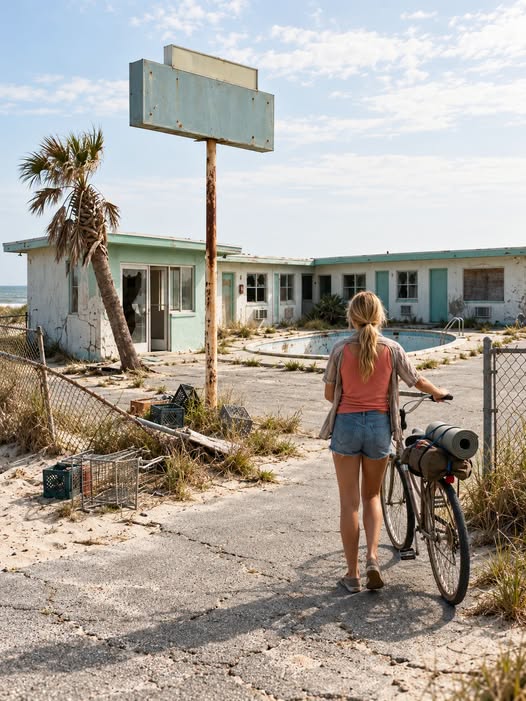
three days after graduation her father threw her out—then the $10 abandoned motel opened a locked room that had been waiting for her since birth
Part 1
Three days after Nella Cade crossed the graduation stage, her father packed eighteen years of her life into two black trash bags and changed the locks.
Her graduation gown was still folded across the back seat of her old Toyota Corolla.
She had not even taken the tassel off the rearview mirror.
That morning she had worked six hours at Beasley’s Grocery, stocking canned beans and ringing up farmers buying coffee, batteries, and sandwich meat before heading out to their fields. It was June, already hot by noon, and thunderstorms had been building dark over the western horizon all afternoon.
Nella came home tired, smelling faintly of cardboard, floor cleaner, and the onions she had bagged for an elderly woman who always counted her coins twice.
The first trash bag sat on the porch.
For one confused second, she thought Renee had cleaned out a closet.
Then she saw her gray hoodie sticking through the knot.
The second bag held shoes and books.
Beside both sat a cedar box.
Nella stopped halfway up the walk.
Her father appeared behind the screen door.
He did not open it.
That was the first thing she remembered clearly later.
Not the bags.
Not even the words.
The screen stayed between them.
Her father, Ray Cade, was forty-six and broad through the shoulders from years repairing farm equipment. Grease lived permanently in the lines of his hands. He could rebuild a carburetor from parts laid on newspaper, sharpen mower blades by eye, and listen to an engine for ten seconds and tell whether a bearing was going bad.
He had never been good with people.
After Nella’s mother died, he got worse.
“Renee and I talked,” he said.
Nella looked at the bags.
“What about?”
He rubbed his palm along the doorframe.
“You’re eighteen now.”
She waited.
“The boys are getting bigger.”
Her stepbrothers were eleven and thirteen.
They shared a room.
Nella knew what was coming before he said it.
“It’s time you got started.”
Nella looked at him.
“Started where?”
His eyes lifted to hers for half a second, then moved away.
“You’ll figure it out.”
There it was.
The sentence people gave practical children when they wanted to stop caring for them.
You’ll figure it out.
Nella had heard variations her whole life.
When Renee married Ray and moved in with two little boys, Nella gave up the larger bedroom.
“You’re mature.”
When her father worked late, Nella cooked.
“You’re responsible.”
When money got tight, Nella stopped asking for new shoes.
“You understand.”
When holidays became centered around Renee’s family and the boys’ activities, Nella learned not to complain.
“You’re easy.”
Being easy had become her assigned virtue.
Now, standing beside two trash bags, she understood the cost.
Practical people were the ones everybody assumed could survive being given less.
Her father’s mouth tightened.
“Don’t make it ugly, kiddo.”
“I’m standing outside my own house.”
“You’re an adult.”
“I was an adult yesterday.”
“I know.”
“And the boys suddenly need the room today?”
Behind him, Renee’s voice floated from the kitchen.
“Everything of hers is out there. I even put her mother’s box out so she can’t say we kept anything.”
Nella looked at the cedar box.
That hurt in a place the trash bags had not reached.
Renee had deliberately gone into the hall closet, climbed onto the stool, taken down the one object that had belonged only to Nella’s mother, and set it outside.
A transaction completed.
Nothing owed.
Nella climbed the last steps.
She picked up the box.
The cedar had gone pale along the corners.
Inside lay a broken gold chain, three photographs, a dried corsage from some dance her mother attended years before Nella was born, and an old brass key.
Nella lifted it.
The key hung from a green plastic fob shaped like a diamond.
Letters nearly rubbed away read:
SUNDOWNER
And beneath that:
7
Nella had played with the key as a child.
After her mother, Shay, died when Nella was six, she sometimes climbed onto the bed where Shay used to sleep and pressed the cold brass against her cheek.
Her father never knew what it opened.
“Stuff from before I met her,” he would say.
Shay had apparently lived an entire life before Ray Cade without him becoming curious enough to ask much about it.
Nella closed the box.
“Where am I supposed to sleep tonight?”
Ray finally pushed the screen open an inch.
“There’s people from school.”
“Most of them live with their parents.”
“Then ask around.”
Nella laughed once.
It came out wrong.
“You really planned this.”
Ray’s eyes filled.
That almost made her angrier.
If he was going to do it, she wanted him certain.
“I don’t want to fight.”
“You packed my things in garbage bags.”
“Renee thinks—”
“I didn’t ask what Renee thinks.”
His face changed.
For years Nella had carefully avoided speaking to him that way.
Now the rules felt stupid.
“You’re my father.”
“I know.”
“Then act like it.”
His eyes closed.
“Please don’t make this harder.”
Nella stared through the screen at the hallway behind him.
Family photographs hung there.
Renee.
The boys.
Ray.
One old picture still showed Shay holding Nella as a baby.
Nella wondered how long before that came down too.
She picked up the bags.
Her father whispered, “You always land on your feet.”
She looked back.
He meant it as comfort.
That was the saddest part.
“You say that so you don’t have to catch me.”
Then she carried everything to the car.
She sat in the driveway for almost twenty minutes after loading it.
No one came outside.
Not Ray.
Not Renee.
Not either boy.
Finally Nella backed out.
The tank was half full.
Her wallet held two hundred thirteen dollars and some change.
Her phone bill was due.
Her next grocery paycheck was six days away.
She drove until the gas gauge frightened her.
Then she stopped.
The first four nights taught her more than eighteen years of school had.
A car became cold around three in the morning even in June.
A twenty-four-hour gas station would let a girl wash her face in the bathroom if she bought something first.
The cheapest thing was a pack of crackers.
A parking lot that felt safe at ten could become dangerous at one when men began noticing the same car had not moved.
The shuttered lumberyard had a dark space behind the loading shed where no one bothered her.
She learned to sleep with her keys in her fist.
She learned which restrooms locked.
She learned never to let the fuel gauge drop below a quarter tank, even if it meant skipping food.
Money vanished.
Gas.
Phone service so employers could call.
A new charging cord.
Crackers.
Water.
One load of laundry at the coin place because she needed a clean work shirt.
By the fourth morning she had eighty-six dollars.
Eighty-six dollars sounded like money until it was everything standing between you and the road.
That afternoon she went to a diner beyond the grain elevator.
A hand-painted sign said MARVIN’S.
Inside were eight booths, six counter stools, a pie case, and a flat-top grill visible from almost anywhere in the room.
Nella ordered coffee, two eggs, and toast.
Cheapest meal on the board.
She ate slowly.
The cook was a large man in his late fifties with a burn scar running up one forearm.
When Nella brought her ticket to the register, he waved her money away.
“I can pay.”
“I know.”
“Then why—”
“You look like you’re between things.”
Nella’s jaw tightened.
“I don’t need charity.”
The cook wiped his hands on a towel.
“Good. Because this isn’t charity.”
“What is it?”
“A loan.”
He nodded toward her plate.
“Come back when you’re between better things. Pay double.”
Nella looked at him.
He turned toward the grill as if the conversation had ended.
That simple dignity almost broke her.
He had seen her.
Not as homeless.
Not as a problem.
Not as an irresponsible girl who should have planned better.
Just between things.
Nella walked toward the door.
Beside it stood a wire rack of community notices.
Farm auctions.
Church supper.
Missing cat.
County sale.
A yellow sheet caught her eye.
TAX-DELINQUENT PROPERTY AUCTION.
She almost kept walking.
Then she saw the name.
THE SUNDOWNER MOTEL.
Nella stopped.
The word seemed to lift off the page.
Sundowner.
Her hand went instinctively to her jacket pocket where the old brass key had stayed since the day she was thrown out.
She pulled it free.
SUNDOWNER.
Nella stood there so long the bell above the door stopped moving.
The motel listing said twelve units, office, one and a half acres, structures poor to failing.
Minimum bid ten dollars.
Ten.
Not ten thousand.
Ten.
That evening she used a public computer at the library.
The Sundowner sat seventeen miles outside town on the old highway.
Once, before the interstate was built, travelers had stopped there.
Then traffic moved north.
Businesses along the old road died slowly.
The Sundowner survived longer than most.
Its owner, Verna Pryor, had operated it until she died two years earlier.
No children.
No recorded heirs.
No valid will located.
Taxes accumulated.
County took possession.
A photograph showed a low L-shaped row of motel rooms, a small office, a tall sign painted with a setting orange sun.
The picture was old.
Even then the place looked tired.
Nella enlarged it.
She could not remember ever being there.
Shay had died when Nella was six.
Memories of her mother came as fragments.
Lotion.
A song sung badly while washing dishes.
Warm hands fixing Nella’s hair.
Rain on a windshield.
No motel.
Still, the key existed.
Saturday morning Nella drove to the courthouse auction.
About fifteen people stood on the steps.
Farmers.
Land investors.
One woman with a clipboard.
Nella stayed near the back.
Parcels sold for real money.
Seven thousand.
Twelve thousand.
Twenty-three.
Then the auctioneer lifted another sheet.
“The old Sundowner Motel.”
The crowd stirred.
Somebody laughed.
“Structures listed poor to failing. Twelve rooms, office, approximately one and a half acres. Opening at one hundred.”
Nothing.
“Fifty?”
Silence.
The woman with the clipboard never looked up.
The auctioneer sighed.
“Somebody give me ten dollars so I can go home.”
Nella raised her hand.
“Ten.”
Every face turned.
The auctioneer stared.
“You serious?”
“Yes.”
A man near the front chuckled.
“Girl, termites probably got more claim to it than you.”
Nella kept her hand raised.
“Ten dollars.”
The auctioneer looked around.
“Twenty?”
Nothing.
“Ten going once.”
Nella’s heart pounded.
“Twice.”
She almost lowered her hand.
Then remembered two trash bags on the porch.
“Sold.”
The gavel cracked.
“Ten dollars. Young lady, may God have mercy on you.”
Laughter followed her to the clerk’s table.
Nella paid with ten one-dollar bills.
The clerk handed her a folder and a large steel ring holding motel keys.
Each key wore the same green diamond-shaped fob as her mother’s.
Room one.
Two.
Three.
All the way through twelve.
Nella searched.
Seven was missing.
She felt the old key against her leg.
The clerk leaned closer.
“You know there’s no utilities.”
“I know.”
“Red-tagged.”
“I saw.”
“County’s been considering demolition.”
Nella frowned.
“Then why auction it?”
The woman looked toward the officials behind her.
“Complicated.”
“What’s complicated?”
“There’s development interest along that highway.”
“What kind?”
The clerk closed the file.
“You bought it as-is.”
Nella understood a door had just closed in the conversation.
She turned to leave.
An elderly man called after her.
“You bought Verna’s place?”
He was perhaps seventy-five.
White mustache.
Canvas work coat despite the warm morning.
Hands swollen from decades of labor.
“Apparently.”
He looked at her as if deciding something.
“Hollis Wynn.”
“Nella.”
“I kept that motel patched together for Verna near thirty years.”
Nella’s pulse quickened.
“You knew her?”
“Better than most.”
He studied Nella’s tired car.
“You got people helping?”
“No.”
“Plan?”
“No.”
The corner of his mustache moved.
“Well. That’s about how most folks arrived at the Sundowner.”
He wrote a telephone number on the back of an old receipt.
“If you go out there today, don’t drink from the office spigot. Line hasn’t been flushed in years.”
“Why are you helping me?”
Hollis looked toward the courthouse.
“Because somebody ought to see what you bought before they tell you what it’s worth.”
He walked away.
Nella reached the Sundowner near sunset.
The old highway stretched nearly empty beneath a wide summer sky.
Weeds had overtaken the gravel parking lot.
The sign stood tall and rusted, the painted sun flaking orange.
Below it a smaller sign hung from chains.
VACANCY.
It had probably said vacancy to no one for years.
Nella turned off the engine.
Silence descended.
The motel looked worse than the photograph.
Boards over windows.
Rot along the eaves.
Cracked concrete.
A swing set rusting in a side yard.
That stopped her.
A swing set at a motel.
Somebody had once expected children.
Nella stepped out.
Movement came around the far corner.
A dog.
Large.
Blue-gray.
Part heeler, perhaps.
White muzzle.
Ribs showing.
He stopped in the gravel and stared at her.
Nella stayed still.
“Hey.”
The dog took several careful steps.
Then turned.
Walked down the row of rooms.
Stopped.
Looked back.
Nella followed.
Room two.
Four.
Five.
Six.
At room seven, the dog sat.
He looked at the door.
Then at Nella.
Slowly, he lifted one paw and scratched the bottom panel.
Once.
A low whine escaped him.
Nella’s whole body went cold.
She reached into her pocket.
The old brass key lay against her palm.
SUNDOWNER.
Dusk thickened around the buildings.
Nella brought the key toward the lock.
Her hand shook so badly the metal rattled against the plate.
She could not find the keyhole cleanly.
The dog watched.
Then the practical voice that had gotten her through four nights in a car spoke.
Not alone.
Not after dark.
Not with nobody knowing where you are.
The door had waited years.
It could wait until morning.
Nella put the key away.
“Tomorrow.”
The old dog stood.
He followed her back toward the car.
Nella pried the plywood from room two.
The room behind it smelled of dust and summers long gone.
There was an old mattress.
A dresser.
Dry walls.
She still slept in the car because she trusted its locks.
She ate half a gas-station sandwich.
Set the other half on the concrete for the dog.
He swallowed it.
Then lay beside her front tire facing outward.
Twice during the night Nella woke.
Twice the dog was still there.
Guarding a girl he had met only hours before.
At eight the next morning, a truck came up the weed-choked drive.
Hollis climbed out.
He saw Nella unfolding herself from the car.
“You slept in there.”
“It was fine.”
“That’s what people say when it wasn’t.”
He gave her two jugs of water.
Then unloaded a small generator, extension cords, a work light, and a toolbox.
“I can’t pay you.”
“Didn’t ask.”
The old dog appeared.
Hollis’s face softened immediately.
“Deacon.”
The dog walked to him.
Hollis dropped to one knee and wrapped both arms around the thin animal.
“Look at you.”
Nella watched.
“He’s yours?”
“No.”
“Verna’s?”
Hollis rubbed the dog’s ears.
“She named him. Said every good house needs a deacon. Somebody to guard the door and mind who comes in.”
“He’s been here this whole time?”
“Two winters.”
Nella stared at the dog.
“I leave food near the sign. He hardly lets me close.”
Hollis looked toward room seven.
“He led you anywhere?”
Nella hesitated.
“Seven.”
Something moved across Hollis’s face.
“What?”
“Nothing.”
“Hollis.”
He stood.
“Let’s open the office.”
They cut the chain.
Pulled boards from the window.
Sunlight entered a room nobody had used in two years.
Dust coated everything.
A coffee cup remained on the desk.
A calendar hung on the wall.
Behind the counter were words painted in faded blue letters.
NO ONE WHO STOPS HERE LEAVES WITH NOTHING.
Nella read them twice.
Hollis touched the counter.
“Verna painted that.”
“What does it mean?”
He looked toward the road.
“That’s a long story.”
Nella glanced at room seven.
She was beginning to understand that the motel contained many of them.
Part 2
Hollis told Verna Pryor’s story in pieces.
Some came while he restarted the well pump.
Some while they dragged rotten boards from the office.
Some while Nella swept years of mouse droppings from the corners.
The interstate had taken most travelers away from the old highway decades before.
Gas stations closed.
A café burned and never reopened.
A tire shop became a storage building.
The Sundowner should have died with the rest.
Verna refused.
“Why?” Nella asked.
Hollis shrugged.
“Same reason some people keep putting coffee on after the person they made it for is dead. Habit. Hope. Stubbornness.”
“Which one was she?”
“All three.”
Verna kept twelve rooms ready even when only two paying guests came in a week.
But the Sundowner survived because the people arriving there were not always ordinary travelers.
A teenage girl with a black eye.
A truck driver stranded without repair money.
A man released from county jail whose family refused to pick him up.
Two elderly brothers put out of a farmhouse after foreclosure.
A mother with three children living from a station wagon.
Runaways.
Widows.
Drunks trying to stop.
Veterans who could not sleep indoors.
People between homes.
People between lives.
Verna charged when people could pay.
When they could not, she did not.
“How did she afford it?”
“Didn’t, half the time.”
Hollis opened a swollen office drawer.
Inside was a shoebox.
Letters filled it.
Some decades old.
Some recent.
Money orders.
Thank-you notes.
Christmas cards.
Photographs of weddings, children, houses, trucks.
“They’d send money back years later.”
Nella picked up an envelope postmarked four months earlier.
“She was already dead.”
“Most don’t know.”
Nella read the letter.
The writer had stayed at the Sundowner thirty years before after running away as a teenager.
He now owned two trucks.
Named a daughter after Verna.
He wrote that whenever he drove at night, he still looked for the motel sign.
Nella lowered the page.
“He thinks she’s here.”
“Yep.”
Hollis sat in Verna’s old chair.
“I found her in this chair one morning. Coffee beside her. Gone in her sleep.”
Nella looked at the faded wall.
No one who stops here leaves with nothing.
The words no longer sounded like motel advertising.
They sounded like doctrine.
Nella thought of Marvin refusing payment for eggs.
A stranger leaving her dignity instead of debt.
“Room seven,” she said.
Hollis became still.
“What about it?”
“Only one that won’t open.”
“It wouldn’t.”
“Why?”
“That was Verna’s room.”
“I thought she lived in the office.”
“Mostly. But seven was hers. Private.”
Hollis rubbed his jaw.
“She kept one key. Wore it on a string around her neck.”
Nella’s heart beat harder.
“When she died?”
“County took what she had on her. Never saw that key again.”
“Did you ever go inside?”
“Not once.”
Nella put her hand in her pocket.
The brass key felt warm.
She did not show him.
Not yet.
Partly because she was afraid of what it meant.
Partly because she did not want Hollis to tell her it meant nothing.
They spent that day working.
He showed her which water line might be usable.
Which roof sections were dangerous.
Which rooms stayed dry.
He explained the old boiler.
Taught her where the shutoffs were.
Before leaving, Hollis pointed toward the highway.
“There’s something else.”
Nella waited.
“Development outfit’s buying frontage.”
“What for?”
“Power line. Maybe warehouses later. County’s been looking to unload condemned properties.”
“So?”
“So you buying this place for ten dollars put a rock under somebody’s wheel.”
Two days later, a county truck arrived.
Nella was on a ladder pulling old plywood from a window.
A man in a pressed shirt climbed out carrying a clipboard.
“Nella Cade?”
“Yes.”
“David Mercer. County compliance.”
She came down.
He glanced at the motel.
His expression was not cruel.
Only tired.
“This site is red-tagged.”
“I know.”
“There’s a demolition recommendation that predates your purchase.”
Nella stared.
“You sold me something you’re planning to demolish?”
“You purchased the parcel subject to existing safety orders.”
“No one said that.”
“It was in the file.”
“Buried where?”
Mercer sighed.
“Miss Cade, I’ll be straight. You’re eighteen. This isn’t a project for somebody with no contractor, no capital, and no utility service.”
She crossed her arms.
“What does my age have to do with the roof?”
He looked uncomfortable.
“Nothing.”
“Then don’t use it.”
He held out a business card.
“A developer interested in the frontage may pay you to release your claim.”
“So I bought the motel and now you want me to sell it because somebody else wants the land.”
“I’m telling you there may be an easier way out.”
Nella looked toward the office.
Through the open door she could see the blue words.
“Did you ever stay here?”
Mercer frowned.
“What?”
“When you were younger.”
“No.”
“Know anybody who did?”
“What’s that got to do with code compliance?”
“Maybe nothing.”
Nella thought of the shoebox.
“Maybe everything.”
Mercer placed the card on the ladder.
“You have limited time.”
Then drove away.
Nella did not call the developer.
She worked.
Rooms one and two cleaned.
Window screens patched.
Water ran rusty, then eventually clear enough for washing.
The generator coughed but held.
Deacon followed her everywhere.
At night he slept across room two’s threshold.
And every day Nella stopped outside room seven.
Sometimes carrying a bucket.
Sometimes a broom.
Sometimes for no reason.
Deacon always came.
Sat beside her.
Waited.
Five nights after she arrived, Nella finally stopped lying to herself.
She could not sleep.
Wind moved dry grass across the parking lot.
The generator ticked as it cooled.
Nella pulled on her boots.
Deacon stood before she reached the door.
She carried the work light down the walkway.
Room seven appeared harsh beneath its white glare.
Old paint.
Tarnished numeral.
Keyhole.
Nella took the brass key from her pocket.
For twelve years it had lived in her mother’s cedar box.
Before that, apparently, on Shay’s own key ring.
It had survived a funeral.
A remarriage.
A childhood where no one knew what to do with Nella’s grief.
Two trash bags.
Four nights in a car.
A ten-dollar auction.
Now it rested against the lock it had been cut to fit.
Nella inserted it.
Perfectly.
Her breath stopped.
She turned.
At first nothing.
Then something deep inside the old mechanism shifted.
The bolt pulled back.
Room seven opened.
Warm, stale air moved across her face.
Deacon whined.
His tail began to wag.
Nella pushed the door.
The room inside was unlike the others.
Not abandoned.
Preserved.
An iron bed stood made with a quilt folded at its foot.
A wooden table sat beneath the boarded window.
A coffee tin held pens.
And the entire far wall was covered in photographs.
Hundreds.
Polaroids.
Snapshots.
Faces.
Families.
Teenagers.
Old men.
Babies.
Women holding grocery bags.
People standing beside broken-down cars.
Nella stepped inside.
Deacon went directly to the foot of the bed.
He lay down.
Exhaled deeply.
Like an old guard finally returned to his post.
Nella approached the table.
A thick clothbound ledger rested there.
She opened it.
The pages were not accounts.
They were people.
October 1979.
Boy, maybe sixteen, arrived barefoot in the rain. Wouldn’t give a name, so I didn’t ask twice. Put him in three. Fixed my back fence before leaving. Hope somebody feeds him.
Another entry.
Young mother. Two babies. Black eye. Garbage bag. Room four. Bus money Tuesday. Told her bruises weren’t her fault. She does not believe it yet.
Another.
Two brothers lost their house to the bank. Rooms five and six through February. Played dominoes every evening. Their son collected them in spring, ashamed. Told him shame is only useful if it changes what you do next.
Nella sat on the bed.
Page after page.
Decades.
People Verna had refused to let disappear unnoticed.
No one who stops here leaves with nothing.
She understood.
Verna did not merely give rooms.
She gave witness.
Somewhere, written in blue ink, each person became proof that they had existed during the hardest part of their life.
Nella stood.
She approached the wall.
Faces blurred past.
Then one stopped her.
A young woman stood on the Sundowner office steps.
Pregnant.
One hand shielding her eyes from the sun.
Laughing toward the camera.
Nella knew that face.
She reached inside her jacket and pulled out one of the photographs from Shay’s cedar box.
Same steps.
Same dress.
Same afternoon.
Two photographs taken seconds apart.
Nella looked at the writing beneath the one on the wall.
SHAY.
Her knees weakened.
Behind the photograph was a folded page.
She removed the tack.
Opened it.
A date appeared at the top.
Eighteen years earlier.
The week Nella was born.
She read.
Storm came hard. Shay’s time came with it. Three weeks early. County road flooded. No hospital possible. It happened here in seven. Longest night of my life and best. Little girl screamed before I could clear her mouth. Both healthy by morning. Shay frightened of everything outside this room. Told her she and the child always have a door here. Gave her the key. Baby’s name is Nella.
Nella stopped breathing.
She read it again.
Then sat heavily on the iron bed.
“This bed?”
Her voice sounded tiny.
Deacon lifted his head.
Nella placed one hand on the quilt.
She had been born here.
Not in a hospital.
Not where her father had always assumed.
Here.
In room seven.
Her mother had arrived frightened and pregnant.
Verna had taken her in.
Asked no questions.
Caught Nella during a storm.
Gave Shay the key.
For eighteen years, Nella had possessed the key to the first room she had ever known without knowing it.
She bent forward.
Tears came silently.
Not only grief.
Something deeper.
Her whole life she had believed she came from a story missing half its pages.
Shay died before explaining.
Ray did not know.
Renee never asked.
Now Nella learned the beginning.
She had come into the world because one stranger had left a door open.
“You caught me.”
Nella spoke toward the empty room.
“You wrote me down.”
Deacon placed his head on her knee.
In a drawer beneath the table, Nella found three letters from Shay.
The last was written when Nella was four.
Dear Verna,
Nella is into every cupboard we own. I blame you. I tell her the story of the woman who caught her in a storm, though she thinks you are ten feet tall. Things are hard, but we are hard too. I keep your key where I can touch it. If anything happens to me, I want her to know one door somewhere will always open.
Nella pressed the page to her mouth.
Shay had planned for danger without knowing what shape it would take.
She had kept the key.
Then died two winters later.
The story vanished.
But the key remained.
Nella saw another framed photograph on a shelf.
Black and white.
A young Verna held a newborn.
Beneath the image were three words.
MY DAUGHTER. SIX DAYS.
Nella stared.
Suddenly Verna’s entire life rearranged itself.
A child held six days.
Then lost.
And afterward, room after room offered to other people’s children.
Other people’s daughters.
Other people’s broken travelers.
Verna had taken the worst grief of her life and refused to let it close the door.
Under the table sat a strongbox.
Inside was cash.
More money than Nella had ever held.
A note.
For the next one who needs a start. You will know them. They will look like they have run out of road. Send them on better than they arrived.
Below it were property papers.
And beneath those, a handwritten will.
The language was plain.
I leave the Sundowner to whoever keeps it a home after me, not whoever has the most money. My lawyer says this wording will cause trouble. He has never needed a room here.
Witness signatures followed.
Nella laughed through tears.
Then headlights swept across the boarded window.
Deacon stood.
Growled.
A car rolled into the motel after midnight.
Nella tucked the papers safely away.
She went outside.
An old sedan sat steaming in the lot.
A young woman stepped from behind the driver’s door.
Maybe twenty.
Grocery bag of clothes.
Fearful eyes checking the road behind her again and again.
“I’m sorry,” she called. “My car quit. I saw your light.”
Nella looked at her.
At the bag.
At the road.
At room four.
Verna’s instructions had barely finished being read.
The first test was already standing in the parking lot.
Nella softened her voice.
“You hungry?”
The young woman began crying.
Nella put her in room four.
Gave her water.
Her own blanket.
Showed her the lock.
She did not ask what she was running from.
When Nella came back outside, Deacon lay across room four’s threshold.
Guarding.
Nella looked up at the dead Sundowner sign.
“I’m turning you back on.”
She did not yet know how.
But she knew one thing with a certainty she had never possessed before.
Nobody was knocking this place down.
Part 3
Three days later, the county delivered the demolition notice.
Nella signed for the certified envelope at the office.
The young woman from room four was asleep.
Hollis was replacing a damaged section of pipe behind room six.
Nella opened the envelope standing beneath the faded blue words.
DEMOLITION AUTHORIZED.
Thirty days.
Public hazard.
Costs recoverable through sale of the land.
She read it twice.
The legal language sounded clean.
The result was not.
Bulldozers.
Room seven crushed.
Shay’s photograph destroyed.
Verna’s ledger scattered.
The wall of faces pushed beneath rubble.
The bed where Nella had taken her first breath broken for scrap.
She drove straight to the county office.
The clerk with reading glasses examined Verna’s handwritten will.
Her expression softened.
“Honey.”
Nella hated that word from people about to say no.
“What?”
“This isn’t formally filed.”
“It’s witnessed.”
“Yes.”
“She owned the property.”
“Yes.”
“Then it’s hers to leave.”
“Possibly. But probate is not simple.”
“The county auctioned it to me.”
“Under a tax proceeding.”
“So you sold it and want to demolish it.”
The clerk sighed.
“There’s a developer.”
“I know.”
“There’s an older hazard order.”
“I know.”
“You’re one girl.”
Nella’s face hardened.
“I’m not one girl.”
The words came out before she understood them.
She carried the will back to the motel.
That night, Hollis sat at the office desk.
The shoebox of letters sat between them.
Nella opened Verna’s ledger.
Names.
Addresses.
People.
“She helped all these people.”
“Yes.”
“Some wrote back.”
“Yes.”
“They don’t know she’s dead.”
“No.”
Nella looked at him.
“What happens if they find out?”
Hollis took his time.
His mustache moved.
“You’re planning something.”
“I’m writing them.”
“How many?”
“All.”
For two days they wrote.
Nella copied until the side of her hand turned blue with ink.
Verna Pryor died two winters ago.
The Sundowner is scheduled for demolition.
My name is Nella Cade. I was born in room seven and did not know it until last week.
If Verna ever left a light on for you, I need you to stand up for hers.
County meeting, fourth Tuesday, seven p.m.
Sixty-one letters went out.
Nella bought stamps with money she could barely spare.
Then waited.
The first call came four days later.
“Is it true?”
A woman’s voice.
“Verna?”
“Yes.”
Silence.
“My name is Marisol Vega. I stayed there when I was fifteen.”
Nella sat straighter.
Marisol continued.
“I ran away from home. Stole forty dollars from Verna too.”
Nella almost smiled.
“Did she catch you?”
“At the bus station.”
“What happened?”
“She bought me lunch.”
Nella closed her eyes.
Marisol’s voice broke.
“Then told me my room was still there whenever I was done being afraid.”
A pause.
“I own three flower shops now. I have an attorney on retainer. Read me the meeting date again.”
Marisol arrived two days before the hearing.
She was in her forties.
Quick-moving.
Silver hoops.
A van bearing the name VEGA FLOWERS.
She entered the office.
Saw the words.
No one who stops here leaves with nothing.
Marisol put one hand over her mouth.
“She said that my first night.”
Nella took her to room seven.
They found Marisol’s old thank-you card pinned among the photographs.
She sat on the iron bed and cried.
Then wiped her face and became practical.
“You don’t understand something.”
“What?”
“You’re not asking those people to save you.”
Nella looked down.
Marisol leaned closer.
“You’re giving them a chance to repay a debt none of us could ever repay.”
The county meeting began at seven.
By six-thirty, the parking lot was full.
Trucks with plates from three states.
A church van.
A sedan carrying an elderly couple.
A man in a dark business suit.
Women with grown children.
Men gray enough to be grandfathers.
Nella stood near the door.
“They came.”
Marisol smiled.
“Told you.”
The room filled.
Hallway filled.
People stood along the walls.
County board members whispered among themselves.
David Mercer, the compliance officer, presented the demolition recommendation.
“Unsafe structures, redevelopment potential, longstanding—”
Marisol stood.
“Before you knock it down, you might want to know what you’re knocking down.”
Mercer stopped.
The chairman frowned.
“Ma’am, public comments—”
“I’ll wait my turn.”
But someone behind her rose.
An older man.
“I stayed in room nine.”
The room quieted.
“Winter of 1991. Got out of jail with no coat and nowhere to go. Verna Pryor gave me three weeks. I sell insurance now.”
He sat.
A woman stood.
“I came there with a baby and a black eye.”
Her daughter, now grown, sat beside her.
“Verna put me in room four. She asked no questions the first night. Paid my bus fare two days later.”
Another rose.
“Truck broke down.”
Another.
“Lost our house.”
Another.
“My husband died.”
Another.
“I was sixteen.”
On and on.
The county officials stopped looking at paperwork.
They listened.
Some stories were only a sentence.
Some lasted several minutes.
One gray-haired man stood, opened his mouth, and failed.
Finally he whispered, “Room nine. She kept me alive.”
Then sat hard.
Nella watched David Mercer.
His face changed.
He was not a villain.
That mattered.
He had seen a condemned building.
A line on an assessment.
A piece of frontage.
He had never been told what stood there.
The town itself had forgotten.
Marisol spoke last.
“Half the people behind me would not be in this room if Verna Pryor treated broken people the way you’re treating that motel.”
Silence.
“This young woman has the deed from your auction. She has a witnessed document stating Verna’s wishes. We have lawyers willing to fight probate. We have contractors willing to bring the property up to code. And we have enough people willing to embarrass everybody involved if you push a bulldozer through a place that saved their lives.”
The chairman shifted.
Marisol opened her hands.
“Or you table demolition, give her a compliance period, and let a dead stretch of highway become useful again.”
The developer’s representative had already left.
The chairman counted faces.
Politicians understood arithmetic.
The demolition order was tabled pending review.
In ordinary language, everyone knew what that meant.
They had time.
Outside, strangers surrounded Nella.
Money folded into her hand.
Phone numbers.
Offers.
Drywall.
Roofing.
Electrical.
Legal help.
One woman said, “I’ll be there Saturday at seven.”
A man said, “Make it six.”
Hollis stood beside his truck watching.
Nella found him after the crowd thinned.
“You knew?”
“Knew what?”
“That they’d come.”
“No.”
He looked toward the courthouse.
“Hoped.”
Nella laughed.
Hollis cleared his throat.
“Verna would’ve enjoyed that.”
“The arguing?”
“All those hard cases she collected showing up in decent clothes to frighten elected officials.”
He smiled.
“She’d have laughed till she cried.”
Saturday morning, trucks filled the Sundowner lot.
Ladders.
Toolboxes.
Lumber.
Roofing tar.
Paint.
A woman arrived with drywall supplies.
The insurance man came in jeans and spent the day tearing out rotten wood.
Two elderly men who had stayed at the motel decades earlier sat on buckets arguing about how doors should be rehung.
Marisol ran names and jobs from a folding table.
Hollis inspected everything.
The young woman from room four stayed too.
She had begun sleeping through the night.
Stopped checking the highway every five minutes.
When someone’s truck would not start, she lifted the hood and stared.
“You know engines?” Nella asked.
“A little.”
She repaired the problem.
The surprise on her face when the engine turned over was almost childlike.
Nella smiled.
“Looks like more than a little.”
By noon, someone repainted Verna’s office words.
Fresh blue letters.
NO ONE WHO STOPS HERE LEAVES WITH NOTHING.
People paused while passing.
Read them.
Returned to work.
Nella stood in the lot holding a hammer.
Deacon at her heel.
The young woman from room four beside her.
“Who are these people to you?” she asked.
Nella opened her mouth.
A dusty gray truck turned off the highway.
Nella knew it immediately.
Her father’s.
The truck rolled to a stop.
Ray Cade climbed out.
Hammering slowed.
People looked.
Nella set her tool down.
Deacon moved with her.
Ray removed his cap.
He looked thinner.
Older.
“Hey, kiddo.”
Nella stopped ten feet away.
“How’d you find me?”
“Whole town’s talking.”
He looked around.
“They said you bought a motel.”
“I did.”
“Ten dollars?”
“Yes.”
Ray almost smiled.
“That’s something.”
Nella waited.
He looked toward all the workers.
“I always knew you’d land on your feet.”
The sentence hit exactly where it had before.
But something had changed.
Nella was standing on land he did not own.
Behind her were doors that opened.
Around her were people who had come because somebody had once cared whether they survived.
The sentence no longer trapped her.
“You didn’t say that because you believed in me.”
Ray’s smile disappeared.
“Nella—”
“You said it so you wouldn’t feel guilty.”
“That’s not fair.”
“Yes, it is.”
He looked at the ground.
“Things were tight.”
“I know.”
“The boys—”
“I’m not fighting about the boys.”
“Renee thought—”
“I’m not fighting about Renee either.”
Ray looked helpless.
For the first time Nella saw him not as the man who could decide whether she belonged in a house.
Just a frightened middle-aged man who had avoided difficult feelings until avoidance became cruelty.
“Come with me.”
“What?”
“I want to show you something.”
She led him to room seven.
The brass key now hung on a cord around her neck.
She unlocked the door.
Ray entered.
He stared at the wall.
Nella pointed to Shay’s photograph.
His body went still.
“That’s your mother.”
“I know.”
“She’s pregnant.”
“With me.”
Ray looked at Nella.
“What?”
“Mom stayed here before she met you.”
He sat on the bed.
Nella told him.
The storm.
Verna.
The birth.
The key.
Shay’s letters.
Her wish that her daughter always know one door would open.
Ray covered his face.
“I didn’t know.”
“No.”
“She never told me.”
“Did you ask?”
Silence.
He shook his head.
“Not enough.”
Nella looked at him.
“After she died, did you ask me anything?”
His hands lowered.
“What do you mean?”
“About her.”
Ray’s eyes filled.
“You needed me to be easy.”
“That’s not—”
“Practical. Responsible. Mature.”
Each word landed.
“All those nice words meant you didn’t have to wonder what I needed.”
Ray’s face folded.
He wept.
Nella did not comfort him.
She did not punish him either.
She stood in the room where she had been born and let her father finally sit inside something he had avoided.
Loss.
Regret.
His wife’s unknown life.
His daughter’s loneliness.
Some pain deserved company.
Some had to be faced alone.
When Ray could speak again, he wiped his face.
“Can I help?”
Nella studied him.
“I don’t know.”
“Money.”
“No.”
“I’m handy.”
“I know.”
“I could come Saturdays.”
Nella thought honestly.
Anger had burned hot for weeks.
Now it felt different.
Not gone.
No longer in charge.
“I’m not pretending nothing happened.”
“I understand.”
“No, you don’t yet.”
Ray nodded.
“Okay.”
“You want to help, come like everybody else.”
He looked at her.
“No special place because you’re my father.”
“Fair.”
“Earn it slow.”
Ray swallowed.
“That’s more than I gave you.”
“Yes.”
He left.
Returned not the next Saturday, but the one after.
Hung three doors.
Fixed a porch sag.
Said little.
Left before supper.
It was not forgiveness.
It was work.
Sometimes work was a more believable beginning.
Part 4
The Sundowner fought them all summer.
One repair revealed three more.
The east roof looked sound until a storm proved otherwise.
Water came through room eleven at two in the morning.
Nella, Hollis, Ray, and three volunteers climbed onto the roof at dawn.
Hollis pointed with his blackened thumbnail.
“Flashing.”
Ray disagreed.
“Decking.”
They argued for ten minutes.
Nella finally said, “Which one can make my ceiling dry?”
Both men stopped.
“Both,” they admitted.
They repaired both.
The boiler failed next.
Then a septic line backed up.
Then the county demanded railing heights brought to current code.
Nella worked mornings at the grocery three days a week and spent every other hour at the motel.
Marisol organized donations but refused to let the project become sentimental chaos.
“Receipts.”
Nella sighed.
“Receipts.”
“Every dollar.”
“Yes.”
“Emergency reserve.”
“We need the roof.”
“We need to survive after the roof.”
Marisol had learned hard lessons building businesses from nothing.
“Good intentions don’t pay November’s electric bill.”
Nella understood.
They created two kinds of rooms.
Regular paying rooms for travelers.
And emergency rooms held whenever possible for people who arrived out of road.
The motel needed income if it was going to keep giving.
That balance mattered.
Verna had survived on instinct and sacrifice.
Nella wanted the promise to outlive one heroic woman.
The young woman from room four eventually gave Nella her name.
It happened three weeks after arriving.
They were repainting a dresser.
Nella did not ask.
The woman said, “My name’s Beth.”
Nella paused.
“Okay.”
Beth watched her.
“That’s it?”
“What?”
“You’re not going to ask where I’m from?”
“No.”
“Why?”
Nella dipped the brush.
“Because when you want me to know, you’ll tell me.”
Beth looked down.
“Nobody ever does that.”
“Verna did.”
“She’s dead.”
“Still teaching.”
Beth stayed.
At first only because her car needed work.
Then because work at the motel gave her something to do.
She learned the boiler.
The office.
Room turnover.
How to greet frightened people without crowding them.
How to leave water outside a door without demanding thanks.
How to say, “You’re safe tonight,” without making promises about tomorrow she could not control.
Nella learned too.
She made mistakes.
The first time an intoxicated man arrived shouting, she nearly let compassion overrule safety.
Hollis stopped her.
“Helping somebody doesn’t mean letting him frighten everybody else.”
They called a local outreach service.
The man got help elsewhere.
Nella added rules.
Open door did not mean no boundaries.
Another time, a family stayed two weeks.
The father kept promising payment.
None came.
Nella felt angry, then guilty for feeling angry.
Marisol told her, “Money is not proof of gratitude.”
“I know.”
“But?”
“I need money.”
“Exactly. Say that without shame.”
Nella asked the family to transition through a church program.
They did.
Kindness needed structure.
Verna’s promise had never meant destroying herself for everyone.
Nella began to understand that legacy was not copying every decision.
It was keeping the principle alive in changing circumstances.
Ray continued coming.
Some Saturdays he and Nella worked side by side without speaking.
He never mentioned moving her home.
Never said the eviction had made her stronger.
Once he started to.
“I guess if all that hadn’t happened—”
Nella looked at him.
He stopped.
“Never mind.”
“Good.”
Renee came once.
Alone.
Nella was repairing curtains in the office.
Renee carried a cardboard box.
“I found some things.”
Nella stood.
Renee looked older away from the house.
Less powerful.
More ordinary.
The box held Shay’s hairclip.
Two photographs.
A paperback novel with notes in the margins.
A recipe card.
An old scarf.
Nella touched the book.
“Where was this?”
“Back of the garage.”
“You knew it was there?”
“No.”
Renee hesitated.
“Not exactly.”
Nella looked at her.
Renee crossed her arms.
“I didn’t come to fight.”
“Then don’t.”
Another silence.
“I shouldn’t have put your things outside that way.”
There.
Not quite apology.
Close.
Nella waited.
Renee continued.
“Your father was afraid you’d stay forever.”
Nella nearly laughed.
“I was eighteen.”
“I know.”
“The boys didn’t need my room that week.”
“No.”
“Then why?”
Renee’s face tightened.
“Because I wanted the house settled.”
The honesty surprised Nella.
“Settled.”
“I wanted to know what belonged to who.”
Nella looked around the motel office.
“People aren’t furniture.”
“I know.”
“Do you?”
Renee flinched.
Nella did not enjoy it.
That mattered.
A few months before, she might have wanted Renee to hurt.
Now she mostly wanted truth.
“I grew up feeling like a guest in my own home.”
Renee lowered her eyes.
“I didn’t understand that.”
“You didn’t try very hard.”
“No.”
Nella touched Shay’s scarf.
Renee whispered, “I’m sorry.”
Not a grand apology.
Not tears.
Just two words from a woman unused to them.
Nella nodded.
“Thank you for bringing the box.”
They stood another minute.
Renee left.
Nothing mended completely.
But the door closed quietly.
Not every relationship needed restoration.
Some needed only an honest ending.
As autumn approached, inspectors returned.
The motel was not beautiful.
But roofs held.
Water passed testing.
Electrical work met code.
Smoke detectors.
Handrails.
Emergency lighting.
Clean rooms.
The demolition order was formally withdrawn.
The old handwritten will went through legal review.
Verna’s intent, Nella’s auction title, and the community’s support aligned enough that the developer backed away.
The land remained hers.
Ten dollars.
And several thousand hours of labor donated by people who believed they owed something to a woman in the ground.
Opening day came with the first hard cold.
Marisol arrived with flowers.
Former guests came with children and grandchildren.
The man who had once stayed after prison brought his wife.
The woman who arrived with a black eye brought the baby who was now forty.
Hollis wore a clean shirt.
Ray came early and quietly repaired a sticking office door nobody else had noticed.
Beth stood behind the counter practicing room rates.
Deacon, now well fed, lay in the office doorway as if he had never left.
At dusk, Hollis walked to the base of the tall roadside sign.
An electrician Verna had sheltered years earlier had spent a week rewiring it.
Hollis looked toward Nella.
“Ready?”
She nodded.
He threw the switch.
One letter flickered.
S.
Then U.
N.
D.
O.
W.
N.
E.
R.
Orange light glowed against the deepening sky.
Below it, the smaller sign buzzed.
VACANCY.
Nobody cheered.
They simply looked.
Some cried.
Nella touched the brass key at her chest.
Shay had once driven this road frightened, pregnant, probably watching for exactly that light.
Somewhere in the dark, the sign told her she could stop.
Now it shone again.
Room seven remained closed to ordinary guests.
Nella kept the bed.
The ledger.
The wall.
Verna’s photograph holding her six-day-old daughter.
Shay pregnant on the office steps.
A small card beside the door read:
ROOM SEVEN
THE SUNDOWNER’S SECOND KEEPER WAS BORN HERE.
ITS FIRST KEEPER IS STILL BEING THANKED.
People visited one at a time.
Sometimes a former guest found his own young face on the wall.
Then he sat on the iron bed.
No one rushed him.
The first true test of the reopened Sundowner came late one freezing night.
A man arrived walking.
No car.
Trash bag over one shoulder.
Hands trembling.
Beth met him at the office.
Nella watched from the back doorway.
Beth said, “Come inside.”
The man looked suspicious.
“I don’t have much.”
“We’ll talk tomorrow.”
“I need—”
“Water first.”
She put him in room three.
Food.
Blanket.
No questions beyond what safety required.
Afterward Beth found Nella.
Her eyes were wet.
“I did it right.”
Nella smiled.
“You did.”
“Like Verna?”
“Like you.”
That night, after everyone slept, Nella sat behind the office desk.
She opened Verna’s ledger.
At the back were blank pages.
Nella uncapped a blue pen.
She wrote the date.
Room three.
Man arrived on foot after midnight with a trash bag and shaking hands.
She paused.
Then added:
He is safe.
The handwriting did not look like Verna’s.
That was good.
The promise did not need imitation.
Only continuation.
Part 5
Winter settled over the old highway.
The Sundowner survived its first season.
Not easily.
One pipe froze.
A room heater failed during a cold snap.
A drunk driver knocked down part of the mailbox.
Deacon developed arthritis.
Hollis complained about all of it over morning coffee.
Most days he arrived shortly after sunrise.
Nella came to recognize his truck by sound.
One January morning they stood outside with steaming mugs.
The big sign was dark in daylight.
Frost silvered the grass.
Deacon lay in a patch of weak sun.
Nella looked across the rooms.
“Do you think she’d approve?”
Hollis drank.
“Verna?”
“Yes.”
He took so long Nella wondered whether he had heard.
Then he said, “She used to tell me nobody’s truly homeless if there’s one light burning for them somewhere.”
Nella swallowed.
“Then she’d complain about the electric bill and leave every light on.”
Hollis smiled.
“You turned the sign back on.”
He looked at her.
“She’s fine.”
Nella watched the highway.
“I hope so.”
“Better than fine.”
A few weeks later Hollis drove Nella to a small church cemetery.
Verna Pryor’s grave lay near the back.
Flat stone.
Name.
Dates.
Nothing about the motel.
Nothing about the hundreds of people.
Nella brought the framed photograph from room seven.
Verna at twenty.
Holding the infant she had for six days.
She placed it against the marker.
For a while, Nella said nothing.
Then quietly:
“The sign’s on.”
Wind moved through dry grass.
“The rooms are open.”
Her voice shook.
“The girl you caught in the storm is okay.”
Nella touched the brass key.
“Her daughter found the door.”
Hollis looked away.
Nella continued.
“I don’t know if I’m doing it the way you would.”
She smiled through tears.
“Probably not. Hollis says you were impossible.”
Behind her, Hollis said, “Correct.”
Nella laughed.
She picked up the photograph before leaving.
It belonged in room seven.
By spring, the Sundowner found its balance.
Rarely empty.
Never completely full if Nella could help it.
Paying travelers covered expenses.
Some left extra money in a glass jar beside the register.
People who could not pay were helped through partnerships with churches, shelters, employers, mechanics, counselors.
The diner cook from that first morning began sending day-old pies on Sundays.
Nella tried to pay.
He refused.
“You still between things?”
“Aren’t we all?”
He pointed his spatula at her.
“Then deal stands.”
She laughed.
Letters began arriving again.
Addressed to the Sundowner.
People who heard Verna was gone.
People who had seen the newspaper story.
People telling Nella what room they once slept in and what happened afterward.
Nella kept every letter.
The old shoebox filled.
Then a second.
Ray became part of the place slowly.
He never regained the uncomplicated role of father he imagined he once held.
That role had probably never existed.
But he became useful.
Fixed sinks.
Hung doors.
Changed oil in the motel van.
Sometimes ate supper.
Sometimes left early.
One evening Nella handed him room seven’s key.
“Why?”
“Door sticks.”
He stared at the key.
“You sure?”
“No.”
He smiled faintly.
“Fair.”
They worked together.
Inside, Ray looked at Shay’s photograph every time.
Nella noticed.
Finally one afternoon he said, “I was married to her nine years.”
Nella continued sorting linens.
“I know.”
“I didn’t know this.”
“No.”
“Do you hate me for that?”
She stopped.
“No.”
Ray looked surprised.
“I hate that you didn’t ask.”
He nodded.
“Different.”
“Yes.”
Ray sat on the edge of the bed.
“I thought love meant taking care of the life in front of you.”
“It does.”
“I didn’t know it also meant asking about the life before you.”
Nella looked at him.
“Maybe now you do.”
He nodded.
Years passed.
Not in a quick happy montage.
In bills.
Storms.
Repainted rooms.
Deaths.
New guests.
Deacon slowed.
His muzzle turned nearly white.
For years he slept near whichever room held the newest frightened arrival.
When he finally died, it happened beneath the office counter on a warm autumn afternoon.
Nella found him asleep.
At first she thought he was simply resting.
Hollis buried him beneath the old sign.
They placed a small stone there.
DEACON
HE KEPT THE DOOR.
Nella cried harder than she expected.
The motel felt wrong for weeks.
Too unguarded.
Then one rainy night a mother and boy arrived after their car broke down.
The child fell asleep in the office chair.
Nella carried him to room five.
When she returned, she looked toward Deacon’s empty place.
“Still working,” she whispered.
Hollis aged too.
His hands became less steady.
He stopped climbing ladders.
Then stopped pretending he could.
Nella made coffee for him anyway.
He sat outside directing younger workers with the authority of a man who had earned the right to point.
Marisol kept coming.
Beth stayed for several years, then eventually moved into her own apartment and trained for automotive work.
On her last night at the Sundowner, she sat with Nella beneath the sign.
“I don’t know what would’ve happened if my car hadn’t broken.”
Nella looked toward the road.
“Don’t romanticize it.”
Beth frowned.
“What?”
“The car breaking was bad.”
“But it brought me here.”
“You got here because you saw a light.”
Nella smiled.
“That’s different.”
Beth carried that lesson with her.
Renee visited rarely.
The relationship never became warm.
But it became civil.
Sometimes that was justice enough.
Nella’s father eventually apologized without explanation attached.
Years after the eviction, he sat outside the office with a cane across his knees.
He had grown smaller.
“I’m sorry I put you out.”
Nella looked at him.
No Renee.
No money problems.
No boys.
No excuses.
Just the sentence.
She nodded.
“Thank you.”
“I should’ve come outside.”
“When?”
“That morning.”
Nella’s chest tightened.
Ray stared toward the road.
“I thought you’d cool off and call.”
“I didn’t.”
“I know.”
“I waited in the driveway.”
His eyes closed.
“I know that now.”
“You could see me from the window.”
“Yes.”
“Why didn’t you come?”
His hands gripped the cane.
“Cowardice.”
The honesty hurt.
But it also freed something.
“I wish I could take it back.”
Nella looked toward room seven.
“I don’t.”
Ray turned sharply.
She continued.
“I wish you hadn’t done it.”
He nodded.
“But I don’t need the past erased.”
He studied her.
“Why?”
“Because erasing something isn’t the same as healing from it.”
Ray’s eyes filled.
“You sound like Verna.”
“You never met her.”
“No.”
He smiled.
“I’ve been hearing about her for twenty years.”
By then the Sundowner was no longer a mystery.
It had become part of the county again.
Not fancy.
Never a chain hotel.
The old orange sign still flickered in wet weather.
Room eight’s shower pressure remained unpredictable.
The office coffee remained too strong.
The swing set had been rebuilt twice.
But people knew the road.
Truckers.
Travelers.
Families.
And those who had run out of road.
Nella eventually married.
Not quickly.
Not because the story required it.
She met Daniel, a high school guidance counselor who started bringing students out for volunteer days.
He was patient.
He never asked her to leave the Sundowner.
That was part of why she trusted him.
They had a daughter.
Nella named her Shay.
When Shay was old enough to understand, room seven became one of her favorite places.
At twelve, she asked the question Nella had always known might come.
“If Grandpa hadn’t kicked you out, would you have found this place?”
Nella went still.
There was the dangerous version.
The version people loved.
Everything happens for a reason.
Cruelty transformed into secret blessing.
Abandonment justified by later success.
“No.”
Shay frowned.
“No what?”
“Don’t tell the story that way.”
“But you bought the motel because you needed somewhere.”
“Yes.”
“So if he hadn’t—”
“What Grandpa did was wrong.”
Shay became quiet.
“But something good came after.”
“Yes.”
“Then—”
Nella sat beside her.
“Bad things can become part of a good life without becoming good things.”
Shay considered.
Nella continued.
“Your grandfather didn’t give me the Sundowner by throwing me out.”
“He didn’t?”
“I got here despite what he did.”
She touched the brass key hanging safely beside the bed now.
“Your grandmother Shay hoped I would never need this key.”
Her daughter looked at the wall.
“Then why keep it?”
“Because she knew life can go wrong.”
Nella smiled softly.
“She wanted one door to exist if I ever needed it.”
That was the inheritance.
Not destiny.
Preparation.
Mercy.
A door.
One summer evening, the motel celebrated the anniversary of its reopening.
Former guests returned.
Marisol came.
Beth drove in with grease on her hands from the repair shop she now co-owned.
Ray sat outside talking with Daniel.
Older.
Bent.
Alive.
Hollis had died the previous winter.
His photograph now hung in the office near Verna’s old coffee cup.
Under it Nella had written:
HE KEPT THE PLACE ALIVE LONG ENOUGH FOR THE NEXT KEEPER TO FIND IT.
At sunset, the sign clicked on automatically.
SUNDOWNER.
Orange against the darkening blue.
VACANCY.
Green below.
Nella stood beside her daughter.
Cars passed.
One slowed.
Kept going.
Another turned into the lot.
A pickup.
Older couple.
The husband came into the office.
“Sorry this late.”
“You’re not.”
“Wife’s tired. Been driving since Wichita.”
“We’ve got a room.”
He looked relieved.
“What rate?”
Nella told him.
He paid.
Then noticed the blue letters behind the counter.
NO ONE WHO STOPS HERE LEAVES WITH NOTHING.
“Those old?”
“The words?”
“The motel.”
“Older than me.”
He smiled.
“My father had a place like this in Nebraska.”
“Gone?”
“Long time.”
Nella handed him room three’s key.
“Three is quiet.”
“Thank you.”
He turned.
Then looked back.
“You own this place?”
Nella thought about that.
Legally, yes.
But ownership no longer felt like the right word.
“I’m keeping it.”
The man nodded as though he understood.
After midnight the lot quieted.
Ray still sat outside.
Nella stepped from the office.
“You waiting for something?”
“Ride.”
“I’m your ride.”
“I know.”
She sat beside him.
Moths circled the glowing sign.
After a while Ray asked, “Think your mother knew you’d come here?”
“No.”
“You sure?”
Nella looked toward room seven.
“I think she hoped I never would.”
Ray nodded.
That answer made more sense.
Shay had not preserved the key because she expected fate to perform some grand miracle.
She preserved it because mothers understood that life could turn cruel.
Jobs disappeared.
People died.
Families failed.
Doors closed.
She wanted one door somewhere to remain.
That was all.
And that was enormous.
Nella drove her father home.
Then returned alone.
Near one in the morning, another car turned into the Sundowner.
It moved slowly.
Uncertainly.
Nella saw a young woman behind the wheel.
Two bags in the back seat.
The woman parked but did not get out.
She sat looking toward the office.
Nella knew that posture.
Ready to leave.
Ready to stay.
Ready to run if kindness turned into questions.
Nella went outside.
She did not approach too fast.
“Evening.”
The window lowered an inch.
“Are you open?”
Nella looked at the glowing VACANCY sign.
“Yes.”
“I don’t have much money.”
“We can talk tomorrow.”
The young woman swallowed.
“I just need tonight.”
Nella nodded.
“Then tonight is what we’re solving.”
She opened the office door.
Warm light spread across the gravel.
The woman looked at it.
Then finally opened her car.
Nella gave her room four.
Water.
Clean towel.
A lock she could feel beneath her hand.
No interrogation.
When the woman disappeared inside, Nella returned to the desk.
She opened Verna’s ledger.
Most original pages were full.
The new pages Nella had added over the years carried different handwriting but the same purpose.
She wrote the date.
Room four.
Young woman arrived after midnight. Two bags. Frightened. Would not say much.
Nella paused.
Outside, the old highway stretched black in both directions.
On the office wall, Verna’s blue letters remained.
Near the desk sat the cedar box Renee had once placed outside like proof that nothing more was owed.
Inside it lay Shay’s photographs.
Her broken necklace.
The first pieces of a life Nella had spent years rebuilding.
Above the doorway hung Deacon’s collar.
Room seven waited down the row.
The brass key remained on its hook.
Nella bent over the ledger.
At the end of the entry, she wrote three words.
She is safe.
Then she closed the book.
The Sundowner sign burned above the road.
Not because everybody would come.
Not because every lost person could be saved.
Not because pain became worthwhile once something beautiful grew from it.
The light stayed on for a simpler reason.
Somewhere, on some night, one person might need to see it.
Eighteen-year-old Nella Cade once had.
So had her mother.
So had hundreds before them.
The girl thrown out with two trash bags had grown into the keeper of twelve doors.
One remained sacred.
Eleven opened to travelers.
And every night, before Nella turned off the office lamp, she looked through the window at the orange letters shining above the dark highway.
As long as one light remained, somebody still out there had somewhere to stop.

