
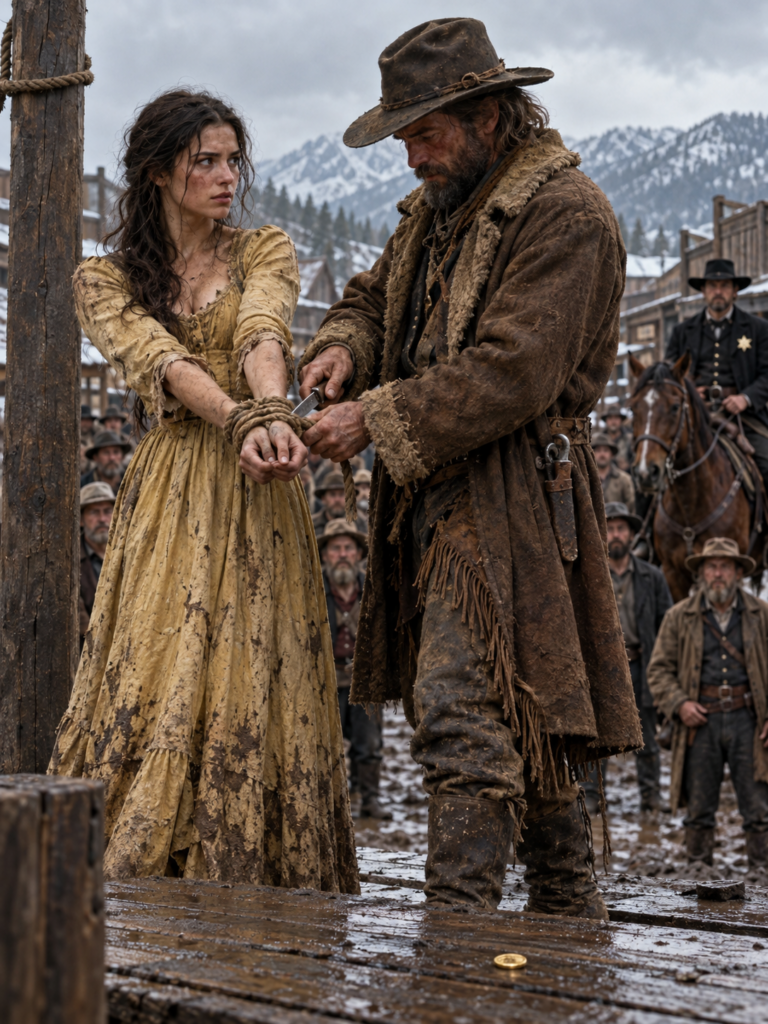
Caleb steadied the ladder with both hands while Eliza descended, her bare feet finding each narrow rung.
Halfway down, she stopped.
“Are you certain?”
“About the ladder?”
“About letting me stay.”
He looked up.
“Yes.”
“Even if I have nothing to offer?”
“Eliza, you don’t owe me your labor.”
Her eyes filled, but she refused to let the tears fall.
“People always say they expect nothing at first.”
He did not contradict her experience.
Instead, he answered, “Then you can take your time finding out whether I mean it.”
She descended the final rung.
For a moment she stood beside him, clutching the blanket.
Then she moved toward the hearth.
He returned to his chair.
She sat opposite him, holding her hands near the warmth.
The silence stretched.
At last she said, “I worked at a boarding house in Millerton.”
Caleb listened.
“The woman who owned it was Mrs. Codell. She was good to me. She paid my wages and taught me to keep accounts.”
“What happened?”
“She died. Her nephew inherited the place. He said he couldn’t afford to keep me.”
“And Garland?”
“He had been watching me.”
Caleb’s expression sharpened.
“He followed me when I left. I tried to reach Helena, but he stopped me before I could buy passage.”
“Did he say why?”
“He claimed I owed money to Reuben Orus.”
“Did you?”
“No.”
She looked directly at him.
“I have never worked for that man. I never borrowed from him.”
“Did Garland show you a document?”
“Not until he had already taken me to Birch Falls.”
Caleb stared at the fire.
The auction had been more than public cruelty.
Someone had invented a debt and used the deputy’s authority to make it appear enforceable.
He remembered Garland riding away with an expression that promised he would return.
“He may come after you,” Caleb said.
“I know.”
“We ought to examine whatever papers he brings.”
“Will it matter?”
“It might. I’ve dealt with enough claims and agreements to recognize some kinds of fraud.”
She studied him.
“You can read legal papers?”
“Some.”
“Then perhaps I should show you something.”
She stopped.
Her expression closed again.
“Not tonight,” she said.
He nodded.
“Not until you’re ready.”
Her shoulders eased.
The storm rattled the shutter.
Caleb rose to add wood to the fire.
Eliza immediately stood.
“I can do that.”
“I know.”
He handed her the smaller pieces of kindling.
She placed them carefully on the coals while he carried another log from the stack.
They worked without argument.
When the fire caught, she returned to her chair.
“Have you always lived alone?”
“No.”
“Were you married?”
He hesitated.
“Yes.”
She looked at him.
“My wife died years ago. Her name was Clara.”
“I’m sorry.”
He nodded.
“She helped build this cabin. After she died, I stopped inviting anyone up here.”
Eliza glanced around the room.
“That’s a long time to keep a house quiet.”
“It is.”
“Why didn’t you leave?”
“Because I didn’t know where I’d rather be.”
She looked toward the loft.
“And now?”
Caleb considered the question.
“Tonight, I’m glad I came down the mountain.”
The answer surprised him as much as it surprised her.
She lowered her eyes.
“I’m glad you did, too.”
He cleared the supper bowls.
This time she did not immediately rise to help.
Instead, she pulled the blanket around her shoulders.
At the foot of the ladder, she stopped.
“Caleb?”
“Yes?”
“If I stay through the storm, I want to be useful because I choose to be. I don’t want every kindness treated as proof that I have earned my bed.”
He set the last bowl aside.
“That sounds fair.”
“And I don’t want anyone deciding where I belong without asking me.”
“Agreed.”
She nodded.
Then she climbed into the loft.
Caleb sat beside the fire until the coals settled.
Above him, he heard her turning beneath the blanket.
He had been alone in the cabin long enough to recognize every sound it made.
Tonight there was a new one.
A woman trying to cry without being heard.
He did not intrude.
He kept the fire alive.
After a long while, her voice drifted down.
“You won’t send me back to Garland?”
“No.”
“Even if he comes with a badge?”
“Then we’ll find out what authority he truly has.”
She was quiet.
“And if you discover I’ve been more trouble than you expected?”
Caleb looked toward the ladder.
“Then we’ll deal with the trouble. Not discard you.”
Another silence.
Then she asked the question that made him understand how deeply the last years had wounded her.
“Caleb, could I stay until spring, even if the snow clears before then?”
He considered the months ahead, the mountain weather, and the risk of Garland returning.
“You can.”
She drew a shaky breath.
“Then I’d like to try.”
He nodded, though she could not see him.
The wind struck the cabin door.
Caleb rose to check the wooden bar.
But before he reached it, Eliza called softly from the loft.
“There’s one thing I haven’t told you about Mrs. Codell’s accounts.”
He stopped with his hand against the door.
Caleb kept his hand against the door while the wind shook it in its frame.
“What about the accounts?”
Eliza did not answer immediately.
Then she said, “Mrs. Codell kept records of everyone who stayed in her boarding house. She was careful about money.”
“That sounds sensible.”
“She taught me to copy her receipts. Before she died, she gave me a paper showing what I had earned and what had already been deducted for lodging.”
“Have you still got it?”
“Yes.”
“Then keep it safe.”
“Do you believe it will help?”
“If Garland claims a debt, an honest record of your wages may matter.”
She was silent for a while.
“There’s more,” she whispered. “But I need to understand it better before I show anyone.”
Caleb removed his hand from the door.
“Then we’ll talk when you’re ready.”
He returned to his chair.
The fire burned steadily until morning.
Outside, snow buried the steps and filled the clearing.
For two days they remained inside.
Caleb checked the roof, brought wood from the covered stack, and tended his horse in the adjoining shelter.
Eliza rested, ate, and gradually regained the strength exhaustion had taken from her.
On the third morning, she was awake before him.
He opened his eyes to the smell of hot cornmeal.
She stood at the hearth, carefully turning a pan.
“You didn’t have to make breakfast,” he said.
“I know.”
He sat up.
“Then thank you.”
She looked over her shoulder.
“Don’t make a ceremony of it.”
“Wouldn’t dream of it.”
Her mouth twitched.
After breakfast she asked which work needed doing.
Not invented work.
Real work.
He told her the indoor wood rack was nearly empty and that several shirts required mending.
She inspected the garments.
“You’ve been wearing these with the seams split?”
“Hadn’t got around to fixing them.”
“There’s more to keeping warm than owning a coat.”
He looked at her.
“I’d gathered that.”
She took a needle from his sewing tin.
He moved wood into the rack while she worked at the table.
For the first time in years, the cabin sounded like two people living ordinary lives.
A chair scraping.
A kettle lifting.
Someone asking where the spare thread was kept.
The next afternoon, Caleb returned from checking his traps and found one of his work shirts neatly repaired.
Eliza held it toward him.
“That seam should last.”
He examined the stitching.
“Better than when I bought it.”
She shrugged.
“I’ve had practice.”
“Where did you learn?”
“A tannery in Missouri. After that, a household in Wyoming. Then boarding houses.”
“How old were you when you began?”
“Fourteen.”
He looked at her.
She noticed.
“Don’t pity me, Caleb.”
“I wasn’t planning to.”
“People often do when they hear how young I was.”
“Then they’re looking at the wrong thing.”
She raised an eyebrow.
“What should they look at?”
“The fact you managed to survive seven years of hard traveling and work.”
For the first time, she smiled without immediately looking away.
That evening they worked on rabbit pelts together.
Caleb demonstrated how to prepare them for drying.
Eliza followed his instructions with practiced hands.
“You’ve done this before?”
“Not exactly. But I’ve worked with hides.”
“Seems there’s more you know than I expected.”
“There’s more you don’t know than I expected.”
He laughed.
It was a low sound, rusty from disuse.
She looked up.
Then she laughed with him.
They continued working until the fire burned low.
Over the following days, the mountain revealed both their strengths and their limits.
Caleb knew the trails, the traps, and how to preserve supplies through severe weather.
Eliza was better at keeping household accounts and noticing where materials were being wasted.
She asked him why the dry food was stored so close to the chimney.
“Because that’s where I’ve always kept it.”
“That’s not much of a reason.”
“It’s the only one I have.”
She moved some of the stores after he agreed.
He discovered that she was right.
And she discovered that being right did not always have to become a quarrel.
Yet the peace between them remained fragile.
On the sixth day, a rider appeared at the clearing.
Caleb was stacking firewood when he heard the horse.
The rider stopped beyond the porch.
“Looking for a woman named Eliza Harper.”
Caleb set down the log.
“Who’s asking?”
“Deputy Garland sent me.”
The young man removed a folded document from his coat.
“Says she owes a debt.”
“Let me see it.”
The rider hesitated.
Then he dismounted and handed over the paper.
Caleb examined it.
The document named Reuben Orus.
It claimed that Eliza owed payment for services but gave no clear explanation of when she had agreed to the charges.
“Who prepared this?”
“That’s not my concern.”
“Then you don’t know whether it’s genuine.”
The rider stiffened.
“Garland expects her brought back.”
“Tell him the matter is disputed. If he wants to pursue it, he can produce proper evidence through lawful proceedings.”
The young man glanced toward the cabin.
A smaller pair of boots stood by the door.
Caleb noticed his glance.
“The woman you’re looking for will not be handed over on a stranger’s claim.”
“Garland won’t like that.”
“He’s entitled to his opinion.”
The rider mounted and left.
Only when the hoofbeats faded did Caleb enter the cabin.
Eliza stood beside the window.
She had heard everything.
“He’ll come back,” she said.
“I expect so.”
“Then I should leave.”
“Where would you go?”
“South. Find a settlement where he doesn’t know me.”
“With fresh snow on the higher trails?”
“I’ve traveled alone before.”
“I know. I’m asking whether that’s your best choice now.”
She looked at the table.
The cabin had become something she did not know how to name.
Safe, perhaps.
But safety was unfamiliar enough to frighten her.
“You could lose everything by sheltering me.”
“That’s a risk I’m willing to consider.”
“I didn’t ask you to risk it.”
“No. You didn’t.”
He paused.
“But I won’t pretend the safest course is to send you into the snow because a deputy has made a threat.”
She sat down slowly.
“Then what do we do?”
“We keep copies of the papers. We ask for proper review. And we don’t let Garland decide everything simply because he wears a badge.”
Eliza considered that.
“I can help write the letters.”
“I’d appreciate it.”
That night they drafted an account of the auction.
Caleb described what he had witnessed.
Eliza added dates and names.
She corrected him when he used the wrong wording for the boarding house.
He accepted the corrections.
They prepared to send the complaint when a trusted trapper next went down to the valley.
The threat had not disappeared.
But Eliza was no longer facing it without a plan.
That night, as they sat beside the fire, she asked him another question.
“Why did you come to the mountains?”
He was silent for a long time.
Then he told her about Clara.
His wife had helped build the first cabin.
They had expected to grow old there.
But a fever took her during their second winter.
Afterward, Caleb found that even familiar places had become difficult to endure.
He stopped visiting town except for supplies.
He stopped making friends.
He convinced himself that solitude was easier than risking another loss.
Eliza listened without interruption.
When he finished, she said, “She must have loved the mountain.”
“She did.”
“And you loved her.”
“Yes.”
She looked at the hearth.
“You don’t have to stop loving someone because they’re gone.”
He met her eyes.
“No.”
“Nor do you have to spend the rest of your life punishing yourself because they are.”
The words settled between them.
He did not answer immediately.
But later, when she climbed to the loft, he looked around his cabin differently.
It was still the home he had built with Clara.
That history remained.
Perhaps another person living there did not erase it.
Perhaps it simply meant that time had continued.
Days passed.
The snow deepened and slowly began to settle.
Eliza grew more comfortable moving through the cabin.
She no longer asked permission to use every spoon.
She disagreed with Caleb when she thought he was wrong.
Once, when he dropped a pot of beans, she laughed so suddenly she had to cover her mouth.
He looked at the scattered supper.
“Glad somebody enjoys my cooking.”
She laughed harder.
And to his surprise, he found himself laughing, too.
On the seventh evening, she finally told him how Garland had taken her.
He had appeared at Mrs. Codell’s boarding house before the older woman died.
She had turned him away.
After her death, when the nephew dismissed Eliza, Garland began following her.
He intercepted her when she tried to buy passage away from the district.
He claimed she owed a debt she had never incurred.
And he used his position to force her onto that platform in Birch Falls.
“I kept telling him I hadn’t borrowed anything,” she said.
“Did he listen?”
“No.”
She folded her hands.
“People were watching when he took me away from the ticket office. Nobody interfered.”
Caleb looked at her.
“I know what crowds are capable of.”
“I thought you would walk past, too.”
“I nearly did.”
She nodded.
“I know.”
The honesty did not hurt her.
It seemed to matter.
“Why did you turn back?”
“Because I couldn’t leave you there.”
She studied his face.
Then, after a long pause, she asked what he truly wanted.
Not what he would provide.
Not what he thought was proper.
What he wanted for himself.
Caleb looked toward the loft, the mended shirts, the second bowl beside the hearth.
“I’d like you to be here when spring comes.”
She became very still.
“I don’t mean you must stay,” he added. “I want you to have enough time to know what you would choose if nobody were chasing you.”
She looked at him for a long moment.
“Then I’ll stay until spring.”
He nodded.
They made no promise beyond that.
And for a while, it was enough.
Spring arrived with thawing snow and a creek that grew louder every day.
The high drifts shrank.
The southern path turned muddy.
Eliza began spending more time outside.
She helped examine the stored firewood and discussed preparations for the warmer months.
Caleb discovered he had begun expecting her voice at supper.
He thought of things to tell her while working away from the cabin.
And every evening, he returned wondering whether she would still be there.
Then, in late March, three horses entered the clearing.
Deputy Garland rode in front.
Two men followed.
Caleb stepped away from the fence he had been repairing.
Garland dismounted with a folded paper in his hand.
“Ror. I’ve brought proper authority this time.”
Caleb accepted the document.
It bore Eliza’s name, a stated debt of forty-seven dollars, and the name of Reuben Orus.
It also carried official signatures.
The form was more convincing than the first.
But the substance remained questionable.
“Eight months of charges,” Caleb read.
“That’s right.”
“Eliza worked for Mrs. Codell during that period.”
“People can have more than one obligation.”
“Then the obligation needs proving.”
Garland’s mouth tightened.
“The woman comes with me.”
Caleb folded the document.
“Not on the strength of this alone.”
Garland glanced toward the cabin.
“You’re obstructing a lawful order.”
“Then we’ll have it examined by an authority beyond your own office.”
The deputy’s companions shifted uneasily.
Caleb did not touch the rifle leaning against the fence.
“There’s a federal prohibition against forcing labor to satisfy a debt,” he said. “If that’s what you’re arranging, you ought to consider how these papers will look when examined.”
Garland studied him.
“You think you know the law?”
“I know enough to ask questions.”
For a moment, the clearing was silent.
Then Garland took back the document.
“This isn’t finished.”
“No,” Caleb agreed. “It isn’t.”
Garland mounted and rode away.
Inside, Eliza had packed her belongings.
She stood by the table with her coat already on.
When Caleb entered, she looked toward the door.
“They’ve gone?”
“For now.”
“Then what happens next?”
“We write to Helena.”
He set out paper and ink.
“We ask for an examination of the debt and the way Garland took you to Birch Falls.”
Eliza looked at the bundle on the table.
Then she untied it.
From beneath the spare shirts, she removed an old folded receipt.
“Mrs. Codell gave me this when I left.”
Caleb took it carefully.
It recorded her wages, the deductions for room and board, and the balance still owed to her.
He read it twice.
“This is important.”
“I thought so.”
“Why didn’t you show me before?”
She lowered her eyes.
“Because I’ve had men tell me my word meant nothing beside a paper carrying somebody else’s name.”
Caleb laid the receipt on the table.
“Then we’ll make certain this one is heard.”
She watched him.
“There’s something else.”
He looked up.
“Mrs. Codell kept ledgers. Not just for the boarding house.”
“What sort of ledgers?”
“Payments from miners. Money connected with a claim near Kettle Creek.”
Caleb grew attentive.
“Where are they?”
“In my bundle.”
“You’ve had them all this time?”
“Yes.”
She met his eyes.
“And now I think I know why Orus wants me brought back.”
She opened the bundle again, drew out the old account books, and placed them beside the false debt document.
Then she turned the first page toward Caleb.
“Look at the names,” she said. “And look who paid for the miners to remain at the boarding house.”
Caleb bent over the page and examined the entries Eliza had indicated.
Several names appeared beside payments recorded in Mrs. Codell’s careful handwriting.
The amounts were small.
The pattern was not.
Miners connected with the Kettle Creek claim had received support while property arrangements were being made elsewhere.
Reuben Orus appeared repeatedly in the accounts.
Caleb turned another page.
“Why did Mrs. Codell record all this?”
“She believed someone was cheating those men.”
“Did she tell you that?”
“Not in so many words. But she taught me how to keep a clear record, and she said honest books could protect people after honest words were ignored.”
Eliza touched the worn cover.
“When she became ill, she asked me to keep these safe.”
Caleb looked at her.
“You’ve carried them since Millerton?”
“Yes.”
“Does Garland know?”
“I don’t think he knows exactly what I have. But I believe Orus suspects.”
Caleb studied the entries again.
“The false debt may have been a way to bring you under their control before you could show these to anyone.”
“That is what I’ve begun to think.”
“Then this concerns more than your wages.”
Eliza nodded.
“I know.”
They sat at the table until the fire burned low, examining dates and comparing the account books with her employment receipt.
Caleb had spent two winters reading legal texts left by his late wife’s father.
He was no lawyer.
But he knew the danger of trusting an official-looking paper without understanding what it claimed.
He also knew they needed someone qualified to examine the evidence.
They prepared a careful statement for the federal authorities in Helena.
Eliza wrote most of it.
She remembered dates precisely and knew which entries had been made by Mrs. Codell herself.
When Caleb suggested a sentence that sounded too certain, she changed it.
“We cannot prove that yet,” she said.
He nodded.
“Then say what we can.”
The following morning, a trapper named Pete arrived on his regular journey down the valley.
He had known Caleb for years.
He looked at Eliza with curiosity but asked no unnecessary questions.
Caleb handed him the correspondence.
“Important?”
“Yes.”
Pete tucked the packet inside his coat.
“Then I’ll see it’s delivered.”
Eliza stepped onto the porch.
“Thank you.”
Pete touched his hat.
“Glad to be of help.”
He rode away with the letters.
For the next three weeks, the mountain resumed its ordinary rhythm.
But nothing felt ordinary to Eliza.
Every day brought the possibility of Garland returning.
Every distant horse sound drew her attention.
She continued to work, yet she had difficulty sleeping.
Caleb noticed.
One evening he found her standing by the window.
“Thinking about Helena?”
“Yes.”
“Anything I can do?”
“Tell me you won’t send me away if the answer is bad.”
He looked at her.
“Eliza, you don’t need to keep asking that.”
“I know.”
She turned.
“But sometimes I need to hear the answer.”
He approached, stopping beside the table.
“Then I’ll tell you as often as you need.”
She studied him.
“You mean that.”
“Yes.”
She nodded.
It was not a cure for seven years of being unwanted.
But every repeated act of reliability made a little more room for trust.
When the reply arrived, Caleb was working along the southern ridge.
He returned to find Eliza seated at the table, two opened envelopes before her.
Her expression was unusually still.
“What’s happened?”
She looked up.
“Judge Aldis Crew has answered.”
Caleb removed his coat.
“And?”
“He wants to examine the original wage receipt and the ledgers.”
“When?”
“In Millerton. Three weeks from Wednesday.”
He sat opposite her.
“That’s enough time to prepare.”
“He also intends to inquire into Garland’s conduct at the auction.”
Caleb considered that.
“Good.”
Eliza looked down at the letters.
“I thought I’d spend the rest of my life avoiding that man.”
“You may not have to.”
She let out a slow breath.
“I don’t quite know how to believe it yet.”
He placed his hands on the table.
“Then don’t rush yourself. We have work to do before the hearing.”
She nodded.
They began preparing the documents that afternoon.
Eliza arranged the account books by date and identified the pages she believed most important.
Caleb helped make copies and assemble a clear chronology.
They discussed what each of them had witnessed.
And they agreed that Eliza would speak for herself.
She did not want to be treated as an object of pity in the courtroom any more than she had wanted to be treated as property in Birch Falls.
“This is my testimony,” she said one evening.
“It is.”
“Then if a judge asks me a question, I will answer it.”
Caleb looked at her.
“I wouldn’t have it any other way.”
She smiled.
Their affection had been growing in the quiet work of the cabin, but neither had yet named it openly.
Sometimes their hands touched while passing papers.
Sometimes they lingered beside the fire after supper, talking until the logs burned low.
Sometimes Eliza looked at him and felt a warmth that frightened her precisely because it was wanted.
She had spent years learning to survive without expecting kindness.
Now she was beginning to want more than survival.
And she needed to know whether that desire was her own.
As the date of the hearing approached, they prepared the horses and gathered provisions for the journey.
The mountain trails were muddy with spring runoff.
They traveled carefully, taking time to rest the animals and avoid dangerous crossings.
When they reached Millerton, Caleb arranged separate rooms at the hotel.
Eliza noticed.
“You remembered.”
“Remembered what?”
“That you said I’d have a place of my own.”
He nodded.
“You still do.”
They spent the afternoon walking through town.
The streets were familiar to Eliza.
Here was the boarding house where Mrs. Codell had once stood up for her.
There was the corner where Garland had appeared when she left.
And near the sheriff’s office stood two men deep in conversation.
One wore a deputy’s badge.
The other was broad, well-dressed, and unmistakably wealthy.
Eliza stopped.
“Caleb.”
He followed her gaze.
“Garland?”
“Yes. The man beside him is Reuben Orus.”
Caleb studied the pair.
“You recognize him?”
“He came to Mrs. Codell’s boarding house several times before she died.”
“Did you ever speak?”
“Only briefly.”
She looked toward the man.
“I remember his face. He always wanted to know who was staying there.”
They turned away before either man noticed them.
Back at the hotel, Eliza opened the ledgers again.
Now that she had seen Orus, several entries made greater sense.
She traced a group of payments connected to Kettle Creek.
“Mrs. Codell wasn’t simply recording board.”
“What do you mean?”
“These men were paid to remain near the claim while Orus arranged its transfer.”
Caleb examined the dates.
“Do you know whether the transfer was lawful?”
“No. But the payments were concealed under ordinary lodging expenses.”
She closed the book.
“I think she wanted somebody to discover it.”
“Then Judge Crew should see these before the hearing.”
They asked for a meeting.
The judge received them that evening.
He was an older man with a patient manner and a habit of reading slowly.
Eliza presented the wage receipt first.
Then the account books.
She explained where she had obtained them and why she believed the entries important.
Judge Crew asked careful questions.
She answered each one.
When she was uncertain, she said so.
Caleb watched her.
The young woman who had once stood silently on a platform now sat before a judge, explaining financial records with the composure of someone who knew her own evidence.
At last, Crew closed the ledger.
“Miss Harper, I shall need your testimony in open proceedings tomorrow.”
“I expected that.”
“Counsel for Mr. Orus may challenge your account.”
“I understand.”
“Are you prepared?”
She met his eyes.
“Yes, Judge.”
He nodded.
Afterward, as they returned to their rooms, Caleb spoke quietly.
“You did well.”
Eliza looked at him.
“I’m frightened.”
“I know.”
“But I won’t let fear decide for me.”
“No.”
She stopped outside her door.
“Caleb, before tomorrow, I want to ask you something.”
“Go ahead.”
“When this is settled, what do you want?”
He knew what she was asking.
Not where he intended to travel.
Not what supplies he needed.
What he wanted from the life waiting beyond the hearing.
He looked at her.
“I want you to remain part of it.”
Her breath caught.
“But only if that’s what you choose,” he added.
She touched his sleeve.
“I think it may be.”
He covered her hand briefly with his own.
Then he said good night.
She entered her room and closed the door.
For once, the door did not feel like a barrier keeping her safe from the world.
It was simply a door she could close when she wished.
The hearing began the following morning.
Orus arrived with counsel.
Garland sat nearby, his expression controlled.
Judge Crew listened to the statements and examined the documents.
Eliza testified first.
She described her employment at Mrs. Codell’s boarding house, the wages she had earned, and the events that followed the owner’s death.
Then she explained how Garland had intercepted her and claimed she owed money to Orus.
She described the platform in Birch Falls.
She did not embellish.
When asked about the account books, she explained how Mrs. Codell had maintained them and how they had come into her care.
Orus’s lawyer tried to challenge her knowledge of the records.
“You are not an accountant by profession, Miss Harper.”
“No.”
“Then how can you know what these entries signify?”
“Because I helped maintain the boarding house accounts, and Mrs. Codell taught me her methods.”
“Could you have misunderstood them?”
“I could have misunderstood some transactions. That’s why I have brought the books themselves rather than asking anyone to rely upon my interpretation.”
The judge made a note.
The lawyer changed his approach.
“Perhaps you invented the debt dispute because you wanted someone to support you.”
Eliza looked directly at him.
“Then why does the wage receipt show that the boarding house owed me money?”
He had no useful answer.
Later, Caleb gave his own testimony.
He described the auction, Garland’s bidding, and the irregular debt documents.
When Orus’s lawyer asked whether Caleb had purchased Eliza, the mountain man remained calm.
“I paid to end a wrongful proceeding. I never considered Miss Harper my property.”
“But money changed hands.”
“Yes.”
“And she went home with you afterward.”
“Because she asked for a safe place to stay.”
The lawyer leaned forward.
“And what did you expect in exchange?”
“Nothing.”
A murmur moved through the room.
Caleb continued.
“She was free to leave when she wished. She is free now.”
Across the room, Eliza watched him.
The words mattered because she had heard him say them many times when nobody else was present.
Now he was saying them publicly.
Under questioning.
Before the very men who had tried to deny her freedom.
The judge reviewed the papers carefully.
The hearing continued into the afternoon.
At last, Crew delivered his findings.
The claimed debt lacked sufficient lawful foundation.
Eliza was not obligated to work for Orus or Garland.
The evidence concerning the Kettle Creek land transactions was referred for further investigation.
Garland’s conduct also required formal examination by the appropriate authorities, and his position as deputy was ended.
The legal consequences for Orus and Garland would require additional proceedings.
But the central question had been answered.
Nobody had a lawful claim upon Eliza Harper’s labor or person.
She was free to go.
Eliza listened with both hands folded in her lap.
For months, she had imagined relief arriving like a shout.
Instead, it came quietly.
A breath.
Then another.
The realization that no one in that room could order her onto another platform.
Outside the hotel, Caleb found her standing beneath the late afternoon light.
She looked toward the road leading north.
“I want to go home.”
He followed her gaze.
“Back to the cabin?”
“Yes.”
He looked at her.
“You’re certain?”
She smiled through sudden tears.
“It’s the first place I’ve ever wanted to return to.”
They left Millerton after the proceedings were concluded and began the journey north.
For a long while, they rode in companionable silence.
Then Eliza drew her horse alongside Caleb’s.
“I thought you were lying that first night.”
He glanced toward her.
“About letting you stay?”
“Yes.”
“I know.”
“I thought you’d change your mind when I wasn’t useful enough.”
He listened.
“Then I worked harder than I needed to, because I was still afraid.”
“And afterward?”
“Afterward, I began to understand you meant what you said.”
She looked toward the mountains.
“And now I’m going back because I want to.”
Caleb nodded.
“That’s what matters.”
She turned toward him.
“I want to build a life there, Caleb.”
He looked at her.
“With me?”
“Yes.”
His voice softened.
“I’d like that very much.”
The trail climbed toward the Bitterroot Mountains.
Above them, spring sunlight touched the remaining snow.
Neither hurried the horses.
There was no one chasing them now.
They reached the cabin after the long journey and found everything much as they had left it.
The hearth was cold.
The wood rack waited to be filled.
A section of fence needed repair.
And the loft still held the blanket Caleb had given her on the first night.
Eliza stood in the doorway, looking around.
“There’s a great deal to do.”
“Always is.”
She smiled.
“I suppose we’d better begin.”
He carried their bags inside.
She opened the shutters.
Sunlight entered the cabin.
The ordinary work of living began again.
In the months that followed, their partnership became more deliberate.
They discussed the income Caleb earned from trapping and timber work.
Eliza helped him keep better records.
He taught her the mountain trails and the seasonal needs of the holding.
She found ways to make the cabin more comfortable without wasting precious supplies.
They shared work according to strength, skill, and circumstance rather than treating any task as naturally belonging to one of them.
And when they disagreed, they spoke plainly.
One afternoon, Caleb suggested replacing the old table.
Eliza looked at it.
“Why?”
“It’s uneven.”
“It can be repaired.”
“I could make a better one.”
“Then perhaps we should make one together.”
He considered the proposal.
“All right.”
It became one of the first things they built as a pair.
Caleb shaped the wood.
Eliza measured and checked the pieces.
When the legs finally stood evenly, they sat opposite one another with coffee and admired the result.
“Not bad,” Caleb said.
“Better than your old table.”
“My old table served me for years.”
“This one may serve us longer.”
He looked at her.
The word us had become so natural that neither needed to explain it.
Summer arrived.
The creek ran clear.
The pines lifted their branches into warm winds.
Sometimes Eliza accompanied Caleb on the trails.
Sometimes she remained at the cabin to handle work she had chosen for herself.
She learned where the mountain grew dangerous after rain and which crossing was safer when the creek ran high.
Caleb learned that she was better at deciding when a task required another pair of hands.
He had spent years believing that independence meant doing everything alone.
She had spent years believing that survival required becoming indispensable.
Together, they began discovering something different.
A person could be capable and still accept help.
A person could be loved without having to prove a daily value.
Their affection grew steadily.
Not from the auction.
Not from the storm.
But from months of seeing one another clearly.
One August morning, Caleb took Eliza along a ridge above the valley.
The horses grazed nearby while they stood looking across the Montana mountains.
The sky was brilliant blue.
The cabin was hidden below the trees.
Caleb reached into his coat.
“I’ve been keeping something.”
Eliza turned.
In his palm lay the gold coin connected with the day in Birch Falls.
She looked at it.
“That coin?”
“Yes.”
For a moment neither spoke.
Then Caleb said, “I’ve thought about what it once represented.”
She looked toward the distant valley.
“So have I.”
“I don’t want it to stand for what those men tried to do.”
“What would you rather it mean?”
He closed his fingers around the gold.
“I’d like to have it made into a ring.”
Eliza grew still.
Caleb looked directly at her.
“Not because I brought you to my cabin. Not because you owe me anything. Not because I need someone to keep house.”
She waited.
“Because I love you. And I’d like to marry you, if that’s a life you want as well.”
The wind moved softly across the ridge.
Eliza looked at the man before her.
She remembered the muddy platform.
The rope around her wrists.
The deputy on horseback.
The first night in the cabin, when she had asked what would happen once she was no longer useful.
And she remembered every ordinary day afterward.
The meals shared.
The work done.
The arguments settled.
The freedom to refuse.
The promises Caleb had kept when no one was watching.
She took the coin from his palm.
Its weight surprised her.
“So much trouble for thirty dollars,” she said quietly.
Caleb almost smiled.
“More than I expected.”
She looked at him.
“I want to marry you.”
He drew a breath.
“Are you sure?”
“Yes.”
“And your work? Your choices?”
“They remain mine.”
“Of course.”
She placed the coin back in his hand.
“Then let’s make the ring.”
He took her other hand.
For a while, they stood together on the ridge without speaking.
There was nothing left to bargain over.
Later, Pete carried the gold to a jeweler in Helena.
By autumn, a plain band had returned.
Eliza wore it because she wanted to.
Not as a mark of ownership.
As a sign of a promise freely given and freely accepted.
They married without grand display.
Their life continued much as it had before, though with a deeper understanding of what they had chosen.
The cabin remained their home.
The mountains remained demanding.
Winter still required stored wood, food, repairs, and careful travel.
Neither love nor marriage made the work disappear.
But now they faced it together.
In time, the story of the illegal auction reached other communities.
The proceedings against Garland and the inquiry into Orus’s dealings continued to remind people that an official title did not excuse wrongdoing.
Eliza’s testimony and Mrs. Codell’s records had mattered.
So had the willingness of others to examine them honestly.
Eliza kept her old wage receipt among her personal papers.
Not because she still feared being taken.
Because it reminded her that the truth she had carried through years of uncertainty had finally been heard.
She also kept the first blanket Caleb had given her.
It had been patched more than once.
He suggested replacing it.
She refused.
“It’s still warm.”
“It’s older than it ought to be.”
“So are some of your shirts.”
He laughed.
She smiled.
And the argument ended as many of their arguments did, with both of them knowing the blanket would remain.
Years did not pass without difficulty.
There were winters when supplies ran short and seasons when the mountain demanded more labor than expected.
There were days when Caleb withdrew into silence and Eliza had to remind him that she could not understand thoughts he never shared.
There were times when Eliza worked herself to exhaustion before remembering she no longer had to earn her right to rest.
But each learned to recognize the other’s old fears without surrendering to them.
Once, after a difficult day in the late autumn, Caleb found her sitting on the porch.
She was watching the light fade behind the pines.
“What’s troubling you?”
“Nothing serious.”
He sat beside her.
She looked down at her hands.
“I was thinking about that platform.”
Caleb waited.
“I used to remember it every time I closed my eyes.”
“And now?”
“Now I remember what came afterward.”
She turned toward him.
“You cut the rope. But you didn’t tell me what to do once I was free.”
“No.”
“You let me work that out myself.”
He took her hand.
“You knew better than anyone what kind of life you wanted.”
“I didn’t then.”
He smiled faintly.
“You learned.”
She leaned against him.
“So did you.”
They sat together until the evening grew cold.
Then Caleb stood and offered his hand.
Eliza took it.
Inside, the cabin was warm.
Two cups stood on the table they had built together.
Their coats hung beside the door.
The work of another day waited for morning.
And the little mountain home that had once held only a lonely man’s grief now held a partnership neither of them had believed possible.
Eliza did not become precious because someone had paid money to stop her humiliation.
She had always possessed dignity.
What changed was that she found the freedom to live without defending that dignity every waking moment.
And Caleb did not become a good man merely because he had intervened once.
He became worthy of her trust by honoring her freedom through the ordinary days that followed.
The night before their first winter together as husband and wife, the wind rose over the Bitterroot Mountains.
Snow tapped against the shutters.
Eliza stood beside the hearth while Caleb checked the latch.
“Caleb?”
He turned.
“Yes?”
“Do you remember what I asked you that first night?”
He looked at her.
“How could I forget?”
“I asked what would happen when I wasn’t worth keeping.”
He crossed the room and stopped before her.
“And I told you the choice of staying was yours.”
She smiled.
“I think I finally understand the answer.”
“What is it?”
She slipped her hand into his.
“That I was never something to be kept.”
He nodded.
“No, Eliza.”
“I was someone who could choose.”
He kissed her forehead.
“And you chose.”
She looked around the cabin.
At the sturdy table.
The warm hearth.
The repaired shirts.
The books on the shelf.
The home they maintained together.
Then she looked back at him.
“Yes,” she whispered. “I chose you.”
Outside, the snow deepened.
Inside, the fire held.
And on her finger, the small golden ring caught the lamplight.
Once, money had been placed upon a platform while strangers argued about her future.
Now the gold carried an entirely different meaning.
It marked a promise between two free people.
A woman who no longer had to prove she deserved a home.
And a mountain man who no longer believed loving someone meant losing himself.
Together, they had made a life neither could have purchased.
Only chosen.

