
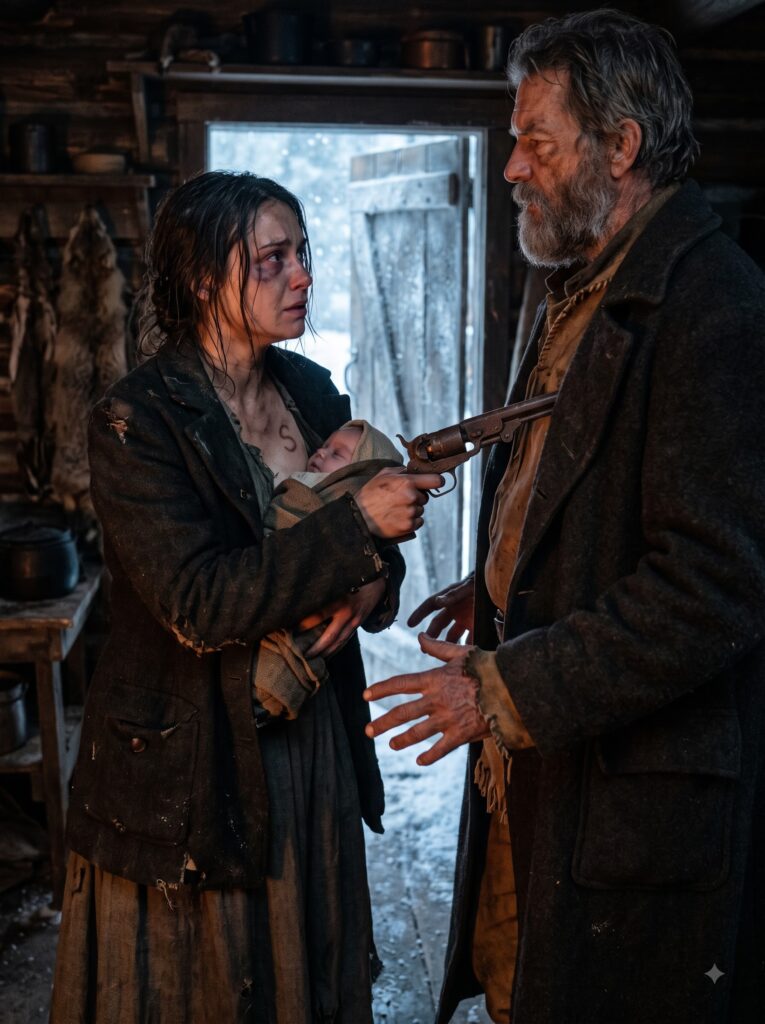
Samuel pulled the shutter open no wider than his thumb.
Cold air touched his face.
Beyond the cabin, snow drifted across the clearing. The lean-to stood dark beside the trees, and Gideon shifted uneasily inside.
Samuel listened.
Nothing.
Then, far down the northern slope, came the muffled clatter of hooves striking frozen ground.
“Someone’s riding,” Clara whispered.
Samuel closed the shutter.
“Could be a traveler looking for shelter.”
“Not up here. Not tonight.”
He turned toward her.
Clara was sitting upright, Thomas held securely against her chest.
Her injured eye was swollen, but the other was clear and watchful.
“They know the trail,” she said. “Holt trapped these mountains before he worked for Blackthorne.”
Samuel had heard the same.
He checked the door latch and returned to his chair.
“We won’t open for anyone without knowing who it is.”
Clara looked at the rifle resting nearby.
“You’d fight them?”
“I’d rather they never find reason to test me.”
“That isn’t an answer.”
“No,” he admitted. “It isn’t.”
He pulled another split log toward the fire.
“Here is one. I’m not handing you over. But I won’t make decisions about your life without speaking to you first.”
Clara watched him.
Her expression changed almost imperceptibly.
“Then you need to understand what he’s done.”
Samuel waited.
She looked down at Thomas before speaking.
“My father left my mother a small property. After he died, she fell behind on taxes and borrowed money. Blackthorne paid what was owing and offered work at his ranch.”
“Was that the agreement she believed she was making?”
“Yes.”
Clara’s voice hardened.
“It wasn’t the agreement he intended to keep.”
She explained how debts were recalculated, wages withheld, and new obligations imposed whenever the old ones should have been settled.
Her mother died before escaping the arrangement.
Clara remained.
Seven years altogether.
“And the mark?” Samuel asked.
Clara touched the cloth covering her shoulder.
“His foreman did it. Holt. Blackthorne ordered it.”
Samuel felt anger rise but kept his voice even.
“Was it meant as punishment?”
“As a warning. To me and anyone who might help me leave.”
Thomas stirred.
She rocked him gently.
“When I crossed the valley, people recognized the mark. They knew whom to notify.”
Samuel looked toward the door.
A scar had become a means of control.
And the authorities in Harland Creek had apparently helped enforce it.
“Why did you leave now?”
Clara’s gaze settled upon her son.
“Because I wasn’t going to let Thomas grow up believing that place was the whole world.”
Samuel understood enough not to press the question further.
But Clara continued.
“There is something else you should know. I didn’t leave with only my clothes.”
He looked at her.
“I took records.”
“What sort?”
“Contracts. Letters. Documents Blackthorne thought nobody beneath him could understand.”
Samuel sat forward.
Clara’s expression remained guarded.
“I kept copies for years. Some show what he did to my mother. Others concern families whose land passed into his hands.”
“Where are they?”
She hesitated.
Then touched the lining of her coat.
Samuel did not ask her to surrender it.
Instead, he said, “A few years ago I watched a family lose property through papers I didn’t trust. Blackthorne was behind it.”
“The Pruitts?”
Samuel looked up sharply.
“You know them?”
“I saw their original agreement. It wasn’t the same as the one presented in court.”
The silence between them changed.
Samuel remembered the courthouse yard, the defeated family, and his own decision to walk away.
He had told himself one isolated mountain man could accomplish nothing.
Now Clara was sitting before him with records that might prove what he had only suspected.
“You understand what you’ve carried here?” he asked.
“Better than Blackthorne ever imagined.”
Samuel gave a slow nod.
“Then you haven’t merely escaped him.”
“No.”
“You’re carrying evidence that could threaten everything he’s built.”
Clara met his eyes.
“That is why Holt won’t stop.”
A gust struck the cabin.
Thomas began crying.
Clara drew him close, attending to him before speaking again.
“I need to reach Helena. Not Harland Creek. Someone beyond Blackthorne’s influence must see those papers.”
Samuel considered the distance, the weather, and the horses.
He knew a federal marshal in Helena named Torrance.
He also knew of Judge Kerry, whose reputation was less easily intimidated than that of local officials.
There might be a way.
But Clara and Thomas were exhausted, and Holt knew the mountains.
“We’ll need help,” Samuel said.
“From whom?”
“A trapper named Gus Winslow keeps a station along Ridley Creek. He’s no friend of Blackthorne.”
Clara considered that.
Then she shook her head.
“We can’t simply ride toward the main road. Holt will be watching.”
“There’s another trail.”
“Does he know it?”
“Not unless he’s followed my boots for four years.”
For the first time, Clara almost smiled.
But the expression vanished when Gideon gave a sharp, frightened cry from the lean-to.
Samuel stood immediately.
Clara stopped rocking Thomas.
The horse cried again.
This time the sound came with the unmistakable creak of another animal’s tack outside.
Samuel crossed to the shutter.
Through the narrow opening he saw a mounted figure waiting among the pines.
A second rider appeared near the eastern edge of the clearing.
They did not approach.
They were watching.
Clara rose from the bunk.
“He’s found us.”
Samuel looked toward her.
She had already tucked the oilskin-wrapped papers deeper into her coat.
Thomas was pressed against her chest.
Her broken pistol lay within reach.
“How many men does Holt usually bring?” Samuel asked.
“Four.”
“Then two are somewhere we can’t see.”
Clara moved closer to the fireplace, away from the exposed window.
Samuel checked the rear shutter.
The second rider was circling the cabin.
He returned to Clara.
“There’s a loft above the stove. Can you climb with Thomas?”
“Yes.”
He brought the ladder.
She tested the rungs before stepping onto them, secured Thomas carefully, and began climbing.
Halfway up, she stopped.
“Samuel.”
He looked up.
“If they come inside, don’t tell them where I’ve gone. Give me time to take the papers farther.”
“I hear you.”
She climbed the remaining rungs.
He steadied the ladder until she reached the loft, then withdrew it from view.
Outside, a horse advanced toward the front door.
A man’s voice cut through the cold.
“Carter! We know the woman is there.”
Samuel stood beneath the shutter, his rifle lowered but ready.
The rider stopped.
“William Blackthorne wants his property returned.”
Samuel looked up toward the loft where Clara held her child.
Then he stepped toward the door and lifted the latch.
The latch lifted beneath Samuel’s thumb.
But he did not pull the door open.
Instead, he held it closed and answered through the wood.
“Holt, there isn’t a person in this house who belongs to William Blackthorne.”
A horse snorted outside.
Then came a low laugh.
“That’s a mighty inconvenient opinion, Carter.”
Samuel recognized the voice.
Holt had once worked as a trapper in these mountains. Now he commanded Blackthorne’s most trusted men.
“Open the door,” Holt called. “Send her out, and nobody gets hurt.”
Samuel stood with the rifle resting against his leg.
“She isn’t coming out to you.”
“Then you’re choosing trouble.”
“You’re welcome to ride away.”
A long silence followed.
From the loft came the faintest rustling of cloth.
Samuel could imagine Clara holding Thomas tightly, trying to keep him warm and quiet.
Holt shifted in his saddle.
“You’re making yourself an enemy of a powerful man.”
Samuel looked at the door.
“I reckon he’s made enough enemies of his own.”
Another silence.
Then Holt spoke more softly.
“You think she’s worth dying for?”
Samuel knew the question was intended to unsettle him.
But something about it clarified matters instead.
Clara’s worth had never been his to judge.
Whether she was innocent of every accusation Blackthorne made would eventually be answered by evidence.
But no accusation granted a rancher ownership of a woman and her baby.
“I’m not bargaining over her,” Samuel said.
Beyond the door, Holt muttered something to another rider.
Then the horses retreated.
Samuel waited.
Their hoofbeats faded toward the tree line.
But he did not mistake the silence for safety.
“Clara,” he called softly, “they haven’t gone far.”
“I know.”
Thomas began fussing above him.
Clara shifted the child.
“We can’t remain here.”
Samuel agreed.
He moved to the bunk and dragged it away from the wall.
Beneath a loose section of flooring lay a narrow opening leading into a root cellar.
He had made the passage years earlier while improving storage beneath the cabin.
Beyond it was a low crawl space connecting to the lean-to.
“We can reach the horses without crossing the clearing.”
Clara appeared at the loft’s edge.
“Will it hold us both?”
“One at a time. The ceiling’s low, but the earth beneath is firm.”
“Then fetch the ladder.”
Samuel positioned it.
Clara descended carefully, keeping Thomas secured against her body.
She did not ask Samuel to carry him.
The baby was frightened and hungry, and she wanted him close.
Samuel respected that.
He gathered blankets, food, water, ammunition, and the few supplies they could reasonably carry.
He also took his winter bedroll.
Clara watched him.
“You’re leaving your cabin.”
“For now.”
“Because of me.”
“Because there are armed men outside and I’ve decided I’d rather see what you can do with those papers than wait for Holt to knock again.”
She considered him.
Then gave a short nod.
“That makes sense.”
Samuel almost smiled.
He lifted the cellar hatch.
“After you.”
The passage smelled of earth, dried herbs, and old wood.
Samuel went first to check the exit.
Clara followed, crouching low with Thomas in his sling.
They emerged behind stacked hay in the lean-to.
Gideon tossed his head nervously.
The gray mare stood farther back, shifting her weight.
Samuel calmed both animals before beginning to saddle them.
Clara examined the mare’s tack.
“She’s steady?”
“Steadier than Gideon when he’s offended.”
Clara checked the girth herself.
“I can ride.”
“Good.”
“And I know how to manage a horse on rough ground. But Thomas will limit how quickly we can travel.”
Samuel looked at her.
“Then we’ll travel at a pace he can bear.”
He arranged a secure carrying sling beneath her coat and checked that she could keep Thomas supported while riding.
They waited until the clearing remained quiet.
Then they led the horses behind the cabin toward the eastern trees.
Samuel did not hurry them into a reckless gallop.
The ground was steep and covered in fresh snow.
One fall could injure a horse, a rider, or the infant.
They moved carefully until the timber concealed them.
Only then did Samuel lead Gideon onto the narrow switchback.
Clara followed on the gray mare.
The trail descended through pine and exposed stone.
Fresh snow hid portions of it.
Samuel knew the route from years of trapping.
At several turns, he dismounted to lead Gideon across uncertain footing.
Clara did the same.
Neither wasted breath pretending the journey was easy.
Thomas needed frequent attention.
The horses needed pauses.
The cold found its way beneath every layer of wool.
Yet they continued.
After they had traveled some distance, a gunshot sounded far above them.
Samuel stopped.
Clara looked toward the ridge.
“They’ve discovered we’re gone.”
“Likely.”
“Can Holt find this trail?”
“He can follow tracks if he has enough light.”
Samuel turned toward the creek below.
“We’ll keep moving, but the horses must keep their feet. No amount of speed is worth breaking a leg.”
Clara studied the narrow descent.
“Agreed.”
They reached the creek bottom with daylight strengthening.
Samuel led them along a sheltered bank toward Ridley Creek.
By afternoon they approached Winslow’s trading station.
Gus Winslow opened the door after recognizing Samuel’s knock.
He looked at the exhausted woman, the bundled baby, and the horses outside.
Then he stepped aside.
“Well, Carter. You’ve brought more company than usual.”
Samuel answered without humor.
“Holt’s behind us.”
Winslow’s expression changed.
“That explains the haste.”
Clara entered with Thomas.
The station smelled of wood smoke and drying hides.
Winslow provided warm food and a place for them to rest.
Samuel tended the horses first, checking their legs and arranging feed.
Then he joined Clara at the table.
Winslow studied her.
“You’re Clara Whitmore.”
She met his eyes.
“Who told you?”
“Word came up the creek. Blackthorne claims you’ve stolen money and property.”
“I took records of what he’s done.”
She laid the oilskin package on the table.
“I didn’t steal his money.”
Winslow looked at Samuel.
“You believe her?”
“I’ve seen enough of the documents to believe they deserve examination by someone Blackthorne cannot command.”
Clara opened the package.
She spread several pages across the table.
There were agreements concerning wages and land, copies of correspondence, and records she had preserved while working at the ranch.
She explained how certain families had signed one arrangement only to find another presented later.
She identified repeated witnesses and men connected to Blackthorne’s transactions.
Winslow listened.
He was not a lawyer.
But he understood what such papers could mean.
“Judge Kerry’s already in Helena,” he said. “He arrived earlier than expected to hear another land matter.”
Samuel looked up.
“Then we have an opportunity.”
Clara gathered the documents.
“We need to reach him before Blackthorne knows where we’re going.”
Winslow nodded.
“You can use the southern track from here. It meets the road toward Helena beyond the creek country.”
He arranged food for the journey and allowed the horses time to recover.
But before they could leave, the station door opened.
A young rider stood there carrying a rifle.
He wore the clothing of Blackthorne’s ranch hands.
Samuel rose slowly.
The young man’s gaze went straight to Clara.
“Mr. Holt sent me.”
Winslow stood behind the table.
Samuel moved where he could address the rider without forcing Clara into a corner.
“What’s your name, son?”
“Eli Marsh.”
“How old?”
“Twenty-two.”
Samuel looked at the rifle.
“Does Holt know you’re here alone?”
Eli hesitated.
“He sent me ahead.”
“Then he isn’t certain what he’ll find.”
The young man’s face tightened.
Samuel kept his voice steady.
“Blackthorne’s affairs are being taken before a federal judge. Whatever Holt told you about the woman, think carefully before you make yourself responsible for something you cannot undo.”
Eli glanced at Clara.
She spoke before Samuel could continue.
“I worked at that ranch seven years. I know what Holt has told you. I’ve seen what happens when men follow orders because they’re afraid to question them.”
Eli shifted his grip on the rifle.
Clara met his eyes.
“You still have a choice.”
The room remained quiet.
At last the young man lowered his weapon.
He had no orders that could justify taking a woman and infant by force from a room full of witnesses.
He stepped backward.
“I’ll tell Holt what you said.”
Samuel did not threaten him.
“Tell him the truth.”
Eli left.
Winslow watched through the window until the young rider disappeared.
“That won’t buy you much time.”
“No,” Clara agreed.
She gathered Thomas and rose.
“But it may buy enough.”
They left after the horses had rested.
Winslow supplied provisions and directions, then stood outside as they mounted.
“Keep to the track I showed you,” he said. “And let the horses breathe.”
Samuel offered his hand.
Winslow shook it.
Then he looked at Clara.
“You make certain those papers reach somebody who’ll read them.”
“I intend to.”
They rode on.
The journey toward Helena took days rather than hours.
At a relay station, they secured fresh provisions and rested the animals.
Thomas’s increasing discomfort forced them to stop longer than Samuel first intended.
Clara insisted on tending him before continuing.
Samuel did not argue.
They were not racing merely to arrive with evidence.
They were trying to arrive alive.
During one of those stops, Clara sat beside the stove with Thomas sleeping in her arms.
Samuel repaired a loose strap on a saddlebag.
“You said you used to be cavalry,” she remarked.
Samuel paused.
“I did.”
“Why did you leave?”
He studied the leather in his hands.
“Too many good men paid for decisions they never had the chance to question.”
Clara waited.
Samuel spoke of service, obedience, and two men lost after following orders he no longer believed should have been given.
He did not turn the account into heroism.
He admitted that some mistakes could not be repaired.
Then he spoke of his wife’s death.
A fever.
A home he could no longer bear to inhabit.
Years of retreating from every reminder of the world below the mountain.
“I thought being alone would spare me losing anyone else.”
“Did it?”
Samuel looked at the stove.
“It spared me knowing anybody.”
Clara considered his answer.
“I spent seven years learning not to trust another person with anything important.”
“And yet you trusted me with those papers.”
“Not all at once.”
He nodded.
“No. Not all at once.”
She adjusted Thomas’s blanket.
“You could have taken them away from me.”
“They’re yours.”
“Blackthorne never allowed me to say that about anything.”
Samuel looked at her.
“Then he never understood you.”
Clara’s expression softened.
“No,” she said. “He didn’t.”
Their journey continued.
Samuel began consulting Clara before choosing difficult stretches of road.
She knew how to organize provisions and judge what could be spared.
He understood the mountain routes and the needs of the horses.
They disagreed sometimes.
When Samuel proposed traveling past sunset, Clara reminded him that Thomas had been unsettled for hours and the gray mare needed rest.
He listened.
They stopped.
Later, when Clara wanted to continue despite her exhaustion, Samuel pointed out a sheltered station ahead and offered another choice.
She accepted.
Their trust grew not because one surrendered judgment to the other, but because each learned the other’s judgment had value.
By the time Helena’s buildings appeared against the winter sky, Clara scarcely recognized the woman who had stumbled into Samuel’s cabin.
She was still afraid.
Her face was healing slowly.
The mark below her shoulder remained.
But she no longer felt alone with the documents hidden in her coat.
They stopped at the edge of town.
Samuel explained that Blackthorne’s lawyer, Reeves, maintained connections in Helena.
If the wrong person recognized Clara, he might interfere before the records reached the marshal.
“We should separate,” Clara said.
Samuel looked at her.
“That’s what I was considering.”
“You reach Torrance first. I’ll follow by a different way.”
He studied her carefully.
“Are you certain?”
“I know the danger. I also know Holt will expect us to stay together.”
Samuel nodded.
They agreed upon where she would wait and how they would make contact.
He left her with sufficient money, provisions, and a clear route to shelter.
She retained the papers.
They would not be taken from her without her consent.
Samuel rode ahead.
Clara followed later with Thomas.
The streets of Helena seemed impossibly busy after the mountains.
Wagons rattled past shops.
Men carried parcels along wooden walks.
Horses stood steaming in the cold.
Every unfamiliar face made her alert.
But she kept moving.
At last she reached the marshal’s office.
Samuel was waiting with Torrance.
The marshal took one look at the exhausted woman and the infant in her arms.
Then he offered her a chair.
“Miss Whitmore,” he said, “Mr. Carter tells me you have information concerning William Blackthorne.”
Clara remained standing.
“I do.”
“Are you willing to explain it?”
“Yes.”
She opened her coat.
Removed the oilskin package.
And placed seven years of carefully preserved evidence on the marshal’s desk.
Samuel stood quietly beside the window.
For once, he had no instructions to give.
Clara had brought them this far.
Now it was her voice that mattered.
Torrance examined the first documents.
His expression became serious.
Then he looked up.
“Miss Whitmore, Judge Kerry will need to hear from you.”
Clara lifted her chin.
“Then I want him to hear everything.”
Torrance rose and sent for his clerk.
Before leaving the office, he turned back.
“The judge is arranging a hearing. You’ll have to testify in the presence of men who may challenge your account.”
Clara looked at Thomas.
Then at Samuel.
She had crossed mountains to reach this room.
But the hardest part might still lie ahead.
“Tell me when,” she said.
Torrance nodded.
“Tomorrow morning.”
“Tomorrow morning,” Clara repeated.
She looked at the oilskin package resting on Torrance’s desk.
For seven years, she had concealed those papers from men who believed she possessed neither the education nor the courage to understand them.
Now they were being carried toward a federal judge.
Samuel saw her watching the marshal’s clerk gather the documents.
“They’ll be properly accounted for,” Torrance assured her.
Clara nodded.
“I want a record of what you’ve received.”
The marshal paused.
Then gave a small approving smile.
“Certainly.”
He had the clerk prepare a receipt listing the materials.
Clara examined it before accepting.
Samuel watched without interfering.
He had learned that the best way to help Clara was not to take decisions away from her.
It was to make certain she had the opportunity to make them.
Torrance arranged a warm room in the building for the night.
It contained a narrow cot, a stove, and a chair.
Clara inspected the window.
Then the door.
Samuel noticed but said nothing.
Thomas was hungry.
She attended to him while Samuel warmed food and made certain they had clean water.
The child had endured more cold and travel than any infant should have to bear.
His mother kept him close, checking his color and breathing whenever he slept.
For the first time since leaving Blackthorne’s ranch, she could give him her full attention without constantly listening for Holt’s horses.
Samuel took the chair.
Clara sat on the cot with Thomas.
She looked toward the locked door.
“Do you think Reeves knows we’re here?”
“By now, perhaps.”
“Then he’ll try to call the papers stolen.”
“Likely.”
“He’ll say I misunderstood them.”
Samuel looked at her.
“You know those records better than anyone.”
She lowered her gaze.
“I’ve never been allowed to explain anything before a judge.”
“Then tomorrow you’ll do something he never expected.”
Clara studied him.
“What?”
“Make him listen.”
She was quiet.
Then she smiled faintly.
“That sounds easier when you say it.”
“Most things do.”
For a moment, the room felt almost peaceful.
Thomas slept.
The stove ticked softly.
Samuel’s coat hung beside the door.
Clara realized she had stopped counting the possible places someone might enter.
She looked at Samuel.
“You should sleep.”
“I can manage.”
“You’ve said that every night since I met you.”
He almost smiled.
“Have I?”
“Yes. And you look dreadful.”
“That’s encouraging.”
She shifted Thomas carefully onto the cot beside her, keeping him attended and secure.
“There’s a chair, Samuel. Sit down and close your eyes.”
He obeyed.
The small surrender made her smile.
Before extinguishing the lamp, she spoke once more.
“Samuel?”
“Yes?”
“Thank you for listening when I told you what I needed.”
He opened his eyes.
“You’ve been right about a good many things.”
“I haven’t always been right.”
“Neither have I.”
She considered that.
“Then perhaps we’ll both improve.”
Samuel’s expression softened.
“I’d like that.”
The hearing began the following morning.
Clara entered the courtroom carrying Thomas, with Samuel beside her.
Marshal Torrance had arranged for the documents to be available.
Judge Kerry sat at the front of the room, reviewing the records.
Blackthorne’s lawyer, Reeves, was already present.
He was a polished man with a controlled voice and a manner suggesting he expected ordinary people to become confused whenever he spoke.
Clara recognized him immediately.
He had been involved in several of the disputed agreements.
When he saw her, his face changed.
Only slightly.
But enough.
Samuel noticed.
So did Clara.
Judge Kerry began by asking her name.
“Clara Whitmore.”
“And your connection to the Blackthorne ranch?”
“I worked there for seven years.”
“Under what circumstances?”
Clara drew a breath.
Then began.
She told him about her mother’s debts following her father’s death.
About the arrangement William Blackthorne had offered.
About the increasing obligations that made repayment impossible.
About the wages that never matched the sums entered in the accounts.
She explained how her mother had died while still believing the original debt remained outstanding.
Then she described the years that followed.
The work.
The threats.
The restrictions placed upon her movements.
The mark burned below her shoulder on Blackthorne’s orders.
She did not describe the injury to provoke pity.
She described it because it had been used to identify her and compel others to return her.
Judge Kerry listened.
Reeves objected to portions of her account.
The judge instructed him to wait until she had finished explaining the relevant facts.
Clara continued.
When she reached the subject of the documents, her voice became steadier.
Here was something she knew thoroughly.
She identified each class of record.
The contracts.
The letters.
The original agreements.
The copies made while she had access to the ranch’s papers.
She explained the differences between what workers had been promised and what later appeared in the records.
She named the witnesses who repeatedly appeared on disputed transfers.
She described why certain dates could not agree with the sequence of events she had personally observed.
Judge Kerry began asking increasingly specific questions.
Clara answered them.
Sometimes she consulted the documents.
Sometimes she explained that she could only testify to what she had seen.
She did not pretend to know everything.
That restraint strengthened her account.
Reeves rose.
“Your Honor, this woman removed private records from an employer without authorization.”
Judge Kerry looked at him.
“The question before us is what those records establish, Mr. Reeves.”
Reeves continued.
“My client disputes their accuracy.”
“Then submit the documents upon which your client relies.”
The lawyer opened his case.
He produced copies of land transfers, affidavits, and statements he claimed proved Blackthorne’s legitimate ownership of disputed property.
Clara watched closely.
She recognized some names.
Others were familiar from the records she had preserved.
Judge Kerry examined the materials.
He compared dates.
Seals.
Signatures.
And the circumstances under which the documents had supposedly been executed.
Samuel sat in the gallery, watching Clara.
She held Thomas quietly and remained attentive to every exchange.
At one point Reeves asserted that she had merely been a servant with no understanding of legal documents.
Clara stood again when permitted.
“I can read, sir,” she answered evenly. “And I know the difference between an agreement someone signed and one they never saw.”
There was a small movement among the spectators.
Judge Kerry looked directly at her.
“Continue, Miss Whitmore.”
She explained the discrepancies plainly.
One family had signed an arrangement permitting temporary use of grazing land.
The document later presented in court described an outright transfer.
Another agreement carried dates inconsistent with the employment of the man named as witness.
The judge examined the examples.
Then he studied Reeves’s submissions.
His expression hardened.
He held up one affidavit.
The notarial seal did not correspond to the period in which the document was supposedly made.
Another transfer bore the signature of a county recorder whose death preceded the stated execution date.
Reeves tried to explain.
The judge asked further questions.
The answers did not satisfy him.
At last, Judge Kerry set the papers down.
The courtroom became still.
He announced that the evidence justified federal action against William Blackthorne concerning fraudulent land transactions and unlawful labor coercion.
He also ordered further examination of the documents Reeves had presented.
Warrants would be issued.
The alleged wrongdoing would proceed through the appropriate legal process.
This was not yet a final trial or a completed restoration of every disputed property.
But Blackthorne’s power to act without challenge had been broken.
For the first time, official action would be directed toward him rather than toward the people who accused him.
Samuel exhaled slowly.
Clara remained motionless.
She looked toward the judge.
Then down at Thomas.
His little hand was curled against her coat.
She touched it gently.
“We’re safe,” she whispered.
It was not a claim that every danger in the territory had vanished.
But a promise that the man who had governed their lives through fear no longer possessed unquestioned power over them.
Later that day, Torrance reported that Holt had been apprehended in Helena.
He had not resisted.
Blackthorne was taken into federal custody at his ranch.
Several hired men began offering information once it became clear their employer could no longer guarantee protection.
Eli Marsh, the young rider who had lowered his rifle at Winslow’s station, was among those whose actions would be examined separately.
Clara listened carefully.
She asked about the families whose land had been taken.
Torrance explained that their claims would require further investigation and proceedings, but the documents had opened a path to challenges that had previously been ignored.
The Pruitt family was among those whose case could now be reconsidered.
Clara looked toward Samuel.
He understood what she was thinking.
He had watched that family lose their land and done nothing.
Now the facts he had once doubted were being examined.
It did not erase his failure.
But it showed that he was no longer content to stand aside.
Torrance asked them to remain in Helena for further statements and identification of records.
Samuel suggested the home of Ruth and Herman Garvey, old acquaintances who lived in town.
Then he stopped himself.
He turned to Clara.
“Unless you’d prefer separate lodgings.”
Clara studied him.
“What sort of people are they?”
“Good people. Ruth has raised a family and knows more about keeping a household running than any man alive.”
“Does she have room for Thomas?”
“Likely she’ll make room before I finish asking.”
Clara considered that.
“Then I’d like to meet her.”
Ruth Garvey opened the door that afternoon.
She took one look at the exhausted mother, the bundled infant, and Samuel’s weather-beaten appearance.
“Merciful heavens. Come inside.”
The house was warm.
It smelled of bread, stew, and clean wool.
Somewhere beyond the hall, children were talking.
Clara stepped across the threshold.
For an instant, the ordinary sounds of family life nearly overwhelmed her.
She had spent so long being afraid that peace felt unfamiliar.
Ruth helped her settle Thomas in the guest room and offered her food and a place to rest.
Herman Garvey greeted Samuel with a firm handshake.
“You look as though the mountains have been chewing on you.”
“They made a fair attempt.”
“Then sit and eat before they finish the job.”
Samuel did.
He ate without keeping one ear turned toward the road.
He slept that night without his rifle across his knees.
And when he woke, the world had not fallen apart because he had allowed himself to rest.
For several days, Clara and Samuel remained with the Garveys while officials continued taking statements.
Clara worked through the records whenever needed.
Samuel helped identify what he had witnessed concerning the Pruitt family’s case.
They saw more of each other in ordinary daylight than they had during the desperate journey.
They shared meals.
Walked through Helena when it was safe and convenient.
And began to discover things about each other that danger had not allowed them time to notice.
Samuel learned that Clara disliked overly sweet preserves.
That she could organize a stack of confused receipts with remarkable speed.
That she had a dry sense of humor when she no longer feared being punished for speaking.
Clara learned that Samuel was less solemn than he appeared.
He knew the habits of birds along the mountain ridges.
He could mend leather almost without looking.
He disliked crowded rooms but listened carefully when someone spoke.
And he sometimes reached for an absent person’s place at a table before remembering that the person was gone.
One afternoon, Ruth found Clara studying Thomas as he slept.
“You look worried.”
Clara gave a small smile.
“I spent so long trying to get him somewhere safe. Now that we’ve arrived, I hardly know what to do next.”
Ruth sat nearby.
“Have you family you can join?”
“A cousin in Millerton. I hoped to reach her when I fled. But she has responsibilities of her own.”
“And what do you want?”
Clara looked down at Thomas.
The question was unexpectedly difficult.
At Blackthorne’s ranch, wanting something had been dangerous.
She had learned to think in necessities.
Food.
Shelter.
A means of escaping.
A place where her son would not be treated as an obligation attached to a debt.
But now, for the first time, she was permitted to imagine something beyond survival.
“I want Thomas to grow up knowing he can make choices,” she answered.
Ruth nodded.
“And for yourself?”
Clara was silent.
Then she smiled faintly.
“I think I’d like to discover that.”
That evening, she found Samuel on the Garveys’ back porch.
Winter stars shone above the roofs of Helena.
Thomas slept against her shoulder.
Samuel turned as she approached.
“Everything all right?”
“Yes.”
She came to stand beside him.
For a while, they watched the dark street without speaking.
Then Clara asked, “Will you return to your mountain?”
Samuel considered the question.
“My cabin’s still there.”
“That wasn’t what I asked.”
He glanced at her.
“No,” he admitted. “It wasn’t.”
She waited.
“I expect I’ll go back to see to the horses, the stores, and the traps. But I don’t know that I want to return to living the way I did before.”
Clara looked toward the stars.
“Four years is a long time to live alone.”
“It was.”
“Did you miss your wife?”
“Every day at first. Then in ways I didn’t always recognize.”
Clara listened.
He spoke of the woman he had lost without trying to make her into a distant memory.
He had loved her.
That love belonged to his life.
It had shaped him.
Clara understood that a new affection need not make an earlier one false.
“What changed?” she asked.
Samuel considered the question.
“You entered my house holding a broken pistol.”
Despite herself, Clara laughed.
“Not my most gracious introduction.”
“It was memorable.”
She looked down at Thomas.
“I thought you might kill me.”
“I know.”
“I had nowhere else to go.”
Samuel’s expression became serious.
“But you have somewhere to go now, Clara. More than one place.”
She met his eyes.
He continued.
“You have family in Millerton. Ruth and Herman would help while you decided what comes next. And you have the ability to work and make a life wherever you choose.”
Clara nodded.
“Yes.”
“I don’t want you to think that because I helped you reach Helena, you’ve acquired another obligation.”
She studied him for a long moment.
“That’s something Blackthorne never understood.”
Samuel said nothing.
“He thought that offering food or paying a debt made a person his.”
She touched the edge of her coat where the scar lay concealed.
“But what I owe you isn’t ownership. It’s gratitude. And I can give that freely.”
Samuel’s eyes softened.
“That’s more than enough.”
Clara looked toward the house.
Light spilled through the window.
Inside, Ruth was talking to one of the children.
The sound was warm and ordinary.
Clara drew a breath.
“Samuel, what if I wanted to keep knowing you?”
He turned fully toward her.
“Then I’d be a fortunate man.”
“Not because I need protection.”
“I understand.”
“Not because Thomas needs someone to stand guard at every door.”
“He already has a mother who would go through anything for him.”
Clara smiled.
“But because I like the man who held the fire steady and listened when I spoke.”
Samuel’s expression changed.
For the first time, the guarded mountain man seemed uncertain what to say.
Clara watched with quiet amusement.
“Have I made you speechless?”
“Near enough.”
She laughed softly.
The sound startled him with its warmth.
Then she grew serious.
“I haven’t decided where Thomas and I will live permanently. I want time to think about work, family, and the possibilities I never had before.”
Samuel nodded.
“Take all the time you need.”
“But I don’t want you to disappear into those mountains again without telling me.”
He looked at her.
“Then I won’t.”
“Will you write?”
“Yes.”
“Will you visit?”
“If you’ll welcome me.”
Clara looked directly at him.
“I will.”
Samuel’s hand rested on the porch railing.
For a moment, he seemed almost ready to reach toward her.
But he waited.
Clara noticed.
Her life had been shaped by men who did not wait to learn what she wanted.
Samuel’s restraint was not hesitation born of indifference.
It was respect.
She reached out with her free hand and laid it over his.
He turned his palm upward.
Their fingers closed together.
Neither made a grand declaration.
They had known each other only a few days.
Those days had carried fear, danger, exhaustion, and extraordinary trust.
But they were not enough to answer every question a shared life would eventually raise.
Clara did not need an immediate marriage proposal to prove she had been loved.
Samuel did not need her dependence to feel needed.
They had time now.
And time was something neither had expected to possess.
Thomas stirred against Clara’s shoulder.
She adjusted his blanket.
Samuel looked down at him.
“He’ll be needing more room to move come spring.”
Clara smiled.
“He’s already impatient with his wrappings.”
“Then we’ll see he’s properly provided for.”
She looked up.
“We?”
Samuel met her gaze.
“If that’s what you’d like.”
Clara considered the word.
For seven years, every future had been described to her as an order.
Now this one was being offered as a question.
She tightened her fingers around his hand.
“Yes,” she answered. “I’d like that.”
Samuel smiled.
A real smile.
The first Clara had seen reach his eyes.
It changed his face more completely than she had expected.
She wondered how a man who could smile like that had endured four years without giving himself much reason to do it.
Then she remembered his losses.
And understood that grief did not disappear because happiness returned.
Both could be true.
She stepped closer, still holding Thomas securely.
Samuel did not draw her toward him.
He simply remained beside her, warm and steady in the winter air.
“Do you ever think about that first night?” she asked.
“Frequently.”
“I thought the mark would make you turn me out.”
Samuel looked at her shoulder.
“That mark told me something about the man who put it there. It told me nothing about your worth.”
Clara’s eyes filled.
She looked away, embarrassed by the sudden emotion.
Samuel did not ask her to explain.
He had learned that she would speak when she was ready.
After a moment, she looked back.
“I used to think that if I ever escaped, I would spend the rest of my life trying not to be found.”
“And now?”
“Now I think I might like to be known.”
Samuel’s expression softened.
“Then I’ll count it a privilege.”
A light came on in another window of the Garvey house.
Ruth called from the kitchen that supper was ready.
Thomas made a small protesting sound.
Clara laughed.
“He seems to agree.”
Samuel opened the porch door.
Then stepped aside.
It was a small action.
An ordinary courtesy.
But Clara remembered another doorway.
A cabin high in the Montana mountains.
A terrible storm.
A broken pistol.
A stranger who had every reason to distrust her.
And a man who had moved aside so she could approach the fire without surrendering her freedom.
She looked at the open door.
Then back at Samuel.
“Are you coming?”
He smiled.
“Right behind you.”
Clara crossed the threshold with Thomas in her arms.
Samuel followed.
They entered the warmth together.
There would be hearings still to attend, documents to examine, and difficult decisions to make. Blackthorne’s arrest had begun a legal reckoning, not magically completed one. Clara would have to choose where to live, how to earn her livelihood, and what future she wanted for her son.
Samuel would have to decide whether a life spent avoiding loss was worth the loneliness it demanded.
Neither journey was finished.
But something essential had changed.
Clara no longer believed that another man’s cruelty defined what she could become.
Samuel no longer believed that caring for someone must end only in grief.
And between them stood no debt, no ownership, no promise extracted under fear.
Only a choice.
Freely made.
To remain in one another’s lives and discover, a day at a time, what those lives might hold.
The broken pistol was no longer the only thing Clara could raise in her defense.
She had her testimony.
Her work.
Her son.
Her freedom.
And the right to decide whom she trusted.
The mark beneath her shoulder would remain, but it no longer carried the meaning William Blackthorne had intended.
It was not proof that she belonged to him.
It was proof of something she had survived.
As the door closed against the Montana winter, Clara took her place beside the warm family table.
Thomas rested safely in her arms.
Samuel pulled out a chair and sat beside her.
For four years, he had mistaken silence for peace.
For seven years, she had mistaken trust for danger.
Now they were beginning to understand something neither had been permitted to believe for a very long time.
A home was not the place where someone could keep you.
It was the place you were free to leave—and still wanted to return.

