
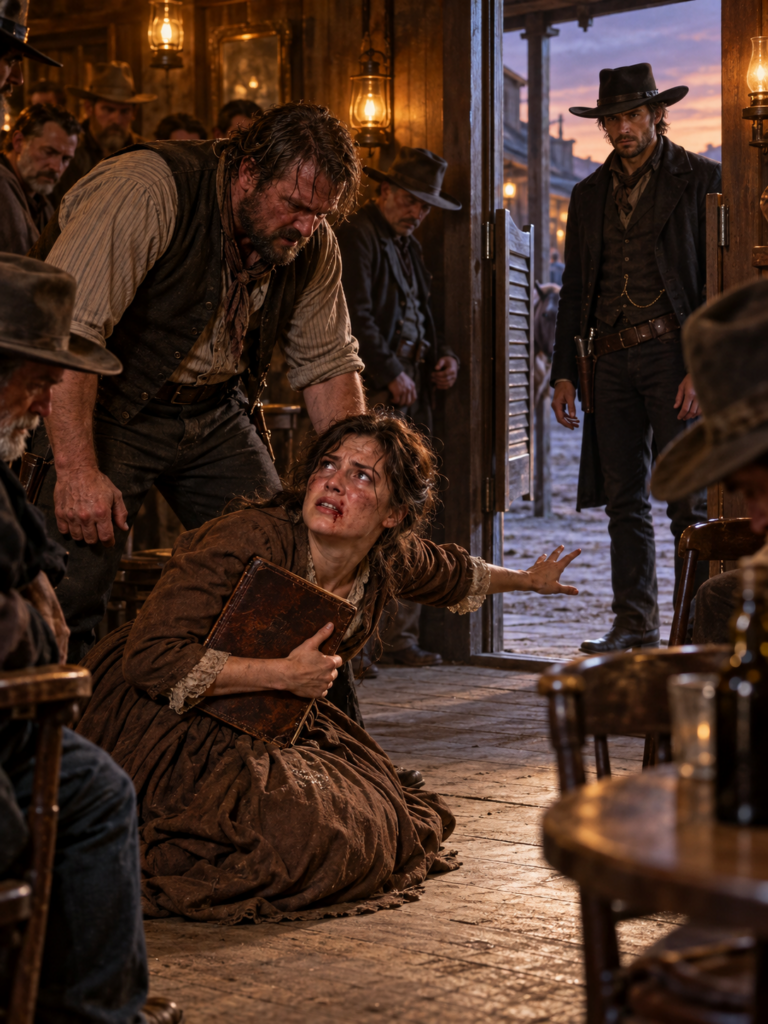
Hollis’s fingers closed around Abigail’s wrist.
She twisted sharply, pulling the ledger against her ribs with her free arm.
“Let go.”
His grip tightened.
Nathan stepped between them.
He caught Hollis’s forearm and forced it away without drawing his revolver.
“She’s asked you twice.”
Hollis’s face reddened.
“You’ve got a bounty on your head, Cain.”
“That doesn’t give you leave to hurt her.”
Around them, chairs scraped backward.
Victor watched with narrowed eyes.
Nathan released Hollis and turned toward Abigail.
“Can you manage the steps outside?”
“I can walk.”
“Then I’ll follow.”
Abigail crossed the room on shaking legs.
Nobody offered her assistance.
Yet nobody tried to stop her.
At the swinging doors, she looked back.
Fifty men.
Some ashamed.
Some frightened.
Others pretending nothing remarkable had happened.
“You all heard him accuse me,” she said.
Her voice trembled, but she continued.
“You also heard me ask to see the accounts. Remember that when somebody finally asks what happened here.”
She walked outside.
The evening air stung her injured lip.
She reached the wooden walkway before her knees weakened.
Nathan came through the doors and stopped beside her.
“May I help?”
She nodded.
He supported her elbow until she could stand steadily.
“Where are you staying?”
“Above the mercantile.”
“I’ll walk with you.”
She studied him.
“Why would a wanted man risk being seen with me?”
Nathan looked toward the saloon.
“Because fifteen years ago, my family needed someone to speak up. Nobody did.”
They started along the street.
He shortened his stride to match hers.
Abigail pressed a handkerchief against her mouth.
“Your father’s name was Ezra?”
“Yes.”
“I saw it in the ledger.”
Nathan stopped.
“Under which company?”
“Sterling Land Holdings.”
His expression darkened.
“That company belongs to Victor.”
“The book lists several others.”
“Different names. Same owner.”
Abigail thought of the pages she had copied.
If Nathan was correct, the entries documented more than suspicious transfers.
They suggested a deliberate system of taking land through fraudulent debts.
She looked toward him.
“How long have you known?”
“Fifteen years. But knowing and proving aren’t the same thing.”
“Why are you wanted?”
“After my father died, I confronted Victor. Six weeks later, men I’d never met swore I robbed a bank.”
“Did you?”
“No.”
She considered his answer.
“I’ll want proof of that too.”
Nathan almost smiled.
“Fair enough.”
They reached the mercantile steps.
Abigail paused beneath the window where her little rented room waited.
“I copied the ledger.”
Nathan looked sharply toward her.
“All fourteen transfers?”
“Every one.”
“Where are the copies?”
She touched the seam of her skirt.
“Somewhere I haven’t yet had cause to distrust.”
He nodded without asking further.
Then she told him about Samuel Brooks.
The letters.
The journey from Missouri.
The death that had occurred just before her arrival.
Nathan listened without interruption.
When she finished, he took off his hat.
“Samuel was investigating Victor before he died.”
Abigail went still.
“How do you know?”
“I watched the ranch. Samuel had begun asking the same questions I was asking.”
“Did you speak with him?”
“Not before his death.”
“Then what do you know for certain?”
Nathan hesitated.
“I found something near him afterward. Something he left that made me believe he expected you to understand the accounts.”
She gripped the railing.
“What was it?”
“A message.”
“Will you show me?”
“Yes. But not tonight. You’re injured, and Victor has men watching this street.”
Abigail looked directly at him.
“I won’t be shut out of matters concerning Samuel.”
“You shouldn’t be.”
“And I won’t surrender the ledger to you merely because you’ve spent years chasing Victor.”
“I haven’t asked you to.”
She searched his face.
There was no resentment in his expression.
Only tired attention.
“Then we understand each other.”
“I believe so.”
Nathan looked toward her swollen lip.
“Is there someone here you trust to see to that?”
“The mercantile owner’s wife may have cold water and clean cloths.”
“Good.”
He stepped back.
Abigail caught his sleeve.
“Nathan.”
He turned.
“Thank you for coming through those doors.”
His expression changed.
“You don’t owe me for doing what any decent man ought to have done.”
She swallowed painfully.
“Nevertheless, thank you.”
He nodded once.
Then looked beyond her toward the dark street.
“Victor won’t leave this alone. He’s built too much upon those papers.”
Abigail felt the weight of the ledger beneath her arm.
“How do we reach a court when he owns half the town?”
“There is a federal land surveyor due through Red Creek. And a circuit judge afterward.”
“How soon?”
“Nine days for the surveyor.”
Nine days.
Abigail considered the copies hidden in her clothing and the suspicious signatures she had already found.
“We’ll need the county land records.”
“Victor controls the office clerk.”
“Then we need evidence the clerk cannot easily explain away.”
Nathan regarded her with growing respect.
“You truly know how to read these books.”
“I know when a man is counting on other people not reading them.”
From the far end of the street came hoofbeats.
Two riders approached the mercantile.
Nathan recognized Hollis’s men.
He stepped away from the stairway.
“Go inside, Abigail.”
She did not move immediately.
“Will you be here tomorrow?”
“If you want me here.”
“I do.”
She started up the stairs.
Behind her, one of the riders slowed.
Nathan turned toward him.
And Abigail, unwilling to abandon the man who had defended her, stopped halfway up the steps and reached beneath her shawl for the copied accounts.
Abigail’s fingers closed around the folded copies beneath her shawl.
Below her, Nathan stood facing the two riders.
Neither man dismounted.
One glanced toward the mercantile window.
“Mr. Langford wants the woman reminded that stolen property must be returned.”
Abigail descended one step.
“The ledger will be preserved for an investigation.”
The rider looked at her.
“Ma’am, that isn’t your decision.”
“It’s my decision whether to surrender evidence to the man it concerns.”
Nathan remained between her and the horses, his hands visible.
“You’ve delivered your message,” he told the men. “Ride on.”
For several seconds, nobody spoke.
Then the older rider pulled his reins.
“Victor won’t forget this.”
Nathan watched them turn away.
“He rarely does.”
When they disappeared, Abigail climbed to her room.
She locked the door.
Only then did she allow herself to tremble.
She washed the blood from her face and studied her swollen lip in the small mirror.
The bruise would last.
So would the memory of fifty people watching her suffer.
But beneath her fear was something she had not felt since Samuel’s death.
A reason to remain.
The following morning, Red Creek had changed toward her.
At the mercantile counter, conversation stopped when she entered.
Two women exchanged glances.
The proprietor’s wife spoke with strained politeness.
“We heard you walked home with Nathan Cain.”
“He helped me after Mr. Langford’s employee struck me.”
“A widow must consider appearances.”
Abigail set her purchase on the counter.
“I would rather be seen accepting an honest man’s assistance than have respectable people watch me bleed.”
The woman flushed.
Abigail paid for her thread and left.
By noon, she understood Victor’s next move.
He was spreading scandal about her association with a wanted outlaw.
If people could be persuaded she was dishonest or improper, they might refuse to believe her evidence.
She found Nathan beside the fence outside town.
He was checking his horse’s hoof.
“Victor’s making a different kind of accusation now,” she said.
Nathan straightened.
“About us?”
“Yes.”
His expression tightened.
“I expected it.”
“I won’t stop speaking to you because he finds it convenient.”
“You may pay a price for being seen with me.”
“I already paid one for standing alone.”
Nathan looked at her for a long moment.
Then he said, “There’s something I should show you.”
From his coat he withdrew a folded scrap of paper.
The handwriting was uneven but legible.
Three words.
She’ll understand numbers.
Abigail recognized Samuel’s writing.
She had studied his letters so often that she knew the slope of his capital letters.
“Where did you get this?”
“Near Samuel’s body. It was tucked inside his boot.”
She touched the paper gently.
“He knew I was coming.”
“Yes.”
“And he knew I could examine the accounts.”
Nathan nodded.
“He may have believed you’d recognize what he’d discovered.”
Abigail stared at the message.
She had imagined Samuel waiting for her at a ranch house.
Instead, he had died while trying to expose the man who controlled that property.
The knowledge hurt.
But it also gave her a direction.
“Then we must finish what he began.”
Together they compared the ledger copies.
Nathan supplied the names of companies he had traced during his years of investigation.
Abigail organized them by date.
Sterling Land Holdings.
Cross County Development.
Other companies that seemed independent until their purchases and transfers were examined together.
The same names appeared as witnesses.
The same parcels changed hands through suspicious debts.
The timing surrounding the deaths was disturbingly consistent.
Abigail arranged the papers across a table in the room she rented.
Nathan stood near the window.
“If these company names can be connected through the land office filings,” she said, “we can show the transfers were coordinated.”
“The clerk won’t hand them over.”
“No.”
“The surveyor arrives in nine days.”
“Then we must prepare before he comes.”
That night, they entered the land office after the streets had quieted.
Nathan knew how to open the old lock.
Abigail disliked the necessity of breaking into public records, but she knew Victor’s influence had made ordinary access nearly impossible.
They took no originals.
Instead, she copied dates, witness names, and company references.
Her fingers moved rapidly across the paper.
Nathan held the lamp low and kept watch.
Then he found a folder bearing his father’s name.
Ezra Cain.
He opened it.
Inside lay the transfer by which the Cain ranch had been lost.
A second signature appeared near the bottom.
Samuel Brooks.
Abigail leaned closer.
“That is Samuel’s writing.”
Nathan stared.
“He witnessed my father’s land transfer.”
She examined the date.
“He was a young man then.”
Nathan’s expression darkened.
“Perhaps he knew what Victor was doing.”
“Or perhaps he understood only part of it.”
Abigail touched the paper.
“We cannot know until we find more.”
He looked at her.
“You’re right.”
The discovery complicated everything.
Samuel had not merely uncovered Victor’s scheme shortly before his death.
His name had appeared in its history years earlier.
Abigail remembered the tenderness of his letters.
She wondered what guilt he might have been carrying.
Nathan seemed to understand her thoughts.
“Whatever Samuel knew then, he tried to expose the truth later.”
She nodded.
“And whatever your father suffered, these documents belong before a judge.”
Footsteps sounded outside.
Nathan extinguished the lamp.
They stood motionless behind the filing cabinets while the night watchman passed.
When his steps faded, they finished copying the necessary records.
Outside, the air was cool.
Abigail breathed deeply.
Nathan looked toward the silent street.
“We have enough to establish a pattern. What we need now is someone willing to testify.”
“Curtis Yoder?”
“He signed the documents.”
“Then he knows whether the witnesses were genuine.”
“He also has a family Victor can threaten.”
Abigail folded her notes.
“We must give him a chance to tell the truth without pretending there will be no risk.”
Nathan nodded.
They walked toward the mercantile.
At the stairs, he stopped.
“Abigail, about the talk in town—”
“I know.”
“I don’t want my reputation to damage yours.”
She turned toward him.
“My late husband was a decent businessman. But for years I was expected to keep his books, maintain his household, and leave important decisions to men.”
Nathan listened.
“Samuel’s letters made me believe another life was possible.”
She glanced toward the street.
“I won’t allow Victor Langford to decide who may stand beside me.”
Nathan’s face softened.
“Then I’ll stand beside you as long as you want me there.”
It was the first promise he had made that was not about danger.
Abigail carried it upstairs with her.
Two days later, a fresh notice appeared outside the sheriff’s office.
Nathan Cain was accused of stealing Victor’s financial records.
A reward was offered for his arrest.
Curtis Yoder had reportedly witnessed the theft.
Abigail read the notice twice.
Then she went looking for Nathan.
He was waiting outside town.
“He’s using Curtis,” Nathan said before she spoke.
“Then Curtis must correct the lie.”
“Victor holds his debts.”
“That’s how he holds everyone.”
Nathan removed his hat.
“I’ll speak with him.”
“Not by threatening him.”
“I wasn’t planning to.”
“Good. A frightened man may tell another lie merely to escape the first threat.”
Nathan studied her.
“You’ve thought this through.”
“I’ve spent years watching men disguise fear as authority.”
That evening, rain began falling over Red Creek.
Nathan visited Curtis at the land office.
The notary went pale when he entered.
“I had no choice,” Curtis blurted. “Victor said he’d take my shop.”
Nathan stayed near the doorway.
“You had choices. None were easy.”
Curtis’s hands shook.
“I signed what he put before me.”
“Fourteen dead ranch owners. Fourteen transfers.”
“I know.”
“And you know the signatures were false.”
Curtis lowered his head.
“Yes.”
Nathan waited.
At last the notary whispered, “I’ll write it down.”
“Every forged witness. Every false seal. Every payment.”
Curtis nodded.
“I’ll tell the truth.”
Nathan left him writing beneath the office lamp.
He found Abigail waiting under the mercantile awning.
Rainwater dripped from his hat.
“He agreed.”
She exhaled.
“Will he testify?”
“He says he will.”
“Then perhaps we’ve finally reached him.”
Nathan studied her face.
The swelling had diminished, though a faint bruise remained.
“You should have been safe here,” he said.
“I thought I would be.”
“I’ve spent fifteen years chasing Victor for what happened to my father. I never imagined I’d find someone who understood why I couldn’t leave it alone.”
Abigail stepped closer.
“You’re not alone now.”
He looked at her.
For a moment, the rain seemed to quiet around them.
Then a gunshot cracked through the darkness.
From the direction of the land office.
Nathan turned immediately.
“Curtis.”
They ran.
The office door stood open.
Rain swept across the floor.
The written confession had been torn apart.
Ink dissolved into black streaks across the boards.
Curtis was gone.
Abigail knelt beside the ruined papers.
Nathan examined the room, then the muddy yard outside.
Fresh wagon tracks led away toward the eastern edge of town.
“The grain depot,” he said.
They followed the tracks through the rain.
The abandoned building stood beyond the last houses.
Inside, they found Curtis bound to a support post, frightened but alive.
Nathan loosened the ropes.
Abigail pulled the gag away.
“Hollis,” Curtis gasped. “He said Victor wanted me quiet until the surveyor left.”
Abigail supported the shaking notary as he stood.
“Where is your family?”
“At home.”
“Then we must get them somewhere safer.”
Before dawn, Curtis, his wife, and their young son were sheltered at the Brooks Ranch.
Abigail stood inside the house she had expected to share with Samuel.
It was the first time she had entered it.
The furniture remained.
Samuel’s desk stood beside the window.
His books were neatly arranged on a shelf.
For a moment, grief overtook her.
Nathan stood in the doorway.
“Would you like me to leave you alone?”
She shook her head.
“Not yet.”
He waited.
“This was supposed to be my home.”
“It still might be.”
She looked around.
“Victor says it belongs to him.”
“His accounts say many things that aren’t true.”
She smiled sadly.
“Then perhaps we shall let a court decide.”
Over the next two days, Curtis prepared a new statement.
Nathan kept watch.
Abigail organized the records.
And an older rancher named Elias Puit approached them with news.
His grandson had overheard Hollis discussing a fire.
At the Brooks Ranch.
The threat was unmistakable.
Victor intended to destroy the witnesses and evidence before an outside official could examine them.
Abigail did not hesitate.
“Then we take Curtis into town. Publicly.”
Nathan frowned.
“Victor still controls the sheriff.”
“He cannot control every witness if the whole town hears the truth together.”
They arranged for Curtis’s family to stay under protection near the sheriff’s boarding house.
Elias agreed to accompany them.
Other townspeople who had begun questioning Victor’s actions offered support.
The following morning, Abigail carried her copied accounts back to the same saloon where she had been struck.
Nathan walked beside her.
Curtis followed, holding his signed confession.
Inside, Victor Langford stood beside the bar.
Hollis was near him.
The room filled quickly as word spread.
Victor regarded Abigail with undisguised irritation.
“More accusations, Mrs. Carter?”
She placed the ledger on the bar.
“No. Today you will hear an answer.”
Then she turned toward Curtis.
“Tell them what you told us.”
The notary unfolded his statement.
His hands trembled.
But his voice, when it came, carried through the room.
“For fifteen years, I have witnessed documents that were false.”
Victor stiffened.
Curtis swallowed.
“I signed names for people who weren’t present. I certified debts that had been altered. I helped transfer ranches from families whose owners had died.”
The saloon fell silent.
Curtis looked directly at Victor.
“I did it because I was afraid of him.”
And for the first time in fifteen years, the men of Red Creek began looking at Victor Langford instead of the floor.
Abigail opened the ledger.
She laid the copied land records beside it.
Then, as Nathan stood beside her, she began reading the names of the dead.
Abigail read the first name clearly.
Ezra Cain.
Nathan’s father.
Then another.
And another.
Fourteen men whose deaths had been followed by suspicious transfers of property.
The saloon remained silent, but it was no longer the silence Abigail remembered from the night Hollis struck her.
Then, fear had kept people from helping.
Now they were listening.
She showed them the ledger entries.
The debt figures.
The company names.
The transfers witnessed by Curtis Yoder.
Every document had a place in the sequence.
Every suspicious transaction connected to another.
Victor Langford tried to interrupt.
“These are the claims of a thief and a wanted outlaw.”
Abigail looked up.
“Then explain why six supposed companies used the same witnesses, the same flawed notarial seal, and repeated the same pattern of transfers.”
Victor’s jaw tightened.
Curtis stepped forward.
“Because Mr. Langford controlled them.”
A murmur rose.
Nathan placed his father’s land record upon the bar.
“This is the transfer that took my family’s ranch.”
He turned toward the assembled townspeople.
“My father was accused of owing money he never borrowed. After his death, the ranch passed through companies that eventually led to Victor.”
Elias Puit stepped away from the crowd.
“I remember Ezra Cain.”
Nathan looked at him.
The older rancher removed his hat.
“I remember him saying those debts were false.”
Nathan waited.
Elias continued.
“I believed him. But I kept quiet because I feared losing my own land.”
His voice thickened.
“I’m ashamed of that.”
A second man spoke.
Then a third.
Others remembered similar accusations against ranchers who had died under troubling circumstances.
They had doubted the official explanations for years.
But suspicion had never become testimony.
Until now.
Victor glanced toward the doors.
The crowd no longer made way for him.
He turned sharply toward Hollis.
“Do something.”
Hollis’s hand moved toward his gun.
Nathan stood still.
Abigail felt her heartbeat quicken.
The man who had struck her now held the room’s attention.
“Hollis,” Victor snapped.
But Hollis looked toward Curtis.
Toward the ledger.
Toward Abigail’s bruised face.
Then he lowered his hand.
“No.”
Victor stared.
“What did you say?”
“I said no.”
Hollis swallowed.
“I’ve done enough for you.”
The room seemed to draw one collective breath.
Victor’s face twisted with anger.
“You ungrateful fool.”
Hollis stepped aside.
“I won’t hurt another person to keep your secrets.”
Victor lunged for the ledger.
His coat opened.
A small pistol became visible beneath it.
Nathan intercepted him before he could draw.
He caught Victor’s wrist and forced his arm away from the weapon.
The pistol struck the floor.
Nathan held him against the bar.
“You’re finished, Victor.”
For fifteen years, Nathan had imagined confronting the man who destroyed his father.
He had imagined anger.
Revenge.
A moment in which violence might somehow answer violence.
But standing there, he understood that killing Victor would accomplish far less than making him answer for his crimes.
The sheriff entered from the doorway.
He had heard enough.
“Victor Langford, you’re under arrest pending judicial examination of these accusations.”
Victor struggled.
“You work for me!”
The sheriff’s face darkened.
“That’s the trouble. I did.”
He stepped closer.
“And now I intend to answer for my part in it.”
Nathan released Victor into the sheriff’s custody.
The saloon watched as the wealthiest man in Red Creek was led away.
Abigail leaned against the bar.
Her legs trembled.
The room seemed suddenly too warm.
Nathan approached without crowding her.
“Are you all right?”
She nodded, though tears stood in her eyes.
“We did it.”
He looked toward Curtis and the people gathering around him.
“We’ve begun.”
She knew he was right.
Victor’s arrest did not restore fourteen lives.
It did not clear Nathan’s warrant automatically.
Nor did it return a single stolen ranch.
But for the first time, there was a public record of the fraud.
And people willing to swear to what they knew.
The days that followed were exhausting.
A federal land surveyor examined the disputed boundaries and reported serious irregularities.
The county records were secured for outside review.
Curtis Yoder submitted his confession.
Other witnesses came forward.
Some admitted what they had seen.
Some confessed to remaining silent.
A few revealed payments or threats they had never dared mention.
Abigail prepared the financial evidence.
She compared dates, copied accounts, and identified the companies that had received land after suspicious deaths.
Nathan gathered testimony from ranching families.
He knew which trails led to abandoned properties, which families had been displaced, and which witnesses had left Red Creek because Victor made staying impossible.
They worked closely, but neither mistook cooperation for romance.
Abigail kept control of her own papers.
Nathan did not presume to direct her decisions.
When her work required long hours, he brought food and made certain she had water.
When his old injuries troubled him, she noticed and insisted that he rest.
They disagreed.
Sometimes sharply.
But when disagreement arose, they returned to the question that had begun everything.
What could they prove?
And what was right?
The first hearing before Judge Holloway brought more families into Red Creek than the town had seen in years.
Abigail sat near the front.
Nathan stood beside her.
The judge examined Curtis’s confession, the original ledger, the copied land filings, and testimony linking Victor to fraudulent debts and transfers.
The evidence showed a long pattern of coordinated wrongdoing.
Samuel Brooks’s role was among the most painful discoveries.
Years earlier, he had witnessed a transfer involving Ezra Cain’s property.
Abigail could not know whether he understood the fraud at the time.
But subsequent letters and his own later investigation showed that he had come to recognize what Victor was doing.
He had begun collecting evidence.
His final message had been intended for someone he trusted to understand the accounts.
Abigail.
She sat through that testimony with her hands clasped tightly.
Nathan noticed her distress.
Afterward, in the quiet passage outside the courtroom, she spoke.
“I wish I could ask Samuel what he knew.”
Nathan nodded.
“So do I.”
“I thought his letters promised me a home. Now I wonder whether he was trying to tell me something else.”
“Maybe he was trying to offer you both.”
She looked at him.
Nathan continued.
“A life with him, and the truth he knew you would recognize.”
Abigail lowered her eyes.
Samuel was gone.
There would never be answers to every question.
But she could honor his attempt to put matters right without pretending his past had been simple.
When the hearing resumed, Judge Holloway ordered that the accusations against Nathan be dismissed on the evidence presented.
The old robbery allegations had depended upon witnesses whose statements were shown to have been fabricated under Victor’s direction.
For fifteen years, Nathan had lived as a wanted man.
Now the court ordered his name cleared and the warrants withdrawn.
He stood as the decision was announced.
His hands shook.
Abigail slipped hers into one of them.
He looked down.
“It’s finished,” he whispered.
“Part of it.”
He nodded.
Victor remained subject to further prosecution.
The families still awaited the outcome of the land cases.
And the deaths required investigation beyond the financial fraud.
Before the hearing could conclude, Hollis Beam stepped forward with another statement.
Victor, he said, had arranged hidden funds beyond the territory.
He also had an armed associate prepared to help him escape if the proceedings turned against him.
The sheriff hurried from the courtroom.
When he returned, his expression was grim.
Victor’s holding cell was empty.
The guards had been overcome.
The prisoner had fled.
Abigail felt Nathan’s hand tighten around hers.
After everything they had uncovered, Victor still intended to escape responsibility.
Nathan looked toward the judge.
“He’ll head for the territory line.”
Hollis agreed.
“He has money waiting beyond it. There’s a river crossing on the northern route.”
The sheriff began gathering a posse.
Nathan volunteered to guide the search.
Abigail stood beside him.
“I’m coming.”
He looked at her.
“The trail may be dangerous.”
“I know.”
“I don’t want you harmed because of this.”
She studied him.
“Then don’t treat me as though I’m unable to judge the danger.”
Nathan lowered his eyes briefly.
“You’re right.”
The sheriff supplied additional riders.
Elias Puit and two other ranchers joined them.
They rode north as the afternoon light began fading.
Nathan tracked the horses by hoofprints along the damp ground.
Near the river, they found Victor and the hired gun who had helped him escape.
The two men were preparing to cross.
Nathan called for them to stop.
Victor turned.
His fine coat was muddy.
His face had lost its customary composure.
“You should have stayed out of my affairs, Cain!”
Nathan remained mounted.
“You made my father’s death your affair.”
The hired gun rested his hand near his revolver.
Abigail felt the danger settle over the group.
Nathan spoke to the armed stranger.
“You can still ride away without drawing. Victor has already lost his case. There’s nothing to gain by dying for him.”
The man glanced at Victor.
Then toward the sheriff’s approaching riders.
For several seconds, his expression remained unreadable.
Finally he withdrew his hand from the revolver and backed his horse away.
Victor shouted after him.
But the man did not return.
The sheriff moved forward.
Victor tried to turn his horse toward the water.
The animal balked at the uneven bank.
Before he could find another crossing, the sheriff’s men surrounded him.
This time there was no escape.
Victor was taken into custody.
Abigail watched the restraints secured.
She expected to feel triumph.
Instead, she felt tired.
Terribly tired.
Nathan rode beside her as they returned toward town.
For a long while, neither spoke.
Then he said, “I thought I’d be happier.”
She turned.
“About Victor?”
“About finally catching him.”
“You’ve spent fifteen years wanting justice for your father.”
“Yes.”
“And now you’ve helped secure it.”
Nathan looked toward the darkening horizon.
“It doesn’t bring him back.”
“No.”
“It doesn’t give me back those years.”
“No.”
His voice grew rough.
“I don’t know what to do with a life that isn’t spent chasing Victor Langford.”
Abigail reached across the space between their horses.
He took her hand.
“Then perhaps,” she said, “you could begin deciding what you want to build.”
He looked at her.
For the first time, he allowed himself to imagine the answer.
Three weeks later, Victor Langford stood trial in the territorial court.
The evidence assembled by Abigail, Nathan, Curtis, and the witnesses from Red Creek was examined in full.
The findings established his involvement in fraudulent land transfers, forged documents, and crimes connected to the deaths of ranch owners.
He was convicted and sentenced to life imprisonment.
The families whose properties had been taken began the long work of recovering them through the courts.
Not every case was simple.
Some records had been destroyed.
Some land had changed hands repeatedly.
But the machinery of fraud that had operated for so many years was finally being dismantled.
At the courthouse, Abigail stood beside Nathan as the sentence was announced.
She thought of Samuel Brooks.
Of Ezra Cain.
Of the families who had buried their dead and been told not to ask questions.
She thought of Curtis’s shaking hands when he first admitted the truth.
And of Elias Puit finally finding the courage to speak.
Justice had required more than one brave moment.
It had required many people to stop protecting the same lie.
Outside the courthouse, Nathan took her hand.
“What will you do now?” he asked.
Abigail considered the question.
Samuel’s ranch was among the properties whose fraudulent transfer could be challenged.
She wanted it restored.
Not merely because she had once hoped to live there as his wife.
But because the property represented a future Victor had stolen.
“I want to help the families recover their land,” she said.
Nathan smiled.
“You’ve already begun.”
“I mean to keep doing it.”
“Then you ought to have an office.”
She looked at him.
“An office?”
“A proper one. For records, accounts, and people who need someone willing to examine them.”
Abigail stared for a moment.
Then she laughed.
“You’re serious.”
“Entirely.”
“And what would you do?”
Nathan considered.
“I know the country. I know the people. I can help gather evidence when land claims depend upon what happened beyond town.”
She smiled more broadly.
“You’re offering to work with me?”
“If you’ll have me.”
She studied him.
The wanted outlaw she had first seen beneath the saloon lamps was gone.
In his place stood a man who had endured injustice without surrendering his capacity to care for others.
“On one condition,” she said.
“Name it.”
“You won’t frighten clients simply because they ask foolish questions.”
He laughed.
“I’ll try.”
“Try harder.”
“Yes, ma’am.”
They established their office in a small converted building on the Brooks property.
The beginning was humble.
A desk.
Two chairs.
A cabinet for records.
A sturdy lock.
Abigail kept the accounts and organized the cases.
Nathan traveled when witnesses needed to be found or boundaries examined.
They worked beside families who had spent years believing nobody would listen.
Some days brought progress.
Others brought frustration.
But the work mattered.
In time, people from neighboring counties began seeking their help.
Abigail found a satisfaction in it that differed from anything she had known before.
She had once kept books because her husband expected it.
Now she used the same skill to protect families from dishonesty.
Nathan changed too.
He no longer slept outside town to avoid the sheriff.
He walked Red Creek’s streets in daylight.
He spoke with ranchers who had once crossed to the other side of the road when they saw him.
When frightened people approached the office, he did not begin by offering threats against their enemies.
He listened.
Then he asked what they could prove.
One evening, late in autumn, Abigail finished balancing the accounts and found Nathan waiting on the porch.
The light was fading across the pasture.
He held something small in his hand.
“Abigail.”
She looked up.
“What’s wrong?”
“Nothing.”
He smiled nervously.
“That may be why this is so difficult.”
She stepped closer.
Nathan opened his hand.
A plain silver ring lay in his palm.
“I made this,” he said.
“From what?”
“A piece of silver I kept from the last things belonging to my father’s ranch.”
Abigail’s expression softened.
“For fifteen years, I carried it because I couldn’t bear to let go of what we’d lost.”
He looked toward the house.
“Now I’d rather it meant something we’re choosing to make.”
Her heart began beating faster.
Nathan took a breath.
“I love you, Abigail.”
She stared at him.
He continued.
“I loved your courage before I knew your whole story. Then I learned how carefully you think, how stubbornly you defend people, and how much kindness you have left even after you’ve been hurt.”
Her eyes filled.
“You’ve given me something I had stopped allowing myself to want.”
“What?”
“A future.”
He lowered himself onto one knee.
“Will you marry me?”
Abigail laughed through her tears.
“Yes.”
The answer came before she had finished drawing breath.
“Yes, Nathan.”
He stood.
She wrapped her arms around him.
For a long moment, they held each other beneath the fading autumn sky.
There was no danger requiring a bargain.
No debt.
No need to save a reputation.
Abigail could remain independent.
Nathan could live freely.
They chose marriage because each wanted a shared life more than a solitary one.
Three weeks later, they married at the Brooks Ranch.
Nearly everyone in Red Creek attended.
Elias Puit offered a toast that made several guests wipe their eyes.
Curtis Yoder came with his wife and son, grateful that his confession had helped end Victor’s power.
Families whose ranches had begun returning to them brought food, flowers, and small gifts.
Abigail wore a simple dress of her own choosing.
Nathan wore a freshly brushed coat.
When they exchanged their vows, she thought of the first night in the saloon.
The blood.
The fear.
The fifty men who had remained silent.
And the outlaw who had offered his hand without expecting anything in return.
Nathan looked at her with tears in his eyes.
She smiled.
They had come farther than either could have imagined.
Marriage did not end their work.
The Brooks and Cain land office grew.
With each recovered record and resolved dispute, their reputation strengthened.
Families brought old deeds, disputed notes, and suspicious accounts.
Abigail trained assistants to check figures carefully.
Nathan continued visiting remote ranches and helping witnesses bring their evidence to lawful authorities.
They argued occasionally about difficult cases.
They worried over money.
They endured long days.
But neither ruled the other’s work.
They shared decisions.
They shared responsibility.
And when one became discouraged, the other understood what needed to be said—and sometimes what was better left quiet until morning.
Two years after their wedding, their daughter Grace was born.
Nathan held the infant with a tenderness that astonished even him.
For fifteen years, he had believed his life would end as a fugitive.
Now a child slept against his chest.
Abigail watched from her bed.
“You look frightened,” she whispered.
“I am.”
“Of a baby?”
“Of how much I love her already.”
Abigail smiled.
“Then we shall be frightened together.”
He leaned down and kissed her forehead.
Outside, the ranch stood peaceful beneath the afternoon sun.
Time continued.
Grace grew.
The land office prospered.
Red Creek gradually learned to speak more freely about wrongdoing and to question the powerful rather than obey them without thought.
Curtis worked to repair the harm he had helped cause.
Hollis, having turned against Victor, spent years proving through his actions that his change was more than a convenient declaration.
Not everyone forgave him.
He did not demand it.
Nathan understood that better than most.
Years later, the town held a gathering to remember the families whose land had been stolen.
The event took place near the old saloon.
Its worn swinging doors had been repaired.
The floorboards had been refinished.
But Abigail recognized the place where she had fallen.
She stood there beside Nathan.
Grace, now old enough to understand something of their history, looked around with curiosity.
“Is this where Papa helped you?”
Abigail smiled.
“Yes.”
“Were you afraid?”
“Very.”
Grace considered that.
“But you spoke anyway?”
Abigail nodded.
“Sometimes being brave means speaking while you’re frightened.”
Nathan rested his hand upon their daughter’s shoulder.
“And sometimes it means being the first person to help when everyone else is afraid.”
Grace looked between them.
“Did you love each other then?”
Abigail laughed softly.
“Not yet.”
Nathan smiled.
“But I knew your mother was remarkable.”
“And I knew your father could be trusted to do one decent thing,” Abigail answered.
“One?”
“At first.”
He laughed.
She took his hand.
The same hand he had extended toward her on a bloodstained saloon floor.
The hand that had helped her walk when pain made her knees uncertain.
The hand that had held hers through investigations, court hearings, hard winters, and years of building a life.
At the gathering, Elias Puit spoke about the townspeople who had once kept silent.
He did not excuse them.
But he reminded those present that courage had eventually spread from person to person.
Curtis had confessed.
Witnesses had come forward.
Ranchers had stood together.
And a community that once allowed fear to govern it had learned to demand evidence and accountability.
Abigail listened with Grace beside her.
She thought of Samuel Brooks and the letters that brought her west.
His courage had not been forgotten.
Neither had Ezra Cain’s death.
Their names remained among the records preserved in the land office.
As the gathering ended, Nathan took Abigail’s hand.
“Do you ever think about leaving Red Creek?”
She glanced toward the road leading past the ranch.
“Sometimes I wonder what life might have been if I’d never boarded that stage.”
“And?”
She smiled.
“I might have had a quieter life.”
Nathan nodded.
“Likely.”
“But I would not trade the life we built.”
He looked at her.
“Neither would I.”
They walked toward home as evening settled over the town.
Behind them stood the saloon where fifty men had once watched a woman beg for help.
Ahead lay the ranch, the office, and the family they had chosen to build.
The old ledger remained safely preserved among their most important records.
Not as a trophy.
But as a reminder of the people whose lives had been changed by the truth it contained.
Abigail had arrived in Red Creek with eleven dollars and the promise of a home that no longer existed.
Nathan had spent fifteen years believing he would never again belong anywhere.
Together, they had helped bring down the man responsible for both their losses.
But their greatest achievement was not Victor Langford’s imprisonment.
It was the life they made after justice was done.
A home where courage was practiced in ordinary ways.
A partnership in which neither voice was silenced.
A town slowly learning that respectability without honesty meant very little.
And a daughter growing up knowing that helping someone in danger was never a foolish thing to do.
At the ranch gate, Grace ran ahead toward the house.
Nathan drew Abigail close.
“You know,” he said, “I nearly rode past that saloon.”
She looked up.
“Why didn’t you?”
He considered the question.
“Because I heard you ask for help.”
Abigail rested her forehead against his shoulder.
“And you came.”
“Yes.”
She lifted his hand and kissed it.
“I’m glad.”
The evening wind moved gently across the pasture.
Nathan held her for a moment longer.
Then they followed their daughter toward the warm lamplight of home.
Behind them, the road lay empty.
Before them, the door stood open.
And this time, nobody had to beg to be let inside.

