
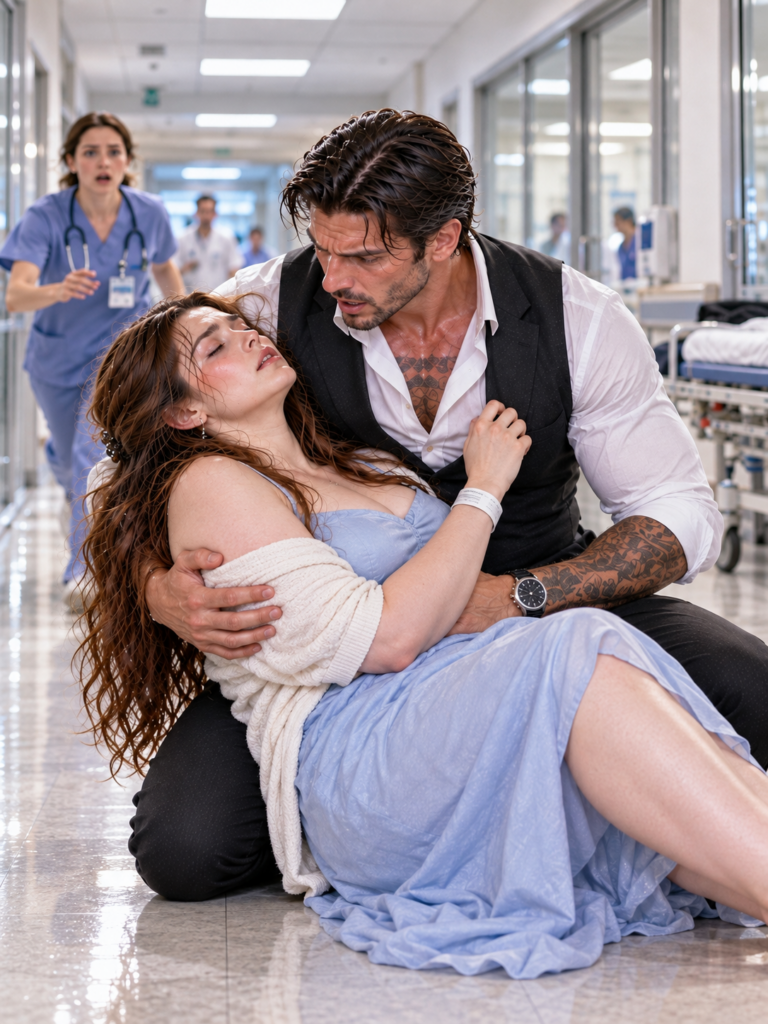
He Missed His Curvy Wife’s Birthday Dinner for the Third Year — Then the Hospital Wristband in Her Coat Pocket Unraveled the Life He Thought He Controlled
Part 1
Nora Quinn’s knees gave out on the ninth stair. The marble foyer of the Benefit Street house stretched cold and polished beneath her, and for one spinning second she thought she might finally reach it. Rain still clung to her hair and the shoulders of her gray coat. The blue dress underneath was damp at the hem from the walk. She had sat alone at Delfina’s from eight until the kitchen closed, smiling at the waiter who kept refilling her water and never once asked where the other place setting was going. Three years. Three birthdays. She had stopped expecting him after the second.
The man who had missed all three crossed the foyer faster than his own guards had ever seen him move.
Luca Ferraro caught her under the arms before her head found the stone. She folded into him, soft and heavy in the way a woman with curves was heavy when her body was done pretending it could keep going. Her waist filled his hands. The full swell of her hips and thighs pressed against his coat as he took her weight. For eleven months he had known the shape of her only in passing—glimpses at the edges of rooms, the way a dress settled across her breasts and hips when she moved through his house like a guest who paid rent. He had not expected the sudden, complete give of her against his chest. She smelled like rain and the sugar she always put too much of in her coffee.
“Nora.” His voice came out wrong. Lower. Rougher. “Nora, look at me.”
Her eyes opened halfway. Rain beaded on her lashes. She was pale in a way that went past tired. The gray cast at her mouth made something tight coil behind his ribs.
“You came home,” she murmured, and the smile she gave him was small and automatic, the kind of smile a woman offered when she had already decided not to make a scene. It cut him worse than any sharp word she could have chosen.
He carried her. Not to the formal living room. Not to the study where men waited to be judged. Up the stairs and down the east-wing hall to the room that had been hers since the day she signed the contract without changing a single line. Clause nine: separate quarters. He had thought it was mercy. She had never complained. Her weight settled against him with every step—soft breasts pressed to his chest, the generous curve of her stomach and hips shifting as he adjusted his hold. She was not light. She was a woman who took up space, and right now that space was collapsing into him because something inside her had finally given out.
He set her on the edge of the bed and peeled off her soaked shoes. Her coat had slipped from her shoulders somewhere between the banister and the doorway. He lifted it to hang it, and something stiff crackled in the pocket. A paper hospital wristband. White. The clasp cut clean. St. Bridget’s Children’s Hospital, Eddy Street. Quinn, Nora. Oncology. Apheresis unit. Yesterday’s date.
Luca Ferraro had stood over open graves without blinking. He had watched men twice his size rehearse their sentences before they entered his office. He stood in his wife’s doorway with a strip of paper in his hand and his fingers were not steady.
Oncology.
His mother had died of lymphoma when he was twelve. Same house. Same thin wristbands cut off at the end. Nora was twenty-nine. She drank her coffee too sweet and apologized to furniture when she bumped it. She had sat alone at Delfina’s on her birthday with this in her pocket, waiting for a husband who did not come.
He sent for Dr. Behan and waited in the hall with the wristband flat in his palm like evidence. Behan came out twenty minutes later, the man who had dug bullets out of Ferraro soldiers on kitchen tables without flinching, and hesitated.
“She’s severely anemic. Exhausted. Dehydrated.” The doctor paused. “Both arms show needle bruising at the veins. Weeks of it. The pattern isn’t illness and it isn’t drugs. If I had to guess, she’s been donating blood and platelets. Frequently. More frequently than any program would legally allow one person.”
Donating.
His wife, who had access to every account he owned and had spent two hundred and twelve dollars on herself in eleven months, was quietly bleeding herself into bags for somebody.
“For whom?” Luca said.
“She declined to tell me.”
He went in. She was propped against the headboard, color coming back in patches across her cheeks and the soft column of her throat. The blue dress clung damply across her chest and the full curve of her waist. When she saw the wristband in his hand, her whole face shut like a door in winter.
“That’s nothing,” she said. “A work thing.”
“You don’t work.” Clause four. She never had to. It had seemed, at the time, like generosity.
“A volunteer thing, then.” She held his eyes. Chin level. Nora was a terrible liar. Every person in Luca’s life lied to him—soldiers, senators, priests. He had married this woman precisely because the arrangement was honest. A signature. A stipend. A shield against the marriage the Marchetti family had tried to force on him. In eleven months she had never once lied to him about anything. Including, memorably, his cooking.
She was lying now.
He did not rage. Rage was for men with no patience. He said, “Sleep, Nora,” turned off the lamp, and stood in the dark hallway until four in the morning with the strip of paper still in his fist.
At six-forty the next morning his wife, who had a black Maybach and two drivers at her permanent disposal, slipped out the side door in the same gray coat and walked three blocks to catch the RIPTA bus on North Main. Luca followed in a car she had never seen, feeling, for the first time in twenty years, like the man tailing instead of the man tailed.
The bus let her out on Eddy Street in front of a brick building with a mural of paper boats on the side. She signed in like someone the desk knew. Third floor. He gave it ten minutes, then followed the visitor badge they handed him without asking who he was, because men in three-thousand-dollar coats were never asked who they were.
He found her through an interior window on the oncology ward. Nora sat in a recliner, sleeve rolled, a line running from her arm into a machine that spun her blood. The blue dress was gone. She wore soft scrubs that stretched across her breasts and the generous swell of her hips. In the bed beside her, holding Nora’s free hand with both of her small ones, a girl of six or seven, bald as an egg, a knit crown on her head, laughing so hard at something Nora said that the IV pole rattled.
A nurse stopped beside him, followed his stare, and smiled the way people smiled in buildings like this. “Are you here for Maisie? Are you family?”
Luca, who had lied fluently in four languages since before his voice broke, opened his mouth and found nothing in it at all.
Nora saw him through the glass. The color she had fought to get back drained all over again. She could not come to him. The line was still in her arm. So he came to her, and the little girl in the bed watched him cross the ward the way small animals watched weather change.
“Nora,” Luca said quietly. “Introduce me.”
He watched his wife do the bravest thing he had ever seen her do, which was smile like nothing was wrong while her pulse jumped in her throat.
“Maisie, this is Luca.”
“The husband,” Maisie said, with the flat judicial tone of the chronically hospitalized who had no time left over for pretending. “You missed the birthday. She wore the blue dress and everything.”
“Maisie,” Nora whispered.
“I did,” Luca said. “I missed the birthday.”
“That’s okay.” Maisie settled back into her pillow with terrible mercy. “Mama used to say men are mostly late. You can hold her other hand. It’s free.”
He sat. He held it. The machine hummed and took his wife’s blood. A bag of pale gold filled drop by drop. Over the next hour the whole architecture of his marriage quietly fell down and rebuilt itself into something he did not recognize.
It came out of Nora in pieces, in the hallway after, her voice low and braced for the blow. She had been a nurse on this ward before. Before a resident’s dosage error had needed a name attached to it and the hospital had needed that name not to belong to a doctor. Nora had been twenty-seven and expendable and had signed what they put in front of her. License suspended. Career over. She had been Maisie’s nurse for two years by then. Maisie’s mother, Jess, had died in the spring. No father on the certificate. No grandparents. A case worker with forty-one files.
“So she had nobody,” Nora said. “And the treatment that’s actually working isn’t the one the state covers.” She looked at the floor, then at him. “Your lawyer called about a marriage contract. A stipend. Twenty-five thousand a month.”
Luca stood very still.
“The withdrawals. Two hundred and sixty-eight thousand,” she said. “It’s all in the St. Bridget’s billing office under her initials. I’m sorry. I know the money was meant to be mine. For me, it was mine, and I chose this.” Her chin came up, that same doomed, level look. “She’s a platelet match for me, and I’m on the marrow registry for her. The harvest surgery is Thursday. Dr. O’Shaughnessy says my counts are too low and I should wait a month.” A breath. “She doesn’t have a month to spare, Luca. I counted. She counted. She counted everything. Pulses, drops, stairs, the days.”
Eleven months he had thought he had purchased a convenient wife. The truth was that a pediatric nurse with sixty-one dollars in her checking account had quietly purchased a child’s life with his name, and had skipped meals and pawned things and ridden the bus to do it, and had still shown up at Delfina’s in a blue dress to have dinner with him.
“The watch,” he said. He had noticed its absence weeks ago and said nothing. Cartier. Christmas. Fourteen thousand dollars.
Nora flushed, the color rising across her collarbones and the soft upper swell of her breasts above the scrub top. “Victor’s office froze my monthly transfer last month pending review. The pawn shop on Broad Street gave me thirty-four hundred. Victor.”
Something cold touched the back of Luca’s neck. Victor Cain had been his father’s consigliere and then his. Victor reviewed everything. He would deal with it.
What he did instead, for nine days, was something no one in Providence would have believed. The most feared man in New England learned the frog book. He learned which chair in the ward did not squeak. That Maisie took her apple juice with exactly three ice chips. That she rated his dramatic voices a four out of ten and his real laugh, when she finally pulled one out of him, a nine. He closed Delfina’s on a Tuesday and brought the entire dessert cart to the third floor of St. Bridget’s, and his wife wore a paper crown with “Happy Birthday Nora” in crayon, nine days late, and laughed until she had to sit down because the curves of her body shook with it and she was still too tired to stand for long.
And once, only once, with Maisie asleep and the monitors keeping their small green time, he told Nora a piece of the thing he never told anyone.
“I had a brother. Enzo.” The name came out rusted. “Younger. Better. He wanted out of the life. And I called him a traitor for it. In front of men whose respect he needed to stay breathing. He drowned twenty months ago. Boating accident, they ruled it.” His jaw worked. “I didn’t give the eulogy. I didn’t trust my voice.”
Nora did not say anything wise. She just moved her hand over his and left it there. Her fingers were warm. The soft press of her thigh against his on the narrow hospital bench was an accident of space, but he felt the heat of it all the way up his spine. And the monitors counted. And that was the first night in twenty months Luca slept without dreaming of water.
It broke on the eleventh day over a thing so small he almost missed it. Maisie was showing him her treasures. A shoebox. A bus transfer. Four smooth stones. A photo-booth strip of a laughing woman who had to be Jess. And a medal on a chain. St. Christopher. Silver. Worn soft.
“Daddy’s,” Maisie said. “Mama said his big brother gave it to him for keeping his head above water. Daddy died before I got big.”
The ward went very far away. Luca turned the medal over with fingers that had gone numb because he already knew, had known since the word water, what was engraved on the back. He had paid the jeweler on Federal Hill himself twenty-two years ago for a brother turning sixteen.
EF. Keep your head above water. L.
Maisie Carey. Jess Carey. Enzo’s Jess. The girlfriend he had hidden from the family, from the life, from Luca most of all.
He looked at the girl in the bed, at the stubborn line of her chin he had been looking at for eleven days without seeing it, and the floor of the world gave way.
He had been reading frog books to his brother’s daughter.
“Luca.” Nora’s voice, miles above the surface. “Luca, what is it?”
He stood. He walked to the window because he needed air that was not in this room, and stopped.
Across Eddy Street, engine idling in the rain, sat a black Lincoln Navigator he knew better than his own cars. Victor Cain did not visit hospitals. Victor Cain sent flowers. Victor had been there for nine minutes watching the third-floor windows, and he had not come inside.
Part 2
Luca went down to the street himself, alone, and pulled open the Navigator’s door before Victor’s driver could move. He got in beside the man who had taught him chess at nine years old.
“Nine minutes,” Luca said. “You don’t sit outside buildings, Victor. You own the people inside them.”
Victor Cain smiled, the smile that had survived four administrations of the Ferraro family. He smelled, as always, of cedar and patience. “You’ve been spending your mornings in interesting places. Eleven days in a children’s cancer ward. The men notice. The Marchettis will notice. And your wife’s withdrawals. Two hundred and sixty-eight thousand to a hospital billing office. I froze her transfer because it looked like blackmail. You understand? And now you know it isn’t. Now I know it’s worse.”
Victor turned his head, unhurried. “It’s Jess Carey’s daughter.”
The heater ticked. Luca kept his breathing even because he had never once, not to Victor, not to anyone, spoken the name Jess.
“Liabilities, Luca. A sick child with no paperwork. And your wife’s blood in her veins. Let me place her somewhere quiet, upstate, clean. You’ll never hear of it again. The way I never heard of her mother.”
“Enzo’s girl,” Luca said, and watched him.
“Your brother didn’t have a girl,” Victor said, flat, instant, a door slamming an inch too fast. Then, softer, patting Luca’s knee the way he had when Luca was nine and down a rook. “Grief makes men see family everywhere. Go home. I’ll handle the loose ends.”
Loose ends.
Luca walked back through the rain and the words walked with him. Nora was waiting in the hospital corridor when he returned, arms folded under her breasts, the soft weight of them resting against her forearms. She had changed back into the gray coat. The blue dress was folded over one arm. She looked at his face and did not ask. She simply stepped close enough that the curve of her hip brushed his thigh, an unconscious seeking of warmth, and said, “Whatever it is, we count it together.”
He almost told her then. The words rose and stuck. If he claimed Maisie openly as Ferraro blood he painted a target on a seven-year-old that would outlive them both. If he did not, Victor would finish what he had started twenty months ago.
The attack came that same night and it did not come with guns. At nine-forty a courier reached the house on Benefit Street with notice of an emergency complaint. An anonymous party had informed St. Bridget’s and the State Donor Registry that Nora Quinn, license suspended, had falsified eligibility paperwork. Her marrow harvest scheduled for Thursday was canceled pending review. She was barred from the third floor. A family-court motion filed at four-fifty-eight that afternoon by a firm Luca recognized because his own family had used it twice ordered the minor M. Carey transferred Friday to a state long-term facility in Pawtucket.
Nora read the pages twice at the kitchen table and then set them down with terrible gentleness, the way you set down something you want to break. The overhead light caught the soft line of her jaw and the generous swell of her chest under the thin sweater she had pulled on. She looked smaller than she was. She always did when she was trying not to take up more space than the world wanted to give her.
“She has a window,” she said. “Her counts. The conditioning schedule. Luca, if the transplant doesn’t happen inside three weeks there’s no second try. I counted.” Her voice did not rise. That was the worst of it. “I counted.”
Luca stood there holding the truth like a live wire he could not set down anywhere. A staged drowning twenty months ago. A mother’s overdose in the spring. An anonymous complaint tonight. Three accidents. One bloodline. And the last loose end was asleep on Eddy Street with a knit crown on her head.
He could not touch Victor. The captains were Victor’s men before they were his. There was no proof a commission would accept. A medal and a name said too fast. Checkmate. From the man who had taught him the word at four in the morning.
He went to tell Nora the one plan he had left and found her bed cold, her gray coat gone, and a bus schedule on the pillow with Thursday’s first departure—four-fifty-five a.m.—circled in pen.
He reached St. Bridget’s at five-twenty and heard the alarm before he was through the lobby doors. Third floor. Nora stood planted in the doorway of Maisie’s room, both arms braced on the frame, pale as paper and absolutely immovable. A broad man in transport scrubs loomed over her with a gurney he had brought for a transfer no night nurse had been told about.
“Five a.m. transports don’t happen,” Nora was saying, loud and clear, for every waking ear on the ward. “Your badge says Mercy Trust. We don’t contract Mercy Trust. And that syringe on your tray is potassium chloride, and it is not on her chart.”
The man’s hand twitched toward the tray. Nora hit the code-blue alarm with her fist. The ward went white with light and noise. The man wrenched her arm from the frame. She went down hard against the doorpost and still got her body between him and the bed. The soft weight of her hips and thighs blocked the gap. She did not cry out. She simply held.
The corridor flooded. Two security guards. Four nurses. And Luca Ferraro moving through all of them like weather.
The man shoved past the gurney and ran for the stairwell. Luca let him run. The syringe was still on the tray. The camera above the nurses’ station had seen everything.
Nora sat on the floor of the doorway, cradling her arm, shaking. She did not cry until she had counted Maisie’s breaths—still sleeping, impossibly—eleven, twelve—and found them fine.
“How did you know?” Luca breathed, on his knees beside her. His hand found the back of her neck, thumb resting in the soft hollow beneath her ear. She was warm. Alive. The full curve of her shoulder pressed into his palm when she leaned, just slightly, into the touch.
“I didn’t.” She looked up at him. There was something new in her face. Not fear. Arithmetic. “I came to take her picture off Jess’s old phone before they moved her. It was in the treasure box. Dead for months. I charged it at the nurses’ station at five.” She pressed the phone into his hand.
Luca listened to the saved voicemail. Jess recorded a call nine days before she died. A woman’s voice first, steady and scared. “Say it again. I’m not signing anything until you say it again.”
And then a voice Luca had known his entire life. Cedar and patience.
“Your man couldn’t keep his head above water, sweetheart. Fifty thousand. You take the girl and vanish. Or I teach the same swimming lesson twice.”
The ward noise fell away. Twenty months of a brother in the ground as a traitor, and the real betrayal had been sitting at Luca’s right hand pouring his coffee, teaching his chess.
“I already sent it,” Nora said quietly. “Six-oh-one this morning. The FBI field office on Dorrance Street and the state attorney general. And you.” She lifted her chin. The doomed level look. Except it was not doomed anymore. “You bury people, Luca. I chop them. I wanted it on record before anyone could make it an accident.”
Part 3
That afternoon Victor Cain arrived at the house on Benefit Street expecting a war council and found three captains, one open laptop, and Nora Quinn standing at the head of the table in a cardigan that did nothing to hide the generous lines of her body. She pressed play.
He listened to his own voice offer Jess Carey swimming lessons. He aged ten years in forty seconds. He turned for the door with his dignity arranged like a borrowed coat and opened it onto four federal agents who had been on the street since six-forty.
The fates came fast and on paper the way Luca had promised Nora they would. Victor Cain indicted for racketeering and two counts of murder for hire, held without bail. The man from the stairwell picked up in Cranston by Friday with the syringes twin in his glove box. The family-court motion withdrawn by a law firm suddenly eager to be forgotten. And one quiet consequence that belonged only to Nora: when the medication-error file resurfaced in discovery with the resident’s handwriting all over it, the state board reinstated her nursing license with an apology she framed and hung crooked on purpose in the kitchen.
The transplant happened eight days later. Nora went under counting backward from ten and woke up asking for Maisie’s numbers. By the third week the numbers were climbing and the knit crown came off in the ward’s pale sunlight to the first half-inch of new dark hair. Ferraro hair. Stubborn as the chin.
On a cold blue Sunday, Luca stood at his brother’s grave with a folded page he had rewritten eleven times and finally gave the eulogy out loud to an audience of one small girl holding his hand with a silver medal around her neck.
“Your father,” he began, “kept his head above water longer than any of us knew.” His voice held. Nora stood back and let it. The wind moved the hem of her coat against the full curve of her calves. She did not reach for him. She simply stayed, solid and warm at the edge of the frame, the way she had stayed in every doorway that mattered.
That night he laid two documents on the kitchen table in front of his wife. The first was the annulment, signed by him, and a cashier’s check with enough zeros to disappear anywhere on Earth. The second was an adoption petition with two blank lines for parents’ names.
“The contract’s done,” Luca said. His hands, the ones that did not shake, were not steady. “The cage is open. You never chose this life. Choose now. Either paper. I’ll honor it.”
Nora looked at the check for a long moment. The overhead light caught the soft slope of her cheek and the way her cardigan pulled across her breasts when she leaned forward. She tore the check in half. She pulled the second paper close and signed the first blank line.
“I count what I can’t lose,” she said. “It’s a short list. You’re on it. Try to be on time for it.”
They had the birthday dinner two months late at Delfina’s on Atwells. The blue dress. A paper crown. Maisie rating the tiramisu a nine out of ten and the restaurant’s frog-free bookshelf a four. Luca Ferraro was twenty minutes early. He was still laughing at something Maisie said when the waiter set down a bottle of Barolo no one had ordered, sent by a gentleman who had already gone, and a cream-colored card with a single line beneath the Marchetti crest.
Congratulations on the empty chair. We should discuss who fills it.
Under the table, Nora found his hand and started counting. Her fingers were warm. The soft press of her thigh against his was deliberate this time. She had chosen the space she took up. She had chosen him. And when the waiter cleared the plates she turned her face into the curve of his shoulder, the full weight of her body settling against him in the booth, and said, very quietly, “I’m not going anywhere. You can stop waiting for me to run.”
He kissed her there, in the middle of Delfina’s, with Maisie watching and the paper crown tilted on Nora’s dark hair. It was not a claiming. It was an answer. Her mouth was soft and sure under his. When she pulled back her eyes were clear.
“On time,” she said. “Every time.”
“Every time,” he answered.
Outside, the city kept its usual dangerous hours. Inside the booth, a man who had missed three birthdays held his wife’s hand under the table and did not let go.

