
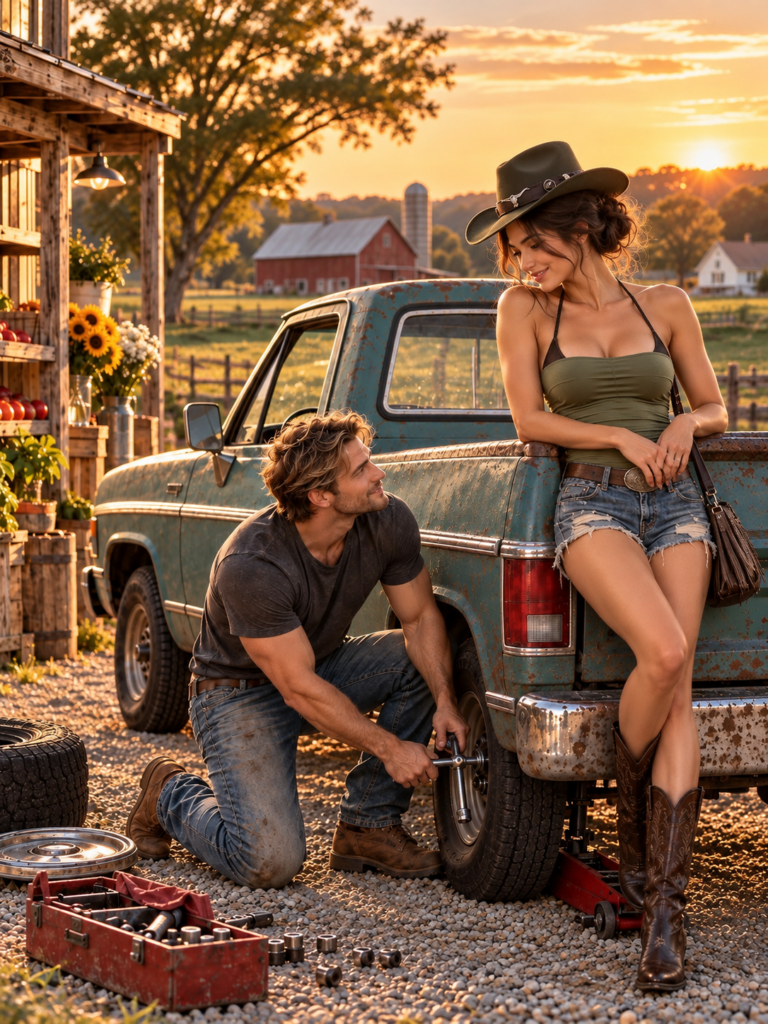
PART 1
The lug wrench slipped from her hand, and she swore under her breath.
I was already kneeling on the gravel shoulder before my brain caught up to my body.
“Hey,” I said, reaching for the wrench. “Let me—”
She turned.
And ten years collapsed into the smell of hot rubber, roadside dust, and summer tomatoes.
June Harold.
Same dark hair tied back with whatever was closest. Today, it was a piece of twine. Same narrow jaw. Same way of holding her mouth like she was deciding whether to laugh at you or tell you to leave.
But she was not seventeen anymore.
She was twenty-six now, and the softness I remembered had been replaced by something sharper. Something earned the hard way.
She looked at my hands on the wrench.
Then at my face.
Recognition moved through her expression like weather.
“Still rescuing me,” she said.
She smiled when she said it, but the smile had an edge I did not remember.
“June.” I sat back on my heels. “I didn’t—I was just stopping for tomatoes.”
“Then go buy tomatoes.”
She pulled the wrench back from where I had gripped it, repositioned herself against the lug nut, and threw her weight into it.
The bolt cracked loose.
I stayed there kneeling like an idiot.
The old produce truck was jacked up properly. The spare tire was already propped against the rear quarter panel. She had the jack positioned under the axle exactly where it should have been. She had been halfway finished before I even pulled off the county road.
“You don’t need help,” I said.
“No.” She loosened another bolt without looking at me. “I don’t.”
I stood, brushed gravel from my knees, and walked toward the farm stand.
A hand-painted sign read: Harold Family Farm.
There were baskets of tomatoes, early sweet corn stacked in wooden crates, bundles of basil sitting in mason jars, and a card reader zip-tied to a folding table. Beyond the stand, the farm stretched toward a line of trees: a farmhouse with a deep porch, a barn with a patched roof, rows of vegetables running under the late afternoon sun.
I picked out four tomatoes and waited.
June finished changing the tire in the time it took me to feel useless.
She lowered the jack, tightened the lug nuts in a star pattern, and gave each one the proper final turn. Not the way people do when they have watched someone else change a tire once. The way someone does when life has made them learn.
Then she wiped her hands on her jeans and walked over.
“Three dollars a pound.”
“These are beautiful,” I said.
“They should be. I’ve been up since four.”
She weighed them on a hanging scale. There was a streak of grease on her forearm and another on her jaw.
“Six even.”
I handed her a ten.
She made change from a cash box and did not offer to keep the difference.
“June,” I said, “I’m sorry I grabbed the wrench. Force of habit.”
She looked at me then.
Really looked.
“My dad had a stroke four years ago,” she said. “Left side. I learned to do the tires, the truck, the tractor, the books, the stand, the wholesale accounts, the irrigation.”
She said it flatly, like a list she had recited too many times.
“When someone walks up and takes the wrench out of my hands, do you know what that feels like?”
I did not answer.
“Like they’re saying I can’t.”
The words landed harder than she probably intended.
Then she added, quieter, “Like they’re saying I can’t.”
For a second, all I could hear was the wind moving through the corn crates.
She looked away first.
“You were always like that, though,” she said. “Showing up.”
“I remember senior parking lot,” I said.
Her mouth twitched.
“My rear passenger tire.”
“October,” I said. “Right before homecoming.”
This time, she almost smiled for real.
“You changed it and left. Didn’t even wait for me to say thank you.”
A pause stretched between us.
“I thought about that a lot,” she said.
I wanted to ask what she meant.
I did not.
“Well,” she said, straightening the tomato baskets, “safe drive.”
“Where are you headed?” she asked.
“Millhaven. Two hours north. Signing a lease on an apartment. New start. Something like that.”
“Good luck, Emmett.”
She remembered my name.
I carried that all the way to Millhaven.
I carried it through the meeting with the property manager, through the stiff handshake, through the hallway that smelled faintly of bleach and old carpet.
Then he opened the apartment door, and the smell hit me.
Black mold climbed the bathroom wall like a living thing.
The landlord tried to talk around it. Moisture issue. Being handled. Nothing serious.
I did not sign.
The lease was voided.
My deposit was refunded.
By four in the afternoon, I was standing in a parking lot with my truck packed full of everything I owned and nowhere to put any of it.
So I drove south.
The farm stand was closing when I pulled back in.
June was stacking crates into the same truck, the one with the new tire. She watched me get out and did not say anything.
“Your spare’s underinflated,” I said. “You should know that.”
“I do know that.”
“Okay.”
I looked past her toward the farmhouse, the barn, and the rows of land glowing under the low sun.
“Is there somewhere on the edge of your land I could park and camp for a couple weeks? I’ll pay. My apartment fell through.”
“No.”
The word came fast.
Then the farmhouse screen door opened.
A man stepped onto the porch and came down slowly, one hand gripping the railing, one foot dragging slightly. He was thin but upright, and he had June’s jaw.
“How much?” he asked.
“Dad,” June said.
“Thirty a night,” he said. “Flat ground past the barn. There’s a spigot.”
I looked at June.
Her lips were pressed together.
“Thirty is fair,” I said.
Her father nodded once, turned, and went back inside.
June stared at the empty space where he had stood.
Then she looked at me.
“Two weeks,” she said. “And you don’t touch my tires.”
“Understood.”
Three days in, I learned her schedule by sound.
Screen door at four-thirty.
Truck engine at five.
Gravel under tires.
Then silence until she returned around seven to open the stand.
I kept to my side of the property. I made coffee on a camp stove, searched for apartments on my phone, and stayed out of her way. That seemed to be the one thing she would accept from me.
On the fourth morning, she backed the truck up to the barn, and one of the crates slid off the tailgate.
Tomatoes rolled everywhere under the chassis like they were making a break for freedom.
I watched from thirty yards away.
Every instinct in me said move.
Pick them up.
Make yourself useful.
But I remembered the wrench.
So I stayed still.
June got on her knees and started gathering tomatoes. After a few seconds, she looked over at me.
She held my gaze for three seconds.
Then she went back to picking them up.
That evening, she brought me a plate.
Sliced tomatoes. Bread. Salt.
PART 2
She set it on my tailgate without comment and walked back to the house.
On day five, she asked me to look at the truck’s alternator.
“It’s whining on startup,” she said. “If you want to.”
I looked at her carefully.
“If I want to?”
She crossed her arms.
“I’m asking.”
“That’s different.”
“It is.”
So I looked at it.
I spent an hour under the hood while she reorganized the stand shelves beside me. We did not talk much. It was easier that way. Quieter. Safer.
When I finished, she leaned over the fender to see what I had done, and her shoulder touched mine.
Neither of us moved away.
“You’re good at this,” she said.
“Twelve years of engines. I’d better be.”
“Why did you quit the garage?”
“Owner retired. New owner wanted oil changes and upsells. I wanted to fix things.”
I wiped my hands on a rag.
“Stupid reason to leave.”
“Sounds like the right reason to me.”
The stand was not doing well.
I could see it in the unsold crates at closing, in the way June counted the cash twice and then stared at the number as if it might change if she waited long enough.
On day seven, I finally asked.
“How bad is it?”
She was at the folding table with a calculator out.
She did not answer right away.
“The land is worth something,” she said. “The farm is worth nothing. Those are not the same thing.”
I stayed quiet.
“A developer named Cahill offered to buy the whole parcel last spring. Full acreage. He’d clear it for mixed-use development.”
She said it like she was reading a verdict.
“The offer would cover Dad’s medical debt and then some.”
“But?”
She looked toward the fields.
“But this is my family’s land. Four generations. And Dad is still here.”
Her voice tightened.
“I wanted to fix it.”
There it was.
The word that lived inside both of us.
Fix.
The impulse rose in me like a reflex.
Research grants. Restructure the books. Find the angle she had missed. Solve it. Prove I could help.
I went back to my campsite and spent two hours on my phone looking up agricultural preservation programs, small farm emergency funding, land trust options, county tax deferrals, and every possible way to keep a farm from being swallowed by development.
She found me the next morning with six browser tabs open.
“What are you doing?”
I turned the laptop toward her. “There’s a USDA program for—”
“Stop.”
She was not angry.
She was tired.
“Emmett, I’ve applied to every program on that list. I’ve called the extension office. I’ve talked to the land trust. I’ve done the work.”
“I know you have.”
“Then why are you doing it again?”
I closed the laptop.
“Because I don’t know what else to do.”
That was the most honest thing I had said since I got there.
She sat down on the tailgate beside me.
The evening was cooling off. The stand was closed. Her father’s television flickered blue through the farmhouse window.
“You want to know why I remembered the parking lot?” she asked.
“Yeah.”
“Every other guy who ever helped me with something made sure I knew about it. Held the door and waited for the thank you. Carried the box and told the story later. You changed my tire and just left.”
“I was scared to talk to you.”
“I know.”
She looked down at her hands.
“But that’s not what it felt like from where I was standing. It felt like you respected that it was my car and my problem, and you were just there quietly. Then gone.”
Crickets filled the silence.
Her shoulder was close to mine again.
“Nobody’s been quiet like that since,” she said.
I turned toward her.
She was already looking at me.
Not guarded the way she had been that first day. Not measuring what I might take. Just looking.
“June,” I said, “don’t say something big.”

PART 3
“I wasn’t going to.”
“Good.”
Then she kissed me.
Brief.
Deliberate.
Her hand flat against my chest like she was checking whether I was solid.
She pulled back and studied my face the way she studied lug nuts, looking for the thing that was not right.
“Okay,” she said quietly.
“Okay?”
“Okay.”
Then she stood.
“Good night, Emmett.”
She walked back to the house.
The screen door closed behind her.
I sat on the tailgate and did not move for a long time.
My laptop was dark beside me, but I knew what waited behind the closed screen. Open browser tabs about grants. Programs. Rescue plans. Evidence of exactly the thing she had told me to stop doing.
Then my phone buzzed.
An email from a property manager in Millhaven.
New unit available. No mold. Move-in ready. First month prorated.
I read it twice.
Then I looked toward the farmhouse porch, where the light had just gone out.
I did not answer the email that night.
Or the next morning.
I told myself I was being thorough. Checking photos. Comparing prices. Making sure I did not repeat the same mistake.
But my laptop stayed closed.
And I kept finding reasons to be near the stand.
The kiss changed the geometry of everything.
Not dramatically. June was not the kind of woman who announced a shift. But the distance she had maintained since I arrived compressed by small, deliberate increments.
She brought coffee to my campsite before dawn.
When I helped load the truck, she stood closer than the task required.
During a delivery run to a restaurant in town, she let me drive while she sat with her boots on the dashboard and the window down.
The silence between us changed too.
It became comfortable.
Chosen.
“You’re smiling,” she said.
“Am I?”
“It’s suspicious.”
“I’m just driving.”
“You’re smiling while driving my truck. That’s a lot of liberties for a tenant.”
I laughed.
She watched me laugh, and something in her face opened like a door she had been leaning against for years.
At the restaurant, the chef knew her by name and asked about her father. June handled everything with easy authority: pricing, quantities, next week’s order, the invoice mistake from last month. I carried boxes and kept my mouth shut.
On the drive back, she said, “You’re doing it again.”
“Doing what?”
“Being quiet and useful.”
“You want me to be loud and useless?”
She smiled out the window.
“I want you to be honest about why you’re still here.”
The Millhaven email sat in my inbox like a small fire I kept walking past.
I should have told her then.
Instead, I said, “Your tomatoes are really good.”
“Emmett.”
“I don’t have a good answer yet.”
“That’s closer to honest.”
She pulled her boots off the dashboard.
“I can work with closer.”
Three more days passed.
We fell into something that looked almost domestic from the outside.
Morning coffee at the tailgate. Work through the afternoon. She let me rebuild the irrigation valve on the east field after the old one started leaking. A real job, one that took focus and parts I drove to the hardware store to buy.
In the evenings, we sat on the porch with her father. He watched us with the quiet attention of a man who had lost the ability to say most of what he noticed, but had not lost the noticing.
On the third evening, June went inside to shower, and her father turned to me.
His speech was careful, each word placed like something measured.
“She tell you about the offer?”
“The developer?”
“Yeah.”
“She told me.”
“She tell you what she gave up?”
I waited.
“Scholarship,” he said. “State school. Agricultural science.”
He looked out over the fields.
“She was going to learn how to do this right. Study it. Come back with answers.”
His left hand rested motionless on his knee.
“Instead, she came back with a jack and a wrench and figured it out alone.”
“She’s good at it,” I said.
“She’s drowning in it.”
Then he looked at me.
“She won’t let anyone help her grieve the life she gave up. That’s not the same as not needing help.”
The screen door opened.
June stepped out with wet hair and a glass of water.
Her father turned back toward the fields as if he had never spoken.
That night, I opened my laptop on the tailgate.
The Millhaven listing was still there. I had also received a confirmation from the property manager. The unit was mine if I signed. Move-in date ready.
I started drafting a reply.
Then June came around the side of the truck.
She saw the screen.
The email.
The subject line.
Lease Confirmation — Unit 4B.
“When did this come in?” she asked.
I closed my eyes.
“Last week.”
The air between us went cold.
“Last week,” she repeated.
“June—”
“You kissed me last week.”
“You kissed me.”
“And you kissed me back with a lease confirmation in your inbox.”
I closed the laptop.
“This is what you do,” she said.
Her voice was steady, which was worse than yelling.
“You show up. You’re quiet. You’re good. And then you leave.”
“That’s not—”
“That’s not rescuing, Emmett. That’s visiting.”
“I haven’t signed it.”
“But you haven’t deleted it either.”
I said nothing.
“You’re keeping your exit open,” she said. “That’s what you were doing at seventeen too. You changed my tire and left because leaving was easier than staying and being seen.”
“That’s not fair.”
“Tell me I’m wrong.”
I could not.
She stood in the dark beside my truck, arms crossed, the porch light behind her making her face unreadable.
Finally, I said the thing I had never said to anyone.
“I don’t know how to stay somewhere without a function.”
Her arms loosened slightly.
“What?”
“Without a reason I’m needed. Your alternator breaks, I’m useful. Your irrigation fails, I matter. But if everything works and you don’t need me to fix anything, I don’t know what I’m for.”
June looked at me for a long time.
“That’s the saddest thing I’ve ever heard.”
“I know.”
Then she looked down at the gravel.
“And I don’t know how to let someone stay without assigning them a job,” she said quietly. “Because if you’re here for a reason, it won’t hurt as much when the reason ends and you go.”
We stood there.
Two people who had just described the exact same wound from opposite sides.
“So what do we do?” I asked.
June looked toward the farmhouse, the fields, the dark outline of everything she had held together alone.
“I don’t know yet,” she said. “But you should probably stop camping and start deciding.”
I did not sleep.
I sat in the truck cab with the seat reclined and the windows down, listening to the irrigation line I had fixed ticking water across the east field. My phone sat on the dashboard, the lease confirmation still unsigned.
Morning came gray.
June was already at the stand when I walked over.
She did not bring coffee.
She arranged tomatoes with the focus of someone who had decided not to look at me.
“June.”
“Stand opens in ten minutes,” she said. “You can buy something or you can go.”
I went back to the campsite.
Around noon, a silver SUV pulled up the gravel drive.
A man in a blue Oxford shirt stepped out, leather portfolio under his arm. He walked straight to the stand.
Cahill.
The developer.
From fifty yards away, I could read June’s posture. Arms crossed. Weight back. Chin level. Listening, not agreeing.
He talked for a while. Opened the portfolio once. She did not look at whatever was inside. He talked more.
She said something short.
He nodded, left a card on the table, and drove away.
June stood there after he left with one hand on the card, staring at the fields.
I did not go over.
That evening, her father was on the porch when I came back from a walk along the tree line. He raised his good hand and waved me up.
I sat in the chair beside him.
“Cahill came back,” he said.
“I saw.”
“Final offer. Better than the last.”
He was quiet for a moment.
“It would clear everything. Medical. Equipment loans. All of it.”
“What does June think?”
He looked at me with something between patience and pity.
“She thinks about what I need. What the land needs. What the numbers say.”
He turned back to the fields.
“She doesn’t think about what she wants. Hasn’t in years.”
Inside, I could hear June washing dishes.
“I’m not going to tell her what to do,” I said.
“Good,” he said. “She’d eat you alive.”
He almost smiled.
“But she’s never let anyone help her grieve the life she gave up. Selling this place would be another version of that. Keeping it might be too. Neither answer fixes anything unless she makes it for herself.”
My phone buzzed in my pocket.
I did not check it.
I already knew it was the property manager in Millhaven reminding me that I had five days before the unit went to the next applicant.
Two exits.
Both real.
Both correct from the outside.
I spent the next two days doing nothing useful.
That was the hardest part.
I did not touch the trucks. I did not research grants. I did not fix the loose board on the barn door I had been eyeing for a week. I sat at my campsite, made calls about other housing options in case I needed them, and let June have the space she had asked for.
She ran the stand.
Loaded the truck alone.
Made deliveries.
Came home.
Cooked dinner for her father.
Sat on the porch until dark.
I watched the routine from the edge of the property and understood, for the first time, that my instinct to step in was not always generosity.
Sometimes it was a way of earning my presence.
Making myself necessary so I would not have to ask if I was wanted.
On the third evening, June was at the stand late.
I walked past on my way back from the spigot and heard her on the phone.
“No, Mr. Cahill,” she said. “I’ve thought about it.”
A pause.
“I appreciate the offer. I do. But this is my land, and I’m keeping it.”
She hung up.
Then she sat on the stool behind the folding table with the calculator, the cash box, and the unsold tomatoes, and pressed both hands flat against the surface like she was holding the whole farm down.
She did not call me over.
She did not look toward my campsite.
She made the decision alone, in the quiet, without asking anyone to validate it.
I went back to my truck and opened my phone.
The property manager’s last text was waiting.
Need your signature by tomorrow 5:00 p.m. or unit goes to waitlist.
I looked at the farmhouse.
The porch light was off.
June’s window was dark.
I thought about what her father had said. About the life she had given up. About how neither answer fixes anything unless you choose it for yourself.
I typed a reply.
Can I get a thirty-day delay? I need a month.
He responded an hour later.
Best I can do is three weeks. Let me know by morning.
I set the phone down, lay back in the truck bed, and looked at the stars over June’s fields.
That was when I finally understood.
The thing I was doing was not about her tire.
Or her farm.
Or her debt.
Or her father.
I was staying because this roadside stand on a county road in the middle of nowhere was the only place I had pulled over and wanted to stop.
At dawn, I texted the property manager.
Three weeks. I’ll take it.
Then I closed my phone and drove north.
Not all the way to Millhaven.
Just far enough to feel the pull in both directions.
The empty highway ahead.
The farm stand behind me.
I stopped at the same stretch of county road where I had first pulled over for tomatoes. I killed the engine and sat with my hands on the wheel.
I was not going back to fix her irrigation.
I was not going back to rebuild her alternator.
I was not going back to research grants.
I was not going back because June needed me.
That was the whole point.
She did not need me.
She had turned down the developer alone.
She had kept her land alone.
She had changed her own tires for four years, and she would change them for forty more.
I was going back because I wanted to be there when she did.
I turned the truck around.
The farm stand was not open yet when I pulled down the gravel drive.
The sun was barely over the tree line, catching the mist on the east field. The produce truck was parked by the barn, and June was on one knee beside the rear passenger tire.
Another flat.
Lug wrench in hand.
I parked, got out, and walked over.
She heard me coming and looked up.
Grease on her jaw again. Twine in her hair. The wrench steady in her grip.
I did not reach for it.
I sat on the tailgate and let my legs hang.
Then I watched her work.
She loosened the first bolt and glanced at me.
I did not move.
Second bolt.
Third.
She repositioned the jack and pumped until the axle cleared. She pulled the flat, rolled the spare into place, tightened the lug nuts in a star pattern. Proper sequence. Same as always.
She lowered the truck, stood, wiped her hands on her jeans, and walked over.
Then she sat beside me on the tailgate.
“You came back,” she said.
“Yeah.”
“Why?”
“Not to help.”
She studied my face.
I let her look.
I did not fill the silence with a reason, a plan, a solution, or a speech.
“I know,” she said quietly.
“I asked for a delay on the lease. Three weeks.”
“Because of me?”
“No.”
Her eyes stayed on mine.
“Because this was the only place I wanted to stop.”
“That’s a terrible financial decision.”
“Probably.”
“You don’t have a job here.”
“No.”
“Or an apartment.”
“I have a campsite.”
“You have a patch of dirt next to my barn.”
“It’s a good patch of dirt.”
She looked toward the fields.
Morning light caught the tomato cages and turned them gold. Her father’s window was open, the curtain moving in the breeze.
“If you stay,” she said, “I’m not going to give you a job.”
“I know.”
“I’m not going to need you to fix anything.”
“I know.”
“You’ll just be here.”
I nodded.
“That’s going to drive you crazy.”
“Probably.”
She was quiet for a long time.
Then she leaned into me, her shoulder against mine, the same point of contact as the evening she had kissed me.
This time, neither of us moved away.
“Stay because you want to,” she said. “Not because I need you to.”
“I want to.”
“Okay.”
“Okay.”
We sat on the tailgate while the mist burned off the fields.
She did not kiss me.
I did not reach for her hand.
We just sat there.
Two people who had spent a decade learning how to be alone, trying something harder.
By the following autumn, the campsite had become a small room in the farmhouse. Her father’s idea, offered in four careful words over dinner one night.
“Room’s empty. Use it.”
I found work at a repair shop in town, twenty minutes down the county road. Not glamorous work. Honest work. Engines, brake lines, alternators, all the things I knew how to fix without confusing usefulness for love.
June expanded the stand’s restaurant accounts and started a winter CSA program. The debt did not disappear, but it shrank. Slowly. The way real things do.
Most evenings, we ended up on the tailgate.
Sometimes with coffee.
Sometimes with nothing.
She talked about crop plans for the next season. I talked about an engine I could not figure out. Sometimes we did not talk at all.
One evening in October, she came outside and found me sitting there already.
She had grease on her jaw from the tractor hydraulics.
“You’re in my spot,” she said.
“Our spot.”
She sat beside me and leaned into me.
The fields were turning amber in the last light.
“Still rescuing me?” she asked.
“Never,” I said. “Just here.”
She took my hand.
We watched the sun go down over her land.
And I did not fix a single thing.
It was the best evening of my life.
The End.

