
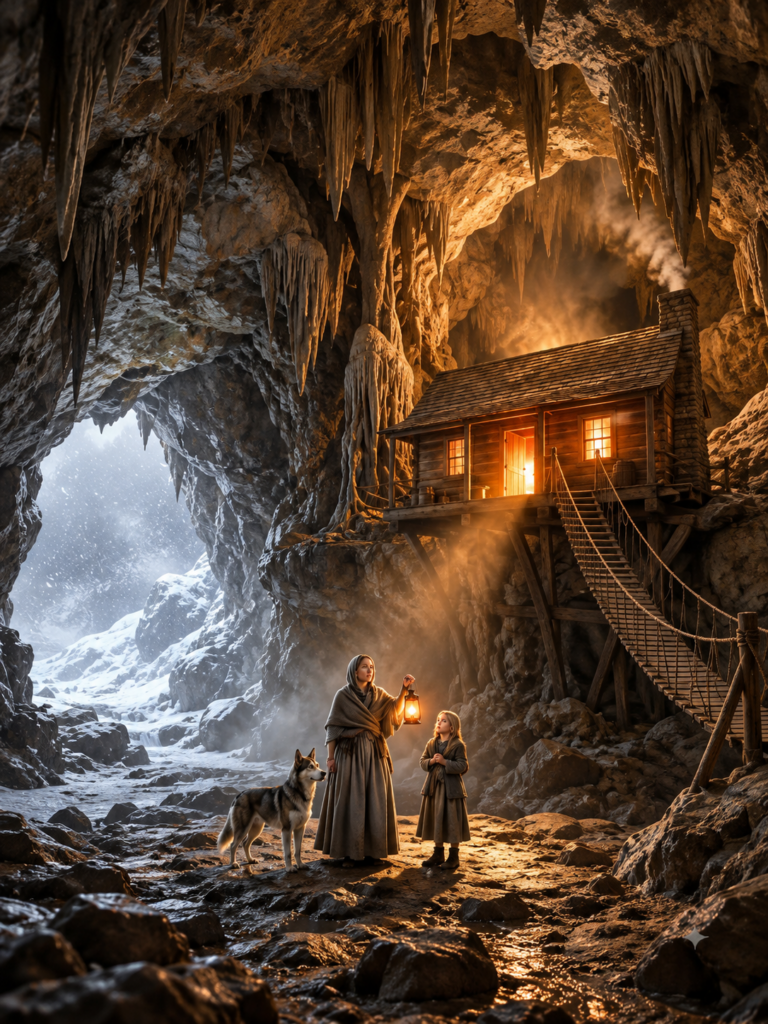
forced out into the wyoming winter with her little sister and their dog she found a hidden house inside the mountain that strangers had built and left for whoever came next
Part 1
The smoke rose from the chimney of a house that no longer belonged to them. Petra Winslow stood at the edge of the tree line with her younger sister June pressed against her side and their father’s old husky Flint leaning warm and solid against her legs. Snow had been falling since before dawn, the kind that came straight down, heavy and deliberate. Through the white she could see the orange glow behind the parlor window and the shadow of a man moving unhurried behind the glass. Her uncle Gideon had lit the same lamp her mother used to read by. Something about that detail settled in Petra’s chest like a stone.
Their father, Thomas Winslow, had worked the Sweetwater County coal seam for eleven years. He had come home black-faced and coughing, eaten his supper at that table, and fallen asleep in the chair beside that lamp. He had been dead since August. A haulage beam had collapsed on a Tuesday morning. People said it was fast. They said he would not have felt much. Petra had learned that people said those things because they did not know what else to offer a twenty-two-year-old woman standing in a mine office doorway with a nine-year-old sister at her back. Their mother had been gone longer, typhoid when June was five and Petra was thirteen. From that year forward Petra had kept the household, mending clothes for other miners’ families, tending the garden, teaching June her letters beside the same lamp Gideon was now burning as though he had always owned it.
He had arrived six weeks after the funeral with papers. She had not understood all of them. There had been no lawyer she could afford and no neighbor willing to stand against Gideon Winslow in front of a county clerk. The papers claimed Thomas had borrowed against the property and never repaid. The signatures at the bottom were ones she did not recognize. The clerk stamped them anyway. On a gray Thursday in November, Gideon told them to take what they could carry and be gone before supper. Petra had taken their father’s canvas rucksack, a wool blanket, a folding knife, a box of matches, and half a loaf of bread already going hard. June had taken the small cloth rabbit she had carried since she was a baby. Flint had simply followed.
That had been three days ago. The first night they sheltered under a deadfall pine on the eastern slope, the rucksack wedged as a windbreak and the blanket pulled over all three of them. The second night they found a shallow cut in the rock above a dry creek bed. Flint had curled himself between June and the open air, and his body heat had been enough. On the third day the storm worsened. The sky dropped lower. The bread was crumbs. June had not complained once, which worried Petra more than crying would have. She had been studying the ridge line all morning, trying to remember what her father had told her about the Elkhorn country. He had prospected these hills briefly in his younger years. He used to say the mountains up here kept secrets better than people did.
The snow thickened. Flint had been walking with his nose low all morning. Now he stopped. Both ears came forward. He was staring at a section of the rock face roughly a quarter mile north, where old ponderosa pines grew so close to the stone that their roots had split the base of the cliff. He did not growl. He simply stood with every muscle gathered and his attention fixed, as though he had been given an instruction she could not hear. June’s lips had gone pale at the edges. Petra had two choices. Turn south toward Laramie, a full day’s walk in fair weather and closer to impossible in this, or trust the dog. She trusted the dog.
The snow was mid-calf by the time they reached the base of the cliff. Roots had worked into the stone over decades, wedging until sections of the face had shifted and cracked. Flint walked directly to a low horizontal fissure and pushed his muzzle into the dark. Then he went through and was gone. For a long moment there was only the wind and June’s quiet breathing. Then Flint barked once from somewhere inside the rock. The gap was tight. Petra turned sideways and pressed flat against the cold stone, keeping one hand behind her for June the entire way. Eight feet of pure darkness and cold stone smell, and then it opened.
The cave was enormous. Not the darkness, not the cold, but the sheer scale of it. Thin seams of light entered through fractures high in the ceiling, enough to see by in the slow careful way of a winter afternoon. The floor was dry stone, littered with old pine needles. At the far end, beneath the largest cluster of roots she had ever seen, roots that had come through the ceiling in great ropey bundles, stood a house. A wooden house. Four walls, a pitched roof, a covered porch with two steps, windows fitted with actual glass, dark with grime but intact. The structure stood perhaps twelve feet tall at its peak. No footprints in the dust on the cave floor except the ones they were making now and the pad marks of Flint’s paws leading toward the porch steps.
Petra’s hand found the folding knife in her coat pocket. She held it there without opening it and listened. No sound from inside. June was at her shoulder. “Is someone in there?” Her voice was barely above a breath. Petra did not answer because she did not know. Flint was on the porch. He sniffed along the base of the door, then sat and looked back at them. His tail moved once. Every board in the porch was still solid underfoot. She pressed on the door and it opened without resistance. The hinges groaned with the complaint of metal that had not moved in a long time. A cloud of dust drifted out. The smell that followed was old wood, dry herbs, faintly medicinal, the ghost of wood smoke from a fire cold for years, but not rot. Flint walked inside, circled the main room once, and lay down in front of a stone fireplace. He was done deciding.
June walked in behind him. She stopped in the center of the room, turned slowly, looked up at the ceiling beams and the stone chimney and the dusty windows. Then she turned to Petra. For the first time in three days the fear was not the loudest thing in her face. Petra made herself be methodical. The fireplace was stone, large, with an iron swing arm and a proper damper. The floor was wooden plank, solid. The windows were intact. Along the near wall a kitchen: wooden counter, shelves mostly bare, a cast-iron stove, a dry sink. A narrow hall led to a small bedroom with a wooden bed frame and a folded quilt on the mattress, old straw but dry. A second door opened into a storage room with empty shelves. There was no one here. There had not been anyone here for a very long time. Whoever had left last had left the door unlocked and the quilt on the bed.
That night she did not sleep. She sat in the chair nearest the door with the knife open on her knee and listened to the storm work itself out against the rock above, muffled and distant, while June slept on the mattress with the quilt pulled to her chin and Flint pressed against the back of her knees. Dawn arrived as a change in the quality of the dark. Gray seeped through the dirty glass. First problem was water. She went to the kitchen and looked more carefully. The counter had a channel cut along its inner edge, a wooden trough running toward the back wall and through a gap fitted with a clay seal. She followed it to a pipe, actual turned wood sealed with pine pitch, that entered the wall from outside. Someone had engineered water delivery to this kitchen. The pipe was dry now, but it had been built with a specific source in mind.
Flint was at the door. She followed him across the cave floor toward a secondary depression where the air was colder and fresher. A narrow fracture at the base of the wall let water seep through the stone in a thin continuous ribbon that collected in a natural basin. She touched it. Cold, clear, moving. She tasted it. Clean. Someone had not merely found this cave and built a house inside it. They had surveyed it, planned it, studied where the water came from, and built the structure to make use of it. She filled their bottle and went back inside.
Part 2
Firewood was the second problem. She went out through the passage into the cold with the folding knife and a length of rope she found coiled on a shelf. The storm had passed. She found deadfall within two hundred yards, branches broken and dried under a skim of new snow. She made four trips before June appeared at the cave entrance still holding her cloth rabbit. “You should be inside.”
“I was helping in my head,” June said. Petra had learned not to argue with that. The first fire that afternoon caught on the first try. The draft pulled cleanly up the old stone chimney. Warmth moved out from the firebox slowly, the way warmth does in stone, but it moved. By the time the light through the cave windows had gone amber, the main room was no longer cold. It was merely cool, and cool was something she could work with.
Food was the third problem. The shelves held two empty ceramic crocks, a wooden spoon with a cracked handle, a tin cup, and a cast-iron skillet. A low cabinet yielded three empty preserving jars. Nothing edible. The people who had left had taken their provisions and left the tools. The next morning, Flint leading, she went north along the base of the cliff and angled uphill into the timber. In a south-facing clearing she found a stand of hawthorn, branches studded with dark red berries that had dried but not rotted. She filled both coat pockets. They were bitter. June ate them without complaint and said they tasted like something trying to be an apple.
The creek yielded fish on the second attempt. She had made a hook the first evening from a bent nail, threaded on fine cord with a hawthorn berry for bait. She lost the first two to impatience and the third to a slipping knot. The fourth she held, a small trout, and cooked it in the skillet that evening. The smell filled the house. Flint sat up and stared at the stove. June laughed at him. It was the first time she had laughed in longer than Petra could accurately remember, small and careful, as though testing whether the mechanism still worked. It worked. It was enough.
Over the next week Petra built systems the way her father had taught her: break it into what you can control today and what you will need to control eventually. Today was water, food, warmth. The firewood operation became a morning task. She identified three deadfall trees and began cutting and carrying, stacking them inside the cave. June took charge of the indoor stack beside the hearth. The fish became more reliable as Petra learned the creek. There was a pool below a particular curve where trout congregated in the afternoon. Combined with hawthorn berries they had enough. Not comfortable. Enough.
At the end of the first week she cleaned the windows with snow and a strip of cloth. The light that came into the main room afterward was brighter and more honest. June noticed, then went back to drawing on a smooth piece of pine board she had found, using a charred stick. A map of the cave. The entrance passage, the spring, the house, a small lumpy shape near the fireplace that was clearly meant to be Flint. “That’s good,” Petra said. June studied it critically. “Flint’s ears are wrong. They’re too pointy.”
On the ninth day Petra found the kitchen beam. She had been checking the structure, pressing on joints and tapping walls. Near the wall end of the main beam above the kitchen counter, where timber met stone and shadow gathered, she found deliberate cuts. Not accidental. Carved. A letter, a period, two more letters, a date. O.M. 1859. Below it, in smaller cuts: built for those who come after. She stood with her fingers resting on the letters and read the words twice. Whoever O.M. was, they had not built this house and then forgotten it. They had built it with the specific understanding that they were not the last people who would need it.
She opened the second kitchen drawer, stuck, which was why she had not tried it before. Inside she found a folded piece of paper, a list written in a careful slanted hand. Materials: oak peg sizes, pitch pine for the roof, clay quantities for the chimney seal. A builder’s inventory. At the bottom, below a double line, someone else had written in a lighter hand: north wall, soft near floor, reinforce. Same different person, different time. Someone had come after O.M. and found what he had left and added to it. She checked the north wall that same afternoon. The plaster near the floor gave slightly under her thumb. She found a section roughly eighteen inches wide where the backing had softened. Frost damage. She spent an hour remaking the seal with clay from the spring depression mixed with ash from the fireplace. It was not elegant. It was functional.
The quilt on the bed was old but well-made, pieced from wool in squares of dark blue and faded red. One morning, shaking it out, she found something she had missed. In the lower right corner, half an inch from the edge, two letters and a date worked in thread that had faded to barely visible. A.P. 1874. Not O.M. A different initial, a different year, fifteen years after the beam inscription. Someone else had been here, had slept under this quilt, had sewn their mark into its corner before they left. She turned the corner of the quilt over in her fingers and thought about the handwriting in the kitchen drawer and the repaired north wall. There was something accumulating here she did not have a word for yet. A chain of strangers who had each arrived with nothing, found something, taken what they needed, left what they could, and in leaving had thought about whoever came next.
Part 3
That evening, after June had gone to sleep, Petra found the notebook. She had been looking in the storage room for another length of rope and pulled the lowest shelf away from the wall. There it was, a soft-cover notebook, ledger-sized, wrapped in a piece of oilcloth. She carried it to the fire. The first twenty pages were in the same formal hand as the land document she would find later. Technical content: roof pitch calculations, chimney draw ratios, depth requirements for the clay seal on the water pipe, species of wood preferred for each structural application and why. Not a diary. A construction manual. Morrow had written down not just what he did, but why, and how someone might maintain or replicate it.
Then the handwriting changed. Smaller, less formal, slightly hurried. A name at the top of the page: A. Pallister, winter 1873. A brief entry. Arrived November. Husband lost at Powder River that spring. Two boys. Nowhere to go. Found the house. Found the notebook. Use the clay method for the window frame on the east side. It works. Morrow knew what he was doing. The entries continued through the winter in brief practical observations. What the creek level did in deep freeze. Where the best deadfall was. Which direction the wind came from during a north storm. Then in April 1874 a final entry: Leaving for my sister’s place in Cheyenne. Boys are well. Left the quilt on the bed. Added herbs to the kitchen drawer. Yarrow, thyme, willow bark for whoever needs them. Fixed the north wall as best I could. This house saved us. I hope it saves whoever comes next.
Petra read this entry three times. She had drunk Agnes Pallister’s yarrow tea. June had slept warm under Agnes Pallister’s quilt. She had repaired the wall Agnes had identified nine years before. She closed the notebook and sat with it on her knees and looked at the fire. There was a word for what this was, though it was not a word she had been taught for this kind of situation. Inheritance, but not in the way Gideon used it. Something older. The kind that moved forward instead of backward, that accumulated not in money but in knowledge and repair and the habit of leaving things better than you found them for people whose names you would never know.
She opened the notebook to the first blank page after Agnes’s entries and looked at it for a long time. Then she set it on the shelf beside the fire and went to bed.
The morning she found the footprints was a clear morning, the kind Wyoming produced after a run of hard weather. Flint was at the cave entrance before she was fully awake, producing the low continuous sound he made when something required her attention without yet requiring her alarm. She looked out through the passage. On the fresh snow outside, one set of footprints. Men’s boots, medium-size, flat-heeled. They came from the east along the cliff face, slowed near the gap, stopped with both feet parallel and close together, someone who had paused deliberately. Then they turned and went back the way they had come. They had not come through. Either they had not found the gap or they had found it and decided against it. She went back inside without touching anything.
“Someone was outside,” she said, keeping her voice level. June looked at Flint, still sitting very still at the entrance. “Did they come in?”
“No.”
“Do you know who it is?”
The honest answer was that she did not know for certain, but she knew what she thought. There was one person with both a reason to find her and the resources to pay someone to do it. She had been gone more than two months. The county records for the Winslow property would show a gap, a transaction without the required signature of the living adult heir. “Get dressed,” she said, “and stay close to the house today.”
Three days passed without another set of prints. She wedged two deadfall branches across the outer face of the gap at a low angle so that new snow would catch on them and build across the opening. Not a lock. Misdirection. It was during those three days that she worked back through the notebook more carefully and found what she had missed the first time. A third hand, just two pages at the very back. A child’s handwriting, large and uneven. Caleb Pallister, age 11, winter 1873. A single entry. Mama says we are leaving in the spring. I do not want to leave. This is the best house I have ever seen. There is a dog carved on the shelf in the bedroom and it looks like a real dog. Mama said I can leave this here. So I am leaving it.
She went immediately to the bedroom and looked at the shelf above the bed. At the far end, pushed against the wall where the shadow was deepest, was a small carved figure perhaps four inches tall. A dog carved from a single piece of pine, sitting with its ears pricked. The proportions were approximate and the tool marks were a learner’s work, but the essential thing was right. The ears were round, not pointed. The chest was broad. A sled dog, the kind Flint was. She set the carving on the bedroom windowsill and went to find June. June turned the figure over in her hands. “A boy made this.”
“How can you tell?”
“The ears are right, but the paws are too big. Boys always make the paws too big. He was practicing.”
On the thirty-fourth day she found the tin box. She had been reinforcing the north wall properly, pulling the soft plaster back to the stone. Working close to the floor she felt the clay give differently, the hard hollow sound of something behind the plaster that was not stone. She worked carefully and found a void in the rock, shaped, sealed across its face with a clay plug painted over to match. Inside the void, a tin box roughly the size of a book, sealed around its lid with a wax ring. Inside the box, a folded document and a single gold coin, five dollars, dated 1856, worn smooth from handling. The document was a second copy of the land survey. Obadiah Morrow had made two copies and hidden the second one behind the wall. He had described the cave in a legal document: rock formation with interior accessible from east face, approximately one quarter mile north of creek junction. He had included the house implicitly by including the cave.
She sat back on her heels and held the coin. The land had belonged to Morrow. He had left in 1863 without filing abandonment or transfer. Wyoming Territory had been organized in 1869. She did not know precisely what those laws said about a claim that predated the territory’s existence. But she knew one thing she had not known before she opened that tin box. The land had a history, and the history had paper behind it, and paper mattered in ways that Gideon Winslow had demonstrated very clearly by using it to take her father’s house. Paper cut both ways.
That night she made a list in the notebook at the back. What Homestead Law said about prior territorial claims. What the six-month residency provision covered. What the process was for filing at the land office in Laramie. She counted. November third she had left the Sweetwater house. Thirty-four days in the cave. That put her at the seventh of December. Twelve weeks until the middle of March. Sixteen weeks until the middle of April. If six months was the threshold, she needed to be in Laramie by the first week of May.
Part 4
February cold was of a different character than November cold. November cold was aggressive and wet. February cold was settled, established, certain of itself. She managed it by managing her mornings: out before full light to collect ice from the spring basin, wood from the indoor stack before the temperature dropped too far. The fishing was harder. The trout had gone sluggish and deep, but she learned to wait longer. June had started singing, not constantly, not loudly, but while she worked, fragments of hymns and songs their mother had sung, and occasionally something that did not seem to be from anywhere. Petra listened from the other room and did not say anything about it because saying something would have made it self-conscious.
It was during one of these mornings, Petra cutting wood near the creek and June’s voice audible from inside the cave as a faint thread through the cold air, that she looked up and found she was not alone. He was standing about thirty yards downhill, past middle-aged, thick-set, wearing a brown wool coat and a hat that had been good quality once. He had a prospector’s pack. He set the axe down slowly. She did not reach for the knife.
“Gideon Winslow’s paying me two dollars to find his niece,” he said. His voice was dry and flat. “Brown hair, traveling with a young girl and a gray-white dog.”
Petra said nothing. She waited. He looked toward the cliff face. The cave entrance was not visible from where he stood. “I’ve been working this ridge since January. Found some sign. Enough.” He looked at her the way people look at something they are trying to price. “What I can’t figure is why a man would pay two dollars in February to find someone he claims owes him paperwork. Usually when someone owes you paperwork you wait for spring. Named Silas Drum. I worked survey crews through this country in ’68 and ’69. Know it better than most. You’ve been here a while. That’s not accident. That’s management. Someone managed this place in winter, which is not simple. Looks like you learned it.”
She had nothing to offer him. No money, no negotiation, no leverage she could name. “What do you want?”
He appeared to consider this as a genuine question. “I want to finish my coffee before it freezes, which I cannot do standing here. There’s a seam of lignite running north of this creek about half a mile. I’m going to go look at it. That’s what I’m being paid to do, really. Survey work. Winslow just added the finder’s request on after.” He picked up his pack. “I haven’t found anyone today.” He turned and went north along the creek without hurrying.
Petra stood in the snow until he was out of sight. Then she went inside. June was drawing on the wall. Flint was asleep. “Was someone there?” June asked.
“Yes.”
“What did they want?”
“He wanted to tell me something without telling me something.”
June looked at this answer from several angles. “Did it work?”
“Yes,” Petra said. “I think it did.”
She went to the bedroom, took the notebook from under the mattress, and added one more line: Silas Drum. Survey. Knows the ridge. Not working for Winslow. Not entirely.
That night she found the last entry in the notebook, written not on a page but on the inside of the back cover in small letters. Agnes Pallister had written it: There will come a day when the person reading this has to decide whether this place is a shelter or a home. Those are not the same thing. A shelter is somewhere you survive. A home is somewhere you choose. I chose. I hope whoever reads this gets to choose too.
She held the notebook open and read those words in the firelight until she had memorized them. Outside the cave the February wind worked along the ridge. Inside, the fire was steady. The house was warm. The walls were holding. She had been here ninety-one days. She needed one hundred eighty-three. She turned to a blank page and wrote the date and a single sentence. Still here. Still deciding.
March came in the way Wyoming March always did, like something that had not decided yet what it wanted to be. Some mornings the light through the cave fractures was almost soft. By afternoon the wind would pick up from the northwest and the temperature would fall back. She had been counting days on the inside of the kitchen cabinet since December, a single mark for each, grouped in fives. One hundred twenty-three. Sixty more to reach six months. She needed someone who worked with land documents, who would know what a prior territorial claim meant against a current homestead filing. She needed Laramie. And she needed to know what calculations Silas Drum was actually running.
She waited for a clear morning and went looking. He was working along the lignite seam with a prospector’s pick and a small scale, taking samples. He heard her coming and did not turn around. She stopped ten feet away. “You haven’t filed anything.”
“How do you know that?”
“Because if you’d filed a finder’s report with Winslow, someone would have come by now. Someone other than you.”
He set his pick down and turned. “You’ve been counting the days. Since November.” He wrapped a sample chip in cloth. “Gideon Winslow is not a man I’d work for if I had better options. Winter survey work in the Elkhorn country is what a man does when the better options have run out. The lignite seam is real and it’s decent quality. That’s worth more to me than two dollars for finding somebody.”
He looked at her. “You need a witness. Someone who can stand in front of the land office in Laramie and say you’ve been on this ground since November. I’ve been on this ridge since January. I know you’ve been here since before that because I can see it in the work.” He gestured toward the stacked wood, the debris she had cleared. “That’s months of management, not days. What do you want for it?”
“The lignite seam. Whoever ends up holding this land, I want a surveyor’s right of access to the seam and a percentage if it comes to anything. Filed properly. Recorded.” He reached into his coat and produced a folded paper. “I wrote it out. You can read it before you agree to anything.”
She took the paper and read it in the cold. Brief and plainly written. Access rights to the north seam. Twenty percent of any mineral extraction revenue contingent on her successfully establishing a land claim to Elkhorn Ridge. If the claim failed, the agreement was void. He had signed it at the bottom. She folded it and put it in her coat. “I’ll need six weeks more.”
“I can wait six weeks.”
She walked back to the cave. June was in the storage room when she returned. She had reorganized the shelves. The tools arranged by size. The rope lengths coiled and hung. The tin of nails sorted by approximate size into three smaller tins. “You did this.”
“The nails were all mixed together. It was inefficient.” June paused. “There are also two hinges that don’t belong to anything. I put them on the middle shelf because I thought maybe they’d be useful later.”
The morning the fever found June was in the third week of March. It arrived overnight with the small factual evidence of a child who was too warm when she should have been cold. Not a deep fever, but real. Petra went directly to the kitchen drawer and took out the remaining dried herbs Agnes Pallister had left. The yarrow was nearly gone. She had a substantial amount of dried thyme and one good bundle of willow bark. She stripped bark pieces into the tin cup and poured hot water over them and let it steep until the water went the color of pale tea. June drank it without complaint.
“How long do I have to stay in bed?”
“Until the morning.”
“Can I have the notebook?”
Petra brought it to her with a charred pencil. By evening the fever had broken as cleanly as it had come. June was sitting up with the notebook open. She had drawn the cave, not the map version, but an interior view looking from the entrance toward the house, the roots hanging from the ceiling, the light coming through the cracks. Below the drawing, in her careful large-lettered hand: J.W. 1883. I was sick here and then I got better. The house helped.
Petra looked at that sentence for a long moment. “You put yourself in it.”
June looked at the page. “I’m only nine.”
“Agnes Pallister’s boy was eleven.”
Part 5
The last week of March arrived with a thaw that felt more serious than the previous ones. Petra began preparing in earnest. She needed to spend as little time in Laramie as possible. Go in, reach the land office, file the claim, get Silas his witness statement certified, and leave before Gideon had any chance to learn she had been in town. She counted the marks again. One hundred fifty-six days. First week of April. Six months from November third was the third of May. Four weeks still to wait.
She spent those four weeks doing every repair the house needed that she had been deferring. The roof had three places where the cedar shingles had lifted. She used the notebook’s construction section to confirm the correct method for reseating split cedar without access to new pitch. The repairs held. She reinforced the storage room shelves with diagonal bracing cut from the straightest pieces of deadfall, joining them with pegs. She rebuilt the water pipe from the spring to the kitchen. Two sections had failed over the winter. She replaced them with sections she carved herself from green aspen wood. Green aspen would shrink slightly as it dried, tightening the joint rather than opening it. She did these things not only because they needed doing, but because she wanted the record of them. She wanted someone who came here after to find a house in better condition than she had found it.
On the morning of May second she went to find Silas Drum. He was where she had left him, still working the lignite seam. “Tomorrow,” she said. He nodded once and began putting away his sample kit.
She told June the plan that evening, sitting at the kitchen table. “I’ll be gone two days, maybe three. Silas Drum will check on you once each day. You know where the food is. The fire is easy now. Flint knows this place as well as either of us.”
June looked at this information from several angles. “What if Gideon’s people come while you’re gone?”
“Flint will hear them before they reach the entrance. If that happens, you go to the back of the storage room and you close the door and you be quiet. They can’t get in without knowing where the passage is. The snow branches I put up last February are still there and the passage looks like a rock face from ten feet. No one finds it unless they already know it’s there.”
“And Silas knows it’s there.”
“Silas Drum found himself a job worth doing. Men like that don’t burn the thing they’re working toward.”
They left before first light. The trail down toward Laramie was longer than Petra had mentally compressed it to be. In her head it was four hours. On foot in May mud it was closer to six. Silas set a pace that covered ground without appearing to hurry. He did not talk much. What conversation they had was practical: the state of the trail, the location of a reliable water source three miles from town. He told her the land office opened at eight and closed at five, and that today was Wednesday, which meant they would get the afternoon clerk, a man he had dealt with once before whose manner was business-like and fair.
Laramie announced itself first as smell, coal smoke and horses, then as sound, then as the specific visual density of a working town in spring, mud-streaked and busy. The land office was a frame building on the north side of the main street. Inside, two clerks’ desks faced the public counter. At the nearer one sat a man in his thirties with the organized desk of someone who thought systematically. Petra put the tin-box document and the cabinet document on the counter.
“Homestead filing. Prior territorial claim with six-month residency. I need to know whether those are separate filings or one.”
He picked up the Morrow survey document and read it. He flipped it over and examined the territorial stamp, set it down, picked up the tin-box copy, and compared them. “These are both Obadiah Morrow. He left in 1863 and didn’t return. The property has been unregistered since Wyoming Territory organized.” He turned to the shelf of bound ledgers and pulled the 1869 volume. He ran his finger down a page, then another, closed the ledger and put it back. “There’s no transfer on record and no abandonment filing. The land went into unregistered status when the territory organized. That makes it eligible for homestead claim under the ’62 act as modified by territorial incorporation. Your six months of residency with documented improvements would satisfy the primary condition. I need a witness statement for the residency.”
Silas stepped forward and put his own folded paper on the counter. His written statement stated that he had observed signs of continuous habitation at the Elkhorn Ridge property beginning no later than January of the current year and consistent with a longer period of occupation based on the extent and character of the improvements visible. The clerk looked at him. “You’re a surveyor.”
Silas produced his credentials. He had a formal territorial surveyor’s license. The clerk looked at the license. “Licensed surveyor’s attestation satisfies the witness requirement.” He pulled a blank form and began writing. “I’ll need your full name.”
“Petra Anne Winslow.”
He wrote it. He wrote the property description from the Morrow documents, the survey bearings, the creek reference, the ridge reference, the forty acres. He wrote the date of the filing. He asked her three questions about the improvements she had made and wrote her answers. He asked Silas two questions about the condition of the property as observed and wrote those answers too. Then he dated the form, stamped it with a brass stamp, and slid a copy across the counter. “Ward Callaway is the deputy land recorder. He’ll countersign this tomorrow morning and the claim will be on record by Thursday. Congratulations, Miss Winslow. The property is yours, pending the sixty-day confirmation window.”
She took the paper and held it without looking at it. The door behind her opened. Gideon Winslow came into the land office with the particular energy of a man who had been moving quickly and was trying to look like he had not been. He stopped when he saw her. The calculation in his face was fast and visible. He looked at the paper in her hand, at the stamp on the clerk’s desk, at Silas Drum standing to her right.
“She has no legal standing to file,” he addressed the clerk, not her. “She’s a minor.”
“She is twenty-two years of age,” the clerk said. “That’s documented on the filing.”
Gideon shifted approach. “The land may be subject to a prior mineral claim. My company has been surveying the northern ridge.”
Silas spoke without moving. “I’m the surveyor working that ridge. There is no filed claim.”
Gideon looked at Silas with an expression that recalibrated visibly. He had not expected Silas to be here. He looked back at the clerk. “The girl left a property in Sweetwater County that was under active transfer. Abandonment of the property during an active transfer may constitute—”
“Describe the transfer,” the clerk said.
The pause that followed was brief but complete. Gideon had walked himself somewhere he had not intended to go. The clerk’s question required him to either describe the Sweetwater transfer or stop. If he described it, he would be describing it to a government clerk who would know immediately that a transfer requiring a living adult heir’s signature and lacking that signature was not a completed transaction. “The transfer was executed through the Sweetwater County clerk,” he said. “With the primary heir’s signature.”
The clerk reached for his pen. The room was quiet. Gideon Winslow said nothing. The clerk set his pen down. “I’m going to need to note this exchange in the filing record. And I’m going to send a letter to the Sweetwater County office requesting documentation of the transfer you referenced. That’s standard procedure when a question about a related property comes up during a filing.”
The color in Gideon’s face shifted in a way that told her everything about what the Sweetwater transfer documents actually contained. He had been certain she would never be in a position to create a problem. He left without saying anything further. The clerk looked at the closed door for a moment, then at Petra. “The letter will go out Thursday.”
She put the filed copy of the claim inside her coat against her chest where she could feel it. Outside, Silas was beside her on the porch. “I’ll stop by the deputy recorder’s office this afternoon,” he said. “Make sure Callaway has everything he needs for tomorrow.”
“Thank you,” she said. It was not sufficient, but it was honest. He nodded and walked toward the recorder’s office. She started the walk back. She reached the cliff base in early evening. The light was going amber through the trees. She went through the passage and into the cave. June was at the kitchen table. Flint was at the door, already on his feet. He walked to her and pressed his head briefly against her hand, then went back to the door.
Petra reached into her coat and took out the filed claim and held it across the table. June took it with both hands. She read it with careful concentration, her lips moving slightly over the formal language. Then she found the line she was looking for and stopped. “Petra Anne Winslow. Elkhorn Ridge. Forty acres.” She looked up. “Is this ours?”
Petra pulled out the chair across from her sister and sat down. The fire was low but present. Outside the cave the evening was coming in with its particular blue quality, the blue of high Wyoming evenings in May. “It’s ours,” Petra said.
June put the document flat on the table and smoothed it with both hands carefully. Flint moved from the door to the hearth and lay down. June was quiet for a moment, and when she spoke it was in the practical settled voice she used for things that were decided. “I’m going to draw the house. On the wall. So whoever comes next knows what it looks like.”
Petra sat with that for a moment. The fire cracked once. She thought about Obadiah Morrow carving “built for those who come after” into a beam he would leave behind. She thought about Agnes Pallister folding a quilt she would not keep and leaving herbs for a woman she would never know. She thought about Caleb Pallister, eleven years old, learning to carve an ear the right shape and leaving the proof of it on a shelf. She thought about June, nine years old, who had not cried once in six months, who sorted nails by size and fixed drawings until they were right, and had just put her name in a notebook that had been keeping its record for twenty-four years before she arrived.
Petra got up from the table and went to the kitchen drawer and took out the piece of charred stick June used for drawing. She held it out. June took it. She went to the wall, considered her space, and began. Petra went to the bedroom and sat on the edge of the bed. She took the notebook from under the mattress and opened it to her last entry. The one that said “Still here. Still deciding.” She looked at it for a moment, then drew a line through it. Not to erase it. It had been true when she wrote it. She drew the line through it because it was not true anymore. Below it she wrote: P.W. May 1883. Filed the claim. Silas Drum witnessed. June is drawing the house on the wall so whoever comes next knows what it looks like. Fixed the roof. Rebuilt the water pipe. Added bracing to the storage room. The north wall held. She looked at what she had written, then wrote one more line below everything else. For whoever comes after.
She closed the notebook. She did not put it back under the mattress. She carried it to the storage room and set it on the middle shelf in plain view beside the extra hinges and the rope coils and the sorted nails in their three small tins. Beside it she set the Morrow documents in their oilcloth. Beside those she put the tin box with the coin still in it, because the coin had been placed there as a kind of proof and it should stay where proof lived.
From the kitchen she could hear the soft focus sound of June working. She went to the doorway and watched. June had the proportions right from the start this time, the house sitting properly in the cave space, the roots coming correctly through the ceiling above it. She was working on the porch now, two steps, the railing, the angle of the roof eave exactly as it actually was. She was going to be good at this, Petra thought. Not just drawing. The particular skill of seeing a thing as it really was and putting it down accurately so someone else could understand it without having been there. That was a useful thing to be able to do. That was the kind of thing that outlasted the person doing it.
The fire needed wood. She went and added two pieces and adjusted the damper slightly. Outside through the cracks in the cave ceiling the last of the evening light was doing what it always did, finding the specific surfaces, making them momentarily clear, then letting the dark have them back. Flint was asleep. The house was warm. The claim was filed. June kept drawing.

