
Part 1
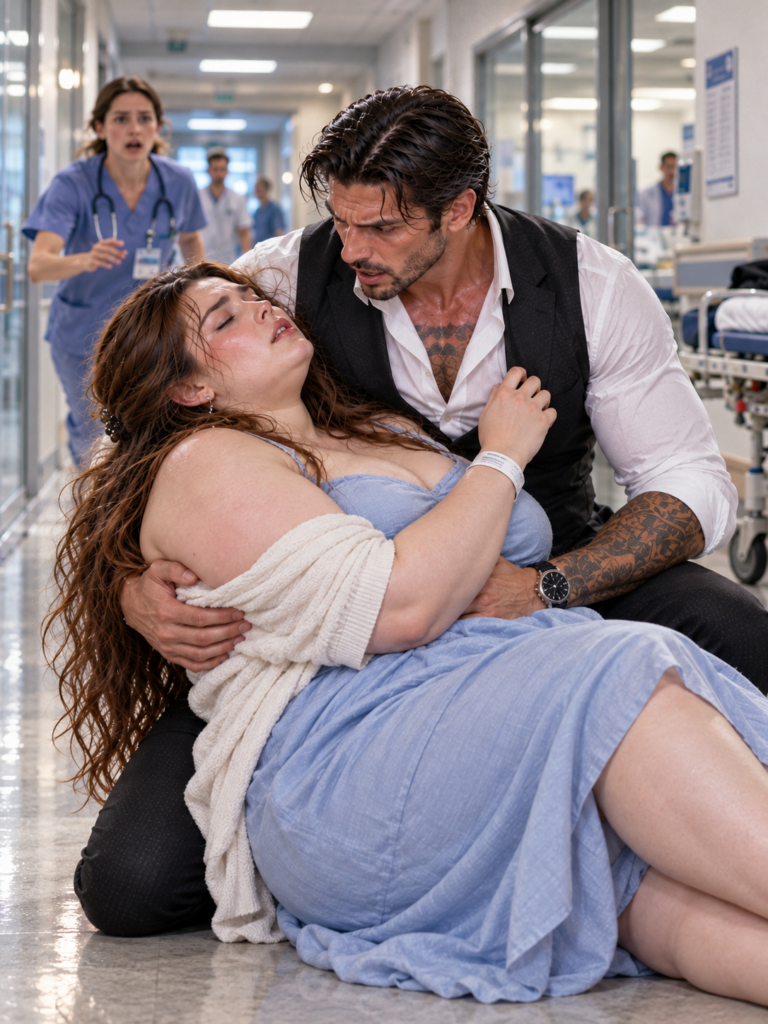
Nora Quinn was halfway up the grand staircase when her legs stopped obeying her.
One moment, she was gripping the polished banister, trying to ignore the dizziness spreading behind her eyes. The next, her knees folded, her fingers slipped, and the marble floor rushed toward her.
Luca Ferraro caught her before she hit the ground.
He had crossed the enormous foyer so quickly that the two armed guards stationed near the front entrance barely registered his movement.
“Nora!”
Her body collapsed against his chest.
For a man who had spent half his life surrounded by violence, Luca knew the difference between ordinary weakness and genuine danger. He had watched wounded men turn gray beneath their expensive suits. He knew how rapidly a person’s breathing could change when something inside the body was failing.
But he had never felt terror quite like the sensation of his wife’s fragile body hanging in his arms.
She was far too light.
That was what struck him first.
Not the fall. Not her alarming pallor. Not even the heat radiating from her skin.
It was how easily he could lift her.
“Nora. Open your eyes.”
Her eyelashes fluttered.
For a moment, she seemed unable to recognize where she was. Then she focused on his face, and something painfully gentle appeared in her expression.
“You’re home,” she whispered.
As though his presence were an unexpected gift.
Luca felt an unpleasant pressure settle beneath his ribs.
It was nearly midnight.
He was supposed to have been at Delfina’s on Atwells Avenue four hours earlier.
Tonight was Nora’s twenty-ninth birthday.
She had reserved a table for two at eight o’clock, put on the blue dress he had once told her looked beautiful, and waited.
Luca knew she had waited because his driver had called shortly after eleven.
“Sir, Mrs. Ferraro is still at the restaurant. Would you like me to bring her home?”
Luca had been in the middle of an emergency meeting concerning his operations at the Providence docks.
The Marchetti family was becoming increasingly aggressive. Shipments had been delayed, loyalties questioned, and one of his captains had arrived with information serious enough to summon the entire inner circle.
He had watched his driver’s name illuminate his phone.
Then he had ignored the call.
Now his wife was lying nearly unconscious in his arms, her clothes soaked from the October rain.
She had walked the mile and a half home.
Despite having a black Maybach S680 and two professional drivers available whenever she wanted them.
Despite being married to one of the wealthiest, most feared men in New England.
And despite the fact that this was the third birthday dinner Luca had failed to attend.
“Why didn’t you call someone?” he asked, gathering her closer.
Nora attempted a smile.
“Everyone was busy.”
It was not an accusation.
Somehow, that made it worse.
He carried her upstairs to the east wing.
Her bedroom was enormous, with tall windows overlooking the gardens, antique furniture, and a fireplace large enough to heat an entire apartment.
It was also separate from his.
Clause nine of their marriage agreement had established that arrangement.
Eleven months earlier, Luca’s attorneys had presented Nora with a contract designed to solve a very specific problem.
The Marchetti family had wanted to bind him to them through marriage. Luca had no intention of surrendering that much influence to a rival organization.
Nora Quinn had needed financial security.
The agreement was straightforward.
He would provide protection, housing, and a monthly allowance of twenty-five thousand dollars.
She would become his wife in public, maintain the appearance of a respectable marriage, and remain outside his business.
Neither would demand affection from the other.
Nora had read the document, signed every required page, and never attempted to negotiate a single condition.
At the time, Luca had considered that an unusually convenient arrangement.
Tonight, carrying her through the silent mansion, he wondered whether convenience had been another word for neglect.
He lowered her onto the bed and removed her wet shoes.
“Get Dr. Behan,” he ordered the guard waiting outside. “Now.”
He pulled a blanket over Nora.
She was already drifting toward unconsciousness.
When he reached for her gray coat, which had slipped across the banister, a faint crackling sound came from one of its pockets.
He almost ignored it.
Then he felt something stiff through the damp wool.
He withdrew a narrow strip of white hospital identification paper.
A patient wristband.
The clasp had been cut cleanly, presumably with scissors.
Luca turned it toward the bedside lamp.
St. Bridget’s Children’s Hospital.
Eddy Street, Providence.
His eyes moved downward.
Patient: Quinn, Nora.
Department: Oncology — Apheresis Unit.
The date printed beneath her name was yesterday.
Luca stared at the small strip of paper.
Oncology.
A single word, and suddenly the bedroom seemed to lose all its air.
When Luca was twelve, his mother had died of lymphoma.
She had spent her final weeks in a bedroom inside this same house, surrounded by expensive medical equipment that had done nothing to save her.
His father had brought in specialists from Boston and New York. He had offered money, influence, and private treatment.
None of it had mattered.
Luca remembered the hospital identification bracelets around his mother’s increasingly thin wrists.
He remembered the way the nurse had removed the final one.
He had buried those memories beneath twenty years of work, violence, and discipline.
Yet one paper wristband had brought every detail back.
He looked at Nora.
Her face was almost colorless against the pillows.
For eleven months, she had been living under his roof.
How often had he really looked at her?
He knew she liked too much sugar in her coffee. He knew she had a habit of apologizing when she bumped into furniture. He knew she preferred books to parties and avoided the expensive clothing stores his accountant recommended.
He knew that she rarely complained.
He knew almost nothing else.
And now a hospital bracelet was telling him she might be seriously ill.
Luca closed his hand around it.
For the first time in years, he was afraid of receiving an answer.
Dr. Patrick Behan arrived shortly after one in the morning.
The physician had treated Luca’s family for almost two decades. He had removed bullets from Ferraro soldiers, stitched knife wounds without unnecessary questions, and once stabilized a captain who had lost enough blood to leave half the kitchen floor red.
Very little unsettled him.
Tonight, when he emerged from Nora’s bedroom, his expression was grave.
Luca was waiting outside.
“Tell me what’s wrong with her.”
“She’s dangerously exhausted,” Behan replied. “Severe anemia. Dehydration. Her blood pressure is much lower than I’d like.”
“Is it cancer?”
The question came too quickly.
Behan glanced at the hospital wristband in Luca’s hand.
“I haven’t found evidence of that.”
“Then explain the oncology department.”
The doctor hesitated.
“There are repeated needle marks around the veins in both arms. Some fresh, some healing. The pattern is consistent with frequent blood-component collection.”
Luca’s gaze sharpened.
“Explain.”
“I believe your wife has been donating blood or platelets. Repeatedly. Far more frequently than would be considered medically safe.”
For several seconds, Luca could only stare at him.
“Donating?”
“That’s my assessment.”
“To whom?”
“She wouldn’t tell me.”
Luca looked toward the closed bedroom door.
Nora had access to more money than most people earned in a lifetime.
His accountant had once mentioned, almost incredulously, that during eleven months of marriage, she had spent only two hundred and twelve dollars on personal purchases.
Luca had assumed she was saving the rest.
He had admired her restraint without bothering to understand it.
Now he was imagining her sitting in a hospital chair while blood left her body through a needle.
Again.
And again.
Until she could barely climb a staircase.
“Can she recover?” he asked.
“She needs proper care and she must stop whatever she’s been doing. Immediately.”
Luca thanked him.
Then he entered his wife’s bedroom.
Nora was awake.
Her eyes moved first to his face, then to the paper strip between his fingers.
Something changed.
The softness disappeared from her expression.
“Where did you find that?”
“In your coat.”
“It’s nothing.”
He placed the wristband on the bedside table.
“An oncology department isn’t nothing.”
“It’s related to something I was doing.”
“What?”
“Volunteer work.”
“Volunteer work that left you unconscious on the stairs?”
Nora looked away.
Luca remained standing near the bed.
He had interrogated men who could lie without blinking. He knew the smallest signals of deception: unnecessary explanations, rehearsed answers, eyes that searched for an exit.
But Nora’s silence was different.
She was frightened, certainly.
Not of him hurting her.
Of him discovering something she desperately wanted to protect.
“You’re ill,” he said.
“No.”
“Then tell me why you were at the hospital.”
“I can’t.”
Two quiet words.
Not I won’t.
I can’t.
Luca noticed the distinction.
“Nora, I’m your husband.”
Her eyes returned to his.
For the first time that night, there was something almost bitter in them.
“Only when it’s convenient.”
The words landed between them.
She seemed immediately to regret them.
“I’m sorry,” she whispered.
Luca felt a sudden, unfamiliar shame.
His wife had just collapsed from exhaustion, and she was apologizing to him.
He looked at the bruises visible beneath the sleeve of her nightgown.
Then he drew the blanket carefully over her arm.
“We’ll talk tomorrow.”
Nora closed her eyes.
He switched off the lamp.
But he didn’t return to his own room.
He stood in the corridor for hours with the wristband in his hand, listening to the silence inside a house that had always obeyed him.
By morning, he had made a decision.
He was going to find out what his wife had been hiding.
At 6:40 a.m., Nora left through the side entrance.
She was wearing the same gray coat.
Luca watched from an unfamiliar car parked beyond the gates.
He had instructed his usual drivers to remain at the house. If Nora saw the Maybach or one of his security vehicles, she would know someone was following her.
She walked three blocks toward North Main Street.
Then she boarded a RIPTA bus.
Luca stared through the windshield.
He had purchased a luxury car specifically for her use.
She was taking public transportation.
The bus continued south through Providence.
When it stopped on Eddy Street, Nora stepped onto the sidewalk in front of St. Bridget’s Children’s Hospital.
Luca waited several minutes before following.
Inside, the building smelled of disinfectant and coffee.
Colorful paper boats decorated a mural near the entrance. Children’s drawings covered the walls, bright efforts to make a place full of frightened families appear less frightening.
Nora moved through the reception area without hesitation.
The staff recognized her.
A receptionist greeted her by name.
Luca followed toward the third floor after obtaining a visitor badge.
He was accustomed to entering buildings where men stood when they saw him.
Here, no one paid much attention.
A nurse hurried past carrying medication. A father stood beside a vending machine with his head lowered. Somewhere farther down the corridor, a child was crying.
Luca heard the sound of an apheresis machine before he saw his wife.
He stopped beside an interior window.
Nora was sitting in a reclining chair.
Her sleeve had been rolled above the elbow. A line connected her arm to equipment beside her.
And next to her chair stood a hospital bed.
A little girl lay beneath a blanket decorated with cartoon frogs.
She appeared to be about seven.
She had a pale face, no hair, and a knitted crown pulled crookedly over her head.
Both her small hands were wrapped around Nora’s free hand.
Nora said something.
The child began to laugh.
It was the kind of uncontrolled laughter that made her shoulders shake and the nearby equipment tremble slightly.
Luca stood motionless.
He had expected to discover a medical diagnosis.
A secret illness.
Perhaps an explanation involving money.
He had not expected to find his wife making a sick child laugh while a machine collected components from her blood.
A nurse approached him.
“Are you visiting Maisie?”
Luca glanced toward her.
“The girl?”
“Yes.” The nurse smiled. “Are you family?”
It was a simple question.
He had lied to policemen, politicians, business partners, and dangerous men who knew how to recognize dishonesty.
But standing outside that hospital room, he found himself unable to answer.
Then Nora looked toward the window.
She saw him.
Her smile vanished.
“Luca?”
Nora sat rigidly when he entered.
She couldn’t stand because the collection procedure was still underway.
The little girl looked him over with unabashed curiosity.
He stopped beside Nora’s chair.
“Would you introduce us?”
Nora swallowed.
“Maisie, this is Luca.”
Maisie studied his expensive coat and polished shoes.
Then she frowned.
“You’re Nora’s husband.”
Luca nodded.
“That’s right.”
“The one who didn’t come to her birthday dinner?”
Nora’s cheeks turned red.
“Maisie—”
“What?” the girl asked. “You told me about the blue dress.”
Luca pulled a chair closer.
“Yes,” he said. “I’m the husband who missed her birthday.”
Maisie considered that information.
“My mom said men are usually late.”
Her voice was matter-of-fact.
Not angry.
Not particularly surprised.
“She sounds like she knew a few.”
Maisie gave him a cautious smile.
“Sometimes she said it about the bus.”
Then she looked at Nora.
“You can sit with us.”
Luca glanced toward his wife.
Nora said nothing.
He sat down.
Maisie noticed the empty hand resting on Nora’s lap.
“You can hold that one if you want.”
Luca looked at Nora again.
She was watching him carefully.
For a moment, he remembered the marriage contract.
The separate bedrooms.
The expensive house and the financial arrangements and all the careful boundaries designed to prevent intimacy from becoming an inconvenience.
Then he reached for her hand.
Her fingers were cold.
She allowed him to hold them.
For nearly an hour, he remained beside her while Maisie talked about the books she liked, the nurses she trusted, and a frog character whose adventures she apparently considered very serious business.
Luca listened.
He asked questions.
When Maisie teased him for looking too formal, he even removed his coat.
Nora watched as though she were witnessing something impossible.
Afterward, when her procedure had finished, she followed him into the hallway.
Her face was pale with apprehension.
“Please don’t be angry.”
Luca turned.
“Tell me what is happening.”
Nora folded her arms around herself.
For a moment she seemed to be organizing the facts in a way that might make them sound less terrible.
Then she began.
Two years before her marriage, she had worked as a pediatric nurse on this ward.
She had loved the work.
The long shifts, difficult families, frightened children, exhausting nights—none of it had made her want to leave.
Then a medical resident made a serious dosage error.
The hospital had needed someone to accept responsibility.
The resident’s career had been considered worth protecting.
Nora’s had not.
At twenty-seven, faced with pressure from the institution where she worked, she had signed documents accepting blame.
Her nursing license was suspended.
Her career ended.
But she had never forgotten one patient.
Maisie Carey.
“I was her nurse for two years,” Nora explained. “She trusted me before she trusted most of the doctors.”
Luca glanced through the nearby window.
Maisie was playing with the corner of her blanket.
“Where are her parents?”
“Her mother was Jess. She died this spring.”
“And her father?”
“He died before she was old enough to remember him. He isn’t listed on her birth certificate.”
“Other family?”
Nora shook her head.
“No grandparents. No one who’s come forward. Her caseworker has forty-one children to manage.”
Luca looked at the little girl again.
A child in a hospital bed.
A mother dead.
No father.
No one waiting to take her home.
“What does that have to do with your donations?”
“The treatment helping her isn’t covered by the state. And her doctors have been trying to arrange a marrow transplant.”
Nora drew a shaky breath.
“I’m compatible with Maisie. I’ve been donating platelets, and I’m registered as a marrow donor for her.”
Luca studied the bruising along her arms.
“How often?”
She didn’t answer.
“Nora.”
“More than I should.”
“How much more?”
Her eyes filled.
“Her numbers kept getting worse.”
He understood then that she had been measuring time in hospital results rather than days.
“There’s a harvest scheduled for Thursday,” she continued. “Dr. O’Shaughnessy wants to postpone because my blood counts are too low.”
“And?”
“And Maisie may not survive another month.”
Luca looked at her.
“You’re risking your life.”
“I’m trying to save hers.”
“You could have asked me for help.”
Her expression changed.
“I thought I already had.”
He fell silent.
She continued before he could respond.
“When your lawyer approached me about the marriage agreement, I was almost completely broke. I had sixty-one dollars in my checking account.”
“Twenty-five thousand a month,” Luca said quietly.
Nora nodded.
“I knew exactly what it could do for her.”
He remembered the account statements.
The withdrawals his staff had questioned.
“How much?”
“Two hundred and sixty-eight thousand dollars.”
Every cent, she explained, had been directed toward Maisie’s treatment through St. Bridget’s billing office.
The amounts were recorded under the child’s initials.
Nora’s voice began to tremble.
“I know what the agreement said. The allowance was supposed to be for my own expenses. But after you gave it to me, I thought—”
She stopped.
Luca waited.
“I thought it was mine to choose what to do with.”
He stared at her.
For eleven months, he had believed himself generous.
He had imagined a modest young woman living comfortably because of his money.
Instead, she had been using their marriage to keep a little girl alive.
She had skipped meals.
Taken buses.
Spent almost nothing on herself.
And still dressed up for a birthday dinner with a husband who couldn’t be bothered to arrive.
Then Luca remembered something else.
“The watch.”
Nora looked confused.
“Your Christmas present,” he said. “The Cartier.”
Her hand moved instinctively toward her bare wrist.
The watch had cost fourteen thousand dollars.
It had disappeared several weeks earlier.
Luca had noticed, but assumed she simply didn’t like wearing it.
Nora looked down.
“I sold it.”
“Why?”
“Your monthly transfer stopped.”
Luca went still.
“Stopped?”
“Last month. Victor’s office said the account needed to be reviewed.”
Luca felt a cold, deliberate anger beginning to form.
“How much did you get for the watch?”
“Three thousand four hundred. The pawnshop on Broad Street wouldn’t offer more.”
“You should have told me.”
“I didn’t want you thinking I was asking for extra money.”
She tried to smile.
“I knew what I’d agreed to.”
Luca looked at the bruises beneath her sleeves.
Then at the ward where Maisie lay.
Victor Kane had served as consigliere to Luca’s father before becoming Luca’s closest adviser.
The man had been part of the Ferraro organization for decades.
He managed sensitive information, reviewed accounts, and controlled financial safeguards that Luca rarely questioned.
If Victor had frozen Nora’s allowance, there would be an explanation.
Luca would demand it.
But first, he reached for his wife’s hand.
“You’re not paying another hospital bill alone,” he said.
Nora searched his face.
“Luca, I don’t want Maisie used as part of your business.”
“She won’t be.”
“Promise me.”
He held her gaze.
“I promise.”
For the first time since he had found the wristband, Nora’s shoulders relaxed.
Only slightly.
But enough for him to notice.
Behind the glass, Maisie raised her hand and waved at him.
Luca waved back.
He had entered the hospital expecting to discover what was wrong with his wife.
Instead, he was beginning to discover how little he had understood about her.
And he had not yet realized that the little girl smiling at him from the bed belonged to his own family.
Part 2
For the next nine days, the Ferraro organization operated without its boss for several hours every morning.
The captains noticed.
So did the men at the docks.
Luca had spent years building a reputation for absolute control. Meetings began when he entered the room. Decisions did not wait for anyone. His subordinates understood that personal attachments were liabilities, and weakness was an invitation to be challenged.
Yet every morning, the most powerful man in Providence left his office and drove to St. Bridget’s Children’s Hospital.
Sometimes he brought coffee for Nora.
Sometimes he arrived with breakfast she insisted she wasn’t hungry enough to eat.
He learned to recognize the moments when she was too exhausted to argue and the moments when her stubbornness meant she was feeling better.
Most importantly, he learned how to be present.
It was a skill that had nothing to do with commanding other people.
He couldn’t intimidate a blood count into improving.
He couldn’t negotiate with a child’s illness.
And for once, writing a check was not enough to resolve the problem.
The hospital’s medical team controlled Nora’s donor eligibility, and Dr. O’Shaughnessy remained firm about the risks.
Luca could make financial resources available and insist that Nora receive proper care, but he couldn’t force a transplant to proceed.
That powerlessness frustrated him more deeply than he wanted to admit.
Maisie, however, had little interest in his frustrations.
She considered Luca’s primary responsibility to be entertainment.
On his third visit, she handed him a picture book about a frog who wanted to become a king.
“Read it,” she demanded.
Luca examined the cover.
“Does this frog have any qualifications for ruling?”
Maisie blinked.
“He’s a frog.”
“That seems insufficient.”
Nora laughed into her coffee.
Maisie gave Luca the disapproving stare of someone encountering a particularly slow student.
“You’re supposed to do the voices.”
Luca had conducted negotiations with dangerous men throughout New England.
Nothing had prepared him for being evaluated by a seven-year-old girl wearing a knitted crown.
Nevertheless, he read the book.
His first attempt received a rating of four out of ten.
“Your king voice sounds like a man who sells insurance,” Maisie informed him.
Nora laughed so hard she had to put her coffee down.
Luca looked at her across the bed.
He had heard her laugh before.
Never like that.
Not freely, with her eyes bright and her face unguarded.
For a moment, he forgot the machines, the hospital, and the growing anxiety beneath everything.
He simply watched his wife.
Then he began reading again, this time giving the frog an exaggerated accent that made Maisie shriek with laughter.
By the end of the week, the child had become accustomed to his visits.
She knew which of his coats had the softest lining.
She knew he disliked the hospital vending-machine coffee.
She discovered that he was terrible at drawing animals but unexpectedly good at remembering stories.
He learned that she preferred exactly three ice chips in her apple juice.
Not two.
Not four.
Three.
He learned which chair beside her bed didn’t squeak and how to adjust the reading light without waking her.
And when she finally heard him laugh without restraint, she announced that his real laugh deserved nine out of ten.
“Why not ten?” he asked.
“Because nobody’s perfect.”
Nora was sitting beside the window.
She smiled.
“She’s right.”
Luca looked at her.
“You’re enjoying this.”
“Immensely.”
“Both of you are becoming difficult.”
Maisie grinned.
Nora lowered her eyes, but the smile remained.
In that ordinary moment, Luca realized something remarkable.
He did not want to be anywhere else.
The birthday celebration happened on a Tuesday.
Nine days after Nora had sat alone at Delfina’s, Luca arranged for the restaurant to close to regular customers.
Instead of bringing Nora there, he brought the restaurant to St. Bridget’s.
The staff prepared a dessert selection that seemed wildly excessive for a children’s hospital.
The nurses helped arrange a small celebration in the ward.
Someone found colored paper.
Maisie spent nearly an hour making a birthday crown, writing Nora’s name across the front in uneven crayon letters.
When Luca entered with the desserts, Nora stared at him.
“What have you done?”
“Something I should have done nine days ago.”
“This is ridiculous.”
“Probably.”
“Luca, you didn’t have to—”
“I know.”
He set a small cake on the table.
There were no diamonds.
No expensive speeches.
No room full of strangers congratulating him for buying something extravagant.
Just hospital lighting, paper plates, smiling nurses, a child with a knitted crown, and a woman who had spent her birthday waiting for him in the rain.
Maisie placed the handmade crown on Nora’s head.
“Now it’s official.”
Nora touched the paper carefully.
Her eyes filled with tears.
Luca stepped closer.
“Happy birthday.”
She looked up at him.
“You’re late.”
He nodded.
“Very.”
Then she laughed.
And for the first time since their marriage, when Luca reached for her, she moved toward him instead of merely allowing him to come close.
He wrapped one arm around her shoulders.
There was nothing dramatic about it.
No declaration.
No kiss intended for an audience.
Only warmth.
Only her cheek resting briefly against his chest.
Only the unmistakable realization that neither of them wanted the moment to end.
That evening, after the nurses had finished their rounds, Maisie fell asleep.
Her knitted crown had slipped onto the pillow.
The machines continued their measured rhythms.
Nora sat beside Luca near the window.
For several minutes, neither spoke.
Then he said, “I had a younger brother.”
Nora turned toward him.
Luca rarely discussed his family.
She knew his mother had died when he was young. She knew his father had built the Ferraro organization into something far more powerful than its original operations.
She knew there had been another son.
But the subject had always remained closed.
“Enzo,” Luca said.
The name seemed difficult for him to pronounce.
“He was different from me.”
“How?”
“He wanted a normal life.”
Luca stared at the hospital corridor.
“He hated what our family did. Hated the violence. The constant suspicion. The way every friendship became something we had to evaluate for possible betrayal.”
Nora listened.
“He wanted to leave?”
Luca nodded.
“I told him he was weak.”
She said nothing.
“I said it in front of the captains. Men who expected me to be stronger than my father. I couldn’t let them think my brother could walk away whenever he pleased.”
“What happened?”
“He died twenty months ago.”
Nora’s expression softened.
“A boating accident. That’s what the investigation concluded.”
Luca paused.
“He drowned.”
The last word was almost inaudible.
Nora looked at his hands.
They were clasped so tightly that his knuckles had gone white.
“I didn’t attend the eulogy,” he continued. “I stood at the cemetery, but I couldn’t speak.”
“You loved him.”
Luca swallowed.
“I called him a traitor.”
“That doesn’t answer whether you loved him.”
He turned toward her.
Something in his expression changed.
All his life, people had responded to his regrets in predictable ways.
They excused him.
They told him he had done what leadership required.
They assured him that his brother had understood.
Nora offered none of those comforts.
She simply waited for him to answer.
“Yes,” he whispered.
“Then he deserved to hear that.”
Luca looked away.
“I know.”
For a long while, they listened to Maisie’s breathing.
Then Nora moved her hand over his.
She didn’t promise that grief would disappear.
She didn’t tell him he had been a good brother.
She let him sit with the truth.
That night, for the first time in twenty months, Luca slept without dreaming of dark water.
The eleventh day began quietly.
Maisie had brought out a shoebox containing what she called her treasures.
Inside were four smooth stones, a faded bus transfer, a photo-booth strip, a few scraps of paper, and a silver medal attached to a worn chain.
Luca sat beside the bed while Nora helped arrange the objects on the blanket.
Maisie held up the photograph.
“That’s my mom.”
The woman in the pictures had dark hair and an open, laughing face.
In each image, she leaned toward someone just outside the frame.
“Her name was Jess,” Maisie said.
“I know.”
“She used to make pancakes shaped like animals. They always looked wrong.”
Luca smiled.
“What kind of animals?”
“Mostly bears. One time she tried to make a rabbit, but it looked like a potato.”
Nora laughed softly.
Maisie reached back into the shoebox.
Then she lifted the silver medal.
Luca saw the image of St. Christopher.
A traditional symbol of protection for travelers.
The metal was scratched, softened by years of handling.
“That belonged to my daddy,” Maisie said.
Luca’s expression changed almost imperceptibly.
“Did it?”
She nodded.
“Mom said his big brother gave it to him.”
Nora was folding the photograph carefully.
She didn’t notice Luca straighten.
Maisie continued.
“She said it was to help him stay safe on the water.”
Luca felt a slow, cold pressure building behind his eyes.
“Can I see it?”
Maisie placed the medal in his palm.
He turned it over.
The inscription on the back was small.
The letters had worn slightly, but there was no mistaking them.
E.F. — Keep Your Head Above Water. — L.
Luca stopped breathing.
Twenty-two years earlier, he had visited a jeweler on Federal Hill.
He had been choosing a birthday gift for his younger brother, who was turning sixteen.
Enzo had loved boats.
He had wanted to sail beyond Rhode Island, beyond the family business, beyond everything their father expected of them.
Luca had purchased the St. Christopher medal and asked the jeweler to engrave a private message.
He had placed it around Enzo’s neck himself.
Now that medal was resting in his palm.
In a children’s cancer ward.
Twenty months after Enzo had drowned.
Luca looked at the girl lying in the bed.
The dark eyes.
The stubborn chin.
The expression that appeared whenever she thought an adult was being foolish.
Features he had noticed for days without understanding why they felt familiar.
“Maisie,” he asked carefully, “what was your mother’s last name?”
“Carey.”
His chest tightened.
Jess Carey.
He knew that name.
Enzo had once mentioned a woman named Jess in a conversation Luca barely remembered.
A girlfriend he had kept away from the Ferraro family.
A woman who represented the ordinary future he wanted.
“Did your mother ever talk about your father?”
Maisie nodded.
“She said he was funny. And brave. She said he loved the ocean.”
Luca’s fingers closed gently around the medal.
“Did she tell you his name?”
Maisie shook her head.
“She called him Daddy when she talked about him.”
Nora finally noticed Luca’s face.
“Luca?”
He looked toward her.
He couldn’t speak.
The little girl who had spent eleven days teasing him, laughing at his terrible frog voices, and reaching for his hand was his dead brother’s daughter.
Enzo had become a father.
And Luca had never known.
He returned the medal carefully to Maisie.
Then he rose.
“I need a moment.”
Nora followed him with her eyes as he walked toward the window.
“Luca, what is it?”
He stood with one hand against the glass.
Across Eddy Street, rain moved slowly over the parked cars.
And there, beneath the gray sky, sat a black Lincoln Navigator.
Luca knew the vehicle.
He knew the driver.
More importantly, he knew the man sitting behind its tinted windows.
Victor Kane.
His father’s oldest adviser.
His own consigliere.
Victor had been waiting outside the hospital for nine minutes.
And Victor Kane did not make unannounced visits to children’s hospitals.
Luca left the ward without speaking to Nora.
He crossed the lobby, walked into the cold rain, and approached the Navigator.
The driver straightened when he recognized him.
Before the man could step out, Luca opened the rear door and climbed inside.
Victor sat comfortably against the leather seat.
He was in his sixties, immaculately dressed, with silver hair and the faint scent of cedarwood cologne.
He had taught Luca chess when Luca was nine years old.
He had advised Luca’s father through decades of wars and alliances.
When Enzo died, Victor had been among the first people to offer condolences.
Now he smiled pleasantly.
“Luca.”
“Nine minutes.”
Victor raised an eyebrow.
“Excuse me?”
“You’ve been sitting outside this building for nine minutes.”
“I was considering whether to disturb you.”
“Since when do you hesitate to enter a building?”
Victor adjusted the cuff of his coat.
“You’ve been spending a great deal of time here.”
“Have I?”
“Eleven days. People notice these things.”
Luca watched him.
Victor continued.
“The Marchettis are looking for signs that your attention has shifted away from business. So are some of our own captains.”
“Is that why you’re here?”
“Partly.”
“And the other reason?”
Victor sighed.
“Your wife’s financial activity.”
Luca remained still.
“Two hundred and sixty-eight thousand dollars directed toward a hospital account,” Victor said. “I assumed she was being blackmailed. It was the most reasonable explanation.”
“So you froze her allowance.”
“Pending review.”
“Without informing me.”
“I was protecting you.”
Luca looked at the older man.
Victor had used those words throughout Luca’s life.
When Enzo refused to join the family business.
When a captain disappeared.
When an associate had been punished for disloyalty.
Always the same explanation.
Protection.
“And now?” Luca asked.
Victor’s gaze remained calm.
“Now I understand where the money went.”
“Then release the transfer.”
Victor didn’t answer immediately.
Instead, he looked toward the hospital.
“It’s Jess Carey’s daughter.”
Luca felt the world narrow.
He had never told Victor that he knew Jess’s name.
He hadn’t yet told Nora.
He had discovered the connection only minutes earlier.
“How do you know Jess Carey?”
Victor folded his hands.
“Old family business.”
“What business?”
“Nothing that concerns you now.”
“It concerns me.”
Victor studied him for a moment.
Then he spoke with the calm authority of a man accustomed to being obeyed.
“The child is a liability, Luca.”
Luca felt a cold pressure behind his ribs.
“Careful.”
“You’re exposing yourself for a sick girl with no recognized family connection. Your wife has become entangled in medical and financial matters that could invite an investigation. The simplest answer is to have the child transferred somewhere private.”
“Transferred where?”
“Upstate. A quiet facility. She’ll be cared for.”
Luca looked at him.
“And forgotten?”
Victor gave a small shrug.
“Sometimes distance is the kindest solution.”
“The way Jess Carey was forgotten?”
Victor’s expression barely changed.
But Luca saw it.
A brief flicker.
Too quick for most people to notice.
“Jess was a troubled woman,” Victor replied.
“She was Enzo’s girlfriend.”
Victor’s hand stopped moving.
Luca continued.
“Maisie is his daughter.”
“No.”
The denial came immediately.
Too immediately.
“Enzo didn’t have a child.”
“I held the medal I gave him when he turned sixteen.”
Victor watched him.
Luca leaned forward.
“How did it get into that girl’s possession?”
“People steal things, Luca. They invent histories. Grief makes connections where none exist.”
He reached across and touched Luca’s knee in a gesture so familiar that it was almost unbearable.
“Go home. Let me handle this.”
For a moment, Luca saw the man who had taught him to move a chess piece across a board.
The patient mentor.
The trusted adviser.
Then he saw the black Navigator parked outside a cancer ward while a seven-year-old girl fought for her life upstairs.
And he understood that Victor knew far more than he was willing to admit.
Luca opened the door.
“Stay away from Nora.”
Victor’s expression cooled.
“And the child?”
Luca met his eyes.
“Both of them.”
He stepped into the rain and closed the door.
Behind him, the Navigator remained parked.
Luca knew he had just drawn a line that Victor would not appreciate.
What he didn’t know was how quickly the older man would move against it.
At 9:40 that evening, a courier delivered an emergency legal notice to the Ferraro mansion on Benefit Street.
Luca was in his study when the documents arrived.
He examined the first page.
An anonymous complaint had been submitted to St. Bridget’s and the State Donor Registry.
The allegations concerned Nora Quinn.
Her suspended nursing license was cited as evidence of professional misconduct.
The complaint accused her of falsifying donor eligibility paperwork and concealing medical information.
Pending review, the transplant arrangement was suspended.
The marrow harvest scheduled for Thursday had been canceled.
Nora was barred from the third-floor ward.
Luca turned to the next document.
A family court motion, filed at 4:58 that afternoon, requested Maisie Carey’s transfer to a long-term state facility in Pawtucket.
The transfer was scheduled for Friday.
Luca recognized the law firm’s name.
The Ferraro family had used the firm twice before.
He placed the papers on his desk.
A complaint.
A medical review.
A transfer order.
All moving with remarkable speed.
All directed toward separating Nora from Maisie.
He didn’t need to guess who might benefit.
When Nora entered the study, he handed her the documents.
She read them.
Then she read them again.
Her face lost its remaining color.
“No.”
Luca stepped toward her.
“Nora—”
“No, they can’t do this.”
She spread the papers across his desk, searching for something he had missed.
“The conditioning schedule was planned around Thursday. Her counts are already unstable. If they delay everything—”
Her voice cracked.
Luca reached for her.
She pulled away, not out of anger but because she needed both hands to steady the pages.
“Three weeks,” she whispered.
“What?”
“That’s the window we have. If the transplant doesn’t happen within three weeks, Dr. O’Shaughnessy doesn’t think we’ll have another opportunity.”
Luca looked at the court papers.
The transfer would take place in less than two days.
He could challenge the legal action.
He could hire the best attorneys available.
He could pay every legitimate medical expense in full.
But none of those things guaranteed an immediate ruling.
And every delay had a cost that Maisie might not survive.
“Victor did this,” he said.
Nora looked at him.
“Why?”
Luca remained silent.
She noticed.
“What aren’t you telling me?”
He drew a long breath.
“Maisie’s father was my brother.”
Nora stared at him.
“Enzo?”
Luca nodded.
“The medal she carries. I gave it to him.”
Nora slowly lowered herself into a chair.
For several seconds, she said nothing.
Then she looked up.
“Does Victor know?”
“Yes.”
“Did he know before you did?”
Luca thought of the Navigator.
The frozen bank transfers.
The ease with which Victor had spoken Jess Carey’s name.
“I believe so.”
Nora’s face tightened.
“Then this isn’t just about money.”
“No.”
“Someone wants her gone.”
Luca couldn’t deny it.
He remembered Victor’s suggestion that Maisie be moved to a quiet facility where no one would hear about her again.
He thought of Enzo’s death.
Of Jess dying from an overdose the previous spring.
Of the anonymous complaint filed within hours of his confrontation with Victor.
Three tragedies connected to the same family.
One child remaining.
Luca felt the weight of a terrible possibility.
But suspicion was not proof.
Victor had spent decades building relationships within the Ferraro organization.
Many of the captains were loyal to him before they were loyal to Luca.
If Luca accused him openly without evidence, the resulting conflict could endanger everyone he was trying to protect.
And if he publicly announced that Maisie was a Ferraro, he would identify her as someone worth threatening.
He had spent his life learning how to defeat enemies.
Now the usual methods threatened to destroy the very people he wanted to save.
Nora watched him.
“What are you going to do?”
“I’m going to find a way to stop the transfer.”
“Before Friday?”
“Yes.”
“Without hurting anyone?”
Luca looked at her.
She didn’t lower her eyes.
He understood that this was not a casual question.
Nora had seen enough suffering in a hospital.
She was not asking him to become more dangerous on her behalf.
She was demanding that he find another way.
“I’ll try,” he said.
She shook her head.
“I need more than that.”
He moved closer.
“Then I’ll give you more.”
For a moment, she seemed to want to believe him.
Then her gaze returned to the papers.
Luca went downstairs to contact his attorneys and review the options available to him.
By four in the morning, he had decided on a legal strategy.
He would use the hospital records, the financial history, and whatever evidence he could obtain to challenge the complaint and the transfer.
He went upstairs to explain it to Nora.
Her bedroom door was open.
The bed was empty.
Her gray coat was gone.
On the pillow lay a RIPTA bus schedule.
One departure had been circled in dark ink.
Thursday — 4:55 a.m.
Luca picked up the paper.
Then he called for his car.
For the second time in less than two weeks, he was following his wife through Providence because she had decided that waiting for him was no longer an option.
Part 3
Luca reached St. Bridget’s at 5:20 in the morning.
Before he passed through the lobby, he heard the alarm.
A Code Blue.
Third floor.
He didn’t wait for the elevator.
He ran up the stairwell, taking the steps two at a time.
When he reached the oncology ward, the corridor was filled with noise.
A nurse shouted for security.
Another was calling instructions into a telephone.
At the far end of the hallway, outside Maisie’s room, Nora stood with both arms braced against the doorframe.
Her face was white.
Her body was shaking.
But she refused to move.
A large man wearing medical transport scrubs stood in front of her.
Behind him was a gurney.
On a tray near his hand lay a syringe.
“This patient isn’t scheduled for transport,” Nora said, her voice carrying through the corridor.
The man tried to push past her.
“Move aside.”
“Your identification says Mercy Trust. This hospital doesn’t use Mercy Trust for patient transfers.”
“Ma’am, you’re interfering with an authorized procedure.”
“Then show me the authorization.”
He stepped closer.
Nora didn’t retreat.
She looked at the syringe.
“And explain why you’re carrying potassium chloride that isn’t listed anywhere on her medication chart.”
The man’s expression changed.
For a second, his hand moved toward the tray.
Nora struck the emergency alarm with her fist.
The corridor erupted.
The man grabbed her arm and pulled her away from the doorway.
Nora stumbled, striking her shoulder against the wooden frame.
She fell hard.
But even from the floor, she twisted to keep her body between him and Maisie’s bed.
“Somebody check his identification!” she shouted.
Two security guards appeared.
Then Luca came around the corner.
He saw Nora on the floor.
He saw the man standing over her.
And something ancient and violent rose inside him.
For one terrible instant, he wanted nothing more than to destroy the stranger.
The man saw his face.
He recognized him.
Then he turned and ran toward the stairwell.
Luca took one step after him.
Nora cried out.
Not his name.
“Maisie!”
Luca stopped.
He looked toward the open hospital room.
The child was still lying in bed.
A nurse rushed inside to check her.
Another security officer called in the description of the fleeing man.
Luca looked at the syringe on the tray.
Then at the security camera mounted above the nurses’ station.
The evidence was still there.
The witnesses were gathering.
The camera had recorded what happened.
He did not pursue the attacker.
Instead, he knelt beside his wife.
“Nora.”
She was holding her injured arm.
Her lips were trembling.
But her eyes remained fixed on Maisie’s bed.
“Is she breathing normally?”
“Yes.”
“Check again.”
Luca looked toward the nurse, who confirmed that Maisie was stable.
Only then did Nora lower her head.
Her composure broke.
Luca gathered her carefully into his arms.
For a few moments, she cried against his coat.
He held her without speaking.
Then he looked at the medical personnel surrounding them.
“Preserve the camera recording,” he said. “And nobody touches that tray except the police.”
His voice was controlled.
That frightened the security guards more than shouting would have.
Nora lifted her face.
“Luca.”
“I’m here.”
“I found something.”
He studied her.
“What?”
She reached into her coat pocket.
Her hand shook as she withdrew an old cellphone.
The screen was scratched.
The protective case was faded.
Luca recognized it from the shoebox.
“Jess’s phone?”
Nora nodded.
“Maisie kept it. The battery was dead.”
“How did you get it?”
“I came to retrieve her mother’s photographs before they transferred her. I thought she might need them if they took her away from everyone she knows.”
She swallowed.
“I charged the phone at the nurses’ station.”
Luca waited.
“There was a saved voicemail.”
Something in her expression made his stomach tighten.
“From whom?”
Nora unlocked the screen.
“You need to hear it.”
The recording began with a faint crackle.
Then a woman’s voice.
Luca recognized her from Maisie’s photograph only in the sense that he knew who she had to be.
Jess Carey.
She sounded frightened, but determined.
She was demanding that the man on the other end repeat his offer.
Then another voice answered.
Low.
Controlled.
Familiar.
Victor Kane.
The recording was dated nine days before Jess died.
Luca stood absolutely still.
On the recording, Victor offered Jess fifty thousand dollars to disappear with her daughter.
He spoke about Enzo’s drowning with a coldness that made Luca’s blood turn to ice.
Then he threatened to arrange another death if Jess refused.
He called it another swimming lesson.
The words were not ambiguous.
They were not the careless remarks of a man trying to frighten someone without meaning them.
They were the language of someone who believed he held absolute power over another person’s survival.
The recording ended.
Luca looked at the phone.
Then he looked at Nora.
“Victor killed my brother.”
Nora’s eyes filled.
“I think he arranged it.”
“And Jess.”
She nodded.
Luca turned toward the hospital window.
Twenty months.
For twenty months, he had carried the belief that Enzo had died because he was reckless.
He had spent those months regretting the argument they had before Enzo left.
He had called his brother a traitor.
He had failed to speak at the funeral.
And through every sleepless night, Victor Kane had remained at his side.
Advising him.
Comforting him.
Helping him manage the organization.
The same man who had known the truth.
The same man who had tried to erase Enzo’s daughter.
Luca felt the familiar pull of violence.
He knew exactly how men like Victor were ordinarily dealt with inside the Ferraro world.
One telephone call.
One order.
A disappearance no one would investigate too carefully.
He reached for his phone.
Nora caught his wrist.
“Don’t.”
He looked down at her.
“You heard what he did.”
“Yes.”
“He murdered my brother.”
“I know.”
“He threatened a child.”
Nora’s grip tightened.
“And if you kill him, what happens to the evidence?”
Luca said nothing.
“What happens to Maisie when his people retaliate? What happens to every person who knows you ordered it?”
He stared at her.
She held his gaze.
“Victor has spent his whole life deciding who gets to disappear. Don’t give him another secret.”
Luca looked again at Jess’s phone.
Then he slowly lowered his own.
Nora released his wrist.
“I’ve already sent the recording.”
His eyes returned to her.
“Where?”
“To the FBI field office on Dorrance Street. To the state attorney general. And to you.”
“When?”
“At six-oh-one.”
Luca checked his messages.
There it was.
The audio file.
The timestamp.
The accompanying explanation.
His wife had sent the evidence to federal and state authorities before asking him what to do.
“You sent it without telling me.”
“I had to.”
“Why?”
Nora’s eyes flashed.
“Because you have men who make problems disappear, Luca. I wanted this documented before someone could make another death look like an accident.”
For a long moment, he studied her.
Eleven months ago, he had married Nora Quinn because he believed she would be easy to protect and easy to control.
He had assumed that her quietness meant she would never challenge him.
Now he realized how badly he had misunderstood her.
She wasn’t fearless.
He could see fear in the trembling of her hands.
But when fear demanded a decision, she acted anyway.
Luca reached for her hand.
“You did the right thing.”
Nora’s face crumpled slightly.
“I just want her to live.”
He drew her into his arms.
“Then that’s what we’re going to fight for.”
That afternoon, Victor Kane arrived at the Ferraro mansion expecting a council meeting.
He had been informed that Luca wanted to discuss the growing conflict with the Marchetti family.
Three captains were already waiting in the study.
A laptop sat open on the large conference table.
Victor entered wearing a dark suit, his usual composure restored.
Then he saw Nora.
She stood at the head of the table in a simple cardigan.
Luca stood beside the window.
Victor paused.
“What is this?”
Nora placed one finger on the laptop.
“Something you should hear.”
She pressed play.
Jess Carey’s voice filled the room.
Victor’s expression changed.
At first, he merely stopped moving.
Then the color slowly drained from his face.
The recording continued.
His own voice answered Jess.
The offer of money.
The threat.
The reference to Enzo’s drowning.
Every word seemed to strip another year from the older man’s face.
When the recording ended, nobody spoke.
Victor looked toward Luca.
“You don’t understand what you’re hearing.”
Luca regarded him without emotion.
“Then explain it.”
“Your brother was creating problems that could have destroyed this family.”
“That wasn’t my question.”
Victor’s eyes moved toward the captains.
“You know how difficult those years were. Your father had already lost control of—”
“Did you order Enzo killed?”
Victor stopped.
Nora watched the exchange.
She could see the older man’s mind working.
Searching for an explanation.
A way to divide the room.
A means of turning the accusation into a question about loyalty.
But the men who had spent years respecting Victor were now looking at him differently.
He had taught them that trust was everything.
Now they had heard what he did to a man who trusted him.
Victor drew himself upright.
“I won’t answer questions based on a manipulated recording.”
“That’s your choice,” Luca said.
Victor straightened his jacket.
“Then this meeting is over.”
He walked toward the door.
Opened it.
And found four federal agents standing in the hallway.
They had been in position outside the property since 6:40 that morning.
One agent stepped forward.
“Victor Kane?”
Victor glanced back at Luca.
For an instant, something like genuine disbelief appeared on his face.
He had taught Luca everything he knew about power.
He had never imagined that his student would allow outsiders to remove him from the board.
Luca said nothing.
The agents took Victor into custody.
As he was led away, Victor looked over his shoulder.
“You’ll regret this.”
Luca watched him go.
Then he turned toward Nora.
“Perhaps.”
But it was not regret he felt.
It was grief.
For Enzo.
For Jess.
For the little girl who had grown up without either parent.
And for the years he had spent trusting the wrong man.
The consequences moved through Providence in the days that followed.
Victor Kane was indicted on racketeering charges and two counts of murder for hire.
He was held without bail.
The man who had attempted the unauthorized hospital transfer was arrested in Cranston by Friday.
Investigators found a matching syringe in his glove compartment.
The hospital security recording and staff testimony established what had happened outside Maisie’s room.
The family court motion requesting her transfer was withdrawn.
The law firm responsible for filing it suddenly became eager to distance itself from the entire matter.
And for Nora, another consequence emerged.
During the review of records connected to Victor’s case, the old hospital medication-error file resurfaced.
This time, investigators examined the resident’s original handwritten notes.
The evidence pointed back to the person who had made the dosage mistake.
Not Nora.
The state nursing board reviewed the case.
Then it reinstated her license.
The official apology arrived in writing.
Nora read it three times.
She had imagined that moment for two years.
She had imagined anger.
Vindication.
Perhaps the satisfaction of knowing that the people who sacrificed her career could no longer pretend they had done nothing wrong.
Instead, she sat at the kitchen table and cried quietly.
Luca found her there.
He saw the letter in her hands.
“Good news?”
Nora nodded.
“I can be a nurse again.”
He sat beside her.
“You always were one.”
She looked at him.
“No. For two years, I was someone who used to be a nurse.”
Luca understood that the difference mattered.
He didn’t correct her.
He simply held her while she cried.
Later, Nora framed the letter.
She hung it in the kitchen, deliberately a little crooked.
When Luca offered to straighten it, she stopped him.
“Leave it.”
“Why?”
“Because I like it that way.”
He smiled.
And left it exactly where she wanted it.
The transplant took place eight days after the hospital attack.
Nora lay on the operating table beneath bright lights, listening to the medical staff prepare her for anesthesia.
Her blood counts had been monitored carefully.
The physicians had reassessed the risks before allowing the procedure to proceed.
Outside, Luca waited.
For most of his life, he had believed that being powerful meant never allowing another person to decide the outcome of something important.
Now he was waiting in a hospital corridor while surgeons and nurses did work he couldn’t perform himself.
He had never felt so helpless.
Before Nora went into surgery, he had held her hand.
“You don’t have to prove anything,” he told her.
She smiled faintly.
“I’m not proving anything.”
“You’re sure?”
“Luca, I’ve been sure since the day they told me I might be a match.”
He wanted to argue.
To tell her that he couldn’t lose her.
That he was only beginning to understand what she meant to him.
But he recognized something in her expression.
This decision belonged to Nora.
It had always belonged to her.
So he kissed her forehead.
And let the medical team take her.
When she woke afterward, the first thing she asked about was Maisie.
Not the pain.
Not the recovery.
Maisie.
“How are her numbers?”
Luca was sitting beside her.
He had been there for hours.
“She’s being monitored.”
“Did they get what they needed?”
“The doctors said the procedure went well.”
Nora closed her eyes.
For a moment, Luca thought she had fallen asleep.
Then her fingers moved toward his.
He took her hand.
And this time, neither of them let go.
Over the following weeks, Maisie’s condition began to improve.
Her blood counts climbed.
The doctors remained cautious, but the changes were encouraging.
By the third week, there was enough progress for the hospital staff to smile without forcing it.
One morning, Maisie removed her knitted crown.
A soft layer of dark hair had begun growing across her scalp.
She touched it proudly.
“Look.”
Luca leaned closer.
“Very impressive.”
“It’s real hair.”
“I can see that.”
“Not a wig.”
“Even better.”
She studied him.
“Do you think it’ll look like Daddy’s?”
Luca looked at the photographs Nora had helped recover from Jess’s phone.
Then at the little girl whose features reminded him so strongly of his brother.
“I think so.”
Maisie smiled.
“Good.”
Luca brushed a careful hand over her new hair.
For the first time, he allowed himself to believe that she might grow up.
That she might attend school.
Learn to drive.
Fall in love.
Complain about ordinary things.
Have birthdays that weren’t celebrated beside hospital machines.
And perhaps, someday, laugh at stories about the father she had never known.
On a cold Sunday afternoon, Luca took Maisie to the cemetery.
Enzo Ferraro’s grave stood beneath a line of old trees.
The grass was damp.
A pale sky stretched over the surrounding headstones.
Luca carried a folded piece of paper in his coat pocket.
He had rewritten it eleven times.
Each draft had seemed inadequate.
Too formal.
Too distant.
Too much like an explanation and not enough like the truth.
Nora stood several steps behind them.
Maisie held Luca’s hand.
Around her neck hung the silver St. Christopher medal.
Luca looked at his brother’s name engraved in stone.
For twenty months, he had been unable to give Enzo a eulogy.
Now he unfolded the page.
“Your father was the bravest man in our family,” he began.
Maisie looked up.
“He was?”
Luca nodded.
“He knew what kind of life he wanted. And he was willing to give up everything familiar to try to live it.”
His voice trembled.
“He wanted to be free. I didn’t understand that. I thought being loyal meant staying, no matter what staying cost.”
The little girl listened.
Luca looked back at the grave.
“I was wrong about him.”
The admission hurt.
But he continued.
“Enzo wanted a life where people didn’t have to be frightened of his name. He wanted a family that belonged to him because they loved him, not because they owed him something.”
He lowered his eyes toward Maisie.
“And he found one.”
She squeezed his hand.
Luca swallowed.
“I wish I’d known you sooner.”
Maisie leaned against his side.
“Mom said Daddy loved me.”
“He did.”
“Even when I was little?”
“Especially then.”
Luca knelt beside her.
“Your father loved you before I knew you existed. And I think he would have been very proud of you.”
Maisie considered that.
Then she wrapped her arms around his neck.
Luca held her tightly.
Nora remained behind them, allowing the moment to belong to the brother and niece who had found each other too late for Enzo to see it.
When Luca finally stood, he was crying.
He didn’t hide it.
For the first time in his adult life, he no longer considered that a weakness.
That evening, Luca asked Nora to join him in the kitchen.
There were no guards.
No attorneys.
No captains waiting for instructions.
Just the two of them at the old wooden table beneath the warm light.
Luca placed two documents in front of her.
Nora glanced at the first.
An annulment agreement.
Signed by him.
Beside it lay a cashier’s check.
The amount was enormous.
Enough money to buy a home anywhere she wanted and live comfortably for the rest of her life.
Nora looked up.
“What is this?”
“Your freedom.”
She stared at him.
Luca sat across from her.
“When we married, I made you sign a contract that gave me almost everything I wanted.”
“That’s not entirely true.”
“You agreed to live in my house, follow the arrangement my lawyers designed, and ask for nothing beyond what was written.”
Nora lowered her eyes.
“I knew what I was signing.”
“I know.”
He paused.
“But I didn’t know who I was marrying.”
She looked at him again.
Luca touched the annulment papers.
“If you want to leave, I won’t stop you. The money is yours. No conditions.”
“Luca—”
“Let me finish.”
He drew the second document closer.
It was an adoption petition.
Two spaces remained blank for the prospective parents’ names.
Nora looked at it.
Then at him.
Luca’s hands were trembling.
He didn’t try to hide them.
“Maisie deserves a family. I want to give her one.”
Nora’s eyes filled.
“And I want that family to include you,” he continued. “But I won’t make your decision for you.”
He looked at the annulment agreement.
“Our marriage began because I needed a wife and you needed money. That’s the truth.”
Nora said nothing.
“I don’t want that to be the reason it continues.”
For a long moment, the only sound was the ticking of the kitchen clock.
Then Luca spoke again.
“I love you, Nora.”
Her breath caught.
He had never said the words before.
Not once in eleven months.
Not even as part of a public performance.
“I should have told you before you got sick. Before I found the hospital bracelet. Before I discovered that you were giving everything you had to someone who couldn’t repay you.”
He looked at her.
“I should have known you long before I learned how much you were willing to sacrifice.”
A tear slipped down Nora’s cheek.
Luca continued.
“I can’t undo what happened to Enzo. I can’t give Maisie her parents back. And I can’t change the birthdays I’ve missed.”
He paused.
“But I can choose what kind of man I become from this day forward.”
Nora looked at the check.
Then she picked it up.
Luca remained silent.
He had promised to honor whichever choice she made.
And he would.
Even if it meant watching her leave.
Nora held the cashier’s check between her fingers.
Then she tore it in half.
Luca stared.
She tore it again and placed the pieces on the table.
“That was a great deal of money,” he said quietly.
“I know.”
“Enough to go anywhere.”
“I know that too.”
She pulled the adoption petition toward her.
Then she picked up the pen.
Before signing, she looked at him.
“For a long time, I thought the only way I could keep Maisie alive was to count everything.”
Luca listened.
“Every donation. Every dollar. Every day until the next treatment.”
Her voice trembled.
“I was so afraid of losing her that I forgot there were things I could choose to keep.”
She signed the first blank line.
Then pushed the document toward him.
“You’re one of those things.”
Luca looked at her signature.
Then at her face.
“You’re sure?”
Nora gave a small, tearful laugh.
“Very.”
He reached across the table.
She took his hand.
“But I have one condition.”
“Anything.”
She leaned closer.
“Stop making me celebrate my birthdays without you.”
Luca laughed.
It surprised both of them.
Then he stood, walked around the table, and drew her into his arms.
This time, when he kissed her, there was no contract defining what the gesture meant.
No agreement about what he owed her.
No expectation that she would accept him because of his wealth or power.
She kissed him because she wanted to.
And Luca understood, perhaps for the first time, the difference between possessing someone’s loyalty and being worthy of it.
Two months after Nora’s birthday, the three of them finally went to Delfina’s.
The reservation was for seven-thirty.
Luca arrived at seven-ten.
Nora noticed immediately.
“You’re early.”
“Twenty minutes.”
“Should I be worried?”
“About what?”
“Perhaps the world is ending.”
He smiled.
“Not tonight.”
She was wearing the same blue dress.
The one she had worn on the night he left her waiting alone.
But this time, there was no sadness in her expression when she entered the restaurant.
Maisie walked between them, holding one of Luca’s hands and one of Nora’s.
Her dark hair had grown thicker.
She still tired easily, and her recovery required ongoing medical care, but she was strong enough to spend an evening outside the hospital.
That alone felt like a celebration.
At their table, Maisie placed a handmade paper crown on Nora’s head.
“Official birthday dinner,” she announced.
Nora laughed.
“Two months late.”
“Still counts.”
Luca pulled out Nora’s chair.
“Absolutely.”
Dinner passed with the kind of ordinary conversation Luca once would have considered unimportant.
Maisie told a long story about a nurse who had brought her the wrong flavor of gelatin.
Nora corrected several of the details.
Maisie objected.
Luca sided with Maisie.
Nora accused him of encouraging her.
He admitted that he probably was.
When the tiramisu arrived, Maisie tasted it with great seriousness.
“Nine out of ten.”
Luca raised an eyebrow.
“What’s missing?”
“More chocolate.”
Nora smiled.
“And the books?”
Maisie glanced toward a nearby bookshelf the restaurant kept for younger guests.
“Four out of ten.”
“Why?”
“Not enough frogs.”
Luca shook his head.
“An ongoing tragedy.”
Maisie laughed.
And Luca laughed with her.
Nora watched them across the table.
Eleven months earlier, she had believed marriage to Luca Ferraro meant accepting a comfortable but lonely life.
She had expected security without closeness.
A house without a family.
A husband who would never truly be hers.
Now she was watching that same man help a little girl wipe chocolate from her chin.
He looked up.
Caught her watching.
And smiled.
It was such a small moment.
Yet Nora felt happier than she had in years.
Then a waiter approached their table.
He carried an unopened bottle of Barolo and a cream-colored envelope.
“Mr. Ferraro?”
Luca looked up.
“Yes?”
“A gentleman asked me to deliver these to you.”
Luca’s smile faded.
“Which gentleman?”
“He left a few minutes ago, sir.”
The waiter placed the bottle and envelope on the table.
Luca recognized the crest before he touched the card.
The Marchetti family.
He opened the envelope.
Inside was a single message.
Congratulations on the empty chair. We should discuss who fills it.
Luca read it once.
Then again.
The empty chair.
Victor Kane’s position within the Ferraro organization.
A place of extraordinary influence, suddenly vacant.
And the Marchettis were already considering how to exploit it.
Across the table, Maisie was still explaining why every respectable restaurant needed a better selection of frog books.
She hadn’t noticed anything.
Nora had.
She saw the change in Luca’s expression.
She saw the message.
And she understood that the world he came from had not disappeared simply because they had found happiness.
But something important had changed.
Luca no longer sat alone at the head of his family.
He had people beside him.
People who knew his worst mistakes.
People who loved him without pretending he was innocent.
People he had finally learned to protect without demanding that they surrender their freedom.
Nora reached beneath the table.
She found his hand.
Luca turned toward her.
For one brief moment, she saw the man he had been on the night she collapsed.
Frightened.
Uncertain.
Convinced that power meant controlling every possible outcome.
Then his fingers closed around hers.
This time, he didn’t look away from the people sitting beside him.
He folded the card, placed it in his pocket, and turned his attention back to Maisie.
“So,” he asked, “how many frog books would earn this restaurant a perfect score?”
Maisie considered the question.
“At least twelve.”
“An ambitious requirement.”
“I’m very serious.”
“I can see that.”
Nora smiled.
She began counting again.
Not the remaining treatments.
Not the money.
Not the days she feared they might lose.
She counted what was in front of her.
One little girl, alive and laughing.
One husband who had finally come home in every way that mattered.
And one family that had been built not through contracts, bloodlines, or fear, but through the choices they continued to make for one another.
Outside, the October-like chill of a New England evening pressed against the restaurant windows.
Inside, Maisie laughed at something Luca said.
Nora tightened her fingers around his.
And Luca Ferraro, a man once feared throughout Providence, stayed exactly where he was supposed to be.

