
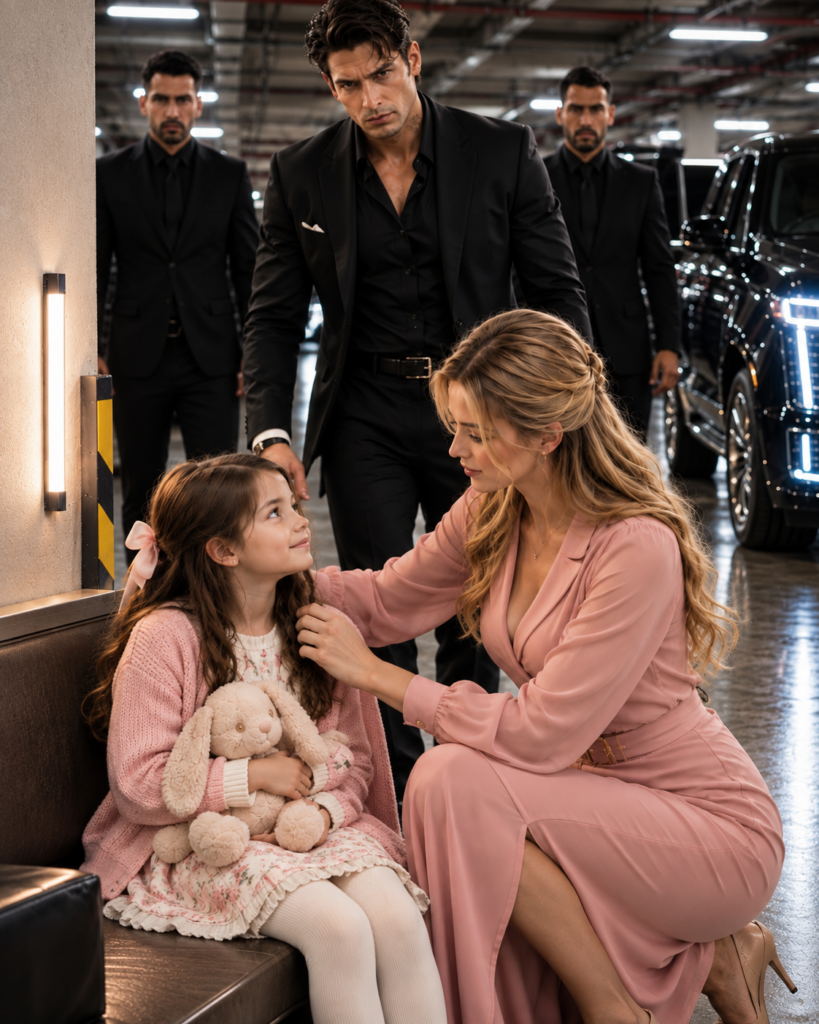
Harlan Voss looked at me for three seconds.
That was all.
Three seconds while the garage seemed to hold its breath around us, while the men who had arrived with him stood perfectly still, while Belle’s small fingers tightened weakly around mine beneath the sleeve of my coat.
Then he crossed the distance between us.
Not toward me.
Toward his daughter.
Every frightening story I had ever heard about Harlan Voss disappeared from his face when he knelt on the concrete.
“Belle.”
His voice was so quiet I almost didn’t recognize it as the same one that had answered the phone.
Belle’s eyelids lifted.
“Dad?”
“I’m here.”
Her mouth moved in something close to a smile.
“You came fast.”
His jaw tightened.
“I always will.”
Two people hurried forward from one of the SUVs, a woman carrying a medical case and a man unfolding a compact stretcher. Harlan shifted aside immediately, giving them space.
The woman introduced herself as Dr. Anika Patel.
She asked me questions while checking Belle’s breathing.
How long had I been with her?
Had she lost consciousness?
Had she complained of chest pain?
Had she taken anything?
I answered everything I could.
Dr. Patel listened to Belle’s heart, checked the inside of her wrist, then gave Harlan a small nod.
“She’s stable enough to move.”
I hadn’t realized how hard I’d been holding my breath until it left me.
Belle’s hand slipped from mine as they lifted her onto the stretcher.
Her eyes opened again.
“My coat,” she murmured.
Harlan glanced at the navy coat she was already wearing.
Belle gave the smallest shake of her head.
“Rue’s.”
For the first time, Harlan looked down at the cheap black coat wrapped around his daughter’s shoulders.
My coat.
Twenty-nine dollars from a clearance rack.
The left pocket had a tear I kept meaning to sew.
One button was different from the others because I’d lost the original in a laundromat.
Belle had somehow decided it mattered.
Harlan looked back at me.
“She can keep it for now.”
“That wasn’t what I—”
“She wants it.”
Something in his voice made me stop.
Not authority.
Fear.
Plain, exhausted, ordinary fear.
Dr. Patel guided the stretcher toward the SUV.
Belle reached for me again.
“Rue?”
“I’m right here.”
“Coming?”
I looked at Harlan.
He didn’t hesitate.
“Yes.”
I blinked.
“I actually need to get home.”
Dr. Patel stopped walking.
Harlan stared at me as if I had just announced I planned to swim across Lake Michigan.
“It’s nearly midnight.”
“I noticed.”
“You’re not walking.”
“I take the bus.”
“There is no bus.”
“I also noticed that.”
His eyes dropped to my waitress uniform.
Then to my shoes.
Then to the bare goose-pimpled skin of my arms.
I suddenly became aware that I was standing in a freezing garage wearing a short-sleeved diner uniform and no coat.
Harlan removed his own without comment.
I stepped back.
“No.”
“It’s twenty-three degrees.”
“I’m fine.”
“You’re shaking.”
“I’m annoyed.”
“That doesn’t prevent hypothermia.”
One of the men nearby looked down, and I had the distinct impression he was trying not to smile.
I folded my arms.
“I don’t need your coat.”
Harlan held it out.
“I’m not asking you to marry it.”
That surprised a laugh out of me.
A tiny one.
It surprised him too.
Something shifted in his expression.
Barely.
Then Belle whispered my name again from the stretcher.
I took the coat.
It was warm from his body.
That bothered me more than it should have.
“Fine,” I said.
“Good.”
“But I’m only coming until I know she’s okay.”
His gaze stayed on mine.
“That is also fine.”
The way he said it made me suspect neither of us believed it.
I expected a mansion.
Or a private hospital.
Or maybe one of those glass towers downtown where billionaires had elevators that opened directly into their living rooms.
Instead, twenty minutes later, we pulled into a discreet medical center near Midtown that looked surprisingly normal except for the security gate and the fact that no one asked Harlan Voss for identification.
Belle was taken through a set of double doors.
Harlan followed until Dr. Patel stopped him.
“Give us ten minutes.”
“I can stand in the room.”
“You can make everyone in the room nervous.”
“I don’t make you nervous.”
“No. You irritate me.”
He stared at her.
She stared back.
Then, astonishingly, Harlan obeyed.
Dr. Patel disappeared behind the doors.
I sat on the nearest chair.
Only then did I realize I was still wearing his coat.
He stood across from me, phone in one hand, speaking quietly to someone.
“No press. No statements. Call Lenora. Tell her Belle is stable.”
A pause.
“No. Do not wake my mother yet.”
Another pause.
“Yes, I know she’ll be furious.”
He ended the call.
For a few seconds, there was silence.
Then he looked at me.
“You should be evaluated.”
“For what?”
“Cold exposure.”
“I work doubles at a diner with a broken heater. This is basically my natural habitat.”
His mouth almost moved.
Almost.
“You make jokes when you’re frightened.”
I straightened.
“I’m not frightened.”
He glanced at my hands.
They were clenched together in my lap.
I separated them.
“That proves nothing.”
“No,” he said. “It doesn’t.”
He sat opposite me.
That seemed stranger than anything else.
Harlan Voss didn’t look like the photographs I remembered seeing online.
Or maybe photographs flattened him.
In person, he wasn’t enormous or theatrical or covered in the visual accessories people expected powerful men to wear. He was perhaps forty, dark-haired, clean-shaven, dressed in a charcoal suit that probably cost more than everything I owned.
But there were faint lines at the corners of his eyes.
And tiredness around his mouth.
He looked like a man who had spent years making sure nobody ever saw him uncertain.
Tonight, he was uncertain.
“Tell me exactly what happened,” he said.
I did.
I told him about missing the bus.
The garage.
The cough.
The missing shoe.
Belle’s phone.
The call.
When I finished, he remained silent for a moment.
“She was alone when you found her?”
“Yes.”
“No one nearby?”
“No.”
“Did she say how she got there?”
“She barely said anything.”
His fingers tapped once against his knee.
Stopped.
“Her driver was supposed to be taking her home from a school music rehearsal.”
I looked at him.
“So why was she in a parking garage?”
“That,” he said, “is what I intend to understand.”
The doors opened.
Dr. Patel stepped out.
Harlan stood immediately.
“She’s okay,” she said.
Two words.
I watched them nearly break him.
Not visibly.
But enough.
His shoulders lowered half an inch.
His eyes closed for one beat.
Then he nodded.
“What happened?”
“Cold, exhaustion, and an episode triggered by stress. Her oxygen is good now. Heart rhythm has stabilized.”
“Can I see her?”
“In five minutes.”
“Why five?”
“Because I said five.”
She turned toward me.
“And you must be Rue.”
“I am.”
“Belle has asked about you three times.”
Harlan looked at me.
I lifted my hands.
“I didn’t encourage that.”
For the first time, Dr. Patel smiled.
“I’m sure you didn’t.”
She studied my face for a second longer than necessary.
Then her expression changed.
Not dramatically.
Just enough for me to notice.
“Callaway?” she asked.
My stomach gave a strange little turn.
“Yes.”
“Rue Callaway?”
“Yes.”
Harlan’s gaze moved sharply to her.
“You know the name?”
Dr. Patel recovered almost instantly.
“No.”
It was too fast.
We all knew it.
Harlan’s eyes narrowed.
But she continued before he could ask.
“Belle needs calm tonight. Questions can wait until morning.”
“Anika.”
“Morning.”
For several seconds, they looked at each other.
Then Harlan stepped aside.
Dr. Patel glanced at me once more before returning through the doors.
I stared after her.
“What was that?”
“I don’t know.”
“You looked like you knew.”
“I looked like she knew.”
He studied me.
“Is there some reason she would?”
“No.”
My answer came quickly because it was true.
Or because I thought it was.
My family wasn’t important.
There was no Callaway legacy.
No old money.
No political dynasty.
There had been my mother, who died when I was nineteen.
A father whose name existed only as an empty line on my birth certificate.
An aunt in Toledo I hadn’t spoken to in years.
And me.
Rue Callaway.
Waitress.
Late-rent specialist.
Owner of fifteen dollars and forty cents.
There was nothing for a private physician to recognize.
Nothing at all.
Belle was sitting upright when they finally let us in.
Her color had returned.
A blanket covered her legs, and my coat was folded beside her.
She looked small against the white pillows but no longer fragile in the terrifying way she had in the garage.
Harlan crossed to her immediately.
He didn’t hug her.
Not at first.
He touched her hair.
Then her cheek.
Then he seemed to give up on restraint and carefully gathered her against him.
Belle folded her arms around his neck.
I looked away.
Some moments didn’t need witnesses.
“Dad?”
“Yes?”
“I lost my shoe.”
“I heard.”
“It was my good shoe.”
“I’ll notify the authorities.”
Belle pulled back.
“That isn’t funny.”
“I’m devastated.”
She frowned at him with impressive seriousness.
Then her eyes found me.
“Rue.”
“Hi.”
“You came.”
“I said I would.”
“No,” she said. “Dad said you would.”
Harlan glanced over her shoulder at me.
I pretended not to notice.
Belle patted the bed.
“Sit.”
I looked at Harlan.
His expression said his daughter was currently in charge.
So I sat.
“Were you scared?” she asked.
“Of what?”
“The garage.”
I thought about lying.
Then I remembered being six and how quickly children knew when adults weren’t telling the truth.
“A little.”
“Me too.”
“That makes two of us.”
“I thought nobody would hear me.”
My throat tightened.
“Well,” I said softly, “you have an inconveniently loud cough.”
She smiled.
Harlan’s face changed when she did.
Completely.
I finally understood something about him.
Whatever else people said about Harlan Voss, he loved his daughter with no armor at all.
“Do you remember how you got there?” I asked.
Harlan looked at me sharply, but Belle didn’t seem upset by the question.
She nodded.
“Mr. Ellis stopped the car.”
“Your driver?” Harlan asked.
“Yes.”
“Why?”
“He said the tire light came on.”
Harlan went still.
Belle continued.
“He went to check. Then a lady knocked on my window.”
“What lady?”
“I don’t know.”
“What did she look like?”
“Harlan,” Dr. Patel said quietly from the doorway.
He stopped.
Belle looked between them.
“I’m not in trouble.”
“No,” Harlan said immediately. “Never.”
“The lady said Dad sent her.”
His face changed.
Not anger.
Something more complicated.
Confusion.
“Did you believe her?”
“At first.”
“Why?”
Belle looked toward me.
“Because she knew my song.”
“What song?”
“The one Mom used to sing.”
Silence filled the room.
Harlan’s expression emptied.
Belle tilted her head.
“She sang the beginning through the glass.”
“What song?” I asked gently.
Belle looked at her father.
Harlan’s eyes had gone distant.
Then Belle sang four soft words.
A simple melody.
Nothing dramatic.
Nothing unusual.
And yet something inside me seemed to stop.
Because I knew it.
Not the song itself.
The melody.
My mother used to hum it while washing dishes.
While braiding my hair.
While counting change at our kitchen table after midnight.
I had never known where it came from.
I stared at Belle.
Harlan saw my face.
“What?”
I shook my head.
“Nothing.”
“Rue.”
“My mother used to hum that tune.”
He became very still.
Belle looked delighted.
“You know it?”
“Sort of.”
“Sing the rest.”
“I can’t.”
“You said you know it.”
“I know the melody.”
Harlan’s attention never left me.
“What was your mother’s name?”
I hesitated.
“Marianne.”
His face remained unreadable.
“Marianne Callaway?”
“Yes.”
Something passed through his eyes.
Not recognition exactly.
But close enough to make my pulse quicken.
Before I could ask, Dr. Patel came farther into the room.
“That’s enough for tonight.”
Belle sighed.
“I’m not tired.”
“You nearly fell asleep while saying that.”
“I blinked.”
“For forty seconds.”
Belle leaned against her pillows.
“Rue can stay.”
The room went quiet.
I felt Harlan looking at me.
“I should really go home.”
Belle’s face fell.
I hated myself instantly.
Not because I had any responsibility to stay.
I didn’t.
But because she had spent enough of the night wondering whether people would come back.
“I can stay until you fall asleep.”
Her eyes brightened.
“Promise?”
I glanced at Harlan.
“Yes.”
Belle settled down immediately.
Within minutes, her breathing became slow and even.
I sat beside the bed.
Harlan stood by the window.
Neither of us spoke.
When Belle finally slept, I carefully stood.
“She’ll be okay?” I whispered.
He nodded.
“Anika says yes.”
“Good.”
I picked up his coat from the chair.
He didn’t take it.
“Keep it on until the car drops you home.”
“I don’t need a car.”
“You are not walking home at one in the morning.”
“I can call a ride.”
“With fifteen dollars and forty cents?”
My hand froze on the coat.
He saw it.
I saw that he saw it.
A cold embarrassment climbed my neck.
“How do you know what’s in my bank account?”
His expression changed.
“I don’t.”
“You just said the exact amount.”
“No. I said—”
“You said fifteen dollars and forty cents.”
He frowned.
“I said fifteen dollars?”
“And forty cents.”
“I was going to say fifteen dollars for a ride.”
We stared at each other.
Neither of us moved.
I knew exactly how absurd the coincidence sounded.
But I also knew powerful men did strange things with information.
“You looked me up.”
“No.”
“You knew my last name before we got here.”
“You told me your name.”
“Did your people search it?”
He was silent one second too long.
My stomach sank.
“Harlan.”
“Yes.”
I pulled off his coat.
“I knew it.”
“I asked them to verify who you were.”
“I saved your daughter.”
“That is exactly why I wanted to know who you were.”
“And?”
“And you are twenty-seven years old. You work at Tillie’s Diner. You attended Wayne State for three semesters. Your mother died eight years ago.”
Every fact felt like a stranger opening drawers in my apartment.
“You had no right.”
“You are right.”
That stopped me.
He didn’t defend himself.
Didn’t soften it.
“I should not have done that without telling you,” he said. “I was afraid, and fear made me reach for information because information is how I make myself feel in control.”
I folded the coat over my arm.
“You’re very good at apologies for a terrifying Detroit businessman.”
“I have a six-year-old.”
“That doesn’t answer anything.”
“It answers more than you think.”
I wanted to stay angry.
Part of me succeeded.
But another part understood the look I had seen when Dr. Patel said Belle would be okay.
Fear made ordinary people irrational.
Maybe it made powerful people invasive.
That didn’t excuse it.
But it explained something.
“What else did you find?”
“Very little.”
“Because my life is boring?”
“Because somebody removed most of your mother’s public records.”
I forgot how to breathe for a moment.
“What?”
His gaze sharpened.
“Did you know that?”
“No.”
“Rue—”
“No.”
I took one step toward him.
“What does that mean?”
“It means the search returned inconsistencies.”
“What kind?”
“Employment records that begin late. An address history that stops abruptly when she was twenty-four. No school records before 1995.”
“That’s impossible.”
“Maybe.”
“My mother grew up in Michigan.”
“Did she tell you that?”
“Yes.”
The certainty in my voice faded.
Had she?
I remembered assuming it.
Her stories were always about places around Detroit.
Eastern Market.
Belle Isle.
Hamtramck bakeries.
Summer storms over Lake St. Clair.
But had she ever actually said she was born here?
I couldn’t remember.
Harlan watched the realization happen.
“Rue.”
I hated how gently he said my name.
“Don’t.”
“All right.”
I looked toward Belle.
Still sleeping.
Safe.
Then I looked at the man beside the window.
“Why did Dr. Patel react to my name?”
“I intend to ask her.”
“Why did you react to my mother’s name?”
His eyes shifted.
There.
The smallest hesitation.
“You did.”
“I remembered something.”
“What?”
He looked toward his daughter before answering.
“My wife had a friend named Marianne.”
My heart seemed to tilt.
“Your wife?”
“Evelyn.”
Belle’s mother.
I knew the name only vaguely.
Evelyn Voss had died when Belle was a baby. There had been a foundation afterward. Pediatric heart research. Photographs from charity events.
I had never paid attention.
“My mother knew your wife?”
“I don’t know.”
“But you just said—”
“I said Evelyn had a friend named Marianne. I never knew her surname.”
“How does that even happen?”
“Evelyn met her before I met Evelyn. They had lost touch by then.”
My thoughts tangled.
“Did Evelyn hum that song?”
His gaze dropped.
“Yes.”
The word was almost inaudible.
Something cold moved through me.
Not fear.
The feeling of a locked room appearing where you had always believed there was a hallway.
A driver named Miles took me home.
Harlan did not come.
I was grateful.
I needed the thirty-minute ride alone.
Detroit passed beyond the dark glass in quiet winter fragments.
Streetlights.
Closed storefronts.
Snow along the curbs.
Apartment windows glowing above laundromats and liquor stores.
My whole life was out there.
Normal.
Unremarkable.
Or it had been until midnight.
Miles stopped outside my building.
I immediately saw the notice taped crookedly beside the front door.
FINAL NOTICE.
I closed my eyes.
Of course.
I had forgotten the eviction letter folded in my purse.
The landlord had given me until Friday.
Tonight was Tuesday.
“Ma’am?”
“I’m fine.”
Miles looked unconvinced.
I opened the door.
“Thank you for the ride.”
“Mr. Voss said I should make sure you get inside.”
“That sounds like Mr. Voss.”
I crossed the sidewalk.
The key stuck twice before the lock turned.
When I finally got inside, Miles drove away.
My apartment was freezing.
The radiator clicked without producing meaningful heat.
I turned on the kitchen light.
There was my life.
Two chipped mugs.
A stack of unpaid bills.
A dying basil plant my neighbor had given me.
A photograph of my mother taped to the refrigerator.
I stood in front of it.
Marianne Callaway smiled from a summer afternoon fifteen years earlier.
Her dark curls were escaping a yellow scarf.
She was holding a paper plate with birthday cake on it.
I had always thought I looked like her.
Same brown eyes.
Same sharp chin.
Same stubborn mouth.
“Who were you?” I whispered.
The refrigerator hummed.
That was all.
Then I remembered the box.
My mother had kept one cardboard box on the top shelf of her closet.
“Boring grown-up papers,” she used to call it.
After she died, I had moved the box through three apartments without opening most of it.
I found it under my bed.
Dust along the lid.
My hands shook slightly as I pulled it into the light.
Inside were tax forms.
Medical bills.
A recipe book.
My elementary school drawings.
A Christmas card from Aunt June.
Nothing mysterious.
Nothing that explained why half my mother’s records apparently didn’t exist.
I nearly laughed at myself.
Then I found the envelope.
It had been taped beneath the bottom flap.
I only noticed because the cardboard had started separating.
The envelope was old.
Cream-colored.
No address.
On the front, in my mother’s handwriting, were two words.
FOR RUE.
I sat on the floor.
For several minutes, I couldn’t open it.
My mother had been dead eight years.
Eight years of wishing I had one more thing from her.
One more note.
One more recipe written in the margin of something.
One more voicemail.
And here one had been under my bed the entire time.
I slid my finger beneath the seal.
Inside was a photograph.
Three young women stood together beside a lake.
My mother was one of them.
She looked perhaps twenty.
Beside her stood a woman I recognized immediately despite the younger face.
Dr. Anika Patel.
The third woman had pale hair blowing across her cheek and a bright, unguarded smile.
I turned the photo over.
Three names were written on the back.
Anika.
Marianne.
Evelyn.
Below them, in smaller writing:
Sisters by choice. Whatever happens.
My heart thudded painfully.
There was also a folded letter.
I opened it.
Rue,
If you are reading this, then either I finally became brave enough to tell you everything and forgot where I put this letter, or life made the decision for me.
I smiled despite myself.
That was my mother.
Even in a secret confession, she made a joke.
Then I kept reading.
There are things I should have told you earlier.
Not because they are dangerous.
Not because you need to be afraid.
But because adults sometimes convince themselves that silence is the same as protection.
It isn’t.
It is only silence.
Before you were born, I had two people I loved like family.
Anika Patel.
And Evelyn Mercer.
Evelyn later became Evelyn Voss.
Your life and Belle Voss’s life crossed long before you met.
If you ever meet Harlan, do not judge him by the stories people tell about him.
Judge him by the way he looks at his daughter.
That will tell you the truth.
My eyes burned.
I read faster.
There was one more paragraph.
Then I stopped.
Read it again.
And again.
Because the words made no sense.
Evelyn made me promise something before Belle was born.
I kept that promise.
Perhaps too well.
If Belle ever needs you, I believe you will understand why when the time comes.
There is a key in the blue sewing tin.
It belongs to a box Evelyn left with me.
I never opened it.
It was meant for you.
I stood so fast the room swayed.
The blue sewing tin was in the kitchen cabinet.
I found it behind a bag of flour.
Buttons.
Thread.
Two needles.
And beneath a cardboard divider—
a small brass key.
I stared at it.
Then someone knocked on my door.
Three quiet knocks.
Not urgent.
Not frightening.
I froze anyway.
“Rue?”
A woman’s voice.
Familiar.
I crossed the apartment and looked through the peephole.
Dr. Anika Patel stood in the hallway holding my black coat.
I opened the door.
She looked at the photograph in my hand.
Then at the letter.
Her face softened with something that looked painfully like recognition.
“You found it,” she said.
I gripped the door.
“You knew my mother.”
“Yes.”
“You knew Evelyn.”
“Yes.”
“Why didn’t you tell me at the clinic?”
“Because Harlan was there.”
My stomach tightened.
“Why does that matter?”
Anika looked down the empty hallway before meeting my eyes again.
“Because your mother asked me not to tell Harlan the truth until you had the chance to learn it for yourself.”
I could hear my heartbeat.
“What truth?”
She looked at the brass key in my hand.
“That depends,” she said quietly, “on whether Marianne finally left you Evelyn’s box.”
I held up the key.
Anika closed her eyes briefly.
When she opened them, there was relief there.
And grief.
And twenty years of history I didn’t understand.
“Then tomorrow,” she said, “you need to decide whether you want to know why Belle’s mother trusted your mother with the one thing she couldn’t leave to Harlan.”
Fifteen dollars and forty cents in my account.
Believing I was one missed paycheck away from falling out of the world.
I wished I could tell her something.
Not that everything would magically work out.
That would have been a lie.
There would still be bills.
Difficult choices.
Regrets.
People I loved would still disappoint me.
I would disappoint them.
Life would remain stubbornly ordinary.
But ordinary, I had learned, could hold astonishing things.
A friendship hidden in an old photograph.
A message preserved on magnetic tape.
A father brave enough to admit he had misunderstood the woman he loved.
A child who believed losing one shoe was a crisis worth reporting.
A neighbor who treated cinnamon bread as emergency medicine.
A job that mattered.
A decision that belonged to me.
And a family that did not arrive all at once or through blood alone.
It formed slowly.
Through choice.
Through returning.
Through forgiveness.
Through people asking instead of assuming.
Through doors held open without anyone pushing me through them.
Belle stopped in front of the ice cream shop.
“Chocolate,” she announced.
Harlan opened the door.
“You said strawberry in the car.”
“I changed my mind.”
He looked at me.
I smiled.
“People are allowed.”
He held the door wider.
“Yes,” he said.
“They are.”
And this time, when I stepped through, it was because I chose to.

