
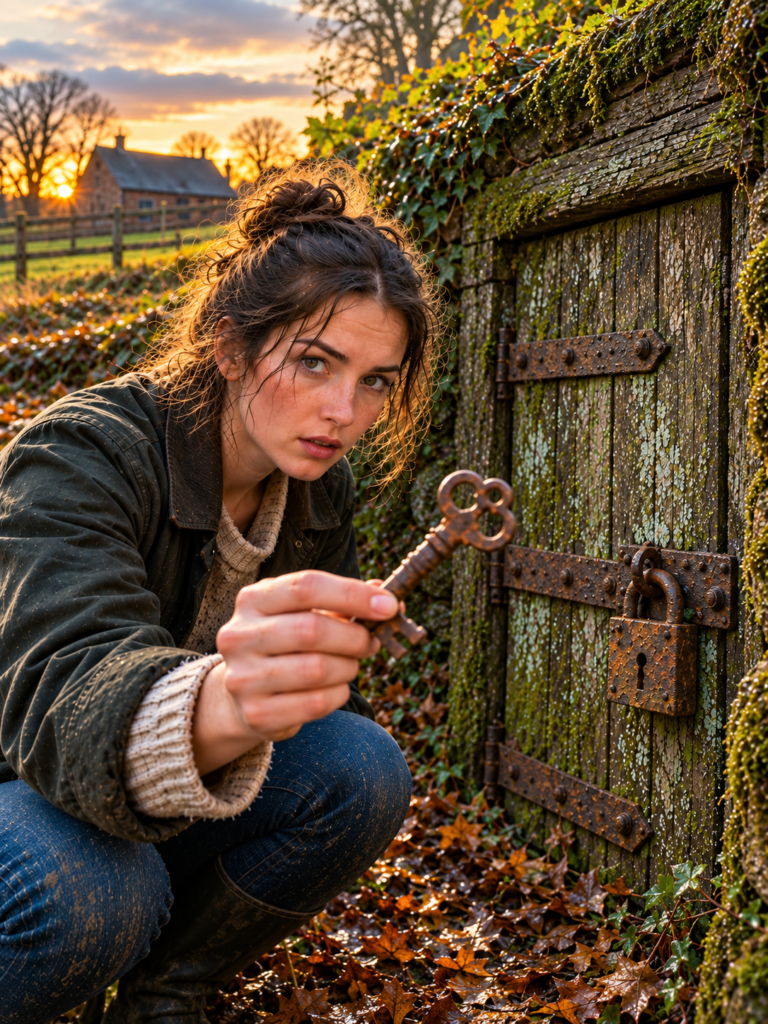
nobody had opened the old root cellar in fifty years until the hospice nurse found the key taped inside a button tin and fifty jars of peaches waiting for the daughter who left after the fight in 1976
Part 1
Desa Lindquist stood in the kitchen of the small farmhouse outside Brattleboro and listened to the rain on the metal roof. She was forty-four and had spent the last nineteen years as a hospice nurse in Albany. The work had taught her the particular quiet that settles into a house when people stop pretending they have more time. She had held hands that went cold. She had heard the things people said when they knew they would not say them again. Most of all she had learned that sleep did not fix the kind of tired she carried. It lived under her ribs and made ordinary rooms feel too bright.
The farmhouse had come up for sale in January. Josephine Har had died at ninety-six with no husband living and no children nearby to argue over the furniture. The town clerk, Carol Bisby, handled the sale from a folding table in the town office. Carol was brisk and kind in the way of people who have buried half the county. She slid the paperwork across and said, “Josephine was a strange one. Lovely, but strange. Canned peaches every August and handed jars to half the people around here. But she never let a living soul near that root cellar. Not the plumber, not the census man, not me. And I tried.”
Desa asked why. Carol shrugged. “She said it wasn’t time.”
Desa smiled the way she smiled at families who still hoped for a miracle. She signed the papers without walking through the kitchen. The price was low. The land was steep and the barn needed a new roof. She told herself she was buying quiet. She did not tell herself she was buying a place where no one would ask her to sit beside another bed.
The first three weeks she worked room by room. Josephine had left everything sorted. Spools of thread lined up by color in the sewing room. Church bulletins from the sixties stacked in a drawer. Seed packets labeled in a slanting hand that never hurried. On a rainy Tuesday Desa emptied a round tin of buttons onto the table. Glass and brass and mother-of-pearl rolled across the wood. Something small clicked against the lid. She turned it over. Taped inside, flat and yellow with age, was a single brown key. Beside it a folded scrap of paper said, “For Ruth, or for whoever is kind enough to wonder.”
Desa read the note three times. Then she put on her coat and walked down the muddy slope behind the house. The cellar door was set into the hillside. Moss had grown across the hinges. The padlock was rusted nearly orange. Someone had tied a faded paper tag to the latch with kitchen string. Desa turned the tag over. Four words in careful pencil: “Not yet. Not yet.”
She stood there with the key in her hand and felt the rain on her neck. In Albany she had learned that people leave instructions when they are afraid of being forgotten. Sometimes the instructions are spoken. Sometimes they are taped inside a tin of buttons. She did not stop to ask whether the cellar was hers to open. Someone a long time ago had asked to be wondered about. She put the key in the lock.
Part 2
The lock fought her. She sprayed oil and waited and turned the key until it gave with a dull, tired clunk. The hinges screamed when she pulled the door. Cold air rolled up the stone steps. It did not smell of rot or mold. It smelled faintly of sugar and fruit, like a memory of summer that had been sealed away.
She switched on her flashlight and went down. The ceiling was low enough that she had to duck. The walls were stone. The dirt floor had been swept almost clean. Shelves lined every wall. On the shelves sat glass jars, hundreds of them, in neat rows. Each one carried a label written in the same careful hand.
Desa stepped closer. The nearest jar said, “Peaches, August 1976.” The one beside it said, “Peaches, August 1977.” Then 1978. She walked the length of the wall. One jar for every year, lined up like a calendar written in glass. Fifty years of peaches. The light from her flashlight turned the fruit gold behind the glass.
On the lowest shelf sat a wooden box with a latch. Desa knelt and opened it. Inside was a thick stack of envelopes tied with a faded blue ribbon. Every envelope carried the same handwriting on the front, rounder and quicker than Josephine’s. The address was the same on all of them: Mrs. Har, Brattleboro, Vermont. None of them had been opened. Desa counted. Forty-six envelopes. One every December. The postmarks began in 1976 and kept going until 2021.
A second box sat beside the first. It held a small stack of Josephine’s own pages, folded in thirds. These were addressed only to a first name: Ruth. None of them had ever been mailed.
Desa sat on the cold steps and opened the first of Josephine’s letters because she thought that was what the old woman would have wanted.
“Ruth, it is August and the peaches are in. I made a jar for you the way you used to help me. I know you will not read this. I do not even know where to send it. But I said some things the day you left that I would take back if I could. The tree is still here. I will keep your jar until you come home.”
The letters after that were short. They spoke of the weather, the cat, a hard winter, a neighbor who had passed. Every August there was a new letter and every August there was a new jar. For forty-six years Josephine had made a jar of peaches for a daughter she believed would never come back. And every year a letter had arrived from that daughter that Josephine could not bring herself to open.
Desa held the stack of unopened envelopes in her lap. She had sat at a lot of bedsides. She knew exactly what this was. Two people, each waiting for the other to speak first. Outside the rain kept falling on the hillside. The smell of sugar and fruit hung in the cold air. She stayed on the steps until her flashlight dimmed.
Part 3
Carol Bisby was the first person Desa called. Carol was quiet on the phone for a long time. “Ruth,” she said finally. “I remember a Ruth. She left in the summer of ’76. I was a girl. There was a terrible fight about selling the back field. Josephine wanted to keep it. Ruth wanted to go to college in the West. I never heard what was said.”
Desa asked if Josephine ever talked about her. “Never,” Carol said. “Not once. After that the subject was closed like a door.”
Desa went through the return addresses. The earliest said Eugene, Oregon. Later ones said Portland. The most recent was from a town called Hood River. She did not know whether Ruth was alive. She did not know whether Ruth would want to hear from a stranger. She wrote a short letter anyway, put it in the mail, and tried not to count the days.
Meanwhile she called the county extension office. A food safety specialist named Mr. Admi drove out on a clear morning and walked through the cellar with his hands clasped behind his back. He studied the rows of glowing glass and said, “I have to be honest. Please do not eat any of this. Home canned food that old is not safe, even when the jar looks perfect. Some of these seals have probably failed. If one has, the contents can make you very sick.”
“I wasn’t going to,” Desa said. “But I couldn’t throw them away.”
“Then don’t keep them as they are on the shelf. They’re safe to look at.” He turned slowly. “What a thing to make, though, for somebody who never came.”
It was not all tidy news. When Desa checked the earliest jars, three of the oldest had cracked. The peaches inside had dried to dark crumbs. Josephine’s first letters had faded so badly in places that Desa could barely read the words. Some of what the old woman had wanted to say was simply gone. Desa copied every letter she could save, word by word, into a notebook. It took her two weeks. She sat at the kitchen table after the light failed and wrote by the lamp, her handwriting careful so nothing else would be lost.
In May the phone rang. A younger voice said, “Hello. My name is Anne Callaway. I got your letter. It was forwarded from my mother’s old address.”
Desa stopped breathing. “Your mother is Ruth.”
“She is. She’s seventy-two. She’s alive. But I should tell you, she has early memory loss. Some days she’s herself, some days she isn’t.”
Desa closed her eyes. “I understand. I work with people like that.”
Anne was quiet for a moment. “My mother never talked about Vermont. She’d go quiet whenever anyone asked. But last Christmas she said something odd. She said, ‘I wrote to her every year, you know. I just never found out if she read them.’”
Desa looked down at the ribbon-tied stack on the kitchen table. “Anne,” she said quietly. “She did not read them. But she kept every one.”
Part 4
Ruth arrived in August on a clear, hot morning with her daughter driving. She was small, with white hair cut short, and she held Anne’s arm as she stepped out of the car. She looked at the farmhouse for a long moment. Her face did not change. “It’s smaller than I thought,” she said.
Desa did not know whether Ruth meant the house or the years. She did not ask. They walked slowly down the slope. The cellar door stood open. Desa had wedged a chair against it so it would not swing shut. Ruth stopped at the top of the stone steps. For a while nobody said a word. Then, very slowly, she began to smile.
“The tree,” she said. “Is the tree still there behind the house?”
Desa said it still bloomed every spring.
“I used to climb it.” Ruth laughed, a small startled laugh. “She’d shout at me. You’ll fall and break your neck. I never did.”
Anne took her mother’s hand. They went down the steps together. Desa stayed at the top because some moments belong to the people in them. She could see Ruth in the lantern light moving along the shelves. She touched the first jar and then the next, reading each label under her breath. 1976. 1977. 1978.
When she reached the lowest shelf she saw the box with the blue ribbon and went very still. Anne said something gently. Ruth did not answer. She picked up the stack of her own letters and held it against her chest. Then she sat down on the cold stone steps right where Desa had sat in March and began to read the first letter that Josephine had written to her.
Desa never found out exactly what Ruth said when she finished. Anne told her later that her mother had read the last line aloud to the empty cellar in a voice that sounded very young. Then she said, “I’m here, Mama. I’m sorry it took so long.”
Desa stayed in the house through that autumn. She did not fix the cellar up. She did not put up a sign. She simply took off the rusted padlock and left the door unlatched so that anyone who wanted to walk down those steps could. Ruth came back twice more before the snow. On the second visit she and Anne carried a basket to the old tree and picked the last of the fruit, hard and small and not quite ripe. They did not can any of it. They just sat in the grass and ate a few right there, with juice running down their wrists, the way someone once did when she was a girl. Desa watched them from the porch.
It occurred to her that for fifty years that cellar had held two kinds of things. Fruit that was meant to be shared and words that were never said. Only one of them had gone bad.
Part 5
In the weeks after Ruth’s last visit the hillside turned gold and then brown. Desa walked the property each morning and checked the fences the way Josephine must have done. The barn still needed a roof. The back field still grew more weeds than grass. She did not sell it. She left the cellar door unlatched and the chair wedged so the wind could not close it.
On a cold evening in late October Anne called. Ruth had asked, on a good day, whether the tree still dropped its leaves the same way. Anne said her mother had started keeping one of Josephine’s letters folded in her pocket. She did not always remember what it said, but she liked the feel of the paper.
Desa sat on the porch steps with the phone against her ear and watched the last light leave the field. She thought of the jars still lined on the shelves, gold behind the glass, and of the three that had cracked and gone to crumbs. She thought of the words that had faded past reading and the ones she had copied so they would not disappear again. She thought of the padlock she had taken off and left on the workbench, rusted and useless.
When the snow came she kept a path cleared to the cellar door. She did not go down often. The cold settled deeper underground than it did in the house. But she left a lantern hanging on a nail just inside the entrance, and she checked that the batteries still worked. Some nights she stood at the top of the steps and listened to the quiet. It was the same quiet she had known in Albany, only here it did not ask her to do anything except stay.
In December a package arrived from Hood River. Inside was a single jar of peaches, sealed and labeled in Anne’s handwriting: “August 2026. For the tree.” Anne’s note said Ruth had watched her can them on a morning when the light was good and the memory was better. They had used the last of the fruit from a neighbor’s tree. Ruth had not been able to climb, but she had stood at the bottom and told Anne which branches still held the sweetest ones.
Desa carried the jar down the stone steps and set it on the lowest shelf beside the wooden box. The blue ribbon had faded further. The envelopes were still unopened by Josephine’s hand, but Ruth had read the letters written to her. Desa left the new jar there and climbed back into the winter light. She locked nothing. She hung the paper tag on the latch again, the one that said “Not yet,” and she left it facing out so anyone who came down the slope could read it if they wanted.
That night the wind moved across the field and rattled the loose tin on the barn. Desa sat at the kitchen table with Josephine’s notebook open in front of her. She did not add anything to it. The last page she had copied was already enough. Outside the cellar door stayed open to the dark, and the jars waited in their rows the way they had waited for fifty years, only now the waiting had a different shape. It was no longer a closed door. It was a place someone could walk into if they chose, and leave again when they were ready, with the taste of peaches still on their hands.


