
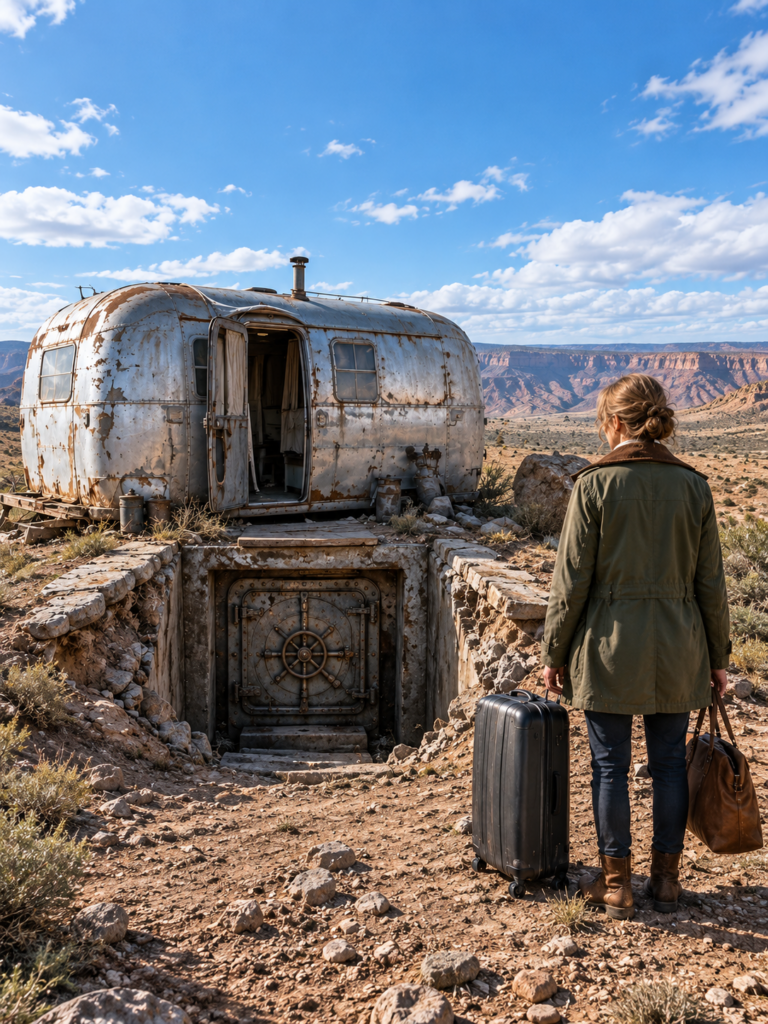
evicted by her cruel stepson with nothing but a barren field the landslide revealed the vault of gold her husband left her
Part 1
The rain falling on the slate roof of the Portland crematorium felt like the universe weeping, even if no one else was. Adelaide Miller stood perfectly still, her black mourning dress clinging to her rigid frame. At fifty-eight she had spent the last fifteen years pouring every ounce of her soul into her marriage with Roland Miller. She had nursed him through three aggressive bouts of lymphoma, managed his chaotic schedules, and loved him with a quiet, unwavering fierceness. Now Roland was gone, reduced to ash in an urn, and Adelaide was utterly alone.
Standing a few feet away, entirely unaffected by the somber atmosphere, was Dominic. Dominic Miller, Roland’s thirty-two-year-old son from his first marriage, checked his gold Patek Philippe watch with an irritated sigh. He hadn’t shed a single tear. To Dominic his father’s death was merely a bureaucratic delay in his grand ambitions. He was a ruthless real estate developer, a man who saw the world only in terms of leverage, assets, and hostile takeovers. He had always despised Adelaide, viewing her as a gold-digging interloper, despite the fact that she had married Roland when his logistics company was on the verge of bankruptcy and helped him rebuild it from the ground up.
“Can we wrap this up?” Dominic whispered loudly to his companion, a slick-haired attorney named Gregory Hughes. “I have a zoning board meeting at four.”
Adelaide squeezed her eyes shut, trying to block out the callousness. Just get through today, she told herself. Roland promised you’d be taken care of. He promised.
Two days later Adelaide found herself sitting in the plush, mahogany-paneled conference room of Hughes and Associates for the reading of the will. She was exhausted, running on black tea and grief. Dominic sat across from her, scrolling through his phone, a smug, barely concealed smirk playing on his lips. Gregory Hughes cleared his throat, adjusting his wire-rimmed glasses.
“Let us begin. I will read the provisions as dictated by the late Roland Charles Miller in his final testament, updated just three weeks prior to his passing.”
Adelaide frowned. Three weeks ago? Roland had been heavily medicated then, slipping in and out of lucidity.
“To my son, Dominic Miller,” Gregory read, his voice devoid of emotion, “I leave the entirety of Miller Logistics, including all subsidiary holdings, commercial real estate, and fleet assets. I also bequeath the primary residence located in Lake Oswego, along with all liquid capital in my personal and joint accounts.”
Adelaide’s heart stopped. “Joint accounts? Wait.” She interrupted, her voice trembling. “Our joint accounts? That’s everything we have to live on. Roland and I built that savings together. What about my share?”
Gregory looked up, offering a thin, practiced smile of false sympathy. “According to the legal restructuring Dominic and Roland finalized last month, those funds were absorbed into the corporate trust. Mrs. Miller, Dominic is the sole beneficiary of that trust.”
“He was on morphine!” Adelaide protested, standing up. “He didn’t know what he was signing!”
“Careful, Adelaide.” Dominic said, finally looking up from his phone, his eyes cold and predatory. “Slander is a messy legal arena. Dad knew exactly what he was doing. He was securing his legacy, keeping it in the bloodline.”
Adelaide felt the room spinning. She had signed away her own career to manage Roland’s care. She had nothing of her own. “And what about me?” she whispered.
Gregory looked back down at the document. “To my wife, Adelaide, I leave the title and deed to the fifteen-acre plot known as Olson’s Ridge in Malheur County, free and clear of any encumbrances. That concludes the division of assets.”
Silence fell over the room. Olson’s Ridge. Adelaide remembered it. It was a joke among Roland’s friends, a worthless, rocky expanse of dead dirt out in the absolute middle of nowhere in Eastern Oregon. Roland had bought it decades ago on a whim at a tax auction, intending to build a hunting cabin, but the soil was too toxic to grow anything, and the bedrock made building impossible. It was a literal wasteland.
“A barren field?” Adelaide choked out, tears finally breaking through. “Fifteen years, Dominic. I bathed him. I fed him. I loved him. And you took everything.”
Dominic stood, buttoning his tailored Italian suit. “You got a piece of land, Adelaide. Sounds like a fair severance package for a glorified nurse. Oh, and by the way, the Lake Oswego house is now corporate property. I’m listing it on the market this Friday.” He leaned in, his cologne sickeningly sweet. “You have twenty-four hours to pack your bags and get out of my house.”
The eviction was a master class in psychological cruelty. The next morning Dominic sent a team of private security contractors to supervise Adelaide’s packing. They followed her from room to room, ensuring she didn’t take any of the expensive art, silver, or furniture. She was only allowed to take her personal clothing, some cheap paperback books, and a single box of photographs. When she tried to take the antique clock Roland had given her for their tenth anniversary, one of the guards gently but firmly placed a hand on it. “Sorry, ma’am. Mr. Miller’s orders. Fixtures and valuables stay.”
Adelaide walked out the front door carrying two suitcases. The rain had returned, a cold, biting drizzle. She looked back at the beautiful stone mansion she had decorated, the rose bushes she had planted with her own hands. Dominic was standing in the large bay window. He raised a crystal glass of bourbon in a mocking toast, then turned his back on her.
With less than four hundred dollars in her personal checking account, Adelaide loaded her suitcases into her aging Subaru Outback. She had nowhere to go. Her parents were gone, and she had lost touch with most of her friends while consumed by Roland’s illness. She pulled out the crinkled manila envelope Gregory Hughes had given her. Inside was the deed to Olson’s Ridge. It was the only piece of the earth that belonged to her. With a heavy, shattered heart, she put the car in drive and headed east into the desolate high desert.
The drive to Malheur County took seven agonizing hours. As Adelaide crossed the Cascade Mountains, the lush green landscapes of western Oregon gave way to a harsh, unforgiving terrain of sagebrush, cracked earth, and jagged basalt cliffs. The sky above seemed larger, emptier, and mercilessly gray. When she finally found the GPS coordinates for Olson’s Ridge, she almost broke down and wept all over again.
The property was a desolate nightmare. It was a sprawling slope of shale and dead, yellowed weeds scarred by deep, unnatural-looking ravines. There was no water hookup, no power lines. The only structure on the entire fifteen acres was a rusted, dilapidated 1970s Airstream trailer that some squatter must have abandoned decades ago. Its tires were flat, sinking into the mud, and half the windows were shattered, patched over with peeling duct tape. This was her inheritance. This was her home.
Adelaide parked the Subaru, the engine ticking loudly in the deafening silence of the desert. She stepped out, pulling her thin coat tight against the biting autumn wind. The smell of dust and dry rot filled the air. She pushed open the door of the Airstream. It screamed on rusted hinges. Inside it smelled of mouse droppings and decay. The linoleum floor was curling, and the faded floral cushions were torn to shreds. For the first time since Roland died, Adelaide sank to her knees on the dirty floor and screamed. She screamed until her throat was raw, cursing Roland for his weakness, cursing Dominic for his greed, and cursing herself for being so blindingly foolish.
But Adelaide Miller was not a woman who stayed on her knees for long. Survival mode kicked in. The first few weeks were a brutal test of human endurance. She used her meager funds to buy a cheap space heater, heavy sleeping bags, plastic sheeting to seal the broken windows, and jugs of purified water from a gas station ten miles away. She learned how to patch the leaks in the Airstream’s aluminum roof with roofing tar. She cooked canned beans and instant rice on a small propane camping stove. The isolation was deafening. Her hands, once soft and manicured, became calloused, blistered, and perpetually stained with dirt.
Part 2
To make matters worse, Dominic wouldn’t let her suffer in peace. Three weeks into her exile, a sleek black Mercedes G-Wagon rolled up the dirt road, kicking up a massive cloud of dust. Adelaide, who was outside trying to chop dead sagebrush for kindling, watched warily. It wasn’t Dominic, but one of his suited lackeys. The man stepped out, looking at the rusted Airstream with profound disgust, and handed her an envelope. “Mr. Miller wanted to ensure you receive this legal notice,” the man said smoothly. “He is auditing the estate and noticed a missing set of pearl earrings. He expects them returned, or he will involve the authorities.”
Adelaide stared at the man. “Roland gave me those earrings on our wedding day. They are my personal property.”
“Mr. Miller considers them an estate asset,” the man replied, turning back to his car. “Oh, and he sent this.” The man tossed a small, folded piece of paper onto the dirt. “Said you might need it for groceries.”
The Mercedes sped off. Adelaide walked over and picked up the paper. It was a crisp ten-dollar bill wrapped inside a handwritten note from Dominic. “Don’t spend it all in one place. Enjoy the dirt.”
Fury, hot and white, flared in Adelaide’s chest. She didn’t cry this time. Instead she tore the ten-dollar bill to shreds and let the desert wind carry it away. “I will survive this,” she vowed quietly to the empty sky. “I will outlive your cruelty, Dominic.”
But nature, it seemed, was allied with her stepson. In late November a freak atmospheric river stalled over eastern Oregon. It didn’t just rain; the sky unleashed a violent torrential deluge that lasted for three days. The dry, cracked earth of Olson’s Ridge couldn’t absorb the water. Flash floods turned the dry river ravines into raging rivers of mud and debris.
On the second night of the storm Adelaide huddled in the Airstream, terrified. The wind howled, shaking the metal shell violently. Water poured through a dozen new leaks, soaking her sleeping bags. Around three in the morning a deafening crack echoed over the roar of the rain, followed by a deep, rumbling vibration that shook the ground so hard it rattled her teeth. The trailer tilted violently to the left, groaning as the earth beneath it began to give way. Adelaide grabbed a flashlight and scrambled toward the door, terrified she was going to be buried in a mudslide. She threw the door open and shone the beam out into the darkness.
The hillside directly behind the trailer had collapsed. A massive chunk of the ridge had simply sheared off and slid into the valley below, leaving a gaping jagged wound in the earth. The rain continued to pound, washing away tons of topsoil and loose shale. Adelaide didn’t sleep the rest of the night, sitting by the door, praying the ground beneath the trailer would hold.
When dawn finally broke, the rain had reduced to a heavy drizzle. The gray light revealed the sheer scale of the devastation. Her makeshift driveway was gone, washed out entirely. Adelaide pulled on her rubber boots and a heavy slicker, trudging out into the ankle-deep mud to inspect the collapsed hillside. As she climbed over the debris, her boots slipping on the wet shale, she noticed something strange. The earth that had washed away hadn’t just revealed bedrock. Sticking out of the side of the newly exposed cliff face, about twenty feet up the slope, was a sharp, straight line of gray material that didn’t look like stone. It looked like poured concrete.
Frowning, Adelaide climbed higher, her breath misting in the cold air. She wiped away clumps of wet clay with her bare hands, digging frantically. Her fingernails scraped against something hard and metallic. She grabbed a heavy branch and used it to pry away a large slab of compacted dirt. She gasped, taking a step back.
Embedded into the solid concrete retaining wall was a massive, heavy iron door. It was severely rusted, flaking with orange and brown oxidation, and secured by a large, circular rotary wheel in the center, like the door to a bank vault or a maritime bulkhead. Adelaide stood in the freezing rain staring at the impossible sight. Olson’s Ridge was supposed to be empty bedrock. Roland had bought it for nothing. Why was there a reinforced subterranean vault buried deep inside this barren hill? She reached out, her trembling fingers brushing the cold wet iron. “What did you really leave me, Roland?”
For three days after the storm Adelaide worked like a woman possessed. Armed with nothing but a cheap garden spade and a wire brush, she cleared the remaining mud and debris away from the iron door. The structure was massive, at least seven feet tall and four feet wide, set deep into a heavily reinforced concrete frame that seemed to plunge straight down into the bedrock of the ridge. She tried to turn the rotary wheel. She put all her weight into it, straining until her muscles screamed and her boots slipped in the mud, but the rusted iron wouldn’t budge a fraction of an inch. It was seized solid by decades of corrosion and earth pressure.
She needed help, but she knew, with absolute certainty, that she couldn’t call the authorities or local contractors. If she discovered anything of value, Dominic’s expensive lawyers would swoop in and claim it belonged to the estate, citing some obscure clause in Roland’s will. She needed someone she could trust with her life. There was only one person left in the world who fit that description. Frank Chambers.
Frank was a retired structural engineer and an old Vietnam veteran who had served with Adelaide’s late father. For years Frank had been a surrogate uncle to her. More importantly, Frank had met Dominic once at a Thanksgiving dinner five years ago and had openly called him a soulless parasite to his face. Frank hated Dominic, and Frank knew how to keep his mouth shut.
Adelaide drove to the gas station ten miles away to get cell reception. She dialed Frank’s number. “Uncle Frank?” she said, her voice shaking. “It’s Adelaide. I need your help. I need you to bring your truck, heavy chains, and some industrial solvent. And Frank, don’t tell a soul where you’re going.”
Part 3
Forty-eight hours later Frank’s heavy-duty Ford F-250 rumbled up the washed-out dirt road, its tires tearing through the mud. Frank, a burly man in his late sixties with a thick silver beard and piercing blue eyes, stepped out. He took one look at Adelaide’s ragged appearance and the rusted Airstream and his jaw tightened in anger. “That stepson of yours,” Frank growled, pulling her into a tight hug, “I swear to God, Bea, I should drive up to Portland and break his legs.”
“Forget about Dominic,” Adelaide said, her eyes flashing with a new, frantic energy. “Look at this.” She led Frank up the muddy slope to the exposed cliff face. Frank stopped dead in his tracks, letting out a low whistle as he stared at the concrete and iron door. “Well, I’ll be damned,” Frank muttered, stepping closer to inspect the frame. “This isn’t a root cellar, Bea. This is military grade or at least depression-era bank spec. High-tensile steel, poured concrete reinforced with rebar. Someone went to incredible lengths to hide whatever is behind this door.”
“Can we open it?” Adelaide asked, her heart pounding.
“We’re going to try.” Frank grinned. They spent the next four hours working in the biting cold. Frank doused the rotary wheel and the massive hinges in gallons of penetrating oil, using a sledgehammer to violently tap the metal, breaking up the deep-seated rust. He then backed his truck up the treacherous slope, dangerously close to the edge of the ravine. He unwound the thick steel cable from his front-mounted winch, hauled it up the hill, and looped it securely around the heavy spokes of the rotary wheel. “Stand back!” Frank yelled, climbing into the cab of the truck. Adelaide scrambled behind a large boulder.
Frank engaged the winch. The steel cable snapped taut, humming with immense tension. The truck’s engine roared, tires slipping slightly in the mud. For a terrifying minute nothing happened. The cable looked like it might snap and slice through the air. Then a loud, gunshot-like crack echoed off the canyon walls. The rust seal broke. The rotary wheel jerked, turning a quarter rotation. Frank kept the winch engaged, pulling the cable. The wheel turned further, and with a hideous groaning shriek of metal on metal, the locking bolts inside the heavy door retracted.
Frank put the truck in park and jumped out, grabbing a long steel pry bar. He jammed it into the gap between the door and the concrete frame, throwing his considerable weight against it. Adelaide ran over to help, pulling on the bar with all her remaining strength. Slowly, agonizingly, the heavy vault door swung outward. A rush of freezing, stale air blew out from the darkness inside, carrying a strange scent—dust, old grease, and something distinctly metallic.
Frank handed Adelaide a heavy, high-powered tactical flashlight. “Ladies first,” he said softly. Adelaide stepped over the threshold, her boots clicking onto a dry, solid concrete floor. She swept the beam of the flashlight around. They were standing in a massive, cavernous room, roughly thirty feet wide and fifty feet deep, blasted directly into the solid bedrock of the ridge. The walls were lined with heavy steel support beams. It wasn’t empty. Stacked in neat, organized rows along the back wall were dozens of heavy wooden crates. They were covered in a thick layer of dust, but the wood was preserved perfectly in the dry, sealed environment of the vault.
Adelaide approached the nearest stack, her hands shaking violently. She wiped the dust off the side of one of the crates. There was a faded, stenciled logo burned into the wood. Kensington Mining Corp. 1924. “Kensington,” Frank whispered, coming up behind her, shining his own light on the crate. “The Kensington Mining Corporation went bankrupt in the late 1920s. They supposedly hit a massive vein of gold in the Blue Mountains, but the owners vanished before the government could audit them. It’s a local legend.”
“Roland loved local legends,” Adelaide whispered. “He used to spend hours in the county archives. That’s why he bought this useless land. He knew.”
Frank handed her a crowbar. “Only one way to find out.” Adelaide wedged the crowbar under the lid of the top crate. She threw her weight down. The old, rusted nails shrieked and gave way. She pushed the heavy wooden lid aside. Inside, packed meticulously in decaying straw and wax paper, were rows upon rows of heavy, dull, yellow, rectangular bars. Adelaide reached in, her breath catching in her throat. She gripped one of the bars and pulled it out. It was shockingly heavy, dragging her arm down. She rubbed her dirty thumb across the surface, wiping away the wax residue. The beam of Frank’s flashlight caught the metal. It wasn’t dull anymore. It gleamed with a rich, brilliant, unmistakable luster in the darkness. It was solid gold bullion. Stamped into the center of the bar was a purity mark. 99.9% fine.
Adelaide stared at the gold in her hands, her mind completely short-circuiting. She looked at the crate. There were at least forty bars in this box alone. She looked up at the wall. There were easily over a hundred crates stacked in the vault. “Good God almighty,” Frank breathed, taking off his hat. “Bea, do you have any idea how much this is worth? At today’s market value?”
Adelaide looked around the vault. The barren field she had been banished to, to die in poverty, didn’t just hold a secret. It held a fortune that dwarfed Dominic’s entire real estate empire ten times over. Roland hadn’t abandoned her. He had hidden his greatest asset in plain sight, knowing Dominic was too arrogant and obsessed with modern corporate wealth to ever dig into a piece of worthless dirt. “It’s worth everything,” Adelaide whispered, a slow, fierce smile spreading across her dirt-streaked face.
But as the thrill of the discovery washed over her, a cold dread suddenly spiked in her chest. Outside, over the howling of the wind, she heard a sound that didn’t belong in the remote desert. The unmistakable crunch of heavy tires rolling up the muddy road, followed by the slamming of car doors. Multiple doors. Someone else was here.
Frank instantly clicked off his high-powered flashlight. The massive vault was plunged into absolute, suffocating darkness. Adelaide held her breath, her heart hammering against her ribs like a trapped bird. Outside, the heavy thud of car doors slamming echoed off the canyon walls, followed by the squelch of expensive leather shoes sinking into the thick, clay-heavy mud. “Careful, Mr. Miller,” a familiar, weaselly voice called out. “The ground is highly unstable.”
“The county surveyor’s drone footage wasn’t exaggerating the extent of the landslide.” Adelaide’s blood ran cold. It was Gregory Hughes. And if Gregory was here, that meant—
“I don’t care about the mud, Gregory.” Dominic’s sharp, arrogant voice sliced through the cold desert air. “The county sent a notice that the geological shift exposed an unregistered subterranean structure on my adjacent property line. If that old bat has been squatting in some abandoned bunker, I want her evicted for environmental violations by sundown.”
Frank reached into the back waistband of his jeans and quietly unholstered a heavy 1911 Colt .45. He didn’t point it, but he held it down by his side, his thumb resting gently near the safety. He leaned in, his beard brushing Adelaide’s ear. “Stay behind me,” he breathed.
The beam of a tactical flashlight pierced the gloom of the vault entrance. Dominic stepped over the threshold, flanked by two burly private security contractors and the ever-present Gregory Hughes. Dominic stopped dead in his tracks. His flashlight beam swept across the cavernous room, catching the gleaming, undeniable luster of the exposed gold bars resting in the broken crate. The silence that followed was heavy enough to crush bone. Dominic’s mouth fell open, his arrogant sneer completely vanishing, replaced by a look of naked, ravenous greed. He took a step forward, completely ignoring Adelaide and Frank, his eyes locked onto the bullion. “My God,” Gregory whispered, pushing his wire-rimmed glasses up his nose. “Is that Kensington gold? The lost 1924 reserve? Mr. Miller, there are billions of dollars in this room.”
“Well, well, well,” Dominic breathed, his lips curling into a predatory smile as he finally looked at Adelaide. “It seems my father wasn’t entirely senile after all. He was just hiding corporate assets. This doesn’t belong to you.”
“This doesn’t belong to you, Dominic,” Adelaide said, her voice remarkably steady despite the terror coursing through her veins. She stepped out from behind Frank, lifting her chin. “Roland left this land to me, free and clear.”
Dominic laughed a harsh, barking sound. He turned to his lawyer. “Gregory, educate my former stepmother on the intricacies of subsurface rights.”
Gregory cleared his throat, pulling a waterproof tablet from his briefcase. “Mrs. Miller, while you own the surface deed to Olson’s Ridge, Miller Logistics retains all subterranean mineral and historical salvage rights to this entire quadrant of Malheur County. This was established in a blanket corporate charter signed by Roland ten years ago. Whatever is buried beneath the dirt belongs strictly to the company, and Dominic is the company.”
Adelaide felt the ground tilt beneath her. He had a loophole. He always had a loophole. Dominic was going to steal her salvation right out from under her, just as he had stolen her home. “Security!” Dominic snapped, pointing a manicured finger at Frank and Adelaide. “Escort these trespassers off my property. Confiscate their phones. If they resist, have them arrested for grand larceny and breaking and entering.”
The two contractors stepped forward, their hands resting on their utility belts. Frank didn’t flinch. He raised the Colt .45 just enough for the men to see the matte black barrel. “I wouldn’t take another step, boys,” Frank rumbled, his voice like grinding stone. “Castle doctrine applies in Oregon. You’re standing in her home. You take one more step toward this woman, and I’ll put a hole in you so big the wind will whistle through it.”
The contractors froze, looking nervously at Dominic. They were paid to intimidate widows, not to take bullets from a combat veteran. “Put the gun away, old man!” Dominic shouted, though he took a cautious step back. “You’re only making it worse for her. I have the law on my side. I have the paperwork.”
Paperwork. Adelaide’s eyes darted around the vault. Roland was a meticulous man. He wouldn’t have left this to chance. He wouldn’t have just buried gold. He would have protected it. She looked down at the crate of gold bars nestled beneath the heavy wax paper. Barely visible in the dim light was a thick, dark green leather ledger sealed with a brass clasp. While Frank held the men at bay, Adelaide dropped to her knees and yanked the ledger free.
“What is that? Confiscate that!” Dominic yelled, his composure cracking.
Adelaide ignored him. She broke the brass clasp and opened the ledger. Inside were decades of handwritten notes in Roland’s distinctive scroll, but tucked into the very first page was a heavy notarized document bearing the seal of the federal government and the state of Oregon. She read the bold heading, a slow, triumphant smile spreading across her face. She stood up holding the document high. “You’re right about one thing, Gregory,” Adelaide said, her voice echoing off the steel beams. “Subsurface rights belong to Miller Logistics, but this isn’t a natural mineral deposit, and it’s not a corporate asset.”
She walked forward, Frank keeping step beside her, the gun still drawn. She shoved the document directly into Gregory’s chest. “Read it,” she commanded.
Gregory adjusted his glasses, his eyes scanning the page. All the color drained from his face, leaving him looking like a sick ghost. “What does it say, Gregory?” Dominic snapped.
“Mr. Miller,” Gregory stammered, his hands shaking. “This… this is a sovereign trust deed established in 1998. Roland didn’t just buy the land; he bought the dissolved Kensington Mining Corporation in its entirety. This vault isn’t on Miller Logistics land. It was federally reapportioned as a sovereign, privately held trust, and the sole unalterable beneficiary of that trust…” Gregory swallowed hard. “Is Adelaide Miller.”
“Give me that!” Dominic snatched the paper, his eyes frantically scanning the legal jargon. “This is fake. This is a forgery. I own the company.”
“You own a logistics company, Dominic,” Adelaide said, stepping right into his personal space. For the first time in fifteen years she didn’t see a terrifying, powerful CEO. She just saw a spoiled, pathetic little boy throwing a tantrum. “I own a gold mine. Now get out of my vault before I have my friend here shoot you for trespassing.”
Part 4
The legal battle that followed was not merely a lawsuit. It was a corporate bloodbath that captivated the Pacific Northwest. Dominic, driven mad by greed and the public humiliation of being bested, threw the full weight of Miller Logistics at Adelaide. He hired a notoriously aggressive legal team from Seattle, determined to crush the sovereign trust deed. But Adelaide was no longer a helpless widow running on borrowed time. She took a single, heavy bar of 1924 Kensington gold to William H. Prescott, the most ruthless wealth management attorney on the West Coast. Prescott took one look at the authenticated bullion and the government-stamped trust deed, and he unleashed a legal firestorm. He immediately secured a sixty-million-dollar line of credit for Adelaide against the vault’s contents, giving her the infinite ammunition needed to fight a brutal war of attrition.
The climax occurred in the echoing chambers of the Multnomah County Courthouse. Dominic sat with his slick attorney, Gregory Hughes, looking incredibly smug. But that smugness evaporated when Prescott called Gregory to the stand, presenting a meticulous forensic analysis of Roland’s will. “Isn’t it true, Mr. Hughes,” Prescott boomed, his voice carrying to the gallery, “that the legal restructuring you orchestrated for Dominic specifically excluded pre-existing sovereign trusts to avoid federal tax auditing?”
Gregory stammered, sweating profusely under the harsh fluorescent lights. The trap was sprung. Judge Harrison Peterson, a strict adjudicator who despised corporate bullying, didn’t even need to recess. He threw Dominic’s lawsuit out with severe prejudice. “This court finds your attempt to seize the Kensington Trust legally baseless and morally bankrupt,” Judge Peterson declared, violently banging his gavel. “The vault, the land, and the gold belong solely to Adelaide Miller.”
But Adelaide wasn’t finished. Through Prescott’s aggressive counter-discovery phase, she ordered a full forensic audit of Miller Logistics. What the accountants unearthed was a terrifying house of cards. Blinded by absolute ambition, Dominic had secretly leveraged the entire logistics company, including the Lake Oswego mansion, to fund an incredibly high-risk commercial real estate development in Seattle. He was desperately relying on Roland’s liquid assets just to keep the margin calls at bay. When Dominic lost the billion-dollar gold reserve, his jittery investors completely panicked. Whispers of his financial incompetence flooded the market, and within forty-eight hours the banks called in their massive loans. Six months after throwing Adelaide into the freezing street, Dominic Miller was forced to file for Chapter 7 bankruptcy. His entire empire evaporated overnight.
Part 5
The liquidation auction of Miller Logistics assets was held on a crisp Tuesday morning in a luxury hotel in downtown Portland. Adelaide attended in person, wearing a perfectly tailored emerald green designer suit, exuding quiet power. Dominic sat across the aisle, his suit deeply rumpled, staring blankly at the floor in defeat. When the Lake Oswego mansion came up onto the auction block, the bidding started at four million dollars. Adelaide didn’t even blink. She casually raised her paddle and bid six million in cash, utterly crushing the competing bids and silencing the room. She bought her beautiful home back in sixty seconds. An hour later she bought the controlling shares of Miller Logistics for a mere fraction of their former value.
The next morning Adelaide walked into the sleek, glass-paneled corporate headquarters of the company she and Roland had built. Bypassing the shocked receptionist, she walked straight into the corner executive office. Dominic was throwing his personal items into a cheap cardboard box. He looked up, his eyes bloodshot and filled with a venomous, impotent rage. “Are you here to gloat?” he spat, his voice shaking. “You ruined me. You took everything I worked for.”
Adelaide paused, looking at the broken man before her. Her expression was completely unreadable, neither angry nor pitying. “I took back what was mine, Dominic,” Adelaide said calmly, her voice steady and resolute. “The rest? The debt? The lies? The overreaching? You did that entirely to yourself. You bet your soul on a barren field, and you lost.”
She reached into her designer handbag, pulled out a crisp, brand-new ten-dollar bill, and dropped it onto the glass desk directly in front of him. “Don’t spend it all in one place,” she said softly. “Enjoy the dirt.”
She turned on her heel and walked out of the office, never looking back.
In the years that followed, Adelaide Miller didn’t hoard her unimaginable wealth. She completely transformed Olson’s Ridge. The gold was carefully liquidated in tranches, the vast funds used to establish the Roland Miller Foundation, an organization dedicated to providing comprehensive health care, housing, and legal representation to disenfranchised widows facing corporate eviction. The rusted Airstream trailer was removed, replaced by a beautiful, state-of-the-art retreat center for those needing shelter and peace. As for the heavy iron door in the hillside, Adelaide left it exactly where it was, a permanent reminder that sometimes the most barren places on Earth hold the greatest hidden treasures. The house worked, and because of that so did the quiet promise her husband had left waiting in the dark.


