
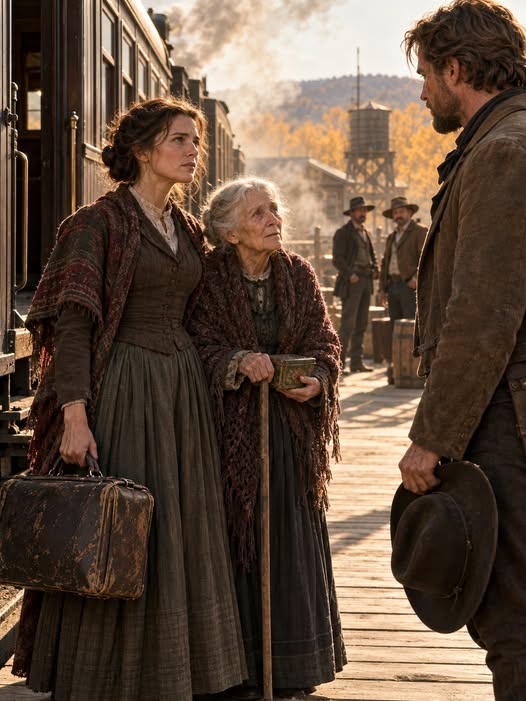
Marta did not ask when his mother died.
She only said, “If you do not want anyone in that room, say so.”
Josiah looked toward the house.
“No.”
The answer came slowly.
Then he corrected himself.
“I mean no, I do not want it kept closed forever.”
Marta waited.
“My mother died three years ago.”
“I’m sorry.”
“She went blind near the end.”
That changed the meaning of the room.
Marta looked at him carefully.
Josiah continued.
“The chair was hers. The spinning wheel too. She knew that room without looking at it.”
His voice flattened slightly, the way voices sometimes did when feeling had been pressed down too often.
“She fell once on the stairs before I moved her downstairs.”
Marta glanced toward the front of the house.
“You built that room for her.”
“I cleared it for her.”
“And after?”
“I closed the door.”
Neither spoke for several seconds.
Then Josiah said, “Halda can have it.”
Marta’s throat tightened.
Not because he was generous.
Because he had not made generosity theatrical.
“You should speak with her first.”
Josiah frowned.
“Why?”
“Because it was your mother’s room.”
“And?”
“And Halda is not a chair you decide where to place.”
Understanding came into his expression.
He nodded.
“Right.”
That evening, after supper, Josiah sat across from Halda at the kitchen table.
He told her about the room.
About his mother.
About the stairs.
Halda listened with both hands folded around her cup.
When he finished, she said, “Do you want me in there?”
Josiah took his time.
“I think the room should be used.”
“That was not my question.”
Marta looked down so neither of them would see her smile.
Josiah tried again.
“Yes.”
Halda nodded.
“Then I will look at it.”
Josiah glanced at Marta.
Halda heard the silence.
“I said look.”
Her cane tapped once against the floor.
“I did not say accept.”
Josiah stood.
“Yes, ma’am.”
The next morning, Halda inspected the room.
Not with her eyes.
With her hands.
The distance from bed to door.
Door to stove.
Stove to washstand.
The window latch.
The floorboards.
The narrow rug that could catch a cane tip.
She stopped at the carved chair.
Her fingers moved across one arm.
“Your mother used this?”
“Yes.”
“Then move it.”
Josiah looked surprised.
Halda tilted her head.
“If you want me in the room, I need the path clear. Memory is not improved by bruising an old woman’s shins.”
Josiah moved the chair.
That was the first change.
Others followed.
Marta placed Halda’s seed packets in a shallow drawer she could identify by touch.
Josiah added a rail along the short passage between room and kitchen.
Not without asking.
Halda approved it only after making him lower one end.
“You are taller than sense requires,” she told him.
Josiah obeyed.
Within a week, the closed room was no longer closed.
That mattered to him more than he expected.
Marta noticed.
She did not mention it.
The test hole on the south rise became their next problem.
For four mornings, Josiah and Marta dug.
The soil changed from packed brown to heavier dark earth.
Then gravel.
On the fifth morning, moisture appeared along one side.
Not water.
Not yet.
Enough to keep them going.
Josiah knelt and pressed two fingers into the soil.
“You may have been right.”
Marta leaned on her shovel.
“That is not the same as water.”
“No.”
“You sound disappointed.”
“I was hoping to say it once and be finished.”
She smiled.
They dug another two feet.
By afternoon, water began seeping through the gravel.
Slowly.
Clear.
Josiah sat back.
Marta crouched and smelled it.
No sharp mineral edge.
No pale crust.
She dipped a tin cup, waited for the sediment to settle, then looked at him.
“This needs proper testing.”
“There is no laboratory in Redpine.”
“I know.”
“We can let it settle and try it on one animal first.”
“Not a calf.”
“No.”
“An older steer.”
“Yes.”
He paused.
“You always this cautious?”
“When something living pays for my mistakes.”
The answer stayed with him.
They deepened the well.
Lined it.
Built a simple cover.
Ran a temporary trough.
One older steer drank there for several days.
Then two.
Then a small group.
The calves that had been losing condition were moved last.
By autumn, both had improved.
Not dramatically.
But visibly.
Josiah stopped dismissing the old stock tank merely because it had “always been that way.”
Marta noticed something else too.
He did not replace it immediately.
He kept both systems running while he watched the herd.
That pleased her.
“You are learning caution.”
He looked offended.
“I knew caution.”
“You knew stubbornness with intervals.”
“That sounds unfair.”
“It is generous.”
Halda laughed from the porch.
She had become the third witness to most of their disagreements.
By September, the seed packets in her tin box had turned into a garden.
Not a large one.
A strip beside the kitchen protected from cattle and close enough that Halda could reach it safely.
Marta marked rows with raised twine.
Josiah built low borders.
Halda planted by touch.
Dill.
Beans.
Cabbage.
Turnips.
Two kinds of peas.
And flowers nobody needed.
Josiah questioned those.
Halda turned her face toward him.
“If everything on your ranch must earn money, you have misunderstood being alive.”
He stopped questioning the flowers.
The marriage question did not disappear.
That was the difficulty.
It sat between Marta and Josiah in every practical improvement.
They had not crossed half a continent to become merely employer and housekeeper.
Their letters had begun as a courtship.
But letters imagined futures cheaply.
Life charged more.
By October, Marta knew she liked him.
That was not enough.
She respected how he worked.
How he listened.
How he adjusted the rail for Halda without defensiveness.
How he no longer drank from the old stock tank simply because he always had.
How he spoke little, but when he changed his mind, he changed his behavior too.
Still not enough.
Marriage required more than finding a decent man in a difficult country.
One evening they sat on the back step while Halda shelled beans inside.
Josiah said, “We should talk.”
Marta looked at him.
“Usually ominous.”
“The letters.”
“Yes.”
“I asked you here with marriage in mind.”
“I know.”
“You came with marriage in mind.”
“I came willing to consider it.”
He nodded.
“That is more accurate.”
Marta waited.
Josiah looked across the pasture.
“I do not want you feeling that bringing Halda makes you indebted to me.”
She went still.
“I do not.”
“Good.”
“And I will not marry you because you let her stay.”
“Good.”
“That answer was very fast.”
“It was meant to be.”
Something in her relaxed.
Josiah continued.
“I also do not want to marry because we have already begun living as though it is decided.”
Marta looked toward the house.
“We have?”
“You work beside me. You keep records. You tell me when the cattle look wrong. Halda calls my kitchen ours when she thinks I cannot hear.”
Marta smiled.
“She does that deliberately.”
“I know.”
He looked at her.
“Familiarity can look like consent if people are careless.”
That sentence surprised her.
“Who taught you that?”
“My mother.”
Marta waited.
“She married my father because there was no practical reason not to.”
“That sounds cheerful.”
“It was not unhappy.”
“But?”
“It was not chosen with much room.”
Josiah folded his hands.
“She told me once that gratitude and affection can keep a marriage alive, but neither should be confused with wanting it at the beginning.”
Marta looked at him for a long moment.
“Wise woman.”
“Yes.”
“So what are you asking?”
“I am asking whether you want more time.”
The question touched something deep.
Because yes was easy.
Because he had every practical reason to push.
Winter was coming.
A woman alone with an older nearly blind widow had fewer options than a rancher with land and cattle.
Marriage would simplify everything for him.
Instead he was offering delay.
“How much?”
“As much as you need.”
“That could be spring.”
“Yes.”
“Longer.”
“Yes.”
“And if I decide no?”
Josiah’s face changed.
Not much.
Enough.
“Then we work out a fair arrangement for you and Halda until you choose somewhere else.”
Marta looked away.
“Would you want me gone?”
“I did not say that.”
“What would you want?”
Josiah answered slowly.
“You.”
There was no performance in it.
Marta’s heart moved unpleasantly.
He continued.
“But wanting you does not answer for you.”
That night Marta lay awake longer than she wanted to admit.
The first frost came early.
Then the cattle problem deepened.
Three cows began showing the same weakness the calves had shown months earlier.
Not from the new water.
From the north pasture.
Marta checked manure.
Feed.
Salt.
Then watched the herd.
One cow repeatedly licked soil near an exposed bank.
Another avoided the mineral block.
A third chewed old fence boards.
Josiah found her crouched beside the salt box.
“What?”
“I do not know yet.”
“Water again?”
“Maybe not.”
She checked the winter hay.
Then the old pasture.
Then the grazing pattern.
The northern ground had been grazed too closely for several seasons.
Not ruined.
Depleted.
“Your cattle are short of something.”
“What?”
“If I knew, I would tell you.”
They rode to Redpine and spoke with an older cattleman who had wintered stock in the territory longer than either of them.
He listened.
Asked about soil.
Asked about hay.
Asked whether bones seemed weak.
Whether cows licked wood.
Then suggested adding a different mineral mixture and reducing pressure on the north pasture.
Not certainty.
A test.
Marta approved of that.
They changed the ration.
Moved part of the herd.
Condition improved.
Slowly.
Josiah had lost no animals.
But something else had changed.
He stopped calling the ranch his when making major decisions with Marta.
He began saying ours, then catching himself.
Marta noticed every time.
She never corrected him.
December brought snow.
Halda had learned the house so well that she could cross from bedroom to kitchen without cane on clear days.
Marta still insisted she carry it outside.
Halda called this tyranny.
Josiah supported Marta.
Halda called this conspiracy.
The three of them had become a household without choosing a name for it.
That was both comforting and dangerous.
On the first Sunday before Christmas, Josiah drove them into Redpine.
Church.
Then supplies.
Then a meal at the boardinghouse.
Marta had been in town before, but not with both of them.
People stared.
Some because of Halda.
Some because Marta had arrived months earlier as a prospective bride and no wedding had occurred.
One woman asked, kindly enough to make refusal difficult, “And when are you two making things proper?”
Marta looked at Josiah.
He looked at her.
Then said, “When Marta decides she wants to marry me.”
The woman blinked.
“What?”
Josiah picked up his coffee.
“I have already decided.”
Marta nearly choked.
The woman left confused.
Outside, Marta caught his sleeve.
“You have already decided?”
Josiah looked at her.
“Yes.”
“When?”
“September.”
“You did not say.”
“I was waiting.”
“For what?”
“You.”
Marta stared.
“That is inconvenient.”
“It has been.”
She laughed despite herself.
He smiled.
That was the moment she understood she probably loved him.
Not because he had decided.
Because he had decided and then waited without turning his decision into pressure.
Still, she did not answer.
Christmas morning came clear and bitter.
Halda gave Josiah a small cloth packet.
Inside were seeds.
He turned them over.
“What are they?”
“Flowers.”
His expression changed.
“Useful ones?”
Halda smiled.
“No.”
Marta laughed.
Josiah put them carefully in his shirt pocket.
For Marta, Halda had saved one thing from her tin box.
A folded scrap of paper.
Marta opened it.
A recipe.
Her father’s handwriting.
She stared.
“You had this?”
“He gave it to me twenty years ago.”
“For what?”
“Apple preserve.”
Marta’s eyes filled.
Halda shrugged.
“He was a better farmer than cook.”
Marta leaned over and kissed her cheek.
Halda pretended to dislike it.
Josiah gave Marta nothing until after supper.
Then he placed a small wooden box on the table.
Inside lay no ring.
Only a key.
Marta looked at him.
“What does it open?”
“The west desk.”
His ranch records.
His contracts.
His ownership papers.
His account books.
Until now, he had let her review cattle and household records, but the land papers remained his private business.
“Why?”
“If you stay here in any capacity, you should know what you are standing on.”
Marta looked at the key.
“This is not a proposal?”
“No.”
“Good.”
He hesitated.
“I do have one of those available when appropriate.”
Halda laughed from the stove.
Josiah closed his eyes.
Marta smiled.
She did not take the key immediately.
Then she did.
In January, she spent two days reading.
The ranch was sound.
Not wealthy.
Josiah owed money on winter feed from two years earlier, but payments were current.
The land itself was secure.
There were no hidden claims.
No debt large enough to trap a wife.
That mattered.
So did the fact he had shown her before marriage.
She closed the last book.
Josiah stood in the doorway.
“You found the terrible secret.”
“You keep terrible records.”
His face fell.
She added, “But honest ones.”
“That sounds like forgiveness.”
“Do not become ambitious.”
He stepped inside.
Marta looked at the key.
“Why did you really give me this?”
“Because if you marry me, I want you to know exactly what that means.”
“And if I do not?”
“You still came here because of my offer.”
He shrugged.
“You deserved the truth either way.”
Marta stood.
The answer came then.
Not dramatically.
No sudden certainty.
More like a gate unlatching.
She crossed the room.
Josiah went very still.
“I have one condition.”
His face changed.
“One?”
“Do not sound relieved.”
“I was expecting more.”
“There will likely be more.”
“Yes.”
Marta looked at him.
“Halda stays for as long as she wants.”
“Yes.”
“Not as charity.”
“Yes.”
“She has her own room.”
“Yes.”
“And if someday she needs more help than either of us can give, we decide with her, not about her.”
“Yes.”
Marta took a breath.
“The garden remains hers.”
Josiah almost smiled.
“I would not survive taking it.”
“Good.”
He waited.
Marta’s hands suddenly felt cold.
“You may ask.”
Josiah did not drop to one knee.
She was glad.
He simply took both her hands.
“Marta Halverson, will you marry me and stay here because you want this life?”
She looked at him.
Not because you need shelter.
Not because Halda needs a room.
Not because I need a wife.
Because you want this life.
“Yes.”
His eyes closed briefly.
Then he asked, “Are you certain?”
Marta laughed.
“You have learned badly from me.”
“I have learned exactly enough.”
She leaned forward and kissed him.
Short.
Quiet.
Halda called from the next room.
“I cannot see you, but silence has become suspicious.”
Marta pulled back laughing.
Josiah looked mortified.
They married in March.
Not sooner.
Marta insisted winter was no time to organize a wedding while cattle still required constant attention.
Josiah did not argue.
By then, the south well had become the primary stock source.
The old mineral-heavy tank remained for washing equipment and emergency use.
The north pasture rested.
Cattle condition improved.
The two weak calves were nearly indistinguishable from the others.
Marta began formal herd records.
Breeding dates.
Calving histories.
Water use.
Pasture rotation.
Illness.
Loss.
Sale.
Josiah complained that the cattle now possessed more paperwork than people.
Marta told him the cattle were better organized than people.
After marriage, ownership did not become vague.
That mattered to Marta.
Josiah’s ranch remained legally his.
Her savings remained hers.
Household expenses became joint.
Marta received a defined share from cattle profits for the management work she performed.
Josiah objected once.
“You are my wife.”
“And?”
“You do not need wages.”
“I am not asking wages for being married.”
That ended the objection.
Halda heard about the argument and sided with Marta so aggressively that Josiah surrendered before supper.
Spring came late.
The flowers from Halda’s Christmas packet went into the garden beside the kitchen.
Josiah planted them.
Poorly.
Halda made him redo half the row.
Marta stood on the porch watching.
The man she had come west to marry was taking gardening instructions from an elderly nearly blind woman who had once been destined for a poor farm.
Something about the sight reached deeper than romance.
It was proof that none of them had become what the world had expected to do with them.
Marta had not become merely a rancher’s wife.
Halda had not become a burden.
Josiah had not become the kind of husband who mistook providing a home for owning the people inside it.
Years passed.
The south well remained good.
They eventually drilled a deeper one nearby when the herd expanded.
The old test hole was capped but marked.
Marta refused to let Josiah remove it.
“Why?”
“Because that was the first argument we won together.”
“You were right.”
“That is why we won.”
He looked at her.
She smiled.
“Mostly.”
The ranch grew carefully.
Not vast.
Not famous.
Healthy.
Calf losses fell.
Pastures rotated properly.
Water was tested by observation before habit.
Whenever cattle refused a trough, someone checked the water before blaming the cattle.
Halda’s eyesight declined completely.
By then she knew the house, garden paths, porch, and yard so well that blindness changed less than outsiders expected.
She continued saving seeds.
Continued ordering Josiah around.
Continued refusing to be called helpless.
One evening, years after Marta’s arrival, Halda sat in her carved chair near the kitchen stove.
The chair had once belonged to Josiah’s mother.
Marta had worried the first time Halda chose it.
Josiah had not.
He stood in the doorway and watched the old woman settle into it.
“Comfortable?”
Halda ran one hand along the arm.
“Your mother had sense in chairs.”
Josiah smiled.
That was all.
The room no longer belonged exclusively to grief.
It carried memory.
Halda’s blankets.
Seed drawers.
A cane by the wall.
A dried flower tied near the window.
A life layered over another life without erasing it.
When Halda died, she did so in that room.
Old.
Warm.
Marta beside her.
Josiah nearby.
Her last spring seeds already sorted into labeled cloth packets for a garden she knew she would never see planted.
Marta grieved her like family.
Because that was what Halda had become.
At the burial, a neighbor called Marta generous for bringing an old nearly blind widow west.
Marta corrected her.
“I did not save Halda.”
The woman looked confused.
Marta glanced toward Josiah.
Then toward the ranch.
“Halda changed the terms of my life before I ever understood what they were.”
Afterward, Marta planted every seed packet.
Including flowers nobody needed.
Years later, when travelers heard the story, they usually told it wrong.
They said Marta Halverson arrived in Dakota with an old blind woman and immediately saved a ranch by discovering good water.
That version annoyed her.
The cattle had not been dying dramatically.
The old tank was not poison.
No miracle spring erupted from the ground.
The truth was slower.
She noticed cattle losing condition.
She questioned water everyone else had accepted.
She saw green grass where dry ground suggested moisture.
Josiah listened enough to dig.
Then they tested.
Watched.
Changed.
That was how the ranch improved.
The same was true of the marriage.
Nothing miraculous happened at the train station.
Josiah did not look at Marta and instantly know she belonged beside him.
Marta did not see him and decide the long journey had ended.
He had room for one woman.
She arrived with two lives that mattered.
The question became whether his idea of home could grow without asking either woman to shrink.
It did.
Not because he said yes once on a railroad platform.
Because he kept saying yes in smaller ways afterward.
To the room.
To the garden.
To better water.
To records.
To wages.
To questions.
To being corrected.
And Marta kept choosing too.
To stay another month.
Then winter.
Then marriage.
Then years.
One autumn afternoon, long after Halda was gone, Marta stood beside the southern pasture while Josiah checked a new calf.
The herd moved toward the newer trough.
Clear water spilled over the edge.
Near the house, Halda’s flower bed still bloomed badly because Josiah planted too many seeds in one place every spring despite instructions Marta had repeated for years.
She looked at him.
“You know those flowers need thinning.”
Josiah straightened.
“I know.”
“You say that every year.”
“Yes.”
“And then do nothing.”
“They appear determined.”
“They are crowded.”
“Still alive.”
Marta shook her head.
He came beside her.
“Do you regret it?”
“What?”
“Bringing Halda.”
Marta looked at him.
“No.”
“That was quick.”
“She was never the mistake.”
Josiah nodded.
He understood.
Marta looked across Cinder Creek.
At the cattle.
The water.
The house with one downstairs room that had belonged first to one grieving son’s memory, then to an old woman who planted flowers no ranch needed.
At a life she had not crossed the country to surrender into.
A life she had chosen after examining it carefully.
“No,” she said again.
“Halda was how I found out whether there was room here for me.”
Josiah took her hand.
There had been.
Not because the house was large enough.
Because eventually, the people inside it were.

