
Part 1
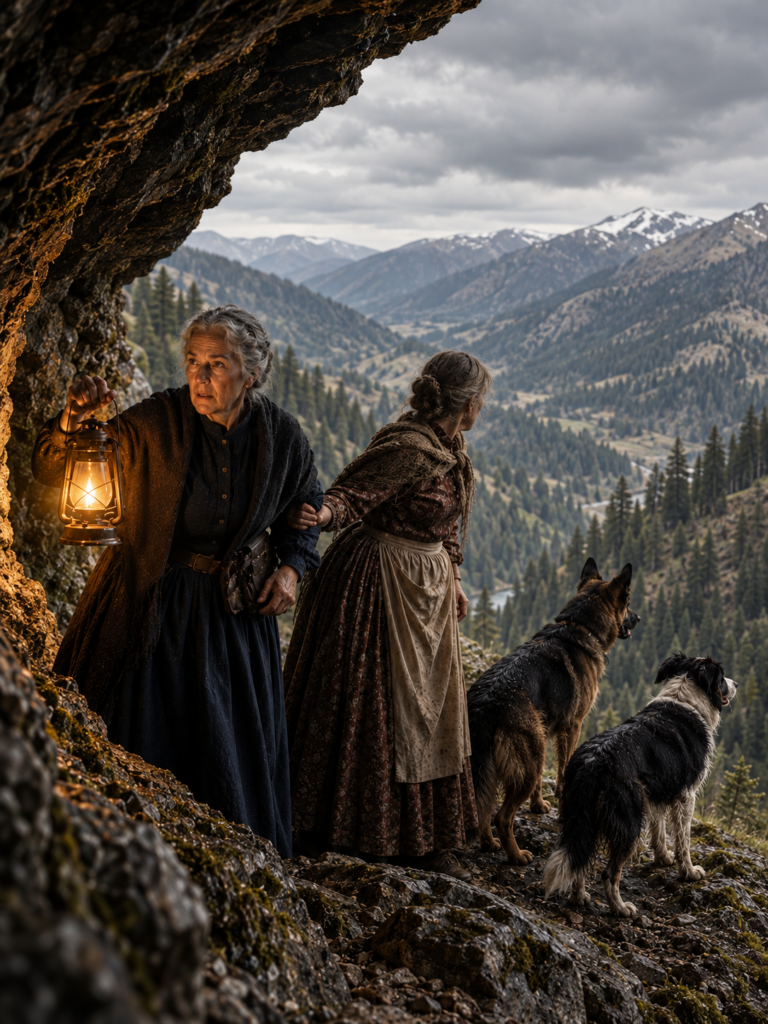
The first thing Margaret Oliver noticed was that the dog wouldn’t stop circling the wagon.
Milo had been a dependable animal for most of his life. He knew when to follow, when to guard, and when to settle down beside a fire. At his age, he generally preferred lying somewhere warm to wasting his energy chasing things that weren’t worth catching.
But that afternoon, he refused to settle.
He kept moving between the wagon wheels and the dark line of the mountain ridge, stopping every few moments to lift his nose into the wind.
Scout, Mary Ann Foster’s old sheepdog, was behaving much the same way.
Neither woman understood what had gotten into them.
Margaret stood beside the wagon, tightening the wool shawl around her shoulders. She was sixty-eight years old, her knees ached from days of traveling over rough ground, and the clouds gathering above the Wyoming mountains looked nothing like an ordinary autumn sky.
“Something’s bothering those dogs,” Mary Ann said.
Margaret followed Milo’s gaze toward the ridge.
“Maybe they know something we don’t.”
Mary Ann gave a tired little laugh.
“Wouldn’t be the first time.”
Neither woman laughed for long.
Beyond the trees, the wind was beginning to rise.
And somewhere inside the mountain ahead of them lay a secret that had waited decades to be discovered.
Neither widow had any reason to suspect that the worst betrayal of her life would lead her to something extraordinary.
Three weeks earlier, Margaret hadn’t even known she would be leaving home.
She had believed, with the stubborn certainty of a woman who had worked the same land for forty years, that she would die on the ranch where she had spent most of her adult life.
Her husband had been buried the previous winter.
For the four years before his death, illness had slowly taken away the strength that once allowed him to lift feed sacks, mend fences, and work from sunrise until the last cattle were accounted for.
During those years, Margaret had done the work of two people.
She kept the books, arranged for supplies, managed the livestock, paid the men when extra hands were needed, and rode out to inspect damaged fencing when the weather permitted.
There had been mornings when she could barely straighten her back after climbing out of bed.
She got dressed anyway.
There had been winters when the water froze in the troughs and she spent hours breaking ice before the animals could drink.
She did that, too.
After her husband’s funeral, she expected life to become quieter.
What she hadn’t expected was for her own son to decide that her life belonged to him.
Bradley arrived one morning with his wife, Sandra, and a folded document tucked beneath his arm.
He kissed his mother on the cheek.
Then he sat at the kitchen table where his father had eaten breakfast for nearly four decades.
Sandra remained standing.
Margaret noticed that immediately.
Her daughter-in-law had never been particularly comfortable in the old ranch house. She disliked the smell of woodsmoke that settled into the curtains, the uneven floors, and the way cattle sometimes wandered close enough to the kitchen windows to make their presence known.
Margaret had always tried to be civil.
Family was family, after all.
“Coffee?” she offered.
“No, thank you,” Bradley said. “We need to discuss something.”
Margaret looked at the document beneath his hand.
“What kind of something?”
Bradley hesitated, though not because he was uncertain.
He had the expression of a man rehearsing words he had already decided to say.
“Mother, Sandra and I have been talking.”
“That generally means trouble.”
“Please don’t start.”
“I haven’t started anything. You came into my kitchen carrying papers.”
Sandra shifted her weight.
Bradley unfolded the document and pushed it across the table.
“It’s for the best, Mother.”
Margaret didn’t touch it.
“What is?”
“The ranch. Your situation. All of it.”
“My situation?”
“You’re getting older. This place is too much for one person.”
Margaret looked toward the window.
Outside, the afternoon sun fell across the barn roof. Beyond it stretched the pasture where she had helped raise cattle, watched calves struggle onto their feet, and walked beside her husband on evenings when they were too tired to say much.
She turned back.
“I’ve managed it alone since your father took sick. Four winters now.”
“That’s exactly the trouble,” Bradley replied. “You shouldn’t have had to.”
“But I did.”
“Mother.”
“And I did it well.”
Bradley rubbed his forehead.
Sandra finally spoke.
“We’ve found a very respectable home in town. You’d have meals prepared, people to look after you, and none of this constant worry.”
Margaret stared at her.
“Whose worry?”
Sandra didn’t answer immediately.
“Everyone’s.”
Margaret lowered her eyes to the document.
The old survey boundaries were unmistakable.
So was her husband’s signature.
She recognized the shape of his letters, the uneven pressure of the pen, the final stroke that always curved slightly upward.
For a moment, seeing his handwriting hurt more than anything Bradley had said.
Then she noticed the buyer’s mark.
And the figures beside it.
Her gaze moved slowly back to her son.
“What’s this?”
Bradley cleared his throat.
“We’ve already spoken with the land agent. The sale should bring enough to provide for your care for years.”
Margaret placed one hand flat on the table.
“You’ve already spoken to someone about selling my home?”
“It’s not that simple.”
“It seems simple enough to me.”
“We’re trying to help you.”
“You went to a land agent before asking whether I wanted to leave.”
Sandra folded her arms.
“Margaret, please be reasonable.”
That word struck harder than either woman intended.
Reasonable.
For forty years, Margaret had been reasonable.
Reasonable when money was scarce.
Reasonable when her husband spent more time in bed than on horseback.
Reasonable when Bradley was young and wanted things they couldn’t afford.
Reasonable when she gave up small comforts because the ranch needed something more urgently.
Now they were using the same word to explain why she should hand over the life she had built.
“Have you already chosen the day I’ll be leaving?” she asked.
Bradley looked away.
That was answer enough.
Margaret folded the document and returned it to him.
“I’ll pack.”
Bradley’s expression softened with visible relief.
“Mother, I’m glad you understand.”
She stood.
“I understand more than you think.”
He began explaining how comfortable the home would be and how much easier life would become.
Margaret walked out before he finished.
In her bedroom, she opened the old trunk at the foot of the bed.
She packed practical things first.
Two dresses. Clean stockings. A spare blouse. Her warmest coat.
Then she opened the small wooden box in which her husband had kept his compass.
Its brass case was scratched from years of use, but the needle still pointed north.
She held it for a moment before placing it inside the trunk.
Next came the shawl her mother had knitted long before Margaret married.
Everything else stayed where it was.
There were photographs on the mantel.
A chair her husband had repaired three times rather than replace.
A worn quilt that still held the faint smell of cedar from the chest where they stored it every summer.
She left them.
Not because they meant nothing.
Because taking them would have meant admitting that a few objects were all she was allowed to keep from forty years of marriage.
When Bradley returned to help with her trunk, Margaret was already fastening the straps.
“You don’t need to rush,” he said.
“I thought that was exactly what you wanted.”
He flinched.
“That isn’t fair.”
Margaret looked at him for a long moment.
She remembered the little boy who once cried because he had stepped on an injured bird.
She remembered teaching him to ride, standing beside the horse with one hand on his boot.
She remembered staying awake through nights when he was sick, promising that nothing bad would happen while she was there.
Now he stood in front of her, a grown man, asking her to believe that taking her home away was an act of kindness.
“Neither is this, Bradley.”
She picked up her husband’s compass.
“Neither is this.”
By afternoon, she was preparing her wagon.
She hadn’t agreed to enter the home Bradley and Sandra had chosen.
She hadn’t told them where she intended to go.
The truth was, she didn’t know.
But she knew where she wasn’t going.
And for the first time since her husband’s death, making a decision for herself felt like breathing without somebody watching.
Two valleys away, Mary Ann Foster was experiencing a different kind of betrayal.
Her husband, Frank, had died the previous autumn.
For years they had worked a modest piece of land that had never made them wealthy but had always provided enough.
Their house stood beside an open field where the grass grew high in summer and the wind came down hard in winter.
Frank had been a quiet man.
He repaired things slowly and carefully, sometimes spending an entire afternoon fixing a tool that another man would have thrown away.
Mary Ann used to tease him for it.
He would shrug.
“Still has work left in it.”
After his death, she found herself using the same words whenever something broke.
It was one of the ways she kept him close.
She had expected hardship after losing him.
She hadn’t expected his brother Carl to be the cause of it.
Carl arrived with a lawyer and a yellowing family deed.
Mary Ann invited them inside, though she quickly came to regret it.
The lawyer placed the papers on her kitchen table and explained that the Foster property had been passed down under an old inheritance clause.
The land, according to that clause, belonged to the male heirs of the Foster line.
Frank had possessed it during his lifetime.
Now that he was gone, the lawyer claimed it reverted to Carl.
Mary Ann listened without interrupting.
When the man finished, she asked one question.
“Where does that leave me?”
The lawyer adjusted the papers.
“I’m afraid the land was never legally yours to retain, Mrs. Foster.”
Mary Ann looked at Carl.
He wouldn’t meet her eyes.
“I planted those fields,” she said. “I helped put that roof over our heads. I nursed your brother when he couldn’t get out of bed.”
Carl shifted uncomfortably.
“No one’s denying you worked hard.”
“Then what are you denying?”
“It’s a matter of family property.”
Mary Ann almost laughed.
“Family property?”
Carl stared at the table.
“There’s no reason to make this unpleasant.”
She rose from her chair.
“You came into my home to tell me it doesn’t belong to me anymore. I reckon unpleasant started before you knocked.”
The lawyer spoke again, explaining that the old clause had been examined and that the necessary paperwork was already moving forward.
Mary Ann refused to sign anything.
She demanded time.
She asked whether the years she and Frank had spent improving the land counted for nothing.
But the answers never changed.
The paperwork favored Carl.
And the sheriff’s signature eventually appeared on an eviction notice.
She was expected to leave by Friday.
Mary Ann read that notice three times.
Then she folded it carefully and placed it in a kitchen drawer.
For several minutes she stood beside the window overlooking the field.
Frank had been buried only months earlier.
His boots still sat near the back door.
His favorite coat hung from its peg.
She had believed those small things would be hers to live with until she was ready to put them away.
Now a man who hadn’t helped build their life was telling her she could no longer remain inside it.
She packed what she could fit into a wagon.
A few pieces of furniture.
Bedding.
Pots and pans.
A sack of flour and what remained of the cornmeal.
The old mule stood patiently while she tightened its harness.
Scout, her sheepdog, watched from the porch.
When she climbed onto the wagon seat, he immediately trotted alongside.
“You could stay,” she told him.
Scout wagged his tail.
“Wouldn’t be much use to you, I suppose.”
The dog jumped up beside her.
Mary Ann took one last look at the house.
Then she turned the mule toward the road.
She did not look back again.
Three days later, the two widows met at a crossroads trading post.
Margaret had stopped to secure a loose strap on her wagon when she heard someone call her name.
“Margaret Ollie?”
She turned.
A woman stood beside a mule-drawn wagon, holding a small sack of supplies.
For a moment, neither recognized the other completely.
Then Margaret’s face changed.
“Mary Ann?”
Mary Ann’s smile widened.
“Well, I’ll be.”
They had known each other as girls, years before marriage carried them into different valleys.
They had once shared secrets, attended the same gatherings, and made impossible plans about the futures they expected to have.
One of those plans involved growing old together on a porch somewhere.
They had laughed about it because neither imagined that adulthood would separate them for forty years.
Now they stood facing one another with gray hair, tired eyes, and two wagons that contained what was left of their households.
Mary Ann glanced at Margaret’s belongings.
Then Margaret glanced at hers.
Neither needed much explanation.
“You too?” Mary Ann asked softly.
Margaret nodded.
“Bradley.”
“Carl,” Mary Ann replied.
They stood without speaking.
Then Mary Ann shook her head.
“Seems we’ve both had the same kind of week.”
Margaret gave a small, humorless smile.
“Mine’s been longer than a week.”
The dogs approached one another cautiously.
Scout sniffed Milo’s shoulder.
Milo circled him once.
Within minutes, the two had apparently decided they belonged to the same traveling party.
Their owners took a little longer.
They purchased the supplies they could afford and sat beside the wagons eating bread and cheese.
Margaret explained Bradley’s plan to sell the ranch and place her in a home.
Mary Ann described Carl’s deed, the lawyer, and the eviction notice.
As the afternoon lengthened, their conversation moved beyond the injuries themselves.
They spoke of husbands they missed.
Of houses that had become quiet.
Of the strange humiliation of having younger relatives explain what they were no longer capable of doing.
“Bradley keeps talking about my age,” Margaret said.
“How old does he expect to get?”
Mary Ann smiled.
“Apparently men don’t age. They just become respectable.”
Margaret laughed then.
A real laugh.
It surprised her.
She couldn’t remember the last time laughter had come without effort.
Eventually Mary Ann looked toward the western road.
“Where are you headed?”
Margaret followed her gaze.
“Don’t know.”
“Neither do I.”
The wind stirred dust along the wagon wheels.
Mary Ann considered the road for a moment.
“We always said we’d have a porch together someday.”
“Didn’t picture it starting with two wagons and a pair of homeless dogs.”
“Well, nobody ever accused us of planning sensibly.”
Margaret looked at her old friend.
A familiar thought came to her, one she hadn’t allowed herself to consider since leaving the ranch.
She didn’t have to make every decision alone.
“We could travel together awhile,” she suggested.
Mary Ann glanced at Scout, then Milo.
“Looks like those two already settled it.”
They set out westward the following morning.
For four days they followed old logging roads through country neither knew well.
They traveled slowly because of the wagons and the animals.
They stopped beside streams where the water was shallow enough to fill their containers.
They shared simple meals and watched the sky each evening before settling down.
Margaret proved better at judging distances and keeping their direction.
Mary Ann understood the mule’s limits and had a steady way with frightened animals.
Neither woman tried to take charge of the other.
It was a small difference from what they had recently endured, but it mattered more than either admitted.
At night, they spoke beside their little campfires.
Sometimes about their families.
More often about ordinary things.
The taste of fresh bread.
The trouble with cold fingers.
The way Wyoming wind could find its way through wool, canvas, and wood as if none of them existed.
One night, Mary Ann asked whether Margaret thought Bradley might come searching for her.
Margaret stared into the fire.
“He knows how to find me if he wants to apologize.”
“Do you think he will?”
Margaret considered the question.
“No.”
Mary Ann waited.
“Not because he doesn’t know what he did,” Margaret continued. “Because he’d have to admit he was wrong.”
Mary Ann nodded.
She understood that kind of stubbornness.
It was the sort that looked remarkably like pride until someone else paid the price for it.
On the fifth day, the weather changed.
The morning began under heavy gray clouds.
By noon, a hard wind swept down from the mountains.
The first snowflakes came almost sideways.
Margaret pulled her coat tighter.
“We ought to find shelter.”
Mary Ann scanned the country ahead.
“Don’t see any.”
The snowfall thickened.
Within an hour, the road had begun to disappear beneath a shifting layer of white.
The mule stumbled once.
Mary Ann slowed the wagon.
Then it stumbled again, slipping hard on ice hidden beneath the fresh snow.
She climbed down immediately and hurried to its head.
“Easy now. Easy.”
The animal struggled to regain its footing.
She held the bridle and spoke in the quiet, reassuring tone Frank had once used.
“Nobody’s in such a hurry. Take your time.”
At last the mule stood.
But it favored one leg.
Mary Ann watched its movements and felt the weight of what that meant.
It could not pull the wagon much farther.
Margaret’s horses were struggling too.
Their heads hung low against the wind, and the snow gathered along their manes.
The women exchanged a look.
Neither wanted to say what both understood.
They were in unfamiliar country.
The road was disappearing.
And if their animals failed, they might not survive the night.
“We can’t keep going,” Margaret shouted.
Mary Ann looked toward the trees.
“We can’t stay here either!”
The wind tore at their clothes.
Snow blinded them whenever they turned toward the ridge.
Eventually they were forced to abandon the wagons in the narrow ravine and lead the exhausted animals toward what shelter the terrain offered.
Mary Ann secured the mule as carefully as she could.
Margaret checked the horses, speaking softly to them as they stood with lowered heads.
Neither woman wanted to leave the animals.
But the storm was becoming too dangerous to remain in the open.
Then Scout started barking.
Not the ordinary bark he used when a stranger approached.
This was sharp, repeated, insistent.
He ran several yards up the rocky slope and turned back.
Milo followed him.
Both dogs disappeared briefly behind a curtain of blowing snow.
Then Scout barked again.
Mary Ann raised her head.
“Margaret!”
“I see him!”
High above the ravine, a dark opening broke the line of the rock face.
It was almost invisible from below.
Margaret shaded her eyes.
“Could be nothing.”
“Could be somewhere the wind can’t get us.”
They gathered a few necessary supplies and began climbing.
The slope was steep enough to make every step painful.
Loose stones shifted beneath their boots.
Margaret’s knees protested.
Mary Ann reached back more than once to steady her.
Scout kept moving ahead, then returning, as though impatient with the slow progress of his two human companions.
Milo waited near the opening.
By the time Margaret reached the cave, she was breathing hard enough that she couldn’t immediately speak.
She stepped over the rocky threshold.
And the wind stopped.
The silence was astonishing.
Outside, the storm roared across the ridge.
Inside, they could hear one another breathing.
Mary Ann leaned against the stone wall.
“Well,” she said after a while, “I’ll give the dogs credit for this one.”
Margaret lowered herself onto a dry patch of ground.
“I’ll give them all the credit they want.”
The cave was larger than it appeared from outside.
Its entrance was sheltered by an overhang, and the passage narrowed before extending into deeper darkness.
Dry branches had accumulated near the opening.
The women gathered what they could and built a small fire.
They shared their remaining cornmeal.
Their supper was thin, but warm.
Scout curled close to Mary Ann.
Milo settled beside Margaret’s boots, apparently satisfied that the women had finally followed his advice.
As the fire burned lower, Margaret examined her husband’s compass.
The brass case caught the light.
Mary Ann noticed.
“That his?”
Margaret nodded.
“He carried it nearly everywhere.”
“Good thing you brought it.”
“I almost didn’t.”
She closed the compass.
“Bradley wanted to make sure I had everything I needed for the home in town. But I suppose I didn’t agree with his definition of needed.”
Mary Ann looked around the cave.
A stone wall.
Two blankets.
A small fire.
Food enough for another meal, perhaps.
She thought of the house she had lost.
Then she looked at Margaret.
“Funny, isn’t it?”
“What?”
“We had roofs and beds and proper kitchens. And somehow, sitting here with you, I feel less alone than I did in my own house those last few months.”
Margaret watched the fire.
“I know what you mean.”
Neither said anything more.
Outside, the snow continued falling.
They slept in short intervals, waking whenever the fire needed tending.
By morning, the worst of the storm had passed.
Pale daylight entered the cave.
Mary Ann was first to rise.
She checked Scout, then stepped toward the entrance to look at the sky.
The ravine lay buried beneath snow, but the wind had quieted considerably.
The animals would need attention.
Their supplies were limited.
And they still had no clear destination.
Margaret remained near the fire, working life back into the embers.
Mary Ann began searching for dry wood.
She found small branches near the entrance, then noticed that the cave continued farther into the mountain.
She took a burning piece of wood from the fire and cautiously made her way deeper.
The passage turned slightly.
The ground was uneven, scattered with loose stones.
After roughly fifty feet, she noticed something unnatural beneath a low shelf of rock.
At first she thought it was a fallen timber.
Then the light caught a straight metal edge.
She crouched.
It was a chest.
Old, iron-cornered, and half buried beneath accumulated dirt and stone.
Mary Ann brushed away the dust.
There was a rusted lock on the front.
The chest looked as though it had not been touched for decades.
She stared at it for several seconds.
Then she called toward the entrance.
“Margaret?”
Her voice sounded different in the narrow passage.
“Margaret, you’d better come here.”
Footsteps scraped against the stone behind her.
“What is it?”
Mary Ann moved the torch closer.
Margaret stopped.
Neither woman spoke at first.
The chest sat before them in the darkness, with its old iron fittings and a lock so corroded that rust had spread down the front.
Margaret knelt slowly.
“Well, somebody wanted that kept safe.”
Mary Ann touched the lid.
“Or kept hidden.”
They tried lifting it.
It wouldn’t move.
Margaret searched among their few tools and eventually brought back a tire iron from the wagon supplies.
Working together, they wedged it against the ruined lock.
Mary Ann held the chest steady while Margaret pulled.
The first attempt accomplished nothing.
The second shifted the metal slightly.
On the third, the lock broke free with a sharp crack that echoed through the passage.
Both women sat back, startled by the sound.
Then Margaret lifted the lid.
Inside lay a leather-bound journal, a folded hand-drawn map, and several small bundles of seed packets.
There were no coins.
No jewelry.
No precious stones.
Only paper, leather, and seeds carefully wrapped against the damp.
Mary Ann looked disappointed for just a moment.
Then Margaret lifted the journal.
Its cover was worn but intact.
Pressed into the leather was a name.
Constance Ayers.
Margaret opened the first page.
The handwriting was neat, deliberate, and surprisingly easy to read.
She held the journal closer to the light.
The opening sentence made her stop.
Mary Ann noticed the sudden change in her expression.
“What does it say?”
Margaret swallowed.
Then she read aloud.
“If you are reading this, then you are very likely a woman who has been told she cannot manage on her own.”
Mary Ann stared at her.
Margaret looked back down.
“I was told the same.”
There was another sentence.
“This is what I found instead.”
For a long moment, the two women looked at one another without speaking.
Neither knew who Constance Ayers had been.
Neither understood why she had hidden her journal inside a mountain.
But forty years of friendship, two unhappy families, and a sudden snowstorm had brought them to a message that seemed to have been written specifically for them.
And the pages that followed were about to tell them something neither had ever imagined.
Part 2
Margaret carried the journal back toward the fire with the care she might have given a sleeping child.
Mary Ann followed with the map and the seed packets, while Scout and Milo wandered ahead, apparently satisfied that whatever had drawn the women into the darkness was no longer dangerous.
The storm had moved eastward during the night.
Outside, the mountain wore a fresh layer of snow.
Inside the cave, the two widows sat close enough to the fire to read the old pages.
Margaret turned to the beginning.
Constance Ayers had arrived in Wyoming Territory in 1874.
She came west with her husband, carrying the ordinary hopes of people who believed that hardship was easier to endure when it promised something better on the other side.
They had little money.
Their belongings were modest.
But they possessed a homestead claim, and Constance believed that land, once worked and improved, could become a place where they would grow old together.
For a time, she worked as though that future were certain.
She helped clear the ground.
She learned the seasons.
She carried water, tended what could be grown, and kept careful notes about the soil and weather.
Then, the following spring, her husband left.
He had heard of richer land two counties away.
He had also found a younger woman he preferred to take with him.
According to the journal, he departed with few explanations and no intention of returning.
Constance remained behind.
She had no family nearby and little money with which to begin again.
Worse, the land she believed was hers had become legally uncertain.
The land office was unwilling to recognize her position in the way it had recognized her husband’s.
She could work the ground.
She could improve it.
She could spend every remaining year of her life there.
But whether she would be allowed to keep it was another matter.
Margaret stopped reading.
Mary Ann looked at her.
“Sounds familiar.”
Margaret gave a small nod.
“Too familiar.”
She turned another page.
Constance had written about waiting for letters that never came.
She described the humiliation of hearing other people discuss what would become of her, as though she were a piece of furniture left behind by a departing owner.
She wrote about men who advised her to abandon the claim before winter.
Some suggested she find relatives willing to take her in.
Others assumed she would remarry.
But Constance had no wish to exchange one dependency for another.
Mary Ann reached toward the fire and adjusted a piece of wood.
“Imagine coming all that way,” she said quietly, “just to have somebody tell you the place you built isn’t yours.”
Margaret thought of Bradley standing in her kitchen.
She could still see the document beneath his hand.
“Don’t have to imagine much.”
They continued reading.
Constance’s circumstances changed when a neighboring widow named Delphine Marsh appeared at her door.
Delphine arrived with a wagon, a milk cow, and a proposition.
She had been living alone and understood what it meant to struggle without help.
But unlike the people who advised Constance to surrender, Delphine offered something practical.
They could work together.
Two women sharing labor, supplies, risks, and decisions might be able to maintain what neither could protect alone.
They would file their claim together and insist that their signatures be treated as seriously as anyone else’s.
They were not sisters.
They were not connected by marriage.
They simply agreed that if the world refused to make a place for women like them, they would try to make one themselves.
Margaret rested the journal in her lap.
“They just decided to do it.”
Mary Ann considered that.
“Suppose nobody was coming to do it for them.”
The journal continued through seasons of difficult work.
Constance described carrying stone for a foundation and Delphine repairing the wagon after a wheel failed.
There were notes about their milk cow, about water, about windbreaks, and about the relentless labor required to establish a home in country that offered little freely.
They argued occasionally.
Constance believed work should begin before daylight.
Delphine believed a person ought to eat breakfast first.
Constance was careful with supplies.
Delphine was more willing to use what they had when work needed doing.
But the disagreements never threatened their arrangement.
They settled them because neither wanted to return to the life she had escaped.
Their partnership wasn’t romanticized in the journal.
Constance recorded exhaustion, failed efforts, cold nights, and days when the two women barely spoke because there was nothing useful left to say.
But she also recorded the small successes.
A repaired roof.
A full water barrel.
A meal cooked after a long day.
The first night they sat beside their own hearth without wondering whether someone would arrive and order them away.
Mary Ann listened closely.
She had spent years beside Frank, and she understood the comfort of working with another person who could anticipate what needed doing.
What surprised her was how naturally she could imagine the two widows building a life without husbands.
She looked at Margaret.
“You reckon we could’ve done something like that?”
Margaret glanced around the cave.
“We’ve already managed five days on the road and a snowstorm.”
“That isn’t a homestead.”
“No. But it’s more than Bradley thought I could manage.”
Mary Ann laughed softly.
They returned to the journal.
Constance had included a map.
It marked a spring beyond the eastern ridge, sheltered ground, a stand of dead pine, and the foundation the two women had laid for their home.
Beside the drawing were detailed notes about distances and natural landmarks.
The handwriting was careful enough to make Margaret wonder whom Constance had expected to read it.
The answer appeared in a later entry.
Constance had begun keeping the journal not only for herself but for another woman who might someday need it.
She knew how easily a woman’s work could disappear from official accounts.
A fence remained standing, but the person who mended it was forgotten.
A field continued producing, but the woman who cleared it was mentioned only as somebody’s wife.
Constance wanted there to be a record.
More than that, she wanted another woman to know the spring existed, the ground could be worked, and the life she had built was possible.
Margaret studied the map.
“Think the spring’s still there?”
Mary Ann leaned closer.
“If she’s drawn it right.”
“It might be buried.”
“Then it’ll still be buried tomorrow if we don’t look.”
Margaret smiled.
That was the Mary Ann she remembered from childhood.
The one who had always been willing to try something simply because no one had proved it impossible.
The following morning, after tending to their animals and checking the weather, they followed the map.
The snow made travel difficult.
They moved slowly, guided by the compass and the landmarks Constance had drawn.
They passed a cluster of dead pine and crossed an uneven stretch of ground where the rock rose in shelves.
At several points, Margaret stopped to compare the surrounding country with the map.
The drawing was old, but the mountains had not changed.
Finally, they came to a narrow fold in the land.
Mary Ann heard the water before she saw it.
A faint, steady trickle beneath the silence of the snow-covered valley.
She hurried forward as quickly as her aching legs would allow.
There, emerging from beneath a shelf of rock, flowed a spring.
Clear water gathered in a shallow basin before moving away between the stones.
It had not frozen.
Mary Ann knelt and touched it.
Then she looked up.
“She was right.”
Margaret came beside her.
For several moments, they did nothing but watch the water flow.
After days of uncertainty, it seemed astonishing that something drawn on a piece of old paper could still exist exactly where it had been promised.
Nearby stood the remains of a stone foundation.
Snow had filled its corners.
Moss covered many of the stones.
Brush and fallen branches obscured its outline.
But the shape was unmistakable.
Someone had built a home here.
Margaret walked slowly around it.
She touched a stone darkened by years of weather.
“Constance and Delphine?”
Mary Ann nodded.
“Must be.”
They stood together inside the ruined foundation.
The walls were gone.
The roof had disappeared long ago.
But the space still held the proportions of a dwelling, and Margaret could imagine where two women might once have warmed themselves near a hearth after a long day.
“It’s sheltered,” she said.
“Spring’s close.”
“Ground looks workable beneath all that snow.”
Mary Ann turned toward the valley.
The northern ridge stood between them and the worst of the wind.
Trees lined the outer slopes.
The land was isolated, but it did not feel barren.
“What do you think?” she asked.
Margaret looked at the remains of the house.
“I think they knew what they were doing.”
They began clearing the foundation.
At first, it was simply something useful to do while deciding where they could go.
Then one day became several.
They brought supplies from the wagons as the weather improved.
They made the animals as comfortable as possible and gradually established a modest camp close to the spring.
Every morning, they worked until their strength failed.
They removed fallen branches.
They pulled roots from between the foundation stones.
They shifted loose rocks back into place and cleared away decades of accumulated earth.
Margaret’s hands developed blisters.
Mary Ann’s back ached whenever she straightened.
The work was slower than either liked.
Neither complained much.
They had both spent most of their lives performing necessary tasks without expecting anyone to praise them.
But something was different here.
When Margaret moved a stone, Mary Ann thanked her.
When Mary Ann carried water, Margaret took over the next task.
No one suggested they were too old to understand what needed doing.
No one spoke of placing them somewhere more convenient.
Each morning, they looked at the work before them and decided together how much they could manage.
One afternoon, Margaret sat on a cleared section of the foundation and rubbed her sore hands.
Mary Ann approached carrying a small bundle of branches.
“Think we’re foolish?” she asked.
“Probably.”
“Good.”
Margaret looked up.
“Good?”
“If we’re foolish, at least we’re being foolish on our own account.”
Margaret smiled.
It had been a long time since her choices had felt entirely hers.
She looked toward the spring.
“I keep thinking about that kitchen table.”
Mary Ann set the branches down.
“Bradley?”
Margaret nodded.
“I keep hearing him tell me I can’t manage. Then I look around here and realize I’m doing exactly what he said I couldn’t.”
Mary Ann sat beside her.
“Maybe that was never really the question.”
“What do you mean?”
“Maybe he wasn’t worried about whether you could manage.”
Margaret was quiet.
She understood what Mary Ann meant.
If Bradley truly believed she was helpless, he might have asked what help she wanted.
Instead, he had chosen an answer before discussing the problem with her.
Mary Ann stared across the ruined foundation.
“Carl did the same. He didn’t ask how I’d live after leaving. Just made certain I had a day to be gone.”
Margaret studied her friend’s face.
“Do you wish you’d fought harder?”
Mary Ann took her time answering.
“I wish Frank had been there.”
Margaret reached across the stone and took her hand.
Mary Ann looked down at their joined fingers.
“But he wasn’t,” she continued. “And wishing hasn’t made Carl kinder.”
They sat a while longer.
Then Mary Ann stood, brushing dirt from her skirt.
“Come on. Those stones won’t move themselves.”
By the end of the week, the foundation’s outline was visible again.
The old hearth had been cleared.
The area around the spring was easier to reach.
They had even prepared a small patch of ground using the directions Constance had recorded.
Mary Ann examined the seed packets from the chest.
The labels identified what each contained and where Constance believed it would grow best.
The packets were decades old.
Neither woman knew whether any seed could still take root.
But Mary Ann carefully planted a few in the prepared ground.
Margaret watched.
“You think they’ll grow?”
Mary Ann patted the soil.
“Only one way to find out.”
It was Milo who discovered the second container.
He had been sniffing along the outside corner of the foundation when he suddenly began digging.
At first, Margaret ignored him.
Then the old shepherd started scratching so insistently that she walked over to investigate.
“Milo, what have you got there?”
The dog moved aside.
Beneath the loosened earth, Margaret noticed a hard, straight surface.
She knelt and cleared away more dirt.
Something had been buried against the foundation.
“Mary Ann!”
Her friend came around the remains of the hearth.
Margaret pointed.
“We’ve found something else.”
Working together, they uncovered a small, heavily secured container.
Unlike the chest in the cave, this one had been hidden deliberately beneath packed earth and stone.
They carried it near the fire.
It took patience to open.
Inside were folded documents protected by layers of wrapping.
One bore the seal and signature of a territorial surveyor.
Another contained formal measurements and references to the land surrounding the spring.
Margaret unfolded the largest sheet.
Mary Ann leaned over her shoulder.
At the top was a land claim.
The boundaries corresponded with the map from the cave.
And on the document, beneath the official markings, stood two names.
Constance Ayers.
Delphine Marsh.
Their claim had been witnessed and recorded.
Not merely discussed.
Not merely hoped for.
Recorded.
For a long time, Margaret studied the signatures.
Then she discovered a separate letter.
Its handwriting was harsher than Constance’s careful script.
The writer was Delphine’s brother.
The letter and the surrounding records told a bitter story.
After Constance and Delphine died, he had tried repeatedly to have their claim overturned.
He argued that two women had never possessed the proper authority to hold the land in their own names.
He complained about their signatures.
He questioned the validity of their filing.
And he insisted that the property ought not remain under the names of women who had no men to represent them.
The language grew increasingly angry.
But the accompanying records showed something he had not managed to change.
The claim had never been overturned.
The two women had endured the difficulty of establishing the land and the hostility of a man determined to take it from them.
Yet their names had remained attached to what they built.
Mary Ann read the documents a second time.
Then she sat back.
“Sounds familiar.”
Margaret looked at the old signatures.
A woman had lost her home.
Another had helped her build a new one.
Together they had faced a family member who believed the land should belong to him because they were women and he was not.
The pattern was so close to their own experiences that Margaret felt a strange uneasiness.
Not fear.
Recognition.
“Constance must’ve known somebody would come looking,” she said.
Mary Ann glanced at the buried container.
“That’s why they kept these safe.”
“Maybe.”
Margaret touched the official seal.
“Or maybe she knew people would forget what happened.”
Mary Ann stared toward the ruined hearth.
“Well, they haven’t forgotten now.”
That evening, they spread the papers carefully beside the journal and map.
The documents provided evidence of the original claim.
But Margaret understood that finding a record did not automatically give them ownership.
The land office would have to establish what remained legally valid and whether a new filing could be made.
The thought brought back an old familiar anxiety.
Men behind desks.
Documents she had not written.
Decisions about whether she was entitled to live where she wished.
For a moment she considered putting the papers away and continuing west.
Then she remembered the first sentence of Constance’s journal.
A woman who has been told she cannot manage on her own.
Margaret closed the journal.
“I’m going to the land office.”
Mary Ann lifted her head.
“That’s four days’ ride.”
“I know.”
“You sure you want to do that alone?”
Margaret looked at the papers.
“No. But somebody has to find out whether these still mean anything.”
Mary Ann considered the long journey, the unsettled weather, and the work remaining at the foundation.
Then she nodded.
“I’ll stay and look after things.”
Margaret smiled.
“You’re trusting me with the papers?”
Mary Ann gave her a look.
“I’m trusting you to come back.”
Over the next three days, they prepared carefully.
Margaret arranged the documents in her saddlebag, protected from damp and damage.
Mary Ann helped pack food and made certain the animals had what they needed.
On the morning of Margaret’s departure, the sky was clear.
Milo stood beside the saddle, watching.
Scout remained near Mary Ann.
Margaret checked her husband’s compass.
Then she swung herself onto the horse.
Mary Ann reached up and rested a hand against her boot.
“Don’t let them talk you out of what you’ve already proved.”
Margaret looked down at her.
“I haven’t proved anything yet.”
Mary Ann shook her head.
“Yes, you have. The papers are just for the part they insist on seeing.”
Margaret smiled.
Then she turned the horse eastward.
As she rode away, the spring continued flowing behind her.
Mary Ann stood beside the cleared foundation until horse and rider disappeared beyond the trees.
For the first time since Carl’s lawyer had arrived at her door, she allowed herself to imagine a future without another eviction notice.
But she knew how easily men with official papers could destroy a woman’s plans.
Constance and Delphine had learned that lesson decades earlier.
Now Margaret was carrying their evidence back into the same kind of world that had questioned their right to own anything.
Mary Ann could only hope that this time, the names on the documents would be enough.
Part 3
The ride to the land office took Margaret four days.
She traveled with the papers wrapped inside her saddlebag and her husband’s compass close at hand.
Each morning, she rose early, tended her horse, and examined the sky before setting out.
The country was difficult, but familiar in its demands.
A traveler needed water, a reliable sense of direction, and enough patience not to exhaust an animal before reaching shelter.
Margaret understood those things.
She had spent her life learning them.
What worried her was not the journey.
It was what might happen when she reached her destination.
She had watched men dismiss women with fewer words than it took to explain a problem.
She had seen important decisions made before the people most affected were invited into the room.
Bradley had done precisely that.
So had Carl.
And from Constance’s journal, she knew that the same attitude had existed decades before either widow was born.
Still, she kept riding.
On the fourth day, she reached the land office.
The building was ordinary enough.
There were desks, shelves of records, filing cabinets, and the dry smell of paper that had been stored too long.
Margaret had expected it to seem imposing.
Instead, it reminded her of a place where important things could be made to look remarkably small.
She approached the desk and placed the documents before the clerk.
“I need these records examined.”
The man glanced at her, then at the papers.
“Regarding what property?”
Margaret gave the location and unfolded Constance’s map.
The clerk studied the markings.
He looked at the survey document.
Then he examined the old claim.
“Where did you find these?”
“In a stone foundation west of here.”
He raised his eyes.
“A foundation?”
“There was a home there once. Two women built it.”
Margaret pointed toward the signatures.
“Constance Ayers and Delphine Marsh.”
The clerk examined the surveyor’s seal.
He read the names again.
Then he reached for a record book.
Margaret waited as he searched.
She watched him compare the old measurements with the information in the office records.
Every few minutes, he returned to one of the documents.
There were questions.
Margaret answered what she knew.
She explained the cave, the journal, and the buried papers.
She explained that the two women had worked the land together and that a relative had tried to challenge their ownership after their deaths.
When the clerk asked how she came to possess the documents, she told him the truth.
She and another widow had found them while sheltering from a storm and restoring the old foundation.
He seemed surprised that two elderly women would have traveled so far into the mountains alone.
Margaret noticed.
But she did not volunteer a defense of her age.
She was finished explaining why she could do things she had already done.
The search through the records continued.
At last, the clerk located the original claim.
The names matched.
The boundaries matched.
The survey matched.
And most importantly, the records showed no successful action overturning Constance and Delphine’s claim.
The brother’s objections had not accomplished what he intended.
The women had held their ground.
Even after their deaths, the recorded evidence of their ownership had survived.
Margaret stared at the signatures as the clerk explained what the office could confirm.
She thought of Constance arriving with almost nothing.
Of Delphine bringing a cow and a wagon.
Of two women lifting foundation stones and making a home where others believed they had no right to remain.
For decades, their names had been buried beneath other people’s assumptions.
Now those names were before an official again.
And this time, the records supported them.
But Margaret had another question.
“What happens to the land now?”
The clerk looked at her.
“That requires another filing.”
Margaret stood straighter.
“There are two of us.”
“Two?”
“My friend and me.”
She paused.
“We want to live there. In our own names.”
The clerk studied her for a moment.
Margaret expected a comment about her age.
Or her widowhood.
Or the unusual nature of two unrelated women seeking land together.
Instead, he returned to the documents.
The older claim would need to be formally recognized, and the necessary records concerning the present filing would have to be addressed.
Margaret listened carefully.
She answered each question.
She signed where required.
And when the process was completed, the documents reflected what she had come to establish.
The original claim of Constance Ayers and Delphine Marsh stood recognized in the official record.
Beneath it, a fresh filing registered the quarter section to Margaret and Mary Ann in their own names.
Neither husband nor son appeared as the authority under which they held it.
For a long moment, Margaret simply looked at the paper.
She had ridden four days carrying the evidence of two women who had refused to surrender.
Now she held proof that their work had not been erased.
And she carried something more.
A future.
She folded the documents carefully and placed them inside her saddlebag.
Then she began the journey back.
At the valley, Mary Ann had been working every day.
She tended the animals, checked the spring, and continued clearing the foundation.
The ground had begun to soften where the snow melted beneath the afternoon sun.
She watched the little garden patch, though she knew the old seeds might never grow.
She had also been keeping a journal.
At first, she wrote only brief notes.
The weather.
The animals.
The work completed each day.
Then she began writing about Frank.
About Carl.
About the house she had lost.
And about the strange experience of arriving in a place where she had never lived yet feeling more welcome than she had felt in her own home near the end.
Sometimes she paused over the pages and wondered whether anyone would ever read them.
Then she remembered Constance.
A woman who had written for someone she would never meet.
Mary Ann continued.
Each evening she watched the eastern trail.
She knew the journey would take time.
She knew Margaret was capable.
But knowledge did little to quiet worry when someone mattered to you.
On the day Margaret finally returned, Scout noticed her first.
The sheepdog lifted his head from beside the hearth stones.
Then he stood.
Milo followed.
Both dogs began moving toward the trail.
Mary Ann looked up from her work.
Beyond the trees, a horse appeared.
Margaret sat upright in the saddle.
Her hat was dusty, and she looked tired from the journey.
But she was smiling.
Mary Ann set down the stone she had been carrying.
“Well?”
Margaret dismounted carefully.
She took a moment to ease the stiffness from her legs.
Then she reached inside her coat.
Without speaking, she handed Mary Ann a folded document.
Mary Ann opened it.
The territorial seal stood out against the paper.
She saw the names first.
Constance Ayers.
Delphine Marsh.
The old claim was formally recognized.
Forty years after both women had died, their ownership remained part of the legal record.
Mary Ann’s fingers tightened slightly on the paper.
Then she looked farther down.
There were two more names.
Margaret Oliver.
Mary Ann Foster.
Freshly entered.
Officially registered.
Their own names.
Mary Ann read the lines again.
Then a third time.
Her mouth moved as though she meant to say something, but no words came.
She looked up at Margaret.
“Is this what I think it is?”
Margaret nodded.
“It’s ours.”
Mary Ann stared at her.
“Both of us?”
“Both of us.”
“No Carl?”
“No Carl.”
“No Bradley?”
Margaret shook her head.
“No Bradley.”
Mary Ann lowered herself onto the nearest foundation stone.
She held the document in both hands.
For a moment, Margaret worried that she might cry.
But Mary Ann only laughed.
It began softly.
Then grew until she had to wipe her eyes with the back of her wrist.
Margaret sat beside her.
Soon she was laughing too.
Neither woman could have explained the sound to anyone who hadn’t spent years having her judgment questioned.
They were not laughing at Bradley or Carl.
They were not imagining revenge.
They were laughing because, after everything, a piece of land existed where no one could dismiss them simply for being widows.
Where the work they performed would be theirs.
Where they could decide when to rise, what to plant, and whether to sit beside the fire all afternoon without anybody insisting they needed supervision.
Mary Ann finally managed to speak.
“Frank would’ve liked this place.”
Margaret looked toward the spring.
“I think my husband would have too.”
They sat quietly.
The dogs settled at their feet.
The wind moved gently through the pines.
Mary Ann folded the document with extraordinary care.
“We’d better keep this somewhere safe.”
Margaret smiled.
“Preferably somewhere we can find it again.”
They both laughed.
Then Mary Ann looked toward the foundation.
“Suppose we’ve got a house to finish.”
Margaret followed her gaze.
The old stones lay in orderly lines, waiting for the next stage of work.
Beyond them, the spring flowed steadily.
She could almost imagine Constance and Delphine standing there, discussing where a wall should go.
“Suppose we do,” Margaret said.
The work that followed was neither quick nor easy.
Their age did not disappear because they had found a home.
Margaret still woke with stiff joints.
Mary Ann still needed time to straighten her aching back after working close to the ground.
They had to make their supplies last.
They had to care for the animals and prepare for the weather.
But now, each task had a purpose beyond getting through another day.
They were restoring a place that belonged to them.
They rebuilt around the old stone foundation, keeping the hearth where the first women had placed it.
They improved the shelter and prepared the ground near the spring.
They worked according to their strength, resting when necessary and helping each other whenever one grew tired.
Some days, progress amounted to little more than moving a few stones or repairing a damaged piece of timber.
Neither considered those days wasted.
When they were tired, they sat together and talked.
When they disagreed, they argued briefly and returned to work.
When the wind grew cold, they went inside.
The place slowly became a home.
Mary Ann continued tending the patch where she had planted Constance’s old seeds.
She understood that most of them might never germinate.
Still, she watered the soil.
The act itself seemed important.
Constance had saved those packets because she believed someone might need them.
Mary Ann was determined to give that hope a chance.
Meanwhile, Margaret began writing down what they accomplished.
She kept a record of the repairs, the weather, and the things they learned about the valley.
Soon she was writing about matters that had nothing to do with building.
She described the journey from her ranch.
She wrote about the kitchen table and the document Bradley had placed before her.
She recorded the shame she felt when he treated her life’s work as evidence of her inability to care for herself.
But she also wrote about Mary Ann.
About laughter beside a campfire.
About Scout discovering the cave.
About Milo uncovering the buried documents.
And about the day she rode home from the land office with two women’s names officially joined to the names of two others who had lived before them.
She didn’t write that the land erased what Bradley had done.
It hadn’t.
She still missed her son.
There were evenings when she wondered whether he ever thought of her or whether he preferred to imagine she was comfortably settled somewhere out of sight.
Sometimes she wished he would come and say he was sorry.
But she no longer built her days around that possibility.
Mary Ann felt much the same about Carl.
The house where she and Frank had lived remained part of her memory.
Losing it still hurt.
She never pretended otherwise.
But the valley gave her something the old house no longer could.
Security that did not depend on Carl’s generosity.
A home where her name mattered.
A life in which no one else held the final word.
Neither woman heard an apology from the men who had driven them away.
Bradley never came to see the spring.
Carl never saw the foundation.
Neither stood inside the shelter the two widows had rebuilt.
And neither man was given an opportunity to decide whether the arrangement was sensible.
That was perhaps the most important difference.
Margaret and Mary Ann no longer needed their approval.
The years passed.
The valley changed slowly, as places do when they are cared for by people who intend to remain.
The stone hearth continued serving its purpose.
The trail toward the spring became easier to follow.
The old foundation no longer looked abandoned.
And inside the house, beside the hearth, the women’s writings accumulated.
Constance’s story remained preserved in her leather journal.
Delphine’s record of their shared life stood alongside it.
Margaret and Mary Ann added their own accounts.
Four women.
Two different generations.
The same determination to live without surrendering their dignity to relatives who believed they knew better.
The journals did not contain tales of great wealth.
There were no hidden fortunes waiting to be divided.
No trunks of gold.
No precious jewels.
The treasure was land, water, shelter, and the proof that women dismissed as helpless had built something strong enough to outlast the people who tried to take it.
Years later, a traveler passing through the western trail would discover the four journals resting side by side near the old stone hearth.
Constance’s.
Delphine’s.
Margaret’s.
Mary Ann’s.
The older pages were worn by time.
The newer ones carried ink that had not yet faded as deeply.
A final entry echoed the opening words of Constance’s journal.
“If you are reading this, you are very likely a woman who has been told she cannot manage on her own.”
And beneath it:
“Let this valley be what you find out instead.”
Outside the house stood an old weathered marker facing the trail.
Four names were carved into its surface.
Two belonged to women who had first claimed the valley when the country was younger.
Two belonged to widows who found it many years later.
The names had been cut in different times, by different hands.
But beneath all four, there was a single sentence.
It contained no bitterness toward the men who had failed them.
No plea for recognition.
No demand for an apology.
Only the truth of what those four women had done.
They did not wait for permission.

