
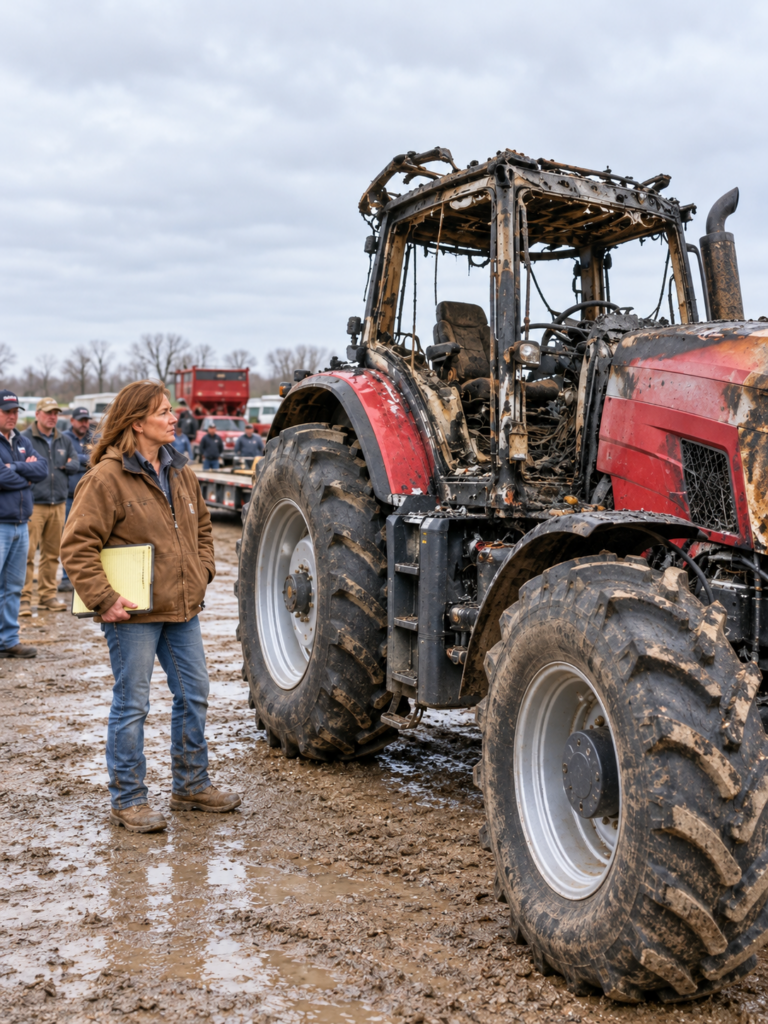
everybody at the salvage auction figured the burned massey ferguson was scrap so she paid seventy five thousand for it and rebuilt the cab into a machine that ran clean for two full seasons
Part 1
The auction yard sat on the edge of Mankato under a sky the color of cold iron. Late October in Blue Earth County had already put frost on the grass along the fence line, and most of the men standing there kept their hands in their pockets while the auctioneer moved lots. Forty-three in three hours. The serious buyers were already loading trailers in the east lot by the time the flatbed rolled the fire-damaged Massey Ferguson 8S.265 to the front. From thirty feet the machine looked finished. The cab was gone, not damaged but gone. Fire had started in the electrical harness behind the right-hand console, burned through the roof structure and both pillars before the suppression system killed it. What remained above the operator platform was a blackened steel skeleton open to the sky. The seat still sat in place. The steering column had warped from the heat. The hood was blistered on the right side, the paint scorched from the door forward on a clean forty-five-degree line that showed exactly where the flames had traveled.
Paula Reinhardt had been standing at thirty feet when the lot came up. She walked closer, to fifteen. She was fifty-five and had been farming nine hundred acres of corn and hay ground in the county for the better part of twenty-six years. She had started with two hundred eighty rented acres and a used Massey Ferguson 6180 bought at a private sale for twenty-eight thousand. She had run that tractor for eleven years until it owed her nothing. Expansion had come the same way everything else had: forty acres here when a neighbor sold, sixty there when a lease opened, a parcel purchased only after the bank finally treated her operating history as the evidence it was. She had never bought a machine she could not afford. She had never financed a piece of iron on optimism alone. She had never walked into an equipment decision without having read everything available about it first.
She had read the insurance assessor’s report on the 8S.265 twice. Once in her truck outside the auction company’s office the previous Thursday, when she had driven forty minutes to pick up the inspection packet in person rather than wait for an email. Once more at her kitchen table on Sunday night, highlighter in one hand and a legal pad under the other. The report was specific. The fire had originated in the cab electrical harness, a fault traced to an aftermarket GPS mount installed improperly by a previous owner, bridging two circuits the manufacturer’s wiring diagram clearly prohibited. Damage above the operator platform was total: cab structure, HVAC, displays, all controls above the console, the wiring loom from the firewall forward. Below the firewall, nothing. The Dyna-VT transmission had been inspected and documented as fully functional. The hydraulic system had been pressure-tested and showed no contamination and no internal damage. The engine had twenty-two hundred hours, had been serviced on schedule, and showed no thermal stress beyond the cosmetic scorching on the hood exterior. The assessor had written in the summary that the machine’s mechanical components were in above-average condition for its hour range and that the fire damage was entirely cosmetic and electrical, severe in appearance, contained in scope. Paula had circled that sentence.
She had called a Massey Ferguson certified cab rebuilder in Rochester on Friday. Dennis Hower had given her a straight answer. A full cab replacement on an 8S.265, including new wiring loom, HVAC, displays, and controls, ran between nine thousand five hundred and thirteen thousand in labor depending on parts, plus the cab assembly itself. A used cab from a late-model 8S could be sourced through a parts broker in Iowa for between seventy-eight hundred and ninety-two hundred. Total reconstruction cost seventeen to twenty-two thousand. She had written the midpoint on the legal pad: nineteen thousand five hundred. She had looked up current private-sale prices for a comparable clean 8S.265. The range was one hundred eighty-four thousand to one hundred ninety-seven thousand for machines with two thousand to twenty-five hundred hours in good condition. Midpoint: one hundred ninety thousand five hundred. She had done the subtraction. A clean, fully rebuilt machine, assuming the hammer fell at or below one hundred thirty thousand and the rebuild came in at the high end of her estimate, would land her in a tractor worth one hundred ninety thousand for somewhere around one hundred fifty thousand all-in. That was a forty-thousand-dollar spread on nine hundred acres of Blue Earth County corn ground. Forty thousand was not a rounding error. It was a grain bin. It was a land payment. It was two years of operating-loan reduction that created breathing room she had never had.
She had driven to the auction with a ceiling in her head. Not a round number. A calculated one. The number above which the math stopped working and the decision became something other than a decision.
The auctioneer opened the lot at forty thousand. Three hands went up immediately. Two came down inside sixty seconds. The third belonged to Kurt Dalan, who ran the Case IH dealership out of Mankato and had arrived that morning in a pickup with his parts manager. Kurt was bidding for components: the rear axle assembly, the hydraulic pump stack, and the transmission casing, all compatible with several machines in his service inventory. He had done his own math. His ceiling was the value of the parts he wanted minus his labor to extract them. It was not a high number. He bid fifty-eight thousand. Paula bid sixty. Kurt looked at her. She stood at fifteen feet with the legal pad folded under her arm and her hands in her jacket pockets, watching the auctioneer. She did not look at him. He bid sixty-three. She bid sixty-five. He bid sixty-eight. She bid seventy. He looked at her again, longer this time, and said something to his parts manager she could not hear. The parts manager shrugged. Kurt bid seventy-three. She bid seventy-five. There was a pause. The auctioneer looked at Kurt. Kurt shook his head once and put his hand down. The hammer fell at seventy-five thousand.
Paula wrote the number on the legal pad. She did the addition in her head. Seventy-five thousand plus the nineteen thousand five hundred estimated rebuild came to ninety-four thousand five hundred all-in for a machine with a clean-market value of one hundred ninety thousand. A spread wider than she had projected because Kurt had stopped earlier than she had expected. She paid the auction clerk by bank draft and arranged the flatbed for that afternoon. Two of the men she knew from the county, both of them corn farmers, both of them Case IH, found her before she got back to her truck. The first said he hoped she knew what she was doing. The second asked, not unkindly, whether she had had someone look at the machine before she bid. She told him she had read the assessor’s report. He nodded the way people nod when they want to be polite about skepticism and said he guessed she knew more about it than he did. She did not disagree.
The flatbed left the auction yard at two-thirty. Paula followed it home in her truck. The machine that had looked finished from the fence line rode down the county highway under a sky the particular hard blue Blue Earth County produces in late autumn, clean and without sympathy for decisions that do not work out. She was not worried. She had read the report.
Part 2
Dennis Hower drove out on Thursday to inspect the machine in her shop. He was fifty-eight, had been working on Massey Ferguson tractors for twenty-two years, and walked around the 8S.265 twice before he spoke. He pulled the firewall panel and inspected the wiring-loom junction. He pressure-checked the hydraulic connections at the cab floor. He ran the engine for twenty minutes from the operator platform with a portable diagnostic unit. When he finished he told her the assessor had been accurate. The damage was above the firewall entirely. Below it was a clean machine. He could source a used 8S cab from the Iowa broker and have the tractor running in five to six weeks. He quoted eleven thousand two hundred in labor. She accepted.
The next day she called her neighbor Gerald Mack. Gerald ran fourteen hundred acres three miles east and had two Case IH Puma 220s he ran hard through every season. He was not a hostile man. He had helped her pull a stuck planter out of a wet field two years ago without being asked, and she had returned the favor with a tank of diesel the following spring. But he had watched her bid on the Massey Ferguson at the auction with the expression of a man observing a decision he could not quite follow, and he had said nothing to her directly since. She was not calling him for his opinion. She was calling to ask if she could borrow his loader tractor for the month while the 8S was in the shop. He said yes without hesitation. He asked her how the machine looked underneath the damage. She told him it looked exactly like the assessor’s report said it would. He was quiet for a moment. Then he said, “I didn’t think you’d bought it blind.” She told him she hadn’t.
The rebuild took six weeks and four days. The cab assembly from Iowa arrived ten days late because of a freight delay that pushed Dennis’s schedule and created three weeks in November when Paula was running Gerald’s Case IH loader for fieldwork while the 8S sat in her shop with its new cab frame but not yet wired. Those three weeks were the ones she thought about later when people asked whether she had had any doubts. Gerald’s Puma was a capable machine. She said so plainly because it was true. But it was configured for his operation and not hers, and running it reminded her daily of the difference between a machine that was adequate and a machine that was right. The loader’s powershift transmission required more managing under load. The hydraulic pump hunted when she tried to run the larger grain cart she preferred. The cab was louder. She finished the fieldwork the loader could finish and left the rest for later. At night she sat at the kitchen table with the legal pad and the assessor’s report and wrote nothing new. The numbers had not changed.
Dennis delivered the rebuilt tractor on December fourteenth. He drove it off the trailer himself. New cab, new wiring loom, new HVAC, new displays, new controls. The Dyna-VT transmission engaged on the first key cycle. The hydraulic system held pressure across all circuits without a fault code. He had run the machine for four hours on his own lot before delivering it and had found nothing that concerned him. He handed her the delivery inspection sheet. She read it. She signed the check. Total spend: seventy-five thousand at auction, eleven thousand two hundred in labor, eight thousand four hundred for the cab assembly from Iowa, one thousand six hundred fifty in parts and consumables during the rebuild. Ninety-six thousand two hundred fifty all-in. She wrote the final number on a new page of the legal pad and put it in the farm records folder next to the assessor’s report. Outside, the December light was already thin. The machine sat in the shop with its rebuilt cab square and clean against the concrete floor, looking nothing like the skeleton that had come off the flatbed six weeks earlier.
Part 3
The first full season with the rebuilt 8S.265 was the spring and summer of the following year. Paula put the machine through planting, side-dressing, and first cutting of hay. The Dyna-VT ran without a single fault. Fuel consumption came in at ten-point-two gallons per hour on heavy planting passes, inside the published specification for the model. The hydraulics were clean. The cab, which Dennis had rebuilt to factory specification using OEM components throughout, was as functional and as quiet as a new machine. She ran six hundred hours on it before the end of July without an unplanned stop.
Gerald Mack came by in late June to look at a border-tile question on the shared field boundary. He walked past the 8S on his way to the field and stopped. He looked at it for a moment: the rebuilt cab, the clean paint, the machine sitting on its tires in the morning light the way a good machine sits. He said it looked like it had never been on fire. She told him Dennis did good work. Gerald said he had heard the auction went higher than Kurt Dalan had expected. She told him Kurt had stopped at seventy-three thousand. Gerald looked at the machine again. He did the math the way farmers do it, not fast and not slow, just thoroughly. He said, “So you’re in it for what? Under a hundred?” She told him ninety-six thousand two hundred fifty. He was quiet for a long time. Then he said, “That’s a hell of a machine for ninety-six thousand.” She told him she had known that when she read the assessor’s report. He nodded. He did not say anything else about it. They walked out to the tile question and talked about the drainage line and the outlet grade and the things that needed to be decided before the ground froze. She had the conversation she had come to have and she let the other one sit where it had landed.
The real test came in corn harvest. She had nine hundred acres to cover and she was running the 8S.265 as her primary tractor on harvest support, grain-cart work, cover-crop seeding, and the field-road passes that keep a harvest moving when everything is running on time and break it apart when something is not. The fall was dry, which was good for her, and the corn was standing clean, which was better. She started on September twenty-second with the 8S running grain cart behind her combine and finished the last field on October sixth. Fourteen days. Nine hundred acres. No mechanical stops. Zero. She ran the machine through three hundred forty hours of harvest work without a single fault code, a single unplanned stop, or a single service call. The rebuilt electrical system, Dennis’s wiring loom, and the factory-spec cab controls performed without a glitch. The transmission shifted under full grain-cart load the way the Dyna-VT was designed to shift: smoothly, automatically, without the operator managing anything. She wrote three hundred forty hours and zero unplanned events on the legal pad.
When she ran the annual operating-cost calculation at the end of the season—fuel, service, parts, total cost divided by total hours—the number was twenty-one dollars and forty cents per hour. She cross-referenced it against the published operating-cost data for the Case IH Puma 220 that Gerald ran on comparable Blue Earth County ground. Gerald’s published equivalent was thirty-six dollars and eighty cents per hour based on the same industry data she used for every comparison. She was aware that Gerald’s actual costs might differ from the published figure. She had no access to his records. But even if his real number was ten percent better than the industry average, the gap between the two machines remained substantial. The gap was not accounted for by the auction discount alone. The gap was also in the machine itself. The 8S.265’s larger-displacement engine running at lower RPM under equivalent load. The Dyna-VT’s efficiency advantage over a powershift transmission in stop-start grain-cart work. The hydraulic capacity that allowed her to run a larger cart without the pump hunting she had noticed on Gerald’s Puma during the season she borrowed it. She was precise about this. She did not claim the Massey Ferguson was a better machine in every application. She claimed it was the right machine for her operation at the right price, proven by a season of data she had generated herself. She told no one what the numbers said. She put them in the folder with the assessor’s report and the auction receipt and Dennis’s delivery inspection sheet.
Part 4
The second season confirmed the first. She put another five hundred eighty hours on the 8S.265 through planting, hay, and harvest. One service call: a scheduled hydraulic filter change that Dennis completed in ninety minutes at her shop in July. No unplanned stops. Fuel consumption held at ten-point-four gallons per hour average across all operations, two-tenths above the first season and well inside the specification range. The cab controls and display system, which she had been watching carefully given their rebuilt origin, showed no faults and no degradation.
At the end of the second season she put the machine through a full dealer inspection at the Massey Ferguson dealership in Mankato. She wanted an independent assessment of the transmission and hydraulic system at twenty-eight hundred total hours, the hour range where, if the fire had caused any undetected stress to the drivetrain, it would likely be visible. The technician spent four hours on the machine. He found a minor hydraulic fitting that he replaced under the service contract. He found nothing else. He told her it was a clean machine. She asked him what he would estimate its current private-sale value at given its history. He looked at the service record. He looked at the inspection results. He said, given a disclosed fire history but a full documented rebuild and a clean two-year operating record, he would put it at one hundred fifty-five thousand to one hundred sixty-five thousand on the private market, depending on the buyer’s comfort with the history. She wrote the midpoint, one hundred sixty thousand, on the legal pad. Below it she wrote ninety-six thousand two hundred fifty. Below that she wrote the difference: sixty-three thousand seven hundred fifty. She had bought sixty-three thousand seven hundred fifty dollars of equity at an auction that Kurt Dalan had left at seventy-three thousand.
She thought about that for a moment. She thought about the men along the fence line who had watched her bid with the expressions of people watching a decision they found difficult to explain. She thought about the neighbor who had asked whether she had had someone look at the machine before she bid. She thought about the way Kurt had looked at her across the auction yard when she had kept her hand up past the point where he had expected her to put it down. She did not think about any of it for very long. There was work to do.
In the spring of the third year, thirty-five acres of ground came available on her north boundary, a parcel that had been rented out by an estate for six years and was now going to sale. The estate’s attorney had called three buyers before he called her. She was the fourth call. She made an offer the same day. The price was what Blue Earth County ground was worth, which was serious, and she financed it on a structure her bank approved in seventy-two hours, partly on the strength of two years of operating records that showed what her farm produced and what it cost to produce it. The Massey Ferguson was not the reason she could finance the ground. The records were the reason. But the records showed what they showed because the machine had performed the way the assessor’s report had said it would perform, and she had known that before she raised her hand at the auction.
Part 5
Kurt Dalan called her in April. His dealership had a clean Case IH Maxxum 150 that had come off a lease. Good machine, reasonable hours, a price he described as aggressive. He was not unkind about it. He was a dealer who understood where the conversation had gone at the auction and was adjusting his approach accordingly. She thanked him for thinking of her. She told him her fleet needs were covered for the season. She meant it as a professional courtesy, which was what it was. She was not angry at Kurt Dalan. He had done what a parts buyer does at a salvage auction. He had calculated the value of the components he wanted and bid to that ceiling. When her ceiling proved to be higher than his, he had stopped. The fact that she had been bidding on a whole machine while he was bidding on parts, that she had read the report and he had not, or had not read it the way she had, was not his failure. It was her preparation.
Gerald Mack bought a Massey Ferguson 7S.210 in the fall of that year. She did not ask him why. He did not explain it to her. He mentioned it in passing at the grain elevator in Garden City the way farmers mention equipment decisions that have already been made and no longer require discussion. She told him the 7S was a good machine for his acre range. He said he had done some numbers on it. She told him that was a good place to start. They talked about the four-base rates and the tile repair on the east boundary and the things that needed deciding before winter. She drove home on the county road with the 8S.265 visible in the equipment shed as she turned into the yard, its rebuilt cab square and clean against the late-afternoon light, looking exactly like a machine that knew what it was worth and had known it, she suspected, since before anyone at the auction had been willing to admit it.
She had known it too. She had known it when she read the assessor’s report in her truck in the parking lot the previous Thursday, before she drove home and read it again at the kitchen table with a highlighter and a legal pad, and the patience of a woman who had been making equipment decisions on this farm for twenty-six years and had learned over all of it that the most expensive thing you can bring to an auction is the assumption that everyone else in the yard has already figured out what you are looking at. They had not. She had. That was the whole story. Everything else was just the numbers proving it out. The machine sat in the shed with thirty-four hundred hours on the rebuilt drivetrain, a clean service record, and a current market value that put her sixty-three thousand ahead of the day she drove it home on a flatbed. Outside, the October light was already thinning the way it had thinned the afternoon she followed the flatbed down the county highway. The difference was that this time she did not need the report to know what she was looking at. She had the hours. She had the records. She had the gate that opened when she turned the key and closed when she decided it should. No one else held the chain.


