
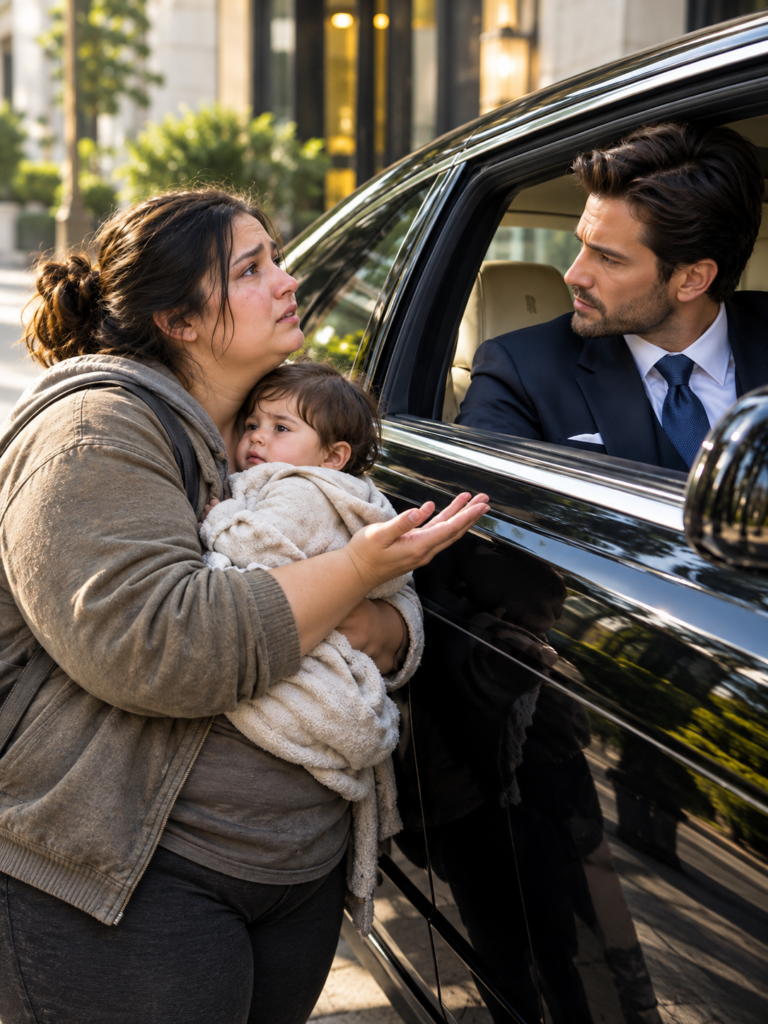
Part 1
The baby had not eaten properly since five that morning.
By nine, Mariana had stopped checking the time. Every glance at the cracked screen of her phone made the emptiness in her stomach seem less important than the small, exhausted body resting against her chest.
Eight-month-old Teodoro—her little Té—was usually a restless child. He liked grabbing her hair, tugging at her collar, and laughing whenever she pretended to bite his fingers.
That morning, he barely moved.
His pale cheek rested against her shoulder. Occasionally, his tiny mouth opened as though he were searching for a bottle that wasn’t there.
Mariana adjusted the thin blanket around him and stared at the enormous glass building across the street.
Oliveira Holdings.
Thirty-two floors of polished windows, steel, and money. Inside, people made decisions involving sums she couldn’t imagine. Outside, on the sidewalk in downtown São Paulo, she was trying to gather enough courage to ask a stranger for the chance to earn her son’s next meal.
She had no appointment.
No professional clothes.
No impressive résumé.
All she had was a hungry baby, two hands willing to work, and a desperation that had finally become stronger than her pride.
“I’ll find something, sweetheart,” she whispered against Té’s forehead. “I promised you.”
The promise hurt because she had made it the night before, too.
She had shared her last piece of stale bread with him in the tiny shack where they lived. When he cried afterward, she had held him against her chest until exhaustion finally quieted him.
Tomorrow, she’d told him.
Tomorrow, Mommy will find milk.
But tomorrow had arrived, and she still had nothing.
Three months earlier, her grandmother had died, leaving Mariana without the only person who had consistently helped her survive. Té’s father had disappeared before his birth. The money Mariana earned washing clothes was never enough to cover food, diapers, rent, and childcare. The daycare near their neighborhood cost more than she could make working.
Her savings had disappeared.
So had nearly every reasonable option.
Now only the unreasonable ones remained.
She crossed the street before fear could change her mind.
The security guard standing near the revolving doors noticed her immediately. His eyes moved from her faded clothes to the baby wrapped against her chest.
“Can I help you?”
“I’m looking for work.”
“Applications are online.”
“I understand, but I was hoping I could speak to someone. Maybe whoever is in charge of cleaning. Or the kitchen.”
The guard glanced toward the lobby.
“You can’t come inside with a child.”
Mariana felt Té stir.
“Please. I don’t need an office job. I can wash floors, clean bathrooms, carry things, cook—whatever needs doing. I just need someone to give me a chance.”
“Miss, I already told you—”
The revolving doors moved behind him.
Three men stepped out of the building.
Two carried briefcases. The third wore a charcoal-gray suit so perfectly fitted that Mariana noticed it even through her fear. He was tall, dark-haired, and walking with the composed impatience of someone whose time belonged to several people at once.
He was speaking into his phone.
The guard immediately straightened.
“Good morning, Mr. Rafael.”
Mariana recognized him.
Rafael Oliveira.
The billionaire chief executive whose face occasionally appeared on the television inside the bakery near her home. The man whose company occupied the building behind him. A man who, according to the news, had built a business empire before turning forty.
He passed within a few steps of her without looking.
For one terrible instant, Mariana thought of allowing him to continue.
Then Té gave a faint, hungry whimper.
And something inside her refused to remain silent.
“Mr. Oliveira!”
The name came out too loudly.
One of the men beside Rafael turned.
Rafael continued walking for another step before stopping.
“Sir, please.”
He lowered the phone.
Mariana had imagined this moment on the bus. She had prepared polite words and explanations, a reasonable account of what she could offer.
All of them disappeared when he looked at her.
“Yes?” he asked.
Her throat tightened.
“I can clean. I can cook. I can do anything you need.”
Rafael studied her without speaking.
“I know I shouldn’t stop you like this. I know you’re busy. But my baby needs food, and I’ve tried everywhere.”
Her voice cracked.
She shifted Té higher against her chest.
“His name is Teodoro. He’s eight months old. I have no one left to help us, and I don’t know what else to do.”
The two men exchanged a glance.
Mariana barely noticed.
“Please,” she continued. “I don’t want money for nothing. I’ll work. I’ll scrub every floor in your building if that’s what you need. I just need to feed my son.”
Her eyes filled.
“I can’t let him go hungry again.”
The traffic moved around them. Somewhere nearby, a bus sounded its horn. A gust of October wind pushed loose strands of hair against her wet cheeks.
Rafael had not changed his expression.
That frightened her more than anger would have.
He looked at the baby, then at Mariana’s worn hands holding him.
The man nearest Rafael took half a step forward, perhaps intending to end the conversation.
Rafael raised one hand.
The man stopped.
Then the CEO asked a question Mariana had not expected.
“What’s the boy’s name?”
“Teodoro, sir. I call him Té.”
“How old?”
“Eight months.”
Rafael watched the sleeping child a moment longer.
Then he turned to the security guard.
“Open the door.”
The guard blinked.
“Sir?”
“She’s coming upstairs with me.”
Mariana’s fingers tightened around the blanket.
She had prepared herself for rejection.
She had even prepared herself for someone offering a little money and telling her to go away.
She had not prepared herself to be invited inside.
Rafael turned toward the entrance.
“Come along,” he said. “Keep a good hold on him. The elevator is fast.”
And just like that, Mariana found herself following one of São Paulo’s most powerful businessmen into a world she had only ever seen through glass.
The lobby smelled of coffee and polished stone. Marble stretched beneath her worn shoes. Large plants stood in expensive ceramic pots, and the employees moving between the reception desks and elevators seemed to know exactly where they were going.
Mariana felt as though every one of them could see how poor she was.
Rafael said nothing.
Inside the panoramic elevator, he stood beside her while his assistants remained several feet away.
The city dropped beneath them as the elevator climbed.
Té opened his eyes, looked sleepily toward Rafael, and tucked his face back against Mariana.
For an instant, something changed in the man’s expression.
It happened so quickly that Mariana wondered whether she had imagined it.
On the thirty-second floor, the doors opened.
A secretary looked surprised when Rafael walked past her with a young mother and baby following behind.
“Hold my calls for a few minutes,” he instructed.
He opened the door to his private office.
The room was enormous.
One wall consisted almost entirely of windows overlooking São Paulo. A wide wooden desk faced two leather chairs. The bookshelves were neatly arranged, though there were surprisingly few personal belongings.
On one side of the desk stood a framed photograph turned facedown.
Mariana noticed it because everything else in the room seemed precisely arranged.
Rafael removed his jacket and indicated the chair opposite him.
“Sit.”
She lowered herself carefully, supporting Té’s head against her arm.
Rafael remained standing a moment before taking his own seat.
“You said you can clean and cook.”
“Yes, sir.”
“Have you done housework professionally?”
“I’ve cleaned houses when I could find the work. Mostly I wash clothes. I can keep a kitchen, do laundry, clean floors. Whatever you need, I can learn.”
He picked up a pen.
“And your son stays with you?”
Mariana swallowed.
“He has to. I can’t afford childcare.”
Rafael wrote something on a sheet of paper.
He didn’t ask about her education, her marital status, or why the baby’s father wasn’t supporting them.
He simply tore the paper from the pad and slid it across the desk.
“Tomorrow morning. Seven o’clock. This address.”
Mariana read the street name.
It belonged to an expensive residential neighborhood far from where she lived.
She looked up.
“What is this?”
“A house I own.”
“I’m sorry, sir. I don’t understand.”
“It needs someone to look after it. Cleaning, cooking, laundry, general upkeep. You’ll have a room there, meals, and somewhere suitable for your son.”
He paused.
“The salary will be twice what you’ve probably earned before.”
Mariana stared at him.
For a moment, she couldn’t make the words fit together.
A room.
Food.
A salary.
Enough room for Té.
All the things she had spent months trying to secure were being placed in front of her by a stranger who spoke as though he were arranging an ordinary business transaction.
“Why?” she whispered.
Rafael leaned back.
“Because the house needs someone, and you’re asking for work.”
“That’s all?”
“Isn’t that what you came here for?”
She lowered her eyes to the address.
It would have been easy to cry again. She wanted to, but she was afraid that if she did, she would never stop.
“Yes,” she managed. “Yes, sir. I’ll be there.”
“Seven o’clock.”
“I’ll be early.”
He stood and reached for his jacket.
Mariana rose too quickly, almost disturbing the sleeping child.
“Mr. Oliveira?”
He looked at her.
“Thank you. I don’t know how to—”
“You don’t need to thank me yet. You haven’t started working.”
There was no mockery in his voice.
Only a restraint she couldn’t understand.
He opened the door, then stopped.
“And Mariana?”
She stiffened.
He had remembered her name.
“Bring the boy. There’s plenty of room.”
Before she could answer, he added, “My secretary will give you an advance. Get whatever he needs today.”
Then he left.
Mariana remained motionless for several seconds.
She looked at the address again, afraid the words might somehow vanish.
Té stirred and opened his eyes.
He gave her a tired little smile.
That was when she finally cried.
Not because all her problems had been solved.
But because, for the first time in weeks, she knew where her son’s next meal would come from.
The secretary handed her an envelope without asking any questions.
Mariana counted the money in the elevator, once, then again.
It was more than enough for the essentials.
She bought diapers, milk, and food at the first stores she could find. Then she stopped at a small bakery and ordered an egg sandwich and something warm to drink.
She fed Té first.
Watching him eat was almost painful.
His little hands reached eagerly for more, and Mariana realized how much she had learned to fear that movement.
Today, she had enough.
She could give him what he needed without calculating what would remain for tomorrow.
Only when he was satisfied did she begin eating her own sandwich.
It tasted better than anything she could remember.
That evening, she returned to the shack and packed everything they owned into a market bag.
A blouse.
Two pairs of pants.
Té’s blanket.
The diapers she had bought that afternoon.
She glanced around the small room.
The damp walls, the rough floor, the corners where rain sometimes found its way inside—every detail represented something she had struggled to survive.
Yet she felt no desire to remain.
She switched off the light, lay beside her son, and tried to sleep.
Tomorrow they were going somewhere neither of them had ever been.
She wanted to believe it would be better.
She was simply afraid to believe too much.
At six the following morning, Mariana left with Té and the market bag.
The journey required a bus, a subway ride, and another bus. As the buildings changed and the roads grew quieter, she watched São Paulo transform into a city she hardly recognized.
The houses became larger.
The sidewalks cleaner.
High walls concealed gardens she could only glimpse through elaborate gates.
At 6:50, she stood outside a two-story house with white walls, a dark roof, and carefully maintained grounds.
It was beautiful.
But something about it seemed lifeless.
The upstairs curtains were closed. The windows reflected the morning light without revealing anything inside.
Mariana pressed the doorbell.
A gray-haired woman in her sixties answered.
“Mariana?”
“Yes, ma’am.”
“I’m Célia. Mr. Oliveira told me you were coming.”
She stepped aside.
“Come in. I’ll show you around.”
Inside, the house was even more impressive than the exterior suggested.
There were light wooden floors, expensive but understated furniture, a spacious living room, and a kitchen equipped with appliances Mariana had only seen in advertisements.
Yet the rooms felt strangely untouched.
There were no scattered shoes near the entrance.
No family pictures lining the hallway.
No signs of the everyday disorder that usually made a house feel inhabited.
Célia led her toward the back.
“This will be your room.”
Mariana stopped in the doorway.
There was a single bed, a closet, and a window overlooking the yard.
Beside the bed stood a wooden crib.
Already assembled.
With clean, new sheets.
Mariana walked toward it, almost afraid to touch it.
“He had that arranged last night,” Célia said.
Mariana turned.
“Mr. Oliveira?”
“Yes.”
The older woman offered no explanation.
Mariana lowered Té into the crib. He stretched his little legs and looked around with solemn curiosity before settling comfortably against the mattress.
For the first time in months, he had a proper place to sleep.
She brushed her fingers over the rail.
“Thank you,” she murmured.
Célia showed her the bathrooms, laundry area, kitchen, and bedrooms upstairs.
There were four rooms on the upper floor. Most had remained closed. One contained a made bed, a few men’s clothes, and a bedside table with a book and a pair of glasses.
Another door stood at the end of the hallway.
It was locked.
Célia stopped before Mariana could reach it.
“That room stays closed.”
Mariana glanced at the dark metal handle.
“Should I clean it?”
“No. Mr. Oliveira doesn’t want anyone entering.”
“Of course.”
The older woman looked at the door a second longer than necessary.
Then she turned away.
By nine, the tour was finished.
Célia gave Mariana the keys and her telephone number.
“I usually come once a week. You’ll be responsible for the daily work. There is food in the kitchen, and you may use what you need.”
“And Mr. Oliveira?”
“He doesn’t come here very often. He’ll let us know when he does.”
Mariana nodded.
When Célia left, she stood in the middle of the living room and listened.
The quiet was unfamiliar.
At her old home, there had always been someone shouting through a wall, music carrying from a neighboring house, or traffic passing close enough to shake the windows.
Here, the ticking of a clock sounded unusually loud.
She began cleaning.
Dusting furniture.
Washing surfaces.
Mopping the floors.
She organized the kitchen shelves and opened the refrigerator.
Milk, eggs, bread, fruit, yogurt, and fresh ingredients filled the shelves.
Enough food to prepare several meals without having to count every portion.
She made porridge for Té, then ate a banana with some cheese.
At noon, the intercom rang.
A delivery had arrived.
Mariana collected two grocery bags and a smaller cardboard box from the gate.
Inside the box were diapers in Té’s size, new bottles, baby clothes, and a soft blanket.
There was no letter.
Only a piece of paper bearing her name.
She sat on the bedroom floor and held one of the little shirts in her hands.
It was small, soft, and new.
Té crawled toward her and grabbed a diaper from the open package.
Mariana laughed.
The sound startled her.
It was the first time she had laughed without forcing herself in weeks.
That afternoon, she cleaned the bathrooms and swept the back porch.
In the garden stood a jabuticaba tree covered with dark fruit.
She picked a few berries, washed them, and tasted one.
The sweet, slightly sharp flavor brought back memories of her grandmother making jam in the kitchen of her old home.
For a moment, the memory hurt.
Then Té reached for a leaf, and Mariana gently moved his hand away.
Life, she thought, could be cruel enough to make a person forget how many small, beautiful things still existed.
That evening, she prepared rice, eggs, and salad.
She bathed Té in the little plastic tub that had arrived with the supplies, laughing when he splashed water across her sleeves.
By eight, he was sleeping peacefully.
Her phone vibrated.
An unfamiliar number.
Is everything in order at the house?
She knew immediately who had sent it.
Yes, sir. Everything is fine. Thank you for the things you bought for Té.
The reply came shortly afterward.
Get some rest. Tomorrow is another day.
Mariana read the message twice.
Nothing about it was affectionate.
Nothing suggested that Rafael Oliveira expected gratitude beyond the work he had hired her to perform.
Still, she glanced toward the crib.
Té was sleeping with a full stomach, warm clothes, and a clean blanket.
That was enough.
For now.
She lay down and closed her eyes.
But sometime during the night, she dreamed of the locked room upstairs.
In the dream, its door stood open.
A narrow strip of light crossed the hallway.
And from somewhere inside came the sound of someone crying.
Mariana woke abruptly.
The clock read three.
She rose, checked on Té, and went to the kitchen for water.
Outside, the street was empty.
For an instant, she thought she saw movement beyond the garden wall.
She watched until she was certain there was nothing there.
Then she returned to bed.
The next morning, while she was preparing breakfast, a car stopped outside.
A key turned in the front door.
Rafael Oliveira entered carrying his briefcase.
Mariana straightened.
“Good morning, sir.”
“Morning.”
His gaze moved toward Té, who was awake in her arms.
“I’ll be working here today. Don’t change your routine because of me.”
He set his laptop on the kitchen table.
Mariana returned to the counter, though she suddenly became conscious of every sound she made.
Rafael worked quietly.
Occasionally, she noticed him looking toward the baby.
When Té giggled at something she did, Rafael stopped typing altogether.
“He laughs a lot,” he observed.
“He does when he’s feeling well.”
The answer seemed to affect him.
He looked down at his laptop, but his hands remained still.
Mariana put a piece of toast on a plate and set it near him.
“You should eat something too, sir.”
Rafael looked surprised.
Then he took the toast.
“Thank you.”
Té reached for the plate.
Mariana smiled.
“He’ll take your breakfast if you aren’t careful.”
For the first time, Rafael’s mouth curved.
Only slightly.
But it was a smile.
“He seems ambitious.”
“Very,” she replied. “And he doesn’t believe in sharing.”
A quiet laugh escaped Rafael before he returned to his screen.
The moment passed.
Yet it left something different in the kitchen.
For the first time, Mariana felt less like an intruder.
At midday, Rafael prepared to leave for a meeting.
Before going, he stopped near the door.
“Does the boy need anything else?”
“No, sir. You’ve already provided everything.”
“Good.”
He left.
That evening, he returned at half past nine.
Mariana had left a bowl of hot chicken-and-vegetable broth covered on the table.
He ate while she finished cleaning the kitchen.
Then, unexpectedly, he spoke.
“This house has been mostly empty for almost two years.”
Mariana turned.
“I usually stay at my apartment downtown,” he continued. “Or I work late enough that it hardly matters where I sleep.”
She said nothing.
“Célia used to come once a week. I didn’t want anyone else here.”
He stared at the empty bowl.
“When you approached me yesterday, I was going to keep walking.”
Mariana lowered her eyes.
“I understand.”
“But your son made a sound.”
Rafael looked toward the hallway leading to the back bedroom.
“I heard him.”
A long pause followed.
“You needed a place. I had a house standing empty. It was a practical arrangement.”
Mariana nodded.
“Yes, sir.”
He rose and went upstairs.
Later, she lay awake thinking about his explanation.
Practical.
Perhaps it was.
Yet she remembered his expression when Té laughed.
She remembered the new crib, assembled before they had arrived.
And she wondered why a man with everything money could buy had chosen to live almost anywhere except his own beautiful house.
Over the next few days, Rafael began appearing more often.
Sometimes he worked at the kitchen table.
Sometimes he came home late, ate the dinner she had prepared, and disappeared upstairs.
Té grew comfortable around him.
One morning, while eating porridge, the baby reached out a sticky hand toward Rafael.
The CEO stared at the tiny fingers.
Mariana smiled.
“It’s all right. He doesn’t have teeth enough to do much damage.”
Rafael hesitated, then extended one finger.
Té grabbed it with both hands.
And laughed.
Rafael stopped moving.
His eyes changed, becoming unexpectedly vulnerable.
Then he gently freed his hand and stood.
“I have to go.”
He left sooner than usual.
That evening, he came home carrying two cloth picture books and a brightly colored teething toy.
He handed them to Mariana.
“For the boy.”
She stared at the gifts.
“Thank you, Mr. Oliveira.”
He nodded and went to work in the living room.
Mariana watched him from the doorway.
There was something about this man she didn’t understand.
Something that made him approach Té with care, as though the simple act of touching a child’s hand might cost him more than he could bear.
Later, after her son was asleep, she gathered her courage.
“Sir, may I ask something?”
Rafael closed his laptop halfway.
“What is it?”
“The room upstairs. The one that stays locked.”
His expression changed.
Not dramatically.
But enough that Mariana immediately regretted the question.
“Is there anything I’m supposed to do with it?” she asked quickly. “Célia said I shouldn’t enter.”
“You shouldn’t.”
“Of course.”
He closed the laptop completely.
“It’s locked because I need it to stay that way.”
Mariana nodded.
“I’m sorry. I didn’t mean to pry.”
Rafael studied her for a moment.
“You don’t need to apologize. Just leave that room alone.”
He went upstairs.
Mariana remained standing beside the sofa.
That night, long after the house had gone quiet, she heard footsteps moving through the upper hallway.
Then a faint metallic sound.
A key turning.
A door opening.
And finally, the careful click of that same door closing again.
She lay perfectly still, listening.
For the first time, Mariana understood that the locked room was not simply somewhere Rafael refused to let other people enter.
It was somewhere he could barely bring himself to go.
And whatever waited behind that door still had power over him.
Part 2
Mariana did not mention the sound the next morning.
She prepared Té’s breakfast, washed his little bowl, and went about her work as though she had slept peacefully.
But when Rafael appeared in the kitchen wearing a white shirt with the sleeves rolled up, she noticed the shadows beneath his eyes.
He looked like a man who had spent most of the night arguing with something no one else could see.
“Good morning,” he said.
“Good morning, sir.”
He poured coffee but barely drank it.
Té, sitting on Mariana’s lap, reached toward him again with fingers covered in porridge.
This time, Rafael didn’t hesitate.
He offered his hand, and the baby caught his finger eagerly.
Té burst into laughter.
For several seconds, Rafael simply watched him.
There was sadness in his face, but also an attentiveness that made Mariana wonder whether these small encounters meant as much to him as they had begun to mean to her.
He left for the office shortly afterward.
Mariana kept the house in order, washed the clothes, and spent part of the afternoon playing with Té in the garden.
She avoided the upstairs hallway.
Yet she couldn’t forget the sound of the key turning in the darkness.
Around three o’clock, the intercom rang.
Dona Célia had arrived carrying bread and fruit.
“Mr. Oliveira asked me to continue checking on things once a week,” she explained.
Mariana welcomed her into the kitchen and made coffee.
Té sat nearby, investigating his new teething ring.
Célia watched him for a while.
“He looks better than when you arrived.”
“He is better,” Mariana said. “He’s eating, sleeping. He’s even laughing more.”
“Children recover quickly when they’re properly cared for.”
Mariana smiled and brushed a crumb from Té’s shirt.
“Mr. Oliveira has been very generous.”
Célia stirred her coffee.
The older woman’s gaze moved toward the staircase.
For a moment, it seemed she was considering whether to speak.
Then she set down her spoon.
“Did he tell you anything about this house?”
Mariana hesitated.
“Only that it’s been empty for nearly two years.”
Célia sighed.
“There was a little girl.”
Mariana looked up.
“Her name was Clara. Four years old. Pretty fair hair. Always running from one room to another.”
The older woman’s eyes softened.
“And her mother was Beatriz. Mr. Oliveira’s wife.”
Mariana felt the atmosphere change.
She glanced automatically toward Té, who was beating his teething toy against the floor.
“What happened to them?”
Célia folded her hands.
“There was an accident. Almost two years ago. It was raining heavily. The road was wet.”
She paused.
“Neither of them survived.”
Mariana’s hand went still around her coffee cup.
“Mr. Oliveira was traveling for business. By the time he returned, the funeral and burial were already over.”
“Oh, God.”
“He couldn’t bear staying here afterward. Everything reminded him of them.”
Célia looked toward the ceiling.
“The room at the end of the hallway belonged to that part of his life. He locked it and wouldn’t let anyone enter. Not even me.”
Mariana thought of the footsteps.
The key.
The silence afterward.
“Does he ever talk about them?”
“Hardly at all. He works. That’s what he does when he doesn’t want to feel something.”
Célia’s voice grew quieter.
“He was always a reserved man, but afterward, he became almost impossible to reach. He would spend weeks at the apartment, come here briefly, and leave again.”
Mariana looked down.
She had imagined so many explanations for the locked door.
Nothing she had imagined was as simple or terrible as this.
A wife.
A little daughter.
An ordinary journey on a rainy road that had destroyed an entire family’s future.
Suddenly, Rafael’s strange behavior around Té made sense.
The way he froze when the baby laughed.
The way he sometimes reached for him, only to step away.
The new toys.
The careful questions about whether he had eaten.
He wasn’t unfamiliar with children.
He remembered loving one.
Célia stood.
“Don’t tell him I said anything. He doesn’t like people discussing it.”
Mariana nodded.
The older woman glanced down at Té.
“Your little boy has brought some life back into these rooms. That’s good. But be gentle with Mr. Oliveira.”
She picked up her bag.
“He’s not a cruel man. He’s a grieving one.”
After Célia left, Mariana remained at the kitchen table for a long time.
Té crawled toward her and climbed against her knee.
She lifted him into her lap.
“Come here, my love.”
He rested his head against her chest.
She imagined holding him one morning and learning that by nightfall he would never come home again.
The thought was unbearable.
Mariana closed her eyes and kissed his hair.
For the first time, she did not see Rafael Oliveira primarily as the powerful businessman who had rescued her from desperation.
She saw a father who had lost the person he most wanted to protect.
And a husband who had returned from work to discover that the life waiting for him was gone.
That evening, Rafael came home late.
He ate the food Mariana had left for him without much conversation.
She wanted to tell him she knew.
She wanted to say she was sorry.
But Célia’s revelation wasn’t hers to expose, and Rafael’s grief wasn’t something she could demand he explain.
So she washed the dishes and let him have his silence.
Later, she heard the familiar sound upstairs.
Footsteps.
A key.
The door.
Only this time, Rafael remained inside longer.
When the door finally closed, she heard him descend the stairs.
Mariana waited a few minutes before leaving her room.
She found him sitting on the living room sofa in the dark.
A glass rested in his hand, untouched.
Streetlight filtered through the window, outlining the tired planes of his face.
“Sir?”
He didn’t seem surprised.
“Couldn’t sleep?”
She shook her head.
He looked toward the staircase.
“You heard the door.”
“Yes.”
Rafael placed the glass on the table.
“It’s not usually that loud.”
“The house is very quiet.”
A faint, humorless smile touched his mouth.
“Yes. It is.”
Mariana remained near the doorway.
Then she decided that pretending ignorance would be dishonest.
“Dona Célia told me about your family.”
He closed his eyes briefly.
“Of course she did.”
“I’m sorry. I didn’t ask her to. She just started talking.”
Rafael rubbed his forehead.
“She means well.”
Mariana waited.
He looked toward the darkened hallway.
“My daughter was named Clara.”
Mariana said nothing.
“She had a laugh a little like your son’s. Short and loud. You could hear her from anywhere in the house.”
He stopped.
“Beatriz used to say that Clara could turn an ordinary morning into a celebration.”
His voice remained controlled, but his hand gripped the edge of the sofa.
“For a while, I couldn’t remember that sound without remembering the accident afterward.”
Mariana stepped a little closer.
“I can’t imagine how painful that must be.”
“No.”
He looked at her.
“I don’t think anyone can unless they’ve lived through it.”
She lowered her eyes.
“I lost my mother when I was young. My grandmother was the one who helped me most afterward. When she died, I thought I knew what it meant to be alone.”
Rafael listened.
“But I still have Té,” Mariana continued. “And I know that makes my loss different from yours.”
He nodded slowly.
“After the accident, I couldn’t stay in this house,” he said. “Every room reminded me of what wasn’t there.”
“That’s why you moved downtown?”
“Yes. Work was easier. Meetings. Numbers. Contracts. Things with answers.”
He looked down at his hands.
“None of those things ask you why you didn’t come home sooner.”
Mariana’s throat tightened.
“You weren’t responsible for the rain.”
“No. But I wasn’t here.”
There was nothing she could say that would make that distinction disappear.
Rafael leaned back.
“Sometimes I open the room just to remind myself that it still exists. The belongings are there. Everything is where it was.”
Mariana stood quietly beside the chair.
She did not move closer.
She sensed that offering comfort too quickly might feel like asking him to stop grieving.
After a while, Rafael looked at her.
“Your son makes the house sound different.”
“He can be very loud when he wants something.”
“He can.”
A small, genuine softness crossed his face.
“Don’t apologize for that.”
He stood.
“You should get some rest.”
“Good night, sir.”
He had almost reached the staircase when he stopped.
“Mariana?”
“Yes?”
“Thank you for looking after the house.”
He hesitated.
“And for letting the boy be himself here.”
Then he went upstairs.
Mariana remained in the living room until the clock neared one in the morning.
When she returned to her room, Té was sleeping with his arms spread across the mattress.
She sat beside the crib and watched his chest rise and fall.
She had entered the house thinking she was the only person inside it who desperately needed something.
Now she understood that Rafael had been surviving a different kind of hunger.
And unlike hers, it wasn’t something money could feed.
Several days later, Rafael left a note saying he would be away on business for two days.
There was food in the house, and she had his number in case of an emergency.
Mariana folded the note and slipped it into her pocket.
His departure shouldn’t have mattered.
She had known him only a short time, and their arrangement was still professional.
Yet the house seemed larger without him.
She cleaned, cooked, played with Té, and spent time in the garden beneath the jabuticaba tree.
In the evenings, she left a light on downstairs.
On the second day of his absence, she went into the upstairs bedroom to fold and put away laundry.
A drawer in Rafael’s closet was slightly open.
She had noticed it before.
As she reached to close it, something inside caught her attention.
A small wooden box.
Mariana hesitated.
She had no right to look through Rafael’s belongings.
She knew that.
But the box was partly visible beneath folded clothes, and curiosity won over judgment.
She pulled the drawer open and lifted the box.
It was smooth and unadorned.
Inside lay a photograph.
A beautiful dark-haired woman smiled at the camera, holding a little girl with fair hair on her lap.
The child was laughing.
Mariana knew immediately who they were.
Beatriz.
Clara.
Behind the photograph lay a small silver earring and a folded piece of paper.
She did not unfold the paper.
Instead, she closed the box, returned it to its place, and pushed the drawer shut.
For several moments, she stood motionless.
Then she went downstairs and stepped outside into the garden.
Té crawled across the grass, delighted by a fallen leaf.
Mariana sat beside him and looked back toward the house.
It wasn’t a mansion that had been abandoned because its owner had grown bored.
It was a home that had become too painful to inhabit.
Every room held the shape of the people who were missing.
And Rafael, for all his money and influence, had never found a way to make those absences smaller.
Her phone vibrated that evening.
Everything all right?
It was Rafael.
Yes. Té is eating well, and the house is fine.
Good. I’ll be home tomorrow night.
She stared at the word home.
Perhaps he had written it without thinking.
But for a man who had spent two years avoiding this place, it seemed significant.
Mariana put the phone away.
She had been frightened of losing her new security from the moment she received it.
Now another fear had begun to form.
She was becoming attached to the man who had given it to her.
Not because he was wealthy.
Not because he had saved her from hunger.
But because she had begun to recognize the kindness beneath his reserve, and the sadness he carried into every room.
She did not know what to do with that feeling.
So she did what she understood.
She went inside and prepared dinner.
Rafael returned earlier than Mariana had expected, late in the afternoon of the second day.
He entered carrying a small suitcase.
Té was playing on the kitchen floor.
The moment he saw Rafael, he let out an excited cry and began crawling toward him.
Rafael stopped.
Then, instead of walking past, he crouched.
He held out a hand.
Té seized his finger and smiled triumphantly.
“Well,” Rafael murmured. “Someone seems to have grown while I was away.”
“He has been eating very well,” Mariana said from the stove.
Rafael glanced up at her.
“I can see that.”
They ate together.
The conversation was ordinary at first.
The journey.
The meetings.
Té’s new fascination with pulling himself upright against furniture.
Then Rafael set down his spoon.
“Did you open the wooden box?”
Mariana’s stomach dropped.
She looked at him.
“The drawer was open,” she admitted. “I went to close it, and I saw the box.”
Rafael waited.
“I shouldn’t have touched it. I’m sorry.”
“What did you see?”
“The photograph. Of your wife and daughter.”
She swallowed.
“There was a note, but I didn’t read it.”
He looked at his plate.
For several seconds, she wished she could take back the entire afternoon.
Then he spoke.
“That photograph was taken when Clara was four.”
Mariana listened.
“Beatriz was pregnant again before the accident.”
His voice lowered.
“We lost the baby a few months earlier.”
Mariana’s eyes filled.
She had known he was grieving two people.
Now she understood that the house held another loss as well.
“We were trying to find our way back to normal,” he continued. “Then came the accident.”
He looked toward the window.
“Afterward, the house seemed full of people who weren’t here anymore.”
Mariana held Té closer.
“I’m so sorry.”
Rafael gave a slight nod.
“People always say that.”
She lowered her eyes.
“It’s all I know how to say.”
“I know.”
His response was not cruel.
It was simply exhausted.
After a moment, Té stretched his arm toward Rafael and offered him his spoon.
Rafael took it carefully.
The baby giggled, pleased with himself.
“He trusts people easily,” Rafael observed.
“He hasn’t learned many reasons not to,” Mariana replied. “I hope he can stay that way for a long time.”
Rafael looked at her.
Something unspoken passed between them.
He set the spoon down and rose.
“I have a few things to finish.”
Later, when Té was asleep, Mariana found Rafael sitting with his laptop in the living room.
She stopped at the entrance.
“Would you like coffee?”
“No, thank you.”
He closed the laptop.
“You can sit if you want.”
She hesitated.
“It’s your living room, sir.”
Rafael looked around.
“You live here now, Mariana. You don’t need an invitation every time you enter it.”
She sat in the armchair opposite him.
For a while, they talked about ordinary things.
Then Mariana admitted, “When I arrived, I was afraid to touch anything.”
“Why?”
“Everything looked expensive. Everything was so quiet. I thought one mistake might send me back where I came from.”
Rafael listened without interrupting.
“But the house feels different now,” she continued. “It’s still quiet, but not the same kind of quiet.”
“I built it because I wanted a place full of people,” Rafael said.
His eyes moved toward the dark staircase.
“Friends visiting. Children running around. Meals that lasted for hours.”
He paused.
“After the accident, I couldn’t imagine wanting any of that again.”
Mariana looked down at her hands.
“I didn’t come here expecting to change anything.”
“You haven’t damaged anything.”
He met her gaze.
“Quite the opposite.”
She felt warmth rise to her cheeks.
Rafael seemed to recognize that he had said more than he intended.
He looked toward the window.
“Tomorrow is Saturday. There’s a park nearby. If you’d like, we could take Té there.”
Mariana looked up.
“All three of us?”
“Yes.”
“Are you sure?”
“He needs fresh air. And I won’t be working.”
She smiled.
“I think he’d love it.”
“Then we’ll go.”
The next morning, Rafael came downstairs wearing jeans and a light shirt.
Without his suit, he looked younger.
Less like the man whose photograph appeared in business newspapers and more like someone Mariana might have passed on an ordinary Saturday morning.
She packed Té’s diapers, water, and snacks.
The baby sat excitedly in the stroller that had been delivered to the house.
Rafael helped load it into the car.
The park was only ten minutes away.
It was small and green, with a bandstand, a sandbox, and trees casting patches of shade across the paths.
They walked together.
Mariana noticed a few curious glances.
A wealthy-looking man.
A plainly dressed woman.
A baby between them.
She wondered what strangers imagined when they looked at the three of them.
Rafael appeared unconcerned.
They settled near the sandbox, and Mariana let Té explore the grass.
The baby immediately began investigating everything within reach.
Rafael kept a watchful eye on him, removing a pebble before Té could put it in his mouth.
Mariana smiled.
“You’ve clearly had practice.”
Rafael watched the boy.
“Clara loved sand.”
The words came naturally, surprising them both.
“She’d make little piles,” he continued. “Then knock them down and start again. Beatriz photographed practically every one.”
Mariana looked toward him.
“You seem happy when you talk about them.”
“Sometimes.”
He picked up a fallen leaf and turned it between his fingers.
“Sometimes it hurts.”
“I imagine it does.”
“But not talking about them hurts too.”
Mariana nodded.
Té crawled toward Rafael, grabbed his pants, and tried to stand.
Rafael immediately put his hands around the baby’s waist.
“Easy there.”
Té laughed, wobbling on his small feet.
Without thinking, Mariana lifted her phone and took a picture.
The camera shutter sounded.
She froze.
“I’m sorry. I should have asked.”
Rafael looked at her.
“Why?”
“I took your picture. With Té.”
He glanced at the phone.
For a moment, she worried she had reminded him of all the photographs he could no longer take with Clara.
Then he said, “You can send it to me.”
Mariana smiled.
“I will.”
They stayed nearly two hours.
When Té became hungry, they drove home.
Mariana prepared lunch, and Rafael set the table.
They ate together without anyone rushing away to a meeting.
Afterward, Mariana put Té down for his nap.
When she returned downstairs, she found Rafael standing quietly near the staircase.
“I went into the room again yesterday,” he said.
Mariana stopped.
“The locked room?”
He nodded.
“I stayed a few minutes.”
She waited.
“Beatriz’s dress is still hanging in the closet. Clara’s teddy bear is on the bed. I haven’t moved much of anything.”
His voice remained low.
“Sometimes I think I should give it all away. Other times, I can’t bear the thought.”
Mariana approached slowly.
“You don’t have to decide today.”
He looked at her.
“Nearly two years isn’t a long time to lose an entire life.”
He said nothing.
“And keeping their things doesn’t mean you’re doing something wrong. Neither would putting some of them away when you’re ready.”
Rafael watched her for several seconds.
“You’ve lost people too.”
“Yes.”
“Does it ever stop?”
Mariana thought of her mother.
Of her grandmother.
Of the finality of the empty chair where someone used to sit.
“No,” she replied. “But sometimes you learn how to carry it without feeling its weight every single minute.”
He lowered his eyes.
She continued gently, “It doesn’t mean you love them less.”
Rafael turned toward the hallway.
For once, he didn’t seem eager to escape the conversation.
Then he spoke.
“Stay, Mariana.”
She looked at him.
“I mean here. In the house.”
“I work here, sir.”
“I know.”
He hesitated.
“I’m saying I don’t want you to feel that you have to leave as soon as things become easier for you.”
Mariana’s chest tightened.
“You and the boy have made this place better.”
She wanted to tell him that he had done the same for them.
That the house had become more than shelter.
That hearing his car arrive in the evening had started making her happy in ways she did not know how to explain.
Instead, she said softly, “Thank you.”
That night, she looked again at the photograph from the park.
Rafael was holding Té steady as the baby tried to stand.
Neither of them was looking at the camera.
She saved the picture.
Then, troubled by how much it meant to her, she deleted it.
A few moments later, she restored it.
She lay awake looking at the screen.
Somewhere upstairs, a door opened.
And Mariana realized she no longer feared the sound.
In the days that followed, the house settled into a new rhythm.
Rafael sometimes came home early.
He brought Té another storybook and a little pair of shoes after seeing them in a shop window.
Mariana continued working.
She cleaned, cooked, washed clothes, and cared for her son.
Nothing about their responsibilities had changed.
But Rafael no longer seemed like an occasional visitor.
He began appearing in the kitchen simply because Té was there.
He sometimes watched the baby play on the living room rug instead of returning immediately to his computer.
And Té had developed a particular greeting for him: an enthusiastic cry followed by an attempt to crawl as quickly as possible toward his shoes.
Mariana tried not to read too much into it.
She reminded herself that Rafael was her employer.
That she was living under his roof.
That gratitude and affection could become dangerously tangled when the person you cared for also controlled the security of your life.
So she guarded her feelings.
She never asked him for anything personal.
She never presumed that his kindness promised more than he had offered.
Yet every time he entered the kitchen and Té reached toward him, she saw something changing.
Rafael was allowing himself to love a child again.
And somewhere along the way, she had begun loving the man who was learning how.
Then, on a Tuesday night, everything was interrupted.
Té woke crying.
Mariana reached into the crib and immediately felt that his skin was unusually hot.
She lifted him.
His body felt heavy and limp with fever.
“Té?”
He whimpered.
She carried him into the light, touched his forehead again, and felt panic rising.
She tried the fever medicine she had purchased earlier, but the baby resisted.
His crying became weaker.
Mariana wet a cloth and pressed it gently against his forehead.
“Please, sweetheart. Look at Mommy.”
Behind her, footsteps approached.
Rafael appeared in the doorway, his shirt untucked and his hair disheveled.
“What happened?”
“He’s burning up. The fever started suddenly, and he won’t take his medicine.”
Rafael came closer and touched the baby’s forehead.
His expression grew serious.
He retrieved a thermometer.
102.2 degrees Fahrenheit.
Mariana felt the blood drain from her face.
“I’m taking him to the hospital.”
“Let me call someone first,” Rafael said.
He was already reaching for his phone.
“A pediatrician. He treated Clara.”
Mariana looked at him.
Rafael met her frightened eyes.
“He makes house calls. I’ll tell him what’s happening.”
She held Té tighter.
For the first time since coming to the house, Mariana wasn’t thinking about money, work, or whether she belonged there.
All she could think about was the fragile child in her arms.
And for the first time, Rafael’s fear was visible too.
Part 3
The pediatrician arrived half an hour later.
He was a middle-aged man carrying a medical bag, and he seemed entirely accustomed to being summoned to wealthy homes in the middle of the night.
Mariana barely noticed.
She sat on the edge of the bed, holding Té while the doctor examined him.
He listened to the baby’s chest, checked his throat, measured his temperature, and asked several questions about his symptoms.
Rafael remained nearby.
He answered only when Mariana looked to him for help.
This was her child, and he understood that she needed to hear the doctor’s explanations directly.
Finally, the pediatrician stepped back.
“It appears to be a viral infection,” he explained. “I don’t see signs of anything more serious at present. We’ll manage the fever, make sure he stays hydrated, and watch him carefully.”
He prescribed an appropriate fever reducer and explained what symptoms would require further medical attention.
Mariana listened to every word.
She asked him to repeat the instructions when she was uncertain.
By the time he left, it was past midnight.
Té was still uncomfortable, though his crying had softened.
Mariana sat with him against her chest, stroking his hair.
Rafael brought fresh water and a clean cloth.
Then he pulled a chair beside the bed.
“I’ll stay.”
Mariana looked up.
“You don’t have to. You have work tomorrow.”
“I know.”
“He may be restless all night.”
“I know that too.”
She hesitated.
“You should sleep.”
Rafael looked at the little boy.
“I don’t think I could.”
There was no dramatic declaration.
He simply remained.
Throughout the night, they took turns soothing Té.
When the baby became uncomfortable, Mariana adjusted his position. Rafael brought water, helped with the cloths, and watched his breathing as carefully as she did.
Sometimes Té opened his eyes and looked from one face to the other.
Both were still there.
At nearly four in the morning, the fever finally began to ease.
Té’s body relaxed.
His breathing became quieter and steadier.
Mariana held him for another few minutes, afraid to trust the change.
Then tears slipped down her cheeks.
“Thank God.”
Rafael leaned back in the chair.
“He is a strong little boy.”
“He shouldn’t have to be strong all the time,” she whispered.
Rafael looked toward the window.
The first suggestion of morning was beginning to soften the darkness.
“When Clara had pneumonia once, I was in New York.”
Mariana turned toward him.
“Beatriz called me in the middle of the night. Three in the morning, I think.”
His voice was tired.
“I booked the earliest flight I could. By the time I arrived, Clara was already improving.”
“That must have frightened you.”
“It did.”
He rubbed his hands together.
“But what I remember most is that Beatriz spent the whole night with her, and I wasn’t there.”
“Rafael…”
He looked at her.
It was the first time she had spoken his name without the formality of Mr. Oliveira.
She hadn’t meant to.
But she didn’t correct herself.
“You were working,” she said.
“I was always working.”
His words were quiet, almost matter-of-fact.
“That was the problem. Every time something happened, there was another meeting, another flight, another important decision.”
He looked at Té.
“I told myself I was doing it for them.”
Mariana listened.
“Then I lost them, and work became the only thing I knew how to do.”
He paused.
“Seeing you with your son reminds me of everything I lost.”
She lowered her eyes.
“And everything I might still have,” he added.
The admission seemed to surprise him.
Mariana looked at the sleeping baby.
“I came to this house because I couldn’t feed him.”
Her voice shook.
“I didn’t have the luxury of thinking about anything beyond the next day.”
She glanced at Rafael.
“But now I think about things I never expected to think about.”
“Such as?”
“What it means when you come home. How he laughs when he sees you.”
She hesitated.
“How different this place feels when we’re all here.”
Rafael said nothing.
Neither did she.
The silence between them was not empty.
It held a possibility neither was ready to name.
When daylight finally entered the room, Rafael stood.
“Try to sleep. I’ll stay with him.”
Mariana looked toward the crib.
“You’ll call me if he needs anything?”
“Immediately.”
Exhaustion overcame her hesitation.
She lay on the narrow bed and closed her eyes.
When she woke nearly three hours later, Té was sleeping peacefully in his crib.
Rafael had fallen asleep in the chair beside him.
His head rested awkwardly against the back, his sleeves still rolled above his wrists.
Mariana watched him for a moment.
Without the controlled expression he wore at the office, he looked exhausted.
And strangely defenseless.
She took a light blanket from the closet and gently placed it around his shoulders.
Then she went downstairs to make coffee.
When Rafael eventually appeared in the kitchen, his hair was untidy and his eyes still heavy with sleep.
“Thank you for the blanket,” he said.
“You’re welcome.”
He glanced at the clock.
“I canceled my meetings.”
Mariana turned.
“All of them?”
“The important ones can be rescheduled.”
She stared at him.
He poured himself coffee.
“And the unimportant ones shouldn’t have been meetings in the first place.”
She laughed softly.
It was such an ordinary exchange, but she recognized what it meant.
Rafael Oliveira, the man who had missed nights with his own daughter because work always demanded something more, had chosen to remain at home with a sick child who wasn’t his.
He had made the decision without anyone asking him to.
By late afternoon, Té was improving.
He was still tired, but he had begun playing again.
Rafael sat on the living room floor while the baby crawled toward him and climbed into his lap.
Mariana stood in the doorway watching them.
Rafael steadied the little boy with both hands.
Té settled against him as naturally as if he had always belonged there.
Mariana knew then that what she felt was no longer simply gratitude.
And she was frightened by how much it mattered.
That evening, after Té fell asleep, Rafael and Mariana sat on the back porch.
A gentle breeze moved through the leaves of the jabuticaba tree.
For a while, neither spoke.
Then Rafael looked toward the house.
“I thought about selling this place many times.”
Mariana turned toward him.
“What stopped you?”
“Célia kept telling me not to make a decision while I was still grieving.”
He paused.
“I used to think she was wrong. I thought the house itself was the problem.”
“And now?”
Rafael considered the question.
“Now I think I was afraid of what it would mean to live here again.”
Mariana looked out into the garden.
“It’s changed since we came.”
“It has.”
“The furniture is the same. The rooms are the same.”
“Yes.”
“But it doesn’t feel empty anymore.”
Rafael turned to her.
“No. It doesn’t.”
Mariana folded her hands.
She wanted to enjoy the moment.
Instead, an old fear returned.
“What is it?” he asked.
She gave a faint smile.
“Nothing.”
“Mariana.”
There was no command in his voice.
Only an invitation to stop pretending.
She took a breath.
“I’m afraid.”
“Of what?”
“Of becoming too comfortable here.”
He waited.
“I’m afraid that one morning you’ll decide you don’t need anyone to care for the house anymore.”
Her voice lowered.
“And then Té and I will have to leave.”
Rafael’s face grew serious.
“I don’t intend to send you away.”
“I know. But people change their minds.”
She looked at him.
“I’ve spent so long worrying about food and money and where we’ll sleep. Sometimes I wake up here and forget to be afraid.”
A tear slipped down her cheek.
“Then I remember that none of this belongs to me.”
Rafael was quiet for a moment.
He seemed to understand that reassurance alone could not undo years of insecurity.
“Your work here matters,” he said. “You have a place in this house because of what you do, not because you owe me something.”
Mariana looked down.
“And I don’t want you to stay because you’re frightened of leaving.”
He continued gently, “But I do want you and Té here.”
She raised her eyes.
“I’ve spent nearly two years avoiding this house,” he said. “Now I find myself looking forward to coming back.”
The leaves rustled above them.
“Your son has brought laughter into rooms I thought would never hear it again.”
Mariana smiled through her tears.
“And you?”
Rafael looked at her.
“You’ve made it possible for me to hear that laughter without feeling guilty.”
Neither reached for the other.
They simply remained seated, close enough to share the silence.
Later, they went to their separate rooms.
But Rafael did something before going to bed.
He walked upstairs to the locked door.
He took the key and opened it.
Inside, the room was exactly as he remembered.
The dress.
The photograph.
The small teddy bear.
Objects that had become almost sacred because the people who owned them were gone.
He stood there for a long time.
Then he stepped into the hallway and gently closed the door.
He did not turn the key.
Instead, he left it on the dresser nearby.
The next morning, Mariana saw it.
She recognized the significance immediately.
She didn’t touch it.
She didn’t ask questions.
She simply continued downstairs and prepared breakfast.
Rafael was already making coffee.
“Good morning,” he said.
“Good morning.”
She lifted Té from his crib and brought him into the kitchen.
Rafael approached and lightly touched the baby’s forehead.
“No fever.”
“No fever,” she confirmed.
He looked pleased.
Té reached for him.
And this time, Rafael lifted the baby without hesitation.
The days became easier.
Not perfect.
Not free of memories.
But easier.
The key remained on the dresser, and the hallway door stayed unlocked.
Sometimes Rafael went into the room and sat there quietly.
Other times, he passed without entering.
Mariana never suggested what he should keep or what he should give away.
She understood that grief did not obey a schedule.
One sunny morning, Té turned another month older.
Mariana made a small banana cake.
Rafael came home early with a teddy bear and a pair of brightly colored socks.
The three of them sat on the porch, with Té clapping happily while Rafael helped celebrate.
There were no guests.
No expensive decorations.
Just a little cake, a child making a mess, and a man who had once believed family celebrations were something he would never experience again.
That evening, after Té was asleep, Rafael asked Mariana to join him in the living room.
His expression made her nervous.
“Is something wrong?”
“No.”
He indicated the sofa.
“There’s something I’ve been meaning to say.”
Mariana sat, folding her hands in her lap.
Rafael remained standing for a moment before sitting beside her.
“This isn’t about your work.”
Her heart began beating faster.
He took his time.
“When I met you outside my office, I thought I was making a practical decision. You needed employment. I had an empty house.”
Mariana nodded.
“I remember.”
“But I wasn’t being entirely honest with myself.”
He looked toward the staircase.
“I had spent two years avoiding anything that reminded me of what I’d lost.”
His eyes returned to hers.
“Then I started coming home and hearing Té laughing. I saw you making meals, taking care of the garden, bringing ordinary life back into these rooms.”
Mariana felt tears gathering.
“I began wanting to come home again,” he said.
He paused.
“And I realized I wasn’t only coming back for the house.”
She looked at him.
“Rafael…”
He continued before she could say more.
“I’m not asking you for anything. Your job, your room, and your son’s place here aren’t conditions attached to what I’m about to tell you.”
He held her gaze.
“I don’t want you to leave. And if, someday, you want something more between us, I’d like the chance to build it with you.”
Mariana pressed her lips together.
For so long, she had survived by asking as little of life as possible.
A little food.
A safe place for her child.
Enough work to get through the next week.
Now the man sitting beside her was speaking about a future.
And that frightened her more than she expected.
“When I came to your office, I was desperate,” she whispered.
“I know.”
“I didn’t imagine any of this.”
“Neither did I.”
She wiped her eyes.
“You gave Té a place where he could eat and sleep safely. You gave me work when I couldn’t find any.”
Her voice trembled.
“And then you became someone I looked forward to seeing every day.”
Rafael remained still.
“But I’m afraid,” she admitted. “I’m afraid of loving this life too much. And I’m afraid the pain you’ve carried for so long will one day become stronger than what we’re trying to build.”
He listened.
Then he said, “I will always miss Beatriz and Clara.”
Mariana nodded.
“I know.”
“I can’t promise that certain days won’t hurt. Or that I’ll never need time alone with those memories.”
He glanced toward the hallway.
“But I don’t believe loving them means I have no room to care for anyone else.”
Mariana’s tears fell freely now.
“There’s room for Té,” he said.
He paused.
“And if you want it, there’s room for you.”
She looked into his eyes.
There were no extravagant promises.
No declarations that money could erase suffering.
Only a man willing to admit that he was ready to try again.
Mariana took a slow breath.
“Then let’s try.”
Rafael’s expression softened.
“Slowly?”
She smiled.
“Slowly.”
He smiled back.
And for the first time since she had met him, the happiness in his face was unmistakable.
Over the following months, they kept that promise.
Nothing changed all at once.
Mariana continued caring for the house and her son.
Rafael continued working, though he made more room in his days for life outside the office.
They shared more breakfasts.
More dinners.
More quiet evenings on the porch.
Mariana planted basil and rosemary in pots near the back door.
The herbs filled the air with their fragrance whenever she watered them.
Rafael gradually began sorting through the belongings he had kept untouched.
He packed some things into boxes and donated clothes he was ready to part with.
Other objects remained.
Clara’s teddy bear found a place on a high shelf, beyond Té’s reach but still visible.
Sometimes Rafael paused in front of it.
He didn’t pretend the memories no longer hurt.
He simply allowed himself to continue living afterward.
Té grew stronger and more adventurous.
One afternoon, he stood in the backyard holding Rafael’s finger.
Mariana watched as her little boy attempted an uncertain step.
Then another.
“Té!”
She hurriedly took out her phone.
Rafael crouched, allowing the child to steady himself against his hand.
“That’s it,” he encouraged softly. “You can do it.”
Té took another step.
Mariana filmed the entire moment, laughing and crying at once.
Rafael looked up at her.
For a second, the past and the present seemed to meet in his expression.
He was remembering Clara.
But he was also smiling at Té.
And both feelings were allowed to exist.
Later, Mariana watched the video several times.
She saved it beside the photograph from the park.
The one she had almost deleted.
On a rainy December afternoon, Rafael returned from work and found Mariana preparing dinner.
Té was sleeping in his room.
Rain tapped steadily against the kitchen windows.
Mariana turned when she heard Rafael enter.
“You’re home early.”
“I finished what I needed to.”
She smiled.
“There’s still a little while before dinner.”
“I’m not hungry yet.”
He approached.
For a moment, he simply watched her.
Then he rested a hand gently on her shoulder.
Mariana turned fully toward him.
Their eyes met.
She could see the question in his expression.
And she answered by moving closer.
Rafael kissed her.
It was a quiet, lingering kiss, tender and unhurried.
Nothing like the dramatic moment Mariana might once have imagined love required.
There was no fear in it.
No urgency to prove anything.
Only warmth, affection, and the relief of finally allowing something good to happen.
When they separated, Rafael rested his forehead lightly against hers.
Mariana smiled.
Outside, the rain continued falling.
Inside, the house no longer sounded empty.
Their relationship grew in the same gentle way.
Through conversations that lasted long after dinner.
Through small acts of consideration.
Through knowing when to speak and when to let the other person remain quiet.
Rafael still traveled for business, but he told Mariana when he was leaving and when he expected to return.
And he returned.
Each time he entered the house, Té greeted him with delighted excitement.
The little boy had begun toddling confidently enough to make Rafael watch every sharp corner and misplaced object.
Mariana sometimes laughed at his concern.
“You know he’s going to fall occasionally.”
“I know.”
“You can’t prevent every little tumble.”
Rafael watched Té carefully.
“No,” he said. “I suppose I can’t.”
But his voice held more acceptance than fear.
When Té turned one, they celebrated in the garden.
Dona Célia came carrying a chocolate cake.
She laughed when she saw the decorations and then began crying when Té walked across the grass without holding anyone’s hand.
“Look at him,” she said, wiping her eyes. “Already walking.”
Mariana laughed.
“He’ll be running before we know it.”
Rafael took photographs.
Té wandered happily between the adults, delighted by the attention.
It was a small celebration.
But to Mariana, it felt larger than anything she had ever attended.
A year earlier, her son had entered the world with almost nothing waiting for him.
Now he had food, warmth, safety, and people who celebrated every little thing he accomplished.
And Rafael, who had once abandoned this house because he could not bear the memories inside it, stood beneath the jabuticaba tree taking pictures of a laughing child.
That evening, after Célia left and the house had been tidied, the three of them sat together on the sofa.
Té had fallen asleep in Rafael’s lap.
One of his small hands rested against Rafael’s shirt.
Mariana leaned her head against Rafael’s shoulder.
For a long while, they said nothing.
The house was peaceful.
Not because everything sad had been forgotten.
But because sadness no longer occupied every corner.
Finally, Mariana spoke.
“Thank you.”
Rafael looked down at her.
“For what?”
She smiled.
“For stopping that morning.”
His eyes softened.
“Outside the office?”
“Yes.”
She looked at Té.
“I was so afraid you would walk away.”
Rafael remembered the worn clothes, the trembling voice, and the baby whose quiet cry had reached him through the noise of the street.
He remembered how close he had come to continuing toward his car.
“I almost did,” he admitted.
“I know.”
Mariana rested her hand gently over her son’s little fingers.
“Thank you for listening. For giving me work. For letting us come here.”
She paused.
“And for letting us stay.”
Rafael looked around the living room.
He remembered the days when he could barely cross its threshold.
The untouched furniture.
The closed curtains.
The unbearable silence.
Now there were children’s books on a shelf.
A stroller near the entrance.
Herbs growing outside the kitchen.
A little boy sleeping comfortably in his arms.
And Mariana beside him.
He kissed the top of her head.
“I should be thanking you.”
She lifted her eyes.
“Why?”
Rafael smiled.
“Because you brought me back to my own home.”
Mariana closed her eyes against his shoulder.
Outside, the jabuticaba tree moved gently in the summer breeze.
Upstairs, the door that had remained locked for nearly two years was still unlocked.
It didn’t mean Beatriz and Clara had been forgotten.
Their photographs remained.
Their names were spoken.
Their memories still belonged to the house and always would.
But the rooms were no longer places Rafael needed to flee.
There was room for remembrance.
Room for grief.
Room for a little boy’s laughter.
And room for the future he had once believed was closed to him forever.
Mariana listened to Té’s soft breathing and the steady heartbeat beneath her cheek.
She thought of the morning she had stood outside Oliveira Holdings, praying only for enough money to feed her child.
She had asked for work.
Nothing more.
She had expected to scrub floors, prepare meals, and earn whatever small amount someone was willing to pay.
Instead, she had found a home.
And inside that home, she had met a man who possessed everything except the one thing money couldn’t restore.
Neither had arrived in the other’s life expecting love.
Neither had been looking for it.
But together, through ordinary days, difficult nights, grief, tenderness, and a child’s laughter, they had discovered that a broken life could still make room for happiness.
Mariana opened her eyes and looked at the man beside her.
Rafael smiled back.
Té stirred in his lap, then settled peacefully between them.
Tomorrow there would be dishes to wash.
Work to finish.
A child to feed and dress.
Perhaps difficult memories, unexpected problems, and the familiar challenges of ordinary life.
But Mariana no longer feared the arrival of another morning.
And Rafael no longer dreaded returning home at the end of the day.
Because tomorrow was not another day they would have to survive alone.
It was another day they would face together.


