
Part 1
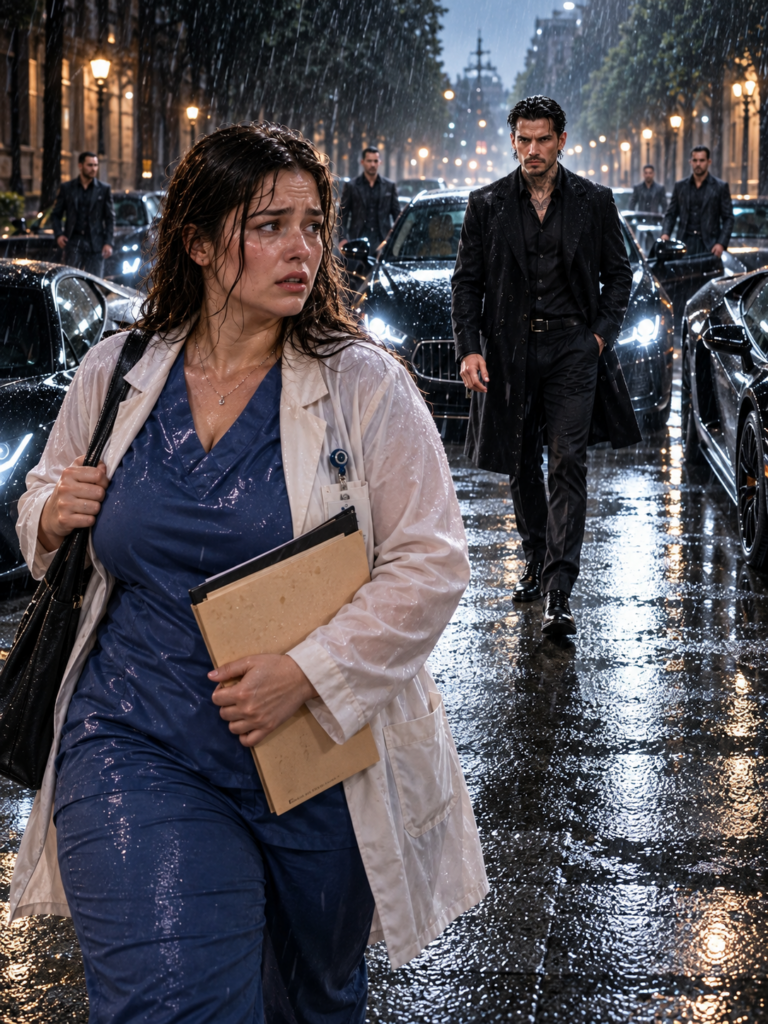
The first black SUV nearly struck Clare before she realized the five vehicles had come for her.
Its massive front grille swept across the rain-soaked sidewalk, stopping so close to her knees that she stumbled backward against a brick wall. A second SUV skidded behind her. Three more closed the remaining gaps, their headlights flooding the deserted Chicago street with blinding white light.
Within seconds, she was surrounded.
Doors opened. Men in expensive dark suits stepped into the downpour, their hands hovering near concealed weapons.
Then a tall man emerged from the lead vehicle.
Blood covered the cuffs of his white shirt.
He surveyed the street with the frightening concentration of someone searching for a target.
“Where is she?”
Nobody answered.
His pale gray eyes finally settled on Clare.
“Where’s the nurse?”
Three hours earlier, Clare had lost the job she’d given nine years of her life to.
Now a stranger carrying a gun was demanding to know where she was.
And she was beginning to understand that the blood on his shirt belonged to someone who might not survive the night.
The fluorescent lights in the human resources office of St. Jude’s Memorial Hospital had been flickering for weeks.
Clare had noticed the problem during previous visits to administration, usually when she was being asked to explain why her overtime had exceeded the department’s budget or why she’d refused to discharge a patient who was still dangerously unstable.
Today, the flickering seemed particularly cruel.
Across the desk, Administrator Davis slid a folder toward her.
“We have to consider the hospital’s liability.”
Clare looked at the folder without touching it.
Inside were nine years reduced to a termination notice.
Nine years of twelve-hour shifts that routinely became sixteen. Christmas mornings spent inserting IV lines. Thanksgiving dinners eaten cold from plastic containers. Sleepless nights after losing patients whose families would never understand why the people in scrubs hadn’t been able to save them.
And now this.
“Dr. Weber was the attending physician,” Davis continued. “You were not authorized to perform that procedure.”
“The patient had a tension pneumothorax.”
“Clare—”
“His oxygen saturation was falling into the sixties. His trachea had shifted. He was dying.”
Davis folded her manicured hands.
“That’s your interpretation.”
“No. That’s what was happening in the room.”
Clare remembered every second.
The patient struggling against the bed. The alarm shrieking. A young respiratory therapist looking desperately toward the physician who was supposed to lead the team.
And Dr. Weber, standing motionless.
Clare had called his name twice.
He hadn’t responded.
So she’d acted.
The patient was alive because she had.
“Dr. Weber’s statement describes your behavior as erratic,” Davis said carefully. “He claims you physically displaced him and proceeded without authorization.”
“He froze.”
“That is a serious accusation.”
“So is letting a man die because the person authorized to save him won’t move.”
Davis’s expression remained professionally sympathetic.
Clare knew that expression. She’d seen versions of it on doctors informing families that nothing more could be done.
Only now there was no grieving family, no emergency, and no life left to save.
Just an institution protecting itself.
“The board has made its decision,” Davis said. “We are prepared to offer two weeks of severance in exchange for your signature on the nondisclosure agreement.”
Clare looked at the pen beside the documents.
She could argue. Demand another meeting. Insist someone review the medical chart.
But she could also see the decision had been made long before she entered the room.
The hospital had decided which employee was easier to sacrifice.
She signed.
When she returned the pen, Davis seemed relieved.
“I’m sorry it ended this way.”
Clare stood.
“The patient didn’t die.”
Davis looked up.
“That’s the part I intend to remember.”
She walked out before the administrator could answer.
The hospital corridors hadn’t changed. The same stretchers crowded the emergency department. The same exhausted nurses moved between rooms. The same antiseptic smell clung to everything.
Yet Clare felt strangely invisible.
A nurse she’d trained two years earlier glanced toward her, then immediately looked down at a chart.
Another turned away beside the medication station.
News traveled quickly at St. Jude’s.
Apparently loyalty traveled considerably more slowly.
In the staff locker room, Clare opened the narrow metal compartment that had held the remnants of her working life.
Spare scrubs.
A half-empty box of granola bars.
A battered stethoscope with medical tape wrapped around a cracked section of tubing.
She packed everything into a plastic grocery bag.
For a moment, her hand lingered over the hospital identification badge hanging from its hook.
CLARE.
REGISTERED NURSE.
Nine years.
She left the badge where it was.
Outside, Chicago was drowning beneath an early evening thunderstorm.
Water poured from the hospital awning. Traffic crawled through flooded intersections, headlights reflecting across the asphalt.
Clare stood at the entrance and searched instinctively for her car before remembering it was still parked at a mechanic’s garage.
The alternator needed replacing.
She hadn’t been able to afford it yesterday.
With two weeks of severance and an uncertain future, the repair now felt like an impossible luxury.
Her apartment sat above a struggling laundromat in an industrial neighborhood several miles from the hospital.
Normally she would have taken the bus.
But the next one was delayed, and the thought of standing among strangers while trying to keep herself from falling apart was unbearable.
So she started walking.
Rain penetrated her denim jacket almost immediately.
Within five minutes, her canvas sneakers were soaked through. Water ran down her neck and collected beneath her collar.
She barely noticed.
Her thoughts were occupied by numbers.
Rent.
Electricity.
Groceries.
The mechanic’s bill.
The negative balance waiting in her checking account.
She considered applying to the free clinic downtown. The pay would be miserable, but at least she wouldn’t have to pretend that a physician’s pride mattered more than a patient’s pulse.
By the time she reached the warehouse district, the sidewalks were empty.
Brick factories rose behind chain-link fences. Streetlights cast weak yellow circles across the wet pavement. The rain blurred everything beyond a few yards.
The handle of her grocery bag broke without warning.
Her belongings spilled onto the sidewalk.
Clare stopped and stared at the stethoscope lying in a shallow puddle.
For one terrible moment, she couldn’t move.
Of everything she’d lost that afternoon, it was the sight of that cheap, damaged instrument in the dirty water that nearly undid her.
She crouched, retrieved it, and wiped the metal bell against her jeans.
“Come on,” she whispered to herself.
Then the pavement trembled.
At first she thought it was thunder.
But the sound grew louder, deeper, more mechanical.
Engines.
Several of them.
She looked toward the intersection.
Five pairs of headlights emerged through the rain.
The vehicles weren’t moving like ordinary traffic.
They were coming directly toward her.
Clare immediately quickened her pace.
There was an alley between two factories ahead. If she could reach it, she might escape toward the next street.
She managed three steps.
Tires screamed.
The first SUV mounted the sidewalk.
The remaining vehicles surrounded her.
And suddenly the worst day of her professional life had become something far more dangerous.
The men formed a perimeter without needing instructions.
Clare counted at least eight of them, although the headlights made it difficult to see clearly.
They weren’t drunk or careless.
Their suits were tailored. Their shoes expensive. Their movements deliberate.
Several carried weapons openly.
The tallest man approached her.
His charcoal jacket hung open over a bloodstained white shirt. Rain darkened his hair, emphasizing the hard angles of his face.
There was something more unsettling about him than his size.
The others watched him.
Even armed men seemed to be waiting for permission to breathe.
“Where is she?” he demanded.
A younger man with a scar crossing one eyebrow approached from the side.
“Dominic, the tracker puts her phone on this block.”
Dominic’s gaze snapped back toward Clare.
He studied her wet jacket, muddy jeans, and broken grocery bag.
“The nurse from St. Jude’s,” he said. “She came this way. Where did she go?”
Clare pressed her shoulders against the brick.
“I don’t have any money.”
“I didn’t ask whether you had money.”
His hand moved.
A black handgun appeared beside his thigh.
He didn’t point it at her.
He didn’t need to.
“A trauma nurse left the hospital about twenty minutes ago,” he continued. “Short hair. Blue scrubs. We tracked her here.”
Clare stared at him.
They had tracked her telephone.
Somehow, these strangers knew where she’d worked, when she’d left, and which direction she’d walked.
But they didn’t recognize her.
She was no longer wearing her scrubs, and the rain had flattened her hair against her forehead.
To Dominic, she was merely an inconvenient woman standing between him and someone he desperately needed.
Then she noticed his cuffs.
The blood wasn’t diluted enough to be old.
There was far too much of it.
Her eyes shifted toward the SUV behind him.
Through its rain-streaked rear window, she saw a hand slide weakly down the glass.
A bloody hand.
Her fear didn’t disappear.
It simply moved aside for something stronger.
“What happened to him?”
Dominic frowned.
“What?”
“The person in your vehicle. What kind of injury does he have?”
The scarred man stepped forward.
“Who the hell are you?”
Clare ignored him.
She looked directly at Dominic.
“That blood came from an active hemorrhage. Whoever’s inside that car is losing time while you stand here threatening strangers.”
Dominic’s expression changed.
“How would you know?”
“Because I’ve spent nine years watching people bleed.”
She reached into her jacket.
Weapons rose around her.
Several metallic clicks broke through the storm.
“Don’t,” the scarred man warned.
Clare slowly withdrew her battered stethoscope.
She held it where everyone could see.
“I’m the nurse you’re looking for.”
Dominic stared.
“And I was fired three hours ago,” she added. “So unless somebody intends to tell me what happened to your patient, this conversation is going to end very badly for him.”
The handgun at Dominic’s side lowered slightly.
He moved toward the SUV and pulled open its rear door.
“Then save him.”
Clare pushed past him.
The young man inside was barely conscious.
He looked about twenty-two, with dirty blond hair pasted to his forehead and skin drained almost gray.
His suit trousers were saturated with blood.
A leather belt had been wrapped around his upper leg, but the improvised tourniquet had failed to control the hemorrhage.
Clare leaned closer.
Two bullet holes.
One entry wound. One exit.
The upper thigh had been badly damaged.
The location immediately concerned her.
“What’s his name?”
“Tommy.”
“When was he shot?”
“Not long ago.”
“That isn’t an answer.”
Dominic moved closer.
“Can you help him?”
“I can try to keep him alive. But he needs an emergency department and a vascular surgeon.”
“He can’t go to a hospital.”
She turned toward him.
“Then you’re choosing a funeral.”
Dominic’s face hardened.
“Every emergency room within ten miles is being watched. The men who shot him want him dead.”
“That doesn’t change the anatomy of his leg.”
He reached into the luggage compartment and dragged out a large military trauma bag.
Inside were emergency supplies, packed and organized with the care of someone who expected to need them.
“Use whatever you need.”
Clare looked from the equipment to Tommy’s barely moving chest.
“What about a surgeon?”
“We have one.”
“Good. Drive there.”
Dominic’s gaze held hers.
“Get inside.”
Before she could question where they were going, a firm hand guided her farther into the vehicle.
The door slammed.
The engine surged.
And Clare found herself on the floor of a speeding mafia SUV, with a dying stranger bleeding across the leather seats.
“Interior lights!” she shouted.
Dominic reached forward and switched them on.
Harsh illumination revealed Tommy’s condition.
His lips had begun to turn blue. His breathing was shallow. The blood beneath him had collected in the seams of the expensive upholstery.
Clare pulled the trauma kit toward her.
“Tommy.”
She touched his cheek.
“Tommy, look at me.”
His eyelids fluttered.
“That’s it. Stay with me.”
She cut away the ruined trouser fabric and assessed the injury.
The bullet had passed through the upper thigh, damaging muscle and the major blood vessel running through it.
The makeshift belt was positioned badly.
“This isn’t stopping the bleeding.”
Dominic leaned over the seat.
“What do you need?”
“For you to stop asking questions and help me.”
There was a brief pause.
Then he moved.
Clare removed the ineffective belt while controlling the wound as best she could. Fresh bleeding followed, and Tommy cried out, his body twisting against the seat.
“Keep him still!”
Dominic braced his brother’s shoulders.
The young man struggled beneath him.
“Tommy,” Clare said, keeping her voice firm despite the chaos, “listen to me. I know this hurts. You have to let me work.”
She used the trauma supplies to control the hemorrhage, packing the damaged wound with hemostatic dressing and maintaining heavy pressure.
Blood coated her fingers.
The vehicle lurched through another turn.
Her shoulder struck the door, sending pain down her arm.
She barely registered it.
“Hold pressure here,” she instructed Dominic.
He followed her directions immediately.
No argument.
No hesitation.
Whatever authority he possessed outside this vehicle, he understood that she was the one keeping Tommy alive.
Clare secured a proper tourniquet high on the injured thigh and checked the bleeding again.
It had finally slowed.
She marked the application time—8:14—with a black marker so the surgical team would know how long blood flow had been restricted.
Then she checked Tommy’s pulse.
Fast.
Weak.
But present.
Only then did she sit back.
“He needs blood,” she said. “And he needs surgery. What I’ve done is temporary.”
Dominic continued holding pressure.
“How long?”
“I can’t give you a guarantee.”
His eyes settled on her face.
For the first time, he seemed to be looking at her as a person rather than an emergency resource.
“What’s your name?”
“Clare.”
“Clare,” he repeated quietly.
She was too tired to understand why the sound of her name in his voice unsettled her.
“Don’t thank me yet,” she said. “He’s not safe.”
Dominic struck the partition between the passenger compartment and the driver.
“Move faster.”
The engine answered with a growl.
Clare glanced at Tommy.
His chest continued rising, each breath shallow and uncertain.
Outside, the city rushed by in blurred streaks of light.
She had signed away her job that afternoon because she’d refused to watch a man die.
Now she was doing the same work inside a vehicle owned by someone who had threatened her with a gun.
And the strangest part was that she felt more certain of herself here than she had in the administrator’s office.
The convoy entered Chicago’s meatpacking district and turned into a narrow alley.
A corrugated steel door rose as they approached.
Beyond it lay an underground garage so clean and brightly lit that Clare initially mistook it for the service entrance of some private medical facility.
Five SUVs rolled inside.
The steel barrier crashed shut behind them.
Clare felt the sound in her stomach.
Men hurried toward the lead vehicle with a collapsible gurney.
“Watch his leg,” she ordered as they transferred Tommy. “Keep pressure on the wound. Don’t disturb the tourniquet.”
Dominic walked beside her.
“Where’s your surgeon?” Clare demanded.
He pointed toward reinforced double doors.
They passed through them into a fully equipped surgical suite.
Clare stopped.
Stainless steel workstations gleamed beneath surgical lights. An operating table occupied the center of the room. Oxygen equipment, monitors, sterile supplies, and a crash cart lined the walls.
It was cleaner than some hospital trauma rooms she’d worked in.
That realization frightened her almost as much as the guns.
People didn’t build an operating room beneath a warehouse unless they expected violence to be part of their lives.
“Get him onto the table,” she said.
The men obeyed.
She ordered everyone unnecessary out.
Two guards looked toward Dominic.
“You heard her,” he said.
The doors closed.
Clare went directly to the sink.
There was no time to think about the armed security, the hidden underground clinic, or the fact that nobody had explained where she was.
She needed intravenous access.
She needed volume replacement.
She needed the surgeon Dominic had promised.
Working methodically, she established two IV lines and began stabilizing Tommy while Dominic retrieved fluid bags from the supply cabinet.
His hands were steady.
That impressed her more than she wanted to admit.
Most people became clumsy or panicked when someone they loved lay bleeding in front of them.
Dominic remained alert, watching each movement with an intensity that bordered on frightening.
“Call the surgeon,” Clare said.
Dominic didn’t answer immediately.
She looked up.
“Dominic.”
His eyes met hers.
“The doctor isn’t answering.”
A cold sensation traveled through her chest.
“What do you mean, he isn’t answering?”
“His phone is off. His location tracker is down.”
“Then find another surgeon.”
“I’m working on it.”
“Your friend has a damaged femoral artery. I can keep his heart beating, but I cannot replace a vascular surgeon.”
Dominic placed both palms against the edge of the operating table.
The steel gave a small metallic sound beneath his hands.
“He isn’t my friend.”
Clare looked toward Tommy.
“Then who is he?”
For the first time since she’d met him, Dominic’s composure seemed to crack.
Just enough for her to see what lay underneath.
Fear.
Not for himself.
For the young man on the table.
“He’s my brother.”
Clare’s gaze moved between them.
The resemblance was there, hidden beneath the differences in age and coloring. Something about the eyebrows. The shape of the mouth.
Dominic straightened.
“Somebody knew where Tommy would be tonight. They knew his security would be light. And now the surgeon I pay to be available at all hours has vanished.”
“You’re saying this was planned.”
“Yes.”
“Then you have a much bigger problem than a missing doctor.”
His eyes sharpened.
“I know.”
Clare glanced at the monitor.
Tommy’s blood pressure was dangerously low.
His heart was racing to compensate for blood he no longer had.
There wasn’t enough time for arguments.
“I’m a nurse, Dominic. I can manage trauma. I can stabilize him. I can’t perform a proper vascular repair.”
Dominic moved to the other side of the table.
“Then tell me what you can do.”
Clare studied the wound.
A temporary solution formed in her mind.
Something she’d learned through years of emergency work, observing trauma surgeons and helping maintain patients through the worst minutes of their lives.
It was dangerous.
It wasn’t a substitute for surgery.
And if it failed, Tommy might die in front of both of them.
“There might be a way to restore blood flow temporarily,” she said. “But it’s only a bridge until a specialist gets here.”
“Do it.”
“I need assistance.”
“I have men outside.”
“No.”
Dominic stared at her.
She pointed toward the scrub sink.
“I need somebody who won’t faint when he sees blood, who can follow instructions precisely, and who understands that while we’re in this room, I’m in charge.”
For a moment, his expression became impossible to read.
Then he removed his watch.
Set it aside.
And walked to the sink.
“Tell me what to do.”
Part 2
The first thing Clare noticed was how strange Dominic looked wearing surgical gloves.
His hands were large, scarred across the knuckles, and obviously more familiar with weapons than medical instruments.
Yet when he stood opposite her at the operating table, he didn’t try to take control.
He waited.
“What happens now?” he asked.
Clare checked the monitor.
Tommy’s heart rate hovered near 140 beats per minute. His blood pressure remained critically low.
“Now we buy your brother time.”
She gathered the supplies she needed, examining the sterile tubing available in the surgical cabinets.
Under ordinary circumstances, a vascular surgeon would repair the damaged artery using proper instruments and specialized graft materials.
Those circumstances were nowhere to be found.
She could attempt a temporary shunt with the equipment available.
But everything about the situation was dangerously imperfect.
“We’re not fixing the artery,” she warned. “We’re creating a temporary route for blood to reach his leg. It could fail. He could develop complications even if it works.”
Dominic looked at his brother.
“What’s the alternative?”
Clare didn’t answer.
She didn’t have to.
“Then we do it,” he said.
“One more thing.”
His gaze returned to her.
“If I tell you to move, you move. If I tell you to hold something, you hold it. You do not decide you know better because you’re accustomed to people obeying you.”
Something flickered in his eyes.
It might have been irritation.
It might have been admiration.
“Understood.”
Clare adjusted the surgical lights.
The brightness exposed the damage to Tommy’s thigh with brutal clarity.
She worked carefully to expose the injured vessel, conscious of every limitation of the supplies and her own training.
Dominic assisted with the retractors, keeping the surgical field visible exactly as instructed.
Clare expected him to look away.
He didn’t.
She expected him to ask how much longer it would take.
He didn’t do that, either.
He stood across from her, his attention fixed on her hands, and responded only when she spoke.
The wound was worse than she had hoped.
Torn muscle surrounded the damaged artery. Clotted blood obscured the injury. The lack of normal blood flow had left the tissues pale and lifeless.
She identified the damaged vessel and worked toward establishing temporary circulation.
A sudden release of blood splashed across her chest.
Dominic’s body tensed.
“Don’t move,” Clare ordered.
He froze immediately.
She regained control of the bleeding, then continued the delicate work of positioning the improvised shunt.
Her shoulders ached.
Sweat gathered beneath the protective face shield.
She could hear Tommy’s monitor and the faint hiss of circulating air.
Everything else seemed to have disappeared.
No hospital board.
No administrator.
No Dr. Weber.
Only an injured young man, an artery that had been torn apart, and the fragile possibility of keeping enough blood moving through his leg until a real surgeon arrived.
At last, the temporary connection was in place.
Clare studied it.
It looked painfully inadequate.
A short length of clear tubing where a healthy blood vessel should have been.
Yet it represented the only chance she could give him.
She looked up at Dominic.
“This is the critical part.”
His eyes remained steady.
“I’m ready.”
Clare cautiously assessed the restored circulation.
For one horrible second, nothing appeared to change.
Then blood moved through the transparent tube.
The connection held.
Clare watched for leakage.
There was none.
Tommy’s monitor continued sounding.
His heart rate remained fast, but the numbers began moving in the right direction.
She checked his injured leg.
His foot, which had been cold and gray, gradually showed signs of returning circulation.
Clare let out a breath.
Not relief.
Not yet.
But the first small release of fear she’d permitted herself all evening.
“We have blood flow.”
Dominic stared at the tubing.
Clare checked again before allowing herself to believe it.
“The leg has circulation for now,” she said. “He still needs definitive surgery.”
Dominic looked at the monitor.
Then at his brother’s face.
Then back at Clare.
For several seconds, he said nothing.
She wondered if he understood how close they’d come to losing Tommy.
Perhaps he understood too well.
Once the immediate crisis had passed, the physical consequences arrived.
Clare stripped off her bloodied gloves.
Her hands began shaking almost at once.
Not subtly.
They trembled so hard that she had trouble dropping the gloves into the biohazard container.
Her clothes were soaked with rain, sweat, and blood.
A dull ache radiated through the shoulder she’d struck against the SUV door.
She hadn’t eaten a proper meal since the previous morning.
Dominic remained beside the operating table, watching his brother’s vital signs.
For the first time, Clare could study him without a weapon in his hand or an injured man demanding her full attention.
He was tall and broad-shouldered, with an expression that made even stillness look intimidating.
His clothes had to be expensive. The jacket he’d discarded was finely tailored, and the watch he’d removed would probably cover her rent for months.
But there were scars across his knuckles.
And he watched the heart monitor like a man who’d learned that wealth couldn’t negotiate with death.
Eventually, he moved to the sink and washed his hands.
The water ran pink.
Then clear.
“Where did you learn to do something like that?” he asked.
Clare leaned against the wall.
“Six years of Friday-night trauma shifts on the South Side.”
“That doesn’t sound like an answer.”
“It is if you’ve ever worked one.”
Dominic dried his hands.
She continued, “You see gunshot wounds, stabbings, industrial injuries. Sometimes three critical patients arrive at once and the surgical team is already occupied. You learn how to recognize what’s killing someone, what you can temporarily control, and when you need a specialist.”
He looked toward Tommy’s leg.
“You’re a nurse.”
“I was.”
Dominic turned.
“What?”
“Until this afternoon.”
He glanced at the oversized surgical clock.
“Why?”
Clare gave a tired laugh.
No humor accompanied it.
“I saved a patient whose doctor froze.”
She told him what had happened at St. Jude’s.
Not dramatically.
She was too exhausted for that.
She explained the collapsing patient, the attending physician who failed to respond, and the emergency intervention that had cost her job.
She described Davis’s office and the termination paperwork.
Dominic listened without interruption.
When she’d finished, he looked genuinely perplexed.
“They dismissed you because the patient survived?”
“They dismissed me because Dr. Weber would rather blame a nurse than admit he panicked.”
“Was the patient going to die?”
“Yes.”
“And you stopped it.”
“Yes.”
Dominic glanced at Tommy.
“Then your hospital is run by fools.”
Clare folded her arms.
“Maybe. But their fools have medical licenses and lawyers.”
The corner of his mouth moved slightly.
It wasn’t quite a smile.
Then she straightened.
“Your brother still needs a surgeon. None of what we did replaces that.”
Dominic’s expression closed again.
“The doctor who was supposed to be here has disappeared.”
“Then find him.”
“I have people looking.”
“That’s not enough.”
Dominic took a slow breath.
“The attack on Tommy was planned. Whoever arranged it knew his schedule, his route, and the size of his security detail.”
“And the doctor?”
“He was paid to be available whenever we needed him. Tonight he switched off his phone.”
Clare considered the implication.
“Someone may have paid him more.”
“Or killed him.”
The certainty in Dominic’s voice disturbed her.
She looked toward the heavy doors.
There were armed men on the other side.
A fortified garage outside.
A hidden surgical suite equipped for precisely this kind of emergency.
And apparently an enemy capable of reaching into Dominic’s organization.
“Then your brother isn’t the only person in danger,” she said.
Dominic regarded her.
“No.”
The single word settled between them.
Clare felt suddenly aware of how far she was from her apartment.
She didn’t know the address of this building.
She didn’t know the identity of the people who’d attacked Tommy.
And she had just witnessed something that powerful criminals would consider extremely sensitive.
“I should leave once another medical professional takes over,” she said.
Dominic’s expression hardened.
“Not yet.”
Clare held his gaze.
“That isn’t your decision.”
“Tonight, it is.”
The room seemed colder.
He approached her slowly.
“You know where my brother is. You know about this facility. And until I know who betrayed us, I can’t risk that information getting outside.”
“You’re telling me I’m a prisoner.”
“I’m telling you I can’t let you walk out.”
Clare’s exhaustion turned abruptly into anger.
“I just kept your brother alive.”
“I know.”
“And your response is to threaten me?”
Dominic stopped.
For a moment, he looked toward Tommy.
His voice lowered.
“I need someone competent here until another surgeon arrives. I have a medical team flying in from New York.”
Clare said nothing.
“They’ll be here in the morning.”
“That’s not what you said before.”
“The first surgeon was supposed to be here already. That option is gone.”
“So what are you offering?”
Dominic reached into his pocket.
He removed a thick bundle of hundred-dollar bills bound with a paper band.
Then he placed it on a metal tray.
“Twenty thousand dollars.”
Clare stared at the money.
“For what?”
“One night. Monitor Tommy. Keep him stable until the surgical team arrives. When they take over, you’re free to leave.”
She looked at the bills.
Twenty thousand dollars.
More than she’d earned in six months of punishing hospital shifts.
Enough to repair her car.
Enough to catch up on rent.
Enough to stop calculating the price of every grocery item.
Under different circumstances, it might have felt like rescue.
But money offered by a man who had already told her she wasn’t allowed to leave was not the same as a normal employment contract.
“You understand I’m not agreeing that you can keep me here,” she said.
Dominic’s face remained impassive.
“I understand.”
“And I want your word that I can leave after the surgeon arrives.”
“You have it.”
She wanted to ask whether his word meant anything.
But Tommy shifted faintly on the operating table.
The monitor reminded her that the patient still needed continuous attention.
Clare looked back at Dominic.
“He’s going to need close observation. Medication. Probably more blood. And I can’t promise that temporary shunt will hold until morning.”
“I understand the risks.”
“Do you?”
His gaze went to his brother.
“More than you think.”
Clare stood quietly for a moment.
Then she nodded toward her ruined clothes.
“I need clean scrubs.”
Dominic said nothing.
“And coffee. Black.”
For the first time, he looked genuinely surprised.
Then he reached for his phone.
Ten minutes later, a compact, heavyset man with a bruised jaw entered the surgical suite carrying folded navy scrubs and a cup of coffee.
He placed both items on a rolling tray and departed without making eye contact.
Clare watched him go.
“Does everyone around you act like you’re going to execute them for speaking?”
Dominic looked up from the tablet he’d been examining.
“Not everyone.”
“That’s reassuring.”
She carried the clothes into a small changing alcove.
Her denim jacket had stiffened with drying blood.
Her white T-shirt was ruined.
She cleaned herself as best she could and changed.
The borrowed scrubs were enormous.
She rolled the waistband three times and cuffed the legs.
When she returned, Dominic had changed into a black henley.
Without the bloodstained suit, he looked less like a businessman who had stepped out of a luxury vehicle and more like the dangerous man she’d first suspected him to be.
He sat near the wall with a tablet balanced on one knee.
His eyes returned repeatedly to the monitor.
Clare drank the coffee.
It was bitter, overheated, and tasted as though it had been prepared by someone who considered flavor an unnecessary weakness.
She loved it.
“I need access to the medication cabinet.”
Dominic stood.
He opened a heavy steel compartment embedded in the wall.
Inside were carefully arranged shelves of medical supplies and controlled medications.
Clare examined what was available.
She selected the appropriate antibiotics and pain medication, recording what she administered out of long-standing professional habit.
There was no electronic patient chart.
No hospital billing system.
No pharmacy department to call if she made a mistake.
Only her own judgment and the patient in front of her.
“How long until the surgeon?” she asked.
“Seven hours. His plane is leaving Teterboro. He should land at Midway around four.”
“He’s bringing a team?”
“His own surgical staff.”
“Good.”
Clare sat beside Tommy and checked his vital signs.
“Seven hours is a long time for a temporary shunt,” she added.
Dominic leaned against the cabinet.
“We have O-negative blood stored here.”
She looked up.
“You have a blood bank?”
“A limited supply.”
“Then we’ll need to assess whether he requires an emergency transfusion. I’d still prefer proper testing and crossmatching wherever possible.”
“He’s lost a lot of blood.”
“I know exactly how much blood he’s lost.”
Her tone was sharper than she’d intended.
Dominic accepted the correction.
Clare rubbed her forehead.
“I’m sorry. I’m exhausted.”
“You’ve been working for hours.”
“I’ve been working for nine years.”
He regarded her for a moment.
Then he looked toward the cot in the corner.
“Sleep. I’ll watch the monitor.”
Clare shook her head.
“No.”
“If something changes, I’ll wake you.”
“If something changes with that shunt, we may not have much time. I’m staying awake.”
Dominic studied her.
This was the second time she’d refused a direct instruction from him.
The first time, she’d ordered him to scrub in.
The second time, she was refusing to rest.
He didn’t argue.
Instead, he dragged another chair closer to the operating table.
And sat down.
The hours that followed felt detached from the ordinary world.
Above them, Chicago continued through the night.
Trucks crossed wet streets. Late-shift workers returned home. Apartment windows went dark.
Somewhere, the hospital that had fired Clare continued operating without her.
But beneath the city, time narrowed to the movement of a patient’s chest and the changing numbers on a monitor.
Tommy remained unconscious.
His temperature rose around midnight.
Clare managed the fever, adjusted his treatment, checked his circulation, and watched for signs that the improvised shunt was failing.
Each reassessment brought cautious reassurance.
Blood was still moving.
His breathing remained steady.
But she knew stability could vanish without warning.
Dominic worked nearby.
He spoke quietly into a burner phone, checked messages on his laptop, and studied security information on his tablet.
Clare didn’t ask whom he was contacting.
Not at first.
She had spent enough years in emergency medicine to recognize that some patients arrived with stories nobody intended to tell the police.
Broken hands.
Bruises in the shape of restraints.
Gunshot wounds accompanied by explanations that contradicted the injuries.
She knew what kind of world produced those patients.
And now she was sitting inside it.
Around three in the morning, Dominic closed his laptop.
Clare looked up from Tommy.
“Did you find whoever betrayed you?”
Dominic crossed the room carrying a bottle of water.
He opened it and handed it to her.
“We’ve narrowed the possibilities.”
“To?”
“Four people knew Tommy’s route tonight.”
Clare drank.
“Four.”
“Two of them were killed during the attack.”
She lowered the bottle.
“That leaves two.”
“The head of my security and his second in command.”
“Where are they?”
“Being questioned.”
She studied his face.
“Questioned how?”
Dominic didn’t answer.
He didn’t need to.
Clare looked toward Tommy.
She thought of all the nights she’d treated people whose injuries came from precisely that kind of questioning.
The realization didn’t make her comfortable.
But it did make something clear.
This wasn’t an ordinary family dispute.
Whatever organization Dominic controlled, someone inside it had decided Tommy should die.
And that person had understood exactly how to make it happen.
The route.
The reduced security.
The missing surgeon.
One betrayal had created the conditions for another.
“Whoever did this expected him to bleed out,” she said.
Dominic nodded.
“They planned for it.”
Clare looked at the temporary shunt beneath the dressing.
“Then they underestimated his brother.”
Dominic’s gaze shifted toward her.
“What?”
“Tommy’s brother,” she said. “He found somebody to keep him alive.”
His expression changed almost imperceptibly.
It wasn’t softness.
Not quite.
But something in his posture eased.
“I almost got that somebody killed.”
Clare frowned.
“What’s that supposed to mean?”
“The SUV. The way we found you.”
“You mean the guns?”
His gaze dropped toward her shoulder.
“And the injury.”
Clare instinctively touched the bruised place near her collarbone.
She’d forgotten it for several hours.
The pain returned as soon as she remembered.
Dominic noticed.
He stepped closer.
“May I?”
She hesitated.
Then gave a small nod.
He moved the edge of her scrub collar just enough to see the discoloration.
His fingertips were warm against her cold skin.
The contrast startled her.
She had watched those same hands hold surgical instruments steady.
She’d seen them resting beside a handgun.
Yet now his touch was extraordinarily careful.
“That happened in the car,” he said.
Clare looked at him.
“Your driver seemed to think traffic laws were optional.”
Dominic didn’t smile.
“I’m sorry.”
The apology surprised her more than the touch.
“For the bruise?”
“For the way I took you.”
Clare watched him closely.
“That’s a fairly large apology.”
“I know.”
“Most people would have started with asking for help.”
“Most people weren’t watching their brother die.”
She held his gaze.
“That explains your behavior. It doesn’t make it right.”
Dominic withdrew his hand.
“No,” he said quietly. “It doesn’t.”
For several seconds, neither spoke.
The silence felt different from the threatening quiet in the SUV.
There was no demand hanging between them.
No order.
Only the uncomfortable awareness that they had seen each other at their worst and had somehow survived the encounter.
Clare broke eye contact first.
“I would have helped him if you’d asked.”
Dominic looked toward Tommy.
“I know that now.”
Her voice softened.
“Why?”
He turned back.
“Why what?”
“Why do you believe that?”
Dominic considered her question.
“Because you could barely stand when I found you. You’d lost your job. You had every reason to look after yourself.”
He paused.
“But the moment you saw blood, you stopped thinking about your own problems.”
Clare glanced at her hands.
“I’m a nurse.”
“That doesn’t answer everything.”
She thought about the patient at St. Jude’s.
About Tommy bleeding in the SUV.
About the countless faces she’d seen during nine years in emergency rooms.
“It answers enough.”
A faint mechanical beep interrupted them.
Clare turned immediately.
The IV infusion had finished.
She walked over to replace the empty fluid bag and check the line.
Dominic moved toward the workstation.
He was reaching for his tablet when a low vibration rolled through the concrete beneath their feet.
Clare froze.
It sounded like a distant siren.
But deeper.
Muffled by heavy walls.
She looked toward Dominic.
“What was that?”
His entire expression changed.
The man who’d apologized beside the operating table disappeared.
In his place stood the man who commanded armed guards and traveled through Chicago in a convoy of black SUVs.
“Perimeter alarm.”
He crossed to the security console and activated the monitors.
Several camera feeds appeared.
The garage.
The main entrance.
The service corridor.
The alley.
Except the alley camera showed only static.
Dominic stared at it.
Then his eyes shifted to the garage feed.
Three dark sedans had stopped outside the heavy steel door.
Men wearing tactical clothing emerged from the vehicles.
They carried rifles.
No visible police insignia.
No hesitation.
They began positioning themselves around the entrance.
Clare looked from the screens to Dominic.
“Is that the surgeon?”
Dominic’s answer came immediately.
“No.”
He reached for the handgun at his waist.
“The rat told them where we are.”
On the security monitor, one of the armed men signaled toward the steel door.
A second man approached carrying equipment.
Dominic’s voice became cold.
“They’ve come to finish the job.”
Part 3
The first impact struck the outer steel door hard enough to make the surgical lights tremble.
Clare flinched.
A second impact followed.
Dust drifted from the ceiling.
On the security monitors, the armed men moved with practiced efficiency.
They weren’t looters or frightened amateurs.
They knew where to stand. They covered one another. And they appeared entirely unconcerned about the possibility of police arriving.
Dominic reached into a steel drawer and removed a compact handgun.
He checked it quickly before turning toward Clare.
“Take this.”
She stared at the weapon.
“No.”
“Clare.”
“I don’t use guns.”
“They’re coming through that door.”
“Then call your security team.”
“I already have.”
Another tremendous boom shook the room.
Somewhere beyond the surgical suite, metal began to tear.
Dominic stepped closer and offered the pistol grip-first.
Clare looked at Tommy.
He was unconscious beneath the surgical lights, unaware that the people who had almost killed him earlier were approaching again.
Her stomach tightened.
“I save people,” she said. “I don’t shoot them.”
Dominic’s expression didn’t change.
“Those men don’t know you. They won’t care that you’re a nurse. And if they get inside, they won’t leave a witness.”
He placed the weapon in her hand.
Its weight surprised her.
She had handled scalpels, surgical clamps, needles, and countless other instruments capable of injuring a person.
But she’d always used them to preserve life.
This felt different.
“Stay behind the operating table,” Dominic ordered. “Keep my brother breathing.”
He moved toward a reinforced support column with his own weapon raised.
Clare stared at the pistol in her hand.
For the first time that night, she desperately wanted to be somewhere else.
Her apartment.
The broken couch she’d been thinking about during the walk home.
Even the locker room at St. Jude’s.
Anywhere that didn’t have armed men breaking into a hidden hospital.
The next impact was followed by the unmistakable sound of gunfire.
Not one shot.
Several short, controlled bursts.
Then shouting.
Footsteps.
The heavy double doors shook.
Clare crouched beside the operating table.
Her pulse hammered in her ears.
Tommy’s monitor continued its steady rhythm.
She focused on that sound.
It was the only familiar thing left.
The lock on the surgical suite’s outer doors failed with a shriek of metal.
Dominic adjusted his position behind the column.
“Get down!”
Clare dropped lower.
The doors burst inward.
Two men in tactical gear rushed through, rifles raised.
Dominic fired.
The gunshots exploded through the enclosed room, louder than Clare had imagined possible.
One attacker fell.
The second stumbled backward and returned fire.
Bullets struck the wall and ceiling.
Fragments of plaster showered the surgical equipment.
An overhead light shattered.
Clare covered her head as broken glass scattered across the floor.
Then the main lights went out.
For an instant, everything disappeared into darkness.
The backup power system activated.
Emergency lights bathed the surgical suite in a dim red glow.
“Clare!” Dominic shouted. “Check the monitor!”
She looked up.
The heart monitor’s casing had been struck.
Its screen was black.
No numbers.
No rhythm.
No reassuring electronic pulse.
A wave of panic swept through her.
She dropped the handgun onto the floor and reached over Tommy.
“Come on,” she whispered.
She placed two fingers against his neck.
For one terrifying second, she felt nothing.
Then—
A pulse.
Fast.
Weak.
But steady.
She almost sobbed with relief.
“He’s alive!”
Dominic fired toward the doorway again.
“Stay down!”
More footsteps sounded in the corridor.
The attackers were pushing farther into the compound.
Clare crouched beside Tommy, checking his breathing and ensuring the equipment still connected to him had not been damaged.
She couldn’t see the shunt clearly in the emergency lighting.
She could only hope it remained intact.
The gunfire continued.
Dominic moved with brutal precision, shifting between cover and the doorway as he forced the attackers back.
Clare had seen men wounded by gunfire hundreds of times.
She knew what bullets did to tissue.
She knew how quickly an artery could empty a human body of blood.
But knowing the consequences wasn’t the same as hearing rounds strike concrete a few feet from her head.
Every shot made her instinctively shrink closer to the floor.
She was afraid.
Not professionally concerned.
Not detached.
Terrified.
Then she heard a sound that didn’t belong to the battle in the corridor.
A soft footstep.
Behind her.
Clare turned.
A figure emerged from the narrow alcove near the autoclave.
One of the attackers had entered through the side access door.
He wore dark tactical clothing and a mask that concealed most of his face.
His handgun was raised.
But he wasn’t aiming at Dominic.
He was aiming directly at Tommy.
For one extraordinary second, Clare understood everything.
The missing surgeon.
The breached compound.
The armed men willing to fight through a fortified garage.
They weren’t here to threaten Dominic.
They weren’t searching for money.
They had come to make sure Tommy died.
The masked man took another step.
Clare moved before she had time to consider what she was doing.
Her fingers closed around the pistol she’d dropped.
She brought it up.
The attacker shifted his aim.
Clare saw the muzzle moving toward the unconscious young man.
“No!”
She fired.
The recoil jolted through her wrist.
The report was deafening.
The attacker jerked backward.
Blood spread across the fabric of his thigh.
He collapsed with a cry, his weapon striking the floor several feet away.
For an instant, nobody moved.
Clare remained on her knees, both hands locked around the gun.
She had just shot someone.
The realization arrived with terrible clarity.
Not a simulated emergency.
Not a patient arriving with a wound somebody else had inflicted.
She had pulled the trigger.
She had put a bullet into another human being.
The wounded attacker groaned and clutched his leg.
Clare saw the blood.
Her mind immediately began assessing its source, the rate of bleeding, the possibility of a major vessel injury.
Even now, some part of her wanted to help him.
But then she looked at Tommy.
He was still breathing.
The attacker had been aiming at his chest.
And she understood that if she hadn’t acted, the patient she’d spent the entire night trying to save would already be dead.
Dominic appeared beside the operating table with his weapon raised.
He saw the wounded man.
Then Clare.
Then the gun trembling in her hands.
“Clare?”
She couldn’t answer.
The attacker tried to move.
Dominic approached him, kicked his pistol beyond reach, and held him in place.
“Don’t,” he warned.
From the garage came the squeal of tires.
Vehicles stopped abruptly.
A voice thundered over a loudspeaker.
“Drop your weapons! The perimeter is secured!”
Clare stiffened.
More attackers?
Another assault?
Dominic listened.
Then his shoulders lowered slightly.
“That’s my backup.”
Outside, men shouted instructions.
The remaining gunfire stopped.
Boots pounded through the corridor.
Dominic exchanged a few terse words with someone beyond the broken doors.
Only after receiving confirmation that the attackers had been contained did he turn back toward Clare.
She was still kneeling beside the table.
Still holding the gun.
Her hands shook so badly that the metal seemed to vibrate between her fingers.
Dominic approached slowly.
“Clare.”
She stared at the wounded attacker.
“I shot him.”
“I know.”
“He’s bleeding.”
Dominic glanced toward the man’s injured leg.
“You didn’t hit the femoral artery.”
Her lips parted.
“I wasn’t trying to kill him.”
She struggled to take a breath.
“I just wanted him to stop. He was aiming at Tommy.”
Dominic crouched in front of her.
For the first time since the attack began, his expression lost its hard, commanding edge.
He reached carefully for the weapon.
“Let me have that.”
Her fingers wouldn’t release it.
He waited.
“Clare. Give it to me.”
Slowly, she loosened her grip.
Dominic took the pistol, secured it, and placed it out of her reach.
Then he looked directly into her eyes.
“You saved him.”
She shook her head.
“I hurt somebody.”
“Somebody who came here to murder a man who can’t defend himself.”
She looked away.
“That doesn’t make it easy.”
“No,” Dominic said. “It doesn’t.”
He made no attempt to convince her that violence was simple or that she should feel proud of what she’d done.
Instead, he stayed beside her while the shaking gradually lessened.
Behind them, Tommy continued breathing.
The temporary shunt had survived the attack.
Clare reached up and checked his pulse again.
Still there.
She closed her eyes briefly.
It had been hours since she’d walked out of the hospital with everything she owned in a grocery bag.
She’d believed then that losing her job was the worst thing that could happen to her.
Now she was kneeling in a bloodstained operating room, with broken glass across the floor and a wounded gunman only a few yards away.
Nothing about her life made sense anymore.
Dominic examined the bruise beneath her collarbone again, then the fresh abrasions on her wrist.
He didn’t touch them without warning.
Instead, he simply looked.
Clare noticed the difference.
This was the same man who had pushed her into his SUV without asking.
The same man who had announced she wasn’t allowed to leave.
The same man who had told her that if Tommy died, she would have problems of her own.
But he had also followed her instructions during a medical emergency.
He had sat beside his brother through the night.
And when the shooting started, he’d placed himself between her and the attackers.
Those things didn’t erase what he’d done.
They made him more difficult to understand.
“Tommy’s alive because of you,” Dominic said.
Clare glanced toward the operating table.
“He’s alive because we kept him going long enough.”
“You saved him in the car.”
“He still needed surgery.”
“You gave him that chance.”
“Dominic—”
“And when someone came through that door to finish him, you stopped it.”
She swallowed.
“Because he was my patient.”
Dominic studied her face.
Something changed in his expression.
She couldn’t name it.
Gratitude was part of it.
Respect, perhaps.
But there was something else, something that had begun when she’d ordered him to help with the surgery and grown during the hours he’d watched her refuse to abandon his brother.
He reached toward her face.
His thumb gently brushed away a smear of dust and soot from her cheek.
Clare held still.
She was conscious of the warmth of his hand.
Of the closeness between them.
Of how little she truly knew about him.
And of how dangerous it would be to mistake a moment of tenderness for safety.
“You crossed a line tonight,” he said quietly.
Clare met his eyes.
“I didn’t have a choice.”
His gaze moved toward Tommy.
“You could have hidden. You could have let me handle it.”
“The gun was pointed at his chest. You were at the other side of the room.”
Dominic remained silent.
Clare continued, her voice unsteady but firm.
“I didn’t shoot that man for you. I did it because Tommy couldn’t protect himself.”
For a moment, Dominic simply looked at her.
Then he nodded.
“I know.”
The admission unsettled her.
He wasn’t demanding loyalty.
He understood she had acted according to a principle that existed long before she’d met him.
The same principle that had cost her job.
She would not watch a patient die when she believed she could prevent it.
Dominic’s voice dropped.
“You’re part of something now, Clare. Whether either of us expected it or not.”
She frowned.
“What does that mean?”
“You know things that people outside this organization aren’t supposed to know. You saved my brother twice. And the men who came here tonight saw you.”
Clare felt her stomach tighten.
“Are you threatening me again?”
He glanced at the ruined doorway.
“I’m telling you the danger didn’t end when the shooting stopped.”
She couldn’t deny that.
Whoever had arranged Tommy’s murder had already compromised Dominic’s security and his medical support.
Clare had become involved in that conflict without understanding its rules or its consequences.
Dominic leaned closer.
“I can’t pretend tonight never happened.”
“Neither can I.”
His eyes held hers.
“And I don’t think I’m going to let you walk away.”
The words carried the same possessive certainty she’d heard earlier.
But this time Clare recognized something else beneath them.
He had almost lost his brother.
He had nearly lost control of his own organization.
And now he was confronting the possibility that the woman who’d kept them both from disaster might simply return to a life that had already rejected her.
Clare didn’t promise to stay.
She didn’t tell him she belonged to him.
She only looked at him and said, “You don’t get to make every decision for me.”
Dominic regarded her for a long moment.
Then his gaze moved toward the operating table.
“No,” he said at last. “I suppose I don’t.”
Before either of them could speak again, footsteps echoed through the damaged corridor.
Clare stiffened.
Dominic immediately turned toward the entrance.
But the men who appeared weren’t carrying rifles.
They wore surgical masks and scrub caps.
Several pushed medical equipment.
Others carried portable trauma cases.
One of them approached the operating table, already surveying Tommy’s condition.
The surgeon had arrived.
At last.
Clare felt something inside her loosen.
The specialist immediately assessed Tommy’s circulation and the temporary shunt, then began directing the surgical team.
Clare answered his questions.
She explained the injury, the blood loss, the emergency stabilization, the medications, and the improvised procedure that had maintained circulation.
She reported the changes in Tommy’s vital signs and the interruption caused by the gunfight.
The surgeon listened carefully.
Then he turned toward his team.
They began preparing for definitive vascular repair.
Clare watched them work.
They had the right equipment.
The training.
The personnel.
Everything she’d needed hours earlier and hadn’t been able to obtain.
For the first time all night, she was no longer the only person standing between Tommy and death.
Her knees suddenly weakened.
She stepped back.
The edge of the operating table caught her hand as she struggled to remain upright.
Dominic was there almost immediately.
He didn’t grab her.
He simply moved close enough to support her if she fell.
“Sit down,” he said.
This time, Clare didn’t argue.
She lowered herself against the base of the table, allowing the cold metal to support her exhausted body.
Her eyes burned.
She didn’t know if she wanted to laugh or cry.
Perhaps both.
She had been fired.
Threatened.
Taken against her will.
Covered in blood.
Forced to improvise in circumstances that no nurse should ever have been expected to manage alone.
And finally, she’d fired a gun to keep her patient alive.
Yet Tommy still had a chance.
That was what mattered.
That was what she’d been fighting for since the moment she saw his bloody hand against the SUV window.
Across the room, Dominic stood near the surgical team.
He listened to the surgeon’s assessment without interrupting.
For a moment, his expression softened as he looked down at his younger brother.
It was a small, private change.
One Clare suspected very few people ever witnessed.
Then Dominic looked toward her.
Their eyes met across the damaged surgical suite.
Nothing about his world had become less dangerous.
The armed guards were still outside.
Somewhere in Chicago, someone who had ordered Tommy’s death might already be learning that the attempt had failed.
The traitor in Dominic’s organization had not yet been definitively identified.
And Clare still had no guarantee that the freedom he’d promised her would be as simple as walking through the garage doors.
But something had changed between them.
He no longer saw her as a disposable stranger he’d tracked down in the rain.
She no longer saw him only as the terrifying man who’d stepped out of a black SUV holding a gun.
They had seen each other stripped of power, professionalism, and certainty.
She’d witnessed the fear beneath his ruthless composure.
He’d witnessed the courage beneath her exhaustion.
Neither could pretend otherwise.
Clare looked down at her trembling hands.
They were the same hands Administrator Davis had effectively declared a liability.
The same hands Dr. Weber had accused of acting recklessly.
The same hands that had saved two patients in a single day.
One in a respected hospital.
Another in a hidden operating room beneath the city.
She thought about the identification badge she’d left hanging in her locker.
About the severance agreement.
About her broken car and the rent she could barely afford.
She had spent nine years believing that St. Jude’s Memorial Hospital was the center of her professional life.
Now that life was gone.
And the man standing across the room was offering her a place in something infinitely more dangerous.
Dominic approached once the surgeon took control.
“You kept your word,” he said quietly.
Clare looked up.
“Tommy isn’t out of danger.”
“No. But he’s alive.”
She accepted that with a tired nod.
For several seconds, neither spoke.
Then Clare looked toward the ruined double doors.
Beyond them lay the corridor, the underground garage, and eventually the Chicago streets.
Somewhere above, dawn was approaching.
She could almost imagine the rain finally stopping.
“I want to go home,” she whispered.
Dominic studied her.
The tenderness in his expression did not erase the uncertainty of her situation.
“I know.”
Clare looked back toward the surgical team.
For now, Tommy was receiving the care he needed.
She’d fulfilled the promise she’d made when she accepted the twenty thousand dollars.
But she understood that money would never be the most important consequence of this night.
She had stepped into a criminal world where family loyalty could invite murder, where wealth purchased secret operating rooms, and where a single betrayal could endanger everyone close to a powerful man.
She had saved Dominic’s brother twice.
She had become a witness to his enemies’ violence.
And, whether she wanted the responsibility or not, she had made herself invaluable to a man who was accustomed to holding tightly to anything he couldn’t afford to lose.
Dominic stood beside her, keeping watch as the surgeon worked.
Clare could feel his presence without looking at him.
For the first time all night, she allowed herself to close her eyes.
She was alive.
Tommy was alive.
The gunfire had stopped.
But the choices waiting beyond those underground doors were far more complicated than the ones she’d faced inside the operating room.
Because saving a life had already cost Clare one career.
And saving the mafia boss’s brother might change everything that came after it.
The old life she’d walked away from in the Chicago rain was finished.
The new one had only just begun.


