
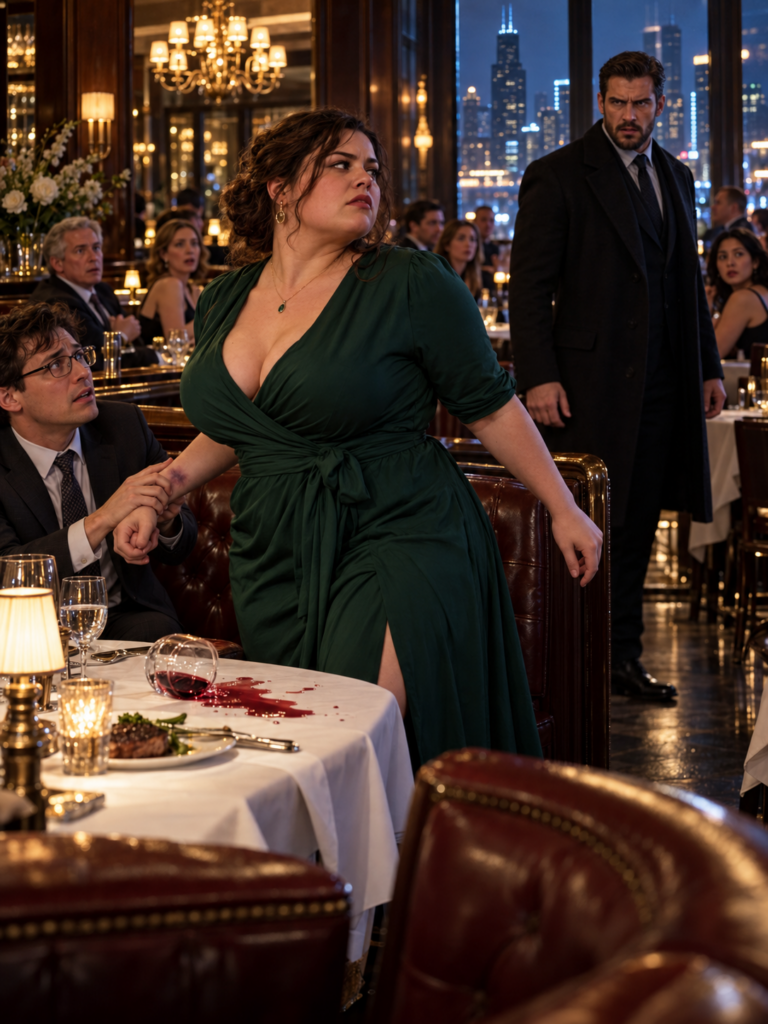
Her fingers closed around Douglas’s wrist before his hand could disappear beneath his coat.
He stopped.
Greg stopped breathing.
For one suspended second, Bliss understood exactly how much control Douglas had surrendered simply by allowing her to keep her hand there.
“Not here,” she said.
His eyes shifted to hers.
“He grabbed you.”
“And I’m standing.”
“He threatened you.”
“And there are fifty witnesses in this restaurant.”
Douglas’s face remained hard, but his hand came slowly away from his coat.
That mattered.
Bliss released him.
“Greg,” she said, “tell him what you wanted.”
Greg stared at her as though she had lost her mind.
Douglas pulled out the chair beside her and sat instead of looming over the table.
Somehow that was more intimidating.
Greg swallowed.
“It was just business.”
“What business?” Bliss asked.
Douglas said nothing.
Greg looked between them.
Bliss saw the calculation happening and realized something else.
Greg was more frightened of what Douglas already knew than of what Bliss might reveal.
She turned toward Douglas.
“You knew about him.”
His silence answered.
The hurt arrived before the anger.
“When?”
“Not enough soon enough.”
“That isn’t an answer.”
Douglas glanced at Greg.
“Tuesday, he received fifty thousand dollars through an offshore account linked to Leo Cavallo.”
Bliss felt her stomach drop.
Tuesday.
The same day Greg had asked her out.
Douglas continued.
“My people confirmed it less than an hour ago.”
“You investigated him after I mentioned the date.”
“Yes.”
“And instead of calling me?”
“I came myself.”
“That still leaves a rather important gap.”
Douglas’s mouth tightened.
Greg suddenly pushed away from the booth.
“I’m done with this.”
Bliss saw his right hand move toward his jacket.
“Douglas.”
Douglas moved, but Bliss had already seized the steak knife from beside her plate and knocked Greg’s wrist sideways before he could reach inside.
Something metallic struck the floor.
A compact pistol skidded beneath the neighboring table.
Diners screamed.
Douglas’s men crossed the room immediately.
Greg barely reached his feet before Dante pinned both arms behind him.
Bliss remained standing beside the table, the knife still in her hand.
Douglas stared at her.
Not at the weapon.
At her.
“You saw it?”
“His jacket pulled when he shifted.”
A flicker of something almost like pride crossed Douglas’s face.
Then disappeared beneath concern.
Dante dragged Greg toward the service corridor.
Bliss put the knife down.
“Don’t kill him.”
Douglas’s attention snapped back to her.
“He threatened you.”
“He also knows who paid him, what they wanted, and what else they may have compromised.”
That stopped him.
Bliss picked up her clutch.
“You want to protect me? Start by remembering that my brain still works when I’m scared.”
Douglas looked toward Dante.
“Keep him alive.”
Dante nodded and disappeared with Greg.
Only then did Douglas offer Bliss his coat.
She took it because she was cold, not because the gesture settled anything.
Outside, sleet had begun needling the street.
The black car waited at the curb.
Douglas opened the rear door.
Bliss didn’t get in.
“Did you know Greg was targeting me when you told me to cancel?”
“No.”
“Were you jealous?”
His gaze held hers.
“Yes.”
The answer struck harder because it came without decoration.
“And were you also worried?”
“Yes.”
“Then next time, tell me both. Don’t turn either one into an order.”
Douglas absorbed that in silence.
Finally he nodded.
“All right.”
Bliss got into the car.
He followed.
The door closed behind them, cutting away the city noise.
As the vehicle pulled from the curb, Douglas reached toward her bruised wrist, then stopped before touching her.
“May I?”
The difference was so small it almost hurt.
Bliss gave him her hand.
His fingers were careful around the swelling.
“I should have answered you in the office,” he said.
“Yes.”
“I was afraid the answer would change things.”
“It already has.”
His eyes rose.
Before either could say more, his secure phone vibrated.
Douglas read the message.
His expression emptied.
Bliss recognized that look.
Business had just become dangerous.
“What happened?”
He turned the screen toward her.
A security alert showed unauthorized access to the South Side warehouse system.
Below it was a second line.
LEVEL FIVE CREDENTIALS ACCEPTED.
Bliss stared.
Only a handful of people possessed level-five access.
She knew every one of them.
“Greg couldn’t do that,” she whispered.
“No.”
Douglas’s phone rang again.
He answered.
The voice on the other end spoke fast enough that Bliss caught only fragments.
Fire.
Warehouse.
Security breach.
Inside access.
Douglas’s hand closed around the phone.
Then Bliss heard the name spoken from the other end.
Silvio.
Douglas went perfectly still.
His uncle.
His underboss.
The man who had helped raise him after his father died.
Douglas looked at Bliss as the car accelerated south.
“Tell the driver to turn around,” she said.
“What?”
“We need my office terminal.”
“I’m taking you somewhere secure.”
“And I’m telling you the breach came through an executive credential. Greg was only one piece.”
Douglas’s expression hardened.
“Bliss—”
She leaned forward and pressed the intercom herself.
“Murray Logistics. Now.”
The driver hesitated.
Then Douglas said quietly, “Do it.”
The car swung hard through the next intersection.
Bliss opened her tablet and began pulling server logs.
By the time the skyline shifted outside the windows, she had found three more unauthorized downloads under Silvio Murray’s credentials.
Warehouse schematics.
Safe-house coordinates.
Offshore banking ledgers.
Then she found one final file opened less than twenty minutes earlier.
The emergency lockdown architecture for the South Side command office.
Bliss enlarged the diagram.
Her blood turned cold.
“Douglas.”
He leaned toward the screen.
She traced the electronic blast doors with one finger.
“This isn’t a robbery.”
The car raced through the wet Chicago night.
“It’s a trap for you.”
Douglas took the tablet from her, studied the schematic for three seconds, then handed it back.
“Turn the car north.”
Bliss looked up.
“No.”
His voice sharpened. “My penthouse.”
“No.”
“Cavallo knows who you are now.”
“And Silvio knows how you respond to an attack.”
“I’m not debating this.”
“Then you can argue with yourself while I solve the problem.”
Douglas stared at her.
The driver wisely remained silent.
Bliss zoomed farther into the warehouse blueprint.
“The central office is reinforced. If Silvio seals those doors after you enter, external control takes priority over the interior switch.”
“I know.”
“No, you know the room. I know the automation.”
That silenced him.
For years, people had assumed Bliss handled calendars because calendars were what they saw.
Douglas knew better than most, though apparently not all.
She had reorganized the company’s private logistics network after discovering three incompatible legacy systems were creating security gaps. She had helped design the emergency procedures that allowed legitimate operations to keep functioning during strikes, fires, power failures, and law-enforcement inspections.
And because Douglas trusted almost no outside consultants, Bliss possessed administrator access to systems most executives barely understood.
She tapped another screen.
“The fire alert began at 4:07. The exterior cameras went dark at 4:09.”
“Inside job.”
“Yes. But look here.”
She displayed the ventilation map.
“The secondary vault uses independent fire suppression, but the intake shares a junction with the loading dock.”
Douglas leaned closer.
“If they set the main bay on fire—”
“Smoke gets pulled toward the vault. The suppression pressure builds behind the sealed doors.”
His eyes changed.
“My men.”
“Could be standing beside a steel door when it fails.”
Douglas grabbed his phone and called Dante.
“Pull everyone away from the secondary vault. Shut the roof HVAC manually before anyone breaches the loading area.”
He listened.
Then his face hardened.
“No signal inside?”
Bliss watched him.
“Jammers?”
Douglas ended the call.
“Likely.”
The driver turned toward the St. Regis garage.
Bliss frowned.
“You’re still taking me upstairs.”
“Yes.”
“You need me.”
“I need you alive.”
“And your people need someone who understands the system.”
“I can carry instructions.”
“Until the network changes. Until Silvio overrides something I didn’t predict. Until you walk directly into the box he designed for you.”
Douglas’s composure fractured.
“Enough.”
The word filled the car.
Bliss went silent.
Not submissive.
Finished.
She closed the tablet.
Douglas saw it immediately.
“Bliss.”
“You’re frightened.”
His eyes narrowed.
“So you’re trying to make the fear disappear by making my choices disappear.”
“That is not what I’m doing.”
“It is exactly what you’re doing.”
The car descended into the private garage.
Bliss looked directly at him.
“If you want my help, ask for it. If you want me somewhere safe, explain the risk and let me decide. But do not mistake having armed men for having authority over my life.”
The car stopped.
Neither moved.
Finally Douglas said, “Cavallo may believe hurting you gives him leverage over me.”
“That’s relevant information.”
“I should have told you sooner.”
“Yes.”
“I want you somewhere secure while I confront Silvio.”
“That’s a request?”
His jaw tightened.
“Yes.”
Bliss considered.
Then nodded once.
“I’ll work from the penthouse. You keep an open line as long as possible. If communications fail, I need authorization to override the warehouse remotely.”
“You already have it.”
“I want you to say it.”
Douglas understood.
Not because the system required permission.
Because she needed him to recognize her authority before entering a situation where he might never come back.
“You have full operational authority,” he said. “If I lose contact, you make the call.”
Bliss’s chest tightened.
“All right.”
Upstairs, the penthouse looked less like a home than a beautiful defensive position built eighty floors above Chicago.
Douglas removed his overcoat and went directly to a locked cabinet.
Bliss watched him remove a handgun, check it, and secure it beneath his jacket.
She hated how ordinary the movement looked.
He turned toward her.
For a moment, the warehouse, Greg, Silvio, and Cavallo receded.
Only the office question remained between them.
“As a man,” Douglas said.
Bliss’s breath caught.
He stepped closer but stopped beyond touching distance.
“In the office. I was asking as a man.”
“You were ordering.”
“Yes.”
“And that matters.”
“I know.”
“Do you?”
His gaze dropped briefly.
“I knew how to stop you from going. I didn’t know how to admit I wanted you to stay.”
“That’s not the same problem.”
“No.”
Bliss studied him.
“Then what did you want?”
“You.”
The simplicity of it unsettled her more than possessive declarations would have.
Douglas continued.
“Not because you work for me. Not because you know my business. And not because you owe me anything.”
He looked almost uncomfortable saying it.
That made her believe him.
“I have wanted you for longer than I should have allowed myself to.”
“Why didn’t you say anything?”
“Because you work for me.”
Bliss blinked.
Douglas gave a humorless smile.
“There are lines even men like me understand.”
“And tonight?”
“Tonight I crossed one badly.”
He raised a hand toward her face.
Stopped.
Bliss closed the remaining distance herself.
She kissed him.
Not because he had rescued her.
Not because he was powerful.
Because for once, Douglas Murray had surrendered the outcome to her.
His hands stayed at his sides until she took one and placed it against her waist.
Then he kissed her back.
Slowly at first.
Three years of restraint collapsed into something warmer and more dangerous, but when Bliss pulled away, Douglas let her.
No complaint.
No command.
She rested her forehead briefly against his.
“That doesn’t settle anything.”
“I know.”
“Good.”
His phone rang.
Reality returned.
Douglas answered.
Dante’s voice came through distorted.
“Fire confirmed. South loading bays. We’ve got men pinned outside.”
“Silvio?”
“Inside.”
Douglas looked at Bliss.
She already had the tablet open.
“I’m going.”
Bliss swallowed.
“Don’t enter the command office unless I tell you the lockout is disabled.”
“I heard you.”
“That wasn’t agreement.”
A faint smile touched his mouth.
“I won’t enter until you clear it.”
He left.
The penthouse locks sealed behind him.
Bliss worked.
For twenty-three minutes she tracked changing access permissions, surveillance failures, and automated controls.
Then Douglas’s location beacon entered the warehouse perimeter.
The network went dark.
Bliss tried Dante.
No connection.
Douglas.
Nothing.
She pulled Silvio’s recent access logs again.
One file bothered her.
The lockdown architecture.
Why download plans for a system he already knew?
Unless he had changed something.
Bliss compared the current configuration against the archived build.
There.
The manual override had been rerouted.
Not disabled.
Rerouted to the loading-bay emergency panel.
A trap inside the trap.
Silvio wanted Douglas to believe he had an escape route.
She opened the fire-control grid.
Another inconsistency appeared.
The incendiary alerts formed a semicircle around the central office.
Not the vault.
Not the money.
The office.
“He wants Douglas inside.”
Bliss stood so quickly the stool toppled.
She tried the phones again.
Nothing.
Douglas had told her to remain secure.
He had also given her operational authority.
Those two instructions had just become incompatible.
Bliss grabbed the keys from the counter.
The front doors glowed red.
Lockdown.
She almost laughed.
“Of course.”
She opened the residential security controls.
The emergency release required a biometric authorization she did not possess.
But the building’s fire code did not permit a residence to become a sealed cage.
Bliss triggered a local fire-safety diagnostic.
The doors released.
She stopped.
Then deliberately canceled the false alarm before leaving.
Even in panic, she refused to endanger an entire building to solve her problem.
Downstairs, Douglas’s backup Audi waited in the private bay.
Bliss drove south.
The sky above the industrial district glowed orange.
She parked behind the warehouse near disused rail tracks, away from the main approach.
Smoke rolled over the roof.
Gunfire cracked somewhere beyond the loading bays.
Bliss crouched beside the car and studied the facility.
Douglas’s people were pinned behind shipping containers.
Silvio’s men controlled the center.
She could not fight her way inside.
Fortunately, no one had ever hired her to fight.
She circled toward the maintenance entrance.
Her master badge still worked.
Inside, smoke stung her eyes.
Bliss climbed to the elevated catwalk instead of crossing the warehouse floor.
From above, she saw everything.
Silvio stood near the central command office with armed men.
And behind the reinforced glass, Douglas paced beside the sealed doors.
Trapped.
Bliss dropped behind a steel support.
Her tablet connected to the warehouse’s local network.
Silvio had blocked outside signals.
He had not removed Murray Logistics’ internal maintenance channel.
Bliss opened the automated crane system.
A suspended empty shipping container hung above the aisle separating Silvio from the command office.
She could drop it.
But men stood beneath it.
Her thumb hovered over the release.
Then stopped.
No.
She was here to save Douglas.
Not crush strangers from forty feet.
Bliss changed the crane coordinates.
The suspended container moved.
Metal screamed overhead.
Silvio looked up.
The container swung laterally and descended hard across the aisle, slamming onto the concrete as a massive steel barricade between Silvio’s group and the office.
His men scattered.
Bliss immediately opened the command controls.
ACCESS DENIED.
Silvio had changed the encryption.
“Come on.”
She pulled the archived configuration.
Compared keys.
Found the hidden routing protocol.
The glass doors remained closed.
Below, Silvio spotted movement above him.
His head tilted.
Their eyes met.
Bliss knew instantly that he recognized her.
Silvio raised one arm and pointed toward the catwalk.
Two men broke away from his position and started for the stairs.
Bliss ran the decryption again.
FAILED.
Footsteps rang against metal below.
She had seconds.
Then one idea came.
The lock system itself was protected.
The building-wide emergency power transfer was not.
Bliss opened the electrical controls and isolated the command-office circuit.
The approaching footsteps grew louder.
She cut power.
Every light in the central office died.
The electromagnetic locks released.
Douglas hit the door with his shoulder.
It opened.
He came through just as the first of Silvio’s men reached the upper catwalk.
Bliss backed toward the maintenance stairs.
The man raised his weapon.
Douglas looked up.
“Bliss!”
She grabbed the red emergency lever mounted beside her.
The one Silvio’s people had ignored because it controlled an ancient warehouse feature no longer listed on the digital schematic.
Bliss pulled it.
A steel fire curtain dropped between her and the armed man.
His weapon struck the descending barrier.
Bliss ran.
Below, Douglas crossed the warehouse toward Silvio.
But instead of following, Bliss stopped at the lower landing.
Because Silvio had just shouted something she had not expected.
“You think this began with Cavallo?”
Douglas stopped.
Silvio smiled through the smoke.
“Ask your assistant what your father was moving through these docks before you inherited them.”
Bliss froze.
Douglas looked toward her.
For the first time that night, she had no answer.
And Silvio began laughing.
Silvio’s laughter echoed beneath the warehouse roof while smoke rolled through the rafters.
Douglas did not move toward him.
That restraint frightened Bliss more than rage would have.
“What are you talking about?” Douglas asked.
Silvio leaned against the steel container Bliss had lowered between them.
“You built spreadsheets over a graveyard and convinced yourself numbers made you different.”
“Different from whom?”
“Your father.”
Douglas’s face changed.
Bliss knew little about Patrick Murray beyond the official family history: powerful, feared, dead before Douglas turned twenty-five.
Silvio looked toward Bliss.
“She knows the ledgers. Ask her about the old freight codes.”
Bliss’s mind started racing.
Old codes.
She had seen them.
Three years earlier, during her first month at Murray Logistics, she had been assigned to reconcile a warehouse archive that predated the company’s restructuring.
She remembered strange entries.
Not because they were large.
Because they were repetitive.
The same three shipping designations had appeared for years and then vanished immediately after Douglas took control.
Bliss stepped down another stair.
“Douglas.”
His eyes stayed on Silvio.
“What?”
“He may be referring to the pre-restructuring manifests.”
Silvio smiled.
“There she is. The clever one.”
Bliss ignored him.
“The old ledgers used category codes that weren’t carried into the new system.”
“For what?”
“I don’t know.”
Silvio answered.
“People.”
Silence swallowed the warehouse.
Even the distant shouting seemed to disappear.
Douglas looked at his uncle.
“No.”
Silvio’s smile became cruel.
“Your father made money moving anything that paid. Guns. Cash. Contraband. Men who wanted to disappear. Women who never had a choice.”
Douglas crossed the space between them.
Bliss descended the remaining stairs.
“Douglas.”
He stopped before reaching Silvio.
Again, he listened.
Silvio noticed.
Something like hatred twisted his face.
“That’s why you’re weak,” he said. “You listen to her.”
“No,” Douglas said quietly. “That’s why I’m still alive.”
Silvio’s eyes flicked toward Bliss.
It was answer enough.
Douglas looked back at him.
“Proof.”
Silvio scoffed.
“You think I carried archives into a burning building?”
“No,” Bliss said.
Both men turned.
“You carried leverage.”
She stepped onto the warehouse floor.
Silvio’s coat hung unevenly.
One side heavier than the other.
His cane was gone.
No visible briefcase.
But beneath his left arm, the fabric bulged around something flat and rectangular.
Bliss pointed.
“What’s inside your coat?”
Silvio’s expression sharpened.
Douglas noticed.
“Take it out.”
Silvio laughed.
“No.”
One of Douglas’s men moved forward.
Bliss raised a hand.
“Wait.”
Douglas glanced at her.
She approached until perhaps fifteen feet separated her from Silvio.
“You downloaded records for months,” she said. “Not just the warehouse schematics. Properties. Accounts. Routing files. You weren’t merely giving Cavallo access.”
Silvio said nothing.
“You were building insurance.”
Still nothing.
“If Cavallo won, you needed proof you had helped him. If Douglas won, you needed something valuable enough to bargain with.”
The old man’s expression shifted by a fraction.
Bliss had him.
“The drive is in your coat.”
Silvio’s hand moved.
Douglas drew his gun.
“Slowly.”
Silvio stopped.
Bliss remained where she was.
“Put it on the ground.”
“You take orders well for a secretary.”
Bliss smiled without warmth.
“Tonight I’ve ignored nearly every order anyone gave me.”
Douglas’s mouth almost moved.
Silvio reached inside his coat.
For a terrifying second, Bliss thought she had misread him.
Then he removed a small black drive.
He held it between two fingers.
Douglas stared at it.
“What’s on it?”
“Your father’s real books.”
“Why keep them?”
“Because dead men are useful.”
Bliss’s stomach tightened.
Douglas lowered his gun slightly.
Not carelessly.
Deliberately.
“Give it to her.”
Silvio blinked.
“What?”
“Bliss holds the evidence.”
It was a small decision.
It changed everything.
Three years ago, Douglas would have taken the drive himself.
Three hours ago, he had tried to make a personal decision for her because fear had convinced him that control was protection.
Now, surrounded by armed men and betrayal, he gave the critical evidence to the person best equipped to understand it.
Silvio looked insulted.
Bliss extended her hand.
“Drive.”
He tossed it.
She caught it.
“Back it up before opening it,” Douglas said.
Bliss looked at him.
“Was that advice?”
A grim smile appeared.
“Yes.”
“Good.”
She pocketed the drive.
Sirens sounded faintly beyond the warehouse district.
Fire engines.
Possibly police.
Possibly both.
Dante approached through the smoke.
“We have maybe five minutes before this becomes impossible to contain.”
Douglas nodded.
“Get everyone out.”
Dante looked at Silvio.
“And him?”
Douglas stared at his uncle.
Bliss held her breath.
In the transcript of Douglas Murray’s life, violence had always supplied punctuation.
Betrayal.
Retaliation.
Fear.
More violence.
She wondered if this was the moment he proved Silvio right.
Douglas holstered his weapon.
“Alive.”
Silvio’s arrogance cracked.
Douglas continued.
“He answers for the warehouse. He answers for the records. He answers for Cavallo.”
Dante nodded and restrained him.
Silvio looked stunned.
“You’ve become soft.”
Douglas stepped closer.
“No. I became tired of confusing cruelty with strength.”
He looked toward Bliss.
“And somebody finally made me notice.”
The first firefighters breached the outer perimeter minutes later.
By then, Douglas’s people had abandoned the compromised parts of the building.
Bliss rode with him in the back of an SUV away from the smoke.
Neither spoke until the warehouse disappeared behind them.
Then Douglas said, “You came after me.”
“I did.”
“I told you not to.”
“You did.”
“You broke out of my penthouse.”
“Technically, I used the legally required emergency release.”
Douglas turned his head.
“You stole my car.”
“Borrowed.”
“You drove into an active attack.”
“That part was admittedly questionable.”
A laugh escaped him before he could stop it.
Bliss looked at him.
The laugh faded.
“You could have died.”
“So could you.”
“That is not the same.”
Bliss’s expression hardened.
“There. That.”
“What?”
“That idea that your life is something you get to risk while mine must be managed.”
Douglas leaned back.
The car’s passing lights moved across his face.
“You’re right.”
Bliss had prepared for resistance.
The immediate admission disarmed her.
He continued.
“I don’t know how to do this.”
“Do what?”
“Care about someone without trying to control every variable around them.”
Bliss looked down at her bruised wrist.
“That isn’t romantic, Douglas.”
“I know.”
“You said things tonight that sounded romantic because they were intense.”
He looked at her.
“They weren’t.”
“No.”
He nodded once.
“I don’t own you.”
“No.”
“You don’t belong to me.”
“No.”
A pause.
“Do you want me?”
Bliss looked up.
That question was different.
He was asking about desire, not possession.
“Yes.”
Douglas’s breathing changed.
Bliss continued before he could mistake the answer for absolution.
“Wanting you doesn’t mean I accept everything about you.”
“I know.”
“I won’t be hidden.”
“You won’t be.”
“I won’t be ordered around because you’re afraid.”
“I will fail at that sometimes.”
She appreciated the answer more than a perfect promise.
“What happens when you do?”
“I expect you to tell me.”
“I already do.”
“I noticed.”
Bliss smiled despite herself.
Then she remembered the drive in her pocket.
The smile vanished.
“We still have work.”
Back at Murray Logistics, dawn broke pale over Chicago.
The top floor was nearly empty.
Bliss sat at her desk with two secure laptops and the black drive isolated between them.
Douglas brought coffee.
He set hers beside her without comment.
Exactly the way she liked it.
“You remembered.”
“I remember everything you tell me.”
“That’s inconvenient.”
“Frequently.”
Bliss attached the drive to an offline machine.
Encrypted directories appeared.
She created two duplicate images before opening anything.
Douglas watched.
“What?”
“You told me to back it up.”
“I’m learning.”
The first files contained old manifests.
Then photographs of ledgers.
Then payment records.
Names.
Dates.
Ports.
Companies that no longer existed.
Bliss read in silence.
Silvio had told enough truth to wound.
Douglas’s father had used Murray infrastructure for crimes Douglas had never continued after taking control.
There were records involving smuggling far beyond the weapons and illicit freight Douglas already knew about.
Some entries referred to people as cargo.
Douglas stood behind her chair.
He stopped reading.
For several minutes he said nothing.
Bliss turned.
“You didn’t know.”
“No.”
“You changed these routes after you took over.”
“Yes. I thought they were inefficient.”
A strange laugh broke from him.
“I thought my father was old-fashioned.”
Bliss looked back at the screen.
“There’s something else.”
A set of later files bore Silvio’s personal authorization.
Dates after Patrick Murray’s death.
Douglas leaned closer.
Bliss opened them.
Silvio had continued pieces of the old network secretly.
Not at Murray facilities.
Through shell companies.
Cavallo-controlled routes.
The betrayal was older than anyone had understood.
Silvio had not joined Cavallo because Douglas had become weak.
He had been working with Cavallo for years because Douglas had dismantled revenue streams he considered unforgivable.
Bliss sat back.
“This was never about the warehouse.”
Douglas read the records twice.
“He wanted the old operation restored.”
“And you were in the way.”
“So he planned to replace me.”
“With someone he could control.”
Douglas looked toward the windows.
“Cavallo.”
Bliss shook her head.
“No.”
Douglas frowned.
She pointed toward the payment schedule.
“Look at the dates. Silvio was paying Cavallo’s people as often as Cavallo was paying him.”
“What does that mean?”
“Partners don’t usually invoice one another this way.”
She pulled a second ledger beside it.
“Silvio wasn’t giving your organization to Leo Cavallo.”
Understanding moved across Douglas’s face.
“He planned to let Cavallo attack me.”
“Then expose Cavallo’s losses, take his remaining routes, and absorb both organizations.”
Douglas stared at the evidence.
“All of Chicago.”
“Or as much of the criminal network as he could reach.”
He looked at Bliss.
“You found that in ten minutes.”
“Twelve.”
Douglas shook his head slowly.
“I have underestimated you.”
“Repeatedly.”
“I thought I understood what you did for me.”
“That’s because you noticed the emergencies I prevented but not the systems I built.”
He took that in.
Then he pulled a chair beside hers instead of standing over her.
“What do we do?”
Bliss noticed the phrasing.
We.
Not Tell me.
Not Here’s what will happen.
She turned the laptop toward him.
“We stop reacting.”
Over the next several hours, they dismantled Silvio’s leverage without firing another shot.
Bliss mapped the compromised accounts.
Douglas authorized freezes.
She identified properties Silvio had exposed.
Douglas evacuated the people using them.
She traced shell companies back toward Cavallo’s legitimate businesses.
Douglas turned the evidence over to attorneys who knew precisely which records could be used without exposing Murray Logistics to charges beyond what was already unavoidable.
At noon, Douglas did something Bliss had not expected.
He ordered Murray Logistics’ questionable freight operations suspended.
“All of them?” she asked.
“All routes you cannot defend on paper.”
“That could cost you millions.”
“It probably will.”
“You’ve never cared about legality that much before.”
“No.”
“Why now?”
Douglas looked at the old ledger on her desk.
“Because I just found out what happens when men convince themselves there is no line they cannot cross.”
Bliss searched his face.
“You’re not becoming innocent overnight.”
“I’m aware.”
“And cleaning the company doesn’t erase anything you’ve done.”
“I know.”
“But?”
“But I can decide what I do next.”
That answer she believed.
Three weeks later, Leo Cavallo was facing pressure from every direction.
Silvio’s records had exposed financial relationships Cavallo could not explain and shattered the alliances he relied upon. With Silvio alive and bargaining for his own survival, Cavallo could no longer pretend the warehouse attack had been an internal Murray dispute.
Douglas did not start the street war everyone expected.
Instead, he dismantled Cavallo’s ability to wage one.
Accounts disappeared.
Contracts collapsed.
Union support shifted.
Companies stopped returning calls.
Warehouses lost access.
For once, logistics defeated violence.
Bliss found the symmetry satisfying.
Greg Hastings pleaded guilty to financial crimes and conspiracy charges after discovering that neither Cavallo nor Silvio had any intention of protecting him.
Bliss never visited him.
She had no need.
His betrayal had taught her something useful.
Being publicly chosen was not the same as being genuinely valued.
And being intensely desired was not the same as being respected.
Douglas still had to prove the second.
He did it slowly.
Not with jewelry.
Not with grand declarations.
With behavior.
He stopped tracking her private calendar unless security genuinely required it—and when it did, he asked.
He stopped summoning her on weekends for things someone else could handle.
When a meeting involved danger, he gave her the same information he expected from his male executives and accepted her decision about whether to attend.
When he disagreed, he argued.
He no longer commanded.
Mostly.
One Tuesday afternoon, Bliss entered his office carrying revised corporate documents.
Douglas looked up.
“What are those?”
“My new employment terms.”
His eyebrows rose.
“Negotiating?”
“Correct.”
She placed them before him.
“Chief Operating Officer.”
Douglas read the first page.
“You want the title.”
“I already do the work.”
“Fair.”
“Equity.”
He looked up.
“How much?”
She named the percentage.
Douglas leaned back.
“That’s aggressive.”
“So am I.”
His mouth curved.
“And independent outside counsel reviewing everything.”
“Obviously.”
“One more condition.”
He waited.
“If we continue whatever this is between us, my employment cannot depend on it.”
His expression became completely serious.
“Agreed.”
“If we break up, I remain COO unless the board removes me for actual professional cause.”
“Agreed.”
“No retaliation.”
“Never.”
“Put it in writing.”
Douglas reached for a pen.
Bliss stopped him.
“Counsel first.”
He laughed.
“Right.”
Only after the agreement had been reviewed, revised, signed, and formally approved did Bliss allow herself to acknowledge what had changed.
She was no longer the indispensable assistant standing beside a powerful man.
She had authority of her own.
Months passed.
Murray Logistics became smaller.
Cleaner.
More profitable than Douglas expected.
Bliss found that particularly amusing.
One Friday afternoon, she stood again before the windows in his office.
Same city.
Same lake.
Same desk.
Douglas closed a legitimate quarterly report.
“Anything else before the weekend?”
Bliss checked her phone.
“One thing.”
His eyes narrowed suspiciously.
“I’m leaving at five.”
“Scandalous.”
“I have a date.”
Douglas became perfectly still.
Bliss waited.
He knew exactly what she was doing.
“With whom?” he asked carefully.
“You.”
His expression broke into a smile.
“Good.”
She folded her arms.
“Were you about to tell me to cancel?”
“No.”
“Liar.”
“I was going to ask whether his intentions were honorable.”
“His record is questionable.”
“I’ve heard.”
“He’s controlling.”
“Working on it.”
“Emotionally constipated.”
“That seems unnecessarily clinical.”
“And he once believed jealousy entitled him to issue orders.”
Douglas rose and came around the desk.
He stopped in front of her.
Exactly where he had months before.
But this time he did not crowd her.
He held out his hand.
“Bliss Phillips, would you have dinner with me tonight?”
She looked at his hand.
Then at him.
“As my employer?”
Douglas smiled.
“No.”
“As the man who loves you?”
Her expression softened.
“Better.”
She put her hand in his.
Outside, Chicago moved beneath the evening light—messy, imperfect, dangerous in ways no love story could erase.
Douglas had not become a different man because Bliss loved him.
Bliss had not become powerful because Douglas wanted her.
He had chosen to change what he could.
She had chosen what she would accept.
And somewhere between betrayal, smoke, ledgers, bruised trust, and a warehouse door she refused to leave locked, they had learned that protecting someone did not mean possessing them.
Love did not mean surrender.
It meant information.
Choice.
Accountability.
The freedom to say no and remain.
The freedom to leave and still matter.
Douglas lifted her hand but paused before bringing it to his lips.
Bliss smiled.
“Yes.”
Only then did he kiss her knuckles.
She picked up her coat.
“Reservation?”
“Seven-thirty.”
“Public restaurant?”
“Very.”
“Good.”
He opened the office door for her.
Bliss walked through first.
Douglas followed.
Not ahead.
Not pulling her behind him.
Beside her.
And when the elevator doors closed on the top floor of Murray Logistics, Bliss caught their reflection in the polished metal—Douglas in his dark suit, herself in emerald green, neither one smaller so the other could appear strong.
Months earlier, he had told her to cancel her date because he had mistaken fear, jealousy, and desire for authority.
Tonight he simply asked.
And Bliss, who had saved his life, reshaped his company, exposed a betrayal, negotiated her own future, and never once needed permission to know her worth, chose her answer freely.
“Yes,” she said again.
This time, Douglas understood exactly what made the word precious.

