
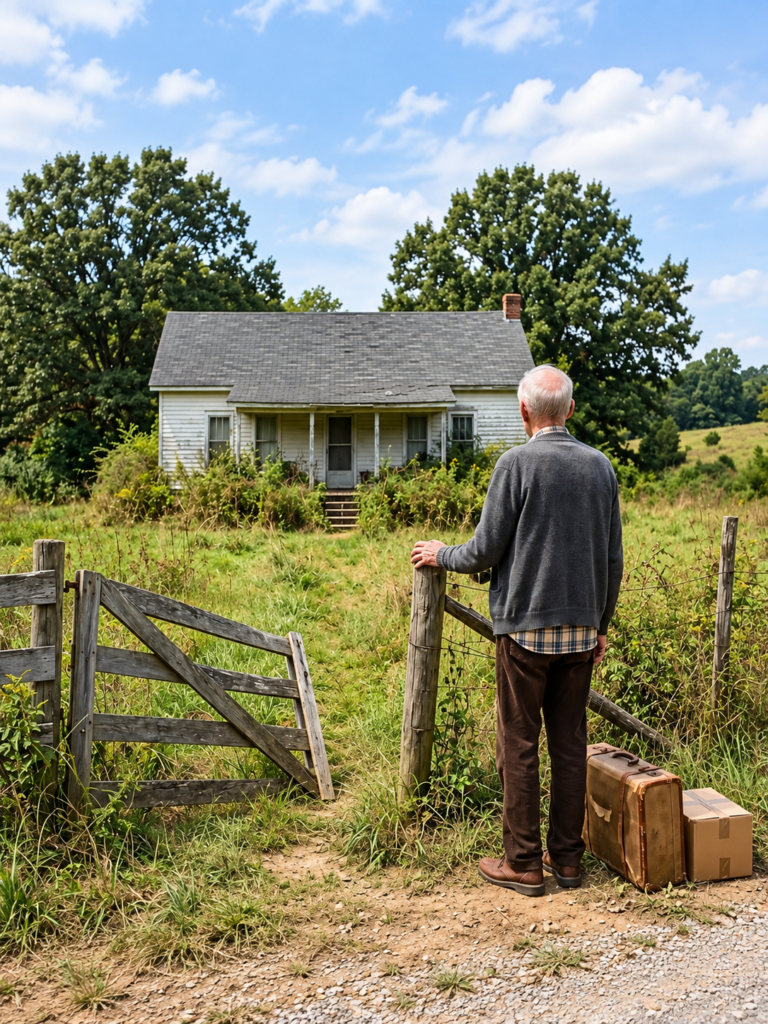
his son sold his dead wife’s things and put him away—then the 82-year-old bought a $100 house hiding a secret beneath the floor
Part 1
At eighty-two years old, Harold Turner had learned there were different ways a man could lose his home.
Fire could take it.
A bank could take it.
A storm could pull the roof off and leave rain standing in the bedrooms.
Age could take it one board, one stair, one difficult repair at a time.
But Harold had never imagined losing his home while it was still standing exactly where he had left it.
That was the part he could not forgive.
Eleven months earlier, he had still lived in the small brick house outside Lexington, Kentucky, where he and Margaret had spent forty-seven years together.
Nothing about the place was grand.
The hallway leaned slightly because the foundation had settled sometime in the 1980s. One kitchen cabinet refused to close during humid weather. The back porch had been rebuilt twice, once by Harold and his brother and again after both men became too old to trust themselves on ladders.
Margaret had loved the house anyway.
So had Harold.
Her blue coffee mug remained beside the sink after she died.
Her gardening gloves still hung from a nail near the back door.
Three dresses remained in the closet because Harold could not decide what should happen to them.
The rocking chair she had used during her last summer sat near the living-room window.
She had been too weak by then to walk out into the garden, so Harold carried flowerpots to the porch where she could see them.
Yellow black-eyed Susans.
Margaret always liked yellow flowers.
“They look cheerful without trying too hard,” she used to say.
After she died, Harold watered them until November even though he knew frost had already finished them.
For forty-three years, Harold had taught American history at the county high school.
He had taught children whose grandparents he had once taught.
Former students stopped him in grocery aisles.
“Mr. Turner?”
He would turn.
Sometimes he remembered them immediately.
Sometimes he needed the name.
They always remembered him.
A mechanic at the Ford dealership once refused to charge Harold for replacing a battery because Harold had stayed after school with him twenty-five years earlier and helped him pass enough history to graduate.
A nurse in the emergency room recognized him when Margaret was dying.
“You taught me about Reconstruction,” she said quietly.
Harold had almost laughed.
Of all the things to be remembered for.
After retirement, Margaret teased him that half of Kentucky knew him and the other half had skipped his class.
Then she was gone.
The house changed.
Not physically.
Something subtler.
Rooms became too large.
Silence grew heavier.
At supper, Harold sometimes looked toward Margaret’s chair with a thought ready to tell her.
Then memory arrived half a second later.
He still made too much coffee.
Still bought two bananas.
Still turned toward the bedroom before leaving for the store and nearly called, “Need anything?”
Grief was full of habits that had nowhere to go.
Harold managed.
Until January.
Ice covered the back steps.
He knew it was there.
That almost made the fall worse.
He held the rail, moved slowly, put his right foot down carefully, and still lost it.
One moment he was upright.
The next he was on his back with the wind knocked from him and pain running from his hip to his ribs.
He lay there looking at the winter sky.
His first thought was absurd.
Margaret would be furious.
His second was practical.
Can I stand?
He did.
Eventually.
The hospital found no fracture.
Bruised hip.
Strained back.
A cut on his elbow.
Nothing that should have changed a life.
But his son Michael was frightened.
Michael had inherited Margaret’s worried eyes and Harold’s tendency to hide worry beneath instructions.
“You can’t be there alone right now, Dad.”
“I’ve been alone nearly a year.”
“That’s different.”
“How?”
“You just fell on the steps.”
“I slipped on ice.”
“Exactly.”
Harold stared at him.
Michael sighed.
“I’m not saying forever.”
Susan, Michael’s wife, sat on the other side of the hospital room.
“There’s a place ten minutes from us,” she said gently. “Meals, somebody checking on you, physical therapy. Just until you’re stronger.”
Harold looked toward the window.
“I want to go home.”
Michael reached across and took his hand.
That was what Harold remembered later.
His son holding his hand.
“Just a few weeks,” Michael said. “The house will be waiting.”
Harold believed him.
He packed clothes for twenty-one days.
He left Margaret’s mug by the sink.
He left her rocking chair by the window.
He left thirty-seven years of tax records in a cabinet because Margaret had believed every receipt since 1968 might one day matter.
He left the tools in the garage.
He left photographs in hallway frames.
He left the Bible on the bedroom nightstand.
He left home expecting to return before February ended.
February ended.
Michael said the doctor wanted another month.
March came.
“The back steps need fixing.”
April.
“You shouldn’t be mowing yet.”
May.
“The air-conditioning’s acting up.”
June.
“It’s too hot to move you now.”
By July, Harold stopped asking every week.
He asked every two.
The facility was clean.
That made his anger feel ungrateful.
The staff were kind.
Meals arrived on schedule.
Medication came in little cups.
His room had a bed, chair, dresser, television, bathroom, and one window overlooking a parking lot and a line of Bradford pear trees.
No one mistreated him.
No one insulted him.
They simply organized his life until very little of it belonged to him.
Breakfast at seven-thirty.
Exercise group Tuesday.
Shower schedule.
Blood pressure.
Dinner.
Lights dimmed after ten.
The staff called him Mr. Turner.
Some called him Harold once they knew him.
One young aide named Vanessa asked about his teaching.
“What period did you like best?”
“The one after the bell.”
She laughed.
“I mean history.”
“I know.”
He liked her.
That did not make the room home.
Margaret’s photograph sat on the dresser.
Harold talked to it less often than he had talked to her chair.
Photographs did not feel the same as places.
Eleven months after the fall, the phone rang.
It was June Hensley, his old neighbor.
“Harold?”
“June.”
Her voice sounded wrong.
“Everything all right?”
A pause.
“I thought you should know something.”
Harold sat straighter.
“What?”
“There are people at your house.”
“Michael?”
“No.”
“What people?”
Another silence.
“Carrying furniture.”
Harold’s hand tightened around the phone.
“What furniture?”
June took a breath.
“The dining table’s gone.”
Harold said nothing.
“They took Margaret’s dresser yesterday.”
Silence.
“Boxes from the garage.”
His throat dried.
“And the rocking chair.”
Harold closed his eyes.
June continued softly.
“I’m sorry. I thought you knew.”
Harold thanked her.
Then he called Michael.
His son answered on the fourth ring.
“Dad?”
“What are you doing with my house?”
Silence.
That silence told Harold more than any answer.
“Michael.”
“Dad, we need to talk about this calmly.”
“My furniture.”
“Some things were sold.”
“Whose things?”
“Dad.”
“Say it.”
Michael sighed.
“Your things.”
Harold looked toward Margaret’s photograph.
“Your mother’s dresser.”
“It was furniture.”
“The rocking chair.”
“Dad, it was an old chair.”
Harold’s voice became very quiet.
“That’s where she sat the last four months she was alive.”
“I know.”
“No. You knew where she sat. That isn’t the same thing.”
Michael’s breathing came through the receiver.
“The house is too much for you.”
“You said it would wait.”
“At first.”
“At first?”
“I was scared after you fell.”
“So you sold my dining table?”
“You’re eighty-two years old.”
There it was.
Not an explanation.
A sentence.
A number transformed into permission.
Michael continued.
“The property needs work. Taxes. Insurance. Repairs. You’re better off where you are.”
Harold stared at the wall.
His anger disappeared.
That frightened him more than anger would have.
Something simply went still.
“Better off.”
“Yes.”
“Where I am.”
“You’re safe.”
Harold looked around the room.
Bed.
Dresser.
Parking lot.
Margaret’s photograph.
“You decided that.”
“We’re your family.”
“You decided.”
“Dad, somebody had to.”
Harold closed his eyes.
Then he ended the call.
That evening rain moved across the parking lot.
Water traced crooked lines down the glass.
Harold sat near the window without turning on the lamp.
At eight-thirty Vanessa knocked.
“You want tea?”
“No, thank you.”
“You okay?”
Harold almost said yes.
Then changed his mind.
“No.”
She stepped inside.
He pointed toward the chair.
Vanessa sat.
“My son sold my wife’s rocking chair.”
She said nothing.
Harold looked at his hands.
Old hands.
Spotted.
Veins raised beneath thin skin.
The right index finger bent slightly from a basketball injury in 1961 when Harold had tried to prove to a class of sixteen-year-olds that teachers could still play.
Those hands had held Michael the day he was born.
Taught him to tie fishing knots.
Helped him build a pinewood derby car.
Signed tuition checks.
Held Margaret’s hand at the hospital while her breathing slowed.
Those hands still belonged to Harold.
He looked at Vanessa.
“They think I’m finished.”
She opened her mouth.
Harold shook his head.
“Don’t tell me they don’t.”
Vanessa did not.
That was one reason he liked her.
“They think the rest is just management,” he said. “Keep me fed. Keep me from falling. Keep me where somebody can check a box.”
Vanessa leaned forward.
“What do you want?”
Nobody had asked him that in months.
Harold stared at her.
“What?”
“What do you want, Mr. Turner?”
He almost laughed.
Such a simple question.
He looked toward Margaret’s picture.
“A door I can lock.”
Vanessa smiled faintly.
“Okay.”
“A kitchen.”
“Reasonable.”
“A place where if somebody decides my chair takes up too much room, they have to ask me first.”
She stopped smiling.
Harold nodded.
“That’s what I want.”
The following morning, he opened the bottom drawer of his desk.
Beneath old birthday cards and two pairs of reading glasses was a white envelope.
Margaret had always kept emergency cash.
After she died, Harold had continued the habit.
Michael did not know about it.
Not much.
But enough to begin.
Harold counted the money.
Then he asked Vanessa if the facility had a newspaper with property listings.
Three weeks later, he found the advertisement.
ABANDONED RURAL HOUSE.
CASH SALE.
AS-IS.
$100.
Harold stared at the price.
Then at the photograph.
The porch sagged.
Paint peeled from weathered siding.
Weeds reached the windows.
The roofline looked tired.
A reasonable person would have closed the paper.
Harold picked up the phone.
Three days later he signed the papers.
The woman handling the sale sat behind a scratched wooden desk in a county office.
She slid the documents toward him.
“The property is being sold exactly as it stands.”
“I understand.”
“No warranty.”
“I understand.”
“No repairs from the seller.”
“Understood.”
She looked up.
“No complaints afterward.”
Harold met her eyes.
“I spent forty-three years teaching high school. I understand consequences.”
The woman almost smiled.
Harold placed five twenty-dollar bills on the desk.
He had spent more on Margaret’s last birthday dinner.
When he signed the final line, the woman stamped the paper.
Harold looked at his name.
For the first time in almost a year, something belonged to him because he had chosen it.
He returned to the assisted living facility.
Packed one suitcase.
One cardboard box.
Margaret’s photograph.
His history books.
A winter coat.
A few kitchen things Vanessa helped him find at a thrift store.
Nobody from his family came.
Michael did not call.
Harold told himself he did not care.
The lie worked until he reached the parking lot.
Vanessa carried the cardboard box.
“You sure?”
“No.”
She laughed.
“Good answer.”
Harold looked back at the building.
“I’m sure enough.”
Before he got into the cab, Vanessa hugged him.
“Call somebody if you need help.”
“I will.”
She pointed at him.
“That includes if you fall.”
“Yes, ma’am.”
“You’re making fun of me.”
“Forty-three years of practice.”
The house stood several miles outside a small Kentucky town at the end of a narrow county road where sycamores and hickories leaned over the pavement.
Before driving out there, Harold stopped at a general store.
He bought bread.
Coffee.
Canned soup.
Batteries.
A loaf of sandwich meat.
The cashier was a woman in her fifties with silver streaks through dark hair.
“New around here?”
“I suppose.”
“Staying with family?”
Harold gave her the address.
The woman stopped bagging groceries.
“You bought that place?”
Harold looked at her.
“I did.”
Near the coffee machine, an older man slowly turned.
Harold noticed.
“What?”
The cashier resumed bagging.
“Nothing.”
“That was not nothing.”
She forced a smile.
“House has been empty a long time.”
“How long?”
“Long enough.”
Harold looked toward the old man near the coffee.
The man stared into his cup.
Harold had spent most of his adult life teaching teenagers.
He knew avoidance when he saw it.
But he had also spent eleven months being told what he should not do.
He gathered his groceries.
“Thank you.”
The house looked worse in person.
The porch dipped several inches on the left corner.
Paint peeled in strips.
A shutter hung crooked.
The fence leaned toward the road.
Goldenrod and briars filled the front path.
Harold stood at the gate.
Wind moved through dead weeds.
He smiled faintly.
“Well,” he whispered, “I know how you feel.”
Inside smelled of dust.
Damp timber.
Closed rooms.
Age.
A small kitchen.
One bedroom.
A bathroom with a rust-stained sink.
Living room with faded wallpaper.
Nothing grand.
Nothing polished.
Nothing scheduled.
Harold opened every window.
Swept until his back protested.
Set Margaret’s photograph on the kitchen shelf.
At sunset he sat on the sagging porch with instant coffee.
No dinner bell.
No medication cart.
No television from the room next door.
No footsteps in the hallway at midnight.
Only crickets.
Wind.
Trees.
Harold raised his cup toward Margaret’s photograph visible through the window.
“Not bad for a hundred dollars.”
The first night, he slept better than he had in months.
The second night, something woke him at 2:17.
Tap.
Harold opened his eyes.
Silence.
Then—
Tap.
Tap.
He sat up.
The house remained dark.
Harold listened.
Nothing else came.
Old plumbing, he decided.
Old houses made noise.
He rolled over.
The following night, it happened again.
Not tapping this time.
A heavier sound.
Something shifting.
Then a scrape.
Harold sat upright.
His heart accelerated.
He reached for the flashlight.
The sound came from the living room.
He walked slowly into the hallway.
“Hello?”
His voice sounded too small in the old house.
No answer.
He entered the living room.
The flashlight crossed wallpaper.
Empty wall.
Old fireplace.
Bare floorboards.
Then cold air touched his ankles.
Harold stopped.
Every window was closed.
The front door was locked.
Another draft moved across his shoes.
From below.
Harold lowered the flashlight.
The beam spread over dark floorboards.
He stood still.
Then—
Thump.
Directly beneath his feet.
Harold stepped back.
For the first time since buying the house, he remembered the cashier’s face.
And he wondered whether the people in town had stayed away for a reason.
Part 2
Morning made everything less frightening.
That irritated Harold.
Sunlight entered through dirty windows and transformed the living room from a place of hidden noises into exactly what it had always been.
An old room.
Worn boards.
Peeling paper.
Dust in the corners.
Harold made coffee.
Ate toast.
Told himself mice could make surprising amounts of noise.
Pipes knocked.
Timber shifted.
Cold air entered through foundation gaps.
People created ghosts when ordinary explanations were less exciting.
Harold had spent forty-three years discouraging students from believing dramatic stories before looking at evidence.
Now he had frightened himself with a draft.
After breakfast, he took his cane into the living room.
He tapped the floorboards.
Solid.
Solid.
Solid.
Hollow.
Harold stopped.
Tapped again.
Hollow.
The sound came from a section near the interior wall.
He lowered himself carefully.
His left knee popped.
His hip complained.
“Don’t start.”
Harold ran his fingertips along the board.
Dust gathered beneath his nails.
Nothing.
Then metal.
He brushed dirt aside.
A small iron ring had been set flush into the wood.
He stared.
Not an old nail.
Not hardware from a previous repair.
A ring.
Deliberately hidden.
Harold slipped two fingers through it.
Pulled.
Nothing.
He pulled harder.
A section of floor moved.
Only slightly.
Enough.
Cold air rushed through the narrow gap.
The same draft.
Harold sat back.
Now the sensible voice arrived.
Call someone.
He considered Michael.
The thought itself made his jaw tighten.
No.
He could call the sheriff.
The general store.
A carpenter.
Anyone.
But curiosity had already taken control.
Harold found an old pry bar in the shed.
Returning to the floor took longer than he wanted to admit.
His grip lacked strength.
Twice he stopped.
Once because his back hurt.
Once because his breathing became too fast.
Finally the wood groaned.
A hidden section lifted.
Harold aimed the flashlight into the opening.
Stone steps descended.
Not a crawl space.
Not a cellar ladder.
Steps.
Real stone steps.
The beam disappeared before finding the bottom.
Harold’s pulse began thudding.
Someone had built this.
Someone had gone to considerable trouble to hide it.
He sat beside the opening.
The old instinct came again.
Call family.
For most of his life, important events automatically moved toward family.
Margaret first.
Then Michael.
The habit did not disappear just because trust had.
Harold imagined Margaret standing in the living room.
Hands on her hips.
You’re going down there.
He smiled.
“Apparently.”
And you know it’s foolish.
“Yes.”
So why are you sitting there pretending you’re deciding?
Harold laughed quietly.
He strapped the flashlight around his wrist.
Placed one hand against the wall.
Started down.
The air cooled immediately.
Damp earth replaced the dusty smell of the house.
Harold counted the steps.
Seven.
Eight.
Nine.
Ten.
Eleven.
At the bottom, the beam found a narrow passage.
Stone walls.
Heavy support beams black with age.
Packed earth underfoot.
Harold’s excitement faded slightly.
The passage looked old.
Very old.
He moved the light along the ground.
Then froze.
A footprint.
Shoe print.
Not animal.
Not his.
Most of the earth carried thick undisturbed dust.
The print was sharper.
Harold crouched as far as his knees allowed.
He did not know enough about soil to date a footprint.
But this one did not look as old as everything surrounding it.
His breathing changed.
He straightened.
At the end of the passage stood a wooden door reinforced by rusted iron bands.
Harold stared.
Every sensible thought told him to go upstairs.
That sensible part of Harold seemed to have suffered badly during the previous year.
He continued.
The old latch lifted with resistance.
The hinges groaned.
A small opening appeared.
Harold pushed farther.
His flashlight crossed a table.
Shelves.
Boxes.
Books.
He opened the door fully.
The chamber beyond was larger than the footprint of the living room above.
Harold stepped inside.
His flashlight moved slowly.
Books lined shelves.
Wooden chests.
Rolled maps.
Stacks of paper bound with string.
Metal objects.
Glass cases.
A rusted lantern.
Old bottles.
A child’s wooden toy missing one wheel.
Harold forgot his fear.
For forty-three years, he had taught students that history was not a collection of dead dates.
History was evidence.
People left traces.
Letters.
Bills.
Tools.
Maps.
Court records.
Recipes.
Photographs.
Objects carried choices inside them.
Now a hidden room beneath his hundred-dollar house contained more evidence than he could understand at a glance.
Harold approached the nearest table.
An old leather-bound volume sat beneath dust.
He wiped the cover.
Stamped into the leather:
Harold stared.
“That can’t be right.”
A scrape came from the darkness.
Harold turned.
The flashlight shook.
Another scrape.
“Who’s there?”
His voice echoed.
Movement flashed near a cabinet.
Something gray darted.
A field mouse appeared.
Harold nearly collapsed from relief.
“You little bastard.”
The mouse vanished.
Harold laughed.
Then returned to the book.
He opened it carefully.
The pages were brittle.
Names filled the first section.
Dates.
Locations.
Short notes.
Crosses beside some entries.
Circles beside others.
Then one word repeated in several places.
Safe.
Harold stopped smiling.
He turned more pages.
He found a rolled map secured with cloth.
Opened it on the table.
Lines crossed Kentucky and neighboring states.
Farms marked.
Churches.
River crossings.
Wooded areas.
Some place names Harold recognized from nineteenth-century maps.
Others had disappeared.
His training told him not to leap.
A map was a map until proven otherwise.
Names did not become history merely because handwriting looked old.
But somebody had hidden these records.
That mattered.
Harold moved through the room.
Sealed letters.
Ledgers.
Coins.
Small journals.
A broken lantern.
Clothing buttons.
Wooden boxes.
Then he saw the iron restraints.
Small.
Too small for a grown man.
Rust covered them.
Harold reached down.
Stopped.
He could not touch them.
The chamber changed.
A moment earlier, it had felt like discovery.
Now it felt inhabited by absence.
Whoever had used this place had not been collecting curiosities for decoration.
Fear had lived here.
Harold lowered himself into a chair.
The wood creaked beneath him.
He looked around.
Names.
Objects.
A child’s toy.
Iron restraints.
Maps with routes.
For years he had told students that official records often showed what institutions chose to write down.
Personal records showed what people were afraid to lose.
He thought about Margaret’s dresser.
The rocking chair.
Michael saying they were just things.
Harold finally understood why those words had wounded him so deeply.
Objects were not people.
But sometimes an object became the last surviving witness that a moment had happened.
Margaret’s chair was not Margaret.
But her hand had rested on its arm.
Her body had occupied it.
Harold had knelt beside that chair and helped her put on slippers.
He had brought soup to her there.
They had watched rain from that window.
A buyer saw wood.
Harold saw time.
He removed his glasses.
His eyes burned.
“I don’t know who you were,” he whispered to the silent room.
“But I’m not throwing you away.”
The sentence came before he understood it.
Then purpose arrived.
Small.
Almost embarrassing.
But real.
For months, Harold had lived as a man protecting the remainder of his own life.
Now something else required him.
He spent another hour examining without disturbing more than necessary.
Near the rear wall he found several closed chests.
One had a broken lock.
Another carried a carved mark.
Beside it lay a bundle of letters tied with dark blue ribbon.
Harold picked up the top envelope.
A name.
Then beneath it another.
His breath caught.
He knew the second surname.
Witcomb.
Not from school.
From Margaret.
Years earlier, after Margaret’s mother died, the family had gathered around a dining table sorting papers.
Inside an old Bible was a handwritten family record.
Margaret had read several ancestral names aloud.
One made her laugh.
“Eleanor Witcomb,” she had said. “Sounds like a woman who’d chase children out of an apple orchard.”
Harold remembered because he had answered, “Only the bad children.”
Margaret threw a dish towel at him.
Now that name appeared on an envelope hidden beneath a house miles away.
Harold sat.
His heart began beating harder.
Coincidence.
Maybe.
Witcomb was not unheard of.
But the historian inside him demanded caution.
He carried the bundle upstairs.
Closed the hidden door.
Sat at the kitchen table beneath a yellow light.
Margaret’s photograph watched from the shelf.
“Oh, Maggie,” he whispered. “What is this?”
He did not open every letter.
He wanted help.
Not from Michael.
That realization hurt less than expected.
Two days later, Harold called Dr. Robert Langley, a regional historian at a university several counties away.
Harold knew his work from journal articles on nineteenth-century migration routes and informal community networks.
Langley answered his own phone.
Harold told him almost nothing.
“Old letters.”
“How old?”
“Possibly mid-nineteenth century.”
“Provenance?”
Harold looked toward the living room.
“Complicated.”
“What kind of letters?”
“Names. Routes. Ledgers. Maps.”
Silence.
“Mr. Turner, where did you obtain these?”
“I would rather show you.”
Langley arrived the next afternoon.
Early sixties.
Silver hair.
Tall.
Slightly stooped.
Leather satchel.
Harold trusted none of those things.
Eleven months earlier, he would have shown the man everything immediately.
Now betrayal had sharpened caution.
He placed one letter on the kitchen table.
“One?”
Langley asked.
“One.”
The historian put on gloves.
Used a magnifying lens.
Examined handwriting.
Paper.
Ink.
Fold patterns.
His expression changed gradually.
“Where is the rest?”
Harold did not answer.
“How old?”
“I can’t authenticate it at your table.”
“Best judgment.”
“Mid-nineteenth century is plausible.”
Harold felt his pulse rise.
Langley pointed toward the surname.
“This means something to you.”
“My wife’s family.”
The historian looked up.
Harold studied him another moment.
Then stood.
“There’s more.”
He lifted the floor hatch.
Langley stopped at the opening.
“What is this?”
“Come see.”
Harold descended first.
When Langley entered the chamber, he simply stood.
“My God.”
For two hours he worked without wasting words.
Photographed markings.
Inspected papers in place.
Read sections of ledgers.
Examined maps.
The farther he went, the quieter he became.
Harold finally asked, “Well?”
Langley removed his glasses.
“I need to be careful.”
“I’m old, Doctor. Not fragile.”
Langley almost smiled.
Then looked around.
“If these materials are authentic—and many appear potentially authentic—you have something far more significant than a box of antiques.”
“What?”
“Possibly an archive.”
The word settled into the room.
Langley explained.
Names.
Movements.
Safe locations.
Family records.
Informal routes.
He refused to make claims before research.
Harold respected that.
A man promising a fortune would have frightened him.
A man admitting uncertainty felt trustworthy.
Langley opened one map.
“Look.”
Near a handwritten mark was the same surname.
Witcomb.
Harold gripped the table.
For months he had lived with Margaret only through memory.
Now a family name connected her to a hidden room beneath stone.
He turned away.
Langley let him.
After a moment the historian asked, “Who knows this exists?”
“No one.”
“Your son?”
“No.”
“Neighbors?”
“No.”
Langley folded the map.
“Good.”
Harold heard the change in his voice.
“What?”
“Don’t tell anyone yet.”
“Why?”
“Because history has value.”
Harold frowned.
Langley looked at the shelves.
“And not everyone means the same thing by value.”
That night, headlights appeared beyond Harold’s fence.
A dark vehicle stopped on the road.
Engine running.
Harold watched from the kitchen.
Nobody got out.
After nearly a minute, the headlights went off.
The vehicle remained.
Harold stood in the dark with one hand beside Margaret’s photograph.
Eventually the car left.
The following morning, tire tracks marked the soft ground.
Three days later, Harold received a letter.
No return address.
Expensive cream paper.
A phone number.
The writer claimed to represent a private collector interested in historical materials “recently discovered in the area.”
Harold read the sentence twice.
He had told one man.
Only one.
He called Langley.
“I did not give anyone your address.”
“Who did you tell?”
“A preservation specialist. No names.”
Harold’s trust tightened.
“I need time.”
More letters came.
Then phone calls.
Offers.
Requests.
Promises.
One man named a number large enough to pay for a comfortable apartment and every remaining year of Harold’s life.
Another promised discretion.
A third mentioned Margaret’s family name.
Harold’s blood went cold.
“How do you know that?”
The caller hung up.
That night Harold dragged a kitchen chair into the living room.
He sat directly over the hidden entrance.
An old shotgun leaned nearby.
Unloaded.
He did not want violence.
He wanted warning.
At 1:46, gravel crunched outside.
Harold switched off the lamp.
Headlights crossed the wall.
Doors opened.
Footsteps.
His heart hammered.
Suddenly he hated his age.
Not being old.
Being made physically vulnerable by it.
His knees.
His slower reactions.
His hands.
He remembered the assisted living facility.
That same helpless feeling.
Waiting for other people to decide what would happen to him.
Harold stood.
He walked to the porch.
Switched on the outside light.
“Can I help you?”
Silence.
Then running steps.
Car doors.
An engine.
The vehicle disappeared.
Harold stayed on the porch long after the red lights vanished.
Only then did he realize he was shaking.
Morning revealed scratches around the back-door lock.
Someone had tried to enter.
Harold sat at the kitchen table.
One purchase offer lay before him.
Margaret’s photograph beside it.
The money was real enough.
Sell.
Walk away.
Live comfortably.
Safe.
Again that word.
Safe.
Harold looked toward the living room.
Then thought of the small iron restraints underground.
The names.
The word safe written in old ink.
The child’s toy.
Margaret’s rocking chair.
Just things.
“No.”
Harold tore the offer in half.
Then quarters.
Then smaller pieces.
He called Langley.
“I’ll work with you.”
A breath of relief.
“What do you want?”
“Document everything.”
“Yes.”
“Protect the originals.”
“Yes.”
“Find out whose names those are.”
“We can.”
“And if something can be sold later without breaking the collection, we discuss it.”
“Of course.”
Harold looked toward the floor.
“But nobody tears that room apart because they have the biggest checkbook.”
Langley answered quietly.
“Your house. Your decision.”
Harold closed his eyes.
Your decision.
He had forgotten how powerful four ordinary words could feel.
Part 3
The work began quietly.
Harold insisted on quiet.
Langley brought two preservation specialists first.
A paper conservator named Dr. Emily Shaw.
A graduate researcher named Marcus Bell.
Both signed confidentiality agreements before Harold allowed them below.
“Necessary?” Emily asked.
“For me.”
She nodded.
“Then necessary.”
That earned her trust.
Nothing left the chamber without Harold knowing.
Every shelf was photographed before anything moved.
Each object received a number.
Documents were placed in archival folders.
The most fragile pieces went into protective boxes.
Temperature and humidity were measured.
Harold kept his own notebook.
Emily smiled when she saw it.
“You don’t have to duplicate our catalog.”
“I know.”
“Then why?”
“Forty-three years of telling students to take notes.”
She laughed.
Within weeks, Harold developed a routine.
Coffee before sunrise.
Check the porch.
Read overnight notes.
Breakfast.
Downstairs by eight.
He worked in intervals because his back would not allow more.
He compared surnames.
Copied dates.
Read letters under supervision.
When his eyes tired, Marcus read aloud.
Harold became a student again.
He loved it.
Not every discovery was dramatic.
That pleased him.
Real history rarely produced revelations every twenty minutes.
Most work was repetition.
Names.
Dates.
Locations.
Connections.
Contradictions.
One letter mentioned a church demolished in 1903.
Another referred to a crossing where a modern highway now ran.
A ledger listed families moving between counties.
Some records appeared to document people who traveled secretly.
Others tracked supplies.
Food.
Shoes.
Blankets.
Medical help.
Several names carried only initials.
Some entries ended with “safe.”
Others with no note at all.
The absence bothered Harold.
He had spent enough years reading casualty lists to know blank spaces could carry weight.
Then there was Margaret’s connection.
Not fantasy.
Not proof of some grand family legend.
Something quieter and more believable.
An Eleanor Witcomb appeared repeatedly in correspondence.
One letter referenced a farm owned by relatives of hers.
Another mentioned “E.W. and the cellar room.”
A later page listed supplies delivered under that surname.
Langley remained cautious.
“We cannot say yet that Margaret’s ancestor personally used this chamber.”
“I know.”
“But the family connection is meaningful.”
“I know.”
Harold traced the name without touching the paper.
Margaret had spent years believing her ancestors were ordinary farmers.
Maybe they were.
Ordinary people often did extraordinary things quietly and returned to milking cows afterward.
That thought sounded like something he would once have told a class.
One morning, June Hensley drove out.
She brought cornbread.
Harold had not told her about the chamber.
She stood on the porch looking at the repaired back-door lock.
“Somebody try to get in?”
“Possibly.”
Her expression changed.
“Harold.”
“I handled it.”
“You’re eighty-two.”
He looked at her.
June stopped.
“Sorry.”
“Don’t be.”
She handed him the cornbread.
“I’m trying.”
He invited her in.
She looked around.
“You’ve done a lot.”
“Mostly sweeping.”
“No.”
She pointed toward the kitchen window.
“You look different.”
Harold poured coffee.
“How?”
“Annoying again.”
He smiled.
“Good.”
June sat.
“Michael called me.”
Harold stopped.
“When?”
“Yesterday.”
“What did he want?”
“To know where you were.”
Harold looked toward the living room.
“You tell him?”
“I told him you bought a house.”
“Address?”
“No.”
Harold exhaled.
June watched.
“That bad?”
“Complicated.”
“He sounds worried.”
“He’s good at that.”
“Harold.”
He turned.
June folded her hands.
“I’m not defending what he did.”
“Good.”
“I’m saying fear makes people stupid.”
“So does greed.”
“You think it was greed?”
Harold considered.
That question had been easier when his anger was fresh.
Michael had sold furniture.
Had he needed money?
Maybe partly.
Had he believed Harold would never return?
Yes.
Had he enjoyed control?
Harold did not know.
“He decided being afraid gave him authority.”
June nodded.
“That sounds closer.”
Harold looked at his coffee.
“I don’t know which is worse.”
After she left, Harold spent the afternoon reading one of the oldest journals.
A short line stopped him.
We kept them here three nights because the road east was watched.
Harold read it again.
Not dramatic.
Not detailed.
But suddenly the underground room became populated in his imagination.
People sleeping on the floor.
Whispering.
Waiting.
Children told not to cry.
Someone listening above.
Someone taking risk.
He climbed the stairs that evening more slowly than usual.
Purpose did not make his body young.
His knees still hurt.
He still forgot why he entered rooms.
He still had to sit after carrying groceries.
One morning his hand cramped while writing and frightened him enough that he stopped working for an hour.
Age remained.
But age no longer felt like the only fact about him.
Then the first authentication results arrived.
Langley came carrying a folder.
He did not remove his coat.
Harold noticed.
“What?”
“Sit down.”
“I hate when people say that.”
“I know.”
They sat at the kitchen table.
Langley opened the folder.
“Several paper samples are consistent with the period.”
Harold nodded slowly.
“Handwriting comparisons support multiple authors.”
“Meaning?”
“Not one later person fabricating a collection.”
Harold leaned back.
“Maps?”
“Some materials appear original. Some may be later copies of earlier routes.”
“Ledgers?”
“Authentic enough that three people are arguing over who gets to study them first.”
Harold smiled.
Langley continued.
“There’s more.”
Harold waited.
“The Witcomb connection is legitimate.”
His smile disappeared.
Langley placed a copied genealogy beside the documents.
“Eleanor Witcomb appears to be related to Margaret’s maternal line.”
Harold stared.
“Directly?”
“Likely through her great-great-grandmother’s branch.”
Margaret’s face appeared in his mind.
Not sick.
Young.
Thirty.
Standing in their first kitchen with flour on her cheek.
Then older.
Laughing over the Bible.
Eleanor Witcomb.
Sounds like someone who’d scare children out of an apple orchard.
Harold’s eyes filled.
He looked away.
“I wish she were here.”
Langley said nothing.
Good historians, Harold thought, knew silence sometimes belonged to the evidence.
Later that afternoon, Harold walked outside.
The house still looked poor.
Roof patched but not replaced.
Porch crooked.
Paint peeling.
But for the first time he imagined fixing it.
Not leaving.
Fixing.
He stood near the gate.
For eleven months other people had treated his future like a declining balance.
How much strength left?
How many safe years?
How much care required?
The archive changed the question.
Not how much time.
What for?
Harold went back inside.
He opened a notebook.
At the top of a clean page he wrote:
HOUSE.
ARCHIVE.
PRESERVATION.
PUBLIC ACCESS?
Then beneath it:
Margaret’s garden.
He looked at the words.
Smiled.
That evening the phone rang.
Michael.
Harold almost let it stop.
Then answered.
“Hello.”
“Dad.”
Harold said nothing.
“June told me you bought a house.”
“She shouldn’t have.”
“She didn’t give the address.”
“Good.”
Michael exhaled.
“Are you okay?”
Harold nearly laughed.
The question angered him less than before.
“I’m working.”
“At what?”
“My life.”
“Dad.”
“What?”
“I’m sorry.”
Harold stared toward Margaret’s photograph.
“For what?”
Silence.
“You want a list?”
“No.”
“Then don’t say sorry because you don’t know what else to say.”
Michael’s voice tightened.
“I was trying to protect you.”
Harold closed his eyes.
There it was again.
Protection.
The word that covered everything.
“You sold your mother’s dresser.”
Michael was silent.
“You sold the chair she died beside.”
“Dad—”
“You sold things without asking.”
“I thought—”
“That’s the problem.”
Harold’s voice remained calm.
“You thought my being old made your thoughts more important than mine.”
Michael did not answer.
Harold continued.
“You were afraid I’d fall.”
“Yes.”
“Reasonable.”
Michael breathed.
Harold said, “But fear is not a deed to my life.”
The line went quiet.
Finally Michael whispered, “I know that now.”
“No.”
Harold looked around his kitchen.
“You’re beginning to.”
He ended the call.
His hands shook afterward.
He hated that.
Not because trembling meant weakness.
Because some part of him still wanted his son.
Betrayal did not kill love cleanly.
That was one of its cruelties.
Harold made tea.
Sat near Margaret’s picture.
“You’d tell me to forgive him.”
He imagined her answer.
No. I’d tell you to stop practicing speeches and listen if he comes honestly.
Harold smiled.
“You always took his side.”
The next morning, work resumed.
Weeks passed.
Harold grew stronger from climbing the hidden stairs carefully each day.
Not strong.
Stronger.
He installed a second handrail.
Emily insisted.
Harold agreed because independence had begun changing shape in his mind.
A year earlier, accepting a handrail would have felt like surrender.
Now it felt like strategy.
Independence was not refusing help.
It was choosing the help.
There was a difference.
Serious offers arrived once word of the authenticated collection spread among professionals.
A private dealer wanted several letters.
A collector wanted early coins.
One buyer made an enormous offer for a small group of documents.
Harold looked at the number.
Then asked Langley, “What happens if we sell?”
“Those specific documents likely disappear into private ownership.”
“Available to researchers?”
“Possibly. Possibly not.”
“No.”
Another offer.
“No.”
A museum expressed interest in acquiring the whole archive.
That was harder.
Professional storage.
Security.
Public access.
Money enough to make Harold comfortable.
But something troubled him.
“What happens to the house?”
Langley hesitated.
“Possibly nothing.”
Harold shook his head.
“The room matters.”
“Yes.”
“The location matters.”
“Yes.”
“The building matters.”
“It may.”
“No.”
Langley smiled slightly.
“You sound like my dissertation adviser.”
“He was probably right.”
“Rarely.”
Harold began forming another plan.
Keep the heart of the collection together.
Protect it.
Allow research.
Sell only secondary objects if preservation professionals agreed they were not essential to the archive.
Use those funds to restore the property.
Not luxurious.
Sound.
Roof.
Porch.
Windows.
Drainage.
Security.
Climate controls where possible.
The house itself could become part of the story.
Langley liked the idea.
Emily liked it more.
“A preservation site.”
“Not a museum circus,” Harold said.
“No.”
“No gift shop selling fake nineteenth-century spoons.”
Marcus laughed.
“Agreed.”
“No schoolchildren scratching names in the walls.”
“We can control access.”
Harold nodded.
“Then maybe.”
Repairs began in early spring.
The roof first.
Harold stood in the yard while carpenters removed rotten sections.
One worker called down.
“You want all this siding replaced?”
Harold looked at the weathered boards.
“No.”
“It’s pretty rough.”
“Replace what’s bad.”
“Rest?”
“Leave some.”
The carpenter frowned.
Harold smiled.
“House should keep a few wrinkles. I kept mine.”
The man laughed.
The porch came next.
Then windows.
Security doors.
The old white siding received paint.
Not bright new white.
Soft cream.
Harold planted yellow flowers beneath the kitchen window.
Margaret’s flowers.
His knees hurt badly that evening.
He took two pain pills.
Sat on the porch.
Looked at the blossoms.
For the first time since her death, he felt grief without feeling only absence.
Margaret was gone.
That had not changed.
But memory could become construction instead of demolition.
He understood that now.
Things were not people.
But honoring things could help people remain present in the shape of a life.
Then on a Saturday morning, a car pulled into the drive.
Harold recognized it before the engine stopped.
Michael stepped out.
Susan remained in the passenger seat.
Harold sat on the porch.
His son stood by the gate.
Neither moved for several seconds.
Michael looked older than Harold remembered.
That startled him.
Parents had a way of freezing children at the age when they needed you most.
Michael was fifty-three.
Gray hair.
Tired face.
A man with grown children of his own.
“I’ve been calling,” Michael said.
“I know.”
“Can we talk?”
Harold considered.
A year earlier he would have begged for this conversation.
Six months earlier he would have enjoyed refusing it.
Now neither impulse felt important.
He opened the gate.
Part 4
Michael sat beside Harold on the porch.
The restored boards were new beneath their feet.
Beyond the yard, spring leaves moved through hickory branches.
Susan remained in the car for several minutes, then stepped out and walked toward the garden, giving them privacy.
Michael looked toward the house.
“You fixed it.”
“Some.”
“It looked abandoned in the old listing.”
“It was.”
“You paid a hundred dollars?”
Harold nodded.
Michael almost smiled.
“Mom would’ve said you overpaid.”
That landed harder than either man expected.
Harold looked toward the yellow flowers.
“Yes.”
Silence.
Michael rubbed his hands together.
“I thought I was doing what was best.”
Harold turned.
“You told me that.”
“I know.”
“Do you believe it?”
Michael stared at the porch.
“At first.”
Harold waited.
“After the fall, I was terrified.”
“Of what?”
“You dying there alone.”
Harold nodded.
“Fair.”
Michael looked up, surprised.
“I mean it.”
Harold leaned back.
“You think I didn’t know falling was dangerous?”
“I didn’t know what to do.”
“You could ask.”
“I did. You always said you were fine.”
Harold almost objected.
Then stopped.
There was truth there.
Older men could turn fine into a fortress.
Michael continued.
“You wouldn’t talk about help.”
“I talked about going home.”
“And I kept thinking if I waited, you’d adjust.”
Harold’s mouth tightened.
“Adjust.”
“I know how that sounds.”
“How does it sound?”
Michael met his eyes.
“Like I decided your life was easier to manage if you gave up.”
Harold said nothing.
Michael’s eyes filled.
“I sold the furniture because I thought the house would eventually have to be sold.”
“Did you need money?”
Michael hesitated.
“Some.”
Harold absorbed that.
“For what?”
“Claire’s tuition. Credit cards. Repairs on our house.”
Susan had not told him.
Michael rubbed his face.
“I told myself we were only clearing things. That you didn’t need them. That eventually the money would still be part of the family.”
Harold looked away.
Greed.
Fear.
Convenience.
All braided together.
More human than villainy.
More painful.
“You sold things because they were useful to you as money.”
Michael nodded.
“And useless to me because you decided I wasn’t coming back.”
“Yes.”
Harold looked toward Margaret’s flowers.
“You sold the rocking chair.”
Michael’s voice broke.
“I know.”
“That one hurt.”
“I know.”
“No.”
Harold shook his head.
“I don’t think you do.”
Michael waited.
Harold spoke slowly.
“Your mother spent her last summer in that chair.”
“I remember.”
“I fed her there.”
Michael lowered his head.
“I washed her hair there twice when she got too weak for the shower.”
Michael’s face tightened.
“She slept there some afternoons because lying down hurt.”
Harold swallowed.
“The night before the hospital, she told me she thought the rain smelled good.”
Wind moved through the trees.
Harold’s voice grew rough.
“That chair wasn’t valuable.”
“I know.”
“That’s why you sold it.”
Michael covered his mouth.
Harold continued.
“It was cheap old wood. Loose arm. Cushion needed replacing.”
Michael wiped his eyes.
“But it had the shape of her in it.”
The sentence nearly broke Harold.
He stopped.
Michael cried silently.
Harold let him.
For months, he had imagined making Michael hurt.
Now that pain stood beside him, Harold felt no victory.
Only exhaustion.
Michael whispered, “I’m sorry.”
This time Harold believed he knew what he meant.
Not enough to erase.
Enough to begin.
“You confused protecting me with controlling me.”
Michael nodded.
“Maybe because I made it easy.”
“No.”
Michael looked up.
Harold held his gaze.
“Don’t make me responsible for what you did.”
Michael swallowed.
Harold continued.
“But I did make it hard to talk about what I couldn’t do anymore.”
A long silence.
Michael nodded slowly.
“Both can be true.”
“Yes.”
Harold had learned that from the archive.
History became dishonest when people demanded one clean motive.
Human beings rarely acted from one.
Fear could exist beside selfishness.
Love beside control.
Good intention beside harm.
Michael looked toward the house.
“What happened here?”
Harold almost laughed.
“You wouldn’t believe me.”
“Try.”
Harold studied his son.
Trust had to be rebuilt.
Not granted because blood demanded it.
He stood.
“Come inside.”
He did not show Michael the chamber immediately.
First the kitchen.
Margaret’s photograph.
Research notes.
Security system.
Then the living room.
Harold lifted the hidden floor panel.
Michael stared.
“What the hell?”
“Language.”
“You taught high school.”
“Doesn’t mean I approved.”
Michael laughed once.
A nervous sound.
They descended.
When Michael entered the chamber, he became quiet.
Harold showed him only part.
The maps.
The ledgers.
Protective boxes.
The carved symbol.
He did not dramatize.
He explained what researchers knew.
What they did not.
The connection to Margaret.
Michael stopped.
“Mom’s family?”
“Yes.”
“Here?”
“Connected.”
Michael looked around.
His face changed.
Harold knew that expression.
The realization that history could stop being abstract and become personal.
“You found this under a house you bought for a hundred dollars?”
“Yes.”
Michael laughed weakly.
“Dad.”
“What?”
“I put you in assisted living because I didn’t think you could handle steps.”
Harold pointed toward the new handrail.
“I added one.”
Michael stared at it.
Then laughed harder.
Harold joined him.
The laughter echoed through the chamber.
Neither man expected it.
It did not erase anything.
That was the strange thing about reconciliation.
Pain remained.
Then something else was allowed to exist beside it.
Back upstairs, Susan joined them.
She apologized too.
Harold listened.
He did not rush to comfort either of them.
Forgiveness was not his responsibility simply because they regretted what they did.
But bitterness had become equally unattractive.
“You can come back,” Harold finally said.
Michael looked up.
“To visit.”
“Yes.”
“Not to decide.”
Michael nodded.
“Not to decide.”
Harold extended his hand.
After a second Michael took it.
Later, after the car left, Harold sat alone on the porch.
Margaret’s flowers moved.
He felt drained.
Langley arrived the following Monday with another folder.
“Bad timing?”
“Family.”
Langley nodded sympathetically.
“Worse than archival politics.”
“Usually.”
They went inside.
The new research was important.
Several records filled gaps in regional family histories.
Researchers had identified names that appeared nowhere in county records after certain dates.
The routes marked on maps aligned with oral histories long dismissed as unverified.
The small restraints were dated broadly enough to fit the archive period, though no one could prove exactly who had worn them.
Harold insisted that the catalog language reflect uncertainty.
“No pretending.”
Emily agreed.
“Always.”
That mattered.
Harold did not want mythology.
He wanted memory.
Sometimes memory was incomplete.
Incomplete did not mean worthless.
Then danger returned.
A man named Charles Weller arrived unannounced.
Expensive coat.
Polished shoes unsuited for Harold’s muddy yard.
He introduced himself as an acquisitions consultant.
Harold remained on the porch.
“We’ve spoken by telephone.”
“You’ve spoken. I said no.”
Weller smiled.
“I think you may not understand the financial opportunity.”
“I understand numbers.”
“Certain pieces could be worth extraordinary sums.”
“To whom?”
“Collectors.”
“What happens after?”
“That would depend on the buyer.”
“No.”
Weller’s smile tightened.
“You’re refusing before hearing the offer.”
“Yes.”
“Mr. Turner, at your age—”
Harold stood.
Weller stopped.
“At my age what?”
“I only mean financial security matters.”
“I spent eleven months around people who said sentences beginning with ‘at your age.’”
“I meant no disrespect.”
“Then don’t use my age to explain my choices to me.”
Weller adjusted his coat.
“Your heirs may see this differently.”
Harold’s face hardened.
“My heirs do not own anything while I’m alive.”
Weller nodded.
“Of course.”
He left a card.
Harold threw it away.
That evening, he called Michael.
Not because he needed permission.
Because he wanted information.
“Do you know a Charles Weller?”
“No.”
“Private collector type.”
“No. Why?”
Harold explained.
Michael became angry.
“Call the sheriff.”
“Already did.”
“Good.”
Harold smiled slightly.
Michael paused.
“Dad?”
“Yes?”
“Thank you for telling me.”
Harold looked toward the floor hatch.
“Don’t make me regret it.”
“I won’t.”
That became another small step.
Harold began building not just a preservation plan but a legal one.
Ownership.
Trust.
Access rules.
What happened after his death.
He hated discussing death.
Not because he feared it.
Because people became sentimental and stupid.
He told Langley, “If I die before this is finished, I don’t want five institutions fighting over boxes.”
“Then we need structure.”
They created it.
The historically essential collection would remain intact.
Professional conservation first.
Research access through partnership with a regional institution.
The house protected as part of the site if feasible.
Selected objects unrelated to the core archive could be sold under review to fund repairs.
No private dispersal of core documents.
No family member could override the agreement for profit.
When Michael read the plan, he did not complain.
Harold noticed.
“You expected me to?”
“Yes.”
“I earned that.”
Harold folded the papers.
“Yes.”
Michael nodded.
That answer hurt them both.
But honesty had become more useful than comfort.
Summer arrived.
The house changed.
Porch straightened.
Roof sound.
Windows repaired.
A gravel path replaced the worst mud.
Harold planted more yellow flowers.
Margaret’s garden became modest but visible.
He refused elaborate landscaping.
“She hated fussy yards.”
Michael helped plant the last row.
They worked slowly.
Harold could no longer kneel comfortably.
Michael dug holes.
Harold placed flowers.
Halfway through, Michael said, “Mom used to make me weed tomatoes.”
“She said it built character.”
“She lied.”
“Obviously.”
Michael smiled.
Then grew quiet.
“I found something.”
Harold looked up.
“The rocking chair.”
Harold froze.
“What?”
“I tracked down who bought it.”
“Where?”
“Antique dealer sold it to a woman in Frankfort.”
Harold’s heart accelerated.
“Does she still have it?”
Michael nodded.
“She agreed to sell it back.”
Harold looked away.
Michael continued quickly.
“I already paid. Not your money.”
Harold’s eyes burned.
“When?”
“Coming Thursday.”
Harold sat in the grass because his legs stopped feeling dependable.
Michael crouched beside him.
“Dad?”
Harold covered his face.
For months he had told himself the chair was gone.
A thing.
Only a thing.
Still, when the truck arrived Thursday and two men carried it onto the porch, Harold touched the worn wooden arm as though greeting someone.
He did not imagine Margaret returned.
That would have been too easy.
He simply remembered her more clearly.
The rain.
Her slippers.
The bowl of soup.
Her hand resting there.
Michael stood behind him.
Harold did not turn.
“Thank you.”
“You’re welcome.”
That evening, Harold sat in the rocking chair.
It squeaked exactly as before.
He laughed.
Then cried until darkness covered the yard.
Part 5
By autumn, the hundred-dollar house no longer looked abandoned.
It still looked old.
Harold insisted on that.
Several boards remained weathered.
The stone foundation showed stains no one tried to scrub away.
The repaired porch used wood close in color to the original rather than bright modern boards.
History, Harold said, should not be cleaned until it looked newly manufactured.
The hidden entrance in the living room was preserved.
A proper railing and lighting were installed along the stairs.
Researchers came by appointment.
Local officials worked with Langley on limited public access.
The archive gained a formal name, though Harold disliked it.
“The Turner-Witcomb Collection sounds like I did something besides buy a bad house.”
Langley smiled.
“You protected it.”
“After nearly falling through the floor.”
“History rewards persistence.”
“History mostly rewards paperwork.”
Harold began speaking with small groups.
Former students came.
Teachers.
Local residents.
Genealogists.
One Saturday morning, twenty people gathered in the restored living room.
Langley asked Harold to say a few words.
“I didn’t prepare anything.”
“Even better.”
“I used to fail students for saying that.”
“Now you know how they felt.”
Harold stood near the hidden floor.
Margaret’s photograph rested on a shelf.
Her rocking chair stood near the window.
Yellow flowers moved outside.
He looked around.
Faces waited.
Some young.
Some old.
Michael and Susan stood near the back.
Vanessa, the aide from the assisted living facility, had driven over with her husband.
June sat in the front row.
Harold cleared his throat.
“When I bought this house, I wasn’t looking for history.”
A few people smiled.
“I wasn’t looking for treasure either.”
He put one hand on his cane.
“I was looking for a door I could lock.”
Silence settled.
“I had spent almost a year living somewhere safe.”
He paused.
“Safe is a good thing.”
Several people nodded.
“But safety can become a very poor excuse for taking choices away from somebody.”
Michael lowered his eyes.
Harold saw.
He continued.
“My family was afraid for me. Some of that fear was reasonable.”
He looked toward his son.
“Some of what they did was not.”
Michael nodded once.
Harold turned back.
“I bought this place because nobody wanted it.”
Soft laughter.
“People thought I was foolish.”
He glanced around at the repaired walls.
“They had evidence.”
More laughter.
“I paid one hundred dollars because that was what I could control. I thought I was buying somewhere to spend whatever years remained without asking permission.”
Harold’s voice softened.
“Then I opened the floor.”
Everyone looked toward the hatch.
“Underneath was a room full of things other people had once believed important enough to hide.”
Harold paused.
“Names. Letters. Maps. Objects. Some valuable. Some probably not worth much money at all.”
He looked at Margaret’s chair.
“I had recently been told by someone I loved that my wife’s belongings were just things.”
The room quieted further.
“I understand the sentence.”
Harold rubbed the chair’s wooden arm.
“A chair is wood. A dresser is wood. A letter is paper. A child’s toy is wood.”
He looked toward the floor.
“But sometimes those things are evidence.”
Harold raised his eyes.
“Evidence that somebody sat there. Somebody wrote that. Somebody carried that. Somebody loved. Somebody feared. Somebody lived.”
June wiped her cheek.
Harold looked at his hands.
“When people get old, everybody talks about what is leaving.”
His voice remained steady.
“Strength. Memory. Independence. Friends. Spouses. Houses.”
He breathed.
“Those losses are real.”
He did not soften the sentence.
“We should not insult older people by pretending they are not.”
Vanessa smiled faintly.
“But loss does not mean the rest of your life belongs to somebody else.”
Michael’s eyes filled.
Harold continued.
“You can need a handrail and still make decisions.”
A few older people laughed knowingly.
“You can need medicine and still own your future.”
He looked down at the hatch.
“You can be eighty-two and still find something under your floor that gives you work for tomorrow.”
The room remained silent.
Harold smiled.
“I came here because I wanted to be left alone.”
He looked toward Langley.
“Unfortunately, historians ruined that.”
Laughter broke the emotion.
Langley bowed.
Harold waited.
Then continued quietly.
“This house gave me something I did not know I had lost.”
He looked at Margaret’s photograph.
“Not money.”
Then Michael.
“Not even independence.”
He paused.
“Usefulness.”
The word landed.
Harold nodded slowly.
“A reason to get up tomorrow.”
Afterward, people came to shake his hand.
Former students told stories.
One woman cried while showing him a family surname found in a copied index.
A man Harold had taught in 1978 said, “You told us history belonged to ordinary people.”
Harold looked at the room.
“I suppose I had to get old enough to believe myself.”
Michael waited until nearly everyone left.
They sat on the porch.
Margaret’s chair stayed inside.
Neither man spoke for a while.
Finally Michael said, “You didn’t have to say I was afraid.”
“It was true.”
“Could’ve made me sound worse.”
Harold looked at him.
“You did bad enough on your own.”
Michael laughed.
Harold smiled.
Then Michael became serious.
“You forgive me?”
Harold watched a yellow flower move in the breeze.
Forgiveness.
The word sounded too complete.
Too polished.
“I don’t know.”
Michael absorbed that.
Harold continued.
“I trust you more than I did last spring.”
Michael nodded.
“I want you here.”
Another nod.
“I still get angry.”
“I understand.”
“No, you accept. Different thing.”
Michael almost smiled.
Harold looked at his son.
“I don’t think forgiveness is one decision.”
“What is it?”
“Probably a lot of small ones.”
Michael leaned back.
“I can do small.”
“So can I.”
That became enough.
Winter came.
Harold stayed in the house.
Not alone in the reckless sense.
A medical alert button stayed in his pocket.
Handrails stood where needed.
Michael called every evening but did not demand answers.
June checked after storms.
Vanessa visited twice.
Harold paid a teenager down the road to salt the porch steps.
On the first icy morning, Michael arrived with a bag of salt.
Harold pointed toward the steps.
“Already handled.”
Michael stopped.
“Oh.”
Harold waited.
Michael smiled.
“Good.”
No lecture.
No demand.
Harold noticed.
“Coffee?”
“Sure.”
Growth could be measured in what people learned not to say.
The archive work continued.
Researchers clarified parts of the record and revised others.
Several early assumptions proved wrong.
Harold liked that.
He insisted those corrections be included.
“If we hide mistakes, we’re doing propaganda.”
Langley nodded.
Some objects remained mysterious.
A carved symbol appeared in three places but could not be definitively interpreted.
Several initials remained unidentified.
A group of letters had suffered water damage long before discovery.
One map appeared to combine information from different dates.
The archive became more complicated.
Therefore more real.
Harold grew physically slower.
His hip worsened.
He began using the cane indoors.
One afternoon he descended to the chamber and had trouble climbing back.
That frightened him.
Not because he imagined death on the stairs.
Because access to the work might be ending.
The next day he told Langley.
“I need a chairlift or something.”
Langley blinked.
“You’re asking?”
“I enjoy shocking people.”
They installed a small lift system designed carefully not to damage the original structure.
Harold hated it for one week.
Then loved it.
“Should’ve done this months ago.”
Emily smiled.
“I suggested it months ago.”
“I was building character.”
“Whose?”
“Yours.”
Harold still resisted some help.
Old habits.
But he no longer mistook difficulty for dignity.
Margaret had sometimes accused him of that.
“You think suffering proves you’re serious,” she used to say.
At eighty-three, Harold finally admitted she had been right.
The following spring, he created a small fund using money from the carefully approved sale of several non-core objects.
Not enormous.
Enough.
Part paid preservation costs.
Part repaired the drainage around the house.
Part established a yearly local scholarship for students studying history, archives, public history, or preservation.
Michael asked why.
Harold answered, “Because storing history without teaching anybody to care about it is just organized hoarding.”
The first recipient was a seventeen-year-old girl named Tasha Greene.
She came to the house with her mother.
Tasha wanted to study archival science.
“I didn’t even know that was a job until this year,” she told Harold.
“Good jobs often hide behind boring names.”
She laughed.
Harold showed her selected materials.
Not the most valuable.
The most human.
A letter.
A child’s toy.
A small ledger.
“Why these?” she asked.
Harold looked at her.
“What do you see?”
“Old things.”
“Exactly.”
She frowned.
Harold smiled.
“Look longer.”
She did.
Years earlier, that would have been a teacher’s trick.
Now it was legacy.
By eighty-four, Harold no longer claimed the house rescued him.
People liked saying that.
He disliked it.
A house did not rescue a man.
People made choices.
Circumstances opened doors.
Luck mattered.
Work mattered.
Neighbors mattered.
Even betrayal, though he would never call it a gift, had pushed him somewhere unexpected.
But Harold refused the cheap lesson that suffering happened for a reason.
Margaret’s death did not happen so he could discover an archive.
Michael’s betrayal did not happen so Harold could become stronger.
Those things hurt because they were bad.
Meaning came afterward.
Meaning was what Harold chose to build out of what remained.
One summer evening, Harold sat in Margaret’s rocking chair.
Michael sat on the porch step.
Susan had gone inside to make tea.
Yellow flowers grew beneath the windows.
“You think Mom would’ve liked this place?” Michael asked.
Harold considered.
“She would’ve hated the bathroom.”
Michael laughed.
“Definitely.”
“Kitchen too small.”
“She’d have remodeled it.”
“With my money.”
“Her money.”
Harold smiled.
Then Michael asked, “Would she have forgiven me?”
The question surprised him.
Harold looked toward the field.
“I don’t know.”
Michael nodded.
Harold continued.
“She loved you.”
“That’s not the same.”
“No.”
They sat quietly.
After a while Harold said, “She would’ve made you work for it.”
Michael smiled sadly.
“I can hear that.”
“So can I.”
Wind moved through the hickories.
Michael looked at Harold.
“Dad.”
“Yes?”
“Can I ask you something?”
“You already did.”
Michael shook his head.
“When you die—”
“Strong opening.”
Michael exhaled.
“When you’re gone, what do you want me to do?”
Harold became still.
Not because death frightened him.
Because the question had changed.
Michael was asking.
Harold looked at his son.
“About the house?”
“Everything.”
Harold nodded slowly.
“The legal documents cover the archive.”
“I know.”
“The house stays connected if possible.”
“Yes.”
“My personal things…”
He looked toward Margaret’s chair.
“Ask before assuming.”
Michael’s face tightened.
Harold continued.
“Not me.”
“Who?”
“Ask yourself what the thing carries.”
Michael stared.
“A chair might be junk.”
Harold rested one hand on the worn arm.
“Or it might be where your mother smelled rain.”
Michael’s eyes filled.
Harold looked toward the house.
“Don’t keep everything.”
“Okay.”
“Your mother kept expired coupons from 1992.”
Michael laughed.
“True.”
“Things become burdens too.”
“Then how do I know?”
Harold shrugged.
“You won’t always.”
Michael waited.
Harold smiled.
“That’s adulthood.”
Near sunset, Susan brought tea.
The three sat together.
No grand reconciliation.
No perfect family.
Trust carried scars.
So did the house.
So did Harold.
That did not make any of them worthless.
The following autumn, a county group placed a small historic marker near the road.
Harold objected to the wording three times.
“It makes me sound dead.”
“You’re a historical figure,” Langley said.
“I taught history. I know what happens to historical figures.”
Finally they agreed on text focusing on the site rather than Harold.
The dedication drew a larger crowd than expected.
Harold stood near the gate.
A reporter asked, “What was the most valuable thing you found?”
She clearly expected coins.
Documents.
A monetary figure.
Harold smiled.
“Depends what you mean by valuable.”
The reporter almost groaned.
“That’s a historian answer.”
“It’s a correct answer.”
“What changed your life the most?”
Harold looked toward the house.
He remembered the first cold draft against his ankles.
The hidden ring.
The stone steps.
The leather ledger.
Margaret’s family name.
The preservation team.
Michael at the gate.
The rocking chair returning.
He thought longer than the reporter expected.
“Choice.”
She frowned.
“Choice?”
“I lost mine for a while.”
Harold pointed toward the house.
“This place made me use it again.”
That evening, after everyone left, Harold remained on the porch.
Margaret’s chair moved gently beneath him.
Yellow flowers had gone brown with autumn.
The air smelled of leaves.
Inside, the living room light fell across the hidden entrance.
Below that floor rested letters, names, maps, ledgers, toys, tools, questions, and stories still being studied.
Harold understood now that the greatest discovery under the hundred-dollar house was not treasure.
Treasure could be priced.
The archive mattered because people mattered.
Names mattered.
Memory mattered.
And at eighty-two, after his family had quietly decided the meaningful part of his life was finished, Harold had become responsible for protecting proof that other lives had once mattered too.
That symmetry pleased him.
Not because he believed fate arranged it.
Because he had chosen what to do with it.
He had been abandoned in a room where other people decided his schedule.
The house had been abandoned at the end of a road where everyone decided it was worthless.
Both were old.
Both damaged.
Both judged quickly.
Both still contained more than outsiders could see.
Harold laughed softly.
“That’s a little too poetic, Maggie.”
He could almost hear her.
You always were sentimental when nobody was looking.
“Never.”
Liar.
He smiled.
Darkness gathered beyond the fence.
Harold stood carefully.
His hip hurt.
He used the cane.
No shame.
At the door, he turned toward the porch once more.
The rocking chair sat empty.
He went inside.
Locked the door.
His door.
His choice.
The floor beneath him creaked.
Years earlier, that sound might have frightened him.
Now it made him smile.
Tomorrow, two researchers were coming to examine another set of letters.
Michael planned to bring lunch.
Tasha Greene had sent Harold her first college paper and asked him to mark it “like an actual teacher, not an old man trying to be nice.”
Harold had already covered the margins in red ink.
There was work to do.
At eighty-four, Harold Turner had stopped asking how many years he had left.
The question no longer interested him.
What mattered was that morning would come.
And when it did, there would still be something worth getting up for.

